
If you want a Suzuki GSX-S1000 import from Japan, you are shopping for one of the best-kept value secrets in the litre-naked class: a streetfighter built around the legendary K5 GSX-R1000 engine that costs thousands less than the badge-name rivals it out-drags. It has never been the fashionable choice, and that is exactly why the clean, low-mileage examples coming out of Japan are so cheap. This guide walks you through every decision before you bid — the four different bikes hiding under the "GSX-S1000" name, the generation that fixed the jerky throttle, the real landed costs into the UK, Australia and New Zealand, and the blunt truth about the US 25-year rule. By the end you will know exactly which one to buy and which to leave on the auction floor.
Here is the thing nobody tells you: the GSX-S1000 makes the same 150 horsepower as a Honda CB1000 Hornet, weighs the same as a Yamaha MT-10, and undercuts both by thousands on the used market. It is not slower. It is just quieter about it.
Why the Suzuki GSX-S1000 is the best-value litre naked to import from Japan
Naked litre bikes are a buyer's market right now, and the GSX-S1000 sits at the bottom of it on price while sitting near the top on ability. That mismatch is the entire reason to import one.
The bike launched in 2015 as a stripped-back, upright version of the GSX-R1000 superbike. Suzuki took the 999cc inline-four, retuned it for the road, wrapped it in a new twin-spar aluminium frame, and sold it for a fraction of the flagship's price. Nine years later, the used values have fallen so far that a tidy example is genuinely one of the most horsepower-per-pound machines you can buy.
Japan is where the best ones live. The domestic market bought these bikes in numbers, riders there cover low annual mileage, and the used inspection culture means auction bikes are documented down to the last scuff. You are not fighting a crowd for a GSX-S1000 the way you would for a limited-run special. You just need to know which year and which variant you are looking at — and that is what the rest of this guide is for.
Who this guide is for: riders in the UK, Australia and New Zealand who can register a modern JDM import today, plus US readers who want the honest timeline on when a GSX-S1000 becomes road-legal there. We will cover all of it.
One more reason Japan is the right hunting ground: the way bikes are bought and kept there. Japanese riders tend to garage their machines, cover modest annual mileage, and sell through a transparent auction system that grades every bike independently. That means the used GSX-S1000s reaching the auctions are often lower-mileage and better-documented than the equivalent bikes you would find advertised privately at home, where "one careful owner" is a hope rather than a graded fact. You are buying condition you can verify, not condition you have to take on trust.
The K5 engine: why the GSX-S1000's heart is the whole story
Ask any Suzuki obsessive what makes the GSX-S1000 special and they will say two letters and a number: K5. That is the internal code for the 2005–2006 GSX-R1000, an engine that road testers still talk about two decades later as one of the great litre-superbike motors. The GSX-S1000 uses a direct descendant of it.
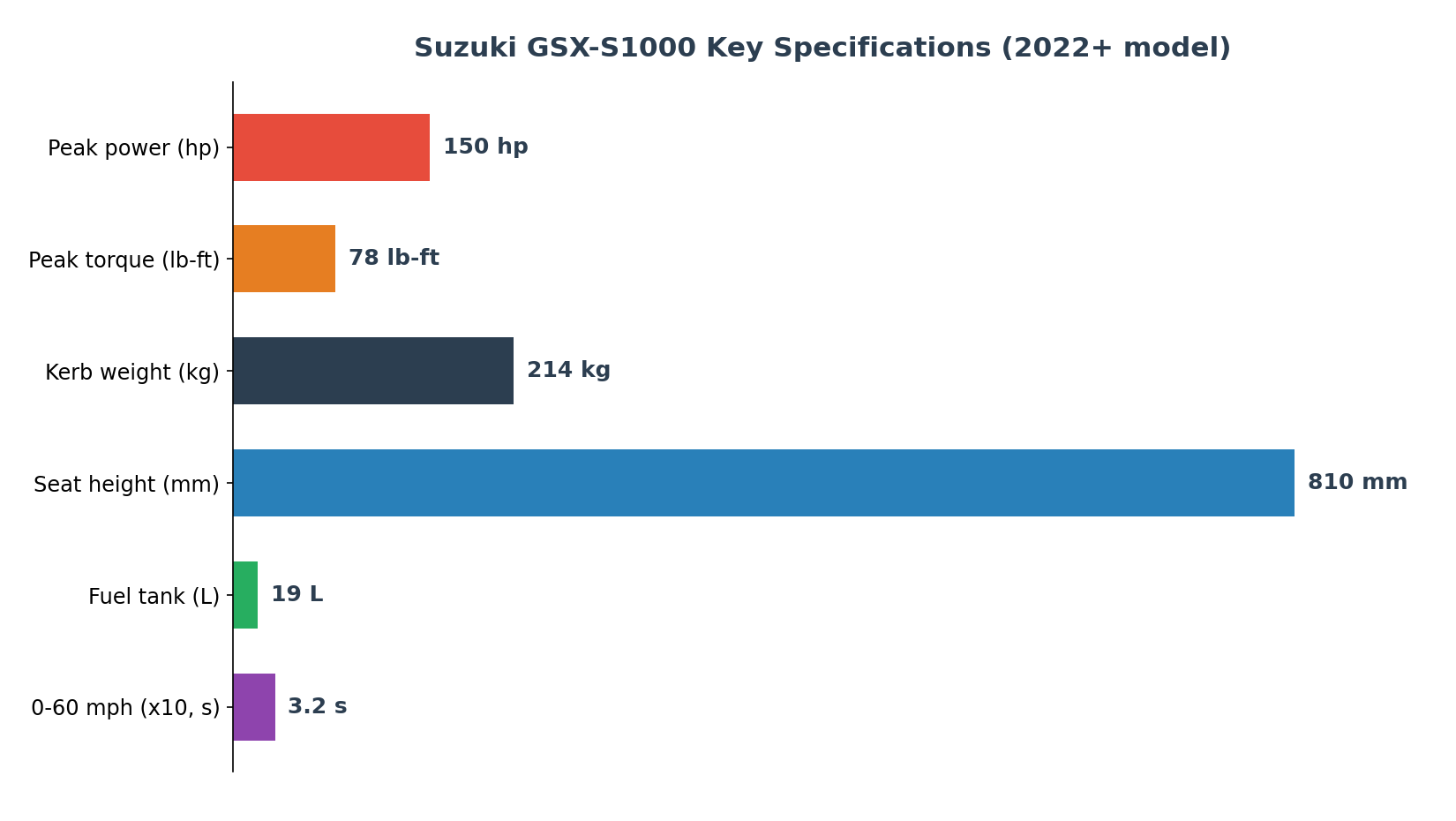
Suzuki did not just bolt the old race engine into a naked chassis and call it done. They fitted new cams, revised the intake and mapping, and shifted the power lower down so it makes sense on the street instead of only above 8,000 rpm. The result is a 999cc four-cylinder that pulls hard from the midrange and still screams at the top when you want it to. On the 2022-onward bikes it makes 150 hp at 11,000 rpm and 78 lb-ft of torque at 9,250 rpm; the earlier bikes made a very similar 143 to 150 hp depending on the year.
The YouTube channel Yammie Noob dedicated an entire video to this exact point — "Okay… How Good is the GSXS-1000? (Legendary K5 Engine)" — and it has pulled over 200,000 views precisely because riders keep rediscovering that the cheap naked Suzuki is running superbike DNA. That is the emotional hook of this bike, and it is real. You are buying a detuned GSX-R1000 for hatchback money.
There is a sound to this engine, too, that the spec sheet can't capture. The inline-four builds from a purposeful growl into a proper top-end shriek, and it is one of the reasons owners forgive the bike its few rough edges. A GSX-S1000 on a bridging road, revs climbing through the midrange, is a genuinely intoxicating thing — and it does it while returning sensible fuel economy and asking very little of you in return.
What matters for an importer is that this engine is proven. It has been in production in one form or another since 2005. Parts are everywhere, specialists know it inside out, and it happily covers big mileage when the oil changes are done. The engine is almost never the reason a GSX-S1000 goes wrong. The problems, when they come, live elsewhere — and we will get to every one of them.
GSX-S1000 vs GSX-S1000F vs GSX-S1000GT: don't buy the wrong one
This is where buyers trip up, so read this section twice. "GSX-S1000" is not one bike — it is a family, and the three-letter suffixes completely change what you are getting.
GSX-S1000 (no suffix) — the naked. Flat handlebar, minimal bikini fairing or none at all, upright riding position. This is the cheapest and most numerous version, and for most people it is the one to buy.
GSX-S1000F — the "F" is for faired. Same engine and chassis, but with a full sport-touring fairing and a small screen for wind protection. Built from 2015 to 2021. If you plan longer motorway runs, the F is worth the small premium. It is not a different bike underneath; it just has clothes on.
GSX-S1000GT — the grand tourer, launched in 2022 to replace the F. This is the serious mile-muncher: bigger fairing, colour TFT dash, standard hard-luggage mounts, cruise control on later versions, and a more relaxed touring focus. MCN ran a group test pitting the "2022 Suzuki GSX-S1000GT vs Kawasaki Ninja 1000SX" that has been watched nearly half a million times, which tells you the GT is a genuine rival to the established sport-tourers, not a budget also-ran.
There was also a short-lived GSX-S1000S Katana — the retro-styled bike using the same platform. Different bodywork, same mechanical story, priced higher for the styling. Lovely thing, but know that you are paying for the looks.
Here is the practical takeaway. Decide your use case before you browse listings. Naked for city and back-road fun and the lowest price. F or GT if you tour. Do not let a cheap price on an F fool you into buying a touring bike when you wanted a hooligan naked — or vice versa. Confirm the exact model designation on the auction sheet, because the letters matter more than the year.
Suzuki GSX-S1000 generations explained — and the years to avoid
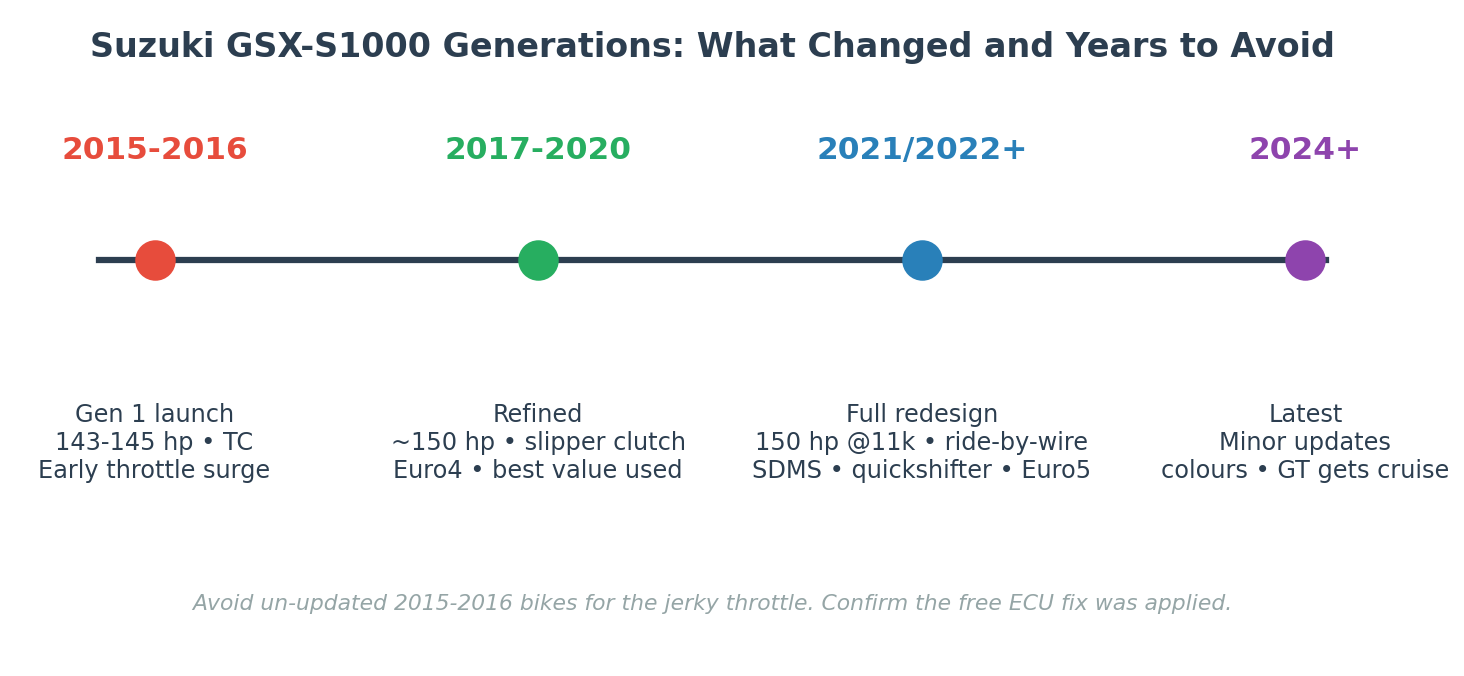
The GSX-S1000 has had three meaningful phases in its life. Knowing which one you are looking at is the single most useful thing you can do before bidding.
2015–2016: the launch bikes (approach with your eyes open)
The first GSX-S1000s made around 143 to 145 hp, came with three-mode traction control, and rode on fairly firm suspension. They also shipped with the bike's most notorious flaw: a snatchy, abrupt throttle at low speed. In first gear, cracking the throttle open from fully closed could deliver a lurch instead of a smooth pull. Some owners found it merely annoying; others found it genuinely tiring in traffic.
Suzuki took it seriously enough to issue revised ECU mapping, and in many markets replaced ECUs free of charge to cure the surging. So a 2015–2016 bike is not automatically a bad buy — but it is only a good buy if the fix has been applied. If you cannot confirm it, budget for an aftermarket ECU flash or a fuelling module. These are the bikes to be most careful with.
2017–2020: the sweet spot for used value
In 2017 Suzuki sharpened the bike up: power nudged to around 150 bhp, a slipper clutch arrived (a genuinely useful addition for aggressive downshifts), and there were cosmetic tweaks like black levers and controls. The throttle behaviour was improved over the earliest bikes. These Euro4 machines are, for my money, the smart used pick — refined enough to live with, cheap enough to feel like a steal, and old enough that the depreciation pain has already been absorbed by the first owner.
2021/2022 onward: the full redesign
This is the big one. For 2021 in the US and 2022 globally, Suzuki gave the GSX-S1000 its most thorough overhaul: aggressive new streetfighter styling with stacked LED lights, ride-by-wire throttle bodies, the Suzuki Drive Mode Selector, a bi-directional quickshifter as standard, and Euro5 compliance. Crucially, the ride-by-wire throttle finally killed off the old snatchiness for good. The engine makes 150 hp at 11,000 rpm. If you want the most modern electronics and the cleanest throttle, this is the generation to target — and JDM examples are now filtering onto the auctions at prices well below a UK or Australian dealer's.
So, years to avoid? There is no year that is truly cursed. But an un-updated 2015–2016 bike with the original ECU is the one that will frustrate you. Prioritise a documented ECU fix on the early bikes, or simply buy 2017-on and sidestep the issue entirely.
Common GSX-S1000 problems every buyer must check
No bike is perfect, and the honest importer checks the weak spots before bidding, not after the crate arrives. The good news: the GSX-S1000's problems are well-documented and mostly minor. Here is the full list, drawn from owner forums, the Engine Patrol problem guide, and the "3 Things I HATE about the Suzuki GSX-S1000" owner video that lays the real-world gripes out plainly.
1. Snatchy throttle (early bikes). Covered above. On 2015–2016 bikes without the ECU update, low-speed throttle response is abrupt. Confirm the fix, or plan a flash. On 2022+ ride-by-wire bikes this is a non-issue.
2. Throttle position sensor (TPS). The single mechanical fault worth knowing. Some owners report the TPS failing to return cleanly after a twist, which shows up as stalling, hesitation, or a flat spot in the power. It is not catastrophic and it is fixable, but a bike that stalls at idle or hunts at low revs deserves a proper diagnostic before you commit.
3. Noisy clutch basket (early bikes). A rattle at idle from the clutch area on some early examples. Usually cosmetic noise rather than a failure, but factor it into your inspection.
4. Chain wear. The stock chain and sprockets can wear faster than you would expect. Cheap to replace, but check the condition — a worn chain is also a handy clue that the previous owner skipped maintenance elsewhere.
5. Tank paint chipping. A genuinely common cosmetic complaint: the paint on the fuel tank and surrounding panels can wear or chip where a rider's knees, belt buckle or jacket zip rub against it. Not a mechanical problem, but it explains why some otherwise-clean bikes have scuffed tanks. Tank protectors solve it.
6. Firm stock suspension. Especially on the early bikes, the standard suspension is on the firm and basic side. It is not a fault so much as a compromise — many owners fit revised springs or get the shock serviced. Budget for it if you are tall, heavy, or fussy about ride quality.
7. Regulator/rectifier and electrical gremlins. As with almost every Japanese four of this era, the charging system is worth a health check. Occasional minor electrical niggles get reported, and a tired reg/rec is cheap insurance to replace or verify. The MOSFET-type upgrade is the standard fix if you want peace of mind.
Notice what is not on this list: the engine, the gearbox, the frame. The K5-derived motor is close to bombproof. The GSX-S1000's issues are the sort you inspect for and budget a few hundred against — not the sort that write off a purchase.
What a JDM GSX-S1000 really costs, landed in the UK, Australia and NZ
Let's talk money, because "cheap Japanese import" means nothing until you see the all-in number on your driveway.
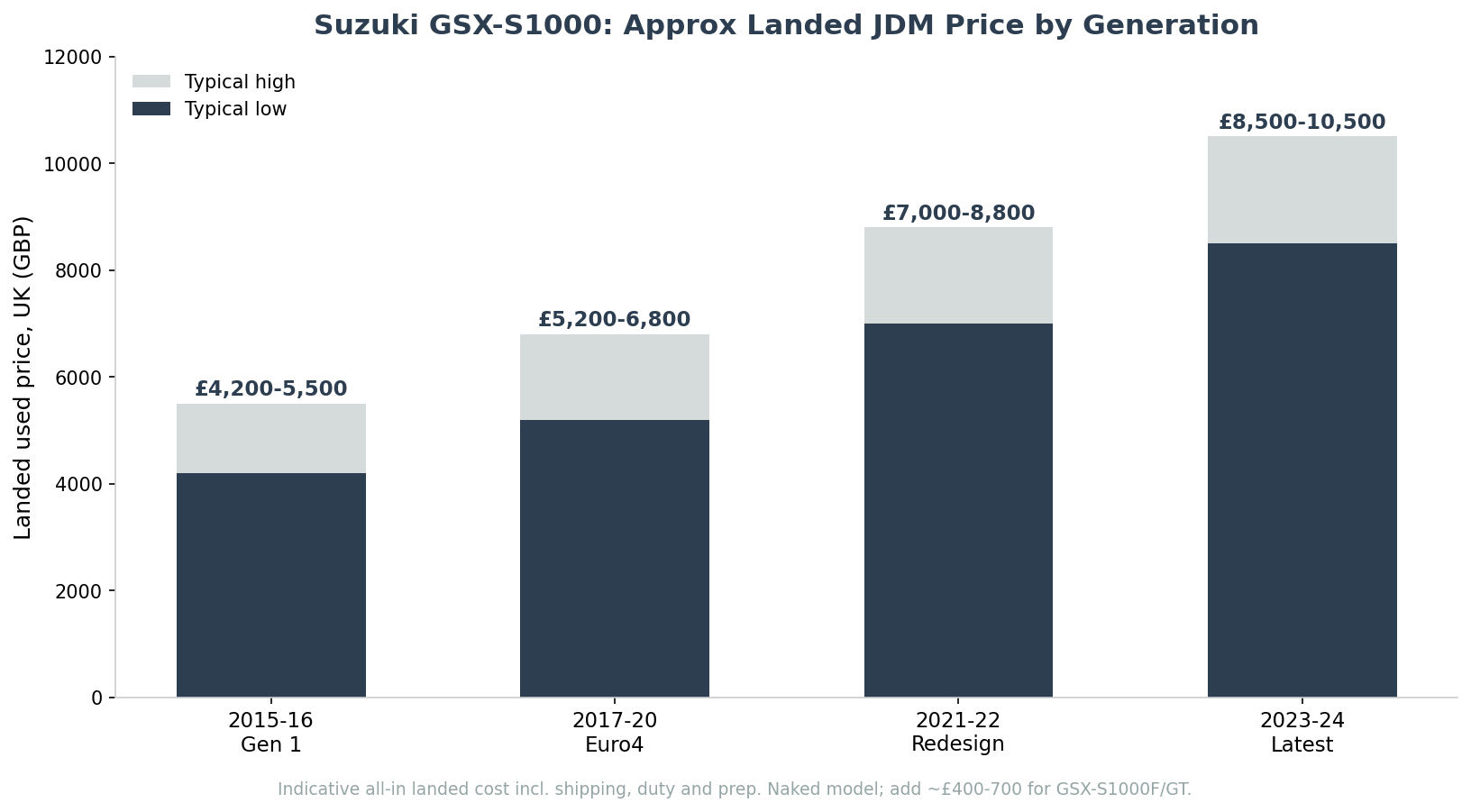
The chart above shows rough landed prices by generation for the UK market. A clean 2015–2016 bike lands somewhere around £4,200 to £5,500 all-in; a 2017–2020 Euro4 example runs £5,200 to £6,800; the 2021–2022 redesign sits around £7,000 to £8,800; and the latest bikes push £8,500 to £10,500. Add roughly £400 to £700 for an F or GT variant over the naked. These are indicative — condition, mileage and mods move them — but they are honest ballparks.
Here is how the landed cost actually breaks down on a worked example: a tidy 2018 GSX-S1000 winning at auction for around £3,800.
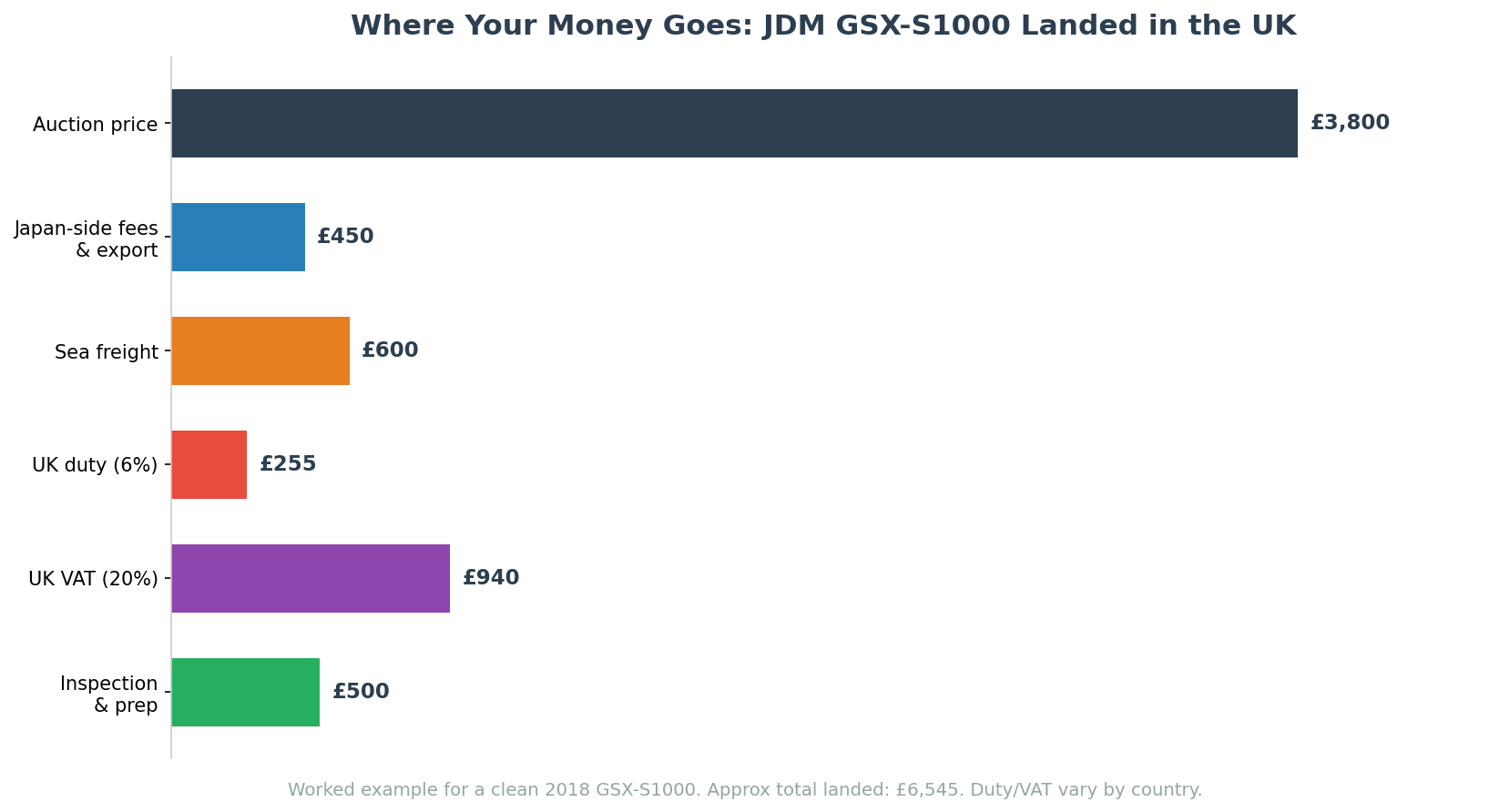
On top of the £3,800 hammer price you have Japan-side auction and export fees (around £450), sea freight (around £600), UK import duty at 6% (around £255), UK VAT at 20% on the total (around £940), and inspection plus prep to get it road-ready (around £500). That brings the worked example to roughly £6,500 landed. For a 150 hp litre bike with a superbike engine, that is remarkable value — you would struggle to buy a tired UK-market example for the same money, and this one comes with a documented auction history.
Australia and New Zealand follow the same shape with different tax lines: GST, any applicable duty, and compliance costs replace UK VAT and duty. The Japan-side and freight numbers barely change. The headline stays true across all three markets — a JDM GSX-S1000 lands for meaningfully less than the equivalent local bike, and the paperwork is cleaner.
Want to see live examples with real auction grades attached? Browse the current listings and you will get a feel for what condition buys what price.
The honest truth about importing a GSX-S1000 into the USA
American readers, here is the part other guides tiptoe around. You cannot import a GSX-S1000 from Japan for road use in the United States right now, and you will not be able to for years.
The US allows road registration of imported bikes under the 25-year rule — a motorcycle must be at least 25 model years old to sidestep federal DOT and EPA conformity requirements. The GSX-S1000 launched in 2015. That means the very earliest examples do not become eligible until 2040. As of 2026, no GSX-S1000 can be legally imported for street use in the US. Full stop.
There is a second wrinkle that actually works in Americans' favour: the GSX-S1000 was sold new in the US market. So unlike a JDM-only bike, you do not need to import one at all — you can buy a US-spec example from a local dealer or the used market and ride it home today. Importing from Japan only makes sense for US buyers who want a specific closed-course, track, or collector machine, and even then the 25-year clock governs road use.
For the UK, Australia and New Zealand, none of this applies — you can register a modern JDM GSX-S1000 as soon as it clears compliance. This is one of those cases where being outside the US is the advantage. If you are Stateside and set on the Japanese route for a competition bike, talk to us first so you go in with clear eyes: contact our team and we will lay out exactly what is and isn't possible.
GSX-S1000 vs MT-10 vs CB1000 Hornet vs Z900: the litre-naked showdown
The GSX-S1000 does not exist in a vacuum. MCN's group test "Honda CB1000 Hornet vs Yamaha MT-10 vs Suzuki GSX-S1000" — nearly half a million views — put the three head to head, and the used market gives the Suzuki a very specific role among them.
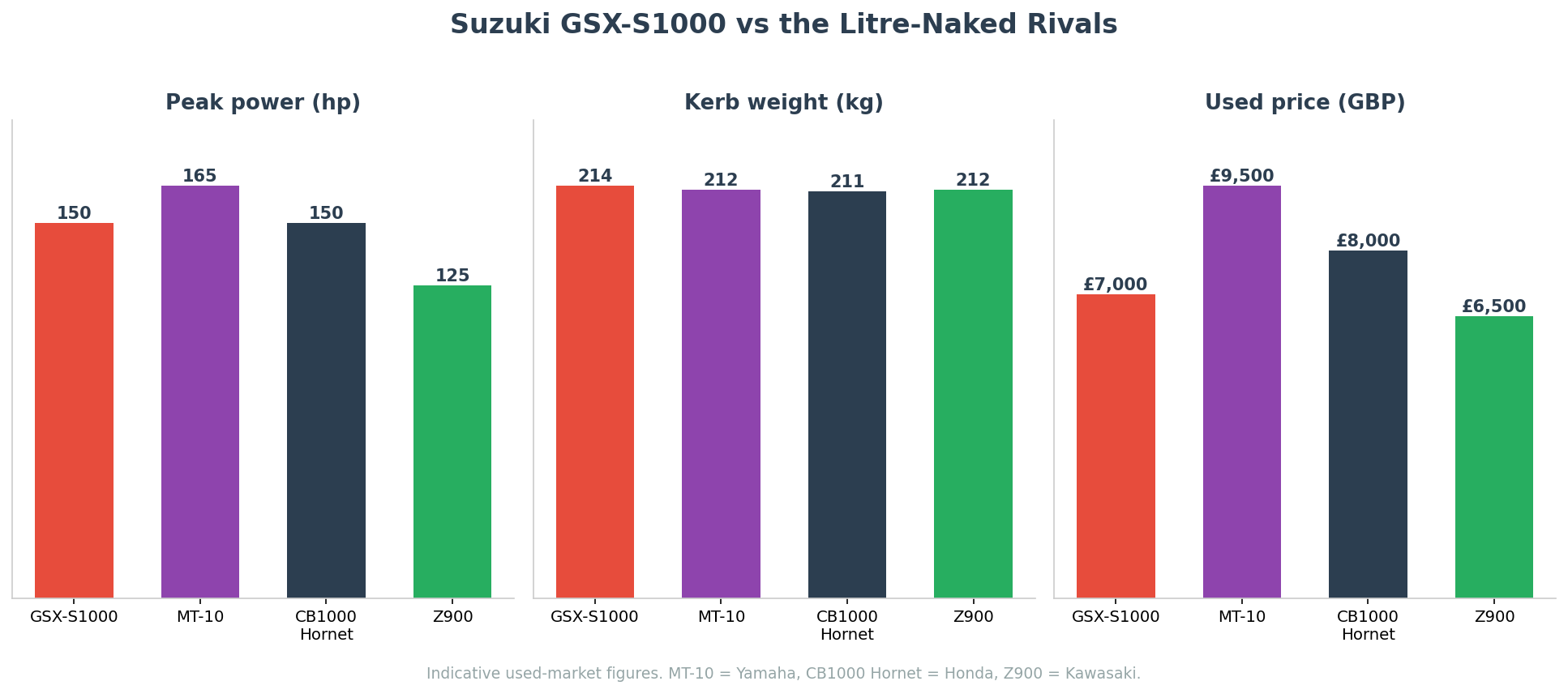
vs Yamaha MT-10. The MT-10 is the pricier, more electronically loaded, crossplane-crank flagship, making around 165 hp with a distinctive burbling character. It is the more sophisticated bike and it costs accordingly — used values run thousands higher. The GSX-S1000 counters with a smoother, more traditional inline-four howl and a much friendlier price. If your heart says MT-10 but your wallet says be sensible, the Suzuki is the answer.
vs Honda CB1000 Hornet. Honda's Fireblade-derived naked also makes 150 hp and weighs about the same, and it is the GSX-S1000's most direct modern rival. The Hornet is newer to the fight and carries a Honda premium used. The Suzuki's trump card is the K5 engine's reputation and the lower entry price, especially via import.
vs Kawasaki Z900. The Z900 is the value-and-friendliness champion — lighter feeling, slightly less power at around 125 hp, and cheaper still. It is the softer, more accessible bike. The GSX-S1000 is the one for riders who specifically want litre-class, superbike-derived punch rather than the sub-litre middleweight feel.
The pattern is clear. The GSX-S1000 is the enthusiast's value play: full litre-class performance and a legendary engine, at a price that undercuts every rival on this chart. It is not the flashiest badge. It is the smartest spend.
Popular GSX-S1000 mods and upgrades
Part of the GSX-S1000's appeal is how cheap it is to make your own. Because it shares so much with the GSX-R family, the aftermarket is deep and affordable. Here is what owners actually fit.
Exhaust. The most popular first mod. A full system or slip-on from Yoshimura, Akrapovič or SC-Project sheds weight, wakes up the inline-four soundtrack, and looks the part. Yoshimura in particular has deep GSX heritage, and a Yoshimura-equipped GSX-S1000 is one of the most common builds you will see.
Fuelling module or ECU flash. On the early snatchy-throttle bikes, an aftermarket fuel controller or a professional ECU flash transforms low-speed manners. Even on later bikes, a flash to remove restrictions and sharpen the map is popular.
Suspension. Revised fork springs and a serviced or upgraded rear shock address the firm, basic stock setup — the single biggest improvement to how the bike rides for taller or heavier owners.
Ergonomics and protection. Bar risers, a comfort seat, a taller screen or a small flyscreen on the naked, tank protectors to stop the notorious paint chipping, and crash protection (frame sliders, bar ends, engine covers) round out most builds. Levers, tail tidies and LED indicators are the usual cosmetic touches.
A word of advice from bikes we have handled: buy the cleanest standard example you can, then mod it yourself. A bike that has already been modified by a previous owner is a gamble — you inherit their taste, their fitting quality, and any corners they cut. A stock GSX-S1000 with a full service history is a far safer bid, and it gives you a blank canvas. The aftermarket will still be there when the bike lands.
Because you saved thousands importing the bike, you have budget to spec it exactly how you want. That is the quiet luxury of buying the value option.
How to inspect a JDM GSX-S1000 at auction
You will almost never see the bike in person before you buy — that is the nature of Japanese auction imports. The auction inspection sheet is your eyes, so learn to read it.
Every bike at a Japanese auction is graded by an independent inspector. You get an overall grade (typically on a scale where 4 and above means a solid, honest bike, and R or accident-history grades are red flags), plus a detailed map of every scratch, dent and area of corrosion. For a GSX-S1000 specifically, here is your checklist to overlay on that sheet:
Confirm the exact variant — naked, F, GT or Katana — so you are bidding on the bike you actually want. Check the model year against the throttle-fix story: pre-2017 needs the ECU update. Look at the tank and knee area for the common paint chipping. Note the chain and sprocket condition as a maintenance tell. Scan for corrosion on fasteners and the reg/rec area, especially on bikes from wetter regions. Read the odometer and service records — JDM bikes often have genuinely low mileage, but verify it against the wear.
If reading these sheets feels like decoding a foreign language, that is because it partly is. This is exactly where a specialist earns their fee — we translate and interpret the sheet, flag the bikes not worth bidding on, and only put you on the good ones. Learn more about the process on our current listings, each of which comes with its grade and history.
How many miles will a GSX-S1000 last, and what does it cost to run?
Buyers coming from smaller bikes worry about litre-class running costs. Relax — the GSX-S1000 is cheaper to live with than its performance suggests, and the K5-derived engine has the longevity to match.
Because the motor traces back to a 2005 superbike design that has covered millions of collective miles, high odometer readings are nothing to fear on a well-serviced example. Owners regularly take these engines past 50,000 miles with nothing more than routine maintenance, and there is no reason a cared-for bike won't sail well beyond that. The things that wear are the consumables you would expect on any performance four: tyres, chain and sprockets, brake pads, and the occasional battery. The bottom end is not on that list.
Servicing is conventional. Oil and filter changes at the standard intervals, valve-clearance checks at the longer intervals (the shim-and-bucket setup means checks are infrequent but worth doing properly), a fresh chain and sprocket set every so often, and the reg/rec health check we keep mentioning. None of it is exotic, and because the bike shares so much with the GSX-R family, independent specialists know it cold and parts are cheap and plentiful. That parts availability is a quiet advantage of buying a Suzuki over a rarer machine — you are never hunting for unobtanium.
Fuel economy sits in the mid-to-high 40s mpg with normal riding, dropping fast if you exploit the top end (and you will). The 19-litre tank gives a genuine touring range on the F and GT. Insurance is litre-naked money — not cheap, but no worse than any 150 hp rival, and often better than a full superbike because of the upright, less crash-prone riding position. Overall, the GSX-S1000 costs about what a big middleweight costs to run, while delivering superbike-adjacent performance. That is the value story extending past the purchase price and into ownership.
Who should buy a GSX-S1000 — and who should skip it
Buy one if you want maximum litre-class performance for minimum money, you love the idea of a superbike engine in a comfortable upright package, you are in the UK, Australia or New Zealand and can register a modern JDM import today, and you do not care about having the trendiest badge on the block. This is a rider's bike bought with the head.
Think twice if you are a nervous newcomer — 150 hp in a light naked is a lot of bike for a first machine, and something like a Kawasaki Z650 or an SV650 is a wiser start. Skip it too if you are a US buyer who wants a road-legal bike now, because the import route is blocked until 2040 and you should simply buy a US-spec example locally. And if you specifically crave the MT-10's crossplane character or a particular flagship badge, no amount of value will scratch that itch — buy the bike you actually want.
For everyone else, the GSX-S1000 is one of the strongest value cases in the entire used market, and importing from Japan sharpens that case further.
How AWA Auction gets you a GSX-S1000 from Japan
This is what we do every week. AWA Auction gives you direct access to the Japanese motorcycle auctions where these bikes sell in volume — the same auctions the local dealers buy from, without the local dealer's markup.
We help you find the right GSX-S1000 for your use case, read and interpret every auction sheet so you never bid blind, handle the bidding, manage export paperwork and shipping, and get the bike landed and compliant in your country. You get the value of a Japanese import without the language barrier, the guesswork, or the risk of buying a lemon sight-unseen.
Ready to start? Browse our current listings to see what is available right now, or contact our team and tell us the exact GSX-S1000 you are after. We will watch the auctions and put you on the right bike.
Frequently asked questions about importing a GSX-S1000 from Japan
Below are the questions we hear most often from buyers researching a GSX-S1000 import. If yours isn't here, get in touch and we will answer it straight.
See Also
Share this article: