
If you want a Suzuki GSX-S1000GT import from Japan, you are chasing the sport-tourer that quietly out-drags its rivals, weighs less than all of them, and costs the least to buy used. Suzuki launched it in 2022 to replace the old GSX-S1000F, wrapped the K5 GSX-R1000 engine in a proper touring package, and then let the marketing budget go to Kawasaki and Yamaha. That is good news for you. The GT has never been the trendy pick, so clean, low-mileage Japanese-market bikes are landing in the UK, Australia and New Zealand for real money less than an equivalent Ninja 1000SX.
Here's the thing nobody mentions: the GT is not a faired version of the naked GSX-S1000. It has its own subframe, its own screen, a bigger brain and a touring seat. Get that straight before you shop and you will not overpay for the wrong bike. This guide covers the model timeline, the trim confusion, the handful of genuine weak points, what a Japanese auction bike actually costs to land on your driveway, and the honest truth about the 25-year rule if you are reading this in the United States.
What is the Suzuki GSX-S1000GT, and why import one from Japan?
The GSX-S1000GT is Suzuki's litre-class sport tourer: a 999cc inline-four making a genuine 150 to 152 horsepower, wrapped in a half-fairing with a touring screen, a 6.5-inch colour TFT dash, cruise control, and a bidirectional quickshifter as standard. It sits on an aluminium twin-spar frame, weighs a claimed 226kg wet, and carries a 19-litre tank. In plain English: it is fast enough to embarrass most sportsbikes on a real road, comfortable enough to do 400 miles in a day, and cheap enough that you will wonder what the catch is.
So why import one from Japan instead of buying local? Three reasons. First, supply. The GT sold in modest numbers, so the domestic used pool in Britain and Australia is thin and dealers know it. Japan bought them too, and the Japanese used market is deep, meticulously documented, and full of bikes that spent their lives dry-stored and gently ridden. Second, condition. A JDM GSX-S1000GT typically shows lower mileage, fewer winters of salt, and a genuine auction-house inspection sheet that grades the bike before you ever bid. Third, price. Even after shipping and duty, a graded Japanese GT often lands cheaper than a tired UK example with a fistful of previous owners.
Suzuki themselves called it "the best bike in years," and MCN agreed in a review that has pulled over 275,000 views. When the manufacturer and the toughest press in the business both say the quiet part out loud, it is worth listening.
GSX-S1000GT vs GSX-S1000F vs the naked GSX-S1000 vs Katana: untangling the badges
This is where most buyers get burned, so read it twice. Suzuki has sold four closely related litre machines off the same K5-derived engine, and the names blur together on classified ads.
GSX-S1000 (naked). The streetfighter. No fairing, tall bars, minimal wind protection. Brilliant value, but a genuinely different bike to ride on the motorway.
GSX-S1000F (faired, 2015–2021). The old "faired naked." Suzuki bolted a full fairing onto the naked's chassis and called it a sports tourer, but it kept the naked's ergonomics, its smaller everything, and its pre-2021 throttle manners. This is the bike the GT replaced. If a listing says "GSX-S1000F," it is not a GT, it is older, and it should cost less.
GSX-S1000GT (2022 onward). The proper sport tourer. Suzuki did not just add plastics; it gave the GT a bespoke rear subframe for luggage and a pillion, a touring screen, a roomier seat, the big 6.5-inch TFT, smartphone connectivity, cruise control and the full ride-by-wire electronics suite. It is the one you want.
GSX-S1000GT+. Same bike, sold new with colour-matched hard panniers and a few extras. If you find a "plus" with its original luggage, that is a bonus worth paying a little more for, because aftermarket panniers rarely fit as cleanly.
Katana. The retro-styled roadster on the same engine. Great looking, but naked and not a tourer. Different bike entirely.
You just need to know one rule: the suffix matters more than the model year. A 2020 "F" is an older machine than a 2022 "GT," even though they look faired and similar in a small photo. Read the exact designation on the auction sheet, not the seller's headline.
The K5 engine story: why this motor matters
The heart of the GSX-S1000GT is a detuned, restrapped version of the 2005–2008 GSX-R1000 "K5" engine, a motor that racers and tuners still talk about in reverent tones two decades later. The K5 GSX-R1000 was the bike that made Suzuki's litre superbike a giant-killer, and Suzuki has spent years re-tuning that same architecture for midrange torque instead of peak-only fury.
In the GT, that means 150 to 152 horsepower at 11,000 rpm and roughly 78 lb-ft (106Nm) of torque at 9,250 rpm, but the number that matters is how it arrives. There is meaningful shove from 4,000 rpm, a fat, usable band through the middle, and a proper hard-edged inline-four howl at the top that no parallel-twin tourer can match. Yammie Noob's teardown of "the legendary K5 engine" has racked up hundreds of thousands of views precisely because riders love the lineage.
The practical payoff is longevity. This engine architecture has been in production, in one state of tune or another, for twenty years. The bugs were found and fixed a long time ago. Well-serviced examples routinely pass 50,000 miles with nothing worse than routine consumables, which is exactly what you want in a bike you plan to tour on.
Model timeline: 2022 to 2025, what changed
Because the GT is a recent bike, you are not navigating decades of generations. You are choosing between model years and colours, and the mechanical package has stayed remarkably consistent, which is good news for used buyers.
2022 — launch. The GT and GT+ arrive, replacing the F. Full electronics suite from day one: five-mode traction control, three power modes under Suzuki's SDMS system, bidirectional quickshifter, cruise control, low-RPM assist, easy-start, and the 6.5-inch TFT with Suzuki mySPIN smartphone mirroring. This is not a stripped launch model you need to avoid. It is fully loaded.
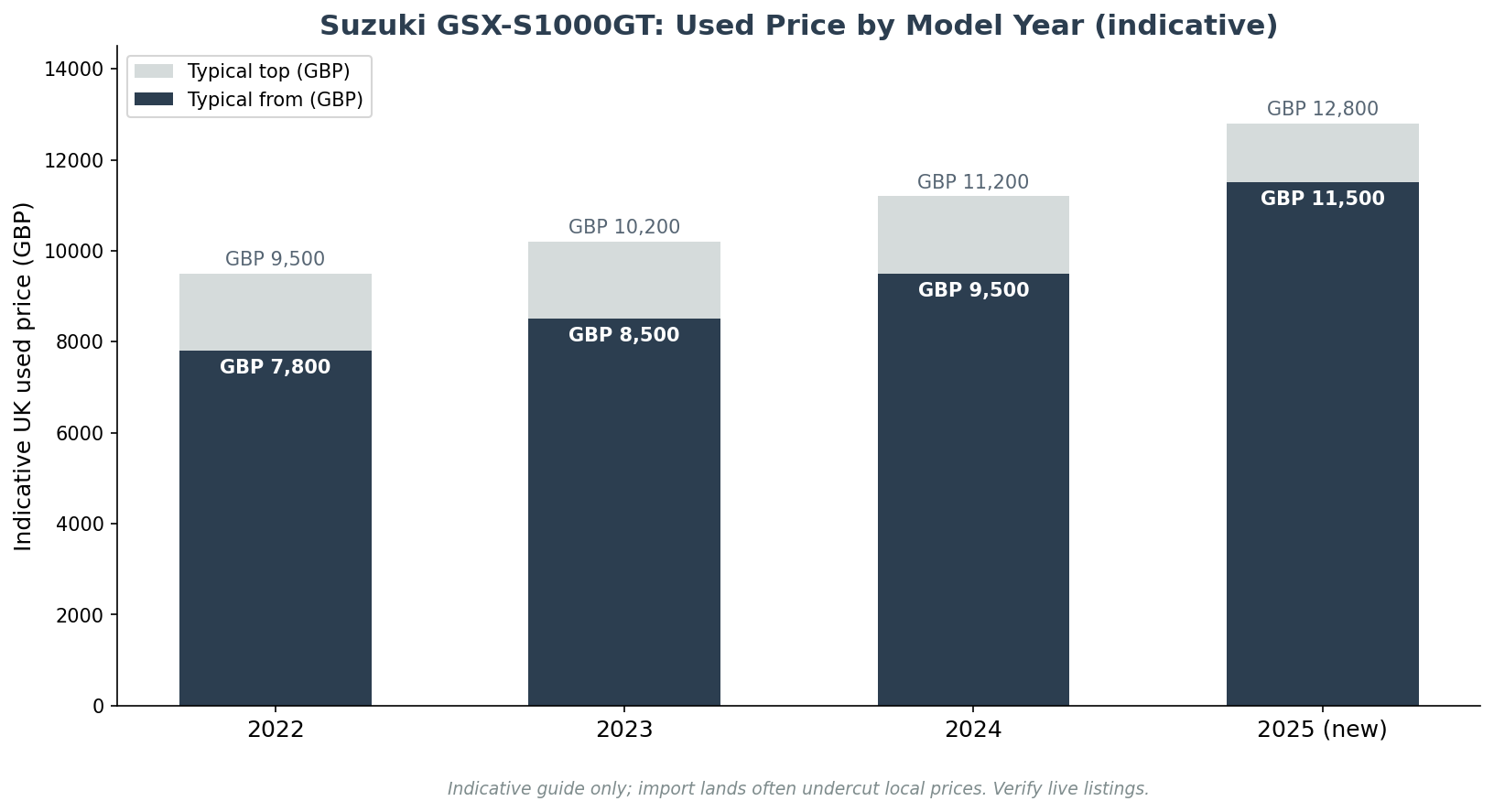
2023–2024 — colours and refinement. New paint schemes, including the black-and-gold "Metallic Matte Black" that owners rave about, plus running tweaks. Mechanically the same strong package. These years are the sweet spot for used value: enough depreciation to sting the first owner, none of the risk of a brand-new bike.
2025 — carryover with detail updates. The GT continues largely unchanged, which tells you Suzuki got it right the first time. A 2025 bike costs new-bike money; a 2022–2023 import saves you thousands for a near-identical machine.
The takeaway: there is no "year to avoid" hiding in the GT range the way there is with older bikes. Buy on condition, history and price, not on chasing a specific model-year fix.
What it's like to live with (and ride)
On a fast A-road, the GT is in its element. The chassis is sharp and responsive, the fully adjustable suspension holds a line at full lean without drama, and because it weighs 9kg less than a Ninja 1000SX, it drops into corners and threads low-speed traffic with a lightness that surprises everyone who rides one expecting a heavy tourer.
The riding position is upright and roomy: high, wide bars, generous legroom and a plush seat for both rider and pillion. Rider Magazine and MCN both clocked the comfort as genuinely long-haul capable. This is a bike you can ride to the far end of the country and back without your wrists filing a complaint.
It is not flawless, and honest owners will tell you so. The non-adjustable screen creates helmet buffeting for some riders at motorway pace. There is a resonant buzz through the pegs around an indicated 80mph that a few reviewers found irritating precisely because it lives at cruising speed. And the stock Dunlop Roadsport 2 tyres are fine rather than special; most owners upgrade to a proper sport-touring tyre at the first change and immediately feel the difference.
The fuel range question every owner asks
Here is the one real-world gripe that comes up again and again from actual owners, especially on Japanese forums and social media: the tank is only 19 litres, and a spirited litre inline-four drinks. Owners report the fuel light coming on with roughly 2 to 3 litres in reserve, and real-world economy hovering around 43mpg when you are enjoying yourself. That works out to a usable range of around 160 to 180 miles before you are hunting for a petrol station with genuine anxiety.
One Japanese owner put it perfectly, half-joking that the GT's fuel economy makes every long ride "tense." Another simply posted "out of fuel again." It is not a dealbreaker; it is a planning fact. If you tour two-up with luggage on motorways, plan fuel stops around 140 miles and you will never sweat it. If your rides are shorter blasts, you will barely notice.
Balance that against the good news owners repeat just as often: the 6.5-inch TFT dash is genuinely excellent, clearer and better laid out than rivals like the BMW F900XR, and the standard cruise control turns motorway miles into a rest.
Buying a used GSX-S1000GT from Japan: what makes JDM bikes good
Japanese-market GSX-S1000GTs have a few structural advantages over the average local used bike. Japan's strict shaken inspection regime and the cultural habit of dry-storing and dealer-servicing bikes means the average JDM example is cleaner underneath than its mileage suggests. Winters are kinder, roads are less salted, and enthusiasts baby their machines.
Then there is the auction sheet. When a bike goes through a Japanese auction house, an independent inspector grades it, notes every scratch and repair on a map of the bike, and assigns an overall grade. A grade 4 or 4.5 GT with a clean sheet is a known quantity before you bid, which removes most of the guesswork that makes buying used stressful. Learn to read that sheet, or work with an exporter who translates it honestly, and you are buying with more information than any local forecourt gives you.
Because the GT is so young, most Japanese examples are low-mileage, one or two owner bikes with full service records. That is the profile you are hunting: a graded, dry-stored, low-owner GT with its original panniers if you can find a "plus."
What it costs to land one on your driveway
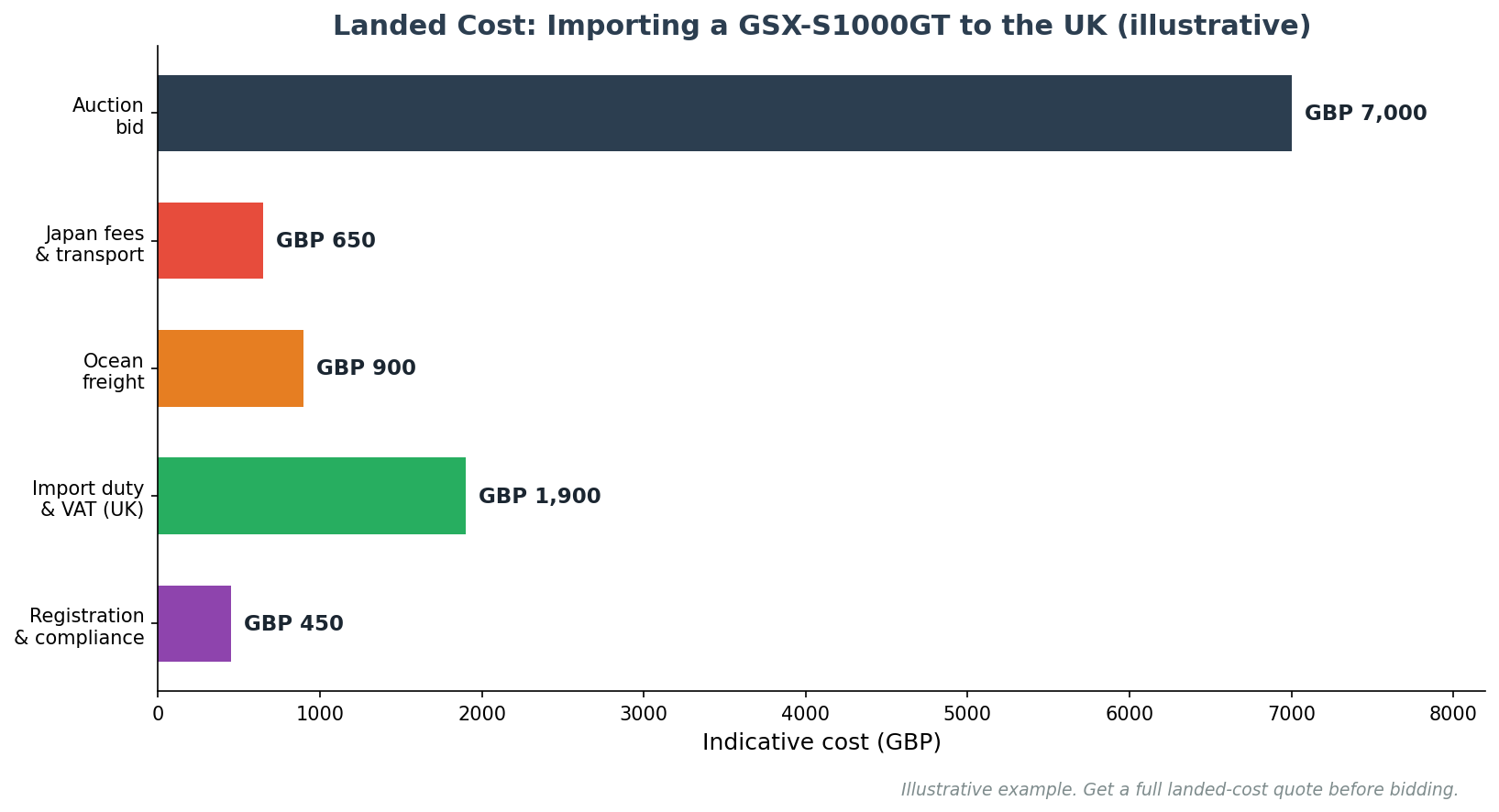
The sticker price at auction is only the start. Here is how the landed cost actually stacks up for a UK importer, and the pattern is similar for Australia and New Zealand with local duty and compliance swapped in.
Start with the winning auction bid, typically the largest single number. Add the Japanese domestic costs: auction fees, the exporter's service fee, and inland transport to the port. Then ocean freight, which varies with crate versus RORO shipping. On arrival you pay import duty and VAT (for the UK, that is duty on motorcycles plus VAT calculated on the landed value), then any local registration, testing and compliance work to get plates.
The honest headline: budget for the auction price plus a meaningful margin on top for everything else. A GT that looks cheap at auction is not cheap once it is registered on your driveway, but it still frequently undercuts a comparable local bike, and you get a lower-mileage, better-documented machine for the money. Get a full landed-cost quote from your exporter before you bid, not after.
Common problems and known weak points
The GSX-S1000GT is a genuinely reliable bike, and that is not marketing fluff; the underlying platform has two decades of debugging behind it. But "reliable" is not "perfect," and here is what to actually check.
Charging system. The wider GSX-S family has a history of regulator/rectifier and charging niggles on higher-mileage bikes. It is rarely catastrophic on the GT, but check the battery health and look for any signs of a replaced reg/rec in the service history.
Thin paint and finish. Owners across the GSX-S range note that the paint and some fasteners are not the most durable. On an imported bike this is mostly cosmetic, but inspect the frame finish and switchgear for corrosion, especially on bikes that saw damp storage.
Chain and consumables. A hard-working litre bike eats chains, sprockets and tyres. Suzuki has issued chain-adjuster recalls on related GSX-R models in the past, so confirm any outstanding recall work has been done and budget for a chain and sprocket set as a wear item, not a fault.
Sticking ignition lock. A minor but well-documented GSX-S quirk. Cheap to sort, but worth noting so it does not surprise you.
Screen buffeting and peg buzz. Not faults, but the two ergonomic traits owners most often mention. A taller aftermarket screen fixes the first for most riders.
What you will not find is a chronic engine or gearbox horror story. The K5-derived motor is the strong point, and the electronics have proven robust. Spend your inspection energy on history, crash damage and consumables, not on hunting for a hidden engine flaw that mostly does not exist.
How the GSX-S1000GT stacks up against its rivals
The GT lives in a small, fiercely-fought class. Here is the honest scorecard against the bikes you will actually cross-shop.
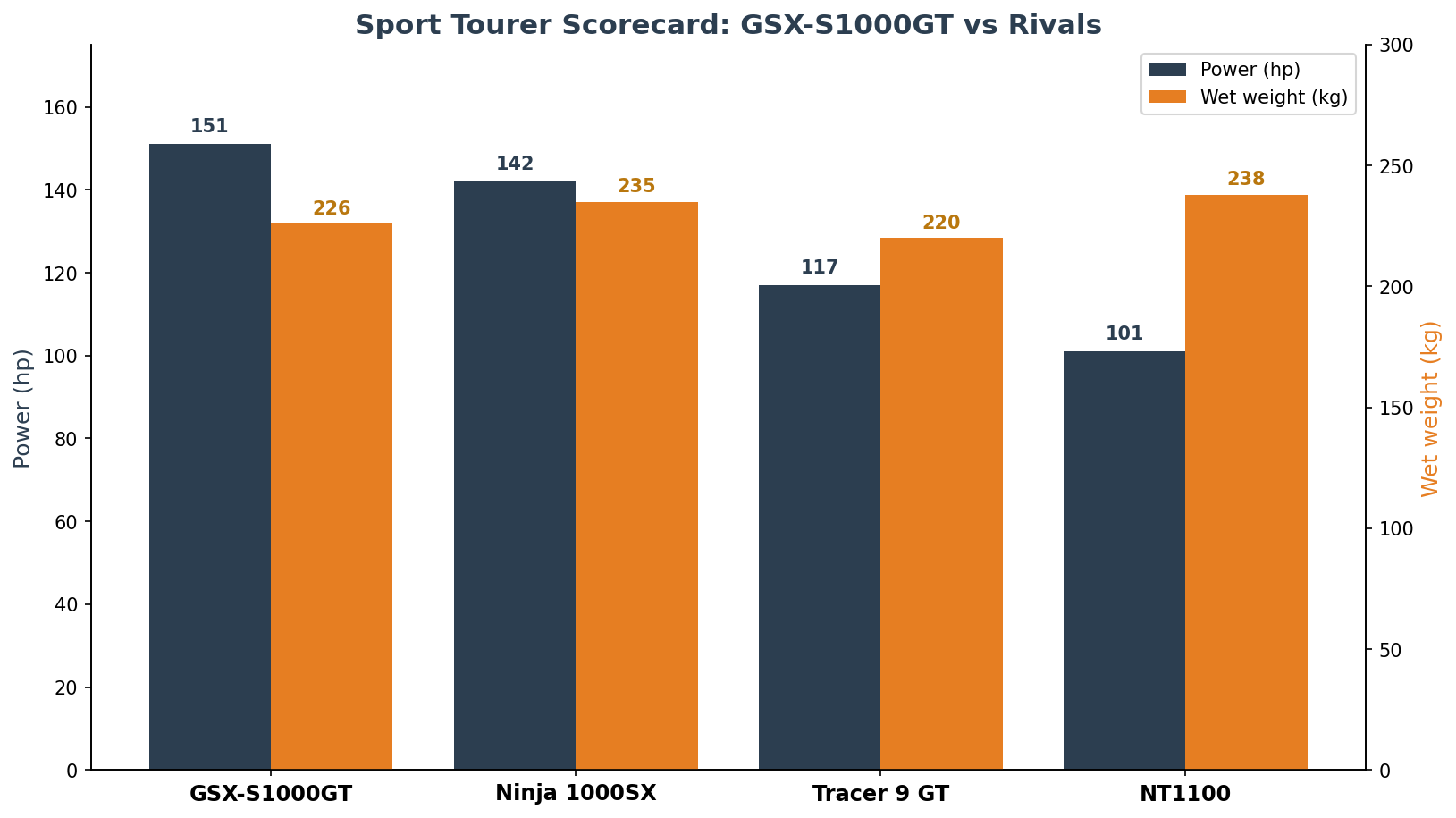
Kawasaki Ninja 1000SX. The direct rival, and the one owners agonise over. The Ninja uses a bigger 1,043cc engine but makes about 142hp, ten to twelve down on the Suzuki, and it carries roughly 9kg more weight. MCN's head-to-head named the GT the sharper, quicker, lighter bike; the Ninja counters with a more planted, comfortable steel-framed ride and, historically, a slightly keener price. If you value handling and pace, the GT wins. If you value plush stability, the Ninja is right there.
Yamaha Tracer 9 GT. A different flavour: a torquey 890cc triple in a taller, more adventure-styled chassis with electronic suspension. Lighter and flickable, hugely capable, but it lacks the GT's inline-four top-end rush and superbike bloodline. Choose the Tracer for tech and versatility, the Suzuki for pace and soul.
Honda NT1100. The comfort-and-luggage benchmark, built around the Africa Twin's parallel twin with an optional DCT auto box. More relaxed, more overtly a tourer, less of a sportbike in disguise. The GT is the enthusiast's choice next to it.
The pattern is clear: the GSX-S1000GT is the value-and-performance pick of the class. It out-guns the Kawasaki, undercuts most rivals on used price, and gives up only outright touring plushness to the softer machines.
The 25-year rule: an honest word for US readers
If you are reading this in the United States, here is the straight answer, and you will not like half of it. The GSX-S1000GT was sold new through Suzuki's US dealer network, so you never needed to import one in the first place; buy locally and you get a warranty and easy parts. And if you are dreaming of importing a grey-market JDM example, the federal 25-year rule blocks it: a 2022 bike is not exempt from FMVSS and EPA compliance until 2047. There is no legal shortcut for a street-registered import before then.
So this guide is aimed squarely at riders in the UK, Australia and New Zealand, where importing a used Japanese GT is straightforward and genuinely worthwhile. US riders: enjoy the fact that yours came from a dealer down the road, and check local used listings instead.
Specs at a glance and what the numbers mean
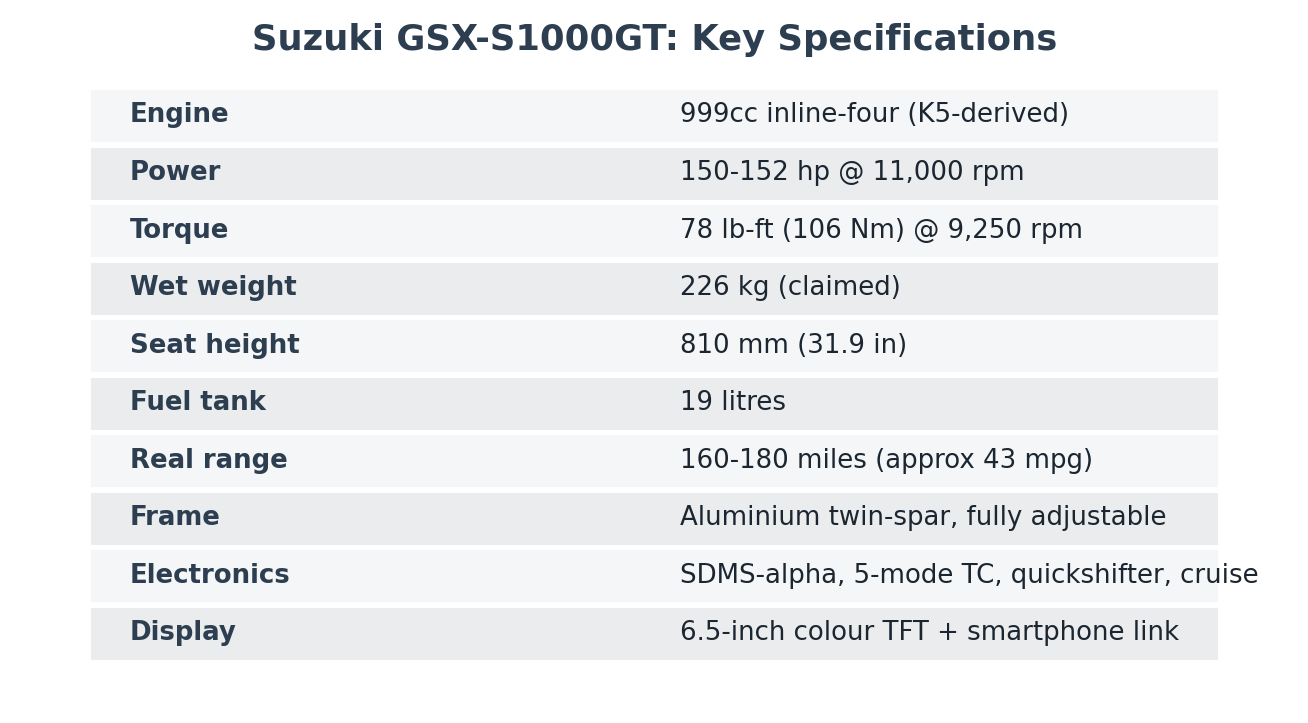
Numbers only help if you know what they translate to on the road, so here is the GT decoded. The 999cc inline-four makes 150 to 152 horsepower at 11,000 rpm and around 78 lb-ft (106Nm) of torque at 9,250 rpm, which in the real world means effortless overtakes in any gear above walking pace and a top end that keeps pulling long after you have run out of nerve. Claimed wet weight is 226kg, light for a fully-equipped litre tourer, and it is that figure that makes the GT feel so agile next to heavier rivals.
The seat sits at 810mm (31.9 inches), low enough for most riders to flat-foot, though a few Japanese owners with shorter inseams still fit a lowering link, so if you are under about five-foot-seven, sit on one first. The 19-litre tank is the one grudging number, giving that 160-to-180-mile real-world range. Suspension is fully adjustable at both ends, brakes are radial-mount Brembo-style stoppers with cornering ABS, and the whole thing rolls on 17-inch wheels wearing sport-touring rubber.
The electronics package: what you actually get
For a bike this affordable used, the GT's rider-aid suite is remarkably complete, and every bit of it was standard from the 2022 launch, so you are not hunting for a specific loaded trim. The core is Suzuki's SDMS-α system, which bundles three power modes (full, mid and low output) with a five-level traction control system plus off. In plain terms, you can make the bike gentle in the wet and savage in the dry with a couple of button presses.
On top of that sits a bidirectional quickshifter that lets you bang up and down the box without the clutch, cruise control that genuinely earns its keep on motorway slogs, low-RPM assist to stop you stalling in traffic, and an easy-start system. The 6.5-inch TFT is the jewel: bright, logically laid out, and paired with Suzuki's mySPIN app so you can mirror navigation, calls and music. Owners consistently rate this dash above pricier rivals, and it is one of the reasons the GT punches so far above its price.
Why does this matter for an importer? Because a Japanese-market GT carries exactly the same electronics as a UK or Australian one. There is no de-contented "export" version to worry about. What left the Hamamatsu factory is what lands on your driveway.
Is the GSX-S1000GT a good first big bike?
It can be, with eyes open. The upright ergonomics, the low-RPM assist, the gentle "low" power mode and the strong electronics make the GT far more approachable than its 150 horsepower suggests. Ridden in mid or low mode with traction control up high, it is docile around town and forgiving on a damp road.
But it is still a full-power litre bike with a serious top end, and the thirsty tank and 226kg mass mean it rewards respect. If you are stepping up from a 650, spend your first weeks in the softer modes, and you will grow into it fast. It is a bike you can keep for a decade rather than outgrow in a season, which is a large part of why used values hold up.
Running costs and ownership
Budget realistically and the GT is a cheap bike to run for its performance. Fuel is the biggest variable thanks to that thirsty tank; expect low-to-mid 40s mpg in real use. Tyres are a genuine cost on a 150hp bike, so factor a good sport-touring set every 4,000 to 6,000 miles depending on how hard you ride. The chain and sprockets are wear items; keep the chain clean and adjusted and it lasts.
Servicing is conventional Suzuki inline-four fare: regular oil and filter changes, and valve-clearance checks at the longer interval, which most owners find need little adjustment. Insurance sits in the sensible middle of the litre-class range because the GT is a tourer, not a track weapon, in the eyes of most insurers. There is nothing exotic here to bankrupt you.
How to think about mileage
Do not panic about mileage on a GT. The K5-derived engine is built for the long haul, and a well-maintained example with 30,000 miles and a full history is a better buy than a neglected 8,000-mile bike with gaps in its records. What matters is evidence: regular oil changes, chain care, and no signs of crash repair.
Because Japanese imports skew low-mileage and one-owner, you are usually choosing between genuinely fresh bikes anyway. Use that to your advantage: prioritise the clean auction sheet and the service book over chasing the absolute lowest odometer reading.
Popular modifications owners actually make
The GT responds well to a short, sensible mod list. A taller touring screen is the single most common change, and it cures the standard screen's buffeting for most riders. A slip-on exhaust from Yoshimura or Akrapovic drops weight and lets that inline-four sing without upsetting the fuelling. Heated grips and a comfort seat make the touring case even stronger. And a fresh set of premium sport-touring tyres transforms the bike more than any other single upgrade.
Resist the urge to go mad. The GT is well sorted from the factory, and the best-value used examples are lightly, tastefully modified rather than butchered. If a listing shows a bike covered in questionable aftermarket parts, walk on.
Who should buy a GSX-S1000GT (and who shouldn't)
Buy one if: you want one bike that can commute, carve a Sunday road and cross a country with luggage, you love the sound and rush of an inline-four, and you would rather spend your money on the bike than on the badge. It is the enthusiast's sport tourer, and importing a clean Japanese example is the smart-money way to get one.
Look elsewhere if: you tour huge distances two-up every weekend and want maximum plushness and tank range, in which case the Ninja 1000SX or a big-tank tourer suits you better. Or if you are in the US, where you should simply buy the locally-sold model and skip the import question entirely.
Step-by-step: how to buy and import your GSX-S1000GT
Step 1 — decide on trim. Fix in your mind that you want a GT (or GT+), not an F or a naked. Set your model-year and budget range before you look, so a pretty photo does not talk you into the wrong bike.
Step 2 — choose an exporter. Work with an auction agent who gives you a full landed-cost quote, translates the auction sheet honestly, and has motorcycle experience. This is where AWA Auction earns its keep: real bidding access, honest grading, and one point of contact from auction hall to your door.
Step 3 — target graded bikes. Bid on grade 4 or above with a clean sheet. Set a hard maximum that includes all the landed costs, and hold to it. There is always another GT next week.
Step 4 — arrange shipping and compliance. Confirm freight, then line up your local import duty, testing and registration in advance so the bike does not sit in a bonded warehouse racking up storage while you scramble.
Step 5 — inspect on arrival and service. Give it a full going-over, do a fresh oil and filter change, fit new tyres if the originals are aged, and confirm any recall work. Then go ride it.
Pre-purchase inspection checklist
Before you commit to any GSX-S1000GT, walk through this list. Confirm the exact designation reads GT or GT+, not F. Read the auction sheet grade and the damage map. Check the service history for regular oil changes and chain care. Inspect the frame finish, switchgear and fasteners for corrosion. Verify the charging system health and battery condition. Look for any crash indicators: scuffed bar ends, cracked plastics, misaligned panels. Confirm the TFT dash and all electronics power up and function. Check chain, sprockets and tyre age as consumables to budget for. Make sure any outstanding recall work is done. And if it is a "plus," confirm the original panniers and keys are present.
Common mistakes buyers make (and how to dodge them)
The GT is an easy bike to buy well and a surprisingly easy one to buy badly. Here are the traps that catch people.
Confusing the F for the GT. We keep hammering this because it keeps happening. A faired 2019 "F" in a small photo looks a lot like a 2022 GT to an excited buyer. Pay F money, not GT money, if that is what it is, and never pay GT money for the older bike.
Bidding on the auction number alone. A cheap-looking winning bid is not the price you pay. Buyers who skip the full landed-cost quote get a nasty surprise when duty, VAT, freight and compliance land. Always know the all-in figure before you raise your hand.
Ignoring the auction sheet. The sheet is the single best tool you have, and people still buy on photos. A clean grade with a tidy damage map is worth paying up for; a vague sheet or a low grade is a warning, not a bargain.
Overpaying for a heavily-modified bike. A tasteful slip-on and a taller screen add value. A rat's nest of cheap aftermarket parts and a chopped subframe subtract it. Standard bikes with good history are the smart buy.
Forgetting the panniers on a "plus." If you want the GT+ luggage, confirm the original colour-matched cases are included. Sourcing them later costs real money and they rarely fit as well as factory.
How AWA Auction gets you the right GSX-S1000GT
Importing a bike from Japan is only stressful if you are doing it blind. AWA Auction gives you direct access to the same Japanese auctions the domestic dealers use, honest translation of every auction sheet, and a single team that manages the process from winning bid to landed, ready-to-register motorcycle. We know the difference between a GT and an F, we know which auction grades are worth chasing, and we quote you the real landed cost up front, not a lowball auction number that balloons later.
If a clean, low-mileage Suzuki GSX-S1000GT is on your list, browse what is coming through the auctions now, or talk to our team about sourcing exactly the trim, colour and grade you want.
See Also
Share this article: