
If you want to import a Suzuki V-Strom 1000 from Japan, you are chasing the sensible person's adventure bike: a big, torquey 90-degree V-twin wrapped in a comfortable all-day tourer that costs a fraction of a BMW GS and refuses to break. It is not the flashiest bike in the class, and Suzuki never pretended otherwise. What the DL1000 does instead is quietly rack up huge miles, sip fuel from a 22-litre tank, and cost almost nothing to keep on the road. That is exactly the kind of bike that rewards importing a clean, low-mileage Japanese example.
Here is the thing nobody tells you: the V-Strom 1000 has one of the most loyal owner bases of any adventure-tourer, and they will talk your ear off about why. Ryan from FortNine ran one as his personal bike for years and his review of it has pulled over 800,000 views, most of it him admitting that the "boring" V-Strom is secretly the bike he kept coming back to. This guide covers the two very different generations, the engine, the common problems the forums argue about, the years to avoid, what a used one really costs, and how to land a genuinely clean Japanese bike in your garage without getting burned.
What is the Suzuki V-Strom 1000?
The Suzuki V-Strom 1000, sold as the DL1000, is Suzuki's big-bore adventure-tourer, first built in 2002 and manufactured in Japan ever since. It takes a detuned version of the 90-degree V-twin from the mad TL1000S sportsbike, softens it for torque and midrange, and drops it into a tall, comfortable road-biased adventure chassis. Think of it as a mile-eater first and an off-roader a distant second. Almost nobody takes a V-Strom 1000 down a serious green lane, and Suzuki built it knowing that.
There are two clearly separate generations, and they ride so differently that you should treat them as two different bikes. The first-generation DL1000 (2002 to 2012) uses a 996cc engine making around 98 horsepower and 101Nm of torque, running an 18-inch front wheel and a slightly agricultural, honest character. The second-generation DL1000 (2014 to 2019) is a ground-up redesign around a new 1037cc engine, with ABS as standard, Suzuki's first-ever traction control, a lighter frame and far better manners. Suzuki then restyled that second-gen bike into the V-Strom 1050 for 2020.
What ties every V-Strom 1000 together is the ownership experience. Shaft-free but chain-simple, cheap on tyres, comfortable two-up, and famously reliable, it is the bike people buy when they have stopped caring about looking cool at the cafe and started caring about getting to the far side of a continent without drama.
V-Strom 1000 vs V-Strom 650 vs V-Strom 1050: don't buy the wrong one
Japanese auction listings throw "V-Strom" and "DL" around loosely, so learn the badges before you bid.
The V-Strom 1000 (DL1000) is the big V-twin this guide is about: 996cc for 2002-2012 bikes, 1037cc for 2014-2019 bikes. It has real grunt, a relaxed long-legged feel, and enough weight that you notice it at walking pace.
The V-Strom 650 (DL650) is the smaller, lighter, cheaper sibling with a 645cc V-twin. It is friendlier, more economical and easier for shorter riders, but it gives away a chunk of midrange punch when loaded two-up with luggage. One of the most-watched V-Strom videos on YouTube is a straight DL650-versus-DL1000 drag comparison with over half a million views, precisely because so many buyers agonise over which one to get. If you tour solo and light, the 650 is plenty. If you carry a pillion and panniers over mountain passes, the 1000's extra torque earns its keep. We keep both in the yard, and it is worth browsing the current listings to feel the price gap before you decide.
The V-Strom 1050 is the 2020-onward restyle of the second-gen 1000. Same 1037cc engine family, sharper "Dakar-retro" bodywork, more electronics, and a higher price. It is a fine bike, but it is not a hidden bargain the way a clean used DL1000 is. For import value, the 2014-2019 second-gen 1000 is the sweet spot the 1050 is built on.
Why import a Suzuki V-Strom 1000 from Japan?
Three honest reasons, and one honest caveat.
First, condition. Japan's strict shaken inspection regime and low average mileage mean a decade-old V-Strom from Japan can look and ride like a lightly used bike from a wetter, saltier Western market. Adventure bikes lead hard lives in Europe and the US: winter commuting, road salt, and neglected chains. A dry-climate, garage-kept Japanese DL1000 sidesteps a lot of that corrosion.
Second, honest mileage and clean sheets. Every bike sold through a Japanese trade auction carries an independent inspection sheet grading condition and flagging damage. You are not trusting a seller's word; you are reading a neutral inspector's report. For a bike people buy specifically to pile on the miles, being able to verify true condition before you bid is a real advantage.
Third, the second-gen supply. The 2014-2019 redesign with ABS and traction control is the one most buyers actually want, and Japan bought them in good numbers. If you want a clean low-mileage second-gen bike rather than a tired early one, a Japanese auction is often the fastest route to it.
The caveat: the V-Strom 1000 was sold new across the UK, Europe, the US, Australia and New Zealand, so you are not importing something unobtainable. On the cheapest, tattiest examples, shipping and duty can eat the saving. The win is a genuinely clean, low-mileage, rust-free bike, or a spec and condition you simply cannot find locally. We will run the honest maths further down.
The engine: the TL1000-derived V-twin
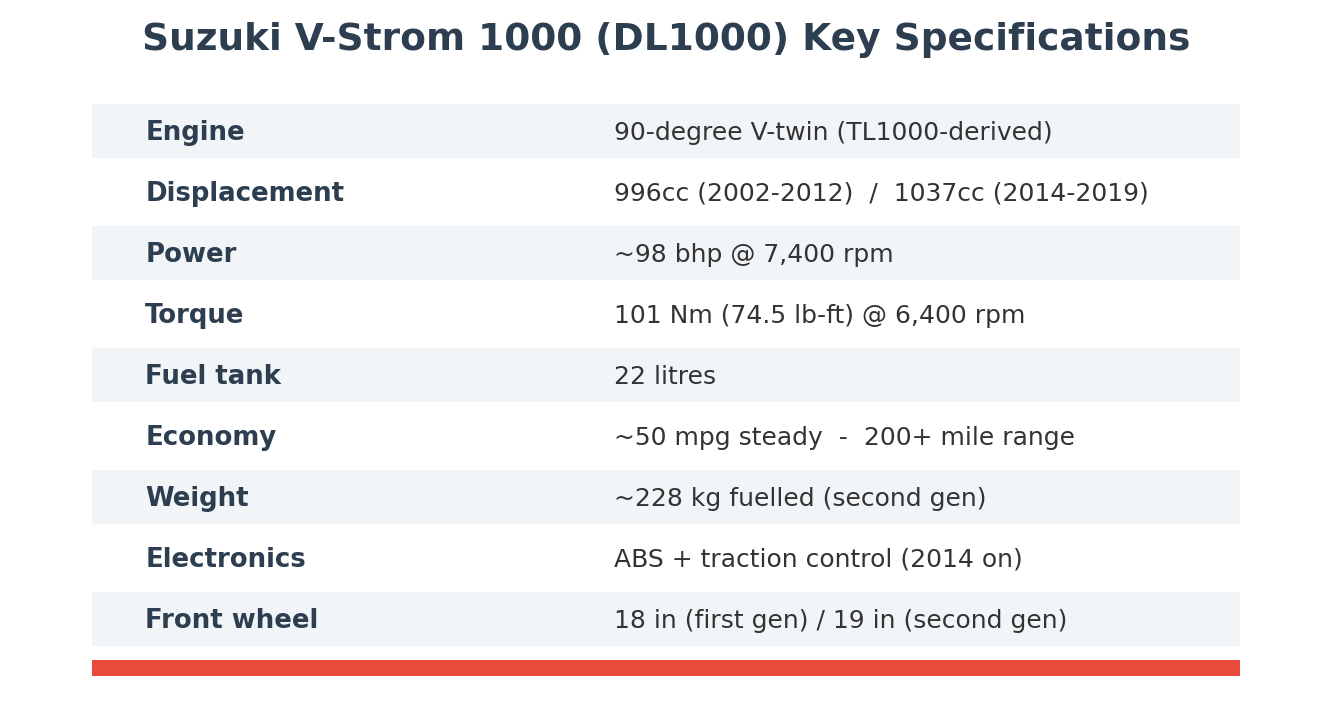
The heart of the V-Strom 1000 is a 90-degree V-twin descended from the TL1000S, one of the most characterful engines Suzuki ever built. In the first-gen DL1000 it displaces 996cc and makes roughly 98bhp at 7,400rpm with 101Nm (74.5 lb-ft) of torque at 6,400rpm. Those are not headline power numbers, and that is entirely the point. This engine is about a fat, usable midrange that pulls cleanly from low revs, exactly what you want two-up with luggage.
The 2014 second-gen bike stepped up to a new 1037cc version of the V-twin, with a 2mm bigger bore, lighter internals, and Suzuki's claim that the whole engine was lighter yet more controllable low down. In practice it feels smoother and more modern while keeping the twin's easy torque. Reviewers who rode the two back to back always said the same thing: the new one lost none of the character and gained a lot of polish.
The character is what owners fall for. It has a lazy, torquey V-twin thrum that makes big distances feel effortless, and it never nags you to rev it out. Ryan at FortNine, who owned his personal V-Strom 1000 for years, kept circling back to the same verdict in his 800,000-view review: it is not exciting on paper, but it is endlessly, quietly satisfying to actually ride. That is the V-Strom engine in a sentence.
Mechanically it is famously durable. StromTrooper forum threads on engine life are full of bikes past 60,000 and 100,000 miles still running strong on nothing more than regular oil and valve checks. This is not a fragile motor. It is one of the reasons a higher-mileage Japanese import with a clean sheet can be a smarter buy than a low-mileage bike that has been sitting.
First gen (2002-2012) vs second gen (2014-2019): generations explained
Understanding the timeline tells you exactly which bike to chase.
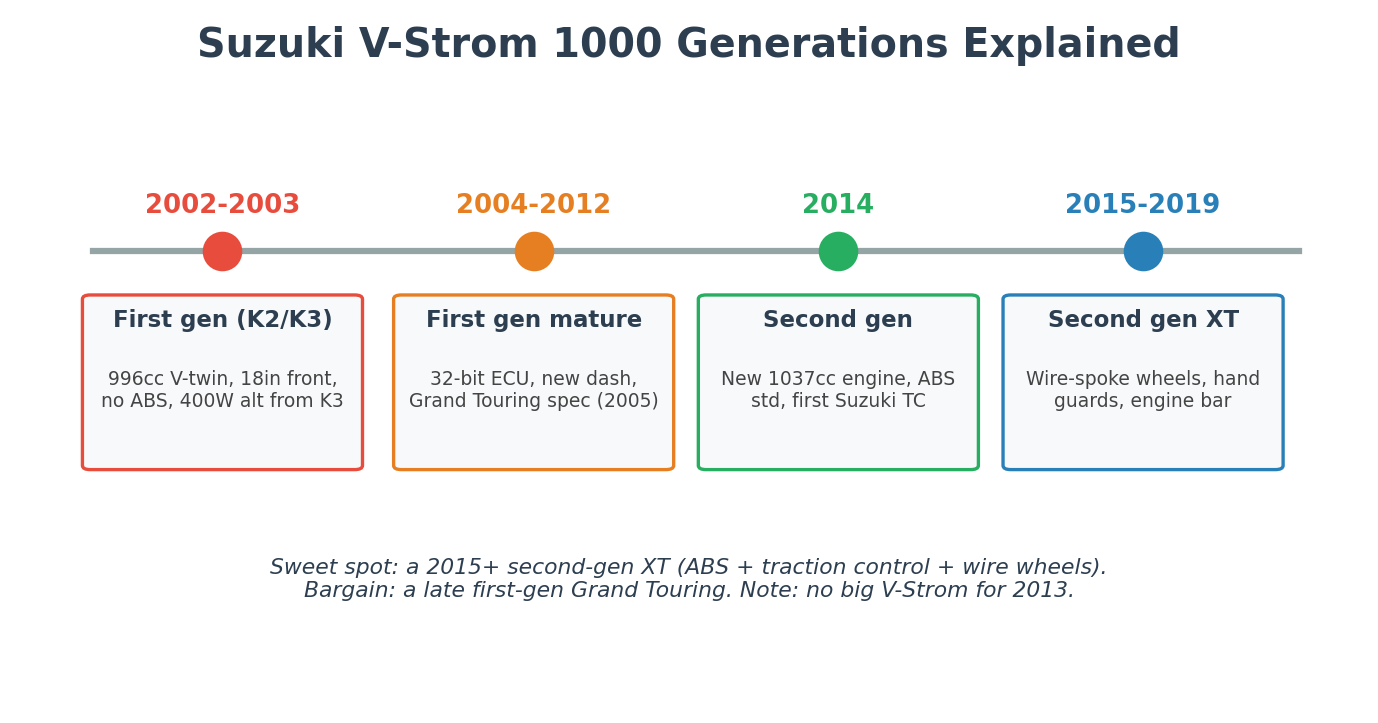
2002 (K2): the original. The first DL1000 arrived with the 996cc engine, a tall stance, an 18-inch front wheel and no ABS option at all. Honest, torquey, a touch rough around the edges. Some very early bikes had a notably soft low-rev throttle response that a Power Commander or a fuel remap tidies up.
2003 (K3): added fork pre-load adjusters and bumped the alternator output to 400 watts, a meaningful upgrade if you run heated kit and extra lighting for touring.
2004 (K4): a redesigned instrument cluster and an upgraded ECU, moving from 16-bit to 32-bit processing for cleaner fuelling.
2005 (K5): the frame finish changed from silver to black, and Suzuki introduced a Grand Touring variant with factory luggage, heated grips and a centre stand. That GT spec is worth seeking out because those parts cost real money to add later.
2014: the ground-up second generation. This is the big one. A new 1037cc engine, a lighter frame, sharper bodywork, ABS as standard, and the first traction control Suzuki ever fitted to a motorcycle, with two sensitivity modes and an off switch. It also dropped weight to around 228kg fuelled. MotorcycleDaily's long-term test called it a far better bike than the old one in nearly every way, and they were not exaggerating.
2015 onward: the XT. Suzuki added a V-Strom 1000 XT with tubeless wire-spoke wheels, hand guards and an engine bar, aimed at riders who wanted the rugged look and a little more real-world toughness. It is the pick of the second-gen bikes if you can find a clean one.
The takeaway: a first-gen bike is the bargain-basement, honest-workhorse choice, and a 2014-onward second-gen is the one to buy if you want modern safety kit and the smoothest ride. Both are tough. Neither is a bad bike.
Common problems: what to check
The V-Strom 1000 is genuinely reliable, but every model has its known niggles, and the forums have documented these to death. Knowing them turns you from a hopeful buyer into a sharp one.
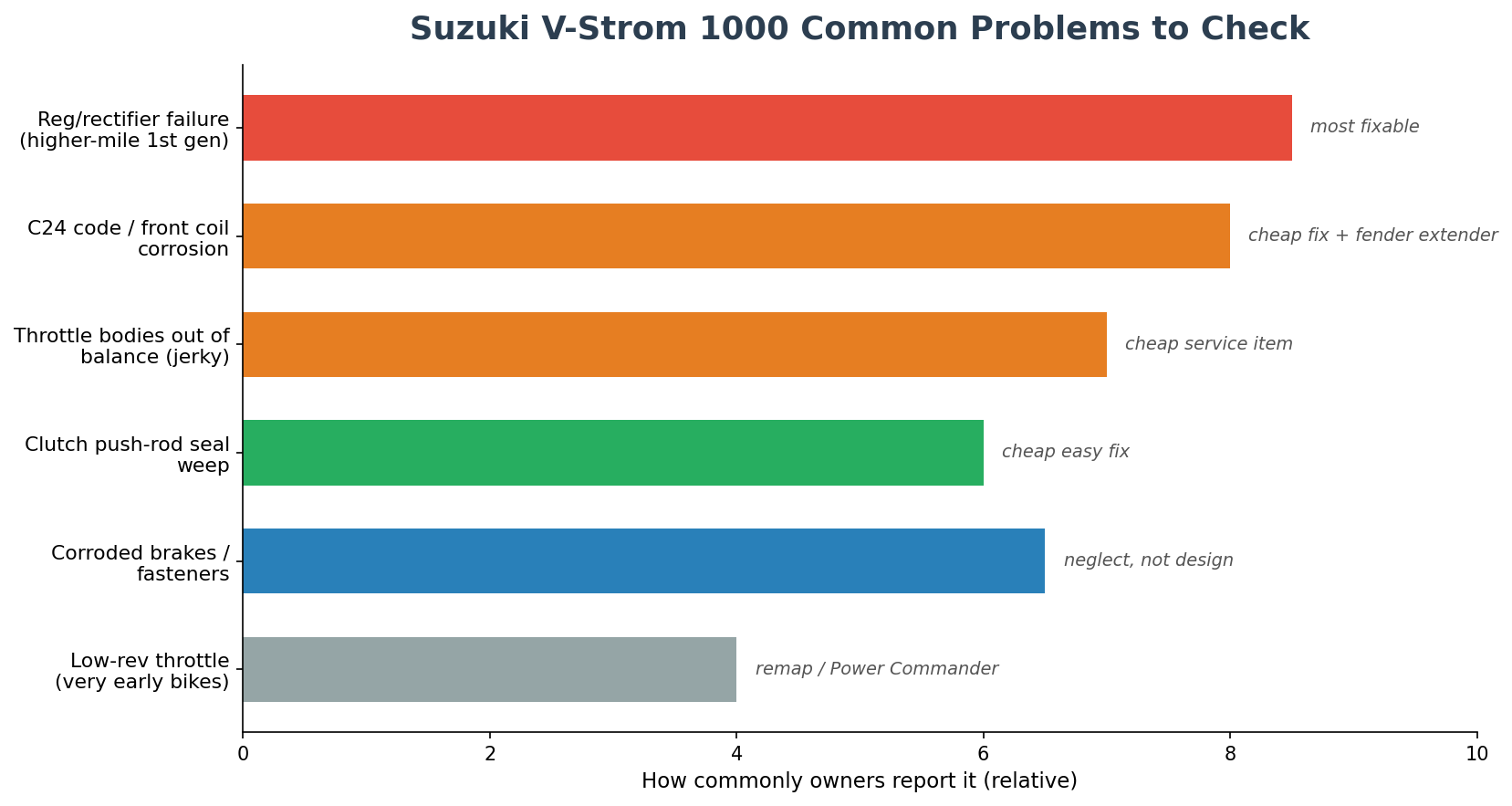
Regulator/rectifier failure. This is the classic Suzuki charging-system weak spot, most common on higher-mileage first-gen bikes. A failing reg/rec cooks batteries or leaves you stranded, and a replacement runs roughly £100 to £280. Check the battery voltage at idle and at revs, and ask whether the reg/rec has already been upgraded to a better unit, which many owners do as a preventative fix.
The C24 error and front coil failure. The front cylinder sits low and gets hammered by road spray, and over time the front ignition coil connector corrodes and throws a C24 fault code. It is common enough that it gets its own section below because it is easy to mistake for something expensive when it usually is not.
Throttle-body balancing. Suzuki recommends balancing the throttle bodies roughly every 7,500 miles. Skip it and the bike gets a jerky, snatchy low-speed throttle response. It is a cheap, quick job for a competent mechanic, but a neglected bike will feel worse than it really is on a test ride.
Clutch push-rod seal leak. A small weep from the clutch push-rod seal is common and looks alarming, but it is one of the cheapest and easiest fixes on the bike. Do not let a seller talk it up into a big discount and then charge you nothing to sort it.
Corrosion and consumables. Flaking engine paint, rusty or warped brake rotors, corroded fasteners and brake pads that stick in the calipers all show up on neglected bikes. This is exactly where a clean, dry Japanese import shines, because these are weather-and-neglect problems, not design faults.
On the 2014-onward second-gen bikes, the early-bike gripes about idle "hammer," clutch chudder and slightly lean fuelling are much reduced, though a poorly maintained individual example can still show them. Buy on service history and condition, not just year.
The C24 error and front coil, explained
This deserves its own section because it panics first-time buyers for no good reason. On the V-Strom 1000, the front cylinder's ignition coil and its wiring connector live right in the firing line of road spray and grime. Over years, that connector corrodes, the front coil starts misbehaving, and the bike throws a C24 diagnostic code, sometimes with a stumble or a rough front cylinder.
Here is the part that matters: it is usually a cheap fix. Cleaning the corroded connector, sometimes replacing the coil, and fitting a fender extender to keep the spray off in future solves it for most owners. It is not a sign of a knackered engine or a dead ECU. If a seller mentions a C24 code, or you see it flagged, treat it as a bargaining chip rather than a dealbreaker, and factor in a fender extender as a cheap piece of preventative maintenance. Knowing this one detail can save you talking yourself out of a good bike.
Years to avoid and the best year to buy
There is no truly bad V-Strom 1000, but there is a clear pecking order.
Approach 2002-2003 with your eyes open. The earliest bikes are the cheapest, have no ABS, the smaller 400-watt-or-less charging output on the very first ones, and are most likely to want reg/rec and coil attention by now. Some also had the soft low-rev throttle. Buy one only if the price reflects it and the servicing is spotless. As a cheap, tough workhorse, they are fine.
Look hard at 2004-2012 first-gen bikes. By the K4 onward you get the better ECU and instruments, and the Grand Touring spec from 2005 adds genuinely useful touring kit. A well-kept late first-gen GT is a lot of adventure bike for very little money.
Buy a 2014-2019 second-gen if you can. ABS as standard, traction control, the smoother 1037cc engine, less weight and better handling make this the sweet spot. A 2015-onward XT with wire wheels and hand guards is the connoisseur's pick. If you want one bike to keep and rely on, this is the target.
The one genuine gap to remember: Suzuki paused the big V-Strom between roughly 2013 and the 2014 relaunch, so do not go hunting for a 2013 model-year first-gen bike that essentially does not exist in most markets.
What a used V-Strom 1000 costs
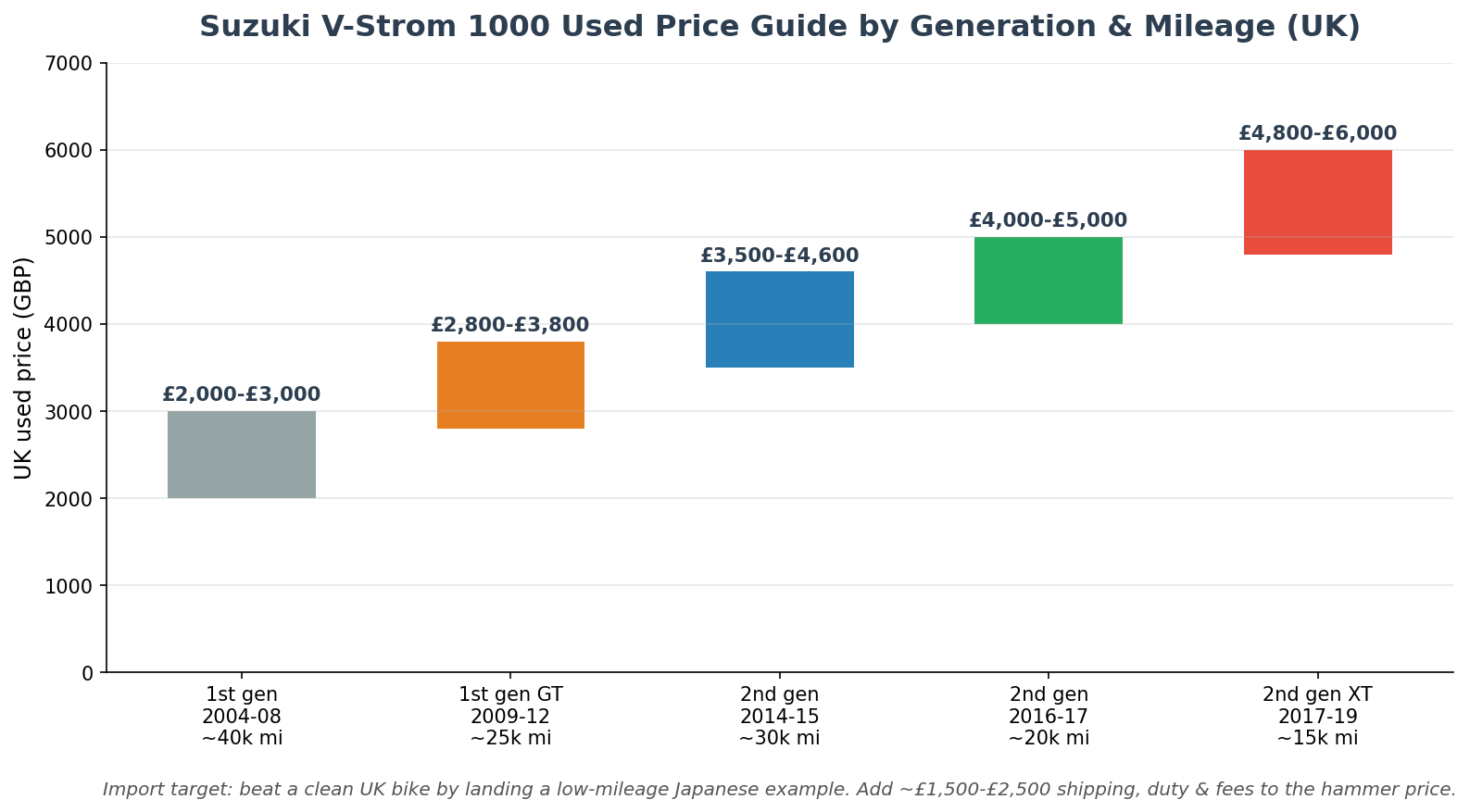
The V-Strom 1000 is one of the best value-per-mile buys in adventure touring, and the used market proves it.
In the UK, tidy second-generation bikes from 2016 and 2017 with 20,000-odd miles typically sell for around £4,000 to £5,000. Real listings back this up: a 2016 bike with just under 20,000 miles at £4,990, another 2016 with 22,500 miles at £4,000, and a 2017 with 21,351 miles at £4,995. First-generation bikes sit well below that, with honest, higher-mileage early DL1000s often changing hands for £2,000 to £3,500 depending on condition and spec.
Compare that with a used BMW R1200GS of the same era, which commands a hefty premium, and the V-Strom's value story writes itself. You are buying 80 percent of the touring ability for half the money, and often less of the maintenance headache.
For an import, the calculation is different. You are not paying a UK dealer's forecourt price; you are paying a Japanese auction hammer price plus the cost to land the bike. A clean, low-mileage Japanese second-gen bike frequently hammers for less than a tired local one costs, and you add shipping, duty and agent fees to reach your landed total. The chart above gives you the rough UK used ladder by mileage as a benchmark to beat.
Is it worth importing from Japan? The honest maths
Let's not pretend. Because the V-Strom 1000 was sold new across the UK, Europe, the US, Australia and New Zealand, local used bikes exist. So importing only makes sense if you win on condition, spec or price, and often all three.
Start with a Japanese auction hammer price for a clean, low-mileage bike. Add shipping to your port, then import duty and taxes, then the agent or auction fees and any local compliance or registration costs. For a bike heading to a market like the UK, that added cost typically lands somewhere around £1,500 to £2,500 on top of the hammer price, depending on the port, the bike's age and the paperwork.
Now compare honestly. If a scruffy local high-miler is £3,500 and a genuinely clean, low-mileage Japanese second-gen bike lands at £5,000, the import is the better bike for a small premium, and it will likely cost you less in the first year of ownership because you are not immediately replacing corroded brakes and a tired reg/rec. If you specifically want a low-mileage XT that barely turns up locally, the import is often the only realistic way to get exactly what you want. If you want us to run the numbers on a specific bike, contact our team and we will give you an honest landed total before you commit a penny.
How to import a V-Strom 1000 from Japan, step by step
The process is more straightforward than most first-timers fear.
Step 1: Set your budget as a landed total. Decide the maximum you will pay with the bike in your garage and registered, not just the hammer price. Work backward from there.
Step 2: Get access to the auctions. The big Japanese motorcycle auctions are trade-only, so you bid through an agent. This is where you browse what is passing through and set targets on specific lots.
Step 3: Read the auction sheet. Every bike is graded and annotated by an independent inspector. Learn to read it, or use an agent who translates it honestly. More on this below.
Step 4: Bid and win. Your agent bids to your limit. If you win, you pay the hammer price plus the auction and agent fees.
Step 5: Export and ship. The bike is de-registered for export, crated or shipped roll-on-roll-off, and sent to your port.
Step 6: Clear customs and register. Pay duty and taxes, complete any compliance inspection your country requires, and register the bike. Then you ride.
Official import rules vary by country. UK importers should check the government's guidance on importing vehicles into the UK before starting, and US buyers must remember the 25-year federal rule: a 2002 DL1000 only became freely importable in 2027, and newer bikes are off-limits for years yet, which is why the V-Strom import case is strongest for the UK, Australia and New Zealand.
How to read a Japanese auction sheet
The auction sheet is your best friend, and it is why buying from Japan is safer than people assume. Each bike is inspected by a neutral third party and given an overall grade, usually on a scale where 4 to 4.5 is a clean, honest used bike, 5 and 6 are exceptional or nearly new, and anything at 3 or below signals wear, damage or high mileage you should scrutinise hard.
Beyond the overall grade, the sheet carries a diagram of the bike with coded notes: scratches, dents, rust, replaced parts and corrosion are all marked with symbols. On a V-Strom 1000, pay special attention to any notes around the front of the engine and the lower fairing area, because that is where road spray causes the coil corrosion and front-cylinder grime this bike is known for, and check the brake and wheel notes for the usual adventure-bike wear.
Do not fear high mileage on the sheet if the grade and condition notes are clean. This V-twin is tough, and a well-maintained higher-mileage bike with a spotless sheet is often a better buy than a low-mileage bike covered in corrosion symbols. A good agent will photograph the exact areas you care about and tell you the truth. That honesty is worth more than any grade number, and it is exactly what we build our reputation on.
V-Strom 1000 versus the rivals
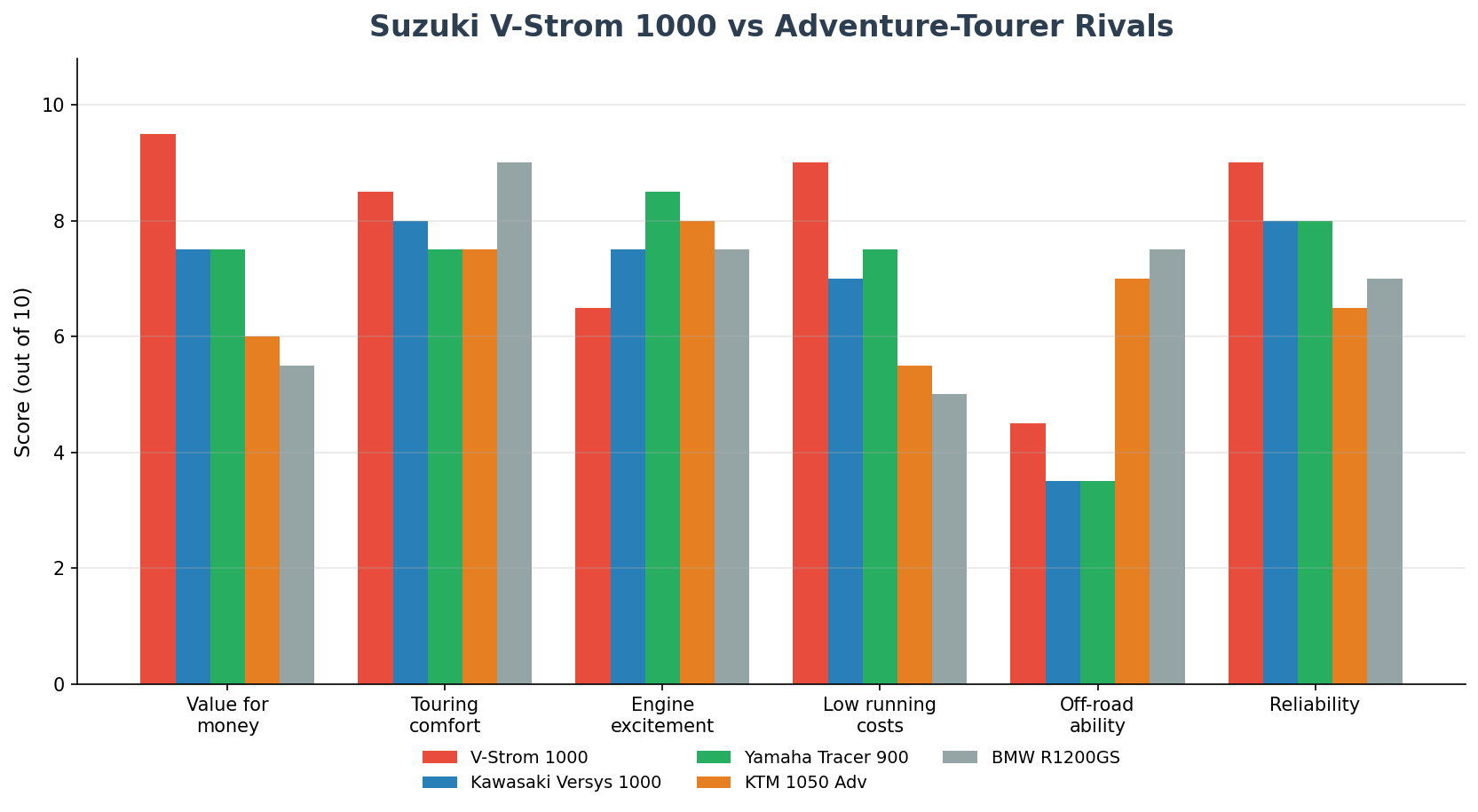
The V-Strom 1000 sits in a busy class, and the used-bargain angle changes the calculus. Motorcycle.com's group test throwing the "Kawasaki Versys 1000LT, Suzuki V-Strom 1000 Adventure and Yamaha FJ-09" together has drawn well over 500,000 views because these are exactly the bikes cross-shoppers weigh up.
Versus the Kawasaki Versys 1000: the Kawasaki's inline-four is smoother and revvier at the top, and it feels sportier on a fast road. The V-Strom counters with lazier V-twin torque, arguably better long-haul comfort and a lower price. If you want to compare a Versys and a V-Strom side by side, they make a fascinating pair.
Versus the Yamaha Tracer 900 / FJ-09: the Yamaha's triple is the most entertaining engine of the group and the bike is lighter and sharper. The V-Strom is the more relaxed, more planted tourer with a bigger tank feel and simpler running costs.
Versus the KTM 1050/1090 Adventure: Moto.it's KTM 1050 Adventure versus V-Strom 1000 test, with nearly 400,000 views, framed them neatly: the KTM is the more exciting, more premium and more expensive machine, while the Suzuki is the value champion you can actually afford to run and repair. The KTM wins the test-ride grin; the Suzuki wins the ownership spreadsheet.
Versus the BMW R1200GS: the GS is the class benchmark and it rides beautifully, but it costs far more to buy and to fix, and its electronics and final drive can bite. The V-Strom gives you most of the touring ability for half the outlay and a fraction of the worry. That is the whole V-Strom pitch in one comparison.
The honest verdict: nothing else in the class gives you this much torquey, reliable, comfortable touring for the money, and on the used market that gap only widens.
Running costs and maintenance
Budget realistically and the V-Strom 1000 is one of the cheapest big bikes to live with. Fuel economy is a genuine strength: expect roughly 50mpg on a steady motorway run and mid-to-high 40s in mixed use, and with the 22-litre tank that translates to over 200 miles between fills. Owners regularly report 230-mile tanks ridden gently, which is proper touring range.
Servicing is refreshingly simple. Regular oil changes, throttle-body balancing around every 7,500 miles, and valve-clearance checks at the recommended interval are the bulk of it, and none of it is exotic. The V-twin is easy to work on, parts are cheap and plentiful, and a competent independent can look after it for a fraction of what a premium-brand adventure bike demands. Chain and sprocket wear is the one recurring consumable, so factor that in, but even that is normal-money stuff.
Insurance sits in the sensible-tourer bracket rather than the superbike bracket, and depreciation on a used bike is already mostly done, so you are not watching value evaporate. Add it all up and the V-Strom 1000 is the definition of cheap-to-run big-bike touring.
Popular modifications
Owners tend to fix the V-Strom's two mild weaknesses first: wind protection and long-day comfort. A taller aftermarket touring screen calms the airflow on the motorway, and a reshaped or gel seat, or an aftermarket item from the comfort-seat specialists, makes big days genuinely painless.
Beyond that, the usual adventure-tourer kit applies. Hard luggage or a top box turns it into a proper two-up tourer, crash bars and a bash plate add protection and the rugged look, and a fender extender is the near-mandatory cheap fix that keeps road spray off the front coil and helps head off that C24 gremlin. Many owners add heated grips if the bike does not already have them, LED auxiliary lights for touring, and an upgraded reg/rec as preventative insurance on first-gen bikes. None of it is essential, and all of it is cheap relative to the bike's ability.
Who should buy a V-Strom 1000, honestly
Buy one if you want a comfortable, torquey, utterly dependable long-distance bike that costs little to buy and less to run, and you value getting there in comfort over looking exotic on the way. It rewards riders who do real distance, who carry a pillion and luggage, and who would rather spend their money on trips than on repairs.
Think twice if you want serious off-road ability, sportsbike sharpness, or badge prestige. The V-Strom is a road-biased tourer that is heavy and mild off the tarmac, and it will never turn heads the way a KTM or a GS does. For a first big bike it is actually a reasonable choice thanks to its friendly power delivery, though the weight is something to respect at low speed. The V-Strom 1000 is the thinking rider's bargain, not a poser's trophy, and its owners would not have it any other way.
Pre-purchase checklist
Before you commit to any V-Strom 1000, Japanese import or local, run through this:
Check the charging system by measuring battery voltage at idle and at revs, and ask whether the reg/rec has been upgraded. Look for a C24 history and inspect the front coil and its connector for corrosion. Feel for a snatchy low-speed throttle that points to overdue throttle-body balancing. Check for the small clutch push-rod seal weep, and price it as the cheap fix it is. Inspect the brakes and rotors for corrosion and warping, and the fasteners for rust. Test the ABS and, on second-gen bikes, cycle the traction-control modes. Confirm the valve-check and service history. Prefer a 2014-onward bike with ABS and traction control, ideally an XT, if your budget allows. And on an import, insist on clear auction-sheet photos of the front cylinder, brakes and wheels before you bid.
How AWA Auction helps you import a V-Strom 1000
Importing an adventure-tourer from a Japanese auction is exactly the situation where a good partner earns their keep. We bid on the trade-only auctions on your behalf, translate the auction sheet honestly rather than talking up a bike to make a sale, and photograph the specific weak spots this model has, the front coil area, the charging system access, the brakes and the wheels, before you ever commit.
We handle the export paperwork, arrange shipping to your port, and give you an honest landed total up front. Whether you want a bargain early first-gen workhorse or a low-mileage second-gen XT that barely exists on Western forecourts, we will find the good example and tell you the truth about it. Start by browsing the current listings or contact our team to set a target on the exact V-Strom you want.
See Also
Share this article: