
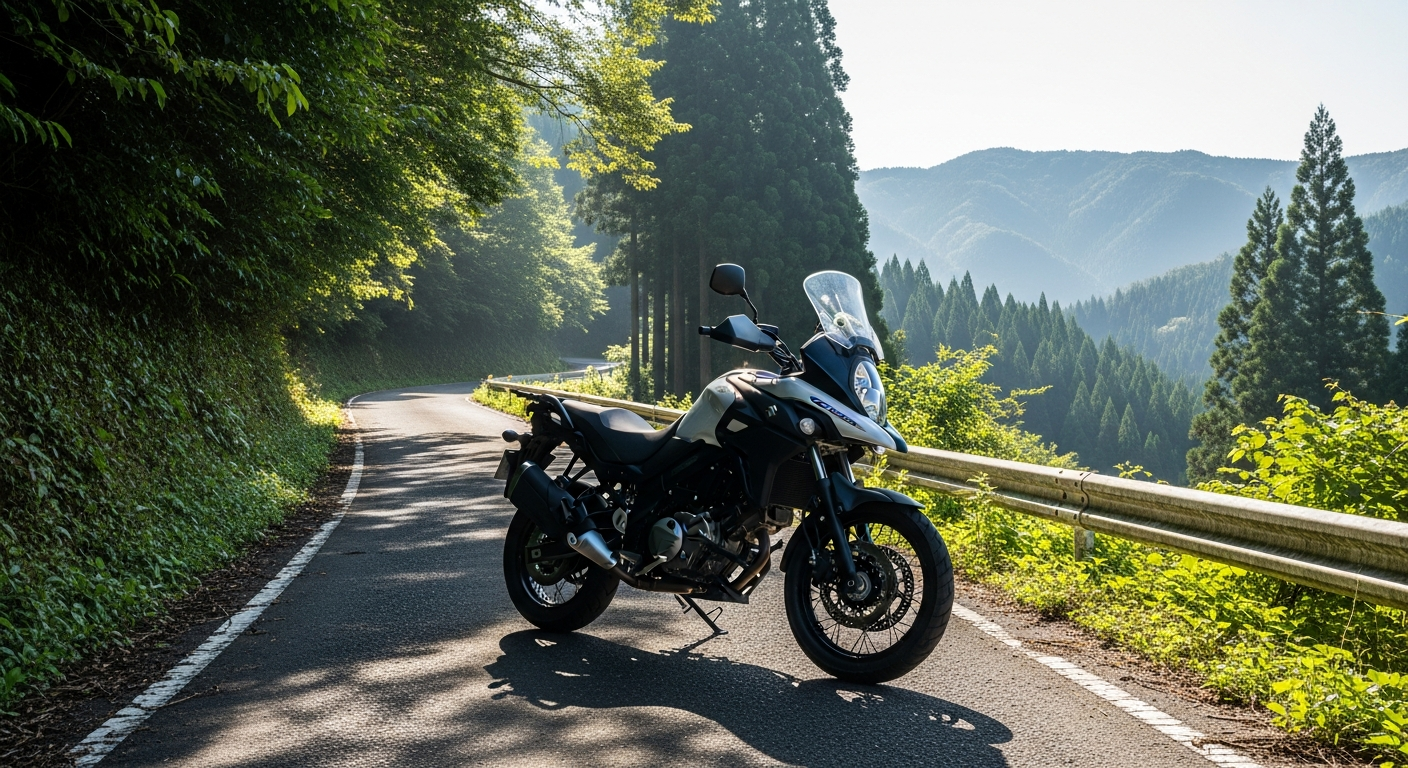
Ask a room full of high-mileage riders to name the most sensible motorcycle ever built and a lot of them will say the same three words: Suzuki V-Strom 650. It is the bike that won't die, won't bankrupt you, and won't pretend to be something it isn't. And here's the part most buyers miss: some of the cleanest, best-value DL650s on the planet are sitting in Japanese auction halls right now, graded, photographed, and waiting for a bid.
So this is your straight-talking guide to importing a Suzuki V-Strom 650 from Japan: what the bike actually is, which generation to chase, what it really costs landed on your driveway, the legal hoops in your country, and the exact faults to check before you spend a yen. We live inside the Japanese motorcycle auctions at AWA Auction, so the goal is simple. By the end of this page you'll be able to read a V-Strom listing, tell a gem from a grenade, and know roughly what the whole adventure will cost you.
No filler, no "speak to a professional" hand-waving. Just what matters when you're buying a bike from 9,000 km away.
What is the Suzuki V-Strom 650?
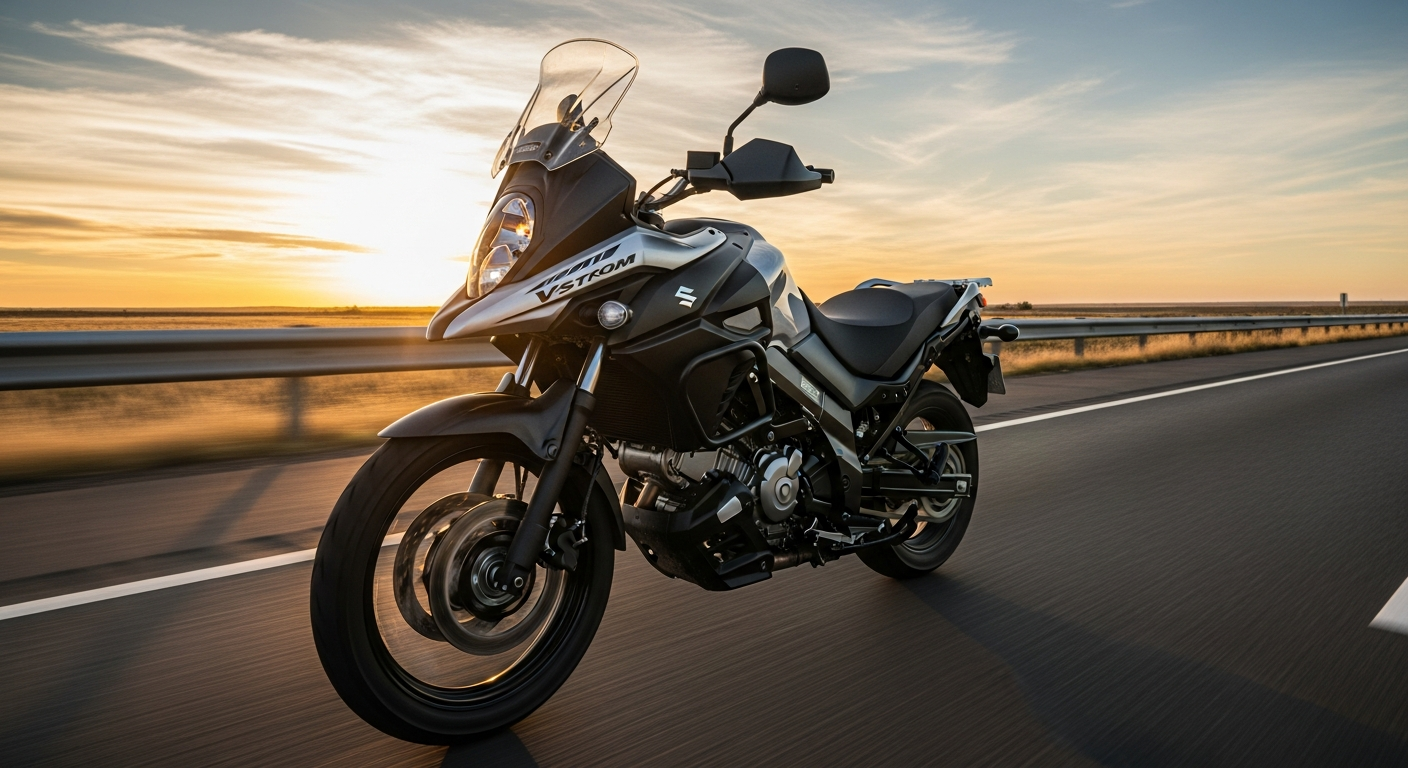
The V-Strom 650 (model code DL650) is Suzuki's middleweight adventure-tourer, built around a 645 cc 90-degree V-twin and launched in 2004. It's not a knobbly-tyred dirt weapon and it never pretended to be. It's a tall, comfortable, do-everything road bike with a bit of rough-road ability bolted on — the kind of machine you can commute on Monday, tour on Friday, and load up for a continent on a long weekend.
The heart of it is that V-twin, which is a detuned, adventure-flavoured version of the engine from the legendary SV650. It makes around 70 horsepower, which sounds modest until you ride one. The torque arrives low and stays flat, the fuelling is honest, and the thing just refuses to feel stressed. It's the antidote to the modern arms race of 150-horsepower adventure bikes that scare their owners and live in the garage.
Here's the detail that tells you everything: in 2021 the YouTube channel FortNine published a video titled "The Best Used Motorcycle to Buy." It has racked up over three million views, and the bike it builds its whole argument around is the SV650/V-Strom platform — specifically because the engine is close to indestructible and the parts cost peanuts. When the internet's most-watched motorcycle reviewer picks your engine as the definition of sensible, that reputation isn't marketing. It's earned.
Why import a V-Strom 650 from Japan?
Three reasons, and they stack.
One: Japan's used market is enormous and brutally honest. Bikes are graded by independent auction inspectors, documented on a standardised auction sheet, and sold in numbers that simply don't exist anywhere else. You're not choosing between the two tired Stroms for sale in your county. You're choosing from dozens every single week, with mileage, condition and history laid out in front of you before you bid.
Two: condition and value. Japanese owners tend to maintain bikes meticulously, ride in a milder climate, and store them indoors. A ten-year-old V-Strom out of Japan routinely presents better than a five-year-old example from a salt-soaked market. Add auction pricing that hasn't been marked up by three middlemen, and even after shipping and duty the maths often still beats your local listings.
Three: the spec you actually want. Want the spoked-wheel XT? A specific colour? A bike with a full luggage set already fitted? Japan's volume means you can hold out for the exact configuration instead of settling for whatever turned up locally.
The catch — and there's always a catch — is that bidding blind on an auction halfway around the world is exactly where people get burned. That's what the rest of this guide is for.
DL650 generations explained: which V-Strom 650 to buy
If you take one thing from this guide, make it this section. "V-Strom 650" covers twenty years of production across several meaningfully different bikes. Know the generation, and you know what you're buying.
| Generation | Years | What changed |
|---|---|---|
| 1st gen | 2004–2011 | The original DL650. Simple, light, bulletproof. Carb-free fuel injection from day one. Basic instruments, no traction control, no ABS early on. The cheapest way into a Strom and still a brilliant bike. |
| 2nd gen | 2012–2016 | Major redesign. Restyled beak and bodywork, more efficient engine, traction control added, ABS standard in most markets, better wind protection and a lighter feel. The sweet spot for most buyers. |
| 2nd gen + XT | 2017–2019 | Updated electronics, refreshed styling, and the arrival of the XT variant: tubeless spoked wheels, hand guards and a sump guard as standard. The XT is the one adventure riders hunt for. |
| Latest update | 2020–2024 | Sharper styling, Euro-compliant engine tweaks, low-rpm assist and easy-start. Near-modern bike, priced accordingly. (Note: the bigger 1050 is a separate model — don't confuse the two.) |
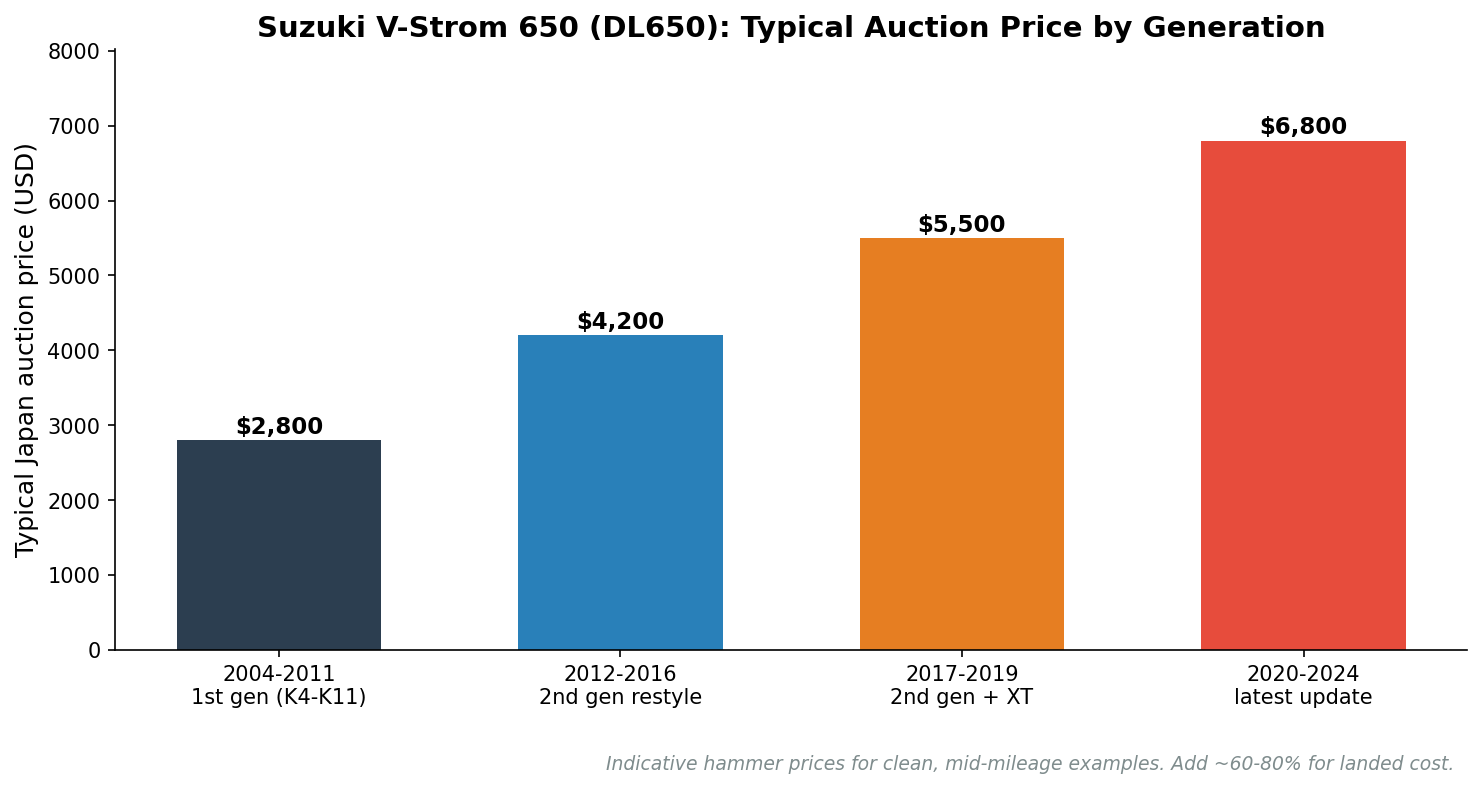
Here's the honest take. If you want the cheapest reliable adventure bike on earth, buy a clean first-gen. If you want the best all-round package, target a 2012-onward second-gen. If you actually ride dirt and gravel, find an XT. And if you must have the newest electronics, pay for a 2020-plus — just know you're paying a big premium for a bike that does the same core job as a $3,000 first-gen.
V-Strom 650 vs 650XT vs the rivals
The two questions buyers always ask: which V-Strom, and why not something else?
Standard vs XT. Mechanically they're the same bike. The XT adds tubeless spoked wheels (stronger, and you can plug a puncture roadside), hand guards and an engine bash plate. If you'll see gravel, the XT is worth chasing. If you live on tarmac, the cast-wheel standard saves you money and does everything you need.
Against the field, the V-Strom's case is simple:
| Bike | Engine | The pitch | The catch |
|---|---|---|---|
| V-Strom 650 | 645 cc V-twin | Bulletproof engine, comfy, cheap to run, huge parts supply | Not a serious off-roader; styling divides people |
| Kawasaki Versys 650 | 649 cc parallel-twin | Sportier road manners, slightly cheaper | Less adventure cred, smaller tank feel |
| Kawasaki KLR650 | 651 cc single | Genuinely cheap, simple, more off-road focused | Thumpy, dated, fewer creature comforts |
| Yamaha Tenere 700 | 689 cc parallel-twin | Far more capable off-road, modern | Much pricier, firmer ride, newer so harder to import on age |
FortNine's other famous video, "The Last Cheap Motorcycle," is about the KLR650 and has over a million views — proof that the budget-adventure crowd is huge. The V-Strom's answer to the KLR is "yes, but with a second cylinder, better road manners and a calmer life." For most riders importing from Japan, that trade is a no-brainer.
Is the 645cc V-twin really that reliable?
Short answer: yes, and it's not close.
The V-Strom 650's engine is a detuned SV650 motor, and that family has one of the best reliability records of any modern motorcycle. Owners regularly report 60,000 miles (around 100,000 km) on the original bottom end with nothing but routine servicing. Plenty of bikes are past 100,000 miles and still running sweet. On the StromTrooper owners' forum — thousands of riders, decades of threads — the recurring verdict is the same: there is no V-Strom 650 you should genuinely avoid on engine grounds.
That matters enormously when you're importing. A bike with 40,000 km on a fragile engine is a gamble. A V-Strom with 40,000 km is barely run in. It means you can shop the Japanese auctions on condition and history rather than panicking about the odometer, which opens up a much bigger pool of well-priced bikes.
The flip side of a bombproof engine is that the bits around it deserve your attention instead. Which brings us to the checklist.
V-Strom 650 common problems and a pre-purchase inspection checklist
No bike is perfect, and pretending otherwise is how you end up overpaying for someone else's headache. Here's what actually goes wrong on a DL650, ranked by how much it should worry you.
Charging system (the big one). Across owner surveys, electrical faults are the single most-reported V-Strom problem — roughly a quarter of all issues. The usual culprit is the regulator/rectifier overheating and failing, sometimes taking the stator with it. The tells: a battery that won't hold charge, dim or flickering lights, or a melted/discoloured connector at the reg-rec. Many owners fit an upgraded unit and a better connector. On a bike you're inspecting, a healthy charging system is non-negotiable; a tired one is a cheap fix if you know to budget for it, and a nasty surprise if you don't.
Throttle-body sync. An out-of-sync V-Strom idles roughly and surges or hunts between about 3,000 and 5,000 rpm. It's not a fault so much as routine maintenance that lazy owners skip. A quick sync sorts it. But a bike that surges badly may have been neglected elsewhere too, so treat it as a clue rather than a dealbreaker.
Front-cylinder exposure. Because of the V-twin layout, the front cylinder sits right in the firing line of road grime and water off the front wheel. On neglected bikes this means corroded fasteners and a tired-looking front exhaust header. Cosmetic mostly, but it's a fast read on how the bike was cared for.
Other watch items: early bikes can suffer cooling-fan and minor sensor gremlins; some report a notchy gearbox that's just down to skipped oil changes; and the side-stand switch and starter clutch are worth a listen on very high-mileage examples.
Use this checklist when you (or your agent) look at any V-Strom before bidding:
| Area | What to check | Why it matters |
|---|---|---|
| Charging system | Connector at reg-rec not melted; battery healthy; lights steady | The #1 V-Strom failure point |
| Idle & 3-5k rpm | Smooth idle, no surging or hunting | Throttle sync / general neglect |
| Front cylinder & header | Corrosion on fasteners and exhaust | Reveals storage and care |
| Service history | Valve clearances, coolant, fork oil done | Cheap engine, costly if ignored |
| Crash signs | Bar-end scuffs, fork alignment, subframe | Adventure bikes get dropped |
| Auction sheet notes | Any frame (X) or corrosion flags | Walk away from structural repairs |
What it costs to import a V-Strom 650 from Japan
Let's talk real money, because the auction price is only the start. Here's the honest rule of thumb: budget the hammer price plus roughly 60 to 80 percent in fees to get the bike landed and legal at home.
Take a clean, mid-mileage second-gen V-Strom that hammers for around 3,800 USD in Japan. Stack on the Japan-side export and handling fees, ocean freight, your country's import duty, local VAT or sales tax, any compliance/inspection cost, and an agent fee, and you're looking at a landed total in the region of 6,500 to 7,500 USD depending on where you live.
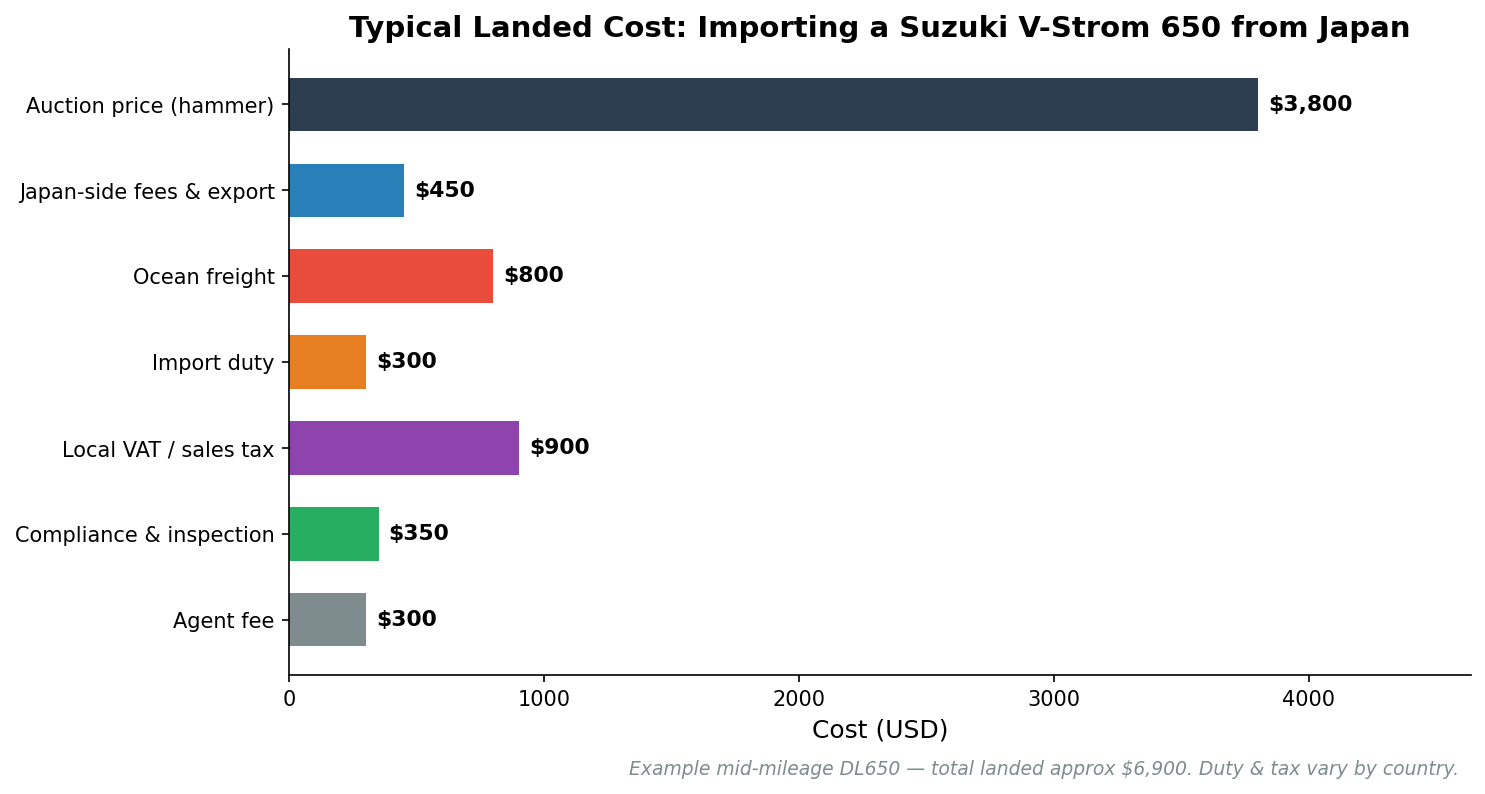
Two numbers swing that total more than anything else: your country's duty-and-tax rate, and which generation you chase. A first-gen bike at 2,800 USD lands cheaper across the board; a 2020-plus example at 6,800 USD lands a long way north of it. The shipping and agent costs barely move — it's the bike price and your local tax that decide your final figure.
Here's the part nobody markets: even at the top of that range, you're often buying a better-conditioned, lower-mileage, better-specced bike than your local money would get you. That's the whole point of importing.
Is the V-Strom 650 legal to import to your country?
This is where you need to be honest with yourself before you bid, because the V-Strom 650 is a relatively modern bike and the rules vary hard by country.
United States — read this carefully. The US 25-year rule lets any motorcycle at least 25 years old in, exempt from DOT and EPA standards. The V-Strom 650 launched in 2004, so for 2026 none of them are old enough yet — the earliest 2004 bikes won't clear the 25-year line until 2029. A newer V-Strom can only come into the US through a Registered Importer meeting full federal standards, which is impractical for a private buyer. If you're American and you want a Japanese import you can ride now, this specific bike isn't your easy route; an older classic is. We'd rather tell you that up front than take your bid.
Everywhere else, it's far easier:
| Country | Rule | V-Strom 650 status |
|---|---|---|
| United Kingdom | No age limit | Any year importable; pay duty + VAT, then register (IVA/registration route) |
| Australia | Import approval + compliance | Importable, but confirm the approval pathway before you bid |
| New Zealand | Entry certification | One of the easiest markets; straightforward certification |
| Canada | 15-year rule | For 2026, first-gen bikes (2011 and earlier) qualify; newer ones don't yet |
| United States | 25-year rule | Not yet eligible — earliest 2004 bikes clear in 2029 |
Always verify the exact build date from the frame number, not just the listed model year — a bike sold as a 2011 can be built in late 2010, and that single month can decide whether it clears your country's age line this year.
How to buy a V-Strom 650 at a Japanese auction
Japanese motorcycle auctions aren't open to the public — you bid through a licensed agent with access. Here's how the process actually runs.
The bikes are consigned by dealers and private sellers, then inspected by an independent grader who fills out a standardised auction sheet. That sheet is the single most important document in the whole transaction. It records an overall grade (commonly 1 to 6, plus letters like S for new-ish and R for repaired), a mileage reading, and a map of the bike marked with codes for scratches, dents, rust and corrosion. A good agent reads that sheet for you and translates the shorthand into plain English.
You set a maximum bid, the agent bids on your behalf, and if you win, the bike moves into the export pipeline. You never have to be awake at 3 a.m. Japan time or speak a word of Japanese. What you do have to do is trust the sheet and pick your battles — on a model this common, there's always another good one next week, so never let auction fever push you past your number.
One question we get constantly: how do the agent's fees work, and are there hidden ones? On a transparent service the costs are simple — a fixed auction-agent fee, the genuine Japan-side handling and export charges, and the shipping quote, all laid out before you bid. The fees that ambush people are the home-country ones: duty, local tax, and any compliance inspection that varies by where you live. That's exactly why we tell every buyer to work backwards from a landed-cost ceiling rather than getting excited about a low hammer price. A 3,000 USD bargain that costs 2,500 USD to land is still a 5,500 USD bike, and knowing that before you bid is the difference between a smart import and an expensive lesson.
Reading the auction sheet on a V-Strom 650
This is a competitor blind spot — most import guides explain auctions in general but never tell you what to look for on this specific bike. So here's the V-Strom-specific read.
Grade. For a V-Strom, target grade 4 or above. A 3.5 can be a great buy if the deductions are purely cosmetic, but read why it scored what it did. Anything flagged with an "X" on the frame map (structural repair) gets a hard pass — there are too many clean Stroms to gamble on a repaired frame.
Mileage in context. Because the engine is so durable, don't reflexively chase the lowest-mile bike. A well-serviced 45,000 km example with history can be a smarter buy than a 12,000 km bike that sat for years with old fuel and a flat battery. On a Strom, evidence of use and maintenance often beats low numbers.
Adventure-bike tells. These bikes get loaded, toured and occasionally dropped. Look for sheet notes around the bar ends, levers, mirrors and panniers — light scuffs are normal and a bargaining chip; heavy damage with fork or subframe notes is a warning. Aftermarket luggage, crash bars and a touring screen are common and usually a plus, not a minus.
Modifications. Loud aftermarket exhausts are everywhere on used Japanese bikes. A slip-on is usually fine; a full non-standard system can complicate noise or emissions compliance when you register at home. Note it and factor it into your offer.
Step-by-step: importing your V-Strom 650 from Japan
Here's the whole journey, start to finish, so nothing blindsides you.
Step 1 — Decide your spec and budget. Generation, standard vs XT, and your all-in landed ceiling (hammer plus 60–80%). Lock the number before you feel anything.
Step 2 — Find candidates. Your agent searches the week's auction listings for V-Stroms matching your spec and sends you the sheets and photos.
Step 3 — Vet the sheet. Grade, mileage, frame map, modifications. Shortlist the clean ones.
Step 4 — Bid. Set your maximum, the agent bids, you win (or you wait for next week — there's no shortage).
Step 5 — Japan-side processing. Payment, export deregistration, and booking onto a vessel.
Step 6 — Ocean freight. A few weeks at sea, depending on your country and whether it goes RoRo or in a container.
Step 7 — Home customs and compliance. Clear customs, pay duty and tax, complete any required inspection or certification.
Step 8 — Register and ride. Title or register it locally, insure it, and go.
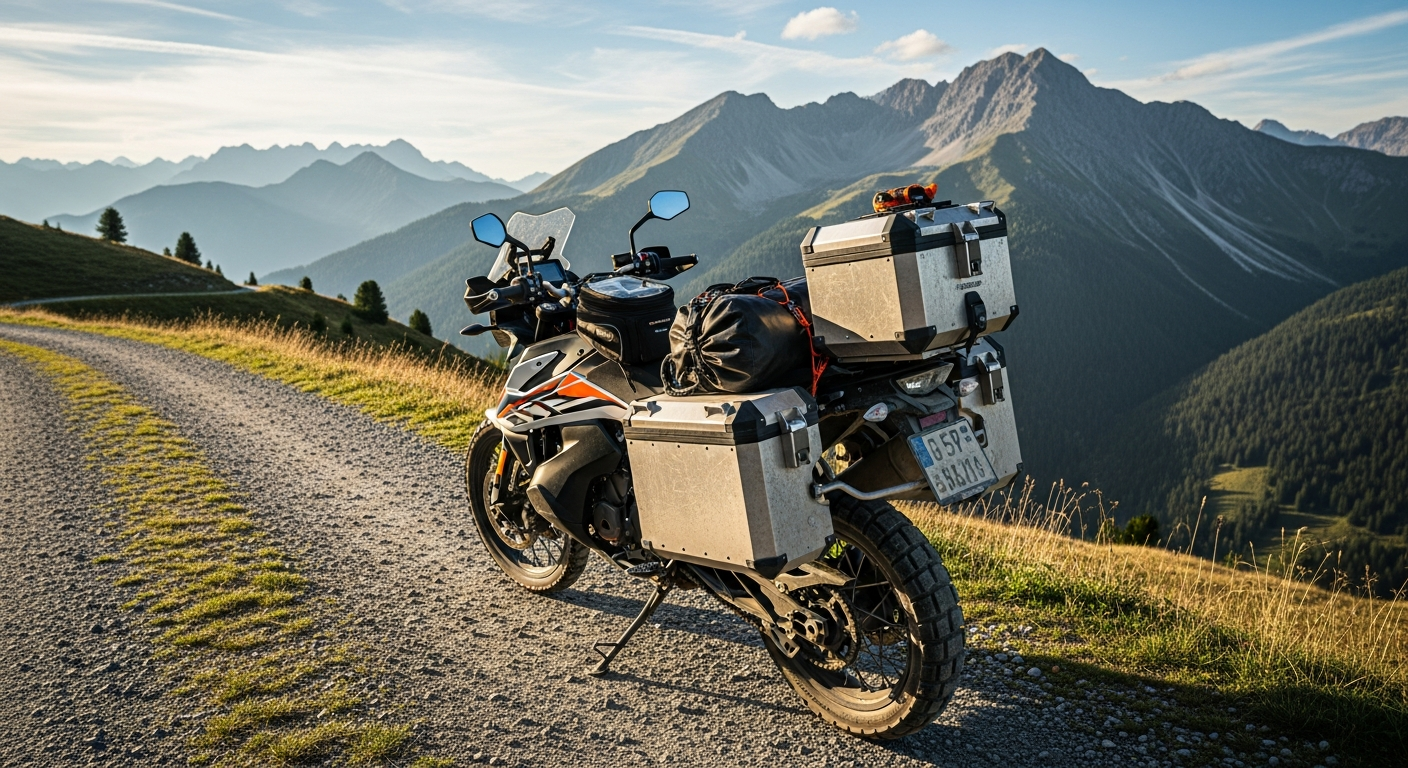
Realistic timeline: plan on roughly six to twelve weeks from winning the auction to legally riding at home. Shipping method and your local paperwork are the two things that swing it most.
RoRo vs container: shipping your V-Strom 650
Two ways to get a bike across the ocean, and the right answer depends on your country and your nerves.
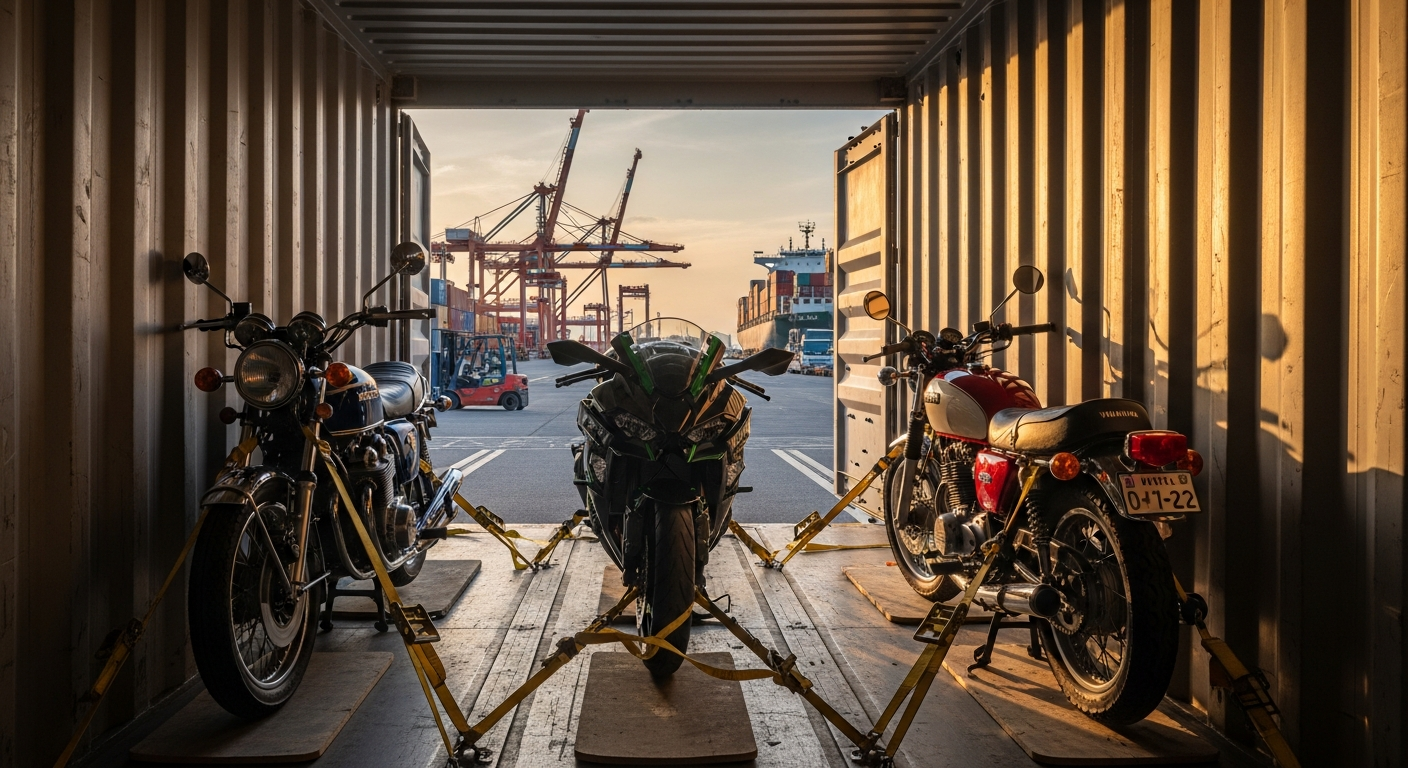
Roll-on/roll-off (RoRo) is usually cheaper. The bike is secured and rolled aboard a dedicated vehicle vessel. It's efficient and fine for the vast majority of imports, but the bike sits exposed in a shared hold, so it's hands-off and slightly higher risk for knocks.
Container shipping costs more but lets the bike be crated or strapped inside a sealed container, sometimes sharing with other vehicles to split the cost. It's the choice for a pristine, higher-value example or for peace of mind. For a workhorse first-gen Strom, RoRo is usually the sensible call; for a mint low-mile XT, many buyers pay up for a container.
Your country can also force the decision — some markets prefer or require one method for biosecurity or customs reasons, so confirm with your agent before you commit.
Living with a V-Strom 650: running costs and who it suits
This is the bit that seals the deal. The V-Strom is famously cheap to own. Fuel economy hovers around 55–65 mpg in normal riding, the V-twin is gentle on chains and tyres, and consumables are dirt cheap because the SV650-derived engine has been in production forever and parts are everywhere. Routine servicing is straightforward enough that mechanically-minded owners do most of it at home.
Who's it for? Commuters who also want to tour. New-ish riders stepping up from a 400 who want something they won't outgrow or be terrified by. Round-the-world types who value "will get me home" over "will win a drag race." Suzuki2Wheelers' own V-Strom Ladakh expedition film — over four million views — shows these bikes hauling luggage over the highest rideable roads on earth. That's the V-Strom's real party trick: it's boring in the best possible way, right up until you point it at a mountain range.
Who should look elsewhere? Hardcore off-roaders (get a Tenere or a dirt-focused single), and riders who buy on styling and brand flash. The Strom has never been pretty, and it has never cared.
One more thing the spec sheets won't tell you: the V-Strom holds its value because everyone who owns one understands what it is. There's no hype cycle to crash. A clean imported Strom that you've serviced and sorted will sell on quickly to the next sensible rider, often for close to what you paid once you factor in the gear you added. That's rare in motorcycling, where most bikes bleed money the moment you ride them home. The Strom depreciates like a good tool, not like a toy — slowly, predictably, and never to zero.
And because the global owner community is enormous, you're never alone with a problem. Forums like StromTrooper have answered virtually every question a DL650 can raise, parts ship anywhere, and any half-decent independent mechanic has worked on the SV-family engine. For someone importing a bike from the other side of the world, that depth of support is worth as much as the bike's mechanical toughness. You're not buying an orphan; you're joining one of the largest, most boring, most contented owner clubs in motorcycling.
What a good V-Strom 650 actually costs in Japan right now
Ballpark hammer prices for clean, mid-mileage bikes at Japanese auction in 2026:
| Generation | Typical hammer (USD) | Best for |
|---|---|---|
| 2004–2011 first-gen | ~$2,500–$3,200 | Cheapest reliable entry; Canada-eligible |
| 2012–2016 second-gen | ~$3,800–$4,600 | Best all-round value |
| 2017–2019 + XT | ~$5,000–$6,000 | Spoked-wheel adventure buyers |
| 2020–2024 latest | ~$6,200–$7,500 | Near-modern electronics |
Prices move with mileage, condition, and whether luggage and crash protection are fitted. A bike with a full set of panniers, crash bars and a touring screen can be worth the small premium — that gear costs real money to add later. Remember to add roughly 60–80% to any of these figures for your landed cost.
The first things to do when your V-Strom 650 lands
Here's the thing nobody mentions: the smart money on a used V-Strom isn't just the purchase price — it's the small, cheap list of jobs that turn a good import into a great one. Budget a few hundred dollars and a weekend, and you'll have a bike that's sorted for the next 50,000 km.
Sort the charging system first. Since the regulator/rectifier is the V-Strom's known weak point, plenty of seasoned owners pre-emptively fit an upgraded reg-rec and a fresh connector rather than waiting for the original to cook on a back road. On an imported bike of unknown service history, it's cheap insurance and the single best money you'll spend.
Fresh fluids, full service. Engine oil and filter, coolant, brake and clutch fluid, and a valve-clearance check if there's no recent record. The V-Strom's valves rarely need adjusting, but checking them once on a new-to-you import buys peace of mind for years.
Fix the screen and the seat. The two universal V-Strom complaints are wind buffeting from the stock screen and a seat that goes numb on long days. A taller aftermarket screen and a comfort seat or sheepskin are the first upgrades almost every long-distance owner makes. If the bike you're importing already has them fitted, that's free money.
Tyres and chain. Check the date codes and wear. Japanese bikes often come with plenty of tread because they were lightly used, but a bike that sat unused can have old, hard rubber that looks fine and grips like plastic. A fresh set of adventure-touring tyres transforms the bike.
Do those, and you've effectively reset the clock on a bike that was already built to outlast its owner.
First-gen vs second-gen: the smarter 2026 import
This is the decision most V-Strom importers agonise over, so let's settle it. The first-generation DL650 (2004–2011) and the second-generation (2012-on) share the same essential DNA — the same indestructible V-twin philosophy — but they're aimed at slightly different buyers.
The case for the first-gen. It's the bargain of the adventure-bike world. Clean examples hammer for under 3,200 USD in Japan, the mechanicals are dead simple, and there's nothing on it to go wrong that a competent owner can't fix in a driveway. For Canadian buyers it's also the only generation old enough to clear the 15-year rule in 2026. If your goal is maximum reliability per dollar, the first-gen is unbeatable, full stop.
The case for the second-gen. The 2012 redesign wasn't cosmetic. You get traction control, standard ABS in most markets, a more efficient engine, better wind protection and a noticeably lighter, more modern feel. For maybe 1,000 to 1,500 USD more at the hammer, you get a bike that's easier to live with day to day and holds its value better. For most riders touring two-up or commuting in traffic, that's money well spent.
Our honest take: if you're on a tight budget or importing to Canada, the first-gen is the hero. If you can stretch, the second-gen is the better all-rounder and the easier bike to sell on later. Either way you're buying one of the most sensible motorcycles ever made — there's no wrong answer here, only a cheaper one and a comfier one.
What you should not do is buy the newest bike you can afford just because it's newest. The V-Strom's whole appeal is that a 2008 example does 95 percent of what a 2022 example does for a third of the price. Spend the savings on tyres, luggage and fuel for the first big trip.
How AWA Auction helps you import a V-Strom 650
This is what we do every day. AWA Auction gives you direct access to the Japanese motorcycle auctions — the same dozens-per-week supply of V-Strom 650s that local buyers never see — without you needing a Japanese licence, a translator, or a 3 a.m. alarm.
We read the auction sheet for you and tell you, in plain English, what the grade and the frame map actually mean for that specific bike. We bid to your maximum, handle the Japan-side export and paperwork, arrange shipping, and guide you through customs and compliance in your country. On a model this common, our honest advice is often "skip that one, there's a cleaner Strom next week" — because the whole advantage of importing from Japan is choice, and we'd rather you bought the right bike than the first bike.
Browse our current listings to see what's coming through the auctions, or contact our team with your spec and budget and we'll start hunting your V-Strom.
See Also
Share this article: