
If you want to import a Yamaha FJR1300 from Japan, you are shopping for one of the great long-distance motorcycles of the last twenty-five years. The FJR1300 is Yamaha's flagship sport-tourer: a 1,298cc inline-four with shaft drive, hard luggage, and enough range to cross a country before lunch. It is the bike police forces buy by the fleet, the bike that swallows 500-mile days without complaint, and the bike owners keep for a decade because nothing else does the job as calmly.
Here is the thing nobody tells you. The FJR was sold new almost everywhere, so most buyers assume there is no point importing one. That logic falls apart the moment you park a rust-free, low-mileage Japanese example next to a tired Western bike that has spent ten winters breathing road salt. This guide walks you through the generations, the specific faults to check, the years worth avoiding, real used prices, and the honest math on whether a Japan import makes sense for you.
We sell Japanese-market motorcycles for a living, so the advice here is the same advice we give friends: buy on condition and history, not on the badge.
Why import a Yamaha FJR1300 from Japan
Start with the bike's one real weakness: weight and the corrosion that comes with age and neglect. A wet FJR1300 tips the scales at around 291kg. That mass, plus a shaft final drive and a lot of exposed fasteners, means a bike that has been left outside and washed with a jet-wash grows furry aluminium and crusty downpipes fast. The engine will run forever. The finish is what ages.
This is exactly where Japan wins. Japanese owners tend to garage their bikes, keep dealer service stamps, and rarely ride through a salted winter because they simply store the machine until spring. The used market there is full of FJRs with genuine low mileage, clean shafts, and bodywork that still shines. You are not importing to save a few hundred pounds. You are importing to skip the corrosion tax.
The demand signal is real, too. On X, the chatter around the FJR1300 in Japan is telling: owners describe cruising the Shin-Tomei expressway two-up with panniers "with no strain at all, if anything self-restraint is the challenge," and note the bike is "completely serene at 120km/h; things only get interesting past 210." One long-time rider posted a lament that Yamaha has now walked away from the flagship-tourer segment entirely, treating a clean FJR as a bike to hold onto rather than sell. When owners talk like that, you know the machines were loved.
There is also a quiet reliability endorsement most buyers miss. Multiple European police forces ran the FJR1300 as a patrol bike, and one of the most-watched French reviews is literally titled "the police bike that is close to perfection." Fleet buyers do not tolerate machines that break. That is the reputation you are buying into.
There is a practical supply angle too. Japan\'s used-bike auctions move enormous volume every week, and big flagship tourers like the FJR were popular there with exactly the kind of methodical, high-income riders who service on time and store indoors. That means the pool of clean examples is deep, and even the parts scene is healthy: sellers list rare items like factory foot shields and side cowls for the 2006-2012 bikes, so keeping an imported FJR original is realistic. You are shopping in the market that produced the bike\'s best-kept survivors.
FJR1300, FJR1300A, FJR1300AS/AE and ES: the nameplates explained
Before you shop, get the suffixes straight, because sellers use them loosely and it changes what you are actually buying.
- FJR1300 / FJR1300A - the standard bike with a conventional manual clutch and gearbox. The "A" denotes ABS on later bikes. This is what most people mean by "an FJR."
- FJR1300AS (Europe) / FJR1300AE (US and Canada) - the clever one. It uses Yamaha's YCC-S system: an electric gearshift and an automatic clutch, so there is no clutch lever. You still choose the gears with a foot lever or handlebar buttons, but the clutch is handled for you. Think of it as Yamaha's answer to Honda's DCT, arriving years earlier.
- FJR1300ES - the top Gen 3 trim with electronically adjustable suspension and cornering lights. The plain "A" keeps manually adjustable suspension.
Why does this matter for an import? Because the AS/AE electric-shift bikes are rarer, and if the YCC-S actuator ever misbehaves it is not a cheap fix. A clean manual FJR1300A is the safe default. Buy the AS/AE only if you specifically want the auto-clutch and the service history proves it works.
The engine that refuses to die: 1,298cc inline-four and shaft drive
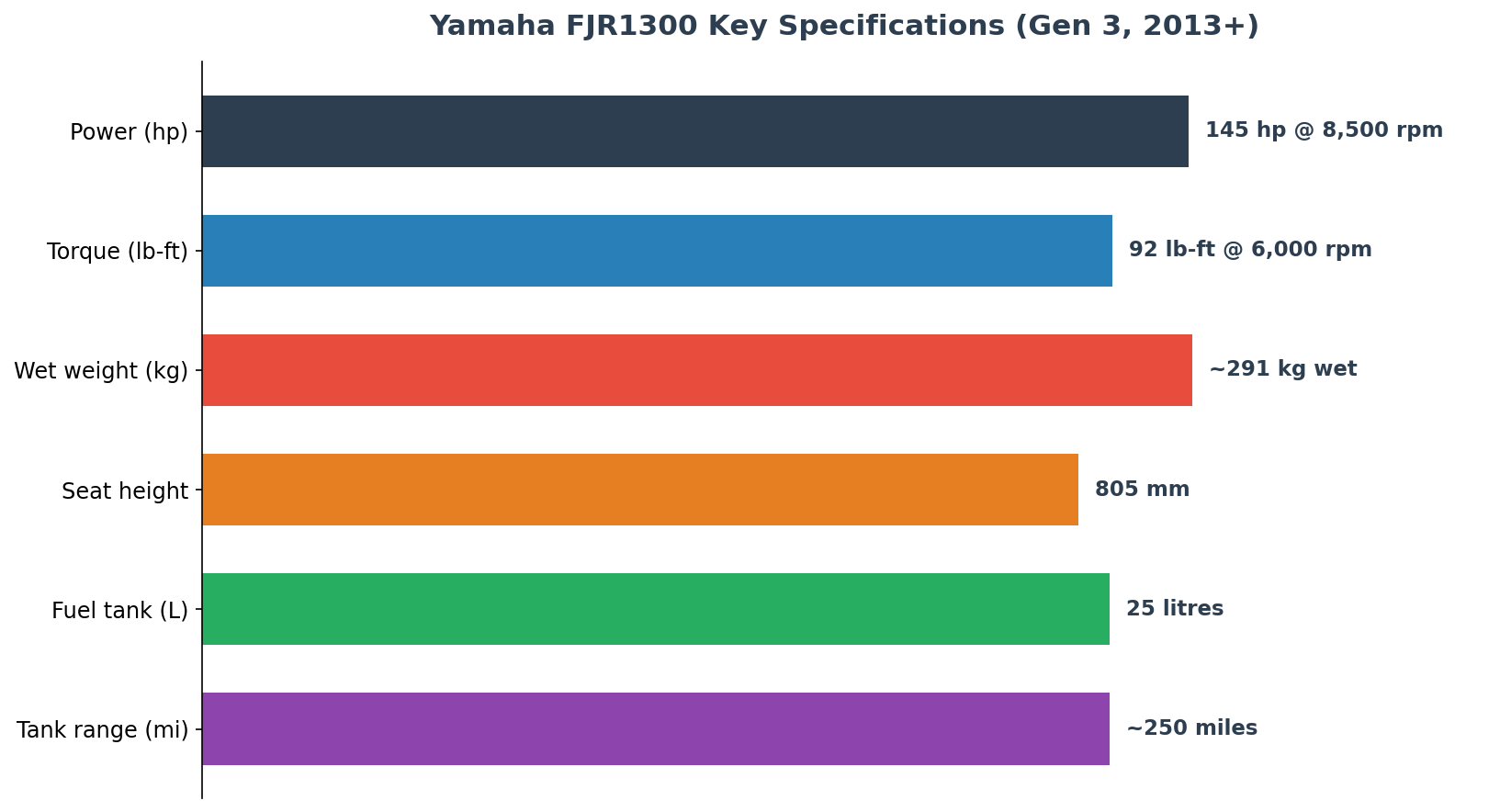
The heart of the FJR is a 1,298cc liquid-cooled, DOHC inline-four. In Gen 3 form it makes 145 horsepower at 8,500 rpm and 92 lb-ft (125Nm) of torque at 6,000 rpm. Later ES models were retuned slightly to around 142 horsepower with a fatter 102 lb-ft midrange. Numbers aside, what matters is the delivery: a wide, lazy wave of torque that makes overtakes a wrist-flick and turns motorway miles into background noise.
The final drive is a shaft, not a chain. That single design choice is why the FJR is such a low-hassle tourer. No chain to lube, adjust, or replace every 15,000 miles. You change the shaft oil occasionally and forget about it. Over a decade of touring, the savings in chains, sprockets, and Sunday-afternoon fettling add up to real money and a lot of clean hands.
People swap this engine into other things precisely because it is so tough. One UK seller recently advertised a 1989 Mini Moke fitted with a 148bhp FJR1300 engine. Nobody transplants a fragile motor. The FJR lump has a reputation for shrugging off six-figure mileages when the oil is changed and the valves are checked on schedule.
Yamaha FJR1300 generations explained
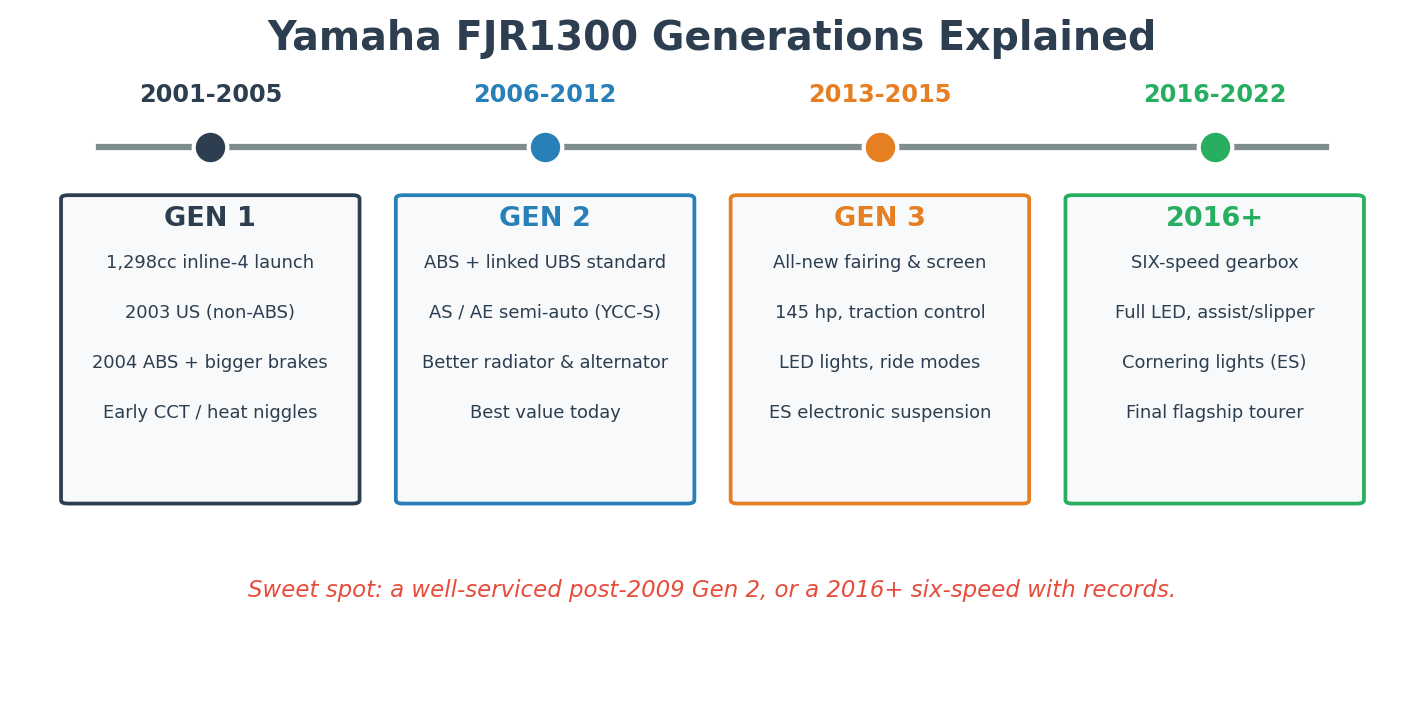
The FJR ran from 2001 to the early 2020s with three clear generations plus a significant 2016 update. Knowing which is which stops you overpaying for an early bike or missing a bargain.
Gen 1 (2001-2005)
Launched in Europe in 2001 and reaching the US as a 2003 model, the first FJR set the template: big inline-four, shaft drive, adjustable screen, sport-tourer stance. The 2003 US bike was non-ABS only; 2004 brought an ABS option, uprated suspension rates, and larger 320mm front brake discs (up from 298mm) plus a small fairing pocket. These are cheap now, but they run the hottest, and early cam chain tensioners can rattle. Buy one only if it has been sorted.
Gen 2 (2006-2012)
The big one for value hunters. In 2006 Yamaha synced model years worldwide and gave the bike revised airflow, a curved higher-capacity radiator, an upgraded alternator, trailing-arm changes, and a new final-drive ratio. ABS and Yamaha's linked "Unified Braking System" became standard. This is also when the AS/AE semi-auto arrived. A well-kept post-2009 Gen 2 is arguably the sweet spot of the whole range: modern enough, reliable, and cheap to buy.
Gen 3 (2013-2015)
A substantial overhaul. All-new front bodywork for better wind and heat management, a faster-acting electric screen, LED lighting, ride-by-wire with riding modes, traction control, and cruise control. The ES trim added electronically adjustable suspension and cornering lights. This is the FJR at its most modern-feeling without the later gearbox change.
2016 and later
The headline was a sixth gear, finally, giving relaxed high-speed cruising and lower revs on the motorway. Full LED lighting and an assist-and-slipper clutch arrived too. These are the most desirable used bikes and hold their value best. One caveat we cover below: a minority of 2016-on bikes have reported second-gear wear, so a test ride through the gears matters.
Common problems on a used FJR1300
No bike is perfect, and the FJR has a well-documented set of quirks. None of them should scare you off. All of them should shape which specific bike you buy. Here they are in the order you should check them.
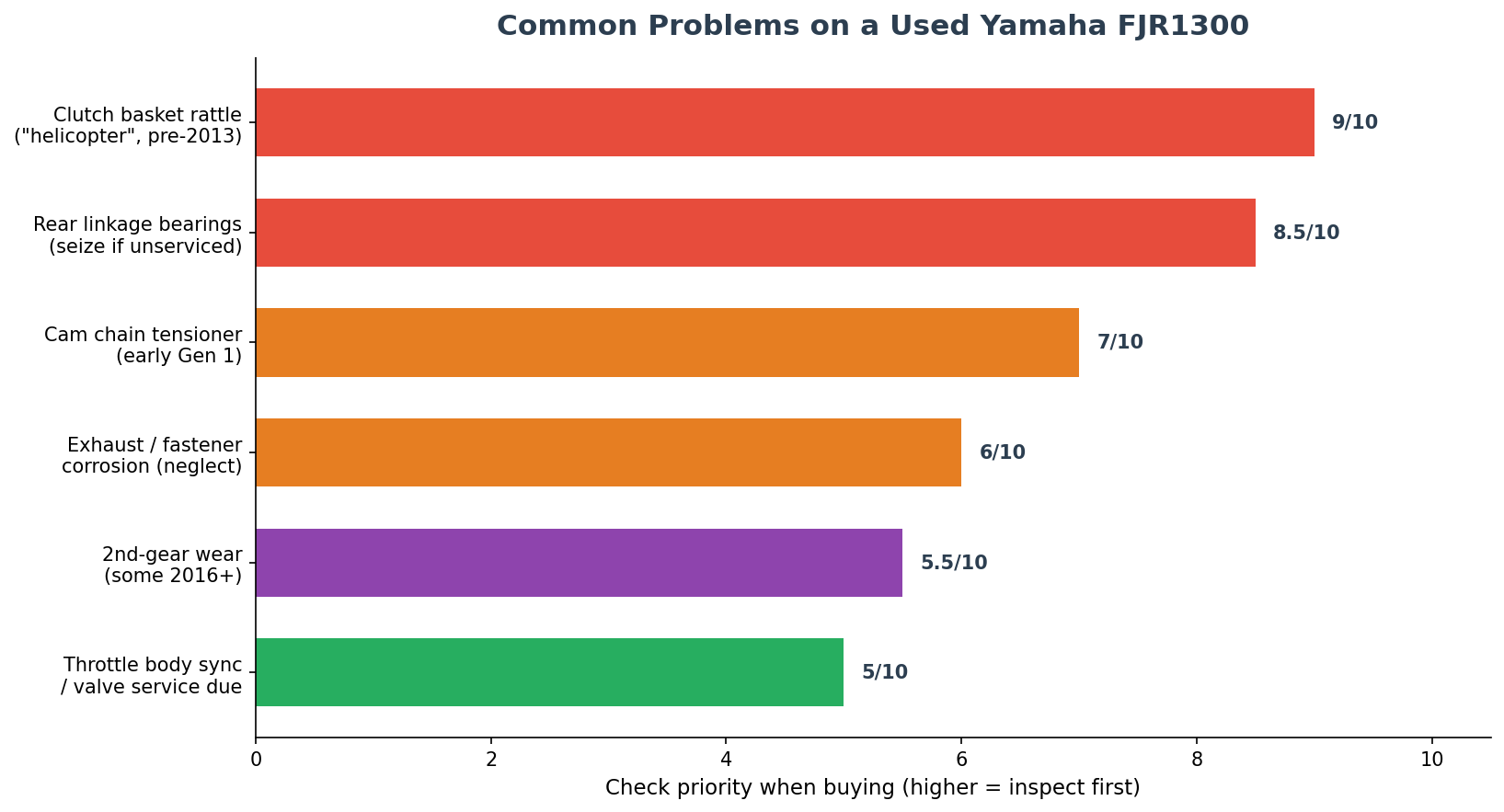
Clutch basket rattle (pre-2013). The headline fault. More below, because it deserves its own section.
Rear suspension linkage. The single most neglected service item on the whole bike. More below.
Cam chain tensioner (early Gen 1). Early tensioners can let the cam chain rattle. Yamaha released an updated part, and fitting it is a known, affordable fix. A rattly top end on a 2003-2005 bike is a bargaining chip, not a deal-breaker, as long as you budget for the update.
Corrosion on exhausts and fasteners. On neglected bikes the downpipes and bolt heads corrode. This is precisely the fault a garaged Japanese import sidesteps, which is a core reason to buy from Japan in the first place.
Throttle body sync and valve clearances. An FJR that feels lumpy at low revs usually just needs its throttle bodies balanced. Valve-clearance checks are a scheduled job. Neither is a fault so much as proof of whether the last owner cared.
Second-gear wear (some 2016-on bikes). A minority of the six-speed bikes have shown second-gear wear or a jump under load. Ride through every gear under acceleration before you buy and listen for it.
The clutch basket "helicopter noise": check this first
If you learn one thing from this guide, make it this. On pre-2013 FJR1300s the clutch basket can wear on its splines, producing a rattling or chattering under hard acceleration that owners nickname the "helicopter noise" or "clutch ratchet." It is the most serious mechanical quirk on the model, and there is no single bad year, which means every pre-2013 bike needs scrutiny here.
How to check it: accelerate hard in a low gear and listen for a metallic chatter that rises with load. Ask the seller directly whether the upgraded clutch basket has been fitted, and look for the invoice. A bike with the updated basket already installed is worth paying more for. A cheap bike with an untouched, rattling basket is a project, and you should price it as one.
On a Japan import you have an advantage here: the auction sheet and service records often reveal whether the bike was dealer-maintained, and a low-mileage garaged example is far less likely to have hammered its clutch basket to death. It is one more reason condition beats badge.
The rear suspension linkage: the silent killer
This one wrecks more FJRs than any headline engine fault, and almost nobody talks about it. The rear suspension linkage bearings must be cleaned and greased on schedule, roughly every 12,000 miles. Skip it, and the bearings seize, the linkage stops moving, and your plush tourer starts riding like a plank. Left long enough, seized linkage damages the shock and the linkage itself, turning a cheap grease job into an expensive rebuild.
Because the FJR is so reliable everywhere else, owners forget the linkage exists. When you inspect a bike, put it on the centre stand, unload the rear wheel, and feel for smooth suspension movement. Ask when the linkage was last stripped and greased. If the seller looks blank, budget for the job immediately. On a high-mileage bike that has toured hard, a fresh linkage service is non-negotiable.
YCC-S semi-automatic vs manual: which to buy
The AS/AE electric-shift FJR is one of the most interesting bikes Yamaha ever built, and it splits opinion. The 2019 AE review titled "Best sports touring bike?" pulled over 1,180 comments, and a big chunk of them argue exactly this question.
The case for the semi-auto: no clutch lever means effortless town riding and slick, quick shifts on the move. Riders with a dodgy left hand or wrist love it. The case against: it adds complexity and weight, the shifts can feel deliberate rather than lightning-fast, and if the actuator fails it is a specialist repair.
Our honest take for an import buyer: the plain manual FJR1300A is the sensible default. It is cheaper, simpler, and easier to get parts and service for anywhere in the world. Buy the AS/AE only if you have ridden one, you specifically want the auto-clutch, and the bike in front of you has a spotless history proving the system works. Do not buy an unknown-history electric-shift bike sight unseen just because it is cheap.
Best and worst years: what to avoid and the sweet spot
You do not need the newest FJR to get a great one. You need the right one.
Approach with caution: the earliest 2001-2005 Gen 1 bikes unless the cam chain tensioner has been updated and the clutch basket sorted. They run hot and they are old. Also treat any pre-2013 bike with an untouched, rattling clutch basket as a negotiation, not a purchase.
The value sweet spot: a well-serviced post-2009 Gen 2. You get ABS, linked brakes, the improved cooling and alternator, and prices that make it the bargain of the sport-touring world. If the linkage has been greased and the clutch basket is quiet, this is the smart-money FJR.
The best all-rounder: a 2016-on six-speed with full history. The extra gear transforms motorway manners, the LED lighting is a genuine upgrade, and these bikes feel modern. Just ride through the gears to rule out the second-gear niggle.
UK used prices vs a Japanese import
Let us put numbers on it. In the UK, private FJR1300 prices for 2013-2016 models run from roughly 5,850 pounds for an early Gen 3 to about 7,600 pounds for a 2016 six-speed, with dealer bikes higher at 7,300 to 9,500 pounds. Gen 2 bikes sit lower, often 3,500 to 5,000 pounds, and tidy Gen 1 examples can be found from around 2,500 pounds. There is decent supply too, with dozens listed across the major UK marketplaces at any time.
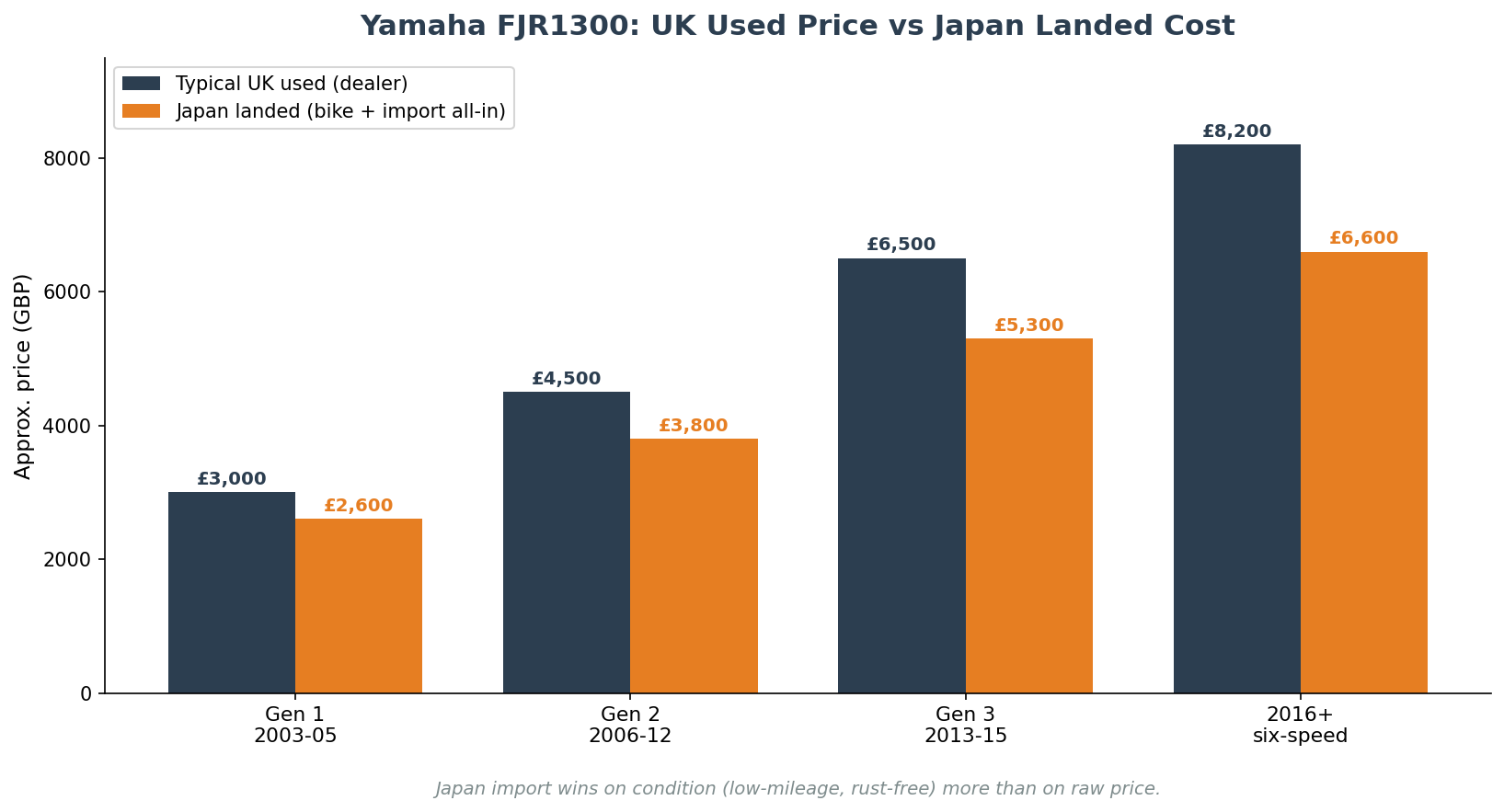
A Japanese import does not always undercut those numbers on the sticker, and honesty matters here. What it changes is the condition you get for the money. The Japan-landed figures in the chart above fold in the bike plus shipping, duty, VAT, and approval, and they broadly match or slightly beat UK used prices while delivering a lower-mileage, rust-free bike. On a machine whose one flaw is corrosion, that is the difference that counts.
Is importing an FJR1300 actually worth it? The honest math
We are an auction company, and we will still tell you plainly: importing is not automatically cheaper. Here is when it makes sense and when it does not.
Import when: you want a genuinely clean, low-mileage bike and your local market is full of tired, corroded, high-mileage examples. You want a specific spec or colour that never sold locally. Or you simply want to know the exact condition from an honest auction sheet rather than a seller's optimism.
Buy locally when: you find a well-loved, fully documented FJR down the road with the clutch basket done and the linkage greased. A sorted local bike you can inspect in person and ride home beats an unseen import every time. Do not import out of principle if the right bike is already in front of you.
For over-30-year-old classics the sums change dramatically thanks to lower tax, but the FJR is not old enough for that yet, so you are in the standard-import bracket. Plan the numbers before you bid, not after.
One more honest point. Import costs are largely fixed, so they hurt more on a cheap bike and matter less on a good one. Adding 2,000 pounds of shipping, tax, and approval to a rough 2,500-pound Gen 1 nearly doubles your outlay for a bike you could find locally. Add the same 2,000 pounds to a pristine, low-mileage Gen 3 and you have a bike that would be hard to find at any price at home. The lesson: import the good ones, not the cheap ones. The economics reward buying condition, which is exactly what Japan is best at supplying.
How to import an FJR1300 from Japan, step by step
The process sounds intimidating and is genuinely straightforward once you have done it once. Here is the UK route, which the AU and NZ processes broadly mirror with local paperwork.
Step 1: Find the bike at auction
Japanese motorcycle auctions list thousands of bikes weekly with a standardised inspection sheet for each. You bid through an agent, like AWA Auction, who has access to the halls.
Step 2: Read the auction sheet and bid
The sheet is your eyes on the ground. It grades the bike, flags corrosion, damage, and mileage, and notes anything the inspector found. We translate and interpret it for you before you commit a penny.
Step 3: Pay and arrange shipping
Once you win, the bike is prepped and shipped. Sea freight from Japan to the UK typically runs 700 to 1,200 pounds depending on crated versus RoRo and the port.
Step 4: Pay duty and VAT
For a bike over 250cc and under 30 years old, expect 6 percent import duty and 20 percent VAT. File a NOVA (Notice of Vehicle Arrivals) with HMRC within 14 days of the bike landing.
Step 5: Approval and registration
Bikes under ten years old usually need MSVA approval (roughly 100 to 250 pounds); older bikes generally skip it. Then register with the DVLA for 55 pounds, get an MOT, and budget 150 to 500 pounds for any modifications or remedial work.
Step 6: Insure and ride
Grey-import insurance runs around 200 to 600 pounds a year depending on the model and your profile. Then the FJR does what it was built to do.
All in, the add-on costs beyond the purchase price land around 1,500 to 3,500 pounds. Question about your specific situation? Talk to our team and we will map the numbers for your exact bike.
How to read a Japanese auction sheet
This is where an import lives or dies, and it is the single biggest advantage of buying from Japan over guessing from a blurry local advert. Every auction bike carries a sheet with an overall grade (typically 1 to 6, plus S for as-new), and a map of the bike marked with codes for scratches, corrosion, dents, and repairs.
On an FJR specifically, we look hard at three things on the sheet and in the photos: the exhaust downpipes and fasteners for corrosion, the shaft-drive area for leaks or neglect, and the overall grade for evidence of a drop. A grade 4 or higher bike with a clean corrosion map is exactly the rust-free machine that makes importing worthwhile. A cheap low-grade bike with corrosion codes is the same tired bike you were trying to avoid at home.
Treat the sheet as a filter, not a formality. A bike two grades higher can cost a little more at the hammer and save you a fortune in remedial work and disappointment when it lands. We would rather talk you out of a cheap, corroded bike than sell you the wrong FJR, because a rust-free import that arrives exactly as described is what turns a first-time importer into a repeat customer.
We read these sheets every day. Browse our current listings and you will see the grade and condition notes up front, no optimism, just the inspector's verdict.
FJR1300 vs the sport-touring rivals
The FJR does not exist in a vacuum. If you are spending import money, know what else it is up against. The most-watched touring comparisons on YouTube, including the MotoUSA shootouts, tend to pit the FJR against exactly these bikes.
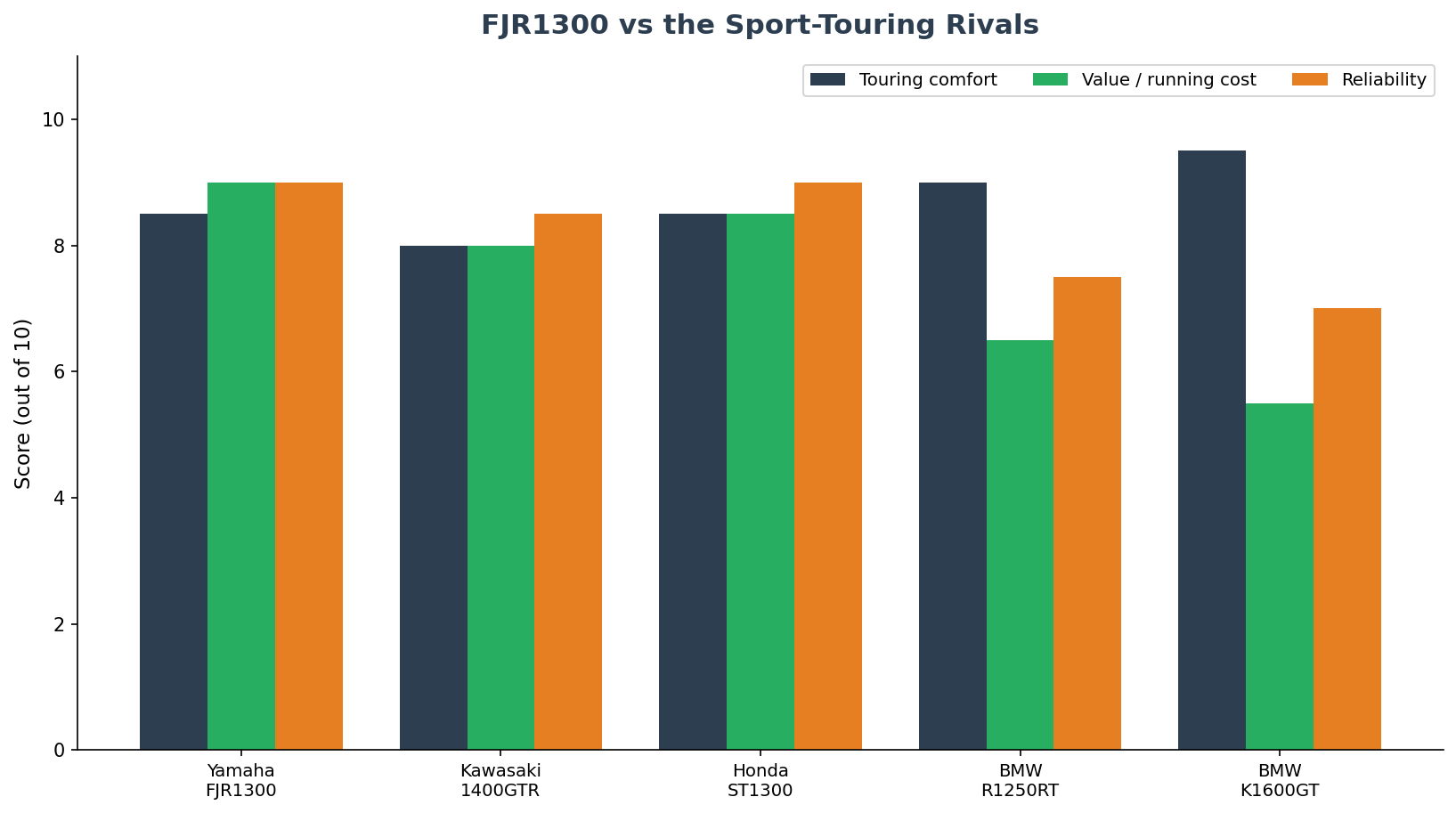
Kawasaki 1400GTR / Concours 14. The FJR's closest Japanese rival: bigger, faster, thirstier, and a touch more complex. The FJR is lighter on its feet and cheaper to run.
Honda ST1300 Pan European. The other shaft-drive Japanese workhorse, beloved of police fleets. Bulletproof and comfortable, but older in design and heavier-steering than a modern FJR.
BMW R1250RT. More refined, more electronics, and a lovely boxer engine, but more expensive to buy and to fix. The FJR wins decisively on running costs and simplicity.
BMW K1600GT. The six-cylinder luxury liner. Smoother and more powerful, but heavier, pricier, and a bigger bill when things go wrong. The FJR is the sensible person's choice.
The pattern is clear: the FJR rarely wins on outright luxury or top speed, and almost always wins on the combination of comfort, reliability, and cost that actually matters over ten years of ownership.
What owner reviews and long-term tests reveal
The FJR1300 has been reviewed and lived-with on camera for two decades, and the recurring themes are worth knowing before you bid. The most-watched clips are not hype reels; they are long-term owners telling you what the bike is actually like to keep.
The single biggest FJR video, a handling-focused piece with over 1.8 million views, spends its time on one surprising point: how a 291kg bike can be flicked through bends with far less effort than the spec sheet suggests. Reviewers keep landing on the same word, "planted," and it is the reason owners forgive the weight. The FJR hides its mass the moment the wheels are turning.
The RevZilla First Ride review, with over 400,000 views, and its blunter follow-up "Sh*t I Couldn\'t Say," both circle the same verdict: the FJR is not the flashiest tourer, but it is the one that just works, year after year, with the fewest excuses. That is not a criticism. For a bike you plan to own for a decade and ride across continents, "it just works" is the highest praise there is.
Then there is the police angle, which is the strongest trust signal of all. One of the most-viewed European reviews is built around the fact that patrol forces chose the FJR, calling it "close to perfection" for the job. Fleet buyers do not care about looks or marketing. They care about uptime, and they voted with their budgets. When you buy a used FJR, you are buying into that same durability.
The owner comments under these videos, thousands of them, keep repeating the same downsides too, and they match this guide exactly: heat on early bikes, the clutch-basket rattle on older ones, and the linkage that people forget to grease. Nobody complains the engine wore out. That pattern, praise for the drivetrain and warnings about a short, known list of niggles, is precisely why the FJR is such a confident used buy when you check the right things.
Running costs and maintenance
This is the FJR's quiet superpower. Fuel economy sits around 45 mpg, and with a 25-litre tank you get roughly 250 miles between fills. The shaft drive means no chain costs, ever. Service intervals are sensible, with valve-clearance checks spaced out and oil changes the main routine job.
The two costs to plan for are tyres, which wear faster on a heavy, powerful tourer, and the rear linkage service we hammered on earlier. Do the linkage on time and the FJR is one of the cheapest big bikes to live with. Skip it and you will pay eventually. Everything else is standard four-cylinder maintenance that any competent mechanic can handle.
Put rough numbers on a year of touring. At 45 mpg a rider covering 8,000 miles burns a manageable fuel bill, the shaft costs nothing beyond an occasional oil change, and there are no chain or sprocket replacements to fund. Against a chain-drive rival that eats a chain-and-sprocket kit every 15,000 to 18,000 miles, the FJR quietly saves you a set of tyres\' worth of money over the same distance. The heavy tourer that looks expensive on the forecourt is one of the cheapest big bikes to actually run.
Comfort, screen and ergonomics on a long day
A tourer lives or dies on how it treats you at hour six, and this is where the FJR earns its keep. The riding position is upright and roomy without being armchair-soft, so you stay engaged rather than slumped. The seat is broad and supportive, and later bikes offer adjustable seat height and reach to dial the fit to your frame.
The electric screen is the headline comfort feature. Raise it and the wind lifts off your chest and helmet; drop it and you get fresh air on a warm day. Some riders on tall or short ends of the spectrum still feel buffeting at the screen\'s edge, which is exactly why an aftermarket touring screen is the most common first modification. Get the airflow right and you can hold motorway speeds for hours with a quiet helmet and no neck strain.
Heat management is worth a mention because it separates the generations. Early Gen 1 bikes are known for throwing engine heat onto the rider\'s legs in slow traffic, one of the reasons Yamaha redesigned the fairing and airflow for Gen 3. If you ride in a hot climate or sit in a lot of town traffic, that redesign is a real reason to favour a 2013-on bike. On the open road, at the speeds the FJR was built for, heat is a non-issue on any generation.
Cruise control, standard on later bikes, turns long motorway droning into a relaxed cruise, and heated grips take the sting out of cold mornings. These are the details that make riders keep an FJR for ten years instead of trading up.
Two-up touring and luggage
The FJR was designed from the ground up to carry a passenger and a fortnight of luggage, and it shows. The pillion seat is genuinely usable for long stints, with grab rails and a sensible perch rather than a token afterthought. Owners regularly report two-up, fully loaded runs across countries with no drama, and the JDM chatter backs this up: one Japanese rider described crossing the Shin-Tomei expressway two-up with panniers as completely effortless.
Luggage is part of the deal. Integrated hard panniers are colour-matched and lock to the ignition key on most bikes, and a top box is a popular add-on for helmet storage and touring capacity. The mounting hardware is built in, so you are not bolting on a compromise, you are using a system Yamaha engineered for the bike.
The 25-litre tank and roughly 250-mile range mean fewer fuel stops on a big day, which matters more than it sounds when you are riding with a passenger who would rather keep moving. Add the shaft drive, and a two-week tour becomes a matter of changing your socks and checking tyre pressures. This is the practical, unglamorous competence that makes the FJR the tourer people actually finish their long trips on, rather than the one that looked exciting in the showroom.
Popular modifications
FJR owners are practical people, and the popular mods reflect it. A taller aftermarket screen (Cee Bailey, MRA, and similar) cures the wind buffeting some riders feel at speed. Bar risers and heli-bars ease the reach for a more upright touring position. Auxiliary lighting, a centre-stand-friendly paddock setup, and upgraded seats (Corbin, Sargent) round out the usual list. Heated grips and cruise control are already standard on later bikes.
None of these are performance mods, and that is the point. The FJR is bought to cover distance in comfort, so the modifications that sell used bikes fastest are the ones that make long days easier, not faster.
Is the FJR1300 a good first big bike?
Honestly? For most riders, no, and we would rather tell you that now than sell you a bike you drop in a car park. At around 291kg wet with a tall centre of gravity, the FJR is a lot of motorcycle to manage at walking pace. A nervous newcomer will find low-speed manoeuvres intimidating.
That said, once rolling, the FJR is remarkably easy: planted, smooth, and forgiving, with a low-effort torque delivery that never bites. If you have some road experience, you are not put off by the weight, and you mostly ride distance rather than town, it can absolutely work as a step up. If you are brand new, start lighter and graduate to the FJR when you are ready. It will still be here, and it will still be reliable.
Pre-purchase checklist
- Accelerate hard through the gears and listen for clutch-basket "helicopter" rattle on any pre-2013 bike.
- Confirm whether the upgraded clutch basket has been fitted, with an invoice.
- Ask when the rear suspension linkage was last stripped and greased; feel for smooth rear movement.
- Check exhaust downpipes and fasteners for corrosion, the FJR's main ageing flaw.
- On 2016-on bikes, ride through second gear under load to rule out wear.
- On early Gen 1 bikes, verify the cam chain tensioner update.
- Confirm valve-clearance and throttle-body-sync service history.
- For an AS/AE, prove the YCC-S electric shift works flawlessly, with history.
- On an import, read the auction sheet: grade, corrosion map, and any drop codes.
- Match the generation to your budget: Gen 2 for value, 2016+ for the best all-rounder.
Where AWA Auction fits in
Importing an FJR1300 from Japan is not gambling when you can read the auction sheet, and reading auction sheets is what we do. We give you the inspector's honest grade, translate the condition notes, flag corrosion and drop codes before you bid, and handle the shipping and paperwork so a rust-free, low-mileage flagship tourer lands on your driveway instead of someone else's tired project.
The FJR1300 is one of the smartest used-tourer buys on the planet, and Japan is where the clean ones live. Buy on condition and history, do the clutch-basket and linkage checks, and you will own a bike that shrugs off 500-mile days for another decade.
See Also
Share this article: