
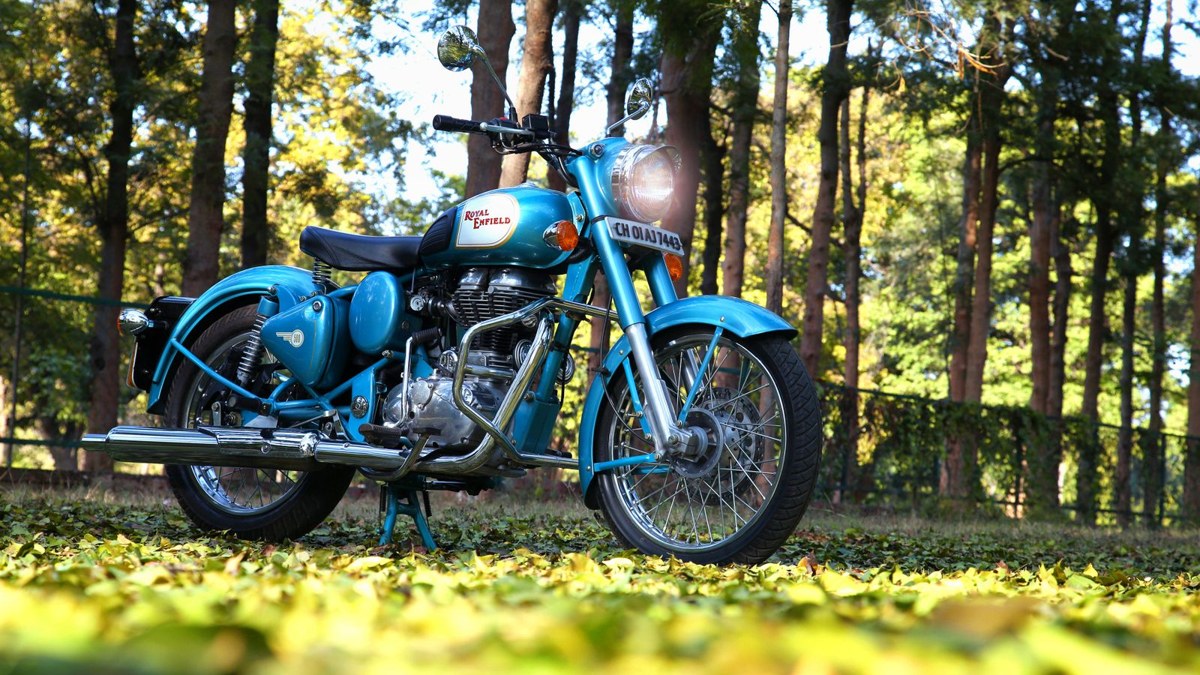
The Yamaha XJR400 is one of those bikes that was never sold where you live, never homologated for your market, and never going to show up at your local dealer. It was built for Japan, sold in Japan, and ridden hard on Japanese streets for thirty years. If you want one, there is exactly one honest way to get it: import an XJR400 from Japan. That is not a limitation. That is the opportunity, because it means you are shopping in the single largest, deepest, best-documented pool of these bikes that has ever existed.
Here is the thing nobody mentions up front. The XJR400 is a small-bore version of a legend. Yamaha took the muscular, air-cooled, twin-shock styling of the big XJR1200 and shrank it into Japan's 400cc class, where a learner-friendly licence and a fierce four-bike rivalry produced some of the most over-engineered middleweights ever made. A 399cc inline-four that screams to 11,000 rpm, a thick steel tubular frame, and the kind of build quality that lets a bike sit abandoned for 21 years and still fire up after a carb clean — there is a 6.6-million-view YouTube restoration that proves exactly that.
This guide is the one we wish existed when we started buying these for customers. Real auction prices, the carb truth, the XJR400 versus XJR400R question, the USA 25-year rule that just opened the door, and the landed-cost math for the US, UK, Australia and New Zealand. No fluff, no recycled spec sheets.
What Is the Yamaha XJR400 and Why It Only Exists in Japan
The XJR400 launched in 1993 as Yamaha's answer to a uniquely Japanese problem. In Japan, the 400cc class is its own universe. A standard motorcycle licence caps most riders at 400cc for years, so the big four — Honda, Yamaha, Suzuki, Kawasaki — poured flagship-level engineering into 400cc machines that the rest of the world never got to see. The XJR400 was Yamaha's retro-muscle entry: air-cooled, carburetted, twin rear shocks, round headlight, and a fat 4-into-1 exhaust note that sounds twice its size.
The engine is a 399cc DOHC 16-valve inline-four, air-cooled with an oil cooler, making 53 PS at 11,000 rpm. That is a genuinely high-revving little four, fed by four Mikuni BSR30 carburettors that stayed analogue for the entire production run. No fuel injection, no water pump, no ride-by-wire — just a mechanically simple, over-built motor in a chassis that weighs around 185 kg dry.
It was sold new only in Japan. It was never federalised for the US, never given UK or EU type approval as a current model, never sent to Australia through official channels. Every XJR400 outside Japan today arrived as a grey import or a personal import. That is why the import route matters so much: there is no domestic used market to fall back on, so the quality and price of your bike are decided entirely by how well you buy it out of Japan.
Production ran from 1993 all the way to roughly 2008, which gives you a wide spread of years to choose from. And because Japan's shaken roadworthiness regime forces owners to maintain bikes or scrap them, the surviving examples skew toward genuinely cared-for machines rather than neglected sheds-finds.
A Quick History: From XJR1200 Roots to Street Icon
To understand why the XJR400 feels the way it does, you have to know what it was copied from. In 1994 Yamaha launched the XJR1200, a big air-cooled muscle naked built around an engine descended from the legendary FJ sport-tourers. It was a deliberate throwback in an era obsessed with plastic-clad race replicas — a return to round headlights, twin shocks, exposed engine fins and honest mechanical character. It sold brilliantly.
The XJR400 was Yamaha playing that same card in the 400cc class a year earlier, in 1993. It borrowed the big bike's whole design language and miniaturised it: same stance, same twin-shock silhouette, same muscular tank, scaled to a learner-legal 399cc. For Japanese riders stuck on a 400cc licence, it was a way to own a bike that looked and felt like a big-bore naked without breaking the licence rules. That is a huge part of its emotional appeal even now.
Across its long life — 1993 to roughly 2008 — the bike evolved steadily rather than dramatically. The 1995 switch to XJR400R brought the strengthened internals and the premium suspension and brake options. Later years tidied details and tightened emissions compliance until ever-stricter rules finally killed the air-cooled four for good. That long run is good news for importers: there are a lot of these bikes out there, across many model years, which keeps prices honest and choice wide.
The cultural afterlife is where it gets interesting. In Japan the XJR400 became a fixture of the kyusha-kai classic-bike scene and the bosozoku-adjacent street culture, beloved for how easily it takes modification and how good it sounds with a four-into-one pipe. That is why your YouTube feed is full of XJR restorations and rev videos pulling millions of views — this is a bike with a living, loud, devoted following, not a museum piece.
XJR400 vs XJR400R: The Difference That Decides Your Budget
Before you bid on anything, you need to understand the single most important badge on this bike. In 1995 Yamaha renamed the model XJR400R and upgraded it, and the difference between the early XJR400 and the later XJR400R is real money.
The base 1993–1994 XJR400 has conventional rear shocks and standard brakes. From 1995, the XJR400R arrived with strengthened internals — Yamaha beefed up the pistons and conrods, revised the ignition and muffler — and, crucially, fitted upgraded suspension and brakes on the higher-spec versions. The desirable XJR400R variants run gold four-piston Brembo front calipers and yellow-spring Öhlins rear shocks. Those are not cosmetic. A genuine Öhlins-and-Brembo XJR400R rides and stops noticeably better, and it commands a clear premium at auction.
Then there is the model code. Both the XJR400 and XJR400R wear the 4HM frame designation through the carburetted era, while the very last fuel-injected-era refinements appear under the RH02J code. For an importer, the practical takeaway is simple: read the model badge and the auction sheet, confirm whether the Öhlins and Brembo parts are present and original, and price accordingly. A seller calling a base 4HM an "XJR400R" with aftermarket shocks bolted on is the oldest trick in the catalogue.
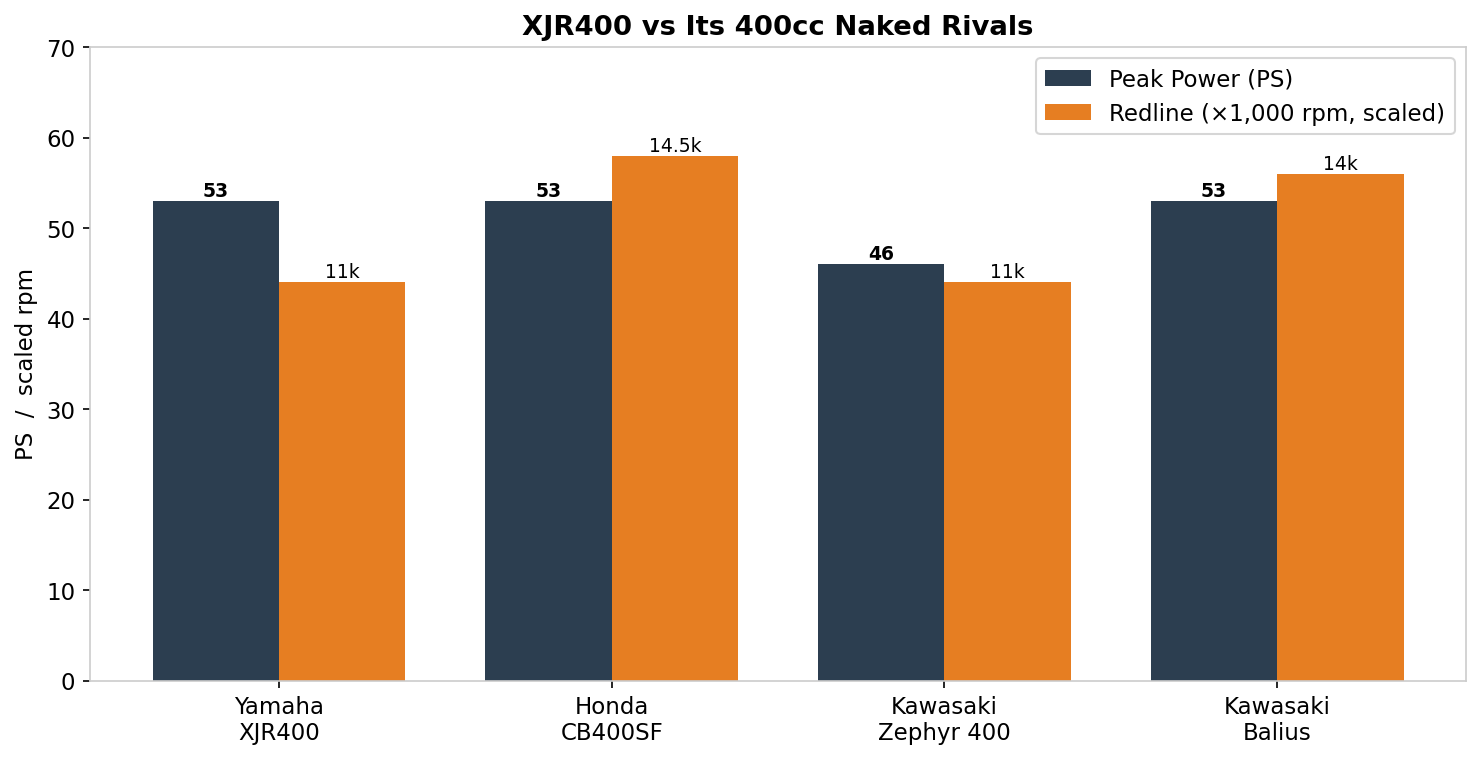
The chart above places the XJR400 against its three eternal rivals — Honda's CB400 Super Four, Kawasaki's Zephyr 400, and Kawasaki's Balius — the four bikes that defined Japan's 400cc naked wars. The XJR's pitch was always torque and stance over outright revs. The CB400SF revs harder and handles a touch sharper; the Zephyr trades on classic looks; the XJR gives you the most big-bike feel for the money. If you want the muscle-cruiser-meets-naked vibe, the XJR is the one.
Why the XJR400 Is Worth Importing in 2026
Three things make right now a smart moment to import an XJR400, and they all point the same direction.
First, the cultural pull is exploding. This is not a forgotten bike — it is a YouTube and street-culture icon. A single full-restoration series on a 21-year-abandoned XJR400 has pulled over 6.6 million views, with thousands of comments. Restoration and kyusha-kai (classic-bike-scene) content around the XJR routinely clears one to two million views. That kind of attention drives demand, and demand drives prices — which means clean examples are appreciating, not depreciating.
Second, the entry point is still sane. On Japanese marketplaces and private sales you can still find running XJR400s changing hands for the equivalent of a few hundred to a couple of thousand dollars. We have seen private listings on X (formerly Twitter) where owners offload running bikes for ¥350,000 and drop to ¥300,000 for a quick pickup — roughly $2,000–$2,400 — and YouTube creators have bought rough-but-running examples for as little as ¥39,800. The cheap ones are projects, but the pipeline is full.
Third, and this is the big one for American buyers: the calendar just unlocked the USA. The earliest XJR400s are now comfortably past the 25-year threshold, which changes the entire import equation for the US market. We will get to exactly what that means below.
Put simply: the XJR400 is a rising classic that is still affordable, still abundant in Japan, and increasingly legal to import. That combination does not last forever.
The 25-Year Rule and What It Means for US Buyers
If you are in the United States, this section is the whole game. American import law treats a motor vehicle that is at least 25 years old, measured from the month and year of manufacture, very differently from a newer one. Once a bike crosses that 25-year line, it qualifies for the exemption that lets it skip the expensive NHTSA (DOT) conformity process, and EPA rules likewise ease for vehicles of that age. The practical result: a 25-year-or-older XJR400 can generally be imported as a collector-eligible motorcycle without a Registered Importer rebuilding it to US standards.
Do the math. In 2026, every XJR400 built in 2000 or earlier is 25-plus years old — and since the model started in 1993, that covers the entire first wave of the bike, including the most sought-after early XJR400R examples with the original Öhlins and Brembo kit. You are no longer waiting; the door is open today and widens every January.
What you still owe: the standard customs duty (motorcycle duty into the US is low, typically 2.4–2.5%), the EPA and DOT entry paperwork (forms 3520-1 and HS-7 with the correct exemption boxes checked), and a customs broker to clear it. None of that requires modifying the bike. Always confirm the current process against the official NHTSA importing-a-vehicle guidance and the EPA imports page before you commit, because the boxes you tick on those forms are what keep the bike legal.
Here is the honest caveat. The 25-year exemption gets the bike into the country. Titling and registering it for the road afterward is a state-by-state matter, and a handful of states are fussy about JDM grey imports. That is a paperwork hurdle, not a wall — thousands of JDM bikes are road-registered across the US — but check your own state's stance before you ship.
Importing an XJR400 to the UK, Australia and New Zealand
The XJR400 is arguably even more at home in the right-hand-drive, right-hand-ride world, and the UK, Australia and New Zealand have well-worn paths for exactly this kind of grey import.
In the UK, an imported XJR400 over ten years old goes through registration with the DVLA, and because it pre-dates the strict modern emissions cut-offs it avoids the worst of the type-approval pain. You will pay 20% VAT plus the motorcycle import duty on the landed value, arrange a valid certificate, and register it. Britain has a deep, decades-old culture of 400cc Japanese grey imports — there are entire forums and specialists built around them — so parts knowledge and registration know-how are easy to find. Confirm the current steps on GOV.UK's importing vehicles guidance.
In Australia, the XJR400 is a strong candidate because motorcycles over 25 years old can be brought in under the older-vehicle pathway of the Road Vehicle Standards rules, sidestepping the tighter approval process newer bikes face. You will need an import approval before the bike ships, then pay duty, GST and any applicable luxury thresholds (rarely an issue on a 400). Pre-2001 XJR400s are the easy wins here.
In New Zealand, grey imports are practically a national sport, and the XJR400 slots right in. The bike must pass entry certification and meet the frontal-impact and emissions rules for its age — older machines face lighter requirements — and then it is compliance-checked and registered. NZ's used-Japanese-import infrastructure is so mature that getting an XJR through it is routine.
Across all three markets the pattern is the same: the XJR400's age is your friend. The older the bike, the lighter the regulatory load, and the early Öhlins-equipped XJR400Rs are both the most desirable and the easiest to land.
What an XJR400 Really Costs: Landed Price Breakdown
Let's talk real numbers, because the auction price is only the start. Below is a realistic landed-cost breakdown for a clean mid-spec XJR400R bought through an auction agent and shipped to a typical Western port.
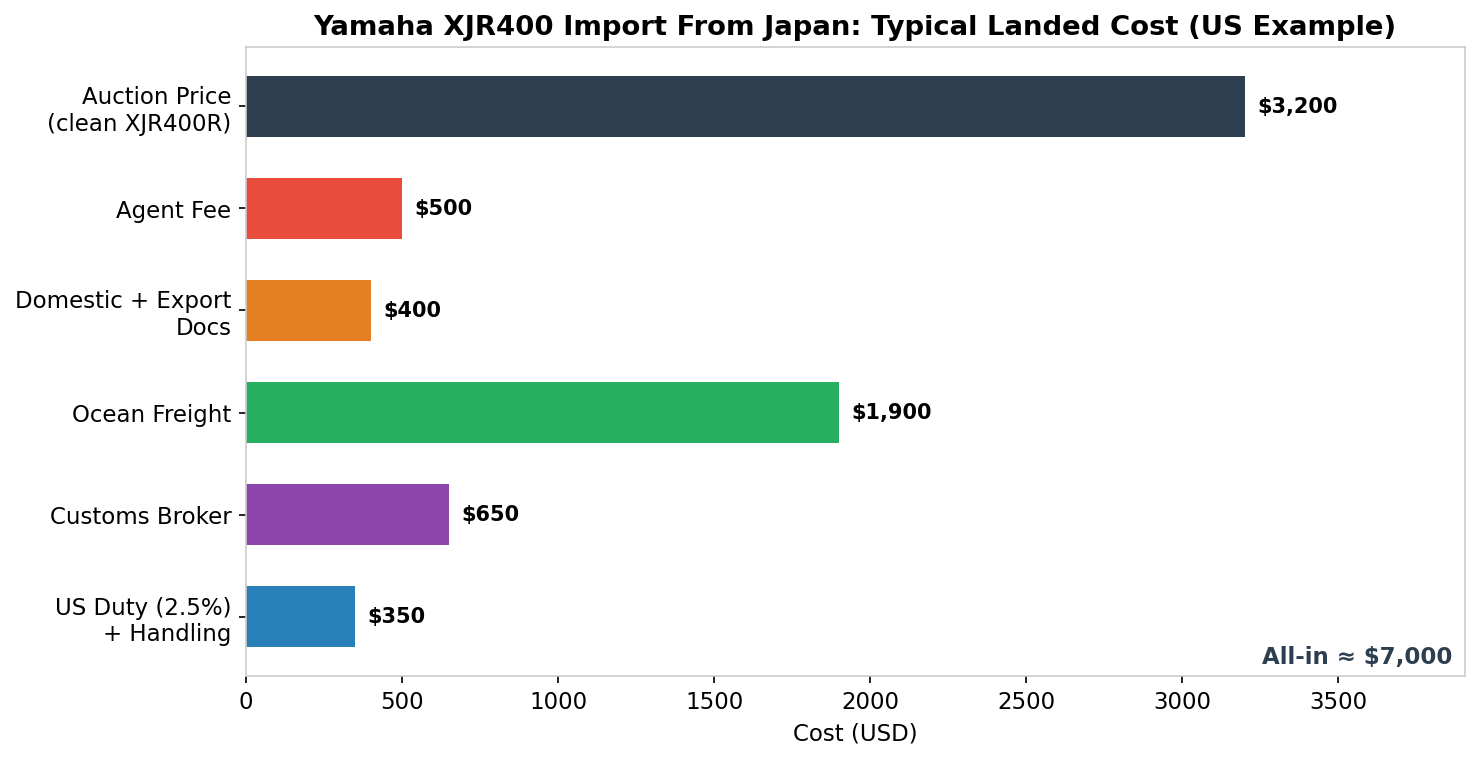
The hammer price for a tidy, running XJR400R in good order typically lands somewhere around ¥350,000–¥600,000 at the Japanese motorcycle auctions, call it $2,300–$4,000 depending on condition, mileage and whether it carries the genuine Öhlins-and-Brembo kit. On top of that you stack the agent's fee, domestic transport to the port, export documentation and de-registration, ocean freight, then your own country's duty and tax.
For most destinations, budget roughly $2,000–$3,500 on top of the hammer price to get the bike landed and cleared. A $3,000 auction XJR400 generally lands between $5,000 and $7,000 all-in — the US sitting near the bottom thanks to its 2.5% duty and no VAT, and 20%-VAT markets like the UK sitting near the top. Shipping alone usually runs $1,500–$2,800, customs brokerage $400–$900, and the agent's commission a few hundred dollars.
Crate versus container changes the freight line. A motorcycle in a shared container is cheaper but slower; a solo crate is faster and safer but pricier. We break down that trade-off in our guide on choosing the right shipping method, and for a bike this collectible we lean toward the more protective option.
Step by Step: How Importing an XJR400 Actually Works
The mechanics of a Japan import scare people who have never done one, so here is the whole thing in plain order. None of it is hard once you know the shape of it.
Step 1 — Decide your spec and budget. Base XJR400 or genuine XJR400R? Stock or project? Set a hard all-in ceiling that includes shipping, duty and tax, not just the hammer price. The landed-cost section above is your map.
Step 2 — Get access to the auctions. The real XJR400s trade at Japan's dealer-only motorcycle auctions (BDS, JBA, i-Auc and others). You cannot bid at these directly from abroad; you go through an agent who holds membership. This is the single most important choice you make, because the agent is also the person reading the inspection sheet for you.
Step 3 — Shortlist and read the sheets. Your agent sends candidates with the auction inspection sheet, the grade, mileage and photos. You filter for variant, originality, frame condition and the carb/tank red flags. This is where good buyers win — patience here saves you thousands.
Step 4 — Set a maximum bid. You name the most you will pay; the agent bids on your behalf at the live auction. Win or lose, you only commit at your ceiling. Lose one, there is another next week — the supply is genuinely deep.
Step 5 — Pay and de-register. When you win, you settle the invoice (hammer price plus fees), and the bike is de-registered for export and given the export certificate that proves its identity and history.
Step 6 — Ship it. The bike is crated or containerised and put on a vessel to your nearest port. Sea freight is typically two to six weeks depending on route. You will get tracking and the shipping documents you need for customs.
Step 7 — Clear customs and register. At your end, a customs broker clears the bike, you pay duty and tax, and you complete the import and registration paperwork for your country and state. For 25-year-eligible bikes in the US, Australia and NZ, this is where the age exemption does its work and saves you the compliance rebuild.
That is the entire journey: pick, bid, pay, ship, clear, ride. The two steps that decide whether you are happy are Step 2 and Step 3 — who is bidding for you, and how well they read the sheet.
The Carburettor Truth: The One Thing That Decides Reliability
If you remember one technical fact from this entire guide, make it this: the XJR400 lives and dies by its carburettors. Four Mikuni BSR30 carbs feed that little four, and because so many of these bikes sat for years before being revived, carb condition is the number-one reason an XJR runs badly.
The owner forums and restoration channels say the same thing over and over. One UK grey-import veteran put it bluntly: a full carburettor overhaul should be treated as a matter of course on any newly imported XJR, "otherwise you could spend a lot of time chasing your tail." Owners report perished inlet rubbers, fuel leaking from the carbs, and bikes that start cold but stumble and hesitate until the bank is properly cleaned and balanced. The recommended rhythm is plugs and a carb balance roughly every 3,000 miles.
This is exactly why the YouTube restoration content is so instructive. The famous 21-year-abandoned XJR400 that came back to life? The hero moment in that build was the carburettor strip and clean. The engine itself was fine — air-cooled inline-fours are tanks — but the fuel system needed the love. That pattern repeats across dozens of revival videos.
The buying lesson is simple. Assume any imported XJR400 needs a carb service, and budget a few hundred dollars and an afternoon for it even if the bike "runs fine." If you are not comfortable balancing four carbs, factor in a shop visit. Do this and the XJR is genuinely reliable; skip it and you will hate the bike. There is no in-between.
XJR400 Maintenance Schedule and Real Running Costs
The XJR400 is cheap to run by big-bike standards, but only if you respect the few things it asks for. Here is the honest ownership rhythm.
Every ride, do the basics any old air-cooled bike wants: check the oil level (this engine relies on its oil cooler, so never run it low), chain tension and tyre pressures. Every 3,000 miles, change the plugs and balance the four carbs — this is the single most important recurring job and the one most neglected imports have skipped for years. Oil and filter changes on the air-cooled four are frequent and cheap; treat it like the simple machine it is and change oil often.
Valve clearances need periodic checking, since this is a 16-valve four with shim-and-bucket adjustment, but the motor is famously durable when the valves are kept in spec. The clutch, gearbox and electrics are robust; the usual age-related gremlins are tired fork seals, perished carb inlet rubbers, brittle wiring connectors and rust in a tank that sat with old fuel. None of it is exotic, and parts are everywhere.
On running costs, budget for fuel at roughly 50 mpg, a set of mid-range tyres every few thousand miles, and consumables. The big variables are the one-off recommissioning items on a fresh import: a full carb overhaul, fresh fluids all round, a new chain and sprockets if the old set is worn, and possibly fork seals. Set aside a few hundred dollars for that initial sort-out and the XJR400 settles into being a genuinely inexpensive classic to keep on the road.
The reassuring part is what the restoration videos prove: even badly neglected examples come back. The engine is the strong point, and most "dead" XJR400s are really just clogged-carb XJR400s. Buy the best one you can, do the recommissioning properly once, and the bike rewards you with years of cheap, characterful miles.
Reading the Auction Sheet: How to Spot a Good XJR400
Japanese motorcycle auctions grade every bike on an inspection sheet, and learning to read it is the difference between landing a gem and importing someone else's headache. The XJR400 has a few model-specific things to watch beyond the usual grade number.
Start with the obvious: confirm the model and variant. The sheet and photos should show whether it is a base XJR400 or a genuine XJR400R, and whether the Öhlins shocks (yellow springs) and gold Brembo calipers are present and original rather than later add-ons. A real XJR400R is worth meaningfully more, so this is where value is made or lost.
Next, the frame and rust. The XJR's thick tubular steel frame is tough but it is steel, and bikes that lived near the coast or got ridden through winters can show frame and fastener corrosion. Check the sheet's corrosion notes and the underside photos.
Then the cosmetics that cost real money: the tank (these are prone to inside rust if the bike sat with old fuel), the four-into-one exhaust (originals are pricey; many have aftermarket cans), the side panels and the round headlight assembly. Mileage on a 400 four is rarely the limiting factor — these motors run well past 50,000 km when serviced — so prioritise condition and originality over a low odometer that may have been wound.
Finally, watch for the bosozoku and kyusha-kai custom history. The XJR400 is a darling of Japan's classic-bike street scene, which means a chunk of the market has been modified — loud exhausts, raised bars, paint. That is fine if you want a project, but if you want a clean stock bike, filter those out early. Our deeper walkthrough on how to read Japanese auction inspection sheets covers the grade-by-grade detail.
XJR400 Performance, Specs and What It's Like to Ride
Numbers first, then the feel.
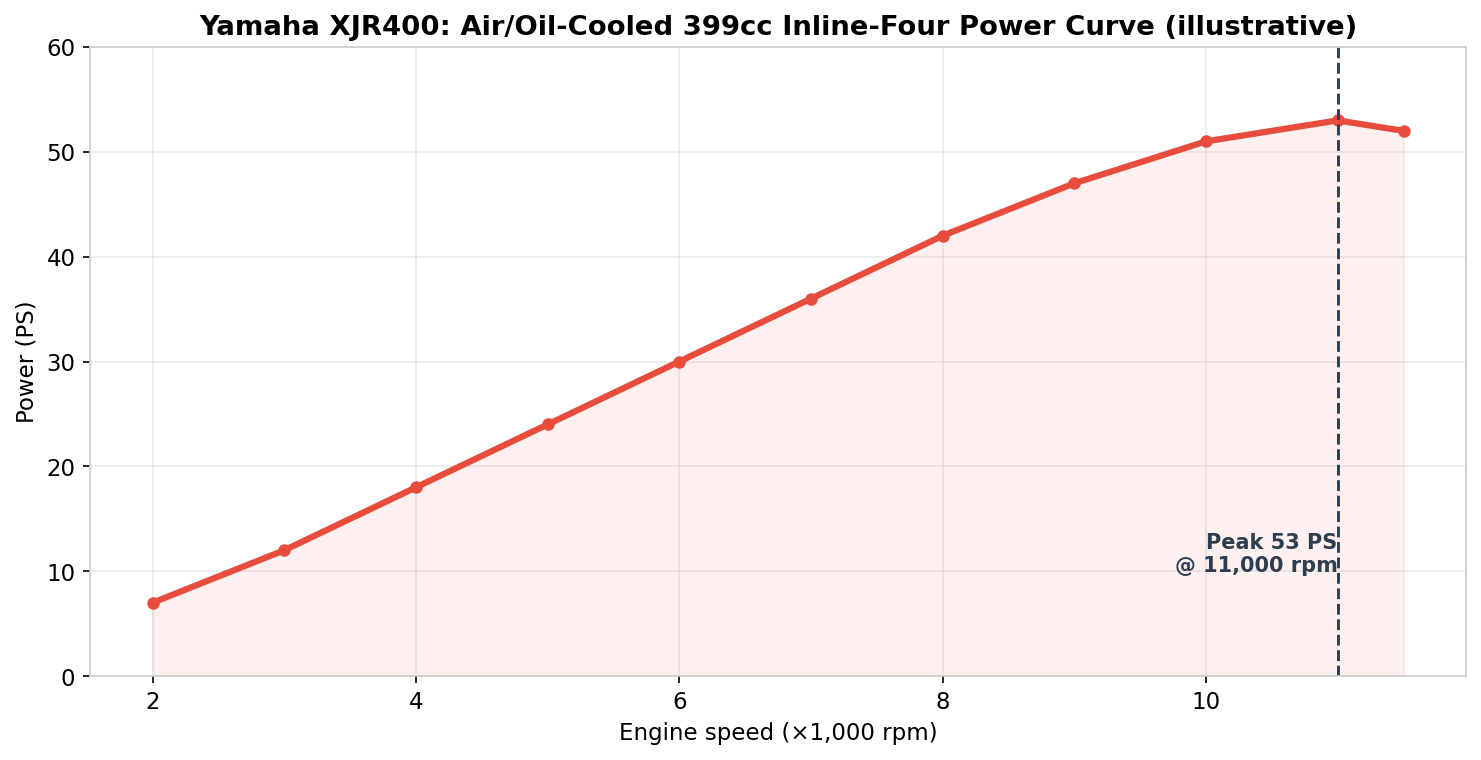
The XJR400 makes its 53 PS at a heady 11,000 rpm from the air/oil-cooled 399cc inline-four, runs a six-speed gearbox, weighs about 185 kg dry, and will see an indicated 180 km/h flat out. Fuel economy sits in the comfortable 50 mpg neighbourhood. On paper it is not the most powerful 400 — the CB400SF revs a fraction harder — but the way the XJR delivers that power is the point.
It feels like a big bike that someone shrank. The riding position is upright and roomy, the torque comes in low and friendly for a high-revving four, and the twin-shock chassis gives it a planted, stable, almost old-school muscle-bike character. Reviewers consistently describe it as a stability-first machine you buy because you love the look and the stance, not because it is the sharpest tool in the 400 box. That is exactly its charm.
For a daily rider it is brilliant: light enough to flick through traffic, torquey enough to not need constant gear-rowing, simple enough to maintain in your own garage, and characterful enough that you will keep finding excuses to ride it. For a weekend classic it is just as good — it looks the part at any bike night and has the cultural cachet to match.
XJR400 Market Values: Where Prices Are Heading
The XJR400 has quietly moved from "cheap JDM commuter" to "appreciating modern classic," and the trajectory matters if you are buying now.
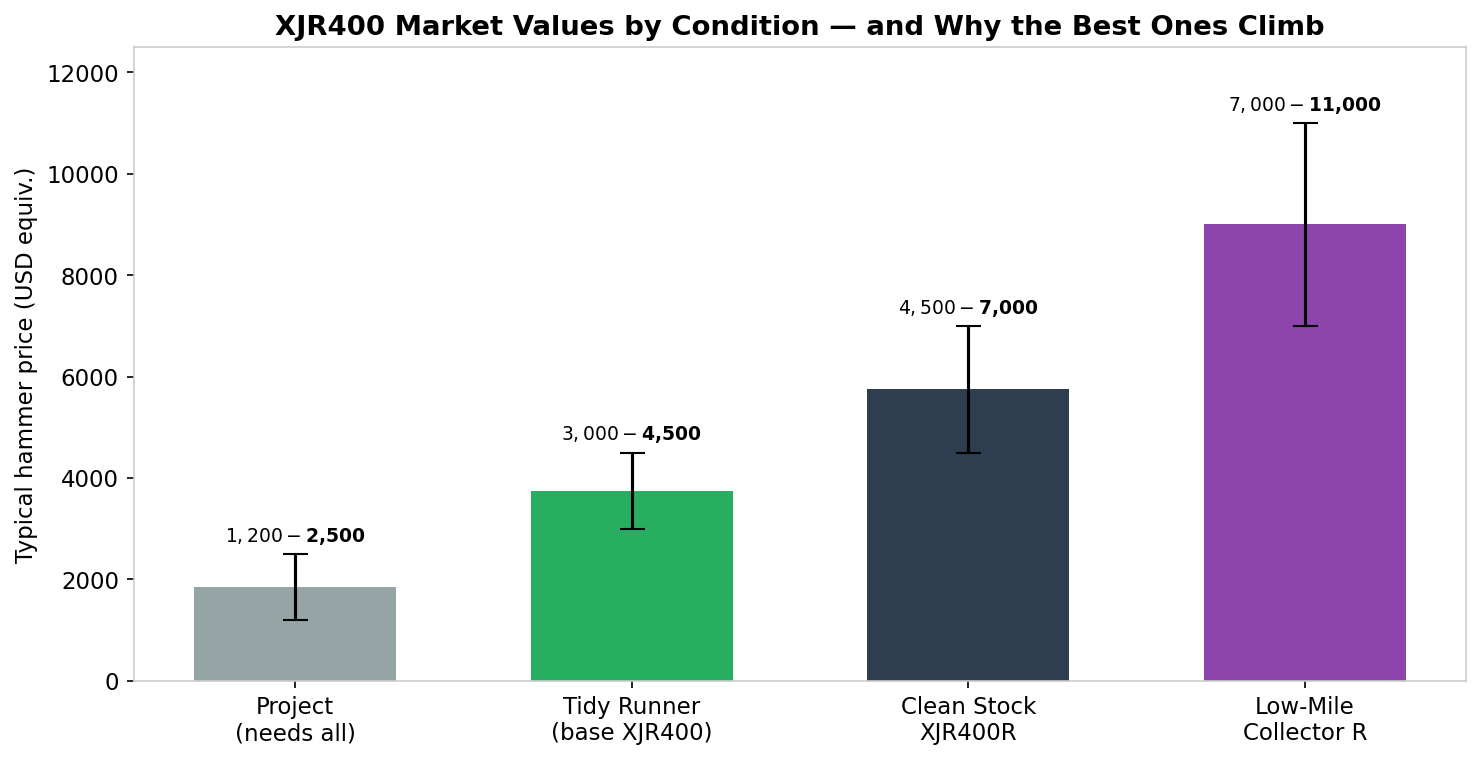
At the bottom, rough running projects and high-mileage bikes still trade for the price of a decent set of tyres — those ¥39,800 marketplace finds are real, but they need everything. In the middle sit the tidy, sorted, stock XJR400s that most importers actually want, generally in the ¥350,000–¥600,000 band at auction. At the top, genuine low-mileage XJR400R examples with original Öhlins and Brembo kit, clean frames and original exhausts are the ones climbing fastest, and the best of them now ask serious money.
Two forces push prices up. The cultural wave we mentioned — millions of YouTube views, a thriving classic-bike scene — keeps demand high among younger Japanese riders, which competes with export buyers for the good ones. And the supply is finite and shrinking: production ended around 2008, no more are being made, and every year some get crashed, scrapped or modified beyond redemption. Rising demand against falling supply only goes one way.
The strategic move is to buy the best original XJR400R you can afford now rather than a cheap base bike you will pour money into. Condition and originality are what appreciate; project bikes mostly just cost you. If you want help spotting which auction examples are genuinely sorted, the AWA team does this every week.
Common XJR400 Buyer Questions From Owners and Forums
We pulled these straight from owner forums, YouTube comment sections and X listings, because the questions real buyers ask are better than any generic checklist.
"Will it pass and register in my country?" — Age is everything. Older bikes face lighter rules in the US (25-year exemption), Australia (25-year pathway) and NZ. The early-to-mid-1990s XJR400s are the easy ones. "Are parts available?" — Yes, abundantly. The JDM aftermarket carries thousands of XJR400 parts; one parts platform alone lists well over 2,000 specific items, from exhausts and brakes to frame and control components. "Is it fast enough?" — For a 400, comfortably. It will cruise at highway speeds and surprise people off the line; it is not a literbike and does not pretend to be. "Carbs or injection?" — Carbs, always, for the whole carburetted run. Plan your maintenance around that and you will be happy.
How AWA Auction Gets You the Right XJR400
This is the part where the import route either works beautifully or goes sideways, and it usually comes down to who is reading the auction sheets for you.
AWA Auction gives you direct access to the Japanese dealer-only motorcycle auctions where the XJR400s actually trade — the same BDS, JBA and i-Auc networks that move thousands of bikes a week. We watch the listings, translate and interpret the inspection sheets, flag the genuine XJR400R variants from the rebadged base bikes, spot the carb-and-rust red flags, and send you real candidates with sheets and photos. You set a maximum bid; we handle the rest, from winning the lot to export paperwork, de-registration, and shipping to your port.
For a bike that only exists through importing — and where variant, originality and condition decide both how it rides and what it is worth — having someone in Japan who knows exactly what a good XJR400 looks like is the whole value. You can browse current listings to see what is available right now, or contact the team to set up a search for your ideal XJR400. It is how a lot of the cleanest XJRs in the West got there in the first place.
Frequently Asked Questions
Quick answers to the questions XJR400 importers ask most.
See Also
Share this article: