
If you want a Honda X-Eleven import from Japan, you are chasing one of the most underrated muscle nakeds Honda ever built: a stripped-back streetfighter that borrows the engine from the legendary CBR1100XX Super Blackbird and wraps it in raw, upright, no-fairing aggression. This guide walks you through everything before you buy one — the confusing three-names problem, the year-by-year changes from 1999 to 2003, the known weak spots, the real landed costs, and the US 25-year rule that finally makes the X-Eleven legal to bring into the States. By the end you will know exactly which one to chase and which one to walk away from, and how to land a clean example through AWA Auction.
Here is the thing nobody mentions about the X-Eleven: Honda never officially sold it in the United States. It was built for Japan and Europe, which means for a huge chunk of riders the only way to get one is to import it. That sounds like a hassle. It is actually an opportunity — because while everyone else fights over overpriced local muscle bikes, you can buy a low-mileage, rust-free Japanese-market X-Eleven for sensible money and ship it to your door. Let's break down how.
Why the Honda X-Eleven is one of Japan's most underrated muscle nakeds
The X-Eleven exists because at the turn of the millennium every Japanese manufacturer wanted a "power naked" — a big-bore standard with no fairing, a fat torque curve, and enough attitude to scare a litre sportbike at the lights. Yamaha had the V-Max. Suzuki had the Bandit 1200. Kawasaki had the ZRX1200. Honda's answer was to take the Super Blackbird's 1,137cc inline-four, detune it slightly for street manners, and bolt it into a naked chassis with a distinctive downforce-generating radiator shroud.
The result is a bike that does something very few nakeds of its era managed: it delivers genuine hyperbike grunt without the wrist-breaking commitment of a full sportbike. You sit up. You see the world. And when you crack the throttle, the same engine that pushed the Blackbird toward 170 mph shoves you down the road with a wave of midrange that never seems to run out.
For an importer, three things make the X-Eleven smart money. It is mechanically a Blackbird, so parts and knowledge are everywhere. It was never a US-market bike, so clean examples are still affordable rather than collector-inflated. And it is old enough now that the 25-year rule has opened the door for American buyers, which is quietly pushing demand up. Buy a good one now and you are buying near the bottom of the curve.
If you are still weighing categories before you commit, our roundup of the best naked motorcycles to import from Japan puts the X-Eleven in context against its rivals.
There is also a scarcity angle that works in your favour over time. Honda built the X-Eleven for only a few years and in modest numbers, and every year a few more leave the road for good. Bikes with a genuine engine pedigree and a shrinking supply do not stay cheap forever — the ZRX1200 and V-Max both proved that as their prices firmed up. The X-Eleven has all the same ingredients and none of the hype yet, which is precisely the window a smart buyer wants to catch.
The X-Eleven, X11, and CB1100SF: why one bike has three names
This trips up almost every first-time buyer, so let's clear it up before you spend a dollar. The exact same motorcycle wears three different names depending on where it was sold and who is talking about it:
- CB1100SF — the Japanese domestic market (JDM) designation. If you are buying at a Japanese auction, this is the name on the paperwork.
- X-Eleven — the full marketing name Honda used in Europe.
- X11 — the shorthand everyone actually uses, and what you will see stamped on the bodywork and in most online listings.
They are not variants. They are not different trims. It is one bike. The confusion matters because a seller who lists a "CB1100SF" and a seller who lists an "X11" are offering the identical machine, and knowing that lets you search auction listings under every name and compare prices across all of them. Sellers who only know one name sometimes price blind — that is where a sharp buyer wins.
One more clarification, because this one costs people real money: the X11 is not the retro air-cooled CB1100 that Honda launched in 2010. That bike is a completely different, modern, classically-styled machine. The X-Eleven is the late-90s liquid-cooled muscle naked based on the Blackbird. If a listing photo shows spoked wheels and a round retro tank, that is the newer CB1100, not what you want here.
The Super Blackbird engine, detuned for the street
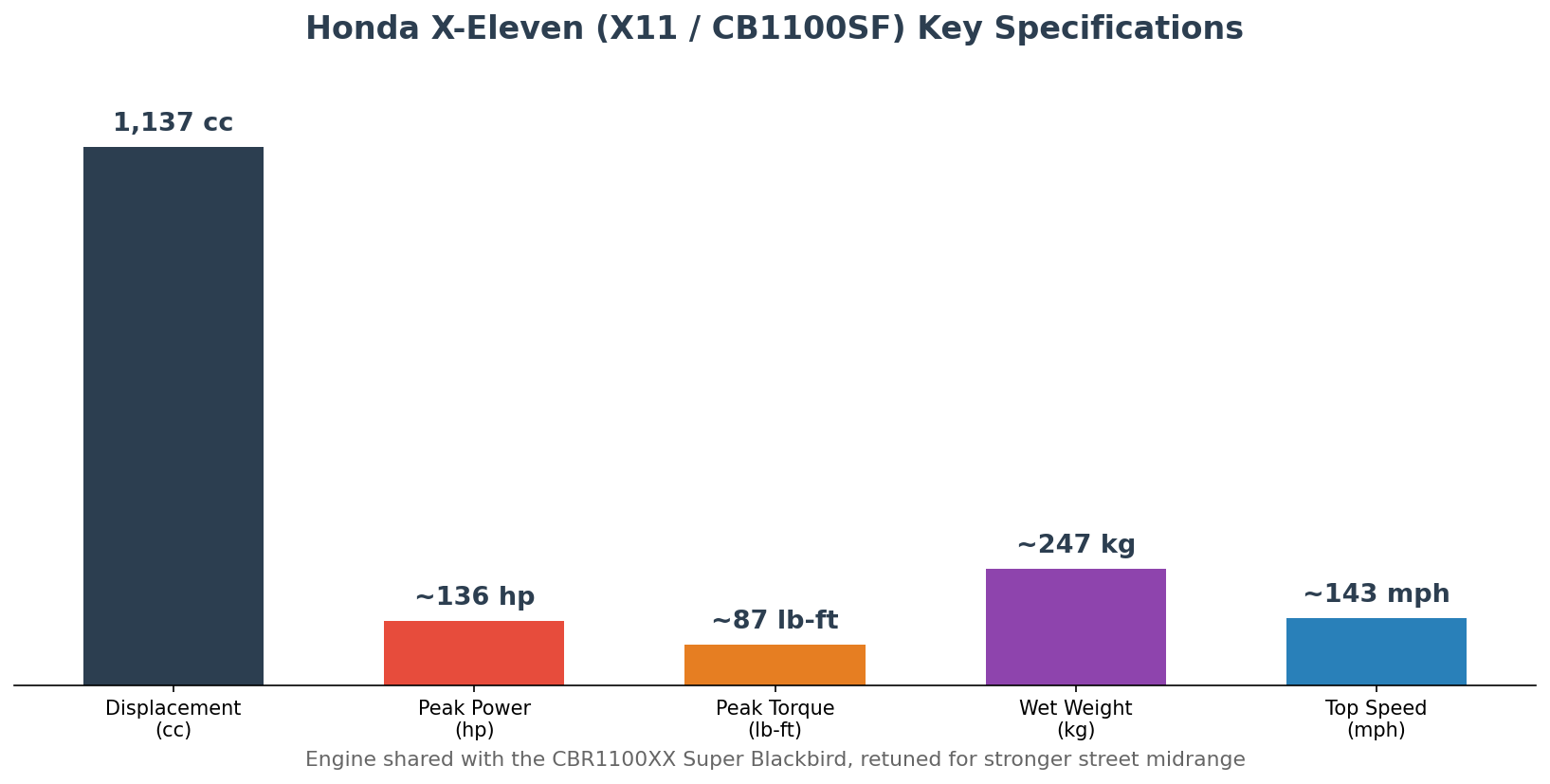
The heart of the X-Eleven is a 1,137cc liquid-cooled, DOHC 16-valve inline-four lifted almost wholesale from the CBR1100XX Super Blackbird. Honda gave it a revised fuelling map that trimmed peak power by around 12 bhp compared to the Blackbird, dropping output to roughly 134 to 136 horsepower at the crank. That is not a downgrade you feel as weakness. It is a re-tune that fattens the midrange and makes the bike friendlier to ride hard on a public road.
Torque is the real story. You get close to 87 lb-ft, and crucially it arrives low and stays flat. Roll the throttle from 3,000 rpm in almost any gear and the X-Eleven simply picks up and goes, no downshift drama required. This is what makes it such an easy bike to ride fast — it does the work for you.
Top speed sits around 140 to 145 mph, limited more by the barn-door aerodynamics of a naked bike than by the engine. That downforce radiator shroud Honda fitted was not just for show; it was designed to add cooling and a touch of high-speed stability to a machine that would otherwise try to lift its rider off the back at speed.
Weight is the honest trade-off. At roughly 222 kg dry and closer to 247 kg wet, the X-Eleven is a heavy bike. You notice it at walking pace and in tight parking. Once rolling, the mass disappears and the low center of gravity makes it feel far more planted than the numbers suggest. It is fuel-injected — Honda's PGM-FI system — so there are no carburetors to balance, a genuine advantage over some rivals of the same era.
Honda X-Eleven model year guide: 1999 to 2003
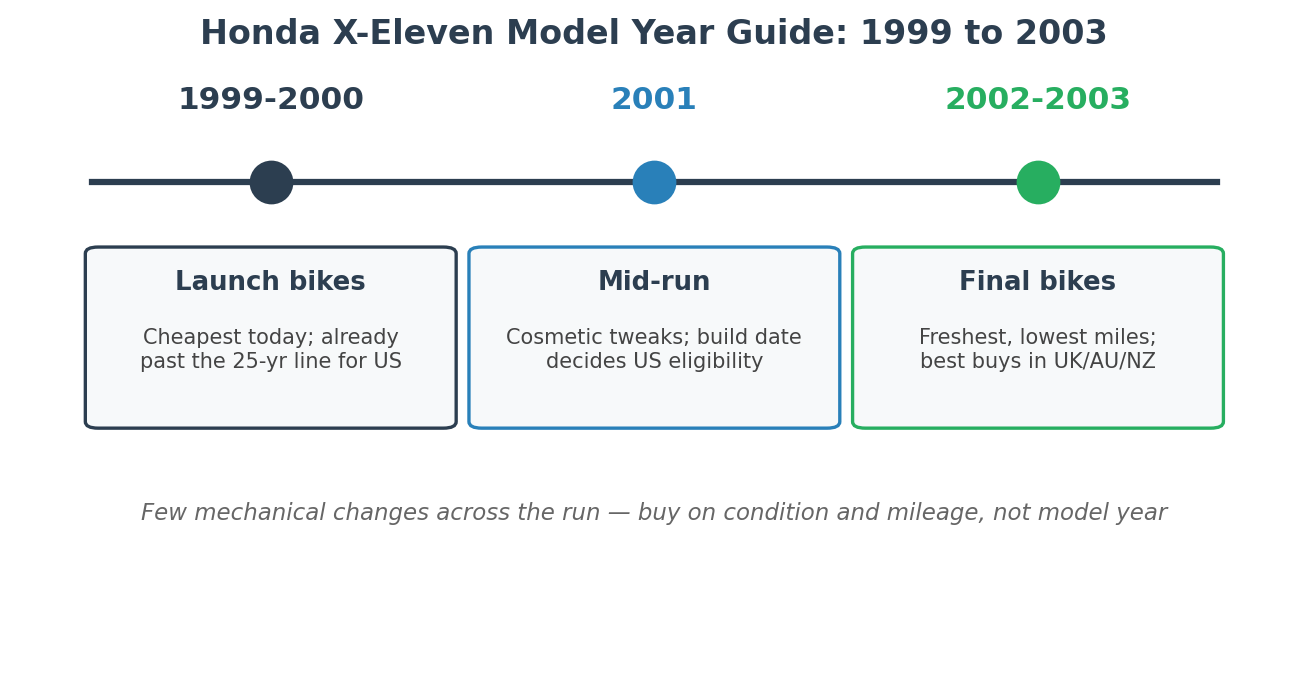
The X-Eleven had a short production run and few mechanical changes, which is good news for a buyer: there is no dramatically better or worse generation to hunt for. But there are details that affect both price and eligibility, so here is the map.
1999 to 2000: the launch bikes
The X-Eleven arrived in late 1999. These early bikes are mechanically identical to the later ones in every way that matters. For US importers they are the sweet spot right now, because a bike built in 1999 or 2000 is comfortably past the 25-year threshold and legal to bring in today. Expect the most affordable prices here, simply because they are the oldest.
2001: the mid-run bikes
Cosmetic tweaks and new color options, but no meaningful mechanical difference. A 2001 model built late in 2000 may already be import-eligible; one built in 2001 rolls into eligibility month by month through 2026. Always confirm the actual manufacture date, not just the model year — this is the single most common paperwork mistake importers make.
2002 to 2003: the final bikes
The last of the line. These are the freshest examples with typically lower miles, and in the UK, Australia and New Zealand — where there is no 25-year restriction — they are often the best buys. US buyers will need to wait for these to age into eligibility, so for now they are a market for the rest of the English-speaking world.
Because the changes across the run are so minor, your decision should be driven by condition and mileage, not model year. A well-kept 1999 with 20,000 km and a clean auction sheet beats a neglected 2003 every single time. That is the opposite of how most model-guide advice reads, and it is exactly why the X-Eleven is such good value.
Common problems: what to check before you buy an X-Eleven
The X-Eleven is a genuinely reliable bike — it is a Blackbird underneath, after all — but every 20-plus-year-old motorcycle has known weak points. Here is what an experienced buyer looks for, and what the owner community keeps flagging.
Regulator/rectifier failure
This is the classic Honda-of-the-era Achilles heel. A failing reg/rec cooks the battery, causes weird electrical gremlins, and eventually leaves you stranded. Check for a battery that will not hold charge and for signs the unit has been upgraded to a modern MOSFET-type replacement — a common and cheap fix that a smart previous owner will already have done.
Cam chain tensioner rattle
A rattle from the right side of the engine, worst on a cold start, usually points to a tired cam chain tensioner. It is not instantly catastrophic but it needs sorting. On a test start, listen carefully in the first few seconds before the engine warms.
Clutch slave cylinder leaks
A spongy clutch lever or fluid weeping around the slave cylinder means perished seals. It is a straightforward repair, but factor it into your offer if the lever feel is off.
Brake caliper seals and stuck pistons
After two decades, caliper seals harden and pistons stick, which drags the pads and eats fuel and rotors. A caliper rebuild is routine on a bike this age — budget for it unless there is fresh receipt evidence.
Fork seals and corrosion
Weeping fork seals and surface corrosion on fasteners and the exhaust are common on bikes that lived in wet climates. This is exactly why Japanese-market bikes are so desirable: many spent their lives garaged and see far less road salt than European examples.
None of these is a deal-breaker. Together they are simply a checklist. A bike where the reg/rec is upgraded, the tensioner is quiet, and the calipers are fresh is worth paying more for — you are buying someone else's completed to-do list.
What it's really like to live with an X-Eleven
Numbers only tell you so much, so this is where the primary research earns its keep. The X-Eleven has a small but fiercely loyal owner base, and the same themes come up again and again in long-term reviews and video walk-arounds.
The Men and Motors "1999 Honda X11 Naked Blackbird Overview" — one of the most-watched X11 videos with well over 120,000 views — frames the bike exactly the way owners describe it: a Blackbird engine with the fairing torn off and the aggression turned up. That video's comment section is full of the recurring owner sentiment that this is a bike people keep for years rather than flip.
A hugely popular French review from the channel Lunaris2142, sitting north of 150,000 views and 370 comments, is literally titled to the effect of "after this video you'll want to buy a 2001 Honda X11" — and the comments back it up, with owners describing it as a torque monster that never gets old. A separate Russian-language "pros and cons" breakdown with over 100,000 views lands on the same verdict: enormous midrange, heavy at low speed, and grin-inducing everywhere else.
Then there is the custom scene. The most-viewed X11 build video — a scrambler conversion with over 210,000 views — shows just how much of a blank canvas this bike is for people who want raw, brutal street presence. That tells you something: bikes people bother to customize are bikes people fall in love with.
The honest downsides owners mention: the weight at parking speed, a fairly firm seat on long days, the wind blast that comes with any naked at highway speed, and the fact that fuel economy is nobody's idea of frugal when you use the engine the way it wants to be used. None of that surprises anyone who buys a muscle naked on purpose.
X-Eleven vs the muscle-naked rivals
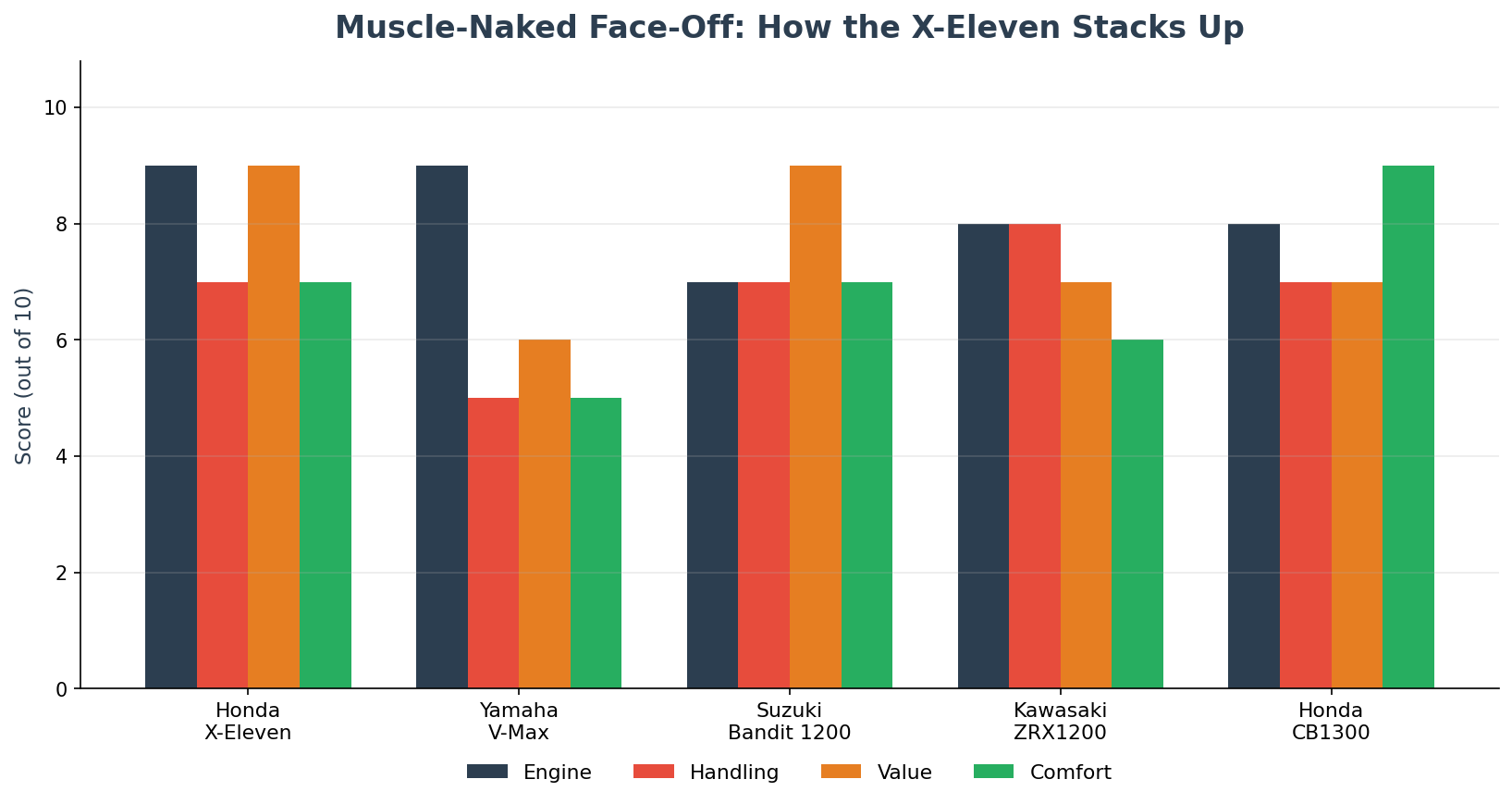
The X-Eleven was born into a fierce class, and if you are shopping this segment you are probably cross-shopping these four. Here is the honest positioning.
Yamaha V-Max: the icon and the drama queen. More outrageous, more of a straight-line theatre act, and heavier and cruder in the corners. The X-Eleven is the more complete, more rideable everyday machine. The V-Max wins on legend; the X11 wins on usability.
Suzuki Bandit 1200: the value benchmark and the X-Eleven's closest rival on price. The Bandit is lighter, simpler, and cheaper to run, but it feels its budget in the suspension and finish. The X-Eleven feels like the more premium, better-engineered bike — because it is essentially a Blackbird.
Kawasaki ZRX1200: the retro-cool choice with a Lawson-replica following that keeps prices firm. Sharper handling than the X11, arguably prettier to a lot of eyes, but without the Blackbird engine's silky top end. This is the closest fight.
Honda CB1300: Honda's own big naked and the more refined, more touring-friendly sibling. Smoother, more mature, less aggressive. If you want comfort over attitude, the CB1300 makes sense; if you want the muscle-naked snarl, the X-Eleven is the pick.
The X-Eleven's argument in this company is simple: it has the best engine of the bunch and it is the most under-appreciated, which means it is the best value. You are buying Blackbird engineering at Bandit prices.
The 25-year import rule and US eligibility
For American buyers this is the section that changes everything. Because Honda never federalized the X-Eleven for the US, you cannot simply buy one locally — and until recently you could not legally import one either. The 25-year rule fixes that.
Under US federal law, any vehicle 25 or more years old is exempt from the FMVSS safety standards and EPA emissions rules that block newer non-US-market vehicles. Once an X-Eleven crosses that 25-year line, it can be imported as an antique with no modifications required. The clock runs on the actual month of manufacture, not the model year.
What that means in practice for 2026: an X-Eleven built in 1999 or 2000 is eligible right now. A 2001 model built in December 2000 is also eligible; one built in, say, June 2001 becomes eligible in June 2026. This is why confirming the build date on the frame and paperwork matters so much — a "2001" bike is either legal today or a few months away from it, depending entirely on when it actually left the factory.
Two more things US buyers must know. First, federal eligibility is not the same as state registration — some states, California most of all, layer their own emissions requirements on top even for exempt vehicles, so check your state before you ship. Second, you will declare the 25-year exemption at the border and CBP will verify the manufacture date from the VIN and Japanese export documents, so clean paperwork is not optional.
Riders in the UK, Australia and New Zealand have it easier — no 25-year wall, so any X-Eleven is fair game, and the freshest 2002 to 2003 bikes are on the table. Our guide to importing a motorcycle from Japan covers the country-by-country steps in detail.
What It Costs to Import a Honda X-Eleven From Japan
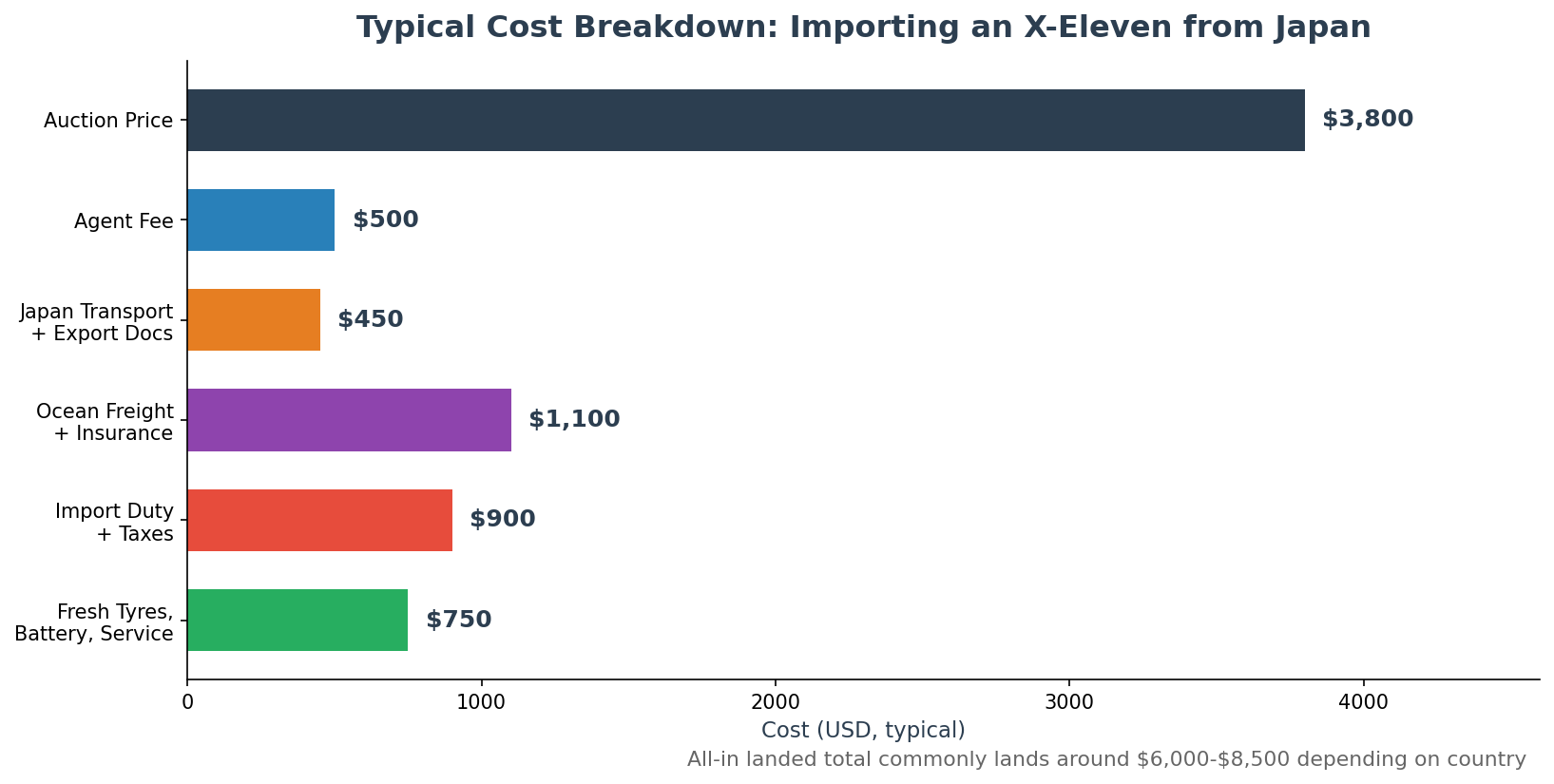
Let's talk real numbers. The headline auction price is only part of the story, and understanding the full landed cost is how you avoid nasty surprises. Here is a realistic breakdown for a clean, mid-mileage X-Eleven.
A good used X-Eleven at a Japanese auction typically hammers somewhere around USD 3,000 to 4,500 depending on condition, mileage, and how many other bidders spot it that day. On top of that you have the auction agent fee, domestic transport to the port, export paperwork and de-registration, ocean freight, insurance, and then the duty and taxes in your own country.
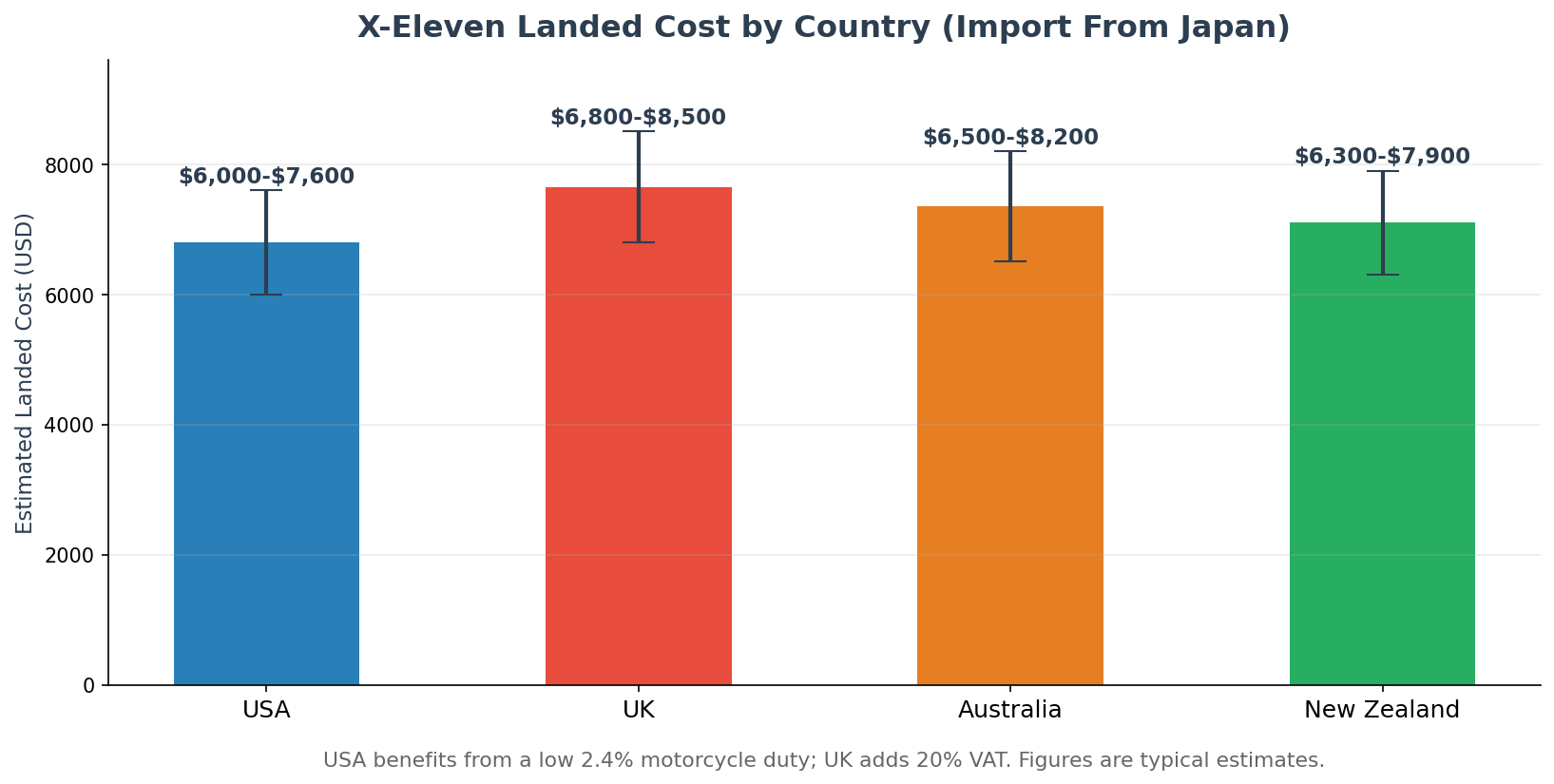
As a rough all-in guide, a clean X-Eleven landed in your country tends to come to USD 6,000 to 8,500 once every fee is paid, with the exact figure driven mostly by your local duty and tax regime. The US, with its low 2.4% motorcycle duty on eligible bikes, often lands cheaper than the UK where 20% VAT applies. Australia and New Zealand sit in between with GST and compliance costs. Even at the top of that range, you are getting a Blackbird-engined muscle bike for the price of a tired mid-size commuter — which is the whole point.
The mistake to avoid: bidding on the auction price alone. A bike that looks cheap at the hammer can end up mid-pack once fees stack up, while a slightly dearer bike with a better auction grade can be the smarter total buy. Always run the full sum before you bid.
How to read the auction sheet on a used X-Eleven
Every bike at a Japanese auction comes with an inspection sheet graded by an independent inspector, and learning to read it is the single biggest edge you can have as a remote buyer. You are not guessing from three phone photos; you are reading a professional's assessment.
The overall grade runs on a scale where 4 and above is a solid, honest used bike, 3.5 is usable but shows wear, and anything labeled R or RA has had accident repairs you need to understand before bidding. For an X-Eleven, a grade 4 with low-to-moderate kilometers is the target zone.
Beyond the number, the sheet carries an inspector's map of the bike marking scratches, dents, rust, and corrosion, plus notes on the engine, tires and any modifications. On an X-Eleven specifically, you want to see notes confirming the exhaust is not heavily corroded, the bodywork around that distinctive radiator shroud is intact, and there is no sign of crash damage to the naked-exposed engine cases and bars.
Our deep dive on how to read a Japanese auction sheet breaks down every symbol, so you can bid with confidence instead of hope. This is where working with an experienced agent pays for itself many times over.
Running costs and maintenance
The X-Eleven is cheap to keep for what it is, largely thanks to that shared Blackbird DNA. Consumables are standard sizes, the engine is famously durable, and there is a deep well of knowledge online for any job you or a mechanic will tackle.
Service intervals are conventional — oil and filter regularly, valve clearances checked at the longer intervals, and the usual chain, tire and brake attention. The fuel injection means no carb balancing, one less recurring cost and headache than the carbureted rivals. Fuel economy in the mid-40s mpg is realistic if you ride it gently, dropping fast if you use the engine the way it begs to be used.
The two costs to plan for on any fresh import are a full fluid-and-seal refresh — fork seals, brake rebuild, coolant, brake and clutch fluid — and consumables like tires and a battery, since a bike that has been sitting in a Japanese garage or auction yard will want fresh rubber. Budget for that once, up front, and the X-Eleven rewards you with years of dependable big-bore fun. For a wider view, our motorcycle ownership and import guide covers what to expect over the long haul.
Who should buy an X-Eleven, and who shouldn't
Let's be straight about fit, because the X-Eleven is a specific bike for a specific rider.
Buy one if you want effortless big-bore torque in an upright, everyday-usable package; if you value engineering substance over fashion; if you like the idea of owning a rare bike that most people cannot identify at a glance; and if you appreciate that Blackbird reliability underpins the whole thing. It is a superb second bike for an experienced rider and a brilliant do-everything single bike for someone who wants pace without a fairing.
Think twice if you are a new rider — 136 horsepower and 247 wet kilos is a lot of motorcycle to learn on. Skip it if you need a lightweight bike for heavy city filtering, if you want cutting-edge electronics like traction control and ride modes (this is a pre-electronics machine), or if long-distance wind protection is a priority, because a naked bike will never give you that.
If that first paragraph sounds like you, the X-Eleven is one of the best-value imports on the market right now. If the second one does, our guides on lighter and more modern options will point you somewhere better suited.
How AWA Auction helps you import a clean X-Eleven
Importing a bike you have never seen, from an auction on the other side of the world, in a language you do not read, sounds daunting. That is exactly the gap AWA Auction fills. We give you direct access to the same Japanese auctions where clean X-Elevens come up every week, and we translate the auction sheets, verify the manufacture date for your 25-year eligibility, and handle the export paperwork end to end.
You tell us the grade, mileage and budget you want. We watch the auctions, bid on your behalf, and only chase bikes that pass the checklist in this guide — quiet cam chain, upgraded reg/rec where possible, honest grade, clean corrosion notes. Then we manage shipping to your port and hand you a bike that is ready to register and ride.
Browse what is available right now on our current listings, or contact our team to set up a search for a specific X-Eleven spec. The right one comes up more often than you think — the trick is being ready to move when it does.
Popular X-Eleven modifications and upgrades worth having
The X-Eleven is a favourite among riders who like to make a bike their own, and a handful of well-known upgrades genuinely improve the ownership experience rather than just changing the look. If you are buying used, spotting these already fitted is a bonus, not a red flag.
The single most valuable upgrade is a modern MOSFET regulator/rectifier, which cures the era's biggest reliability weakness for a modest outlay. A bike that already has one has effectively pre-solved the problem most likely to strand you. Close behind is a manual or updated cam chain tensioner, which kills the cold-start rattle for good.
On the performance and comfort side, an aftermarket exhaust saves meaningful weight over the heavy original cans and unlocks more of that Blackbird-derived engine's voice, though a full stainless system is preferable to a corroded original in any case. A small flyscreen or a taller aftermarket screen takes the edge off the highway wind blast that every naked bike delivers, and braided brake lines sharpen up a braking system that was merely adequate when new and is now two decades old.
Suspension is where a careful owner spends money for real gains: fresh fork oil, upgraded springs, or a rebuilt rear shock transform a tired X-Eleven from a wallowy heavyweight into a bike that carries its mass with genuine composure. If a listing mentions recent suspension work, that is a sign of an owner who actually rode and cared for the bike rather than parking it in a corner. As always, the goal is not the flashiest modifications but the ones that fix known weaknesses — those are the ones that add value and peace of mind.
Frequently Asked Questions
These are the questions real buyers ask most often about importing a Honda X-Eleven from Japan.
Is the Honda X-Eleven the same bike as the CBR1100XX Blackbird?
Not the same bike, but they share the same heart. The X-Eleven uses the 1,137cc inline-four engine from the CBR1100XX Super Blackbird, retuned with a milder fuelling map that drops peak power by around 12 bhp to roughly 134 to 136 horsepower and fattens the midrange. The Blackbird is a faired sport-tourer built for outright top speed; the X-Eleven is a naked muscle bike built for upright real-world torque. Think of the X-Eleven as the Blackbird with the fairing removed, the bars raised, and the character turned toward the street. The shared engine is a big part of why parts and mechanical knowledge are so easy to find.
Can I legally import a Honda X-Eleven into the USA?
Yes, under the 25-year rule, provided the bike is old enough. Any X-Eleven manufactured 25 or more years ago is exempt from FMVSS safety and EPA emissions rules and can be imported as an antique with no modifications. In 2026 that means 1999 and 2000 bikes are eligible now, and 2001 bikes roll into eligibility month by month based on their actual manufacture date. Always confirm the build date stamped on the frame rather than trusting the model year, and remember that federal eligibility does not automatically mean easy state registration — California in particular adds its own requirements even for exempt bikes.
How much does it cost to import an X-Eleven from Japan?
A clean, mid-mileage X-Eleven usually hammers at a Japanese auction for around USD 3,000 to 4,500. Once you add the agent fee, domestic transport, export paperwork, ocean freight, insurance, and your own country's duty and taxes, the all-in landed cost typically lands between USD 6,000 and 8,500. The US usually comes in cheaper thanks to a low 2.4% motorcycle duty, while the UK's 20% VAT pushes the total higher. The key is to budget the full landed figure before you bid, not just the auction price, because fees can add several thousand dollars to a bike that looked cheap at the hammer.
What are the most common problems on a used X-Eleven?
The main ones to check are regulator/rectifier failure, which is the classic Honda weak spot of this era and is often already upgraded to a MOSFET unit on a well-cared-for bike; a cam chain tensioner rattle that shows up worst on a cold start; clutch slave cylinder leaks that give a spongy lever; and brake caliper seals that harden and stick after two decades. Add fork seals and surface corrosion on bikes from wet climates. None of these are catastrophic — they are a standard age-related checklist — but a bike where they have already been addressed is worth paying a premium for.
What is the difference between the X-Eleven, X11, and CB1100SF?
There is no mechanical difference at all — they are three names for one identical motorcycle. CB1100SF is the Japanese domestic market designation you will see on auction paperwork, X-Eleven is the full European marketing name, and X11 is the everyday shorthand that appears on the bodywork and in most listings. Knowing all three names lets you search every listing and compare prices across sellers who each use a different label. Just do not confuse it with the retro air-cooled CB1100 that Honda launched in 2010, which is a completely different modern bike.
Is the Honda X-Eleven a good bike for beginners?
No, and honestly it is not trying to be. With roughly 136 horsepower, a torque curve that hits hard from low revs, and a wet weight near 247 kg, the X-Eleven is a lot of motorcycle. The weight is most noticeable at parking speed and in tight, slow maneuvers, and the power delivery rewards experience. It makes a superb bike for a returning or seasoned rider who wants effortless big-bore performance in an upright package, but a new rider is far better served by something lighter and less powerful to build skills on first.
How reliable is the Honda X-Eleven?
Very reliable for its age, because underneath it is a Super Blackbird — one of Honda's most durable engines. Owners routinely rack up high mileage with little more than regular servicing, and the fuel injection means there are no carburetors to balance or gum up. The reliability caveats are the age-related items every 20-plus-year-old bike shares: electrical components like the reg/rec, seals, and consumables. Buy one with a documented history and the known weak points already sorted, keep up with basic maintenance, and the X-Eleven will run for many years and many tens of thousands of kilometers.
Which year of X-Eleven should I buy?
Buy on condition and mileage, not model year, because the mechanical changes across the 1999 to 2003 run are minor. For US importers, 1999 and 2000 bikes are the practical pick right now since they are already past the 25-year line and tend to be the most affordable. In the UK, Australia and New Zealand, where there is no import age wall, the fresher 2002 to 2003 bikes with lower miles are often the best buys. In every market, a well-maintained early bike with a clean auction sheet beats a neglected late one, so let the inspection grade guide you more than the year.
How does the X-Eleven compare to the Suzuki Bandit 1200 and Kawasaki ZRX1200?
All three are early-2000s Japanese muscle nakeds, but they have distinct characters. The Bandit 1200 is the value and simplicity champion — lighter and cheaper to run, but with more budget-feeling suspension and finish. The ZRX1200 is the retro-cool choice with a loyal Lawson-replica following that keeps prices firm and handling sharp. The X-Eleven sits above both on engineering, since it carries the Blackbird engine and feels the most premium and refined of the group. Its argument is simple: Blackbird pedigree at prices close to the Bandit, which is why it is arguably the best value of the three.
See Also
Share this article: