
Almost every motorcycle in our model guides can be bought locally if you are patient enough. The Kawasaki Ninja ZX-25R cannot. It was never sold new in the United Kingdom, never sold in Europe, never sold in Australia, and never sold in North America. If you want the only mass-produced 250cc inline-four built in the last thirty years, importing it from Japan is not the cheap option or the clever option. It is the only option.
That makes this guide different from most of what you will find. There is very little point writing three thousand words about how a ZX-25R compares to a local dealer's stock, because there is no local dealer stock. The questions that actually matter are harder and less commonly answered: can you legally register one where you live, what does it truly cost by the time it is on your driveway with plates on it, and what are you signing up for when the nearest person who has seen the inside of that engine is six thousand miles away?
This guide answers those questions honestly, including the parts that might talk you out of it.
Why the ZX-25R is the most import-only motorcycle Kawasaki has built this decade
In 2020 Kawasaki did something the industry had quietly agreed was finished. They put a 249cc inline-four into a production sportbike and sold it to the public.
The last time this was normal was the late 1980s and early 1990s, when Japan's domestic licensing structure and a fierce internal horsepower war produced the Honda CBR250RR MC22, the Kawasaki ZXR250, the Suzuki GSX-R250 and the Yamaha FZR250. Those bikes revved to 19,000rpm, made around 45bhp from a quarter of a litre, and sounded like scaled-down superbikes. Then emissions rules, cost, and the collapse of the Japanese 250 market killed the category. For nearly three decades, a 250 four was something you found in a shed, not a showroom.
The ZX-25R brought it back. Not as a retro tribute or a limited run, but as a current-production motorcycle with traction control, a slipper clutch, ride modes and a quickshifter. It revs to around 17,000rpm. It makes close to 50bhp in its highest-output form. It is, by a wide margin, the most technically extravagant 250 on sale anywhere.
And Kawasaki sold it only in Japan and South-East Asia.
The reasoning was commercial rather than mysterious. Indonesia, Thailand, the Philippines and Japan all have licensing, tax or insurance structures that make a 250 a genuine aspirational purchase rather than a stepping stone. In the UK, the US and Australia, a 250 is what you ride for two years before you buy something bigger, and nobody in those markets was going to pay near-600cc money for it. Kawasaki did the arithmetic and skipped us entirely.
The consequence is that the ZX-25R has become one of the purest examples of what a JDM motorcycle actually is: a machine whose entire existence is shaped by a market you do not live in. If you want one, you go and get it.
What the ZX-25R actually is: 249cc, four cylinders, 17,000rpm
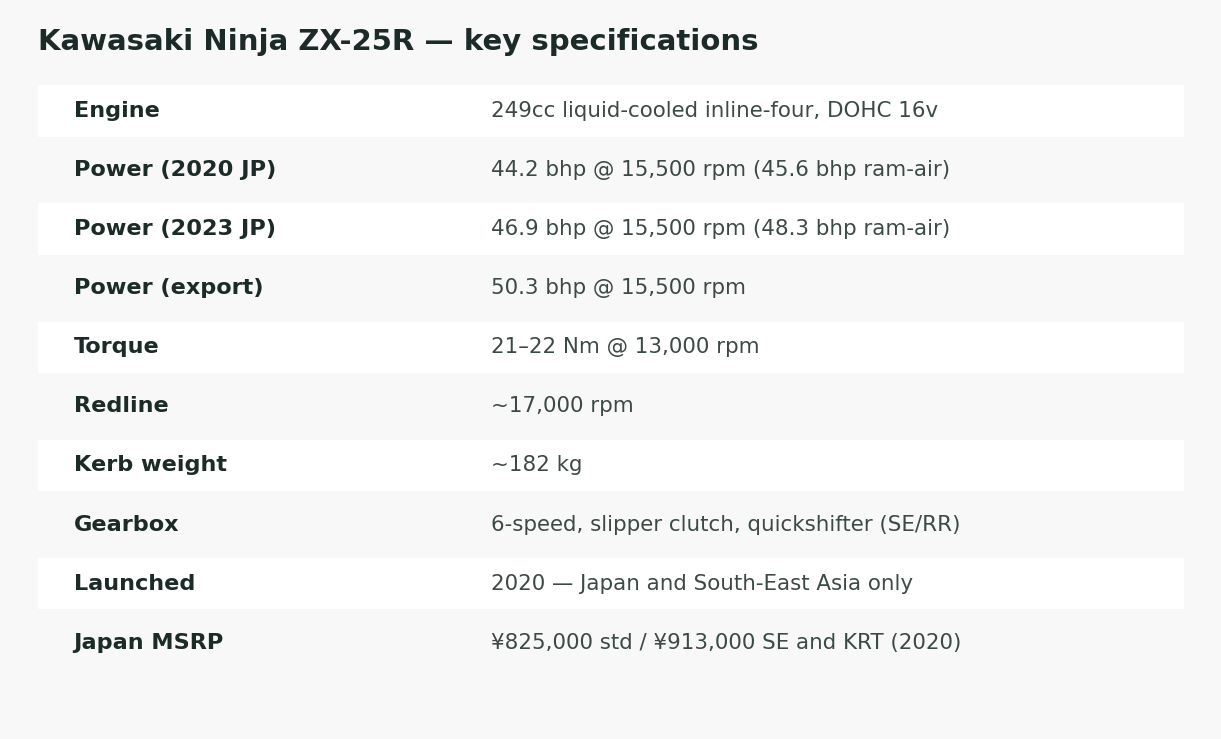
The engine is the whole story. A 249cc liquid-cooled inline-four with double overhead cams and sixteen valves, fed by ram air, spinning to a redline in the region of 17,000rpm. Each cylinder displaces roughly 62cc — about the same as a small scooter — and the pistons are close to the size of a large coin.
Peak power depends entirely on which market and which model year you are looking at, and this trips up a lot of buyers reading spec sheets from the wrong country:
- 2020 Japan-market: around 44.2bhp at 15,500rpm, rising to roughly 45.6bhp with ram-air pressure at speed.
- 2023-on Japan-market: around 46.9bhp at 15,500rpm, roughly 48.3bhp with ram air, after Kawasaki revised the engine.
- Export-market versions: quoted at 50.3bhp at 15,500rpm.
Torque sits at 21 to 22Nm at around 13,000rpm. That number tells you more about the riding experience than the power figure does. There is essentially nothing below 6,000rpm, a slow build to 10,000, and then the top third of the rev range where the bike genuinely comes alive and makes a noise no other current production motorcycle makes. Riders coming from a Ninja 400 or an R3 consistently describe the first ride as confusing, because the ZX-25R feels slower everywhere they are used to riding and then completely transforms in a rev band they have never used.
Kerb weight is around 182kg. That is heavy for a 250 — a Ninja 400 is roughly 166kg — and it is the honest cost of four cylinders, four exhaust headers and the cooling to support them. The chassis, brakes and suspension are lifted in spirit from the ZX-6R, with a trellis frame, upside-down forks, and on the higher specification bikes a Showa Separate Function Fork.
Model variants you will encounter at auction include the standard ZX-25R, the SE with quickshifter and additional equipment, the KRT Edition with the Kawasaki Racing Team livery, and from 2023 the ZX-25RR with further suspension upgrades. Japanese launch pricing in 2020 was ¥825,000 for the standard bike and ¥913,000 for the SE and KRT versions.
ZX-25R vs ZX-4R vs Ninja 400: the comparison that should come first
Before you spend nine thousand pounds importing a 250, you owe yourself an honest look at the alternative Kawasaki built specifically because of the reaction to this bike.
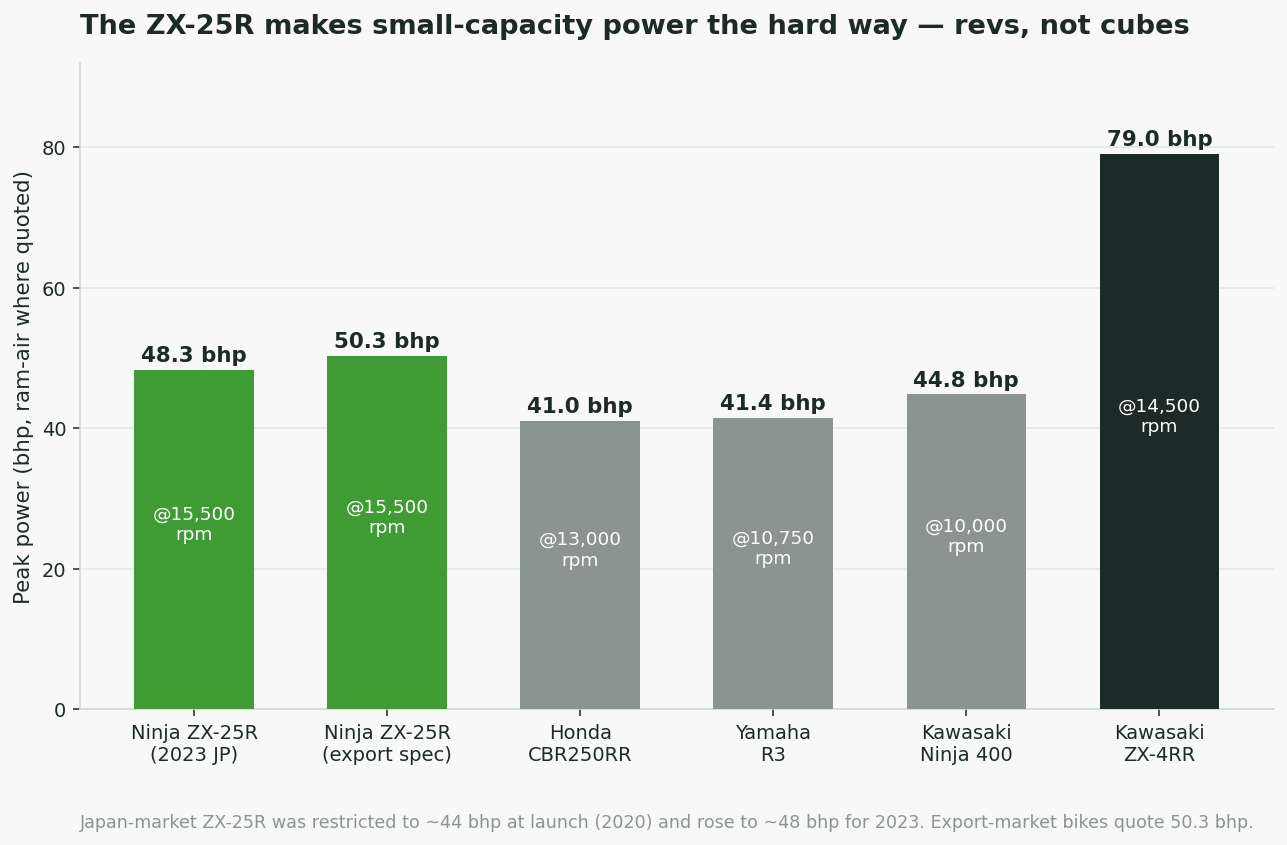
The ZX-4R and ZX-4RR use a 399cc inline-four in essentially the same concept, making around 79bhp. Crucially, Kawasaki did bring them to the UK, Europe and the United States. You can walk into a dealer, buy one with a warranty, and have it serviced by people who have seen one before.
So the comparison looks like this. The ZX-4RR gives you roughly sixty percent more power, full local dealer support, a manufacturer warranty, normal parts supply, straightforward insurance and no import process at all. The ZX-25R gives you a smaller engine, more money spent, a compliance test to pass, and parts that arrive from Asia.
On any rational metric the ZX-4RR wins comfortably. We would be doing you a disservice not to say that plainly.
What the ZX-25R has is the thing that cannot be bought locally at any price: it is a 250 four, it is the last of a line that ran from the ZXR250 to here, and there is a reasonable argument that it is the final one anyone will ever build. Some buyers want the object rather than the performance. If you are one of them, the rest of this guide is for you. If reading the previous three paragraphs made you reconsider, that is a good outcome too, and you have saved yourself several thousand pounds.
Against the more conventional 250s and 300s, the picture is simpler. A Honda CBR250RR makes about 41bhp from a twin, a Yamaha R3 about 41bhp, a Ninja 400 about 45bhp with far more usable midrange. All of them are cheaper, lighter to live with and easier to buy. None of them sound remotely like a ZX-25R at 16,000rpm. That is the entire trade.
Can you legally import a ZX-25R? A country-by-country answer
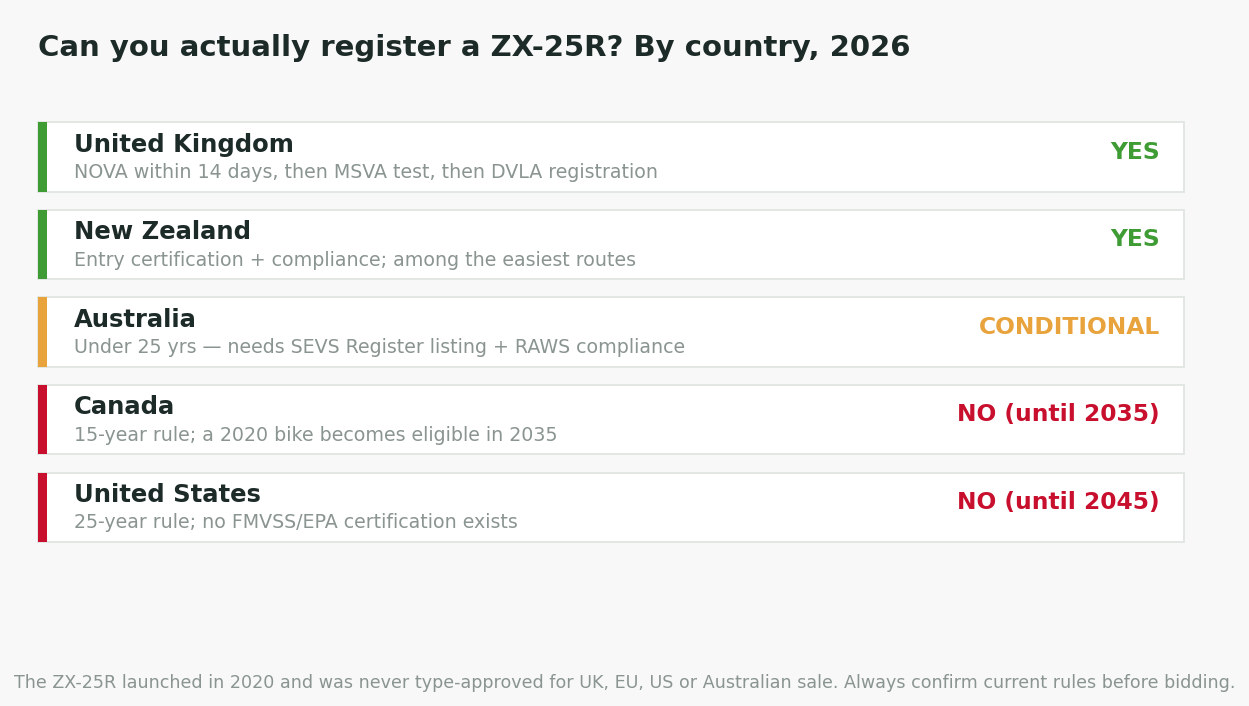
This is the section that should decide your purchase, and it is the section most listings skip. The ZX-25R launched in 2020, which means in 2026 it is six years old. Every major import regime outside Japan is built around vehicle age, and six years is the worst possible age to be.
United Kingdom: yes, with an MSVA test
The UK is the most realistic destination and the reason most ZX-25R import traffic exists at all. The bike was never type-approved for the UK or EU market, so it cannot simply be registered on the strength of its paperwork. The route is:
- Notify HMRC through the NOVA service within fourteen days of the bike arriving in the country.
- Pay import duty and VAT.
- Pass an MSVA test — Motorcycle Single Vehicle Approval — which checks the machine against UK construction and use requirements.
- Register with the DVLA and receive a plate.
MSVA is where imported bikes most often stumble, usually on small details: headlamp beam pattern, rear reflector, speedometer units, sharp edges, and mirror specification. None of these are difficult to fix, but budget for them rather than assuming a Japanese-market bike will pass untouched. Our MSVA guide covers the common failure points in detail.
New Zealand: yes, and comparatively straightforward
New Zealand has long been one of the friendliest destinations for Japanese imports, and motorcycles are treated more simply than cars. You will need entry certification and compliance inspection, but there is no age barrier stopping a 2020 machine. Of the English-speaking markets, this is the least painful route for a ZX-25R.
Australia: conditional, and you must check before you bid
Australia is where buyers most often get caught out. The concessional pathway that lets enthusiasts import older Japanese bikes applies to vehicles twenty-five years and older — in 2026, machines built before roughly mid-2001. A 2020 ZX-25R does not come close.
That leaves the Specialist and Enthusiast Vehicle Scheme. SEVS is the pathway for vehicles under twenty-five years old that were never sold new in Australia, and eligibility criteria include a high power-to-weight ratio — above 130 kilowatts per tonne for vehicles manufactured on or after 1 January 2020.
Here is the trap. A ZX-25R makes roughly 37kW and weighs around 182kg, which on paper is a power-to-weight figure comfortably above that threshold. Buyers see that arithmetic and assume they are clear. Meeting the criteria is not the same as being eligible. The specific model must actually be entered on the SEVS Register, and any compliance work must be carried out by a Registered Automotive Workshop. Check the current register for the exact model and build date before you place a single bid, and get written confirmation from your compliance workshop. Our Australia import guide walks through the process in full.
United States: no, and not for a long time
We will not soften this. A ZX-25R cannot be legally imported and road-registered in the United States, and will not be able to be until roughly 2045.
The NHTSA age exemption applies at twenty-five years, and the EPA operates a separate provision at twenty-one years. A 2020 motorcycle satisfies neither. Because the model was never federalised, no FMVSS or EPA certification exists for it, and there is no realistic conformance pathway for a single privately imported motorcycle. The show-or-display provision is aimed at historically or technologically significant vehicles and is not a practical route for a current-production 250.
American readers occasionally see ZX-25Rs advertised by overseas exporters and assume the exporter has solved this. They have not. An exporter can put a bike on a ship; they cannot make US Customs release it. If you are in the US and you want a small-capacity inline-four experience legally, the ZX-4RR is sold there, and older 250 fours such as the Honda CBR250RR MC22 are now well past twenty-five years old and can be imported properly.
Canada: no until 2035
Canada's fifteen-year rule is more generous than the American twenty-five, but a 2020 bike still means waiting until 2035. The same reasoning applies as above.
ZX-25R model years and what changed
The production run is short and the changes are concentrated in one year, which makes this easier than most model guides.
2020 — launch. Standard, SE and KRT Edition. Japan-market output around 44.2bhp, 45.6bhp on ram air. Showa SFF-BP forks on the higher trims, traction control, ride modes, slipper clutch, and a quickshifter on the SE. Launch pricing ¥825,000 standard, ¥913,000 SE and KRT.
2021 to 2022 — carryover. Colour changes and minor equipment shuffling. Mechanically these are 2020 bikes and should be priced as such. This is the sweet spot for value if you are not chasing the last few horsepower.
2023 — the significant update. Output rose to around 46.9bhp, 48.3bhp with ram air. Kawasaki revised the instrumentation and the suspension, and introduced the ZX-25RR variant with further chassis upgrades. If you intend to keep the bike a long time and want the best version, this is the year the model became what it should have been at launch.
2024 to 2025 — refinement. Continued production with colour updates. Prices in Japan remain firm and these bikes rarely represent good value against a well-kept 2023.
Our practical recommendation: a 2023 or later bike if budget allows, because the engine revision and suspension changes are real improvements rather than marketing. A 2021 or 2022 example if you want the lowest cost of entry, because the mechanical difference is smaller than the price difference.
Known problems and what to check before you bid
The ZX-25R is a modern, low-mileage, generally well-built motorcycle, and it does not have the catalogue of horrors that a thirty-year-old grey import does. But it has characteristics that matter, and the owner community — heavily concentrated in Indonesia and the Philippines, where these bikes are everywhere — has been vocal about several of them.
Cold starting behaviour
A recurring theme among owners is that the bike is fussy when cold and should not be ridden hard until fully warm. This is not a fault so much as physics: very small pistons, tight clearances, and an engine designed to operate at extremely high rpm do not tolerate being rushed from cold. Owner videos warning about cold-start treatment circulate widely in the Indonesian community. Factor a genuine warm-up into your routine and this is a non-issue; ignore it and you are accelerating wear on an engine that is expensive to open.
Starter and no-crank complaints
There is a visible cluster of owner reports about starting problems — the bike turning over reluctantly or not at all. In most documented cases this traces back to battery condition rather than the starter motor itself. A high-compression four-cylinder with a small battery is unforgiving of a tired cell, and bikes that sit for long periods between rides suffer most. Check the battery's age and, on inspection, ask whether the bike starts promptly from cold rather than after being run up by the seller.
Valve clearances and service cost
This is the real ownership consideration. Sixteen valves in a 249cc engine that spins to 17,000rpm means a valve clearance check is a substantial job, and it comes round on a schedule you cannot ignore. Owner discussions about maintenance cost are among the most-viewed ZX-25R content online for good reason. Establish where the bike is in its service schedule before you bid, and get a quote from your intended workshop before you buy rather than after.
Crash damage and modification
These bikes attract young, enthusiastic owners in markets with dense traffic. A meaningful proportion of the used pool has been down the road, and an even larger proportion has been modified — aftermarket exhausts in particular are close to universal, with SC Project systems being something of a default. Neither is automatically disqualifying, but an aftermarket exhaust can complicate a UK MSVA submission on noise grounds, and you should establish whether the original system comes with the bike. Ask. It is a reasonable question and a straight answer tells you something about the seller.
Parts availability outside Asia
The most underrated risk on this entire list. In Jakarta, ZX-25R consumables are on the shelf. In Birmingham or Auckland, they are not. Fairing panels, specific engine components and model-specific parts will be ordered from Japan or South-East Asia with the lead time and shipping cost that implies. Before you buy, price a set of fairings and a full gasket set so you know what a bad day looks like.
What a ZX-25R costs to land in the UK
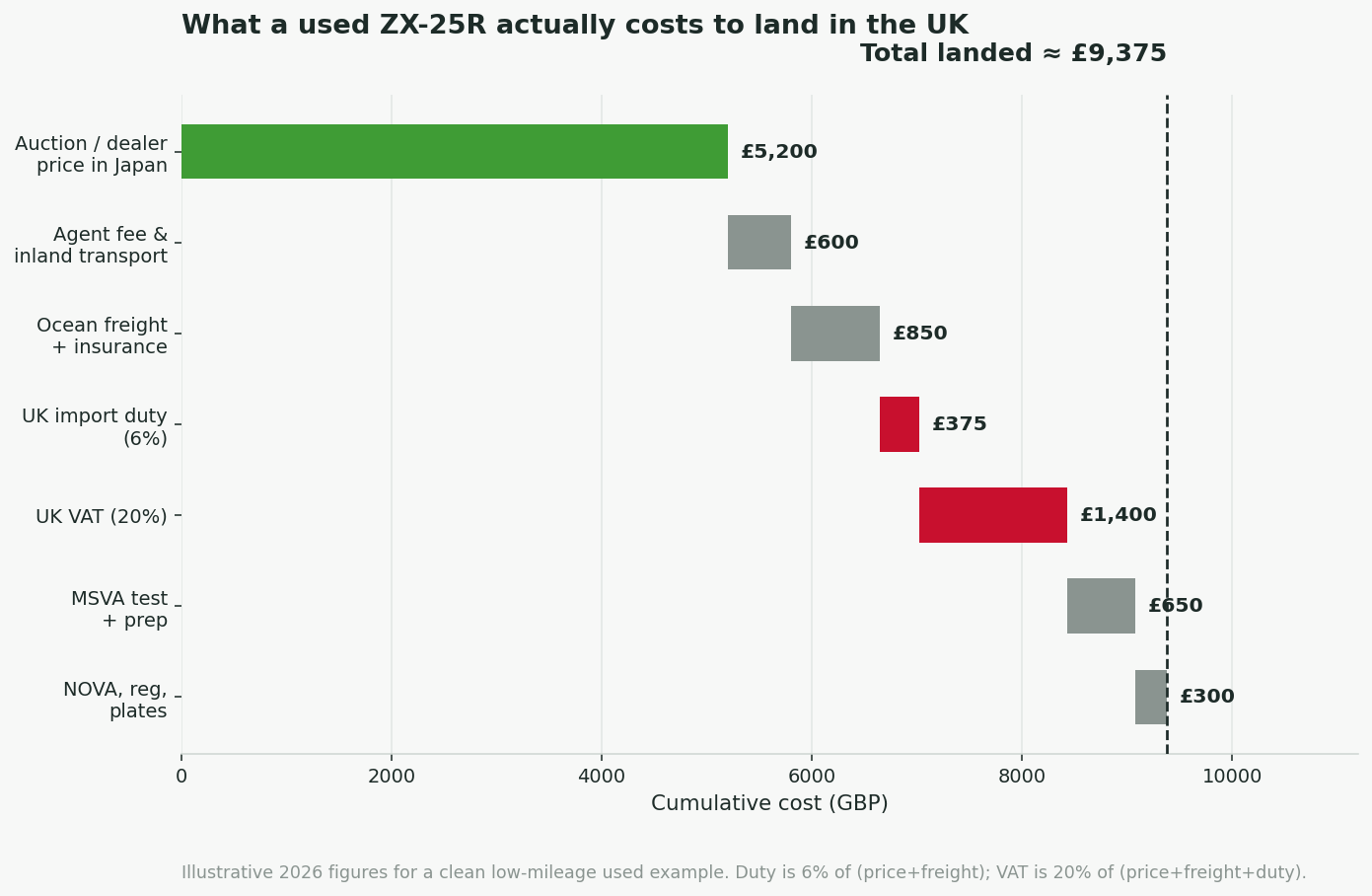
Here is a realistic 2026 build-up for a clean, low-mileage used example landed in the United Kingdom and road-legal. Every figure is illustrative and will move with exchange rates, auction competition and your choice of shipping, but the structure is what matters.
| Item | Cost (GBP) | Notes |
|---|---|---|
| Auction or dealer price in Japan | £5,200 | Grade 4 or better, 2021 to 2022 |
| Agent fee and inland transport | £600 | Bidding, inspection, transport to port |
| Ocean freight and insurance | £850 | Shared container is the usual choice |
| UK import duty at 6% | £375 | Charged on price plus freight |
| UK VAT at 20% | £1,400 | Charged on price plus freight plus duty |
| MSVA test and preparation | £650 | Test fee plus lighting and mirror compliance |
| NOVA, registration and plates | £300 | Including first-registration costs |
| Total landed | £9,375 | Road-legal on your driveway |
Two things about this table deserve emphasis. First, the tax stack — duty plus VAT — adds close to £1,800 on its own, and it is calculated on the shipped value rather than what you think the bike is worth. Our UK import duty and tax guide explains how the cascade works, because a surprising number of first-time importers budget for the bike and the freight and then find the tax bill unaccounted for.
Second, the MSVA and registration line is not optional and is not small. Roughly a thousand pounds of this total is spent purely on making a perfectly good motorcycle legal, and none of it is recoverable when you sell.
Published estimates have put a new ZX-25R at around £6,500 in Japan and roughly £9,000 landed in the UK. Our used build-up arriving at a similar total is not a coincidence — it reflects how firmly these bikes hold value in Japan, which brings us to the next point.
Used ZX-25R prices in Japan and what they mean for you
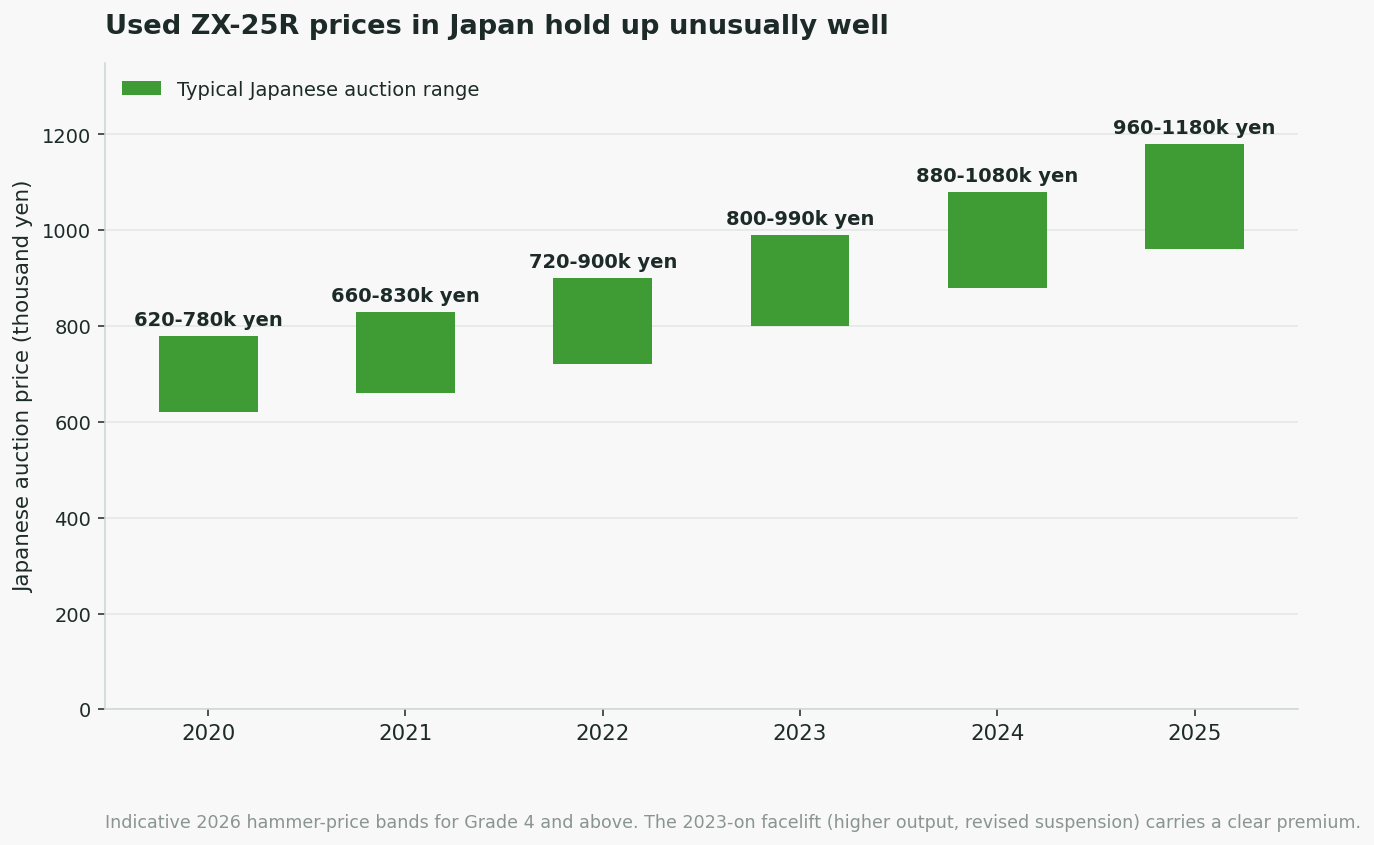
Most import bargains work because the Japanese domestic market undervalues something the rest of the world wants. Japanese buyers move on quickly, shaken inspection costs push older bikes out, and enthusiasts abroad benefit.
The ZX-25R breaks that pattern. Japanese buyers want it too. It is a desirable, current-production, technically unusual motorcycle in its home market, and prices reflect that. Domestic demand competes directly with export demand at auction, so you are not picking up an unloved machine — you are bidding against locals who value it as highly as you do.
The practical implications are worth stating clearly:
- There is no deep discount to find. Anyone promising you a cheap ZX-25R is either describing a damaged bike or has not run the numbers.
- Grade matters more than usual. Because the price band is narrow, the gap between a Grade 3.5 and a Grade 4.5 bike is small in money and large in condition. Buy the better bike.
- Later years cost meaningfully more. The 2023 revision carries a genuine premium, and 2024 to 2025 bikes sit close to new money.
- Patience pays. Auction volume for this model is steady rather than plentiful. Missing one is not a disaster; overpaying for a crashed one is.
Is importing a ZX-25R actually worth it? An honest calculation
Let us do the arithmetic without flinching.
Roughly £9,400 lands a used ZX-25R in the UK, registered. For similar money in 2026, you could buy a new ZX-4RR from a dealer with a warranty, or a very good used ZX-6R, or a nearly new MT-07 with several thousand pounds left over. On performance per pound, the ZX-25R loses to all of them and it is not close.
It also loses on convenience. You wait months rather than an afternoon. You pass a compliance test. You accept slower parts supply. You may pay more to insure a machine your insurer has no data for. And when you sell, your buyer pool in the UK is small, because most riders looking at a nine-thousand-pound sportbike are not looking for a 250.
So the case against is strong, and anyone who tells you otherwise is selling something.
The case for rests entirely on the fact that no amount of money buys this experience locally. A 249cc inline-four at 16,000rpm is a specific, unrepeatable sensation, and the engineering that produces it is unlikely to be attempted again — emissions regulation is moving in exactly the wrong direction for tiny high-revving multi-cylinder engines. There is a reasonable case that the ZX-25R is the last of its kind in the same way the CBR250RR MC22 was the last of the previous generation, and MC22 values thirty years on suggest what happens to the last of a line.
Our honest position: import a ZX-25R if you want this bike specifically and have thought about it for more than a week. Do not import one as a fast way into small-capacity sportbike riding, and do not import one as an investment. Buy it because you want to hear it.
How to import a ZX-25R from Japan, step by step
The mechanics are the same as any Japanese motorcycle import, with one addition specific to this model.
Step 0 — confirm your country's rules first. This step exists only because the ZX-25R is under twenty-five years old. Before you look at a single listing, confirm that you can register the bike where you live. UK and New Zealand buyers can proceed. Australian buyers must verify SEVS Register listing and line up a RAWS workshop. US and Canadian buyers should stop here. Nothing later in this process rescues a bike that cannot be registered.
Step 1 — set your specification. Decide model year, variant and acceptable grade before you start bidding, and write it down. For most buyers that means 2023 or later if budget allows, Grade 4 or above, original exhaust included, and full service history. Having this written down is what stops you from talking yourself into a Grade 3 bike at two in the morning.
Step 2 — work with an agent who bids for you. Japanese auction houses do not sell to overseas private buyers directly. You need a licensed intermediary to inspect, bid, win, and handle export paperwork. This is where AWA Auction operates, and it is worth choosing someone who will tell you when a bike is wrong rather than simply executing your bid.
Step 3 — read the auction sheet properly. Covered in the next section, and the single highest-value skill in this entire process.
Step 4 — export paperwork and shipping. De-registration in Japan, export certificate, and a booking on a vessel. A shared container is usually the sensible balance of cost and protection for a single motorcycle; our container versus RoRo comparison covers the trade-offs. Expect four to eight weeks on the water depending on destination.
Step 5 — customs on arrival. UK buyers: NOVA within fourteen days, then duty and VAT. Have the paperwork ready before the bike lands rather than scrambling afterwards.
Step 6 — compliance and registration. The MSVA test in the UK, entry certification in New Zealand, RAWS compliance in Australia. Budget time as well as money; testing slots are not always immediate.
Step 7 — first service. Whatever the paperwork says, treat a freshly landed import to fresh oil and filter, a coolant check, a chain and sprocket inspection and a brake fluid change. On this engine in particular, do not skip it.
How to read a Japanese auction sheet for a ZX-25R
The auction sheet is the only honest description you will get, and learning to read one is what separates a good import from an expensive lesson. Our full guides on auction grades and reading inspection sheets go deeper, but here is what matters on this specific model.
Grade. For a bike this new, insist on Grade 4 or above. A six-year-old motorcycle graded 3 or 3.5 has been damaged, neglected or both, and given the narrow price spread there is no reason to accept it.
Mileage and the R mark. Check for any indication of odometer replacement or discrepancy. Low mileage is normal and expected on these bikes; implausibly low mileage on a bike with worn controls is not.
Repair and damage notations. Look for marks indicating frame or fairing repair. On a bike with this much bodywork, cosmetic damage is common and mostly acceptable if disclosed and priced. Frame damage is not acceptable at any price.
Exhaust. Sheets typically note when a non-standard silencer is fitted. Ask specifically whether the original system is included — for UK MSVA purposes it can matter, and a bike sold without it costs you several hundred pounds to put right.
Service records. Japanese sellers often include a maintenance record book. On an engine with this service burden, a documented history is worth paying a premium for. A ZX-25R with a complete book is a materially different proposition from one without.
Living with a ZX-25R outside Japan
The purchase is the easy part. Ownership is where the import premium is really paid, and it is worth being clear-eyed about four areas.
Servicing. Find your workshop before the bike arrives, not after. Not every dealer will take on a machine they have no technical documentation for, and valve clearance work on a 250 four is not a job for a general workshop that has never seen one. A Kawasaki main dealer with a sympathetic service manager is the ideal outcome; a specialist with grey-import experience is the realistic one.
Parts. Build a relationship with a supplier who can source from Japan and South-East Asia. Consumables — pads, filters, chain and sprockets, tyres — are largely shared or cross-compatible and pose no problem. Model-specific parts require lead time. Many owners quietly buy a spare set of fairings early, when a good used set appears, precisely because sourcing one urgently is painful.
Insurance. Expect to spend time on the phone. An imported motorcycle with no local type approval sits outside standard rating tables, and mainstream insurers may decline or quote badly. Specialist import and classic brokers handle this routinely. Get an indicative quote before you commit to buying, because discovering the number afterwards is a bad surprise.
Fuel and running costs. Do not expect 250cc economy if you use the engine as intended. Ridden hard in the upper rev range, consumption is closer to a middleweight than a commuter. Chain, sprockets and tyres also wear at a rate that reflects how the bike is ridden rather than its capacity.
Pre-purchase checklist
Before you place a bid, work through this list. If you cannot tick every item, wait for the next one.
- Confirmed the bike can be legally registered in your country, in writing where applicable
- Confirmed SEVS Register listing and secured a RAWS workshop, if importing to Australia
- Chosen a target model year and understood the 2023 revision
- Set a maximum bid including all landed costs, not just the hammer price
- Read the auction sheet and confirmed Grade 4 or above
- Checked for frame damage notations specifically, not just overall grade
- Established whether the original exhaust is included
- Confirmed service history and position in the valve-check schedule
- Obtained an indicative insurance quote
- Identified a workshop willing to service the bike
- Priced a fairing set and gasket set so you know the downside
- Budgeted for MSVA or local compliance preparation, not just the test fee
Ready to find your Kawasaki ZX-25R?
The ZX-25R is a difficult motorcycle to recommend on value and an easy one to understand wanting. It is expensive for what it does, awkward to register, and slower than cheaper alternatives — and it is also the only 250cc inline-four you can buy new-ish in 2026, quite possibly the last one anybody will build, and it makes a noise that no amount of money buys elsewhere.
If that trade makes sense to you, the process is manageable with the right help. The two things that decide whether an import goes well are confirming your registration route before you bid and having someone in Japan who will tell you the truth about a bike's condition.
Browse current Japanese motorcycle listings to see what is coming through the auctions this week, or contact our team with your target year, grade and destination country. We will confirm what is realistic for your market and watch the auctions for the right example — including telling you when a bike is not worth bidding on.
See Also
Share this article: