
An import motorcycle from Japan to Australia project sounds intimidating until you realise the whole thing is just a sequence of forms, fees, and a steam-clean. Australians have been doing it for decades, and in 2026 the door is wider than it has ever been. The bike you want — a clean Honda CB400 Super Four, a one-owner SR400, a screaming RGV250, a low-kilometre ZRX1200 — is sitting in a Japanese auction yard right now, often for half what the same machine costs at a dealer in Melbourne or Perth.
Here's the thing nobody tells you up front: the bike is the easy part. What trips people up is the order of operations. Get the paperwork right and the process is almost boring. Get it wrong — ship before you have approval, skip the asbestos test, leave a smear of mud on the chain — and you can end up paying storage at the wharf while your bike sits in limbo. This guide walks the entire path, from why Japan is the best used-bike market on earth to the exact rego steps in your state.
Why import a motorcycle from Japan to Australia at all?
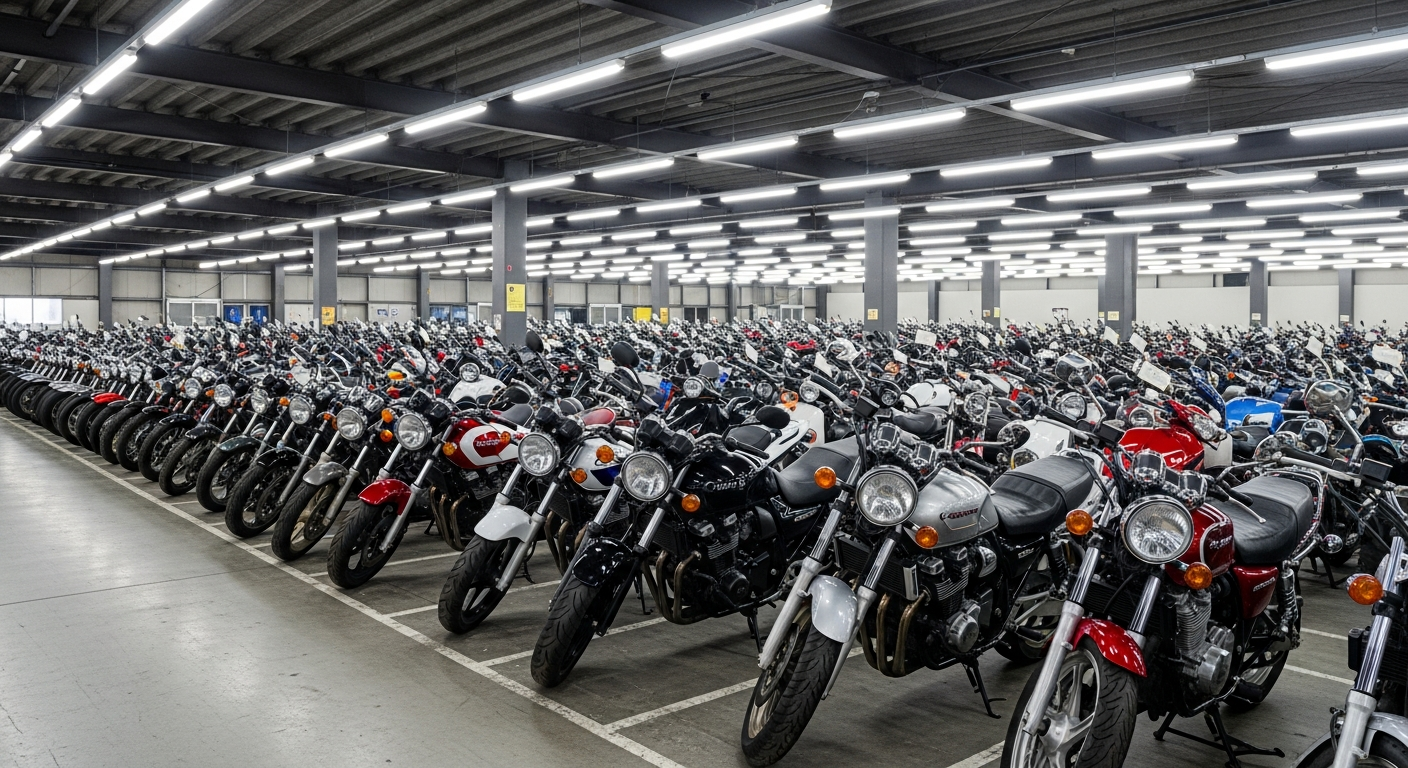
Japan built a used-vehicle culture that has no equal. Strict shaken roadworthy inspections push owners to sell bikes early, the domestic market values low kilometres above almost everything, and the auction system grades every machine with a transparency Australian classifieds can only dream about. The result is a flood of well-kept motorcycles changing hands every week at the big auction houses — BDS, JBA, and the motorcycle lanes of the larger USS halls.
For an Australian buyer, three things make this irresistible. First, price. A JDM-market Honda VFR400 or Yamaha FZR400 in genuinely good order routinely sells in Japan for a third to a half of the local asking price here. Second, choice. Australia never officially received many of the bikes enthusiasts crave — the 250cc and 400cc grey-import four-strokes, the two-stroke race-replicas, the rare 90s nakeds. Japan has them by the hundred. Third, condition you can actually verify before you bid, thanks to the auction inspection sheet.
If you have never read one of those sheets, stop and learn — it is the single most valuable skill in this entire game. Our guide to reading Japanese auction inspection sheets breaks down the grades, the corrosion maps, and the inspector shorthand, and the companion piece on Japanese auction grades explained shows you what a "4 B" actually means for the bike in front of you. The Australian who learns to read these sheets buys better bikes than the one who flies to Japan and pokes them with a screwdriver.
One YouTube reality check worth keeping in mind: channels that actually walk the Japanese auction floors — like the popular "motorbikes for sale in Japan, cheaper than you think" videos pulling hundreds of thousands of views — consistently show clean 400-class machines in the AUD 2,000 to AUD 4,000 bracket at the hammer. That is the number that makes the rest of the cost stack worth swallowing.
Can Australians legally import a motorcycle? The honest answer
Yes — but only through one of a small number of defined pathways, and only with a Vehicle Import Approval (VIA) granted before the bike leaves Japan. This is the rule that catches the most people, so let it sink in: you apply for approval first, you ship second. If a road vehicle arrives in Australia without an approval already in hand, you can be forced to pay storage, export it again, or in the worst case destroy it — all at your own expense.
The VIA is issued by the federal Department of Infrastructure, Transport, Regional Development, Communications and the Arts through its online ROVER portal. The application is free, it is not difficult, and it is the legal spine of the whole import. Everything else — shipping, customs, rego — hangs off it. The official rules live at infrastructure.gov.au, and they are the source of truth that overrides any forum post, including this article.
Motorcycles, helpfully, are treated more simply than cars. Cars get tangled in the SEVS register, model eligibility lists, and luxury car tax. Bikes dodge most of that. There is no Luxury Car Tax on a motorcycle, and the import pathways are cleaner. That does not make a bike a free pass — every vehicle, of any age, still has to clear asbestos and biosecurity — but it does mean the average Australian importing a single bike for personal use has a genuinely manageable job ahead.
The three pathways to import a motorcycle from Japan to Australia
Almost every private import lands in one of three lanes. Pick the right one before you bid, because it changes everything downstream — cost, compliance, even which bikes you should be shopping for.
1. The 25-year rule (the easy door)
This is the path most enthusiasts want. Any motorcycle manufactured 25 or more years ago can be imported under a concessional arrangement that skips full Australian Design Rule (ADR) compliance for personal-use vehicles. As a rolling rule, in 2026 that means anything built in 2001 or earlier qualifies — and every year another model year rolls into eligibility. The entire 1990s catalogue of JDM four-strokes and two-strokes is now fair game.
You still need a VIA. You still need the asbestos test and the biosecurity clean. But you escape the most expensive and time-consuming part of the under-25 process — the licensed compliance workshop converting the bike to full ADR standard. For a 1998 CB400SF or a 1996 TZR250, the 25-year door is the obvious choice.
2. SEVS / Registered Automotive Workshop (the newer-bike door)
Want something younger than 25 years? Then the bike generally has to be brought in by a Registered Automotive Workshop (RAW) and made to comply with the ADRs before it can be entered on the Register of Approved Vehicles (RAV). This is how newer grey imports reach the road legally. It costs more and takes longer because a licensed workshop is doing certified compliance work, but it is a real, legal route for a late-model bike Australia never sold.
3. The Personal Import Scheme (the "I lived overseas" door)
If you personally owned and used the motorcycle overseas for a continuous period (the rule of thumb is at least 12 months) and you are moving to or returning to Australia, the Personal Import Scheme lets you bring your own bike in regardless of its age. This is not a loophole for buying a fresh bike at auction — it is specifically for vehicles you already owned and rode abroad. If that is your situation, it is the cleanest path of all.
For the typical reader of this guide — an Australian buying a specific bike from a Japanese auction without leaving home — pathway one (25-year rule) or pathway two (RAW compliance) is where you will live. The decision is almost always settled by a single question: is the bike 25 years old yet?
Step-by-step: how the import actually works
Here is the full sequence, in the order you actually do it. Print it, tape it to the fridge, and do not jump steps.
Step 1 — Find and win the bike
You bid through an export agent who has a seat at the Japanese auctions, or through a service that aggregates the auction feeds for overseas buyers. You set a maximum bid, the agent bids on your behalf, and if you win you pay the hammer price plus the auction and agent fees. Before you bid, read the inspection sheet and decide your ceiling. This is exactly where AWA Auction lives — we bid the Japanese lanes for Australian buyers and translate the sheets so you are not guessing. Browse what is crossing the block right now on our current listings.
Step 2 — Apply for your Vehicle Import Approval (VIA)
Lodge the VIA through ROVER as soon as you have the bike's details — VIN/frame number, make, model, and proof of build date. For a 25-year-old bike, that proof of manufacture date is the make-or-break document, so chase down the original registration record or a manufacturer VIN decode early. Approvals commonly take a couple of weeks; budget up to three. Do not ship until it is granted.
Step 3 — Asbestos test and biosecurity steam-clean in Japan
Before the bike sails, it should be cleaned to a standard the Department of Agriculture, Fisheries and Forestry will accept, and you will need to deal with Australia's zero-tolerance asbestos rule (more on both below). A good export agent arranges the steam-clean and the documentation as part of the shipping package.
Step 4 — Ship it (RoRo or container)
Roll-on/roll-off (RoRo) is the cheaper, simpler option for a single bike and the most common choice. A shared or consolidated container costs more but adds protection. Transit to the main ports — Brisbane, Sydney, Melbourne, Fremantle — typically runs around two to three weeks on the water. If you are weighing the two methods, our breakdown of container vs RoRo motorcycle shipping lays out the trade-offs, and the wider guide to shipping a motorcycle from Japan covers crating, marine insurance, and port handling.
Step 5 — Customs clearance and the asbestos hold
On arrival, a customs broker files your import declaration, and you pay the duty and GST (the numbers are below). The Australian Border Force can hold any vehicle for asbestos verification — this is routine, not a sign something is wrong — so factor a few days here.
Step 6 — Biosecurity inspection
The DAFF biosecurity officer inspects the bike for soil, plant matter, seeds, and insects. If it is spotless, it clears. If they find a clod of dirt behind the swingarm, it gets sent for cleaning at your cost and re-inspected. Australian quarantine is among the strictest on earth and they are not joking about it.
Step 7 — Compliance (only if under 25 years)
If your bike took the RAW pathway, the workshop now completes ADR compliance and enters it on the RAV. A 25-year-rule bike skips this entirely and goes more or less straight to state registration.
Step 8 — State registration and roadworthy
Finally, you register the bike in your state — which means a state-level safety inspection, compulsory third-party (CTP) insurance, and plates. The exact steps differ by state, covered further down.
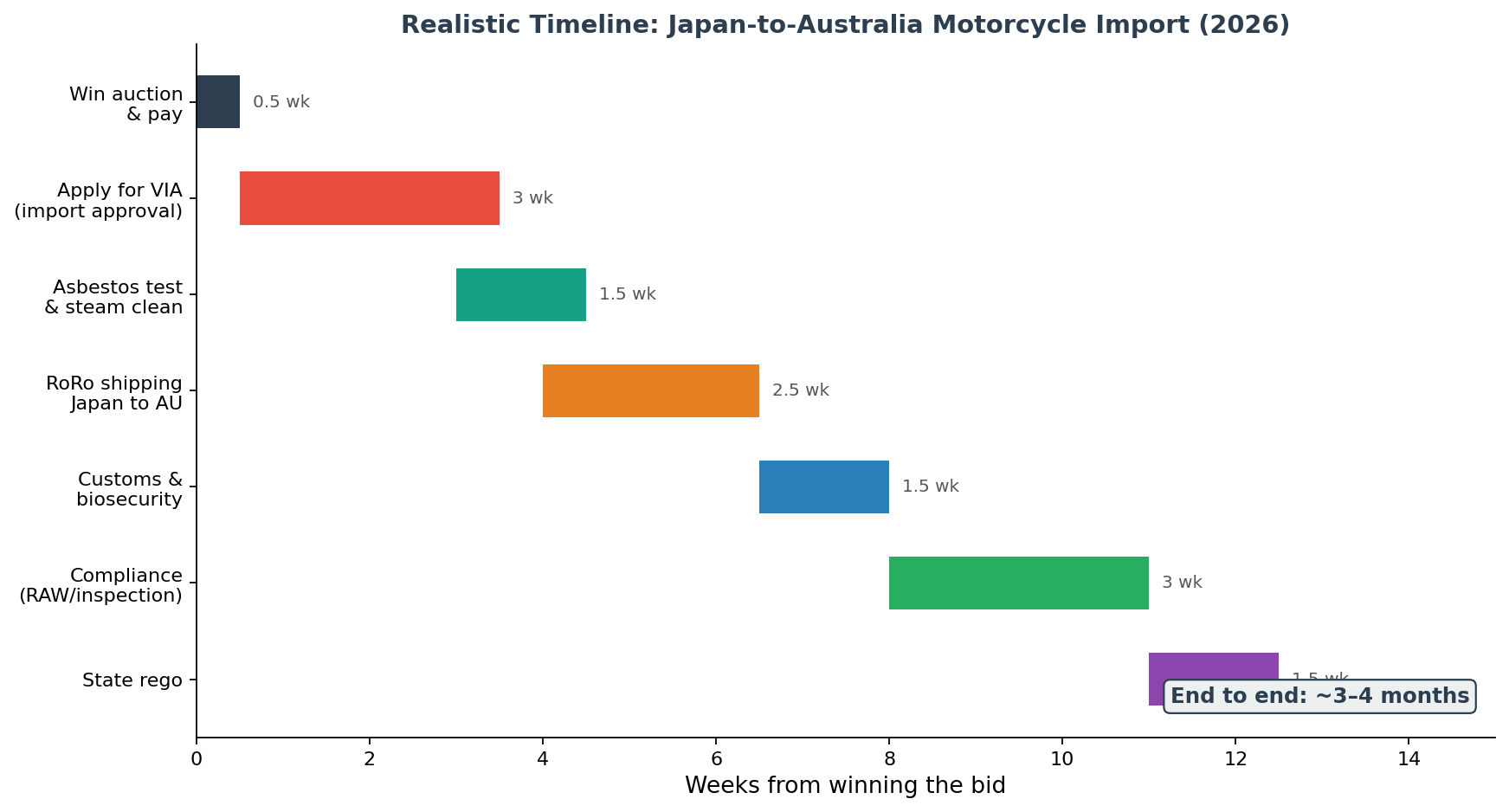
Start to finish, a clean import runs about three to four months. Most of that is queueing — VIA processing, shipping transit, the rego inspection slot — not active work. The two things that blow the timeline out are a rejected VIA (more on that below) and a biosecurity fail. Both are avoidable with a careful agent.
What it really costs to import a motorcycle from Japan to Australia
Let's talk money, because the auction price is only the first line on the invoice. Take a realistic example: a clean 25-year-old Japanese 400 that hammers at around AUD 6,000 all-in at the auction. Here is the stack of costs that turns that into a registered bike in your shed.
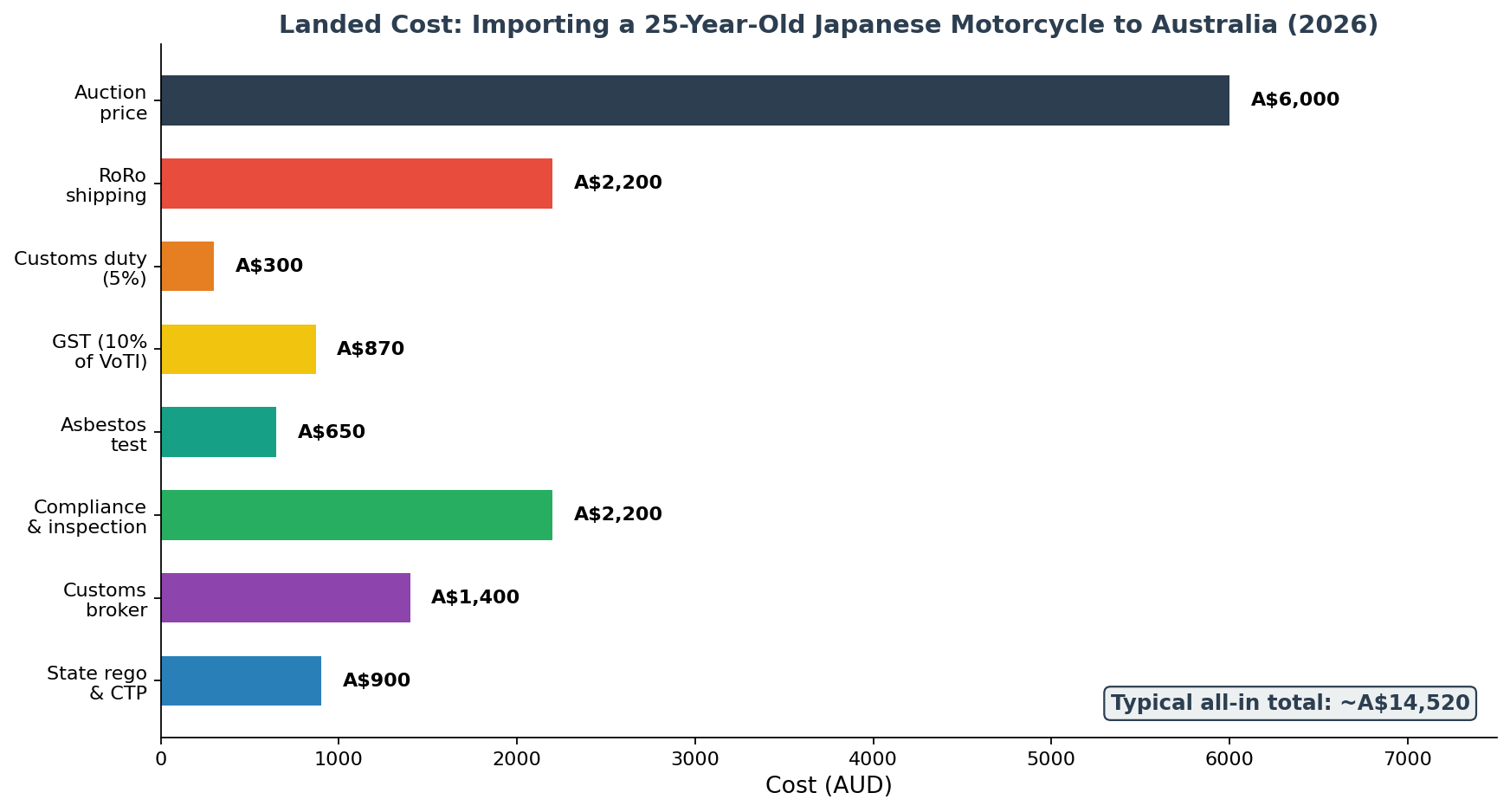
- Customs duty — 5%. Motorcycles less than 30 years old and not US-manufactured attract a 5% duty on the customs value. Bikes over 30 years old generally fall to 0%. Note that the Japan-Australia Economic Partnership Agreement (JAEPA) can reduce or eliminate this duty for qualifying Japan-origin goods accompanied by a valid Certificate of Origin — worth asking your broker about, because it can wipe the duty line entirely.
- GST — 10%. Charged on the "Value of the Taxable Importation" (VoTI), which is the customs value plus the duty plus international transport and insurance. This is why GST is not simply 10% of the bike price — it sits on top of shipping too.
- RoRo shipping — roughly AUD 1,500 to AUD 3,000 depending on origin and destination port.
- Asbestos test — a few hundred dollars for sampling and a clear report.
- Compliance and inspection — AUD 1,500 to AUD 3,000 if you are on the RAW pathway (a 25-year bike avoids the bulk of this).
- Customs broker — roughly AUD 1,000 to AUD 2,000 to file the declaration and handle clearance.
- State rego and CTP — around AUD 600 to AUD 1,200 depending on your state and the bike's capacity.
For the 25-year-rule example above, the realistic all-in lands somewhere around AUD 13,000 to AUD 15,000 by the time it is plated. That sounds steep next to a AUD 6,000 hammer price — until you price the same bike, in the same condition, at an Australian specialist dealer and find it wearing a AUD 18,000 to AUD 22,000 sticker. The import maths only works when you choose a bike Australia charges a big premium for. It does not work for a garden-variety commuter you can buy locally for less than the freight.
The customs and tax figures here are general information, not a personalised quote — your broker calculates the exact duty and GST on your specific declaration, and the official cost-of-importing rules are published by the Australian Border Force. Treat the numbers above as a planning baseline, not a promise.
Asbestos and biosecurity: the two things that catch everyone
These two are uniquely Australian, uniquely strict, and the source of almost every horror story you will read on the forums. They deserve their own section.
Asbestos: zero tolerance, every bike, every age
Australia bans all asbestos, full stop, and that ban reaches imported vehicles regardless of how old or new they are. Older motorcycles can carry asbestos in places you would never think to look — brake pads and shoes, clutch friction plates, and some gaskets and exhaust packing. The Border Force can and does test imported vehicles, and a positive result means the asbestos-containing part must be removed and disposed of under controlled conditions before the bike is released.
The smart move is to get an asbestos test done in Japan before shipping, or to budget for replacement of suspect friction materials with confirmed asbestos-free parts. The official guidance lives with the Asbestos Safety and Eradication Agency and the ABF. Do not gamble on this one — an asbestos hold at the wharf racks up storage fees fast.
Biosecurity: a clean bike is a cleared bike
The other gauntlet is DAFF biosecurity. Australia's quarantine is built to keep out foreign soil, seeds, insects, and plant disease, and a motorcycle is a fantastic place for all of them to hide — under guards, inside the air box, packed into the chain, lodged in tyre tread. The fix is simple and non-negotiable: the bike must be steam-cleaned to a spotless standard before it ships. A reputable export agent uses a quarantine-approved cleaning facility and provides the cleaning certificate, which smooths the inspection on arrival.
Get this wrong and the bike is sent for cleaning in Australia at your expense, then re-inspected, adding days and dollars. Get it right and the officer waves it through. The difference is entirely in the prep, which is one more reason to use an agent who does this every week rather than learning on your own bike.
State-by-state registration: the last hurdle
Federal approval gets the bike into the country. State registration gets it on the road, and that is run separately by each state and territory. The bike will already have its VIA and, if required, RAV entry; now your state transport authority wants its own safety check and its fees.
- New South Wales: an imported bike needs a safety inspection and a blue slip (an unregistered vehicle inspection report) before you can register it with Transport for NSW, plus CTP "green slip" insurance.
- Victoria: a roadworthy certificate is required, and any modified bike needs VASS engineer approval before VicRoads will register it.
- Queensland: you submit the federal import approval to Transport and Main Roads, pass a safety certificate inspection, and register with CTP.
- Western Australia: the bike is examined by the Department of Transport and registered once it passes, with the import approval presented as part of the paperwork.
- South Australia and the others: each runs its own inspection-plus-rego process with its own fee schedule, but the shape is the same everywhere — prove it is legally imported, prove it is safe, pay, get plates.
Budget a few hundred dollars and an inspection booking in every state. None of it is hard; it is simply the last queue. Once you have plates, the bike is yours to ride like any other — and the JDM machine that nobody else at the cafe has is finally on the road.
Common mistakes — and what nobody tells you
Most failed imports fail for boringly avoidable reasons. Here are the ones that actually bite.
Shipping before the VIA is granted. The cardinal sin. No approval, no legal import. The department rejects a meaningful share of first-time VIA applications outright — industry figures put it around a quarter — almost always for incomplete documentation, especially missing or weak proof of build date. Over-document from the start.
Assuming a 25-year bike is automatically older than 25 years. Build date, not model year, is what counts — and a "1999 model" can have a manufacture date that pushes it either side of the line. Verify the actual date stamped or recorded for your specific frame number before you build your whole plan around the concessional pathway.
Underbudgeting GST. People calculate 10% of the bike price and stop. GST is charged on the bike plus duty plus freight and insurance, so the real GST line is always higher than the back-of-envelope figure.
Ignoring asbestos. "It's just a motorbike, surely they don't check" is how you end up with a wharf storage bill. They check. Test in Japan.
Buying a bike that doesn't justify the freight. The import only pays off on machines Australia prices at a premium — the grey-import 400s, the two-stroke replicas, the rare nakeds, clean low-kilometre classics. A bog-standard learner commuter costs more to land than to buy locally. Choose the bike, then choose to import — not the other way around.
Skipping the inspection sheet. The auction sheet tells you about accident repair, corrosion, frame damage, and originality before you spend a cent. The buyers who lose money are the ones who bid on a photo and a vibe. Learn the sheet. Then trust an agent who reads them daily — our take on whether Japanese motorcycles are actually reliable explains why a well-graded auction bike is usually a safer bet than a tired local example with a forgotten service history.
How AWA Auction makes the Japan-to-Australia import simple
Everything above is doable solo. The reason most Australians don't do it solo is that the value sits in the Japanese auctions, and those auctions are closed to the public — you need a licensed seat to bid, and you need to read a sheet written in inspector shorthand to bid well.
That is exactly what we do. AWA Auction gives Australian buyers direct access to the same Japanese motorcycle auctions the trade uses, with the inspection sheets translated and the grades explained so you bid on facts, not photos. We set your maximum, bid on your behalf, and once you win we coordinate the steam-clean, the asbestos handling, the export documentation, and the shipping to your Australian port. You handle the VIA in your name (we tell you exactly what to lodge) and your state rego at the end; we handle the messy middle in Japan.
The bikes you have always wanted — the CB400SF, the SR400, the VFR400, the two-stroke screamers, the 90s nakeds Australia never officially sold — are crossing the auction block every week. Want help reading the lanes before you commit? Start with our guide to bidding on a Japanese motorcycle auction, browse what is live on our current listings, and when you have a bike in mind, talk to our team. We will tell you honestly whether the import maths works for that specific machine — because a happy buyer who imported the right bike is worth more to us than a quick sale on the wrong one.
For the broader picture of how the whole system works beyond Australia, our master guide to importing a motorcycle from Japan covers the universal mechanics of auctions, agents, and shipping that underpin every destination.
Which Japanese motorcycles are actually worth importing to Australia?
The import maths only sings on bikes Australia either never sold or prices at a heavy premium. Spend your freight budget on those, and the landed cost looks like a bargain instead of a tax. Here are the categories that consistently reward an import — every one of them now sits inside or near the 25-year window.
The grey-import 400-class four-strokes
This is the heartland. The Honda CB400 Super Four, CBR400RR, and VFR400 (NC30), the Kawasaki ZXR400 and Zephyr 400, the Yamaha FZR400 and SRX400 — Australia got few of these officially, yet they are everywhere in Japan. A clean CB400SF with genuine low kilometres can hammer for the price of a tired local commuter, and on the road it feels like a scaled-down litre bike with a redline near five figures. For a learner-legal or just-off-learners rider who wants character without a thirsty engine, the 400 four is the smartest import in the country.
The two-stroke race replicas
The Honda NSR250, Yamaha TZR250, and Suzuki RGV250 Gamma are the bikes that built the JDM import legend. Australia never received them in numbers, the local survivors are tired and expensive, and Japan still has clean examples. They are not for everyone — premix, power valves, and a narrow powerband demand respect — but nothing else delivers that 1990s GP-bike-for-the-road hit. Buy on the inspection sheet, budget for a top-end refresh, and you own a future classic.
The modern classics and nakeds
The Yamaha SR400 (a single-cylinder time capsule built almost unchanged for decades), the Kawasaki W650, the big air-cooled Zephyrs, the Suzuki GSX-R and Bandit families — these are the bikes that age into appreciation rather than depreciation. A well-kept SR400 imported today is the kind of bike you ride for ten years and sell for what you paid.
The big bruisers
Honda CB1300, Kawasaki ZRX1200, Yamaha XJR1300 — muscular air-cooled nakeds that Australia barely saw. Japanese examples are often immaculate, garaged, and low-kilometre. If you want presence and torque without a modern bike's plastics and electronics, this is where to shop.
Notice the through-line: in every case you are buying a bike that is scarce, premium-priced, or simply unavailable locally. That scarcity is what the import overcomes. For a bike Australia sells new at a sensible price, skip the freight and buy down the road.
Should you use an export agent or go it alone?
You can, in theory, register with a Japanese auction proxy, bid yourself, arrange your own freight forwarder, and project-manage the whole thing from your laptop in Adelaide. People do it. Whether you should depends on how much of the risk you want to carry personally.
The auctions themselves are trade-only — you cannot walk in off the street and bid, which is why a licensed intermediary exists in the first place. Beyond access, the real value an agent adds is judgement: reading the inspection sheet correctly, spotting the repainted panel or the "R" accident-history note, knowing which auction houses grade harshly and which are generous, and arranging the steam-clean and asbestos paperwork so the bike clears Australian quarantine first time.
Going solo saves the agent margin but exposes you to the expensive mistakes — the misread sheet, the failed biosecurity inspection, the VIA rejected for thin documentation. For a first import especially, a good agent usually pays for themselves in errors avoided. The break-even shifts in your favour once you have done a few and learned the sheet yourself. There is no shame in either choice; just know which risks you are signing up to own.
Insurance, resale, and living with an imported bike
Once the bike is plated, it behaves like any other registered motorcycle in your state — with two small wrinkles worth planning for. First, insurance. Some insurers price grey imports cautiously or want an agreed-value policy with photos and a description, particularly for rarer models. Sort this before you ride, and use an agreed-value policy for anything collectible so a write-off pays what the bike is actually worth, not a generic book figure.
Second, parts and servicing. The mechanical parts on most Japanese imports are shared with models Australia did sell, so consumables — filters, pads, tyres, chains — are easy. The model-specific bits (fairing panels, badges, two-stroke power-valve components) come from Japan, so build a relationship with a parts importer or buy a spares package up front for anything rare.
Resale is the happy ending. Because you bought a scarce bike well, an imported JDM machine in good order tends to hold value far better than a mass-market new bike that loses a third of its price the moment it leaves the showroom. Keep the import paperwork, the auction sheet, and the service records together — that documented history is exactly what the next buyer pays a premium for.
Frequently asked questions
Is it cheaper to import a motorcycle from Japan to Australia than to buy locally?
Only for the right bike. For a scarce or premium model — a grey-import 400, a two-stroke replica, a clean modern classic — importing often lands you the bike for well under the local specialist price even after all fees. For a common bike Australia sells cheaply, the freight and taxes make a local purchase the smarter buy. Choose the bike first, then run the maths.
What is the 25-year rule for motorcycles in Australia?
A motorcycle manufactured 25 or more years ago can be imported under a concessional arrangement that skips full ADR compliance for personal use. It is a rolling rule, so in 2026 anything built in 2001 or earlier qualifies. You still need a Vehicle Import Approval, an asbestos test, and a biosecurity clean — you just avoid the costly RAW compliance workshop.
Do I need import approval before the bike ships?
Yes, always. The Vehicle Import Approval (VIA) must be granted before the motorcycle leaves Japan. Shipping first and applying later is the single most expensive mistake you can make — a bike that arrives without approval can incur storage costs or be forced back out of the country at your expense.
How much does it cost to import a motorcycle from Japan to Australia?
For a 25-year-old bike hammering around AUD 6,000, expect an all-in landed and registered cost of roughly AUD 13,000 to AUD 15,000. That includes shipping (AUD 1,500–3,000), 5% duty, 10% GST on the value-plus-freight, the asbestos test, broker fees, and state rego. A newer bike on the RAW compliance pathway costs more.
How long does the whole process take?
About three to four months end to end for a clean import. The big chunks are VIA processing (up to three weeks), ocean transit (two to three weeks), and the queues for biosecurity and your state rego inspection. Most of the time is waiting, not working.
Why do I have to pay for an asbestos test?
Australia has a zero-tolerance ban on asbestos that applies to every imported vehicle regardless of age. Older bikes can carry asbestos in brake and clutch friction material and some gaskets. Testing in Japan before shipping — or replacing suspect parts with certified asbestos-free components — avoids a costly hold at the wharf.
What is the GST charged on?
GST of 10% is charged on the Value of the Taxable Importation, which is the customs value of the bike plus any duty plus the cost of international transport and insurance. That is why the real GST figure is always more than 10% of the bike's purchase price alone.
Can I ride the bike straight away once it lands?
No. After customs and biosecurity clearance, and compliance if it is under 25 years, you still have to register the bike in your state — which means a safety inspection, CTP insurance, and plates. Only then is it road legal. Budget a few extra weeks for the rego queue.
Do motorcycles pay Luxury Car Tax in Australia?
No. Luxury Car Tax does not apply to motorcycles, which is one of several ways bikes are simpler to import than cars. You still pay duty and GST, but the LCT that catches expensive car imports is not in play.
Which Japanese bikes are the best value to import?
The models Australia never officially sold or prices at a premium: the 400-class four-strokes (CB400SF, VFR400, CBR400RR, ZXR400), the two-stroke 250 replicas (NSR250, TZR250, RGV250), modern classics like the SR400 and W650, and big air-cooled nakeds like the ZRX1200 and XJR1300. Scarcity locally plus abundance in Japan is what makes the import pay.
Choosing your port and shipping method without overpaying
Shipping is where small decisions quietly add or save hundreds of dollars, so it is worth a moment of thought rather than just accepting the first quote. The two levers are method and port.
On method, roll-on/roll-off is the default for a single motorcycle: the bike is crated or strapped, rolled aboard a dedicated vehicle carrier, and rolled off at the other end. It is the cheapest route and perfectly safe for the vast majority of imports. A consolidated container — where your bike shares a box with other vehicles or freight — costs more but wraps the bike in an extra layer of protection from weather and handling, which some owners want for a concours-grade classic. A sole-use container is overkill for one bike unless you are also shipping a pile of spares. The full trade-off, including crating standards and marine insurance, sits in our container vs RoRo comparison.
On port, ship to the capital nearest you rather than the cheapest-sounding option on paper. A slightly lower freight quote into a port three states away evaporates the moment you add interstate transport or a flight to go collect the bike. Brisbane, Sydney, Melbourne, and Fremantle all handle vehicle imports routinely; pick the one your state rego and your driveway are closest to. Always insure the shipment — marine insurance on a motorcycle is cheap relative to the value at risk, and the one time you need it pays for every time you did not.
Your one-page import checklist
Tape this to the wall. If you can tick every box in order, you have done it right.
- Read the auction inspection sheet and set a hard maximum bid.
- Confirm the bike's actual build date, not just its model year.
- Win the bike through a licensed agent or proxy and pay the hammer plus fees.
- Lodge the Vehicle Import Approval through ROVER — and wait for it to be granted.
- Arrange the asbestos test and the quarantine-approved steam-clean in Japan.
- Book shipping (RoRo for most) to your nearest capital port, with marine insurance.
- Engage a customs broker to file the declaration and pay duty plus GST on arrival.
- Clear biosecurity — a spotless bike clears first time.
- Complete RAW compliance if the bike is under 25 years old.
- Register in your state: safety inspection, CTP insurance, plates.
- Sort agreed-value insurance and a spares plan before the first ride.
That is the entire job. None of the steps are hard on their own; the skill is doing them in the right order and not skipping the boring ones. Do that, and the bike Australia never sold ends up in your shed for a price the local dealer could never match.
See Also
Share this article: