
You won the bike. The auction sheet checked out, the price was right, and somewhere in Yokohama there's a Japanese motorcycle with your name on it. Now comes the part that quietly decides whether this whole adventure was a smart buy or an expensive lesson: shipping a motorcycle from Japan to wherever you actually live.
Here's the thing nobody mentions when they post their auction win online. The freight leg is where good deals go to die. Pick the wrong method, skip the wrong document, or trust the wrong forwarder, and the $400 you saved at auction vanishes in port fees and storage charges before the bike even clears customs.
This is the complete guide to getting your motorcycle out of Japan and onto your driveway. Real costs, real timelines, the difference between RoRo and container that sets your entire budget, and the destination-port fees that ambush almost every first-time importer. By the end you'll know exactly what you're paying for and where the traps are.

What Shipping a Motorcycle from Japan Actually Involves
Most people picture shipping as one thing: a bike goes on a boat, the boat arrives, you ride away. In reality, shipping a motorcycle from Japan is a chain of five separate handoffs, and each one has its own cost and its own way of going wrong.
First, the bike moves from the auction house or dealer's yard to the export port — usually by domestic truck. Second, it gets prepared for export: drained of excess fuel, sometimes crated, photographed, and documented. Third, it's loaded onto a vessel, either rolled on or packed into a container. Fourth, it crosses the ocean, which is the part you have zero control over. Fifth, it lands at your destination port, where it has to clear customs, pass any required inspections, and get released to you or your local transporter.
Skip a step in your planning and the bike sits. And a bike sitting at a port is a bike racking up storage fees by the day.
The single most useful mental model: you're not buying "shipping," you're buying a sequence of services from at least two companies — a Japanese exporter/forwarder on the origin side, and a customs broker or transporter on your side. The smoothest imports happen when one party coordinates the whole chain. The ugliest happen when nobody owns the handoff in the middle.
That's the overview. Now let's get into the decision that matters most.
RoRo vs. Container: The Decision That Sets Your Whole Budget
Every conversation about shipping a motorcycle from Japan eventually lands here, and for good reason. Your choice between RoRo and container shipping affects your cost, your transit time, your risk, and even whether your non-running project bike is eligible to ship at all.
RoRo stands for Roll-on/Roll-off. The vehicle is literally rolled onto the vessel under its own power, strapped down on an open vehicle deck, and rolled off at the other end. It's how most cars cross oceans, and it's typically the cheaper option for a single bike.
Container shipping means your motorcycle is loaded into a steel shipping container — either alone, sharing space with other vehicles, or crated inside. The container is sealed in Japan and not opened again until it reaches its destination.
Here's how they actually compare for a motorcycle:
RoRo is usually the lowest-cost method for a single bike, and it's straightforward. But there's a catch most buyers don't discover until it's too late: with RoRo, the motorcycle generally has to be operational and able to roll. If you bought a non-running project, a seized engine, or a bike with no battery, RoRo may not be an option. Your bike also rides on an open deck, exposed to handling by port staff, salt air, and the occasional careless strap. For a beater you're going to restore anyway, that's fine. For a clean, low-mileage grade 4.5 you paid a premium for, it stings.
Container shipping costs more but buys you protection and flexibility. The bike is enclosed, shielded from weather and prying hands, and — critically — it doesn't have to run. Non-running bikes, rare machines, and anything you care about cosmetically belong in a container. Containers also give you room to ship spare parts, gear, or a second bike alongside, which changes the math entirely (more on that later).

Here's the part nobody tells you: RoRo is not automatically cheaper than a container. Depending on the shipping lane and the season, RoRo rates can sit above or below a consolidated (shared) container rate. Freight pricing swings with fuel surcharges, vessel availability, and demand. The honest answer to "which is cheaper" is: get a quote for both on your specific route, in the month you're actually shipping, before you assume anything.
If you remember one thing from this section: operational bike on a budget → RoRo. Valuable, rare, or non-running bike → container. Everything else is negotiation.
What It Costs to Ship a Motorcycle from Japan: Real Numbers
Let's talk money, because vague answers help nobody. The figures below are ballpark ranges for ocean freight from Japan as of 2026 — your actual quote will vary with route, season, bike size, and the forwarder you use. Treat these as a sanity check, not a contract.
For a single motorcycle, most riders pay somewhere in the range of $900 to $2,500 for the ocean freight portion alone. RoRo for a standard bike often falls in the $900 to $2,000 band depending on destination and bike size. A motorcycle in a shared (consolidated) container tends to sit higher per bike, and a sole-use container is higher still — but a sole-use 40-foot container can carry many bikes, which is where the per-unit cost collapses if you're shipping more than one.
But the ocean freight is only one line on the invoice. Here's the fuller picture of what you actually pay when shipping a motorcycle from Japan:
- Domestic transport in Japan — moving the bike from auction yard to port. Often a few hundred dollars depending on distance.
- Export handling and documentation — preparing the bike, paperwork, and export clearance on the Japan side.
- Ocean freight — the RoRo or container charge above.
- Marine insurance — typically 0.5%–0.8% of the bike's CIF value (we'll cover why you want this).
- Destination port charges — terminal handling, customs processing, and any inspection fees. These commonly add $150 to $600 and catch people off guard.
- Import duty and taxes — entirely dependent on your country. This is not a shipping cost, but it lands at the same time, so budget for it.
- Final-mile delivery — getting the bike from your destination port to your garage.
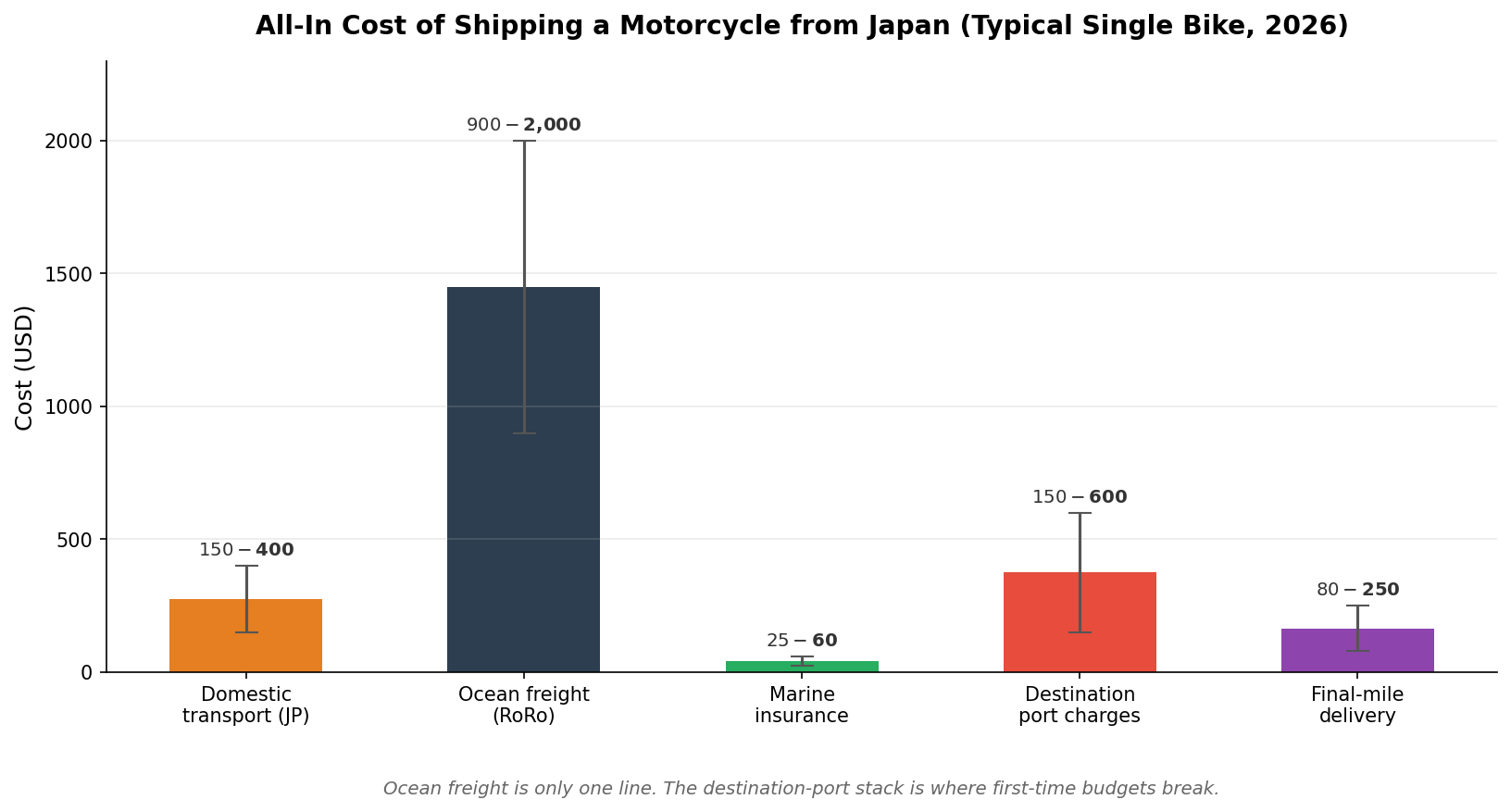
The mistake almost everyone makes is budgeting only for the ocean freight number, then getting blindsided by the destination-port stack. A $1,200 RoRo quote can realistically become $1,800–$2,200 all-in once you add domestic transport, insurance, and the terminal/customs charges at your end. Build your budget around the all-in figure, not the headline freight rate, and you'll never get an ugly surprise.
One more reality check from the field: the cheapest forwarder is rarely the cheapest outcome. A bargain freight rate with a disorganised agent who lets your bike sit at the destination terminal for two weeks will cost you more in storage and demurrage than you ever saved on the freight.
How Long Does Shipping Take? Transit Times by Destination
"How long to ship a motorcycle from Japan?" is the question everyone asks the moment they win a bike, usually because they've already mentally scheduled the first ride.
The honest framing is that ocean transit — the time the bike spends actually on the water — is only part of the wait. Total door-to-door time is ocean transit plus the days on either end for processing, loading schedules, customs, and delivery.
Here are realistic ocean-transit estimates from Japanese ports:
- Japan to the US West Coast: roughly 2 to 3 weeks on the water for many sailings.
- Japan to the US East Coast: longer, often around 5 to 6 weeks given the route.
- Japan to Australia / New Zealand: commonly 2 to 4 weeks depending on the port and service.
- Japan to the UK / Europe: typically 6 to 8 weeks, since it's one of the longest lanes.
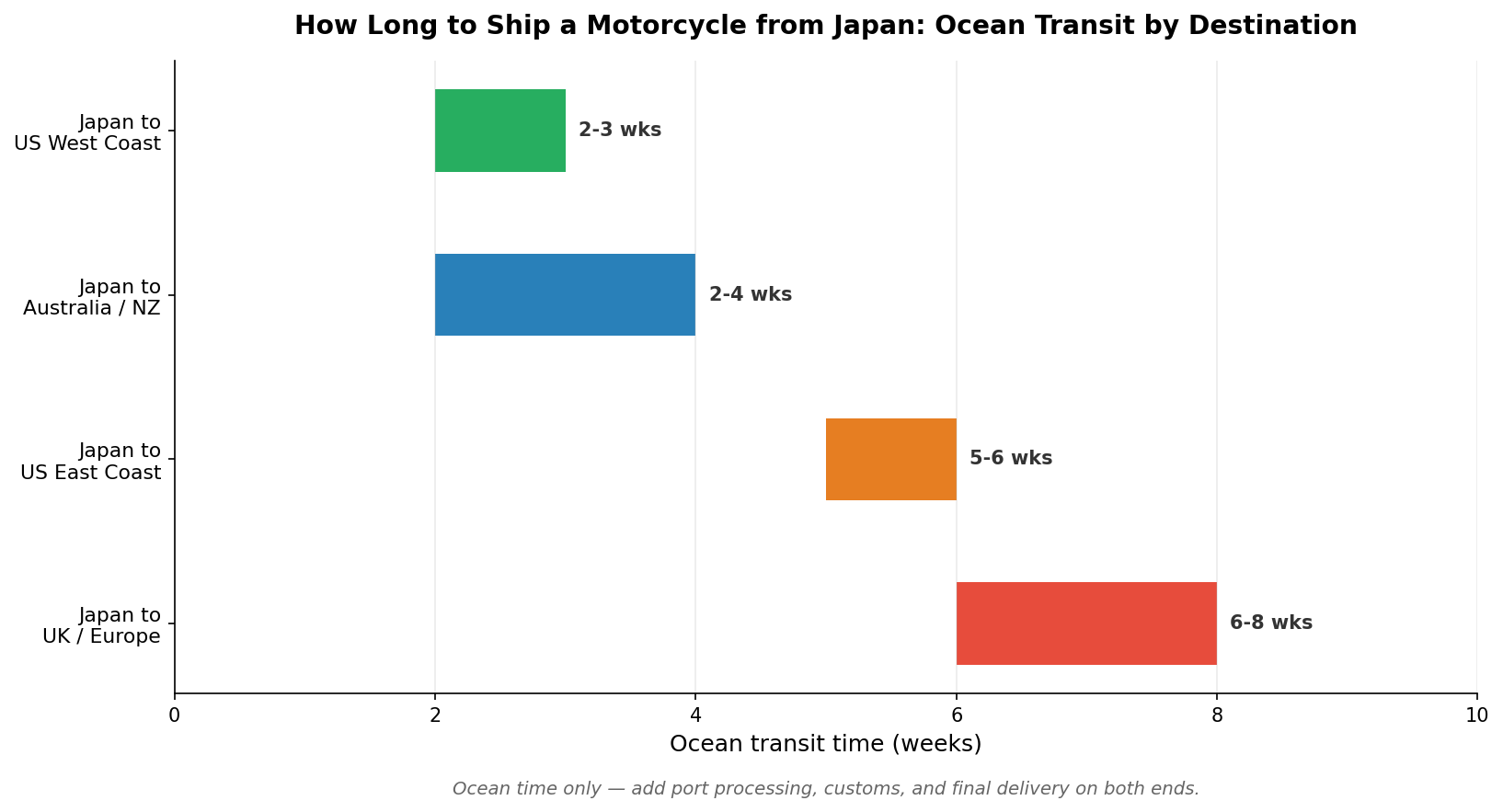
Sea freight for motorcycles overall is often quoted at 3 to 6 weeks of ocean time, which lines up with the ranges above. Container shipments to some US ports have been estimated around 45 days door-relevant, so don't be surprised if a full cycle runs closer to two months once you add port processing on both ends.
Then add the bookends. On the Japan side, your bike may wait for the next suitable sailing — vessels don't leave daily on every lane. On your side, customs clearance can be same-week or can drag if paperwork is incomplete or your country requires inspection. Plan for the long end, and treat an early arrival as a pleasant surprise rather than the baseline.
If you need the bike by a specific date, work backwards from that date, add a buffer of two to three weeks for the things you can't control, and book accordingly. The riders who get burned are the ones who assume "a few weeks" and book a track day before the bike has even cleared the gantry crane.
The Japanese Ports Your Bike Will Leave From
You don't get to pick your departure port like choosing an airport, but knowing the players helps you understand routing and timelines.
The major export ports for vehicles leaving Japan are Yokohama, Tokyo, Nagoya, Osaka, and Kobe. Yokohama and Tokyo serve the Kanto region — which, conveniently, is where Japan's largest motorcycle auctions are held — so a bike won at BDS Kanto often has a short domestic hop to the water. Nagoya is a major automotive export hub. Osaka and Kobe cover the Kansai region.
Which port your bike sails from depends on where it was bought, which forwarder you're using, and which shipping line serves your destination. A reputable agent will route through whichever port gives the best combination of sailing schedule and cost for your lane, and you usually don't need to think about it beyond confirming the bike made it onto a vessel.
What matters to you as a buyer is the connection between auction location and port. A bike bought in the Kanto region and shipping from Yokohama has a tidy, low-cost domestic leg. A bike bought at a regional auction five hours away has a longer, pricier truck ride to the port. It's a small line item, but it's one more reason the "all-in" number matters more than the freight headline.
Crating, Strapping & How Your Bike Is Actually Secured
People worry about the ocean. They should worry more about handling — because the damage that happens to motorcycles in transit usually happens during loading, not on the open sea.
For container shipping, the gold standard is proper securing inside the box. The bike is positioned on a stable base, strapped down at multiple points using soft ties that won't mark the bodywork, and braced so it can't shift when the container is lifted, swung, and stacked. When multiple bikes share a container, spacing and bracing between them is what separates a clean arrival from a domino of scuffed fairings.
For air freight — which most buyers won't use because of cost, but it's worth understanding — bikes are fully crated. The motorcycle sits on a heavy-duty base, gets strapped down, then timber blocks hold it in position while the crate sides go up. A top is fitted and the whole crate is externally strapped. It's overkill for ocean freight, but it shows what proper securing looks like.
For RoRo, the bike rolls on and is strapped to the deck. This is where exposure risk is highest — your motorcycle shares an open deck with cars and other vehicles, handled by port staff who move hundreds of units a day. Reputable RoRo operators do this carefully. But "careful" across hundreds of vehicles is a different standard than a forwarder hand-strapping your single bike inside a container.
The takeaway: if cosmetic condition is part of what you paid for, the few hundred dollars of difference between RoRo and a well-secured container place is cheap insurance against arriving to a scratched tank. Ask your forwarder specifically how the bike will be secured. The good ones have a confident, detailed answer. The ones who mumble are telling you something.
The Paperwork: Export Certificate, Bill of Lading & Conformity Docs
This is the part that bores people right up until it's the reason their bike is stuck at a port. Documentation is not optional, and getting it right on the Japan side is what makes clearance on your side painless.
Here are the documents that matter when shipping a motorcycle from Japan:
The export certificate (deregistration certificate). When a vehicle is exported from Japan, it's deregistered, and the export cancellation certificate is the proof. Your Japanese exporter sends the original to you or your broker, and your customs authority will want it. No export certificate, no clean import. This is the single most important piece of paper in the whole transaction.
The bill of lading (B/L). Issued by the shipping line, this is the contract of carriage and the document that proves ownership of the cargo in transit. You generally need the original or a telex release to take possession of the bike at the destination.
Commercial invoice and proof of purchase. Shows what you paid, which your customs authority uses to assess duty and tax.
Certificate of origin. Confirms the bike was made in Japan. Some countries require it for clearance; others don't.
Conformity / emissions documentation. This is country-specific and the one that trips up US buyers especially. In the United States, the EPA advises that anyone importing a motorcycle obtain a certificate or letter stating the vehicle conforms to the relevant standards, and importers may need a Letter of Conformity from the manufacturer. Bikes 25 years or older are generally exempt from many of these requirements in the US — which is exactly why so much of the import scene revolves around the 25-year rule. (For the full breakdown of that rule and the import process end to end, see our guide to importing a motorcycle from Japan.)
The pattern to internalise: the Japan-side documents (export certificate, B/L, invoice) get the bike legally out of Japan and onto the water. The destination-side requirements (conformity, duty, inspection) get it legally into your country. A good agent handles the first set automatically. The second set is on you to understand for your specific country before you bid — not after the bike is on a boat.
Marine Insurance: The Small Decision Most Buyers Skip
Marine insurance is the line item people are most tempted to cut, and it's the one that ends careers in the importing hobby.
Transport insurance for a motorcycle typically costs 0.5% to 0.8% of the bike's CIF value — that's the cost, insurance, and freight value combined. On a $5,000 bike, that's roughly $25 to $40. For the price of a tank of fuel, you cover yourself against the genuinely terrible scenarios.
Now, here's the nuance most articles skip. Not all marine cover is equal. The basic clause often used for used vehicles — Institute Cargo Clause (C) — is narrow. It tends to pay out only in catastrophic events like the ship sinking or catching fire. It does not necessarily cover a scratch, a dropped bike during handling, or minor damage in transit. If you want broader protection against handling damage and partial loss, you need to ask for a wider clause (A-level cover) and you'll pay a bit more for it.
So the real decision isn't "insurance or no insurance." It's "what does my insurance actually cover?" Ask the question explicitly. Find out whether your cover is total-loss-only or whether it includes handling and partial damage. For a cheap project bike, total-loss cover might be all you want. For a clean, expensive machine, pay for the broader clause. Either way, shipping a motorcycle from Japan with zero insurance to save $30 is the kind of false economy that haunts people when a container goes overboard — which, rarely but really, happens.
What Nobody Tells You: The Destination Port Is Where Budgets Break
Every first-time importer focuses on the freight quote. The freight quote is the part that's easy to compare and easy to shop. So that's where attention goes.
The money actually leaks at the destination port.
When your bike lands, a stack of charges activates that has nothing to do with the shipping line you chose. Terminal handling charges. Customs processing fees. Possibly a quarantine or biosecurity inspection (Australia and New Zealand are strict about soil and contaminants — your bike may need cleaning and inspection on arrival). Document processing. And the silent killer: storage and demurrage, which start ticking if the bike isn't cleared and collected within the free-time window the port allows.
That free-time window is usually just a handful of days. Miss it because your paperwork wasn't ready, your broker was slow, or you didn't realise you needed to act, and you start paying daily storage on a steel yard somewhere, plus container detention if it's a container shipment. These charges compound fast and turn a clean import into a panic.
This is the single biggest reason to either use a forwarder who coordinates the destination clearance, or to line up your own customs broker before the bike arrives — not when you get the "your cargo has landed" email. The riders who clear their bikes smoothly are the ones who had the destination side organised while the bike was still on the water. The ones who get hammered are the ones who treated arrival as the finish line instead of the start of a clock.
Budget $150–$600 for the legitimate destination charges, and treat avoiding storage fees as a deadline you do not miss.
Consolidation: How Sharing a Container Changes the Math
Here's the strategy that separates people who import once and quit from people who do it again and again: don't ship one bike if you can ship several.
The economics of container shipping are brutally simple. A 40-foot container costs roughly the same to ship whether it holds one motorcycle or a dozen. So the per-bike cost of a sole-use container is painful for a single machine and excellent for a load. This is exactly what you see in those viral "unboxing a 40-foot container from Japan" videos — the popular Bikes and Beards episode on opening a 40-foot container of bikes from Japan has pulled over three million views, and the entire premise works because the freight cost gets divided across a whole container of motorcycles.
You have three practical ways to use this:
Consolidation (shared container). Your bike rides in a container alongside other buyers' vehicles, and you split the cost. A good forwarder runs regular consolidation services and slots your bike into the next box heading your way. Cheaper than a sole-use container, more protected than RoRo. For many buyers, this is the sweet spot.
Group buys. If you and a couple of riding buddies are all eyeing Japanese bikes, filling a container together and splitting the freight can drop the per-bike cost dramatically — often below what RoRo would have cost each of you individually.
Buy more than one. If you're even slightly tempted by a second bike, the marginal freight cost of adding it to your container is far lower than shipping it separately later. Plenty of importers fund their hobby this way: ship a container of bikes, keep the one they wanted, sell the rest locally to cover the freight.
The lesson from the field is consistent: the people complaining that "shipping from Japan is too expensive" are almost always shipping a single bike by the most convenient method. The people who think it's a bargain are filling containers.
Air Freight: The Fast, Expensive Exception
Almost every guide treats ocean freight as the only way to move a motorcycle from Japan. It isn't. Air freight exists, and for a small slice of buyers it's the right call — so it's worth knowing where the line sits.
The case for air is speed. Instead of waiting two to eight weeks for a vessel, your bike can be on the ground in your country in a matter of days. For a dealer who's pre-sold a rare machine to an impatient customer, for an auction win that has to make a specific show or event, or for a genuinely high-value collectible where time in a damp container is itself a risk, that speed has real value.
The case against air is everything else, starting with the price. Air freight typically costs several times what ocean freight does, often enough to double or triple your total landed cost on a single bike. You're also paying for the most thorough crating in the business — bikes flown out of Japan are fully boxed, strapped to a heavy-duty base, braced with timber blocks, and externally banded, because air cargo handling and weight rules demand it. That crating is excellent protection, but you're paying for the labour and the materials on top of the premium freight rate.
For the overwhelming majority of buyers shipping a motorcycle from Japan, air freight makes no financial sense. A $4,000 bike with a $3,000 air freight bill is a hard sell to your own wallet. But if you're moving something genuinely rare, genuinely time-sensitive, or genuinely valuable enough that the freight cost is a rounding error against the bike's worth, it's a tool that exists. Most people will read this section, nod, and book ocean freight — which is exactly the right instinct.
The honest rule of thumb: if you're asking whether you should air-freight your bike, the answer is almost certainly no. The people who genuinely need it already know they need it, and they're not reading a budgeting guide to find out.

Importing Into the US, UK, Australia & New Zealand: Country Notes
Shipping is universal, but what waits at the destination port is not. The same bike that clears customs in three days in one country sits in quarantine for two weeks in another. Here's the short version for the four markets most overseas buyers ship into. Treat this as orientation, not legal advice — rules change, and your specific bike and state or region can shift the details.
United States. The big lever is age. Motorcycles 25 years or older are generally exempt from the EPA and DOT conformity requirements that make importing newer bikes complicated, which is why so much of the US import scene is built around the 25-year rule. For a bike under 25 years, you're into EPA and DOT compliance territory, often needing conformity documentation from the manufacturer — a real hurdle. West Coast ports like Los Angeles and Long Beach see the shortest transit from Japan; East Coast arrivals take considerably longer. Customs duty on motorcycles is relatively modest, but it's assessed on your declared value, so keep your purchase paperwork clean.
United Kingdom. Expect VAT and import duty on arrival, calculated on the bike's value plus shipping. Older bikes can qualify for reduced rates, and historic vehicles may get favourable treatment, but you'll deal with registration and an IVA or age-related registration process depending on the bike. Transit from Japan is long — six to eight weeks is normal — so the UK is a patience market. Line up your registration path before the bike arrives.
Australia. Australia is strict, and the strictness is biosecurity. Your bike will likely be inspected on arrival for soil, plant matter, and contaminants, and if it's dirty, it gets cleaned and re-inspected at your expense before release. Bikes also need to satisfy the import approval framework before they arrive — getting that approval sorted in advance is essential, not optional. Transit times are reasonable (two to four weeks), but the paperwork front-loads the work onto you.
New Zealand. Like Australia, New Zealand takes biosecurity seriously — arrival inspection for contamination is standard, and a dirty bike means cleaning fees and delay. New Zealand also applies entry certification and compliance steps before a bike can be registered for the road. The market is smaller but the import scene is active, and the same rule applies: sort compliance and have the bike spotlessly clean before it ships.
The thread running through all four: the destination country's rules are your job to understand before you bid, and the smart move is to confirm your bike's specific path to legal registration while it's still in Japan. Win first and ask questions later, and you risk owning a bike you can ship but can't ride.
How to Vet a Shipping Agent Before You Trust Them With Your Bike
The forwarder or agent you pick matters more than the shipping line, the vessel, or the port. A good agent makes the entire chain invisible to you. A bad one turns a simple import into weeks of confused emails and a bike held hostage by fees. Since most overseas buyers can't physically inspect an operation in Japan, you vet on signals instead.
Start with how they answer questions. Ask a forwarder exactly how your bike will be secured for transit. The good ones give a confident, specific answer — soft ties, multi-point strapping, bracing, the works. The ones who give a vague "don't worry, we handle it" are telling you they either don't do it carefully or don't want you to look closely. The quality of the answer is the quality of the operation.
Ask about the documents. A competent agent volunteers exactly which documents you'll receive and when — the export certificate, the bill of lading, the invoice — without you having to drag it out of them. If they're cagey about the export certificate specifically, walk away. That document is non-negotiable, and any agent who treats it casually will cause you problems at customs.
Ask who owns the destination handoff. This is the question that separates professionals from order-takers. Some agents wave goodbye to your bike the moment it's on the vessel, leaving you to find a customs broker and clear it yourself. Others coordinate the whole chain through to delivery. Neither is wrong, but you need to know which you're getting, because the gap in the middle is where bikes sit and fees accumulate. If the agent stops at the water's edge, you must have your own broker ready before the bike lands.
Watch for the cheapest-quote trap. The forwarder with the rock-bottom freight rate and the disorganised process is not the cheap option — they're the expensive option wearing a disguise. One week of storage fees, one bungled document, one missed clearance window, and the savings are gone with interest. Price matters, but coordination matters more. The total cost of a smooth import beats the headline cost of a cheap one every time.
Finally, look for transparency on the full landed cost. An agent who will quote you the complete number — freight, insurance, domestic transport, and the expected destination charges — before you commit is an agent who isn't planning to surprise you later. Vagueness about the all-in cost is a warning sign, not a convenience. You want the number that lands on your driveway, not the number that gets the bike onto the boat.
How AWA Auction Handles Shipping for You
By now you've seen the moving parts — five handoffs, two countries' worth of paperwork, a freight decision that swings your budget, and a destination-port clock that punishes the disorganised. The whole reason a service like ours exists is so you don't have to project-manage all of that from the other side of the planet in a language you don't read.
When you buy through AWA Auction, the shipping chain is coordinated end to end. We handle the domestic transport from the auction to the export port, prepare the bike and the export documentation, arrange the freight — RoRo or container, whichever fits your bike and budget — and make sure the export certificate and bill of lading reach you or your broker in order. We'll tell you honestly whether your bike belongs on a RoRo deck or in a container, and we'll flag the destination-side requirements for your country before you bid, not after.
You can browse the current listings to see what's available at auction right now, and when you find a bike worth chasing, contact our team and we'll walk you through the full landed cost — freight, insurance, and the destination charges — so the number you budget is the number you pay.
No surprises at the port. No bike sitting in a yard racking up storage while you figure out customs. That's the entire point.

Five Mistakes That Turn a Good Deal Into an Expensive One
After watching how imports actually play out, the same handful of mistakes show up again and again. None of them are exotic. All of them are avoidable. Here they are, in the order they tend to bite.
Mistake one: budgeting for freight instead of landed cost. You compare RoRo quotes, pick the cheapest, and feel clever. Then the destination invoice arrives with terminal handling, customs processing, and an inspection fee, and your "cheap" shipment is suddenly mid-pack. The fix is simple: build your budget around the all-in landed number — freight plus insurance plus domestic transport plus destination charges plus duty — from the very first calculation. The freight rate is a component, not the answer.
Mistake two: choosing RoRo for a bike that deserved a container. RoRo saves money on a beater. On a clean, low-mileage machine you paid a premium for, shipping it exposed on an open deck to save a few hundred dollars is a gamble against a scratched tank or a knocked-over bike. Match the method to the value of the machine, not to the lowest line on the quote.
Mistake three: treating arrival as the finish line. The moment your bike lands, a clock starts. Ports give you a short window of free time before storage and demurrage charges begin, and that window can be just a few days. Buyers who haven't lined up a customs broker in advance scramble, miss the window, and pay daily for a steel yard. Have your destination clearance organised while the bike is still on the water.
Mistake four: skipping or misunderstanding insurance. Either people skip marine cover entirely to save $30, or they buy the basic clause and assume it covers everything — then discover it only pays out if the ship sinks. Know what your cover actually includes. Pay for broader protection on a valuable bike. The cost is trivial against the downside.
Mistake five: not understanding your own country's import rules before bidding. This is the big one. Emissions standards, age rules, inspection requirements, and conformity documentation vary wildly by country, and they're your responsibility, not the Japanese seller's. The 25-year rule in the US, biosecurity inspection in Australia and New Zealand, type-approval quirks in the UK and Europe — find out what applies to you before you win the bike, not after it's floating toward your port. A bike you can't legally register is the most expensive paperweight in the world.
Get these five right and shipping a motorcycle from Japan goes from a nerve-wracking gamble to a routine logistics exercise. Get them wrong and you'll have a very educational, very costly story to tell at the next bike night.
Cost, transit, and insurance figures are 2026 estimates and vary with route, season, and carrier — always confirm current rates before booking. Photos via Pexels — free to use under the Pexels License.
See Also
Share this article: