
If you want to import a Suzuki TL1000S from Japan, you are chasing one of the most misunderstood motorcycles Japan ever built. A 996cc, 90-degree V-twin that Suzuki aimed squarely at Ducati, wrapped in a half-faired roadster, hobbled by an experimental rear suspension unit, and then quietly buried after five model years. The internet calls it the Widowmaker. Owners call it the best-value V-twin on the planet. Both camps have a point.
Here is the part nobody mentions in the horror stories: the TL1000S is now old enough that every single production year is legal to import into the United States, and cheap enough in Japan that a tidy, rust-free, garage-kept example lands on your driveway for the price of a scruffy local one. That combination did not exist five years ago.
This guide covers what the bike actually is, what the rotary damper drama really was, which years to buy, which to avoid, what a Japanese auction example costs landed in the UK, and how to read the auction sheet so you do not import somebody else's neglected project.
Why import a Suzuki TL1000S from Japan rather than buy locally
The TL1000S was sold new in the UK, Europe, Australia and the US. So the obvious question: why bother shipping one halfway around the world?
Three reasons, and only one of them is price.
Condition. This is a bike from 1997 to 2001. Every surviving Western example has spent a quarter of a century being ridden through winters, salted roads, and at least three owners who thought a can of chain lube counted as maintenance. Japanese bikes live differently. Shaken inspection culture, garage storage, low annual mileage, and a domestic market that treats a 25-year-old sportsbike as a collectible rather than a hack. The corrosion difference on fasteners, downpipes and wheel rims is not subtle.
Mileage. A UK TL1000S at this price point is typically showing 30,000 to 50,000 miles. Japanese auction cars and bikes routinely surface at a third of that. On a V-twin with a known cam chain tensioner habit and 25-year-old rubber everywhere, mileage matters more than the paint.
Originality. Western TL1000S bikes have been modified to death, largely because the community fix for the rear damper is to bin it. That is fine if you want a track weapon. If you want an honest, original, unmolested example that has not been crashed, dropped or hacked about, Japan is where they still are.
The one thing importing does not buy you is a bargain-basement purchase price. Work through the numbers later in this guide and you will see the landed cost sits roughly level with a good UK bike. You are paying the same money for a better bike, not less money for the same bike. Anyone telling you otherwise is selling something.
TL1000S vs TL1000R vs SV1000: clearing up the confusion
Three Suzuki V-twins, one engine family, endless confusion in classified ads. Sort this out before you bid on anything.
Suzuki TL1000S (1997-2001). The original. Half-faired roadster, aluminium trellis frame, 996cc 90-degree V-twin producing a claimed 125 bhp at 8,500 rpm and 103 Nm at 8,000 rpm. Upright-ish bars, 825mm seat, 17-litre tank, around 211kg wet. This is the one with the rotary rear damper and the reputation.
Suzuki TL1000R (1998-2003). The full-fairing homologation special built so Suzuki could go World Superbike racing. Same 996cc architecture but race-tuned: 135 bhp at 9,500 rpm, 106 Nm at 7,500 rpm, forged pistons, stronger rods. Critically, the trellis frame was replaced with a stiffer beam frame derived from the GSX-R750 of the era, the swingarm was strengthened, and the suspension got the attention the S should have had from day one. Heavier, more committed riding position, far rarer.
Suzuki SV1000 (2003-2007). The sensible sequel. Suzuki took the lessons, dropped the rotary damper for a conventional shock, detuned the engine for midrange, and built a bike nobody argued about. Also, nobody wrote songs about it.
If a seller lists a "TL1000" without a letter, ask for the frame number and photographs of the tail unit. The S has twin underseat-adjacent silencers and a half fairing. The R is unmistakably a full-fairing superbike. People do mix them up, and the price difference is real.
Suzuki TL1000S specifications: what you are actually buying
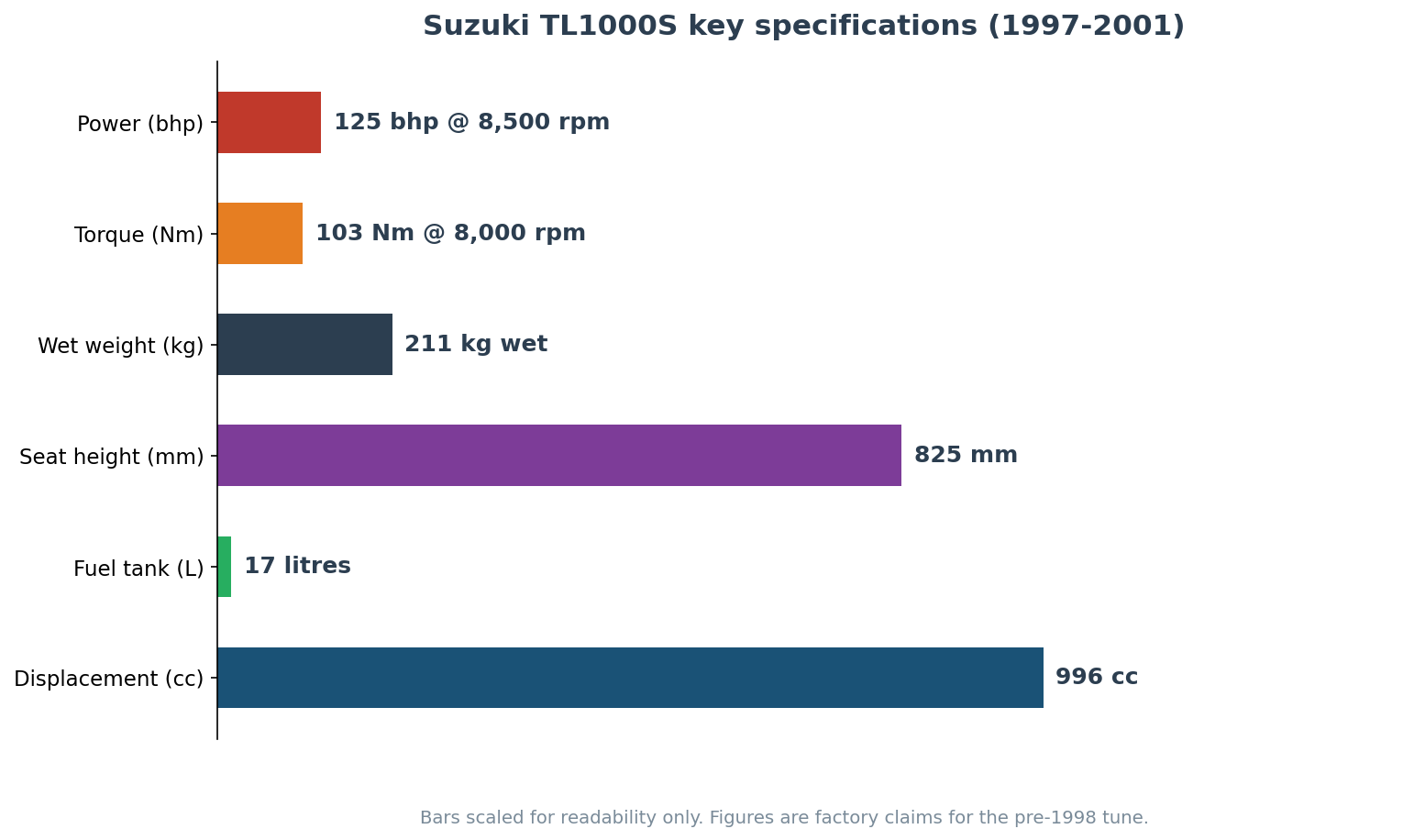
| Specification | Figure |
|---|---|
| Engine | 996cc liquid-cooled 90-degree V-twin, DOHC, 8 valves |
| Power | 125 bhp @ 8,500 rpm (1997); approximately 110 bhp from 1998 ECU |
| Torque | 103 Nm (76 lb-ft) @ 8,000 rpm |
| Fuelling | Fuel injection |
| Frame | Aluminium trellis |
| Rear suspension | Separate rotary damper and spring unit |
| Wet weight | Approximately 211 kg |
| Seat height | 825 mm |
| Fuel capacity | 17 litres |
| Production | 1997-2001 |
Two numbers matter more than the rest. The 825mm seat is tall for a roadster, so short riders should sit on one before committing. And 17 litres against a thirsty big twin means a realistic 110 to 130 miles between fills if you are enjoying yourself. This is not a touring bike, whatever the half fairing suggests.
The rotary rear damper explained, and why it earned the Widowmaker name
This is the heart of the TL1000S story, and it is routinely told badly.
Suzuki wanted the compact rear end of a Ducati without licensing anyone's design. So the engineers split the rear suspension into two parts: a conventional spring, and a separate rotary damper that controlled movement by forcing fluid through a vane rotating inside a sealed chamber, rather than a piston sliding up a tube. Formula One had used similar thinking. On paper it saved space and let Suzuki package the twin tight and short.
In practice, two things went wrong.
First, thermal. The damper sits close to the rear cylinder head. Add the heat the unit generates through its own internal friction and the fluid thins out. Thin fluid damps less. Riders report the rear going vague and wallowy exactly when they are asking the most of it, which is mid-corner, hot, on a hard ride. Feeling the back of a 125 bhp V-twin turn into a hammock is how legends get started.
Second, tuning. Owners consistently describe the original setup as harsh, with heaps of compression damping and almost no rebound. The bike compresses reluctantly then springs back with no control. On a bumpy British B-road that is a recipe for the rear stepping out and unsettling the chassis.
There is also a manufacturing reality worth understanding. A rotary unit is far harder to seal than a telescopic one. Circular seals working longitudinally are a solved problem; sealing a rectangular area between a rotor and a damper body requires tighter tolerances and is vulnerable to warping. Suzuki's damper is not designed to be serviced. When it goes, it goes.
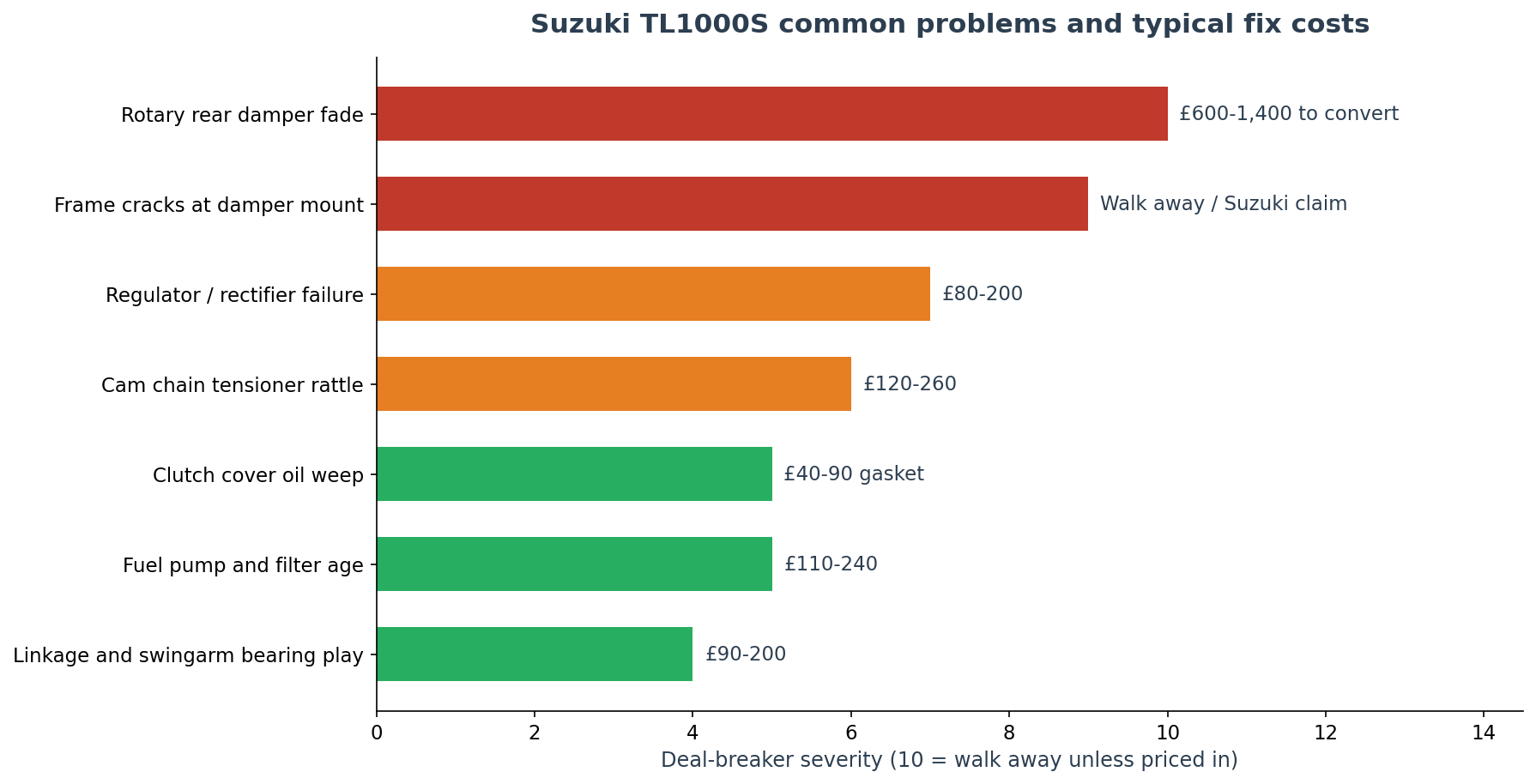
Here is the honest verdict twenty-five years on: the rotary damper is not going to kill you at legal road speeds on a well-sorted bike. It is going to annoy you, it is going to have degraded by now on any unmodified example, and the fix is well established. Penske, Ohlins and Wilbers all sell direct bolt-on conventional shock conversions that delete the rotary system entirely. Budget £600 to £1,400 depending on brand and whether you fit it yourself.
Which means when you are inspecting a Japanese auction bike, an already-converted rear end is a plus, not a red flag. Just make sure it was a quality kit and not a fabricated bodge.
The 1997 steering damper recall: what actually happened
The rotary damper gets the headlines. The steering geometry caused the recall.
Suzuki gave the TL1000S sharp steering geometry and paired it with a rear end that could not keep up. The result was high-speed front-end instability. When the first bikes landed in the UK, the motoring press filled up with tank-slapper stories, and after several serious accidents the situation escalated.
American Suzuki ran a safety recall and modification campaign covering all 1997 TL1000S machines built through 31 May 1997. Suzuki considered the issue serious enough to advise owners not to ride their bikes until a dealer had fitted a steering damper kit. Fitting took roughly 45 minutes. The recall went worldwide.
From 1998, two things changed at the factory. The steering damper became standard equipment, and Suzuki fitted a new ECU with a revised map that retarded ignition in the first three gears and reduced peak power from the claimed 125 bhp to around 110.
Read that again, because it is the single most useful buying fact in this guide. A 1998-onwards TL1000S is a meaningfully different motorcycle from a launch-year 1997 bike. Calmer, safer, slightly slower on paper, and vastly easier to live with.
If you are looking at a 1997 example, your first question to the seller or your import agent is whether the recall work was carried out and whether the steering damper is present and functioning. On a Japanese-market bike, service records make this straightforward to verify.
Suzuki TL1000S generations and year-by-year changes
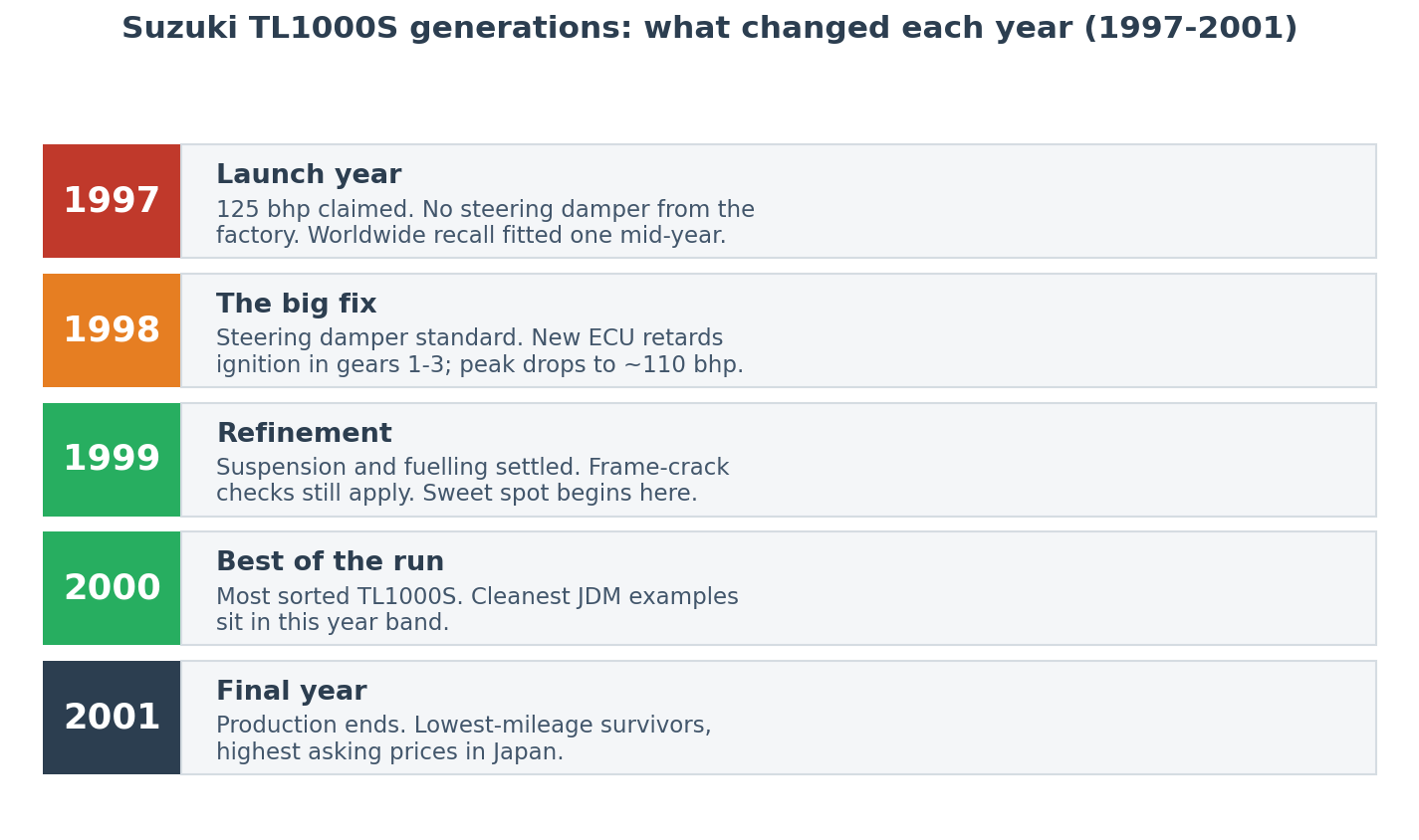
The TL1000S never got a full model revision. What it got was five years of quiet corrections, which makes the model year the most important number on the auction sheet.
1997: the launch year
The full-fat 125 bhp claim, no factory steering damper, and the reputation that followed the bike forever. Recall work fitted a damper mid-year to bikes already sold. These are the most "authentic" TL1000S machines and the ones enthusiasts argue about. They are also the ones that need the most careful verification.
1998: the big fix
Steering damper standard from the factory. New ECU, revised map, ignition retarded in gears one to three, peak power down to roughly 110 bhp. Suzuki was not being timid here. They were making a bike that had frightened people into one that behaved.
1999: refinement
Fuelling and suspension settings settled down and the worst of the early-production teething faded. Frame-crack inspection still applies to every year. For most buyers this is where the sweet spot starts.
2000: the best of the run
The most sorted TL1000S you can buy. Nothing dramatic changed, but the accumulated small fixes mean these are the least troublesome examples. The cleanest low-mileage JDM bikes tend to cluster here.
2001: the final year
Production ended. Suzuki moved on to the SV1000. Final-year bikes are the lowest-mileage survivors and carry the strongest asking prices in Japan, partly because domestic collectors know exactly what they are.
Common problems to check before you buy a TL1000S
Every one of these is checkable before you bid, provided you know to look.
Rotary rear damper degradation
Assume any unconverted damper on a 25-year-old bike is past its best. Look for oil weeping around the unit, a rear end that stays compressed after you push down on the seat, or a seller who mentions the bike "feels a bit soft at the back". Price the conversion in.
Frame cracks at the damper mount
This is the one that should stop a deal. Cracks appear in the steering head area and around the rotary damper mounting point. Suzuki never issued a formal recall for it, though the factory has historically replaced frames when cracks appeared. On an import you have no such recourse. Demand close, well-lit photographs of the frame around the damper mount and the headstock. Any crack, walk away.
Charging system: regulator and rectifier
The late-90s Suzuki special. Failing regulators cook batteries and leave you stranded. Symptoms are a battery that never quite holds charge and connectors that look heat-discoloured. An uprated aftermarket unit costs £80 to £200 and is a routine fix.
Cam chain tensioners
A rattle on start-up that fades as oil pressure builds is the classic sign. Manual tensioner conversions are common in the community and are not a bodge if done properly. Budget £120 to £260.
Clutch cover oil weep and tank issues
Early bikes had leaking clutch covers and, in some cases, leaking fuel tanks. Both were addressed under recall campaigns on affected machines, but 25 years of gaskets means you should still look for a wet patch on the right-hand engine case.
Fuel pump, filters and 25-year-old rubber
Fuel pumps and filters age out. Hoses perish. Brake lines go hard. On a bike this old, factor a few hundred pounds of consumables into your first month of ownership regardless of how clean it looks. That is not a TL1000S problem, that is a 1990s motorcycle problem.
Linkage and swingarm bearings
Neglected linkage bearings seize. On a Japanese bike stored indoors this is less common than on a British survivor, but check for play by lifting the rear and rocking the wheel laterally.
Best and worst years to buy a TL1000S
Best: 1999 to 2001. Factory steering damper, settled fuelling, calmer ECU map, and the highest proportion of surviving examples that were bought by people who already knew what the bike was. If you want to ride rather than restore, buy here.
Buy with care: 1998. The important fixes are present. These are good bikes and often cheaper than the later years for no functional reason.
Only with full history: 1997. A launch-year bike with documented recall work, a present and working steering damper, and a crack-free frame is a genuinely desirable machine and arguably the collector's choice. A launch-year bike with no paperwork is a gamble you do not need to take when 2000 examples exist.
There is no year to categorically avoid. There is a year that demands proof.
The 25-year rule: 2026 is the first year the entire TL1000S run is US-legal
American readers, this section is for you and it is time-sensitive in a good way.
The United States permits import of motor vehicles 25 years old or older without meeting current federal safety and emissions standards. The TL1000S ran from 1997 to 2001. Do the arithmetic: 1997 bikes crossed the line in 2022, and as of 2026 the entire production run, right through to the final 2001 machines, is eligible.
That matters more than it sounds. The TL1000S was sold in the US, so American buyers have never been locked out of the model entirely. What they have been locked out of is the Japanese domestic market supply: the low-mileage, unmodified, uncorroded bikes that never left Honshu. Those are now fully accessible, and the pool of US bikes has been thinned by twenty-five years of hard riding and crash damage.
The practical steps are the standard ones: confirm the manufacture date rather than the model year, file the correct customs paperwork, and check your state's titling process for imported vehicles before the bike ships, not after. Rules vary by state and the paperwork is the slow part.
What a TL1000S costs: UK prices versus a Japanese import, landed
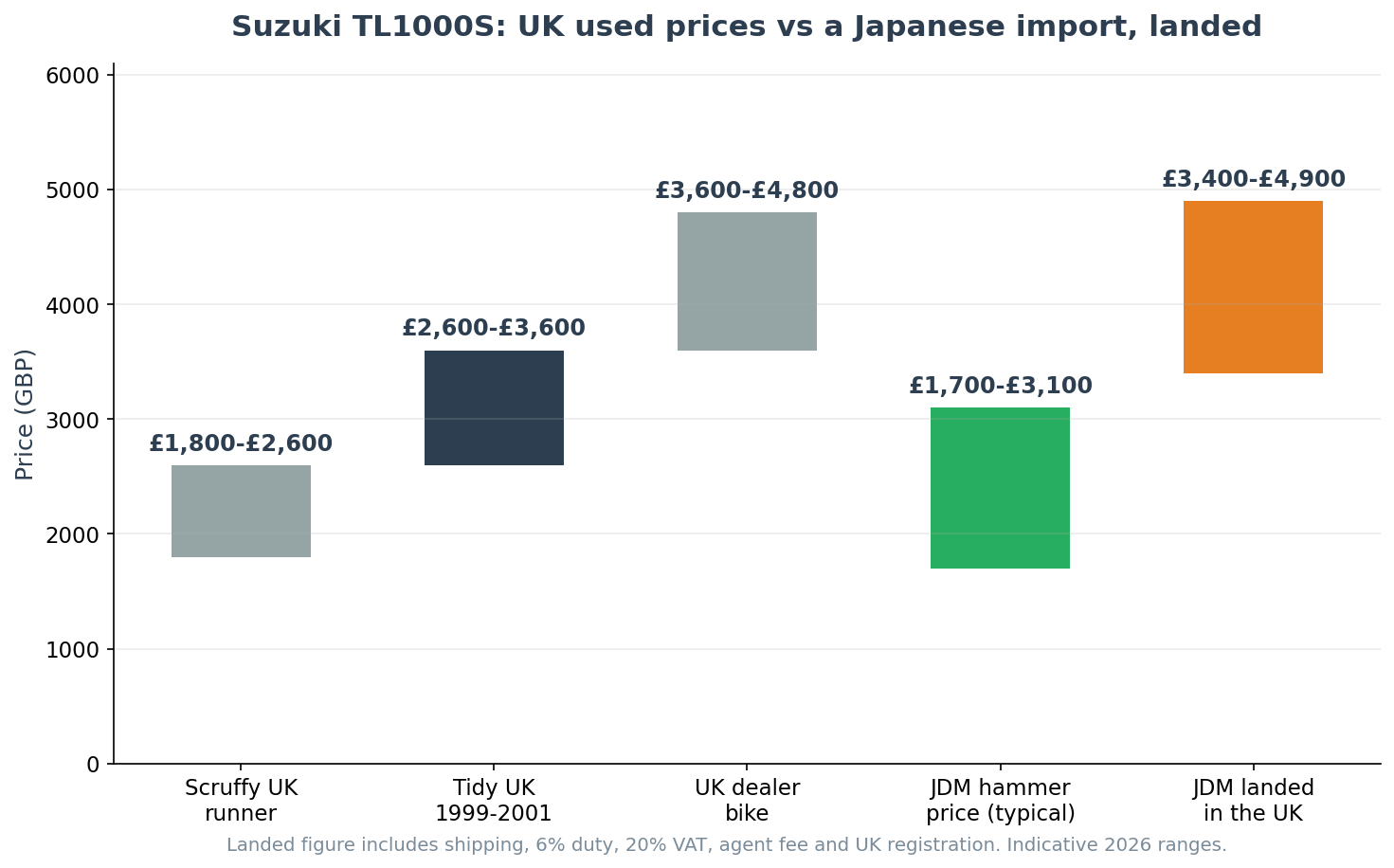
UK market reality first. Tidy modified examples change hands in the £2,000 to £3,000 bracket, with some under £3,000 and less again if you accept something scruffy. Dealer bikes with warranty sit higher, typically £3,600 to £4,800, and you are paying for the warranty rather than the bike.
Japanese auction hammer prices for a TL1000S typically land between £1,700 and £3,100 depending on year, mileage, grade and whether the bike is original. Final-year, low-mileage, high-grade examples push the top of that range and occasionally beyond.
Now the additions. On a bike over 250cc and under 30 years old coming into the UK:
- Shipping: £400 to £600 RoRo, £700 to £1,000 containerised. Container is safer for a bike you care about.
- Import duty: 6% calculated on the CIF value, meaning hammer price plus insurance plus freight, not just the hammer price. This trips people up constantly.
- VAT: 20%, also on the CIF value plus duty.
- MSVA: generally not required for a bike over 10 years old. The TL1000S clears that comfortably.
- DVLA first registration: £55.
- Agent and auction fees, MOT, and getting it road-ready: £300 to £800 realistically.
Total additions run roughly £1,500 to £2,500 on a bike in this price bracket. Landed, expect £3,400 to £4,900 for a good JDM TL1000S in the UK.
Want to sanity-check those figures against live stock? Browse our current Japanese motorcycle listings and compare grades, mileage and asking prices before you commit to a bidding limit. If a specific year is what you want, tell our team and we will watch for it.
One point worth flagging for the patient: bikes over 30 years old qualify as historic vehicles in the UK, which means 0% duty and 5% VAT instead of 6% and 20%. For a 1997 TL1000S that threshold arrives in 2027. If you are buying a launch-year bike and you are not in a hurry, waiting a year is worth real money.
Is importing a TL1000S from Japan actually worth it? An honest calculation
Look at those numbers side by side and the answer is uncomfortable for anyone selling import services: on price alone, importing a TL1000S from Japan is roughly a wash.
A £2,400 hammer price plus £1,600 of shipping, duty, VAT, fees and registration lands you at £4,000. You can buy a running UK TL1000S for £2,800. If your only criterion is the lowest number on the invoice, buy locally and stop reading.
The case for importing is entirely about what you get for the £4,000.
The UK £2,800 bike has 42,000 miles, a rear end somebody converted in a shed, corroded downpipes, one previous owner who cannot be contacted, and a service history that starts in 2019. The Japanese £4,000 bike has 14,000 kilometres, original bodywork, an auction grade confirming no accident damage, a frame you can inspect in high-resolution photographs before you bid, and fasteners that still look like metal.
In five years, one of those bikes will be worth noticeably more than the other. On a model that is transitioning from "cheap old sportsbike" to "interesting 1990s V-twin", condition and originality are where the value is going.
Here is the honest rule: import a TL1000S when you want a specific standard of bike that the local market cannot supply. Do not import one to save money, because you will not.
How to import a Suzuki TL1000S from Japan: six steps
Step 1: Set your specification before you look at listings
Decide the year band, the maximum mileage, whether you accept a converted rear shock, and your absolute ceiling landed. Write it down. Japanese auctions run weekly and enthusiasm is expensive.
Step 2: Work with an agent who bids on your behalf
Japanese motorcycle auctions are closed to overseas private buyers. You need an agent with an account. The agent inspects, translates the sheet, bids to your limit and handles export documentation. This is the step where choosing on price alone costs the most.
Step 3: Read the auction sheet properly
Covered in detail in the next section. This is where an import goes right or wrong.
Step 4: Export paperwork and shipping
Your agent handles de-registration and the export certificate, then books freight. RoRo is cheaper; a container protects a 25-year-old bike better. For a TL1000S, pay for the container.
Step 5: Customs on arrival
UK buyers must notify HMRC through the NOVA system within 14 days of arrival. Duty at 6% and VAT at 20% are calculated on the CIF value. Get this filed promptly; late NOVA submissions delay registration and delay is where storage charges live.
Step 6: Registration and first service
MSVA is generally not needed on a bike this age. Get an MOT, register with the DVLA for £55, then budget a full fluids-and-filters service before you ride it properly. Whatever the seller says, the brake fluid is older than some riders.
How to read a Japanese auction sheet for a TL1000S
The auction sheet is the single most valuable document in Japanese vehicle buying, and most first-time importers skim it.
The overall grade is the headline. Grade 4 and above indicates a genuinely good motorcycle with no significant accident history. Grade 3 and below means damage, heavy wear, or repairs, and on a TL1000S that is a hard stop given what frame damage means on this model. Grade R or a similar repair marker tells you the bike has been in an accident and repaired, regardless of how tidy the photographs look.
Beyond the grade, look for these on a TL1000S specifically:
- Frame notes around the headstock and rear damper mount. Any inspector comment here needs explaining before you bid.
- Rear suspension comments. Japanese inspectors note aftermarket parts. A noted non-standard rear shock is useful information, not a defect.
- Corrosion markers. Even Japanese bikes stored badly corrode. Check for notes on the exhaust and wheels.
- Mileage verification. Sheets flag odometer irregularities. A flagged reading on a cheap bike is not a bargain.
- Modification notes. Aftermarket exhausts are extremely common on JDM TL1000S bikes. That is usually a plus for character and a minus if you want factory-original.
If you cannot read the sheet, the agent reads it for you, and you should expect them to volunteer the bad news rather than wait for you to ask. That is the entire value of a good agent. At AWA Auction we translate every sheet in full and tell you when to walk away, which is more often than you would expect.
Browse our current Japanese motorcycle listings to see what condition and grade actually look like at these price points.
Suzuki TL1000S versus its late-90s V-twin rivals
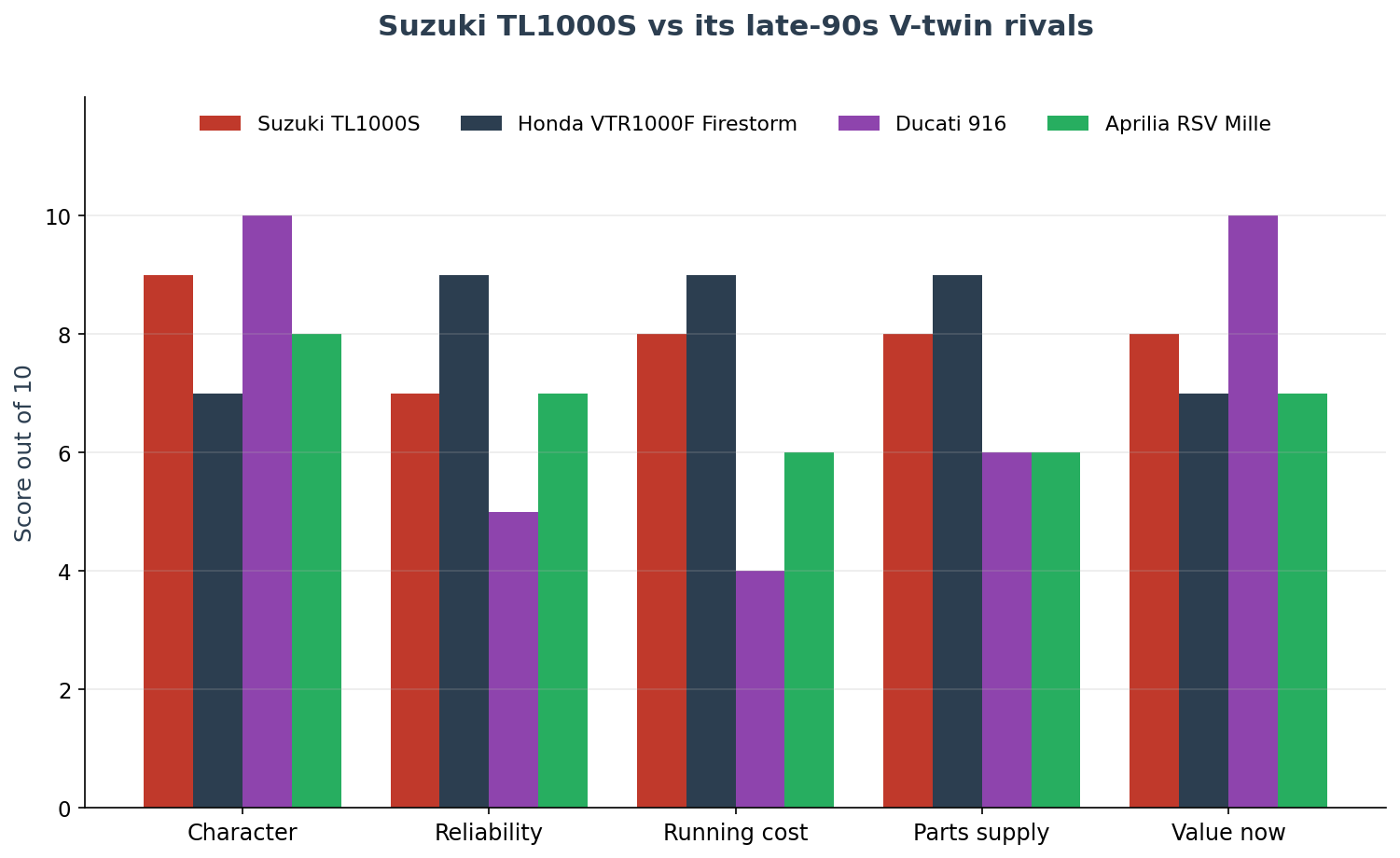
Honda VTR1000F Firestorm. The sensible one. Same era, same big-twin idea, executed by Honda with a conventional shock and none of the drama. Slightly less power, considerably fewer arguments, better parts availability. If the TL1000S stories worry you, the Honda VTR1000F Firestorm does the same job with a lower pulse rate. It is also the bike TL1000S owners are quietly comparing themselves against.
Ducati 916. The reason the TL1000S exists. Prettier, more special, holds value far better, and costs several times as much to run. Desmo services alone will fund a TL1000S conversion kit. Buy the Ducati with your heart and a large maintenance budget.
Aprilia RSV Mille. The other Ducati answer, Rotax-engined, more sophisticated chassis than the TL, and increasingly awkward for parts. Better handling out of the box, worse ownership experience two decades on.
Suzuki TL1000R. If you want the engine with a chassis that works, the R is the answer. Stiffer beam frame, better suspension, more committed riding position, and fewer of them exist. Prices are climbing.
The TL1000S wins on exactly one axis, and it is the axis that matters to the people who buy them: character per pound. Nothing else at this money makes that noise or delivers that punch of torque out of a corner.
What owners and long-term reviews actually say
Search YouTube for the TL1000S and the algorithm serves you a very specific diet. The most-watched TL content includes a video titled "Riding the most DANGEROUS production motorcycle of all time" with 150,205 views and 396 comments, and a channel piece asking why the TL1000R was forgotten, which has pulled 291,048 views and 918 comments. The framing is consistent: this is a bike people are fascinated by rather than one they simply own.
The Japanese-language coverage is a different world and considerably more useful. A Japanese owner's MotoVlog garage tour headlined "the maddest motorcycle" has 194,364 views and 354 comments, and a detailed Japanese breakdown of the defective damper and Suzuki's attempt to beat Ducati has drawn 371,597 views and 168 comments. These are Japanese riders discussing bikes that live in Japan, which is exactly the supply pool you are shopping in.
The X picture is the most telling data point of all. A recent search for TL1000S posts returned an overwhelmingly Japanese-language feed: owners discussing which model years cruise comfortably at what speed, someone comparing radiator fan parts across an SV650, a TL1000S and a GSX1300R, and riders debating fairing coverage and wind noise. Almost nothing in English.
Two conclusions follow. First, the surviving owner community with real hands-on knowledge is disproportionately Japanese, which tells you where the well-maintained bikes are. Second, English-language information on this model is genuinely thin, which is why so many buyers arrive with nothing but the Widowmaker headline.
One recurring theme across owner posts deserves repeating: riders describe the TL1000S as entirely calm at sane speeds and only demanding when pushed hard. That squares with the engineering. The rear damper fades under sustained heat and hard use. Ride it like a fast road bike and it behaves. Ride it like a superbike and it reminds you why it has a nickname.
Running costs and maintenance
The good news about a big Suzuki V-twin is that nothing about it is exotic.
- Fuel: realistically 38 to 45 mpg ridden briskly, giving 110 to 130 miles from the 17-litre tank.
- Oil and filter: every 3,500 to 4,000 miles. Cheap, and this engine responds well to being kept clean.
- Valve clearances: shim-and-bucket, checked at extended intervals, and a job most owners have done once and then forgotten about.
- Chain and sprockets: £120 to £220 a set, and a 125 bhp twin eats them faster than a 600 four.
- Tyres: standard sportsbike sizes, widely available, £220 to £320 fitted.
- Insurance: a 25-year-old 996cc sportsbike is often cheaper to insure on a classic or limited-mileage policy than a modern equivalent. Ask specifically.
The costs that catch people out are the age-related ones rather than the model-specific ones. Fork seals, brake lines, coolant hoses, fuel lines and wheel bearings all reach the end of their service life around now. Budget £400 to £700 in the first year on any 25-year-old sportsbike and you will be pleasantly surprised rather than annoyed.
Popular TL1000S modifications
The TL1000S has one of the most focused modification cultures of any 1990s Japanese bike, because for years the community was fixing what Suzuki shipped.
Rear shock conversion. The big one. Penske, Ohlins and Wilbers bolt-on kits replace the rotary damper with a conventional unit. This transforms the bike more than any other single change and is the reason a modified TL1000S often rides better than an original one.
Exhaust. Almost universal on Japanese-market bikes. A 90-degree V-twin with a decent can is one of the better noises in motorcycling, and Yoshimura and Akrapovic systems turn up regularly on JDM examples.
ECU remap or Power Commander. Particularly worthwhile on 1998-onwards bikes if you want the restricted lower gears opened back up. Also smooths the notoriously abrupt throttle response off closed throttle.
Manual cam chain tensioners. A community standard rather than a modification.
Steering damper upgrade. The factory unit does its job. An adjustable aftermarket unit does it better and lets you dial it in.
When buying, modifications are not automatically a negative on this model. A well-chosen set of upgrades on a TL1000S signals an owner who understood the bike. What you are screening out is cheap fabrication and evidence of track abuse.
Is the TL1000S a good first big bike? The honest answer
No.
Not because it will kill you. Because it will waste your money and your patience. The TL1000S is a 125 bhp V-twin with abrupt fuelling off a closed throttle, a tall seat, an unforgiving riding position for town work, and a rear suspension design that punishes clumsy inputs. Every one of those things is manageable with experience and irritating without it.
If you want the same engine character with none of the anxiety, the Suzuki SV650 is the obvious answer and the reason it has been recommended to new riders for twenty-five years.
Come back to the TL1000S when you have a couple of seasons on a big bike and you want something with an opinion. It rewards riders who already know what they are doing, and it does it for less money than anything else with this much personality.
Pre-purchase checklist for a TL1000S import
- Confirm the model year and whether the bike is a 1997 pre-fix, 1997 post-recall, or 1998-onwards machine
- For any 1997 bike, verify recall work and the presence of a working steering damper
- Demand high-resolution photographs of the headstock and rear damper mount for crack inspection
- Establish whether the rotary damper is original or converted, and to what
- Check the auction grade is 4 or above with no repair marker
- Look for oil weeping from the clutch cover and around the rear damper
- Ask about start-up rattle indicating cam chain tensioners
- Check charging system condition and any evidence of a replaced regulator
- Verify the mileage reading is not flagged on the auction sheet
- Note every aftermarket part and decide whether it adds or subtracts value for you
- Calculate the landed cost including 6% duty and 20% VAT on the CIF value, not the hammer price
- Budget £400 to £700 for age-related consumables in year one, plus conversion cost if the damper is original
Ready to find your Suzuki TL1000S?
The TL1000S is at an unusual point in its life. Cheap enough that nobody has started restoring them properly, old enough that the good ones are getting scarce, and interesting enough that the market has noticed. The best examples left are in Japan, in garages, with low mileage and original bodywork.
AWA Auction bids on your behalf at Japanese motorcycle auctions, translates every auction sheet in full, and tells you honestly when a bike is not worth your money. On a model with a frame worth inspecting and a suspension system worth understanding, that matters more than it does on a Super Cub.
Browse current Japanese motorcycle listings to see what is available this week, or contact our team and tell us the year, mileage and condition you are after. We will watch the auctions for it.
See Also
Share this article: