
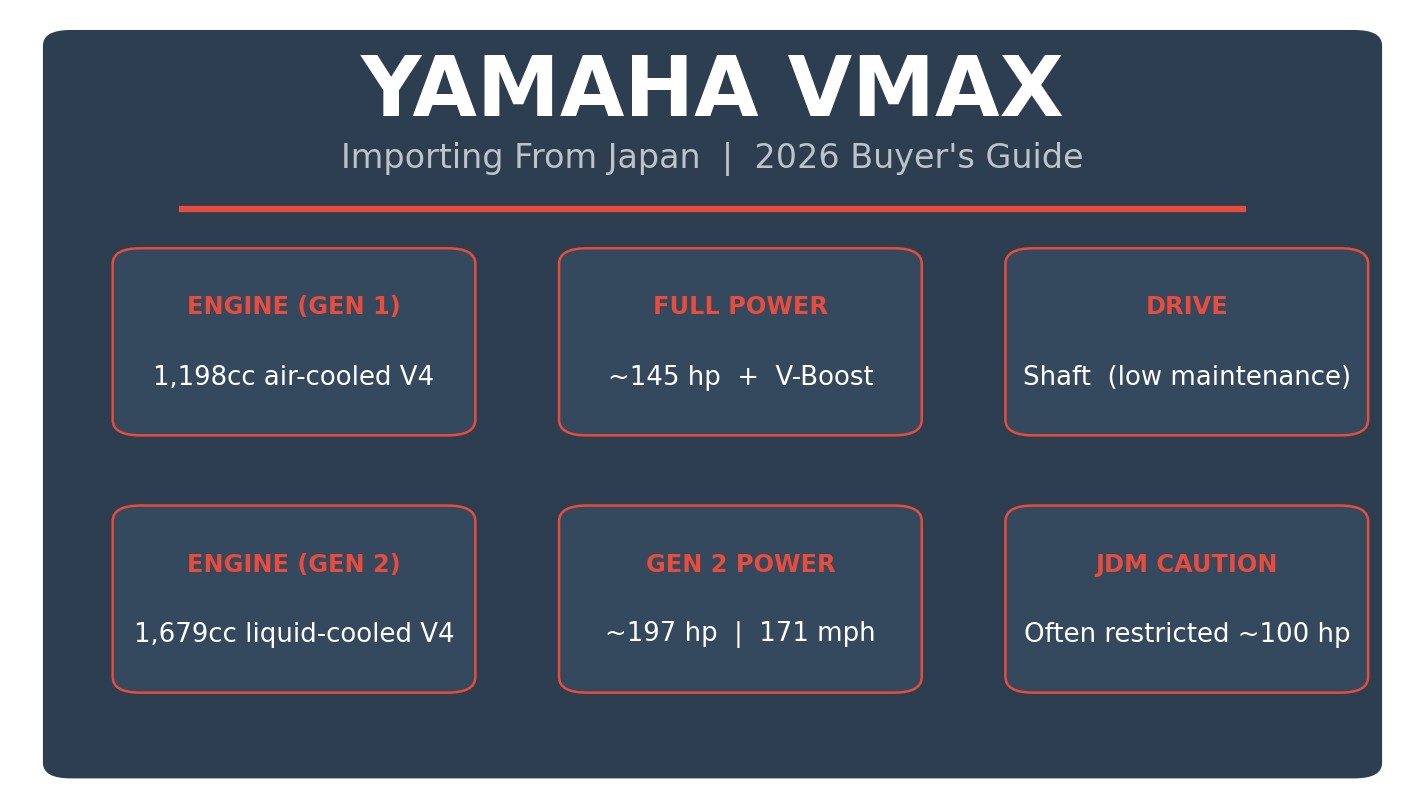
In 1985 Yamaha did something no Japanese factory had dared: they built a motorcycle that behaved like a Detroit muscle car. A 1,198cc V4, shaft drive, a fuel tank hidden under the seat, and two fake air scoops that hid the rudest party trick in motorcycling. The Yamaha VMAX was never meant to corner, never meant to tour, and never meant to make sense. It was built to humiliate everything next to it from a standing start — and forty years later people still line up to own one.
If you want to import a Yamaha VMAX from Japan, you are shopping in the deepest, cleanest pool of these bikes anywhere on Earth. The VMAX was a Japanese home-market icon. Examples were garaged, low-mileage, and serviced under the shaken inspection regime that treats neglect like a crime. The catch — and it is a big one nobody on the forums shuts up about — is that a Japanese-market VMAX is not the same machine as the one your mate in Texas or Manchester rides. It came restricted. Get this part wrong and you will pay full-power money for a bike that is quietly strangled.
This guide fixes that. We will walk through every generation, the full-power-versus-restricted minefield, the V-Boost system that made the legend, the faults that halve a bike's value, real landed costs, and the auction-sheet red flags that separate a clean import from a heartbreak. By the end you will know exactly which VMAX to chase and what it should cost to put one in your garage.
Why a JDM Yamaha VMAX is the smartest muscle-bike buy right now
Here is the thing nobody mentions when they tell you to "just buy one locally." The supply has dried up. Yamaha killed the VMAX after the 2020 model year, the first-generation air-cooled bikes are now genuinely old, and the clean, honest, unmolested examples in the US and UK have mostly been bought, thrashed, or chopped into drag bikes. Japan is different.
Japan kept building and selling the original 1200 right up to the mid-2000s, and the home market loved it. That means the auction houses still see a steady trickle of low-mileage, single-owner VMAXes that spent their lives being polished rather than ridden into the ground. A 1990s VMAX with 18,000km on a Japanese auction sheet is a completely different animal to a 1990s VMAX with 60,000 hard miles and three owners in the West.
There is a money angle too. The first-generation VMAX is now firmly in 25-year-old territory, which in the US and Australia means the import door swings wide open. Values are climbing. Hagerty UK called it "the motorcycle that thought it was a muscle car," and collectors have started treating clean Gen 1 bikes the way they treat early Hayabusas and GPZ900Rs — as future appreciating classics. Buying a tidy Japanese example now is the closest thing motorcycling has to buying low.
The shaft drive helps the case. No chain to stretch, no sprockets to wear, far less of the abuse a chain-driven sportbike racks up. A shaft-drive cruiser that lived an easy Japanese life is about as low-risk as a 30-year-old import gets — provided you know which faults to hunt for, which we will get to.
The bike that invented the muscle-bike genre
Before the VMAX, "power cruiser" was not a category. Yamaha's American arm wanted a bike that captured the spirit of a V8 dragster, handed the brief to designer GK Dynamics and engineer Akira Araki, and the result rewrote what a cruiser could be. The 70-degree V4 came loosely from the Venture tourer, but Yamaha hot-rodded it into something far angrier.
The styling was the statement. Those giant chrome "air intakes" on the tank sides are mostly theatre — the real airbox sits under the dummy tank — but they became the most recognisable silhouette in motorcycling. Squat, low, all shoulders and forearm, the VMAX looked like it wanted to fight you in a car park. It made roughly 145 horsepower in full-power trim at a time when that number was supercar territory, and it did the standing quarter-mile in the low 11s. In 1985. From a cruiser.
It barely changed for two decades because it did not need to. Yamaha tweaked brakes, forks and details over the years, but the recipe was untouchable. When the second-generation 1700 arrived in 2009 it was a technological leap — but plenty of purists still say the raw, slightly unhinged Gen 1 is the "real" VMAX. That argument is exactly why the import market for the original is so healthy.
The restriction story nobody explains: full-power vs JDM-restricted VMAX
This is the single most important section in this guide, so slow down. A Yamaha VMAX sold in Japan was deliberately detuned, and if you do not understand how, you will overpay.
Japanese domestic-market (JDM) VMAXes were built to comply with home-market rules. The factory left out V-Boost, fitted restricted carburettors, and programmed a speed cut-off at around 185 km/h (roughly 115 mph). The exhaust outlets were physically smaller on some restricted bikes too. The net effect: a JDM VMAX makes nothing like the 145 horsepower of a full-power export bike — closer to 95–100 horsepower in stock restricted form.
The export picture adds another layer. According to MCN's model history, the VMAX was available in the UK as a grey import from 1985 but did not officially arrive until 1991 — and even then in a 90-horsepower restricted format. The UK did not get an official full-power version until 1996, identifiable by frame numbers starting 2EN 042101 and the presence of V-Boost. Yamaha stopped officially importing it to the UK in 2003 as emissions rules tightened.
So you have three flavours floating around the auctions: full-power export bikes (the ones everyone wants), JDM-restricted bikes (no V-Boost, capped), and early restricted export bikes. The good news is that JDM bikes can be derestricted — owners on the VMAX forums have been swapping in V-Boost systems, opening exhausts and re-jetting carbs for years. The bad news is that it costs money and effort, and a "derestricted" bike on an auction listing may have been done well or done badly.
The practical rule: assume a Japanese-market VMAX is restricted unless the auction sheet or seller proves otherwise. Budget for the conversion, or buy it knowing you are getting a calmer, cruise-friendly 100-horsepower bike. Either is fine — just do not pay 145-horsepower prices for a 100-horsepower machine.
V-Boost: how the VMAX's party trick actually works
V-Boost is the reason the VMAX became a legend, and it is the first thing you check on any import.
The full-power 1200 runs four carburettors feeding four cylinders. Below a certain engine speed, each cylinder breathes through its own carb in the normal way. But there are butterfly valves in the intake manifold linking the cylinders in pairs. As the revs climb past roughly 6,000 rpm, a servo motor cracks those butterflies open, and suddenly each cylinder can gulp from two carburettors at once. The intake note changes, the airbox roars, and the bike lunges forward with a second, violent surge of power all the way to the redline.
That two-stage delivery is what made the VMAX feel unhinged. The first part of the rev range is brawny; the top is explosive. Riders describe the V-Boost kick as the moment the bike "wakes up and tries to leave without you."
For an importer this matters in two ways. First, JDM-restricted bikes do not have V-Boost at all — so if you want the full experience from a Japanese bike, you are adding the system yourself. Second, on a full-power bike the V-Boost servo and diaphragms can fail with age. The test is simple: ride it hard, and listen for that distinct change in intake note above 6,000–7,000 rpm. If it never arrives, the servo motor or diaphragms are likely dead, and you have a repair bill ahead of you. On a static auction bike you cannot do this test, which is exactly why the auction sheet and a trusted agent matter so much.
Gen 1 vs Gen 2: which VMAX should you import?
There are effectively two completely different motorcycles wearing the VMAX badge, and choosing between them is the first real decision.
Generation 1 (1985–2007/08) is the original: 1,198cc air-cooled 70-degree V4, V-Boost, shaft drive, around 145 horsepower in full-power trim. It is raw, mechanical, demands respect, and is the bike the legend is built on. It is also the one that qualifies for 25-year import rules now. This is the collector's choice and, for most importers, the smart buy.
Generation 2 (2009–2020) — badged VMAX 1700 — is a different beast entirely. A 1,679cc liquid-cooled V4 with architecture derived from the YZF-R1, making roughly 197 horsepower, with proper brakes, a stiffer chassis, and a settled top speed around 171 mph. Reviewers consistently rate it as one of the most capable "big bikes" ever built — it actually handles, stops, and behaves. The trade-off is price (it was hugely expensive new and stays pricey used) and the fact that the earliest examples only became 25-year-eligible later this decade.
The buyer scorecard below sums up the trade-off. Gen 1 wins on character, value, import-eligibility and simplicity. Gen 2 wins on outright performance, brakes, handling and refinement.
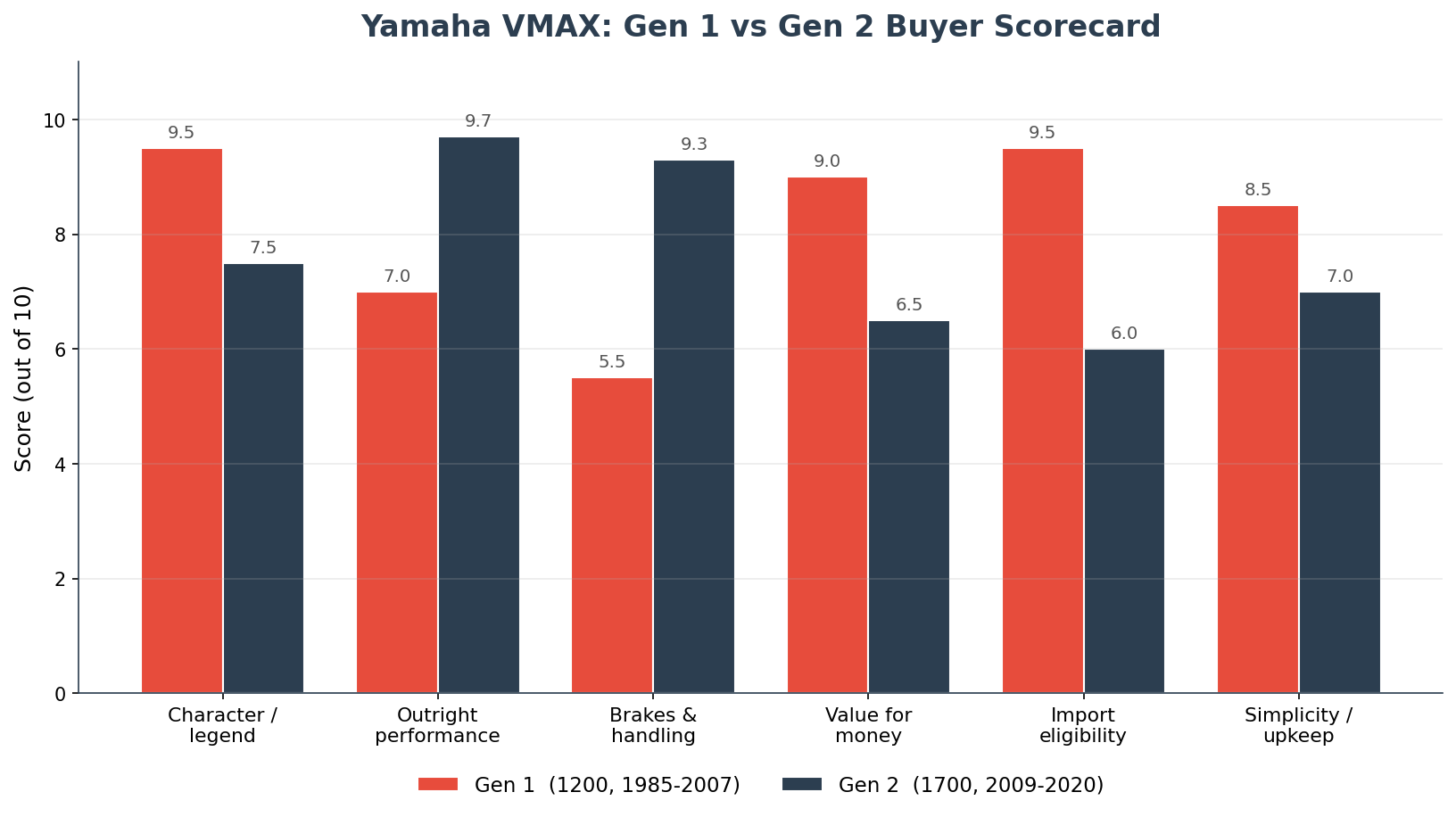
For most people importing from Japan in 2026, the Gen 1 1200 is the answer. It is the bike with the deepest Japanese supply, the friendliest import status, and the appreciation curve. Buy the Gen 2 only if you want the modern hyper-cruiser experience and have the budget — and accept that the cheapest examples may still be a couple of years from clean 25-year-rule eligibility depending on your country.
Power by generation and market: the real numbers
Horsepower claims for the VMAX are a mess because so many different versions existed. Here is the honest version, drawn from manufacturer figures and decades of owner dyno results, so you know exactly what you are buying.
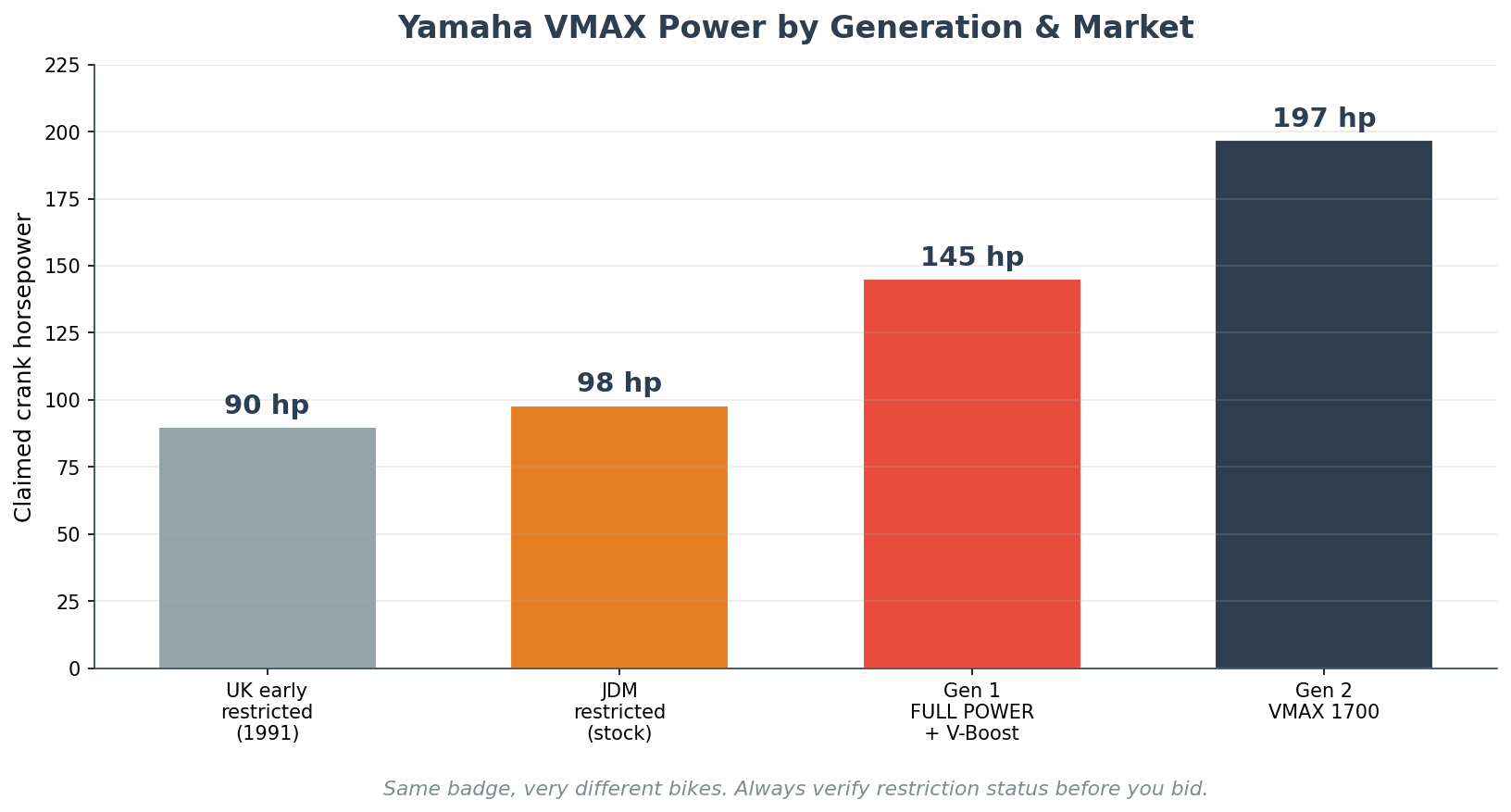
The full-power Gen 1 export bike makes around 145 horsepower with V-Boost doing its thing. The early UK-restricted official bikes were knocked down to about 90 horsepower. JDM-restricted bikes sit around 95–100 horsepower with no V-Boost and a 185 km/h cap. And the Gen 2 1700 towers over all of them at roughly 197 horsepower.
The takeaway for an importer is blunt: the VMAX badge tells you almost nothing about how fast the bike actually is. The market, year and restriction status tell you everything. A full-power 1990s 1200 and a JDM-restricted 1990s 1200 can sit next to each other at the same auction looking identical, with a 45-horsepower gap between them. Verify before you bid.
Year-by-year Gen 1 buy map (1985–2007)
The Gen 1 ran for over two decades with surprisingly few changes, but there are still better and worse years to chase.
1985–1992 (early bikes): The originals. Smaller front brakes, skinnier forks, and the purest "1985 muscle car" feel. Charming and collectible, but the brakes and suspension are of their era — fine if you accept the bike for what it is. The earliest of these are the most import-friendly under 25-year rules and the most likely to appreciate as genuine first-year classics.
1993–2000 (mid-life updates): Yamaha upgraded the front end with bigger 320mm discs and improved forks around 1993. This is the sweet spot for many buyers — the classic VMAX experience with brakes that actually slow you down. Plenty of clean Japanese examples land in this window.
2001–2007 (late bikes): The last of the air-cooled 1200s, often the lowest-mileage examples simply because they are newest. These are excellent buys if you want a Gen 1 that has lived an easy life, though the very latest may not yet clear the strictest 25-year thresholds depending on your country and the exact build date.
Across all years, condition and originality beat model year. A genuine 20,000km Japanese 1996 bike with full V-Boost and a clean sheet is worth more than a tired 2003 with a dodgy second gear and a butchered exhaust. Buy the best individual bike, not the best brochure year.
Known faults by generation: what halves a VMAX's value
Every model has its skeletons. The VMAX's are well documented, which is good news — you know exactly what to inspect.
Gen 1 second gear: This is the big one. A worn or "bad" second gear is a known VMAX weakness, and it can roughly halve a bike's market value. Most owners cannot fix it themselves; a Yamaha dealer rebuild runs around US$2,000. The symptom is the box jumping out of second gear under load. On an auction bike you cannot road-test, so a sheet noting any gearbox issue is a hard red flag — and the reason a trusted agent who can start and check the bike is worth every penny.
Gen 1 V-Boost servo: As covered above, the servo motor and diaphragms can fail with age. No top-end surge above 6,000 rpm means a repair bill. Factor it in on any Gen 1 you cannot ride first.
Gen 1 carbs and shaft drive: Bikes that sat for years get gummed carbs — usually a clean and re-jet, not a disaster. The shaft drive is robust but needs its final-drive oil changed on schedule; ask for evidence it has been done.
Gen 2 oil pump recall (2008–2011): Yamaha recalled certain 2008–2011 VMAX 1700s over an oil-pump fault. High internal oil pressure could push the pump shaft's thrust washer into the housing, accelerating wear until, in the worst case, the pin disconnects from the inner rotor and oil flow stops. Confirm the recall work was done — and done correctly, because a botched fix is the main reliability complaint owners raise about otherwise bulletproof Gen 2 bikes.
Gen 2 wiring recall (2009): A separate 2009 recall covered faulty wiring causing high electrical resistance in the ground wire for the throttle and accelerator position sensors, which could lead to unsteady idling. Again — verify it was addressed.
Reading the auction sheet: VMAX red flags
Japanese auction sheets are the importer's best friend once you can read them. An inspector grades each bike, notes damage on a diagram, and records mileage and modifications. For a VMAX specifically, here is what to hunt for.
Look for any note against the gearbox or transmission — given the second-gear weakness, this is non-negotiable. Check whether the bike is described as modified: aftermarket exhausts, drag-bike conversions, and "tuned" carbs are common on VMAXes and can hide either tasteful upgrades or hack jobs. Watch for replaced or non-original bodywork, which on a power cruiser often points to a drop or a stunt past.
Confirm the mileage corroborates the condition grade. A bike claiming 15,000km but wearing worn grips, a polished tank edge and chewed pegs is telling you a different story. And critically for a VMAX — try to establish whether it is a restricted JDM bike or a full-power machine, because the sheet will rarely spell it out. This is where an agent who physically inspects and starts the bike earns their fee. If you want the deep dive, our guide to reading Japanese auction inspection sheets breaks down every grade and symbol.
What a VMAX actually costs to land
The auction hammer price is only the start. Here is a realistic breakdown of what it costs to get a Gen 1 VMAX from a Japanese auction to your door, before local registration.
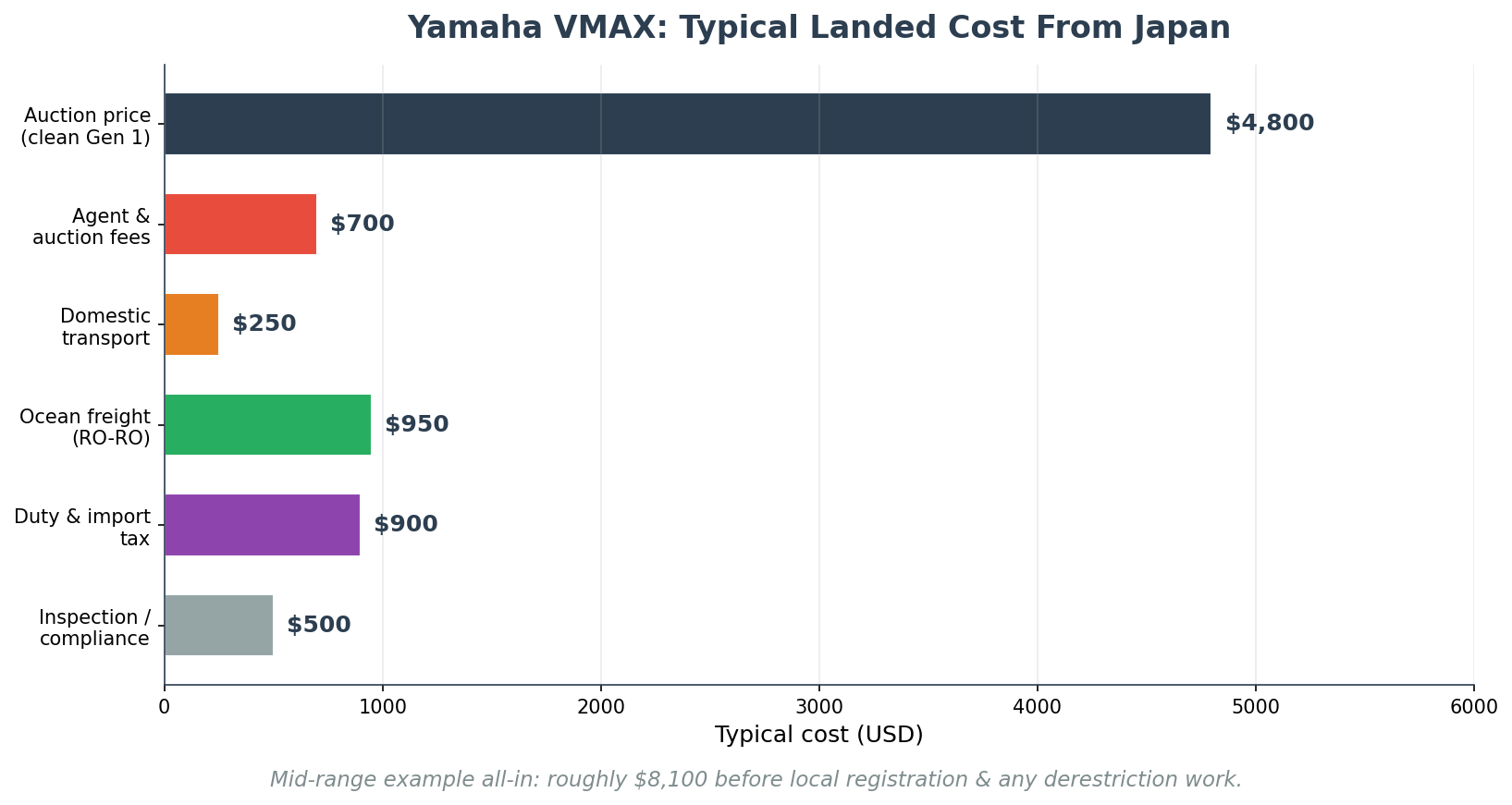
A clean Gen 1 VMAX typically hammers somewhere in the US$3,500–6,000 range at Japanese auction depending on year, mileage and whether it is full-power. On top of that you have the agent and auction fees, domestic transport to port, export paperwork and de-registration, ocean freight, then your country's duty and tax, and finally inspection and compliance at the other end.
As a rule of thumb, by the time a mid-range Gen 1 is sitting in your garage you are looking at roughly US$6,500–9,500 all-in to most major markets, before local registration and any derestriction work. That is still strong value for a clean, low-mileage example of an appreciating icon — and usually well below what an equivalent honest bike costs on the local used market, if you can even find one. For the full method behind these numbers, see our complete motorcycle import cost breakdown.
Used VMAX prices by generation and market
Prices vary enormously by generation, condition and country. The chart below gives realistic 2026 ranges so you can sanity-check any listing.
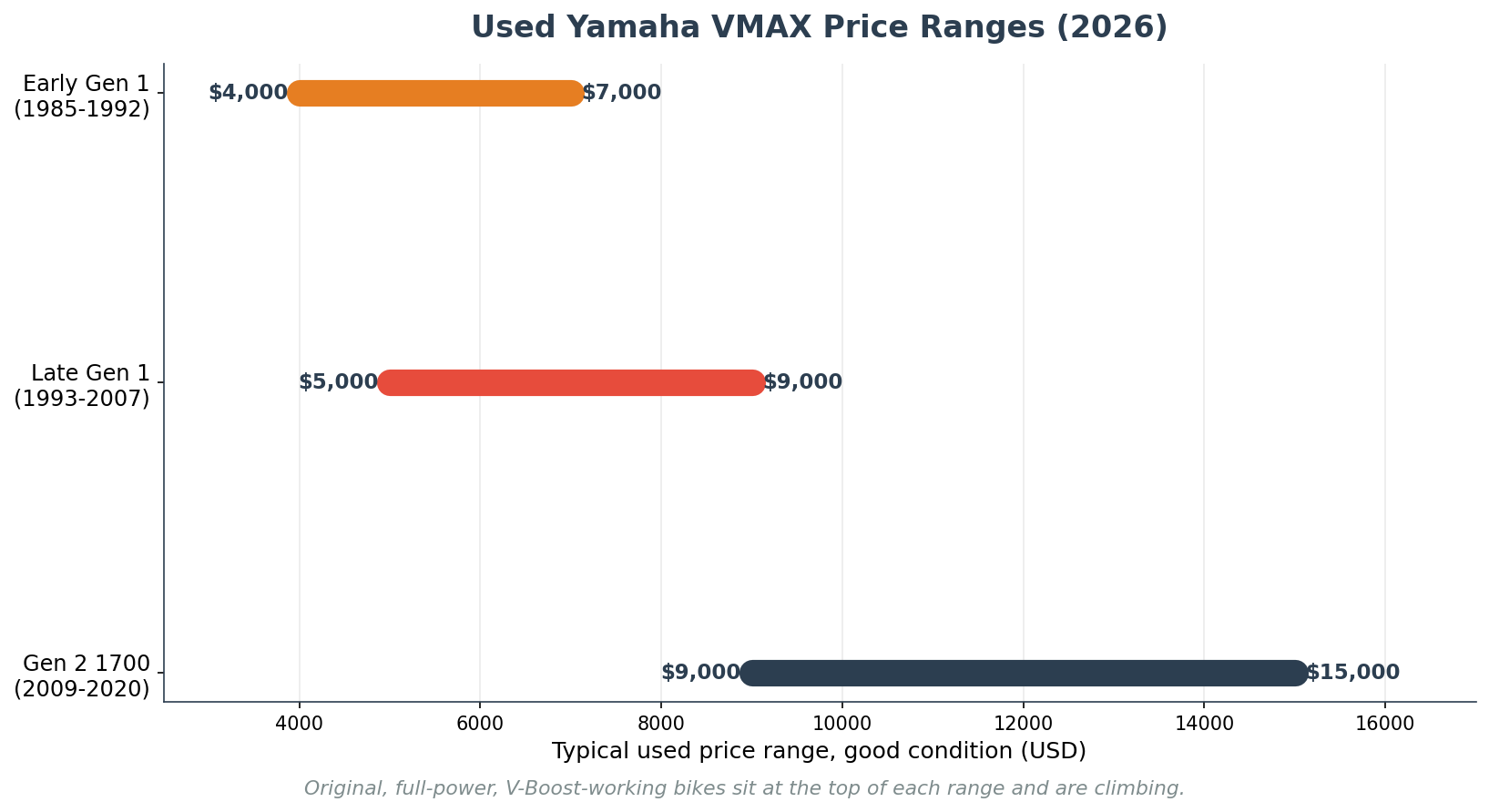
Early Gen 1 bikes (1985–1992) in good order trade roughly US$4,000–7,000. Clean mid-to-late Gen 1 bikes (1993–2007) sit around US$5,000–9,000, with mint, low-mile full-power examples pushing higher as collectors move in. Gen 2 1700s are a different bracket entirely — typically US$9,000–15,000 used, reflecting how expensive they were new and how capable they remain.
The pattern across all of them is that originality and provenance now command a premium. A documented, unmolested, full-power bike with V-Boost working will keep climbing. A modified or restricted bike sold as if it were full-power is the trap. Knowing the difference is the entire game — and it is exactly the kind of homework importing from Japan rewards, because the supply of honest, low-mileage bikes is so much deeper there.
How to import a VMAX from Japan: the 8-step process
The process is the same whether you are in Los Angeles, London, Sydney or Auckland. Here is how it runs end to end.
Step 1 — Confirm eligibility. Check your country's age rule against the exact build date of the bike you want (more on this below). Get this right before you bid.
Step 2 — Choose an agent or auction service. You cannot bid at Japanese auctions directly as a private foreign buyer. You go through an exporter or auction agent who has access and can inspect bikes for you.
Step 3 — Set your budget, all-in. Use the landed-cost breakdown above. Decide your maximum hammer price knowing fees, freight and tax sit on top.
Step 4 — Hunt and verify. Find candidate VMAXes, read the auction sheets, and have your agent confirm condition, gearbox health, V-Boost presence and restricted-versus-full-power status.
Step 5 — Bid. Your agent bids on your behalf up to your limit. Japanese auctions move fast; trust the homework you did in step four.
Step 6 — Pay and prep for export. Once you win, settle the invoice. The bike is de-registered, export documents are prepared, and it is moved to port.
Step 7 — Ship. Choose RO-RO (cheaper, the bike is ridden/rolled aboard) or container (more protection, often shared). Our container vs RO-RO shipping guide covers the trade-offs.
Step 8 — Clear customs and comply. Pay duty and tax, complete any inspection or compliance your country requires, then register locally. The VMAX is yours.
Pre-purchase checklist for an imported VMAX
Before you commit to any VMAX at auction, run this list with your agent.
Confirm whether the bike is full-power or JDM-restricted, and whether V-Boost is present and functioning. Check the auction sheet for any gearbox, frame or accident notes. Verify the mileage matches the condition grade. Establish originality — original exhaust, bodywork and carbs, or documented quality modifications rather than mystery hack work. For a Gen 2, confirm the oil-pump and wiring recalls were completed. Ask for service evidence, especially recent final-drive oil and valve-clearance checks. And confirm the exact manufacture date in writing so your import eligibility is bulletproof.
If a seller or agent cannot answer the restriction and V-Boost questions, walk away. On a VMAX those two answers are the difference between a great buy and an expensive disappointment.
Import rules by country: US, UK, Australia, New Zealand, Canada
The exact rules decide which VMAX you can even consider. Here is the 2026 picture for the main English-speaking markets. Always confirm current details with your national authority before you bid.
United States: The 25-year rule is your friend. Motorcycles at least 25 years old (by month and year of manufacture) are exempt from modern EPA emissions and DOT safety standards, making them dramatically easier and cheaper to title. That puts every Gen 1 VMAX from the mid-1980s through 2001 squarely in play right now, with later Gen 1 bikes rolling in year by year.
United Kingdom: The UK has no blanket 25-year ban, but tax depends on age. For bikes over 250cc and under 30 years old you generally pay 20% VAT and around 6% duty. Once a bike is over 30 years old it is treated as a classic — typically 5% VAT and no duty. You will also register the import and may need an inspection. The earliest Gen 1 bikes now qualify for that favourable classic treatment.
Australia: Under the Road Vehicle Standards rules you can import a motorcycle that was originally built more than 25 years ago. Vehicles 30 years and older are generally classified as historic and are duty-free; most newer imports attract around 5% customs duty plus GST. After import approval you still need to meet your state or territory roadworthy and registration requirements.
New Zealand: NZ is one of the more import-friendly markets, with no blanket age ban, but bikes must pass entry certification and meet safety standards. Older machines are common imports; budget for compliance and registration on arrival.
Canada: Canada applies a 15-year rule for vehicles, which is even more generous than the US — meaning a far wider range of VMAXes is eligible. Confirm provincial registration and inspection requirements where you live.
Running and maintenance costs
A VMAX is not a fragile exotic, but it is a big V4 and it likes attention. Budget for valve-clearance checks roughly every 12,000 miles, a coolant flush every 24,000 miles on the liquid-cooled Gen 2, and final-drive oil changes around every 18,000 miles on the shaft drive. None of this is exotic, but skipping it is how cheap VMAXes become expensive VMAXes.
Fuel economy is what you would expect from 145–197 horsepower with the throttle in your hand — think 35–40 mpg if you behave and considerably worse if you use the V-Boost the way it was designed to be used. Tyres wear at the rear thanks to the torque, and consumables are reasonably priced because the bike shares so much with other Yamahas of its era. The shaft drive removes the single most tedious running cost of a sportbike — chain and sprocket replacement — which is one more quiet reason the VMAX makes sense as a long-term keeper.
Why Japanese-market VMAXes are the cleanest examples
It comes back to how Japan treats motorcycles. The shaken roadworthiness regime makes neglect expensive, so bikes get serviced. Winters are harsh, so machines get garaged rather than left out. And Japanese owners tend to ride less and maintain more, which is why a Japanese VMAX with genuinely low mileage and a tidy auction grade is not a fairy tale — it is the norm at the better auctions.
Yes, you have to navigate the restriction question. But weigh that against the alternative: a Western used market where the honest, unmodified, low-mileage VMAXes have largely been picked clean. The combination of deeper supply, better-kept bikes, and transparent auction grading is exactly why importing from Japan beats hunting locally for a bike like this. You are trading a little homework on restriction status for a much better bike underneath.
What owners actually say
The VMAX community is one of the most vocal in motorcycling, and the primary-source picture is consistent. On YouTube, Srkcycles' "The most POWERFUL cruiser bike EVER!" has pulled over 2.1 million views and nearly 3,000 comments, and the recurring theme is shock at how violent the power delivery still feels decades on. Yammie Noob's "I Finally Rode the LEGENDARY Yamaha VMAX!" frames it the way most first-timers do — a bike they had built up in their head for years that somehow still over-delivered.
JS Films' clip of a VMAX on an Akrapovic exhaust has racked up over 1.8 million views, which tells you everything about how much the engine note matters to this crowd. And on the dedicated VMAX forums, the import and derestriction threads run for pages — owners walking each other through swapping V-Boost into JDM bikes, opening up restricted exhausts, and re-jetting carbs. That body of shared knowledge is a genuine asset when you import: whatever your bike needs, someone has documented the fix.
The consistent owner verdict: the VMAX is not the bike you buy to be sensible. It is the bike you buy because nothing else feels like it. Buy the right one and it rewards you. Buy a restricted bike thinking it is full-power, and you will spend the first month wondering what all the fuss was about.
Who should buy a VMAX — and who shouldn't
Buy a VMAX if you want a genuine motorcycling icon with appreciating value, you love straight-line drama and that unmistakable silhouette, and you appreciate shaft-drive, low-maintenance long-term ownership. The Gen 1 1200 in particular is a future classic you can still buy at sensible money from Japan today.
Think twice if you want a corner-carver or a tourer — the Gen 1 is neither, with limited ground clearance, a thirsty engine and a riding position built for short brutal blasts rather than all-day comfort. And do not buy one expecting an appliance. It demands respect, regular maintenance, and — if it is a JDM bike — a clear-eyed view of restriction and derestriction before you hand over the money.
For most riders chasing the legend, the move is a clean, low-mileage Gen 1 1200 imported from Japan, full-power if you can verify it, restricted with a derestriction budget if you cannot. Get that right and you own one of the most charismatic motorcycles ever built.
How AWA Auction gets you a VMAX from Japan
This is exactly the kind of bike Japanese auction access was made for. AWA Auction gives you eyes inside the Japanese auction system, where the cleanest VMAXes actually live. We read the sheets, verify condition and restriction status, confirm V-Boost and gearbox health where possible, handle the export paperwork, and manage shipping to your port — so the homework this guide describes gets done by people who do it every week.
Browse what is coming through the auctions and tell us the VMAX you are after. Whether it is an early collectible Gen 1, a sweet-spot mid-90s full-power bike, or a modern Gen 2 1700, we will help you land the right one at the right price.
VMAX vs the rivals: how it stacks up
The VMAX created the power-cruiser class, but it never had it entirely to itself. If you are weighing one up, it helps to know what the competition offers — and why people keep coming back to the Yamaha anyway.
The closest period rival was Suzuki's B-King, a naked muscle bike built around the Hayabusa engine. It is faster in a straight line and more modern, but it lacks the VMAX's theatre and that unmistakable shape, and it never earned the same cult status. Triumph's Rocket III brings absurd torque from its 2.3-litre triple, but it is a heavyweight cruiser-tourer, far less of a hooligan than the VMAX. Honda's old CB1300 and Kawasaki's ZRX1200 are brilliant big naked bikes from the same era, but they are inline-fours chasing usability rather than drama.
What none of them quite match is the VMAX's combination of looks, V4 character, shaft-drive simplicity and genuine collectability. The B-King depreciated hard; the Gen 1 VMAX is appreciating. That gap is the whole argument. If you want a sensible fast naked bike, there are better-value options. If you want the bike that defined the genre and is now climbing in value, the VMAX stands alone — and Japan is where the clean ones are.
It is also worth comparing within the Yamaha family. If the full-fat VMAX is more bike than you need, a clean imported litre-class sportbike or a big naked like the imported Yamaha YZF-R1 covers different ground entirely — sharper, lighter, track-focused. The VMAX is the opposite philosophy: mass, torque, and presence. Knowing which camp you are in saves you from buying the wrong legend.
Frequently asked questions
See Also
Share this article: