
More than 100 million of them have rolled off Honda's production lines since 1958. No other motor vehicle on Earth — not the VW Beetle, not the Toyota Corolla — comes close. So when people ask us about a Honda Super Cub import from Japan, the first thing we tell them is this: you are not buying a scooter. You are buying the single most successful machine in the history of personal transport, straight from the country that designed it, built it, and treats it like a national treasure.
Here's the thing nobody mentions: the Super Cub you can buy locally and the Super Cub you can buy at a Japanese auction are not the same experience. In Japan, Cubs were daily-driven by shopkeepers, postal workers, and tofu sellers who maintained them obsessively and rode them gently. The auction halls are full of them — vintage C50s and C70s with the dished chrome tank badge, clean C125 retros, and the trail-ready CT125 Hunter Cub that Western dealers can barely keep in stock.
This guide walks you through exactly how to import a Honda Super Cub from Japan: which model to chase, what one actually costs at auction, the full landed price to your door, and the import rules that decide whether your dream Cub is street-legal or a very expensive ornament. We've moved enough of these little bikes to know where the traps are.
What Makes the Honda Super Cub Worth Importing from Japan
Let's start with why this bike earns its legend, because it explains why a Japanese-market Cub is worth the shipping.
The Super Cub was conceived in 1956, when Soichiro Honda and his business partner Takeo Fujisawa toured Germany and watched ordinary people zip around on mopeds. They came home determined to build something better: a four-stroke, single-cylinder 50cc machine with a step-through frame anyone could ride, an automatic centrifugal clutch so you never stalled, and bulletproof reliability. It launched in 1958 and never really stopped.
The numbers are almost comical. Production passed 60 million units in 2008, 87 million in 2014, and crossed 100 million in October 2017 at Honda's Kumamoto plant. For comparison, the VW Beetle — the most-produced car in history — managed about 21.5 million over its entire run. The Cub series is now sold in more than 160 countries and built at 16 plants across 15 nations. FortNine's video on the world's best-selling motorcycle has racked up over 10 million views debating exactly this kind of trivia, and the Cub is always at the centre of it.
So why import one from Japan specifically? Three reasons.
First, condition. Japanese owners are famous for fastidious maintenance, indoor storage, and low annual mileage. A 1980s C70 from Japan often looks better than a five-year-old example anywhere else. Auctions grade each bike on a standardized sheet, so you know what you're getting before you bid.
Second, selection. The Japanese domestic market got Cub variants the rest of the world never officially received — JDM-spec colours, the Cross Cub, special editions, and decades of vintage models that simply aren't on local marketplaces.
Third, value. Because Japan has such enormous supply, prices for clean used Cubs are frequently lower at the source than what a grey importer charges once it's landed and marked up. Cut out the middleman and the maths starts to work.
The Super Cub Family: Which Model Should You Import?
"Super Cub" is not one bike. It's a dynasty. Before you import anything, you need to know which branch of the family you actually want, because the price, the legality, and the riding experience vary wildly.
The vintage C50 / C70 / C90 (1960s–1990s). These are the originals — the ones with the pressed-steel leg shields and the unmistakable silhouette. The C50 is the 49cc moped, the C70 a 72cc, the C90 a torquier 90cc that can actually keep up with town traffic. In the US these were sold as the Honda Passport. They're the most collectible, the cheapest to buy, and — crucially — old enough to qualify for the 25-year import exemption in strict markets like America. Jay Leno keeps one in his garage and has spent over a million YouTube views explaining why these little engines refuse to die.
The Super Cub C125 (2018–present). Honda's modern retro reboot. Fuel-injected 124cc, ABS, LED lighting, keyless ignition, and that gorgeous throwback bodywork. It's the Cub for people who love the look but want modern reliability and a 2020s suspension. Honda even brought it to the US, though they confirmed in early 2026 that the 2024 model year was the final one sold there — which makes Japanese imports the obvious route going forward.
The CT125 Hunter Cub (2020–present). The breakout star. A trail-focused Cub with a high-mount exhaust, knobby-ish tyres, rear rack, and genuine adventure styling. Demand has been ferocious worldwide. The 2026 model lists at around ¥495,000 new in Japan, making it Honda's most expensive Cub — and used examples hold their value hard. Life of Smokey's "I BOUGHT a Brand NEW HONDA CT125 Hunter Cub from JAPAN!" video captured exactly why people chase these: it's the most fun you can have on a 125.
The Cross Cub CC110. A JDM-favourite middle ground — 110cc, slightly more rugged than the C125, with a leisure/camping vibe that's huge in Japan and almost unknown elsewhere. If you want something nobody at the local bike night has seen, this is it.
Pick your branch first. Everything downstream — budget, paperwork, shipping crate size — flows from that single decision.
Why Buy a Super Cub from Japan Instead of Locally
Fair question. You can find Cubs on local classifieds, so why deal with an ocean?
Because the local market is thin and the Japanese market is an ocean of supply. On any given week, Japanese motorcycle auctions list thousands of Cubs across every variant. Your local market might have three, all overpriced, all tired.
Then there's the JDM factor. Japanese-domestic Cubs often came with specs, colours, and trim the export markets never got. A collector hunting a specific 1970s colourway, or a rider who wants the genuine Japanese CT125 rather than a regional variant, has to go to the source.
Condition is the quiet winner, though. We mentioned it above and it's worth repeating because it's the single biggest reason seasoned buyers import. The combination of strict shaken inspection culture, indoor storage, and gentle urban use means Japanese Cubs are routinely in better shape per year of age than anything you'll find domestically. The auction sheet proves it before you commit a single dollar.
And finally, money. Once you understand the full cost stack — which we're about to break down — importing a clean Cub from Japan frequently lands cheaper than buying an inferior local example, especially for the desirable C125 and CT125.
What a Used Super Cub Actually Costs at Japanese Auction
Numbers people came for numbers, so here they are. These are real-world auction hammer ranges we see for clean, running examples. They move with condition, year, and demand, but they'll calibrate your expectations.
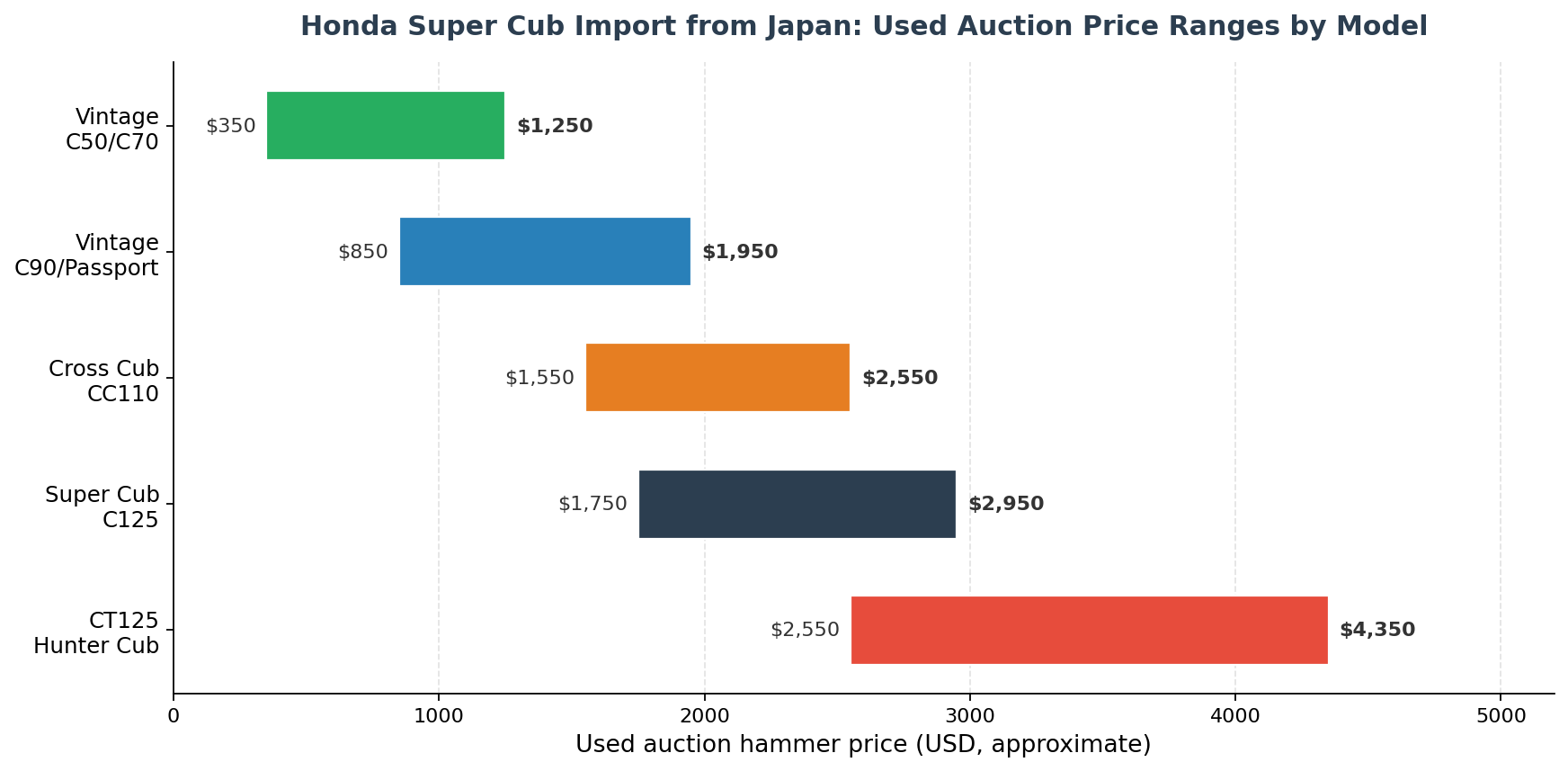
- Vintage C50 / C70 (project to tidy): roughly ¥50,000–¥180,000 ($350–$1,250). The cheapest entry into Cub ownership.
- Vintage C90 / Passport (clean runner): ¥120,000–¥280,000 ($850–$1,950). The torquey one, more usable in traffic.
- Cross Cub CC110 (used, recent): ¥220,000–¥360,000 ($1,550–$2,550). JDM oddball appeal.
- Super Cub C125 (used, 2018–2023): ¥250,000–¥420,000 ($1,750–$2,950). The modern retro, holds value well.
- CT125 Hunter Cub (used, 2020–2024): ¥360,000–¥620,000 ($2,550–$4,350). Highest demand, smallest discount off new.
Notice how flat the depreciation is on the C125 and CT125. That's not an accident. These bikes are so sought-after that a two-year-old example sells for nearly new money. It's frustrating if you want a bargain, and reassuring if you ever plan to sell.
The vintage end is where the deals live. A ¥90,000 C70 that runs and shifts cleanly is a genuine steal — the kind of bike that makes the whole import adventure worth it. Just remember the hammer price is only the first line on the invoice.
The Full Cost Breakdown: From Auction to Your Door
This is the section grey importers hope you skip, because the markup hides in the gap between the auction price and the landed price. We're going to show you the whole stack so nobody surprises you later.
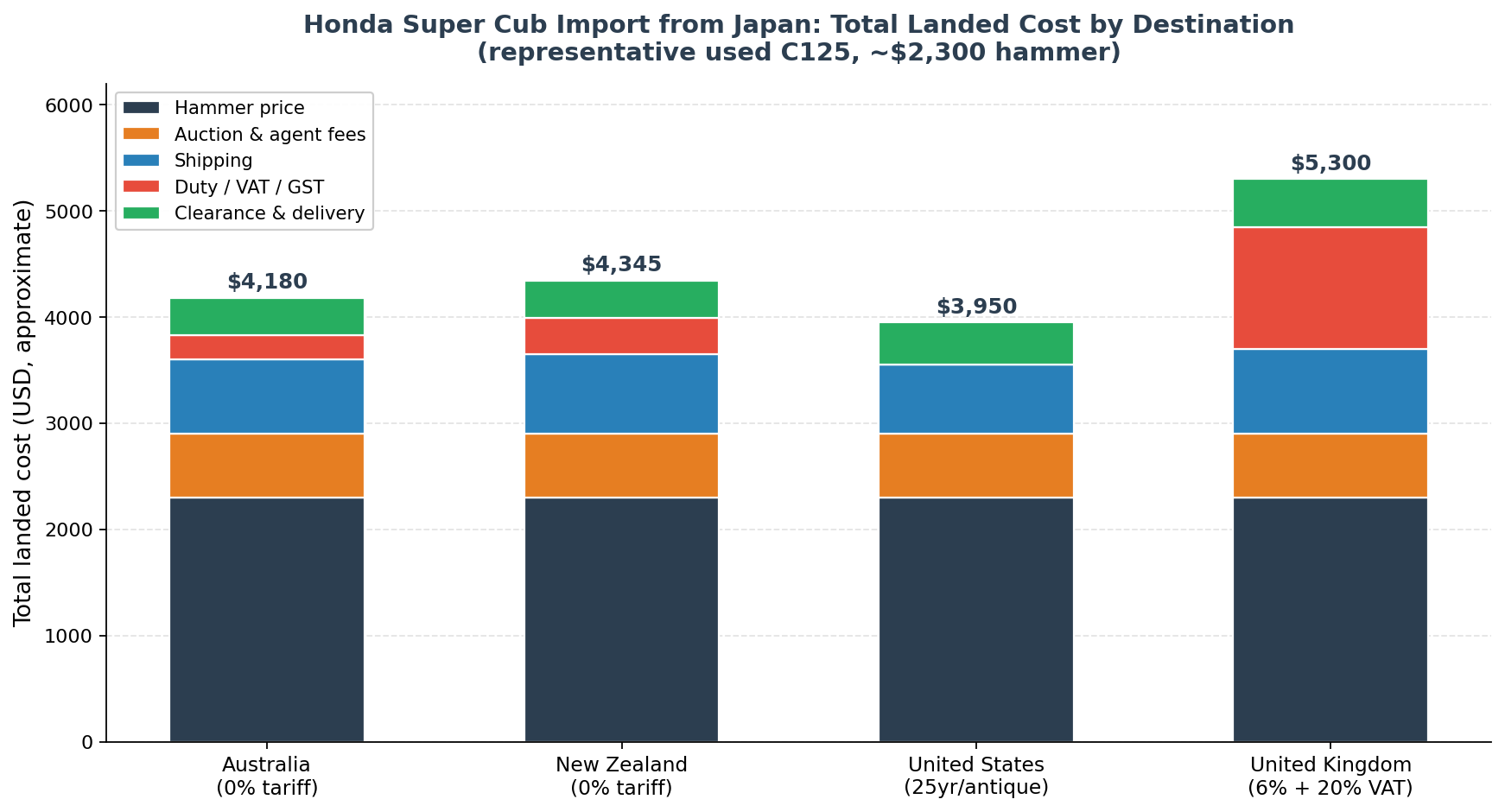
Here's what actually goes into landing a Super Cub at your door:
- Auction hammer price — what you bid and won.
- Auction & exporter fees — the auction's buyer fee plus your agent's commission. Budget roughly ¥40,000–¥90,000 combined for a small bike.
- Domestic transport & deregistration — moving the bike from the auction to the port and handling the Japanese export paperwork.
- Crating — Cubs are small, which is a genuine cost advantage. A Super Cub often shares a container or ships as compact freight far cheaper than a full-size motorcycle.
- Ocean freight — typically $400–$900 for a small bike depending on destination and whether it's consolidated.
- Destination duty & tax — the big variable, and it depends entirely on your country (next section).
- Customs clearance & local delivery — broker fees and the final leg to your address.
For a vintage C70 going to a low-tariff market like Australia, the whole stack on top of the hammer price might add $1,200–$2,000. For a CT125 going to a high-tax market like the UK, it can add considerably more once VAT lands. The bike's small size keeps shipping down, but taxes don't care how cute your Cub is.
The honest takeaway: always get a full, itemized landed quote before you bid. If an exporter gives you a hammer-price-only figure and goes quiet on the rest, that's your cue to walk.
How the Japanese Auction Process Works for Cubs
If you've never bought at a Japanese motorcycle auction, the system is genuinely brilliant once you understand it — and it's why importing from Japan is safer than buying a photo off a classifieds site.
Every bike that crosses the block gets inspected by the auction house and assigned a grade on a standardized auction sheet. The overall grade runs roughly from S (essentially new) down through 6, 5, 4.5, 4, 3.5, 3 and into R (repaired/modified). For a daily-rider Cub, a 3.5 or 4 is perfectly good. For a collector-grade vintage piece, you hold out for a 4.5 or higher.
The sheet also carries a condition map with damage codes — letters marking scratches, dents, rust, and repairs on a diagram of the bike. Learning to read these is the single most valuable skill an importer can have. A bike described as "tidy" in a listing might carry a sheet covered in W (wavy/repaired) and rust marks. The sheet doesn't lie; the listing might.
This is exactly why you bid through an agent who can read the original Japanese sheet rather than a translated summary. The grade and the damage map together tell you whether that ¥90,000 C70 is a clean runner or a project that'll cost you another ¥150,000 to sort. We translate and interpret every sheet before our clients bid, because one misread code can wipe out the whole saving.
Auctions run on a weekly schedule, with major houses moving enormous volumes of bikes. The Cub supply never really dries up — there's always another one next week — so there's no need to overpay in a bidding war. Patience is a strategy.
Import Rules by Country: US, UK, Australia, New Zealand
Here's where a Super Cub import from Japan gets genuinely country-specific, and where most generic guides wave their hands and move on. Your destination decides everything: legality, tax, and whether you can actually ride the thing on the road.
United States — the 25-year rule is your best friend. America is strict about DOT and EPA compliance for new imports, which is why bringing in a current C125 or CT125 for road use is a headache. But any Cub manufactured 25 or more years ago qualifies for the antique exemption. As one importer put it on the forums, you simply check the EXEMPT box for DOT and EPA compliance because the bike is an antique, prove ownership, and crate it over. That's why vintage C70s and C90s are the smart American import — a 1999-or-older Cub clears the federal hurdle that a 2024 one can't. With Honda having ended US C125 sales after 2024, Japanese vintage imports are increasingly the only sane path for road-legal Cub ownership.
United Kingdom — straightforward but taxed. The UK allows imports freely, but expect import duty (historically around 6%) plus 20% VAT on the total landed value, then IVA/registration to get a plate. The VAT is the sting. A cheap vintage Cub stays affordable; a CT125 climbs once the taxman adds his fifth.
Australia — small-displacement heaven. Australia applies 0% tariff on motorcycles, and Cubs are dead-easy to comply and register. Their tiny displacement makes them naturally learner-legal under LAMS, so a new rider can import a C125 and ride it on day one. For our money, Australia is one of the best Super Cub import destinations on the planet.
New Zealand — also 0% tariff, also friendly. Like Australia, NZ charges no tariff on bikes and has a sensible compliance path. GST applies on the landed value, and there's an entry certification step, but the process is well-trodden and Cubs sail through it.
The pattern is clear: low-displacement Cubs are about the easiest thing on two wheels to import almost anywhere, with the US being the one market where age matters more than anything. Match your model to your country before you fall in love with a specific bike.
The Part Nobody Tells You: Cub-Specific Pitfalls
Every bike has its traps. The Cub's are specific, and knowing them is the difference between a joyful import and a regretful one.
The "barn-find" tax. Vintage Cubs are so cheap to buy that people skip the auction sheet and bid on a romantic photo. Then the bike arrives with seized forks, a tank full of rust, and electrics from a horror film. A ¥60,000 Cub that needs ¥180,000 of work is not a bargain. Read the sheet. Always.
Title and ownership paperwork. Some very old Cubs in Japan changed hands informally over decades. A reputable agent confirms the export documentation is clean before you bid, so you're not stuck with a bike you can't deregister or register at home.
Engine swaps and "135cc" specials. The Cub is the most modified small bike on Earth. Plenty of auction bikes have non-original big-bore engines, swapped carbs, or custom wiring. For a rider that might be fine; for a collector or a country with strict compliance, an original numbers-matching bike matters enormously. The sheet and the agent flag this.
Electrical era mismatch. The vintage C50/C70 run 6-volt electrics on the oldest examples. If you want bright lights and modern reliability, know which generation you're buying. It's a small thing that surprises people.
Shipping a tiddler isn't free. Yes, Cubs are cheap to ship relative to big bikes — but "cheap" still means hundreds of dollars. Don't let a low hammer price trick you into thinking the total will be low. Run the full landed number first.
None of these are deal-breakers. They're just the reasons to import through someone who's done it before, rather than gambling solo on an auction you can't read.
The Cub's Cult Status: Customization, Camping, and Why It Keeps Selling Out
To understand why demand for imported Cubs never cools, you have to understand what people actually do with them once they arrive. This isn't a bike that sits in a garage. It's a canvas.
Walk through the custom Cub scene and one name comes up constantly: K-Speed, the Thai workshop whose carbon-bodied Super Cub C125 builds have pulled over a million views on a single video. They turn a humble commuter into a café-racer jewel, and that aesthetic has gone global. Buyers import a clean Japanese C125 specifically as a starting point for that kind of build, because a stock, unmolested base bike is worth more to a builder than a project that's already been hacked about. The auction sheet again earns its keep here — you want an original bike to start from, not someone else's abandoned experiment.
Then there's the camping and "Cub touring" culture that's enormous in Japan and spreading west fast. The Cross Cub and CT125 in particular have become the darlings of riders who strap a tent to the rear rack and disappear into the hills for a weekend. The CT125 Hunter Cub was practically designed for it: high exhaust to ford a puddle, a luggage rack that doubles as a workbench, and gearing happy on a fire road. Life of Smokey's import-and-ride video struck a nerve precisely because it showed an ordinary rider doing extraordinary, joyful things on a 125cc bike that cost less than a used car.
And the heritage crowd keeps the vintage end hot. Jay Leno — a man who can afford literally any motorcycle on Earth — keeps a Honda 50 in his collection and has spent serious airtime explaining why these engines are little miracles of engineering. When the most famous car guy alive treats a 50cc step-through with that kind of reverence, it tells you the Cub isn't a budget compromise. It's an icon people genuinely want.
That cult status has a practical consequence for importers: the desirable models hold value, sell quickly, and reward buying a clean original example. It's also why local supply is so thin — the moment a good C125 or CT125 appears on a Western marketplace, it's gone. The reliable, deep, weekly supply is in Japan. That's the whole reason to import.
Parts, Maintenance, and Living With an Imported Super Cub
A bike is only a bargain if you can keep it running, so let's talk about life after delivery — because this is where the Cub quietly wins again.
Parts availability is extraordinary. The Super Cub shares its core engine architecture across decades and tens of millions of units, which means consumables, gaskets, sprockets, chains, and even big-bore kits are cheap and everywhere. The global aftermarket — much of it routed through Japan and Thailand — treats the Cub like the platform it is. Compared with importing a niche bike that needs unobtanium parts, the Cub is the opposite problem: too many options.
For the modern C125 and CT125, fuel injection and modern electrics mean you mostly just ride and service. Oil changes, valve checks at the recommended interval, tyres, brake pads. These are not temperamental machines. Honda built them to survive being a delivery bike in a monsoon, so a pampered Japanese-market example asks very little of you.
The vintage C50/C70/C90 take a bit more involvement, and that's part of the charm. Budget a first-service kit on arrival: fresh fuel lines, a carburettor clean, new spark plug, oil, and a battery if the bike runs 6-volt and you want reliable lights. None of it is expensive, and the engineering is so simple that home mechanics genuinely enjoy it. There's a thriving global community — forums, YouTube tutorials by the thousand, and parts vendors who specialize in exactly your model. You will never feel alone working on a Cub.
One honest budgeting note: factor a modest "sorting fund" into any vintage import. Even a clean, high-grade Japanese Cub benefits from fresh consumables and a once-over when it lands, simply because it's been sitting and shipping. Set aside a few hundred dollars, do it once, and the bike will run for years. That sorting fund is exactly why reading the auction sheet matters so much — a high-grade bike needs a service, while a poorly-graded one needs a rebuild, and the price gap between those two outcomes dwarfs the saving on the hammer price.
Long term, the Cub is one of the cheapest motorcycles in the world to own. Fuel economy is absurd — these bikes routinely return figures that make a hybrid car look thirsty — insurance is trivial on small displacement, and the mechanical simplicity keeps shop bills low. You import once, sort it once, and then it just works. That's the entire philosophy Soichiro Honda baked in back in 1958, and 100 million bikes later, it still holds.
A Real Import Example: Walking Through the Numbers
Abstract cost stacks are useful, but nothing makes the picture click like two concrete examples. Here's roughly how the maths plays out on two very different Cubs going to two very different countries. Treat these as illustrative — real figures shift with the auction, the exchange rate, and the week — but the shape is accurate.
Example one: a CT125 Hunter Cub to Australia. Say you win a clean 2022 CT125 at ¥520,000 (about $3,650). Add auction and agent fees of roughly ¥75,000, domestic transport and export paperwork of around ¥30,000, and crating. Ocean freight to a major Australian port runs maybe $700 for a small bike. Australia charges 0% tariff, so your duty line is zero, though GST applies on the landed value. By the time it's in your driveway and registered — and remember, the CT125 is learner-friendly under LAMS — you're looking at roughly $5,200–$5,800 all in. Compare that with what a used CT125 commands on the thin Australian used market, where demand routinely pushes prices uncomfortably high, and the import suddenly looks clever rather than indulgent.
Example two: a vintage C70 to the United States. Now the opposite end. You find a tidy 1996 C70 at auction for ¥95,000 (about $670). Fees add maybe ¥55,000, export prep another ¥25,000, and freight to a US port around $650. Because the bike is over 25 years old, it clears the antique exemption — you check the EXEMPT box for DOT and EPA, prove ownership, and it's federally legal with no compliance engineering. Landed and sorted, you're realistically into it for somewhere around $2,200–$2,800, including a sorting fund for fresh consumables. For a genuine piece of motoring history that turns heads at every coffee stop, that's remarkable value.
The lesson in both cases is the same: the hammer price is a fraction of the story, the destination country swings the total more than anything else, and a small bike's low shipping cost is a real structural advantage. Run your own version of these numbers before you bid, and the decision makes itself.
Step-by-Step: How to Import a Super Cub from Japan
Here's the whole journey, start to finish, the way it actually goes when you do it properly.
- Pick your model and confirm legality. Vintage C70/C90 for the US 25-year route; C125 or CT125 for AU/NZ/UK road use. Decide before you shop.
- Set a true budget. Take your target hammer price and add the full cost stack from above. Now you know your real ceiling.
- Partner with an export agent. You need someone with auction access who can read original Japanese sheets. This is where AWA comes in.
- Watch the auctions. We monitor the weekly listings for your specific Cub and send you candidates with translated sheets and our honest read on each.
- Bid with a cap. You set a maximum; we bid on your behalf and never blow past it. Patience beats panic — there's always another Cub.
- Win, pay, and prep for export. We handle deregistration, domestic transport, and crating.
- Ship. Ocean freight to your nearest port, consolidated to keep the cost down for a small bike.
- Clear customs and register. We coordinate the destination paperwork; you handle local registration with our document pack.
- Ride. A Japanese-condition Cub, in your driveway, that nobody else has.
That's it. No mystery, no grey-market shrug. Just a clear chain from a Japanese auction hall to your garage.
How AWA Auction Makes Super Cub Importing Simple
We built AWA Auction for exactly this: giving English-speaking buyers direct, honest access to the Japanese motorcycle auctions, without the markup and without the guesswork.
When you import a Honda Super Cub from Japan with us, you get auction sheets translated and interpreted by people who read them every day, a real bidding cap so you never overpay, and a fully itemized landed quote up front — hammer price, fees, freight, and destination costs, with nothing hidden in the gap. We've handled the small, the vintage, and the high-demand CT125s, and we'll tell you honestly when a bike isn't worth it.
You can browse our current listings to see what's crossing the block this week, or contact our team with the exact Cub you're hunting and we'll watch the auctions for it. Whether it's a ¥80,000 vintage C70 for a weekend restoration or a clean CT125 for the trails, the process is the same: transparent, patient, and built around getting you the right bike at the right number.
The Super Cub has carried more people, more miles, in more countries than any machine ever made. Getting one from the country that perfected it shouldn't be hard. We make sure it isn't.
Browse current Honda Super Cub listings at AWA Auction, or contact the team to set up a monitored search for your exact model.
See Also
Share this article: