
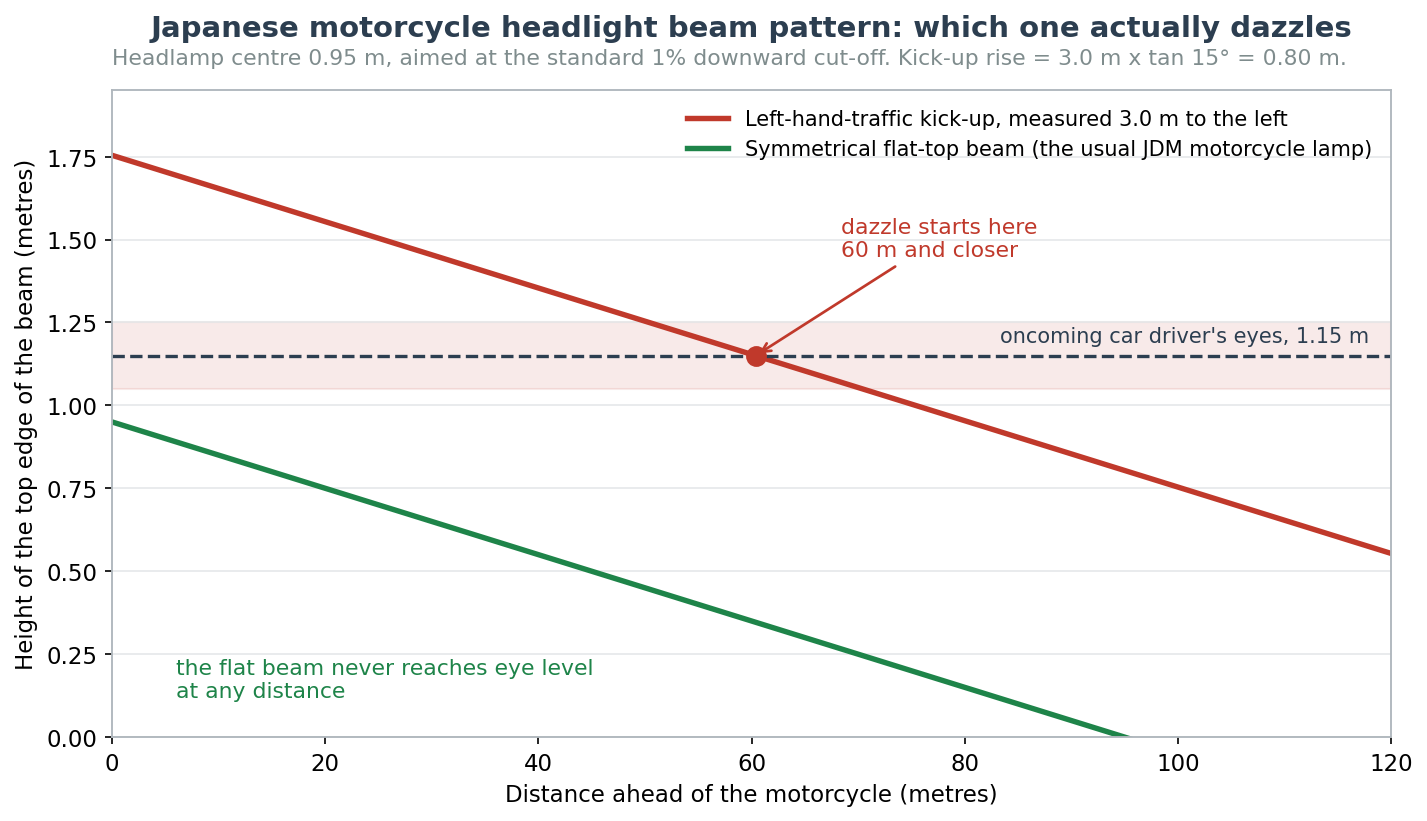
Every guide to importing a bike from Japan says the same thing about the headlight. Buy a beam deflector. Stick it on the lens. Job done.
For a permanent import into the UK, that advice will fail you at the test. In New Zealand it is written into a bulletin that applies only to tourists. In Canada it is barred by statute. And in Australia nobody has ever needed it.
The Japanese motorcycle headlight beam pattern is one of the most confidently misdescribed things in the import trade, and the confusion is inherited wholesale from the car world. Cars from Japan genuinely do have a left-dipping asymmetrical beam, because European car lighting rules effectively force one. Motorcycles do not live under those rules. A large share of Japanese-market bikes leave the factory with a flat-topped, symmetrical low beam that has no left-hand kick-up at all — and a flat-topped beam is not "wrong" anywhere. It is a category that four separate regulators explicitly name and accept.
This guide does the arithmetic that nobody else does. We take the geometry out of the standards themselves, run it on real motorcycle headlamp heights, and work out three things: whether your beam actually dazzles anyone, how far away it starts, and what each of the four common fixes costs you in road you can see. Then we go country by country and say what passes.
One number to set the tone. A motorcycle headlamp sits roughly 30 cm higher than a car's. Run the same wrong-side beam pattern through both and the bike dazzles oncoming traffic from 60 metres where the car manages 30. Every piece of guidance on the internet about beam conversion was written about cars. The bike is twice the problem, and nobody has said so.
The short answer on Japanese motorcycle headlight beam pattern, by destination
Here is the whole thing in one paragraph, then we will show our working for the rest of the guide.
Japan drives on the left. So do the United Kingdom, Australia and New Zealand. A Japanese headlamp is therefore aimed for the correct side of the road in all three, whether it is symmetrical or asymmetrical, and all three have written that acceptance into their inspection manuals. The United States, Canada and continental Europe drive on the right — but in the US and Canada the headlight is almost never the deciding issue, because an age rule settles admission long before anyone looks at the beam. That leaves right-hand-traffic Europe as the one place where a Japanese bike's low beam is a genuine, live problem requiring genuine work.
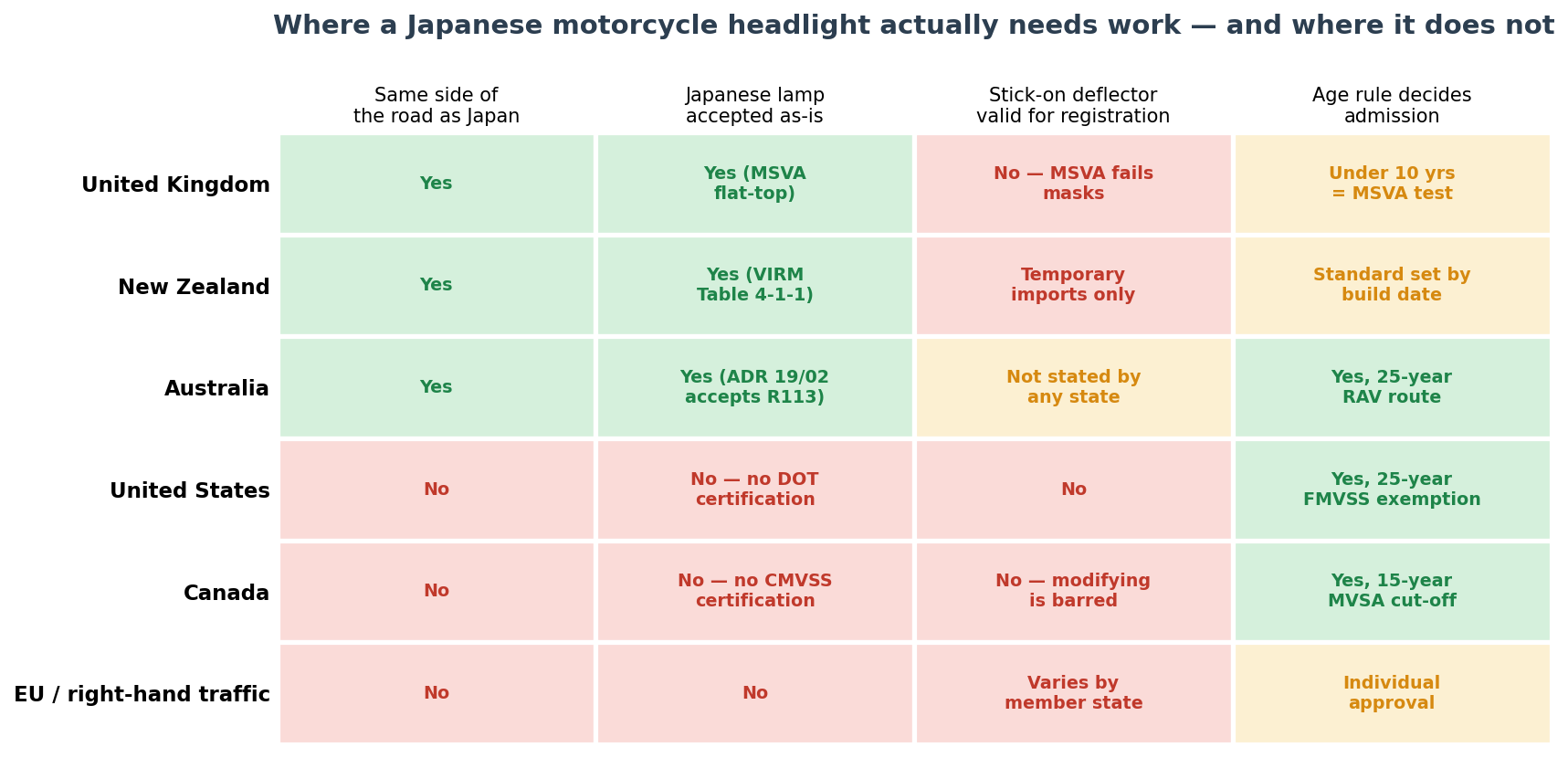
Three conclusions in that grid are worth reading twice.
The stick-on deflector column is red almost everywhere. The UK's motorcycle approval manual fails a lamp fitted with a mask outright. New Zealand's mention of masking sits in a bulletin about temporary visitor imports, not the entry-certification path a permanent import travels. Japan's own inspection rules treat anything stuck to the lens that changes the optical axis as non-compliant. The deflector is a holiday product that the import industry has quietly repurposed as a compliance product.
Canada's cell is the strangest one on the grid. For a Japanese-market motorcycle less than fifteen years old, there is no headlight fix, because there is no import. Canadian law states plainly that non-compliant foreign-market vehicles under the age threshold cannot be modified into compliance. The door is not narrow. It is locked, and there is no key.
The United States column is misleading in your favour. A JDM bike's headlamp does not conform to the US federal standard and never will, because that standard is a certification regime rather than a measurement you can pass after the fact. But a motorcycle 25 years or older is exempt from the whole of that regime, headlight included. If you are importing a 1998 bike into the US in 2026, the beam pattern is legally irrelevant at the border. That does not make it a good idea to ride around with it, which we will get to.
Japan does not require a left-dipping beam. It only bans a right-dipping one
This is the fact the entire subject turns on, and it is almost never stated correctly.
People assume Japanese lighting law mirrors European lighting law, so a Japanese bike must have a left-hand kick-up in the same way a German bike has a right-hand one. It does not. Japan's roadworthiness rules approach the problem from the opposite direction. Rather than mandating a particular asymmetry, the Japanese inspection standard for dipped beams says a lamp passes when its beam distribution is not a right-hand-traffic pattern, and then defines that condition geometrically: if every part of the cut-off line lying to the right of the vertical centre plane sits below the horizontal plane through the centre of the lamp, the lamp complies.
Read that as an engineer would. It is a one-sided test. It says nothing whatsoever about the left half of the beam. A lamp with a big left-hand kick-up passes. A lamp with a perfectly flat top passes just as easily, because a flat top has nothing above horizontal anywhere, let alone on the right. There is no incentive in Japanese law to build the asymmetry in.
Japan is also a contracting party to the 1958 UN vehicle agreement, and its inspection rules accept UN-approved headlamps directly. Two of those UN regulations matter here, and they are not the same document:
- UN Regulation 112 covers headlamps emitting an asymmetrical passing beam. It applies to categories L, M, N and T, so motorcycles are inside its scope. This is the regulation with the elbow, the shoulder and the famous rising cut-off.
- UN Regulation 113 covers headlamps emitting a symmetrical passing beam. Its motorcycle classes are defined by engine size — Class C for machines up to 125 cc, Class D above it — which tells you exactly who it was written for. Its cut-off clause requires the cut-off to be "substantially horizontal and as straight as possible" over at least three degrees either side of centre. There is no elbow provision anywhere in the document, because there is no elbow.
So there are two entirely legitimate, separately approved ways to build a motorcycle low beam, and one of them has no handedness at all. A symmetrical lamp is the same on both sides. Take it to Sydney, take it to Stuttgart: it is identically compliant or identically non-compliant in both, and the side of the road makes no difference to its shape.
What we cannot tell you is the exact percentage of Japanese-market bikes that leave the factory symmetrical. No regulator publishes that figure and no manufacturer breaks it out. What we can tell you is that Japanese law creates no pressure at all towards asymmetry, that R113 exists specifically to approve symmetrical motorcycle lamps, and that the UK's own approval manual has a named category for flat-top lamps precisely because inspectors keep seeing them. Check your bike rather than assuming. The next section is how.
How to tell which beam pattern your bike has, in five minutes with a garage wall
You do not need equipment and you do not need to wait for the shipping agent to tell you. There are three tests, and any one of them settles it.
Test one: read the arrow on the lens
UN-approved headlamps carry their traffic-side status as a moulded marking. A lamp approved for left-hand traffic only is marked with a single horizontal arrow pointing to the right when you stand in front of the bike facing the lamp — that is, pointing towards the kerb the bike drives beside. A lamp built to work in both systems, usually because the optic or bulb can be repositioned, carries a double-headed arrow with a head at each end. A symmetrical flat-top lamp also carries the double-headed arrow, for the obvious reason that it works either way round.
So: no arrow at all usually means a lamp certified outside the UN system entirely, most likely to a Japanese domestic standard. A single right-pointing arrow means asymmetrical, left-hand traffic, and you have a real decision to make if the bike is going somewhere that drives on the right. A double-headed arrow is the best case.
Test two: park it four metres from a wall
This is the definitive test, and it takes longer to describe than to do. Put the bike on level ground with the front wheel straight, four to five metres from a plain pale wall, and switch on the low beam in a dark garage. Now look at the top edge of the light patch.
A symmetrical flat-top beam gives you a single horizontal line straight across, the same height on both sides. It looks slightly boring. That is the point.
An asymmetrical beam gives you a horizontal line across one half and then, at the centre, a step or a diagonal climbing away towards one side. On a Japanese-market lamp that climb goes to the left as you look at the wall from behind the bike. That is the kick-up, and it exists to light up road signs and the verge on the side of the road you drive along.
One comment under a popular JDM headlight conversion video is worth repeating verbatim in spirit: a viewer wrote that the beam the presenter had called flat was not flat at all, and he had learned that the hard way. Look properly. A shallow kick-up on a scratched thirty-year-old lens is easy to miss at a glance and impossible to miss once you know to look for the step at the centre line.
Test three: photograph it before you bid
If the bike is still in Japan, you do not have a wall. You have an agent. Ask them to do exactly the above and send you one photograph of the beam on a wall plus one close-up of the lens markings. Any competent exporter can do this in the time it takes to walk to the shed. If you are still choosing a bike, our guide to reading the Japanese auction sheet covers what else is worth asking for in the same message.
The 15-degree kick-up, and the arithmetic that decides whether it dazzles
Suppose your bike does have the asymmetrical pattern and it is going to a country that drives on the right. What actually happens?
The industry describes the rising section of an asymmetrical cut-off as climbing at roughly fifteen degrees from the elbow. That angle is convention and optics literature rather than a sentence you can quote from the current regulation text, which defines the shoulder against a reference line in a diagram. Fifteen degrees is the right working number and we will use it, but we are telling you where it comes from.
Here is the piece of geometry that makes this calculable. The kick-up is an angular feature of the beam. That means the height it adds at a given sideways offset is the same no matter how far down the road you measure it:
rise = lateral offset × tan 15° = lateral offset × 0.268
Take a normal opposing lane. Three metres of lateral separation between your headlamp and an oncoming driver's head is a fair, slightly conservative figure for a two-lane road. Three metres multiplied by 0.268 gives 0.80 metres. The top of your beam, over on that side, sits 80 cm higher than the flat part of the cut-off, and it sits 80 cm higher at 20 metres, at 60 metres and at 200 metres.
Now add the aim. Both UN regulations put the horizontal part of the cut-off at one per cent below horizontal as the nominal setting — 0.57 of a degree, or a ten-centimetre drop per ten metres. So the height of the top edge of your beam, three metres to the left, at distance d, is:
height = lamp height − 0.01d + 0.80
Put a motorcycle headlamp at 0.95 m, which is typical for a sports bike or a naked, and set an oncoming car driver's eyes at 1.15 m, which is where the standards themselves put them. Solve it and the answer is 60 metres. From 60 metres away, right up until you have passed each other, that driver has your full above-cut-off light in the face.
Run the same sum on a symmetrical flat-top beam and something quite pleasing happens. There is no rise term at all, so the top edge of the beam is 0.95 m at the bike and falls from there. It is below eye height at zero metres, and it only gets lower. A flat-top beam does not put light in an oncoming driver's eyes at any distance, on either side of the road, ever. That is not a loophole. It is what the shape is for.
This is why the cover chart above matters more than any of the advice you have read. The question was never "is this beam Japanese". It was always "does the top edge of this beam cross eye height", and that is a question with an arithmetic answer.
Why a motorcycle dazzles from twice the distance of a car with the identical beam
Everything written about beam conversion — every deflector kit, every forum thread, every workshop video — comes from the car world. Cars are where the volume is. And there is one variable in the equation above that cars and motorcycles do not share.
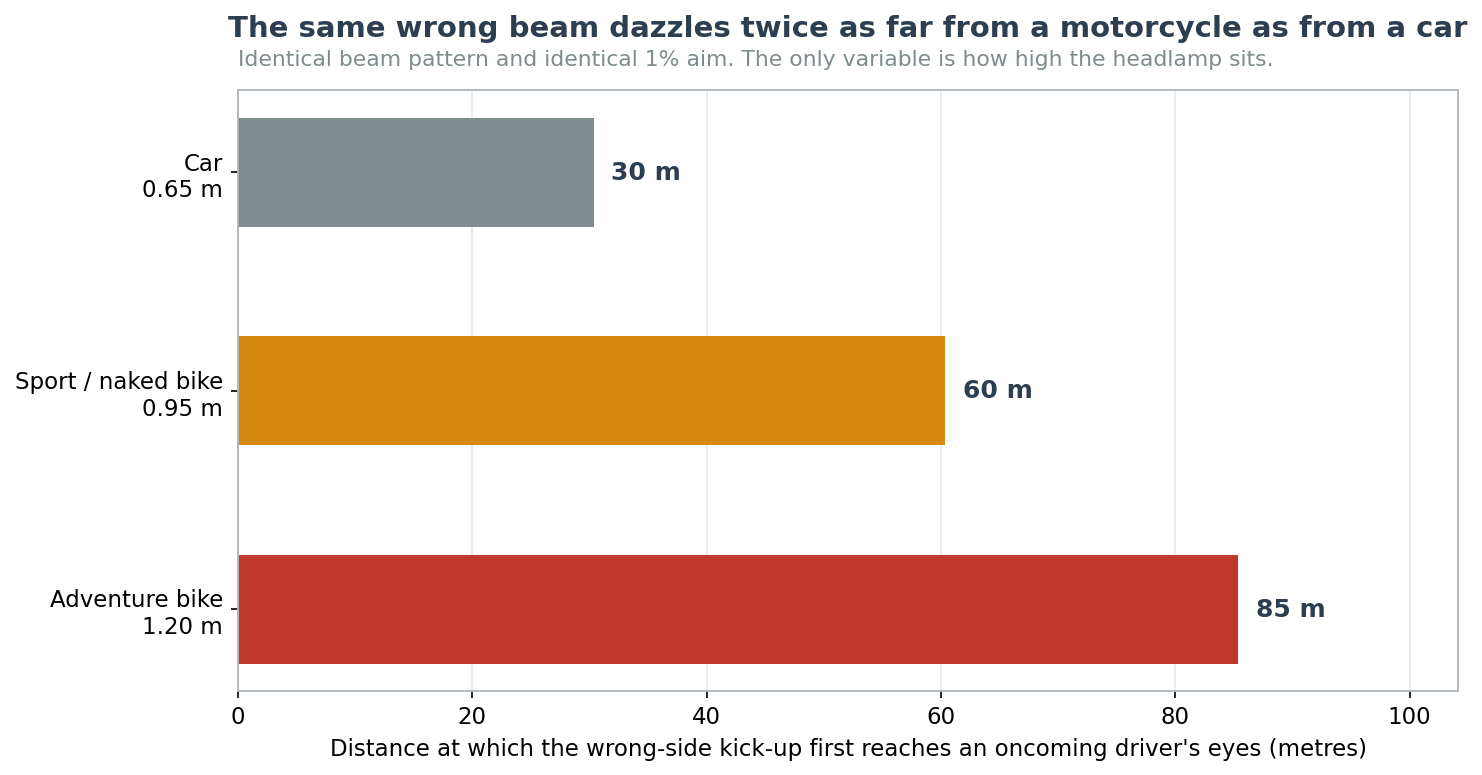
Car headlamps sit low. A typical passenger car has its lamp centres somewhere around 0.65 m off the ground. Motorcycles carry theirs between the forks at bar height: roughly 0.95 m on a sports bike or naked, and 1.20 m or more on an adventure bike with a tall beak. New Zealand's inspection tables are organised around exactly these brackets — under 0.8 m, 0.8 to 1.2 m, and above 1.2 m — which tells you the regulators have long since noticed.
Feed those three heights into the same equation, with the same beam pattern and the same one per cent aim, and the onset of dazzle moves a very long way:
- Car at 0.65 m — dazzle from 30 metres. Unpleasant, brief, and roughly what everyone's intuition expects.
- Sports bike or naked at 0.95 m — dazzle from 60 metres. Exactly double. The bike carries the identical lamp with the identical fault and doubles its reach.
- Adventure bike at 1.20 m — dazzle from 85 metres. At that range you are lighting up somebody's retinas for around three seconds of closing time on a rural road.
Here is the thing nobody mentions: this is a pure consequence of ride height and it cannot be engineered away by anything you buy. A deflector that works acceptably on a car works less well on the same beam mounted 30 cm higher, because the deflector only removes the kick-up while the extra mounting height keeps pushing the whole pattern towards eye level.
It also explains a peculiar detail in New Zealand's rules that looks arbitrary until you have done this arithmetic. NZ requires a steeper downward aim for higher-mounted lamps — 1.0 to 1.5 per cent below 0.8 m, and 2.0 to 2.5 per cent above 1.2 m. That is not bureaucratic fussiness. It is the regulator compensating for exactly the effect in the chart above, on lamps that are otherwise entirely legal. If you own a tall adventure bike, the aim setting matters more than the beam shape.
What each standard actually allows above the horizon
Now for the finding that reverses the whole popular story.
The assumption behind "your JDM headlight will blind people" is that a Japanese lamp is somehow dirtier or less controlled than a Western one. Put the two rulebooks side by side and the opposite is true, by a factor of four.
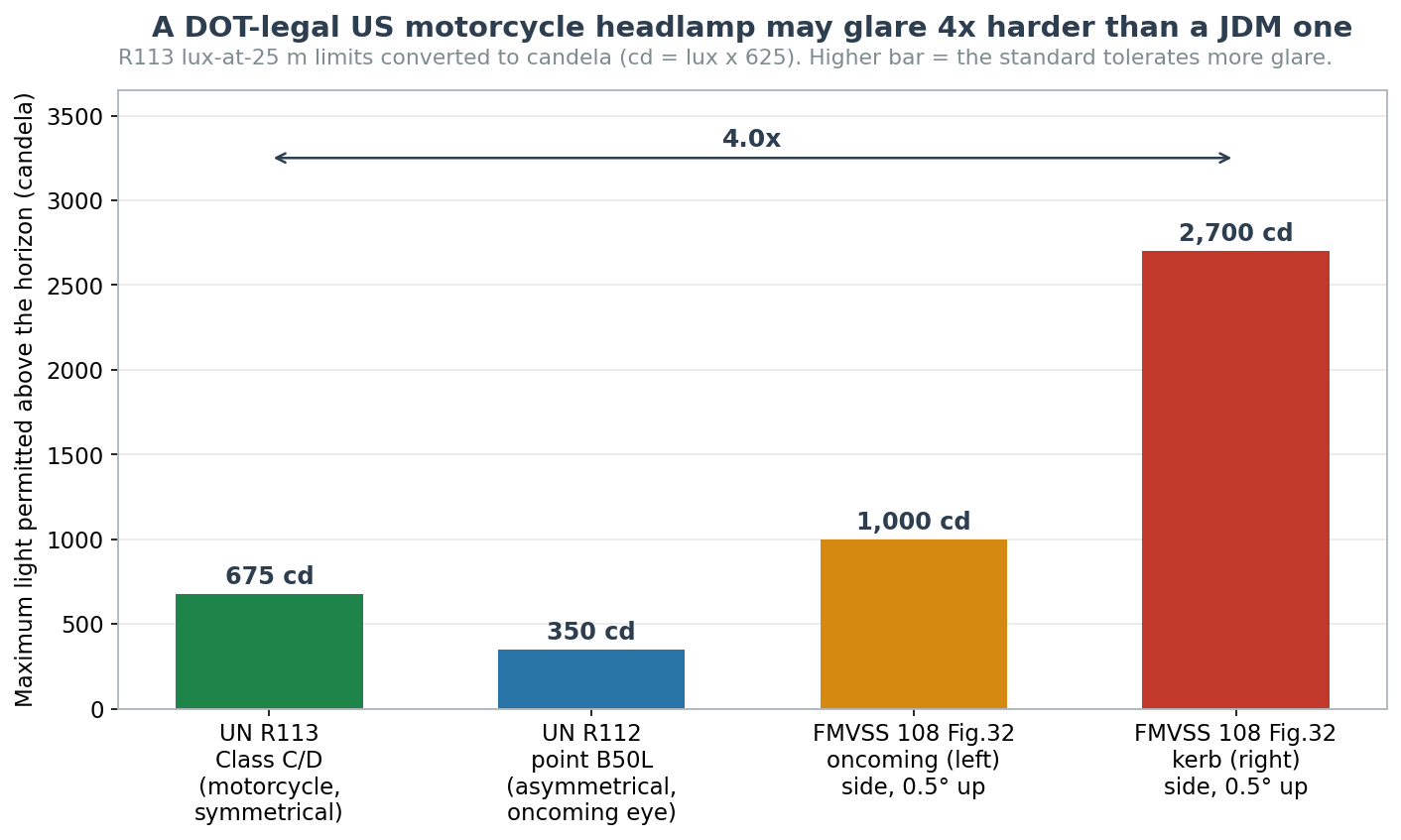
Take the four ceilings one at a time.
UN R113, motorcycle Classes C and D: 675 candela. The regulation's above-horizon test points cap out at 1.08 lux measured on a screen 25 metres away. Convert that to candela the way photometry requires, multiplying by the square of the distance, and you get 675 cd. That is the most a symmetrical motorcycle low beam may put above the horizon anywhere, on either side. The smaller Class B category is stricter still at 437.5 cd.
UN R112, point B50L: 350 candela. This is the single glare point in the asymmetrical regulation, and it applies to both classes. We will come back to it, because it is the most interesting number in the guide.
US FMVSS 108, oncoming side: 1,000 candela. A US motorcycle low beam is verified against a photometric table — Figure 32 in the federal standard, derived from the SAE motorcycle headlamp practice. Half a degree above horizontal, on the driver's side where oncoming traffic is, the ceiling is 1,000 cd.
US FMVSS 108, kerb side: 2,700 candela. Same half a degree above horizontal, other side of the pattern. The US standard permits 2.7 times as much light on the kerb side as on the oncoming side, which is its own quiet form of asymmetry, tuned for right-hand traffic.
Line those up and the conclusion is unavoidable. A fully DOT-compliant American motorcycle headlamp may legally throw 2,700 candela above the horizon — four times the 675 candela ceiling that a UN-approved symmetrical Japanese motorcycle lamp must stay under at every point above the horizon on both sides. Even on its dimmest side, the US standard tolerates 48 per cent more glare than the Japanese-approved lamp is allowed anywhere.
So when somebody tells you a Japanese import is going to blind the neighbourhood, the honest answer is that the bike next to it in the car park, wearing a DOT sticker, is permitted to be four times worse. The Japanese lamp's problem, if it has one, is direction. It is not brightness, and the standards say so in their own numbers.
One caveat we will state plainly because it is the sort of thing that gets quoted wrongly. Older editions of R113 express these limits in lux at 25 metres; later amendments restate them in candela with a spherical coordinate system. The conversion above is arithmetic, not interpretation, but if you are quoting candela figures at an inspector, say which revision you are reading from.
B50L: the test point your Japanese headlamp has never been measured at
The asymmetrical regulation has one named point where glare towards oncoming traffic is capped, and it carries the label B50L. Its position is given in angles: 0.57 of a degree up, 3.43 degrees left.
Those look like arbitrary decimals until you convert them into a picture. At 50 metres, 3.43 degrees to the left is 3.00 metres sideways. And 0.57 of a degree up is 0.50 metres above the lamp axis. Put a car headlamp at 0.65 m and a car driver's eyes at 1.15 m and the difference is, to the centimetre, 0.50 m.
So B50L is not an abstraction. B50L is the oncoming driver. The regulation has quietly encoded "the eyes of the person coming the other way, fifty metres out, one lane over" into a pair of angles, and then said: no more than 350 candela may reach them.
Here is the part that matters for your import. A headlamp approved for left-hand traffic is measured at the mirror-image point, B50R. The regulation swaps left and right for left-hand-traffic lamps throughout, because in Japan the oncoming driver is on your right. Which means that when a Japanese asymmetrical lamp was type-approved, a laboratory measured its output towards a point 3.43 degrees to the right, confirmed it stayed under 350 candela, and stamped it.
Nobody measured B50L. Not because anyone was careless, but because in the country of approval there is nothing at B50L except the verge.
This is the honest framing of the whole issue, and it is worth carrying into any conversation with an inspector. A Japanese asymmetrical headlamp taken to a right-hand-traffic country is not a lamp that has failed a test. It is a lamp that has never been tested at the point that now matters. The number is not bad. The number does not exist. And an inspector's job, reasonably enough, is not to assume a good one.
Notice too what this does to the symmetrical lamp by comparison. A flat-top beam has the same output at B50L and B50R, and it was measured against a blanket above-horizon ceiling that applies on both sides at once. There is no untested side. That is why four separate regulators find it easy to accept: the paperwork already covers the direction they care about.
Just aiming it down costs you 64 per cent of your lit road
Every thread on this subject eventually produces the same confident reply: you can adjust the lights down, all headlights have adjusters, it will work. It does work, in the narrow sense that it reduces the glare. Let us price it.
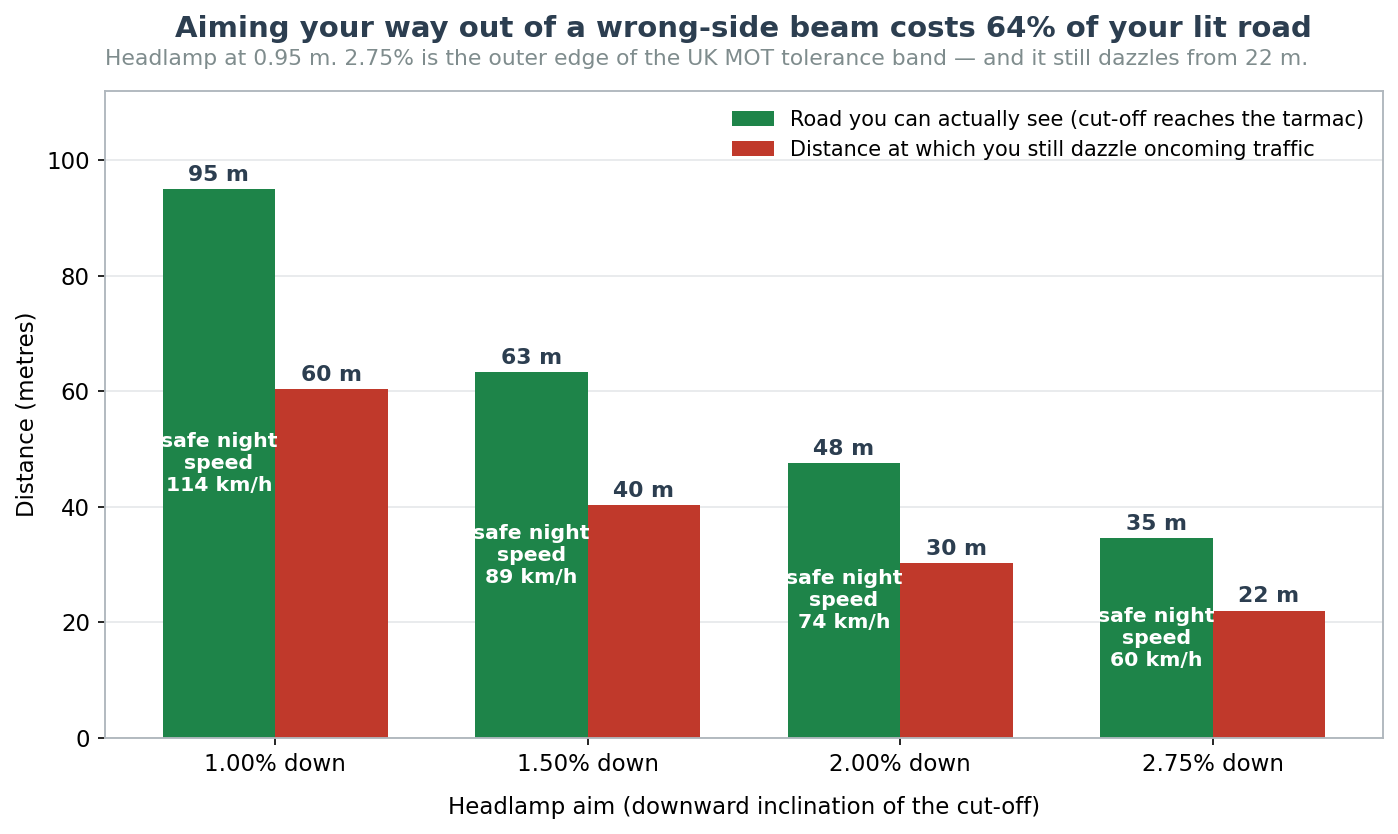
Two distances move together when you rotate a headlamp down, and they move at the same rate.
The first is the dazzle distance we calculated earlier. The second is your own seeing distance: the point down the road where the cut-off finally meets the tarmac, beyond which the road ahead is lit only by whatever stray light is below the pattern. That distance is simply lamp height divided by the aim, so it is brutally sensitive to the adjuster.
With the lamp at 0.95 m:
- 1.00 per cent down — the legal nominal setting. 95 metres of lit road. Still dazzles from 60 metres.
- 1.50 per cent down. 63 metres of lit road. Dazzles from 40 metres.
- 2.00 per cent down. 48 metres of lit road. Dazzles from 30 metres.
- 2.75 per cent down — the outer edge of the UK's in-service tolerance band. 34.5 metres of lit road. Still dazzles from 22 metres.
Read that last line again. You have wound the adjuster to the legal limit, thrown away 64 per cent of the road you could see, and the oncoming driver still gets your kick-up in the eyes for the last twenty-two metres of the approach. Aiming does not remove a kick-up. It only moves it closer.
Then there is what you have done to yourself. Take a standard reaction-and-braking model: one second of reaction time and 0.8 g of deceleration, which is a competent rider on a dry road. Ask how fast you can travel and still stop inside the road you can actually see:
- 95 metres of lit road: 114 km/h. You can use a motorway.
- 63 metres: 89 km/h.
- 48 metres: 74 km/h.
- 34.5 metres: 60 km/h.
At the maximum legal downward aim you are limited to 60 km/h at night before you are outrunning your own headlight. For context, stopping from 100 km/h under the same assumptions takes 77 metres — more than twice what that beam is showing you. Everyone who rides at night on a badly aimed bike is doing this, and almost nobody has put a number on it.
So aiming down is a legitimate fine adjustment on a beam that is already the right shape. As a substitute for fixing the shape, it is a bad trade you make in the dark, at speed, permanently.
United Kingdom: the MSVA fails beam deflectors, the MOT passes them
The UK is where the deflector myth does the most damage, because Britain runs two completely different lighting checks and the internet blends them into one.
The MSVA is the approval test, and it is strict
A motorcycle imported into the UK below the age threshold goes through Motorcycle Single Vehicle Approval — a different scheme from the IVA test that cars take, which is the first thing most car-derived guides get wrong. Our full MSVA walkthrough covers the rest of the test; here is what the headlamp section actually asks.
The manual names both UN regulations by name and treats them as equally valid routes. It then sets three requirements for the dipped pattern: it must not show an offside, right-hand kick-up; it must not dip to the right; and it must not dazzle. Note what is absent from that list. There is no requirement for a left-hand kick-up. A flat-top beam satisfies all three conditions by having nothing above horizontal at all.
The manual goes further and removes a requirement for symmetrical lamps: there is no need to check for horizontal aim adjustment where the beam pattern is symmetrical, described in the manual as "flat top". A flat-top lamp is not tolerated at MSVA. It is designed for.
And then the sentence that kills the deflector: the beam pattern must be met without the use of masks or beam converters unless they were an integral part of the headlamp as approved. Devices applied to a headlamp that were not present at the time of approval are listed as a reason for failure in their own right.
So for a permanent UK import, the deflector kit in your basket is not a shortcut. It is a documented fail.
The MOT is the in-service test, and it is not
Once a bike is registered, its annual test runs from a different manual with different priorities. That manual explicitly allows a flat-top or other alternative dipped beam so long as the whole upper edge sits inside the tolerance band. It also explicitly allows a right-hand-dip headlamp fitted with masks or converter kits that temporarily alter the lamp for UK use.
That is the entire source of the confusion. Someone reads that masks are acceptable, does not notice they are reading the in-service manual, and posts it as import advice. Both statements are true. They apply at different moments in the bike's life, and only one of them is the moment you are worried about.
The UK aim band, for reference, is 0.5 to 2.75 per cent below horizontal for lamps mounted at or below 850 mm, and 1.25 to 2.75 per cent above that. Which brings the previous section's arithmetic into direct contact with the paperwork: 2.75 per cent is legal, and it is also the setting that leaves you 34.5 metres of road.
If the bike is old enough to skip MSVA entirely, none of the approval rules apply and you are straight into the MOT world. Our guides to importing a motorcycle from Japan to the UK and to NOVA registration set out which route your bike takes.
New Zealand and Australia both accept the Japanese approval by name
These two are the quiet good news, and they are good news for a reason worth understanding rather than just believing.
New Zealand names Japanese standards in the table
NZ entry certification requires a motorcycle built from 2006 onwards to have headlamps meeting at least one approved standard from a published table. That table lists the UN regulations, the European directives, the US federal standard, the Australian rules — and then, explicitly, Japan: JIS D5500, JIS D5504, the technical standard for headlamps, and Article 32.
Your Japanese bike's original headlamp is on the approved list under the approval it already holds. No conversion, no re-approval, no lamp swap. This is about as unambiguous as vehicle regulation gets, and it is written down in a public inspection manual rather than being an inspector's opinion.
The in-service manual then adds the operating rules. It rejects a dipped beam that projects its maximum intensity to the right, and prohibits a dipped lamp designed solely for a left-hand-drive vehicle where the beam disperses right. A Japanese lamp fails neither of those: it either has no directional bias or it has the correct one. The same manual rejects a lamp with an overlay applied that reduces or distorts the light — which is the deflector, again, on the wrong side of the line.
Where does the masking advice in New Zealand come from, then? From a technical bulletin covering temporary vehicle imports — the tourist bringing a car off a ferry for a few weeks. That bulletin names plastic overlays and different bulbs as acceptable ways to kill a right-hand flick-up. It is the single cleanest illustration anywhere of the split this guide keeps returning to: masking is a visitor's fix, not a registration fix. Our New Zealand import guide covers the rest of the entry certification path.
Australia does not mention traffic sides at all
The Australian rule governing lighting installation on motorcycles accepts UN Regulation 112 and UN Regulation 113 as equivalents in its own equivalence table. Both routes in, symmetrical and asymmetrical, both fine.
More striking is what is not in the document. The word "traffic" does not appear in the instrument at all. There is no left-side or right-side clause, because Australia drives on the same side as Japan and the question never arises. What the rule does specify is aim: the passing beam's vertical inclination must stay between −0.5 and −2.5 per cent, with initial setting between −1.0 and −1.5 per cent.
Which is the real Australian action item. Not the beam shape — the aim, on a bike that has just been strapped into a container, unstrapped, and had its forks compressed for six weeks. Set it before the inspection. See our Australia import guide for how the rest of the compliance path fits together.
United States and Canada: the age rule decides everything
Both North American markets drive on the right, so a Japanese asymmetrical lamp is genuinely pointing the wrong way. In neither country is that the deciding factor, and the reasons are different enough to be worth separating.
United States: 25 years, and the question evaporates
US federal law exempts any motor vehicle 25 years or older from the federal motor vehicle safety standards entirely, declared on the customs form at entry. Age is counted from the month and year of manufacture, not the model year, and there is no personal-use restriction attached.
Under 25 years, the picture is bleak and has nothing to do with headlights. A Japanese-market motorcycle never certified for the US market has no conformance route as a single private import, and no amount of lamp swapping creates one. Our 25-year rule guide and US import guide go through the paperwork.
So the headlight is legally irrelevant to a US import in both directions: exempt if old enough, blocked for other reasons if not. What remains is state road rules and simple courtesy, and this is where the arithmetic earlier earns its keep. A 1997 bike with an asymmetrical left-hand kick-up is federally fine and will still put light in oncoming eyes from 60 metres out. Federal exemption is not an optical property.
Canada: the door is locked, not narrow
Canada uses fifteen years rather than twenty-five, and vehicles at or beyond that age fall outside the motor vehicle safety legislation. Below fifteen years, Canadian law is unusually blunt: a regulated vehicle manufactured for a foreign market that does not comply with Canadian standards is not eligible for permanent importation, and there is no allowance permitting non-compliant vehicles to be modified in order to comply.
That sentence does more work than any headlight rule. It means the entire question of what you could do to the lamp is moot for a sub-fifteen-year Japanese bike, because the modification pathway does not exist. Fifteen years, or nothing. Our Canada import guide covers the RIV process for bikes that do qualify.
The four fixes, ranked by whether they survive an inspection
If you have established that your bike genuinely has an asymmetrical left-hand kick-up and it is genuinely going somewhere that drives on the right, there are four things you can do. They are not equivalent.
1. Switch the lamp to the other traffic system (best, if available)
Some headlamps are approved for both systems and carry the double-headed arrow to prove it. Inside, they have either a repositionable optic or a bulb holder with two indexed settings, commonly marked R or D for right-hand traffic and L or G for left. Changing it is a screwdriver job that takes minutes. A widely-watched demonstration of exactly this on a modern H4 replacement unit has been viewed over 650,000 times, which tells you how many people are looking for it.
This works because it changes the approved configuration to another approved configuration. There is nothing to argue about at inspection: the lamp is doing what its own type approval says it can do. Cost: nothing, if your lamp has the feature. Check for the double arrow before you plan around it.
2. Replace the headlamp unit with a destination-market unit (best, if not)
The permanent answer. A unit approved for the country you are registering in arrives with the correct pattern designed in and the correct markings moulded on. It passes because it is the thing the manual is asking for.
The catch is supply, and it is a real one. For a common modern model there will be an aftermarket or European-market unit available. For a 1990s Japan-only machine there is often no such thing, and the honest answer is that you are looking at a generic approved lamp in a bracket rather than an original-looking one. Budget guidance from motorcycle import specialists puts replacement units anywhere from £20 for a generic round lamp to £300 for a model-specific assembly — and treat those as indicative trade figures rather than a quote, since they vary enormously by model.
3. Modify the reflector internally (works, but know what you are signing up for)
The route the enthusiast community actually uses on rare machines: open the unit, add an internal shield or blanking plate that removes the kick-up, reseal. The most-referenced demonstration of this on JDM headlights has picked up around 44,000 views and a comment section that is almost entirely people asking where to get the plate and whether anyone will do it for them — which is a fair summary of the state of the art.
Two warnings. First, this modification is invisible from outside, which cuts both ways at inspection: a UK approval inspector is entitled to fail a headlamp altered from its approved state, and internal work does not stop being an alteration by being tidy. Second, the person doing it needs to understand that a low-beam reflector is a designed optical surface, not a mirror. Block the wrong region and you lose your foreground light along with the kick-up.
4. Stick-on deflectors (temporary only, and in several places not even that)
The adhesive prism is the product the whole internet recommends and the regulators mostly do not. To recap the position across the guide: the UK approval manual lists a fitted mask or converter as a reason for failure. New Zealand's mention of masking lives in a bulletin about temporary imports and its in-service manual rejects distorting overlays. Japan's own inspection rules treat anything stuck to the lens that materially changes the light distribution as non-compliant. Canada does not permit the underlying modification at all.
The place deflectors legitimately belong is the one they were invented for: a bike ridden temporarily in a country that drives the other way. Riding your UK-registered machine through France for a fortnight is precisely the case, and the UK's own in-service manual says so. Registering a Japanese import permanently is not that case.
What to ask before you bid: the pre-purchase lighting checklist
All of the above is much cheaper to handle before the bike leaves Japan than after it arrives. Six questions, in the order that saves the most money.
1. Which country is it going to, and does that country drive on the left? If the answer is the UK, Australia or New Zealand, you can stop reading here on the beam-shape question and go straight to aim. If it is the US or Canada, check the age rule before anything else — that decides admission, and the lamp does not.
2. Photograph the lens markings. A double-headed arrow means you have options. A single right-pointing arrow means asymmetrical for left-hand traffic. No arrow means a Japanese domestic approval, which New Zealand accepts by name and the UK will assess on the beam itself.
3. Photograph the beam on a wall. Flat line all the way across, or a step at the centre climbing to one side. That single photograph settles the question that the entire rest of this guide is about, and it costs your agent five minutes.
4. Ask whether the headlamp is original. A replaced lamp on a twenty-year-old bike comes from any market you care to name, including a European unit somebody fitted years ago — which would be excellent news for a right-hand-traffic destination and worth knowing. Non-original lighting is one of the things worth checking against the auction sheet notes.
5. Ask whether the lamp has aim adjusters and whether they still turn. Corroded or seized adjusters are common on bikes that have sat, and every destination country has an aim requirement even when it has no beam-shape requirement. This is the failure that actually catches people out in Australia and New Zealand, where the shape is a non-issue. If the bike has spent its life near the coast, our guide to corrosion on Japanese imports is worth a read on what else seizes.
6. Price the fix into the bid, not into the surprise. If the bike is asymmetrical and heading somewhere right-hand-traffic, a replacement unit is a line item, exactly like the speedometer work. Speaking of which: if you are already budgeting for a km/h to mph conversion, the two jobs get done by the same person on the same afternoon, and quoting them together is cheaper than quoting them apart. The full import cost breakdown shows where these fit against the bigger numbers.
The three claims to stop repeating
To close the loop on the folklore, here are the three statements this guide's arithmetic contradicts outright.
"Japanese bikes dip to the left, so they are fine in the UK." Half right, and right for the wrong reason. Many Japanese bikes do not dip anywhere — they are flat. That is still fine in the UK, because the approval manual names flat-top lamps as an accepted category, but the reasoning matters when you are standing in front of an inspector. "It dips left" is a claim you may not be able to demonstrate. "It has nothing above horizontal at all" is one you can.
"Just fit a deflector and you are legal." For a permanent import into the UK this is a documented reason for failure. New Zealand's masking guidance applies to temporary imports. Japan's own rules reject lens-applied devices. The deflector is a product for holidays.
"A JDM headlight will blind everyone." The symmetrical lamp that most Japanese bikes carry is capped at 675 candela above the horizon on both sides, and never reaches an oncoming driver's eyes at any distance. The DOT-approved lamp beside it in the car park is permitted 2,700. Direction is the issue when there is one. Brightness is not, and it never was.
How AWA Auction handles the lighting question before the bike ships
Every bike we bid on has an owner with a destination, and the destination changes what is worth checking. Two of our most-asked questions are about speedometers and headlights, and both are cheapest to answer in Japan.
Before a bike ships we can photograph the lens markings and the low beam on a wall, so you know which of the two patterns you have bought rather than finding out in a garage on the other side of the world. Where the destination drives on the right and the lamp turns out to be asymmetrical, we can tell you whether a dual-traffic setting exists on that unit before you commit — which on a lot of modern machines turns the whole problem into a screwdriver and no invoice at all.
You can browse the bikes we currently have available to see what is coming out of the Japanese auctions this week, and if you have a specific model in mind and a specific country to land it in, talk to our team and we will tell you what the lighting position is for that combination before you bid rather than after.
The headlight is a small line on a big invoice. It is also the one item on that invoice where the internet's default advice will, in three countries out of six, get you a failure notice. Check the beam, check the arrow, check the aim. Then go and enjoy the bike.
Sources and further reading: UN Regulation 112, headlamps emitting an asymmetrical passing beam (MLIT bilingual copy) ; UN Regulation 113, headlamps emitting a symmetrical passing beam ; 49 CFR 571.108, FMVSS No. 108 and 49 CFR 591.5, import exemptions ; DVSA Motorcycle Single Vehicle Approval inspection manual ; DVSA MOT inspection manual for motorcycles, section 4 ; NZTA VIRM entry certification, headlamps ; ADR 19/02, lighting on L-group vehicles ; CBSA Memorandum D19-12-1, importing vehicles into Canada.
See Also
Share this article: