
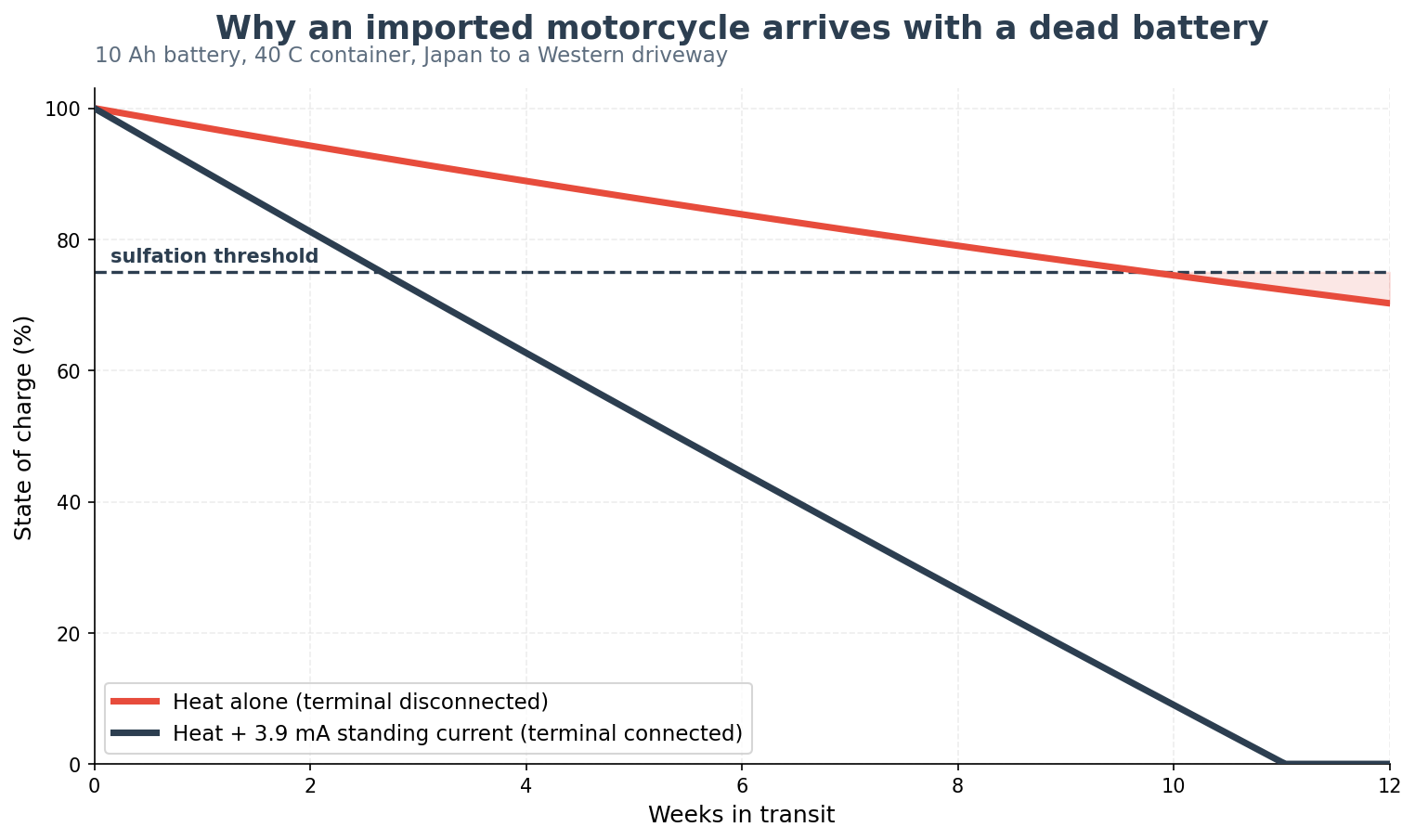
Your imported motorcycle battery is dead. The bike came off the truck, you turned the key, and you got a click and a dimming dash. Every forum thread you find will tell you the same three things: bad luck, cheap battery, just buy a new one.
All three are wrong.
The battery in a bike shipped from Japan does not die randomly. It dies on a schedule you can calculate before the container leaves Yokohama, using two numbers that are published, boring, and completely predictable. Once you have run that calculation, the interesting part is not that the battery died. It is that roughly 71% of the damage was optional, and preventing it costs nothing but a spanner and thirty seconds of somebody's attention in Japan.
This guide runs the arithmetic. Then it shows you how to work out whether your battery is recoverable or scrap, how to test the charging system before you spend money on a replacement, and exactly what to write in the email to your exporter so the next bike does not arrive the same way.
An imported motorcycle battery dies on a schedule, not by accident
Two things drain a battery on a bike that is not being ridden. That is the whole list.
The first is self-discharge. A lead-acid battery leaks charge internally whether or not anything is connected to it. This is chemistry, it never stops, and it is strongly temperature-dependent. The figure the industry works to is roughly 3% of charge per month at 20°C, and that rate doubles for every 10°C of additional temperature. That doubling rule is the single most important fact in this article, and almost nobody applies it to shipping.
The second is parasitic drain, also called standing current or quiescent current. This is the small, constant current your bike draws while switched off, keeping the clock running, the ECU's adaptive memory alive, the immobiliser listening for its key, and the instrument cluster remembering your trip meters. On a healthy modern bike this is somewhere between 0.5 mA and about 4 mA. Anything above roughly 20 to 50 mA means you have a genuine electrical fault, not normal standby.
Here is the thing nobody mentions: those two numbers are not comparable in the way people assume. Everyone blames the heat. The heat is the smaller problem.
The two thieves, measured against a real shipping timeline
To turn those rates into a prediction, you need to know how long the bike actually sits. Not the ocean crossing — the whole dwell time, from the moment the engine is last switched off in Japan to the moment you turn the key in your own driveway.
That clock starts earlier than most buyers think. It includes:
- Time at the auction house or dealer before the bike is even sold — often two to four weeks, sometimes far longer for an unpopular model
- Post-purchase processing, deregistration and paperwork in Japan
- Road transport to the port and time in the yard waiting for a vessel
- The ocean leg itself
- Discharge, customs clearance, quarantine or biosecurity inspection at the destination
- Inland transport to you
Add it up honestly and typical door-to-door dwell looks like this:
| Route | Typical total dwell |
|---|---|
| Japan to US West Coast | About 8 weeks |
| Japan to Australia / New Zealand | About 9 weeks |
| Japan to UK / Europe | About 12 weeks |
Broken down by stage, the ocean crossing is rarely the biggest slice:
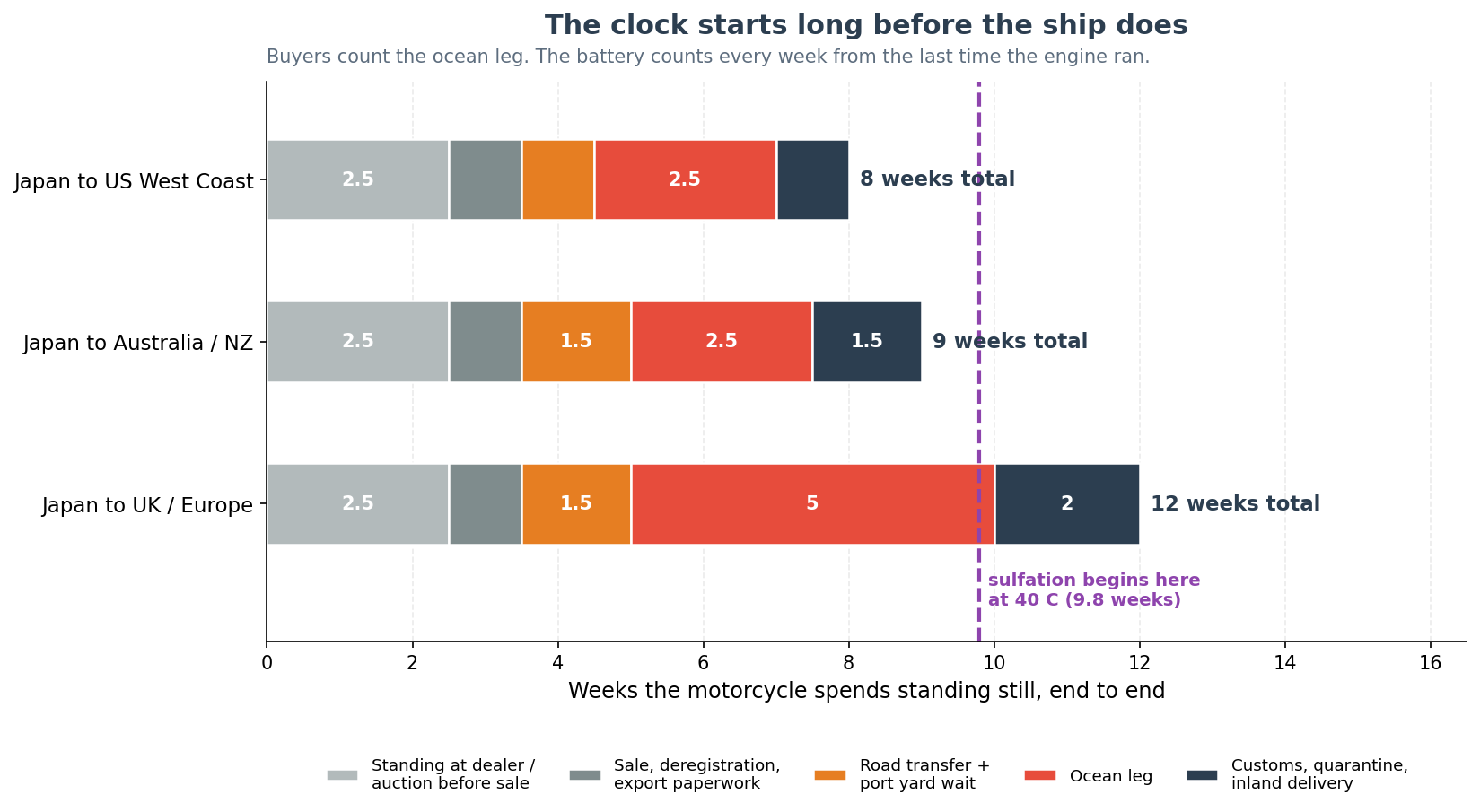
Note where the Japan-to-UK bar ends up relative to that dashed line. We will come back to it.
If your bike went by roll-on/roll-off rather than container, the ocean leg is often quicker but the yard time at both ends is usually longer, so the totals land in much the same place. We covered that trade-off in detail in our comparison of container versus RoRo motorcycle shipping, and our guide to how long it takes to import a motorcycle from Japan to the UK breaks the UK timeline down stage by stage.
Now the temperature. A steel box sitting on a deck in the sun is not at ambient. Measured studies of ocean containers have recorded interior temperatures reaching 50°C at sea, and in hot conditions the interior can climb to around 57°C. Port stops in tropical and subtropical latitudes routinely exceed 40°C ambient before you add the greenhouse effect of the box itself. A container in direct sun typically runs 15 to 20°C above the outside air.
So a bike crossing the Pacific in July is not spending eight weeks at a civilised 20°C. It is cycling between something like 30°C at night and 50°C in the afternoon.
What the temperature curve says about your specific route
Apply the doubling rule and the monthly self-discharge rate looks like this:
| Container temperature | Self-discharge per month |
|---|---|
| 10°C | 1.5% |
| 20°C | 3.0% |
| 30°C | 6.0% |
| 40°C | 12.0% |
| 50°C | 24.0% |
The number that matters is not "how flat is it" but "when does it cross the line where permanent damage starts". For a lead-acid battery that line sits at about 75% state of charge, which reads roughly 12.4 V at rest. Below that, lead sulfate stops being the soft, reversible film that forms during normal discharge and starts crystallising into hard, insulating deposits on the plates. That process is called sulfation, and past a certain point a normal charger cannot reverse it.
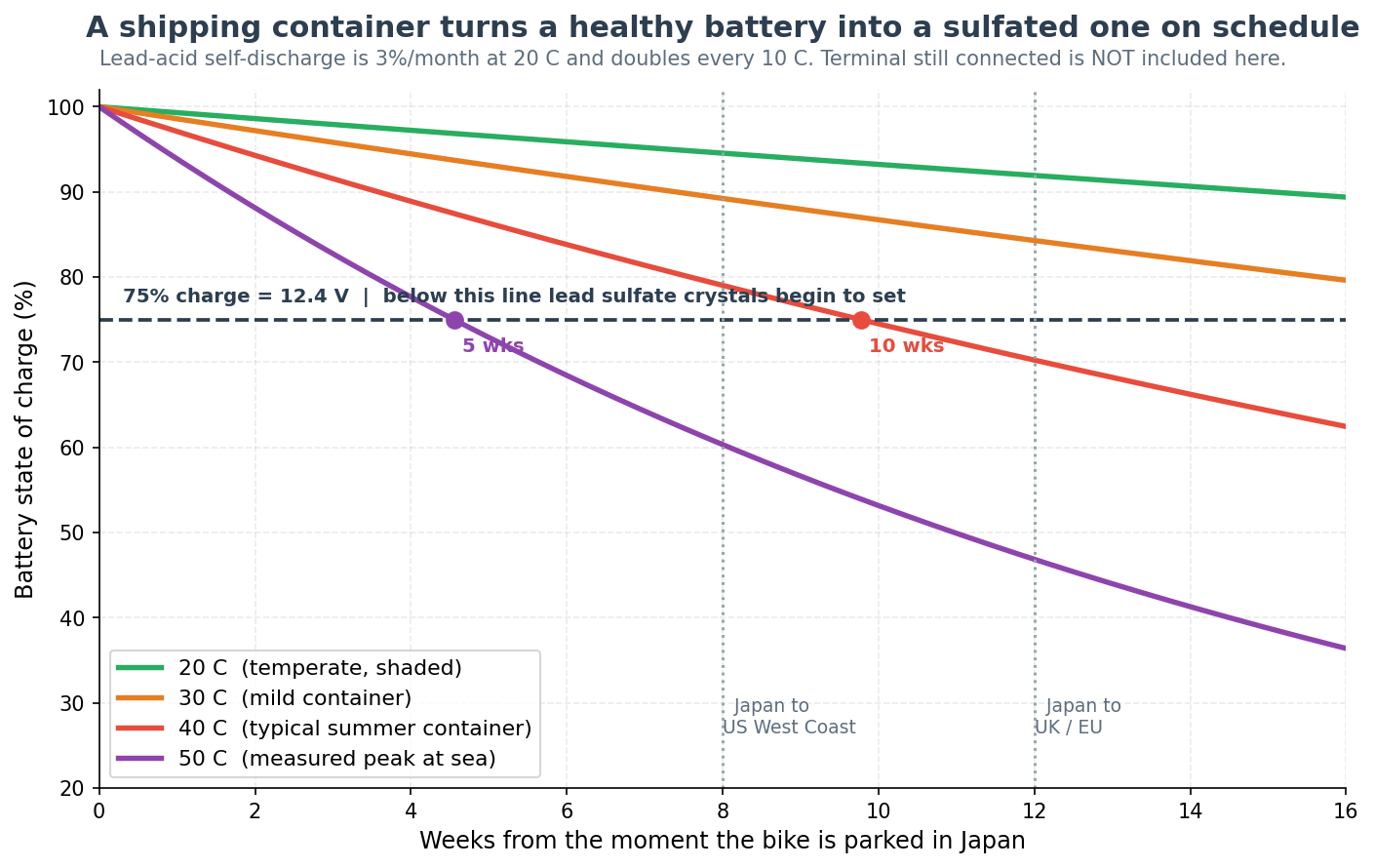
Read the crossings off that chart and the picture gets uncomfortable:
| Container temperature | Weeks until the battery crosses into sulfation |
|---|---|
| 20°C | 41 weeks |
| 30°C | 20 weeks |
| 40°C | 9.8 weeks |
| 50°C | 4.6 weeks |
At 20°C you could ship a bike to the moon and back and the battery would survive. At 40°C — an ordinary summer container, nothing exotic — the battery crosses into permanent damage at just under ten weeks. That is shorter than a Japan-to-UK door-to-door timeline.
At 50°C it crosses at four and a half weeks. That is shorter than the ocean leg alone.
Read that again, because it reframes the whole problem. On a hot summer sailing, the battery is already damaged before the ship reaches your country. Nothing that happens at your end — no charger, no trickle-charging routine, no amount of care in your garage — can undo a decision that was made in a shipping yard in Japan two months earlier.
And this is still the optimistic version. Everything above assumes the battery is disconnected.
Parasitic drain is the bigger thief, and the one you can switch off
Now add the standing current back in.
Take the middle of our range: a bike on an eight-week run to the US West Coast, a 40°C container, and a 10 Ah battery, which is typical for a mid-capacity machine.
Self-discharge over those eight weeks costs 2.1 Ah. Real, but survivable — it leaves the battery at 79%, just above the threshold.
A perfectly normal 3.9 mA standing current over the same eight weeks costs 5.2 Ah.
That is two and a half times more damage than the heat, from a current so small you would need a decent multimeter to detect it. Combined, the two take 7.3 Ah out of a 10 Ah battery, leaving it at 27% charge — deep into sulfation territory, and quite possibly beyond saving.
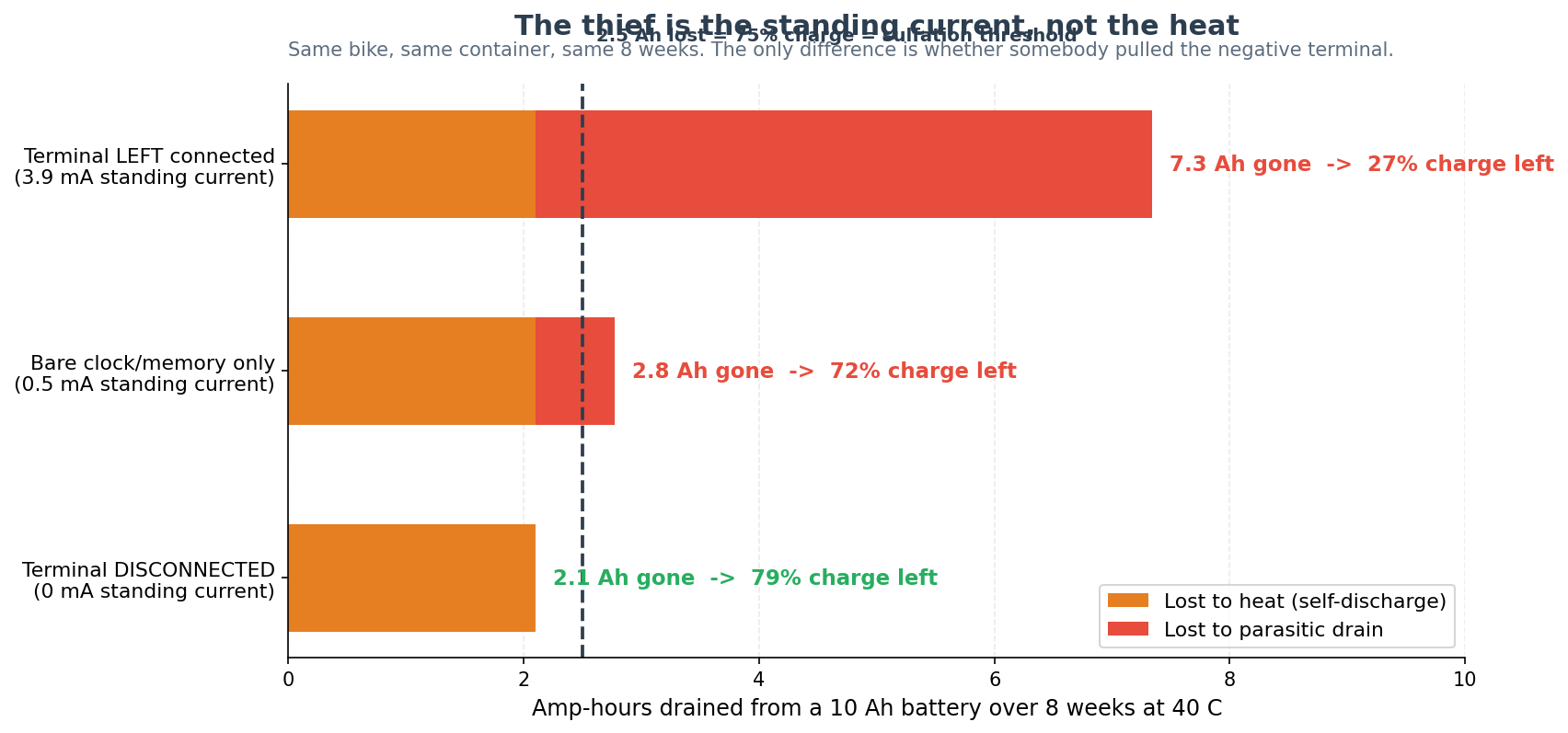
The chart makes the point better than any paragraph can. Same bike. Same container. Same eight weeks. The only variable is whether somebody in Japan spent thirty seconds pulling the negative terminal off the battery.
Disconnect it, and you remove 71% of the total damage for free. The battery arrives at 79% — tired, needing a proper charge, but chemically intact and entirely serviceable.
Leave it connected, and you are buying a new battery. You just do not know it yet.
This is the single highest-value instruction in this entire guide, and it is one line in an email. We will give you the exact wording further down.
Why a JDM bike is more exposed than an ordinary used bike
A used bike bought locally sits for a couple of weeks between owners and nobody thinks about it. An import is a different animal for four specific reasons.
The dwell time is five to ten times longer
This is the obvious one, but people consistently underestimate it because they count the ocean crossing and forget the yard time at both ends. The relevant number is the total, and it is usually two to three months.
Japanese-market bikes are full of things that never switch off
From the mid-1990s onward, Japanese-domestic-market bikes accumulated exactly the sort of electronics that draw standby current. Honda's HISS immobiliser sits waiting for a transponder key. Digital clocks and trip computers hold their state. Engine control units keep adaptive fuelling maps in volatile memory. Alarm systems fitted by Japanese dealers — very common on machines that lived in Tokyo or Osaka — draw considerably more than the factory baseline.
None of these are faults. They are features, and each one is quietly eating your battery for the entire voyage.
Nobody in the chain owns the battery
Here is the structural problem. The auction house is not responsible for the battery. The exporter's job is to load the bike. The shipping line moves a sealed box. The customs broker handles paperwork. Your local delivery driver drops it on the drive.
Not one of those parties has any incentive to think about a £60 battery, and the bike changes hands four or five times between the last time it ran and the first time you try to start it. Unless you specify it, disconnection simply does not happen — not through negligence, but because it is nobody's job.
The bike was probably already sitting before you bought it
The clock does not start at the auction. It starts the last time somebody rode the machine. A bike that spent six months in a dealer's back row before it reached the auction block arrives with a battery that has already done most of its dying. The auction sheet will tell you a good deal about the bike's condition, and learning to read those inspection sheets properly is worth the afternoon it takes — but no auction sheet records how long the machine has been standing still.
"Dead" is three different conditions, and only one is expensive
Before you buy anything, work out which of these you actually have. The test is a multimeter and an hour of patience.
Condition one: discharged but healthy
Rests above about 12.0 V. Takes a charge normally on a standard charger, climbs steadily, settles at 12.6 to 12.9 V an hour after you take it off, and holds that overnight.
This battery is fine. It was disconnected, or the trip was short and cool. Charge it properly and forget about it.
Condition two: sulfated but recoverable
Rests somewhere between about 10.5 V and 12.4 V. Accepts a charge, but reaches full voltage suspiciously fast and then collapses under any real load — cranks once, then nothing. Capacity is well down even though the voltage looks acceptable.
This is soft sulfation, and it is often partly reversible. A charger with a desulfation or reconditioning mode, run over several cycles, can recover a meaningful fraction of the capacity. Do not expect a miracle. Expect maybe 70 to 85% of original capacity if you catch it early.
Condition three: deeply sulfated or shorted
Rests below about 10.5 V, or will not accept a charge at all, or gets noticeably warm while charging, or has a visibly swollen case. A cell has usually shorted or the plates are heavily crystallised.
This one is scrap. Recycle it and move on — and resist the temptation to spend three weekends and the price of a new battery trying to resurrect it.
The rule of thumb: if it has been below 12.4 V for more than a few weeks, assume condition two at best. If it has been below 10.5 V for the length of an ocean crossing, assume condition three and budget accordingly.
Test the charging system before you blame the battery
This is where importers lose real money. The battery is flat, so they buy a battery. Two weeks later the new one is flat too, so they buy another. Only then does anybody check whether the bike can actually charge a battery in the first place.
The demand for this knowledge is not hypothetical. On YouTube, RevZilla's How to Test Your Motorcycle's Stator and Regulator Rectifier has drawn over 809,000 views and 441 comments; Ichiban Moto's charging-system repair video has passed 1.3 million views with 564 comments; Electrex World's multimeter diode test has 916,000 views; and Fab Motorbikes' regulator-rectifier test has 631,000 views and 406 comments. That is well over three and a half million views on videos that are all answering the same question — how do I test this thing — rather than "which one should I buy". Riders do not want a shopping list. They want a diagnosis.
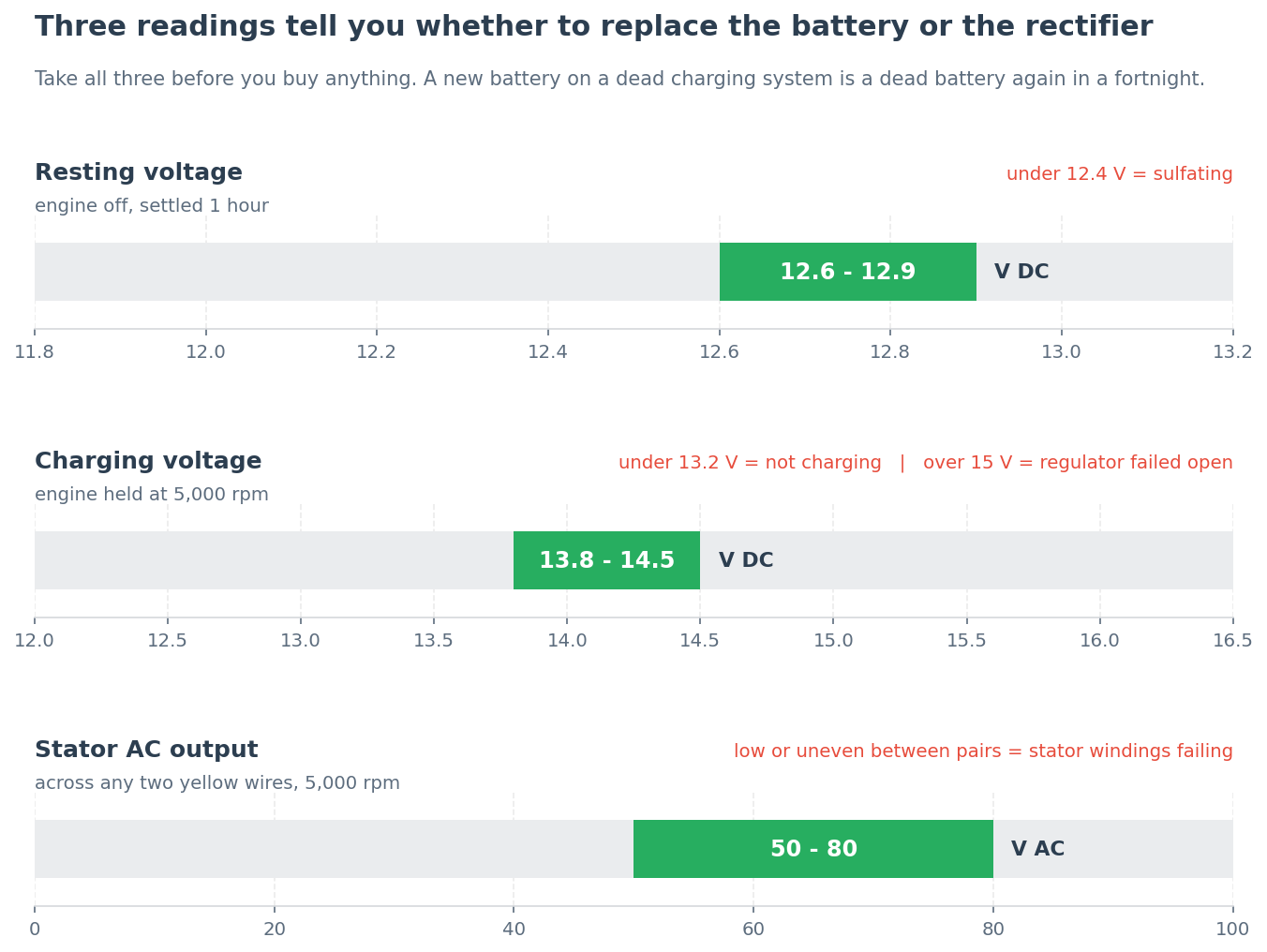
Here is the three-reading protocol. You need a multimeter that reads DC volts and AC volts. That is all.
Reading one: resting voltage
Engine off, bike untouched for at least an hour after any charging. Meter on DC volts, across the terminals.
Healthy: 12.6 to 12.9 V. Below 12.4 V and the battery is sulfating right now, today, in your garage.
Reading two: charging voltage
Engine running, held at around 5,000 rpm. Same meter position.
Healthy: 13.8 to 14.5 V.
Below about 13.2 V means the bike is not charging — the battery is running the motorcycle and losing. Above about 15 V means the regulator has failed open and is cooking the battery, which will boil the electrolyte and destroy it far faster than any container ever could. Overcharging kills batteries more violently than undercharging does.
Reading three: stator AC output
Engine at 5,000 rpm. Unplug the connector between the stator and the regulator-rectifier — on most Japanese bikes this is a block of three yellow wires. Set the meter to AC volts and measure across each pair in turn: one and two, two and three, one and three.
Healthy: roughly 50 to 80 V AC across each pair, and all three readings within about 10% of each other.
If all three are low, the stator is failing. If one pair reads noticeably different from the others, a winding has gone. If the AC output is healthy but reading two was low, the stator is fine and the regulator-rectifier is your culprit.
Those three readings, in that order, separate a £60 problem from a £250 one in about fifteen minutes.
Why Japanese bikes cook their rectifiers in the first place
There is a design reason the regulator-rectifier is the usual suspect, and it is worth understanding because it changes what you look for when you inspect a bike.
Nearly every Japanese motorcycle uses a three-phase permanent magnet alternator. The magnets are fixed to the rotor, so the alternator's output cannot be turned down — unlike a car, where the alternator's field winding can simply be de-energised when the battery is full. The magnets spin, and voltage is produced, whether the bike needs it or not.
So the regulator does the only thing it can: it takes the electricity the bike does not need and shunts it to ground as heat. This is called a shunt regulator, and it is the standard arrangement.
The consequence is brutal. A typical shunt regulator using SCR devices has an on-state voltage drop near 2 V. Multiply that by a maximum alternator output of 20 to 30 A and the regulator is dissipating 40 to 60 watts as pure waste heat — 50 W at a nominal 25 A. That is a soldering iron, bolted to your motorcycle, running continuously.
Now consider where manufacturers put it. Behind a fairing. Under the seat. Next to the radiator or the exhaust. Anywhere it fits, which is frequently somewhere with poor airflow. Then consider that the unit heats and cools through that cycle every single ride, and metal fatigue does the rest.
Three things make it worse, and imported bikes tend to collect all three:
- Low-speed and idling use. A bike that spent its life in Tokyo traffic gave that regulator minimal cooling airflow while it worked hardest. City-bound Japanese bikes are the rule, not the exception.
- Hot climates. Cooling fins work poorly in high ambient temperatures — which is also why this matters for buyers in Australia and the southern United States.
- Corroded connectors. Loose, worn or oxidised connections add resistance, which adds heat, which accelerates the failure. Salt-air corrosion is a known problem on machines that have sat outdoors near the coast, and our guide to rust and corrosion on Japanese motorcycles covers what to look for on the auction sheet.
The practical upshot: on any Japanese import from the 1990s or 2000s, treat the regulator-rectifier as a wear item with a finite life, in the same mental category as a chain or a set of tyres. If the bike is over fifteen years old and there is no evidence the unit has ever been replaced, budget for it. Many owners fit a modern MOSFET-based regulator as a matter of course, since it runs cooler than the original SCR design.
Does a lithium battery solve this?
Fair question, and the answer is genuinely interesting: lithium fixes the problem this article is about, and introduces two new ones.
A lithium iron phosphate battery — LiFePO4, the chemistry used in almost every motorcycle lithium battery — self-discharges at roughly 2 to 3% per month at room temperature, and unlike lead-acid it does not suffer sulfation. There is no crystallising lead sulfate because there is no lead and no sulfate. A LiFePO4 battery sitting disconnected in a warm container for three months arrives essentially fine. On the self-discharge axis, lithium wins outright.
Now the complications.
Lithium hates being deeply discharged, and it hates it permanently. Lead-acid degrades gradually as it sits flat. A LiFePO4 cell taken below its minimum voltage can be damaged in a single event, and many battery management systems will latch off and refuse to accept a charge at all — the battery appears completely dead, with no voltage at the terminals, and a standard charger will not even acknowledge it. Some chargers have a lithium wake-up mode for exactly this. Many do not. So the failure is less likely, but when it happens it is more absolute and less forgiving.
The battery management system draws its own standing current. That BMS is a small circuit board that never sleeps. It is generally a very low draw, but it means a lithium battery left connected on a twelve-week voyage is not immune — it is simply on a longer fuse. Disconnect it anyway.
Cold weather is a real limitation. LiFePO4 cells lose substantial available capacity below freezing and should not be charged below 0°C at all — doing so plates metallic lithium onto the anode and causes permanent damage. For a bike arriving into a British or Canadian winter and going straight into an unheated garage, that matters. Many riders solve it by running the headlights for thirty seconds before cranking, which warms the cells slightly, but it is a workaround for a genuine weakness.
And the charging system was not designed for it. An older Japanese bike's shunt regulator was calibrated for lead-acid, and its regulation can be coarse — the sort of voltage spikes a lead-acid battery absorbs without complaint are harder on a lithium pack's BMS. On a 1990s import with an original regulator of unknown history, fitting an expensive lithium battery before you have verified the charging voltage is an expensive way to find out the regulator is failing.
The honest recommendation: if you are importing a bike and it will sit for months, lithium removes the sulfation risk entirely and is worth considering. But verify the charging voltage first using the three-reading protocol above, and disconnect the terminal for shipping regardless of chemistry. Lithium is a better battery, not an excuse to skip the free step.
The battery tells you something about the rest of the bike
Here is a use for all this that has nothing to do with electricity.
When you inspect a bike on arrival, the battery is one of the few components whose recent history you can actually reconstruct. Everything else on a used import is ambiguous — a shiny engine case might mean a careful owner or a recent steam clean hiding a leak. The battery is different, because the arithmetic in this article works backwards.
A battery that arrives at 12.6 V after a ten-week voyage was disconnected and was fully charged when it was disconnected. Somebody in that chain knew what they were doing and took thirty seconds to do it.
A battery that arrives at 11.8 V was connected the whole way but was healthy when the bike was parked. Normal, unremarkable, and exactly what you would expect from a chain where nobody was told otherwise.
A battery that arrives at 6 V with a swollen case and white crust on the terminals was already weak before it was loaded, and probably sat for a long time in Japan before the auction. That is worth knowing — not because of the battery, but because it suggests the bike was standing unused for far longer than the odometer implies. Long-term standing is what ruins fork seals, flat-spots tyres, gums up carburettors and lets rust take hold in the places that matter. Our guide to mileage and odometer readings on Japanese imports covers why the number on the clock tells you less than you would like.
The battery is a cheap part. As a piece of evidence about how the bike was stored and how carefully it was handled, it is one of the most informative things on the machine.
The pre-shipping checklist to send your exporter
Everything above is preventable, and prevention happens in Japan, not in your garage. Send this to whoever is handling your bike before it is loaded. Keep it short — a list of five items gets actioned, a two-page essay does not.
Before loading, please:
1. Disconnect the negative battery terminal and tape the loose end so it cannot touch the frame.
2. Confirm the battery is fully charged at the point of disconnection.
3. Photograph the disconnected terminal and send the photo with the loading confirmation.
4. Note the battery's make and its date code, if it is marked, in the loading documentation.
5. If the bike has an aftermarket alarm or tracker fitted, please note this — these draw far more current than the factory system.
Item three is the one that makes the difference. A request without a verification step is a request that gets forgotten by a busy yard hand at four in the afternoon. A photograph takes five seconds and makes the instruction real.
Two things worth knowing about the alternatives:
Do not ask for the battery to be removed and shipped separately. Lead-acid batteries are classified as dangerous goods, and shipping one loose creates a paperwork problem out of all proportion to the value of the item. Left installed and disconnected, the battery travels as part of the vehicle. This is the normal and correct arrangement.
A solar trickle-charger inside a sealed container does nothing. It is dark in there. This suggestion appears in forum threads with surprising regularity.
If you are still choosing a shipping method, the container versus RoRo decision has a mild bearing here: RoRo decks are ventilated and generally run cooler than a sealed container in the sun, though the bike is more exposed to salt air. Our full guide to shipping a motorcycle from Japan covers the wider trade-offs, and the complete cost breakdown will tell you where a replacement battery sits against the rest of your budget.
Your first 48 hours after the bike lands
The bike is on your drive. Resist the urge to try to start it — a long crank on a weak battery is the fastest way to convert condition two into condition three.
Do this in order:
1. Measure before you touch anything. Multimeter across the terminals, record the resting voltage. This number tells you what happened during the voyage and determines everything that follows. Write it down.
2. Inspect the case. Swelling, cracks, weeping, corrosion at the terminals. A swollen case means stop — that battery is finished and does not go on a charger.
3. Charge slowly, and properly. Use a smart charger at a low rate — 1 to 2 A for a typical motorcycle battery. A high-current car charger on a small motorcycle battery causes real damage. If the battery reads under 12.4 V, use the desulfation or reconditioning mode if your charger has one, and be prepared to run several cycles.
4. Test whether it holds. Take it off the charger, leave it an hour, and measure. Then leave it overnight and measure again. A battery that reads 12.8 V after charging and 12.1 V the next morning has failed, whatever it looked like on the charger.
5. Only now, check the charging system. Run the three readings from the section above before you commit to a new battery. Fitting a new battery to a bike with a dead regulator-rectifier is how you end up buying three batteries.
6. Check standing current before it sits again. Meter in series with the negative terminal, ignition off, and wait a good half hour for the ECU to go to sleep before you trust the reading. Under about 4 mA is normal. Over 20 mA, find the fault — something on that bike is awake that should not be.
7. If the bike is going to sit again, disconnect it again. The same arithmetic applies to a bike waiting three months for registration, a NOVA submission or an inspection slot. Winter storage in a cold garage is genuinely kind to a battery — the doubling rule works in your favour below 20°C — but only if the terminal is off.
While the bike is standing, it is worth checking the other things that quietly degrade during a long voyage. Tyres develop flat spots and age out regardless of tread depth, which we cover in our guide to Japanese motorcycle tyres, and fork seals and shock damping suffer from long periods of standing, covered in our Japanese motorcycle suspension guide.
What this costs, and what it saves
Put numbers on it, because the asymmetry is the whole argument.
| Item | Typical cost |
|---|---|
| Disconnecting the terminal before shipping | Nothing |
| Replacement AGM motorcycle battery | £60 to £150 / $80 to $200 |
| Replacement regulator-rectifier (OEM) | £120 to £280 / $150 to $350 |
| Replacement stator | £150 to £400 / $200 to $500 |
| Workshop diagnosis if you do not test it yourself | 1 to 2 hours labour |
The worst version of this — a buyer who replaces the battery twice before anyone checks the charging system, then pays a workshop to find the failed regulator — runs comfortably past £400. All of it downstream of a terminal nobody disconnected.
The battery is also a useful proxy for something larger. A bike that arrives with a disconnected, healthy battery came through a chain where somebody was paying attention. A bike that arrives with a swollen, shorted battery and corroded terminals came through a chain where nobody was. That tells you something about everything else on the machine you have not inspected yet.
How AWA Auction handles this
We treat battery disconnection as a standard pre-loading step rather than a special request, because the arithmetic above is not a matter of opinion and the cost of getting it right is zero.
For bikes we handle, that means the negative terminal comes off before loading, the battery's condition is recorded at that point rather than guessed at later, and any aftermarket alarm or tracker is flagged in the loading documentation — because those draw far more than the factory standby current and change the calculation completely.
It also means being straight with you about what a long, hot sailing does to a fifteen-year-old battery that was already tired when it went into the container. Sometimes the honest answer is that the battery will need replacing on arrival regardless, and you should budget for it rather than be surprised by it.
You can browse our current listings to see what is available now, or contact our team if you want to talk through the shipping arrangements for a specific machine — including which route it will take, and roughly how long it will be standing still before it reaches you.
If you are earlier in the process, our guides to importing to the USA, Australia, Canada, New Zealand and the UK cover the paperwork and timelines for each destination, and the export certificate guide explains the document that starts the whole clock running.
The one-line version
If you read nothing else in this guide, read this.
An imported motorcycle battery dies because a small, constant standing current runs for two to three months inside a hot steel box. The heat is real but it is the junior partner — on a typical eight-week run at 40°C, the standing current does two and a half times more damage than the temperature does.
Both are predictable. One of them is free to eliminate.
Ask your exporter to disconnect the negative terminal and photograph it. That single sentence removes about 71% of the damage and is the highest-return instruction in the entire import process.
Then, when the bike lands, test the charging system before you buy a battery. A new battery on a dead regulator-rectifier is just a slower way of losing the same money twice.
Sources and further reading: Self-discharge rates and the temperature doubling rule are from Battery University, BU-802b: What Does Elevated Self-discharge Do? and Battery Builders on battery self-discharge. Sulfation thresholds and storage guidance are from Power Sonic and Crown Battery. Shunt regulator power dissipation figures are from Electro-Tech-Online's analysis of motorcycle regulator-rectifier design, with failure-mode context from J.D. Power. Normal parasitic draw ranges are from Battery Mart's guide to testing for current drain and Optima Batteries. Container temperature measurements are drawn from published ocean-freight thermal studies as summarised by Lotus Containers. LiFePO4 self-discharge rates and BMS parasitic load are from Anern's analysis of LiFePO4 storage and parasitic drain, and the cold-charging lithium plating limits are from GridWright on charging LiFePO4 in freezing temperatures.
See Also
Share this article: