
Kawasaki built the Ninja ZX-6R to win Supersport championships and then quietly hand the keys to ordinary riders. That is the trick that makes it the smartest 600 you can buy used: a genuine race-bred inline-four that you can ride to work on Monday and take to a track day on Saturday. When you decide to import a Kawasaki ZX-6R from Japan, you are tapping into the deepest, cleanest pool of these bikes anywhere on the planet — low-mileage examples that spent their lives on smooth Japanese roads, garaged, and maintained by owners who treat shaken inspections like a religion.
Here is the part nobody tells you up front. The ZX-6R that everyone argues about online — the famous 636 — was sold in Japan in numbers other markets never saw. So the bike that gives you more torque, more daily usability, and the addictive low-end punch riders rave about is exactly the one sitting in Japanese auction halls right now, often with under 20,000 km on the clock and an inspection sheet that tells you the truth before you spend a yen.
This guide walks you through every part of it: the 636-versus-599 debate settled once and for all, which generation to chase, what the bike actually costs landed in your driveway, the known faults and the auction-sheet red flags that reveal them, and the step-by-step process to get one home to the US, UK, Australia, New Zealand, or Canada. No fluff, no marketing — just what a ZX-6R buyer needs to know. By the end you'll know which engine to chase, which year delivers the most bike for your money, what the all-in price really looks like for your country, and how to spot a clean example from a flogged one before a single yen leaves your account. Whether you're in Los Angeles, London, Sydney, Auckland, or Toronto, the playbook is the same — and it's more straightforward than the forums make it sound.
Why the ZX-6R Is the Smartest 600 to Import From Japan Right Now
The 600cc supersport class is dying at the dealership. Yamaha turned the R6 into a track-only toy with no headlights. Honda dropped the CBR600RR from most Western markets for years. Suzuki let the GSX-R600 wither. Kawasaki is one of the last brands still selling a road-legal 600-class supersport new — but a brand-new one is expensive, and the cheap, clean used ones in the West have mostly been crashed, stunted, or flogged on track.
Japan is the exception. The domestic market kept buying these bikes, riding them gently, and trading them in early. A YouTube reviewer with over 400,000 views on his ZX-6R breakdown summed up the appeal better than any brochure: viewers in the comments kept describing the same journey — "I was shopping for a GSX-R600 and came home with a 2019 ZX-6R, I couldn't be happier." That is the ZX-6R effect. People go looking for a rival and leave with the Kawasaki because it does the everyday stuff better.
Importing from Japan gives you three things the local classifieds can't. First, condition: a Japanese-market bike usually has a documented history and far less salt-road corrosion. Second, choice: you can pick the exact year, colour, and spec instead of taking whatever turned up locally. Third, price: even after freight and duty, a clean Japanese 636 frequently lands cheaper than a tired, modified local example. If you want to see what's currently moving through the halls, browse the current AWA listings and you'll get a feel for the supply.
The 636 vs 599 Question: Which ZX-6R Engine Do You Actually Want?
This is the argument that fills entire forum threads, so let's end it. The ZX-6R has been sold with two different engine capacities over its life: a 599cc "true 600" built to the letter of Supersport racing rules, and a 636cc version that ignores the rulebook in favour of real-world riding.
The 599 is the homologation special. Kawasaki built it to race in the 600cc class, so it is peakier — it makes its best power high in the rev range and rewards you for keeping it pinned. On a track, that's exactly what you want. On a back road or a commute, you spend a lot of time below the sweet spot.
The 636 is the road rider's ZX-6R. Those extra 37cc don't sound like much, but they transform the low and mid-range. You get torque where you actually use it — pulling out of corners, overtaking, trundling through town — without losing the top-end scream. One owner of a 2013 636 put it perfectly in a review comment that racked up dozens of likes: after taking it to the track, riding Tail of the Dragon, and the Cherohala Skyway, "I absolutely fell in love with it. The low-end power" made it usable everywhere.
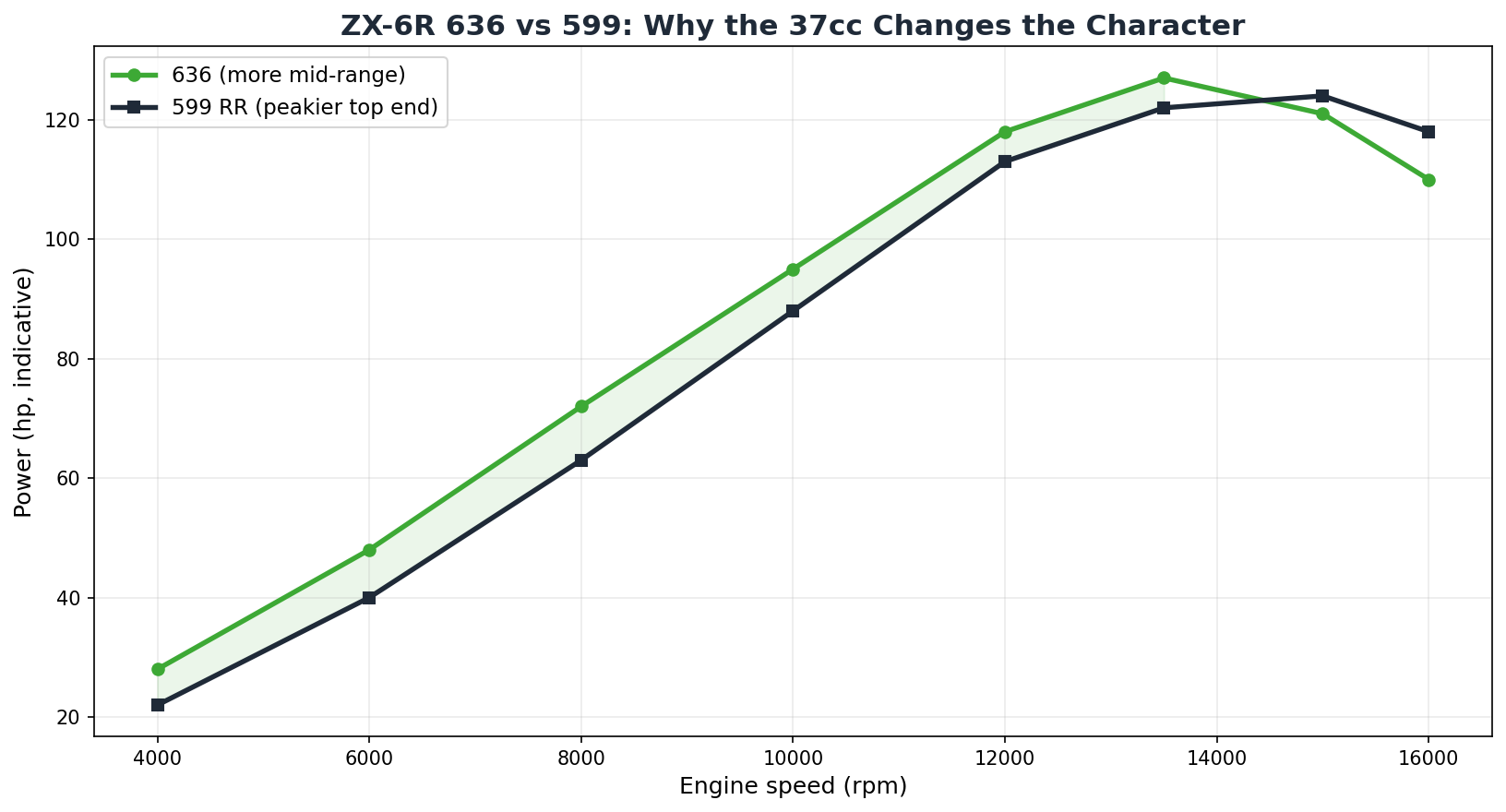
Look at the curves above. The 599 eventually catches and slightly passes the 636 right at the top, which is why racers chose it. But everywhere below 12,000 rpm — the entire range you ride on the street — the 636 is ahead. For 95% of buyers importing a ZX-6R from Japan, the answer is simple: get the 636. It is more usable, more forgiving, and Japan has the most of them. Only chase a 599 if you specifically want a track weapon and you live in the upper third of the tachometer.
Kawasaki ZX-6R Generations: A Year-by-Year Buyer's Map
The ZX-6R name has been around since 1995, but the modern, importable bikes break into clear eras. Here's the map so you know exactly what you're looking at on an auction listing.
2003–2004 (ZX636B) — the first 636. This is where Kawasaki abandoned the 600cc rulebook and made the bike bigger. Fuel-injected, sharp, and full of character. A reviewer who owns a 2003 636 called it "my first bike and it's been good to me" — they learned oil changes, chain adjustments, and brakes on it. These are now cheap and characterful, but they're 20-plus years old, so condition is everything.
2005–2006 (ZX636C) — refined first-gen. Same 636 idea, better detailing, radial brakes, and the start of the aggressive twin-headlight look. Strong value today.
2007–2008 (ZX600P) — back to 599. Kawasaki dropped to 599cc and chased the Supersport title with sharper styling. Brilliant on track. Watch for the head-gasket reports that surfaced on some of these — more on that in the problems section.
2009–2012 (ZX600R) — the polished 599. Still 599cc, but a much more sorted, mature bike. Good used examples are a sweet spot for buyers who want a modern-feeling supersport without paying for the newest tech.
2013–2018 (ZX636F) — the 636 returns, and it's the smart buy. Kawasaki brought back the 636 with traction control, power modes, and a brilliant chassis. This is, for most importers, the generation to target: modern electronics, the usable 636 engine, deep supply in Japan, and prices that still make sense.
2019–2025 (Euro-spec 636) — the modern face. LED lighting, updated styling, a quickshifter on uplevel trims, and a TFT-ish dash later in the run. The KRT replica colours are everywhere. One new-bike owner bragged about hitting 700 miles in a week on his 2022 KRT edition: "It's addictive." These cost the most but give you a near-new bike for used money.
The ZX-6R Engine and Spec Sheet, Explained Without the Marketing
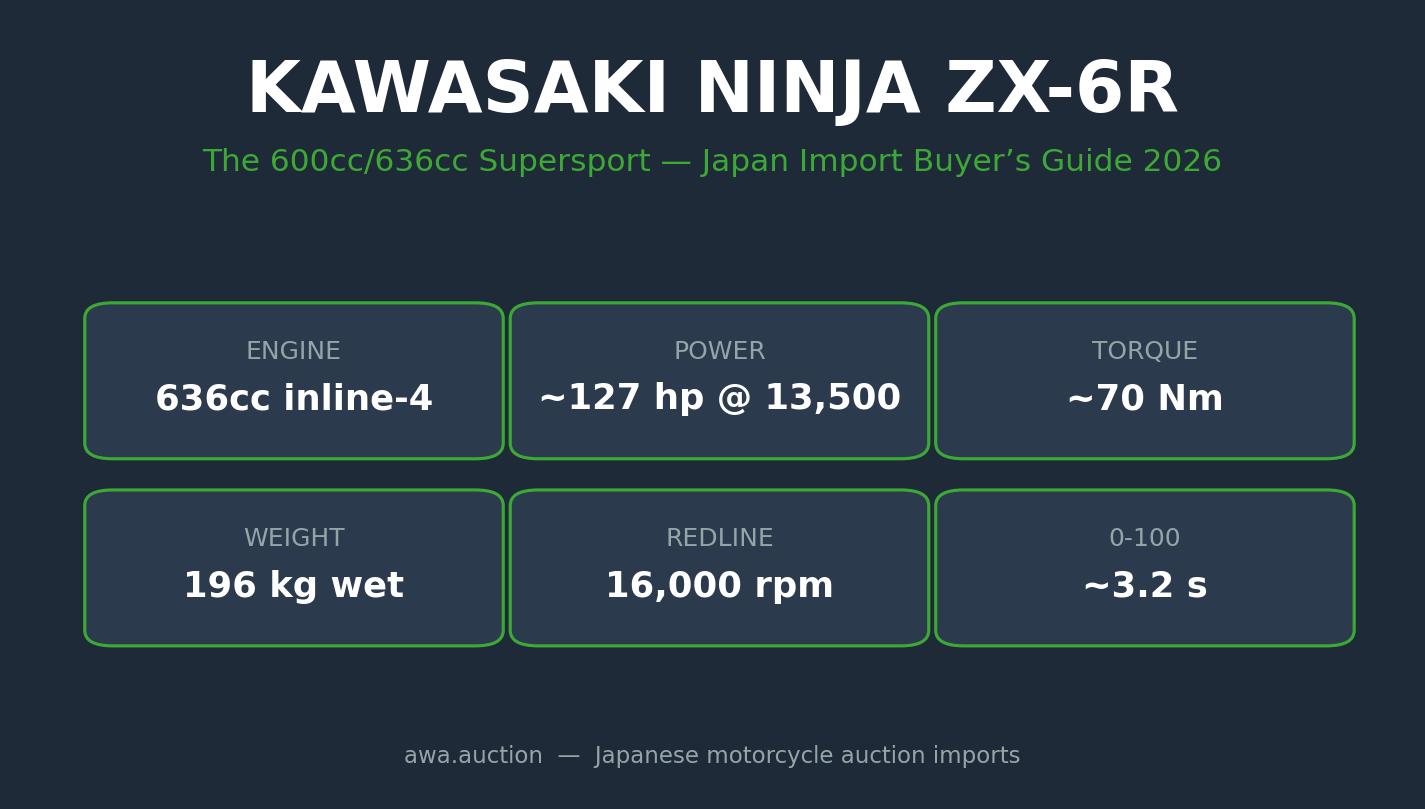
Strip away the brochure language and here's what you're buying. The ZX-6R uses a liquid-cooled, 16-valve, DOHC inline-four. In 636 form it displaces 636cc and makes roughly 125–130 hp depending on year and market, spinning to a 16,000 rpm redline. Wet weight sits around 196 kg. That power-to-weight is genuinely fast — a clean 636 will run 0–100 km/h in the low-three-second range and top out well north of 250 km/h.
What the numbers don't capture is the engine's reputation. Comment after comment on the big review videos repeats the same word: bombproof. "Kawasaki's engines are bombproof," as one buying-guide summary put it, and ZX-6R owners overwhelmingly report nothing alarming on reliability. These motors regularly cross 50,000–60,000 km with nothing more than fluids, chains, and the occasional valve check. The cult line "Kawasaki is a friend to my wallet" — over 500 likes on one review — exists because these bikes don't nickel-and-dime you.
The chassis matches the engine. The 2013-on 636 in particular got a frame and suspension package that flatters average riders: it turns in fast, holds a line, and the Showa Big Piston Fork up front gives real feedback. Brakes are strong four-pot radials on the later bikes. If you're stepping up from a 300 or a naked bike, the ZX-6R feels focused but never scary — which is exactly why so many riders keep them for years. Got a specific year or trim in mind? Tell the AWA team what you're after and they'll watch the auctions for it.
Known ZX-6R Problems and the Auction-Sheet Red Flags That Reveal Them
No bike is perfect, and the honest truth is part of why you should trust this guide. Here are the faults that actually show up on ZX-6Rs, and — more importantly — how the Japanese auction inspection sheet helps you dodge a bad one.
Regulator/rectifier failure. The most common ZX-6R electrical gremlin across several generations. A failing reg/rec cooks the battery or leaves you stranded. It's cheap to replace, but on a bike you can't test-ride before buying, look for signs: an auction sheet noting electrical faults, or a battery that's clearly been recently swapped on an otherwise original bike.
Cam chain tensioner noise. Some examples develop a rattle from the cam chain tensioner. It's usually not catastrophic, but a noisy top end is a bargaining point. On a JDM bike, this is where a good agent's start-up video matters.
2007–2009 head-gasket reports. A subset of the 599 generation had head-gasket issues. Not universal, but if you're set on a 2007–2009, factor a compression check into your plan and don't ignore any coolant-in-oil hints.
Crash and stunt damage. This is the big one for any supersport. The ZX-6R is a stunting favourite, so frame sliders, scuffed bar ends, ground-down pegs, and replaced fairings are warning signs of an abused bike. Here's where importing from Japan wins: the auction sheet grades the bike and maps every scratch and repair on a diagram. Learn to read it. A grade of 4 or 4.5 with a clean diagram is what you want; anything with an "R" (repaired) notation or accident history needs a hard look. We have a full breakdown of how to read Japanese auction inspection sheets that pairs perfectly with this guide.
Modified electronics and ECU flashes. Later 636s with aftermarket exhausts and ECU tunes can have fuelling quirks. A modified bike isn't automatically bad, but you want to know what was changed and why.
What an Imported ZX-6R Actually Costs in 2026
Let's talk real money, because vague "it depends" answers help nobody. The total you pay breaks into the auction hammer price plus the cost of getting the bike to your door. Here's a typical breakdown for a clean 2013–2018 636 bought at around a $5,000 hammer price.
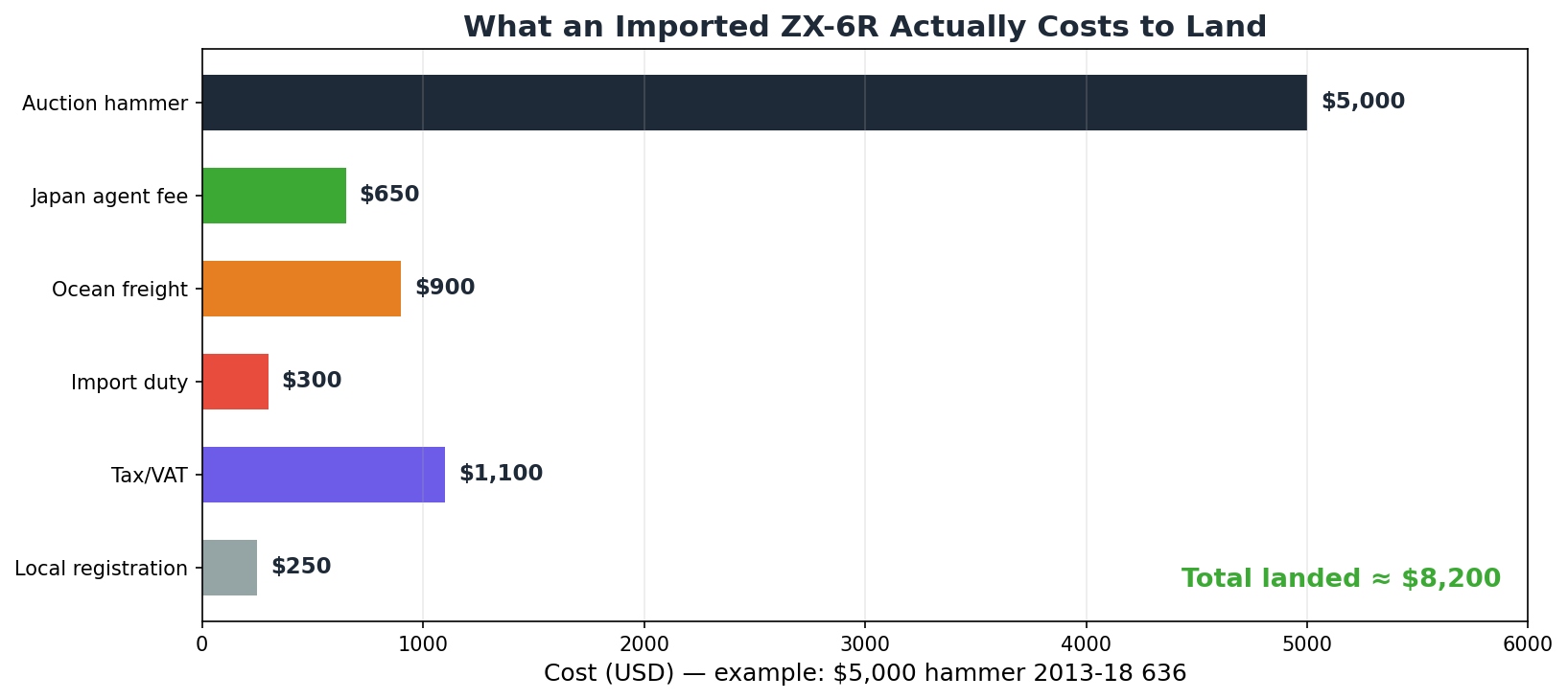
The hammer price is the auction bid. On top of that you'll budget an agent/export fee, ocean freight, your country's import duty, your tax or VAT, and local registration. As the chart shows, a $5,000 hammer 636 lands somewhere around $8,200 all-in for a typical destination — and the single biggest swing factor is your country's tax rate, not the bike itself.
That's the headline most people miss. The mechanical bike costs the same whether it's going to Texas or Birmingham. What changes is the government's cut: a low-tax market like the US sits at the bottom of the range, while a 20%-VAT country like the UK sits at the top. Plan your budget around your destination's tax, and the rest is predictable.
ZX-6R Price by Generation: Where the Value Is
Prices climb steadily by generation, which gives you a clear value ladder depending on your budget and how new you want the bike to feel.
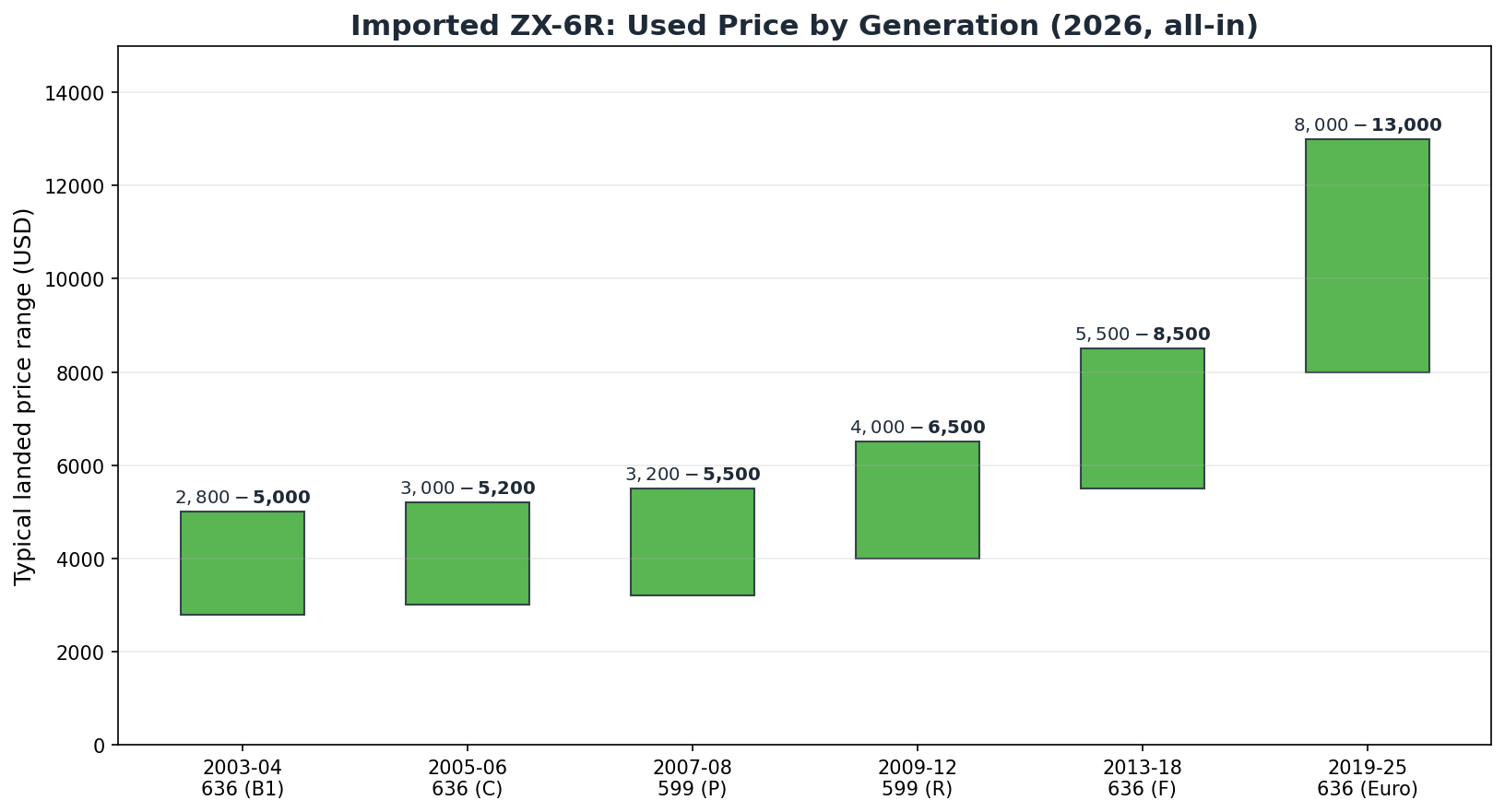
The early 636s (2003–2006) are the bargain hunter's pick — characterful bikes that land for the price of a tired local 300. The 2009–2012 599 is the value-conscious choice for someone who wants a polished, modern-feeling supersport. The 2013–2018 636 is the sweet spot where electronics, usability, and price meet, and it's where we'd point most buyers. The 2019–2025 bikes cost real money but deliver a near-new motorcycle.
One thing the chart makes obvious: the jump to the newest generation is steep. If your heart isn't set on LED lights and a quickshifter, the 2013–2018 636 gives you 90% of the experience for a lot less. The smart import play is to buy the best-condition older 636 you can find rather than the cheapest newest one.
ZX-6R vs R6 vs CBR600RR vs GSX-R600: How It Stacks Up
Every 600 buyer eventually lines up the big four. Here's the honest comparison, rider-weighted for people who actually ride on the road rather than just chase lap times.
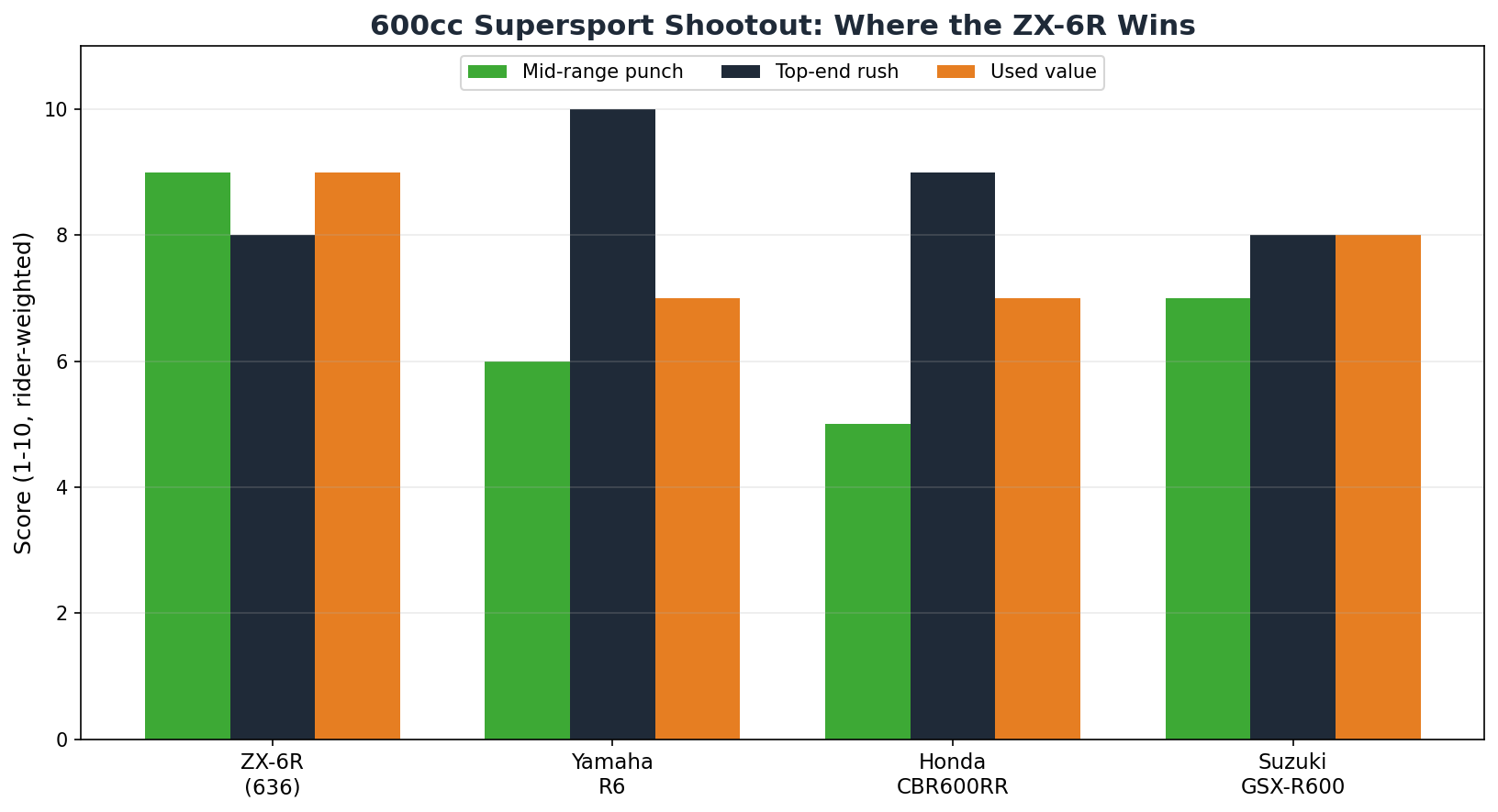
The Yamaha R6 is the screamer — unbeatable top-end rush and the racer's darling, but peaky and now expensive because it's a future classic. The Honda CBR600RR is the polished all-rounder, beautifully built but conservative. The Suzuki GSX-R600 is the value pick with a friendly chassis. The ZX-6R 636 wins on mid-range punch and everyday value, which is exactly why so many cross-shoppers end up choosing it. As one comment under a "So you want a ZX-6R" video put it bluntly: "everybody knows it's the best bike in class — and now with the best price."
If you want the purest track tool, the R6 has an edge. If you want the bike you'll actually enjoy commuting, carving back roads, and occasionally tracking, the 636 is the pick. That versatility is the whole point of the ZX-6R.
Who Should Buy a ZX-6R — and Who Should Walk Away
Buy a ZX-6R if you want one bike that does road and track, you value mid-range torque over peaky top-end, you're stepping up from a smaller bike and want something fast but composed, or you simply want the most usable 600 supersport for the money. The 636 in particular is forgiving enough to be a confident rider's first big bike.
Walk away if you need a comfortable long-distance tourer (the riding position is committed and your wrists will tell you so after 200 km), if you want a relaxed first-ever motorcycle with zero sportbike intent, or if you can't resist the temptation of a 16,000 rpm redline and you've got a heavy right wrist and a fresh licence. Be honest with yourself — a supersport rewards respect.
For everyone in the middle — the huge group of riders who want speed, character, and value — the ZX-6R is one of the easiest motorcycles in the world to recommend.
How to Import a Kawasaki ZX-6R From Japan, Step by Step
The process sounds intimidating until you've seen it laid out. Here's exactly how it works, start to finish.
Step 1 — Decide your spec. Pick your generation (636 vs 599), year range, and budget using the maps above. Knowing what you want makes the auction hunt fast.
Step 2 — Work with an import agent. You can't bid in Japanese auctions directly as a foreign private buyer — you go through an agent with auction access. The agent bids on your behalf, handles export paperwork, and arranges shipping. Get in touch with the AWA team to set this up.
Step 3 — Hunt the auctions. Your agent searches the big auction networks (USS, BDS, and others) for ZX-6Rs matching your spec. You'll get listings with photos and the all-important inspection sheet.
Step 4 — Read the sheet and set a max bid. Check the grade and the condition diagram. Decide your absolute maximum and let the agent bid. Don't get auction fever — there's always another one next week.
Step 5 — Win and pay. Once you win, you pay the hammer price plus the agent fee. The bike moves to the export yard.
Step 6 — Export and ship. The agent handles de-registration and export documents, then books freight — RoRo (roll-on/roll-off) or container. A crate of bikes from Japan, as one famous YouTube importer showed his 18-million-view audience, is genuinely how a lot of these move.
Step 7 — Clear customs at home. Pay your duty and tax, complete any compliance steps your country requires, and collect the bike.
Step 8 — Register and ride. Title it, insure it, and you're done. Total timeline is usually six to ten weeks from winning the auction.
Pre-Purchase Inspection Checklist for an Imported ZX-6R
Even with a good auction sheet, run through this checklist with your agent before you commit. Ask for clear photos or a start-up video covering each point.
Frame and subframe: straight, no welds, no overspray hiding repairs. Stunt and crash bikes show damage here first.
Fairings and bar ends: scuffs, replaced panels, or ground-down ends hint at a drop or a stunter's bike.
Fork seals and stanchions: no weeping oil, no pitting on the chrome.
Cold start: a healthy cold start with no excessive smoke. Blue smoke means oil burning; white means coolant. This is where a start-up video earns its keep.
Cam chain noise: listen for a rattle that doesn't settle as it warms.
Chain and sprockets: a worn chain and hooked sprockets mean a hard, neglected life.
Tyres and DOT codes: check the manufacture date; ancient tyres need immediate replacement.
Documents and VIN: the frame VIN must match the export paperwork. No exceptions.
Electrics: given the reg/rec history, confirm everything powers up and the battery isn't freshly hiding a charging fault.
Country-by-Country ZX-6R Import Rules
The mechanics of importing are the same everywhere; the rules are not. Here's the short version for the main English-speaking destinations. Always confirm current requirements with your national authority before you bid.
United States. The big one is the 25-year rule. A motorcycle 25 or more years old can be imported far more freely as it's exempt from many modern compliance requirements — which, as one importer's audience realised on camera, is why the late-'90s and early-2000s bikes flow so easily. A newer ZX-6R can still be imported but faces EPA and DOT compliance hurdles, so most US buyers either chase the 25-year-exempt early bikes or work with a registered importer. Check current rules with the NHTSA importing guidance.
United Kingdom. Expect 20% VAT plus duty on the landed value, then an IVA or registration process to get a UK plate. The UK is a high-tax destination, which is why your all-in number sits near the top of the range — but the choice and condition of Japanese bikes still make it worthwhile. Confirm via the UK government import guidance.
Australia. Australia runs an import-approval scheme and is strict on compliance, with the SEVS pathway and age-based options. Right-hand-drive isn't an issue for bikes, of course. Budget for GST, duty, and compliance, and get your approval sorted before the bike ships.
New Zealand. Generally one of the friendlier markets for Japanese imports, with a well-established used-import pipeline and a compliance/certification step on arrival. Many NZ riders import precisely because the local market is full of ex-Japan bikes already.
Canada. Canada also has a 15-year rule that makes older bikes straightforward, with newer machines facing more compliance. Check the Registrar of Imported Vehicles requirements before committing.
One universal tip: the right-hand-drive joke ("the problem with buying bikes from Japan is that they're right-hand drive") that racked up over 7,000 likes on a viral import video is exactly that — a joke. Motorcycles have no steering wheel, so JDM bikes are completely at home on any road.
Owning and Maintaining an Imported ZX-6R
The good news is that a ZX-6R is cheap to live with by supersport standards. Parts are plentiful and shared across years, the engines are durable, and the service intervals are sane. Budget for regular chain care, oil and filter changes, brake pads, tyres (a sporty 600 eats rear tyres if you ride it hard), and a valve clearance check at the recommended interval.
A JDM bike may arrive with a speedo in km/h, which is fine in metric countries and a quick swap or conversion in the US and UK. Service manuals and parts cross-reference easily because the ZX-6R was sold worldwide. The aftermarket is enormous — exhausts, rearsets, levers, and electronics are all a search away, and because the bike sold globally, nothing is exotic or hard to source.
Realistically, annual running costs for a ZX-6R ridden for fun come down to insurance (the biggest variable, and higher for younger riders), fuel, consumables, and one main service. Keep on top of the chain and the reg/rec, ride it like you respect the redline, and a clean imported 636 will give you years of grins. When you're ready to find one, start with the current AWA listings.
What ZX-6R Owners Actually Say After a Year
The best research isn't a spec sheet — it's what owners say once the honeymoon ends. Across the big review channels and their comment sections, the pattern is striking. "It's been four months with my ZX-6R and it never stops surprising me with its power." "I daily an '03 636, I love it." "Owned my 2022 KRT for a week, already hit 700 miles. It's addictive."
The negatives are honest and small: the riding position bites on long rides, insurance can sting younger riders, and the reg/rec is the one component people learn to watch. Nobody complains the bike is slow, fragile, or boring. The recurring theme is value — riders who cross-shopped a GSX-R or R6 and chose the Kawasaki keep saying they'd do it again.
That's the real argument for importing one from Japan. You're not gambling on a hyped bike that disappoints. You're buying a known quantity that owners adore, in the best condition available anywhere, for a price that often undercuts your local market. The ZX-6R earned its reputation the hard way — on track, on the road, and in garages full of happy owners. Import a clean Japanese 636 and you join that group on day one, with a bike that cost you less and arrived in better shape than almost anything you'd find waiting in a local showroom or classified ad.
Special Editions and Colours Worth Hunting at Auction
Part of the fun of importing from Japan is access to colours and trims that never reached your local dealer. The ZX-6R has had some genuinely desirable special editions, and snagging one at a Japanese auction is often the only realistic way to get it.
The KRT (Kawasaki Racing Team) replica livery is the icon — that lime-green-and-black World Superbike look that defines the modern ZX-6R. It's common on 2019-onward bikes and holds value well because it's what buyers picture when they think "Ninja." Earlier bikes had their own gems: the Lime Green launch colours of the first 636, special anniversary schemes, and Japan-only paint combinations that simply weren't offered in the West.
One owner of a 2017 "racing edition" 636 summed up the appeal in a review comment with strong support: "I love this bike so much and would recommend a 636 to anyone." Colour won't change how the bike rides, but it changes how it makes you feel every time you walk into the garage — and on a future sale, a clean, original-paint special edition is easier to move. If you have a specific colourway in mind, that's exactly the kind of brief a good import agent can hunt for over several weeks of auctions.
Buying a Modified ZX-6R: Bargain or Booby Trap?
A huge share of used ZX-6Rs have been modified, because the aftermarket for this bike is enormous and owners love to fettle. Aftermarket exhausts, frame sliders, tail tidies, rearsets, levers, and ECU flashes are everywhere. The question is whether a modified bike is a smart buy or a trap.
The honest answer: it depends on the mods and the documentation. Tasteful, quality modifications from known brands — a full Akrapovic system, adjustable rearsets, a flashed ECU to match the exhaust — can represent thousands of dollars of kit you're getting for little extra. That's a genuine bargain if the work was done properly.
The trap is the bike modified to hide its history. Frame sliders and replacement fairings can mean a careful owner who protected the bike — or a crashed bike dressed up to look clean. Stunt-bike telltales (a 12-o'clock bar, scarred subframe, ground-down pegs, a worn rear and pristine front tyre) are a hard no. And a cheap, badly fitted exhaust with no matching tune can mean a bike that runs lean and hot.
Here's the rule: buy a modified ZX-6R only if you can see what was changed, the work looks professional, and the underlying bike checks out on the auction sheet. If you want a clean, original example to build yourself, say so up front — Japan has plenty of stock, low-mileage bikes precisely because so many Japanese owners leave them factory-standard. Either way, talk through your preferences with the team before bidding so you don't end up with someone else's project.
Why the ZX-6R Became a Supersport Legend
You can't understand why these bikes are so good — and so plentiful in Japan — without the racing story. The ZX-6R was built, generation after generation, to win the 600 Supersport class, and Kawasaki took that mission seriously. That's literally why the 599cc versions exist: to fit the racing rulebook so the factory could compete.
Decades of Supersport development trickled straight into the road bikes. The chassis geometry, the brake packages, the engine tuning, and later the electronics were all sharpened by people trying to shave tenths off a lap time. When you ride a ZX-6R, you're riding the road-legal version of a championship project. That heritage is why even the everyday 636, tuned for torque, still feels razor-sharp when you push it.
It also explains the depth of the used market. Japan's domestic racing and track-day culture is huge, and the ZX-6R was a default choice for club racers and fast-road riders alike. That means a deep, well-maintained pool of bikes, plenty of low-mileage road examples from owners who kept a separate track bike, and a parts ecosystem that never dries up. The reviewer whose ZX-6R history segment was praised as "mind-boggling" wasn't exaggerating — there's more development baked into this bike than its modest price suggests. Importing one from Japan is the closest most of us will get to owning a piece of that racing lineage without the racing budget.
Your ZX-6R Import Timeline: From Auction Win to First Ride
People underestimate how predictable the timeline is once you've committed. Here's roughly how the weeks play out so you can plan around it instead of refreshing a tracking page in a panic.
Weeks 1–2: the hunt and the win. Your agent watches the auctions for a ZX-6R matching your spec. Auctions run weekly, so depending on how specific your brief is, you either win the first suitable bike fast or wait a couple of rounds for the right colour, year, and grade. Patience here pays off — bidding on the wrong bike to "get it done" is the most expensive mistake you can make.
Weeks 2–4: export prep. Once you've won, the bike moves to the export yard. De-registration, export certificates, and any pre-shipping cleaning or crating happen here. This is also when you settle the hammer price and fees.
Weeks 3–7: ocean freight. Sailing time depends on your destination. The US west coast and Australia are closer; the UK and Europe are a longer haul. RoRo is usually cheaper and quicker to load; a shared container offers more protection. Your agent will advise which suits a single bike.
Weeks 6–9: customs and compliance. On arrival, you pay duty and tax and complete your country's compliance steps — an IVA in the UK, the import-approval and compliance process in Australia, certification in New Zealand, and so on. This stage varies most by country, so line up the paperwork early.
Weeks 8–10: register and ride. Title, plate, insure, and you're rolling. Most ZX-6R imports land in the six-to-ten-week window from auction win to first ride. Knowing that lets you time things like selling your current bike or booking a track day.
How AWA Auction Makes Importing a ZX-6R Simple
Here's where importing stops being scary. The reason most people never buy from Japan isn't cost — it's that they don't have auction access, can't read the sheets, and don't want to wrestle with export paperwork and freight in a language they don't speak. That's the entire gap an import partner fills.
AWA Auction gives you access to the same Japanese auction networks the trade uses, translates and interprets the inspection sheets so you actually understand what you're bidding on, sets bids on your behalf to a limit you control, and handles export, freight, and documentation end to end. You get the choice and condition of the Japanese market without needing to fly to Tokyo or trust a stranger's blurry photos.
The practical workflow is simple. Tell the team the ZX-6R you want — generation, year range, colour, budget, and condition standard. They watch the auctions, send you candidates with sheets and photos, and you approve a maximum bid. When you win, they take it from there. You can browse current listings to see what's available right now, or contact the team to set up a search for your ideal ZX-6R. For a bike this good, in a market this deep, it's the most sensible way to buy one — and it's how a lot of the cleanest 636s in the West got there in the first place.
Frequently Asked Questions
Quick answers to the questions ZX-6R importers ask most.
See Also
Share this article: