
A Suzuki Bandit import from Japan is the cheapest way into a four-cylinder motorcycle that still feels special. The Bandit is the bike that took a proper inline-four engine, wrapped it in honest standard-bike clothing, and sold it for the price of a worn-out scooter. And here is the part the glossy magazines forget: the very best Bandits, the rev-happy quarter-litre and 400 inline-fours that the rest of the world never officially got, were built in Japan, sold in Japan, and are sitting in Japanese auction halls this week.
You want one of those. Not a tired UK GSF600 that has been dropped, restored on a budget, and ridden through ten salty winters. You want a Japanese-market bike that has lived its whole life under Japan's brutal shaken inspection regime, been ridden gently, and stored indoors. To get that, you import it. From the place it came from.
This guide covers every Bandit worth buying, what one actually costs landed in your garage, how the Japanese auction system works, the Bandit-specific traps hiding on the inspection sheet, and the import rules for the UK, US, Australia and New Zealand. No recycled spec-sheet padding. Just what a sharp buyer needs to bring a great Bandit home.
Why import a Suzuki Bandit from Japan (and which one you actually want)
The Bandit has a split personality, and that split runs straight down a map line drawn at the edge of Japan.
Outside Japan, "Bandit" means the GSF600 and GSF1200 — big, air and oil-cooled standards with detuned superbike engines, sold everywhere from Bristol to Brisbane. Inside Japan, the name first meant something very different: the GSF250 and GSF400, tiny liquid-cooled inline-fours that scream past 14,000 rpm and sound like a Grand Prix bike that shrank in the wash. Those small Bandits were built for Japan's licensing tiers and were never sold new in the UK, US, Australia or most of Europe.
So the question "which Bandit should I import?" really splits in two. If you want a usable, torquey, do-everything bike for not much money, the 600 and 1200 are the answer — and importing a clean Japanese one beats buying a thrashed local example. If you want something nobody on your street has, a screaming JDM four that turns heads at every bike night, the 250 and 400 are the prize, and Japan is the only realistic place on Earth to find a good one.
Here's the thing nobody tells you: in Japan, these small fours are almost disposable. One Indonesian test-ride video of a GSF400 racked up over 1.3 million views with a title that translates roughly to "a four-cylinder big bike for only 30 million rupiah?!" — because that is genuinely the reaction. A four-cylinder motorcycle for the price of a 125 commuter sounds like a typo. It is not. Japan is awash with them, and a sharp importer turns that surplus into your garage.
The reason is supply. Japan made these bikes by the hundred-thousand for a domestic market that prized small-displacement performance. As Japanese riders moved on, the survivors piled up — well-kept, low-mileage, and cheap because demand at home softened. The rest of the world, meanwhile, has almost none. That mismatch is the entire opportunity. You are buying out of a deep, clean pool and selling yourself into a market where the bike is a unicorn.
There's a quieter reason to buy now rather than later. The JDM-only fours are on a one-way clock: Japan stopped building them decades ago, every year thins the survivor pool a little more, and Western interest in 1990s Japanese machinery is climbing fast. The CB400 has already started to appreciate; the Bandit 400 is following a step behind. A clean import today is not just a fun bike — it's a 1990s engineering oddity bought near the bottom of its value curve. You rarely get to ride your appreciating asset to the shops, but a Bandit lets you.
And let's kill one myth early. People assume importing is a fraught, customs-officer-shouting, paperwork-nightmare experience. It isn't, not when a proper exporter handles the Japan end and you understand your own country's rules. Tens of thousands of bikes leave Japan this way every year. The process is boring and well-worn, which is exactly what you want when there's a motorcycle and four figures of your money riding on it.
The Bandit family explained: GSF250, GSF400, 600, 650 and 1200
Before you bid on anything, you need to know exactly what each Bandit is, because the badge hides four very different motorcycles.
GSF250 Bandit (1989–2000) — the screaming quarter-litre
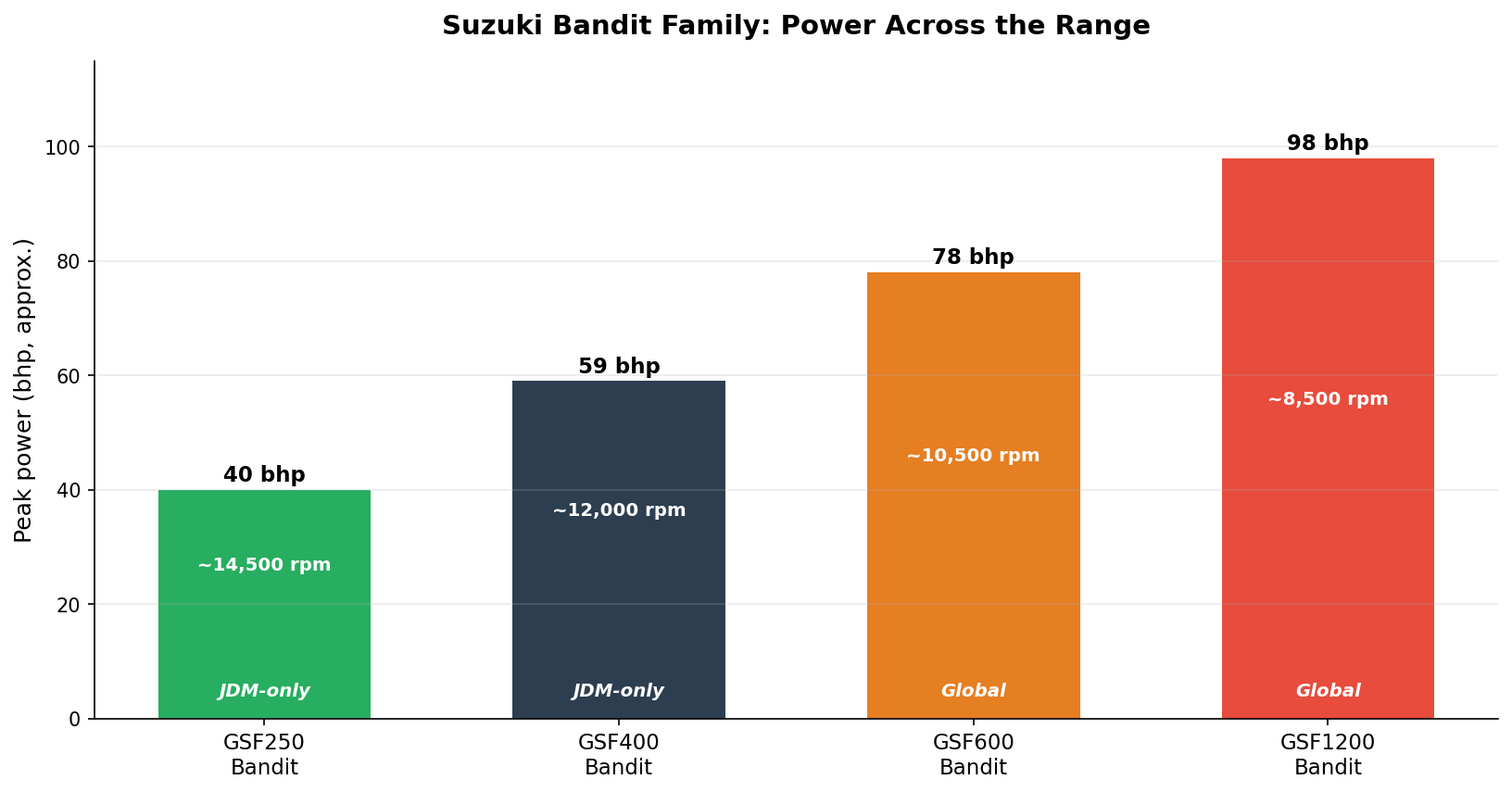
The GSF250 is a 248cc liquid-cooled inline-four that makes around 40 bhp and revs to roughly 14,500 rpm. Read that again: a 250 with four cylinders that spins past fourteen-five. It is a JDM-only oddity built for Japan's old 250cc licence and tax bracket, and it is one of the smallest production inline-fours ever made. Suzuki even built a Bandit 250V with variable valve timing to wring more midrange out of the tiny engine. Outside Japan, almost nobody got these new. Import is the only sensible route.
GSF400 Bandit (1989–1997) — the sweet spot
The GSF400 (GSF400V from 1991) is the one most importers chase. It is a 398cc liquid-cooled inline-four producing about 58–59 bhp at 12,000 rpm, hung in a pretty steel trellis frame, weighing roughly 393 lb dry. It pulls hard, sounds glorious, and is small enough to flick through traffic yet quick enough to embarrass much bigger bikes on a twisty road. The 400V added variable valve timing to fatten up the midrange. This is the JDM Bandit that earned a cult following.
GSF600 / GSF650 Bandit (1995 onward) — the global workhorse
The 600 is where the Bandit went worldwide. An air and oil-cooled 599cc four, derived from an older GSX-R engine and detuned for real-world riding, it makes around 78 bhp and just works. Cheap, tough, easy to fix, and endlessly customisable into cafe racers and streetfighters. The later GSF650 added fuel injection and, eventually, liquid cooling. These sold in the UK and Australia in big numbers, which is exactly why a rust-free Japanese one is worth importing over a tired local bike.
GSF1200 Bandit (1996–2006) — the muscle standard
The 1200 is the hooligan. An air and oil-cooled 1157cc four making roughly 98–100 bhp with a fat slug of torque everywhere, it is the bike that built the Bandit's "cheap thrills" reputation. It wheelies on a whiff of throttle and costs peanuts to run. The catch, as we'll cover, is that plenty have been ridden hard and ignored — another reason a gently-used Japanese example is gold.
So which Bandit should you import?
Strip away the romance and it comes down to four honest recommendations. If you want the rarest, most head-turning import and you love revs, the GSF400 is the bike — it's the cult JDM four with the best balance of usability and exclusivity. If you want maximum oddity and don't mind a peakier engine, the GSF250 is the conversation-starter nobody has seen. If you want a do-everything bike you'll ride hard year-round for little money, the GSF600 or GSF650 is unbeatable value, and a clean Japanese one shames the rusty local examples. And if you want cheap, torquey thrills and the occasional accidental wheelie, the GSF1200 delivers more grin-per-pound than almost anything. There's no wrong answer here, only the right one for how you actually ride.
The JDM secret: the 250 and 400 inline-fours nobody outside Japan got
This is the section the competition does not write, because the competition mostly sells you the 600 and 1200. The real story — and the real reason to import — lives in the small bikes.
In the late 1980s and 1990s, Japan's motorcycle market was shaped by its licensing and tax system. A 250 escaped the mandatory shaken roadworthiness inspection that bigger bikes faced, and a 400 was the ceiling for the most common "mid-size" licence. So the manufacturers fought a horsepower war inside those tiny displacement classes, cramming four cylinders and ever-higher redlines into engines that, in any other country, would have had two cylinders at most. The GSF250 and GSF400 Bandit were Suzuki's entries in that war.
The result is a motorcycle experience you simply cannot buy new anywhere today. A modern 400 is a thumpy single or a friendly twin. A GSF400 is a miniature superbike that needs revs to come alive and rewards them with a wail no twin can match. That CB400 vs Bandit 400 rivalry is so alive in Japan that a single comparison video has pulled over 420,000 views, with owners arguing the toss in the comments. That is the kind of passion you are buying into — and it does not exist for these bikes in the West, because the West never got them.
There's a practical edge to the JDM angle too. Because Japan never needed to federalise or homologate these bikes for export, build quality and originality on home-market examples is often superb. Bikes were serviced by the book to pass shaken, ridden in a culture that frowns on neglect, and frequently stored away rather than scrapped. When you go looking for a JDM Bandit to import, you are fishing in the original, deepest pool of survivors on the planet. Every other market is buying scraps; you are buying from the source.
One warning that comes straight from the home market: these small fours hate sitting. Their banks of tiny carburettors gum up fast when a bike is parked for a season. A Spanish restorer's video of a Bandit bought at auction for €220 and brought back to life has over 600,000 views precisely because the "ran when parked" auction bike is a known quantity. We'll turn that into a checklist below — but file it now: a cheap, neglected JDM four is cheap for a reason, and the reason is usually fuel system.
It's worth understanding why these engines exist at all, because it tells you what they're like to live with. Japan's licence tiers and the bias toward small-displacement bikes meant manufacturers couldn't just sell more cubic capacity — they had to sell excitement inside a tiny box. The arms race that followed gave the world the most over-engineered 250s and 400s ever built: four cylinders, sixteen valves, gear-driven everything, redlines that read like a car's tachometer fell over. A GSF400 makes nearly 60 bhp from less than half a litre. That figure was witchcraft in 1990 and it's still impressive now. You are importing a piece of a very specific moment in motorcycling history, one that economics will never repeat.
What a Suzuki Bandit really costs landed from Japan
Let's talk money, because this is where the Bandit shines and where bad guides wave their hands. The numbers below are a realistic worked example for a clean GSF400 imported to the UK in 2026. Yours will shift with exchange rates, the exact model, and your shipping choice, but the shape holds.
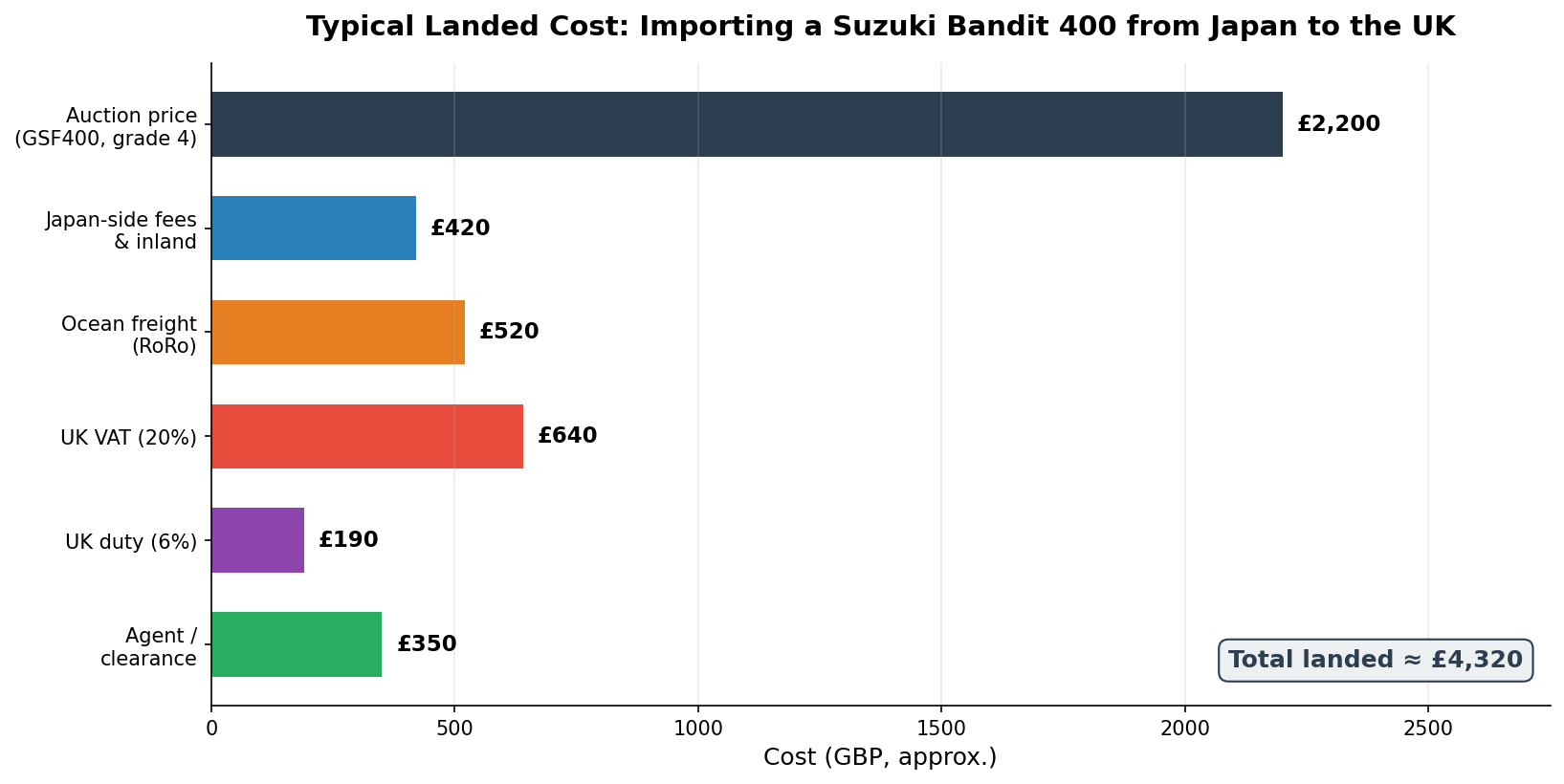
The auction hammer price on a tidy GSF400 sits low — often around £1,800 to £2,600 for a grade 4 bike — because Japan has so many. On top of that you stack Japan-side costs (auction fees, the exporter's commission, inland transport to the port, export paperwork and deregistration), then ocean freight, then your own country's tax and clearance at the other end.
For the UK, motorcycles attract import VAT at 20% and a duty of around 6% on the bike's value plus freight. Add an agent or customs broker to handle clearance, and a clean GSF400 lands in your garage for somewhere around £4,000 to £4,800 all-in. For a 250, knock a little off the bike price. For a 1200, the hammer price is higher but the percentages are identical.
Now compare that to reality. A scruffy GSF400 already in the UK — and there are very few — trades for whatever the seller fancies, because there is no supply to anchor the price. You're often paying import money for a worse bike with no history. Importing a clean one yourself isn't the expensive option; it's frequently the cheap one, and you get to pick the exact bike instead of taking what the one local seller happens to have.
Two money tips. First, shipping method matters: RoRo (roll-on, roll-off) is the cheapest and simplest for a single bike, while a shared container costs more but protects the bike better and lets you ship parts alongside it. Second, watch the exchange rate — on a sub-£3,000 bike, a swing in the yen can move your landed cost by a couple of hundred pounds, so time your transfer if you can.
Budget for the costs that hit after the bike arrives, because they're the ones that ambush first-timers. A 25 to 30-year-old import will want fresh tyres, new fluids all round, a battery, and very probably a carburettor clean. Call it a few hundred pounds or dollars of recommissioning before the bike is genuinely sorted. None of it is scary, but pretending the landed price is the final price is how people end up disappointed. Price the bike as "landed plus a first-month service" and you'll be delighted instead.
One more honest note on grades and money. It's tempting to chase the cheapest grade-3.5 lot to save a few hundred, but on a bike crossing an ocean, the cheap purchase is a false economy if it arrives needing work you can't easily do. Paying a bit more for a grade 4 or 4.5 Bandit with clean inspector notes is almost always the smarter spend — the shipping cost is identical whether the bike is good or rough, so you may as well ship a good one.
How the Japanese auction process works for a Bandit
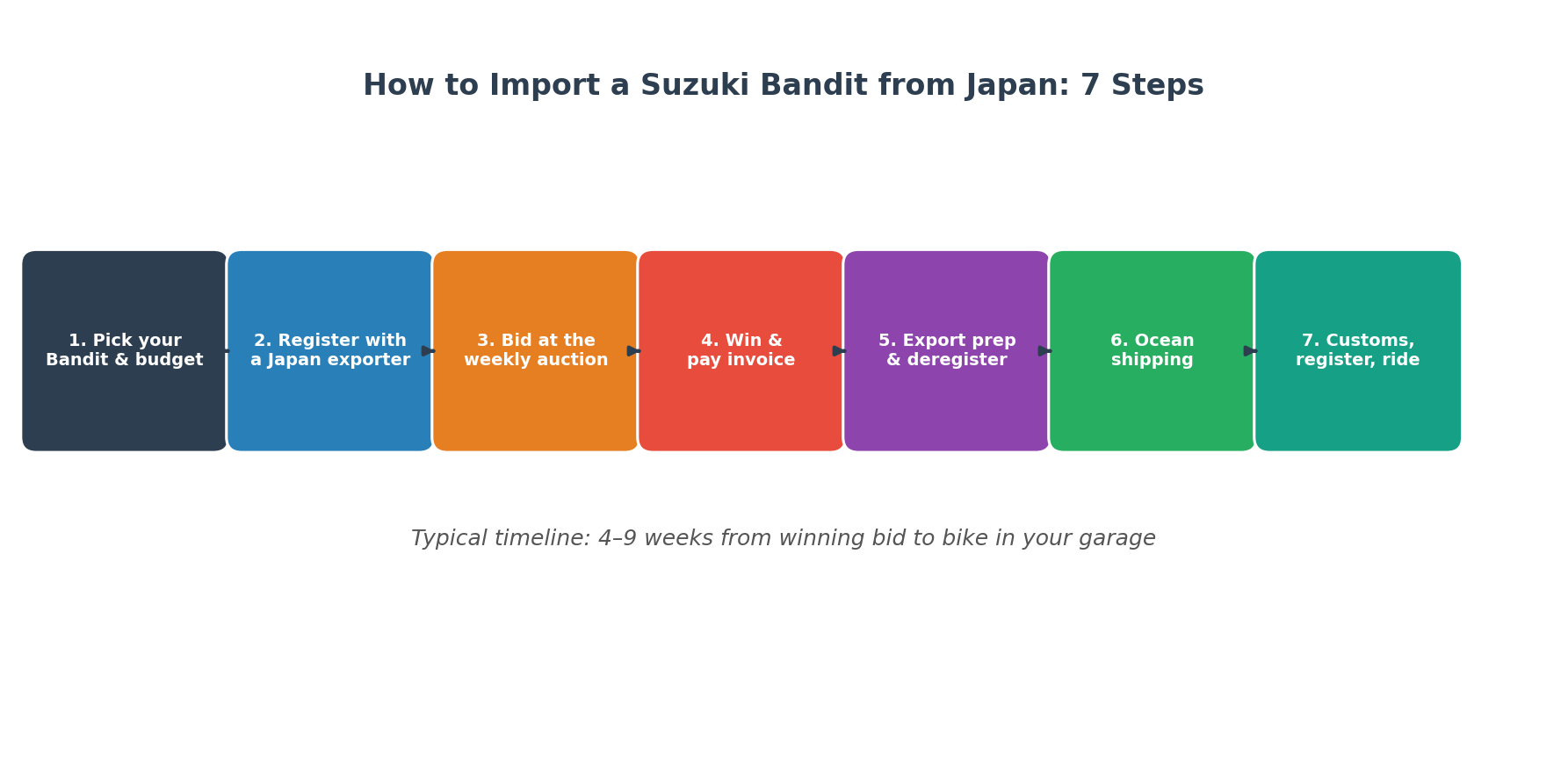
You cannot walk into a Japanese motorcycle auction yourself. They are trade-only, members-only, and run entirely in Japanese at a pace that would leave a tourist standing. That is not a problem — it is why exporters exist. Here is the whole journey, start to finish.
Step 1 — Decide your Bandit and your ceiling
Pick the model (250, 400, 600 or 1200), the condition grade you'll accept, and the absolute maximum you'll pay landed. Write the landed number down and work backwards to a hammer-price limit. Discipline here is everything; auctions are designed to make you spend an extra notch.
Step 2 — Register with an exporter you trust
You sign up with a licensed Japanese exporter (this is where AWA comes in) who has membership at the auction houses. You'll usually pay a refundable deposit that sets your bidding limit. This is also your translation and inspection layer — the people reading the auction sheet so you don't have to.
Step 3 — Bid at the weekly auction
Japanese bike auctions run weekly, listing thousands of machines. Your exporter places bids on your behalf up to your limit. Most lots sell in seconds. You won't win the first one you like, and that's fine — Bandits come through constantly, so patience is cheaper than overbidding.
Step 4 — Win and settle the invoice
Win a bid and you pay the hammer price plus the Japan-side fees. Your exporter collects the bike from the auction yard and takes it to their yard for export prep.
Step 5 — Export prep and deregistration
The bike is deregistered from the Japanese system, the export certificate is issued, and the machine is cleaned and crated or prepped for RoRo. Ask for fresh photos at this stage — it's your last look before it sails.
Step 6 — Ocean shipping
The bike sails. To the UK that's roughly five to eight weeks; to Australia or New Zealand it can be quicker. You'll get a bill of lading and a tracking reference.
Step 7 — Customs, registration, ride
At your end the bike clears customs (you or your broker pay the VAT and duty), then you register it for the road. In the UK that means the DVLA and a NOVA notification; elsewhere it varies, which we'll cover next. Then you ride.
Start to finish, budget four to nine weeks from winning bid to bike in your garage. The single biggest variable is shipping schedule, not paperwork.
A word on the emotional side of bidding, because it costs people real money. Japanese auctions move fast and list constantly, which means the bike you "had to have" will be replaced by an equally good one next week, and the week after. Set your landed ceiling, hand it to your exporter, and let lots you lose simply go. The importer who wins is the one who treats every auction as the first of many, not the last chance on Earth. Bandits are common in Japan; that abundance is your negotiating power, so use it by being willing to walk away.
Reading the auction sheet: Bandit-specific red flags
Every Japanese auction bike comes with an inspection sheet — a one-page report from an independent auction inspector grading the machine and marking damage on a diagram. Learning to read it is the difference between a great import and an expensive mistake. We have a full guide to reading Japanese auction inspection sheets, but here are the Bandit-specific things to hunt for.
Overall grade. Bikes are graded roughly 1 to 6 (plus R for repaired and S for new). For a Bandit you want grade 4 or better. Grade 3.5 can be fine on a cheap project, but below that you're gambling. The grade is the headline; the diagram and notes are the real story.
Carburettor and starting notes. This is the big one on the small fours. Japanese inspectors note hard starting, rough idle, and uneven running, all of which point at gummed carbs on a bike that has been sitting. On a GSF250 or GSF400, four tiny carburettors that haven't run in months are almost a given on a cheap lot. It's usually fixable, but factor a carb clean and possibly a rebuild kit into your budget if the sheet hints at fuelling trouble.
The '92 GSF400 CDI gremlin. Here's one straight from the owner forums that no spec sheet will warn you about: the ignition CDI units on certain early-1990s GSF400s are known to fail, causing misfires or a no-start. If you're chasing a 400 of that era, treat a running, well-starting bike as worth a premium, and know that a dead CDI is a known and sourceable fault rather than a mystery.
Cam chain tensioner rattle. A mechanical clatter from the top end on these fours often points to a worn cam chain tensioner. Inspectors sometimes note engine noise; if they do, ask your exporter to listen and report. It's a cheap part but a tell-tale of a hard or neglected life.
Corrosion and the frame. The trellis frame on a 400 and the paint on any Bandit show their life. Check the diagram for corrosion (often marked with specific symbols), and pay attention to the engine cases and fasteners — furry alloy means damp storage. A Japanese bike should be cleaner than a Western one; if it isn't, ask why.
Mileage and the odometer mark. Many Bandits show genuinely low mileage, but always cross-check the odometer reading against the wear on the grips, pegs and seat in the photos. The sheet records the reading; your eyes confirm whether it's believable.
Why Japanese bikes read so well. It helps to understand the culture behind the sheet. Japan's shaken inspection system makes owning an older vehicle progressively more expensive, which pushes people to either maintain bikes meticulously or move them on while they're still good. Combine that with a riding culture that prizes cleanliness and a climate that, away from the coast, is kinder than a British winter, and you get a national fleet that is, on average, in dramatically better order than its Western equivalent. The auction sheet is the formal proof of that — an independent, standardised, hard-to-fake snapshot of condition that simply doesn't exist when you're buying a bike off a driveway at home. Learning to read it isn't bureaucracy; it's the single biggest advantage importing gives you over buying locally blind.
Bandit 400 vs Honda CB400 Super Four: the JDM showdown
If you're importing a JDM four, you will eventually face the great Japanese standard-bike question: Bandit 400 or CB400 Super Four? It's the rivalry that fills Japanese forums and YouTube comment sections, and the honest answer is that they're aimed at slightly different riders.
The Honda CB400 Super Four is the sensible, polished choice. Smoother, more refined, with Honda's legendary build quality and that clever VTEC valve system on later bikes. It's the one your head picks. It's also more expensive and more sought-after in Japan, so you'll pay more to import one.
The Suzuki GSF400 Bandit is the cheaper, rawer, slightly madder option. It feels lighter and more eager, the trellis frame gives it a sportier character, and crucially it costs less at auction because Japan rates the CB400 more highly. For an importer, that price gap is real money — you can land a clean Bandit 400 for noticeably less than an equivalent CB400SF.
Here's the take you won't get from a brand-loyal forum: for a Western rider who never grew up with either bike, the Bandit is the smarter import. You get 90% of the experience, the same head-turning four-cylinder wail, and the same JDM exclusivity, for meaningfully less money. The CB400 is the better bike on paper; the Bandit is the better deal. And since nobody in your country has either, the badge bragging rights are identical.
That said, if originality and resale matter most to you, the CB400 holds value better worldwide. Buy the Bandit to ride and grin; buy the CB400 to ride and one day sell on at less of a loss. Either way, importing a clean Japanese example beats hunting for the handful that trickled into your country grey-market years ago.
Common Suzuki Bandit problems and what nobody tells you
No bike is perfect, and a Bandit that's travelled across an ocean deserves a clear-eyed list of what to watch. None of these are deal-breakers — they're the things that separate a smart buyer from a hopeful one.
Carburettors, again. It's worth repeating because it's the number-one Bandit issue across the whole range. The small fours have four tiny carbs that gum up if the bike sits; the 1200 and 600 have larger carbs that suffer fuel overflow when the float needle and seat wear on a bike that's been parked. Symptoms: a fuel smell, a wet patch under the carbs, hard starting, and idle that surges or won't settle. The fix is a clean and sometimes a rebuild kit. Budget for it on any cheap, sitting bike and you'll rarely be surprised.
GSF1200 oil burning. The big air-cooled four can develop piston ring wear that shows as oil consumption and a puff of smoke on a trailing throttle. A 1200 that smokes when you blip it after a coast-down deserves a closer look and a compression check. Many are fine; the ones that have been wheelied to within an inch of their life are not.
Charging and electrics. Like a lot of bikes from this era, the regulator/rectifier can run hot and fail, and connectors corrode. It's cheap to fix and easy to test — a charging-system check on arrival is money well spent.
Suspension and brakes that have aged, not failed. A 25 or 30-year-old Bandit will have tired fork seals, old brake fluid, and possibly original brake lines. None of that is a fault so much as a service list. Factor a fork-seal job, fresh fluids and braided lines into your "first month" budget and the bike will feel transformed.
Parts — easier than you'd fear. Here's the good news the doomsayers skip: because Japan built so many Bandits, and because Japanese parts suppliers ship worldwide, consumables and many service parts are readily available through Japanese exporters and specialists. Carb kits, gaskets, cables, brake parts — all sourceable. The genuinely rare items are model-specific bodywork and JDM-only trim, so buy a bike that's already complete and cosmetically sound rather than planning to restore one from boxes.
Chain, sprockets and the boring consumables. An imported bike that's been sitting in a Japanese yard often has an original, stretched chain with hooked sprocket teeth and rust between the links. It's a cheap fix but a non-negotiable one — a worn final drive ruins the way any Bandit rides and can be dangerous. Same goes for old rubber: tyres that look fine can be a decade old and hard as plastic. Treat chain, sprockets and tyres as automatic replacements on arrival and you'll never be caught out.
The headline, though, is that none of this list is unusual or alarming for a bike of this age and price. A Bandit is a simple, robust, air or oil-cooled (or, on the small fours, straightforward liquid-cooled) machine with no fragile electronics to baffle you. Everything that goes wrong is known, documented on enthusiast forums, and fixable with hand tools and patience. That mechanical honesty is a huge part of why the Bandit became a legend, and it's a real advantage when your bike has just crossed an ocean and you want to keep it running yourself.
Import rules by country: UK, US, Australia and New Zealand
Where you live decides which Bandits you can legally put on the road, so check this before you fall in love with a specific bike.
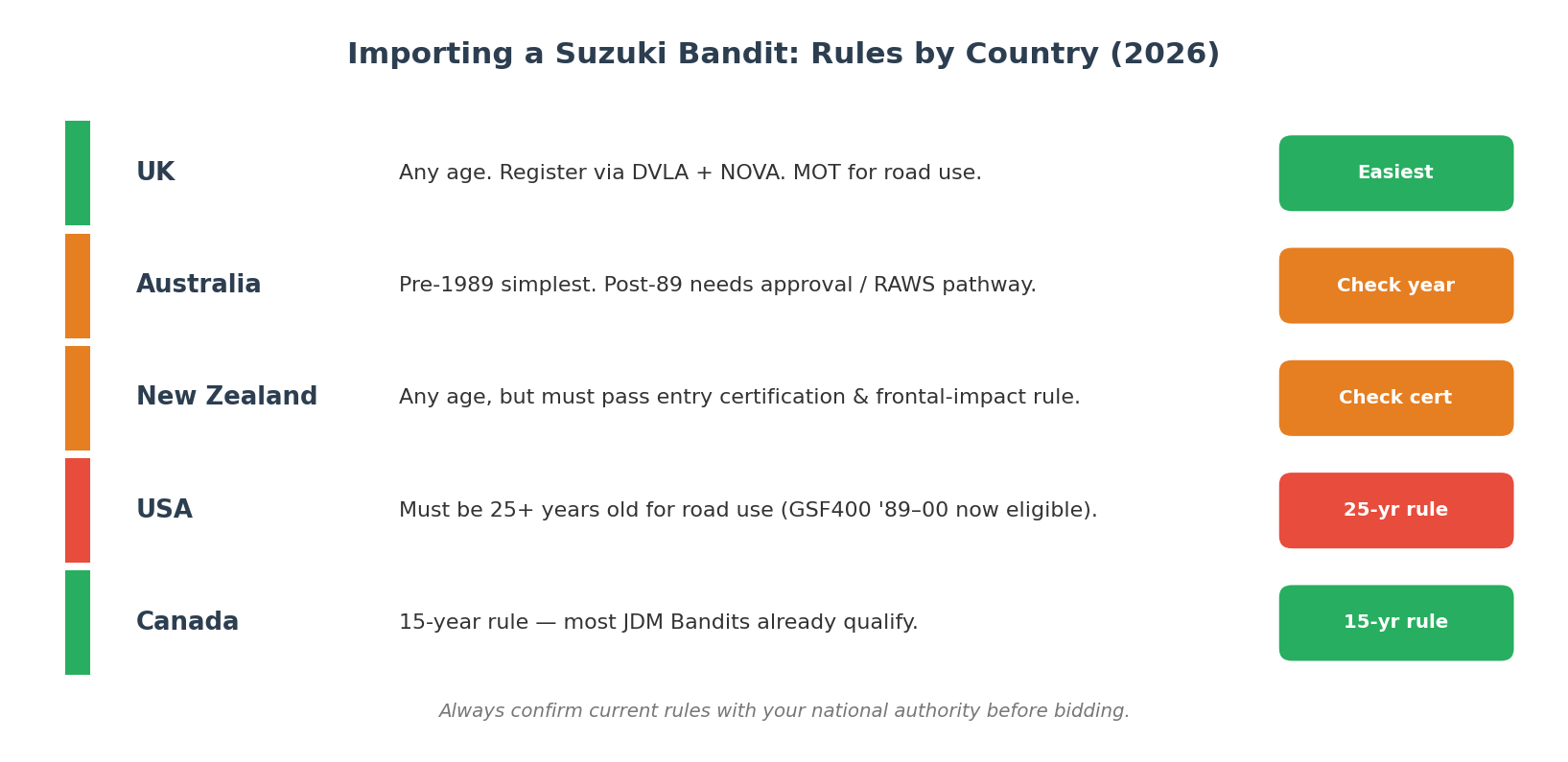
United Kingdom. The easiest market. There's no age bar — any Bandit can come in. You'll register through the DVLA, submit a NOVA (Notification of Vehicle Arrival) to HMRC so the VAT is recorded, get the bike an MOT, and you're road-legal. Older bikes are exempt from some requirements, which makes a 1990s Bandit refreshingly simple to put on a plate. See our UK motorcycle import duty and tax guide for the full process.
United States. The big one to understand is the 25-year rule. A motorcycle that is 25 or more years old can be imported and federally registered without meeting modern DOT and EPA standards. That's great news for Bandit buyers in 2026: GSF400s and GSF250s from 1989 through 2000 are now eligible, as are early 600s and 1200s. A bike newer than 25 years is far harder and usually not worth it for a road bike. Always confirm with US Customs and the NHTSA vehicle-import rules before you commit.
Australia. More involved. Bikes built before 1989 have the simplest pathway, while newer machines need to come in under an approved import scheme or the registered-automotive-workshop (RAWS) pathway, plus state registration and compliance. The exact rules shift, so check the current federal vehicle import requirements and your state's registration process before bidding.
New Zealand. No age bar, but every imported bike must pass entry certification, and there's a frontal-impact and structural rule that can catch some machines. Most clean, unmodified Bandits sail through, but use a compliance specialist and confirm before you buy.
Canada. Worth a mention because it's friendlier than the US: Canada uses a 15-year rule, so virtually every JDM Bandit already qualifies. That makes a Japanese-import Bandit a genuinely easy buy north of the border.
Rest of Europe. Most EU countries allow older-bike imports with a registration inspection and proof that VAT has been paid on entry, though the exact homologation paperwork varies by nation. Right-hand versus left-hand drive is irrelevant on a motorcycle, which removes one headache that car importers face, so a JDM Bandit is often easier to register than people assume.
Whatever your country, the golden rule is the same: confirm the current regulations with your national authority before you place a bid, not after the bike is on a ship. Rules change, and an exporter can only ship what you're allowed to receive.
How AWA Auction gets you a Suzuki Bandit from Japan
This is where the abstract becomes a bike in your garage. AWA Auction is a Japan-based export specialist with direct access to the country's motorcycle auctions — the trade-only halls you can't enter yourself.
We translate and interpret the auction sheets so the carb notes, the grade, and the damage diagram actually mean something to you. We bid to your limit and never over it. We handle the export paperwork, the deregistration, the port logistics and the shipping booking, and we keep you in photos at every stage. When the bike sails, you get the documents your customs authority needs to clear it cleanly.
Whether you're chasing a screaming GSF400 that nobody on your street has seen, a bargain GSF1200 to turn into a streetfighter, or a clean GSF600 to ride year-round, the pool is in Japan and the route runs through people who do this every week. You can browse current listings to see what's coming through the auctions right now, and if you have a specific Bandit in mind, contact our team and tell us the model, year and budget — we'll watch the auctions for it.
If you've never imported a bike before, the thing to hold onto is that you are not doing the hard part. The auction access, the language, the inspection-sheet reading, the export paperwork, the shipping booking — that's our job, done every week, on rails. Your job is the fun part: choosing the bike, setting a sensible ceiling, and getting your own country's registration lined up so the machine can hit the road the moment it lands. Done in that order, importing a Bandit is less stressful than buying a used bike from a stranger on a classifieds site, and you end up with a far better motorcycle and a paper trail to prove it.
The Bandit was always the smart-money four-cylinder bike. Importing one from Japan is just the smart-money way to buy it. You get the best examples on the planet, you pick the exact bike, and you often pay less than you would for a tired local one. That's not a compromise. That's the whole point.
See Also
Share this article: