
For 43 years Yamaha built the same motorcycle and barely changed a bolt. That is not laziness. That is conviction. So when someone asks us about a Yamaha SR400 import from Japan, the honest answer is that you are not chasing horsepower or gadgets. You are buying a 399cc air-cooled single that starts with your right foot, holds its oil inside the frame, and sounds like a heartbeat with a slight limp. People love it for exactly the reasons spec-sheet shoppers ignore it.
Here's the thing nobody mentions: the SR400 was killed off in 2021, and the moment Yamaha announced the Final Edition, the used market in Japan stopped being casual. This guide walks you through which year to buy, what an imported SR400 actually costs once it lands in your driveway, and whether your country will even let you register one. No fluff, no "it depends" — just the numbers and the rules.
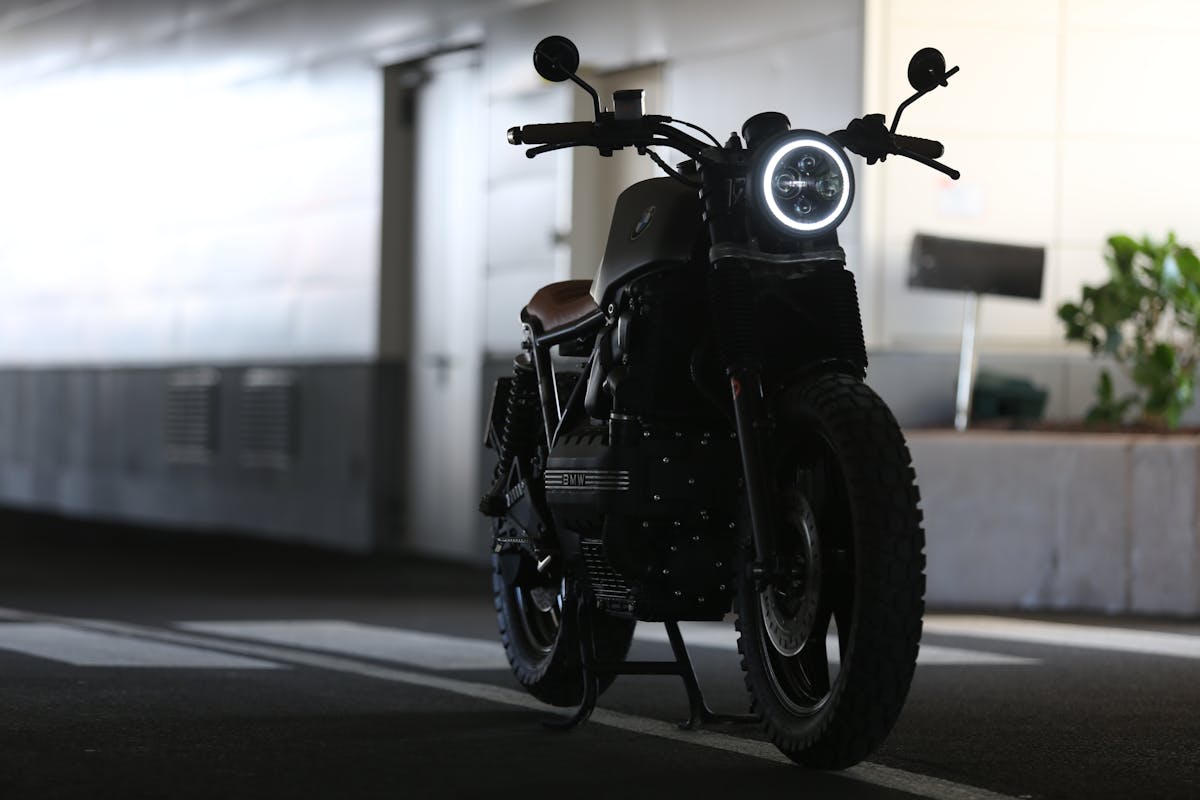
What Makes the Yamaha SR400 Worth Importing from Japan
Most people meet the SR400 through someone else's custom build — a café racer, a bratstyle tracker, a stripped-down bobber. That's because the SR is the most customized motorcycle Japan ever produced. The frame is simple, the engine is a single, and there are decades of bolt-on parts. You start with a bone-stock thumper and end up with something nobody else owns.
But the reason to import one from Japan specifically comes down to three things.
First, supply. The SR400 was sold almost entirely in the Japanese domestic market for most of its life. The cleanest, lowest-mileage, most original examples are in Japan, and they always will be. Japanese owners garage their bikes, service them on schedule, and keep the paperwork. A YouTube channel called Torq Chop pulled in over 12 million views on a single video about reviving a neglected SR400 — and the whole point of that video is how forgiving and rebuildable the bike is. Now imagine starting with a Japanese-market one that was never neglected in the first place.
Second, price. Japanese auction prices for used SR400s start well below what a clean one costs at a dealer in the US, UK or Australia. You pay the auction price, you pay the export and shipping, and you still often come out ahead.
Second-and-a-half, originality. JDM bikes come with Japanese spec details — the analog clocks, the right colors, the untouched factory finish — that collectors actually want. You can buy a customized SR anywhere. A clean, original, numbers-matching one is harder to find than people think.
There's a cultural angle too, and it's not just marketing. In Japan the SR has a near-religious following. Under Yamaha's own SR videos you'll find owners writing things like "this is my whole youth" and "I'll ride this bike for the rest of my life." One longtime owner described touring Hokkaido and Kyushu on his SR and called the memories "a treasure with no shape." That devotion is why Japanese SRs tend to be cherished rather than thrashed — and a cherished bike is exactly what you want to import.
A Quick History: 43 Years of the Same Beautiful Single
The SR400 launched in 1978, born from the same engine family as the legendary XT500 enduro. If you scroll the comments under any SR video, someone always brings up the XT500 or XT600 heritage — one commenter on a 1.6-million-view SR400 walkaround wrote that the format "revs my heart, touches my heart too," and another said his '78 SR500 "still starts on the 2nd kick even after sitting all winter." That is the kind of loyalty no marketing department can manufacture.
The bike came in two displacements: the SR400 and the larger SR500. The 500 left most markets early. The 400 kept going, mostly because Japan's licensing tiers make a 400cc bike a sweet spot for a huge population of riders.
For most of its life the SR400 ran a carburetor. In 2010, Yamaha added fuel injection to meet tightening emissions rules — and, impressively, hid the injection so well that the bike still looks and behaves like a carbureted classic. The kickstarter stayed. The analog gauges stayed. The chrome stayed.
Then Euro 5 emissions rules and a ban on producing non-ABS motorcycles caught up with it. Yamaha could not keep the SR400 compliant without ruining what made it the SR400, so in 2021 they built the Final Edition and the Final Edition Limited — the last of the line after 43 continuous years. The Limited was capped at 1,000 units with special finishes. Production then trickled on briefly in Thailand before ending entirely.
That discontinuation is the single most important fact for anyone importing one today. Here's why it matters in plain terms: for 43 years there was an endless supply of new SR400s rolling out of Japan, so used prices stayed low and nobody treated them as collectible. The day production stopped, the supply became finite. Every clean SR400 in the world is now a fixed, shrinking number, and the market has noticed. That's the classic recipe for an enthusiast bike to start climbing in value — and it's exactly what's happening in the Japanese auction lanes.
It's worth understanding why the 400cc displacement specifically survived so long. Japan's licensing system has a tier that makes 400cc the largest engine many riders can use on a standard license, so the SR400 sat in a protected sweet spot of demand for decades. The SR500 needed a bigger license, sold in smaller numbers, and left most markets early — which is why the 400 became the icon and the 500 became the rarer collector curiosity. When you're shopping imports, you'll see far more 400s, and that's a good thing: more choice, better prices, easier parts.
SR400 Specs and What They Actually Mean on the Road
Let's translate the spec sheet into plain English, because the numbers tell you exactly what kind of bike this is — and is not.
The engine is a 399cc air-cooled, SOHC, two-valve single-cylinder. It produces around 23–24 horsepower and a modest amount of torque low in the rev range. Transmission is a five-speed. Fuel lives in a 13-liter (about 3.4 US gallon) tank, and real-world owners report 65–75 mpg, which gives you a usable range of roughly 160–200 miles before you go looking for a gas station.
Twenty-three horsepower sounds like nothing. On paper it is nothing. In reality, the SR400 weighs very little, so it feels lively up to about 60 mph and is genuinely happy on back roads, in town, and on commutes. It is not a highway tool. Drop it on a freeway and it will hold 70 mph while reminding you, through every vibration, that it would rather be on a winding road.
One quirk that surprises new owners: the engine oil is carried inside the frame. The SR uses a dry-sump design where the frame backbone doubles as the oil tank. One commenter called it "the most insane bike that holds engine oil inside the frame," and they meant it as a compliment. It works, it's reliable, and it's part of the SR's mechanical honesty.
There is no electric start. There never was, on the JDM bike. Which brings us to the part that scares people off and shouldn't.
The Kickstart-Only Ritual Nobody Explains Properly
This is the section every other SR400 guide skips, and it's the one that actually matters before you buy.
The SR400 starts only with a kickstarter, and it has a decompression lever and a tiny sight glass on the cylinder head to help you do it right. Done correctly, the bike fires on the first or second kick, cold or hot. Done wrong, you sweat, swear, and convince yourself the bike is broken.
Here's the ritual. You pull in the decompression lever, ease the kicker down until the sight-glass window shows the indicator, let the lever go, bring the kicker back to the top, then commit to one long, smooth, full-stroke kick. The trick is in the follow-through. Yamaha's own film "Kickstart My Life" — over 1.6 million views — shows a rider doing it, and the top comment is from someone praising her technique: she doesn't muscle it, she "kicks through to the very end, smoothly." Brute force fails. A relaxed, complete stroke wins.
Why does this matter for importing? Because a healthy SR400 should start in one or two kicks. When you're evaluating an auction bike, the inspection report and any start-up video are your best evidence that the engine, compression and carburetion (or injection) are in good shape. A bike that "needs many kicks" is telling you something — usually about valve clearance, a tired top end, or a fueling problem. Knowing the ritual lets you read those signals instead of being fooled by them.
SR400 Model Years and Variants: Which One to Import
Not every SR400 is the right SR400 for you. Here's how the generations break down for an importer.
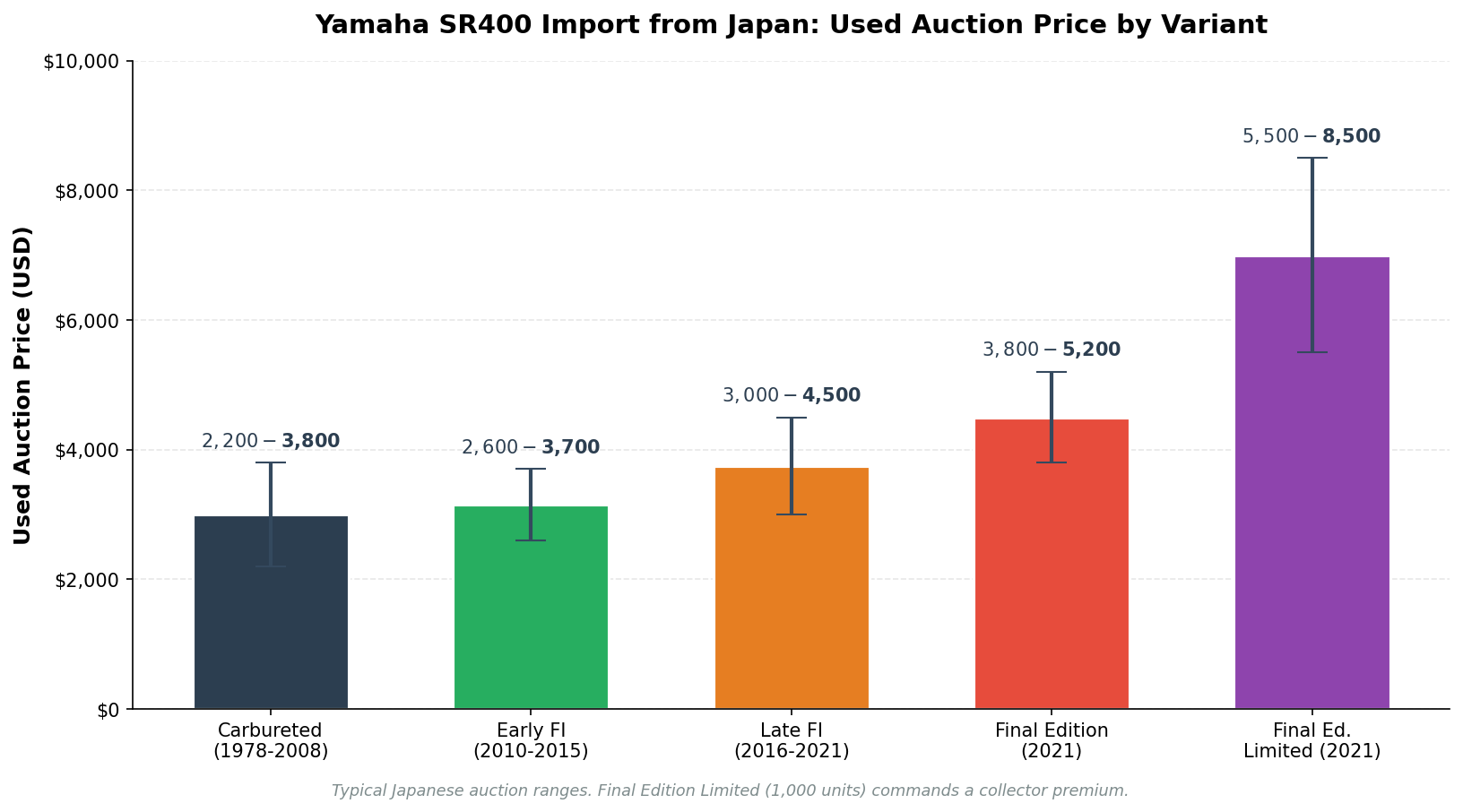
Carbureted SR400 (1978–2008). The purest, oldest, most analog versions. These are the ones café-racer builders fight over. Older carbureted bikes are mechanically simple and easy to work on anywhere in the world. For US buyers, the carbureted bikes are also the ones most likely to qualify under the 25-year rule (more on that below).
Fuel-injected SR400 (2010–2021). Cleaner running, easier cold starts, and still kick-only with the classic look. If you want a modern-reliable SR that you'll actually ride daily and never worry about a carb gumming up, this is the sweet spot. These are newer, so they're less likely to clear the US 25-year threshold yet — but they're ideal for Australia, New Zealand and the UK.
Final Edition and Final Edition Limited (2021). The collector's pick. The Final Edition Limited was capped at 1,000 units with premium gold-and-black finishing, a genuine analog cluster, halogen lighting, and that ceremonial kick-only character preserved on purpose. Final Edition bikes already command a premium in Japanese auctions and will only get rarer. If your goal is appreciation rather than a daily rider, this is the one to hunt.
A few practical notes. Anniversary and special-color editions appeared throughout the bike's life and carry small premiums. Mileage on these bikes is often genuinely low — many SRs were weekend toys, not commuters. And because the design barely changed, parts interchange across decades, which makes an older bike far less risky to own than an older bike from almost any other manufacturer.
What an Imported SR400 Actually Costs
This is where most guides wave their hands. We won't. Here is what goes into the landed price of an SR400 imported from Japan, in plain numbers.
The bike itself. At Japanese auction, clean used SR400s commonly trade in the range of roughly USD $2,500–$4,500 depending on year, mileage, originality and whether it's a Final Edition. For comparison, the new MSRP was around 605,000 JPY (about $5,800), and the Final Edition Limited was set at 748,000 JPY (about £5,200). On the US used market, dealer listings for SR400s average around $4,200 and run as high as nearly $5,000 — which tells you why buying at the Japanese source is attractive.
Auction and export fees. Auction service fees, deregistration, export documentation and domestic transport to the port. Budget a few hundred dollars.
Ocean freight. A motorcycle ships either crated or in a shared container. Expect roughly $700–$1,200 to most major ports depending on destination and method.
Destination duties and taxes. This is the number that changes everything, and it depends entirely on where you live. We break it down by country in the next section.
Local compliance and registration. Customs clearance, any inspection, plating and registration in your country.
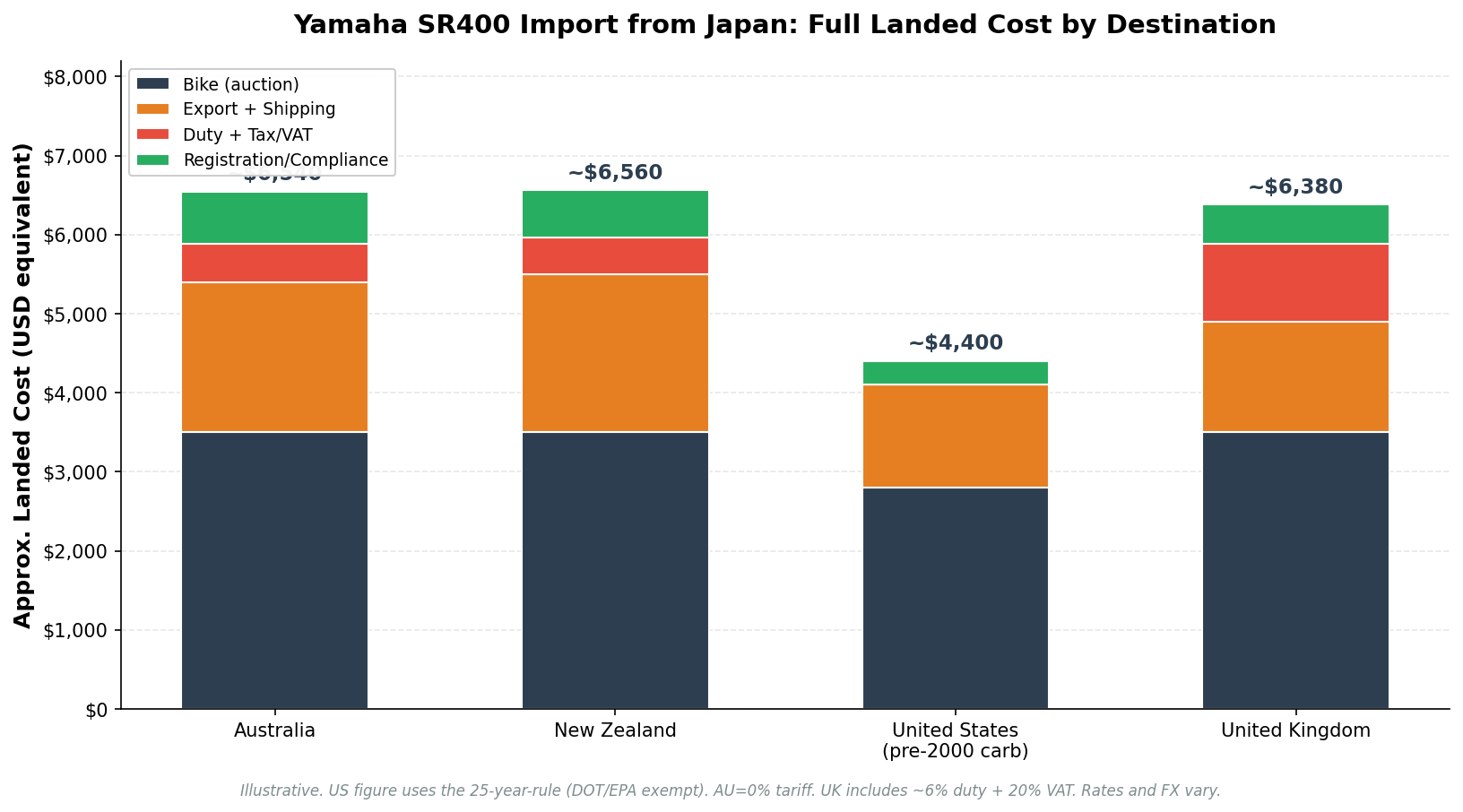
The takeaway: the auction price is often the smallest surprise in the whole process. The duties and the shipping are where budgets blow up if you don't plan. Add them up before you bid, not after.
One more money note that catches first-time importers off guard: the cheapest auction bike is rarely the cheapest bike to own. An SR400 that wins at $2,200 but needs a tank respray, a carb rebuild, new chrome and fresh tires can easily cost more all-in than a $3,800 bike that's genuinely clean. The auction sheet exists precisely so you can tell these apart before you commit a single dollar. Spend your energy reading the grade and the map diagram, not just hunting the lowest number. A higher-graded SR is almost always the smarter buy, because cosmetic restoration on a bike whose whole appeal is its finish is where the real money disappears.
Currency matters too. These bikes are priced in yen, and the exchange rate between the yen and the dollar, pound or Australian dollar moves the final figure more than most buyers expect. A favorable rate can knock several hundred dollars off the landed cost; an unfavorable one can erase the savings versus buying locally. It's worth keeping half an eye on the rate when you're timing a purchase.
Is the SR400 Legal in Your Country? US 25-Year Rule, AU/NZ LAMS, UK
This is the make-or-break section. A cheap auction win means nothing if your country won't register the bike.
United States. The US uses the 25-year rule. A motorcycle that is at least 25 years old can be imported without meeting current DOT and EPA standards — which makes older bikes dramatically cheaper and simpler to clear. For the SR400, that means carbureted bikes built in 2000 or earlier are the easy path right now, and the eligibility window rolls forward every year. (Note that Yamaha also sold a US-spec SR400 from 2015–2017, so domestic examples exist — but if you want a JDM bike, the 25-year route is your friend.) A fuel-injected 2010 SR won't be federally importable on age until 2035, so US buyers chasing a JDM SR should focus on the older carbureted years.
Australia. Good news here. The SR400 is LAMS-approved and appears on state lists of approved motorcycles for novice riders — it's one of the most popular learner-legal classics in the country. Under the Japan–Australia trade agreement, the tariff on Japanese motorcycles is 0%, so your main costs are GST, shipping and compliance. Australia's personal import and registration rules are strict on paperwork, so work with an agent who knows the process.
New Zealand. Similar story to Australia — the SR400 is a learner-approved favorite, and New Zealand has a well-established used-import pathway from Japan. Compliance inspection on arrival is the key step.
United Kingdom. The SR400 (2014–2018 models) is A2-licence compliant, which makes it attractive to newer riders. Importing one means paying duty (typically around 6%) plus 20% VAT, and registering it with a NOVA certificate that proves the bike was imported and the taxes paid. Bikes over 40 years old become MOT-exempt and can use a V112 declaration — relevant for the earliest SRs from the late 1970s and early 1980s.
A blunt summary: Australia and New Zealand are the easiest and cheapest places to register an imported SR400. The US is easy if you buy a pre-2000 carbureted bike. The UK is doable but the 20% VAT stings.
Reading the Auction Sheet for an SR400
Every bike sold through a Japanese auction comes with an inspection sheet graded by a neutral inspector. Learning to read it is the single best way to avoid buying a dud, and there are SR-specific things to look for. (We have a full walkthrough on how to read a Japanese motorcycle auction sheet, but here's the SR400 short version.)
Check the overall grade first — a number from roughly 3.5 to 5 for a genuinely good used bike, with R or RA flagging past repairs or accident history. Then read the map diagram, which marks scratches, dents and corrosion by location with letter codes.
For an SR400 specifically, look hard at the tank and side covers, since SR tanks are a focal point and expensive to repaint correctly, so dents and rust matter more here than on a faired bike. Check the exhaust and chrome — surface rust on chrome is common and not fatal, but heavy pitting is costly to restore on a bike where the chrome is the whole aesthetic. Confirm the engine cases and the kickstarter mechanism are sound, and that the engine turns and starts cleanly, since the kickstart-only design means a start-up video or note is gold. Weigh originality heavily, because so many SRs are customized that a sheet describing a fully stock bike with original parts is worth paying up for if you want a clean base or a collector example. Finally, compare mileage versus condition — many SRs have genuinely low miles, and a sheet showing low km with matching cosmetic condition is the jackpot.
If the bike has been turned into a café racer already, that's not automatically bad — but you're now buying someone else's taste and workmanship, so the sheet and photos matter even more.
Living With an Imported SR400: Parts, Maintenance and the Custom Scene
The SR400 might be the easiest classic-feeling bike in the world to live with, and that's a big part of why importing one is low-risk.
Parts are everywhere. OEM components are still available through Yamaha's network in Japan, Thailand and parts of Europe, and the aftermarket for the SR is enormous. Because the bike barely changed for four decades, a part for a 1990s SR often fits a 2010s one. Consumables — filters, cables, sprockets, tires — are cheap and universal.
Maintenance is genuinely simple. Air-cooled single, two valves, no liquid cooling, no ride-by-wire, no complex electronics. Valve-clearance checks, oil changes and carb or injector servicing are within reach of a confident home mechanic. There's no fairing to remove to reach anything. This is the opposite of importing a modern superbike where one sensor fault can sideline you for weeks.
The custom scene is the secret value. The SR is the global platform for café racers, brat-style builds, trackers and bobbers. Builders in Japan have entire catalogs of bolt-on tanks, seats, bars and exhausts designed specifically for it. Import a clean stock bike and you have either a perfect original to preserve or the best possible canvas. Either way you win.
One honest caveat: it's a single-cylinder kick-start bike with modest power. If your fantasy involves effortless two-up highway touring, the SR will frustrate you. Buy it for what it is — a light, characterful, endlessly customizable thumper — and it will reward you for decades.
Common SR400 Problems to Watch For Before You Bid
No 40-plus-year-old design is perfect, and pretending otherwise helps nobody. The SR400 is unusually trouble-free, but there are specific things that separate a great import from a money pit. Here's what experienced SR owners actually check.
Starting health. Everything on this bike comes back to the kick. A bike that's genuinely healthy starts in one or two kicks. If an auction note or video shows repeated kicking, suspect valve clearances out of spec, a worn top end, or — on carbureted bikes — a tired or gummed carburetor. None of these are catastrophic, but they're bargaining points and budget lines.
Carb gumming on bikes that sat. Carbureted SRs that have been parked for a year or more often need the carburetor cleaned or rebuilt. It's a cheap, routine job, but factor it in. Fuel-injected bikes (2010 onward) sidestep this entirely, which is one of their quiet advantages for an importer.
Top-end rattle and cam chain. Listen for excessive top-end noise. The SR's single is durable, but a neglected one can show cam-chain tensioner wear. A start-up clip on the auction listing tells you more than any photo.
Cosmetic restoration cost. This is the sneaky one. The SR's appeal is its chrome, paint and exposed engine. A faded tank, pitted exhaust, or corroded spokes won't stop the bike running, but restoring them to the standard that makes an SR special costs real money. Read the auction map diagram for rust (often coded by location) and price the cosmetics honestly.
Hidden custom work. Roughly half the SRs out there have been modified. A clumsy wiring job for aftermarket lighting, a non-original carb on a bike that should be injected, or a hacked subframe for a custom seat can all hide in a "clean-looking" listing. If you want stock, insist on stock — the sheet and photos will tell you.
The pattern here is reassuring: nearly every SR400 issue is cosmetic or maintenance-related, not structural. There's no fragile electronics package, no liquid-cooling system to fail, no expensive proprietary part waiting to bankrupt you. That's precisely why importing a used one is so much lower-risk than importing almost any modern motorcycle.
SR400 vs the Modern Retro Crowd: Why People Still Import the Original
You might be wondering why anyone imports a discontinued 23-horsepower single when showrooms are full of shiny modern retros — the Honda CB350, the Royal Enfield singles, Yamaha's own XSR range. Fair question. Here's the honest comparison.
Modern retros give you fuel injection, ABS, electric start, a warranty, and more power. On a pure value-and-convenience basis, they win. If you want a no-drama daily that looks vintage, buy one of those and be happy.
But they're styled to look like the past. The SR400 is the past — a genuinely old design, continuously built, with a kickstarter that isn't a nostalgic gimmick but the only way to start it. That authenticity is the entire point. You're not buying a costume. You're buying the real thing, and the real thing has a character that interpretations can't fake: the deliberate starting ritual, the oil-in-frame engineering, the mechanical honesty of a bike you can fully understand.
There's also the appreciation angle. A new retro depreciates the moment it leaves the showroom. A clean, original SR400 — especially a Final Edition — is going the other direction. Discontinued, finite, and increasingly collected, it behaves more like a modest investment than a depreciating appliance. That combination of usable classic and appreciating asset is rare, and it's why the Japanese auction lanes for SRs are busier now than they were when the bike was still in production.
For the rider who wants more outright capability, our guides on importing a Kawasaki Ninja 400 from Japan or whether Japanese motorcycles are reliable are worth a read. But for the rider who wants soul on a budget, the SR400 has no real rival.
A Real Import Example: Walking Through the Numbers
Let's make this concrete with a realistic scenario, because abstract cost lists never stick.
Say you're in Australia and you find a clean 2016 fuel-injected SR400 at a Japanese auction with low kilometers and an original finish, graded 4. The winning auction bid is about AUD $5,200 (roughly ¥520,000 / ~$3,500 USD). Auction service, export paperwork and domestic transport to port add about AUD $600. Ocean freight to Melbourne or Sydney, crated, runs about AUD $1,300. Customs duty is $0 under the Japan–Australia agreement. GST and import processing come to roughly AUD $700 on the combined value, and compliance inspection plus registration add AUD $500–$800.
All-in, you're looking at roughly AUD $8,300–$8,600 for an original, low-km, learner-legal JDM SR400. Compare that to clean local examples and the math frequently favors the import, and you end up with a bike that has documented history and the JDM spec details.
Now a US example: a 1995 carbureted SR400, comfortably past the 25-year line. The winning bid is about $2,800. Export and domestic Japan logistics add about $400. Ocean freight to a US port is about $900. Federal import is simplified under the 25-year rule (DOT/EPA exempt), and state title and registration vary — budget a few hundred dollars. That's a vintage, fully importable JDM SR400 in your garage for well under $5,000 all-in — a genuinely original classic for the price of a tired used commuter.
These are illustrative, not quotes. Exchange rates, port fees and the specific bike move the totals. But they show the shape of the deal, and the shape is good.
How AWA Auction Helps You Import an SR400
This is where we come in, and we'll keep it straight.
AWA Auction gives English-speaking buyers direct access to the same Japanese motorcycle auctions where these SR400s actually sell — the ones you can't bid in from overseas on your own. We translate the auction sheets, tell you honestly when a bike's grade or photos hint at trouble, and handle the export paperwork, shipping booking and documentation so the bike arrives at your port with the right papers.
We're motorcycle people, not a faceless freight broker. If a Final Edition is overpriced this week, we'll say so. If a "clean" SR has a repainted tank hiding in the auction notes, we'll flag it before you bid. You can browse current listings to see what's coming through the lanes right now, and if you want help finding a specific year or variant, contact our team and tell us exactly what you're after.
Whether you want a pre-2000 carbureted bike for an easy US import, a learner-legal FI bike for Australia, or a Final Edition to tuck away, the path runs through the Japanese auctions — and we'll get you in.
See Also
Share this article: