
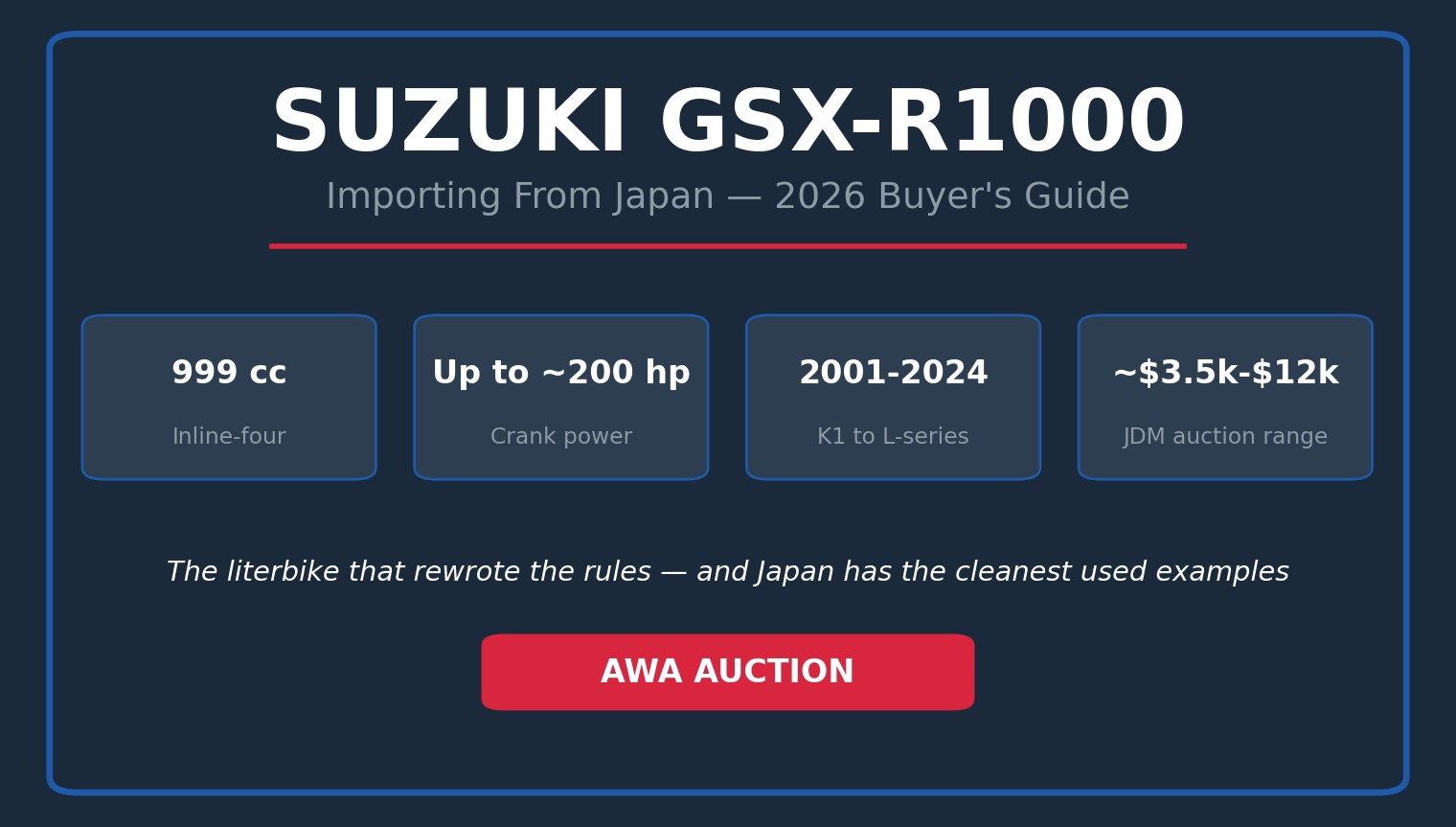
In 2001 Suzuki took the litre-class superbike, threw out the rulebook, and built a machine so fast and so light that every rival had to start again from a blank sheet. That bike was the GSX-R1000, and twenty-odd years later it is still the benchmark for what a 1000cc inline-four should feel like. If you want to import a Suzuki GSX-R1000 from Japan, you are buying into the single biggest, cleanest pool of these bikes on the planet — low-mileage examples that were ridden on smooth roads, garaged through brutal winters, and serviced by owners who treat the shaken inspection regime like a religious duty.
Here is the part the forums argue about endlessly: there is no single "best" GSX-R1000. There are seven distinct generations, each with its own personality, its own weak spots, and its own price. Pick the wrong one and you inherit somebody else's headache. Pick the right one and you own one of the great bargains in modern motorcycling — a genuine 180-plus horsepower superbike for the price of a clapped-out hatchback.
This guide walks you through every generation, what breaks, what to pay, how the Japanese auction system works in your favour, and exactly how to get one landed in your garage. We pulled the real numbers from the people who actually buy these bikes, not the brochure.
Why a Used GSX-R1000 From Japan Is the Smartest Big-Power Buy in 2026
Three things make the GSX-R1000 a uniquely good import target right now.
First, depreciation has done its work. A literbike that cost the equivalent of a small car new can now be had for the price of a decent commuter. Suzuki's third-generation GSX-R1000 in particular has dropped to less than half its original cost, making it one of the genuine bargains of the used litre-superbike class. You are buying 90 percent of a current superbike's performance for a third of the money.
Second, Japan keeps its bikes properly. The domestic market is flooded with GSX-R1000s that have low miles, full service histories, and bodywork that has never seen a winter grit truck. The shaken roadworthiness system makes neglect expensive, so the average Japanese-market bike is in a condition that would be considered exceptional anywhere else.
Third — and this is the part people miss — the GSX-R1000 is the one big Japanese literbike where the supply at home is drying up faster than in Japan. In the US, the UK and Australia, clean, unmolested examples are getting hard to find because so many were crashed, stunted, or stripped for track use. The Japanese market still has the unicorns. The channel that connects you to them is the Japanese motorcycle auction system, and once you understand it, importing stops feeling exotic and starts feeling obvious.
There is also a timing angle worth understanding. As emissions and noise rules tighten and the litre-class superbike slowly becomes an endangered species, the analogue, pre-electronics GSX-R1000s are quietly turning into modern classics. The bikes that were merely cheap five years ago are starting to be recognised as the high-water mark of a particular kind of raw, mechanical superbike. Buying a clean Japanese example now is as much a hedge as a purchase.
If you want the wider picture on this segment first, our roundup of the best 1000cc motorcycles to import from Japan puts the GSX-R1000 next to its big rivals. This guide goes deep on the Gixxer alone.
The Bike That Rewrote the Literbike Rulebook
To understand which GSX-R1000 to import, you have to understand why the first one mattered so much. Before 2001, the open-class sportbike world was split between the brutal but heavy hyperbikes and the razor-sharp 750s. Suzuki's idea was simple and slightly insane: take the chassis philosophy of the featherweight GSX-R750, bore the engine out to 988cc, and refuse to add the weight that everyone assumed a litre bike needed.
The result landed like a hand grenade. The K1 made more power than anything in its class while weighing less than bikes a category smaller. It did not just win comparison tests — it ended them. Yamaha responded, Kawasaki responded, Honda responded, and the modern superbike arms race was officially on. Every literbike you can buy today traces its DNA back to that 2001 GSX-R1000.
That heritage matters when you import one. You are not buying a forgotten model that nobody supports. You are buying a bike with two decades of aftermarket parts, a deep specialist community, and service knowledge in every market on earth. The bike that intimidates new riders — one Big St Charles Motorsports clip titled "Girls hate this bike for ONE reason" has racked up over 43 million views precisely because of the GSX-R1000's fearsome reputation — is also one of the most thoroughly documented machines you can own.
GSX-R1000 Generations: The Complete Buying Map
Suzuki names GSX-R1000 generations by year code: K for the 2000s (K1 = 2001, K5 = 2005), then L for the 2010s and beyond (L7 = 2017). Here is the full map, generation by generation, with what each one is actually like to live with and import.
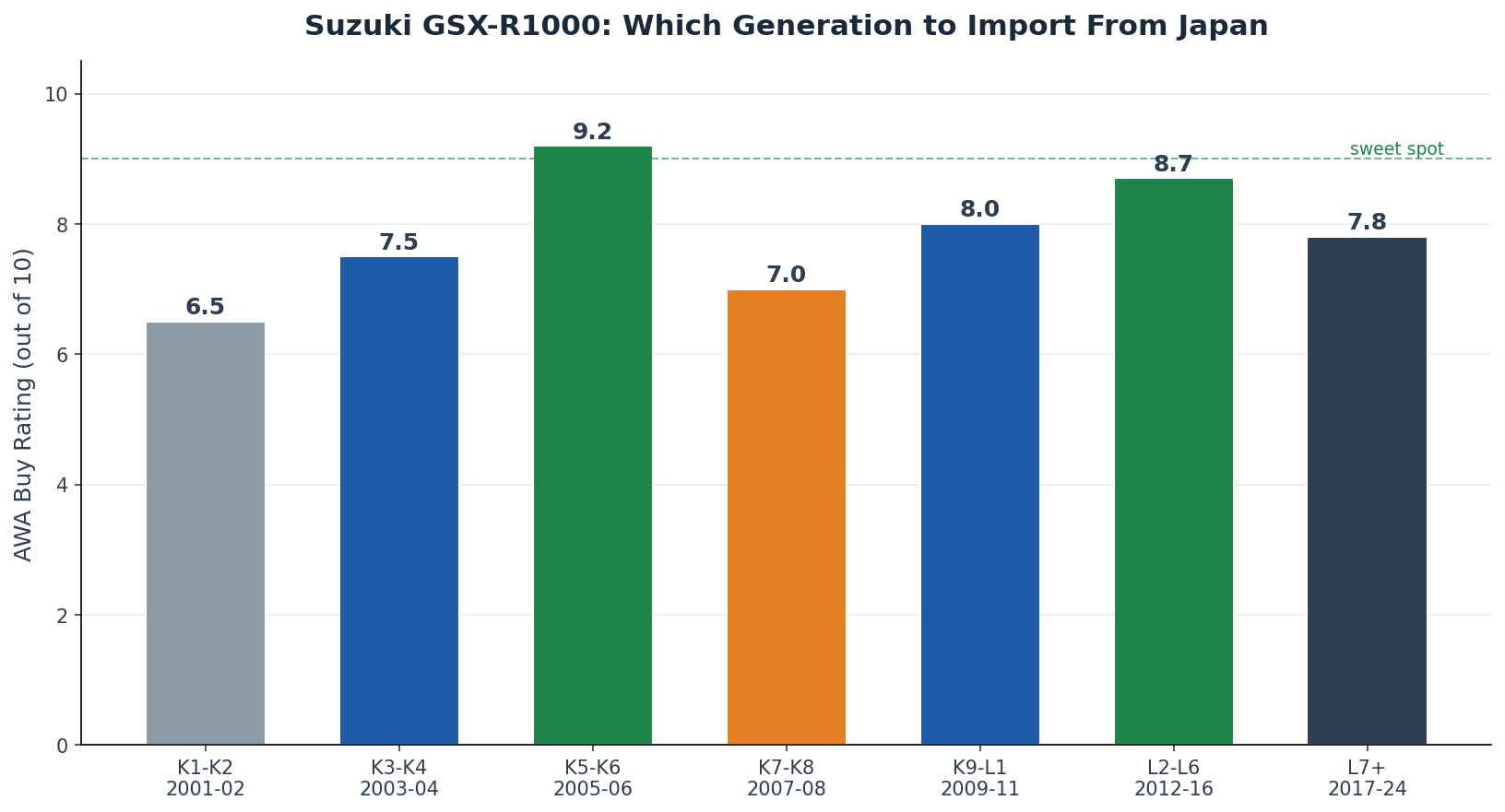
K1-K2 (2001-2002): The Original Game-Changer
The bike that started it all. The 988cc engine is torquey, the chassis is friendly by modern standards, and there is real collector interest building in clean first-year examples. The catch: these are now over twenty years old, so condition is everything. Gearbox problems are not unheard of on K1 and K2 bikes, but they are fortunately rare, and most issues come down to age and abuse rather than design. Import one only if it is genuinely clean — a tatty K1 is a money pit.
K3-K4 (2003-2004): Bigger, Sharper, Better Value
Suzuki took the engine out to a full 999cc, added refinement, and sharpened the styling. The K3/K4 is a noticeably more sorted bike than the original and sits in a sweet spot for value — old enough to be cheap, new enough to be reliable. For a first big-bike import on a budget, this is a smart, overlooked choice.
K5-K6 (2005-2006): The One Everyone Wants
If the GSX-R1000 has a legendary generation, this is it. The K5/K6 combined a brilliant new chassis, a torque-rich engine, and a riding character that road testers still rave about two decades later. Owners routinely clock past 30,000 km with the valves still in spec. It is the bike that made "buy a K5" a piece of standard internet advice. Demand keeps prices firmer than the surrounding years, but a clean K5 import from Japan is about as safe a big-bike purchase as exists.
K7-K8 (2007-2008): The Underrated Bruiser
The K7 grew up and bulked up — more electronics, more presence, and a slightly heavier feel than the lithe K5. There is nothing wrong with these bikes, and they are often the cheapest way into a "modern enough" GSX-R1000. Owners on the Gixxer forums debate the common quirks of the 07-08 1000s, but none of them are deal-breakers. Buy on condition and history.
K9-L1 (2009-2011): The Bargain of the Litre Class
Suzuki's third-generation GSX-R1000 is widely called one of the bargains of the used litre-superbike class. It dropped hard in price, yet it is a genuinely modern, fast, well-sorted motorcycle. If you want the most performance per dollar in this whole guide, the K9-L1 is the answer. This is the value pick.
L2-L6 (2012-2016): The Last of the "Pure" Gixxers
Before the big 2017 redesign, Suzuki spent these years refining the formula into an exceptional road bike. The L2-L6 is frequently described as the sweet spot for real-world riding: fast enough for anyone, friendly enough to live with, and the last GSX-R1000 before the electronics arms race took over. These hold their value well and are worth importing in clean condition.
L7 and Beyond (2017-2024): The MotoGP-Tech Superbike
The 2017 redesign was the first all-new GSX-R1000 in years, launched as the standard bike and the top-spec GSX-R1000R with variable valve timing and racing-grade cycle parts. It is close to 200 horsepower with proper electronics. It is also where the documented gremlins cluster — more on that below. Brilliant bike, but go in with your eyes open and your wallet ready, because clean L7-plus imports command real money.
K5/K6: Why the 2005-2006 Deserves Its Reputation
It is worth pausing on the K5 because it is the generation most first-time importers gravitate toward, and for good reason. The 2005-2006 GSX-R1000 nailed a balance that Suzuki arguably never bettered: a fat, usable spread of torque, a chassis that flatters rather than punishes, and mechanical toughness that has become the stuff of legend.
The Gixxer-brah YouTube clip "Why I bought a 18 year old Super bike (GSXR-1000 K5)" — nearly 200,000 views and almost 800 comments — exists because so many riders independently reach the same conclusion: an old K5 is a smarter buy than a new midweight. The comment threads are full of people swapping mileage figures and reliability stories, and the consensus is consistent. These engines last.
For an importer, that reputation is gold. A bike that owners trust to high mileage is a bike where a Japanese auction example with 18,000 km is barely run in. Pair that with the auction grading system — which we break down in our guide to reading Japanese auction inspection sheets — and you can buy a K5 sight-unseen with real confidence.
Engine, Power and What the Numbers Actually Mean
Every GSX-R1000 since 2001 has used a liquid-cooled inline-four, displacing 988cc on the very first bikes and 999cc from K3 onward. Peak power climbed from the high 150s on early bikes to around 185 horsepower on the K7-era machines and close to 200 horsepower at the crank on the 2017-plus L-series.
But raw peak power is the least interesting number. What makes the GSX-R1000 special on the road is the midrange. Unlike a screaming 600 that needs to be wrung out, the Gixxer pulls hard from low revs, which is exactly why owners describe even 18-year-old examples as "still terrifying" in traffic. You rarely use more than half the rev range on the street, and you still leave almost everything else behind.
One honest caveat on the newest bikes: the 2017-2020 L7-L8 engine lost its counterbalancer in the redesign, and owners widely report an annoying vibration through the handlebars that worsens as the revs climb. It does not hurt reliability, but if you do long motorway miles, it is something to feel for on a test ride or factor into your decision. The pre-2017 bikes are smoother in this respect.
GSX-R1000 vs R1 vs ZX-10R vs CBR1000RR: The Big Four
The GSX-R1000 has spent its whole life trading blows with three rivals, and the "Big Four Japanese literbikes" comparison is one of the most-watched topics on motorcycle YouTube — Big St Charles Motorsports' big-four video alone has passed two million views. Here is the honest positioning.
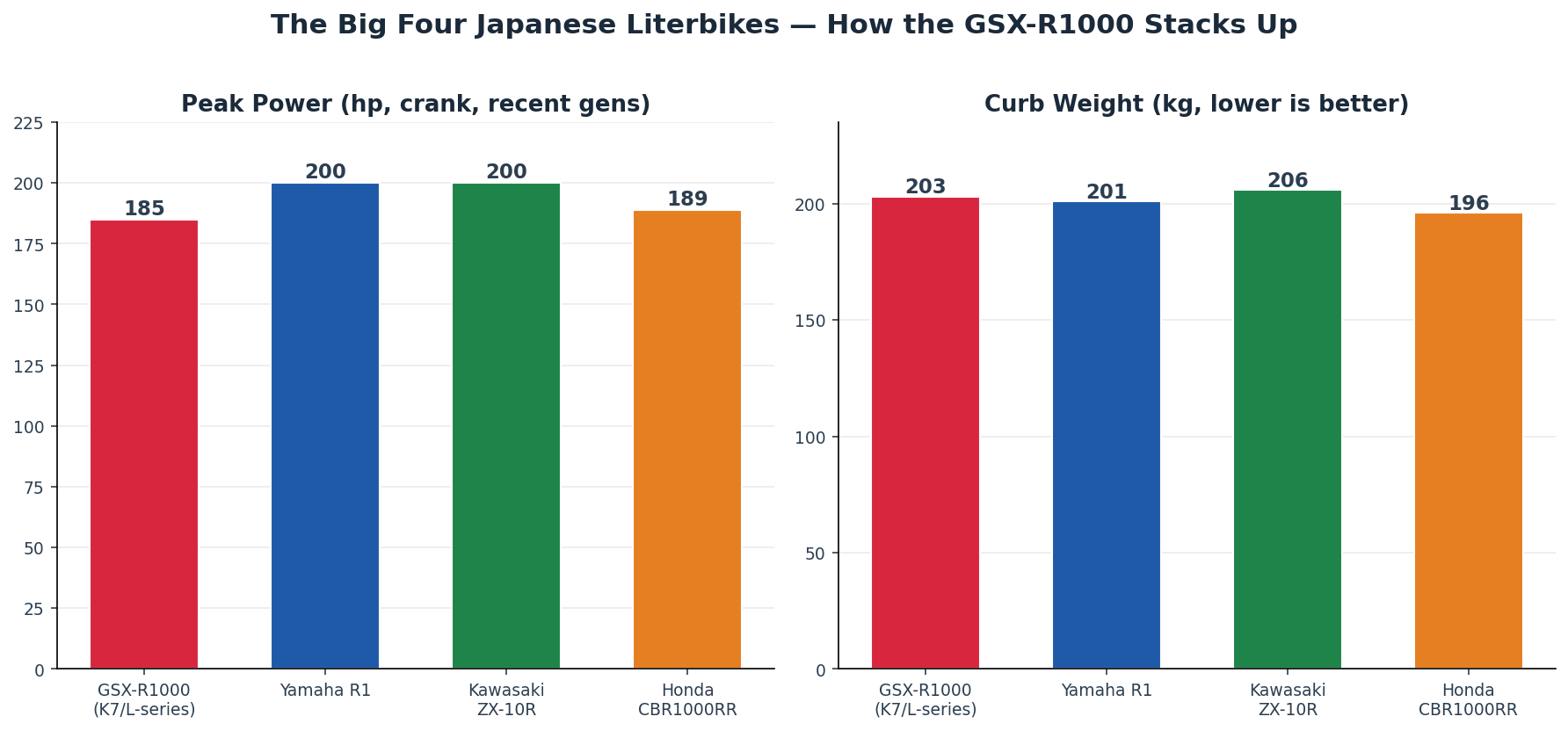
The Yamaha R1 brings the crossplane-crank character and the loudest exhaust note. The Kawasaki ZX-10R is the track weapon with the strongest racing pedigree. The Honda CBR1000RR is the polished, refined all-rounder that flatters every rider. The GSX-R1000 sits in the middle of all of them — not the absolute fastest on paper in its later years, but the one with the broadest, most usable powerband and, crucially, the lowest used prices. Dollar for dollar, the Gixxer is the value play of the four.
For a buyer importing from Japan, that value gap is the whole point. You can land a clean GSX-R1000 for meaningfully less than an equivalent R1 or CBR, and the supply of good examples in the Japanese auctions is excellent.
Known Faults and Weak Spots by Generation
No bike is perfect, and pretending otherwise is how people get burned. Here is what to actually watch for, generation by generation.
Charging system (all generations). Like most Japanese sportbikes of the era, the regulator/rectifier can run hot and fail, especially on bikes that sit. A weak battery, flickering dash, or corroded charging connectors are the classic warning signs. It is a cheap fix if caught early and an expensive stranding if ignored.
Cam chain tensioner and top end (early K-series). A rattle on cold start that does not settle is worth investigating. Well-maintained engines are famously durable — those 30,000 km K5 valve checks are real — but a neglected one will tell you with noise.
Gearbox (K1-K2). Rare, but the earliest bikes can show gearbox wear. A bike that jumps out of gear under load is a walk-away.
L7-L8 (2017-2018) specifics. This is the generation with the most documented owner complaints. Beyond the handlebar vibration from the missing balancer, owners report fuel-delivery problems on deceleration — described as the bike "falling on its face" off a closed throttle — plus cold-start fussiness, occasional quick-shifter glitches, and an ABS light that refuses to go out. Suzuki addressed some of this over the run, so a later, updated example is the one to chase.
The reassuring counterpoint: long-term owners of the 2012-2016 bikes routinely report near-perfect reliability, with one common refrain being that the only trouble they ever had came from a badly fitted aftermarket alarm. Buy a clean, stock, well-documented bike and the GSX-R1000 is as dependable as superbikes get.
Reading the Auction Sheet: Red Flags on a Gixxer
When you import from Japan, you are not standing in front of the bike — you are reading an inspector's grade sheet. This is actually an advantage, because Japanese auction inspectors are ruthless and independent. But you have to know what the GSX-R1000-specific red flags are.
Watch for evidence of stunt or track use: chewed sprockets, scarred frame sliders, drilled fairings for race fasteners, or a speedo that has clearly been swapped. Look for crash markers in the inspector's diagram — scrapes on the bar ends, mirror mounts, and exhaust can. A repainted tail or mismatched fastener finish suggests a previous tip-over. Aftermarket everything (rearsets, exhaust, bodywork) is not automatically bad, but it tells you the bike was modified, and modified Gixxers were often ridden hard.
The single best protection is understanding the grading scale and the inspector's shorthand. Our full breakdown of how to read Japanese auction inspection sheets covers the grade numbers, the interior/exterior letter grades, and the map symbols. Read it before you bid on anything. A good agent — the kind AWA works with daily — will also translate the sheet and flag concerns before you commit a single dollar.
What It Actually Costs to Land a GSX-R1000 From Japan
The number that matters is not the auction hammer price — it is the all-in landed cost. Here is how it breaks down for a typical clean mid-generation example.
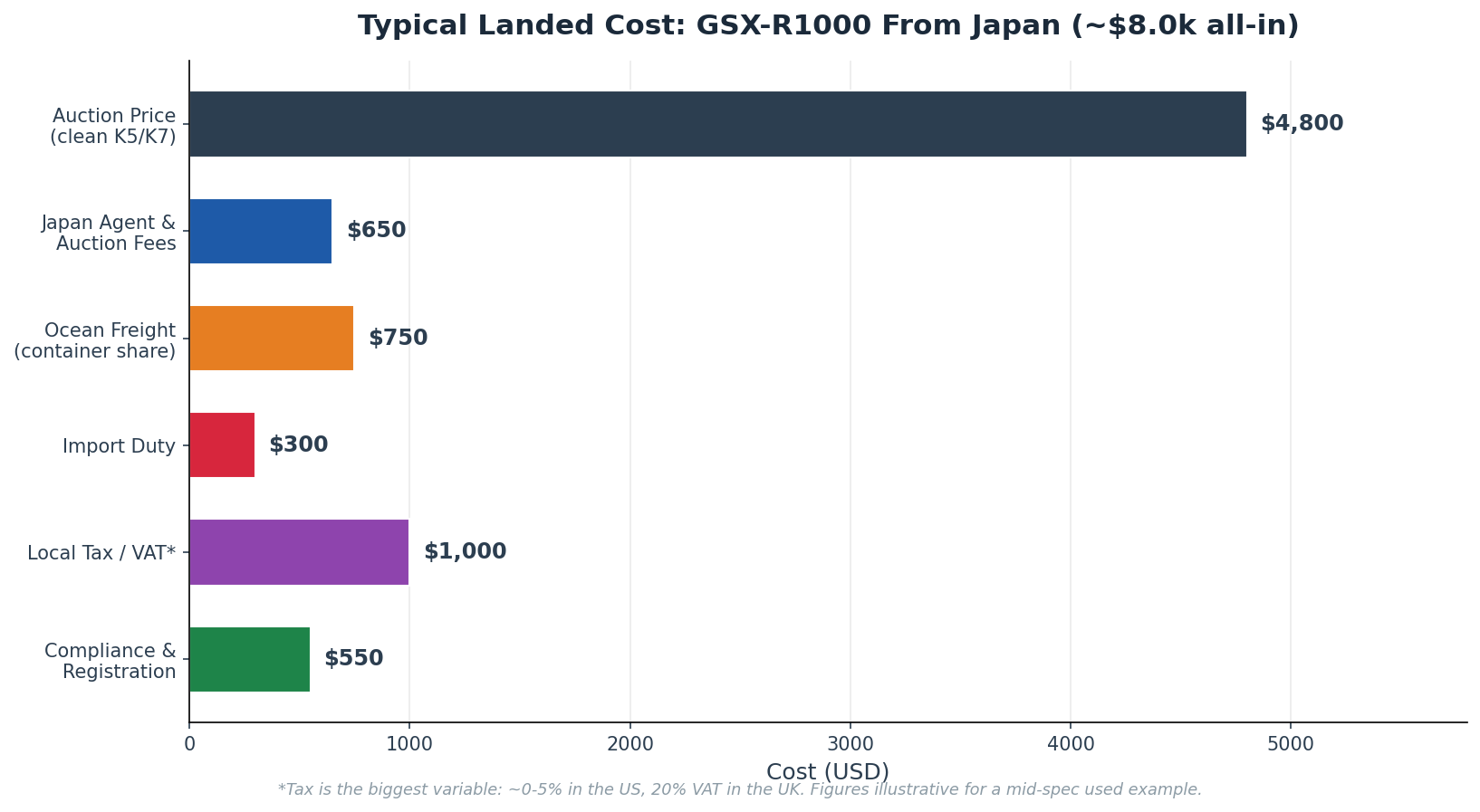
For most destinations, you should budget the auction price plus roughly 2,000 to 4,000 US dollars in agent fees, freight, duty and tax. A clean K5 or K7 hammering at around 4,800 US dollars typically lands somewhere between 7,500 and 9,000 dollars all-in. The newer L-series bikes start higher and climb fast.
One more cost worth flagging: do not skimp on shipping protection for a bike this valuable. The difference between a container slot and roll-on/roll-off is a few hundred dollars, but for a low-mileage Gixxer with pristine bodywork, that margin buys real peace of mind. A scuff picked up in transit can wipe out the saving you worked so hard to find at auction.
The biggest single variable is your own country's tax. The US sits near the bottom of that range with low or no duty on motorcycles over a certain engine size; a 20-percent-VAT market like the UK sits near the top. We cover the country specifics below, and our detailed motorcycle import cost breakdown runs the full math for UK buyers.
Used GSX-R1000 Prices by Generation
Prices vary enormously by generation, condition and spec. Here are realistic 2026 landed-cost estimates so you can match a bike to your budget before you start bidding.
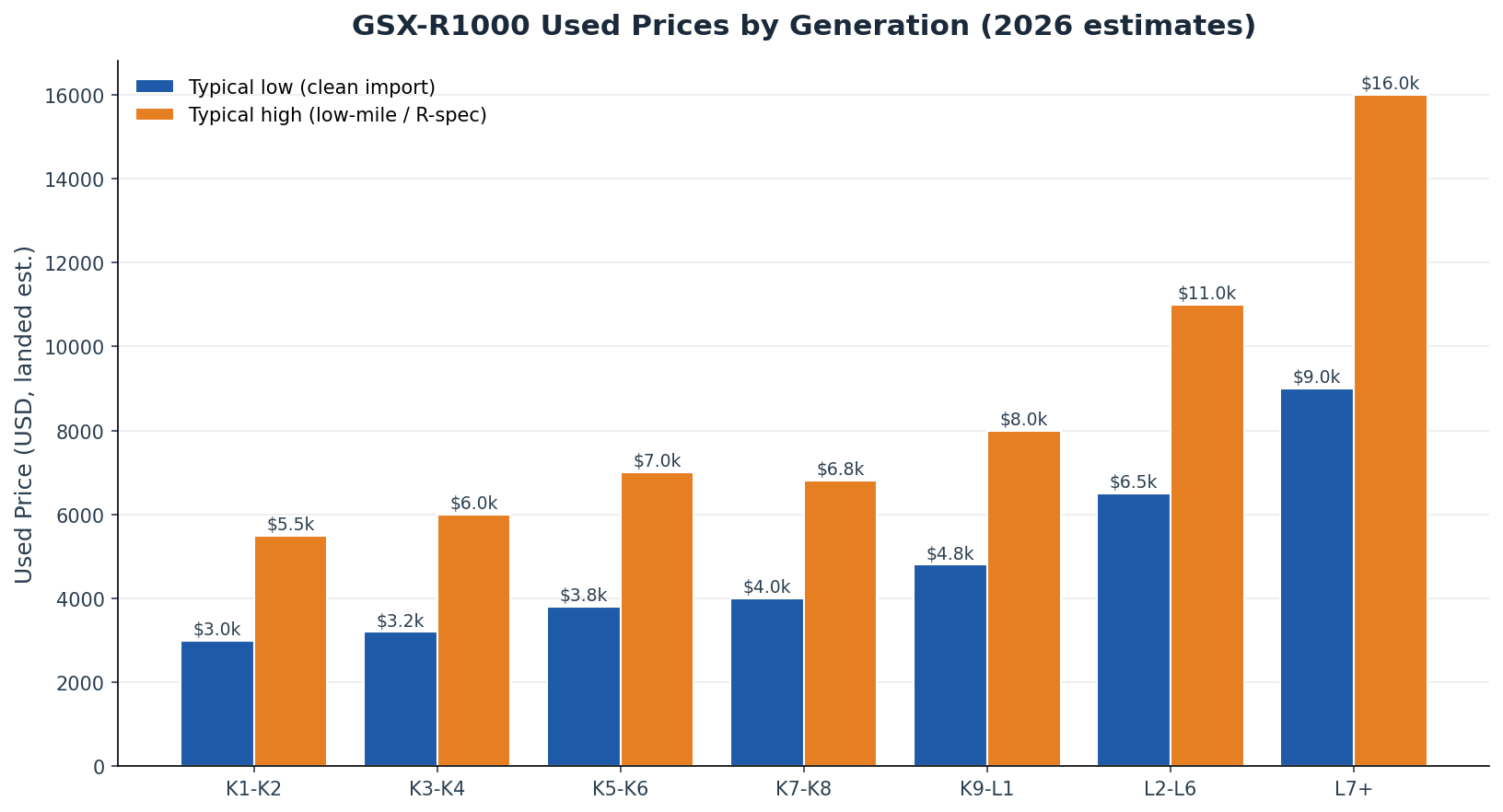
The pattern is clear: the early K-series is where the bargains live, the K9-L1 is the value-performance peak, and the 2017-plus L-series carries a real premium for clean, low-mile examples. A standard L7 in good order sits around the 8,000-dollar mark and climbs steeply for the R-spec bikes with variable valve timing and Brembo brakes. Current open-market listings for all years combined average around 12,000 dollars, which tells you how much room a smart Japanese import leaves on the table.
Browse what is in the auctions right now on our current listings page — supply changes weekly, and the cleanest examples move fast.
The 8-Step Process to Import a GSX-R1000 From Japan
The mechanics of importing are far simpler than most first-timers fear. Here is the whole journey.
Step 1 — Set your budget and target generation. Decide whether you want a bargain K-series, a value K9-L1, or a premium L-series, and fix your all-in number including tax.
Step 2 — Partner with an export agent. You bid through a licensed Japanese exporter who has auction access. This is where AWA comes in — you tell us the target bike and budget, we do the rest.
Step 3 — Watch the auction listings. Hundreds of GSX-R1000s pass through the Japanese auctions every month. Your agent sends you sheets for matching bikes.
Step 4 — Translate and vet the auction sheet. Before bidding, the grade, mileage and inspector notes are checked for the red flags above.
Step 5 — Bid. You set a maximum, the agent bids on your behalf. Win or lose, there is no obligation to chase a bike past your number.
Step 6 — Pay and prepare for export. Once you win, the bike is invoiced, de-registered for export, and prepared for shipping.
Step 7 — Ship. The bike travels by container or roll-on/roll-off to your nearest port. Container is safer for a valuable sportbike; we explain the trade-off in our container vs RoRo shipping guide.
Step 8 — Clear customs and register. You or your customs broker handle duty, tax and local compliance, then register the bike and ride. The exact requirements depend on your country.
Your GSX-R1000 Pre-Purchase Checklist
Before you commit to any auction bike, run this list:
- Confirm the generation and exact year — K-codes and L-codes matter for parts and value.
- Check the auction grade and mileage against the sheet, not the listing photos.
- Look for crash, stunt and track markers in the inspector diagram.
- Verify the bike is stock or sensibly modified — avoid heavily stunted examples.
- Listen (via the agent's notes or video) for top-end rattle and rough cold starts.
- Confirm the charging system and battery are healthy.
- On L7-L8 bikes, prefer a later, updated example for the fuelling fixes.
- Match the all-in landed cost to your budget, tax included.
- Confirm your country's age and compliance rules before bidding.
If any of that feels daunting, that is exactly what an agent is for. Talk to our team and we will vet bikes against this checklist for you.
Country Rules: US, UK, Australia, NZ and Canada
The import process is the same everywhere; the paperwork at the other end is not. The headlines:
United States. Motorcycles are generally far easier to import than cars and are not bound by the same 25-year rule that governs vehicles — though the cleanest path is still a bike that meets EPA and DOT requirements or qualifies under the relevant exemptions. Check current rules with the NHTSA importing guidance before you buy.
United Kingdom. You will pay import duty and 20 percent VAT, complete the NOVA notification, and put the bike through an MSVA test if it lacks European type approval. Our UK-specific guides on NOVA registration and the MSVA test walk through every form.
Australia. Importing requires an approval before the bike arrives, and compliance rules are strict. Older bikes can qualify under specific schemes — verify with the official import authority first.
New Zealand. One of the friendliest markets for Japanese imports, with a well-trodden path and strong demand for clean Gixxers.
Canada. Motorcycles 15 years and older are straightforward to import; newer bikes face tighter rules. Confirm the current threshold before bidding.
Living With a GSX-R1000: Running Costs and Maintenance
A literbike is cheaper to run than people assume, but it is not a commuter. Budget realistically.
Tyres are the big consumable — a sticky sport tyre on a 180-horsepower bike will not last forever, and the rear goes first. Chain and sprockets wear faster than on a midweight if you ride hard. Insurance is the genuine sting for younger riders; the GSX-R1000 sits in the highest groups, so get a quote before you buy, not after. Servicing is straightforward for any competent sportbike mechanic, valve-check intervals are long, and parts availability is excellent thanks to two decades of production.
The flip side: because these engines are so durable, a well-bought example costs very little in unexpected repairs. That is the quiet advantage of importing a low-mileage Japanese bike — you start the ownership clock with a mechanically fresh machine instead of inheriting someone else's hard miles.
What Sets a Japanese-Market GSX-R1000 Apart
Not every used GSX-R1000 is created equal, and the country it was ridden in tells you most of what you need to know before you ever read a service record. A bike that spent its life in Japan benefits from a set of conditions that simply do not exist in most Western markets.
Start with the roads. Japanese surfaces are smooth, salt is rare on the bikes most enthusiasts keep, and the culture of garaging a prized machine is the norm rather than the exception. Add the shaken inspection system, which makes running a neglected bike progressively more expensive, and you get a national fleet that is maintained to a standard Western buyers find startling. Corrosion that plagues a UK-market bike — furred fasteners, pitted fork lowers, crusty brake calipers — is far less common on a Japanese example.
Then there is mileage. Japanese owners ride less on average and store more, so auction lanes are full of GSX-R1000s with genuinely low, verifiable mileage. A 2008 K8 with 14,000 km is an ordinary listing in Tokyo and a unicorn in Texas. For an engine as durable as this one, that means you are buying a bike with most of its mechanical life still ahead of it.
Finally, the auction grading is honest. Because an independent inspector — not the seller — grades the bike, the incentive to hide damage is removed. You are reading an objective assessment, which is exactly why importing sight-unseen works so reliably when you know how to read the sheet.
Modifications: What Adds Value and What Kills It
The GSX-R1000 is one of the most modified bikes on earth, so almost every auction example has been touched. The trick is knowing which changes are harmless — even desirable — and which ones are a warning sign.
Tasteful, reversible upgrades rarely hurt and sometimes help. A quality aftermarket exhaust, fender eliminator, frame sliders fitted properly, adjustable levers, and a tuned suspension setup are all signs of an enthusiast owner who cared. If the original parts come with the bike, even better.
What should make you pause: heavily stunted bikes with welded-on crash cages, drilled fairings, and chewed sprockets; lowering links and extended swingarms from the drag-strip crowd; engine internals opened by an amateur; and electrical work that looks like a spider built it. On the L-series, be wary of a flashed ECU on an early bike, because tuners often chase the factory fuelling gremlins and not all of them get it right.
The cleanest, most valuable import is a stock or lightly modified bike with the original components present. A heavily modified Gixxer is not automatically a bad bike, but it was almost certainly ridden hard, and you should price and inspect it accordingly. When in doubt, a stock bike from a careful Japanese owner is the safer money every single time.
What Owners Actually Say
Cut through the marketing and the owner consensus is remarkably consistent. The K5/K6 is the durability legend. The K9-L1 is the bargain. The 2012-2016 L-series is the best all-rounder for the road. And the 2017-plus bikes are stunning but need a careful eye for the early-run fuelling and vibration issues.
The recurring theme across YouTube and the forums is that an old GSX-R1000 punches absurdly above its price. Srkcycles' video pitching a literbike as "the fastest bike you can buy for under 7,000 dollars" has nearly two million views for a reason — riders keep discovering that a clean used Gixxer humiliates far more expensive machinery. Bikes and Beards' clip of buying "the cheapest Suzuki GSXR at the auction" passed two million views by tapping the same nerve: these bikes are everywhere, they are cheap, and the good ones are a steal.
The lesson for an importer is to be the person who buys the clean one, not the cheap one. Japan is where the clean ones are.
Who Should Buy a GSX-R1000 — and Who Should Walk Away
Buy one if you want maximum performance per dollar, you respect a bike with a serious powerband, and you value the durability reputation of the K5-era engines. Buy one if you want a modern superbike experience — the L-series — without paying current-model money. And buy one from Japan specifically if you want a clean, low-mileage, honestly graded example instead of a tired domestic-market survivor.
Walk away if this is your first-ever motorcycle — a 180-horsepower literbike is not a learner bike, and the GSX-R1000's reputation for intimidating new riders is well earned. Walk away from any specific bike that shows stunt damage, a swapped speedo, or unexplained crash markers on the sheet. And think twice about an early-run L7 unless you are comfortable with its documented quirks.
If you want the thrill without the full litre of terror, browse our wider selection of bikes — there are friendlier sportbikes in the auctions every week.
How AWA Auction Gets You a GSX-R1000 From Japan
This is what we do every day. AWA gives you direct access to the Japanese motorcycle auctions where thousands of GSX-R1000s trade — the same auctions the domestic dealers buy from, without the markup. We translate the auction sheets, flag the red flags, bid to your maximum, handle export paperwork and shipping, and get the bike to your port.
You tell us the generation, the budget and your country. We find the clean ones, vet them against the checklist in this guide, and you only commit when you are happy. No standing in a foreign auction hall, no language barrier, no guesswork.
Start by browsing the current listings to see what is moving, then contact our team with your target spec. The cleanest GSX-R1000s in the world are sitting in Japanese auction lanes right now — let us get you one.
See Also
Share this article: