
A Suzuki RGV250 Gamma import from Japan is now the smartest route to owning the two-stroke that Kevin Schwantz made famous — and as of 2026, it's a fully open door. Every RGV250 ever built, from the first 1988 VJ21 to the last VJ23 of the late 90s, has cleared the 25-year federal exemption in the United States. No EPA drama, no DOT conversion, no waiting. The entire model line is legal, and the supply is sitting in Japan.
The RGV250 was Suzuki's answer in the great Japanese two-stroke war. Where Yamaha's TZR250 traced its DNA to the TZ250 customer racer and Honda's NSR250R borrowed from the NSR500 grand prix program, Suzuki built the RGV as a street version of its RGV500 — the bike Schwantz wrestled to the 1993 500cc world championship. V-twin two-stroke, aluminium beam frame, around 128 kg dry, and a powerband that arrives like a switch being flipped.
This guide covers the three generations and which one you actually want, what RGV250s hammer for at Japanese auctions right now, the power valve and crank seal problems that separate a good buy from a money pit, the 25-year rule for the US plus the rules for the UK, Australia, and New Zealand, and the real landed cost from auction hammer to your garage.
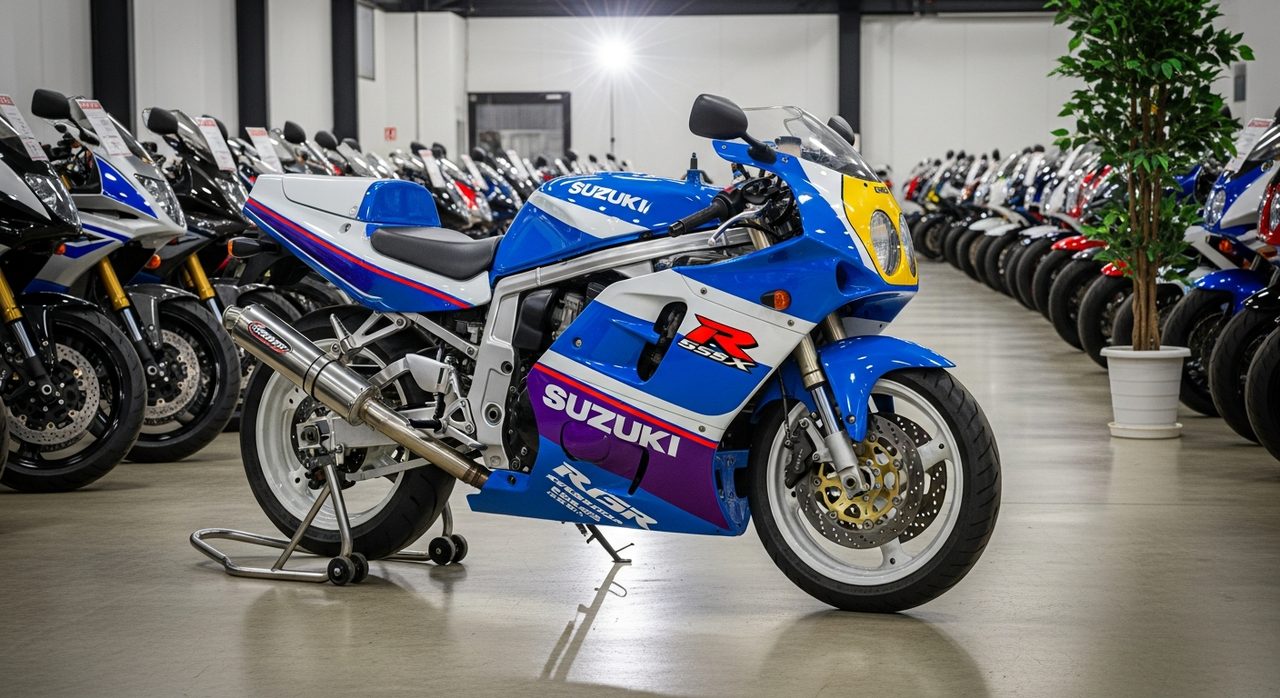
What Is the Suzuki RGV250 Gamma?
The RGV250 launched in Japan in 1988 as the model code VJ21, replacing the parallel-twin RG250 Gamma that had started the race-replica arms race back in 1983. The headline change was the engine: a 90-degree V-twin two-stroke, liquid-cooled, 249cc, fed by 32mm Mikuni carburettors and breathing through Suzuki's AETC exhaust valve system. The V-twin layout came straight from Suzuki's grand prix thinking — narrower frontal area, better primary balance, and expansion chambers that could each take the shape they wanted.
Japan's domestic 250cc class was capped at 45PS by industry agreement, so every JDM RGV250 left the factory claiming exactly that. The chassis was built for far more, which was the entire point: grand prix geometry, a aluminium twin-spar frame, and a dry weight that made modern lightweights look obese, sold to ordinary license holders in a Japan flush with bubble-economy money.
Production ran across three distinct generations — VJ21, VJ22, and VJ23 — that share a name and a philosophy but almost no parts. That matters when you're bidding, because the three generations ride differently, fail differently, and are priced very differently.
One more thing they share: North America never officially got any of them. The UK and Europe received versions of the VJ21 and VJ22, but the VJ23 never left Japan in official trim, and the US received exactly zero RGV250s of any generation. If you want one, it's coming over in a container.
To understand why grown adults bid against each other for 35-year-old 250s, you need the context. Japan in the late 80s had a tiered licensing system that made 250cc machines the practical ceiling for most riders, a booming economy, and four manufacturers locked in an annual horsepower war. The result was the most exotic small-displacement motorcycles ever built — aluminium twin-spar frames, components lifted from racing programs, engines developed by the same departments running 500cc grand prix campaigns — sold to commuters and students. The RGV250 was Suzuki's weapon, and the Gamma name carried weight: the original RG250 Gamma of 1983 had been the first mass-production motorcycle with an aluminium frame, full stop.
The racing connection wasn't marketing garnish. Suzuki's 500cc grand prix machine was literally called the RGV500, Schwantz's title-winning XR79 among them, and the street RGV250 borrowed its V-twin architecture, its styling, and eventually its exact sponsor liveries. When you bought a Lucky Strike RGV250 in 1994, you were buying the closest thing to Schwantz's bike that money could legally register. That emotional circuit still works — it's why a walkaround video of one Lucky Strike VJ22 has 1.5 million views and 861 comments in 2026, decades after the last one left the line.
RGV250 Specs at a Glance
| Spec | VJ21 (1988-1990) | VJ22 (1990-1995) | VJ23 (1996-late 90s) |
|---|---|---|---|
| Engine | 249cc 90° V-twin | 249cc 90° V-twin, revised | 249cc 70° V-twin, new design |
| Claimed power (JDM) | 45PS | 45PS | 40PS (derestricts far higher) |
| Carburettors | 32mm Mikuni (34mm from 1990) | 34mm Mikuni | 34mm Mikuni |
| Swingarm | Conventional aluminium | Curved "banana" aluminium | Braced aluminium, new frame |
| Signature trait | Lightest, purest, cheapest | The definitive RGV, most supply | The exotic one, Japan-only |
| Famous livery | Pepsi Suzuki | Lucky Strike | Lucky Strike |
All three run exhaust power valves and oil injection, and all three deliver the thing four-strokes never have: that moment around 7,500 rpm when the expansion chambers come on song and the bike simply leaves. A 128 kg motorcycle with grand prix geometry doesn't accelerate so much as teleport.
One rider who bought a VJ22 new in 1994 put it plainly in a YouTube comment that's still getting replies decades later: the bike scared him for his first three months of ownership until he learned to ride around the powerband. That's not a defect. That's the product.
Why Import an RGV250 From Japan Instead of Buying Locally?
Three reasons: supply, condition, and price. Plus a fourth specific to the RGV — scarcity is hitting this model harder than its rivals.
Supply. Outside Japan, RGV250s surface a handful of times a year, usually through specialist importers who already priced in their margin. Japanese auction houses run thousands of bikes weekly, and the 250cc two-strokes appear constantly because Japan is where they all were sold in the first place. Even so, a warning from the source: one of Japan's best-known used bike dealers, whose walkaround of a 1991 VJ22 has pulled over 440,000 views, describes the Gamma as "a time machine you can no longer buy" — and his comment section agrees, with Japanese riders noting that while NSRs and TZRs still show up regularly, clean Gammas have become genuinely hard to find even in Japan. The supply is real but shrinking.
Condition. Japanese bikes live gentler lives — lower average speeds, mandatory shaken inspections, and a culture of dealer servicing. Auction bikes come with an independent inspection sheet grading frame, engine, and cosmetics before you bid. Our guide to reading Japanese auction inspection sheets covers how that works. A 30-year-old two-stroke with documented condition beats a Craigslist mystery every time.
Price. Imported, titled RGV250s sell at US collector auctions for strong money — clean VJ22s have been crossing the block at premium prices, and VJ23s trade in five figures wherever they appear. At Japanese auction, a comparable bike hammers for roughly half the US retail figure before shipping and fees. A fully restored 1991 VJ22A — repainted, rebuilt, 37,000 km — was recently listed by a Japanese dealer at 599,900 yen, which is about $4,000. Try finding that bike, in that condition, for that money, anywhere in the English-speaking world.
Scarcity trajectory. Here's the data point that should focus your mind. In the comments of the most-watched RGV250 video on YouTube — a Lucky Strike VJ22 filmed at the Goodwood Festival of Speed, 1.5 million views and counting — a UK collector mentions owning nine RGV250s plus an Aprilia RS250, most bought for under £500 each twenty years ago. Those same bikes are now worth thousands apiece. The era of cheap RGVs ended a decade ago; the era of available RGVs is ending now. Browse our current listings — two-stroke replicas come through regularly, and they don't linger.
The Three Generations: VJ21 vs VJ22 vs VJ23
VJ21 (1988-1990): The Original V-Twin
The first RGV250 is the lightest and rawest of the three. Early bikes ran 32mm carbs; the 1990 update brought 34mm Mikunis with a single air bleed. The Pepsi Suzuki livery — celebrating Schwantz's colours in the 1988 and 1989 grand prix seasons — is the one everybody wants, and J-spec bikes are easy to identify: teardrop indicators, oval mirrors on concertina stalks, kph speedometers with speed warning lights, and drilled brake discs.
Worth knowing for your bidding strategy: the Japanese home market always ran a model year ahead of the export markets in spec and updates. The original 250J went on sale in Japan in 1988 while export markets waited, so a JDM bike of any given year is often the more developed machine than its same-year UK sibling. Auction sheets list the first-registration date — your agent can decode which actual spec you're looking at.
The VJ21 is the budget entry into RGV ownership and arguably the purest. It's also the oldest, which means every rubber part, seal, and wiring connector is approaching its fortieth birthday. The bikes are light, the steering is telepathic, and the riding experience is the least filtered of the three generations. Buy on condition, not on price.
VJ22 (1990-1995): The Definitive Gamma
The VJ22 is the RGV250 most people picture: sharper bodywork, upside-down forks, and the famous curved "banana" swingarm engineered to clear the right-side expansion chamber. This is the generation with the most production, the most parts support, and the most variants — standard, SP with dry clutch and close-ratio gearbox, and the Lucky Strike editions that mirror Schwantz's factory racer.
It's also the generation the market has decided is the sweet spot. The Goodwood Lucky Strike video mentioned above isn't an outlier — VJ22 content dominates RGV YouTube, including a German owner's VJ22B with a GP-spec engine build that's pulled over 420,000 views. When a Japanese restorer rebuilt one of the 240-unit limited edition VJ22s to as-new condition, the resulting video drew 440,000+ views and a comment section full of people asking how to buy one. Demand is global. Supply is one country.
VJ23 (1996 onward): The Japan-Only Exotic
The final Gamma is a different machine entirely: a new 70-degree V-twin in a new frame, lighter and more compact than the VJ22, with styling that still looks current. Suzuki never officially exported it, and production was short — which is why Aprilia bought the engine design for its RS250, giving the VJ23 powertrain a second life in Italian dress.
The VJ23 is the collector piece. US importers list them at strong five-figure prices when they can find them, and SP versions command more. Since the late-90s build dates have now all cleared the 25-year line, 2026 is effectively the first era when the entire VJ23 run is US-legal — and the early-mover advantage belongs to whoever bids first.
A note on character: the VJ23's 70-degree engine is smoother and its chassis more modern, which makes it the easiest Gamma to ride fast — and, some owners argue, the least vintage-feeling. If you want the time-machine hit of a 90s two-stroke, the VJ22 delivers it harder. If you want the most capable machine and the strongest collectible trajectory, the VJ23 is the play. There's no wrong answer at this end of the market, only different invoices.
The 25-Year Rule: Every RGV250 Is Now US-Legal
The US federal rule is simple: a vehicle 25 years or older is exempt from FMVSS requirements, and at 21 years it clears EPA. Count from the month of manufacture. A motorcycle built in March 1999 became importable in March 2024.
For the RGV250 in 2026, the math is finished:
- VJ21 (1988-1990): legal since 2013-2015. Long clear.
- VJ22 (1990-1995): legal since 2015-2020. All clear.
- VJ23 (1996 onward): the last bikes crossed the line by 2024. All clear.
This is the same pattern that played out with the NSR250R and TZR250: as each model year crossed the exemption line, American collector money switched on and started draining the Japanese supply. The RGV is mid-wave right now. Our NSR250 guide documents what happened to that model's prices once the US market opened — MC28 SPs that traded for $6,000 a decade ago now clear $15,000-20,000. The RGV is following the same curve, a few years behind.
The paperwork side is lighter than people fear. The 25-year FMVSS exemption is documented by NHTSA's vehicle importation rules, and the EPA's imports program confirms the 21-year emissions exemption — your customs broker files an HS-7 form with Box 1 ticked and an EPA 3520-1 with code E, and a 1990s RGV qualifies on age alone. No conversion, no bond, no compliance shop. Keep a copy of the auction sheet and the export certificate showing the first registration date; that single document is what proves the bike's age to every agency that asks.
UK buyers: no age restriction — register through the NOVA process, pay import VAT, and use the MSVA route for unregistered bikes. Our NOVA registration guide walks through it. Australia: bikes manufactured before 1989 come in under the pre-1989 scheme, later ones need SEVS eligibility — the VJ21's first year lands pre-1989, which is a quiet bargain. New Zealand: 20-year-plus bikes clear the special interest route comfortably.
What RGV250s Cost at Japanese Auctions in 2026
Here's what the money actually looks like in 2026. Japanese auction hammer prices for RGV250s, in rough USD terms:
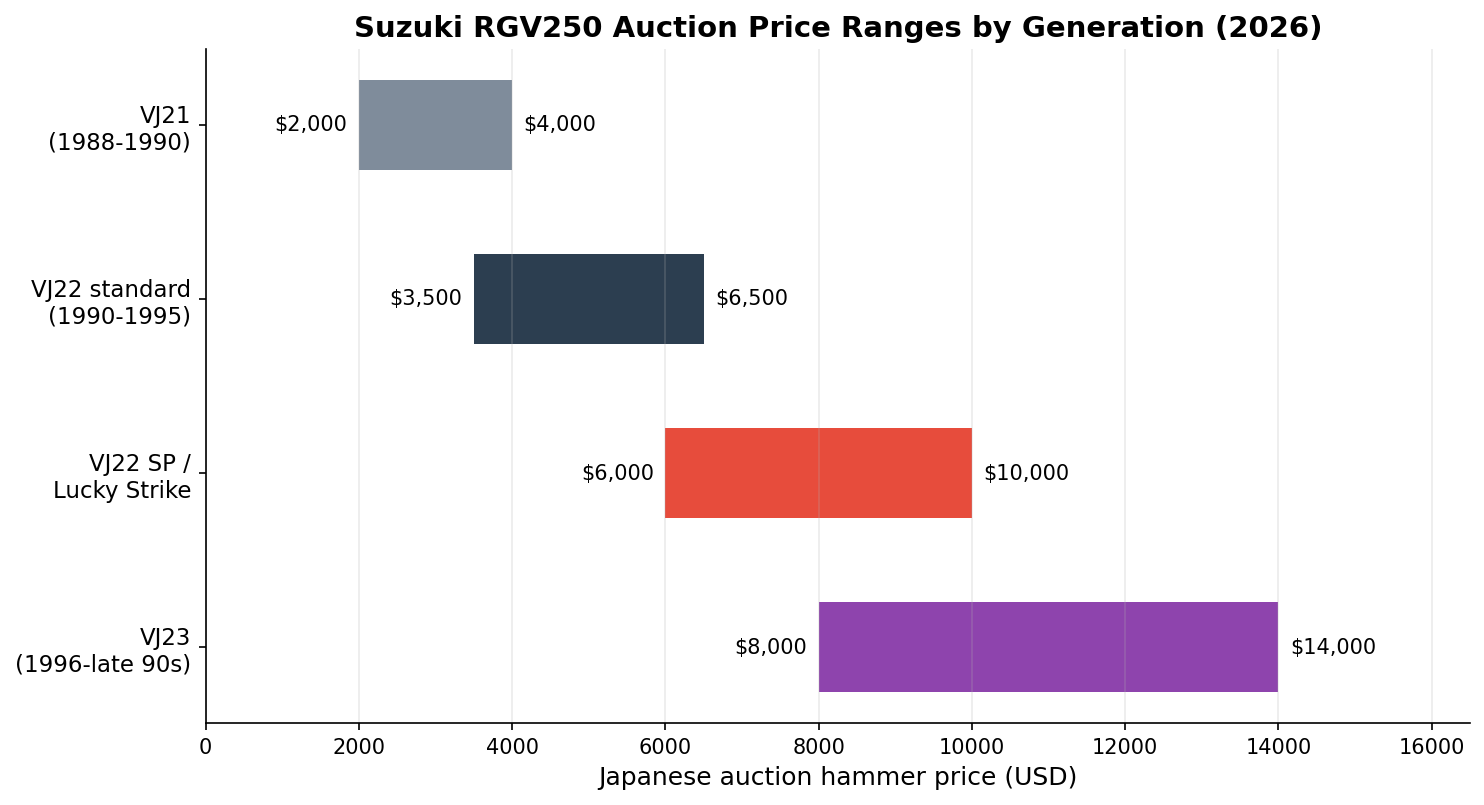
- VJ21: $2,000-4,000 for usable bikes, $5,000+ for clean Pepsi-livery examples
- VJ22 standard: $3,500-6,500 for grade 3.5-4 bikes; dealer-restored examples around $4,000-6,000 retail in Japan
- VJ22 SP / Lucky Strike: $6,000-10,000 and climbing every season
- VJ23: $8,000-14,000 at auction when they appear; US retail well above that
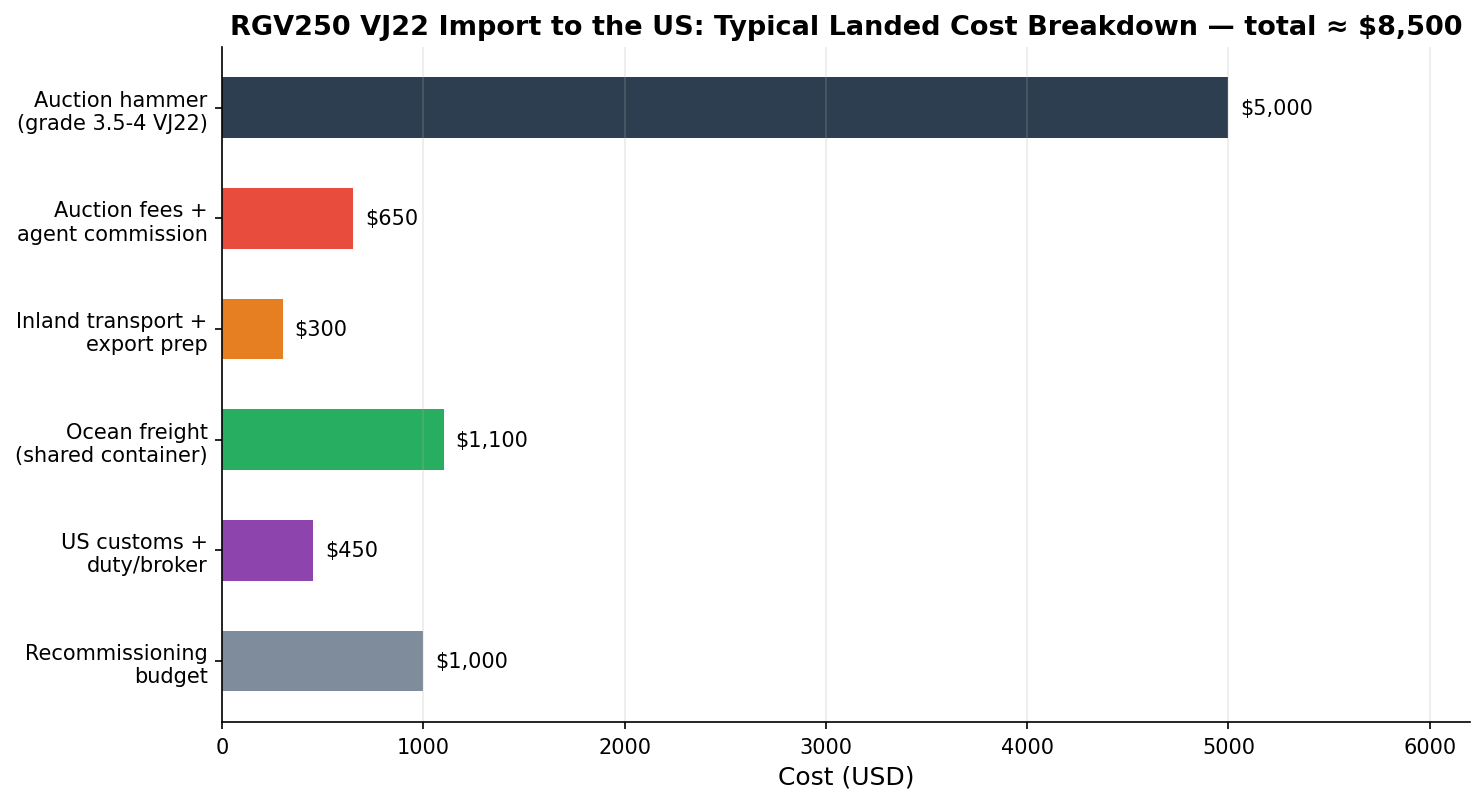
On top of the hammer price, budget for auction fees and agent commission (typically $500-800 combined), inland transport and export prep in Japan ($200-400), and ocean freight ($800-1,500 depending on destination and whether you share a container — our container vs RoRo comparison breaks down that choice).
Then the destination taxes. The US treats motorcycle imports gently. The UK adds import VAT on the whole landed value, which stings. Australia and New Zealand add GST plus compliance costs.
Realistic landed totals for a clean VJ22 standard: around $6,000-9,000 into the US, £5,500-8,500 into the UK, and AU$10,000-14,000 into Australia. Compare that with what titled, imported examples fetch at US collector auctions and the arithmetic explains itself — you're buying at wholesale and skipping the importer's margin.
The yen helps too. Japanese sellers price in yen; your budget arrives in dollars or pounds. With the yen spending the mid-2020s historically weak, your money buys more bike at a Japanese auction than it has in years.
One budgeting habit that separates happy importers from bitter ones: price the bike you'll own in a year, not the bike on the auction sheet. A $5,000 hammer price on a grade 3.5 VJ22 plus $2,000 of landing costs plus $1,000 of recommissioning is an $8,000 motorcycle. That's still excellent value against US retail — but if you bid like $5,000 is the whole story, the follow-up invoices will sour a purchase that was actually fine. Run the full number before the auction starts, set the ceiling, and let your agent do the bidding without you watching the live feed at 3 a.m. — auction adrenaline has talked more people past their budget than any salesman ever did.
Known Problems: Power Valves, Crank Seals, and the Parts Situation
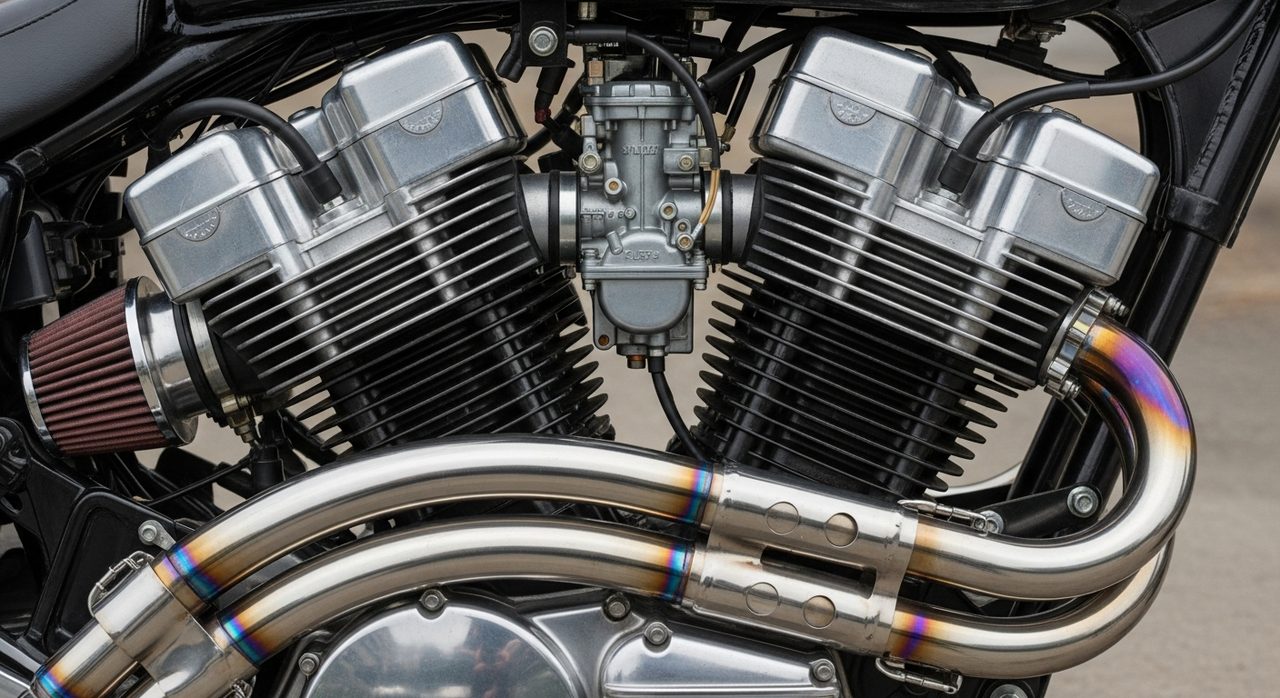
Every RGV250 is now 27 to 38 years old, and the engine is a consumable on a two-stroke — that's the deal you signed. Here's the model-specific list, drawn from the owners and specialists who live with these bikes.
Power Valve Carbon and the Roll Pin
The RGV's exhaust power valves collect carbon with every heat cycle. Left long enough, the deposits build until the valve protrudes into the bore and scores the piston — at which point your bargain auction win becomes a top-end rebuild with possible cylinder replating. The specific weak point on the VJ22 is the roll pin holding the three blades of the power valve unit together; when it lets go, the debris goes somewhere expensive.
On a test ride or auction video, the tell is the transition: power valve operation around 7,500 rpm should be smooth and decisive. Hesitation, flat spots, or a valve servo that doesn't cycle on key-on means budget for a strip-down. And treat any bike advertised with "modified" power valves or non-standard reeds with suspicion — in the RGV world those are usually masking wear, not adding performance.
Crank Seals
Crank seals age out on any two-stroke that sits, and the RGV is no exception. Failed seals lean out one cylinder, and lean two-strokes seize. Look for oil weeping around the seal areas, uneven idle, or smoke that persists long after warm-up. A cold-start video from the seller or auction house is worth more than any written description — uneven firing when cold is the seal warning.
Cooling and Heat History
Inspect the expansion chambers for blueing or warping. On an RGV that's the signature of overheating, and overheating on a two-stroke V-twin usually means somebody got away with it — once. The auction sheet's engine column matters more on this model than almost any other; our auction grades guide explains how to read it.
The Parts Reality
Here's the honest picture: consumables and tuning parts are abundant — Japanese parts retailers list over 2,000 items for the RGV250 — but model-specific gaskets and some engine internals are getting scarce, and chain wear is famously rapid on these bikes. The VJ23 is hardest to support; the Aprilia RS250 connection helps with engine parts but not chassis items. Factor a sorting budget of $500-1,500 into any purchase, and find your two-stroke specialist before the bike lands, not after.
What the Auction Sheet Tells You About an RGV250
Auction sheets were designed for five-year-old commuter bikes, so reading one for a 1992 race replica takes translation. Here's what matters on a Gamma specifically:
The overall grade. Grades run from S (new) down through 4, 3.5, 3, and lower. For a 30-year-old two-stroke, grade 4 is exceptional and priced like it, 3.5 is the sweet spot of condition versus money, and grade 3 means visible history — acceptable if the engine notes are clean, a trap if they aren't. Anything below 3 is a parts donor or a full restoration project; bid accordingly or not at all.
The engine column. This is where the sheet earns its keep on an RGV. Notes like "white smoke," "idling instability," or "engine noise" carry completely different price implications on a two-stroke than on a four-stroke. Some white smoke at start-up is the engine working as designed. Smoke that persists hot, or a note about uneven idle, points at crank seals — and a crank seal job on a V-twin means engine-out labour. The kanji notations are dense; this is precisely the translation work an agent does before you commit money.
The frame and fork notes. These bikes got crashed. They were sold to young riders, ridden at ten-tenths, and many went down the road at least once. The diagram on the sheet marks scratches (A), dents (U), and corrosion (S) with severity numbers. Pay attention to clustering — marks concentrated on one side, plus a note in the fork column, sketches the accident for you. Straight frames matter more than pretty fairings; plastic can be sourced, geometry can't.
Mileage and what it doesn't tell you. A 12,000 km RGV sounds like a gift until you remember that two-strokes measure life in heat cycles and maintenance, not distance. A 30,000 km bike with a documented top-end rebuild beats a 12,000 km bike that sat in a shed for fifteen years with fuel in the carbs and tension on the same chain. Look for the service notations, ask your agent to photograph the maintenance stickers Japanese shops leave under the seat, and treat storage history as seriously as mileage.
Modification flags. The sheet will note aftermarket exhausts and bodywork. On RGVs, chambers from Japanese tuning houses are common and often desirable — but a bike wearing race chambers, braced subframes, and safety wire has lived a track life regardless of what the odometer claims. Price the engine as tired and be pleasantly surprised.
Why RGV250 Values Are Rising (And Why 2026 Is the Window)
Two-stroke race replicas are the fastest-appreciating corner of the Japanese classic market, and the pattern repeats model by model. Honda NSR250s moved first — MC28 SPs that traded for $6,000 a decade ago now clear $15,000-20,000 at US collector auctions. The TZR250 is mid-climb. The RGV sits in a peculiar spot: lower production than either rival, higher attrition, and a fanbase that's only now getting US legal access to the full model range.
Three forces are pushing prices:
The 25-year wave. US demand switches on as each model year crosses the exemption line, and the final RGVs only cleared in 2024. American collector money is currently working through a Japanese supply that Japanese dealers already describe as thin. Every bike shipped west shrinks the pool permanently.
Nostalgia with money. The riders who taped Schwantz posters to their walls in 1993 are in their late forties and fifties now, with garage space and disposable income. This is the same demographic engine that inflated air-cooled 911s, R32 Skylines, and NSR250s. It does not reverse — it just moves to the next poster.
Finite supply, shrinking grid. Emissions law killed the two-stroke street bike forever; nobody is making more. Every seized crank, every crashed VJ22, every parts-bike teardown permanently removes one from a population that was never large. The UK collector who bought nine of them at under £500 apiece twenty years ago wasn't lucky — he was early. The choice in 2026 isn't whether to pay more than he did. It's whether to pay 2026 prices or 2029 prices.
None of this makes an RGV250 a guaranteed investment — buy it to ride it. But on current trajectory, waiting two more years will cost real money.
SP Models and Special Editions: What the Badges Mean
Suzuki ran a parallel line of homologation and special-edition Gammas, and the badges carry real money:
RGV250 SP (VJ22): dry clutch, close-ratio gearbox, adjustable suspension, and solo seat. Built for production racing homologation. The dry clutch rattle at idle is correct — it's supposed to sound like a tin of bolts. SPs carry a 30-50% premium over standard bikes and earn it.
Lucky Strike editions: the Schwantz-replica livery on the VJ22 (and later the VJ23) is the most recognisable two-stroke paint scheme of the era. The Goodwood video that's pulled 1.5 million views? Lucky Strike VJ22. Original-paint examples command serious premiums; resprayed tributes don't.
Pepsi VJ21: the 1988-89 GP livery, and the defining look of the first generation. Watch for repaints — original decals and correct fasteners separate the real thing.
Limited production runs: Japan received small-batch editions the export markets never saw — the recent Japanese restoration video of a 240-unit limited VJ22 is a reminder that JDM auction listings sometimes contain variants Western buyers don't even have a reference for. When an unusual spec appears on an auction sheet, research before dismissing the premium. Sometimes it really is one of 240.
RGV250 vs NSR250 vs TZR250: Picking Your Two-Stroke
The eternal question, and the comment sections settle nothing — one of the most-liked comments under the Goodwood video simply lists all of them: "The RGV250, TZR250, NSR250 and RS250 are some of the most beautiful bikes ever." But here's the practical breakdown for an importer:
Honda NSR250R — the most developed, the most available, the most expensive at the top end (MC28 SP money is serious). The sensible-exotic choice. Full details in our NSR250 import guide.
Yamaha TZR250 — three wildly different generations, the last big-three model where clean bikes still trade in single-digit thousands. The value play. Covered in our TZR250 import guide.
Suzuki RGV250 — the rawest powerband of the three, the strongest racing pedigree per dollar, and the model Japanese dealers themselves describe as the hardest to find clean. The VJ22 is the best blend of character, parts support, and price in the entire two-stroke replica market. The VJ23 is the exotic that out-rares all of them.
The honest answer: the right two-stroke is the one that hits your budget in good condition at this week's auction. All three are appreciating. All three are finite. Riders cross-shop them, and so should you — set your grade and condition floor first, then bid on whichever of the three crosses the block next.
Step-by-Step: How to Import an RGV250 From Japan
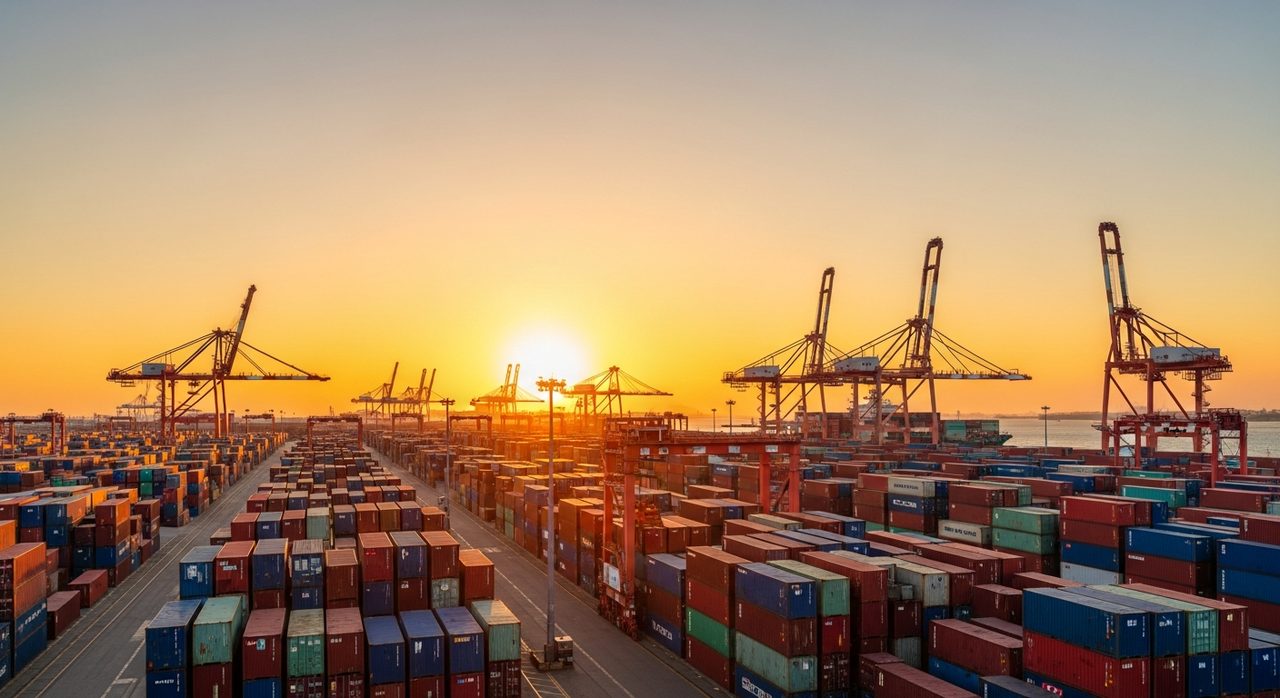
The process is the same machinery we've documented across this site, tuned for a fragile 30-year-old two-stroke:
Step 1 — Set the target. Pick your generation and condition floor. For a first RGV, a grade 3.5-4 VJ22 standard is the rational target: enough supply to be choosy, enough parts to stay running.
Step 2 — Get auction access. The big Japanese auction houses are dealer-only. You bid through an export agent — that's what we do at AWA Auction — who provides the auction sheet translation, extra photos, and a condition assessment before you commit.
Step 3 — Read the sheet like a two-stroke buyer. Overall grade matters less than the engine column and the memo notes. "White smoke" can be normal two-stroke behaviour or a crank seal dying; the difference is whether it clears with warm-up. This is exactly the call your agent earns their fee on.
Step 4 — Bid with the full landed cost in mind. Set your maximum as landed-cost-minus-fees, not as the hammer price. The chart above gives you the framework.
Step 5 — Ship smart. Crated container shipping protects 35-year-old plastic bodywork that no longer exists new. RoRo is cheaper but exposed. For an SP or Lucky Strike, the crate is non-negotiable — replacement fairings cost more than the freight difference.
Step 6 — Clear customs and register. US: file the EPA and DOT exemption forms (over-25 bikes sail through), pay duty on the declared value, done. UK: NOVA declaration, VAT, MSVA test, age-related plate. Australia: import approval first, then compliance. Our full import guide covers each path in detail.
Step 7 — Recommission before you ride. Thirty-year-old fuel lines, crusty carbs, and tired seals don't survive the first hard run. Budget the first $1,000 for fluids, seals, tyres, and a carb service. Have the power valves pulled and decarboned while the bike is apart — it's an hour of labour now versus a scored piston later. Then find a road with corners.
Timeline expectations, end to end: one to three weeks of auction watching depending on how specific your target is, a week for payment and inland transport, two to six weeks on the water depending on route and method, and one to two weeks for customs and registration. Call it two to three months from "that one" to riding it. The bikes waited thirty years; they'll survive a slow boat.
How AWA Auction Gets You an RGV250
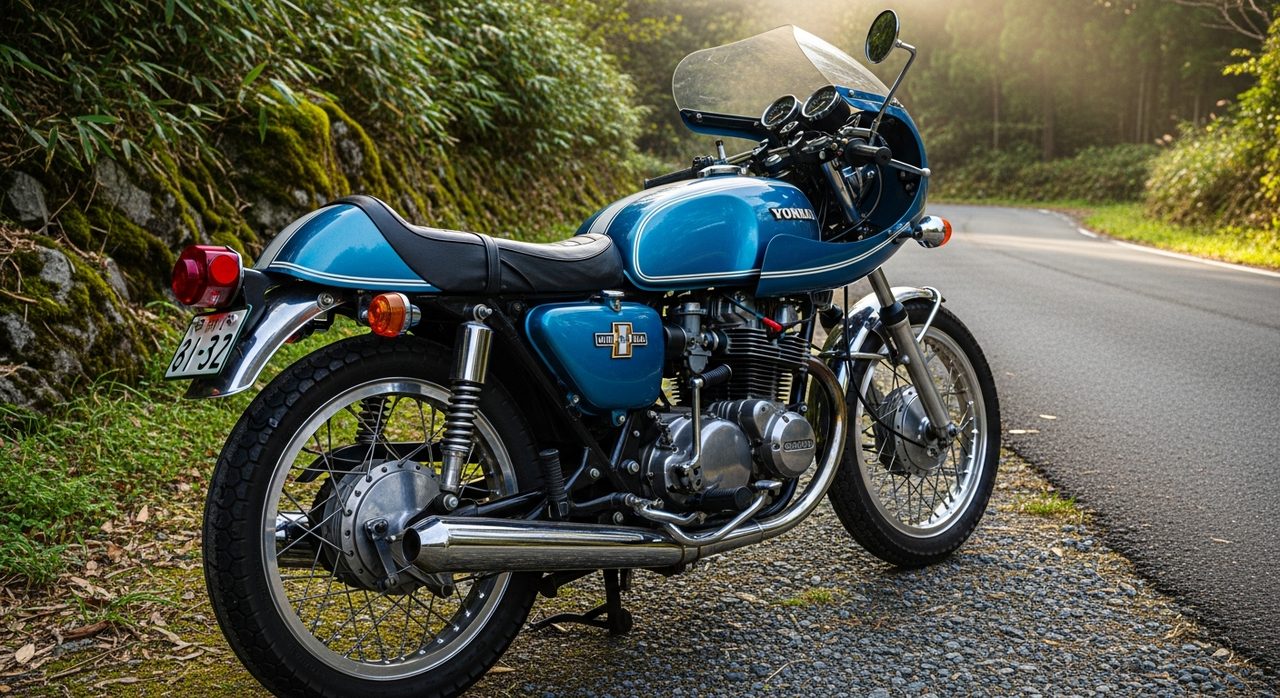
We're the agent on the ground in Japan. AWA Auction gives you direct access to the dealer-only auction network where RGV250s actually trade — the same auctions Japanese shops buy from, before retail margin gets added.
For a two-stroke replica specifically, that means: auction sheet translation with an honest read on the engine notes, extra photos and video of the power valve and chamber condition where access allows, bidding strategy built on real recent hammer prices, and crated export shipping that treats irreplaceable bodywork like the unobtainium it is.
The RGV250 window is open — every generation legal in the US, prices mid-curve, and the yen on your side. Windows close. Browse the current listings to see what's crossing the block now, or tell us the exact spec you're hunting — generation, colour, grade floor — and we'll watch the auctions until it appears.
See Also
Share this article: