
Here's a number that should reframe how you shop for a cruiser: a tidy Honda Steed 400 leaves a Japanese auction for the equivalent of about $1,900, and one mid-tier exporter alone lists over 450 of them in stock right now. Meanwhile a brand-new beginner cruiser in the US or UK starts near $7,000–$8,000 — and that's before you've added a single chrome bolt. That gap is the whole story.
This guide covers the best Japanese cruiser motorcycles to import from Japan in 2026: the JDM-only 400s nobody outside Asia talks about, the big-bore V-twins worth shipping across an ocean, what each one actually costs once it's landed in your driveway, whether your country's import rules are on your side yet, and the cruiser-specific things to check before you bid. Japan built more relaxed, reliable, beautifully-finished metric cruisers than any market on earth — and a huge slice of them never officially left the islands. You just need to know which ones to chase.
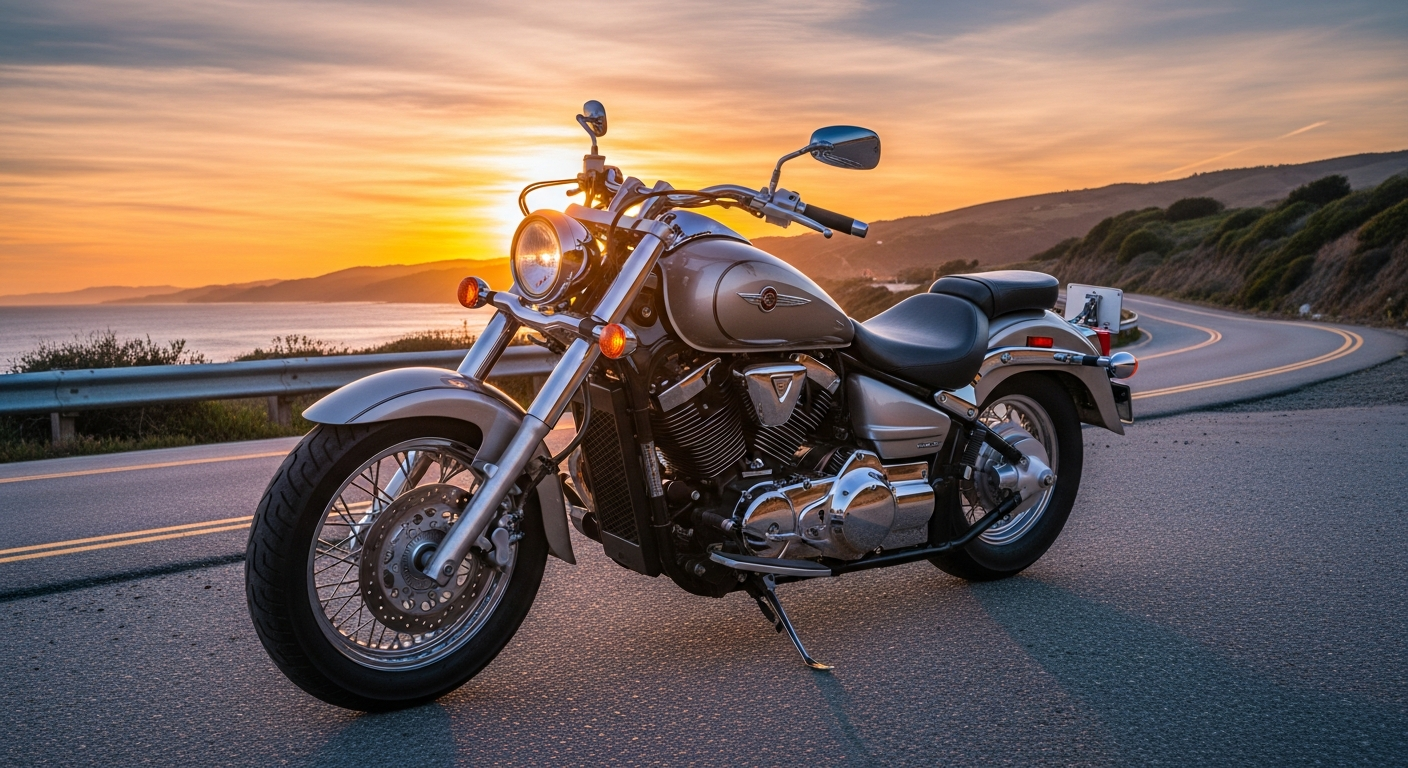
Why a Japanese Cruiser Is the Smartest Cruiser Import Right Now
Cruisers age differently than sportbikes. A 20-year-old supersport has usually been thrashed, crashed, or chopped. A 20-year-old cruiser has usually been ridden gently to a coffee shop and back by someone who waxed it on Sundays. Japan's cruiser owners are famously easy on their machines, and the country's strict shaken inspection regime means even a cheap bike has a paper trail of maintenance behind it.
Then there's supply. Japan is the largest exporter of used motorcycles in the world, and its domestic market is awash in cruisers that western buyers rarely see in those numbers. When FortNine called a basic metric cruiser "the best used motorcycle to buy," the comments filled with people asking the same question: where do I find a clean one that hasn't been beaten to death? The answer, more often than not, is a Japanese auction hall.
And the money makes sense. Watch Yammie Noob's "Top 5 BEST Beginner Cruiser Motorcycles" (1.28 million views) and the most relatable comment isn't about horsepower — it's a rider grumbling that the two "beginner" bikes recommended "are both almost 11k... if I mention these to an actual beginner I'll get laughed out of the room." Importing flips that math. A clean JDM 400 cruiser lands for less than half the price of a new entry-level machine, and you get a real V-twin with character instead of a stripped-down starter bike.
One more thing the listicles miss: Japanese cruisers are the world's best custom-build base. Steeds and DragStars are the backbone of Japan's legendary chopper and bobber scene — search "Japanese chopper culture" on YouTube and you'll find clips with 16 million views built almost entirely on these frames. Import the donor, build the dream.
It's worth dwelling on why the condition is so consistently good. Japan's shaken roadworthiness system makes keeping an old bike on the road relatively expensive, so owners either maintain meticulously or sell on — and the sell-on pipeline runs straight into the dealer auctions. Add a culture that treats vehicles as things to be cared for rather than used up, mild winters in much of the country, and low average mileage, and you get a used market where "clean" is the norm rather than the exception. That's the real product you're importing: not just a cruiser, but a cruiser that was looked after.
The Two Worlds of Japanese Cruisers
Before you start bidding, understand that "Japanese cruiser" means two very different things depending on engine size, and they live in two different corners of the auction.
World one: the JDM 400cc class. Japan's licensing tiers made the 400cc category enormous — a mid-license rider could own a "big" bike without the hardest test, so manufacturers built gorgeous, full-size-looking 400 cruisers exclusively (or mostly) for the home market. The Honda Steed 400, Yamaha DragStar 400 (sold abroad as the V-Star 400 / XVS400), Suzuki Intruder 400, and Kawasaki Vulcan/Eliminator 400 are the stars here. Most never sold new in the US, UK, or Australia, which is exactly why importing is the only realistic way to get one.
World two: the global big-bores. Honda Shadow, Yamaha V-Star/Dragstar 650–1100, Kawasaki Vulcan 800–1700, and the Suzuki Intruder/Boulevard line up to the monster M109R. These were sold worldwide, but Japanese-market and Japanese-auction examples are frequently cleaner, lower-mileage, and cheaper than equivalent bikes in your home market — even after shipping.
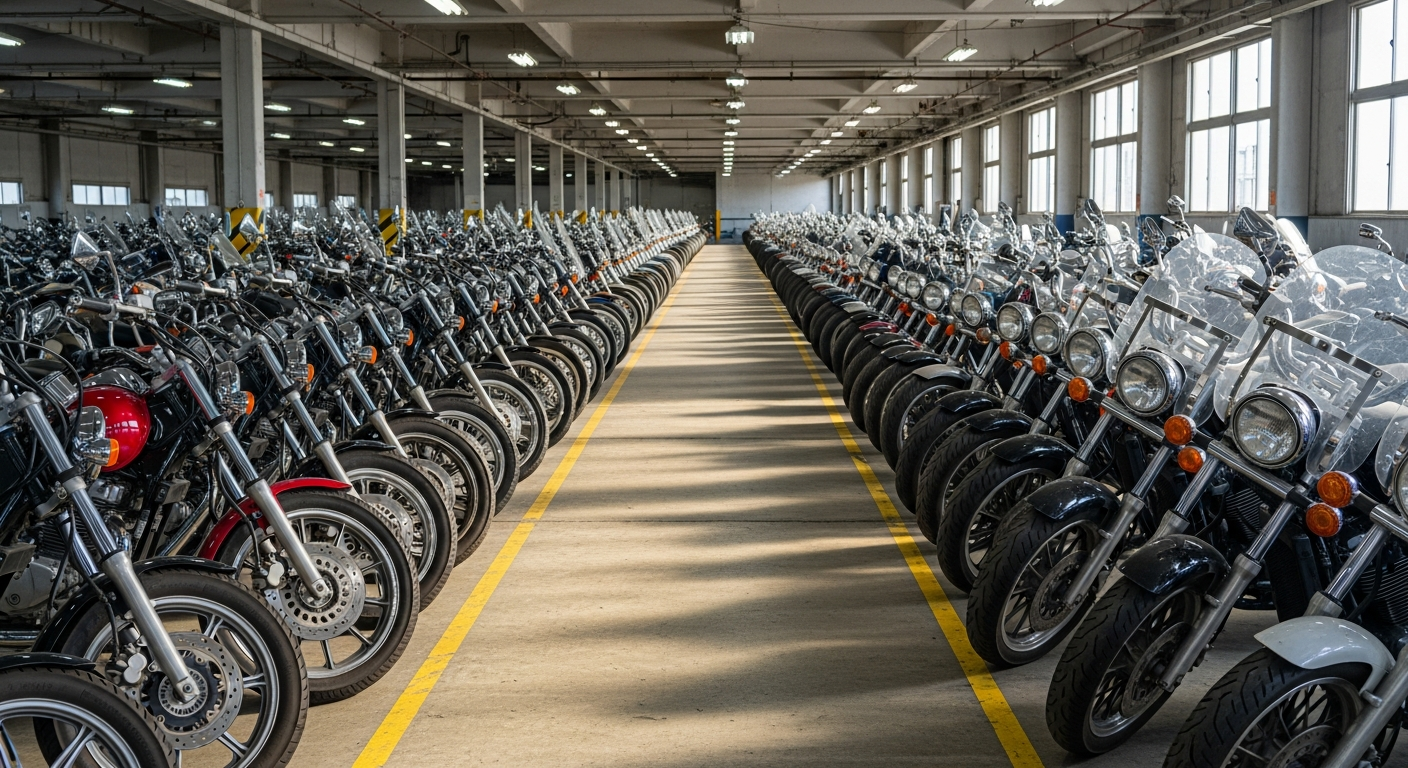
The split matters for your wallet and your paperwork. The 400s are import-or-nothing and tend to be the cheapest path to a characterful cruiser. The big-bores are about condition arbitrage — buying a nicer example than your local market offers. We'll cover both.
There's a third, smaller world worth a nod: the retro and special-interest cruisers — Honda's Magna V4, Yamaha's V-Max-adjacent muscle, and oddball limited runs that only ever sold in meaningful numbers at home. These reward the buyer who knows what they're looking at, and the Japanese auctions are where they surface. We'll touch on the standouts, but the two main worlds — JDM 400s and global big-bores — are where most buyers should start.
The JDM 400cc Cruiser Trio: Steed vs DragStar vs Intruder
This is the heart of the Japanese cruiser import game, and it's where the most heated owner debates live. A popular Russian-language review titled "Top 3 most popular 400cc cruisers: Honda Steed, Yamaha Dragstar, Suzuki Intruder" pulled 243,000 views — and its top comment (490 likes) is a warning every importer should take to heart: "Very superficial review, clearly from a seller and not an owner. As someone who owns both a Shadow and a Drag, the differences absolutely exist and they're not minor." So let's talk like owners, not sellers.
Honda Steed 400
The Steed (1988–2002) is the chopper-builder's darling. Honda offered it in two flavours that matter to importers: the Steed 400 (398cc) and the larger Steed 600 (583cc), both sharing the same lean silhouette. Early VLX-derived models and the later VCL versions differ in spoke wheels, tank shape, and seat height, so confirm exactly which variant you're bidding on. The 400's appeal in Japan was license-driven; abroad, it's pure style-per-dollar. It uses a 398cc air-cooled V-twin derived from Honda's VT engine family, with a long, low, slammed stance that looks fantastic with minimal modification. Steeds run a chain final drive — unusual for a cruiser — which makes them lighter and cheaper to customize but means you actually have to maintain the chain. In Japan's custom scene the Steed is to bobbers what a blank canvas is to a painter. If your plan is to build something, start here.
Yamaha DragStar 400 (V-Star 400 / XVS400)
The DragStar (1996 onward) is the comfort-and-keep-it-stock choice. It's a 399cc air-cooled V-twin with shaft drive, a deeper "thunk" exhaust note, and classic-cruiser ergonomics that owners adore for relaxed riding. One owner in a 397,000-view DragStar review summed up the appeal better than any spec sheet: "I'm 60, I have a Drag 400, and it's plenty for me — I didn't buy it to show off, I ride it and I'm happy." Another, asked whether 400cc is enough for highway work, answered by pointing out he toured thousands of kilometres on the bigger DragStar 650 "and it never let me down." The DragStar is the one to buy if you want to ride it as-is for years.
Yamaha sold the DragStar 400 in two main trims: the standard Custom (raked-out, spoke front wheel, lower and longer) and the Classic (deeply valanced fenders, fat front tyre, fuller retro styling). The Classic is the one most owners covet and the one quietly appreciating. Both use the same reliable 399cc shaft-drive V-twin, so the choice is purely about looks and ergonomics. Whichever you pick, the DragStar's reputation for just-keep-running dependability is why so many first-time cruiser buyers in Japan never trade theirs away.
Suzuki Intruder 400
The Intruder 400 is the value pick and the muscle-styled outlier — a 399cc V-twin with a slightly more aggressive look and often the lowest auction prices of the trio. It's the bike enthusiasts quietly recommend when someone's budget is tight but they still want a "proper" V-twin feel. Parts are a touch harder to find than for the Honda or Yamaha, which is precisely why it's cheap. The Intruder line later became the Boulevard badge globally, so the DNA runs all the way up to the monster M109R. As a 400, it's the underdog of the trio — less of a cult following means less competition at auction, and that's good news for your wallet.
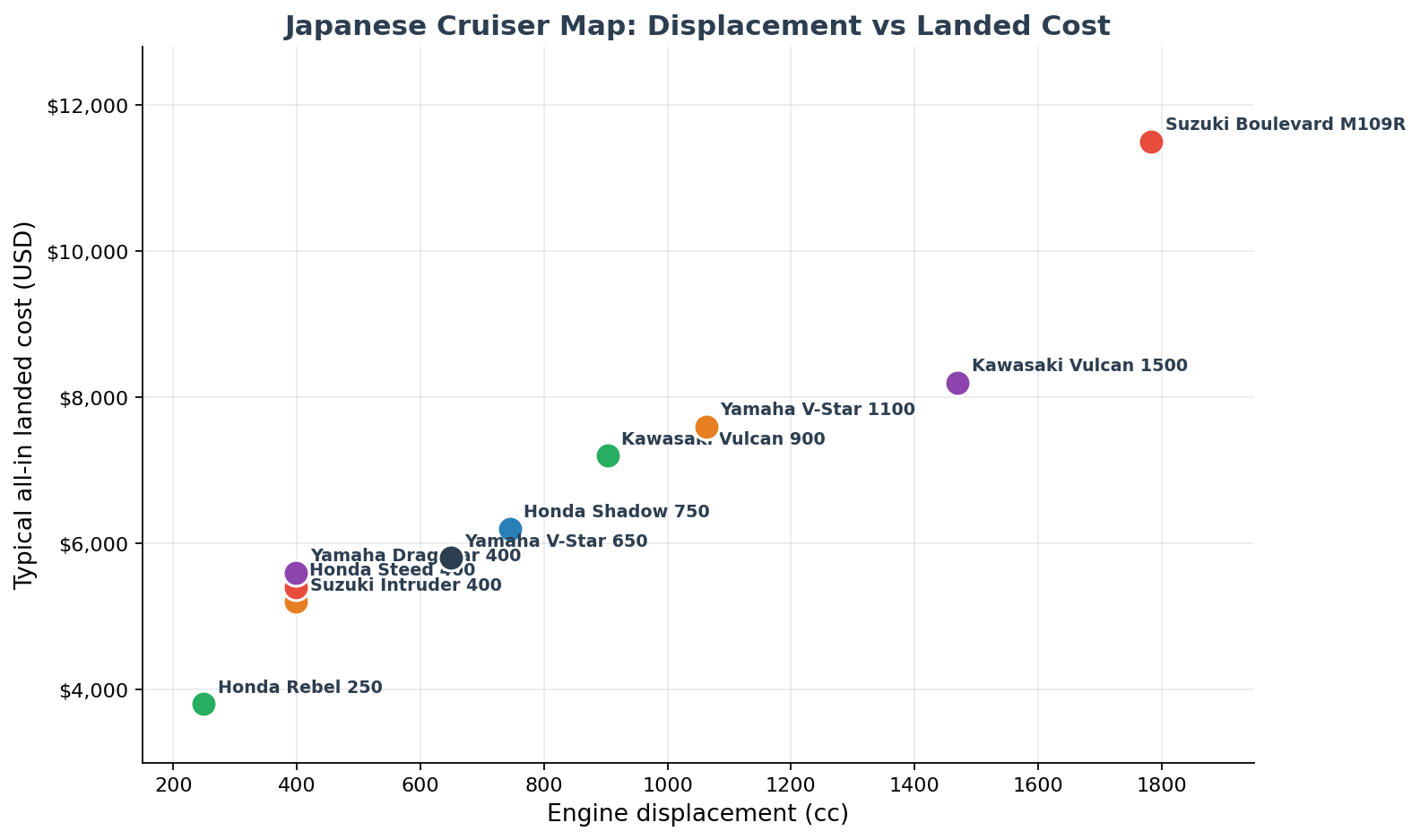
Here's the honest summary the sales videos won't give you: buy a Steed if you want to customize, a DragStar if you want to ride it stock and keep it forever, and an Intruder if you want the most metal for the least money. All three land for roughly $5,000–$6,000 all-in, which is the real headline.
The Big-Bore Japanese Cruisers Worth Importing
If 400cc sounds light for the freeways where you live, the big-bore world is deep — and Japanese auctions are full of low-mileage examples that shame what's sitting on your local classifieds.
Honda Shadow (VT600 / VT750 / VT1100). The Shadow line is the benchmark mid-size metric cruiser and dominated the segment for decades. The 750 is the sweet spot: liquid-cooled, smooth, endlessly reliable, and one of the most-customized cruisers on the planet (the bobber and straight-pipe scene around the Shadow 600 and 750 is enormous on YouTube). A clean Japanese-market Shadow 750 lands around $6,000–$6,500.
One detail the bobber crowd loves: the Shadow's V-twin makes the right noises with very little work, which is why the straight-pipe and custom-exhaust scene around the 600 and 750 is so deep on YouTube. Just remember that a bike modified in Japan still has to pass your country's noise and lighting rules at home, so factor a return-to-sane-exhaust budget into any heavily-piped example.
Yamaha V-Star / DragStar 650, 1100, 1300. Nick Murray's review nicknamed the V-Star "the affordable custom-cruiser," and that's exactly the play. The V-Star 650 is one of the most reliable beginner-to-intermediate cruisers ever built; the 1100 is a genuine highway tourer for V-Star money. Japanese auction examples of both are plentiful.
Kawasaki Vulcan (800 / 900 / 1500 / 1700). The Vulcan range spans from the friendly Vulcan S-style middleweight up to big touring rigs. One commenter on Yammie Noob's beginner-cruiser video captured the segment's loyalty: "Just purchased a 2017 Vulcan S ABS... I'm 58 and recently retired and I'm very much looking forward to my new hobby." Vulcans hold up well and import cleanly.
Suzuki Intruder / Boulevard (800 → M109R). At the top sits the Boulevard M109R — "Japan's most brutal V-twin," producing around 128 hp and 118 lb-ft from its 1,783cc engine. It's one of the fastest production cruisers ever built, and clean examples in Japan cost noticeably less than in western markets.
The wildcard: Honda Magna V4. Don't sleep on the Magna. As one owner put it: "I've got an old '84 Honda Magna V30 — it's a 500cc V4, plenty of power, looks cruiser-ish, and it's quite comfortable." A V4 cruiser is a uniquely Japanese idea, and they're getting collectible.
The Magna borrowed its V4 heart from Honda's sport bikes, which gives it a rev-happy, almost un-cruiser-like character that wins over riders bored by lazy V-twins. They were sold globally but never in huge numbers, and Japanese-auction examples are some of the cleanest left. If you want a cruiser that surprises people, this is it.
Best Japanese Cruiser Motorcycles to Import From Japan, by Rider Type
Picking the "best" cruiser depends entirely on what you want from it. Here's how the field shakes out.
The new rider on a budget: a JDM 400 — DragStar 400 for comfort, Steed 400 for looks. Low seat height, manageable weight, real V-twin character, and it lands for less than half the price of a new beginner bike. This is the segment where importing makes the most obvious financial sense.
The customizer / bobber builder: Honda Steed 400 or Shadow 600/750. These are the donor bikes the entire Japanese and western custom scene is built on. You're buying a starting point, not an ending point.
The relaxed tourer: Yamaha V-Star 1100 or Kawasaki Vulcan 900/1500. Enough torque for two-up highway miles, shaft drive for low maintenance, and bulletproof reliability. Buy the cleanest one the auction grades allow.
The power junkie: Suzuki Boulevard M109R or Yamaha V-Max-adjacent muscle. If you want a cruiser that embarrasses sportbikes off the line, this is your aisle — and Japanese examples are the bargain way in.
And there's a fifth rider worth naming: the returning rider. A huge share of cruiser buyers are people coming back to two wheels in their 50s and 60s — exactly the demographic filling those YouTube comment sections, like the 58-year-old who just bought a Vulcan S to mark his retirement. For that rider, a clean imported V-twin with a low seat and unintimidating power delivery is close to perfect, and importing means getting a pristine example instead of whatever rough local trade-in happens to be for sale.
This is the displacement-versus-cost landscape at a glance:
Country Import Rules for Cruisers (US, UK, Australia, Canada, NZ)
A cruiser is legally just a motorcycle, so the same age-based import rules apply — and they decide which bikes you can actually bring home in 2026.
United States — 25-year rule. Any motorcycle 25 model-years old or older is exempt from NHTSA and EPA requirements. In 2026 that means anything built in 2001 or earlier clears easily on an HS-7 form (box 1). A 1996 Steed or 1998 Shadow is long since legal; 2000–2001 models are unlocking now. Titling happens state by state.
Australia — 25-year rule. Similar 25-year threshold via the import approval system, plus an asbestos check on every vehicle. Pre-2001 cruisers are the clean path.
Canada — 15-year rule. This is the importer's secret weapon. Canada lets in any motorcycle 15 years or older, which means 2011-and-earlier cruisers are fair game today — a full decade more choice than US and Australian buyers get. A 2010 Vulcan 900 you can't touch in America is perfectly legal in Canada.
New Zealand — no blanket age bar. NZ doesn't ban bikes by age; vehicles over 20 years old skip the frontal-impact rule, and motorcycles pay no import duty (just GST). Entry certification and registration apply.
United Kingdom — no age limit. The UK lets you import any age of motorcycle. Older bikes go through the NOVA notification and, depending on age and records, an MSVA test. A 1990s JDM cruiser is one of the easiest things you can register.
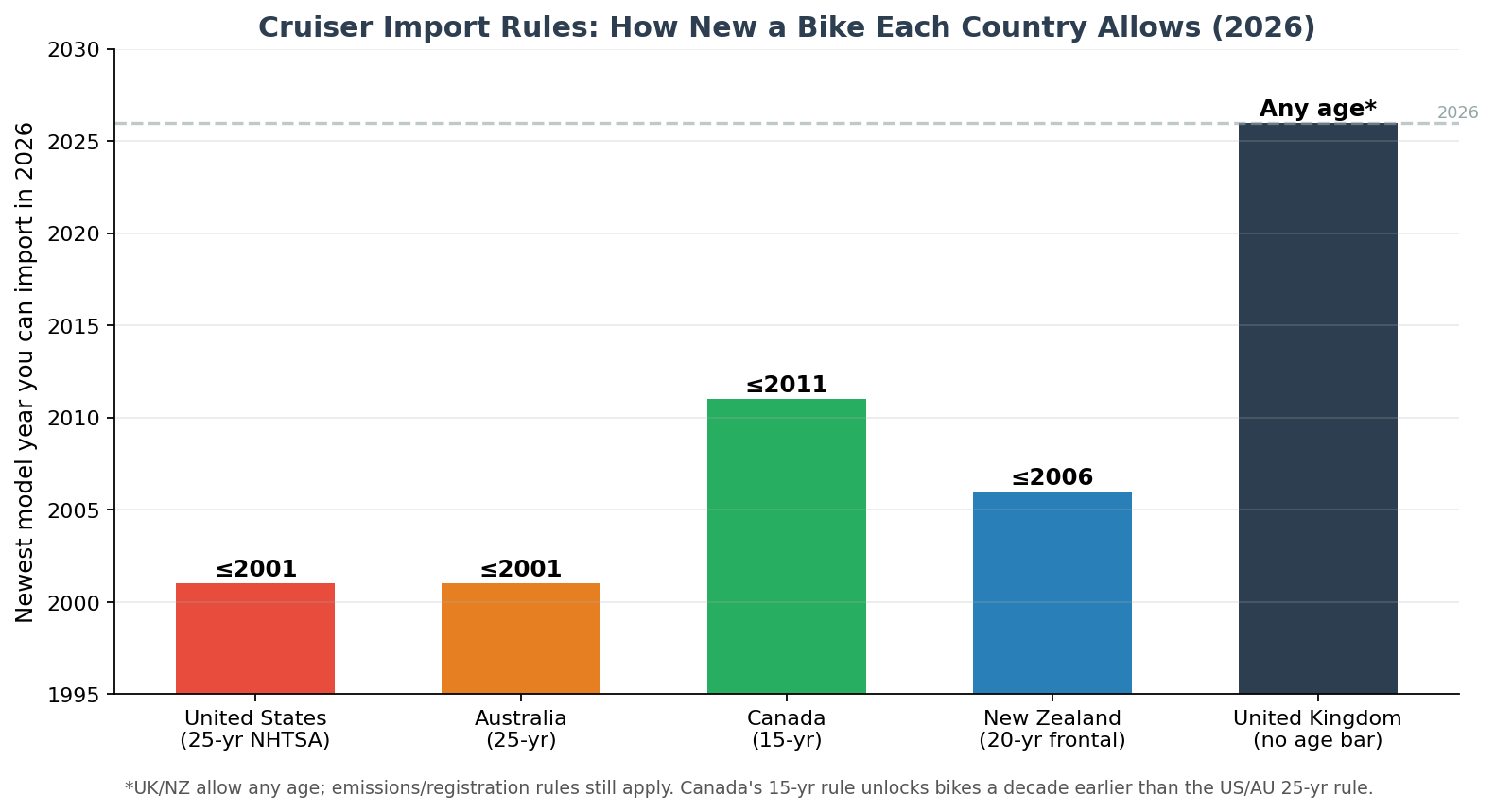
The takeaway: if you're in Canada, the UK, or New Zealand, the entire modern cruiser catalogue is open to you. If you're in the US or Australia, focus on 2001-and-older models — which, happily, is exactly where the cheap, characterful JDM 400s live.
What a Japanese Cruiser Actually Costs, Landed
The sticker price at auction is only the beginning, and the cruiser-buyers who get burned are the ones who budget the hammer price and forget the rest. A good rule: add at least 30% on top of the purchase price for fees and shipping, then layer on your local duty and registration.
Here's a realistic all-in breakdown for a JDM 400 cruiser like a Steed or DragStar bought through a Japanese auction:
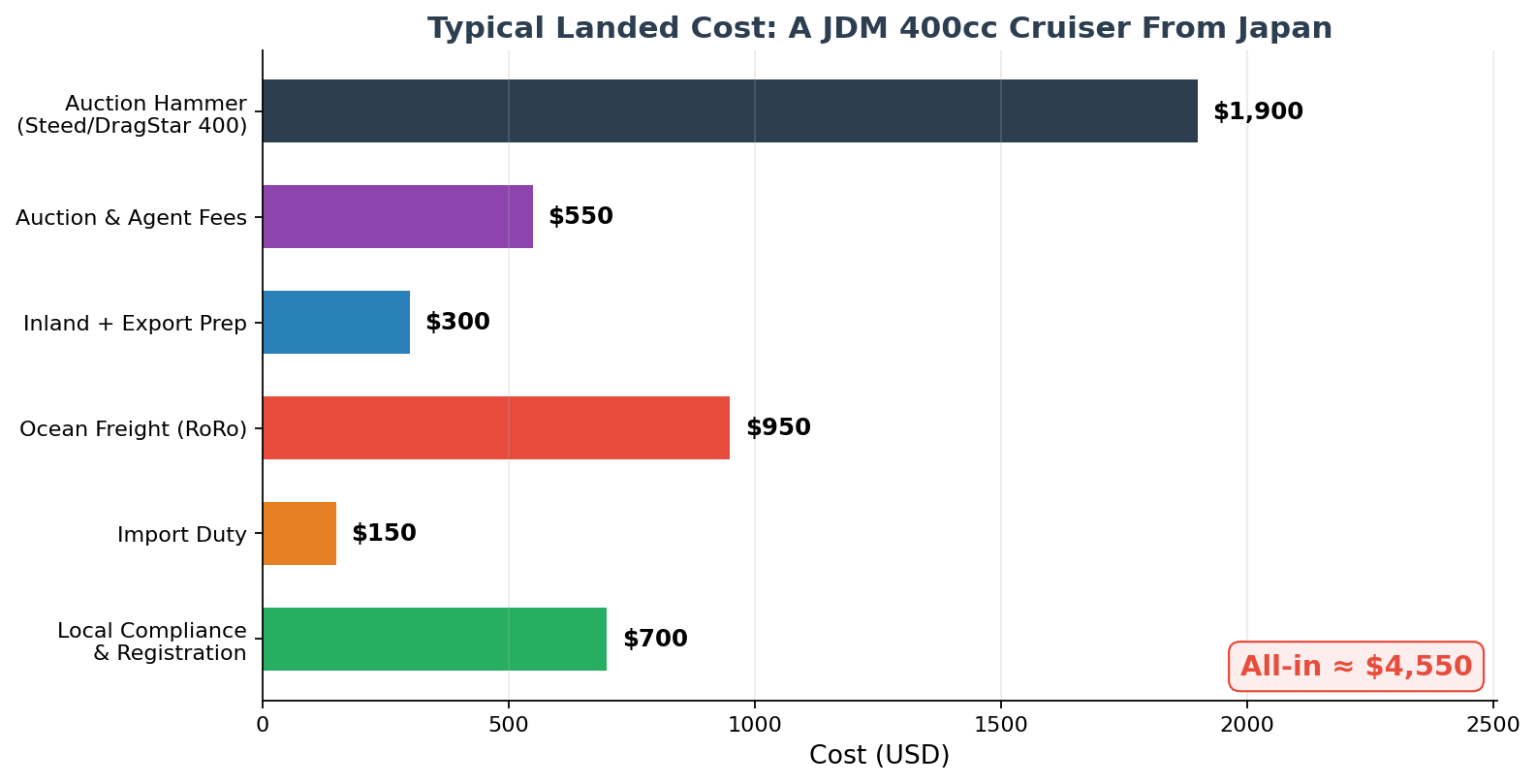
The components, demystified:
Auction hammer price: JDM 400 cruisers routinely sell for the equivalent of $1,500–$2,700. Clean, low-mileage, high-grade examples cost more; rough project bikes cost less.
Auction and agent fees: the auction house takes its cut and your import agent charges a service fee (commonly ¥35,000–¥45,000). This is the cost of having a professional inspect, bid, and handle export paperwork on your behalf.
Inland transport and export prep: moving the bike to port, deregistration (the export certificate), and crating or RoRo prep.
Ocean freight: roughly $1,500–$2,800 depending on destination and method. RoRo (roll-on/roll-off) is usually cheapest where available; container shipping costs more but protects the bike better — worth it if you're shipping a freshly-restored or high-value example. Our container vs RoRo guide breaks down the trade-off.
Import duty: motorcycles enjoy low or zero duty in many destinations (NZ charges no duty; the US is a low 2.5%; check your country). This is one reason bikes are cheaper to import than cars.
Local compliance and registration: inspection, plating, and any required testing. Budget more for newer, non-exempt bikes and less for age-exempt classics.
Net result: a JDM 400 cruiser typically lands somewhere around $4,500–$6,000 all-in, and a clean big-bore Shadow or V-Star around $6,000–$8,000 — still frequently below local prices for equivalent condition.
Buying a Cruiser at a Japanese Auction: Step by Step
You don't fly to Japan and raise a paddle. The process runs through licensed dealer auctions, and you reach them through an export agent. Here's the flow.
Step 1 — Pick your model and set a ceiling. Decide on, say, "DragStar 400, grade 4 or better, under 30,000 km, max ¥350,000 hammer." A firm ceiling stops auction-day adrenaline from wrecking your budget.
Step 2 — Choose an agent with auction access. The big bike auctions — BDS (Bike Dealer's System), JBA, and the motorcycle lanes at USS — are members-only. Your agent is your bidding membership, inspector, and shipping coordinator in one. Our guide to Japanese motorcycle auction houses explains who runs what.
Step 3 — Read the auction sheet. Every bike gets an inspection sheet with an overall grade (S, 6, 5, 4.5, 4, 3.5, down to R for repaired) and a condition map. For cruisers, pay special attention to the notes on chrome, tank condition, and any accident marks. Learn to read these with our auction inspection sheet guide and grades explained.
Step 4 — Bid. Your agent places your maximum bid in the live auction. Win or lose, you'll know within days. Don't chase a bike past your ceiling — another clean one comes through every week.
Step 5 — Pay, ship, and clear. Settle the invoice, choose RoRo or container, and your agent handles export documents. Plan on 6–10 weeks door to door, then your local customs and registration.
A word on grades, because cruisers reward patience here. The big bike auctions move thousands of machines a week — BDS alone has run on a dealer-membership model since the 1980s and turns over enormous volume — so if the clean grade-4.5 DragStar you wanted slips away, another surfaces within days. There is no scarcity at the top of the grade scale; there's only the discipline to keep your ceiling and wait. The buyers who overpay are the ones who treat one auction as their only shot.
Timeline: From Winning Bid to First Ride
One question every first-time importer asks is simple: how long until I'm actually riding it? Here's the honest schedule for a Japanese cruiser, assuming nothing exotic goes wrong.
Week 0 — the win. Your agent secures the bike at auction and sends you the invoice. You pay, including the agent fee and domestic costs.
Weeks 1–2 — export prep. The bike is collected, deregistered, and an export certificate is issued. If you chose container shipping, it's crated; if RoRo, it's booked onto the next sailing. Sailings don't leave daily, so a few days of waiting for a slot is normal.
Weeks 2–7 — on the water. Transit time depends entirely on destination. Japan to the US west coast or Australia is faster; Japan to the UK, the US east coast, or Canada's interior takes longer. RoRo to a major port is usually the quickest and cheapest leg.
Weeks 7–9 — customs and clearance. The bike arrives, clears customs (your duty and any forms are settled here), and is released. A customs broker typically charges $400–$900 to handle full clearance, which is money well spent to avoid a bike stuck at the dock.
Weeks 9–10 — compliance and plates. Local inspection, registration, and plating. For an age-exempt classic this is usually painless; for newer bikes it's where any compliance testing happens. Then you ride.
Six to ten weeks, give or take. It's not instant gratification — but neither is finding a clean, original JDM cruiser in your home market, which can take years. The wait is the price of buying the exact bike you want at the price you want.
Cruiser-Specific Buyer's Checklist
Cruisers hide different problems than sportbikes. Run through this before you let your agent bid.
Final drive. Shaft-drive cruisers (DragStar, most Vulcans, V-Stars) are low-maintenance but check for shaft and final-drive oil service history; a neglected shaft is expensive. Chain-drive cruisers (Steed) are simpler but the chain and sprockets must be in good shape.
Carburettors. Most pre-2008 Japanese cruisers are carbureted V-twins. A bike that sat for years will have varnished carbs — usually a clean-and-rebuild job, but factor it in. On the auction sheet, look for engine-start confirmation.
Chrome and tank. Cruisers are 50% jewellery. Pitted chrome and a rusty tank interior are the most common cosmetic killers. Japan's climate is kind to chrome, but always check the inspection map for surface rust ("S") marks.
Customization — friend and foe. Japan's custom scene is glorious, but a chopped Steed with a hardtail and questionable wiring is a registration headache abroad. Decide whether you want a clean stocker or a custom — and price the custom's quality honestly.
Mileage in context. A 40,000 km Shadow that's been serviced beats a 12,000 km bike that sat in a damp garage. Maintenance history outranks the odometer — a point worth remembering on every cruiser. (More in our reliability guide.)
JDM 400 Cruiser vs a New Beginner Bike: The Real Math
Let's settle the question that sends most people down the import path in the first place: is shipping a 25-year-old cruiser from Japan actually cheaper than buying new at home? For the 400cc class, it's not close.
Walk into a dealer and the friendly entry cruisers — the ones every beginner video recommends — sit around $7,000–$8,000 new before tax, freight, and the inevitable accessories. That's the exact frustration riders keep voicing in the comments under those videos: the "beginner" recommendations cost as much as a used car. A new V-Star 650, where it's still sold, lands in that same $7,000–$8,000 bracket. You're paying for a warranty and a showroom, not for more motorcycle.
Now run the import column. A clean Honda Steed 400 or Yamaha DragStar 400 lands all-in around $5,000–$6,000 — and for that money you get a genuine air-cooled V-twin with decades of proven reliability, a body that looks like a full-size cruiser, and the kind of character a stripped-down modern starter bike can't fake. You also get something nobody at the dealer can sell you: scarcity. These bikes were never common in your market, so you'll be the only one at the meet-up on a Steed.
The trade-offs are real and worth saying out loud. You wait 6–10 weeks instead of riding home the same day. You take on the paperwork (or pay an agent to handle it). And you buy carburetted, pre-electronic machinery that rewards basic spanner skills. For a lot of riders, that's not a downside — it's the appeal. For others, the convenience of new is worth the premium. Just make the choice with the numbers in front of you, not the dealer's financing brochure.
One more wrinkle that tilts the math further toward importing: depreciation. A new cruiser sheds 20–30% the moment you ride it off the lot. A 25-year-old imported JDM cruiser has already done all the depreciating it's ever going to do — and the best examples are starting to gain value. You're buying at the bottom of the curve, not the top.
Living With an Imported Japanese Cruiser: Parts, Insurance, and Resale
The purchase is the exciting part. Ownership is where imports either delight or frustrate, so go in with eyes open.
Parts. This is the quiet advantage of buying Japanese. Honda, Yamaha, Suzuki, and Kawasaki cruisers share huge volumes of components across models and decades. Service items — filters, pads, cables, bearings, tyres — are universal and cheap. The 400cc JDM models occasionally need a model-specific part (a Steed tank badge, a DragStar side cover) that's easiest to source from Japan, and the same suppliers who export the bikes export the parts. Because these were mass-market machines built in the millions, you're never hunting for unobtainium the way a rare-sportbike owner is.
Maintenance. Carburetted V-twins are about as friendly as engines get. Valve checks, carb balancing, and oil changes are jobs a competent home mechanic can do in a weekend, and the engines are famously tolerant. The thing that actually kills imported cruisers isn't mechanical — it's neglect of the chrome and the carbs during shipping and storage. Get the bike running and serviced promptly after it lands and it'll outlive you.
Insurance and registration. An age-exempt classic is often cheap to insure, and in many regions qualifies for classic or limited-mileage policies. Registration is the step that varies most by country — straightforward in the UK and NZ, state-by-state in the US and Australia, province-by-province in Canada. Keep every export document your agent provides; the export certificate and bill of lading are what turn a crate of metal into a plated, road-legal bike.
Resale. Here's the part that makes importing feel less like a splurge and more like a smart buy. A well-chosen, clean JDM cruiser holds its value better than almost any new bike, because the supply is fixed and shrinking while interest grows. Buy a tidy Steed or DragStar, look after it, and you can ride it for years and sell it for close to what you paid — sometimes more. Try that with a new beginner bike.
Common Mistakes People Make Importing a Cruiser
Most import horror stories come from a handful of avoidable errors. Dodge these and you'll be fine.
Buying the cheapest bike instead of the cleanest. The auction's bargain-bin examples are cheap for a reason. The difference between a grade 3.5 and a grade 4.5 cruiser is often only a few hundred dollars at the hammer but thousands in restoration. Spend up front; cry never.
Ignoring the custom trap. A heavily chopped Steed looks incredible in photos and can be a nightmare to register — hardtail conversions, non-standard lighting, and homebrew wiring all draw inspection scrutiny abroad. If you want a custom, buy a quality one with documentation, or buy a stocker and build it yourself at home where you control the spec.
Forgetting the 25-year (or 15-year) clock. US and Australian buyers especially trip here: a bike that's gorgeous and cheap can turn out to be a 2003 model you can't legally import until 2028. Always confirm the exact build year against your country's rule before you bid. Canadians, enjoy your 15-year head start.
Under-budgeting the landed cost. The hammer price is maybe a third to half of the total. Buyers who budget only the auction price get a nasty surprise at the shipping invoice. Use the 30%-plus rule, then add duty and registration.
Skipping the agent. You cannot bid at BDS, JBA, or USS yourself, and trying to buy through random "for export" classified listings instead of the real auctions removes the inspection grades that protect you. The agent isn't an upsell — it's your eyes, your bidding access, and your shipping desk. Pay for a good one.
Get those five right and importing a Japanese cruiser is one of the best deals in motorcycling. Get them wrong and you'll write one of the cautionary comments the next buyer reads.
5 Japanese Cruisers Quietly Climbing in Value
Cruisers aren't usually thought of as appreciating assets — but a handful are starting to move, and importing now is the cheap entry point.
1. Honda Steed 400. As the definitive Japanese bobber base, clean unmodified Steeds are getting harder to find precisely because so many got chopped. Original examples are the ones to grab.
2. Yamaha DragStar 400 Classic. The most-loved JDM 400 cruiser, with a passionate owner base. Tidy, low-km Classics are creeping up.
3. Honda Magna V4 (V30/V45/V65). A V4 cruiser is a Japanese-only flavour of cool, and the survivors are increasingly collectible.
4. Suzuki Boulevard M109R. Modern muscle cruisers with this much character don't get built anymore. Clean low-mile examples are a smart-money buy.
5. Kawasaki Vulcan 1500/1700 Classic. Big, comfortable, bulletproof tourers that are still cheap — the value won't last as the good ones get used up.
The pattern is the same as every other corner of the Japanese import world: the clean, original, well-documented bikes appreciate while the rough ones fade. Buy the best one the grades allow.
It's also worth being realistic: not every cruiser is an investment, and you shouldn't import one purely hoping to flip it. The smarter framing is downside protection. A clean, original Japanese cruiser is unlikely to lose money the way a new bike does, which means you can ride it for years essentially for the cost of fuel, tyres, and servicing. Appreciation is the bonus; not depreciating is the point.
How AWA Auction Helps You Import the Right Cruiser
This is exactly what we do. AWA Auction gives English-speaking buyers direct access to Japan's dealer-only motorcycle auctions — the same BDS, JBA, and USS lanes where these cruisers cross the block every week. We inspect the auction sheets, translate the condition notes, bid to your ceiling, and handle export and shipping to your port.
Whether you want a $5,000 DragStar 400 to learn on, a clean Shadow 750 to bob, or a low-mile M109R that costs a fortune locally, the bike is almost certainly sitting in a Japanese auction right now. Browse the current listings to see what's available this week, or contact our team with your target model and budget and we'll hunt it down for you.
The cruiser you actually want — clean, original, fairly priced — is in Japan. Now you know how to get it home.
See Also
Share this article: