
Search "CBR400RR" on YouTube and the algorithm hands you the same thing over and over: a half-second of silence, a thumb on the starter, and then a 399cc inline-four climbing toward 14,000 rpm with an exhaust note that sounds like a shrunken superbike being asked a serious question. One clip of an NC29 on an SC Project pipe has pulled past half a million views, and the top comment is some version of "I felt that through my screen." That sound is the entire reason a Honda CBR400RR import from Japan is on your radar in the first place.
Here's the thing nobody tells you up front: Honda barely sold this bike outside Japan. The CBR400RR was a Japanese-market racer replica built for a licensing system that only existed there. Across the US, Australia, New Zealand and most of Europe, the only way to put one in your garage is to import a Honda CBR400RR from Japan — the same auction halls where these bikes have been changing hands for thirty years.
That's exactly what we do. This guide covers the generations worth chasing (and the one people confuse it with), how the four-cylinder makes that noise, what one really costs landed in your driveway, the faults that separate a bargain from a money pit, and the import rules for the US, UK, Australia and New Zealand. By the end you'll know which year to hunt and which to leave on the auction block.
Let's get into it.
What Is the Honda CBR400RR (And Why It's a Grey-Import Legend)
The CBR400RR is a 399cc, liquid-cooled, four-cylinder sportbike that Honda built for the Japanese market from the late 1980s into the late 1990s. Think of it as a FireBlade that got shrunk in the wash — same aggressive fairing, same race-bred chassis ideas, same appetite for revs, just wrapped around a 400cc engine instead of a 900.
So why is a bike this good a "grey import" almost everywhere? One word: licensing. Japan has a dedicated 400cc license tier, and for decades that tier was where the engineering money went. While the rest of the world jumped from learner bikes straight to 600s and litre bikes, Japanese manufacturers fought a quiet war over the 400cc class, building tiny, jewel-like four-cylinder machines that screamed to five figures on the tacho. The CBR400RR was Honda's weapon in that war.
The rest of the planet never officially got it. A four-cylinder 400 made perfect sense in Tokyo and zero sense in a US Honda dealer, where a CBR600 cost about the same and made far more power. So Honda kept the CBR400RR at home, and a generation of riders outside Japan only ever saw them as rare grey imports — bikes brought in privately rather than sold new through dealers. That rarity is now exactly why demand to import a Honda CBR400RR from Japan keeps climbing.
One quick clarification, because it trips people up constantly. The classic CBR400RR is not the modern Honda CBR400R that turns up in 2024 launch videos with millions of views. The new CBR400R is a parallel-twin sold in parts of Asia today. The bike this guide is about is the old inline-four racer replica — the NC23 and NC29. If a seller shows you a shiny new twin and calls it a "CBR400RR," they either don't know the difference or hope you don't.
If you want to see what Japanese-market inventory looks like in real time, our current listings come straight from the same auctions we bid in.
The Generations: NC23, NC29 and the Aero (Which One to Import)
Buy the wrong version and you'll spend a year hunting fairing panels. Buy the right one and you've got one of the great small sportbikes of all time. Here's the family tree, stripped of the trainspotter detail.
CBR400R "Aero" (NC23, 1986–1987) — The Ancestor
Before the double-R there was the single-R: the CBR400R, nicknamed the "Aero" for its fully enclosed bodywork that hid the engine almost completely. It's an interesting piece of history and undeniably period-correct, but it's the heaviest and least sharp of the bloodline. Collectors want them; first-time importers usually shouldn't. Mention it only so you recognise it on an auction list.
CBR400RR (NC23, 1988–1989) — The "Tri-Arm"
The first proper CBR400RR. This is the bike that introduced the twin-headlight, aluminium-framed racer-replica formula, and it's known among enthusiasts as the "Tri-Arm" for its triangulated swingarm. It looks the business and rides hard, and every single NC23 is now comfortably past the 25-year mark, which makes it fully import-legal in the US today. The catch is parts — being the older, lower-production design, some NC23-specific bits are harder to find than NC29 equivalents.
CBR400RR (NC29, 1990–1999) — The "Gull-Arm" Icon
This is the one most people mean when they say "CBR400RR," and the one we import most. The NC29 arrived in 1990 with the famous gull-arm swingarm — a curved, banana-shaped piece that let Honda mount the exhaust and shock cleanly — plus six-spoke wheels and FireBlade-inspired styling that still looks modern thirty years on. It runs 120/60-17 front and 150/60-17 rear tyres, sizes you can still buy off the shelf, which matters more than it sounds when your bike is an ocean away from its home market.
Power is where the NC29 gets interesting. From 1990 to 1993 it made a genuine 59 bhp at a screaming 12,500 rpm. Then, from 1994, Honda dropped it to 53 bhp — not because the engine got worse, but because Japan's manufacturers signed a gentleman's agreement capping 400cc output. So an early NC29 is actually the more powerful bike, a detail that almost never makes it into the auction listing. If you want the full factory figures and period road-test context, Bennetts BikeSocial's NC23/NC29 buying guide is the most reliable English-language reference out there.

The short version: US buyer who wants legal-now and iconic, chase a 1990–1993 NC29 for the extra horsepower, or an NC23 if you love the early look. Anyone outside the US can shop the whole range. Decoding exactly which year a given bike is comes down to a single letter in the model code — an "L" is a 1990 bike, an "N" is 1992, and so on, skipping the letters I, O, Q, U and Z. We'll come back to why that letter is worth knowing before you bid.
That 14,000 RPM Inline-Four Sound: Why People Import These
Let's talk about the thing that actually sells these bikes, because it isn't the practicality. Nobody imports a 35-year-old 400cc sportbike because it's a sensible commuter. They import it for what happens above 10,000 rpm.
A modern 400 twin makes its power low and gets boring up top. The CBR400RR does the opposite. The inline-four breathes hard, spins to roughly 14,000 rpm, and saves its best for the last third of the tacho. Down low it's docile and easy. Wind it out and it transforms into something that sounds and feels like a 1990s superbike that someone left in the dryer too long. That's why the exhaust clips do the numbers they do online — that NC29 SC Project video isn't popular because of the riding, it's popular because of the noise.
You can measure the obsession in the comments. Under one video titled, roughly, "400cc and THIS acceleration?!" — over 300,000 views — riders pile in describing the moment the engine comes alive past 10,000 rpm as the reason they'll never sell. These aren't paid reviews. They're owners trying to explain an addiction to strangers.
The CBR400RR also carries genuine track pedigree, and this is where its story gets richer than most import guides bother to tell. In Japan, 400cc racing was fierce, and the CBR400RR fought a famous rivalry against the two-stroke Yamaha NSR250 and its kin. A single onboard race video pitting an NSR250 against a CBR400RR around Tsukuba Circuit has pulled north of 700,000 views, with hundreds of comments arguing two-stroke versus four-stroke like it's still 1992. That rivalry is part of what you're buying: this was a homologation-flavoured racer for real Japanese club racing, not a styling exercise.
Here's the practical takeaway that the romance hides: a healthy CBR400RR should pull cleanly and smoothly all the way to its redline, with no flat spot, misfire or hesitation in the upper rpm where it's supposed to shine. A four-cylinder that won't rev out happily is a four-cylinder with a problem. Make the seller or your import agent rev it through the range on video before you commit a cent. The sound is the product — confirm the product works.
Is It Legal to Import? Rules by Country
This is where buyers get burned, so read this part twice. The exact same CBR400RR can be a dream buy in Brisbane and an expensive paperweight in Boston, purely because of where you live and what the rules say.
United States — The 25-Year Rule Is Your Friend
The US blocks most non-compliant foreign vehicles, but there's a giant exemption: any vehicle at least 25 years old, counted from its month of manufacture, is exempt from FMVSS safety standards, and the EPA exempts engines 21 years and older. For 2026, that means anything built in 2001 or earlier clears both gates.
The good news for CBR400RR buyers is that production ended in the late 1990s, so every CBR400RR ever made is now old enough to import legally into the US. NC23, early NC29, late NC29 — all of it qualifies. You'll file an EPA Form 3520-1 and a DOT HS-7 at import, and because a 25-year-old motorcycle is exempt from the recent Section 232 tariff via a specific classics provision, the duty picture is far gentler than on a new bike. For the official process straight from the source, the NHTSA importation FAQ lays out the forms and the 25-year exemption in plain language.
If a US "importer" tries to sell you a CBR400RR with a story about EPA paperwork costing thousands, be skeptical — on a genuinely 25-year-old bike, most of that complexity simply doesn't apply.
Australia and New Zealand — Beautiful, But Not for Learners
Here's a fact that almost every generic import guide gets wrong, and it matters enormously if you're a newer rider. The CBR400RR is not a LAMS-approved learner bike in Australia, and it isn't on the equivalent learner-approved list in New Zealand either.
The reason is math. LAMS approves bikes up to 660cc with a power-to-weight ratio of 150 kilowatts per tonne or less. The CBR400RR makes around 44 kW and weighs under 200 kg wet — that works out to well over 200 kW per tonne, comfortably above the limit. A 400cc engine doesn't automatically mean learner-legal; this one is a full-license sportbike. If you're on a learner or restricted license, you cannot legally ride it yet, no matter how much you want to. Always confirm against your state's official list — for example, Transport for NSW's approved motorcycles list — before you bid. The upside: there's no 25-year wait in Australia or New Zealand, so once you hold a full license, the entire CBR400RR range is open to you.
United Kingdom and Europe — Restrict It or Hold a Full License
You can ride a CBR400RR in the UK, but the licensing tier decides how. The bike makes roughly 39–44 kW depending on year, and the A2 license caps at 35 kW (47 bhp). To ride one on an A2 license you'll need a restrictor, and even then the bike's original output can't be more than double the restricted figure — a detail worth checking on the higher-output early NC29. On a full license, ride it as Honda intended. On import you'll also handle a NOVA notification, import duty, and 20% VAT, so build those into your budget before an auction photo makes the decision for you.
The rule of thumb: US buyers, the whole range is legal right now thanks to the 25-year rule. Australian and Kiwi buyers, gorgeous bike but full-license only. UK and European buyers, plan for restriction and tax. When in doubt, ask our team for your exact country and year before you bid — it's a thirty-second answer that saves a costly mistake. Our guide to reading a Japanese auction sheet pairs nicely with this if you want the whole picture.
What a CBR400RR Import Actually Costs
Time for real numbers. The auction hammer price is only the opening act, and anyone quoting you "just the bike" is hiding the rest of the bill. A CBR400RR import has roughly five cost layers: the winning bid, the Japan-side auction and handling fees, ocean freight, your country's duty and tax, and the agent fee.
Start with the bike itself. In the UK, where the CBR400RR has the deepest grey-import history, the market sorts roughly into three tiers. A rough but running example trades around £1,800 to £2,500. A tidy, honest bike sits at £3,000 to £4,500. A genuinely mint, low-mileage NC29 now asks £5,000 to £6,000 — and prices are rising, after years when tidy bikes slumped near £1,500. That climb is the whole story: these were once cheap, and they aren't getting cheaper.
Auction hammer prices in Japan are typically lower than finished retail prices abroad, because you're buying before the fees, freight and tax that build the final number. That's the arbitrage that makes importing worthwhile in the first place.
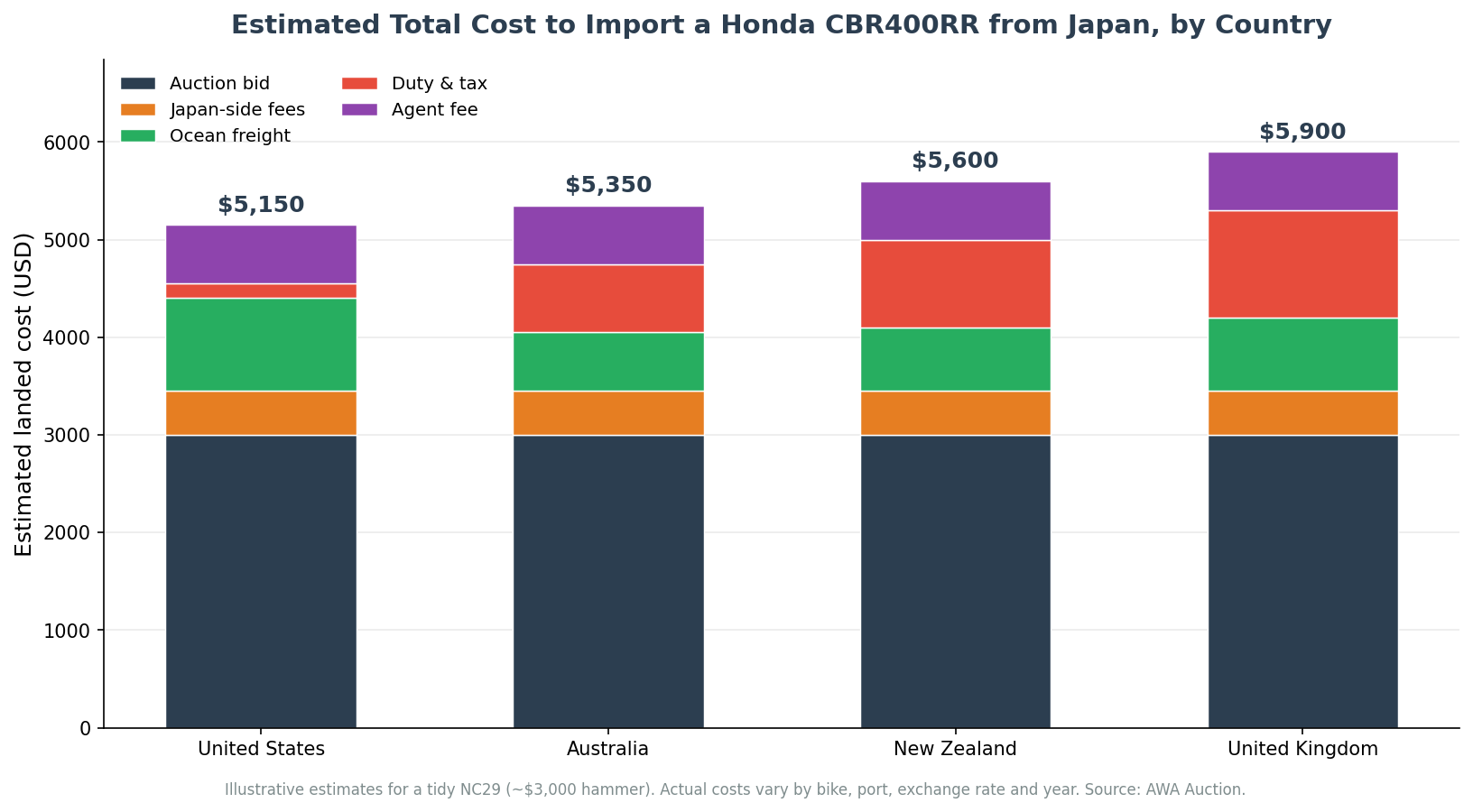
The single biggest swing factor is your destination. The US keeps landed costs lowest, because a 25-year-old motorcycle largely sidesteps import duty. Australia adds GST and compliance. The UK lands at the expensive end thanks to that 20% VAT stacked on top of duty. Same bike, very different final figure — which is why a price that looks insane in one country is a steal in another.
Here's how condition tends to map to price once a bike is landed and sorted, so you can set expectations before you fall for an auction photo:
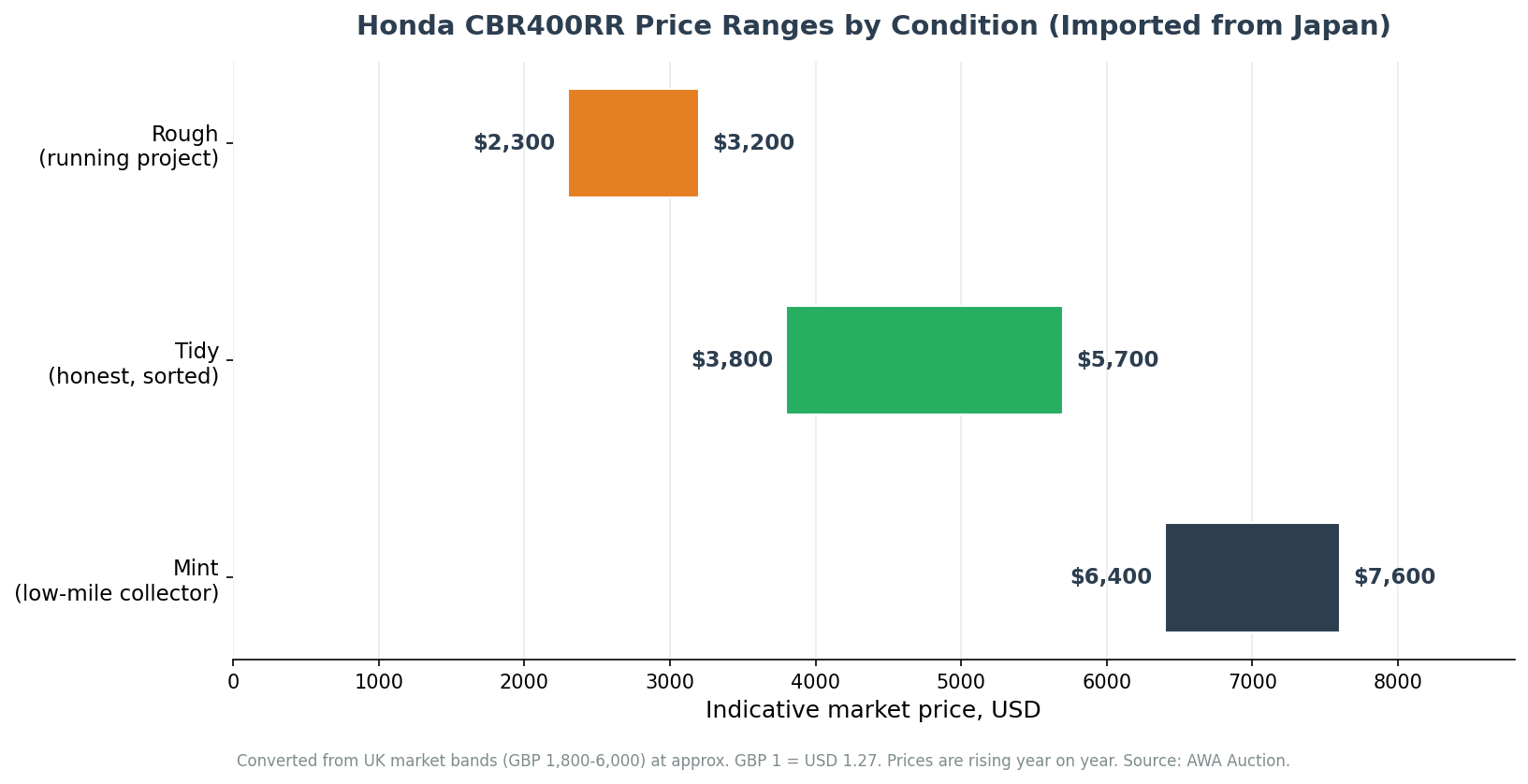
The lesson from the chart is the same one that applies to every old sportbike: condition beats everything. A tidy, well-documented NC29 with a clean auction sheet is worth paying up for. A "cheap" CBR400RR with a vague history and a mystery rattle is the most expensive bike you can buy, because you'll pay the difference back in parts and labour within a year.
Reading the Auction Sheet: What to Check on a CBR400RR
Every bike that crosses a Japanese auction block arrives with an inspection sheet graded by a neutral third party. This is the real reason importing from Japan beats buying blind off a classified ad — a professional inspector already went over the bike and wrote down what's wrong with it. You just need to know how to read it.
For a CBR400RR specifically, here's what matters most.
Overall grade. Bikes are graded on a scale, commonly 1 to 6 plus S for new. A 4 or 4.5 is a clean, honest used bike. A 3 shows real wear or needs work. Anything flagged as accident-repaired deserves extra scrutiny on a high-revving sportbike — a tweaked frame on a bike that lives at 12,000 rpm is not where you save money.
Mileage and the meter mark. The sheet records the odometer and flags whether the reading is believed genuine. A CBR400RR with 25,000–40,000 km has plenty of life left; these engines are tough when serviced. Be more suspicious of a 9,000 km bike with worn grips and faded paint than a 45,000 km bike whose wear matches its numbers.
The corrosion and damage map. The inspector draws a diagram and marks scratches, dents, corrosion and repairs with letter-and-number codes. On a CBR400RR, look hard at corrosion around the frame, the gull-arm swingarm and the exhaust headers, especially on bikes from snowy regions where roads get salted in winter. Fairing condition matters too — original panels for these are getting scarce and expensive.
Engine and running notes. A genuine inspection often notes whether the bike starts and runs and whether anything sounds off. For a four-cylinder this is gold. Any note about abnormal engine noise, a difficult start, or a rough idle points straight at the known weak spots we'll cover next.
If decoding all of this sounds like work, it's the job we do for you on every bike — translate the sheet, flag the landmines, and tell you honestly when a cheap bike is cheap for a bad reason.
Common CBR400RR Problems to Catch Before You Bid
No 35-year-old sportbike is perfect, and the CBR400RR has a short, well-documented list of weak spots. None are dealbreakers if you catch them on the sheet or in pre-bid photos. All of them are nasty surprises if you don't. This list comes straight from decades of owner reports on enthusiast forums like FireBlades.org, where NC29 owners have logged every fault the model can throw.
The regulator/rectifier and battery. This is the number-one gremlin on the NC29. A tired reg/rec can overcharge or undercharge, cooking the battery or leaving you stranded. The classic symptoms are a battery that runs hot, swells, or repeatedly goes flat, and a starter that struggles to spin the engine. A recently replaced battery with no explanation is a clue worth chasing. The fix is cheap once you know — brutal if it fails on your first ride home.
The starter clutch rattle. Here's the one that scares people unnecessarily. NC29 starter clutches can work their rivets loose over time, producing a jangly metallic rattle, often most obvious on startup. It sounds alarming, and plenty of owners have mistaken it for something terminal. It's a known, fixable issue — but it should be a price negotiation you go in with eyes open, not a mystery noise you discover after the bike lands.
Carburettors on a bike that's been sitting. Remember that hugely popular video of someone buying a CBR400RR that sat untouched for five years, firing it up, and finding the engine sounding wrong? That's the carbs. Four carburettors that have sat full of stale fuel gum up, and the bike runs lumpy, stalls at idle, or won't pull cleanly until they're stripped and cleaned. A neglected, long-stored bike isn't necessarily a bad buy — but factor a carb clean and balance into your first-service budget.
Airbox seal and idle quality. Owners report air leaks around the airbox causing a rough, hunting idle and poor low-rpm running. Combined with dirty carbs, a poorly sealed airbox is why some imports feel ragged at low speed even when the top end is healthy.
Cooling and the usual consumables. Some owners note coolant overflow on longer, harder rides, so check the level and look for leaks. Beyond that it's normal old-bike stuff — tyres, chain and sprockets, fork seals, brake pads — the same as any used machine.
Catch the reg/rec, the starter clutch and the carbs and you've caught the vast majority of what goes wrong with a CBR400RR. Everything else is ordinary wear — which is exactly the kind of thing a good auction sheet and an honest agent surface before you bid, not after.
The Two-Stroke Rivalry and Racer-Replica Era Nobody Explains
Here's context that genuinely changes how you should value a CBR400RR, and almost no import guide bothers with it. The CBR400RR didn't exist in a vacuum. It was born into the wildest era of Japanese motorcycling — the late-1980s and early-1990s 400cc replica wars — and understanding that era tells you why these bikes are special and why they survived when their rivals didn't.
In that period, the 400cc class in Japan was a genuine battleground. Honda's four-stroke CBR400RR went up against two-stroke screamers like the Yamaha NSR250 and various 250 and 400 two-strokes, plus Kawasaki's ZXR400 and Suzuki's GSX-R400. These weren't styling exercises with a 400 badge — they were homologation-flavoured machines built so manufacturers could go racing in popular Japanese club categories. The Tsukuba Circuit onboard videos racking up hundreds of thousands of views today are the living memory of that war.
Then emissions rules and changing tastes killed the two-strokes. The smoky, peaky, gloriously unhinged NSR-style bikes couldn't survive tightening regulations, and they vanished. The four-stroke CBR400RR, cleaner and more durable, outlived them — which is why there are still healthy examples crossing auction blocks today while many two-stroke rivals are either gone, thrashed, or priced into the stratosphere.
Why does this matter to you as an importer? Two reasons. First, it tells you the CBR400RR is the *usable* way into that legendary era — a four-stroke you can actually ride and maintain, rather than a fragile two-stroke that needs a rebuild every few thousand kilometres. Second, it explains the rising prices. As the survivors of an entire golden age, clean CBR400RRs are appreciating classics, not depreciating used bikes. You're buying a piece of a era that's already closed, and the door doesn't reopen.
There's also a naming trap worth repeating, because the racer-replica history is exactly why it's confusing. The "RR" badge means the inline-four classic. The modern parallel-twin "CBR400R" borrows the look and the number but shares none of the soul. When you're scrolling listings, the RR is the one with the period bodywork and the four-into-one exhaust — and the price that's been climbing for a decade.
Step-by-Step: How to Import a CBR400RR from Japan
So how does the whole thing actually work, start to finish? Here's the honest sequence, with no mystery and no padding.
Step 1 — Confirm legality for your country and year. Lock this down first. US buyers: every CBR400RR is legal now. Australian and Kiwi buyers: full license only, no learner riding. UK buyers: plan for restriction or a full license, plus tax. One message settles it and prevents the only truly unfixable mistake.
Step 2 — Set your budget in landed terms. Decide your maximum out-the-door number, then work backwards. Subtract estimated freight, duty and tax, and the agent fee, and what's left is your auction ceiling. Bid the bike, not the fantasy.
Step 3 — Get auction access. Japanese auctions are members-only and run entirely in Japanese. You bid through a licensed agent — that's us. You tell us the generation, grade and budget; we watch the auctions you can't see.
Step 4 — Vet the auction sheet. When a CBR400RR comes up, we translate and read the sheet, study the photos, flag accident repairs, corrosion, starter-clutch and reg/rec clues, and give you a straight recommendation. You approve the bid.
Step 5 — Win, settle and prep for export. Once you win, the bike is paid for, de-registered for export, and moved to port. The Japanese export certificate is prepared.
Step 6 — Ocean freight. The bike is crated or shipped roll-on-roll-off to your nearest port. This is the slow leg — typically a few weeks on the water depending on destination.
Step 7 — Clear customs and register. At your end, customs clearance happens, duty and tax are paid, and you complete local registration — state DMV and title in the US, NOVA and DVLA in the UK, your transport authority in Australia or New Zealand.
Step 8 — Ride it. First service, fresh fluids, a carb balance if it's been sitting, and then you go find an empty road and an excuse to use all 14,000 rpm.
That's the entire process. The hard parts — auction access, reading the sheet, export paperwork, freight — are precisely what a good agent handles so you don't have to.
A Real CBR400RR Import, Start to Finish
Numbers in a chart are abstract, so here's how a typical CBR400RR import plays out. Treat this as an illustrative example, not a quote — every bike and every exchange rate is different.
A buyer in Texas wants an early NC29 with the full-fat 59 bhp, legal to import thanks to the 25-year rule. We find a 1992 model on a mid-week auction list, graded 4, around 32,000 km, with a clean corrosion map and a sheet that notes a healthy start and no accident history. The hammer falls at the equivalent of roughly US$3,000.
On top of the winning bid come the Japan-side auction and handling fees, domestic transport to the port, and export documentation. Ocean freight to a US west-coast port adds several hundred dollars more. At the American end, because the bike is well over 25 years old, the duty picture is light, and the buyer completes state title and registration. Add the agent fee, and the bike lands road-ready for a figure that undercuts the few finished CBR400RRs that occasionally surface on US classifieds — and with a documented inspection history those private sales almost never include.
Now flip the same bike to a buyer in Melbourne. The 1992 NC29 is legal to import and ride — but only because that buyer holds a full license, since the CBR400RR isn't LAMS-approved. They pay GST and compliance on top, so the landed number is higher than the US example, but they skip the 25-year-rule worry entirely because Australia doesn't have one. Two buyers, two countries, two different cost stacks, one identical bike. That's the whole game: match the bike, the year and the paperwork to the market.
CBR400RR vs the Obvious Alternatives
Should you import a CBR400RR at all, or buy something else? Honest question, honest answer. Here's how it stacks up against the bikes people cross-shop.
CBR400RR vs the Honda CB400 Super Four. This is the big one, because they share an engine size and a country of origin. The Honda CB400 Super Four is the upright, naked, do-everything standard with Hyper VTEC — friendlier, more practical, and produced for far longer. The CBR400RR is the committed sportbike: lower bars, race-replica fairing, sharper everything. If you want one bike for commuting and weekend fun, the CB400SF is the smarter pick. If you want a miniature 1990s superbike and you'll forgive the riding position, the CBR400RR is the one that makes your pulse jump.
CBR400RR vs a modern Kawasaki Ninja 400. A new Kawasaki Ninja 400 is cheaper, comes with a warranty, makes similar real-world power, and won't need a carb clean. What it doesn't have is four cylinders or a 14,000 rpm top end. You don't import a CBR400RR because it's the rational choice — you import it because a screaming inline-four is an experience a modern parallel-twin can't reproduce, full stop.
CBR400RR vs a two-stroke NSR250. The old rival. A two-stroke NSR250 is lighter, more frantic, and arguably even more of an event — but it's also fragile, thirsty for rebuilds, increasingly rare, and priced accordingly. The CBR400RR gives you most of the racer-replica thrill with four-stroke durability and far better parts support. For a rider who wants to actually use the bike, the four-stroke wins.
CBR400RR vs a used 600. The question Americans always ask. A used 600 makes far more power for similar money and is everywhere. True. But a 600 is a known quantity that everyone has ridden, while a CBR400RR is rare, distinctive, usable at sane speeds, and appreciating. Rarity has value, and a 400 four you can wring out fully on a back road is more fun more of the time than a 600 you can only use a third of.
Bottom line: if you want sensible and cheap, buy local. If you want a screaming piece of the 400cc replica era, the auctions in Japan are where the clean ones live.
How AWA Auction Gets You Into a CBR400RR
This is what we do every week. AWA Auction is a Japan-based export agent with direct access to the same domestic auctions where tens of thousands of motorcycles change hands. We're not a middleman reselling bikes at a markup — we bid on your behalf, at the real auction price, and charge a transparent agent fee on top.
For a CBR400RR specifically, that means finding you the right generation for your country, reading the auction sheet honestly, telling you when to walk away from a rattle or a dodgy repair, and handling the export end so the bike shows up legal and ready. We've done it for Ninja 400s, Super Cubs, SR400s and CB400s, and the playbook never changes: condition first, honesty always.
If you want to see what's on the auction blocks right now, browse our current listings. If you already know you want a CBR400RR and just want someone to go get you a good one, contact our team with your country and budget and we'll start watching for it.
The bike behind every one of those half-million-view exhaust clips is sitting in a Japanese auction yard right now. Let's get you on it.
See Also
Share this article: