
Japanese motorcycle tyres are the single cheapest thing on your import and the single most likely thing to be illegal the day it lands. Not damaged. Not worn out. Illegal.
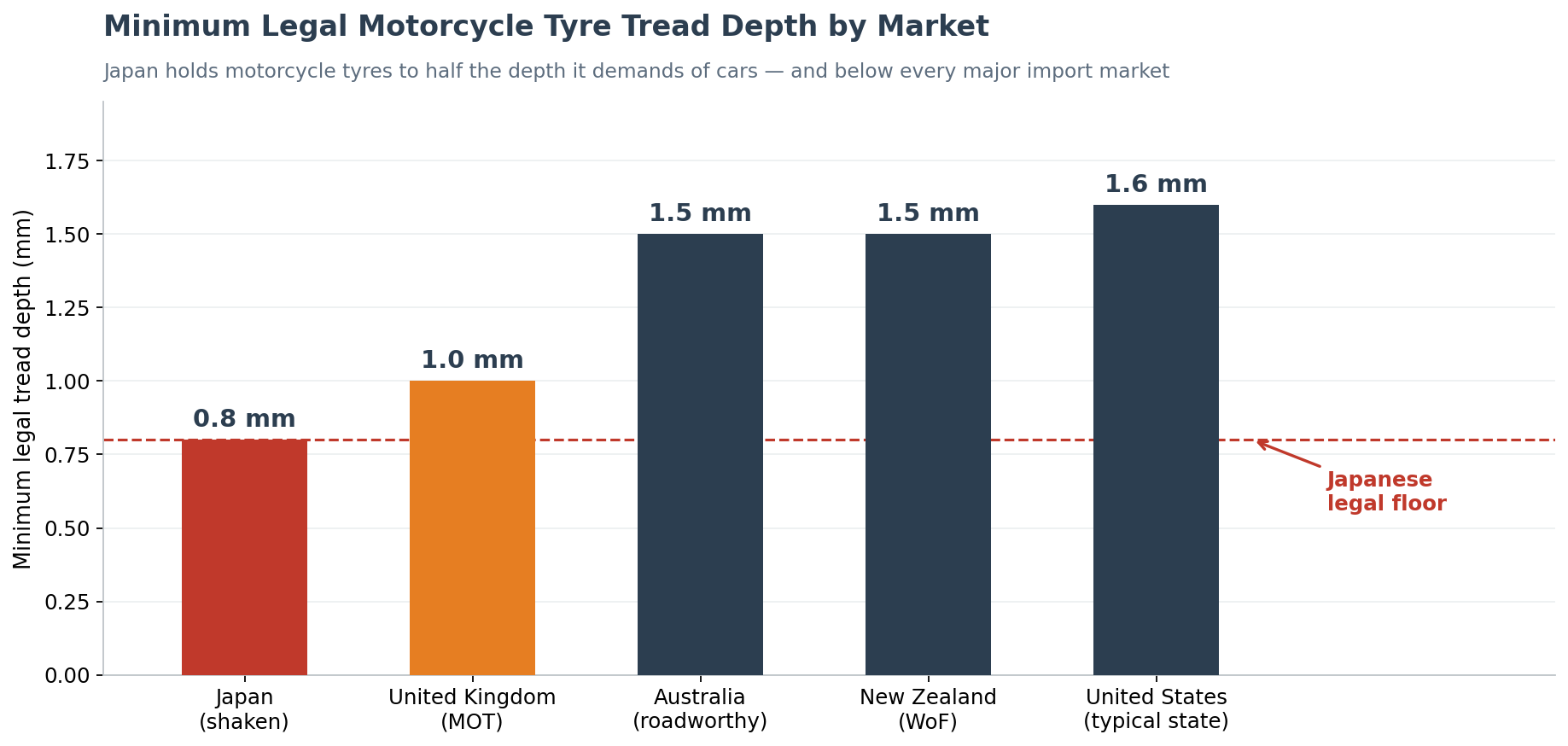
Here is the reason, and it is a one-line reason that almost nobody in the English-speaking import world has bothered to look up. Japan's roadworthiness standard for a motorcycle tyre is 0.8mm of tread. The UK's is 1mm. Australia's and New Zealand's are 1.5mm. A bike can roll through a Japanese shaken inspection in perfect legal standing, get deregistered, get containerised, and arrive in Auckland or Brisbane with tyres that are below the legal minimum by nearly half — without a single kilometre being ridden in between.
That gap is written into Japanese law. Article 89 of Japan's Ministry of Land, Infrastructure, Transport and Tourism enforcement notice sets the groove depth for road vehicles at 1.6mm, then adds a bracket: "for those fitted to two-wheeled vehicles and two-wheeled vehicles with sidecars, 0.8mm." Cars get 1.6mm. Motorcycles get half of that. You can read it yourself in the MLIT enforcement notice for Article 89 (走行装置) — it is a public PDF, and the bracket is in paragraph 4, item 2.
This guide covers what that means for your import, how to read the age of a Japanese motorcycle tyre before you bid, why the sidewall markings on a JDM-market tyre can fail an inspection that has nothing to do with tread, which wheel sizes have quietly gone extinct, and what the whole thing costs to put right. Along the way we will kill the "five year rule" that a million people watched being debunked, and replace it with something that actually predicts whether rubber is dead.
Japanese motorcycle tyres: the short answer
If you want the whole article in nine lines:
- Budget for a full set. Always. Treat tyres as a fixed line item on every import, the same way you treat shipping. Not a maybe.
- Japan's minimum is 0.8mm. Yours is 1mm (UK), 1.5mm (Australia, New Zealand) or typically 1.6mm (most US states). Legal in Japan does not mean legal at home.
- Shaken has no tyre age limit at all. None. A twelve-year-old tyre with 3mm of tread passes in Japan every time.
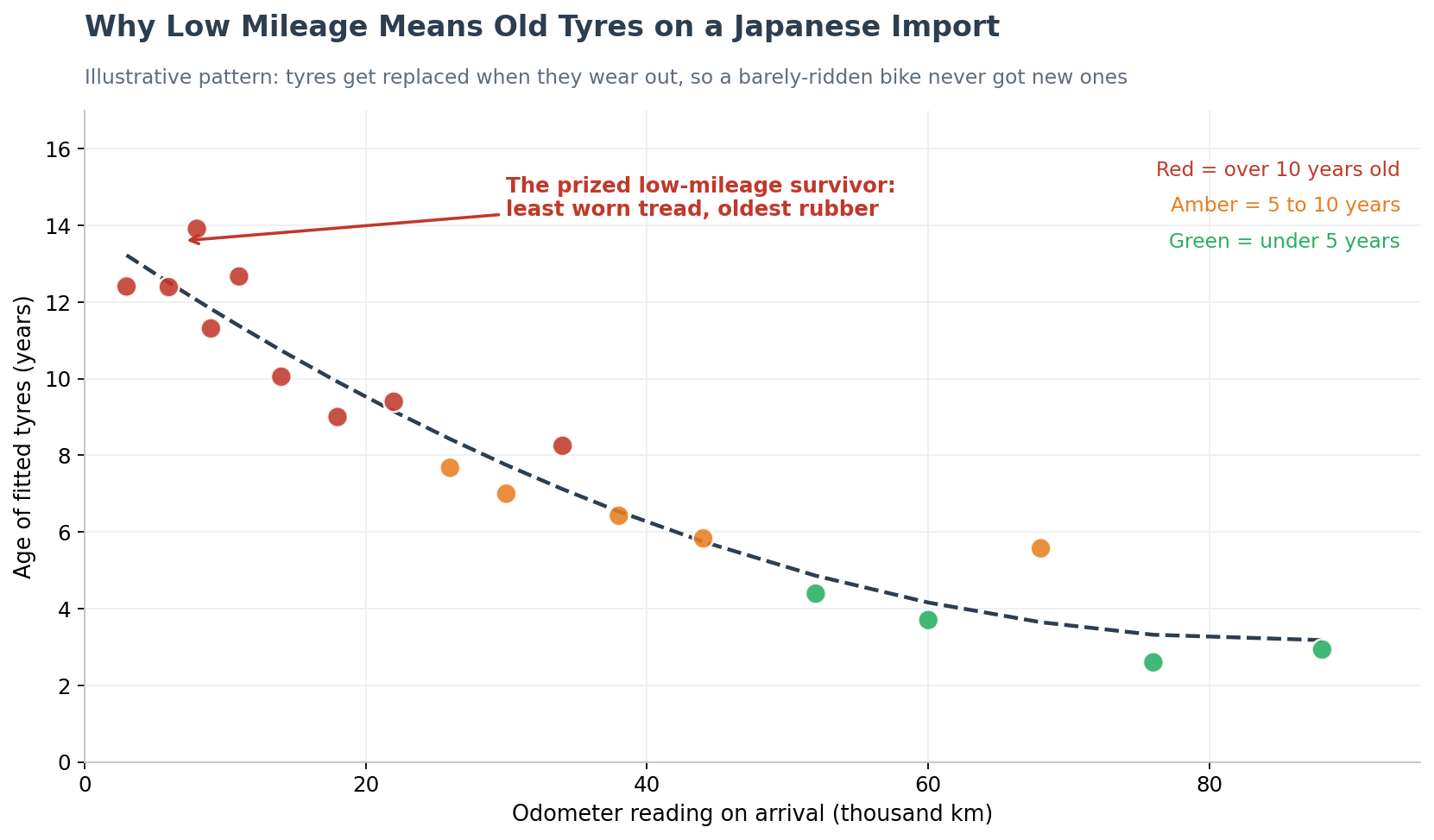
- Low mileage is the warning sign, not the reassurance. The 8,000km survivor you are excited about has old rubber almost by definition.
- The date code is four digits: week, then year. A three-digit code means the tyre was made before 2000. If you see three digits, the tyre is scrap.
- A JDM-market tyre may carry no DOT or E-mark at all. Japanese domestic tyres are marked to Japanese standards. That is a paperwork failure, not a rubber failure, and it still fails inspections.
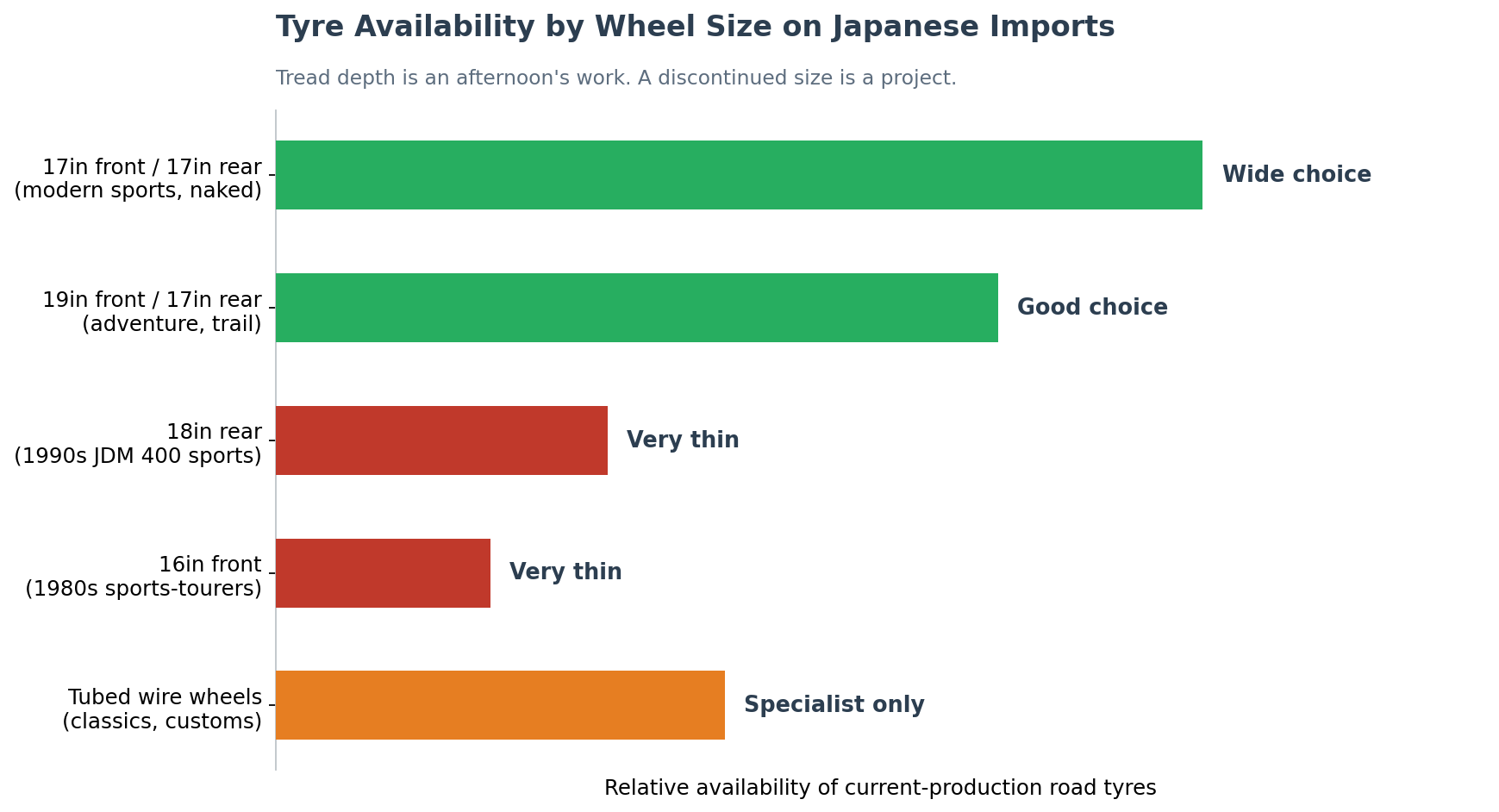
- Sixteen-inch fronts and eighteen-inch rears are the real problem. The tread depth is fixable in an afternoon. Finding a modern tyre in 130/70-18 is not.
- Age alone does not kill a tyre. Storage does. Heat cycles, UV, ozone and flat-spotting do the damage. A garaged eight-year-old tyre can outperform a three-year-old that lived outside.
- Do the five-minute check before you ride it, not after. Date codes, cracking, flat spots, pressure, and a look at the bead.
Japan's legal minimum is 0.8mm. Yours almost certainly is not.
Start with the primary text, because this is the part every English-language import guide skips.
Japan's vehicle safety standard — the 道路運送車両の保安基準, and specifically the detailed enforcement notice at Article 89, covering running gear — requires that the anti-slip grooves across the contact patch retain a depth of "1.6mm or more" at every point. Then comes the exception in brackets: two-wheeled vehicles, and two-wheeled vehicles with sidecars, need 0.8mm.
Half. Japan holds motorcycle tyres to exactly half the standard it holds car tyres to.
Now line that up against where your bike is going.
In the United Kingdom, the MOT standard for a motorcycle over 50cc is 1mm of tread depth across the central three-quarters of the breadth of the tread, around the entire circumference. Machines of 50cc and under escape the 1mm figure but must show a visible tread pattern across the full breadth and the whole way round. That is set out in section 5 of the DVSA MOT inspection manual for motorcycles. Note the detail that trips people up: the continuous 1mm band does not have to run parallel to the tyre's centre line, which matters on a squared-off rear where the wear is off-centre.
Australia and New Zealand both work to 1.5mm. In Australia the requirement is a clearly visible tread pattern with at least 1.5mm across the primary tread; secondary tread grooves are allowed to be shallower. New Zealand's Warrant of Fitness requires 1.5mm within all principal grooves that contain the moulded wear indicators, right around the tyre — and tread depth is one of the measurements a WoF inspector is required to physically record on the check sheet rather than eyeball.
In the United States the number is state law rather than federal law, and most states land on 2/32 of an inch, which is 1.6mm. A few write a motorcycle-specific figure. Check your state, because there is no single national answer to quote.
So here is the arithmetic that should change how you budget an import. A Japanese motorcycle tyre at the legal Japanese limit is at 80% of the UK minimum, 53% of the Australian and New Zealand minimum, and 50% of the typical US state minimum. A bike that has been signed off as roadworthy in Japan, by a Japanese inspector, applying Japanese law correctly, can be an instant fail in three of the four biggest markets that buy Japanese bikes.
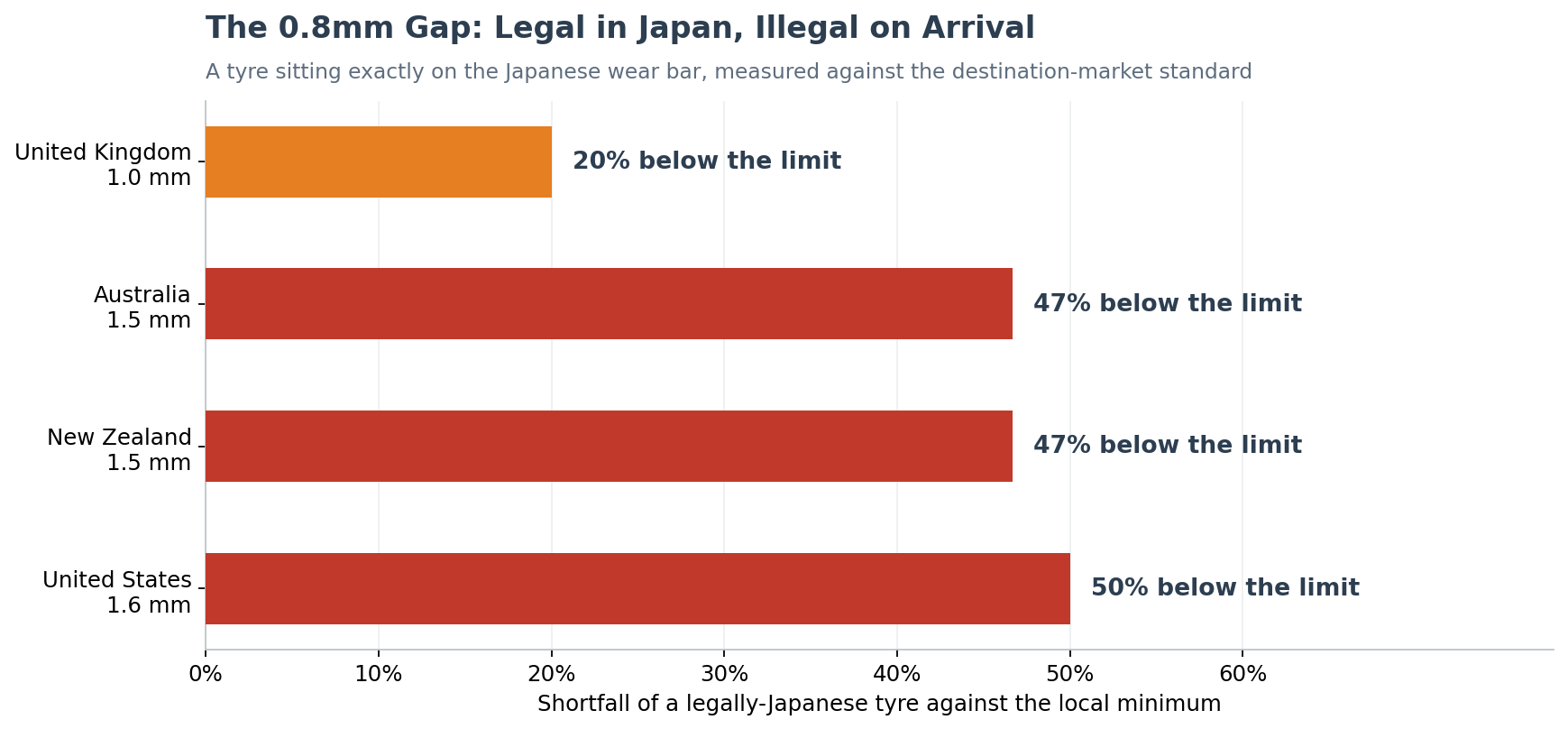
Nobody is being dishonest here. The exporter is not hiding anything. The auction inspector is not lying on the sheet. Two countries simply wrote different numbers into their rulebooks, and the bike travelled between them.
Why the gap exists at all
Japan's 0.8mm figure is not carelessness. Japanese motorcycle tyres are moulded with wear indicator bars 0.8mm tall, and the same Article 89 text explicitly allows the inspector to judge groove depth by the wear indicator rather than a gauge. The standard and the tyre are designed as a matched pair. Within Japan, the system is coherent.
It stops being coherent the moment the bike crosses a border, because the wear bar on a Japanese-market tyre now tells your inspector something different from what it told the Japanese one. When the tread is level with the bar, a Japanese inspector sees "legal, just." A New Zealand inspector sees a tyre nearly a millimetre under the line.
If you want the wider picture of what a Japanese inspection does and does not prove, we have taken it apart in detail in our guide to Japanese motorcycle shaken. The tyre standard is one of several places where "it passed shaken" means less than buyers assume.
Shaken has no tyre age limit — and that is why low-mileage imports have old rubber
Read Article 89 again and notice what is not there. There is a rule for depth. There is a rule against cracking and exposed cords. There is a rule about correct inflation pressure. There is no rule about age.
Japan does not care how old a motorcycle tyre is. Neither, to be fair, does the UK, Australia or New Zealand for a private motorcycle — age limits in those markets apply to buses and coaches, not bikes. But Japan's used-bike market has a structural feature that turns "no age limit" into a genuine problem for importers.
Japanese bikes get stored. A lot.
The 250cc and under class is exempt from periodic shaken entirely, so those machines can sit for years with no inspection touching them. Above 250cc, the shaken cycle plus the cost of keeping a bike registered pushes owners toward long dormant periods. Then the bike enters the auction system, where it may sit in a yard, get bid on, get moved, get re-listed. Then it sits in an exporter's warehouse. Then it spends four to eight weeks in a container.
The result is the thing that catches out every first-time importer: the lower the mileage, the older the tyres.
Think about what low mileage actually means on a twenty-year-old bike. It means the tyres were not worn out, so they were not replaced. A 1998 machine with 9,000km could easily be wearing its second set of tyres — fitted in 2006. The bike looks immaculate on the auction sheet. Grade 4, maybe 4.5. Clean panels, straight frame, tidy paint. And the rubber underneath it is old enough to vote.
One commenter under a widely-watched tyre video put it perfectly, describing a Honda CB250 from 1998 bought with completely original tyres still fitted — date code 498, a three-digit code, meaning the 49th week of a year in the 1990s. Original tyres, on a bike that had turned twenty. It happens constantly, and Japanese bikes are the single most common place it happens, because Japan's storage culture and shaken economics produce exactly this animal: the low-mileage, well-preserved, ancient-rubber survivor.
We wrote a whole guide on why the odometer reading is the least trustworthy number on the sheet — see Japanese motorcycle mileage and odometer verification. Tyres are the flip side of that story. Low mileage is not a reason to relax. It is a reason to look harder at the date codes.
How to read the date code on a Japanese motorcycle tyre
Every tyre made for a regulated market carries its birthday on the sidewall. Learning to read it takes about five seconds and saves you from the single most common imported-bike mistake.
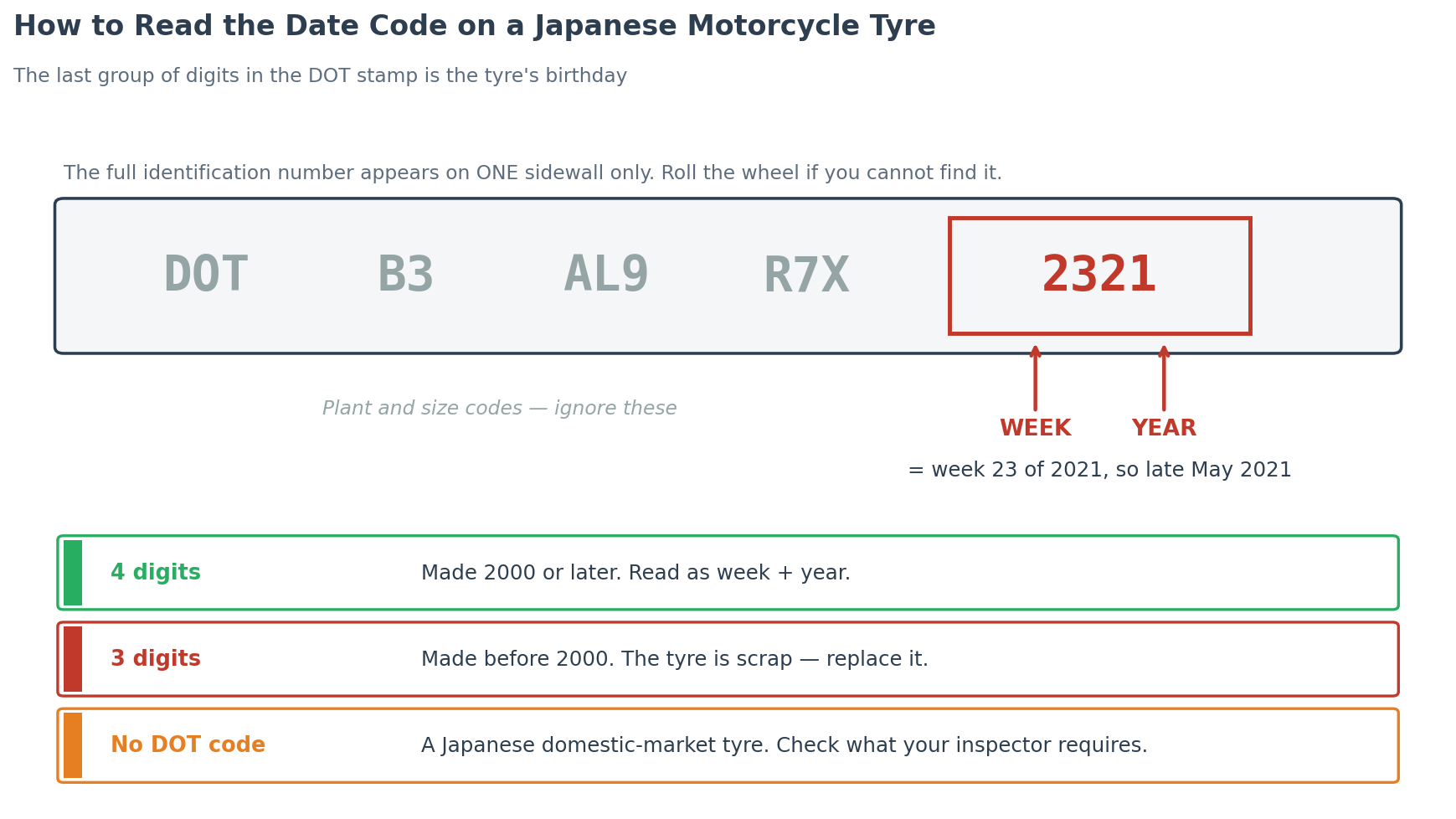
Look for the letters DOT followed by a string of characters. The information you want is the last group of digits, and there are only two possibilities.
Four digits: week, then year. A code ending 2321 means the 23rd week of 2021 — late May or early June that year. 0517 means week five of 2017, so early February. This has been the format since 2000, mandated under the US tire identification rules that most of the world's tyre plants now follow regardless of destination. The legal framework sits in the NHTSA tire identification and recordkeeping rule.
Three digits: pre-2000, and the tyre is scrap. Before 2000 the format used two digits for the week and a single digit for the year. The obvious flaw is that a single digit repeats every decade, and the industry never resolved it cleanly. What matters to you is simpler: any three-digit date code on a tyre you are about to ride means that tyre was manufactured in the previous millennium. There is no judgement call to make. Replace it.
Three things that catch people out
The full code is on one sidewall only. Manufacturers are required to show the complete identification number including the date on one side; the other side may carry a partial code without the date. If you cannot find a date, roll the bike 180 degrees and look at the other side before concluding it does not have one.
Front and rear are usually different ages. Rears wear roughly twice as fast as fronts on a road bike, so a bike that has had one rear replaced will show two different codes. This is normal and it is also useful intelligence: a fresh rear with an ancient front tells you the previous owner was replacing tyres reactively, one at a time, on the cheap. That habit rarely stops at tyres.
A JDM-market tyre may have no DOT code at all. This is the part that is specific to Japanese imports and is covered in the next section, because it is a bigger problem than age.
The marking problem: DOT, E-mark, JIS and what your inspector wants to see
Here is the failure mode nobody warns you about, and it has nothing to do with how much rubber is left.
A tyre sold into the Japanese domestic market is built and marked for the Japanese domestic market. It complies with Japanese standards, and Japanese standards are what the Japanese inspector checks. It may carry a JATMA reference. It may carry a Japanese Industrial Standard mark. What it may not carry is a US DOT code or a European E-mark — the circled "E" plus a country number that signals approval under the UN ECE regulations.
Your inspector at home is not looking for JATMA. They are looking for the mark their own rulebook names.
Importers who have been through this describe the same three failure points on JDM-market rubber, and none of them are about tread:
- No maximum pressure rating on the sidewall. Some markets require the maximum cold inflation pressure to be moulded into the sidewall. JDM tyres, particularly older ones, frequently do not carry it.
- No load index or speed rating in the expected format. Again common on older domestic-market tyres, and again an automatic write-up in markets where the inspector is required to read those figures off the tyre.
- No approval mark the inspector recognises. The tyre may be a perfectly good Bridgestone made in Japan. If it does not carry the mark that the local standard demands, the standard has not been met.
This matters most in the UK, where a bike that needs approval before registration will be examined against a defined standard. If you are going down that route, read our MSVA test guide for imported motorcycles first — the tyre section is one of the easiest points to fail on and one of the cheapest to fix in advance. It also matters in Australia and New Zealand, where compliance work on an imported machine will pick up non-conforming tyres as a matter of routine.
The fix is unglamorous and completely reliable: fit a set of properly marked tyres before the bike is inspected, not after it fails. A new set costs less than a re-test plus the time you lose. And on age grounds you were replacing them anyway.
The one nuance worth knowing
An E-mark does not have to come from the country where the tyre was made. Approval and manufacture are separate things. A tyre built in Japan can carry an E-mark issued by any signatory country, and plenty do — because Japanese manufacturers export to Europe and mark accordingly. So "made in Japan" is not the problem. "Made for Japan only" is.
That distinction is worth carrying into other parts of your import too. It is the same logic that governs lighting, speedometer markings and mirrors: the object is often fine, the paperwork attached to the object is not.
What a million viewers were told about tyre age, and what actually kills rubber
There is a rule of thumb floating around the motorcycle world that says tyres expire at five years. It is repeated in dealerships, in forums, and by people trying to sell you tyres.
It is not a rule. It is a marketing round number, and the most-watched examination of it says so.
RevZilla's The Shop Manual episode "Debunking The Tire Age Myth" has been viewed 1,034,107 times and drawn 1,615 comments since it went up in October 2021. The framing in its own description is direct: everyone knows tyres age and rubber hardens over time, but do motorcycle tyres actually have an expiration date, and if they do not, how old is too old? Motorcyclist's MC Garage covered adjacent ground in "How To Tell If You Need To Replace Your Motorcycle Tires," now at 1,039,897 views. ChrisFix's short on reading the date code before buying has 2,329,602 views and 109,746 likes, and his stated guidance is worth quoting because it is the most widely circulated version of the advice: never buy new tyres more than 18 months old, start thinking about replacement at six years, and definitely replace at ten.
Two things fall out of the comment threads under those videos, and both are more useful than the five-year number.
First: storage beats calendar age, decisively. A tyre shop employee commenting under the RevZilla video described seeing tyres two or three years old that were dry-rotted and rock hard, alongside eight-year-old tyres that were perfectly fine. That is not a contradiction of tyre chemistry — it is tyre chemistry. Rubber degrades through oxidation, ozone exposure, UV and heat cycling. A tyre that lived in a dark, cool, dry garage on a bike that was ridden gently is chemically younger than a tyre of the same age that sat outside in sunlight, or next to an electric motor throwing off ozone.
Second: riders consistently underestimate how bad hard rubber is until they replace it. One commenter described buying a bike with seven-year-old tyres, assuming the aging story was a sales gimmick, then discovering the rear kept sliding unexpectedly and the sidewalls showed dry rot. Another realised the bike they had owned for two years was running a twenty-year-old rear and a six-year-old front; after fitting a fresh set, they described the old rubber as rock hard — including the six-year-old one — and the change as going from leather soles to grip. A third bought a KTM in 2017 wearing its original 2001 tyres with plenty of tread left and only 2,220 miles covered.
That last one is the JDM import story in a different accent. Low mileage, tread remaining, sixteen years old.
So what should you actually use as a threshold?
Use age as a screening tool and condition as the verdict.
- Under 5 years and stored indoors: inspect, then ride. No automatic action.
- 5 to 10 years: inspect hard. Flex the sidewall and look into the crease for fine cracking. Press a thumbnail into the tread block — good rubber gives, dead rubber does not. If you are importing and the history is unknown, assume the worst end of the range.
- Over 10 years: replace. Not because a law says so, but because you have no way to reconstruct the storage history of a bike that has passed through an auction yard, a warehouse and a container, and the downside is a low-side in the wet.
- Three-digit date code: replace, no inspection needed.
For an import specifically, there is a further argument that has nothing to do with rubber. You have just spent four figures or more landing a bike you have never ridden, whose handling you do not know, in a country whose roads it has never seen, often on the opposite side of the road from the one it was ridden on for its whole life. New tyres remove one enormous variable from that first ride. That is worth the money on its own.
The sizes that have quietly gone extinct
Tread depth is a two-hour problem. Tyre size can be a two-month problem, and it is the one that actually decides whether some Japanese imports are practical to own.
Japanese manufacturers in the late 1980s and 1990s built to wheel sizes the rest of the world has since abandoned. The industry consolidated around 17-inch front and rear for sports and naked bikes, and the tyre makers followed the volume. Sizes outside that consolidation did not disappear overnight — they slowly stopped getting new compounds, then stopped getting new models, then stopped getting made at all except by a handful of specialists.
Three groups matter for Japanese imports.
16-inch fronts. Kawasaki's GPZ900R is the famous case; the original specification uses a 16-inch front wheel, and the choice of modern rubber in that size is thin. Buyers of this generation typically end up choosing between a small number of sport-touring patterns or converting to an 17-inch front, which is a project rather than a purchase. If you are looking at that era, our Kawasaki GPZ900R import guide covers the model context.
18-inch rears on 400cc sportsbikes. This is the big one for the JDM 400 class — the machines that exist almost nowhere else and that people import specifically because they cannot be bought locally. The Honda VFR400 NC30, the Kawasaki ZXR400, the Yamaha FZR400 generation. These bikes were built when 18-inch rears were normal on sports machinery, and they are not normal now. Availability exists but it is narrow, and the good options are premium-priced because volume is low. Before you commit to a 400, price the tyres. Both of them. In the actual size on the actual bike, not the size you assume it uses.
Two-stroke 250 sizes. The RGV250 and TZR250 generation sit in the same trap for the same reason, with the added complication that these machines are ridden harder than their tyre supply supports.
The practical rule: check the size on the swingarm sticker or the tyre itself before you bid, and search for it at your local supplier while the auction is still running. Five minutes of searching tells you whether you are buying a bike or a project. This is exactly the pre-bid discipline we describe in our guide to sourcing Japanese motorcycle parts, applied to the one consumable you cannot defer.
What to do if your size is genuinely thin
You have three routes and they are all legitimate.
- Buy the specialist option. Classic-focused manufacturers keep older sizes in production precisely for this market. Expect to pay more per tyre and expect fewer compound choices.
- Convert the wheel. On some models a later wheel bolts in with known spacer and disc changes. This is well-documented for popular machines and completely undocumented for unpopular ones. Research before you buy the bike, not after.
- Accept the constraint and buy two sets at once. If the size is available now and thinning, buying a spare set while it exists is cheaper than discovering in three years that it does not.
Reading tyre condition from an auction sheet before you bid
Japanese auction sheets are a genuinely good source of information, but they are not a tyre report. Understanding exactly what they do and do not tell you is the difference between a realistic budget and an unpleasant surprise.
What the sheet reliably gives you:
- The overall grade. A condition grade reflects the whole machine and is weighted heavily toward cosmetics and structure. It is not a tyre grade.
- The odometer reading. Useful as an inverse tyre-age signal, as covered above. Low reading, suspect old rubber.
- The inspector's remarks. The free-text field is where useful detail lives. Japanese inspectors do sometimes note worn or cracked tyres, and when they do, it means the condition was obvious enough to be worth writing down. Treat any tyre remark as a serious signal, not a minor one.
- Photographs. Usually including at least one three-quarter shot where the tread pattern is partly visible.
What the sheet will not give you:
- Date codes. Nobody photographs the sidewall stamp.
- Measured tread depth in millimetres.
- Whether the tyre carries a DOT or E-mark.
- Whether the bike has been standing on flat spots for two years.
So work with what you have. Our full breakdown of the document is in how to read a Japanese motorcycle auction sheet, and the grading system itself is explained in Japanese auction grades explained. For tyres specifically, run this four-step screen:
- Zoom the photos on the tread, not the bodywork. You are looking for two things: obvious wear to the wear bars, and a squared-off profile on the rear. Both are visible at auction-photo resolution if you look for them.
- Compare front and rear pattern. If the tread patterns are visibly different brands or designs, the bike has had at least one tyre replaced separately. That is your age clue.
- Read the remarks field properly, including the Japanese. Terms relating to tyres appear in inspector shorthand. If you are using an agent, ask them specifically whether the sheet says anything about tyres — do not rely on a summary translation to surface it.
- Ask for a sidewall photo if the auction format allows it. Some sellers and some auction houses will supply extra images on request. It costs nothing to ask and it converts a guess into a fact.
And then, regardless of what any of that tells you, budget for a set anyway. If the screen comes back clean and the tyres turn out to be recent, you have a pleasant surprise and a spare few hundred in the budget. That is a better failure mode than the reverse.
What Japanese motorcycle tyres actually cost to replace
Numbers, so you can put a real figure into your import spreadsheet rather than a shrug.
The cost of a set breaks into three parts, and importers routinely forget the third.
The tyres themselves. Mainstream road rubber in common 17-inch sizes is the cheap end. Sport and sport-touring compounds cost more. Sizes outside the mainstream cost more again, because low production volume, not because the tyre is better. Classic and vintage-pattern tyres for older machines occupy their own bracket.
Fitting and balancing. Charged per wheel, and higher if you bring loose wheels versus a whole bike, or lower, depending entirely on the shop. Tubed wheels — common on classics and on wire-spoked machines — add a tube to the bill and add labour.
The bit everyone forgets: getting the bike to the fitter. Your import cannot legally be ridden on the road until it is registered, and in several markets it cannot be registered until it has passed an inspection that it will fail on tyres. That circle is closed by either trailering the bike, paying a mobile fitter to come to you, or removing both wheels and taking them in. Each of those has a cost. Plan for it at the point you plan the shipping, not the week the bike lands.
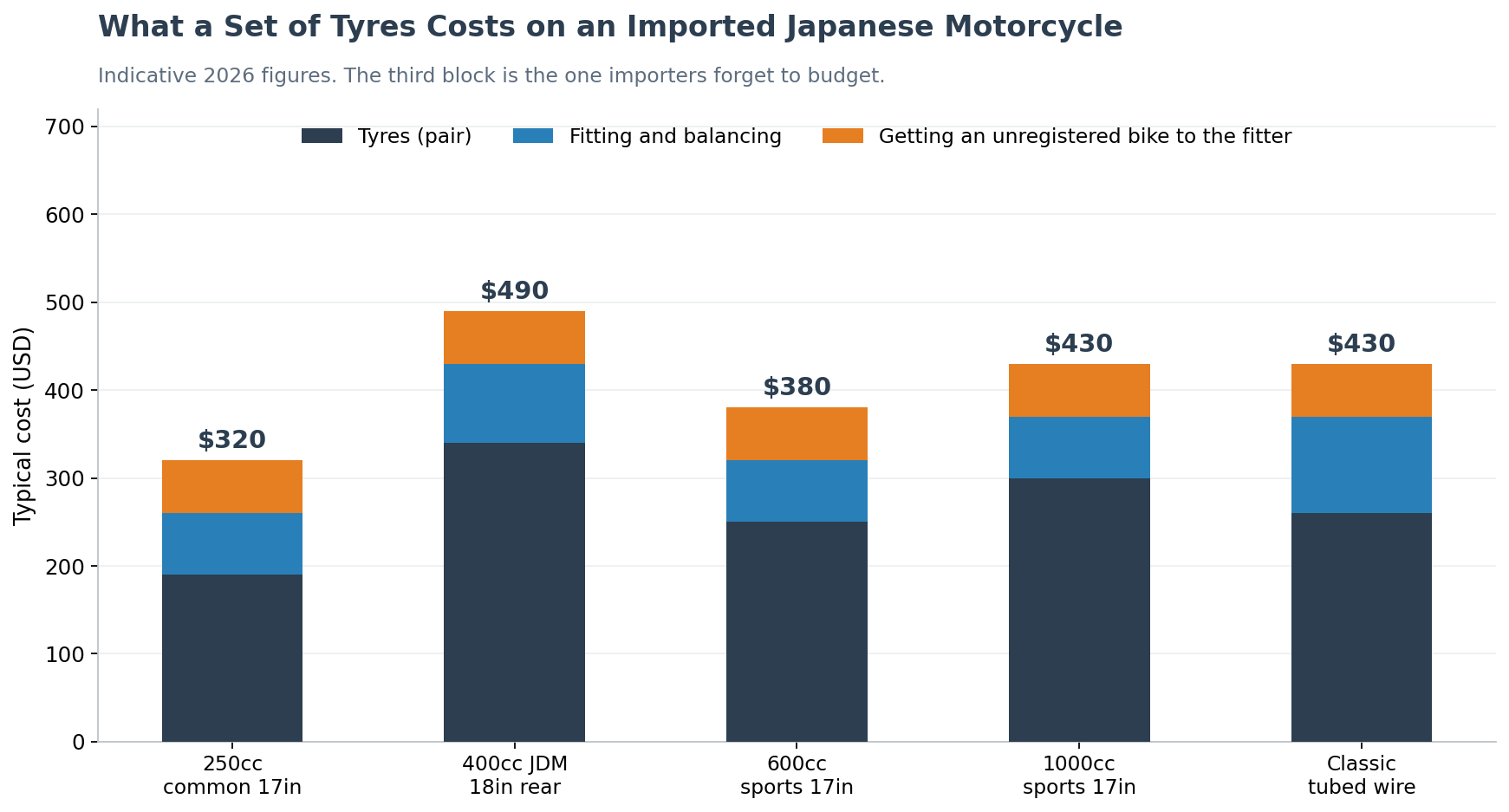
Set against the whole cost of an import, a set of tyres is a rounding error. Our complete import cost breakdown puts the individual line items in proportion. Tyres sit alongside fluids, a battery and a chain as the recommissioning block — the money you spend after the bike lands to turn a shipped object into a motorcycle you trust.
The mistake is not the amount. The mistake is treating it as optional and discovering it is not.
Flat spots, cupping and squaring: the storage damage nobody photographs
Three specific defects show up on Japanese imports far more often than on locally-bought used bikes, because all three are produced by exactly the conditions an import experiences.
Flat spots. A tyre carrying the weight of a bike, parked in one position, under-inflated, for months, takes a set. The contact patch deforms and the rubber remembers it. On a short-stored bike the flat spot rides out after a few miles as the tyre warms. On a long-stored bike it does not, and you get a persistent thump through the bars or the seat at low speed. Japanese imports are the textbook case: dormant in Japan, then dormant in a yard, then strapped down hard in a container for four to eight weeks. Container strapping is the underrated part — the tie-downs compress the suspension and load the tyres harder than parking does, and they hold that load continuously for the whole voyage.
Cupping and scalloping. Uneven wear in a wave pattern, usually on the front, usually caused by worn fork internals, incorrect pressures or a worn head bearing. It causes a vibration through the bars that riders often misdiagnose as a wheel balance problem. One commenter under the MC Garage video described exactly this: a mild handlebar vibration traced to a cupped front tyre. On an import, cupping is a useful diagnostic — it tells you the previous owner was running the bike with something wrong in the front end, and that something may still be wrong.
Squaring off. The rear wears flat in the centre while the edges keep their profile, because the bike was ridden mostly in a straight line. Japanese urban riding produces this reliably. A squared rear does not just look odd — it makes the bike reluctant to turn in and then abrupt once it does, which is a genuinely unpleasant first impression of a machine you have just imported. It also interacts with the UK MOT rule quoted earlier: the required 1mm band does not have to run parallel to the centre line, so a squared tyre can pass on the worn centre and still handle badly.
None of these three appear on an auction sheet. All three are visible in five minutes with the bike in front of you, and all three are more likely on a low-mileage, long-stored, freshly-shipped Japanese bike than on almost anything else you could buy.
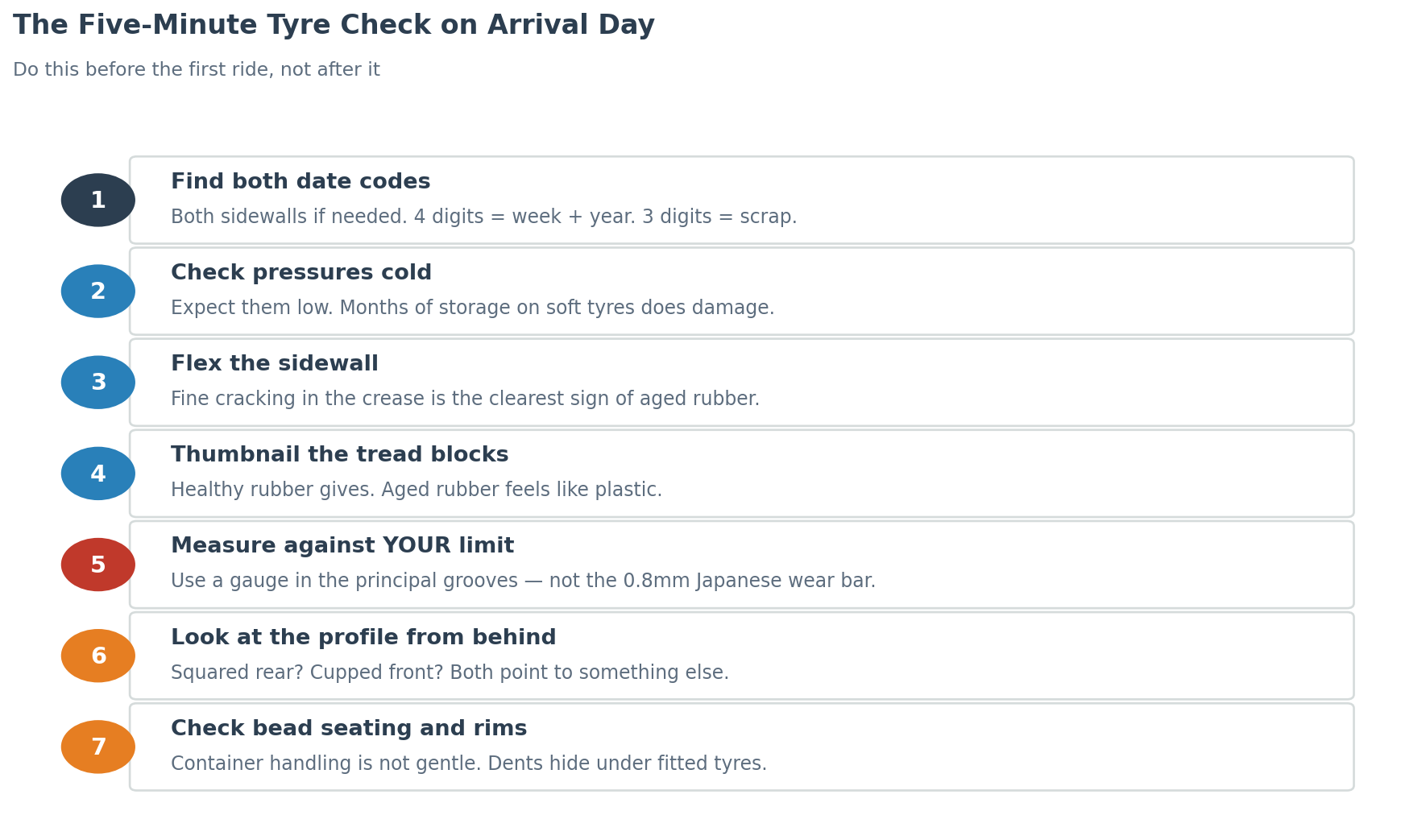
The five-minute check the day your import lands
Do this before the first ride. Not after.
- Find both date codes. Both sides of both wheels if necessary. Write them down. Four digits is week and year; three digits means scrap.
- Check pressures cold, and expect them to be low. Tyres lose pressure over months of storage, and a bike that has been sitting on soft tyres has been damaging them the whole time. Inflate to the manufacturer's figure — which, on a JDM bike, may be on a sticker in Japanese. Look it up rather than guessing.
- Flex the sidewall and look into the crease. Fine cracking in the flex zone is the clearest visible sign of aged rubber. Do it in good light.
- Run a thumbnail across the tread blocks. Healthy rubber deforms slightly under a nail. Aged rubber feels like plastic. Once you have felt the difference, you never need a chart again.
- Measure the tread properly against your local limit, not Japan's. Use a gauge, in the principal grooves, at several points around the circumference. Do not judge by the Japanese wear bar, which is set to 0.8mm.
- Look at the profile from behind. Squared rear? Cupped front? Both tell you something about how the bike was ridden and what else to check.
- Check the bead seating and look for rim damage. Container handling is not gentle, and a corroded or dented rim under a fitted tyre is easy to miss.
This same arrival-day discipline applies to more than tyres. Our guide to rust and corrosion on Japanese imports covers what the ocean voyage adds to the rest of the machine, and the first thirty days are when you find everything.
Tread depth compared: Japan, UK, Australia, New Zealand, USA
One table, because this is the fact that should drive your decision and it is oddly hard to find in one place.
| Market | Motorcycle minimum | Measured how | Where it comes from |
|---|---|---|---|
| Japan | 0.8mm | Any point in the anti-slip grooves; wear indicator may be used instead of a gauge | MLIT enforcement notice, Article 89, paragraph 4 |
| United Kingdom | 1mm (over 50cc) | Continuous band across the central three-quarters of the breadth, entire circumference; band need not be parallel to the centre line | DVSA MOT inspection manual for motorcycles, section 5 |
| Australia | 1.5mm | Across the primary tread pattern; secondary grooves may be shallower | State roadworthy standards, tyres marked to ADR requirements |
| New Zealand | 1.5mm | Within all principal grooves containing moulded indicators, around the whole circumference | Warrant of Fitness; tread depth is a recorded measurement on the check sheet |
| United States | Typically 2/32in (1.6mm) | Varies by state; some states write a motorcycle-specific figure | State vehicle codes, not federal law |
Read the first row against the rest. Japan's motorcycle figure is the lowest number in the table, and it is the number your bike was legally allowed to sit at on the day it left.
If you are importing into one of these markets, the country guides carry the rest of the inspection detail: importing to the UK, to Australia, to New Zealand and to the USA.
Five things English-language guides get wrong about Japanese motorcycle tyres
1. "Tyres expire at five years." They do not. There is no expiry date on a motorcycle tyre in any of the markets discussed here, and the most-watched examination of the claim exists specifically to take it apart. What ages a tyre is heat cycling, UV, ozone and storage conditions. Use age to decide how hard to inspect, then let the inspection decide.
2. "If it passed shaken, the tyres are fine." Shaken checks tread depth to 0.8mm, checks for cracking and exposed cords, and checks pressure. It does not check age, and its depth standard is the lowest in the developed world for motorcycles. "Passed shaken" and "legal at home" are different statements.
3. "Tread depth is the only thing that matters legally." This is broadly true once a bike is registered and in normal use — and it is exactly the assumption that fails an import at approval stage, where missing DOT or E-marks, absent pressure ratings and missing load indices are all live issues on JDM-market rubber.
4. "Low mileage means the tyres will be good." It means the opposite, and on Japanese bikes it means the opposite more strongly than anywhere else, because Japan's storage culture and shaken economics produce large numbers of genuinely low-mileage, genuinely old machines. The 9,000km survivor is the one most likely to be riding on rubber from the previous decade.
5. "You can sort it out when it arrives." You can, but not by riding it there. In several markets an unregistered import cannot legally use the road, and cannot be registered until it passes an inspection it will fail on tyres. Decide in advance whether you are trailering it, using a mobile fitter, or pulling both wheels. That decision is free to make in advance and expensive to make on the day.
How AWA Auction handles the tyre question
We bid on machines in the Japanese auction system on behalf of buyers in the UK, Europe, Australia, New Zealand, North America and the Gulf, so this problem crosses our desk constantly, and it is nearly always the same conversation in a different accent.
What we do about it:
- We read the remarks field, in Japanese, and we tell you what it says about tyres. Not a summarised translation of the sheet — the actual tyre remarks, if there are any.
- We flag the size problem before you bid, not after you win. If a machine runs a 16-inch front or an 18-inch rear, that is information you need while you can still decide not to bid.
- We tell you to budget for a set on every bike. Every single one, regardless of what the photos suggest. It is the cheapest insurance in the whole import.
- We are straight about what the auction sheet cannot tell you. Date codes are not on it. Nobody's sheet has them. Any agent who implies otherwise is guessing.
You can see what is currently running through the auctions on our current listings, and if you want a specific machine assessed — including a realistic landed cost with the recommissioning block included rather than hidden — talk to our team. We will tell you what the sheet says, what it does not say, and what the tyres are likely to cost you.
Two related reads if you are early in the process: how bidding actually works, and the export certificate that turns a Japanese registration into an importable vehicle.
The short version
Japan sets its motorcycle tyre minimum at 0.8mm — half what it demands of cars, and below the legal floor in the UK, Australia, New Zealand and most of the United States. Japan also sets no age limit on motorcycle tyres at all. Combine those two facts with a used-bike market built around long storage periods, an auction system that adds more storage, and a sea voyage that adds several more weeks of strapped-down standing, and you get the characteristic Japanese import: beautifully preserved, low mileage, and riding on rubber that is simultaneously legal where it came from and illegal where it is going.
The fix is a set of tyres. The mistake is not budgeting for them, discovering the problem at inspection, and then finding out that you cannot legally ride the bike to the place that would solve it.
Check the date codes. Check the size while the auction is still live. Budget the set. Then go and enjoy a bike that most people in your country will never get to own.
See Also
Share this article: