
If you want to import a Kawasaki W650 from Japan, you have picked one of the smartest retro-twin buys on the planet. It is the bike Kawasaki built to out-Triumph Triumph: an air-cooled 676cc parallel twin with a bevel-gear-driven overhead cam, a genuine kick-starter, and lines that look more like a 1960s Bonneville than most modern Bonnevilles do. Japan is where these bikes were born, sold in the biggest numbers, and cared for obsessively, which is exactly why the domestic auction market is the best place on earth to find a clean one.
Here is the thing nobody tells you: the W650 was only ever a niche seller in most Western markets, so local used examples are thin, tired, or overpriced. In Japan, they are everywhere, they are cheap, and they were ridden gently. This guide walks you through the best years, the handful of things to watch, what a W650 really costs to land in your driveway, and the country-by-country import rules for the US, UK, Australia and New Zealand.
What Makes the Kawasaki W650 Special
The W650 arrived in 1999 as a deliberate throwback. Kawasaki reached into its own history — the W1 of the mid-1960s, which was itself a copy of the BSA A7 — and rebuilt the idea with 1990s engineering. The result is a 676cc air-cooled vertical twin that makes around 49 bhp. That is not a big number, and it is not supposed to be. The W650 is about torque, character and sound, not headline horsepower.
The party trick is the camshaft drive. Instead of a chain or belt, the W650 uses a vertical shaft with bevel gears to spin the overhead cam — the same expensive, jewel-like method Ducati used on its 1970s singles and V-twins. Kawasaki did it purely for the look and the mechanical romance of it. Open the right-hand side of the engine and there is a beautiful bevel tower where a boring cam chain would normally live.
It also kept a real kick-starter alongside the electric start. On a modern retro that detail matters more than you would think. In one of the most-watched W650 owner videos, the owner's wife kick-starts the bike first prod and bursts out laughing at how easy it is — that is the W650 experience in a nutshell: old-school theatre without old-school hassle.
Owners are fiercely loyal. On that same video, a rider who bought a 1999 W650 brand new summed up more than two decades of ownership like this: apart from one front-brake micro-switch, plus the usual battery and tyres, nothing has gone wrong. Another put it more bluntly — his 2006 example had been heavily modified and was still "fairly sturdy and hard to break." When people describe a 20-plus-year-old bike that way, you pay attention.
The W650 Was Built in Akashi — and That Matters
The W650 was assembled at Kawasaki's plant in Akashi, Japan, and the domestic market got the lion's share of production. One long-term owner in the comments of a popular review explained he bought his specifically because it was made just up the road from where he lived, near Akashi, and he wanted to support the local factory. He rode it from 2000 to 2018.
For an importer, that Japanese-market concentration is the whole opportunity. The bikes were sold new in Japan by the thousand, serviced at Kawasaki dealers, and often ridden seasonally by older enthusiasts who kept them immaculate. When you buy at a Japanese auction, you are buying from the deepest, best-maintained pool of W650s that exists anywhere. Compare that to the trickle of grey and official imports scattered across Western classifieds, and it is obvious why serious buyers go straight to the source.
Kawasaki W650 vs W800: Which One Should You Import?
This is the first question every buyer asks, so let us settle it. The W650 (1999-2007) and the later W800 (2011 onward) look almost identical and share the same DNA, but they are not the same bike.
The W650 is carbureted. The W800 is fuel-injected. That single difference drives everything else. The carbureted W650 has a rawer, more analogue feel and — crucially for the retro crowd — many owners simply think it looks better. As one commenter under a W650 review put it, "I really think this carburated one looks so much better than the newer models." Another owner who has a modern W800 in the garage still went out of his way to praise the older carb bike's purity.
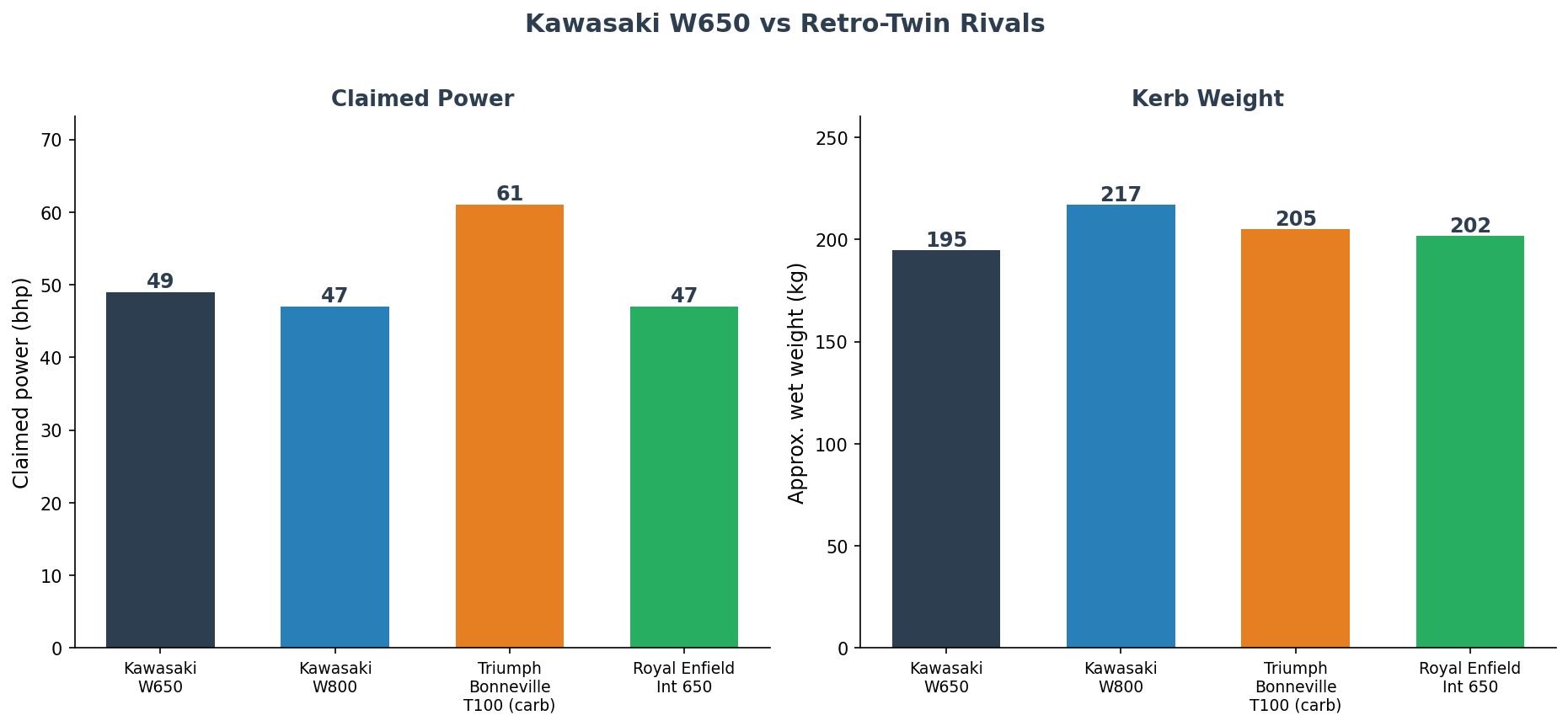
The W800 is smoother, a touch more refined, and easier to live with in stop-start traffic thanks to injection. It is also heavier. The W650 is the lighter, more flickable machine at roughly 195 kg wet versus the W800's 217 kg. If you want the most authentic, old-school ride, the W650 wins. If you want modern fuelling and the newest possible bike, the W800 wins — and we have a full W800 import guide.
But there is a decisive practical factor if you are in the United States, and it is all about the calendar. Keep reading — the W650's age is its superpower.
The US 25-Year Rule Is the W650's Secret Weapon
American buyers live and die by the federal 25-year import exemption. Any vehicle 25 years or older can be imported into the US without meeting modern DOT and EPA standards, under the rolling rule administered through Customs and the guidance published by the NHTSA.
Do the math. The W650 launched in 1999. That means:
- A 1999 W650 became US-eligible in 2024 — it can be imported today with no federal drama.
- A 2000 model cleared in 2025.
- A 2001 model becomes eligible in 2026 — this year.
- Each following year, one more model year rolls into the window.
Contrast that with the W800, whose earliest 2011 examples will not be 25 years old until 2036. For a US rider who wants this style of Kawasaki twin right now, the W650 is not just the better-looking option — it is the only one you can legally import under the age exemption. That is a genuinely rare situation, and it is why W650 interest in the States is climbing.
One honest note: Kawasaki did sell the W650 new in North America for the 2000 and 2001 model years before withdrawing it, so a small number of US-titled bikes exist. They are scarce and often rough. For most American buyers, a clean Japanese-market import will be both nicer and, once you add up the numbers, competitive on price.
Kawasaki W650 Generations and the Best Years to Buy
Good news: the W650 barely changed across its life, so there is no minefield of bad years to memorize. It is one of those rare models where almost any example is a good example, provided it has been looked after. Here is how the run breaks down.
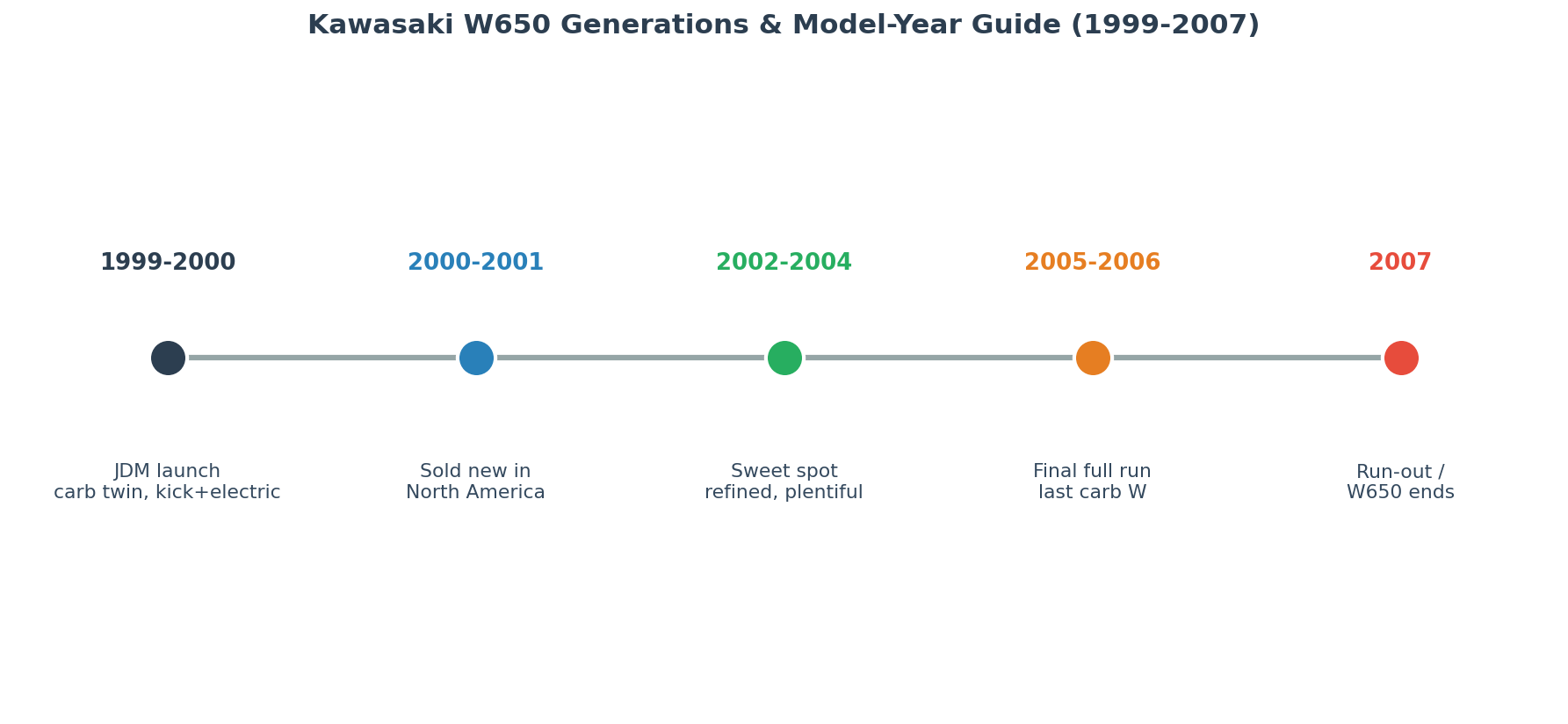
1999-2000 (launch): The original Japanese-market bikes. Carbureted twin, kick and electric start, single front disc and a rear drum. Mechanically the same as everything that followed. These are now the oldest and therefore the first to clear the US 25-year rule.
2000-2001 (North American run): The short window when the W650 was officially sold in the US and Canada. Identical to the JDM bike apart from market-specific fittings.
2002-2004 (the sweet spot): By now any tiny early niggles were long sorted, the bikes are plentiful in Japanese auctions, and prices are sensible. If you want the best balance of age, condition and value, shop here first.
2005-2006 (final full run): The last of the carbureted Ws before tightening emissions rules ended production. These are the youngest, lowest-mileage W650s you will find, and they command a small premium for it.
2007 (run-out): A final trickle of bikes before the W650 was retired in 2008. Rare, and worth grabbing if the condition is right.
The practical takeaway: chase condition and history, not a specific year. A well-kept 1999 will serve you better than a neglected 2006. As one long-term rider noted, these engines and frames are "fairly sturdy and hard to break," so the deciding factor is almost always how the previous owner treated it — and Japanese owners tend to treat them beautifully.
Kawasaki W650 Years to Avoid and Known Problems
The honest answer is that there are no cursed model years to run from. The W650 is one of the more trouble-free retro bikes ever made. But every used machine has weak spots, and a smart importer checks for them before bidding. Here is the real-world list.
- Regulator/rectifier and charging: Like most bikes of its era, the reg/rec can weaken with age. Check that the battery holds charge and the headlight does not dim at idle. A replacement is cheap and a common preventive upgrade.
- Carburettor gumming from sitting: Many Japanese bikes sit for long stretches. Stale fuel can varnish the carbs, causing rough idle or hard starting. Usually a clean and rebalance fixes it — factor a carb service into your first-year budget on any bike that has been parked.
- Chrome and fastener corrosion: The W650 wears a lot of chrome and polished metal. In coastal or salted climates it can pit. On a Japanese import from a dry region this is often minimal, but inspect the rims, exhaust and fasteners in the photos.
- Fork seals and steering-head bearings: Standard age-and-mileage wear. Look for oil weeping on the fork legs and notchy steering.
- Front brake feel: The single front disc with a basic twin-piston caliper was never a sportbike stopper. That is design, not a fault — but braided lines and fresh pads transform it.
- Modified examples: The W650 is a hugely popular cafe-racer and scrambler donor. Many have been customized. A tasteful build is fine, but check that engine internals and wiring were not butchered in the process.
None of this is scary. It is the normal checklist for a 20-year-old modern classic, and most of it is visible on a good auction sheet and inspection video.
What a Kawasaki W650 Really Costs to Import from Japan
Let us talk actual money. The auction hammer price is only part of the story; you need the landed cost — the total to get the bike to your door, road-legal. A clean, honest W650 typically hammers in the region of USD 3,500 to 5,000 at Japanese auction, depending on year, mileage and condition. Build the rest on top of that.
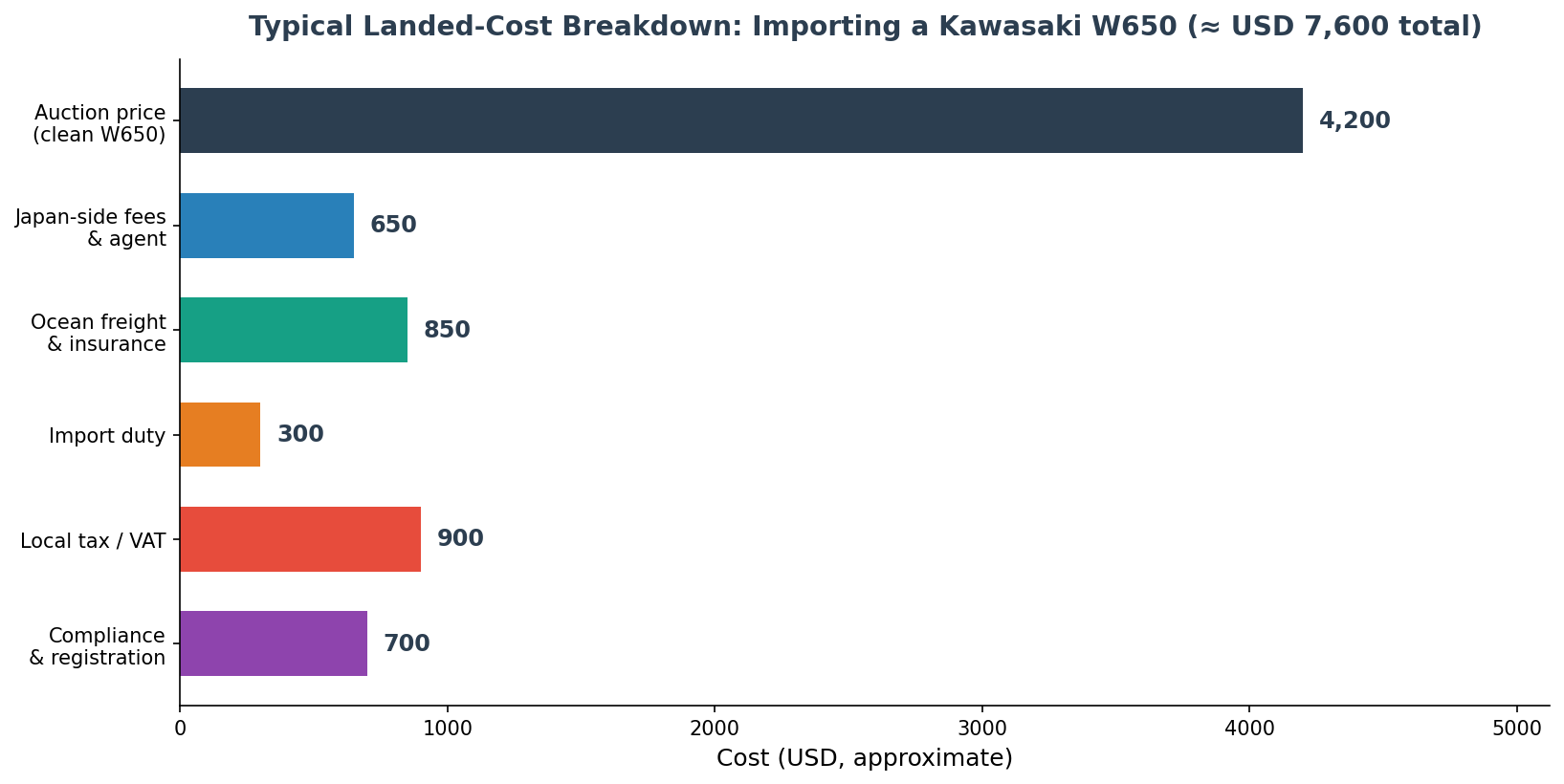
Here is a realistic breakdown for a mid-condition W650:
- Auction price: around USD 4,200 for a clean, unmolested example.
- Japan-side fees and agent commission: roughly USD 650, covering the bidding service, domestic transport to port and export paperwork.
- Ocean freight and insurance: about USD 850, varying by destination and whether the bike ships crated or in a shared container.
- Import duty: around USD 300, though this depends heavily on your country's tariff.
- Local tax or VAT: around USD 900, again country-dependent.
- Compliance and registration: roughly USD 700 for inspection, any required modifications and titling.
That lands a clean W650 around USD 7,600 all-in. The exact figure moves with exchange rates, your freight lane and local rules, but it gives you a sane planning number. And remember the comparison point: because the W650 was never a mass-market bike in the West, a good local example — if you can even find one — often costs as much or more, without letting you hand-pick from Japan's enormous, well-kept inventory.
How to Read a Japanese Auction Sheet on a W650
The auction sheet is your eyes on the bike. Japanese auction houses grade every vehicle and note its faults on a standardized sheet, and a good import agent translates it for you. For a W650, here is what to focus on.
- Overall grade: Grades typically run from around 3.5 up to 5 (and S for near-new). For a modern classic, a 4 or 4.5 is a genuinely good, tidy bike. Anything at 3 or below needs careful scrutiny.
- The map diagram: The inspector marks scratches, dents, rust and repairs on a diagram of the bike. Learn the codes — A/W means scratches, U means dents, S means rust, and so on. A few small marks on a 20-year-old bike are normal and honest.
- Mileage verification: Confirm the odometer reading and that the sheet does not flag a replaced or suspect meter.
- Modifications: The sheet often notes aftermarket exhausts, bars or seats. Given how many W650s were customized, this matters — you want to know exactly what you are bidding on.
- Rust and corrosion notes: Because of all that chrome, pay attention to any rust callouts on the exhaust, rims and frame.
A trustworthy agent will also request extra photos or a start-up video. Never bid blind. Missing or vague documentation is the single most common way an import goes wrong, so insist on clear photos of the VIN plate, engine number, odometer and the full auction sheet before you commit.
Import Rules by Country: US, UK, Australia and New Zealand
Every destination has its own paperwork. Here is the practical version for the four biggest English-speaking markets.
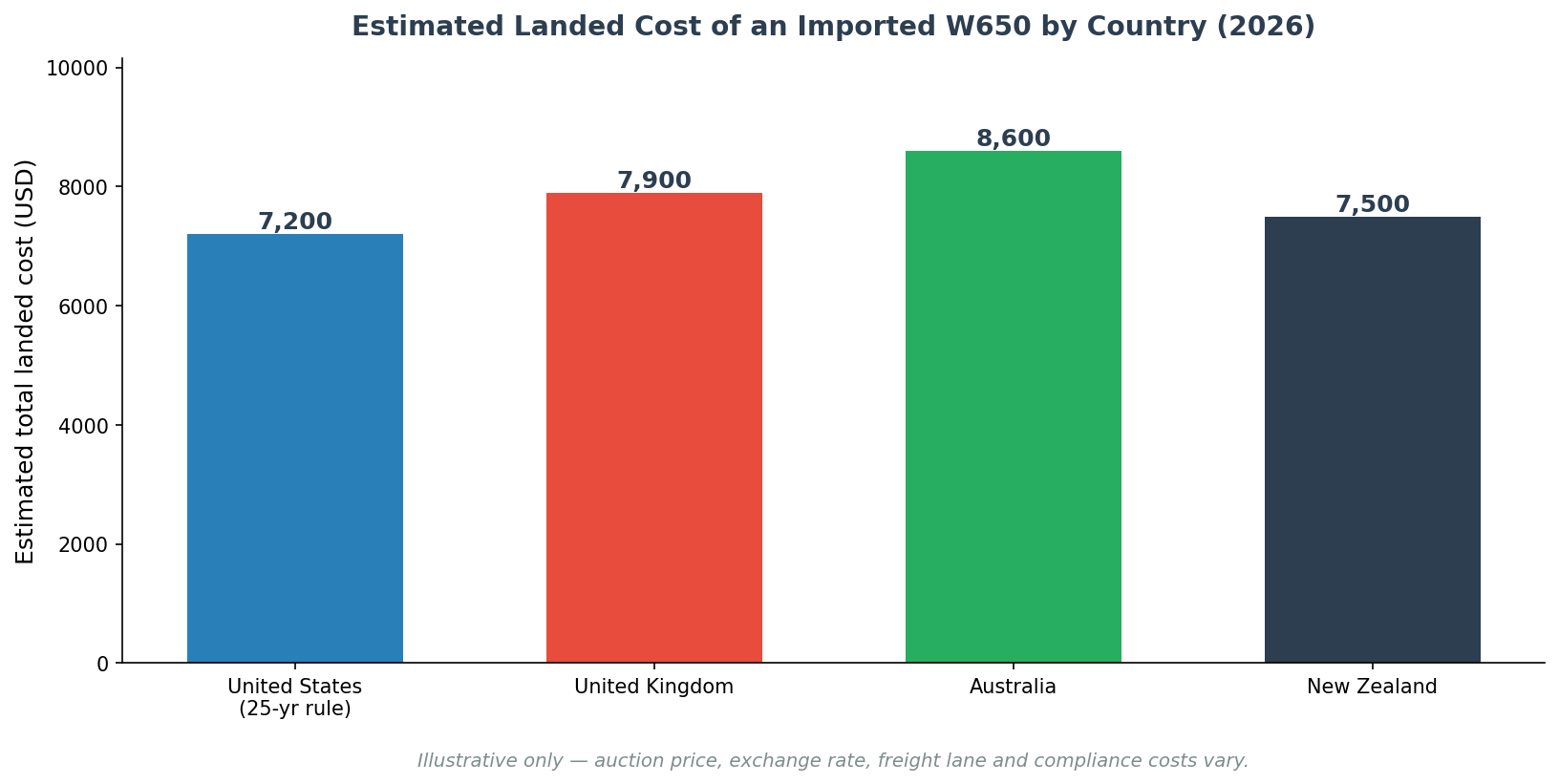
United States: The 25-year rule is your friend. A W650 that is 25 or more model years old imports free of DOT and EPA conformity requirements. You file the standard Customs entry plus EPA and DOT exemption forms citing the age exemption, pay the modest duty, then title and register in your state. For a full walkthrough, see our guide to importing a motorcycle from Japan to the USA. As of 2026, 1999 through 2001 models qualify, with more rolling in each year.
United Kingdom: No age barrier — the UK happily imports bikes of any age. You will pay import VAT and duty on arrival, submit a NOVA notification to HMRC so the bike can be registered for tax, and register it with the DVLA. Because the UK already has a healthy W650 following, parts and knowledge are easy to find.
Australia: Australia is stricter. Road bikes generally need to come in under an approved import pathway — often the process for vehicles on the register of approved models, or an older-vehicle route for bikes over 25 years old. You will deal with import approval, quarantine cleaning (the bike must arrive spotless — no soil or plant matter), GST, duty and state registration compliance. Budget more time and money here than anywhere else.
New Zealand: NZ is one of the most import-friendly countries in the world thanks to its long love affair with Japanese imports. Expect an entry certification (compliance) inspection, GST, and registration. The used-import culture means inspectors and workshops know these bikes well.
Wherever you are, confirm the current rules with your own customs authority before you bid, because tariffs and procedures change.
W650 vs the Modern Retro Rivals
How does the W650 stack up against the bikes people cross-shop it with? Mainly the Triumph Bonneville and the Royal Enfield Interceptor 650. This is where the W650's reputation as "the Bonneville Triumph should have built" really lives.
On paper the numbers are close. The W650's roughly 49 bhp sits right alongside the carbureted Triumph Bonneville T100's low-60s and the Interceptor 650's high-40s. Weight is similar too, with the W650 actually the lightest of the group. But the W650's appeal was never a spec sheet.
It is about authenticity. More than one owner has told the same story: they showed a photo of their modern Triumph Bonneville to a friend, who asked whether they had ever seen a W650 — because the Kawasaki, with its bevel drive and slim classic tank, looks more like a 1960s Bonneville than the modern Triumph does. As one rider flatly put it, the W650 is "way nicer than a modern Bonneville. It's what Triumph should have done when they came back."
The Interceptor 650 is the value king and a brilliant bike, but it is a current mass-production model. The W650 offers something it cannot: genuine two-decade-old modern-classic status, bevel-drive mechanical charm, and rarity. If you want the bike everyone at the cafe asks about, the W650 is the answer.
The W650 as a Custom Base
You cannot talk about the W650 without mentioning the custom scene. It is one of the most sought-after donor bikes in the world for cafe racers, scramblers and brat builds. The slim frame, air-cooled twin and classic silhouette make it a builder's dream, and there is a deep aftermarket to match.
One of the most admired custom W650s — Ashley Watson's dual-purpose scrambler build featured by Bike Shed — drew comments like "the coolest looking scrambler ever" and praise for being built for real riding rather than show. That build sums up the W650's flexibility: leave it stock for pure retro cool, or use it as the foundation for a one-off.
For an importer, this is a bonus. A clean, standard W650 from Japan is both a lovely bike to ride as-is and the perfect blank canvas if you catch the custom bug later. Just remember, if you are buying an already-modified example, to check the quality of the work and that nothing important was compromised.
Common Mistakes First-Time W650 Importers Make
- Obsessing over model year: The W650 changed so little that condition and history matter far more than whether it says 2001 or 2005 on the papers. Buy the best-kept bike, not the newest number.
- Skipping the auction sheet translation: Bidding on a bike you cannot fully read is how people end up with hidden rust or a swapped odometer. Always get the sheet properly interpreted.
- Forgetting the landed cost: The hammer price is not the price. Freight, duty, tax and compliance can add 40 to 80 percent. Plan for the full number.
- Ignoring compliance rules until the bike arrives: Especially in Australia, sorting out the import pathway after the bike is on the water is a recipe for storage fees and stress. Confirm eligibility first.
- Underestimating a fresh service: On any bike that has been sitting, budget for a carb clean, fresh fluids, tyres and a battery. It is normal, and a sorted W650 is a joy.
- Going it alone: The buyers who get burned are almost always the ones who tried to bid directly at a Japanese auction with no local agent, no translation and no inspection. A good import partner pays for itself.
What the Kawasaki W650 Is Like to Ride and Own
Numbers do not capture this bike, so let us describe the experience. The W650 is unhurried in the best way. The 676cc twin pulls cleanly from low revs with a warm, offbeat exhaust note, and because the 360-degree crank fires both cylinders together, it thumps along with real character rather than the flat drone of a modern parallel twin. It is happiest on back roads at a relaxed pace, and that is precisely where owners fall for it.
One rider who owned his from new for more than two decades described it as the kind of bike you never get bored of and never feel the urge to replace. Another, who kept his for eighteen years in Japan, only sold up because life changed, not because the bike ever let him down. That is the recurring theme in W650 ownership stories: people keep them for a very long time.
Fuel economy is excellent — expect somewhere in the region of 55 to 65 mpg with gentle use, giving a comfortable real-world range from the classic teardrop tank. The riding position is upright and roomy, the seat is genuinely usable for a passenger, and the light kerb weight makes it effortless to manage at walking pace or in a car park. This is a motorcycle you can hand to a nervous returning rider or a shorter rider with confidence.
What it is not is a motorway missile. Sustained high-speed cruising is not the W650's world; it will do it, but it would rather be threading through villages and coast roads. Go in expecting a charming, torquey, characterful classic and you will love it. Go in expecting sportbike urgency and you have bought the wrong bike.
Is the Kawasaki W650 a Future Classic?
It is already becoming one, and the market is starting to notice. Prices for genuinely clean, standard examples have been firming up for years, and the reasons are easy to see. The W650 is out of production, it has a cult following, it uses a charming and unrepeatable bevel-drive engine, and — unlike its W800 successor — the earliest examples are now old enough to qualify for the US 25-year import exemption, opening a whole new market of American buyers.
That combination of scarcity, character and fresh demand is exactly what drives modern classics upward in value. This does not make the W650 a guaranteed investment, and you should never buy a motorcycle purely as a financial bet. But of all the affordable retro twins you could import from Japan right now, the W650 sits in a genuine sweet spot: cheap enough to buy and ride, distinctive enough to appreciate, and increasingly hard to find in original condition. Buying a well-preserved standard bike, rather than a heavily modified one, is the smart move if long-term value matters to you.
Your Pre-Bid W650 Inspection Checklist
Before you set a maximum bid on any W650 at a Japanese auction, run through this quick list with your agent. It takes five minutes and saves a lot of regret.
- Confirm the auction grade and read the map diagram — understand every mark noted on the bike.
- Check the odometer reading and that it is not flagged as replaced or unverified.
- Look hard at the chrome — exhaust, rims, mirrors and fasteners — for pitting and rust.
- Ask for a cold start-up video to hear the engine and confirm the charging light behaves.
- Verify it is standard or note every modification — exhaust, carbs, bars, seat and wiring.
- Inspect fork legs for oil weeping and the tank interior for rust if photos allow.
- Confirm the paperwork — clear photos of the VIN plate, engine number and the export documentation.
- Set a firm landed-cost ceiling so an auction bidding war does not blow your budget once freight and tax are added.
Get comfortable with these eight points and you will bid with confidence rather than hope. On a bike as fundamentally solid as the W650, careful buying is what separates a great import from an expensive lesson.
Kawasaki W650 Colours, Variants and What to Look For
Across its life the W650 was offered in a rotating palette of classic two-tone schemes — deep greens, blues, reds, silvers and blacks, usually with a contrasting cream or silver panel and plenty of chrome. Japanese-market bikes came in colour combinations that were never sold in the West, which is part of the appeal of importing: you can find a scheme nobody else in your country has.
Beyond colour, the range was refreshingly simple. There was no confusing spread of trims or performance variants to decode — the W650 was sold essentially as one well-sorted standard model throughout, with occasional special-edition paint. That simplicity is a gift to importers, because it means you are comparing like with like and can focus entirely on condition, mileage and originality rather than chasing a rare high-spec version.
The one thing worth hunting for is genuine originality. Because so many W650s were customized, a completely stock bike with its factory exhaust, bars, seat and paint intact is increasingly desirable and holds value better. If you love the custom look you have endless options later, but an unmolested survivor is the harder thing to find — and the Japanese auction pool is where the best of them surface.
How Long Does It Take to Import a W650 from Japan?
Plan for roughly six to twelve weeks from winning bid to riding, though it varies by destination and season. The rough sequence looks like this. Once you win a bike at auction, it takes a few days to a week for payment to clear and the bike to be collected and moved to the export yard. Export de-registration and documentation add another week or two.
Ocean freight is the big variable: shipping from Japan to the US west coast or Australia can be as quick as two to three weeks, while other lanes or a wait for a container to fill can stretch longer. After the bike lands, customs clearance, any required compliance inspection or modifications, and registration typically add two to four more weeks depending on how busy your local authorities and workshops are.
The single biggest cause of delay is paperwork, not shipping. A missing document or an unclear auction sheet can hold a bike at the port and rack up storage fees. That is another reason to work with an agent who gets the documentation right the first time — it is usually the difference between a smooth eight-week import and a frustrating three-month one.
How AWA Auction Helps You Import a Kawasaki W650
This is exactly what we do. AWA Auction gives you direct access to the same Japanese auctions where the cleanest W650s change hands every week, without needing to speak Japanese, fly to Osaka, or gamble on a bike you have never seen.
We translate every auction sheet, request extra photos and start-up videos, bid on your behalf to a limit you set, and handle export paperwork and shipping to your country. You get the pick of Japan's enormous, well-maintained W650 inventory at wholesale prices, with someone in your corner who knows precisely what to look for on these bikes.
Browse what is coming through the auctions right now, or talk to our team about sourcing a specific year, colour or condition of W650. Whether you want a bone-stock survivor or a clean base for a build, we will help you land the right one.
See Also
Share this article: