
If you want a Yamaha Tracer 900 import from Japan, you are chasing the sweetest-value sport-tourer of the last decade — an 847cc three-cylinder machine that punches far above its price and rewards you with a soundtrack no twin or four can match. Get the year and the trim right and you land a do-everything bike that commutes on Monday, carves on Sunday and crosses a country on the bank holiday. Get them wrong and you overpay for a bike with soft forks and a plank of a seat.
Here's the thing nobody tells you before you start bidding: this bike has worn four different names in ten years, and half the used listings you will read get the model wrong. FJ-09, MT-09 Tracer, Tracer 900, Tracer 9 — they are all cousins, but they are not the same bike, and the price gaps between them are huge. Mix them up and you either pay Tracer 9 money for a 2015 FJ-09, or you buy a bike missing the exact features you wanted.
We pulled the real detail in this guide from owners and long-term reviewers, not from a Yamaha brochure. RevZilla's "2021 Tracer 9 GT Daily Rider" review has drawn over 580,000 views and a remarkable 780-plus comments, and the theme that runs through them is consistent: people love the engine and argue endlessly about the seat and screen. One rider on X put it best after a highway run — "the first thing that won me over was the sound; that sweet three-cylinder growl comes alive as the revs climb." That growl is the whole point of this motorcycle, and it is why you import one.
This guide walks you through every generation, the real common problems, the years to avoid, honest used prices, what importing from Japan actually adds up to, and a pre-purchase checklist you can take to the auction. Let's get into it.
What is the Yamaha Tracer 900?
The Yamaha Tracer 900 is a 847cc inline-triple sport-tourer built on the bones of Yamaha's MT-09 naked bike. Take the MT-09's punchy CP3 crossplane-concept engine, stretch the subframe, bolt on a fairing, a taller screen, hard luggage mounts and a bigger tank, and you have the Tracer. It is the practical, long-legged member of the triple family — same heart as the hooligan MT-09, but dressed for distance.
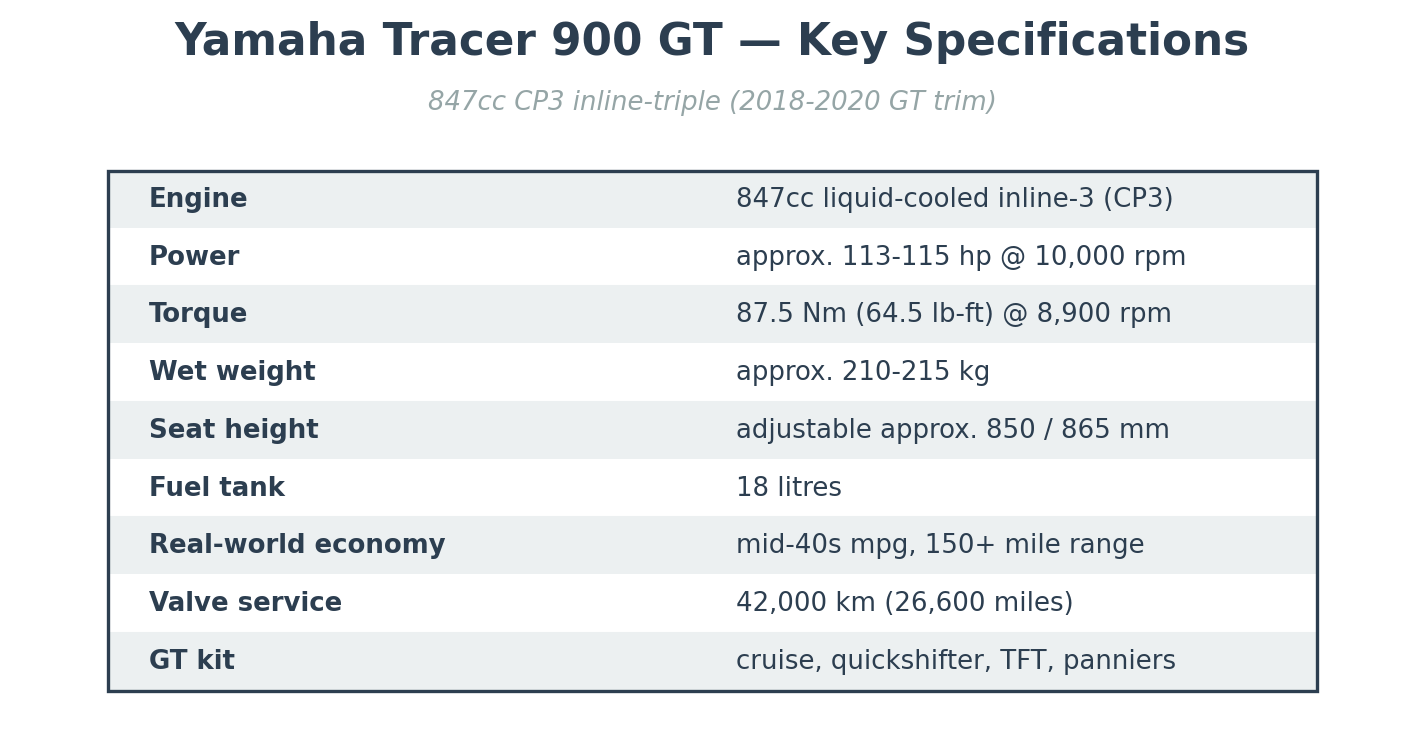
The CP3 engine is the star. It makes roughly 113 to 115 horsepower and about 87.5 Nm (64.5 lb-ft) of torque at 8,900 rpm, but the numbers undersell it. A triple gives you the low-end grunt of a twin and the top-end rush of a four, wrapped in an off-beat exhaust note that owners get genuinely sentimental about. On the road it feels faster than its power figure suggests because the torque arrives early and never really stops.
The Tracer 900 weighs around 210 to 215 kg wet depending on trim, carries an 18-litre tank, and runs an adjustable seat (roughly 850 to 865 mm on most versions). It is a middleweight in size but a heavyweight in ability. That is exactly why it sold so well in the UK, Australia and New Zealand — it does 90 percent of what a big adventure-tourer does, for two-thirds of the money and a good 40 kg less to hold up at the lights.
For you as a buyer, the takeaway is simple: this is a bike bought by sensible riders who covered real miles, not a garage-queen showpiece. That shapes what you should expect to find on the used and import market — genuine touring bikes with luggage scuffs and honest service histories.
Yamaha Tracer 900 naming explained: FJ-09, MT-09 Tracer, Tracer 900 and Tracer 9
This is the section that saves you the most money and the most embarrassment, so read it twice. Yamaha changed this bike's name in nearly every market, and the used listings are a mess because of it.
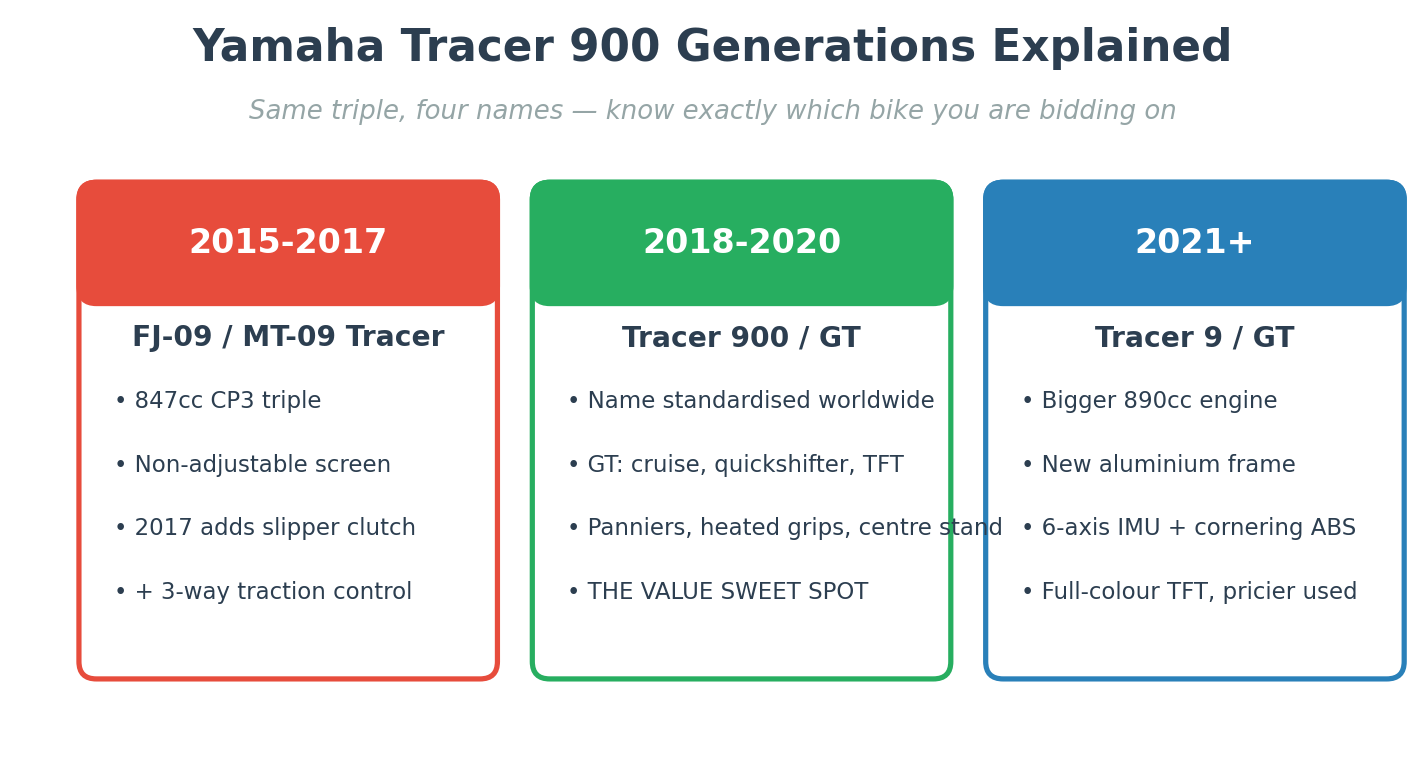
2015-2017 — FJ-09 / MT-09 Tracer: When the bike launched, North America got the name FJ-09. Japan, Australia, New Zealand, South America and Europe called the very same machine the MT-09 Tracer. Different badge, identical motorcycle: 847cc triple, non-adjustable screen, early ride-by-wire mapping. If you see a Japanese auction sheet that says "MT-09 Tracer," that is a first-generation Tracer 900 — do not assume it is a naked MT-09.
2018-2020 — Tracer 900 and Tracer 900 GT: For 2018 Yamaha finally standardised the name worldwide to Tracer 900, and split it into a base model and a loaded GT. The United States joined the Tracer 900 name from the 2019 model year. This is the generation most people mean when they say "Tracer 900."
2021 onward — Tracer 9 and Tracer 9 GT: For 2021 the bike grew up. Yamaha bored the triple out to 890cc, gave it a new aluminium frame, a six-axis IMU, cornering electronics and full-colour TFT screens, and renamed it Tracer 9. It is a genuinely different, more expensive motorcycle — not just a facelift.
So when someone advertises a "Tracer 900," ask one question: what year? A 2016 that is really an MT-09 Tracer, a 2019 Tracer 900 GT and a 2022 Tracer 9 GT are three different bikes at three different price points. Nail the year and the trim before you get anywhere near a bid.
Yamaha Tracer 900 generations explained (2015-2020, plus the 2021 Tracer 9)
Now that the names are sorted, here is how each generation actually rides and what it is worth to you.
First generation (2015-2017, FJ-09 / MT-09 Tracer): The original. Sharp, light and cheap, but it carries the early MT-09's snatchy throttle in the most aggressive power mode, a screen you cannot adjust on the move, and soft suspension. The 2017 model quietly fixed a lot of this — it gained an assist-and-slipper clutch and three-way traction control, so if you want a first-gen bike, hunt for a 2017.
Second generation (2018-2020, Tracer 900 / GT): This is the value sweet spot of the whole range, and we will keep saying it because it is true. Yamaha lengthened the swingarm for stability, reshaped the seat, added a proper adjustable screen, and on the GT piled on cruise control, a quickshifter, colour TFT, heated grips, adjustable suspension, a centre stand and matched panniers. A 2019 Tracer 900 GT is, pound for pound, one of the most bike you can buy for the money anywhere.
Third generation (2021 onward, Tracer 9 / GT): Bigger 890cc engine, more power, a much better chassis and proper cornering electronics. It is the best Tracer to ride, no argument. But it costs meaningfully more used, and the earliest examples carry a few teething niggles we will cover below. If your budget stretches and you want the latest, this is the one. If value is the priority, the 2018-2020 GT wins.
The Ducati Multistrada 950 versus Tracer 900 comparison video that pulled over 580,000 views tells you everything about where this bike sits: reviewers keep concluding that the Yamaha gives away almost nothing in real-world ability while costing thousands less. That is the Tracer's entire personality — the sensible enthusiast's choice.
Base Tracer 900 vs Tracer 900 GT: which one should you import?
On the 2018-2020 bikes, the base Tracer 900 and the Tracer 900 GT look almost identical in photos, and that catches people out. Here is what the GT adds, and why it is worth chasing.
The GT gives you cruise control, an up-only quickshifter, a full-colour TFT dash, heated grips, a remotely adjustable rear shock and adjustable forks, a centre stand, a taller and better screen, a comfier seat, and colour-matched hard panniers as standard. The base bike has none of that — it is a fine motorcycle, but it is a stripped commuter next to the GT.
Here is the buyer's maths that matters. Fitting cruise, heated grips, a quickshifter, panniers and a centre stand to a base bike after the fact costs far more than the price gap between a used base and a used GT. So unless you find a base bike at a genuine bargain, the GT is the smarter import. On the Japanese market you will mostly find the MT-09 Tracer badge on first-gen bikes, so for a GT you are usually looking at 2018-onward stock — confirm the TFT dash and factory panniers in the auction photos, because those are the giveaways.
One warning: sellers sometimes list a base bike with aftermarket luggage as a "GT." It is not. Look for the colour TFT screen and the cruise control switch on the right bar. Those two features cannot be faked cheaply, and they tell you instantly which bike you are bidding on.
Why import a Yamaha Tracer 900 from Japan
Japan is one of the best places on earth to buy a used Tracer 900, and it comes down to how Japan treats motorcycles. Bikes there cover low annual mileage, live in dry garages, and pass a strict roadworthiness culture that keeps them honest. A Japanese-market Tracer with 12,000 km on it is genuinely a 12,000 km bike, and the auction inspection sheet grades it independently before you ever bid.
Remember that in Japan this bike was sold as the MT-09 Tracer, so that is the name you search for on the domestic auctions. Supply is healthy because the triple sold well at home, and because Japanese riders churn through bikes quickly, you find low-mileage examples with full dealer stamps that would cost a lot more on your local classifieds.
The auction system is the real advantage. Every bike gets an independent grade and a written condition sheet noting scratches, rust, tyre wear and mechanical notes. You are not trusting a private seller's optimism — you are reading a professional inspector's honest report. New to how that works? Our step-by-step guide to importing a motorcycle from Japan and our explainer on the Japanese motorcycle auction system walk you through every stage.
One honest note on markets. If you are in the United States, the Tracer 900 was sold there new as the FJ-09 and later the Tracer 900, so you generally do not need to import one — and the 25-year rule keeps a 2015 bike off public roads until 2040 anyway. Importing from Japan makes the most sense for buyers in the UK, Australia and New Zealand, where the auction supply, low mileage and pricing genuinely beat the local used market. We would rather tell you that straight than sell you a shipping quote you do not need.
Yamaha Tracer 900 common problems and what to check
The good news first: the CP3 triple is one of the most reliable engines Yamaha has ever made. Across the whole triple family — Tracer, MT-09, XSR900, Niken — there are no engine horror stories, and the valve-clearance service interval is a genuinely enormous 42,000 km (about 26,600 miles). This is not a fragile motorcycle. But "reliable" is not "perfect," so here is what actually comes up.
Soft suspension (all years): The single most common complaint. The stock springs are set up for a light rider, and anyone over about 85 kg (190 lb) in kit will find the forks dive and the rear wallow on a bumpy road. Owners routinely swap to firmer fork springs and dial in the rear preload. On the GT the rear is remotely adjustable, which helps, but the fork springs are still the first upgrade most people make. Budget for it.
Hard seat and buffeting screen: The stock seat gets uncomfortable after an hour or two, and the first-generation screen both buffets at motorway speed and is fiddly to adjust while riding. Yamaha improved the screen mechanism on the 2018 bikes, but the aftermarket seat and touring screen remain the two most popular purchases for a reason. These are cheap fixes, not deal-breakers.
Instrument cluster glitches: Some owners report the dash flickering or showing odd readings. On the 2015-2020 bikes it usually traces to a tired connector or a software quirk rather than a failing cluster. On a used bike, watch the dash boot up on a cold start and make sure every segment lights correctly.
Snatchy fuelling on early bikes (2015-2016): The first FJ-09 / MT-09 Tracer bikes share the early MT-09's abrupt throttle in the sharpest power mode. It is not a fault — it is a mapping character — and most riders simply leave it in the softer mode or fit an aftermarket flash. The 2017 update smoothed it considerably.
Tracer 9 GT specific (2021+): The newer 890cc bike is excellent but the early examples threw up three known niggles — a fuel pump fault that causes stalling and a rough idle, front fork seals that weep oil earlier than they should, and TFT screens that delaminate or fog with visible bubbles or moisture. All three are documented and fixable, often under warranty on low-mileage bikes, but check for them specifically on a 2021-2022 Tracer 9.
Consumables: Chain, sprockets and tyres wear at the normal rate for a torquey triple. Factor a chain-and-sprocket set and a pair of tyres into any bike over 20,000 km unless the seller has just done them.
Years to avoid and the value sweet spot
Nobody makes a truly bad Tracer, but some years are smarter buys than others, so let's rank them honestly.
Approach with care — 2015-2016 FJ-09 / MT-09 Tracer: These are the cheapest, and they are still good bikes, but you inherit the snatchy fuelling, no slipper clutch, and the worst of the screen and suspension complaints. Buy one only if the price is genuinely low and you are happy to fettle it.
The clever budget pick — 2017 MT-09 Tracer: The last first-gen year, and the best of them. It gained the assist-and-slipper clutch and three-way traction control, which makes it noticeably nicer to ride than a 2015. If you want first-gen money with second-gen manners, this is your bike.
The sweet spot — 2018-2020 Tracer 900 GT: This is the one to import if you can. Fully sorted ergonomics, the best kit-for-money in the range, and used prices that have settled into bargain territory. It is the bike we would put our own money on.
The premium choice — 2021-2023 Tracer 9 GT: The best to ride, with modern electronics, but it costs more and the earliest ones carry the fuel-pump, fork-seal and TFT niggles above. A one-to-two-year-old Tracer 9 GT that someone bought intending to tour and then barely used is the hidden gem here — a few thousand miles, looks like new, and sells at a big discount off list.
What a Yamaha Tracer 900 costs — used prices and the import maths
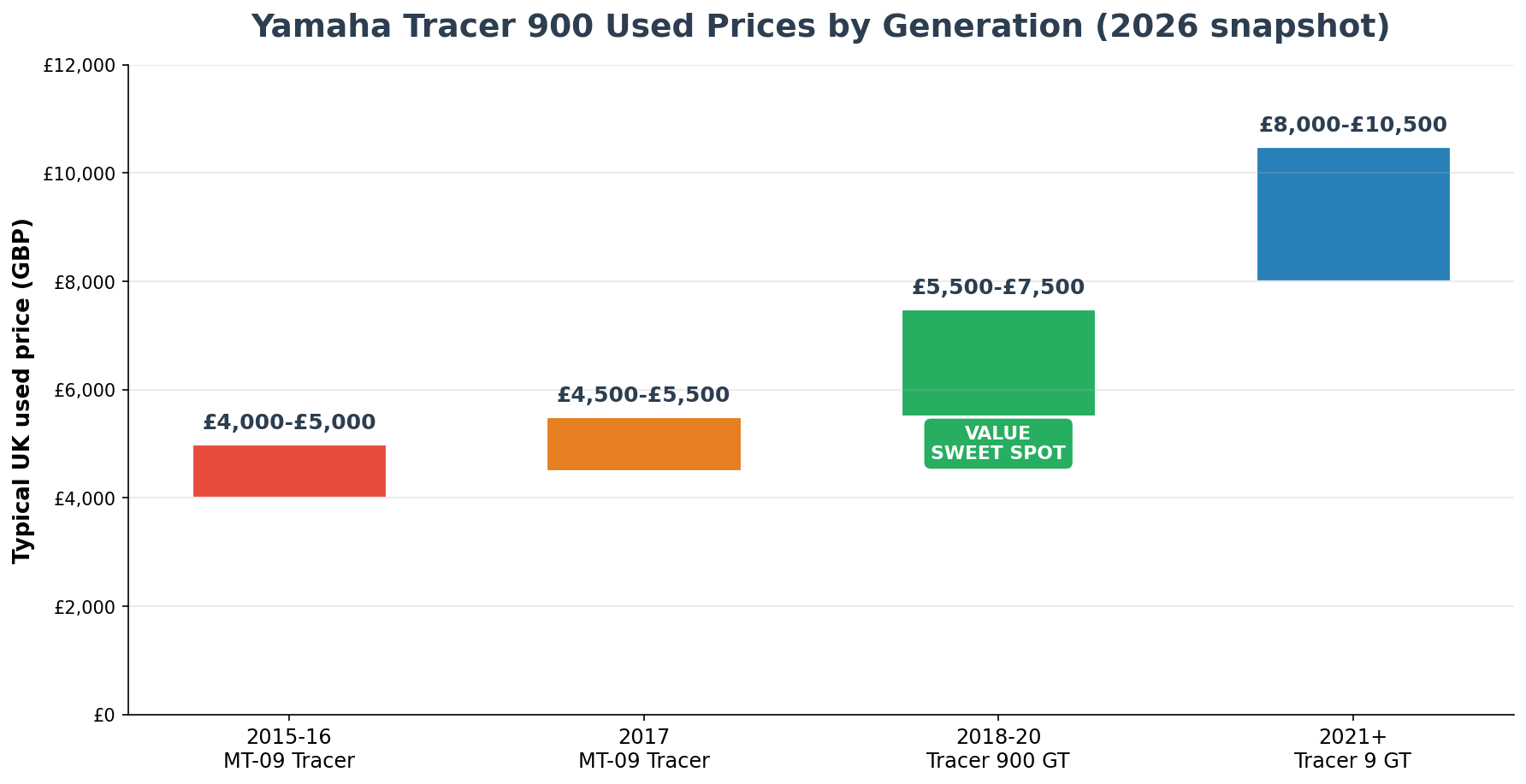
Prices move, and they vary by market and mileage, so treat these as a realistic 2026 snapshot rather than gospel. In the UK used market, an early FJ-09 / MT-09 Tracer from 2015-2016 sits roughly in the £4,000-£5,000 band. A tidy 2017 first-gen runs about £4,500-£5,500. The 2018-2020 Tracer 900 GT — the sweet spot — typically lands between £5,500 and £7,500 depending on miles and history. A used Tracer 9 GT from 2021 onward runs from around £8,000 up to £10,500, and a new one is well north of that.
Now the import maths, which is where a Japanese bike earns its keep. When you import from Japan you are paying the auction hammer price plus shipping, plus your home country's duty and tax, plus an agent fee. The reason it still works out is that Japanese-market bikes come in at lower mileage and often lower hammer prices than equivalent local bikes, and the auction grade removes the guesswork. On a Tracer 900 GT, buyers routinely land a lower-mileage, honestly-graded bike for a total landed cost at or below local used prices — and they know exactly what they are getting because the inspection sheet told them.
The trap to avoid is fixating on the hammer price alone. A cheap-looking auction bike with worn tyres, a stretched chain and weepy fork seals will cost you the difference back in parts. Read the grade, read the sheet, and budget for the consumables. Our UK import duty guide breaks down exactly what you pay on top of the hammer price so there are no surprises at the port.
Living with the Tracer 900: the three-cylinder sound and the touring reality
Let's talk about why people fall for this bike, because the spec sheet does not capture it. Every owner review circles back to the engine. That CP3 triple has a hard-edged, slightly manic exhaust note that gets under your skin — the rider on X who said the "three-cylinder growl comes alive as the revs climb" was not exaggerating, and it is why the Akrapovic sound walk-around clips rack up hundreds of thousands of views. Fit a slip-on and the Tracer sounds like a bike costing twice as much.
On the touring side, the honest picture is that the Tracer 900 is a brilliant sport-tourer with two well-known compromises straight from the factory: the seat and the wind protection. Sort both with aftermarket parts — a comfort seat and a taller touring screen — and it transforms into a genuine long-haul machine. Owners regularly report 200-plus-mile days in comfort once those two boxes are ticked. Leave them stock and you will be shifting on the seat after an hour. Now you know, so you can factor it in.
Fuel range is decent for the class. The 18-litre tank and mid-40s mpg give you a real-world range comfortably over 150 miles between fills, which is plenty for a day's touring with sensible stops. It is not a 250-mile GS, but it was never trying to be.
The other thing owners keep mentioning is how happy the Tracer is doing boring things. It filters through traffic like a naked bike because underneath the fairing it basically is one, yet it settles into a motorway cruise without the frantic feel of a supersport. That breadth is rare. Most bikes are good at one job and tolerable at the rest; the Tracer is genuinely good at commuting, back-road scratching and two-up touring, and that is exactly why so many owners keep theirs for years and buy another when the time comes. It is the quiet all-rounder that never gives you a reason to sell it.
Running costs, servicing and that 26,600-mile valve interval
This is where the Tracer 900 quietly wins the ownership argument. The headline is that valve-clearance service interval of 42,000 km — about 26,600 miles. Most riders will do minor services (oil, filter, checks) far more often than they ever touch the valves, which keeps big-bill visits rare.
Day to day, budget for tyres every 6,000-8,000 miles depending on how hard you ride, a chain and sprocket set every 15,000-20,000 miles, and regular oil changes. Insurance sits in a sensible middle band for a 100-plus-horsepower bike because the Tracer is bought by touring riders rather than teenagers, which keeps groups reasonable. Fuel economy in the mid-40s mpg is genuinely good for the performance on tap.
Parts availability is excellent because the Tracer shares its engine and much of its running gear with the hugely popular MT-09 and XSR900. That shared-platform advantage means service parts are cheap and everywhere. If you want the naked sibling's side of the story, our Yamaha MT-09 buying guide covers the same engine in a different jacket.
One more ownership note worth having in writing: depreciation on the Tracer has been gentle, especially on the GT. Because these bikes are bought and kept by touring riders who look after them, clean examples hold their money well, and a Japanese-import bike with a documented low mileage and a strong auction grade tends to resell for close to what you paid. That matters more than people admit when they buy — the cheapest bike to own is often the one that gives most of its purchase price back when you move on.
How the Yamaha Tracer 900 stacks up against its rivals
The Tracer 900 lives in a crowded class, so here is how it measures up against the bikes you will cross-shop. Think of this as a scorecard rather than a knockout.
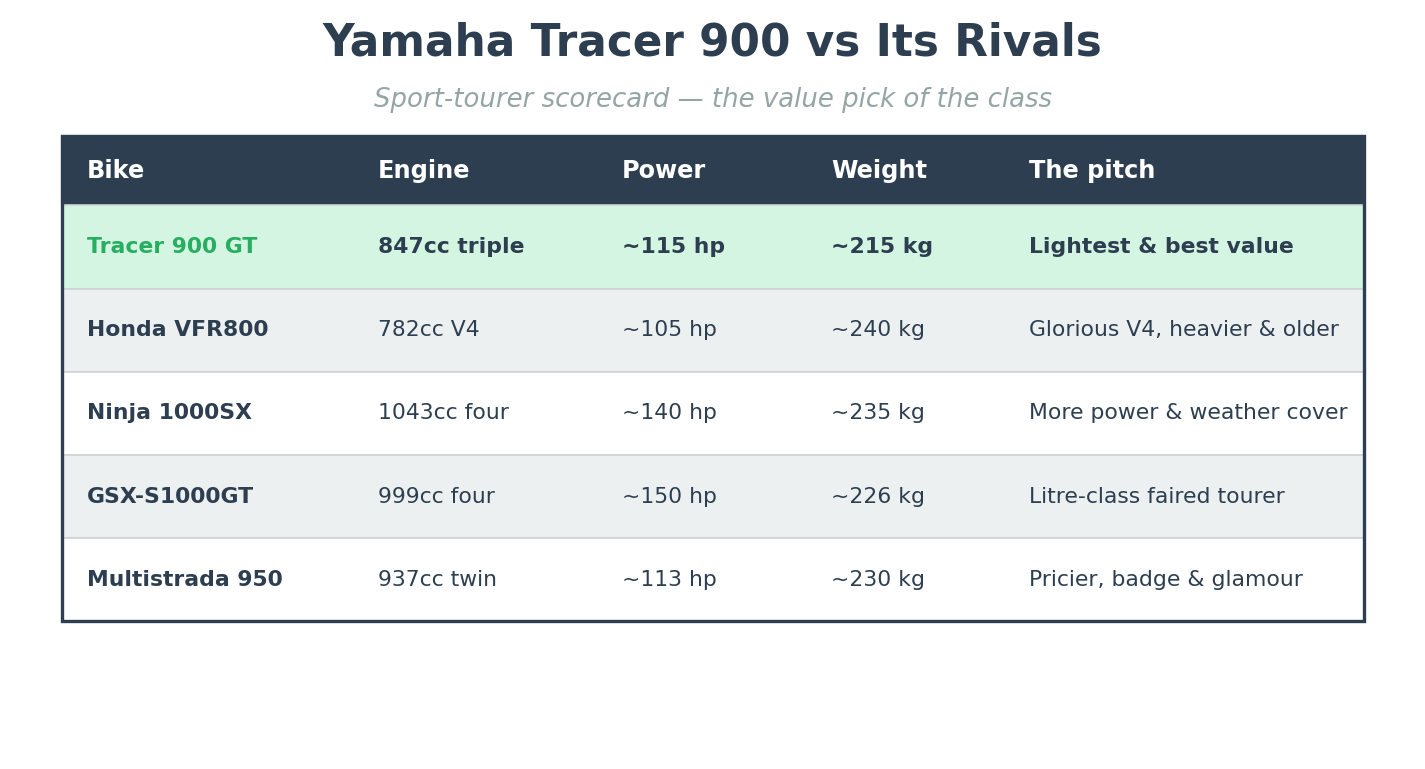
Honda VFR800: The gear-driven-cam V4 sounds glorious and feels premium, but it is heavier, thirstier and older-tech. The Tracer is lighter, more modern and cheaper to run. Read our Honda VFR800 import guide if the V4 song tempts you.
Kawasaki Ninja 1000SX and Suzuki GSX-S1000GT: Both are litre-class, faired sport-tourers with more outright power and more weather protection. They are the sensible faired alternative if you tour two-up with luggage on motorways all day. The Tracer counters with less weight, a more playful chassis and a lower price. See our Ninja 1000SX guide and GSX-S1000GT guide for the litre-tourer case.
Ducati Multistrada 950: The bike the Tracer is most often compared against on video, and the comparison always ends the same way — the Ducati is more glamorous and more expensive, the Yamaha gives away surprisingly little for thousands less. If badge and dealer network matter to you, the Ducati wins. If value and reliability matter, the Tracer wins.
The Tracer's overall pitch is clear: it is the lightest, most fun and best-value bike in this group. It does not win any single category outright, but it finishes a strong second in all of them at the lowest price — and that combination is exactly why it sold in the numbers it did.
Popular Yamaha Tracer 900 modifications
Because the factory bike has a couple of obvious weak spots, the modification list is short and predictable — which is good news, because it means the fixes are proven. The big three are a comfort seat, a taller touring screen, and firmer fork springs with the rear preload dialled up. Do those and you cure the three most common complaints in one weekend.
After that, riders add a slip-on exhaust (for that triple soundtrack), heated grips if they bought a base bike, a taller or adjustable screen, engine bars and a centre stand on the base model, and a tail rack or top box for touring. A tail-tidy and quality LED indicators clean up the rear end cosmetically. None of this is expensive, and most of it bolts on with hand tools — the Tracer is an easy bike to make your own.
Is the Yamaha Tracer 900 a good first big bike?
Honestly, yes — with one caveat. The Tracer's upright riding position, manageable weight, adjustable seat height and genuinely useful electronics (traction control on all, plus rider modes) make it forgiving and confidence-inspiring for a rider stepping up from a 500 or an A2 machine. The torque is smooth and predictable once you are out of the sharpest power mode.
The caveat is that 113-plus horsepower is real, and the sharp throttle mode on the early bikes can catch a nervous newcomer out. Keep it in the softer mode, respect the front brake, and the Tracer is one of the friendlier ways into big-bike ownership. It is fast enough to keep you happy for years, not so brutal that it will bite you in month one. As a one-bike-does-everything first big bike, it is hard to beat.
How to buy and import your Tracer 900 from Japan
Here is the process in plain steps, so you know what you are signing up for.
Step 1 — Fix your spec. Decide the exact year and trim: first-gen MT-09 Tracer, 2018-2020 Tracer 900 GT, or 2021+ Tracer 9 GT. Write down the must-have features (TFT dash, cruise, panniers) so you do not get talked into the wrong bike.
Step 2 — Set your landed budget. Work out the total you can spend delivered to your door — hammer price, shipping, duty, tax and agent fee combined. Not just the auction price. Our import-duty guide gives you the numbers for your country.
Step 3 — Work with an agent and read the sheets. Search the Japanese auctions (remember: MT-09 Tracer for first-gen), and for every candidate bike read the auction grade and the written condition sheet. Look for a solid grade, low genuine mileage, and no notes about frame damage or corrosion.
Step 4 — Bid with discipline. Set a maximum and stick to it. There is always another Tracer next week; there is not always a reason to overpay for this one.
Step 5 — Ship, clear and register. Your agent handles export paperwork and shipping; you handle home-country import clearance, any required inspection, and registration. Browse what is landing now over on our current bike listings, or talk to our team and we will help you find the right Tracer.
Yamaha Tracer 900 pre-purchase checklist
Print this and take it to the auction sheet — or better, hand it to your import agent as your buying brief.
Confirm the model and year: Is it a first-gen MT-09 Tracer, a 2018-2020 Tracer 900 GT, or a 2021+ Tracer 9? Check the badge, the dash (colour TFT means GT or Tracer 9), and the panniers.
Check the fuelling year: A 2017 has the slipper clutch and smoother mapping; a 2015-2016 does not. Prefer the later first-gen bikes.
Cold-start the dash: Watch every segment or the full TFT light up correctly on a cold boot to rule out cluster glitches.
Suspension and forks: Look for oil weeping below the fork seals — a known Tracer 9 issue — and factor in firmer springs if you are a heavier rider.
Tracer 9 niggles: On a 2021-2022 bike, ask specifically about the fuel-pump recall work, fork seals, and any TFT fogging or delamination.
Consumables: Check tyre age and tread, chain and sprocket wear, and brake pad life on the auction sheet.
Service history and mileage: Confirm genuine low mileage and, ideally, evidence the 42,000 km valve service has been done or is not yet due.
Read the grade: Trust the independent auction grade over the photos. A grade with no frame or corrosion notes is worth more than a shiny picture.
How AWA Auction helps you import a Yamaha Tracer 900
Buying a Tracer 900 at a Japanese auction is genuinely the best-value way to get one — but only if someone who reads the sheets in Japanese is on your side. That is what we do. AWA Auction gives you direct access to the same domestic auctions where these bikes trade as MT-09 Tracers, translates every condition sheet, checks the grade honestly, and handles export, shipping and paperwork end to end.
No guesswork, no optimistic private-seller descriptions — just the independent grade, the real mileage and a bike that lands at your door exactly as described. Tell us the year and trim you want, and we will hunt the auctions for it. Browse the bikes we have available now or contact our team to start your Tracer 900 import.
See Also
Share this article: