
If you want a Kawasaki Ninja 1000SX import from Japan, you are chasing one of the most quietly brilliant motorcycles of the last fifteen years: a 142 hp inline-four that will scratch your knee-down itch on a Sunday and then carry you and a passenger 300 miles with panniers bolted on. One well-known YouTube review is literally titled "Kawasaki Made the Greatest Sport Tourer Ever, and You Never Heard of It" and pulled over half a million views. That title is doing a lot of work, but it captures the SX perfectly: massively capable, weirdly underrated, and cheap on the used market. Japan is where the cleanest, lowest-mileage examples live, and this guide walks you through every generation, every known fault, and exactly what it costs to get one on your driveway.
Here is the thing nobody tells you when you start shopping: the Ninja 1000SX and the Z1000SX are the same bike wearing two badges, and getting that straight is the difference between a great buy and an expensive mistake. We will sort that out first, then get into the metal.
What Is the Kawasaki Ninja 1000SX (and Why Japan Has the Best Ones)?
The Kawasaki Ninja 1000SX is a full-fairing sport-tourer built around a 1,043cc liquid-cooled inline-four. Think of it as a Z1000 super-naked that put on a jacket, sat up a little straighter, and learned some manners. Same muscular engine, same aggressive character, but with wind protection, a more relaxed riding position, cruise control on later bikes, and the ability to take hard luggage. It is the bike you buy when you want one machine that does everything instead of a garage full of specialists.
It first appeared in 2011 as the Z1000SX, and in the UK it became a phenomenon. For roughly a decade it was one of Kawasaki's best-selling models in Britain, and the used market is now flooded with them. That popularity is exactly why importing from Japan makes sense. The Japanese domestic market bought these bikes too, but Japanese owners tend to ride fewer miles, garage their machines, and keep meticulous service records. Roads there are not salted through winter the way UK roads are. So while a home-market SX often carries 40,000 hard miles and a corroded rear subframe, a Japanese auction bike of the same year can turn up with 9,000 dry kilometres and paint that still shines.
When you browse current listings from Japan, you are shopping from a pool that has, on average, been treated far better than the equivalent bikes sitting in Western dealer forecourts. For a heavy sport-tourer that lives or dies on the health of its charging system and consumables, that head start matters.
Kawasaki Ninja 1000SX vs Z1000SX: One Bike, Two Names
Let us kill the confusion right now, because it trips up nearly every first-time buyer.
From 2011 to 2019, this bike was sold almost everywhere as the Z1000SX. In North America it wore a "Ninja 1000" badge for most of that period. Then in 2020 Kawasaki globally rebranded it the Ninja 1000SX to line it up with the rest of the faired Ninja family. Nothing fundamental changed at the rebrand beyond a new name, updated electronics and a TFT dash. A 2018 Z1000SX and a 2021 Ninja 1000SX are the same lineage, same 1,043cc motor, same chassis philosophy.
So if you see a Japanese auction listing badged "Ninja 1000," a UK ad for a "Z1000SX," and an Australian bike called a "Ninja 1000SX," you are looking at three examples of the same model. Do not let a seller convince you that one badge is rarer or more special than another. What matters is the model year and the generation, not the sticker on the tail.
One more trap: do not confuse the Z1000SX with the naked Z1000. They share an engine and a name, but the Z1000 has no fairing, no touring intent, and a very different mission. If you want the naked, read our separate Kawasaki Z1000 import guide. If you want to tour, the SX is your bike.
Kawasaki Ninja 1000SX Generations Explained (2011 to 2024)
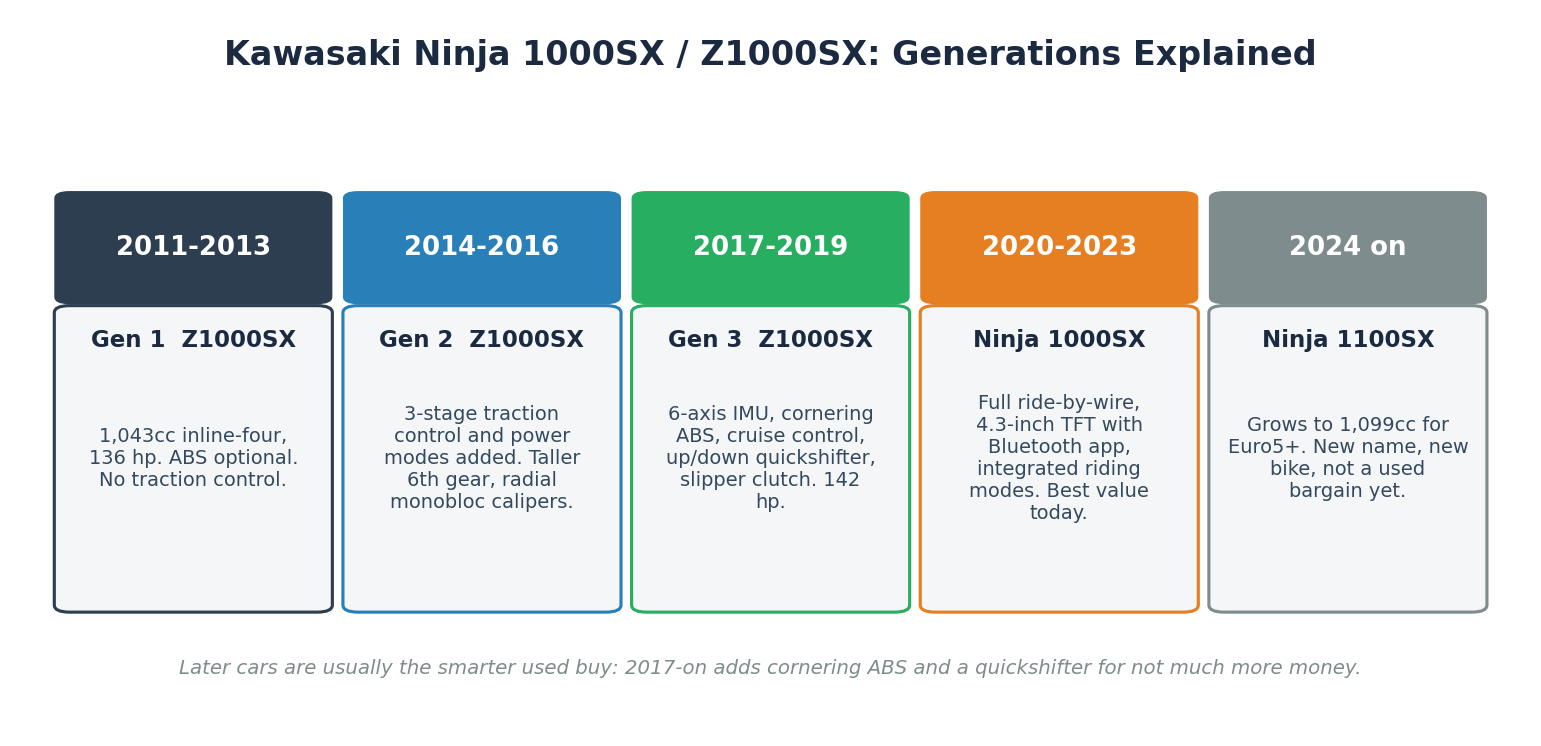
The 1,043cc engine has carried through the SX's entire life, but the electronics, brakes and dash changed a lot. Knowing which generation you are looking at is the single most useful thing you can learn before you bid, so here is the map.
2011 to 2013 (Gen 1, Z1000SX)
The original. A 1,043cc inline-four making around 136 hp, a proper 190-section rear tyre, and ABS as an option rather than standard. There is no traction control here at all. That is not a dealbreaker for an experienced rider, but on a 235 kg bike with 136 hp and a wet Japanese-import tyre you have never tried, respect the throttle. These are the cheapest SX models to buy now, and a clean Japanese Gen 1 is a lot of bike for the money.
2014 to 2016 (Gen 2, Z1000SX)
Kawasaki's first big refresh. Three-stage traction control and two power modes became standard, the sixth gear was made taller for calmer motorway cruising, radial-mounted monobloc front calipers sharpened the braking, and the rear shock was stiffened slightly with a remote preload adjuster added so you could dial in a passenger and luggage without tools. If you want driver aids but do not want to pay Gen 3 money, this is the sweet spot.
2017 to 2019 (Gen 3, Z1000SX)
This is where the SX grew up. Kawasaki added a six-axis IMU, which unlocked cornering ABS and lean-sensitive traction control that were previously reserved for high-end superbikes. You also got cruise control, a two-way up-and-down quickshifter, a slipper clutch and a configurable riding mode. Power nudged to 142 hp at 10,000 rpm with 111 Nm of torque at 7,300 rpm, and the screen grew for better wind protection. For most buyers, a Gen 3 is the smartest used SX you can import: it has the safety net and the touring toys without the newest-model price.
2020 to 2023 (Ninja 1000SX)
The rebrand generation. Kawasaki switched to full ride-by-wire electronic throttle, fitted a 4.3-inch colour TFT dash with Bluetooth and a companion smartphone app, and tidied the integrated riding modes. Mechanically it is very close to a Gen 3, so if the extra tech and the newest looks do not sway you, an earlier bike saves you real money. If they do, these are lovely.
2024 Onwards (Ninja 1100SX)
For 2024-2025 Kawasaki grew the engine to 1,099cc to clear Euro5+ emissions and renamed the bike the Ninja 1100SX, with pricier SE variants. It is a genuinely new chapter rather than a facelift. For an importer chasing value, it is not relevant yet: these bikes are too new and too expensive to be bargains, and there is barely any used stock. Stick with the 1000SX for now.
Ninja 1000SX Specifications and What They Mean on the Road
Numbers on a spec sheet only matter if you know how they feel. Here is what the SX's headline figures translate to when you are actually riding.
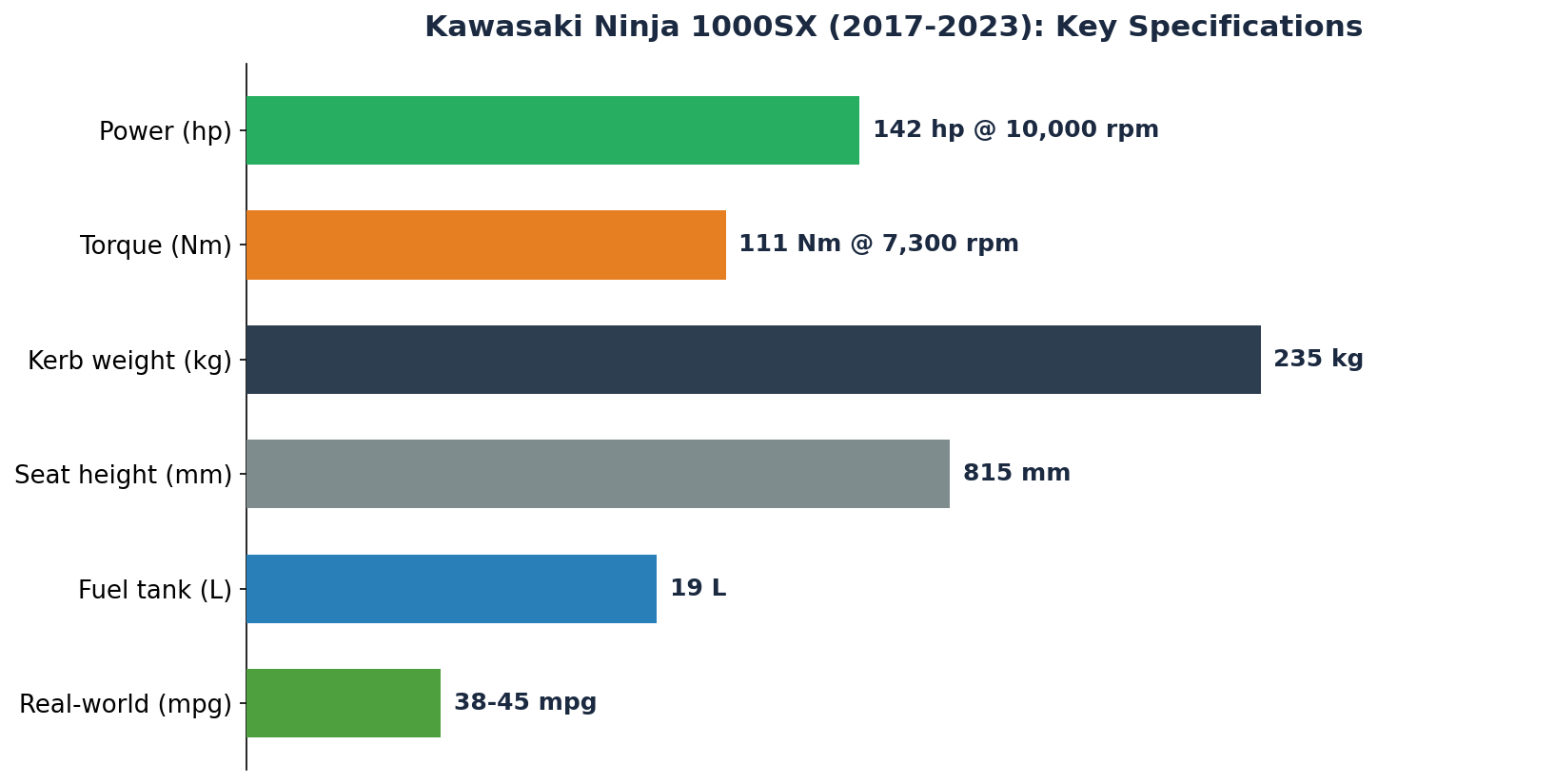
142 hp and 111 Nm. This is not a peaky superbike engine that only wakes up at 9,000 rpm. The SX pulls hard from about 4,000 rpm, which is exactly where you spend your life on the road. Roll the throttle open in third gear at a motorway junction and it surges forward without a downshift. That flexible midrange is the whole point of the bike.
235 kg kerb weight. It is not light. You feel it at walking pace and when you paddle it backwards out of a parking spot. But once it is rolling above 10 mph that weight vanishes, and it actually helps stability when you are two-up with luggage at speed. Just be honest with yourself about handling 235 kg in a petrol-station forecourt.
815 mm seat height and a 19-litre tank. The seat is a fairly average height that suits most riders, though shorter riders may want to try before they buy. The 19-litre tank gives a genuine touring range, and that is before you factor in fuel economy, which we will get to.
Real-world fuel economy of 38 to 45 mpg. Data pulled from dozens of owners logging over a quarter of a million combined miles shows economy ranging from a thirsty 22 mpg when you are hooning to about 46 mpg when you are cruising, with most riders landing in the high 30s to mid 40s. That thirst is the SX's one honest weakness, driven by tight emissions tuning, and we will cover how owners claw some of it back.
What Is It Like to Live With a Ninja 1000SX?
Spec sheets and fault lists tell you what a bike is; they do not tell you what it is like to own one. So here is the lived-in picture, drawn from the owners who actually rack up the miles.
The recurring theme in long-term reviews is contentment. This is not a bike that people buy in a fit of passion and sell six months later; it is a bike people keep. On social media you will find owners doing exactly what the SX was built for: a 150-mile Sunday loop to a favourite coffee stop, bike washed and ready to do it all again the next weekend. It is the everyday, unglamorous stuff that the SX nails, and that is precisely why it earns such loyalty.
On the road, the first thing that strikes you is how civilised the engine is. A Japanese test rider's on-bike review, watched well over half a million times, spends most of its length simply showing the bike wafting through traffic and then pinning it up a slip road, and that contrast is the SX in a nutshell. Below 6,000 rpm it is docile and torquey, happy to trickle through town. Open it up and the inline-four hardens into a proper superbike-derived howl that will surprise anyone who wrote it off as a soft tourer.
The riding position is the classic sport-tourer compromise: sporty enough that you can hustle it hard, upright enough that your wrists survive a full day. Wind protection from the fairing and screen is genuinely good, which is the single biggest reason to choose the SX over its naked Z1000 cousin. Add heated grips, a comfort seat and the factory panniers, and you have a bike that will cross a country without complaint. That breadth, the ability to be a commuter, a canyon carver and a tourer in one week, is what "sport-tourer" is supposed to mean, and few bikes deliver it as completely for the money.
Kawasaki Ninja 1000SX Common Problems and Years to Watch
Good news first: the SX is a mechanically tough, over-engineered bike. There is no cursed model year to run away from, and plenty of examples clear 30,000 miles without drama. One long-term owner on YouTube documented riding his Z1000SX 30,000 miles over five years and came away recommending it without hesitation. But "tough" does not mean "faultless." Here is the honest list of what to check.
Charging system: stator and regulator/rectifier
This is the big one, and it is a family trait across many Kawasaki inline-fours of this era. The stator and the regulator/rectifier can weaken over time, and the classic warning signs are dim headlights, a battery that struggles to hold charge, and low voltage at idle. Left alone, a failing reg/rec can cook a battery or leave you stranded. The good news is that the fix is well understood: aftermarket regulator/rectifier units with proper heat-sink fins run cooler and cure the problem for good. Before you buy, get the bike to idle and, if you can, put a multimeter across the battery: you want to see charging voltage climb into the low 14s as revs rise. A bike that sits stubbornly at 12-point-something is telling you something.
Brake calipers seizing from neglect
On any bike that has been parked for long stretches, and plenty of low-mileage Japanese imports have, the front brake caliper pistons can seize or drag from lack of use. It is not a design flaw so much as a storage flaw. Check that both front discs are spinning freely, feel for a wheel that is reluctant to roll, and look for uneven pad wear. A caliper rebuild is cheap and routine, but you want to know before you pay, not after.
Pannier latch wear and cracking
The optional hard panniers are brilliant, but the plastic latch mechanisms wear and can crack with age and repeated use. If a bike comes with luggage, work the latches a dozen times and make sure they lock positively. And here is a quirk that catches touring buyers out: Kawasaki states you cannot fit the top box and the panniers at the same time. If you were planning to run all three cases loaded to the gunwales, that is a hard no from the factory.
The seat and the fuel economy
Two comfort gripes come up again and again from owners. The standard seat is on the firm and thinly padded side, and long-distance riders often swap it or add a gel pad. And that fuel economy figure of roughly 38 mpg on a stock bike frustrates people who expected touring-bike frugality. A remap and a freer-flowing exhaust can lift real-world economy into the mid 40s while waking the engine up, which is why so many SX owners fit both.
Valve clearances and service history
The SX uses a shim-under-bucket valve arrangement, and the valve-clearance check is a scheduled job that some owners skip because it is labour-intensive. A bike with a documented history that shows the valve check has been done is worth a premium, because a neglected top end is expensive to sort. When you read a Japanese auction sheet or a service book, look specifically for that entry. Get that paperwork right and you remove most of the risk from a used purchase.
Consumables on high-mileage bikes
As with any used bike, budget to inspect and likely replace the wear items: chain and sprockets, tyres, wheel bearings, brake pads and discs. Check the discs for warping and the pistons for seizing. None of this is SX-specific, but on a 235 kg bike that gets ridden hard, worn consumables add up fast, so factor them into your offer.
How Many Miles Is Too Many on a Ninja 1000SX?
Mileage anxiety kills more good deals than it should, so let us put it in perspective. The SX's 1,043cc inline-four is fundamentally a detuned superbike engine, built with a big safety margin and asked to make far less than its peak. That means it is a genuinely long-lived unit. Owners regularly report bikes sailing past 30,000 and 50,000 miles with nothing more than routine servicing, and one long-term owner's five-year, 30,000-mile account is a ringing endorsement rather than a horror story.
So do not panic at a five-figure odometer. A 40,000-mile SX with a full service history, a healthy charging system and fresh consumables is a far better buy than an 8,000-mile example that has sat neglected in a shed with seized calipers and a tired battery. On this bike, evidence of care beats a low number every time. That is also where a Japanese import earns its keep: the auction grading system and a good agent let you judge condition properly instead of guessing from a blurry photo and an optimistic advert.
What you actually want to see is a clear paper trail: regular oil and filter changes, the valve check done on schedule, chain and sprocket replacements logged, and ideally evidence that the reg/rec has been upgraded or at least tested. Find that, and mileage becomes almost a footnote.
What a Kawasaki Ninja 1000SX Import Really Costs
Let us talk money, because this is where the SX quietly shines. It offers superbike-adjacent performance and full touring ability for the price of a mid-size commuter.
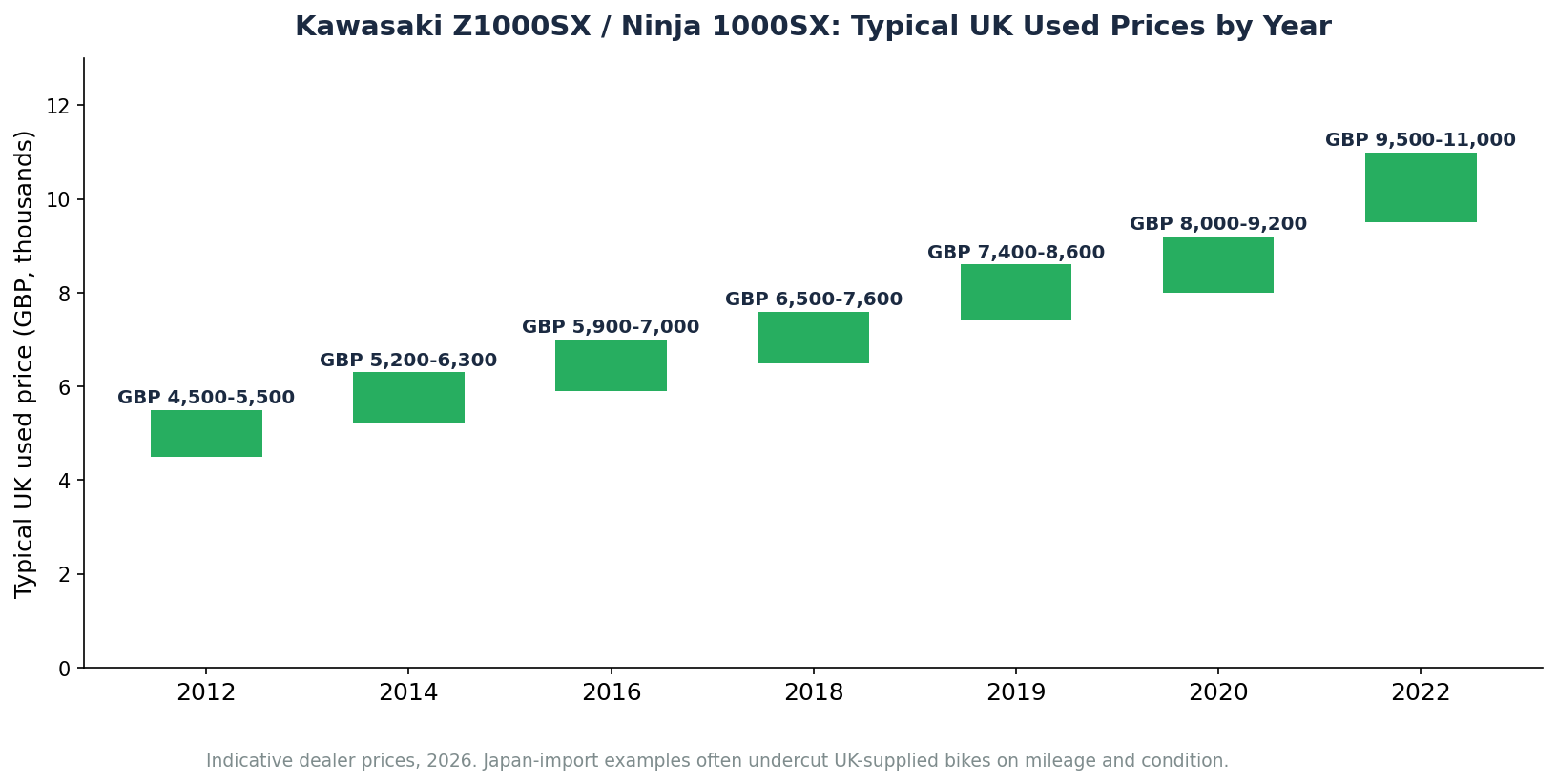
As a rough guide to the UK used market in 2026, an early Gen 1 from 2012 can be found from around 4,500 to 5,500 GBP. Mid-life Gen 2 and Gen 3 bikes from 2014 to 2018 sit in the 5,200 to 7,600 GBP band depending on mileage and luggage. A 2019 Z1000SX runs roughly 7,400 to 8,600 GBP, a 2020 Ninja 1000SX around 8,000 to 9,200 GBP, and the newest 2022 examples reach into the 9,500 to 11,000 GBP territory.
Those are prices for bikes already in the country. When you import from Japan, the sums work differently. You are buying the bike at a Japanese auction price, then adding shipping, your destination's import duty and taxes, and an agent's fee. The reason importers still come out ahead is condition: a Japanese SX at a given price often has half the mileage and none of the winter corrosion of the equivalent home-market bike. You are not always paying less in total; you are frequently getting a much better bike for similar money. For a full breakdown of shipping, duty and taxes, read our guide to importing a motorcycle from Japan, and if you want to understand where the bikes actually come from, our explainer on the Japanese motorcycle auction system covers it.
One honest note for US readers. The Ninja 1000 was officially sold in the United States, so you do not need to grey-import one for road use, and the 25-year rule does not help you here anyway, since a 2011 bike does not become import-eligible until 2036. For UK, Australia and New Zealand buyers, importing a clean JDM example is a live and often smart option today. If you are unsure about eligibility in your country, our team can help you check import rules before you commit.
How the Ninja 1000SX Compares to Its Rivals
The sport-touring class is small but fierce, and the SX has to justify itself against some talented machines. Here is where it stands.
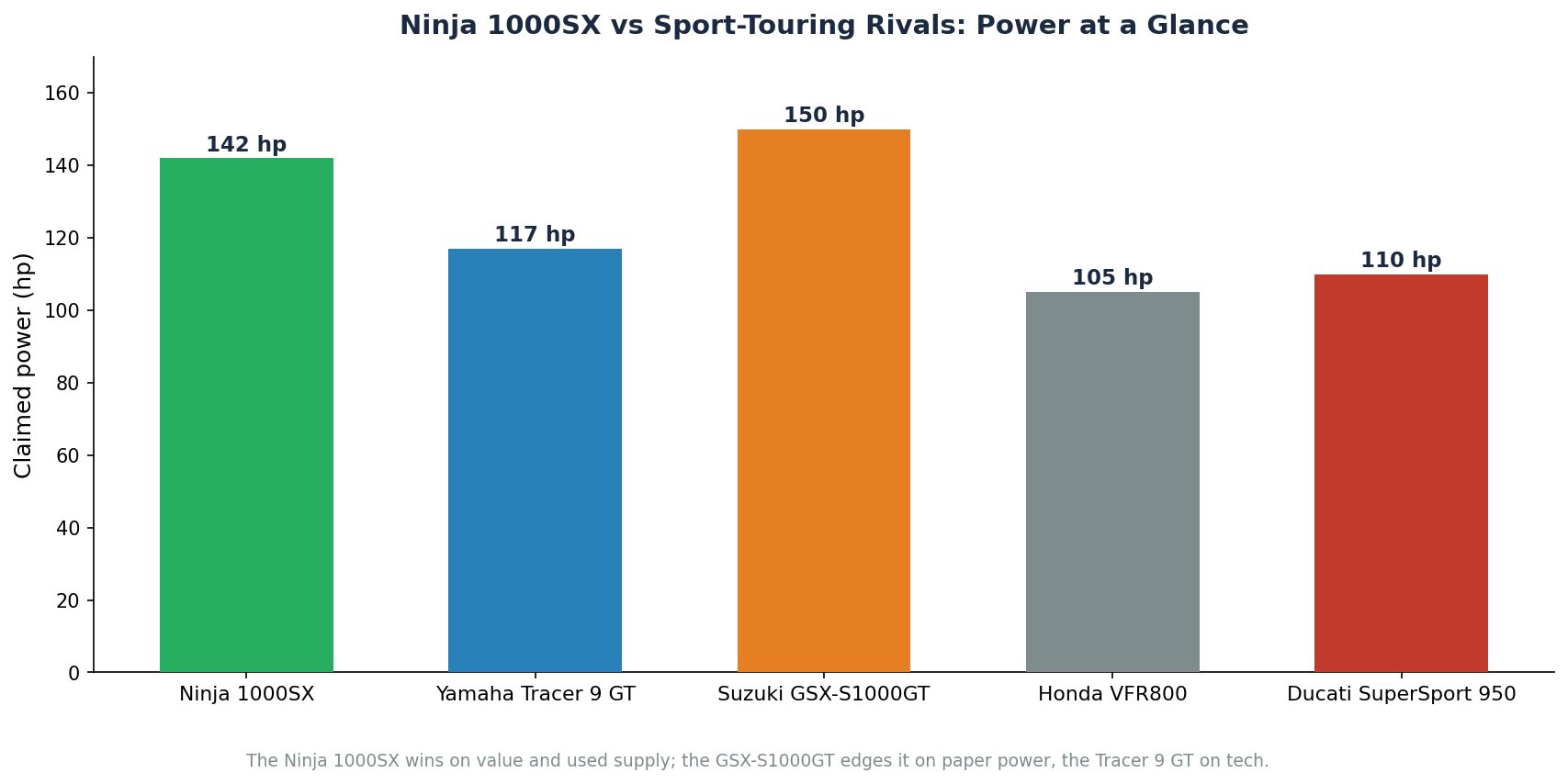
Against the Yamaha Tracer 9 GT, the SX is heavier and less tech-laden but has a smoother, torquier inline-four and, crucially, a far deeper used market. The Tracer is the more modern-feeling tool; the SX is the more relaxed cruiser with a sweeter engine.
Against the Suzuki GSX-S1000GT, the Suzuki edges the SX on paper power at around 150 hp and feels a touch sportier, but it is newer, pricier used and rarer to find. If you want the same recipe from another factory, read our Suzuki GSX-S1000 import guide for the naked version of that engine.
Against the Honda VFR800, the SX simply has more power, more modern electronics and a lower used price, though the Honda's V4 soundtrack and build quality win hearts. And against the old Yamaha FZ1, the SX is the more comfortable, better-equipped tourer, though the raw FZ1 is a hooligan's bargain, as our Yamaha FZ1 import guide explains.
The pattern is clear. The SX rarely wins any single category outright, but it is the value champion and the do-everything champion. Nothing else offers this blend of real power, genuine touring ability, proven reliability and rock-bottom used pricing. That is why the "greatest sport-tourer you never heard of" tag stuck. If you want to see how it stacks up against other litre-class imports, our roundup of the best 1000cc motorcycles to import from Japan puts it in context.
The Popular Ninja 1000SX Upgrades and Mods
Most competitor buyers' guides stop at "check the reg/rec" and call it a day. But a huge part of SX ownership is personalisation, and the aftermarket is enormous. Here is what owners actually fit, and why. One rider we found even mentioned casually adding around 700 euros of mods to his black-and-green SX, which is very much on-brand for this crowd.
- Exhaust and remap. The single most common upgrade. A slip-on or full system plus an ECU flash frees up the strangled emissions tuning, wakes the midrange, drops weight and, as a bonus, often improves real-world fuel economy into the mid 40s. This is the mod that fixes the SX's one genuine weakness.
- Comfort seat. Given the firm stock perch, an aftermarket or gel-topped seat is near the top of most long-distance owners' lists.
- Taller screen. The stock screen is decent, but touring riders often fit a taller aftermarket item to push wind off their helmet on long motorway stints.
- Hard luggage. If a bike does not come with the factory panniers, they are worth hunting down. Just remember the top-box-or-panniers rule from the factory.
- Crash protection and hugger. Frame sliders, engine case protectors and a rear hugger are cheap insurance on a heavy bike, and they help preserve value for the next owner.
The takeaway for an importer: a bike that already wears sensible mods like an exhaust, comfort seat and luggage can be a bargain, because you are getting hundreds of pounds of extras baked into the price. Just make sure the original parts come with it if you ever want to return it to standard.
What It Costs to Run a Ninja 1000SX
Buying the bike is only half the story. A litre-class sport-tourer has running costs to match its capability, so budget honestly before you commit.
Fuel. At a real-world 38 to 45 mpg and a 19-litre tank, you are looking at a comfortable 150 to 180 miles between fills in normal riding. Ride it hard and that tumbles fast, so a spirited track-day pace can see the low-fuel light glowing before 120 miles. It is thirstier than a middleweight, but that is the price of 142 hp on tap. If long, uninterrupted range matters more to you than outright pace, a remap and freer exhaust push the average up and, in the process, make the bike feel livelier everywhere in the rev range.
Tyres. The SX runs sporty rubber, and a heavy bike ridden with enthusiasm chews through a rear tyre in around 4,000 to 6,000 miles. A quality sport-touring tyre is the sweet spot here: it lasts longer than a pure sports tyre without giving up much grip, and it suits the bike's dual character perfectly.
Servicing. Routine oil and filter services are cheap and well within DIY reach. The bigger cost is the valve-clearance inspection, which is labour-intensive and comes up at longer intervals. Factor that into your ownership plan, especially on a higher-mileage import where the previous owner may have deferred it.
Insurance and consumables. Insurance sits in the usual big-bike bracket, so get a quote before you buy if you are a younger rider. Chains, sprockets, brake pads and a battery are the recurring consumables. None of this is unusual for the class, but a Japanese import that arrives with fresh consumables and a healthy charging system saves you a chunk of that spend in year one, which is another quiet argument for buying a well-kept example rather than the cheapest one you can find.
Who Should Buy a Ninja 1000SX, and Who Should Look Elsewhere
Let us be straight about fit, because the SX is not for everyone.
Buy one if you want a single motorcycle that can commute on Monday, carve a mountain road on Saturday and tour two-up with luggage on your summer holiday. Buy one if you value a strong, flexible engine over the last word in electronics. Buy one if you want maximum capability for minimum money, and if the idea of a slightly underrated, slightly under-the-radar bike appeals to you more than badge cachet.
Look elsewhere if you are a brand-new rider; 142 hp and 235 kg is a lot to learn on. Look elsewhere if low-speed manoeuvring worries you, because this is a heavy bike in car parks. And look elsewhere if you demand class-leading fuel economy from a bone-stock bike, because the SX will disappoint you until you remap it.
For most riders looking for one bike to do it all on a sensible budget, though, the SX is close to unbeatable. That is the whole reason it sold in such numbers, and the reason the used market is your friend.
How to Import a Kawasaki Ninja 1000SX From Japan, Step by Step
If you have decided the SX is your bike, here is the honest path from Japanese auction to your driveway.
Step 1: Decide your generation and budget
Use the generation map above. Decide whether you want the cornering-ABS-and-quickshifter safety net of a Gen 3 or later, or whether an earlier bike's lower price wins. Set a total budget that includes the bike, shipping, duty, taxes and a cushion for consumables and a reg/rec upgrade.
Step 2: Work with an import agent who reads auction sheets
Japanese auctions grade every bike, and the auction sheet is a goldmine of honest condition information once you know how to read it. A good agent inspects bikes on your behalf, translates the grades, and steers you away from the crash-damaged or heavily corroded examples that occasionally slip through. This is where a Japan-based buyer earns their fee.
Step 3: Bid, win and verify
Once you win a bike, your agent confirms condition, mileage and documentation. For the SX specifically, you want evidence of a healthy charging system, free-moving brakes, and a service history that shows the valve-clearance checks were done.
Step 4: Ship, clear customs and register
The bike is crated and shipped, usually by sea. On arrival you pay your country's import duty and taxes, arrange any required inspection or modification, and register it for the road. Timelines vary by country, but budget several weeks from auction to registration.
None of this needs to be daunting. The whole point of using an established importer is that they handle the parts you cannot do from your sofa. When you are ready, you can browse the bikes we currently have available or talk to our import team and we will point you at the right SX for your budget and country. There is no obligation and no jargon, just an honest steer on which bikes are worth bidding on and which to walk away from.
Frequently Asked Questions
Below are the questions we hear most often from buyers importing a Ninja 1000SX from Japan.
See Also
Share this article: