
A Yamaha TZR250 import from Japan is the only realistic way to own one of these bikes, because Yamaha never sold the TZR250 in the United States — not one model year, not one unit. Every TZR250 on American soil came over in a container. And here's the date that changes everything: in 2026, every TZR250 ever built — from the first 1986 1KT to the final 1995 SPR — has cleared the 25-year federal exemption. The entire model line is now legal to import into the US. No EPA drama, no DOT conversion, no grey areas.
The TZR250 is the street bike Yamaha built from its TZ250 grand prix racer. Liquid-cooled two-stroke twin, around 126 kg dry, and the first production 250 to carry Yamaha's aluminium Deltabox frame. It's one-third of the great Japanese two-stroke war of the late 80s and early 90s, fighting Honda's NSR250R and Suzuki's RGV250 for bragging rights on every touge in Japan.
This guide covers the three generations and which one you actually want, what TZR250s sell for at Japanese auctions right now, the YPVS and crankshaft problems that separate a good buy from a money pit, the 25-year rule for the US plus the rules for the UK, Australia, and New Zealand, and the real landed cost from auction hammer to your garage.
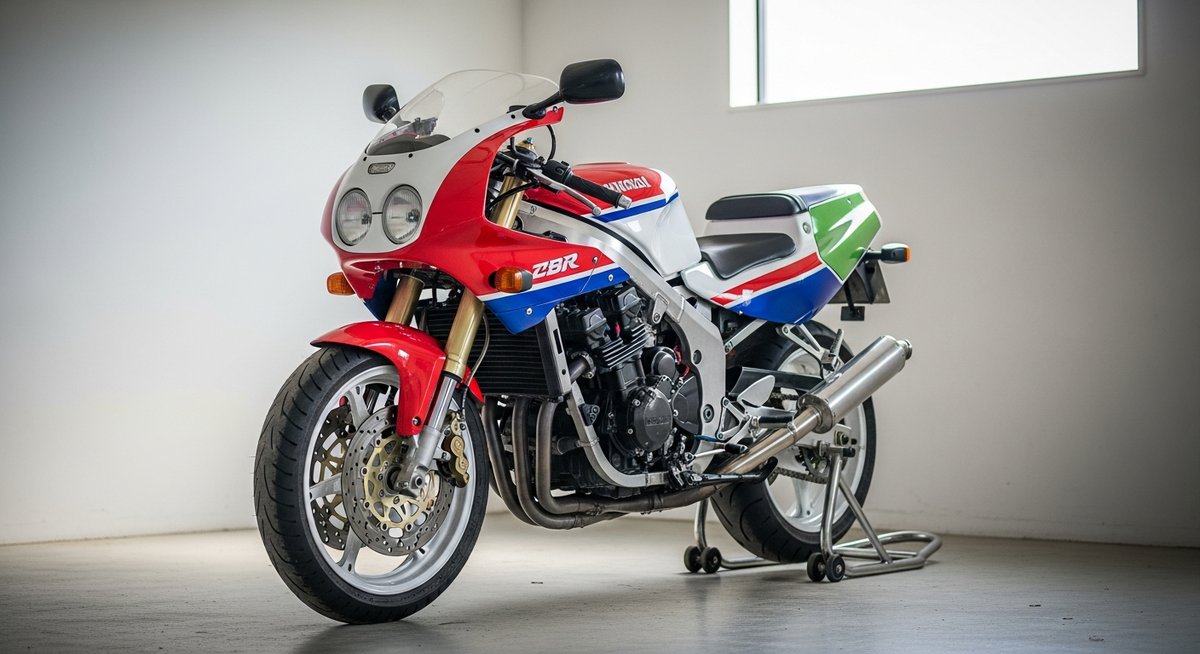
What Is the Yamaha TZR250?
The TZR250 launched in Japan in 1986 as the model code 1KT. It took the architecture of the TZ250 production racer — the bike privateers ran in grand prix — and civilised it just enough for a number plate. Parallel twin-cylinder two-stroke, 249cc, liquid-cooled, with Yamaha's YPVS power valve system managing the exhaust port height.
Japan's domestic 250cc class was capped at 45PS by industry agreement, so every JDM TZR250 left the factory claiming exactly that. The chassis could handle far more. That was the point: a 126 kg motorcycle with grand prix geometry that a 20-year-old in Chiba could insure.
Production ran from 1986 to 1995 across three completely different machines that shared almost nothing but the name. That matters when you're bidding, because the three generations behave differently, fail differently, and are priced differently.
One thing they share: none of them were officially exported to North America. The UK and a few other markets got the first-generation parallel twin as the 2MA, but the 3MA and 3XV stayed home. If you want the interesting ones, they're sitting in Japan.
To understand why grown adults fight over 30-year-old 250s, you need the context. Japan in the late 80s had a licensing system that made 250cc bikes the practical ceiling for most riders, plus a roaring economy and four manufacturers locked in a horsepower war. The result was the most exotic small-displacement motorcycles ever built: aluminium twin-spar frames, magnesium components, and engines derived directly from grand prix programs, sold to commuters. The TZR250 was Yamaha's entry, and the name meant something specific — TZ was the company's customer racing line, and the R suffix promised the street version kept the DNA.
It worked. The 1KT won Japan's domestic sales race and put pressure on Honda that produced the NSR250R a year later. For the next decade the two companies traded blows annually, with Suzuki's RGV250 making it a three-way fight. Every generation got lighter, sharper, and closer to the racetrack until emissions regulations ended the entire category in the mid-90s. The TZR250 line died in 1995 with the SPR, the most sophisticated two-stroke road bike Yamaha ever built.
TZR250 Specs at a Glance
| Spec | 1KT (1986-88) | 3MA (1989-90) | 3XV (1991-95) |
|---|---|---|---|
| Engine | 249cc parallel twin, forward cylinders | 249cc parallel twin, reversed cylinders | 249cc 90° V-twin |
| Claimed power (JDM) | 45PS | 45PS | 45PS |
| Dry weight | approx. 126 kg | approx. 128 kg | approx. 126 kg |
| Frame | Aluminium Deltabox | Aluminium Deltabox | Aluminium Deltabox, revised |
| Exhaust | Conventional chambers | Underseat pipes | Side-exit chambers |
| Signature trait | Friendliest powerband | Wildest character | Most developed, 8 versions |
All three run Yamaha's YPVS exhaust power valve and Autolube oil injection, and all three rev with an urgency that no four-stroke 250 has ever matched. The numbers undersell the experience: 45PS pushing 126 kg with grand prix geometry is a power-to-weight figure that still embarrasses modern lightweight twins on a tight road.
Why Import a TZR250 From Japan Instead of Buying Locally?
Three reasons: supply, condition, and price.
Supply. Outside Japan, TZR250s trickle onto the market a few units a year, usually through specialist dealers who already added their margin. Japanese auction houses run thousands of bikes weekly, and 250cc two-strokes appear constantly because Japan is where they all went in the first place.
Condition. Japanese bikes live gentler lives — lower average speeds, mandatory shaken inspections, and a culture of dealer servicing. More importantly, auction bikes come with an independent inspection sheet that grades the frame, engine, and cosmetics before you bid. Our guide to reading Japanese auction inspection sheets covers exactly how that works. A 30-year-old two-stroke with documented condition beats a Craigslist mystery every time.
Price. Imported and titled TZR250 3XVs have been selling at US auctions for $8,500 to $12,840 in recent sales. At Japanese auction, a comparable bike hammers for roughly half that before shipping and fees. The delta is your reward for doing the paperwork — or letting an export agent do it.
There's also a currency angle working in your favour. The yen has spent the mid-2020s historically weak against the dollar and pound, which means your money goes further at a Japanese auction than it did a decade ago. Japanese sellers price in yen; your budget arrives in dollars. When the exchange rate moves your way, you're effectively buying collector-grade metal at a discount that domestic sellers in your country can't match.
Browse what's currently available on our current listings page — two-stroke replicas come through regularly.
The Three Generations: 1KT vs 3MA vs 3XV
1KT (1986-1988): The Original
Forward-facing cylinders, parallel twin, conventional expansion chambers, white-faced tachometer. The 1KT is the purest TZ250 translation and the friendliest of the three to actually ride. Powerband hits around 8,000 rpm and the chassis is forgiving by two-stroke standards. The UK-market 2MA and 2XT are the same basic machine; JDM 1KT bikes run the 45PS CDI restriction, which specialists can liberate.
This is the cheapest entry into TZR ownership and the best starter two-stroke of the trio. Values are climbing but haven't gone vertical yet: UK price guides put a rough one at £1,500-2,500, a tidy one at £3,000-4,300, and a mint one at £4,500-5,000.
3MA (1989-1990): The Wild One
The 3MA is the strange one — and strange sells. Yamaha reversed the cylinders so the exhausts exit rearward under the seat and the carburettors face the airflow. It looks like nothing else, sounds like nothing else, and Japanese motorcycle media still call it the jaja-uma — the unruly horse — of the replica era.
The reputation is earned. The 3MA makes its power high and sudden, and a YouTube test of a tuned 3MA — 286,000 views and counting — is essentially three minutes of a rider giggling and apologising every time the powerband detonates. It is the most exciting TZR and the least forgiving.
One factory landmine: 1989 3MAs left the line with lean jetting, and unsorted examples seize. Any 3MA worth bidding on has had its jetting corrected decades ago — but you verify, you don't assume.
Collectors have noticed the 3MA's weirdness. UK guide prices: rough £3,500-4,800, tidy £6,000-8,500, mint £9,500-10,500. The underseat-pipe TZR is now the second most valuable generation and climbing fastest.
3XV (1991-1995): The V-Twin Masterpiece
For 1991 Yamaha gave up on the parallel twin and built a 90-degree V-twin, just like Honda's NSR250R and Suzuki's RGV250. Tighter chassis, fatter rubber, sharper steering. The 3XV is the most developed TZR250 and the one most buyers should target.
It's also the most complicated to buy, because Yamaha built eight distinct versions across five years — different carburettors, ignitions, wet and dry clutches, and three iterations of power valve. More on decoding them below.
Recent imported 3XV sales in the US cluster between $8,500 and $12,840 depending on variant and condition, with a 1993 TZR250RS making £8,280 at a UK auction in 2025. The limited SP and SPR homologation models command the top of the range and keep appreciating.
3XV Sub-Variants Decoded: R, RS, SP, and SPR
This is where TZR buying gets genuinely confusing, so here's the cheat sheet nobody hands you:
| Variant | Years | What it is | Buy it if |
|---|---|---|---|
| TZR250R | 1991-1995 | Standard model, wet clutch, street gearing | You want to ride it, not shrine it |
| TZR250RS | 1992-1995 | Sportier spec, upgraded suspension | Best balance of price and hardware |
| TZR250SP | 1991-1994 | Homologation special: dry clutch, close-ratio gearbox, adjustable suspension | You race, or you collect |
| TZR250SPR | 1994-1995 | The final boss: revised power valves, the most developed two-stroke Yamaha ever sold to the public | You want the best and will pay for it |
The auction sheet won't always spell out the variant. Learn the visual tells — dry clutch covers, remote-reservoir shocks, solo-seat cowls — or work with an agent who knows them. An SPR carries a price premium of 50-100% over a standard R, so misidentifying one cuts both ways: you either overpay for an R dressed as an SPR, or you steal a real SPR listed as a base model. Both happen.
Is the TZR250 Legal to Import? US 25-Year Rule, UK, Australia, NZ
The legal picture in 2026 is the best it has ever been for this model.
United States. Federal law exempts vehicles 25 years and older from DOT and EPA conformity requirements. The last TZR250 rolled out in 1995, which crossed the 25-year line in 2020. Every TZR250 in existence is now importable into the US as a simple customs entry. Note the short-VIN reality: JDM bikes carry frame numbers, not 17-digit VINs, and some state DMVs need walking through that. It's paperwork, not a wall.
United Kingdom. No age limit. You'll pay import VAT and duty, complete NOVA, and put the bike through registration — older bikes use the simpler historical routes. Grey-import TZRs have been arriving in the UK since the 80s, so registrars have seen them before.
Australia. All TZR250s qualify as older vehicles under the road vehicle rules, and the 1989-and-earlier examples enter under the most relaxed concessional arrangements. State registration with an inspection follows.
New Zealand. Straightforward entry compliance inspection. NZ has one of the healthiest two-stroke import scenes anywhere, and TZRs are a known quantity.
One practical tip that applies everywhere: photograph and copy every document the bike arrives with — export certificate, customs entry, auction sheet, the lot. Registration offices and insurers handle JDM imports unevenly, and the difference between a smooth visit and three return trips is usually a complete paper trail. Agreed-value insurance is worth arranging too, because standard book values don't exist for a bike your insurer has never heard of.
Yamaha TZR250 Import Costs: Auction Prices and Landed Totals
Here's what the money actually looks like in 2026. Japanese auction hammer prices for TZR250s, in rough USD terms:
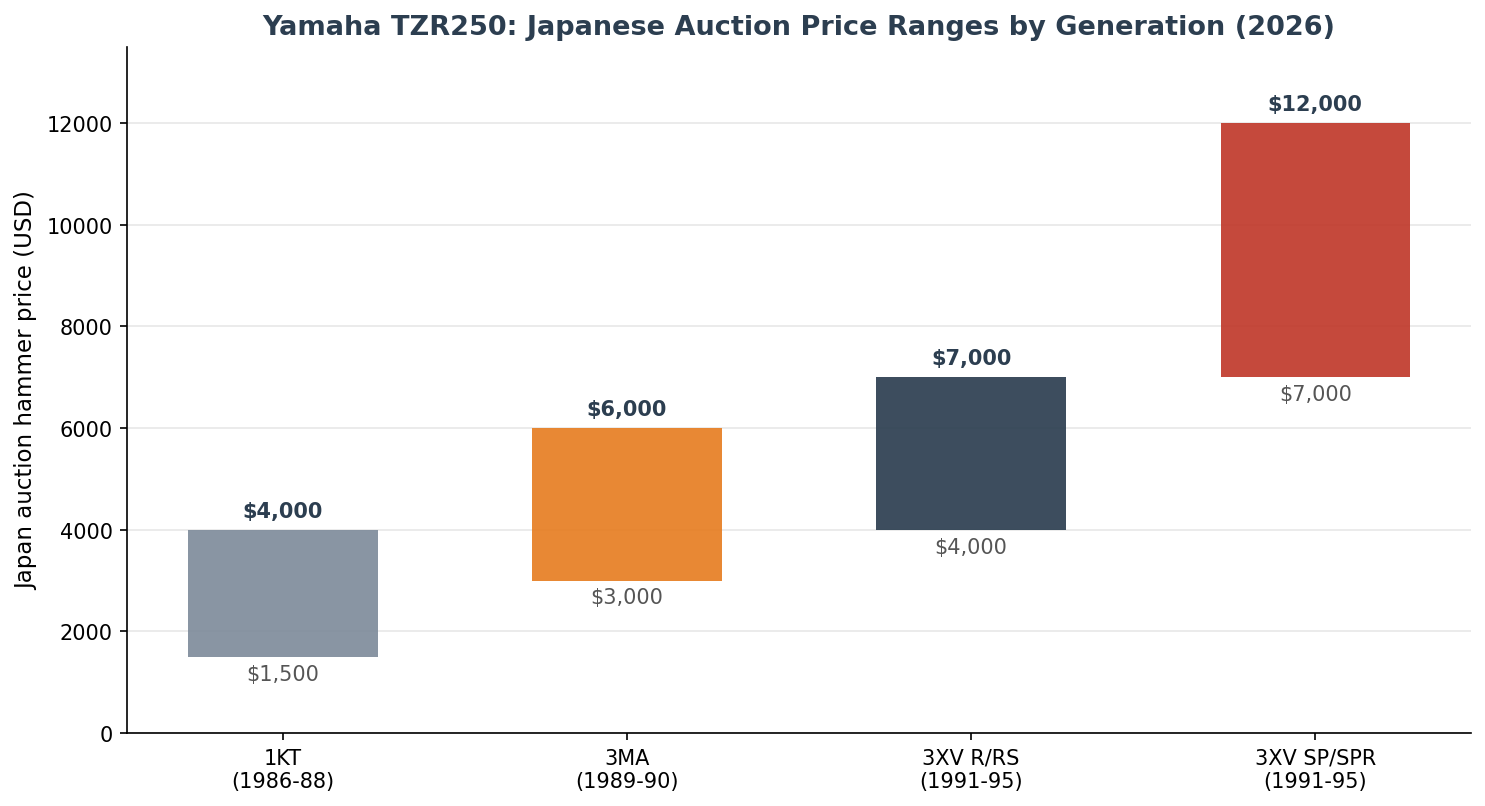
- 1KT: $1,500-3,500 for usable bikes, $4,000+ for excellent originals
- 3MA: $3,000-6,000 for solid examples, more for low-mileage gems
- 3XV R/RS: $4,000-7,000 for grade 3.5-4 bikes
- 3XV SP/SPR: $7,000-12,000+ and rising every year
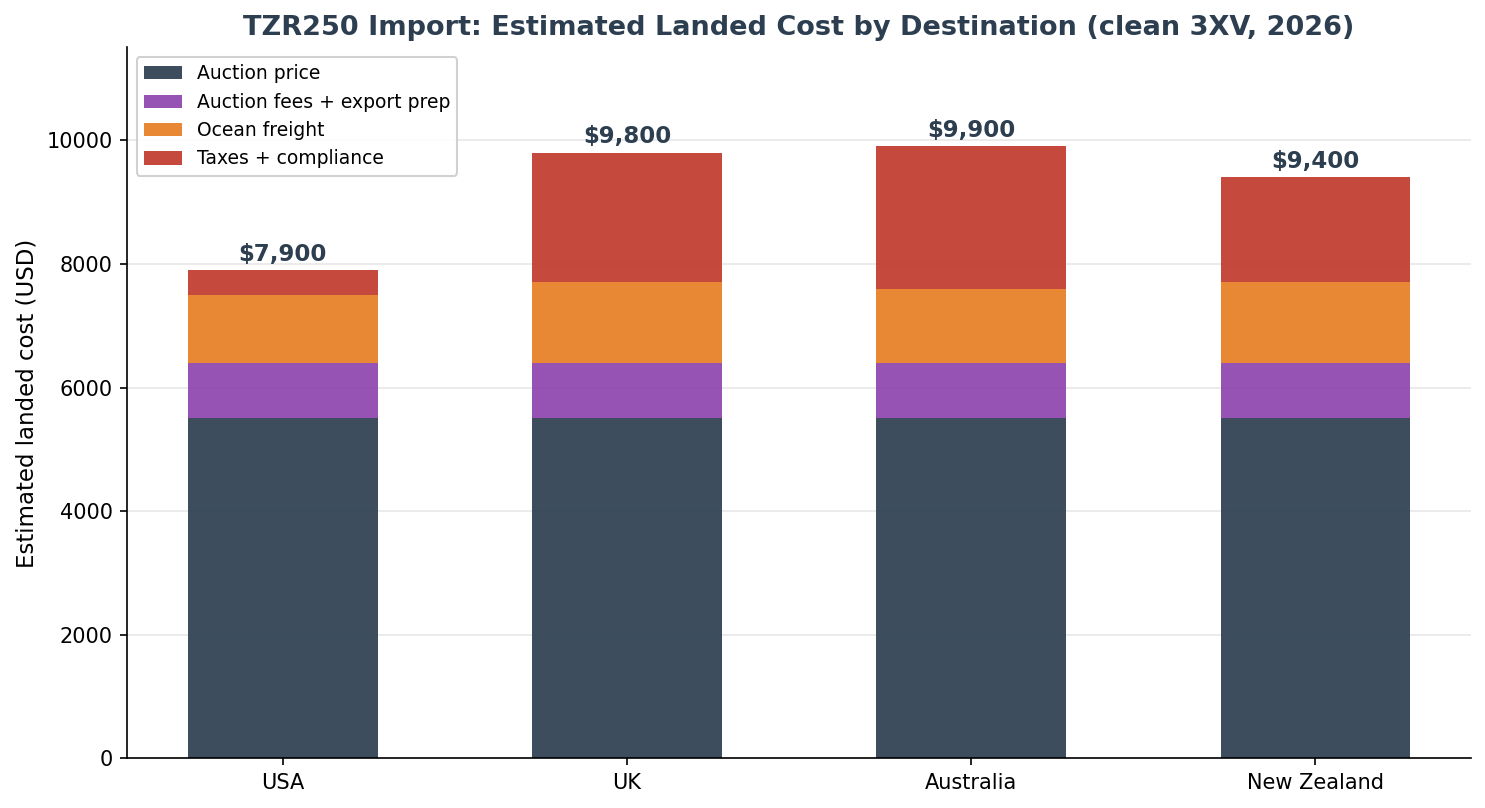
On top of the hammer price, budget for auction fees and agent commission (typically $500-800 combined), inland transport and export prep in Japan ($200-400), and ocean freight ($800-1,500 depending on destination and whether you share a container — our container vs RoRo comparison breaks down that choice).
Then the destination taxes. The US treats motorcycle imports gently. The UK adds import VAT on the whole landed value, which stings. Australia and New Zealand add GST plus compliance costs.
Realistic landed totals for a clean 3XV R/RS: around $7,000-9,500 into the US, £6,500-9,000 into the UK, and AU$11,000-15,000 into Australia. Compare that with the $8,500-12,840 that imported, titled examples fetch at US collector auctions and the math explains itself. You're buying at wholesale and skipping the dealer margin.
Auction grades drive everything here. A grade 4 bike with a clean engine column is worth stretching for; a grade 3 with murky engine notes is a gamble. Our auction grades guide explains the system.
Known Problems: What to Check Before You Bid
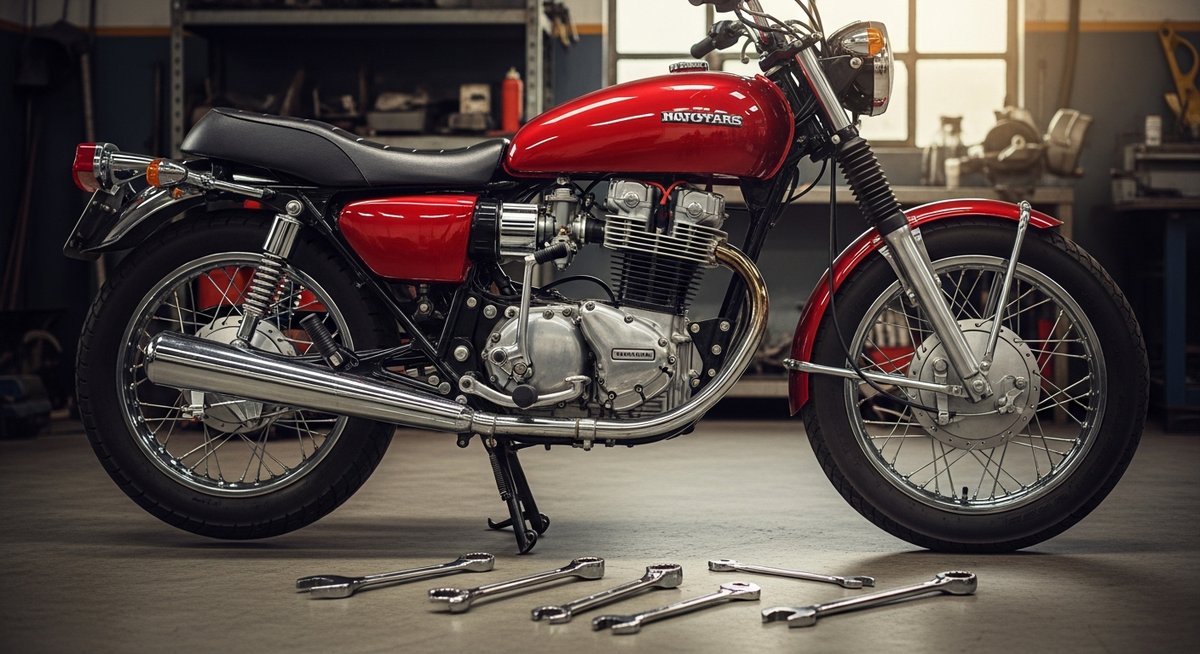
Every TZR250 is now 30 to 40 years old. The engine is a consumable on a two-stroke — that's the deal you signed. Here's the model-specific list:
YPVS Power Valve Wear
The YPVS system chews through its locating bushes with age and mileage. Left unchecked, a worn valve can collapse into the bore, and then you're funding a full top-end rebuild plus a possible cylinder replating. Listen for rattle at idle, and treat any bike with a lazy or non-cycling power valve servo as a project, priced accordingly.
Crankshaft and Crank Seals
Snapped cranks are a known TZR failure, and crank seals age out on any two-stroke that sits. A real-world data point from a Japanese 1KT owner documenting his bike publicly in 2026: a failed crank seal forced him to split the crankcases entirely — and the diagnostic wild-goose chase started because a previous owner had fitted a tachometer from a different model, masking the real symptoms. Thirty-year-old bikes accumulate thirty years of previous-owner decisions. The auction sheet grades condition; it doesn't list which parts aren't original.
3MA Factory Jetting
Covered above, worth repeating: 1989 3MAs ran lean from the factory and seize when unsorted. Ask whether jetting has been corrected. If the answer is silence, bid like the top end is due.
Fuelling Electronics
Rough running below the powerband often traces to the throttle position sensor or the air-bleed solenoids rather than the carbs themselves. Parts exist, but diagnosis takes someone who knows two-strokes — find your specialist before the bike lands, not after.
Why TZR250 Values Are Rising (And Why 2026 Is the Window)
Two-stroke race replicas are the fastest-appreciating segment of the Japanese classic market, and the pattern is repeating itself model by model. Honda NSR250s ran first — MC28 SPs that traded for $6,000 a decade ago now clear $15,000-20,000 at collector auctions. RGV250s followed. The TZR is the last of the big three where clean examples still trade in single-digit thousands at Japanese auction.
Three forces are pushing prices:
The 25-year wave. US demand for these bikes only switched on as each model year crossed the exemption line. The final TZR250s became US-legal in 2020, and American collector money has been working through the supply since. Every bike shipped west shrinks the pool in Japan.
Nostalgia with money. The riders who taped TZR posters to their walls in 1991 are in their late forties now, mortgage halfway done, garage space available. This is the same demographic engine that inflated air-cooled 911s and R32 Skylines. It does not reverse.
Finite supply, shrinking grid. Nobody is making more two-strokes. Emissions law killed the engine type for road use, and every seized crank or crashed 3MA permanently removes one from the population. Racing culture runs deep here too — the Eddie Lawson Marlboro Yamaha connection still moves metal, and a single TZR clip in Lawson-replica colours has pulled 745,000 views on YouTube. The audience for these machines is global and growing while the supply only shrinks.
None of this makes a TZR250 a guaranteed investment — buy it to ride it. But it does mean waiting another two years will cost you real money, on current trajectory.
What the Auction Sheet Tells You About a 30-Year-Old Two-Stroke
Auction sheets were designed for five-year-old commuter bikes, so reading one for a 1992 race replica takes translation. Here's what matters on a TZR specifically:
The overall grade. Grades run from S (new) down through 4, 3.5, 3, and lower. For a thirty-year-old two-stroke, grade 4 is exceptional, 3.5 is the sweet spot of price versus condition, and grade 3 means visible history — fine if the engine notes are clean, dangerous if they aren't.
The engine column. This outranks everything else on a stroker. Notations for smoke, noise, or weak compression are walk-away flags unless you're pricing in a full rebuild. A cosmetically rough bike with a strong engine beats a shiny bike with a tired one, every single time.
Modification flags. Most surviving TZRs wear aftermarket expansion chambers — that's normal and often desirable if they're quality Japanese pipes. What you want to see noted is whether the originals come with the bike. Original pipes add real resale value.
Mileage reality. Odometer readings on 30-year-old bikes are advisory at best. Many JDM bikes show under 20,000 km honestly; others have been around the clock or had clusters swapped. Condition tells the truth that numbers can't. This is exactly why bidding from photos alone, without a graded sheet and someone who can request extra images, is gambling with a four-figure stake.
Common Mistakes First-Time Two-Stroke Importers Make
Buying the cheapest one. A $2,500 TZR is $2,500 for a reason. On a two-stroke, deferred maintenance compounds: a worn YPVS becomes a destroyed top end, a tired crank seal becomes split cases. The expensive bike is usually the cheap one.
Ignoring the variant premium. Bidders who can't tell an SP from an R either overpay or miss steals. Twenty minutes of homework on clutch covers and suspension spec pays for itself in one auction.
Forgetting recommissioning costs. Budget $500-1,500 post-arrival for fluids, fuel lines, carb service, tyres, and a YPVS check even on a good bike. A bike that sat for five years in a Japanese warehouse needs every rubber part questioned.
Shipping a project unseen. Restoration-grade bikes make sense for locals who can inspect in person. Importing adds a fixed $2,000+ of logistics to whatever you buy — spend it on the best bike, not the worst.
Skipping the title plan. Know your state or country's registration path for a frame-number JDM bike before you bid, not when the container lands. Importers in 25-year-rule states do this daily; copy their homework.
Living With a TZR250: Parts, Fuel, and Reality
Good news first: consumables are easy. Pistons, rings, gaskets, seals, and reeds are available through Japanese parts channels like Webike and the big exporters' catalogues. The TZR shares its two-stroke logic with every other stroker, and the specialist scene — strongest in the UK, Australia, and Japan — keeps knowledge alive.
The hard parts are bodywork, expansion chambers, and model-specific trim, especially for the 3MA with its one-generation-only underseat exhaust architecture. Buy the most complete bike you can afford. A $1,500 saving on a bike missing its airbox and original pipes is not a saving.
Running it: the TZR uses Yamaha's Autolube oil injection, so no premixing — keep the two-stroke oil tank filled and ride. Real-world fuel economy from owners is around 20 km/L (roughly 47 mpg US) with enthusiastic backroad use, which is better than the bike's reputation suggests. Feed it quality two-stroke oil and it rewards you; the engines respond to maintenance more than mileage.
And the riding experience is the entire point. The powerband arrival on these bikes is an event — the 660,000-view classic Japanese video pitting an NSR250SP against a TZR250 exists because that rivalry, and that hit of power at 8,000 rpm, never stopped being magnetic. A modern 300cc twin is faster point-to-point. Nobody films it.
Step-by-Step: How to Import a TZR250 From Japan
- Set the budget — hammer price plus roughly $2,500-4,000 of fees, freight, and taxes depending on destination.
- Choose your generation and variant — decide before auction day, because SP/SPR examples appear without warning and sell fast.
- Get access to the auctions — auction houses don't deal with overseas individuals; you bid through an exporter or agent with auction membership. That's what we do.
- Read the auction sheet hard — frame grade, engine notes, modification flags. On a two-stroke, engine column comments matter more than cosmetic grade.
- Bid and win — your agent handles payment, paperwork, and inland transport to port.
- Ship — RoRo is cheaper, container is safer for a collectible. Three to six weeks on the water for most routes.
- Clear customs — US: 25-year exemption entry. UK: NOVA and VAT. AU/NZ: compliance inspection.
- Register — bring the export certificate, the customs entry, and patience for the frame-number conversation at the DMV.
- Recommission before riding hard — fresh fuel lines, carb clean, crank seal check, YPVS service, new tyres. Thirty-year-old rubber is a lie waiting to happen.
JDM Restriction and Derestriction: What 45PS Really Means
Every Japanese-market TZR250 claims 45PS, because that was the industry's self-imposed ceiling for the 250 class. The number on the brochure is a treaty, not a measurement of what the engine wants to make.
The restriction lives mostly in the CDI ignition mapping, with the exhaust and carburation tuned around it. The 1KT and 3MA respond to a derestricted or aftermarket CDI plus jetting work; the 3XV's restriction strategy varies across its eight versions, which is one more reason variant knowledge matters. Properly liberated, these engines move from 45PS to somewhere in the 50-60+ range depending on generation, pipes, and how brave your tuner is.
Should you derestrict? Three honest considerations:
Originality has a price now. Collector-grade bikes are worth more bone-stock. If you've bought a mint SPR, leave it alone and bank the appreciation.
Restriction protects old engines. A 35-year-old crank with unknown history lives longer at 45PS than at 58PS. Plenty of owners derestrict, then ride at eight-tenths anyway — which is the worst of both worlds: rebuild-interval risk with no originality.
Do it properly or not at all. Half-derestricted bikes — derestricted CDI with stock jetting — run lean, and lean kills two-strokes. If you change the ignition, the carburation gets rebuilt around it. This is specialist work, and it's another reason a bike with documented tuning history beats a bike with mystery modifications.
After the Hammer: Shipping, Customs, and First Start-Up
Winning the auction is the halfway point. Here's the back half of the journey in practice.
Your agent settles the auction invoice and moves the bike from the auction yard to the export warehouse — figure one to two weeks for collection and export prep, including the deregistration paperwork that becomes your export certificate. That document matters: it's the bike's identity for customs and registration at your end, so confirm your agent supplies it with a translation.
On shipping, the calculus for a collectible two-stroke tilts toward container. RoRo saves a few hundred dollars but the bike travels exposed, strapped on its wheels. Shared-container services crate the bike and cost between the two. For an SPR you just paid five figures for, the crate is cheap insurance. Transit runs three to six weeks to most US, UK, and Australian ports.
Customs clearance for a 25-year-exempt bike into the US is genuinely simple — the right entry forms, the exemption boxes, duty on the declared value, done. The UK and Australia take longer because of VAT/GST processing and compliance inspection slots. Then registration, and the bike is legally yours to ride.
Resist the urge to kick it over the day it arrives. Months in warehouses and a sea crossing mean stale fuel, condensation, and dry crank seals. Drain the tank, flush the carbs, fresh premium fuel, fresh two-stroke oil, check the YPVS cycles on key-on, and give it a gentle heat cycle before you go looking for the powerband. The powerband will still be there. Make sure the engine is too.
TZR250 vs NSR250 vs RGV250: Which Two-Stroke Should You Import?
The eternal question, and the honest answer is that you're choosing flavours of the same drug.
The Honda NSR250R is the polished one — the most developed electronics, the biggest cult following, and the highest prices, with MC28 SPs now reaching silly money. The Suzuki RGV250 is the rawest and donated its engine to Aprilia's RS250, which keeps its parts scene oddly healthy. The TZR sits between them: more character than the Honda, more civilised than the Suzuki, and right now, cheaper than both for equivalent condition.
A practical note on availability: NSR250s appear at auction most weeks, RGV250s less often, and TZR250s sit in between — but SP and SPR variants surface unpredictably and sell the day they appear. If you're set on a specific homologation model, the winning strategy is a standing watch on the auction feeds rather than waiting for one to show up on a dealer floor. By the time a special lands on a retail listing outside Japan, two layers of margin have already been added to the price you could have paid at the hammer.
That price gap is the opportunity. NSR money has already run; TZR money — especially 3MA and SPR money — is still moving. Buy the unloved sibling before the market finishes noticing.
Set your alert keywords carefully, too. Japanese auction listings won't say "SPR" in roman letters every time — model codes, frame number prefixes, and equipment notes do the identifying. This is exactly the kind of pattern recognition a good agent earns their commission on: the difference between a listing that says "TZR250" and one that a trained eye reads as a dry-clutch SP with original pipes is several thousand dollars of either saving or mistake.
How AWA Auction Gets You a TZR250
We're the auction access piece of this puzzle. AWA Auction bids on your behalf at the Japanese motorcycle auctions where TZR250s actually trade, translates the inspection sheets so you know exactly what you're bidding on, and handles export paperwork, inland transport, and shipping coordination to the US, UK, Australia, New Zealand, and beyond.
Two-stroke replicas are a specialty of ours precisely because they're condition-sensitive purchases. A TZR250 bought blind is a gamble. A TZR250 bought off a graded sheet, with photos of the engine cases and an agent who knows what a real SPR looks like, is just shopping.
Check the current listings for what's in stock, or tell us which TZR you're hunting and we'll watch the auctions for it.
See Also
Share this article: