
If you want a Honda CBF1000 import from Japan, you are chasing one of the biggest secrets in the used bike world: a Fireblade-engined litre sport-tourer that costs less than a tidy 600 and does about 90% of everything you will ever ask a motorcycle to do. Owners nicknamed it "the Biffer," and it earned that affection honestly. This guide walks you through every decision before you buy one — the confusing CBF-versus-CB-versus-CBR naming problem, the Mk1 and Mk2 differences, the electrical weak spot that strands the unlucky, the real landed costs into the UK, Australia and New Zealand, and the blunt truth about the US 25-year rule. By the end you will know exactly which CBF1000 to bid on and which to walk away from.
Here is the thing nobody tells you about this bike: it was never sold new in the United States, it was built in small numbers in Europe, and it has always lived in the shadow of flashier machines. That is precisely why the used examples coming out of Japan are so cheap and so clean. You are not fighting a crowd for these. You just need to know what you are looking at.
Why the Honda CBF1000 is Japan's most underrated sport-tourer bargain
Sport-tourers with handlebars and a windscreen have quietly gone out of fashion. The market chased adventure bikes and nakeds, and machines like the CBF1000 got left on the shelf. Depreciation did the rest. Today a clean Mk2 CBF1000 trades for money that would barely buy you a scruffy middleweight, and that mismatch between price and ability is the whole story.
The CBF1000 is a 998cc four-cylinder built around real-world torque, an adjustable riding position, ABS with combined braking, a centrestand, and a genuine 180-mile tank range. It is comfortable enough to cross a country in a day and quick enough to embarrass a sportbike rider who was not paying attention. One popular YouTube clip simply films a stock CBF1000 pulling cleanly from a roll to 220 km/h — over 300,000 people watched a "boring" Honda do something distinctly un-boring.
The reputation is the opportunity. A French review titled, roughly, "this bike sadly makes nobody dream" pulled more than a quarter of a million views and 367 comments — most of them from owners defending it. When a bike this capable is this unloved by the market, the person who ignores the badge and reads the spec sheet wins. That person is you.
Because Japan bought and rode these too, its auction halls hold low-mileage, single-owner, rust-free examples that were babied their whole lives. Importing one is not about finding a unicorn. It is about picking a good one out of many and getting it home for a sensible number. That is what the rest of this guide is for.
CBF1000, CB1000R and CBR1000RR: clearing up the naming confusion
The single most common mistake buyers make with the Honda CBF1000 is confusing it with three other Hondas that share letters and numbers. Get this straight before you bid, because on a Japanese auction listing a one-letter difference is the difference between the bike you want and a completely different machine.
CBF1000 — that is this bike. A half-faired upright sport-tourer, built 2006 to 2018, with an adjustable screen, seat and bars, a centrestand, and a detuned Fireblade engine. Comfortable, practical, cheap.
CB1000R — a naked streetfighter, no fairing, sharper styling, sportier ergonomics. Same engine family, different mission entirely. Great bike, not this one.
CBR1000RR Fireblade — the full-on superbike the CBF borrows its engine from. Clip-ons, race ergonomics, nearly double the peak power. If you wanted that, you would not be reading a sport-tourer guide.
Honda themselves leaned into the confusion. A German feature titled "one engine, three concepts" put the CBF1000, the CB1000R and the Fireblade side by side — it drew over half a million views precisely because people cannot keep them apart. Do not add yourself to that statistic. If the tank badge and the fairing say CBF, and the screen adjusts, you are looking at the right bike. If you specifically want the naked or the superbike instead, we cover those separately in our CBR1000RR import guide and the wider best nakeds to import from Japan roundup.
One more trap: the Honda CB1000 Super Four — the early-1990s air-cooled "Big One" — shares almost the same number but is a totally different, older machine. On an auction sheet, read the full model line, not just the digits.
The Fireblade engine, detuned for the real world
The heart of the CBF1000 is a 998cc liquid-cooled DOHC inline-four lifted from the 2004 to 2007 CBR1000RR Fireblade. Same 75 x 56.5 mm bore and stroke, same basic block. Honda then did the smart thing and tuned it for the way humans actually ride.
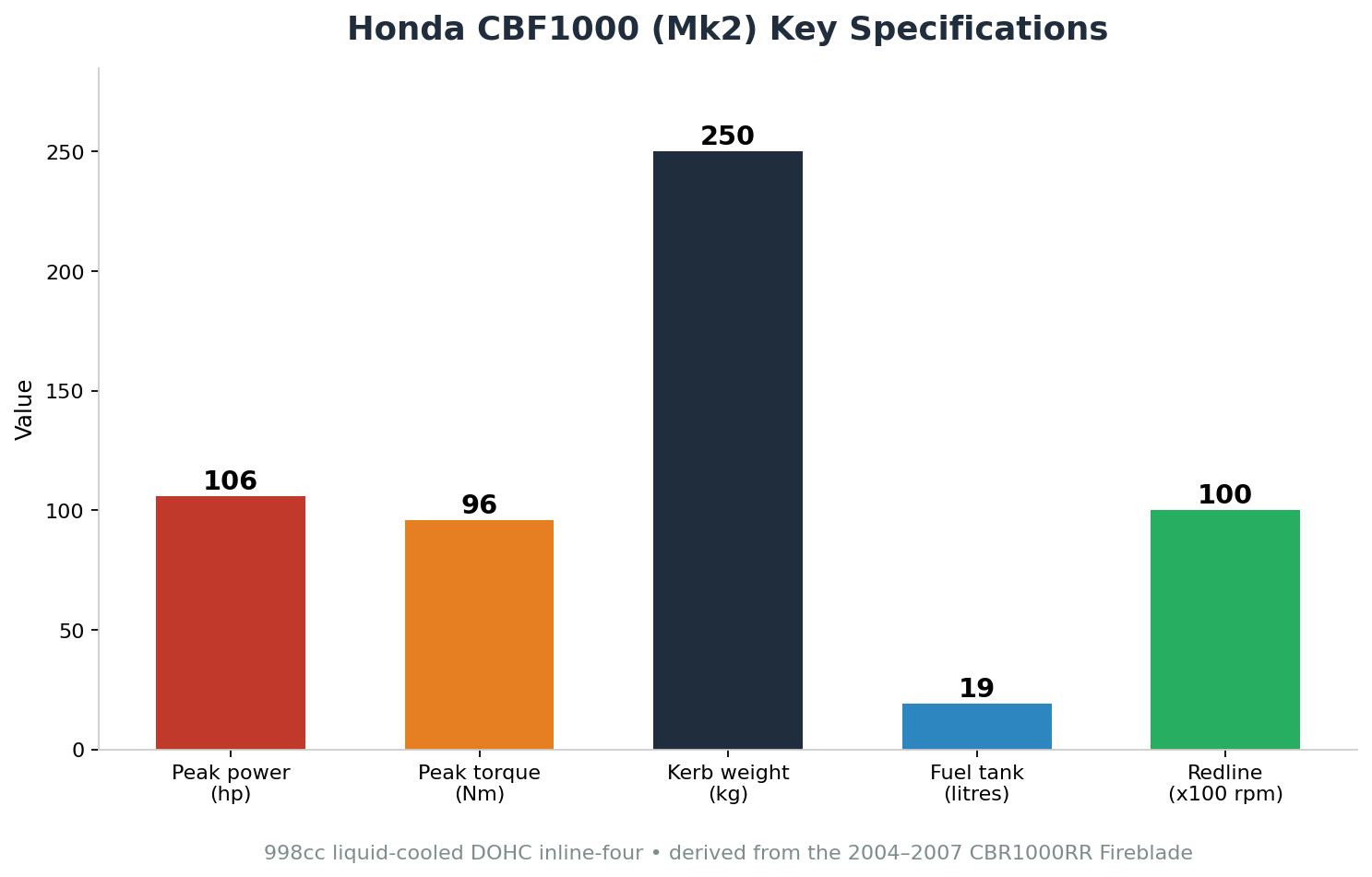
Where the Fireblade of that era screamed to nearly 12,000 rpm for 170-plus horsepower, the CBF makes its claimed 97 hp (Mk1) to 106 hp (Mk2) far lower down and gives up revving at a 10,000 rpm redline. That sounds like a huge sacrifice — roughly three-fifths of the superbike's peak power — and on paper it is. In the real world it is the opposite of a sacrifice.
The CBF1000 makes 90% of its peak torque between roughly 3,000 and 8,500 rpm. That is the entire band you use on a road. Off a blip past idle at 2,000 rpm it is already pulling; by 3,000 it is doing nearly everything. You do not chase a powerband because there is no powerband to chase — there is just a wide, flat table of torque you can lean on in any gear. That is what makes a heavy bike feel easy.
Honda has a habit of under-claiming these figures. Independent dyno runs suggest the quoted numbers are close to rear-wheel output, which implies a bit more at the crank — the same sandbagging they did with the CB1100. Either way, the takeaway is simple: this engine is bulletproof, unbothered, and happy on regular 90-octane pump fuel. It is a Fireblade motor that will do a 200,000-mile life of commuting and touring without drama.
Honda CBF1000 model year guide: Mk1 vs Mk2 (2006 to 2018)
There are only two generations to learn, and telling them apart is easy once you know the tells. Get this right and you will never overpay for the wrong one.
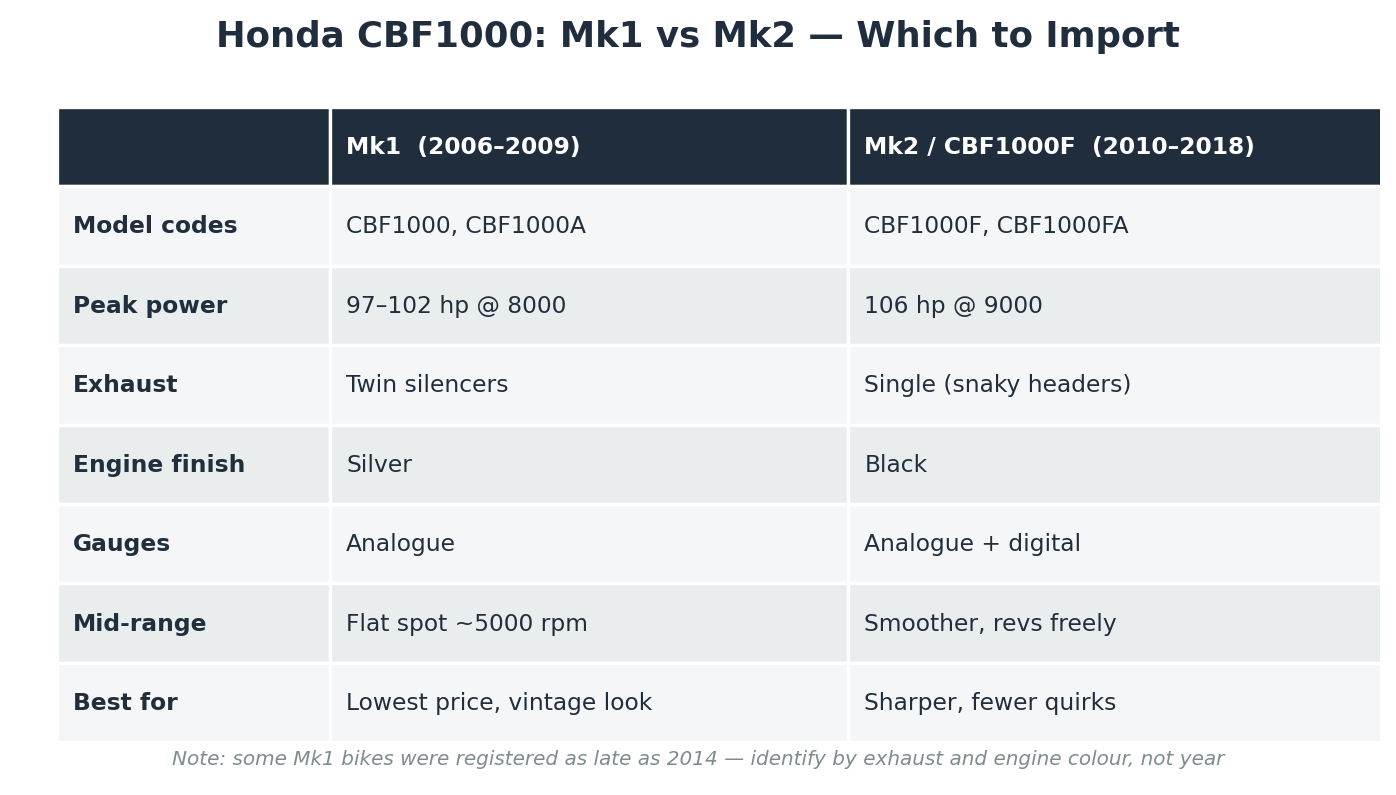
Mk1 (2006 to 2009) — CBF1000 and CBF1000A. Twin silencers, straight exhaust headers, silver engine and wheels, mostly analogue gauges. The engine has a mild hesitation around 5,000 rpm and a slightly fluffy cold-start fuelling glitch up to about 4,000 rpm. Neither is a dealbreaker, and a decent tune or a Power Commander cleans it up. This is the one to buy if you want the lowest possible price and you like the more upright, slightly vintage look.
Mk2 (2010 to 2018) — CBF1000F and CBF1000FA. Formally the CBF1000F, though everyone still just says CBF1000. You spot it by the single silencer fed by snaky curved headers, a black engine, slimmer headlights, a new top fairing, and an analogue-plus-digital dash. Honda retuned the engine to rev more willingly and killed most of the Mk1 flat spot, and bumped claimed power to 106 hp. Riding position is a fraction more forward but still upright and comfortable. This is the smarter used buy for most people.
Here is the catch that trips up buyers: the CBF1000 was never a big seller, so unsold Mk1 stock was registered late — some first-registered as recently as 2014 are still Mk1 bikes. Never identify the generation by the registration year alone. Look at the exhaust and the engine colour. Twin pipes and silver means Mk1, full stop, whatever the paperwork says.
Common problems: what to check before you buy a CBF1000
The CBF1000 is a genuinely reliable motorcycle — an owner survey found 75% had no problems at all, 20% had a single minor issue, and only 5% had a few. But "reliable" does not mean "faultless," and there is one weak area you must inspect hard.
The charging system. This is the big one. Stator, alternator and regulator/rectifier faults are the known CBF1000 weakness, and they hit early bikes hardest. Batteries can fail prematurely as a knock-on effect. One owner on the enthusiast forums described his Mk1 as "engine lots of fun and the bike is comfy" but admitted the "notorious electrical issues left me stranded halfway home on a 400 km ride." Before you buy, check the charging voltage at the battery: it should climb to roughly 14 volts as you rev. If it sits stubbornly at 12-something, budget for a stator or reg/rec. It is a fixable, well-documented job — but only if you know it is coming.
Aftermarket electrical gremlins. Badly fitted heated grips, extra lights and phone chargers can overload the CBF's modest generator and let electrical faults creep into the loom. If the bike is festooned with cheap add-ons and a bird's nest of Scotchlok connectors under the seat, factor that in.
Suspension. The rear shock is not rebuildable, so a worn or leaking one means a replacement. Check the fork sliders for stone chips and corrosion — damage there wrecks the seals. Work the front end and listen and feel for the suspension linkage bearings: they seize on neglected bikes, and smooth, quiet movement is what you want.
Consumables and finish. Check the chain and sprockets have real life left. A very few owners report flaking engine paint, but the vast majority praise the finish, so a scruffy example is usually a neglect signal, not a model fault. And yes — the pegs scrape early. One Mk1 owner who called himself "not a very aggressive rider" admitted to grinding them regularly. That is ground clearance for luggage-laden touring, not a flaw, but it tells you this is a tourer, not a knee-down weapon.
Run through this list on any bike you shortlist and you will filter out the 5% of bad ones fast. For the auction-specific version of this inspection, see the section on reading the auction sheet further down, and our full Japanese auction sheet guide.
What it's really like to live with a CBF1000
Numbers only tell you so much. What sells the CBF1000 is how it disappears underneath you on a normal ride. The bars, seat and screen all adjust, so you can dial in a genuinely comfortable position instead of compromising the way you do on a sportbike-derived naked. The combined ABS braking is reassuring in the wet. The centrestand makes chain maintenance a two-minute job. And the 180-mile range means you stop when you want to, not when the fuel light tells you to.
The character comes from that inline-four. It has a smooth, revvy engine note that a V-twin or parallel-twin simply cannot match, and enough midrange that overtakes happen in whatever gear you happen to be in. Owners describe it as the bike that makes a mockery of everyday riding — bumpy roads, gravel car parks, motorway slog, a spirited back-road blast — all handled without fuss. One long-term owner toured his new CBF1000 across the North Sea to Norway on it and never looked back.
The honest downsides are two. First, weight. At around 250 kg wet it is heavy, and you feel it at walking pace on a slope or when you are paddling it backwards out of a parking spot. At any real speed it vanishes, but low-speed manoeuvres take respect. Second, it is not exciting in the way a 150 hp naked is exciting. It is fast, but it is never frantic. For a huge number of riders — commuters, tourers, returning riders, tall riders who want space — that is a feature, not a bug.
Owners keep the bike for years and get attached to it. Scroll any CBF1000 forum and you find people on their second or third one, people who tried a flashier bike and came back, and first-big-bike buyers who chose it over a BMW R1250R and were glad they did. That kind of loyalty around an "unloved" model is the clearest signal there is that the market has the CBF1000 mispriced.
CBF1000 vs the sport-tourer rivals
If you are cross-shopping, three bikes come up again and again against the Honda CBF1000. Each is a superbike-engined all-rounder from the same era, and each has a different flavour. Here is how they stack up.
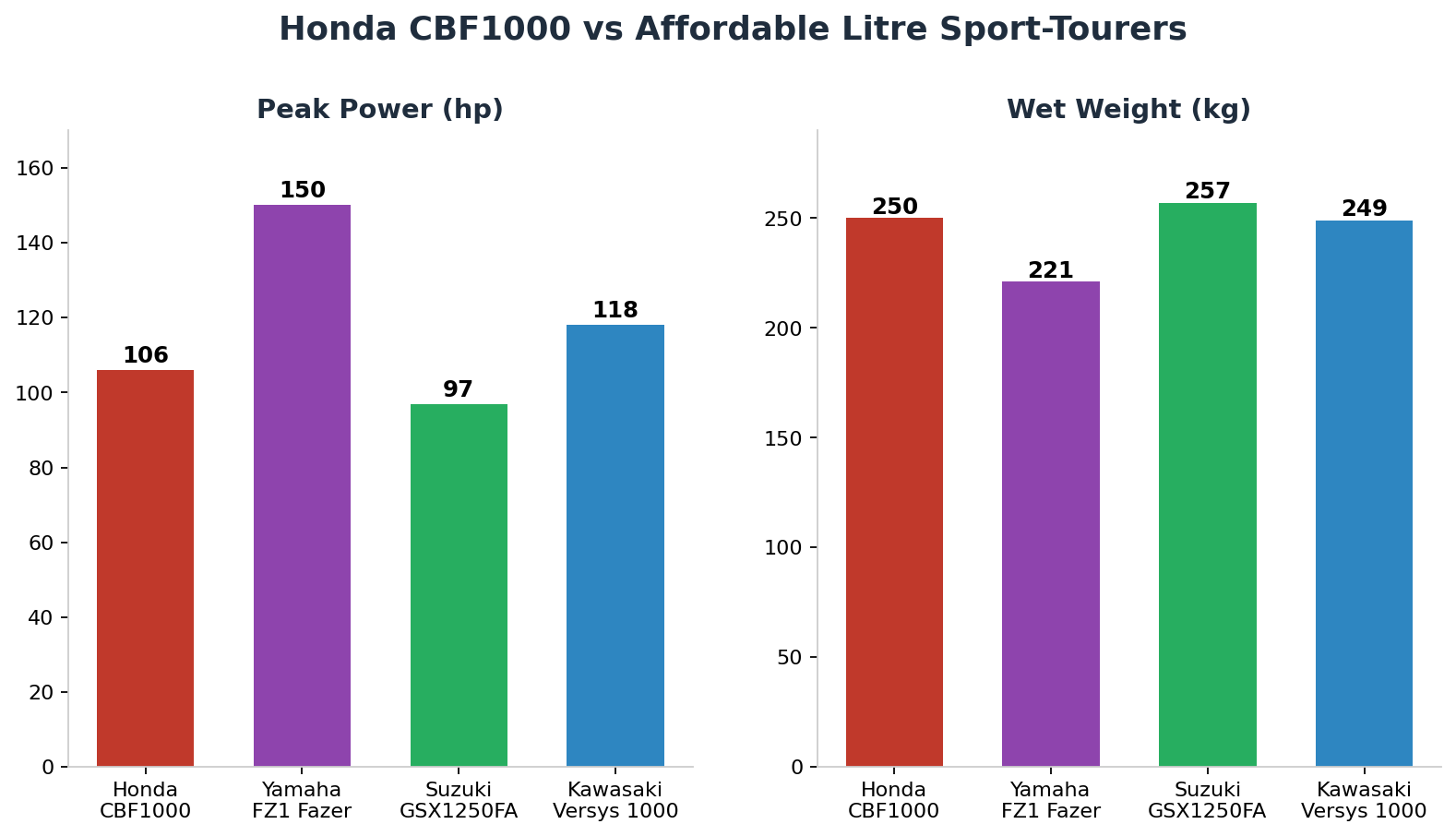
Yamaha FZ1 Fazer (2006 to 2016). Built around a detuned 2004 R1 motor, it makes a wild 150 hp and weighs less at 221 kg. It is the sporty choice — peakier, faster, hungrier for revs. But it makes less torque down low than the CBF and demands more from the rider. Plenty of people trade an FZ1 for a CBF precisely because they wanted the same idea in a calmer, comfier package. If you want the sharper one, we cover it in the Yamaha FZ1 import guide.
Suzuki GSX1250FA (2010 to 2016). The Bandit-derived big Suzuki runs a 1255cc lump that makes a colossal wall of torque from 3,700 rpm — arguably even more effortless than the CBF low down. It is heavier at 257 kg and, like the Honda, keeps things simple with ABS as its only rider aid. A brilliant, understated, cheap tourer. The full picture is in our Suzuki Bandit and GSX1250 import guide.
Kawasaki Versys 1000 (2012 to 2018). More upright, taller, adventure-styled, with a 1043cc four making 118 hp plus traction control and ride modes on later bikes. It is generally newer and higher-spec, which means it is pricier. If you want more toys and a taller stance, it is worth a look; if you want the cheapest capable literbike tourer, the CBF undercuts it.
The pattern is clear. The FZ1 is faster, the Versys is fancier, the Suzuki is torquier — and the CBF1000 is the cheapest, comfiest, most fuss-free of the lot. For a rider who values a low buy-in and a bike that just works, the Honda wins on exactly the terms that matter.
The 25-year import rule and where the CBF1000 is legal
This is where you need the truth rather than the hype, because import legality depends entirely on where you live.
United States — not yet, and that is the honest answer. The CBF1000 was never federalised for the US (no EPA or DOT certification), so the only legal road route is the 25-year exemption. The first CBF1000s are 2006 models, which means they become eligible in 2031. As of 2026, no CBF1000 can be imported into the US for road use. Anyone telling you otherwise is selling you a problem. The upside: US buyers who love the bike can line up a clean Japanese example now, build the plan, and be ready the moment the calendar turns. That five-year gap is also why so few Americans know this bike exists — a genuine sleeper.
United Kingdom — open, and the natural home for CBF1000 imports. There is no age barrier. You pay import duty (about 6% on a used motorcycle) plus 20% VAT, then register it. Because the CBF was sold in the UK, parts, manuals and specialists are everywhere. This is the easiest market to import into, and our UK import duty and tax guide and general how-to-import walkthrough cover the paperwork step by step.
Australia and New Zealand — open, with process. Both allow imports without a 25-year wait, though Australia has its own approval and compliance pathway (and stricter rules on some modifications). New Zealand's process is relatively importer-friendly. In both markets the CBF1000 was officially sold, so compliance is straightforward compared with a true grey-market oddity.
The short version: if you are in the UK, Australia or New Zealand, you can do this today. If you are in the US, you are planning for 2031 — but starting the search now is smart, because the clean examples get picked off first.
What it costs to import a Honda CBF1000 from Japan
The reason this bike is such a bargain is that the sums genuinely work. A clean, sub-40,000 km Mk2 CBF1000 regularly changes hands at Japanese auction for the equivalent of a couple of thousand pounds — a fraction of what an equivalent bike costs on a local forecourt. Add the import costs and you still land well under used-market money.
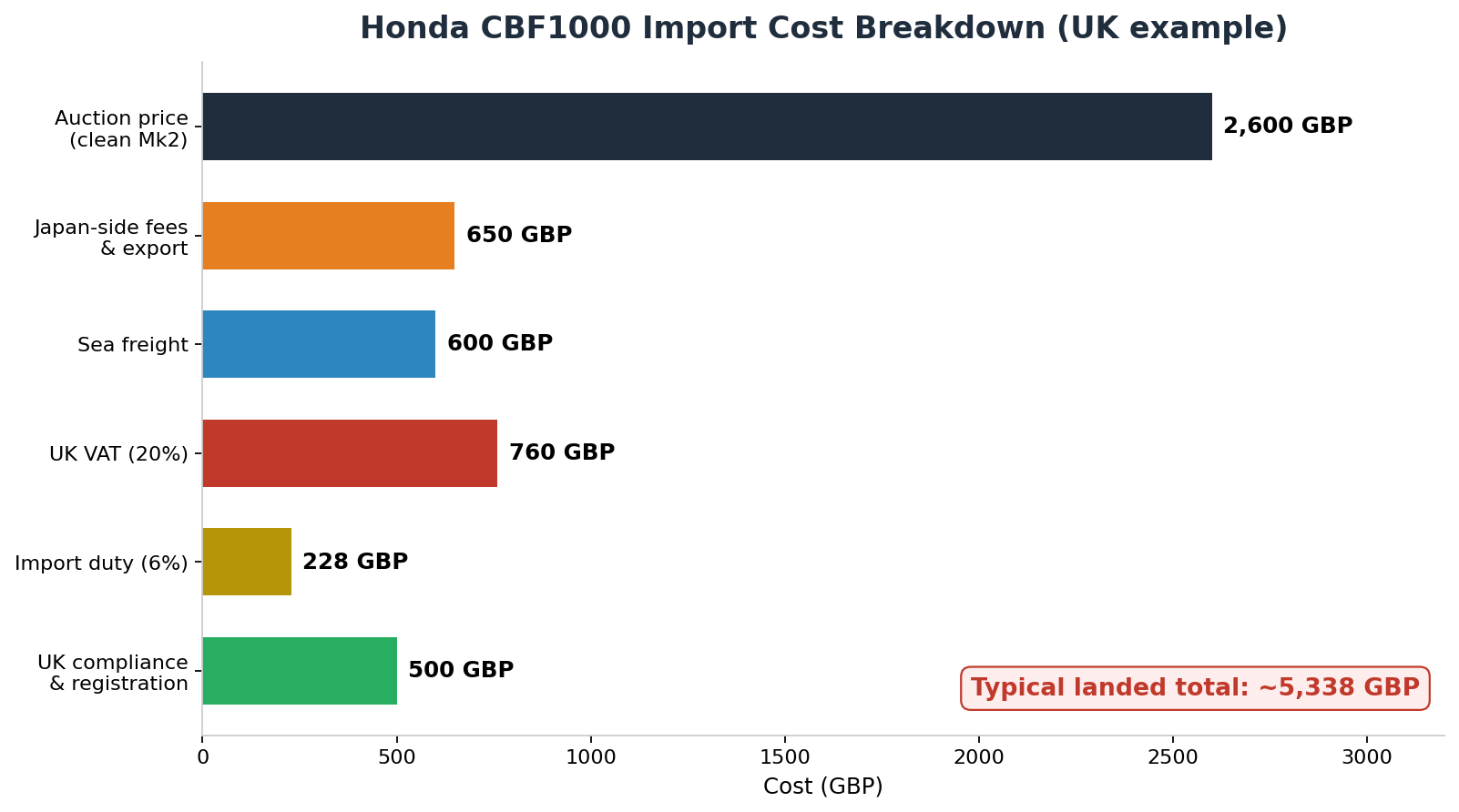
Here is a realistic UK example on a clean Mk2. The auction price lands around 2,600 GBP; Japan-side fees, de-registration and export handling add roughly 650; sea freight to a UK port is about 600; then UK VAT at 20% and import duty at 6% are calculated on the value plus shipping; and finally UK compliance and registration cost a few hundred more. Total landed cost comes out near 5,300 GBP for a bike that would be optimistically priced at that on the used market and would likely have more miles and more owners.
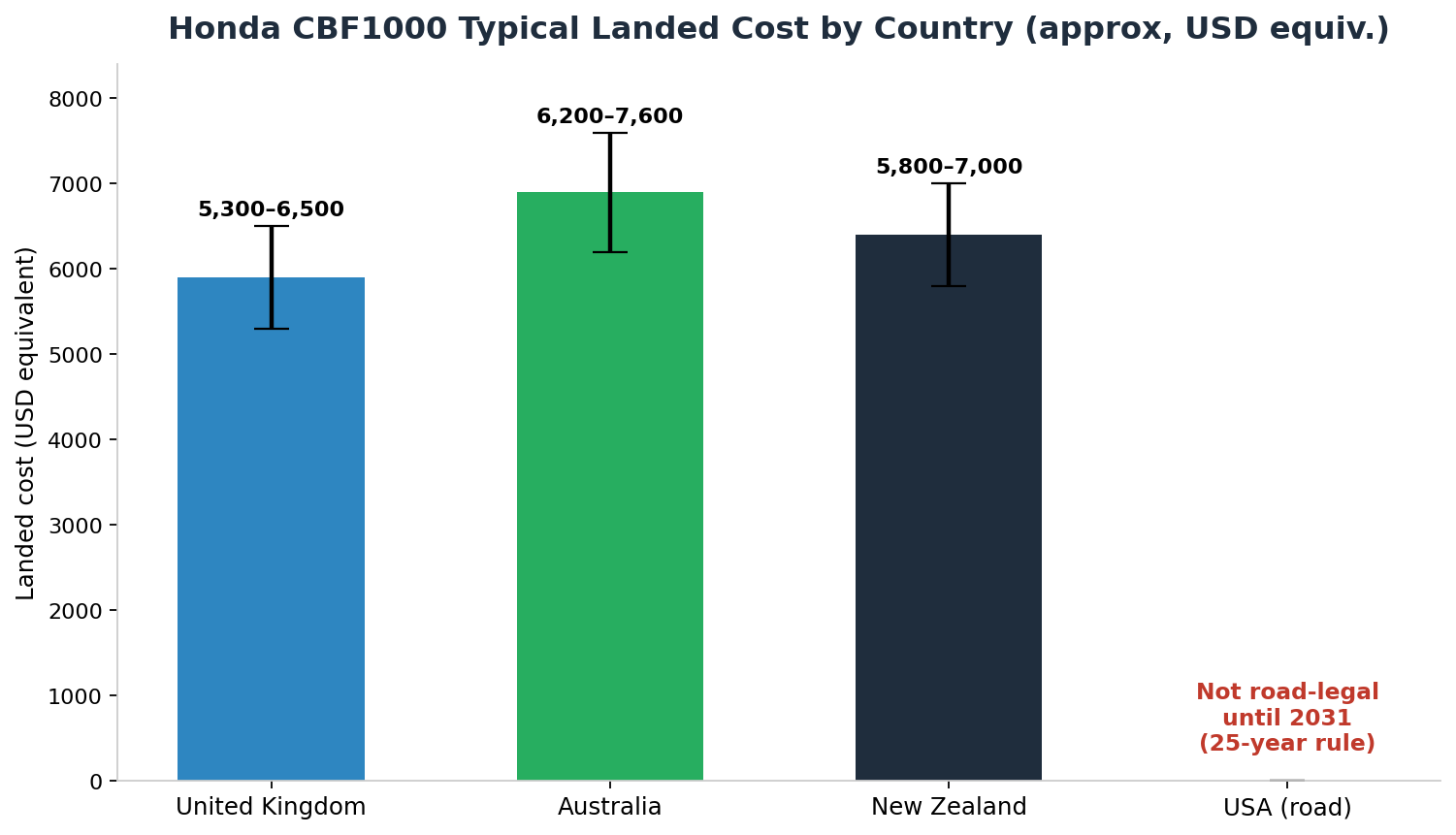
Across markets, expect a landed cost roughly in the 5,300 to 7,600 USD-equivalent range depending on freight distance, local taxes and compliance. Australia sits at the top end because of its approval and compliance regime; the UK sits at the bottom because the process is well-trodden and freight is short. The US column is empty on purpose — remember, no road-legal route until 2031. For a deeper cost model, our complete import cost breakdown shows how each line item is calculated.
The maths only breaks if you buy badly. Overpay for a high-mileage bike with a tired charging system and you eat the savings in repairs. Buy a clean, well-graded example and the CBF1000 is one of the best value litre bikes you can put in your garage.
How to read the auction sheet on a used CBF1000
Every bike in a Japanese auction gets an inspection sheet graded by a neutral inspector, and learning to read it is how you buy a good CBF1000 without ever seeing it in person. This is the single most important skill in the whole process.
Start with the overall grade. A grade of 4, 4.5 or 5 means a genuinely clean bike; 3.5 is usable but expect wear; anything at R or with an accident history (修復歴) needs a hard look and usually a pass. On the CBF specifically, cross-check the sheet's notes against the model's known weak points: look for any mention of electrical faults, warning lights, or a weak battery, because that is your charging-system canary. Confirm the mileage against the condition — a genuinely low-mileage Japanese CBF is common, but the numbers should match the wear on the pegs, grips and seat.
Check the diagram for scratches (A marks), dents (U marks) and corrosion, paying attention to the fork sliders and lower fairing. Verify it is the generation you want from the photos — twin pipes and silver engine for a Mk1, single pipe and black engine for a Mk2 — not from the listed year, for the reason we covered earlier. Our full auction sheet reading guide breaks down every symbol, and it is worth ten minutes before you bid on anything.
Do this properly and the auction system works in your favour: a neutral third party has already inspected the bike, so you are buying on documented condition, not a seller's optimism.
Running costs and maintenance
A CBF1000 is cheap to keep because it is a mature, over-engineered Honda four with a global parts supply. Servicing is conventional: oil and filter every 6,000 miles or so, valve clearances checked on the longer interval (they rarely need adjustment), and the usual chain, brake and tyre consumables. It runs happily on regular unleaded, which keeps fuel bills down.
The one line item to plan for is the charging system on higher-mileage or early bikes. Budget for the possibility of a regulator/rectifier or stator at some point — parts are inexpensive and the fix is well documented by the enthusiast community. A common owner upgrade is a MOSFET-type regulator/rectifier, which runs cooler and is more reliable than the original, and it is cheap insurance against the model's best-known weakness.
Tyres are a standard 120/70 front and 160/60 rear in common sizes, so you are not paying a premium for anything exotic. Insurance tends to be reasonable because the bike is not classed as a hooligan machine and has ABS. Overall, the CBF1000 costs about the same to run as a middleweight while giving you litre-bike ability — another reason the value equation is so lopsided in the buyer's favour.
Popular CBF1000 modifications and upgrades worth having
The CBF1000 responds well to a handful of sensible upgrades, and because the platform is cheap you can improve it meaningfully without spending superbike money. This is a section the thin competitor articles skip entirely.
MOSFET regulator/rectifier. The first upgrade any high-mileage CBF should get. It directly addresses the charging weakness and runs cooler than the stock unit. If you buy an early bike, budget for this before you budget for anything cosmetic.
Suspension refresh. The stock fork and shock are basic commuter spec. Fresh fork oil and a firmer spring, or an aftermarket rear shock, transform the ride for heavier riders and two-up touring. Because the base bike is so cheap, spending a little here gives you a genuinely capable sport-tourer.
Fuelling tune (Mk1). If you buy a Mk1 and the 5,000 rpm hesitation or the cold fluff bothers you, a Power Commander or a dyno tune smooths it out. Mk2 owners rarely need it.
Luggage. Honda's own panniers and top box bolt straight on, and the centrestand and adjustable screen already make it a natural tourer. A screen tweak or an aftermarket touring screen cuts buffeting for taller riders.
Comfort and ergonomics. Bar risers, a comfort seat and heated grips are the usual trio. Just wire the grips sensibly through a relay so you do not overload the generator — remember the electrical warning from the problems section.
Mileage, longevity and what a high-mile CBF1000 is worth
One question dominates the CBF1000 forums: how many miles is too many? The reassuring answer is that this engine barely notices six-figure mileages. It is a detuned Fireblade motor running well within itself, and well-maintained examples routinely sail past 60,000 miles with nothing more than routine servicing. Owners report 100,000-plus-mile bikes still running strong. Mileage alone should never scare you off a CBF1000.
What matters far more than the odometer is how the bike was treated. A 50,000-mile CBF with a full service history, fresh chain, healthy charging voltage and clean fork sliders is a better buy than a 15,000-mile example that sat outside for three winters with a flat battery and seized linkage bearings. Japanese auction bikes tend to fall into the good camp — mild climate, short commutes, careful owners and covered storage are the norm — which is exactly why the used stock coming out of Japan is worth importing in the first place.
On value, the CBF1000 depreciates gently because it started cheap and has a loyal owner base. A clean Mk2 holds its money better than the badge-obsessed market would suggest, and a well-kept, low-owner Japanese import with documented condition often commands a small premium over a tired local bike. In other words, buy a good one and you are not just saving money on the purchase — you are buying something that will not sting you when you sell it. That is a rare combination in the used litre-bike world, and it is the final piece of the case for importing a CBF1000 rather than settling for whatever happens to be on the local classifieds.
Who should buy a CBF1000, and who shouldn't
Buy one if you want a comfortable, reliable, do-everything litre bike for the least money possible; if you commute and tour and want one bike for both; if you are a returning or taller rider who values an upright, adjustable position; or if you simply refuse to overpay for a badge. The CBF1000 rewards the pragmatist.
Look elsewhere if you want a light, aggressive weapon for back-road heroics — the FZ1 or a proper naked suits you better; if low-speed weight worries you and you would prefer a middleweight; or if you are a US road rider who needs the bike legal before 2031, in which case you should either wait or choose something already 25 years old from our other import guides.
For most riders reading this, the CBF1000 lands squarely in the "buy one" column. It is the definition of a lot of motorcycle for not much money.
How AWA Auction helps you import a clean CBF1000
This is exactly the kind of bike our auction access is built for. AWA Auction plugs you directly into the Japanese used-bike auctions where clean, low-mileage CBF1000s appear every week, and we handle the parts that trip up first-time importers: reading and translating the auction sheet, bidding on your behalf, verifying condition against the CBF's known weak points, arranging export and shipping, and getting the bike to your port with the paperwork done right.
You tell us the generation and budget — a lowest-price Mk1 or a smoother Mk2 — and we filter the auctions, flag the charging-system and suspension checks on any candidate, and bid only on bikes that pass. No guesswork, no surprise repairs hidden behind an optimistic listing. Browse what is available now on our current listings, and when you are ready to talk specifics, get in touch with our team and we will build your CBF1000 import plan around a bike that is actually worth importing.
See Also
Share this article: