
If you want to import a Yamaha FZ1 from Japan, you are chasing one of the best-value litre bikes ever built: an R1 engine wrapped in an upright, all-day chassis, for the price of a tired 600. One YouTuber with 429,000 views called it "the best sleeper bike under $5,000," and he is not wrong. The FZ1 quietly does everything a superbike does, minus the wrist pain and the insurance premium.
Here's the thing nobody mentions on the classified listings: the FZ1 comes in two completely different generations that share almost nothing but a name and a 998cc displacement. Buy the wrong one, or the wrong year within the right one, and you either inherit a fuelling flat spot or a shock that is already garbage. This guide walks you through every generation, the exact years to avoid, what a Japanese-auction FZ1 really costs to land in your driveway, and how to read the auction sheet before you bid. By the end you'll know precisely which FZ1 to hunt and what to pay.
What Is the Yamaha FZ1 (and Why Import One From Japan)?
The Yamaha FZ1 is a naked/semi-faired sportbike built around a detuned YZF-R1 engine. Yamaha's pitch was simple: take the most exciting litre engine on the market, retune it for real-world midrange, bolt it into a comfortable upright frame, and sell it for thousands less than the superbike it came from. It worked. The FZ1 became the default "one bike for everything" for riders who had grown out of track-day crouches but still wanted 140-plus horsepower on tap.
In Europe it wears the Fazer name; in the US it was simply the FZ1. First-generation bikes were badged FZS1000 Fazer in Europe and FZ1 in the States, which is exactly the kind of naming mess that trips up first-time importers. More on that below.
So why import one from Japan instead of buying local? Three reasons. First, price and mileage: the Japanese domestic market is flooded with clean, low-kilometre FZ1s that were ridden gently and inspected obsessively. Second, condition: Japan's brutal shaken inspection regime and salt-free winters mean bikes rot far slower than UK or coastal Australian examples. Third, availability: certain colours and the naked FZ1-N in particular are far more common in Japan. For a broader primer, our guide on whether Japanese motorcycles are actually reliable covers why JDM bikes hold up.
Gen 1 vs Gen 2: The Two Very Different Yamaha FZ1s
This is the single most important thing to understand before you bid on a Yamaha FZ1 from Japan. There are two generations, and they ride like different motorcycles.
Gen 1 (2001–2005): FZS1000 Fazer
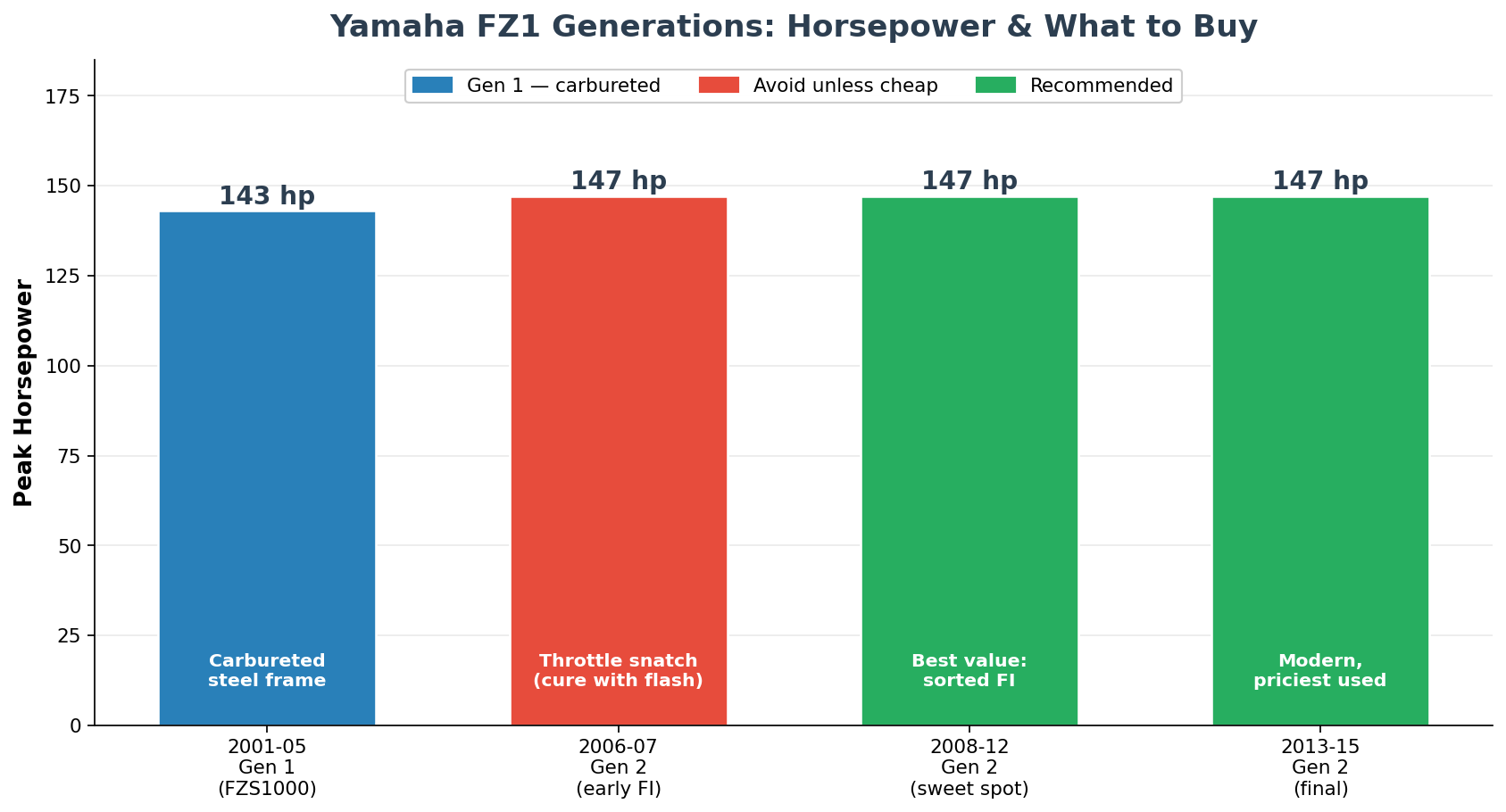
The original. A carbureted, 998cc five-valve-per-cylinder engine derived from the 1998–2001 YZF-R1, making 143 hp at 10,000 rpm and 78 lb-ft of torque at 7,500 rpm. It sits in a tubular steel frame with conventional right-way-up forks and a bigger fuel tank. The Gen 1 is softer, torquier down low, and — because it is carbureted — has beautifully linear throttle response with none of the abruptness that plagued the early fuel-injected bikes. Riders who have owned both often say the Gen 1 is the smoother, easier machine to ride fast on a real road.
Gen 2 (2006–2015): FZ1-N and FZ1-S Fazer
A ground-up redesign. The 2006 bike swapped to a 20-valve DOHC engine lifted from the 2004–2006 R1, retuned for midrange, making around 147 hp at 11,000 rpm. It gained a compact cast-aluminium diamond frame with the engine as a stressed member, upside-down forks, radial-mount brakes, and fuel injection. It is sharper, more modern, and revvier at the top — but the early fuel injection and a cheaper rear shock are the two things you must budget around. We'll get to that.
Quick tell: if it has a steel frame, carbs and conventional forks, it's a Gen 1. Aluminium frame, USD forks and fuel injection means Gen 2. On a Japanese auction listing, the frame code and year will confirm it instantly.
Yamaha FZ1 Years to Avoid (and the Sweet Spot)
Every FZ1 owner forum eventually arrives at the same conclusion, so let's save you the reading. The years to be careful with are 2006 and some 2007 Gen 2 bikes, purely because of throttle snatch. The early fuel injection opened the secondary throttle plates too fast between roughly 5,000 and 7,000 rpm, producing an abrupt on/off surge when you rolled the throttle hard. It is not a reliability problem — the engines are bulletproof — it is a rideability annoyance.
The good news: Yamaha fixed it from 2008 onward with a revised throttle-plate map, and on the earlier bikes a Power Commander or an Ivan's flash cures it completely. If you find a mint 2006 in Japan for the right money, factor a couple hundred dollars for a fuelling module and move on.
The sweet spot for a Gen 2 is 2008–2012: sorted fuelling, still modern, and cheap. For a Gen 1, any 2001–2005 example is a fine buy — the sweet spot there is simply the lowest-mileage, best-maintained bike you can find, because they were all mechanically similar. One owner on a 2008 bought new reported 115,000 km with nothing replaced except two ignition coils in ten years. That is the FZ1 in a sentence.
The R1 Engine, Detuned — What That Really Means
People hear "detuned R1" and picture a strangled, boring engine. Wrong. The FZ1 keeps the R1's bottom end and top end and simply re-profiles cams, intake and (on Gen 1) carburetion to shift the power lower. You still get an inline-four that pulls cleanly from 3,000 rpm and screams to five figures. What you lose is the last slice of peak horsepower you will never use on the road anyway.
The real-world result: a bike that will run with hyperbikes in a roll-on but is genuinely happy commuting at 4,000 rpm. One owner in the comments summed it up as "all the power with no gimmicks." Another put 50,000 km on his in a single year. If you have read our guides on the Suzuki Hayabusa or the Kawasaki ZX-14R, think of the FZ1 as the sensible, upright cousin that costs a third as much to buy and insure.
Maintenance is refreshingly normal. Valve clearances use shim-under-bucket adjustment on the standard R1-derived schedule, the engines tolerate hard use, and parts are cheap and everywhere because they are shared with millions of R1s and other Yamahas. This is not an exotic — it is a Yamaha you can actually live with.
And the character survives the detune completely. Crack the throttle open past 7,000 rpm and the FZ1 delivers that unmistakable Yamaha inline-four howl and a shove in the back that reminds you exactly what engine family it belongs to. The difference is that you can also short-shift it through traffic at 4,000 rpm all day without it feeling strangled. That dual personality — docile commuter one minute, snarling near-superbike the next — is the whole reason the FZ1 has such a loyal following, and it's why a clean imported example feels like far more motorcycle than the money suggests.
FZ1-N Naked vs FZ1-S Fazer: Which One to Import
From 2006, Yamaha sold the Gen 2 in two flavours, and Japan has plenty of both. The FZ1-N is the naked version — bare handlebar, exposed engine, streetfighter stance. The FZ1-S Fazer adds a half-fairing and a taller screen for genuine wind protection at motorway speeds. The US market largely got the naked FZ1; Europe and Japan got both.
Which to import comes down to how you ride. If you do long distances or a lot of open highway — very relevant if you're in Australia or New Zealand — the Fazer's fairing turns a 200 km blast from a wrestling match into a cruise. If you live in town, love the muscular naked look, and prefer a lower price, the FZ1-N is your bike. Both use the identical engine and frame, so there is no performance penalty either way. Naked bikes generally import slightly cheaper simply because they are more common.
Yamaha FZ1 vs the Rivals: Z1000, Bandit 1250, CB1000R
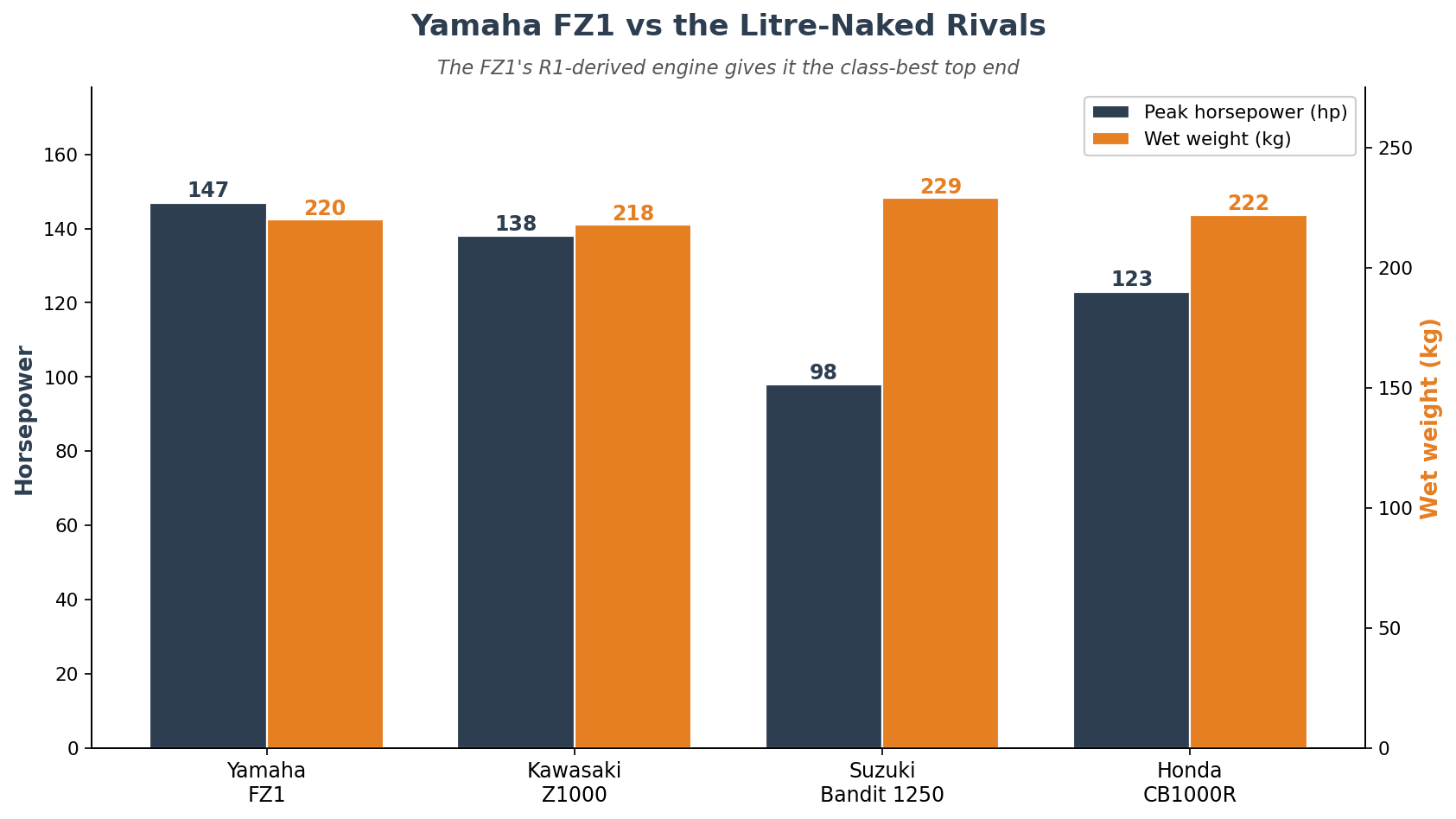
The FZ1 lives in the litre-naked class, and Japanese auctions are full of its rivals too. Here's how it stacks up so you can decide what to actually bid on.
The Kawasaki Z1000 is the styling statement — more aggressive, a torquier 953cc/1043cc four, but firmer and less practical for two-up touring. The Suzuki Bandit 1250 is the budget torque king: an oil-cooled (later liquid-cooled) big four that makes its grunt down low, comfortable and cheap, but heavier and softer than the FZ1. The Honda CB1000R is the premium option — beautiful single-sided swingarm, sharp handling, but pricier and down on outright top-end.
The FZ1's trump card is the R1 engine. Nothing else in the class has genuine superbike top-end lurking under an upright riding position. In head-to-head magazine tests — including MCN's multi-bike Fazer comparisons that have racked up hundreds of thousands of views — the FZ1 consistently reads as the sportiest all-rounder of the group. If you want the most bike-per-yen, it's hard to beat.
The 25-Year Rule and Why 2001 FZ1s Matter Right Now
If you're importing to the United States, timing just became interesting. Under NHTSA's 49 CFR § 591.5(i) exemption and the EPA's age-based exclusion, any motorcycle 25 or more years old clears customs free of the usual FMVSS and emissions requirements. That means the 2001 Yamaha FZS1000 Fazer becomes eligible in 2026 — the first FZ1s are hitting the 25-year window this year.
One caveat that trips people up: it's the actual manufacture date that counts, not the model year on the badge. A "2001" bike built in late 2000 qualifies early in 2026; one assembled in early 2001 waits a few more months. Check the frame's build date, not the sales year. Our full walkthrough on importing a motorcycle from Japan to the USA covers the HS-7 and EPA 3520-1 paperwork step by step.
Outside the US the rules are friendlier and age-independent. The UK uses NOVA notification plus IVA/MSVA where required and charges import duty and VAT — see our UK import duty and tax guide. Australia requires an import approval and asbestos assurance; New Zealand needs compliance and a border inspection. In all three, a clean Gen 2 FZ1 can be imported at essentially any age, which is why so many UK and Aussie FZ1s already came from Japan.
What It Costs to Import a Yamaha FZ1 From Japan
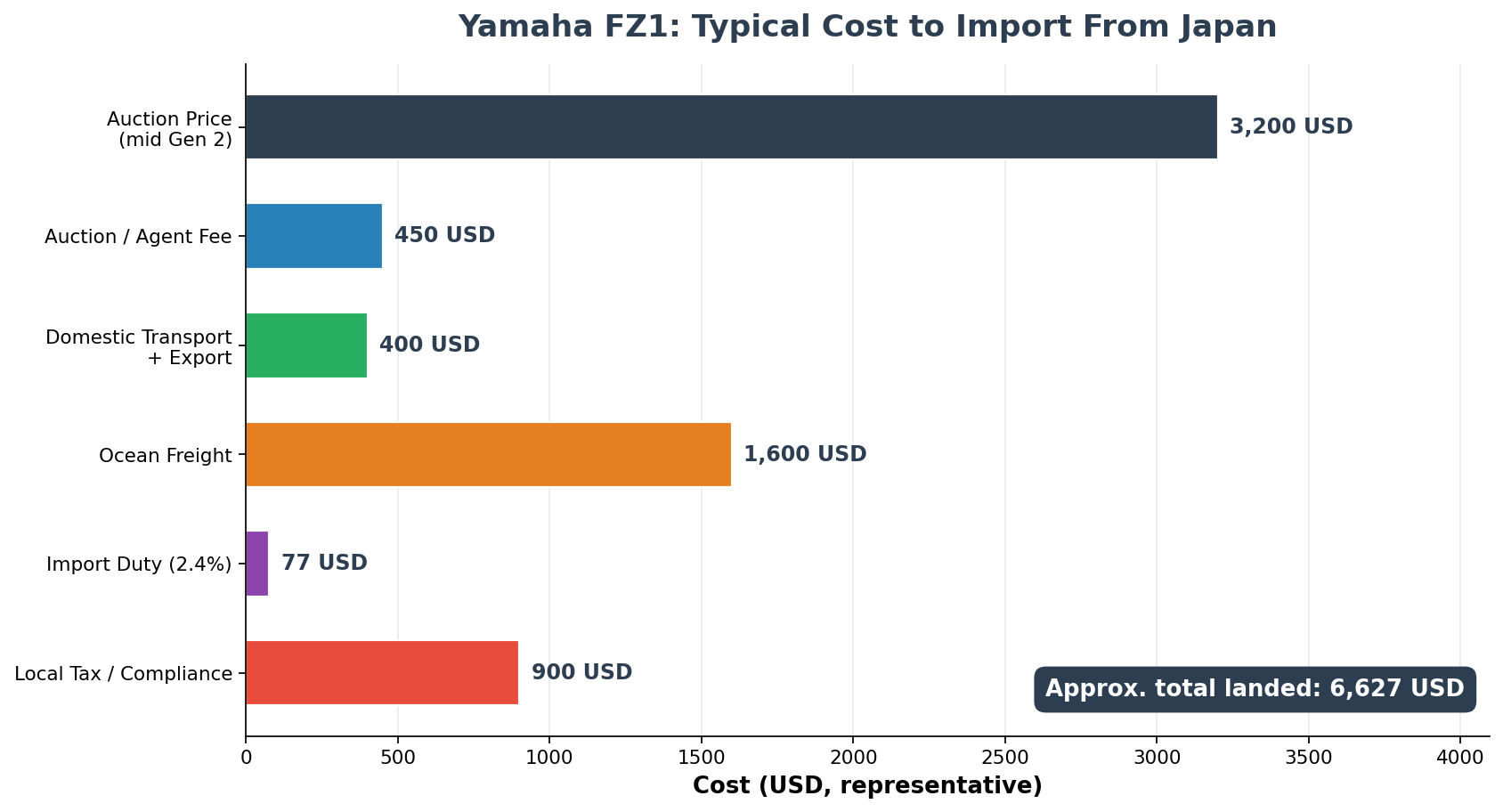
Let's talk real numbers. An FZ1 is not a rare unicorn, so the auction hammer price stays sane — clean Gen 1 bikes trade in Japan for roughly the equivalent of 1,800 to 3,000 US dollars, and good Gen 2 examples for 2,500 to 4,500 depending on year, mileage and whether it's the faired Fazer. On top of the hammer price you add the layers most first-timers forget.
Here's the typical stack on a mid-priced FZ1: the auction price itself, an auction/agent fee, domestic transport to the port, ocean freight (usually crated or RoRo), then destination-side customs duty, tax, and compliance or inspection costs. US duty on motorcycles runs about 2.4% of value; shipping alone typically lands between 1,000 and 2,500 dollars depending on method and port. The chart above breaks down a representative example.
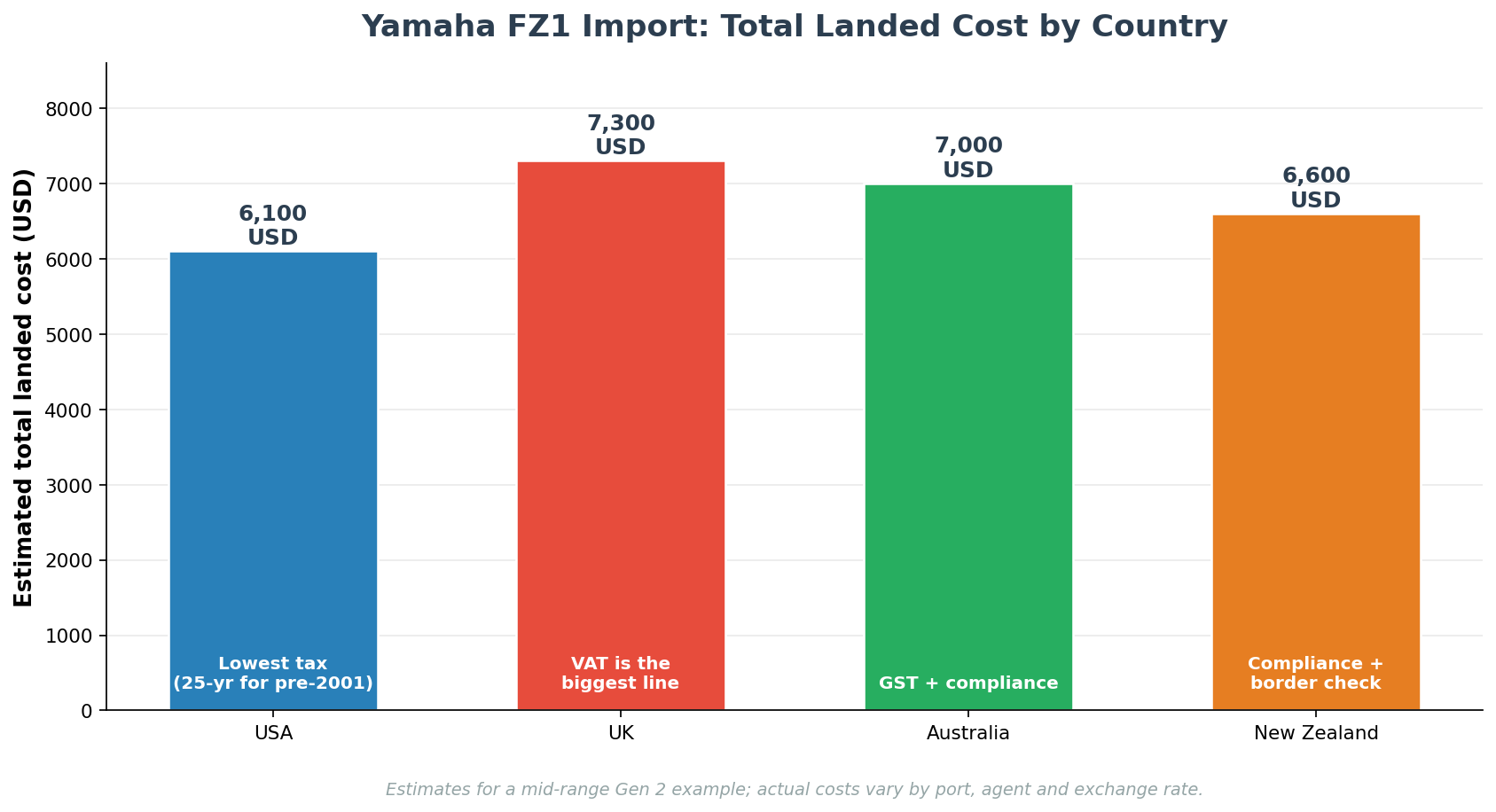
Total landed cost varies most by destination, because that's where duty and tax structures diverge hardest. The UK's VAT is the single biggest line item for British buyers; Australia and New Zealand add GST and compliance; the US stays cheapest on tax but you're waiting for the 25-year clock on newer bikes. Budget realistically and an imported FZ1 still undercuts a comparable local bike while giving you a cleaner, lower-mileage example. As one Spanish owner put it, it's all about "smiles per thousand euros."
Reading the Auction Sheet on a Yamaha FZ1
Every bike at a Japanese auction gets an inspection sheet with an overall grade and a map of every scratch, dent and rust spot. This is your single best tool for buying an FZ1 you've never seen. Grades run from 6 (nearly new) down through 5, 4.5, 4, 3.5 and lower, plus letter codes for the cosmetic and mechanical condition. Aim for grade 4 or above on an FZ1 — anything lower usually means cosmetic damage or a hard life.
On an FZ1 specifically, watch the sheet for notes about the exhaust (many were fitted with slip-ons like FMF or Akrapovic — fine, but confirm the original is included if you care), fork condition, and any crash indicators on the bar ends and engine cases. The naked FZ1-N shows drop damage more obviously than the faired Fazer. Our detailed guide to reading Japanese auction inspection sheets decodes every symbol so you're never guessing.
One more FZ1-specific tip: pay attention to the odometer note and cross-check it against the general wear the sheet describes. A bike claiming 15,000 kilometres but graded down for worn grips, a scuffed seat and pitted fork legs is telling you a story the number doesn't. Japanese auction inspectors are famously honest, so when the written condition and the mileage disagree, believe the condition. On a sporty inline-four that begs to be revved, an honest 40,000-kilometre bike with a clean, documented history is a far safer bet than a suspiciously low-mileage example with mismatched wear. This is the whole advantage of buying from Japan: the paperwork actually tells the truth.
Known Problems and Pre-Purchase Checklist
The FZ1 is one of the most reliable big bikes you can import, but "reliable" isn't "perfect." Here's what to actually check.
Gen 2 rear shock
The stock Gen 2 shock is a non-rebuildable budget unit that goes soft and bouncy with age and miles. It's the FZ1's one genuine weak point. Owners routinely upgrade to a Öhlins or Wilbers unit. On a high-mileage import, assume you'll replace it and negotiate accordingly.
Early fuel injection (2006–2007)
Throttle snatch, as covered above. Cheap to cure, but know it's there before you bid.
Ignition coils
A handful of owners report coil failures over very high mileages — one replaced two coils across 115,000 km. Cheap parts, easy job, not a dealbreaker.
Charging system and battery
Like most bikes that sit between rides, imported FZ1s occasionally arrive with a tired battery after weeks in a shipping container. That's normal and cheap to fix. What you want to confirm is that the regulator/rectifier and stator are healthy — check for clean, steady charging voltage on a test ride, and treat a bike that struggles to hold charge as a negotiating point rather than a dealbreaker.
General checks
Confirm the valve service history (the R1-derived engine wants periodic shim checks), look for chain and sprocket wear, check the rotors on high-mileage bikes, and verify the bike hasn't been thrashed as a track weapon — plenty were. A clean Japanese auction bike with a grade 4 sheet and full service stamps is exactly what you want.
How AWA Auction Helps You Import a Yamaha FZ1
Bidding at a Japanese motorcycle auction from overseas is not something you do with a credit card and a prayer. You need access to the auction halls, someone to translate and verify the inspection sheet, and a logistics chain that gets the bike crated, shipped and delivered without nasty surprises. That's the entire point of AWA Auction.
We give you direct access to the same Japanese auctions the domestic dealers use, translate and interpret every auction sheet so you know exactly what you're bidding on, handle export paperwork and shipping to your country, and keep you updated at every step. Whether you want a carbureted Gen 1 Fazer or a low-mileage 2010 FZ1-N, we help you find the right one and land it for the right price.
Ready to start? Browse the bikes we currently have available or contact our team to set up a search for the exact FZ1 spec you want. For a wider view of the process, our guide on how to bid on a Japanese motorcycle auction is the perfect next read.
The bottom line: an imported Yamaha FZ1 gives you superbike-derived performance, everyday usability and modern-classic upside, all for the price of an ordinary used middleweight. Do the homework in this guide, buy on condition and grade rather than chasing the cheapest listing, and you'll end up with a bike you keep for a decade instead of a season. That's exactly what the FZ1's owners keep telling anyone who'll listen.
Is the Yamaha FZ1 a Good Bike to Own Day to Day?
Spec sheets sell bikes; ownership keeps them. And on the ownership front the FZ1 is quietly outstanding. The riding position is the star of the show — upright bars, sensible pegs, a seat you can spend a full day on. Reviewers repeatedly single out the ergonomics as the reason riders keep the FZ1 for a decade instead of flipping it after a season. One long-term owner made a point that most reviews skip the rider triangle entirely, and praised the FZ1 for finally letting a tall rider stretch out.
The comment sections back this up better than any brochure. "Best bike I ever owned, still riding it at 56." "I have the 2007 — very comfortable for everything: commuting, group spirited riding, and comfort." A rider who traded up from a Kawasaki Versys called the swap "insane" in the best possible way. Another found a 2015 still in its factory crate in 2016, bought it, and put 38,000 miles on it. These are not people describing a bike they tolerate; they're describing a bike they can't stop riding.
Fuel range is honest — the Gen 1's larger tank is genuinely useful, and both generations will happily see 150 to 180 miles between fills at a sane pace. Two-up capability is real thanks to the upright ergonomics and torque. And because the engine is unburstable, the running costs are dominated by consumables rather than repairs. For a bike making superbike power, that combination is rare. If you're weighing categories, our overview of Japanese motorcycle reliability puts the FZ1 in context against the rest of the field.
The FZ1 Tuning and Mod Scene
Because the FZ1 shares its heart with the R1, it plugs straight into one of the largest aftermarket ecosystems in motorcycling. If you want to personalise or wake up an imported FZ1, the parts are cheap, plentiful and well-documented. This matters when you're buying from Japan, because many JDM bikes already wear tasteful upgrades.
The three most common mods you'll see on auction FZ1s are a slip-on or full exhaust (FMF, Akrapovic and Yoshimura all appear regularly), a fuelling module or ECU flash to cure the early Gen 2 throttle snatch and unlock a little more midrange, and a suspension upgrade — usually a rebuildable rear shock and revalved forks to fix the Gen 2's soft factory setup. One owner mentioned running an FMF Apex slip-on at 27,000 miles and loving it; another's father had a fully tuned FZ1 making 152 rear-wheel horsepower. That's the ceiling if you chase it, but a stock, well-sorted bike is already plenty.
The lesson for importers: a modified FZ1 isn't automatically a red flag the way a modified exotic would be. Tasteful, common mods on an FZ1 often mean an enthusiast owner who cared. Just confirm on the auction sheet whether the original exhaust and parts are included, because emissions and registration rules in some destinations — California's CARB standards are the classic example — care about what's actually bolted on.
Which FZ1 Should You Import? A Straight Answer
Enough hedging — here's the decision tree. If you want the smoothest, most characterful ride and you value carbureted simplicity (and, for US buyers, the 25-year exemption that's opening up right now), hunt a Gen 1 FZS1000 Fazer from 2001–2005. It's the connoisseur's pick and increasingly a modern classic.
If you want the more modern, sharper, fuel-injected bike with better brakes and don't mind newer, chase a 2008–2012 Gen 2 and budget for a shock upgrade eventually. Choose the naked FZ1-N for city riding and looks, or the FZ1-S Fazer for touring and weather protection. Avoid paying a premium for a 2006–2007 unless it's mint and cheap, and always factor the fuelling fix.
Whichever you pick, the winning move is the same: buy the cleanest, best-documented, lowest-mileage example you can find on a grade 4-or-better auction sheet. On a bike this mechanically robust, condition and history matter far more than the exact year. A tidy Japanese-market FZ1 will outlast and outvalue a cheaper, rougher local bike every time.
What Happens After Your FZ1 Lands
Getting the bike to port is only two-thirds of the job. Once your FZ1 arrives, there's a short checklist that separates a smooth first ride from a frustrating month of paperwork. First, clear customs with the correct forms — in the US that's the HS-7 and EPA 3520-1; elsewhere it's your local import approval and compliance documentation. Keep every document from the Japanese side, especially the export certificate and deregistration paperwork, because your local registration authority will want them.
Next, register and title the bike. This is where destination rules bite: some US states demand their own emissions or safety inspection regardless of the federal 25-year exemption, the UK needs its NOVA reference before you can tax it, and Australia and New Zealand require compliance sign-off. Build a week or two of buffer into your plans for this.
Finally, give the bike a proper recommissioning service before you lean on it — fresh oil and filter, new brake fluid, a chain and sprocket inspection, coolant, and a valve-clearance check if the history is unclear. A Japanese import has usually been sitting through shipping, so treat the first service as non-negotiable. Do that, and you've got a superbike-engined all-rounder that'll run for another hundred thousand kilometres. Our country guides — from the USA to the UK, Australia and New Zealand — cover each destination's exact steps.
A Short History of the Yamaha FZ1: How Yamaha Built an All-Rounder Legend
To understand why the FZ1 is such a smart import today, it helps to know where it came from. In 2001 Yamaha faced a simple question: what do you build for the rider who loved the R1 but couldn't live with it? The R1 had rewritten the superbike rulebook in 1998, but its committed riding position and peaky delivery made it punishing as an everyday bike. Yamaha's answer was the FZS1000 Fazer — R1 engine, real-world tune, upright frame. It was an instant hit, especially in Europe, where the Fazer name became shorthand for "sensible fast bike."
For five years the Gen 1 built a devoted following. Then in 2006 Yamaha did something braver than a facelift: it threw the bike away and started again. The second-generation FZ1 borrowed the newer 2004–2006 R1's short-stroke, fuel-injected, aluminium-framed platform, sharpening the whole package into something closer to a sports bike wearing streetfighter clothes. Yamaha split it into the naked FZ1-N and faired FZ1-S Fazer to cover both the city crowd and the mile-eaters.
The FZ1 stayed in production through 2015, quietly outlasting flashier rivals because it did the one thing they couldn't: everything, competently, for years, without drama. When Yamaha finally retired it, the model had cemented a reputation as one of the great all-rounders — which is precisely why clean used examples remain in such demand, and why importing a well-kept one from Japan makes so much sense in 2026.
Common Mistakes When Importing a Yamaha FZ1 (and How to Avoid Them)
Here's the stuff that catches first-time importers, learned the expensive way so you don't have to.
Confusing the two generations
People see "FZ1" on a listing and assume they're all the same. They are not. Buying a Gen 1 when you wanted the modern fuel-injected Gen 2 — or vice versa — is the number-one regret. Confirm the frame code, year, and whether it's carbureted or injected before you bid. A steel frame with carbs is Gen 1; aluminium with USD forks is Gen 2.
Ignoring the manufacture date on US imports
The 25-year rule runs off the build date, not the model year. Bidding on a "2001" FZ1 that was actually assembled in early 2001 and expecting it to clear US customs in January 2026 will leave you storing a bike you can't register. Always verify the exact manufacture month.
Overlooking the rear shock on high-mileage Gen 2s
The soft, non-rebuildable factory shock is a known FZ1 weak point. On a 40,000-kilometre import it's almost certainly tired. Budget for a replacement and negotiate the price with that in mind rather than discovering it on your first spirited ride.
Skipping the auction sheet translation
The inspection sheet is written in Japanese with a dense grid of codes. Guessing at it — or trusting a seller's summary — is how people end up with a graded-down crash bike. Have the sheet professionally translated and interpreted every single time. On sporty bikes like the FZ1 that were often ridden hard, this step pays for itself instantly.
Underbudgeting the landed cost
The hammer price is the beginning, not the end. Shipping, agent fees, duty, tax and compliance stack up fast, and a rider who only planned for the auction price gets an unpleasant surprise at the port. Use the cost breakdown above, add a buffer, and you'll never be caught out.
Yamaha FZ1 Price Guide: What to Pay for a Japanese Import in 2026
Money talk, generation by generation, so you walk into an auction with a number in your head instead of getting swept up in a bidding war.
Gen 1 FZS1000 Fazer (2001–2005)
These are the value play. Clean Japanese-market Gen 1 bikes hammer for roughly 1,800 to 3,000 US dollars, with the very best low-mileage, unmodified examples nudging the top of that range. Because the earliest years are entering modern-classic territory and hitting the US 25-year window, prices on the tidiest bikes have started firming up rather than falling. If you find a grade 4.5 or 5 Gen 1 with genuine low kilometres and full stamps, it's worth stretching for — those don't get cheaper from here.
Gen 2 FZ1-N and FZ1-S Fazer (2006–2015)
The modern bikes cost more but give you fuel injection, better brakes and a newer chassis. Budget 2,500 to 4,500 US dollars at the Japanese hammer, with the faired FZ1-S Fazer and the later, more sought-after 2012–2015 bikes sitting at the upper end. The 2006–2007 throttle-snatch years are the cheapest way into a Gen 2 if you're happy to fit a fuelling module. Mid-range 2008–2011 bikes are the sweet spot for value against condition.
What actually moves the price
Three things swing an FZ1's value more than the year: mileage, auction grade and originality. A low-kilometre grade 5 bike commands a real premium and deserves it. Modifications cut both ways — a tasteful exhaust and suspension upgrade from a caring owner can be a bonus, but heavy track-focused mods or missing original parts drag the value down and can complicate registration in strict-emissions destinations. When you add shipping, duty and tax on top, a well-bought FZ1 still lands cheaper than an equivalent-condition local bike, which is the whole reason importing one makes sense. Compare that maths against buying at home using our guide on how Japanese motorcycle auctions work.
Frequently Asked Questions
Is the Yamaha FZ1 reliable enough to import from Japan?
Yes. The FZ1 is one of the most reliable litre bikes ever made. Owners routinely report 100,000-plus kilometres with only consumables and the odd ignition coil replaced. A clean, well-maintained Japanese-auction example is an excellent long-term buy.
What are the worst years for the Yamaha FZ1?
The 2006 and some 2007 Gen 2 bikes had abrupt fuel injection (throttle snatch) between 5,000 and 7,000 rpm. It's not a reliability issue and a Power Commander or ECU flash cures it, but factor that fix into your budget or buy a 2008-or-later Gen 2.
Gen 1 or Gen 2 FZ1 — which is better to import?
Gen 1 (2001–2005) is carbureted, smoother and simpler, and its earliest years are now hitting the US 25-year rule. Gen 2 (2006–2015) is fuel-injected, sharper and more modern but needs a rear-shock upgrade in time. Both are great; pick based on your riding and destination rules.
Can I import a 2001 Yamaha FZ1 into the USA in 2026?
Yes, once the specific bike is 25 years old by its manufacture date, not just its model year. NHTSA and EPA exemptions then let it clear customs without meeting FMVSS or emissions standards. Verify the frame build date before you bid.
How much does it cost to import an FZ1 from Japan?
Expect a Japanese hammer price of roughly 1,800–4,500 US dollars depending on generation and condition, plus 1,000–2,500 in shipping, plus destination duty and tax. Total landed cost still usually undercuts a comparable clean local bike.
What's the difference between FZ1-N and FZ1-S Fazer?
The FZ1-N is the naked version; the FZ1-S Fazer adds a half-fairing and taller screen for wind protection. They share the same engine and frame, so it's purely a comfort-versus-looks choice. Nakeds tend to import slightly cheaper.
Is the FZ1 really a detuned R1?
Yes. It uses the R1's engine architecture retuned for midrange rather than peak power. Gen 1 borrows the 1998–2001 five-valve R1 engine; Gen 2 uses the 2004–2006 20-valve R1 engine. You keep the superbike character with more usable, road-friendly delivery.
What auction grade should I look for on an FZ1?
Aim for grade 4 or higher. That indicates a clean, honest bike with only minor cosmetic wear. Lower grades can hide crash damage or hard track use, which is common on sporty bikes like the FZ1, so read the sheet carefully.
Do I need an agent to import an FZ1 from Japan?
Effectively yes. Overseas buyers can't bid directly at Japanese auctions, and you need someone to verify the inspection sheet, handle export paperwork and arrange shipping. That's exactly what AWA Auction does end to end.
See Also
Share this article: