
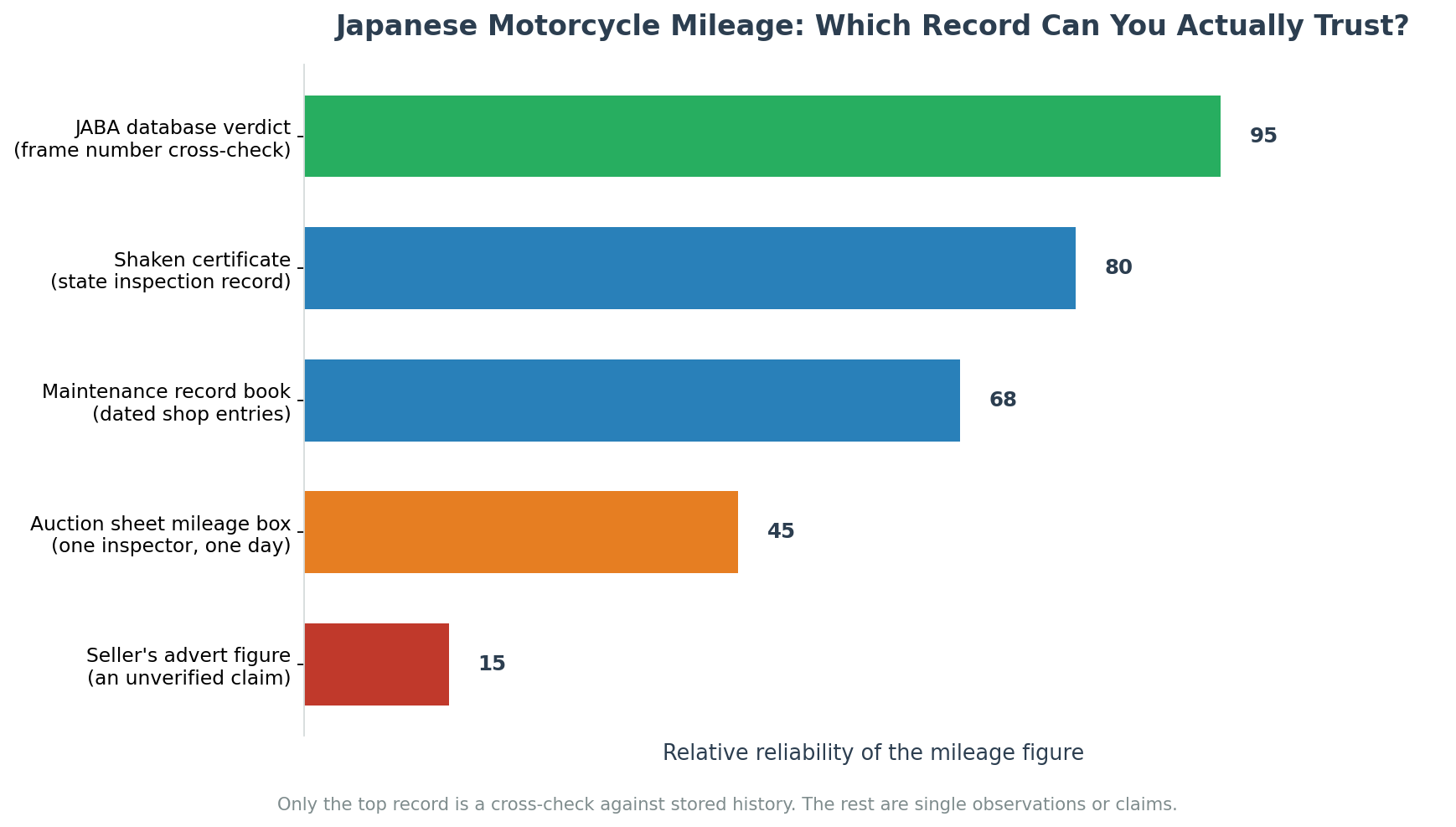
Japanese motorcycle mileage is the number every importer fixates on and almost nobody can actually verify. You scroll a listing, you see 12,400 km on a 2003 bike, you do the arithmetic in your head, and you decide the machine has barely been ridden. Then you wire the money.
Here is the thing nobody mentions: that figure came from one inspector, glancing at one dial, on one morning, and writing a number in a box. It is not verified. It is not cross-checked against anything before it reaches your screen. And in the country the bike is leaving, there exists a national database that could tell you within seconds whether that number has ever been wound back — a database that the English-speaking import world has, as far as we can find, never written about.
This guide is about that database, the four verdicts it returns, how a foreign buyer gets access to it for about ¥1,100, and what to do on the many bikes it cannot see. It is also about the four separate paper records that carry a mileage figure on a Japanese motorcycle, why they routinely disagree with each other, and which one you should trust when they do.
By the end you will be able to look at a Japanese auction listing and say something more useful than "low miles, must be good."
What Japanese motorcycle mileage actually means on a Japanese-market bike
Start with the unit. Japanese domestic bikes read in kilometres. Every one of them. If a UK or US seller quotes you a mileage figure in miles for a bike that has never left Japan, they have converted it, and conversion is where the first errors creep in — 12,400 km becomes "7,705 miles," which becomes "about 7,700," which becomes "under 8k" in the ad. Nothing dishonest happened. The number just got softer at every step.
Second, understand what the odometer physically is. On bikes built through the late 1990s you are usually looking at a mechanical drum odometer with five digits, sometimes four. A five-digit drum rolls over at 99,999 km and starts again at zero. A four-digit one rolls over at 9,999. That is not fraud, that is arithmetic, and on a 1993 commuter bike it has probably happened at least once. Digital dashes arrived on Japanese bikes through the 2000s and generally carry six digits, which removes the rollover problem and introduces a different one: a digital cluster can be swapped in five minutes with a screwdriver and a second-hand part.
Third — and this is the part that reframes everything — Japan records motorcycle mileage in four different places, run by four different organisations, for four different reasons. None of them talks to the others automatically. Your job as a buyer is to collect as many of the four as you can and see whether they line up.
Those four records are the auction sheet, the shaken certificate, the maintenance record book, and the export deregistration certificate. We will take them one at a time later on. But first, the database.
Japan has a national odometer database for motorcycles — and it is not the one you have read about
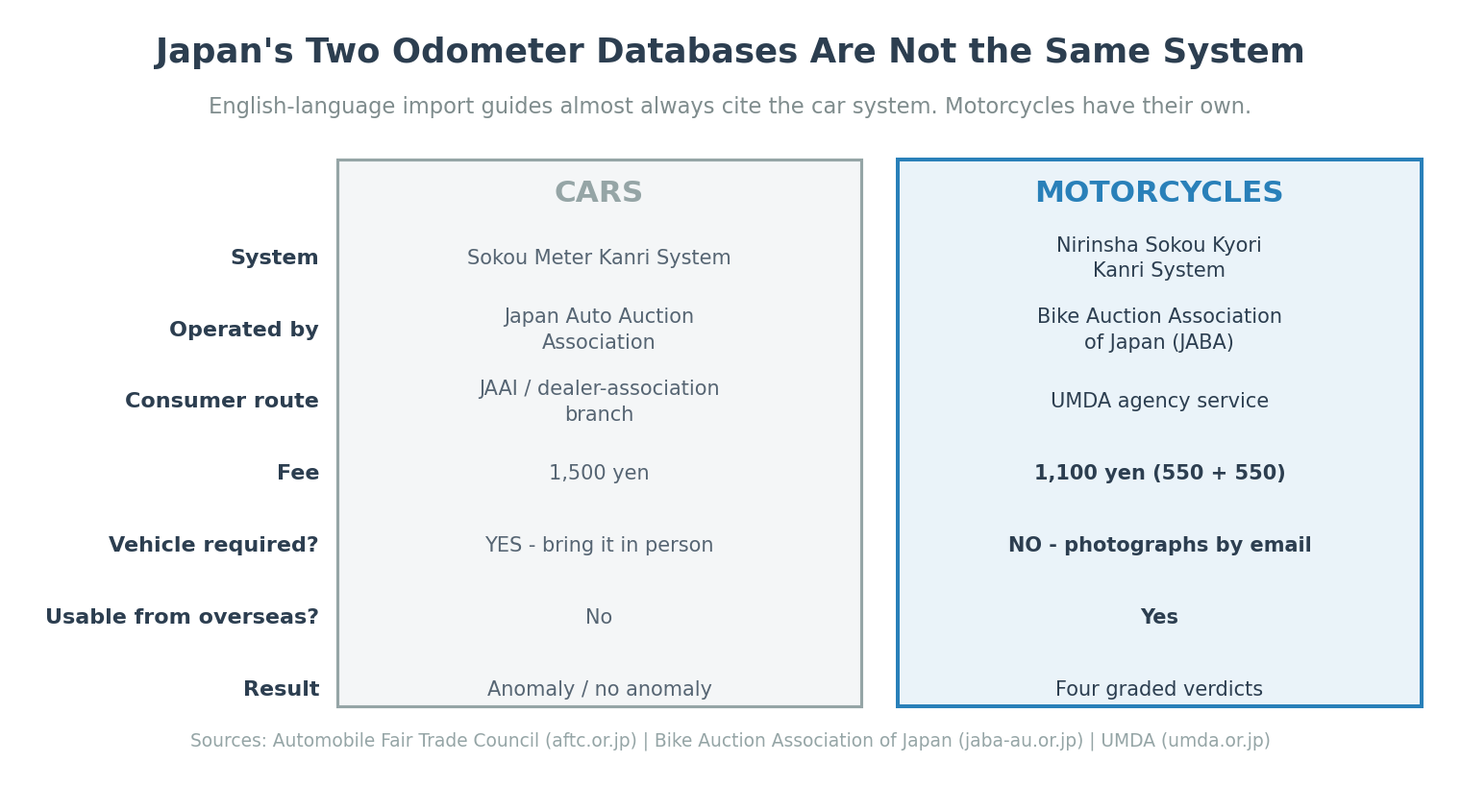
Search in English for how to check a Japanese vehicle's odometer history and you will land, every time, on the same answer: Japan's "Odometer Management System," run by the Japan Auto Auction Association. Import forums cite it. Vehicle-history resellers cite it. It is real, it works, and here is the problem.
It is for cars.
The system those English pages are describing is the Sōkō Meter Kanri System (走行メーター管理システム), operated by the Japan Auto Auction Association and made available to consumers through the Automobile Fair Trade Council. A member of the public can have a used car checked against it at a Japan Automobile Appraisal Association branch or a used-car dealers' association branch. The fee is ¥1,500. And there is a condition attached that ends the conversation for anyone reading this in Bristol or Brisbane: you have to physically bring the vehicle in. The council's own page says so plainly — 現車を持ち込む必要があります, "it is necessary to bring the actual vehicle."
So the widely-cited system is a car system that requires the car to be standing in front of a Japanese office. Useless to you twice over.
Motorcycles have their own, entirely separate system. It is called the Nirinsha Sōkō Kyori Kanri System (二輪車走行距離管理システム) — the Two-Wheeler Odometer Management System — and it is operated by the Bike Auction Association of Japan (JABA), a body headquartered in Hirakawachō, Chiyoda-ku, Tokyo. It accumulates the odometer reading of every motorcycle that passes through a JABA-member auction, every time it passes through, and stores it against the frame number.
Then it offers a lookup service on top: the 走行距離確認サービス, the Odometer Verification Service. You enter two things — the frame number and the odometer reading — and it compares your figure against everything the system has ever recorded for that frame. It runs 24 hours a day, 365 days a year, from a phone or a laptop, and the result prints to a PDF.
This is precisely the tool an importer needs. It is keyed on the frame number, which you can read off the headstock in a photo. It needs no vehicle present, no attendance, no Japanese address. And virtually no one buying a Japanese bike from overseas knows it exists.
The four verdicts JABA returns, and what each one is really telling you
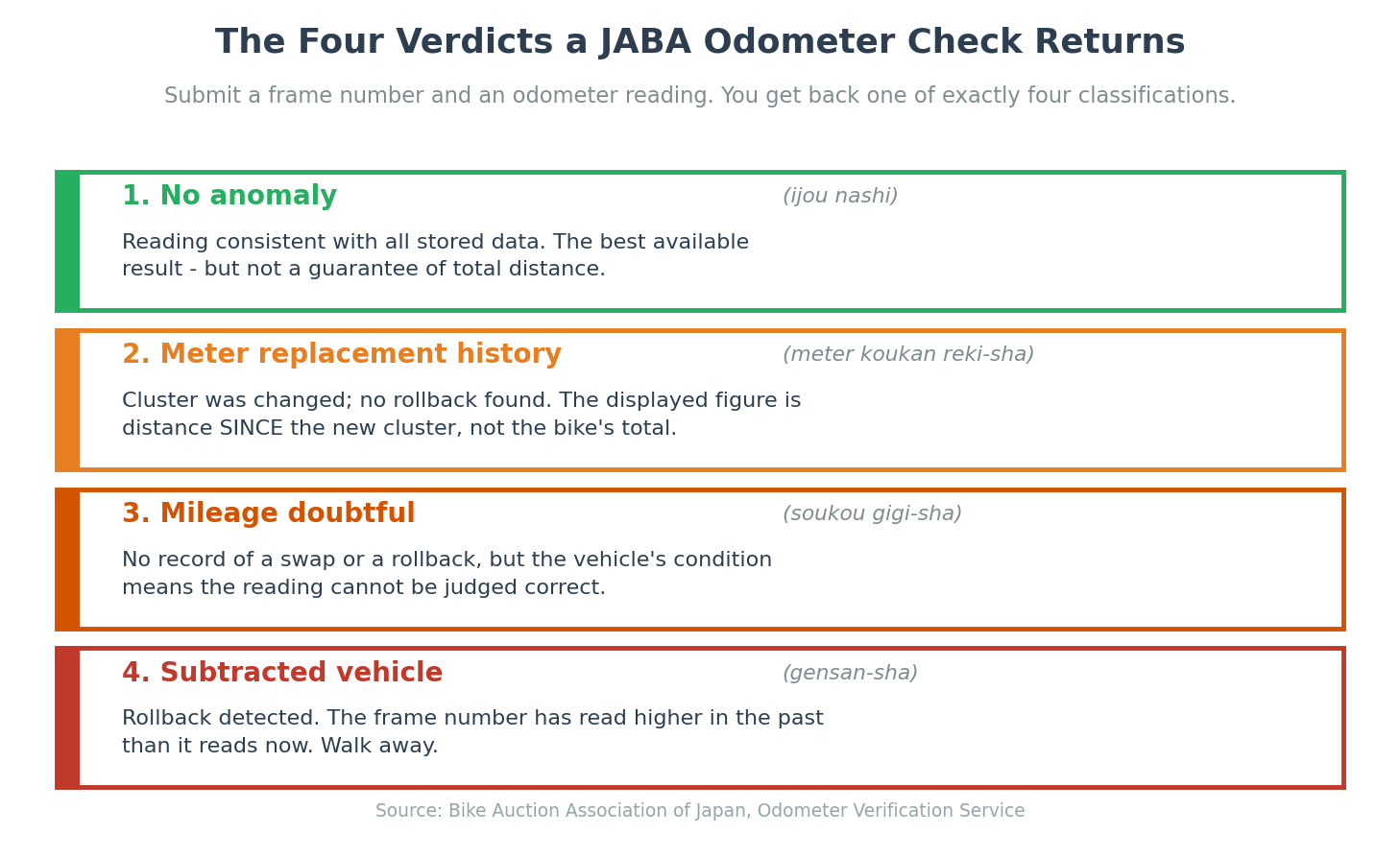
The service does not hand back a mileage history. It hands back a classification — one of exactly four, defined by JABA as follows.
1. 異常なし — "No anomaly"
The reading you submitted is consistent with everything the system holds. No rollback, no meter swap on record. This is the result you want, and it is worth being precise about what it means: it means no contradiction was found in the data JABA holds. It does not certify the total distance. JABA says so explicitly in its own disclaimer — the result "does not guarantee the vehicle's cumulative distance or condition."
2. メーター交換歴車 — "Meter replacement history"
The instrument cluster has been changed at some point, but no rollback was detected. This is the verdict that separates informed buyers from the rest. A replaced meter is not automatically sinister — clusters fail, crash damage takes them out, a stolen-recovered bike gets a new dash. What it means is that the number on the face is not the bike's total distance. It is the distance since the new cluster was fitted. If you get this verdict, the displayed figure and the machine's actual life are two different quantities, and no one can tell you the gap.
3. 走行疑義車 — "Mileage doubtful"
This is the most interesting category and the hardest to translate. JABA's definition: there is no record of a meter replacement and no record of a rollback, but the condition of the vehicle means the displayed figure cannot be judged correct. In other words, a human inspector looked at a bike showing 18,000 km, looked at the chain, the pegs, the seat, the fork stanchions, and flagged it. The paperwork is clean. The machine disagrees with the paperwork.
Take that verdict seriously. It is the one where a professional who handles hundreds of bikes a week has effectively said "I don't believe it," and it is exactly the judgement you cannot make from photographs.
4. 減算車 — "Subtracted vehicle"
Literal rollback. The system has seen this frame number read higher than it reads now. Walk away. There is no benign explanation for a number that goes down, and a seller who fitted a wound-back meter did not stop there.
How a foreign buyer actually gets a JABA check done
Now the practical part, because JABA does not sell to you directly.
Direct access to the Odometer Verification Service is restricted to the Japanese motorcycle trade, and the bar is high. JABA's published requirements: you must be a member of one of nine named auction venues; you must hold a koburōshō kyokashō, the secondhand goods dealer licence issued by the prefectural police; your main business must be buying and selling motorcycles and you must operate from business premises; you must submit a written application and pass a review; and you must certify that neither you nor your officers or staff are members of organised crime. Pricing is a monthly base fee plus per-lookup metering across five plans, A to E.
You are not getting through that door. You do not need to.
A second organisation exists precisely to bridge the gap. The Used Motorcycle Distribution Association (UMDA, 中古二輪自動車流通協会) runs the same JABA lookup as an agency service for ordinary consumers. Their published process:
- Submit their contact form, selecting "Odometer Verification Service" as the enquiry type.
- They email you the information they need. You reply with the vehicle details plus photographs of the frame number and of the odometer display. This is the critical detail — the evidence is photographic, so it does not matter where on earth the bike or the buyer is.
- You pay in advance by bank transfer.
- They run the JABA lookup and return the result as a PDF, together with a PDF of the vehicle photographs used for the check.
The price is published: ¥550 for the lookup, ¥550 for UMDA's handling, ¥1,100 total per bike including tax, plus your bank transfer charges. Paper copies by post cost extra.
Compare that to the numbers you are already spending. A container slot, a set of shipping documents, a customs entry, a compliance inspection — you are into thousands. The single most consequential unverified number in the whole transaction can be tested for the price of a tank of fuel.
Two restrictions to note, because they matter. UMDA limits the service to the owner or a prospective purchaser — as a bidder you qualify, as a reseller trying to certify stock you do not, and UMDA explicitly forbids using the result as a mileage guarantee at resale. And JABA blocks repeated lookups of the same frame number within 24 hours, an anti-abuse rule that exists to stop people fishing for a favourable answer by tweaking the submitted figure.
One more practical note. The lookup compares your submitted reading against the stored data. So submit the number that is genuinely on the clock now, not the number in the advert. If the advert is wrong, you want the mismatch to surface.
What the JABA system cannot see
A verification service is only as good as its coverage, and JABA is refreshingly blunt about its own limits. Three exclusions, all of which bite hardest on exactly the bikes overseas buyers want.
Exclusion one: no auction history, no record. JABA states that only vehicles with a distribution history through a JABA-member auction can be checked. That membership list is finite and published: AJ Hokkaido, AJ Saitama, AJ Aichi, AJ Osaka, AJ Hiroshima, AAAI (Arai Shoji), AUCNET, BDS, and JBA. Nine operators. If a bike went from its first owner to a neighbourhood shop to a second owner and never crossed an auction floor, the database has never met it. A "no data" outcome is not a clean bill of health — it is silence.
Understand what this makes the system. It is not a register of Japanese motorcycles. It is a register of motorcycle trade movements. The index is commerce, not vehicles. That distinction decides whether a check will work for you before you spend a yen, and it is the same structural quirk that trips up buyers trying to check import recall history: these systems catalogue transactions, and a machine that avoided transactions is invisible.
The upside for importers is real, though. A bike being sold for export has, almost by definition, been through an auction — that is how the export trade sources stock. The bikes you are bidding on are the population most likely to be in the database.
Exclusion two: four-digit odometers. JABA excludes any vehicle whose odometer has only four digits. That writes off a swathe of pre-1990 small-capacity machines, and it is logically unavoidable: a meter that rolls at 9,999 km produces readings that cannot be ordered in time. If you are buying a 1980s two-stroke and it has a four-digit clock, there is no database answer available at any price. Your evidence is physical and documentary only.
Exclusion three: authority-stamped frames. Bikes carrying a shokken dakoku (職権打刻) frame number — a number re-stamped by the authorities, typically because the original was corroded away, destroyed in a repair, or the machine was rebuilt or recovered from theft — are excluded. The key on which the whole database is built has been reissued, so history before the reissue cannot be attached to it.
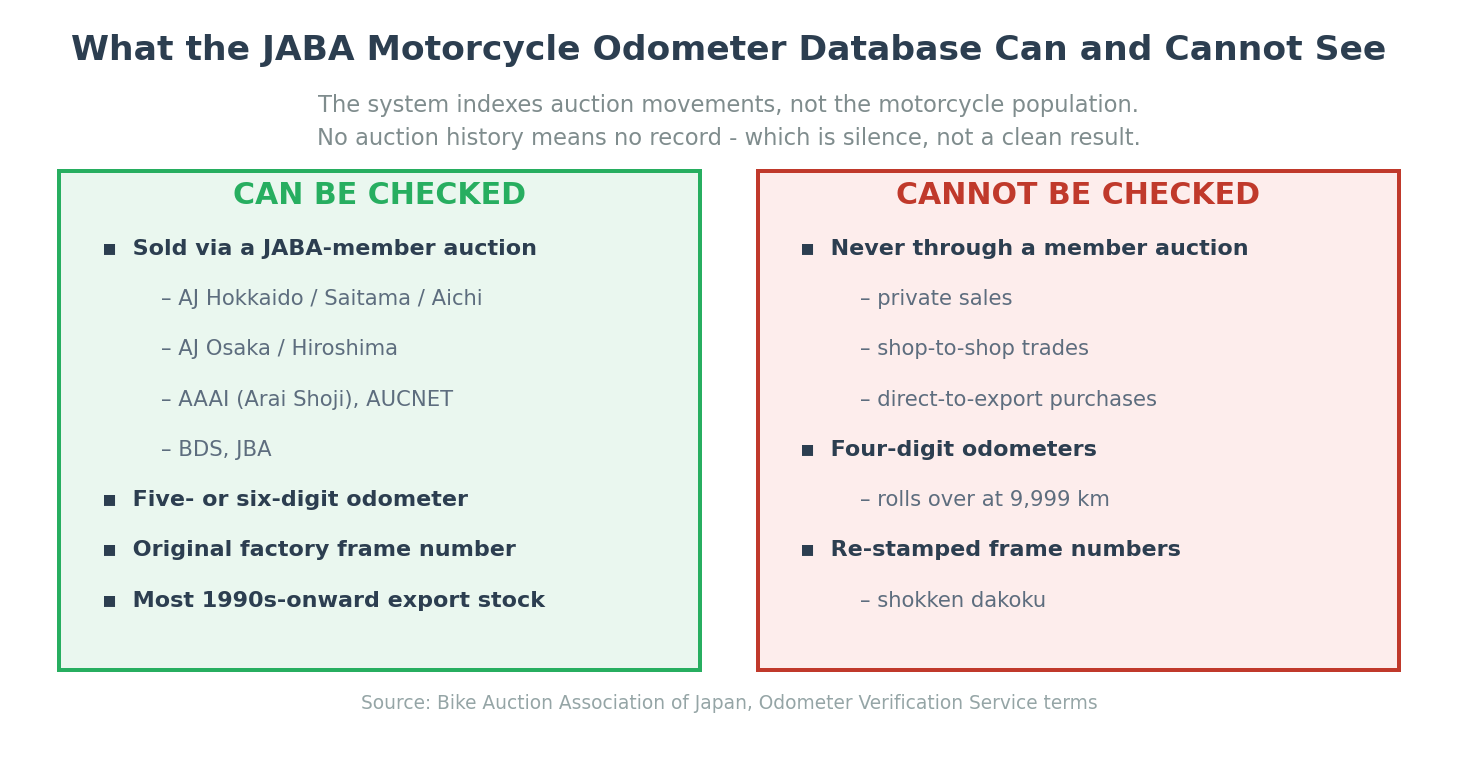
Run those three filters and you get a clear rule for when to spend the ¥1,100. Bike from the 1990s or later, six- or five-digit meter, being sold through an export channel that sources from auction? Check it. Pre-1990 machine with a four-digit clock, bought privately, frame number re-stamped? Save your money and put the effort into physical inspection instead.
The four paper records that carry a mileage figure — and why they disagree
Database or no database, a Japanese motorcycle drags a paper trail behind it, and four of those documents carry an odometer figure. Collect them and you can triangulate.
The auction sheet
The sheet the auction inspector fills in before the bike crosses the block. It carries an overall grade, a condition diagram, notes, and a mileage box. This is the number in almost every listing you will ever see, and it deserves a specific warning: it is an inspector's transcription of what the dial showed on inspection day. It is a witnessed reading, not a verified one.
What makes the sheet valuable is the annotation. Japanese inspectors flag suspected discrepancies with symbols beside the mileage — a star or asterisk is the one you will encounter most often, and its presence means the reading is not accepted as genuine, whether because of a rollback, a replaced meter, or a reading the inspector simply could not stand behind. A mileage figure with a mark next to it is worth less than no figure at all, because it means someone qualified looked and declined to vouch for it. If you want the full anatomy of the sheet, our guide to reading a Japanese motorcycle auction sheet takes it apart box by box.
The shaken certificate
Japan's roadworthiness inspection certificate records the odometer indication at each inspection. For a bike that has been through several, that gives you dated waypoints — the closest thing to a mileage history that exists in ordinary Japanese paperwork.
The catch is enormous, and it is the single most important thing to know about Japanese bike documentation: shaken does not apply to motorcycles of 250cc and under. Not at three years, not ever. Every Ninja 250, every CBR250RR, every 250 two-stroke in the auction hall has never been through a government inspection, which means it has no state-recorded odometer waypoints at any point in its life. For the whole picture on what the inspection does and does not prove, see our breakdown of what shaken actually certifies.
So the rule is blunt. Over 250cc: ask for the shaken certificate and read the mileage fields. 250cc or under: that evidence does not exist and never did, and the JABA check becomes disproportionately more valuable.
The maintenance record book
The tenken seibi kirokubo (点検整備記録簿) is the service booklet, and Japanese owners who use main dealers tend to have a well-stamped one. Each entry carries a date and an odometer reading. Two, three, four honest waypoints written years apart by people with no interest in your purchase are extremely hard to fake consistently — the handwriting, the ink, the shop stamps, the sequence all have to hold up.
The book is legally optional in Japan, so its absence proves nothing. Its presence, with a coherent ascending mileage sequence, is one of the strongest mileage signals available to you.
The export deregistration certificate
When the bike is deregistered for export, the resulting certificate is the document that follows it onto the ship and into your destination country's registration process. Where a mileage figure is recorded on it, that figure is the last officially captured reading before the machine left Japan — and it is the one your destination authority is most likely to see. Our guide to the Japanese export certificate covers which of the three possible documents your bike gets and why the 250cc line changes that too.
What to do when they disagree
They will disagree. Here is the order of reliability, most to least:
- A JABA verdict — cross-referenced against every auction appearance the system holds.
- The shaken certificate — recorded by a testing station with no stake in the sale.
- The maintenance record book — multiple independent dated entries, hard to forge coherently.
- The auction sheet — one witnessed reading, one day, one inspector.
- The seller's advert — a claim.
A figure that appears in three of these and matches is a figure you can act on. A figure that appears only in the fifth is a sentence somebody typed.
Why Japanese bikes genuinely do have low mileage
All of this scepticism could leave you thinking every low-km Japanese bike is a lie. That would be the wrong lesson, because the low figures are usually real, and it helps to understand why.
Japanese motorcycles cover far less distance per year than their counterparts in the UK, the US or Australia. Analysis of Japanese usage patterns puts average annual motorcycle distance at roughly a third of the average private car's — and Japanese private cars themselves average only around 6,000 to 7,000 km a year, well below Western norms. Do that arithmetic and you get a typical Japanese motorcycle covering something in the low thousands of kilometres annually.
Four structural reasons sit behind it:
Distances are short. Japan is dense, urban and served by the best rail network on earth. A motorcycle is a weekend machine or a short commute, not a 200-mile-each-way tool.
Ownership is expensive relative to use. Over 250cc, shaken recurs every two years after the first three, and it costs real money every time. Add annual road tax and weight tax that steps up at 13 and 18 years, and a bike that gets ridden 2,000 km a year becomes an expensive object to keep. That cost — not mechanical failure — is what pushes clean, low-mileage machines onto the export market.
Storage culture. Japanese owners garage bikes, cover them, and take them off the road over winter as a matter of routine. That is also why so many Japanese imports arrive with genuinely low miles and genuinely poor fork seals: sitting is its own kind of wear, and our guide to rust and corrosion on Japanese imports covers what long storage actually does to a machine.
Multiple-bike ownership. Enthusiasts with three bikes in a garage spread the same annual distance across three odometers.
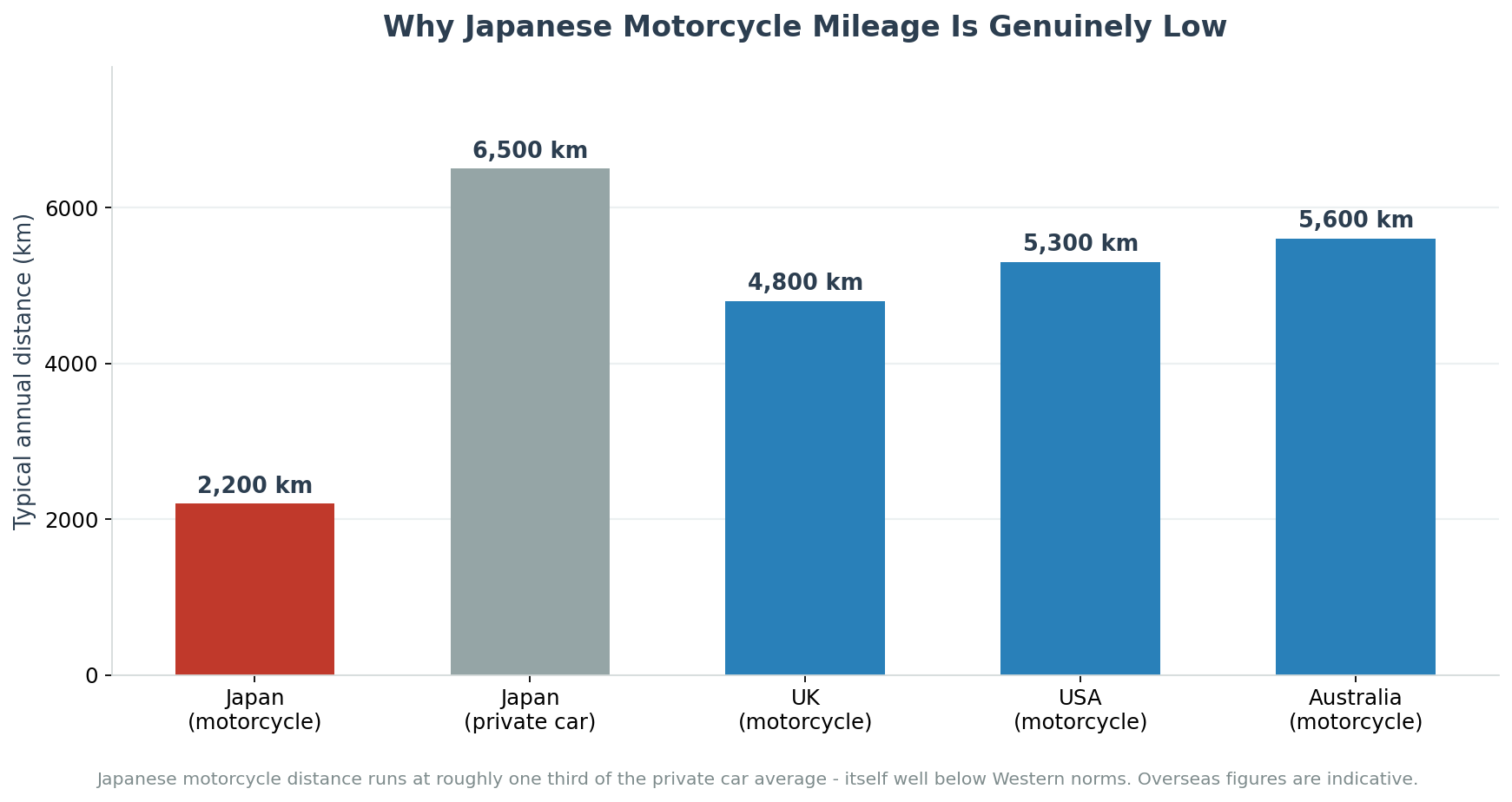
So the low number on the sheet is probably true. The mistake is treating "probably" as "certainly" on a five-figure purchase when a definitive check costs ¥1,100.
What a low reading is actually worth in money
Buyers routinely overpay for a low number and underpay attention to what produced it. Worth separating the two, because on a twenty-five-year-old machine they pull in opposite directions.
Distance wears the things that get replaced: chains, sprockets, pads, tyres, cables, bearings. Those are consumables with known costs and known intervals, and a bike that has covered 45,000 km has usually had them replaced by someone who was still riding it and cared whether it worked.
Time and storage wear the things that do not get replaced casually: fork seals and stanchion chrome, brake and clutch hydraulics, rubber fuel and vacuum lines, carburettor diaphragms, wiring insulation, wheel bearings, and the inside of the fuel tank. A bike that sat under a cover in a Japanese garage for eleven years covering 400 km a year has perfect footpeg rubbers and a fuel system full of varnish.
Which is why the 8,000 km 1998 bike is frequently the more expensive machine to get running properly, and why the auction listing that reads like a bargain sometimes is not one. Ask what the bike did with the years it did not spend moving.
A workable pricing frame, once you have a verified figure:
- Verified low mileage plus evidence of use — service book entries spread across years, consumables replaced at sensible intervals. This is the best combination available and deserves a premium.
- Verified low mileage plus long dormancy — one owner, few entries, big date gaps. Budget for a full fluid and perishables refresh before you value it as low-mileage. On a carburetted bike that is a meaningful bill.
- Higher mileage with a full record — often the better machine and almost always the better value, because everything with a service interval has been through it at least once.
- "Meter replacement history" verdict — treat the bike as unknown mileage and price it on condition alone. That is not a disaster, it is a different bike to the one advertised.
- "Mileage doubtful" or "subtracted vehicle" — no price. Move to the next lot.
The point of verifying is not to find fraud. Most of the time you will not find any. The point is to know which of those five bikes you are bidding on, because they are worth materially different amounts of money and they all look identical in a listing photograph.
Reading the machine against its claimed mileage
A database check tells you whether the number has been altered. It cannot tell you whether the number is plausible for the machine in front of you. That judgement is physical, and it is entirely learnable from photographs if you know where to point the camera.
Ask the seller or your agent for close, well-lit shots of these seven areas, then read them against the claim:
Footpeg rubbers and the gear lever. The two places a rider's boots make contact ten thousand times. Under 15,000 km the peg rubbers keep their moulding lines and the gear lever's top face keeps its texture. Worn-smooth pegs on a bike claiming 9,000 km is the loudest single tell there is.
The handlebar grips and switchgear. Grip pattern flattened on the throttle side, lettering worn off the starter button — those are tens of thousands of kilometres of thumbs.
The seat. Look at the front edge where the rider slides on and off, and at the shape under the sit bones. Vinyl compresses in a way that reflects hours, not distance, but the two correlate.
The fork stanchions. Pitting, staining and a lip on the chrome above the seal say either high distance or hard storage. Combined with a low reading, they push you toward "sat outside for years" rather than "fresh."
The chain, sprockets and brake discs. Consumables get replaced, so worn ones prove nothing on their own. But a bike claiming 8,000 km on a chain and sprocket set that has clearly been replaced once already is telling you a story that does not add up.
The exhaust and downpipes. Heat cycling colours steel. A downpipe with deep straw-and-blue banding has been hot a great many times.
The instrument cluster itself. Look at the screws, the surrounding paint, the seal around the lens, and whether the cluster's plastic has aged the same amount as the plastics either side of it. A cluster noticeably fresher than the bike is a cluster that has been off.
None of these is proof. Three of them pointing the same way, against the sheet, is a reason to spend the ¥1,100 before you bid rather than after.
What happens to the mileage figure when the bike lands
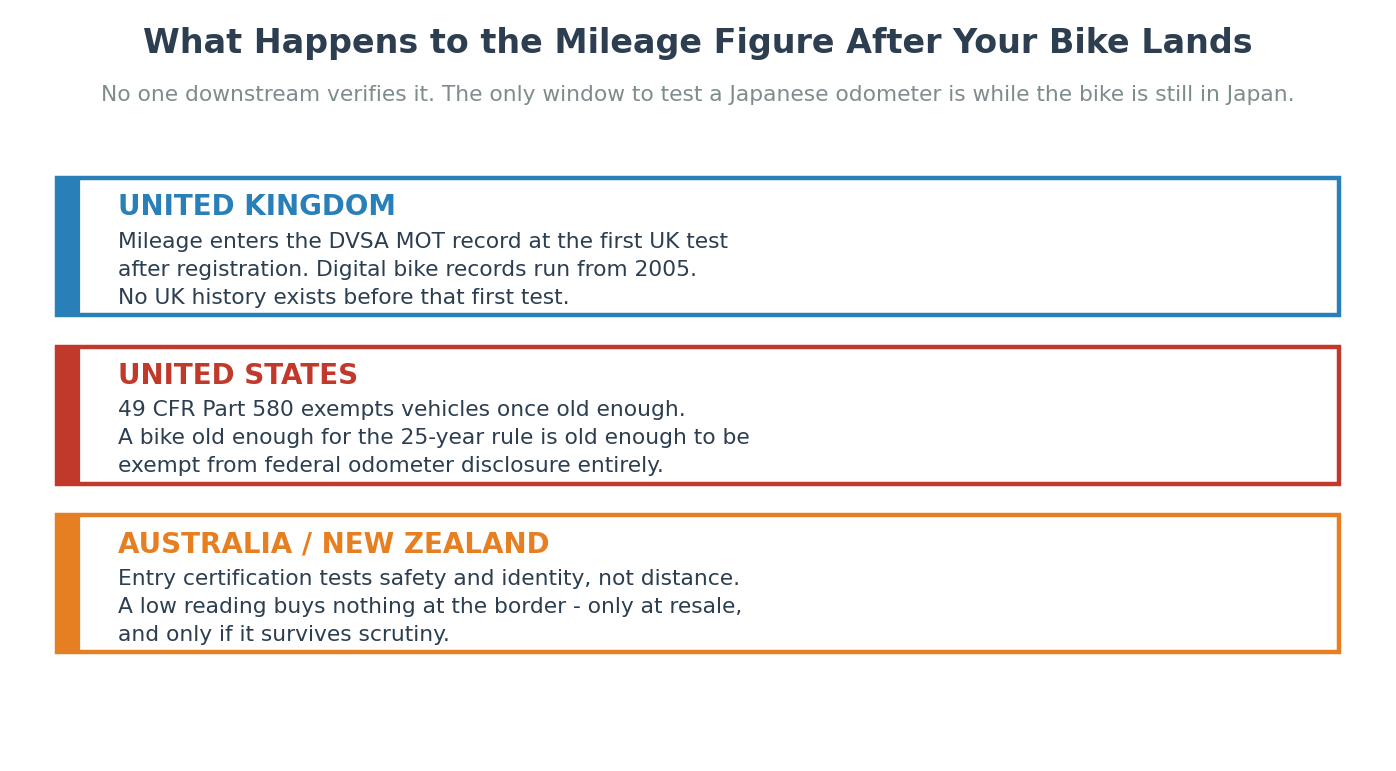
Here is the part that surprises people most: in several destination markets, the mileage figure legally stops mattering the moment your import is old enough — which is precisely the age at which most Japanese bikes qualify to be imported.
United States. Federal odometer disclosure lives in 49 CFR Part 580, and it carries an age exemption. A vehicle from model year 2010 or earlier is exempt from odometer disclosure once it is transferred at least ten years after its model year; NHTSA's 2019 rule extended that to twenty years for model year 2011 and later. Now line that up with the 25-year import rule that gets most JDM bikes into the country in the first place: a bike old enough to import is, by definition, old enough to be exempt from federal odometer disclosure entirely. Nobody in the US chain is legally required to certify its mileage. Our 25-year rule guide covers the import side of that equation.
United Kingdom. DVSA's MOT database records mileage at every test, and digital motorcycle records generally run from 2005 — but an import has no UK record until it has been registered here and passed its first MOT. That first test is the moment your bike's mileage enters a tamper-resistant public record, and the figure recorded is whatever is on the clock that day. If the Japanese paperwork said 12,400 km and the first MOT logs a figure inconsistent with it, that discrepancy is now permanent and public, and it will follow the bike through every future sale.
Australia and New Zealand. Compliance and entry certification focus on safety and identity rather than distance, so a low reading buys you nothing at the border. It buys you resale value later, and that only holds if the number survives scrutiny.
The practical consequence is the same everywhere: nobody downstream is going to verify this for you. The only window in which a Japanese motorcycle's mileage can be properly tested is while the bike is still in Japan, still attached to its Japanese records, and still checkable against a Japanese database. Once it is on a ship, that window has closed.
Five things English-language guides get wrong about Japanese motorcycle mileage
"Japan's odometer database will tell you the bike's history." The system everyone links to is for cars, and it requires the vehicle to be physically presented in Japan. The motorcycle system is a different system, run by a different association, with a different consumer route.
"A clean auction sheet means verified mileage." The sheet records what one inspector saw. Verification means comparison against stored history, which is a separate act performed by a separate organisation.
"Japanese bikes get strict inspections, so the mileage is documented." Only above 250cc. Below that line there is no inspection, ever, and therefore no state-recorded mileage waypoint in the machine's entire life.
"A replaced meter means the mileage is fake." JABA maintains "meter replacement history" and "rollback" as two distinct verdicts precisely because they are different events. A replacement means the displayed figure is incomplete. A rollback means somebody lied.
"Low mileage on a Japanese bike is too good to be true." Usually it is simply true — Japanese annual distances are a fraction of Western ones. The correct response is not suspicion, it is verification, which now costs about the same as a set of brake pads.
Your pre-bid mileage checklist
- Get the frame number and a clear photograph of the odometer face. Both, in focus, from the actual bike.
- Check the meter's digit count. Four digits means no database check is possible and rollover is likely — price accordingly.
- Read the auction sheet's mileage box and look hard for any symbol beside the figure. A mark there ends the conversation.
- If the bike is over 250cc, request the shaken certificate and list every recorded reading with its date. Plot them. The line should only go up, at a believable gradient.
- Ask for the maintenance record book. Photograph every stamped page.
- Order the JABA check through UMDA — ¥1,100, photographs by email, PDF result. Do it before you bid, not after you win.
- Read the machine: pegs, grips, seat, stanchions, chain, downpipes, cluster. Three disagreements with the claim mean stop.
- Keep every PDF. When you sell the bike in five years, that folder is worth more than the mileage itself.
How AWA Auction handles mileage
We source from the Japanese auction network, which means the machines we handle are exactly the population the JABA system covers. Every bike we list comes with its auction sheet, in full, before you commit — not a summary, not a grade, the actual document with the mileage box and any annotation beside it.
Where a bike carries shaken history or a maintenance record book, we photograph the mileage pages and send them with the listing. Where a bike is 250cc or under and no inspection history exists, we say so rather than letting silence imply a clean record. And when a mileage figure looks inconsistent with the machine, we tell you that too — a discrepancy found before the hammer costs nothing, and a discrepancy found after your container lands costs everything.
Browse the bikes we currently have available and check the sheet on anything that interests you. If you want us to chase down the mileage records on a specific machine, or you want help ordering a JABA verification before you bid, get in touch with our team and we will handle it.
The short version
Japanese motorcycle mileage is genuinely low, genuinely unverified by default, and genuinely checkable if you know where to look. Japan runs a motorcycle-specific national odometer database through JABA that returns one of four verdicts against a frame number, and a consumer proxy at UMDA will run it for you for ¥1,100 on the strength of two photographs — no vehicle, no attendance, no Japanese address.
It cannot see bikes that never went through a member auction, bikes with four-digit meters, or bikes with re-stamped frames. On everything else, it is the only tool in existence that turns the number on the clock from a claim into a finding.
Do it while the bike is still in Japan. Once it is on the water, the only mileage evidence you will ever have is a number an inspector wrote in a box one morning, and the hope that it was true.
See Also
Share this article: