
The Japanese motorcycle export certificate is the single document that decides whether your imported bike becomes a registered, road-legal machine or an expensive ornament sitting in a bonded warehouse. Get it right and registration is administrative tedium. Get it wrong and you are looking at four figures of storage fees while somebody in Japan tries to persuade a transport bureau to reissue paperwork for a bike that already left the country.
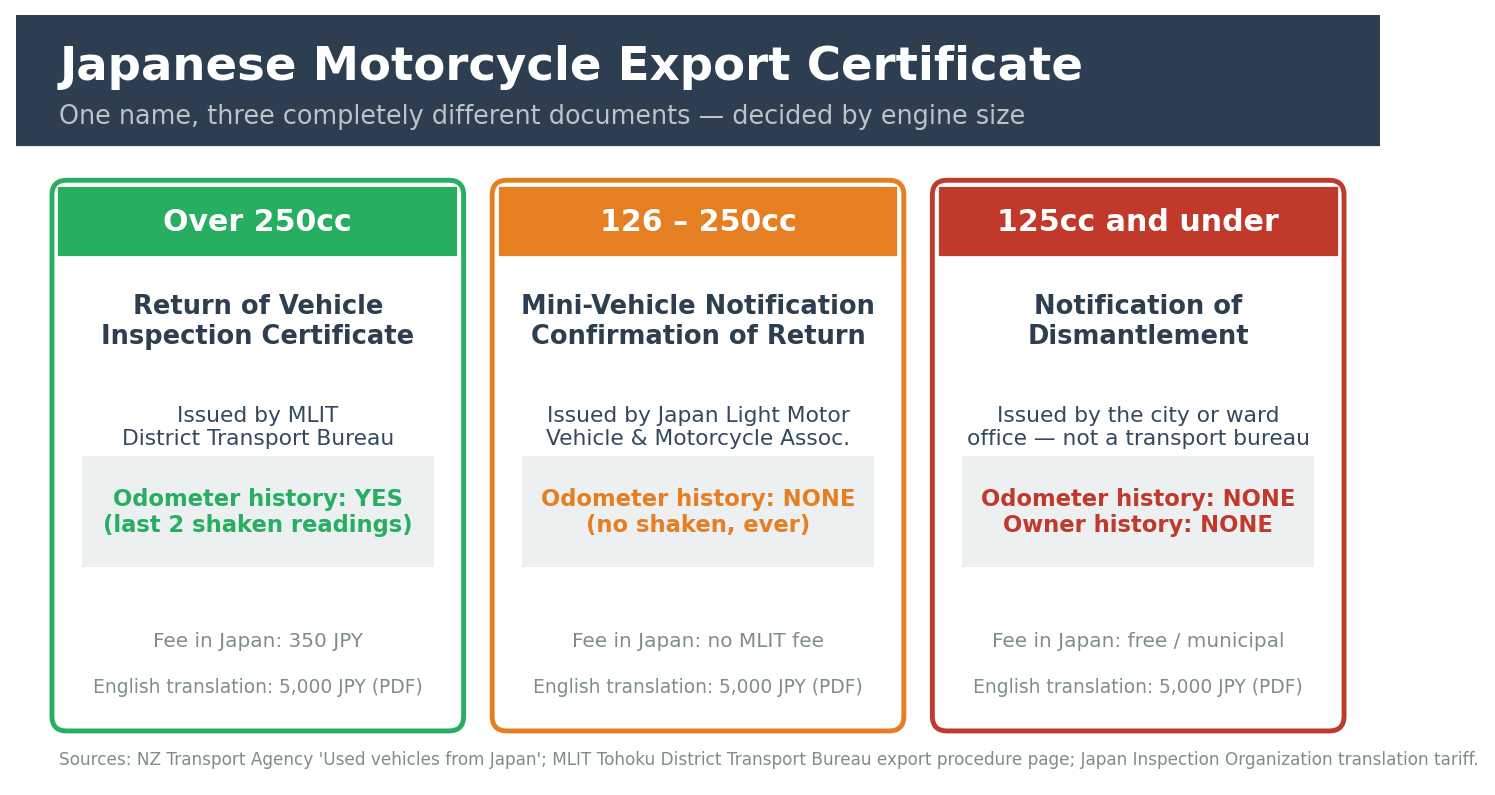
Here is the part almost nobody tells you before they take your deposit: there is no such thing as "the" Japanese motorcycle export certificate. Japan issues three completely different documents depending on engine size, from three completely different authorities, containing completely different information. Two of the three contain no mileage record at all. If you are buying a 250cc bike and you think the export paperwork protects you from odometer fraud the way it protects car buyers, you have been sold a comforting fiction.
This guide covers what each document is, which one your bike gets, what the eight fields on it actually mean, how it is cross-checked in the UK, New Zealand, Australia, the United States, Canada and the GCC, and the specific failure modes that strand shipments at the port. We have written the country-by-country cost and timing guides already — this one is about the piece of paper that all of them depend on.
What the Japanese motorcycle export certificate actually is
Before any vehicle can legally leave Japan, it has to be deregistered. The owner surrenders the registration, the plates come off, and the state removes the machine from its national vehicle database. Japanese Customs then converts that deregistration record into the export document that travels with the bike.
That process exists for one reason: to stop stolen vehicles leaving the country. Only the true registered owner can deregister a vehicle, because only they hold the original registration paperwork that the bureau checks. This is why an exporter who says "the certificate is coming later" is telling you something structurally alarming. The certificate is not a receipt printed at the end. It is the thing that had to happen before the bike was allowed onto a ship.
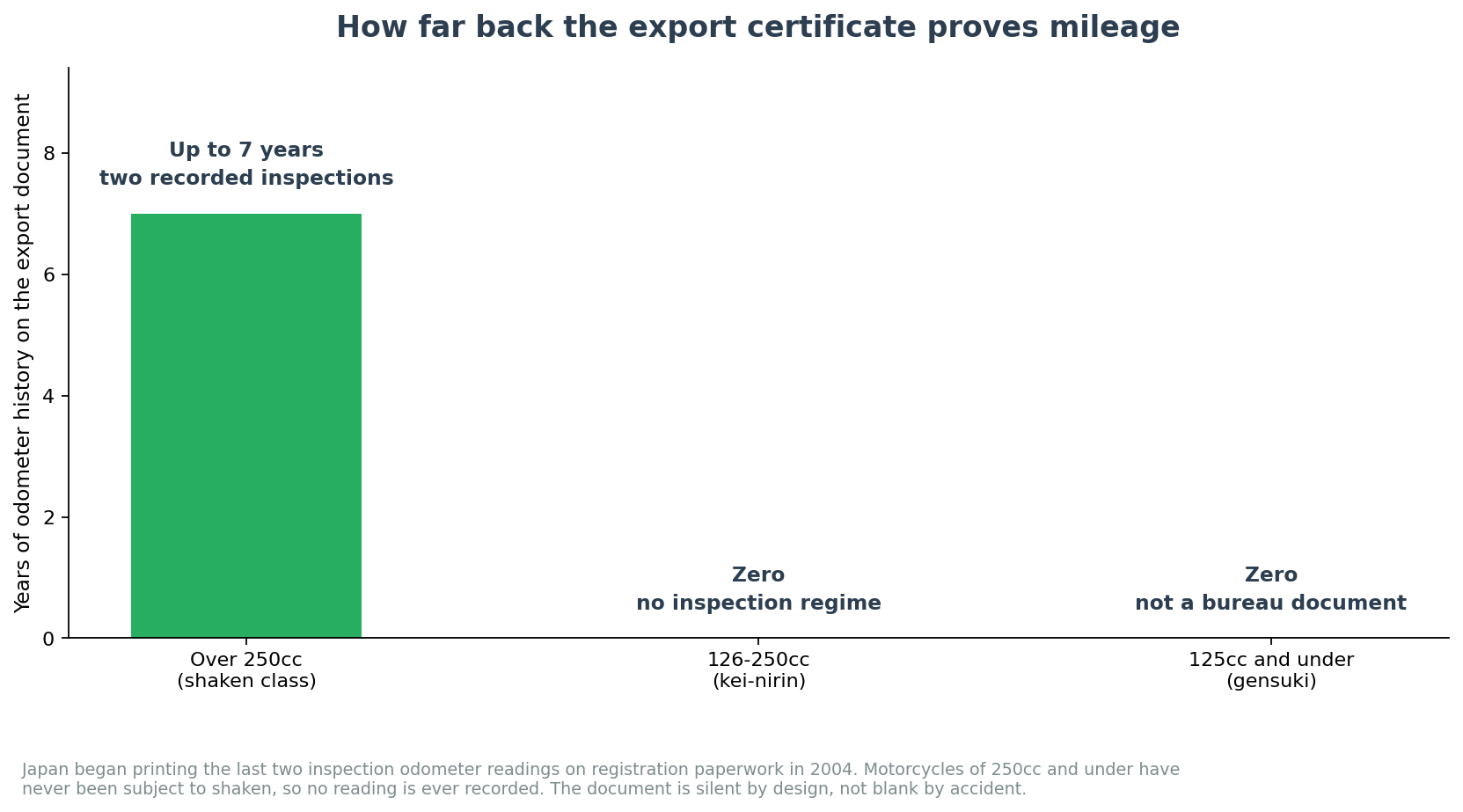
Since a 2004 change to Japanese law, the last two registration inspections — date and odometer reading — are carried onto the paperwork. For cars, and for motorcycles over 250cc, that gives you a mileage trail going back as far as seven years. It makes odometer tampering in Japan genuinely difficult, because a buyer sees immediately that the paperwork and the clocks disagree.
For motorcycles of 250cc and under, that protection does not exist. Not because the paperwork is worse, but because those bikes are not part of the inspection regime that generates the readings in the first place.
The three documents, and which one your bike gets
New Zealand's transport agency publishes the clearest breakdown of this anywhere in the English-speaking world, because its entry certifiers have to accept or reject these documents every day. NZTA's used vehicles from Japan page splits motorcycles into three classes, each with a different required document.
Over 250cc: the return of vehicle inspection certificate
Bikes above 250cc are subject to shaken, Japan's periodic roadworthiness inspection. They carry a proper inspection certificate, they sit in the national registration database run by the Ministry of Land, Infrastructure, Transport and Tourism, and when they are exported the owner surrenders that certificate at a District Transport Bureau. What comes back is the document most people mean when they say "export certificate."
This is the good one. It carries the chassis number, the engine number, the model and type code, displacement, first registration date, the registered owner, and the last two recorded odometer readings. The MLIT fee for the export deregistration procedure is 350 yen, and the requirements are published by the Tohoku District Transport Bureau along with every other regional bureau. The owner needs a seal registration certificate issued within the previous three months, the inspection certificate itself, and the number plates. Applications can be lodged from six months before the planned export date, which is why a competent exporter starts the paperwork the week the auction closes rather than the week before the vessel sails.
126cc to 250cc: the mini-vehicle notification confirmation of return
This is the class that catches people out. In Japan, motorcycles from 126cc to 250cc are kei-nirin. They have never been subject to shaken. They are not registered with MLIT at all — they are notified to the Japan Light Motor Vehicle and Motorcycle Association, and the document you receive on export is a confirmation that the notification has been returned.
It proves identity and it proves ownership. It does not prove mileage, because no inspection ever recorded any. NZTA's own page carries an explicit warning on this point, recommending "extra care and checks if importing mopeds and small motorcycles."
Think about which bikes live in that class. The Ninja 400's smaller siblings, the entire 250cc twin-cylinder sport segment, most of the trail bikes people import for green laning. Every single one of them arrives with paperwork that is silent on how far it has been ridden.
125cc and under: the notification of dismantlement
Below 126cc, Japan does not involve a transport bureau at all. Registration for a gensuki is handled by the local city or ward office, essentially as a municipal tax matter. The export document is a notification of dismantlement issued by that city office.
It is the thinnest of the three. No inspection history, no meaningful ownership chain, and — because it is a municipal form rather than a national one — it varies in layout between municipalities, which entertains customs officers everywhere. If you are importing a Super Cub, a Monkey or a Grom, this is the piece of paper standing between you and a registration.
Why the 250cc line matters more than anything else in this article
There is an entire cottage industry built on the claim that Japanese paperwork makes odometer fraud impossible. For cars, that claim is broadly fair. The export certificate shows dated mileage readings, the gaps between them should be two to three years, and a seller who has wound the clocks back gets caught the moment you compare the document to the dash.
Apply that same confidence to a 250cc bike and you have no protection whatsoever. Consider what that means in practice. A dealer imports a 2019 CBR250RR. The export document is genuine, watermarked, correctly issued and completely silent on mileage. The dash reads 6,400km. There is nothing in the Japanese paperwork that contradicts any number the seller chooses to present, because there was never a number to contradict.
This is not theoretical. The same structural gap exists for newer cars that were exported before their first re-inspection, and it has produced documented cases of serious misrepresentation. One frequently cited example involved a three-year-old vehicle advertised in Sydney at 9,200km with an 80,000 AUD sticker, where auction records from eight months earlier showed 56,000km. The export certificate supplied with it was entirely authentic.
The protection for small-capacity bikes has to come from somewhere else: the auction sheet, the auction house's own inspector reading, and independent verification of the frame number against Japanese records. If you are buying a 250cc machine and the seller offers you the export certificate as proof of mileage, they either do not understand the document or they are counting on you not understanding it.
The eight fields that decide whether your bike gets registered
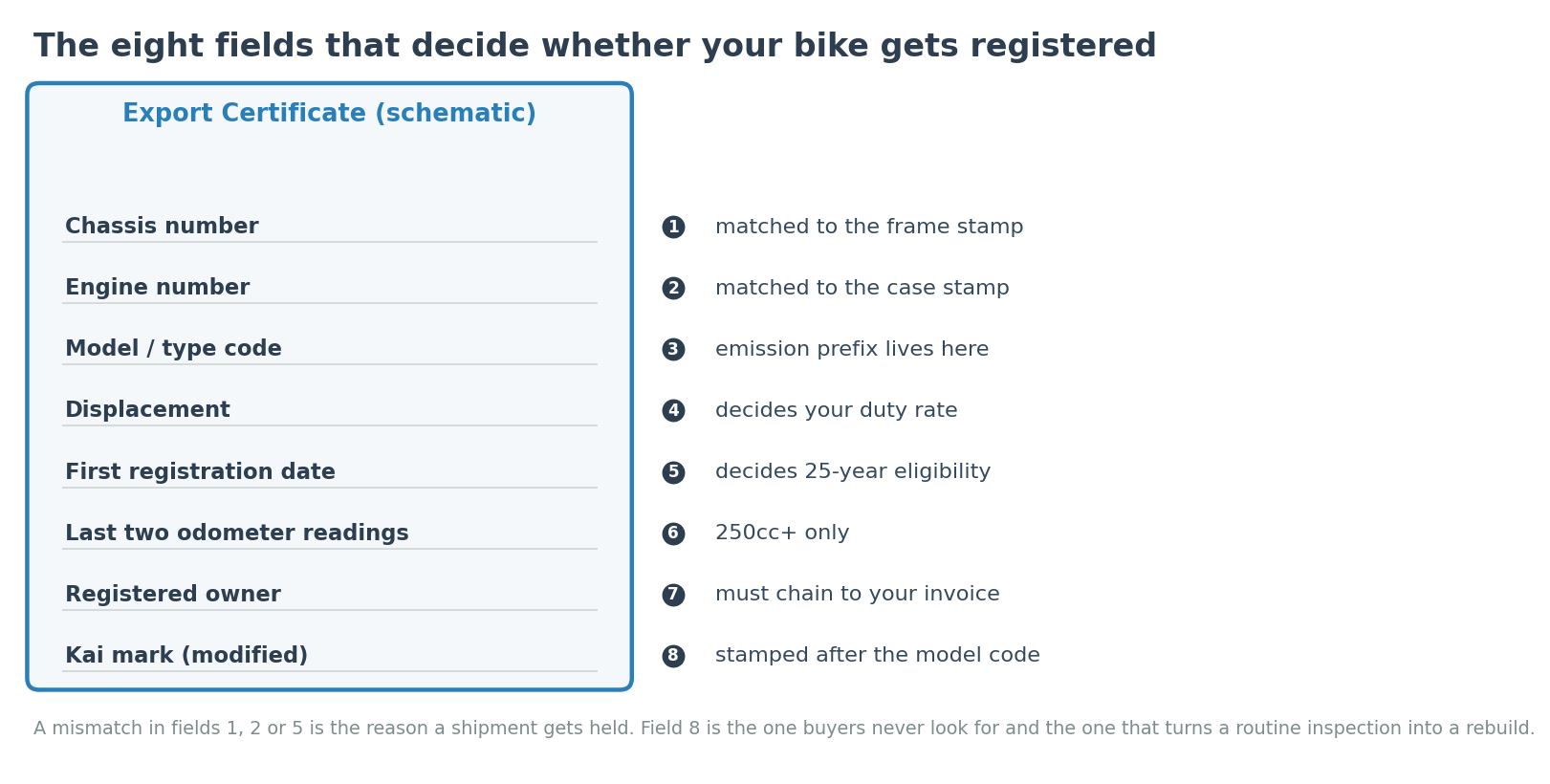
Every registration authority reads the same handful of fields and cross-references them against something else. Learn these eight and you can audit a document photo in about ninety seconds.
1. Chassis number
Matched to the physical stamp on the frame. This is the field that holds shipments. If the number on the certificate and the number on the bill of lading do not agree, the vehicle sits until somebody explains the discrepancy with new documentation. Japanese chassis numbers use a model-code prefix followed by a serial — and the prefix has to belong to the model you think you bought.
2. Engine number
Stamped on the crankcase. Registration authorities in the UK, Australia and New Zealand all record it. A replaced engine is not automatically a problem, but an engine number that does not match the certificate and has no supporting paperwork turns your registration into a correspondence project.
3. Model and type code
This is the field that carries the emission code prefix, and for New Zealand it is decisive. Entry certifiers read the character set at the start of the industry model code to establish which emissions standard the bike was built to. Where the code is absent or unrecognised, you need a separate statement of compliance, which costs money and time.
4. Displacement
It sets your duty rate. The UK charges a different rate on motorcycles below 250cc than above it, and the number the customs system uses is the one on this certificate — not the one in the brochure. This is exactly where the 845cc-versus-847cc style discrepancies between Japanese registration documents and English-market literature cause trouble.
5. First registration date
For anyone importing to the United States or Canada, this field is the whole ballgame. It establishes age against the 25-year rule in the US and the 15-year rule in Canada. Customs cross-references it against the date declared on the federal forms, and a mismatch between the two is one of the most common reasons a vehicle is held pending further documentation.
6. Last two odometer readings
Present on 250cc-plus documents, absent below that. Where present, check the gap between the dates. Japanese private vehicles are inspected at three years from new and then every two years, so a normal document shows a two-to-three-year spacing. Two inspections in quick succession is the classic method of wiping earlier mileage records off the paperwork, and it is visible to anybody who reads the dates instead of just the numbers.
7. Registered owner
Every destination wants an unbroken ownership trail from the last registered owner in Japan to you. The certificate names that owner. Your invoice, bill of sale and shipping documents need to chain to that name without gaps. A missing link in the middle is worse than a missing document at the end, because there is no form you can file to invent one.
8. The kai mark
A small character stamped after the model code, indicating the vehicle has been modified from its type-approved specification. NZTA flags it explicitly and recommends checking with an entry certifier before you commit. Buyers almost never look for it. It is the difference between a routine inspection and a conversation about returning a bike to standard at your expense.
When the paperwork actually happens
The sequence matters more than the individual steps, because almost every disaster in motorcycle importing comes from doing the right things in the wrong order.
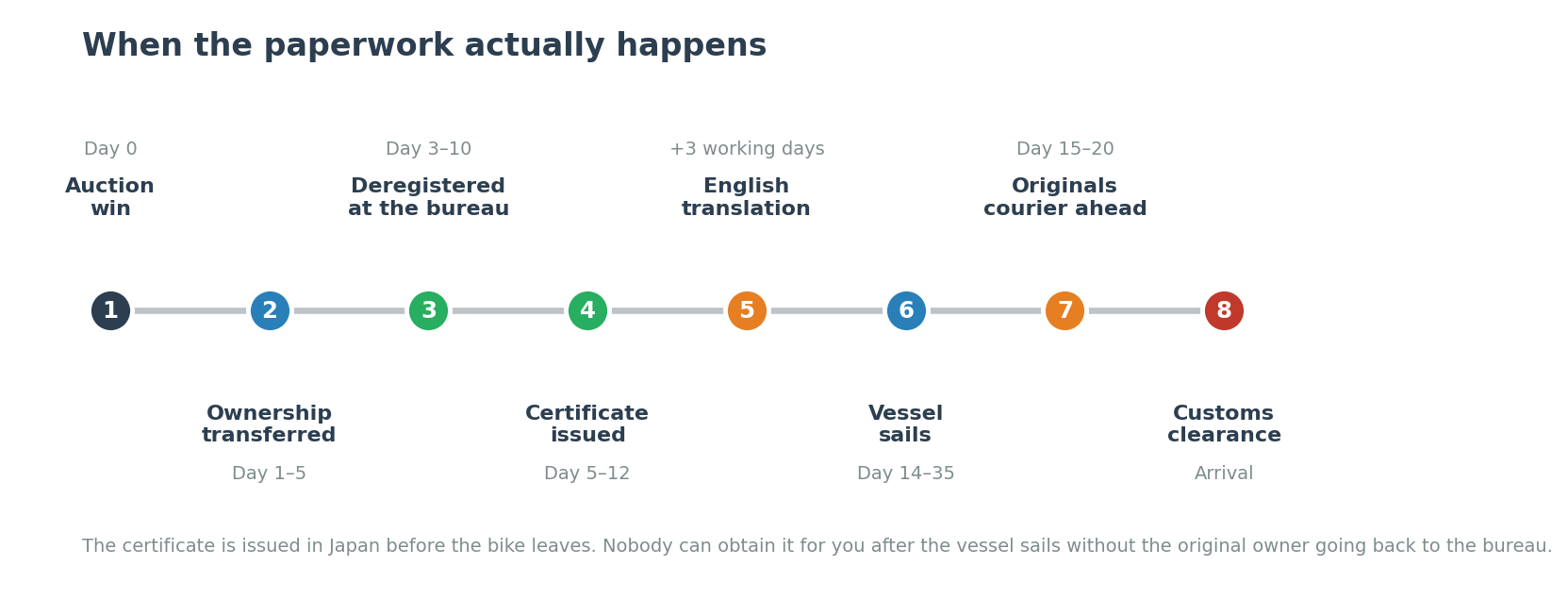
Day 0 — the auction closes. You have bought a machine that is still registered to somebody in Japan. Nothing has been deregistered yet.
Day 1 to 5 — ownership transfers. The auction house releases the bike to your exporter, and the registration transfers into the exporter's name or into a holding arrangement. This is the step that goes quiet if the seller's paperwork is incomplete, and it is invisible to you unless you ask.
Day 3 to 10 — deregistration at the bureau. For a 250cc-plus bike, somebody physically attends a District Transport Bureau with the inspection certificate, the plates, a seal registration certificate issued within the last three months, and 350 yen. For a smaller bike, the equivalent step happens at the Light Motor Vehicle and Motorcycle Association or the city office.
Day 5 to 12 — the certificate is issued. Japanese Customs converts the deregistration record into the export document. This is the moment the piece of paper exists.
Plus three working days — English translation. Most Japanese export certificates are issued entirely in Japanese, and most destinations want a certified English translation. Commercial translation services quote around three working days and charge roughly 5,000 yen for an emailed PDF or 10,000 yen for a couriered hard copy.
Day 14 to 35 — the vessel sails. Container or roll-on roll-off, the bike is now at sea and the paperwork situation is frozen. Whatever you have, you have.
Day 15 to 20 — originals go by courier. Competent exporters send the original documents by tracked courier so they arrive before the ship does. Documents that travel inside the container with the bike are documents you cannot present to customs until the container is released, which requires the documents. Yes, that is circular. It happens.
Arrival — customs clearance. The certificate is compared against the bill of lading, the invoice, and whatever federal or national form your destination uses.
What each destination does with the document
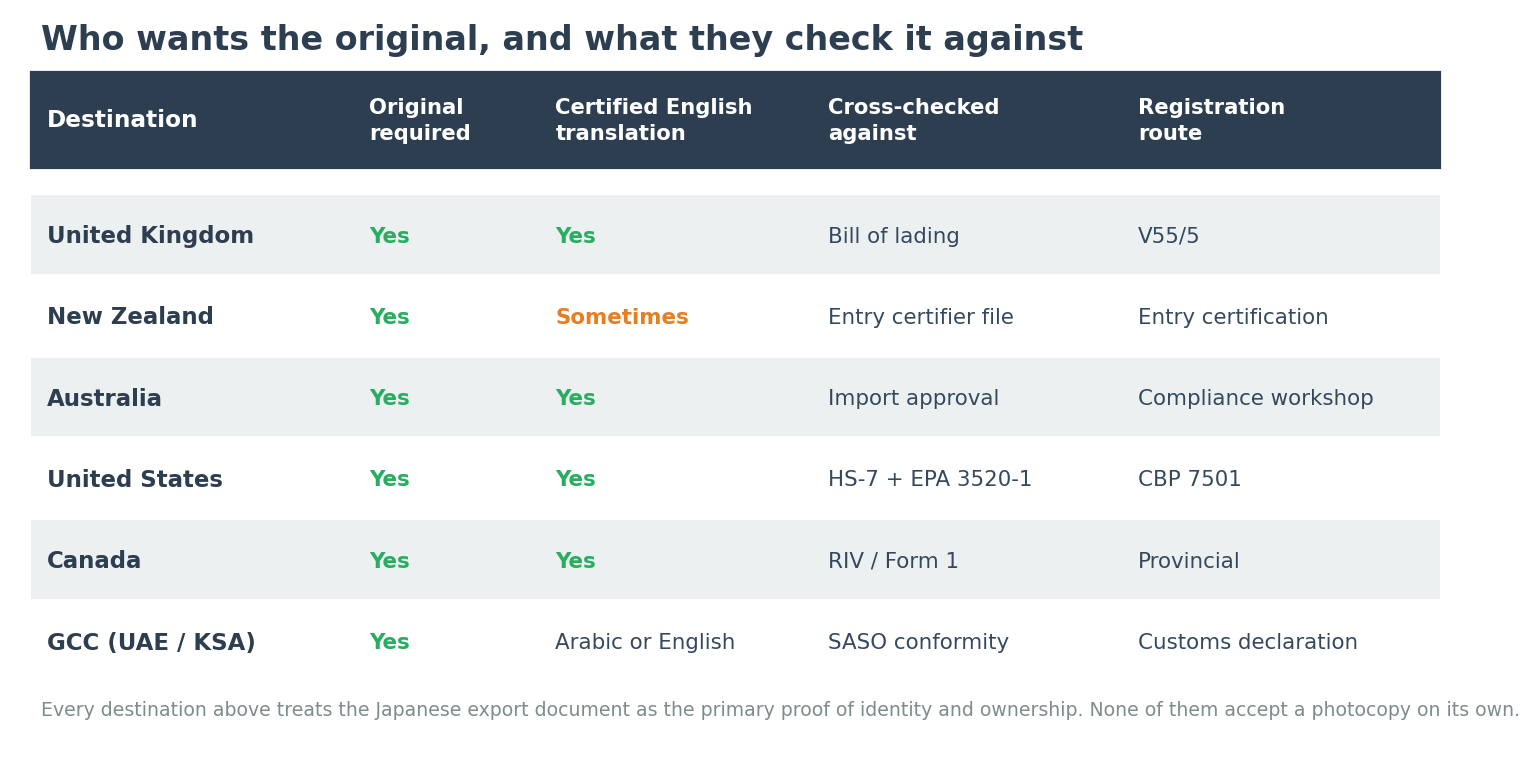
United Kingdom
You need the translated Japanese export certificate and the original purchase invoice to clear customs, then you register with DVLA on form V55/5. The registration fee is 55 pounds. DVLA does not return the original Japanese registration document, so photograph every page before you post it — people forget this and then discover the only record of their bike's Japanese identity is inside a government filing system. Registration typically runs four to six weeks.
Two age thresholds change your workload. Over ten years old and you skip the MSVA test. Over forty years old and you skip the MOT and pay nothing in road tax. We cover the mechanics of both in the MSVA test guide and the broader UK import walkthrough, and the customs side in the UK duty and tax guide. If you are importing commercially or within a short window of arrival, the NOVA registration guide covers the notification step that has to happen within fourteen days.
New Zealand
NZTA wants the original document appropriate to the displacement class, and an entry certifier checks it. Beyond ownership, the certificate does double duty: the model code establishes emissions compliance, and where a type designation number is present it supports frontal impact compliance for the classes that need it. No type designation number means a statement of compliance or an exemption application. The New Zealand import guide walks through entry certification in detail.
Australia
Australia adds a wrinkle worth knowing about. The original export certificate is held on file by the compliance workshop that issued the import approval, and the details of that company appear on the compliance plate. If the compliance workshop and the selling dealer are the same business, that business both profits from the sale and decides whether the bike passes inspection for rust and accident repair. That is not an accusation, it is a structural conflict, and it is a good argument for getting independent verification of the Japanese records rather than accepting the file copy at face value. See the Australia import guide for the approval process itself.
United States
Three federal forms meet your export certificate at the port: CBP Form 7501 for the entry summary and duty, NHTSA Form HS-7 for vehicle identification, and EPA Form 3520-1 for the emissions declaration. For a bike 25 years or older you claim the age exemption on Form HS-7, and customs cross-references the manufacture and first registration dates against the Japanese certificate. Inconsistency between the date on the form and the date on the certificate is the single most common reason a shipment is held pending documentation. The full sequence is in the USA import guide.
Canada
Canada's threshold is fifteen years rather than twenty-five, which opens up a great deal of 2010s machinery that Americans have to wait for. The Registrar of Imported Vehicles process wants the export certificate as proof of age and identity, and provincial registration follows. Details in the Canada import guide.
GCC
Gulf customs authorities want the export deregistration certificate plus conformity documentation, and translation into Arabic or English depending on the port. There is no age restriction of the kind the US and Canada impose, which is why the Gulf is one of the few markets where importing a five-year-old Japanese bike still makes financial sense.
The six ways this goes wrong
The certificate never existed for your bike
A bike that was scrapped on paper in Japan rather than deregistered for export does not produce an export certificate. Neither does a bike sold as parts. If an exporter is vague about which of the three documents your machine will receive, that vagueness is the answer.
Chassis number mismatch between certificate and bill of lading
Usually a transcription error by the shipping agent, occasionally something worse. Either way the vehicle is held until the discrepancy is explained with corrected documentation. Ask for a photograph of the frame stamp before you pay, and compare it character by character with the certificate. Every machine in our current listings is photographed this way for exactly this reason. This takes two minutes and prevents the most common hold in the business.
Originals arrive after the bike
Storage at a container terminal runs into the hundreds of dollars per week and accrues whether or not anybody is doing anything useful. Confirm in writing that originals ship by tracked courier separately from the freight.
The document is a photocopy or a colour scan
No destination in the table above accepts one. The genuine article is watermarked, and for cars the front page is distinctively blue. A dishonest seller can alter a scan trivially, which is exactly why authorities insist on originals.
The translation is wrong or missing
An inaccurate translation is worse than no translation, because it puts a specific incorrect claim in front of an official who will act on it. Use a service that specialises in vehicle certificates rather than a general translator who has never seen a Japanese model code.
You are buying a bike already in your country
This is the highest-risk purchase of all. The export certificate has already done its job, the seller holds it, and it can be altered by a dishonest owner. Trust only the original watermarked document, and if the bike is a 250cc or smaller machine, remember that the document says nothing about mileage regardless of how authentic it is.
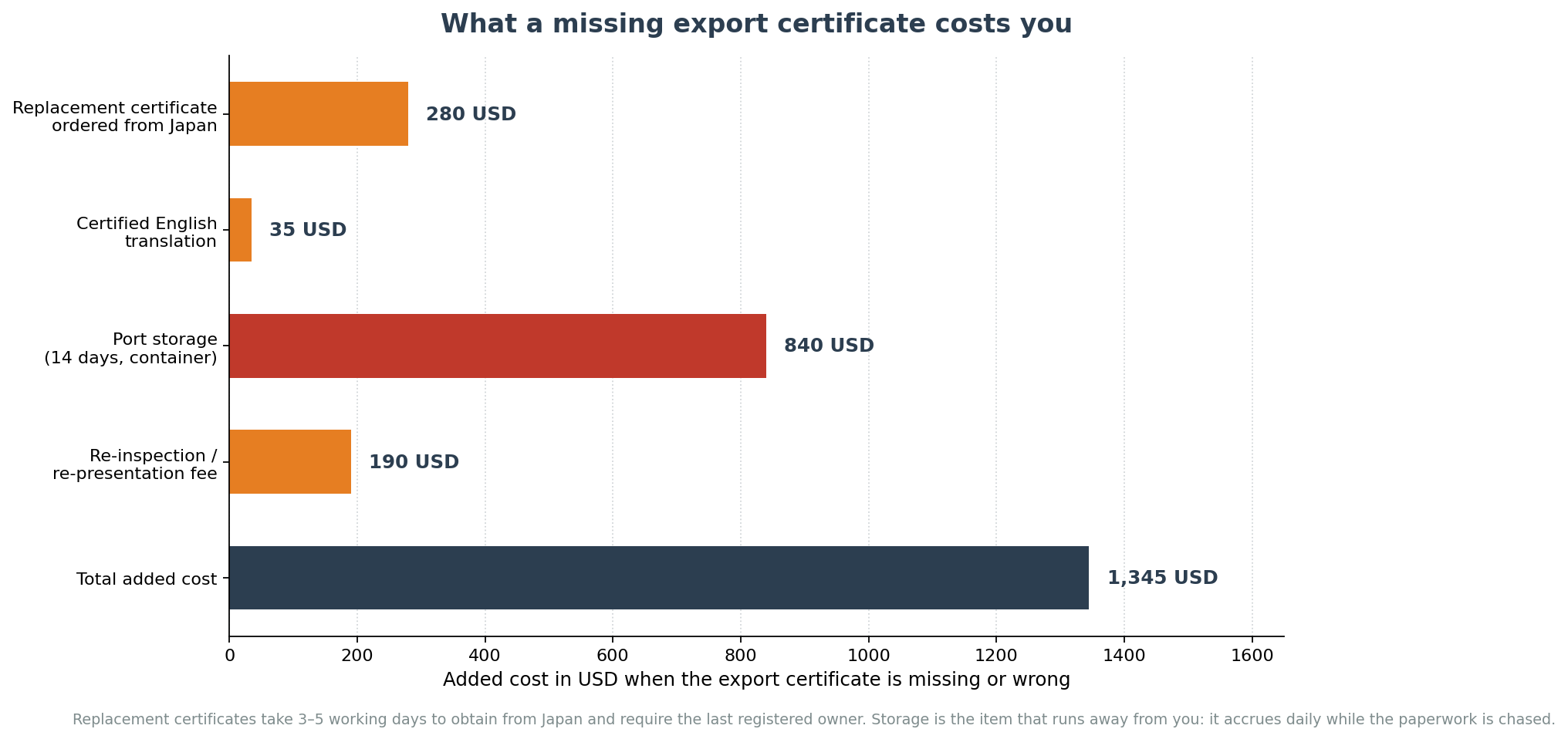
The numbers above are the reason we are pedantic about this. Individually none of them is catastrophic. Together they turn a good auction result into a mediocre one, and they are all avoidable with about ten minutes of checking before anybody wires money.
What the export certificate does not tell you
Buyers routinely over-read this document. It is a registration record, not a condition report, and the gap between those two things is where most disappointment lives.
It says nothing about accident history
A bike that has been dropped, repaired and put back on the road in Japan produces exactly the same export certificate as one that never fell over. Frame damage, replaced subframes, straightened forks — none of it appears. That information lives on the auction sheet, in the inspector's diagram and comments, and nowhere else.
It says nothing about service history
For a 250cc-plus bike, the certificate proves the machine passed shaken on specific dates. Passing shaken is not evidence of maintenance; it is evidence of meeting a roadworthiness minimum on one particular morning. Valve clearance checks, cam chain tensioner replacements, fork oil intervals — the certificate is silent on all of it.
It says nothing about how the bike was ridden
Thirty thousand kilometres of Tokyo commuting and thirty thousand kilometres of weekend touring produce the same number in the same box. Japanese urban riding is unusually hard on clutches, chains and cooling systems because of the stop-start density, which is one reason we push people towards the auction sheet's condition grade rather than the odometer number alone.
It does not confirm the engine in the frame is the original one
It records an engine number, which is a different claim. If the engine has been swapped since the last inspection, the certificate records the number that was on the bike when the paperwork was generated. Matching the certificate against the physical case stamp is your job, not the bureau's.
Replacing a certificate that has gone missing
It happens. A dealer loses the original, a previous owner throws it away, a document goes astray in the post. The situation is recoverable and it is expensive, and the cost scales with how long the bike has been out of Japan.
Official copies of Japanese export certificates can be obtained through services that hold access to the transport ministry records, typically within three to five working days. Independent history-check providers who read the same MLIT records directly can often produce the underlying registration and odometer data faster — one to two business days — which is useful when you are trying to establish mileage rather than satisfy a registration office that wants a specific document in its hands.
Two things determine whether this is a mild irritation or a serious problem. First, whether the bike is still identifiable in Japanese records, which depends on an accurate chassis number. Second, timing: if the bike is sitting at a port accruing storage while the replacement is chased, the document fee is the small number in the equation.
If you are staring at a missing document right now, send us the chassis number before you start paying storage. The practical lesson is unglamorous. Photograph every page of the certificate the moment it arrives, store it somewhere that is not your phone, and treat the physical original the way you would treat a passport. DVLA in particular does not return it.
The rest of the document set that travels with it
The export certificate is the centre of a small stack, and each piece exists to be cross-referenced against the others. Understanding the stack is what lets you spot a hole in it.
Bill of lading. The shipping line's document. Carries the chassis number, the shipper, the consignee and the vessel. This is the document your export certificate is most often checked against, and mismatches here are the classic hold.
Commercial invoice. Establishes the declared value that duty and VAT are calculated on. The name on it needs to chain cleanly from the registered owner named on the certificate.
Auction sheet. Not a legal document, but the only independent record of condition and the inspector's own mileage reading. For sub-250cc bikes it is the only mileage evidence in existence.
Export declaration and packing details. Generated by the exporter. Where a container is shared between multiple bikes, this is what identifies which machine is which — and shared containers are where paperwork gets mixed up between buyers. Our comparison of container versus roll-on roll-off shipping covers the trade-offs, and the shipping guide walks the freight side end to end.
If you want the whole picture in sequence — bidding, winning, paperwork, freight, clearance, registration — start with the complete import walkthrough and the auction bidding guide. The cost side is broken down in the full cost breakdown, and the auction houses guide explains who is actually running the sales you are bidding into. If the terminology in this article was new to you, the JDM motorcycle primer and the grey import guide are the right places to start.
How to verify a Japanese motorcycle export certificate before you pay
Here is the checklist we run internally. It costs nothing and it catches almost everything.
Ask which of the three documents this bike gets
Name the displacement, name the expected document. An exporter who cannot immediately tell you whether your bike produces a return of vehicle inspection certificate, a mini-vehicle notification confirmation of return, or a notification of dismantlement is an exporter who has not thought about your bike specifically.
Demand a photograph of the actual document, not a template
Front page, legible, before payment. Templates and sample images are marketing. The document with your chassis number on it is evidence.
Read the chassis number against the frame stamp photo
Character by character. The model-code prefix has to belong to the model. If you are buying a bike whose Japanese type codes you do not know, spend ten minutes finding them — every model has a small number of valid prefixes and an invalid one is an immediate stop.
Check the odometer dates for suspicious spacing
Only applies to 250cc-plus documents. Two to three years between readings is normal. Two readings months apart means somebody re-registered the bike twice in quick succession, and the effect — deliberate or not — is that earlier mileage disappeared from the record.
Look for the kai mark
After the model code. If it is there, ask what was modified and get it in writing before the bike ships, because you will be explaining it to an inspector later.
Cross-check against the auction sheet
The auction sheet and the export certificate are produced by different parties for different purposes, which makes them a useful pair. The sheet gives you a condition grade and an inspector's mileage reading; the certificate gives you registration mileage for larger bikes and identity for all of them. Where they disagree, something is wrong. Our guides on reading auction inspection sheets and Japanese auction grades cover how to read the sheet properly, and the auction sheet primer explains what the inspector is and is not looking at.
Confirm the courier arrangement in writing
"Documents sent separately by tracked courier, tracking number provided on despatch." One sentence in an email is worth several hundred dollars of storage you will never pay.
What this changes about which bike you should buy
Once you understand the three-document structure, the risk profile of different purchases looks different.
Large-capacity bikes are the safe end. Anything over 250cc arrives with a document that carries dated mileage readings. A ZX-10R, a CB1300, an XJR1300 — these come with a verifiable mileage trail, and combined with the auction sheet you have two independent sources. This is one of several reasons the big-bore segment dominates our own listings and why guides like the 1000cc round-up and the 750cc round-up are the easiest recommendations to make.
The 400cc class sits comfortably above the line. A CB400 Super Four, a CBR400RR, a VFR400 NC30 or an XJR400 all get the full document with mileage history, which is worth remembering when you are comparing a 400 against a 250 on price alone.
The 250cc class needs a different approach. The CBR250RR MC22, the NSR250, the RGV250 Gamma, the TZR250 — every one of these arrives with paperwork that proves who owned it and says nothing about how far it went. For thirty-year-old two-strokes that matters less than compression and crank condition, but you should know that the document is not doing the work you assumed. The same applies across the whole 250cc category and to modern machines like the ZX-25R.
Sub-125cc is a documentation exercise, not a verification one. A Super Cub arrives with a municipal form. Buy on condition and photographs, not on paperwork.
How AWA Auction handles the export certificate
We treat the certificate as the first deliverable of a purchase, not the last. When a bid wins, the document class is already known — we established it when the bike was listed, because the displacement told us which of the three routes it takes. Deregistration starts immediately rather than waiting for shipping to be arranged, which is what keeps the certificate ahead of the vessel rather than chasing it.
Every buyer receives a photograph of the issued document with the chassis number visible before the bike is loaded, along with the frame stamp photograph so the two can be compared side by side. Where the destination requires certified English translation, we arrange it during the shipping window rather than after arrival, because three working days spent while a container is at sea costs nothing and three working days spent while it is on a quay costs money.
Originals travel by tracked courier, separately from the freight, with the tracking number issued to the buyer on despatch. For 250cc and smaller machines we say plainly in the listing that the export document carries no mileage record, and we point you to the auction sheet reading instead. That is a slightly awkward thing to volunteer during a sale. It is also the difference between a customer and a repeat customer.
You can see what is currently available on our current listings, and if you have a specific model in mind or a question about paperwork for a destination not covered above, talk to our team before you bid rather than after.
The short version
The Japanese motorcycle export certificate is three documents wearing one name. Over 250cc you get the full MLIT document with up to seven years of odometer history for 350 yen. Between 126cc and 250cc you get an association document with no mileage record at all. Under 126cc you get a municipal form that proves very little. Every destination wants the original, most want a certified English translation at around 5,000 yen, and every one of them cross-references it against something — a bill of lading, a federal form, an entry certifier's file.
Check the chassis number against the frame stamp. Check the odometer dates for suspicious spacing. Look for the kai mark. Confirm the originals ship by courier. Do those four things and the paperwork side of importing a Japanese motorcycle stops being the part that keeps you awake.
See Also
Share this article: