
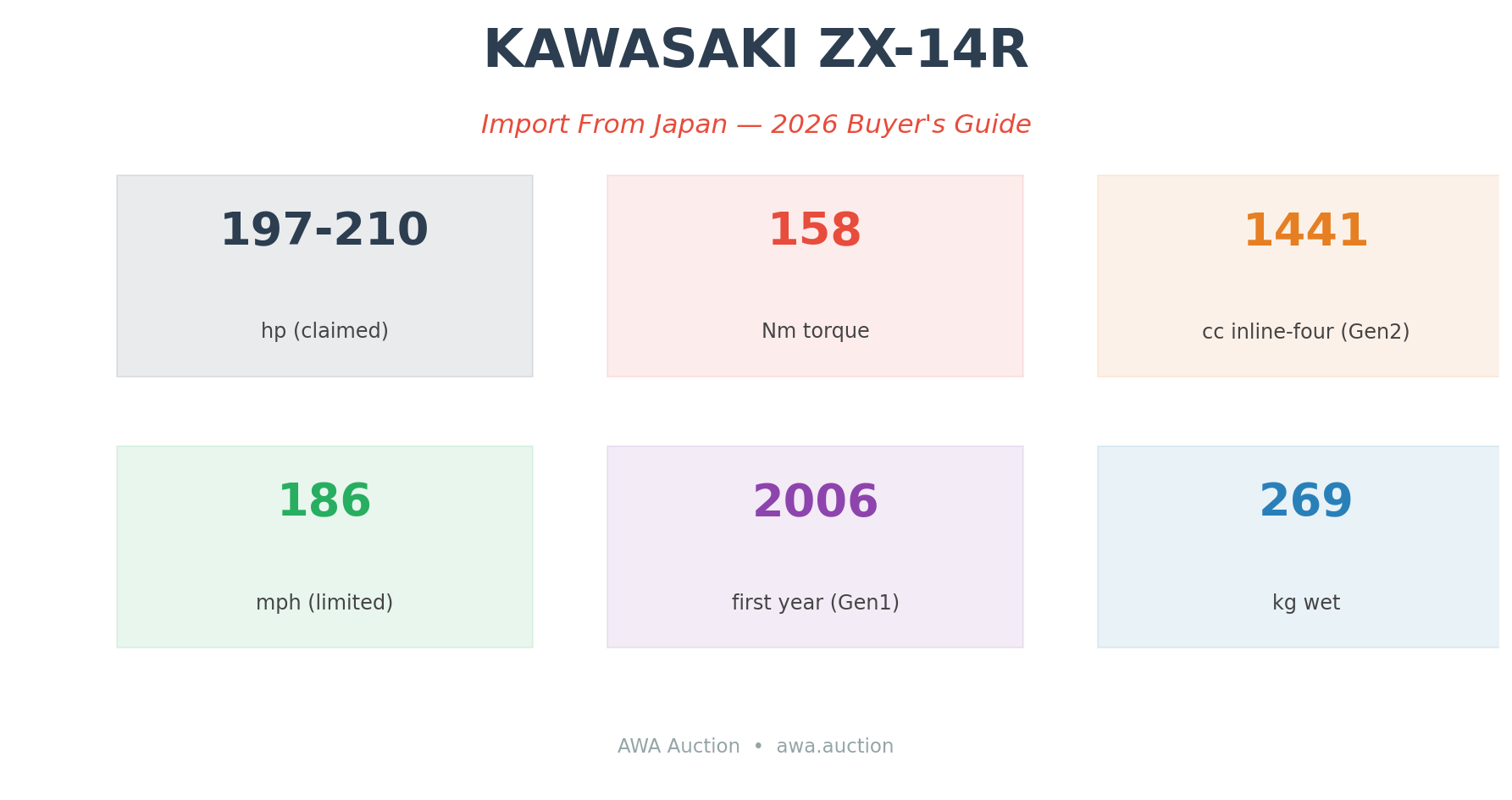
A Kawasaki ZX-14R import from Japan is how you buy the most brutally fast bike of the modern era for the price of a mid-size commuter. This is the 1,441cc inline-four that Kawasaki built to settle the top-speed war once and for all, the bike that made 197 claimed horsepower and 158 Nm of torque feel almost polite, and the one that owners describe as "the finest sports tourer money can buy" one breath before they twist the throttle and disappear. In many of the auctions we watch every week, a clean example crosses the block for less than a tired used litre-bike costs at a Western dealer.
Here is the thing nobody tells you: the ZX-14R was officially sold in the US and UK, so importing one is not about legality the way it is with a JDM-only bike. It is about condition, price, and getting the right generation with the right history. Japan is where the cleanest, lowest-mileage, best-kept examples live, and the exchange rate in 2026 still makes them a bargain. This guide walks you through the naming maze, the two generations, the years to avoid, the real landed costs, and the country rules for the US, UK, Australia and New Zealand.
What a Kawasaki ZX-14R import from Japan actually gets you
Strip away the marketing and the ZX-14R is deceptively simple: a big, over-square inline-four bolted into a monocoque aluminium frame, wrapped in the most aerodynamic bodywork Kawasaki could shape in a wind tunnel. The Gen 2 bike (2012 onward) makes a claimed 197 hp, and with ram-air pushing intake pressure up at speed, Kawasaki quoted figures north of 210 hp. On a dyno, real-world rear-wheel numbers land in the 180s. Torque is the headline though — 158 Nm arrives low and stays flat, which is why the bike feels like it is being fired out of a slingshot in any gear.
What you are really buying is effortlessness. One owner on a video with 1.4 million views put it perfectly: "I've done days of 1,400 km, so I would know — it is a superb traveller." That is the ZX-14R's party trick. It will run 300 km/h in a straight line, then cruise across a continent two-up with luggage without beating you up. It is a hyperbike and a sports tourer wearing the same suit.
The catch for buyers is that Kawasaki quietly wound the model down. By the mid-2020s it was pulled from Europe and North America on emissions grounds, surviving in Japan and select export markets. That is exactly why Japan is now the deepest, cleanest pool of used ZX-14Rs on the planet — the domestic market kept buying them after the West stopped. If you want a low-mileage, rust-free, fastidiously maintained example, you import it from Japan.
ZZR1400, ZX-14, ZX-14R — the naming maze that trips up every importer
This is the single biggest source of confusion when you start reading auction listings, and getting it wrong can cost you thousands. The same motorcycle wears three different names depending on where it was sold, and Japanese auction sheets use the domestic name.
In Europe and Japan, the bike is the ZZR1400 (sometimes written ZZ-R1400). In North America, the identical machine is the Ninja ZX-14 for 2006–2011 and Ninja ZX-14R from 2012. In Australia it followed the ZZR1400 badge early, then ZX-14R. So when a Japanese seller lists a "ZZR1400," that is your ZX-14R. Do not scroll past it because the name looks unfamiliar. That listing is the bike you are hunting.
Why does Kawasaki do this? The "R" suffix on the 2012 model wasn't just marketing — it marked the jump to the bigger 1,441cc engine and a genuine second generation. But the ZZR/ZX split is pure regional badging. On a Japanese auction sheet you will see the model coded as ZXT40 (Gen 1) or ZXT40E and later frame codes (Gen 2). Learn to read the frame prefix and you will never be fooled by a name again — and we cover exactly how to read those sheets further down.
The two generations of ZX-14R import decoded
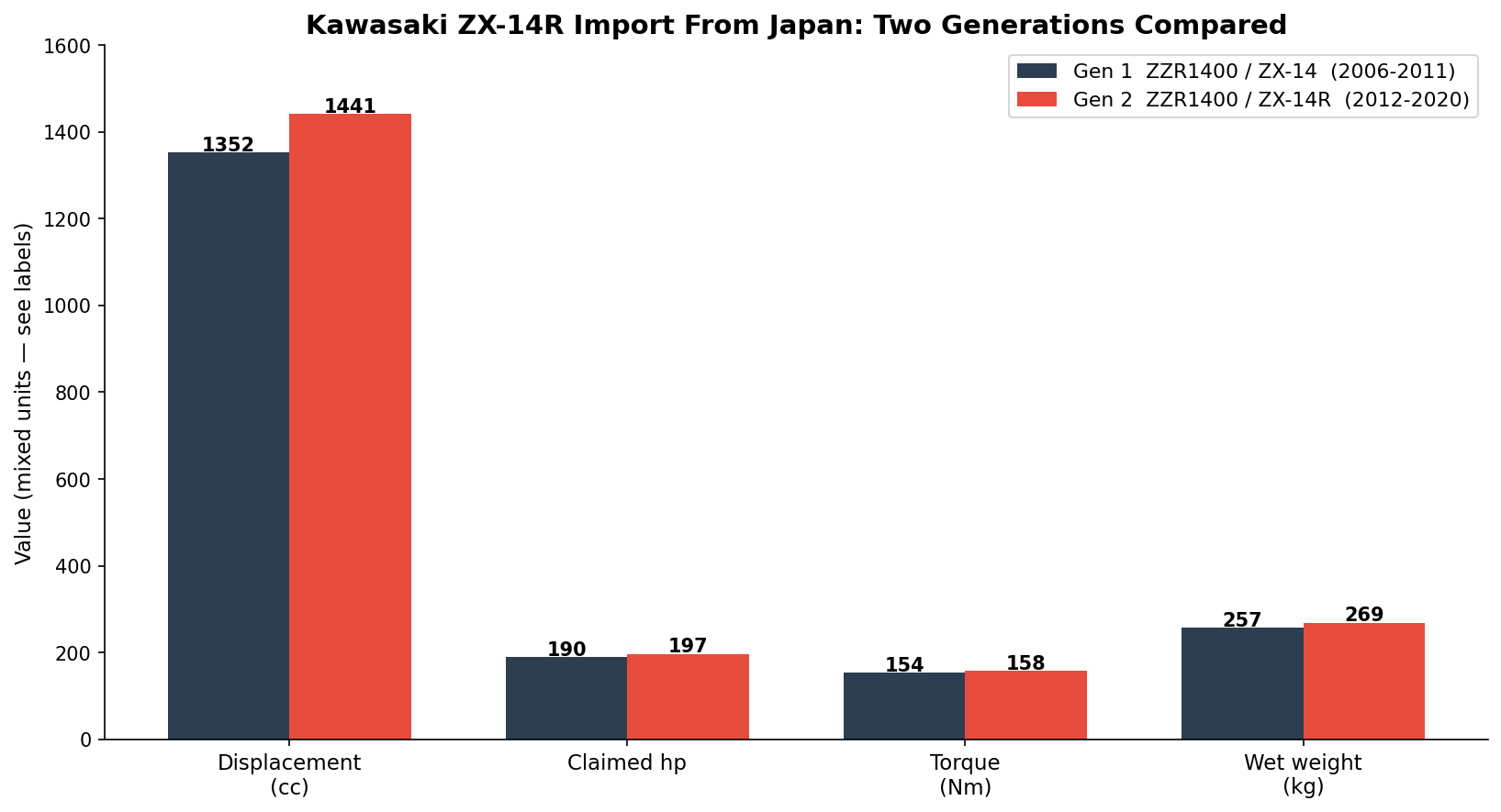
There are really only two bikes to understand here, and the difference between them matters more than any single model year.
Gen 1: 2006–2011 (ZZR1400 / ZX-14, 1,352cc)
The original launched in 2006 and instantly became the fastest production bike Kawasaki had ever built. The 1,352cc engine made a claimed 190 hp, the monocoque frame was a genuine engineering flex, and the styling — those quad headlights and that hunched, muscular tank — still looks purposeful twenty years on. This is the generation that matters for US buyers, because the earliest 2006 bikes hit the 25-year import threshold in 2031, and Gen 1 examples are the cheapest way into the family. In the UK, Australia and Japan they are everywhere and cheap.
Gen 1 is the value play. A tidy 2007 or 2008 bike in Japan is genuinely inexpensive, and the engine is famously tough. The trade-off is fewer electronics — early bikes have no traction control and basic ABS at best.
Gen 2: 2012–2020 (ZZR1400 / ZX-14R, 1,441cc)
The 2012 update is the one most imports should target. Kawasaki bored the engine out to 1,441cc, lifted claimed power to 197 hp and torque to 158 Nm, and — crucially — added a proper three-mode traction control system (KTRC) and selectable power modes. The brakes went to bigger monobloc calipers, and the whole bike got easier to live with while going even harder. A 2016 owner summed it up: "A multi-dimensional motorcycle that is good in so many ways."
If your budget stretches to it, a late Gen 2 (2016 onward) is the sweet spot. You get the electronics, the bigger engine, and — being newer — the lowest-mileage examples on the Japanese market. The generations chart above shows how close the numbers are on paper, but on the road the Gen 2's torque and rider aids make it the more complete machine.
Kawasaki ZX-14R vs Hayabusa vs ZX-12R — the hyperbike three-way
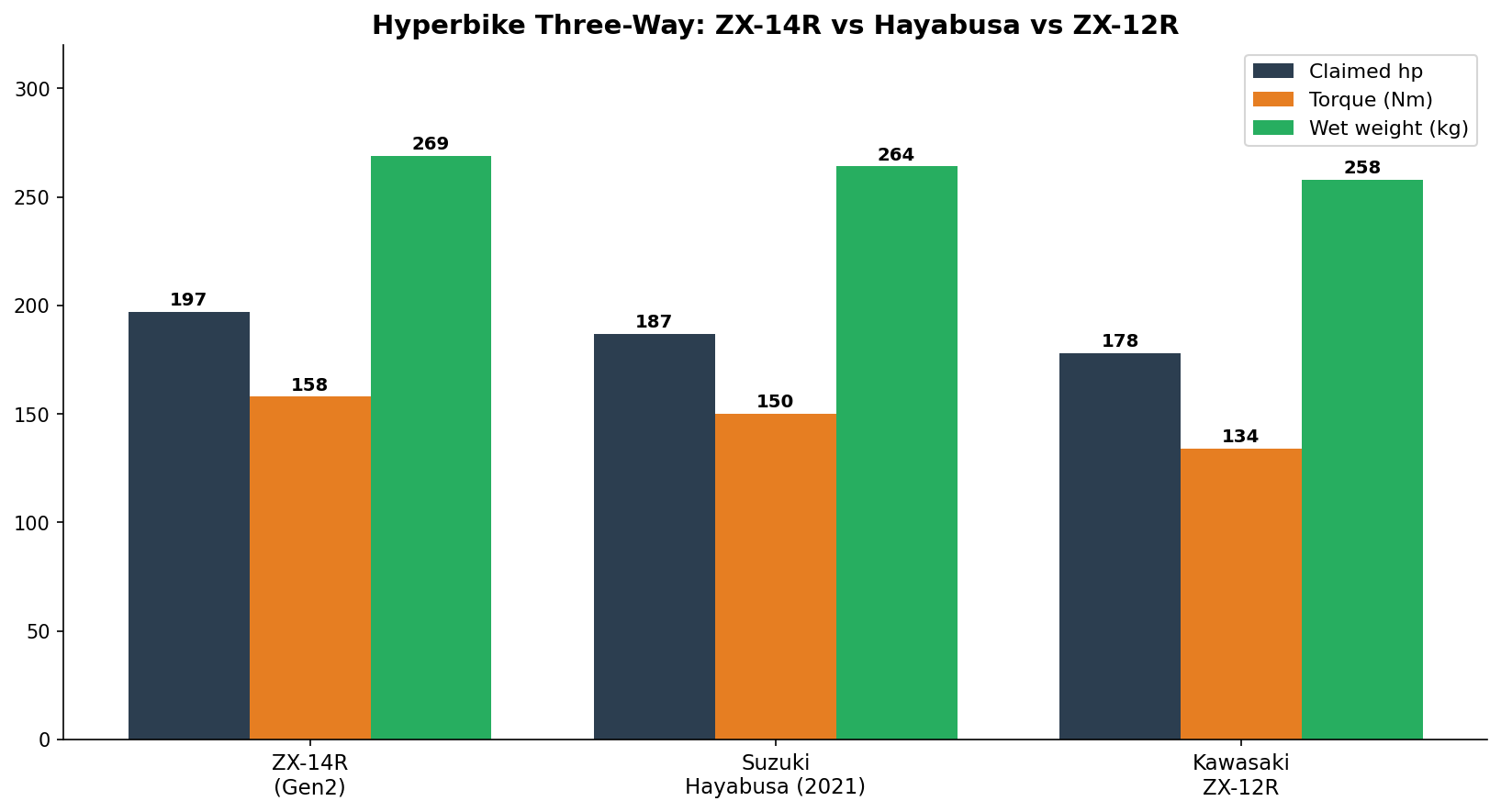
You cannot research a ZX-14R without bumping into its two great rivals. If you are cross-shopping, here is the honest breakdown — and both of these bikes are also worth importing, which is why we have full guides on the Suzuki Hayabusa import and the Kawasaki ZX-12R import.
ZX-14R vs Hayabusa. This is the rivalry. The ZX-14R makes more claimed power (197 vs the Hayabusa's 187) and more torque, and it is the brute-force choice — it hits hardest and sounds meanest. The 2021-onward Hayabusa fights back with far more refinement: ride-by-wire, cruise control, launch control, and a smoother chassis. As one Australian magazine test concluded, the Kawasaki is the bigger hammer, the Suzuki the more polished tool. Both are electronically capped at 186 mph thanks to a manufacturers' agreement, so neither wins the top-speed argument outright.
ZX-14R vs ZX-12R. The ZX-12R is Kawasaki's own predecessor from 2000, a lighter, rawer, more intimidating hyperbike that never quite matched the Hayabusa's sales. Next to the ZX-14R it feels like a different era — less torque, fewer aids, more of a handful. For a collector, the ZX-12R is the cult pick; for someone who wants to actually ride 1,400 km in a weekend, the ZX-14R wins easily.
The chart above lays the three side by side. Notice how close the weights are — these are all big bikes — but how the ZX-14R's torque figure towers over the others. That flat wall of shove is the whole point of the bike.
ZX-14R years to avoid and the known problems
The good news first: the ZX-14R is genuinely reliable. Trawl the owner forums and the overwhelming message is thousands of trouble-free miles. But "reliable" is not "flawless," and a few specific things are worth knowing before you bid.
2006–2007 frame recall. The very earliest Gen 1 bikes were subject to a frame inspection recall. It sounds scary but it is not — the check takes about half an hour and the frame is replaced only if a fault is found. What matters for an importer is confirming the recall work was done. On a Japanese bike, this is usually documented in the service records, and it is one of the first things a good agent will verify.
2011 heat management. The last of the Gen 1 bikes had a reputation for throwing a lot of engine heat onto the rider in slow, hot traffic. Kawasaki addressed the cooling on the 2012 Gen 2, so if riding in stop-start summer heat matters to you, that is one more reason to lean toward the newer generation.
2017 gauge flicker. The most commonly reported ZX-14R niggle is a flickering instrument display on some 2017 bikes. It is an easy fix and was typically covered under warranty when new. On an import it is a cheap, known quantity rather than a dealbreaker — just budget for it if the bike shows the symptom.
The universal used-bike stuff. Beyond those model-specific points, treat a ZX-14R like any high-performance import: check for crash damage hidden under fairings, look for chain and sprocket wear, confirm the tyres are not squared off from motorway miles, and be wary of any bike that has obviously been drag-raced. Which brings us to the next section.
The 186 mph gentleman's agreement and the tuning underworld
The ZX-14R is capable of running well past 300 km/h, but you will never see that on the speedo of a stock bike. Since the late 1990s, the major manufacturers have quietly agreed to electronically limit their fastest bikes to 300 km/h — 186 mph. Kawasaki honours it on the ZX-14R. That limiter is the single most important thing to understand about the tuning scene around this bike, because a huge chunk of the ZX-14R community exists to remove it.
This is where you need your eyes open as a buyer. The ZX-14R is one of the most heavily modified bikes in the world. In the drag and roll-racing scene, tuners routinely push these engines past 400 hp with turbochargers, big-bore kits and race fuel. A stretched swingarm, a lowered rear, a fistful of nitrous — these are common. That is fantastic if you want a purpose-built drag weapon. It is a nightmare if you thought you were buying a clean stock tourer.
When you import, you want to know exactly which camp a bike sits in. A stock, unmolested Japanese ZX-14R with full service history is the goal for most riders. A tuned bike can be a bargain or a money pit depending on who built it and how honestly it is described. The auction sheet and the photos tell you a lot — aftermarket exhaust, a Power Commander, an obviously non-standard swingarm — and a good import agent will flag all of it before you spend a yen. Here's the honest truth nobody in a dealership will tell you: a modified hyperbike is only as good as the person who modified it, and you usually cannot meet them.
What a ZX-14R import from Japan really costs
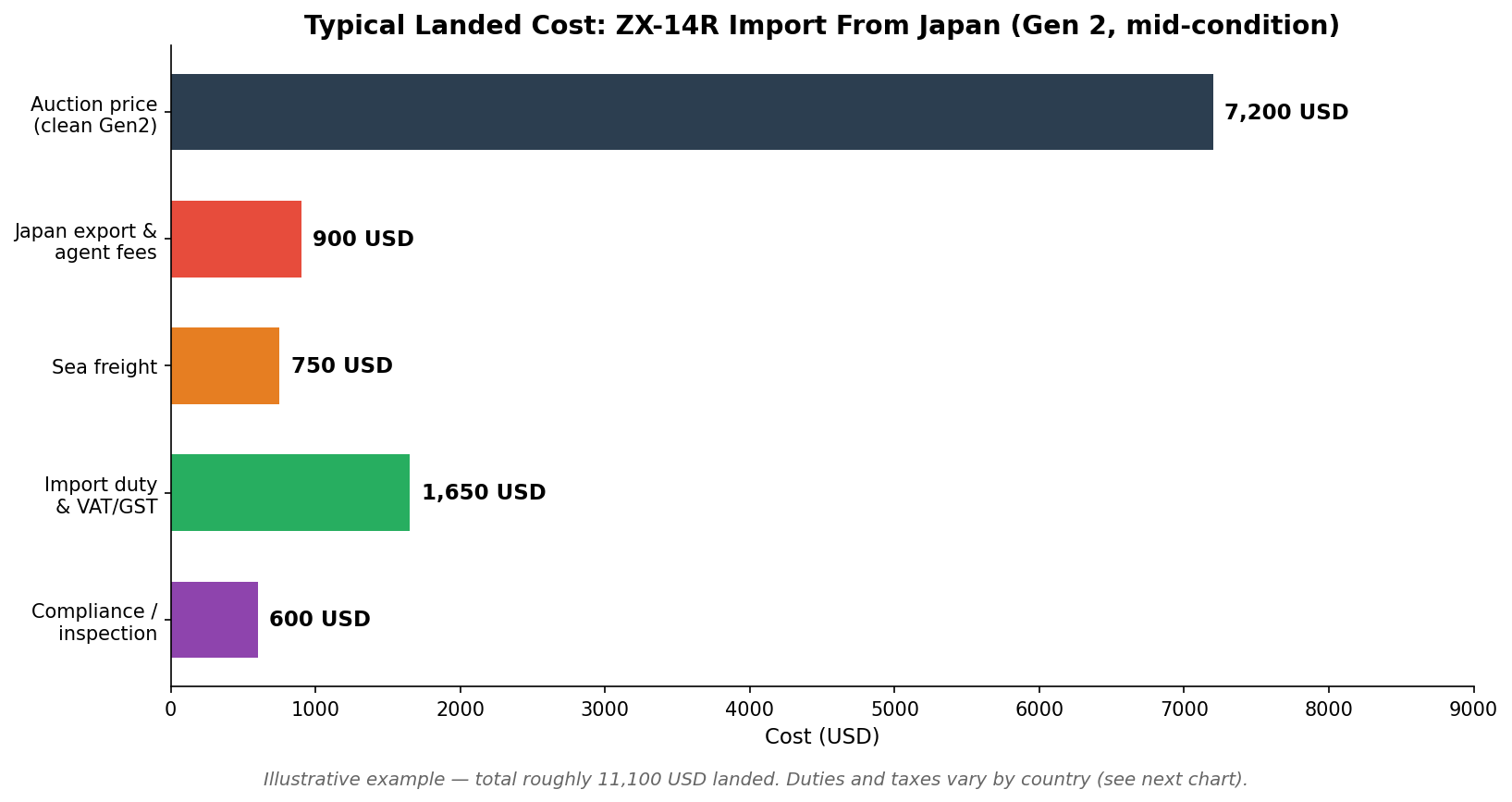
Let's talk numbers, because this is where importing stops being a fantasy and becomes a spreadsheet. The chart above breaks down a realistic example: a clean Gen 2 ZX-14R bought at a Japanese auction, shipped, taxed and complied into a Western market.
The auction price for a tidy, mid-mileage Gen 2 sits around 7,200 USD equivalent in 2026 — Gen 1 bikes are meaningfully cheaper, often well under 5,000 USD. On top of that you have Japan-side export handling and agent fees (roughly 900 USD), sea freight (around 750 USD for crated or RoRo shipping), then your home-country import duty and consumption tax, and finally any compliance or inspection work. In the example shown, that adds up to about 11,100 USD landed.
Put that against a used ZX-14R at a Western dealer and the maths often favours importing — especially because the Japanese bike is typically lower mileage and better kept. One long-time owner captured why these bikes hold their appeal: "I sold mine, and five months later I missed it so much I bought a brand-new one. Best bike I have ever owned." Bikes people regret selling do not get cheap. Importing is how you sidestep the local premium on a machine nobody wants to let go of.
Two honest caveats. First, exchange rates move — every figure here is a 2026 ballpark, and the yen's level is a big part of why importing is attractive right now. Second, the auction price is the smallest source of nasty surprises; the fees and taxes are where people get caught out, which is exactly why the next section breaks costs down country by country.
Country-by-country rules: US, UK, Australia, New Zealand
The rules change dramatically depending on where you live. Here is the plain-English version for the four biggest English-speaking markets.
United States
The US runs a rolling 25-year rule enforced by the NHTSA. Any motorcycle 25 or more years old can be imported without meeting current federal safety standards. For the ZX-14R that is a slow-moving door: the first 2006 Gen 1 bikes become eligible in 2031. Until then, importing a newer ZX-14R into the US as a road bike is not straightforward, because it was federally sold here and a used-market example is often easier to buy domestically. If you are American and set on importing from Japan specifically, you are usually looking at a future Gen 1 play or a track/off-road route. We spell this out honestly because it is the one market where importing this particular bike is not the obvious win it is elsewhere — see our US import guide for the full picture.
United Kingdom
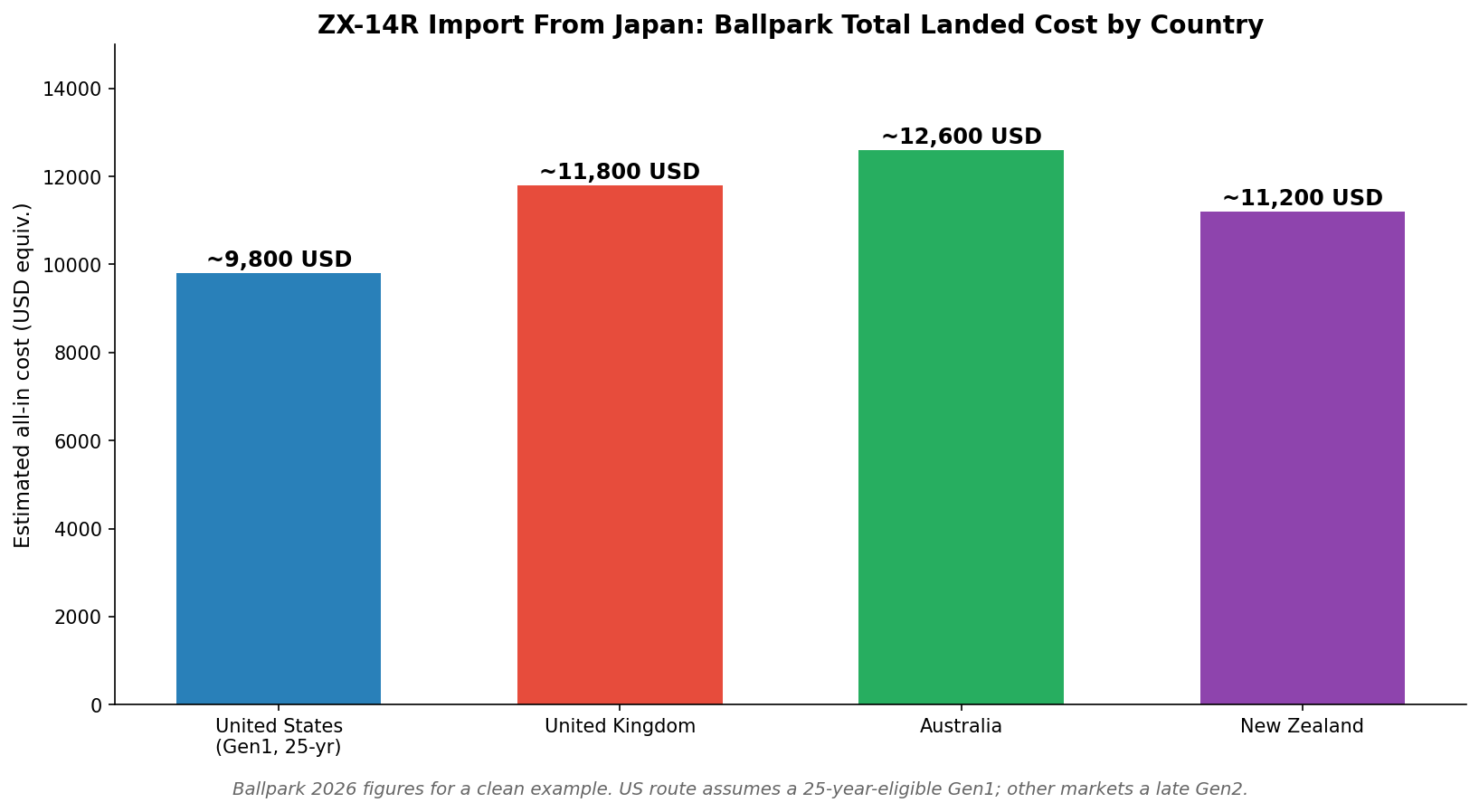
The UK is one of the friendliest markets for importing a ZX-14R. You will pay import duty and VAT on arrival, register the bike through the NOVA (Notification of Vehicle Arrival) system, and because the ZX-14R was UK-market, getting it road-legal is refreshingly simple. Expect an all-in cost around 11,800 USD equivalent for a clean Gen 2 in the example above. The UK's deep used-bike culture also means parts and specialists are everywhere.
Australia
Australia allows imports but the compliance regime is stricter and the total cost is the highest of the four markets here — around 12,600 USD equivalent — driven by GST, Luxury Car Tax thresholds in some cases, and stricter compliance requirements. The upside is that the ZX-14R has a passionate following in Australia and holds value well once landed.
New Zealand
New Zealand is famously import-friendly, which is why so many JDM machines end up there. The compliance process is well-trodden, GST applies, and a clean Gen 2 lands around 11,200 USD equivalent. Kiwis have been importing Japanese bikes for decades, so the infrastructure is mature and the community knows these bikes inside out. One ZX-14R owner described cruising New Zealand roads on his daily — the bike is a known and loved quantity there.
The country-cost chart above puts these four side by side. The US number assumes a future 25-year-eligible Gen 1; the others assume a late Gen 2. Your exact figure will depend on the specific bike, the exchange rate, and the compliance work needed — but these are honest ballparks to plan around.
How to read the auction sheet on a ZX-14R
Every bike sold through a Japanese auction comes with an inspection sheet, and learning to read it is the difference between a great import and an expensive mistake. For a ZX-14R specifically, here is what to zero in on.
The grade. Japanese auctions grade bikes on a scale — a 4 or 4.5 is a solid, clean used bike; a 5 or 6 is exceptional; anything with an R in the grade means the bike has been repaired after damage. On a hyperbike that may have been crashed or drag-raced, the grade is your first filter.
The frame code. As covered earlier, ZXT40 is Gen 1 (1,352cc) and the later ZXT40 variants are Gen 2 (1,441cc). Confirm the code matches the year the seller claims. This is how you cut through the ZZR1400 / ZX-14 / ZX-14R naming maze with certainty.
The mileage and the map. The sheet includes an odometer reading and a diagram of the bike marked with any scratches, dents or corrosion. On a ZX-14R, pay special attention to marks around the fairings and the exhaust — signs of a drop or a hard life. Low, verified mileage on a stock Gen 2 is the jackpot.
Modifications. The sheet and photos will reveal an aftermarket exhaust, a tail tidy, a non-standard screen or an obviously modified rear end. None of these are automatically bad, but each one is a question you want answered before you bid. If you want the deep version, we have a full guide on reading Japanese auction inspection sheets.
Why the ZX-14R exists: the top-speed war explained
To understand why the ZX-14R is the bike it is, you have to understand the fight that created it. In 1999, Suzuki dropped the original Hayabusa and claimed the title of fastest production motorcycle on earth, nudging 194 mph. Kawasaki answered in 2000 with the ZX-12R, aiming for 200 mph. The escalation spooked regulators — European politicians openly discussed banning fast bikes — and so the manufacturers blinked first and agreed among themselves to cap everything at 300 km/h. The war for the number was over almost as soon as it started.
But the engineering race did not stop; it just changed target. Instead of chasing a bigger speedo number, Kawasaki poured everything into making the fastest bike that was also the most usable. The 2006 ZZR1400 / ZX-14 was the result: monstrous power delivered so smoothly and with such stability that it flattered ordinary riders. The 2012 ZX-14R doubled down, adding displacement and electronics rather than chasing a headline top speed it was not allowed to advertise anyway.
That history is why the bike feels the way it does. It was never designed to be a peaky, scary missile. It was designed to be the ultimate high-speed grand tourer that happens to obliterate anything at a set of traffic lights. Knowing that changes how you shop for one: you are not looking for a stripped-out racer, you are looking for a well-kept, comfortable, high-mileage-capable machine that has been loved rather than thrashed. The bikes that survive best are the ones ridden hard on open roads and maintained obsessively — which is exactly the profile of a typical Japanese-market example.
Living with a ZX-14R: real running costs and servicing
A hyperbike sounds expensive to run, and it can be if you ride it like it is stolen. Ridden sensibly, a ZX-14R is surprisingly civilised, and the ownership numbers are worth knowing before you import one.
Fuel. Owners report real-world economy in the region of 10 litres per 100 km when ridden briskly, opening out to better than that on a steady motorway cruise. One rider noted a practical touring range of around 200 km between fills from the 22-litre tank before the light comes on. It drinks premium unleaded, and it will drink a lot of it if you use the performance, but as a tourer it is no thirstier than many big adventure bikes.
Tyres. This is where the power tax shows up. A 190-section rear tyre on a 200-plus horsepower bike does not last forever, and hard riders can wear a rear in a few thousand kilometres. Budget for good rubber and check the tyres carefully on any import — a squared-off rear is a sign of a motorway-mile bike, which is not necessarily bad, but factor a fresh set into your first-year costs.
Servicing. The engine is famously durable — this is a motor tuners routinely push past 400 hp, so in stock 197 hp trim it is barely working. Valve-clearance checks come at long intervals, oil and filter changes are conventional, and the chain-and-sprocket set is a normal wear item. The monocoque frame makes some jobs slightly more fiddly than on a conventional-frame bike, but nothing a competent mechanic cannot handle. The single biggest thing that protects value is a documented service history, and Japanese bikes usually come with a thick stack of stamps.
Insurance and depreciation. A big-power bike costs more to insure, no surprise there. But depreciation on a well-kept ZX-14R has flattened out — these are becoming modern classics, and the fact that the model was discontinued has put a floor under clean examples. As one owner said after re-buying his, they are bikes you regret selling. That sentiment is what keeps used values firm.
Common mistakes when importing a ZX-14R (and how to dodge them)
Most import horror stories are not bad luck — they are avoidable errors. Here are the ones that catch ZX-14R buyers specifically.
Buying a drag bike by accident. Because so many ZX-14Rs are modified for straight-line racing, it is genuinely easy to bid on a bike with a stretched swingarm, a nitrous kit, or an engine that has been apart more times than anyone will admit. If you want a clean stock tourer, insist on stock, and have someone who reads the auction sheet and photos flag every modification before you commit.
Confusing the generations. Paying Gen 2 money for a Gen 1 bike, or assuming a "ZZR1400" is a lesser machine than a "ZX-14R," happens constantly. Confirm the frame code, confirm the displacement, confirm the year. The names lie; the codes do not.
Underestimating the taxes. The auction price is the number everyone fixates on, but the duty, VAT or GST, and compliance costs are where budgets blow up. Do the full landed-cost maths for your specific country before you fall in love with a listing. The cost charts above are your starting point, but get a firm quote for your market.
Ignoring the recall history on early bikes. On a 2006–2007 Gen 1, confirm the frame recall was carried out. It almost always was, and it is documented, but skipping that check on the oldest bikes is a needless risk.
Going it alone at a trade-only auction. The Japanese auctions are not consumer marketplaces. They are fast, in Japanese, and closed to the public. Trying to navigate them without an agent who knows the ZX-14R market is how people end up overpaying for the wrong bike. This is precisely the problem a good import partner solves.
ZX-14R special editions and colours worth hunting
Part of the fun of importing from Japan is access to colours and editions that never reached your local showroom. The ZX-14R ran through a long list of paint schemes, and a few are genuinely collectible.
The most sought-after is the 40th Anniversary Edition, finished in the classic lime-green-and-blue Kawasaki racing livery that nods to the brand's superbike heritage. It is the one collectors chase, and clean examples command a premium. Beyond that, the ZX-14R appeared in a rotating cast of finishes — Metallic Spark Black, Golden Blazed Green, Candy Surf Blue, and various red and grey schemes — many of which were market-specific. A Japanese-market bike often wears a combination you simply could not buy new in the UK, US or Australia, which is a quiet bonus of importing: your bike will not look like every other one at the meet.
What should you actually prioritise, colour or condition? Condition, every time. A pristine, low-mileage, fully-documented bike in a plain colour is a far better buy than a scruffy example in the anniversary paint. But when you can get both — and on the deep Japanese market you often can — that is when importing really pays off. Tell your agent your dream spec and let them wait for the right one to cross the block rather than settling for whatever is nearby.
One more tip: original bodywork matters. The ZX-14R's fairings are expensive and the paint is complex, so a bike wearing all its factory panels in good order is worth more than one patched with aftermarket plastics — however tidy those look in photos. It is another line on the auction sheet worth reading carefully.
How AWA Auction gets you the right ZX-14R
This is the part that turns all of the above from theory into a bike in your garage. Bidding at a Japanese auction is not something you can just walk in and do — the auctions are trade-only, conducted in Japanese, and run at a pace that assumes you already know exactly what you are looking at. That is where we come in.
We watch the ZX-14R and ZZR1400 listings crossing the major Japanese auctions every week. We read the sheets, translate the grades, flag the modified bikes, verify the recall and service history, and bid on your behalf so you are not gambling on a machine you have never seen. Then we handle the export paperwork and shipping to your country.
You can browse the motorcycles we currently have available to see what is crossing the auctions right now, and if you have a specific ZX-14R in mind — a particular generation, year, colour or a guaranteed-stock example — you can tell our team exactly what you are hunting and we will go and find it.
The ZX-14R is one of the last of a breed: the unapologetic, do-everything hyperbike, built before emissions rules killed the big inline-fours. Owners keep them for decades and buy them twice. Japan has the cleanest examples on earth, and in 2026 the exchange rate still makes them a steal. Importing from Japan is not the hard way to get one — it is the way to get the best one.
See Also
Share this article: