
If you want to import a motorcycle from Japan to New Zealand, here is the good news up front: New Zealand is one of the easiest countries on earth to do it in. No 25-year ban like Australia. No EPA and DOT paperwork like the United States. Kiwis have been importing Japanese vehicles by the shipload for forty years, the system is built for it, and motorcycles ride right through the middle of it tariff-free.
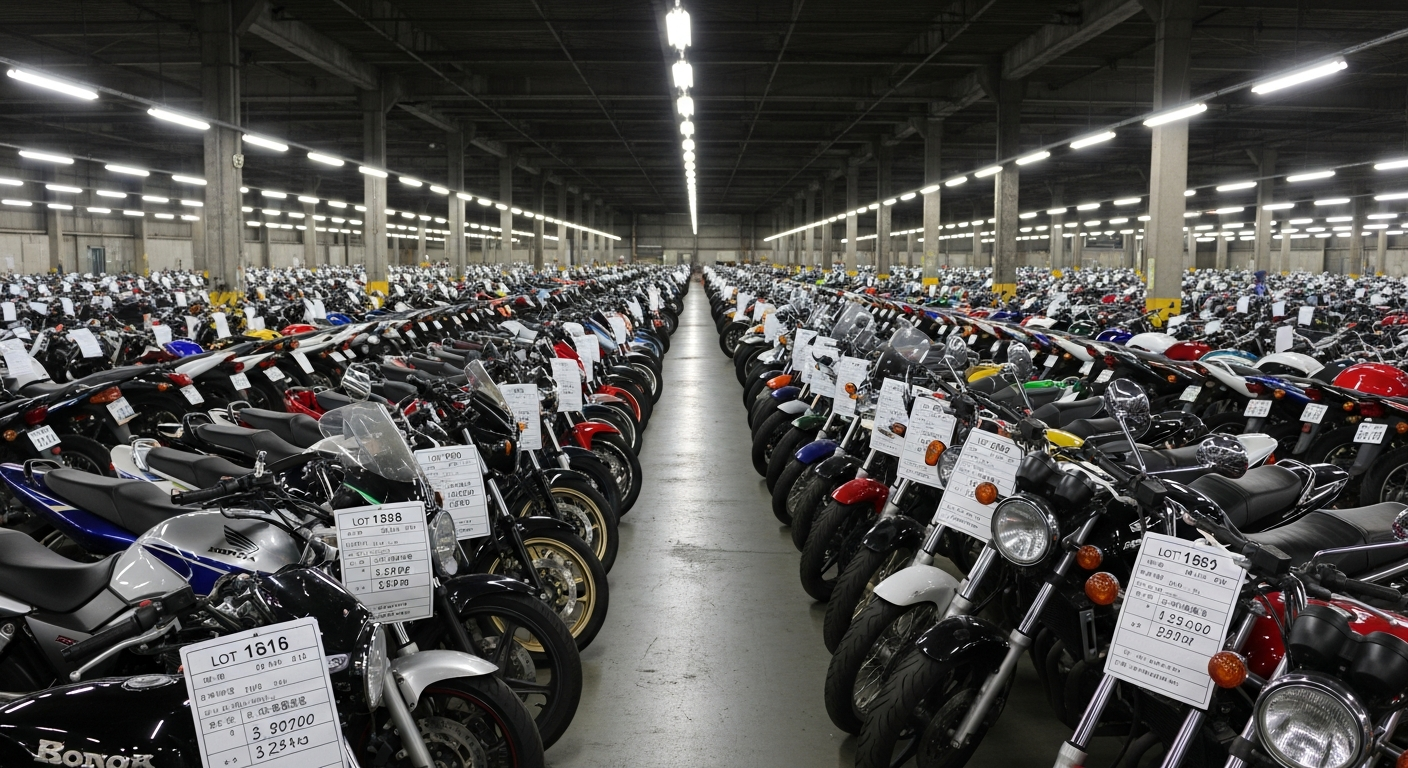
The bike you actually want — a tidy Honda CB400 Super Four, a one-owner SR400, a screaming RGV250, a low-kilometre ZRX1200 — is sitting in a Japanese auction yard this week, often for half what the same machine costs at a dealer in Auckland or Christchurch. The Japanese sell their bikes early, keep them immaculate, and grade every one of them on an inspection sheet you can read before you bid.
Here's the thing nobody tells you: the bike is the easy part. What trips people up is the order of operations and the boring details — the export deregistration certificate, the steam-clean before the biosecurity inspector sees a fleck of mud, the entry certification that turns a foreign machine into a road-legal Kiwi bike with plates. Get the sequence right and the whole job is almost dull. This guide walks the entire path, from why Japan is the best used-bike market alive to the exact day your new plates arrive.
Why import a motorcycle from Japan to New Zealand at all?
Japan built a used-vehicle culture with no equal. The shaken roadworthy inspection regime gets brutally expensive as a bike ages, so Japanese owners sell early and sell often. The domestic market prizes low kilometres above almost everything. And the auction houses grade every machine with a transparency our local Trade Me listings can only dream about. The result is a river of well-kept motorcycles changing hands every week at the big auctions — BDS, JBA, and the motorcycle lanes of the larger USS halls.
For a New Zealand buyer, three things make this irresistible. First, price. A JDM-market Honda VFR400 or Yamaha FZR400 in genuinely good order routinely sells in Japan for a third to a half of the local asking price here. Second, choice. New Zealand never officially received many of the bikes enthusiasts crave — the 250cc and 400cc grey-market four-strokes, the two-stroke race-replicas, the rare 90s nakeds. Japan has them by the hundred. Third, condition you can verify before you bid, thanks to the auction inspection sheet.
If you have never read one of those sheets, stop and learn — it is the single most valuable skill in this entire game. Our guide to reading the Japanese auction sheet breaks down the grades, the corrosion maps, and the inspector shorthand. The Kiwi who learns to read these sheets buys better bikes than the one who flies to Tokyo and pokes them with a screwdriver.
One YouTube reality check worth keeping in mind: the channels that actually walk the Japanese auction floors — the popular "motorbikes in Japan, cheaper than you think" videos pulling hundreds of thousands of views — consistently show clean 400-class machines hammering in the NZ$3,000 to NZ$5,000 bracket. That is the number that makes the rest of the cost stack worth swallowing. And the people who do this well, like the import-experience videos where a buyer wins a bike at a Japanese auction and follows it all the way home, all repeat the same lesson: the paperwork is what wins or loses, not the bidding.
Can Kiwis legally import a motorcycle from Japan? The honest answer
Yes — and more easily than almost anywhere else in the English-speaking world. New Zealand does not run a blanket age ban on imported motorcycles. There is no rule that says "nothing newer than 25 years," the way Australia and the USA effectively do. A bike of almost any age can be imported and registered, as long as it can be certified as meeting New Zealand's safety and emissions requirements through the entry certification process.
The agency in charge is NZ Transport Agency Waka Kotahi (NZTA), and they are the source of truth that overrides any forum post, including this article. Their rules sit alongside two other gatekeepers you will meet: New Zealand Customs, who collect the GST, and the Ministry for Primary Industries (MPI), who run the biosecurity inspection. Clear all three and your bike gets plates.
Motorcycles are treated more simply than cars here. Cars get tangled in emissions standards, frontal-impact rules, and odometer checks. Bikes dodge most of that. There is no import duty on a motorcycle at all — they come in tariff-free — and the only border tax is GST. That does not make a bike a free pass; every used vehicle still has to clear biosecurity and pass entry certification. But the average Kiwi importing one bike for personal use has a genuinely manageable job ahead.
Why New Zealand's import rules beat Australia's and America's
This is the section that should make you grin if you have ever read our guides on importing to Australia or the USA. New Zealand is, plainly, the friendliest of the three.
Australia enforces a hard 25-year rule for the easy concessional pathway: anything newer than 25 years generally needs a licensed compliance workshop and a Vehicle Import Approval granted before the bike ships. The United States is stricter still — its 25-year exemption from federal DOT and EPA rules is famously rigid, and a bike one month too young can be seized at the border. New Zealand does neither of those things to motorcycles.
Instead, New Zealand works on certification, not prohibition. A bike of any age can come in, and the age only changes how it gets certified. Vehicles 20 years or older are treated as older vehicles and are exempt from having to prove compliance with modern frontal-impact standards — the same generous threshold that makes New Zealand a magnet for classic-car imports. Newer bikes simply have to meet the safety standards that applied when they were built, which the vast majority of modern Japanese motorcycles already do.
Read that difference again, because it is worth real money. A 2003 motorcycle is too young for Australia's 25-year door until 2028, and too young for the US exemption until 2028 as well. In New Zealand, that same 2003 bike is already past the 20-year line and rides in with the lightest possible compliance burden. You get a five-year head start on the rest of the English-speaking world.
For genuinely rare or non-standard machines that cannot meet a normal standard, NZTA also runs a special interest vehicle pathway — for bikes of historic value, or models where fewer than a defined number of units were built per year. Most buyers never need it, but it exists as a backstop for the exotic stuff.
The documents you need from Japan
Almost every avoidable delay in a New Zealand import traces back to one missing piece of Japanese paperwork. Get these sorted before the bike leaves the auction yard and the rest of the process is smooth.
The key document depends on engine size, because Japan registers bikes in two brackets:
Motorcycles over 250cc
For anything above 250cc you need the original deregistration (export) certificate issued when the bike is taken off the Japanese register — the MLIT return inspection certificate from Japan's Ministry of Land, Infrastructure, Transport and Tourism. This proves the machine was legally registered in Japan and has been cancelled for export. NZTA's entry certifier wants the original, not a photocopy, so your agent has to physically post it with the bike or to you.
Motorcycles 125cc to 250cc
For the 125cc-to-250cc class — the light motorcycle category that includes legends like the NSR250 and TZR250 — you need the original mini-vehicle notification certificate, confirmation of return, issued by the Japan Light Motor Vehicle and Motorcycle Association. Same idea, different issuing body, because Japan handles these smaller bikes through a separate notification system rather than full registration.
On top of the deregistration document, you want the bilingual auction sheet (or a translation of it), the invoice showing what you paid, and the bill of lading from the shipping line. Keep every one of these. The entry certifier, Customs, and your future self selling the bike all want to see them.
Step-by-step: how the import actually works
Here is the full sequence, in the order you actually do it. Tape it to the fridge and do not jump steps.
Step 1 — Find and win the bike
You bid through an export agent who holds a seat at the Japanese auctions, or through a service that aggregates the auction feeds for overseas buyers. You set a maximum bid, the agent bids for you, and if you win you pay the hammer price plus the auction and agent fees. Before you bid, read the inspection sheet and set a hard ceiling. This is exactly where AWA Auction lives — we bid the Japanese lanes for New Zealand buyers and translate the sheets so you are not guessing. Browse what is crossing the block right now on our current listings.
Step 2 — Deregister and collect the export documents
Once you own the bike, your agent deregisters it in Japan and obtains the export certificate described above. This is the single most important piece of paper in the whole job. No export certificate, no entry certification in New Zealand.
Step 3 — Steam-clean to biosecurity standard
Before the bike is loaded, it gets a thorough wash — and not a quick rinse. MPI will inspect every nook on arrival, so the chain, the underside, the wheel arches, and the air intake all need to be spotless. A reputable Japanese exporter does this as standard. Skimp here and you pay for an MPI clean at the wharf, which costs more and burns days.
Step 4 — Ship it to New Zealand
The bike is crated or strapped and loaded for the voyage to Auckland, New Zealand's main vehicle port. Transit from Japan typically runs two to three weeks. You insure the shipment — marine insurance is cheap relative to the value at risk.
Step 5 — Customs clearance and GST
On arrival, a customs broker files the import entry and you pay 15% GST on the landed value. There is no duty on motorcycles, so GST is the only border tax. Pay it and Customs releases the bike to the next gate.
Step 6 — MPI biosecurity inspection
An MPI officer inspects the bike inside and out for soil, seeds, insects, and other quarantine risks. A genuinely clean bike clears first time. A dirty one gets sent for a supervised clean at your expense before it can move.
Step 7 — Entry certification
You take the bike to an NZTA-approved entry certifier — the same kind of place that does compliance checks for imported cars. They verify the documentation, inspect the bike for safety and condition, decide whether it needs any repairs, and, when it passes, issue a warrant of fitness and clear it for registration.
Step 8 — Register and get your plates
With entry certification done, you register the bike, pay the registration and plate fees, and ride away on a road-legal New Zealand motorcycle. That is the finish line.
What it really costs to import a motorcycle from Japan to New Zealand
Forget the hammer price for a second — the number that matters is the landed-and-registered cost, the total to get the bike road-legal in your driveway. The encouraging news for Kiwis is that without import duty, the New Zealand stack is leaner than Australia's or America's.
Here is a realistic breakdown for a clean 400-class bike that hammers at around NZ$3,500, the kind of money those auction-floor YouTube videos show changing hands every week.
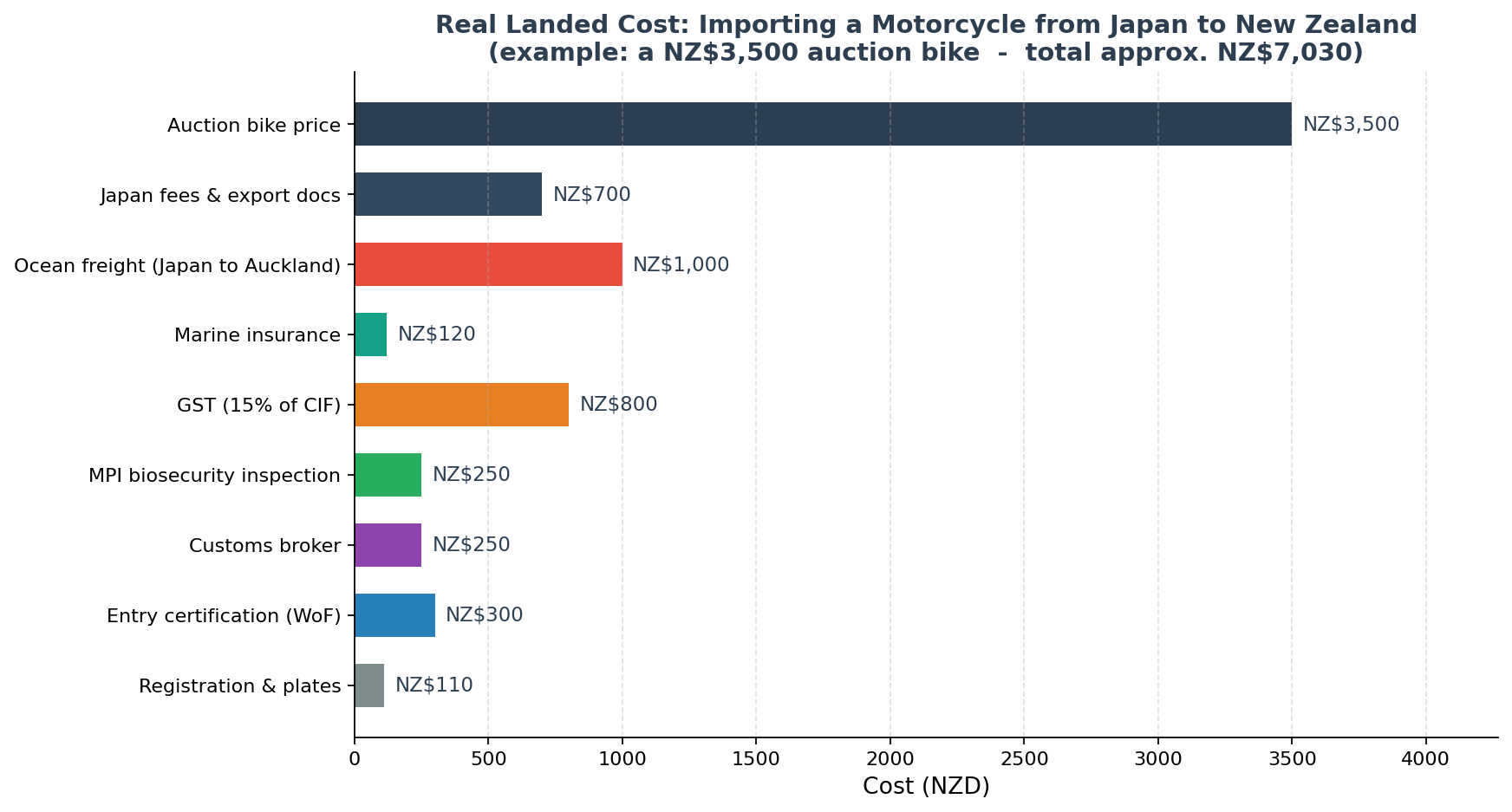
Walk down the stack. The Japan-side fees — auction commission, deregistration, domestic transport to port, export handling — run around NZ$700. Ocean freight to Auckland sits near NZ$1,000 for a single bike, with marine insurance adding roughly NZ$120. At the border, GST is 15% of the CIF value (cost plus insurance plus freight), which on this example lands near NZ$800. Then come the New Zealand compliance costs: MPI biosecurity inspection around NZ$250, a customs broker around NZ$250, entry certification around NZ$300, and registration plus plates around NZ$110.
Add it up and a NZ$3,500 auction bike costs roughly NZ$7,000 on the road. Notice the shape of it: roughly half the total is the bike, and the other half is the cost of getting it here and certified. That ratio is the single most important thing to understand before you bid, because it tells you the import only pays on bikes that are scarce or overpriced locally. On a common machine that Kiwi dealers sell cheaply, the freight and GST wipe out the saving. On a rare grey-market four-stroke or a clean two-stroke replica, you still come out well ahead.
Two honest caveats. Freight is the most variable line — a shared-container slot is cheaper than a sole-use crate, and rates move with fuel and season, so get a real quote rather than trusting this estimate. And the GST is calculated on the value Customs assigns, which includes freight and insurance, so the real GST figure is always more than 15% of the purchase price alone.
How long the whole thing takes
From the moment you win the bid to the day you get plates, budget six to nine weeks for a clean, well-organised import. Most of that time is waiting, not working.
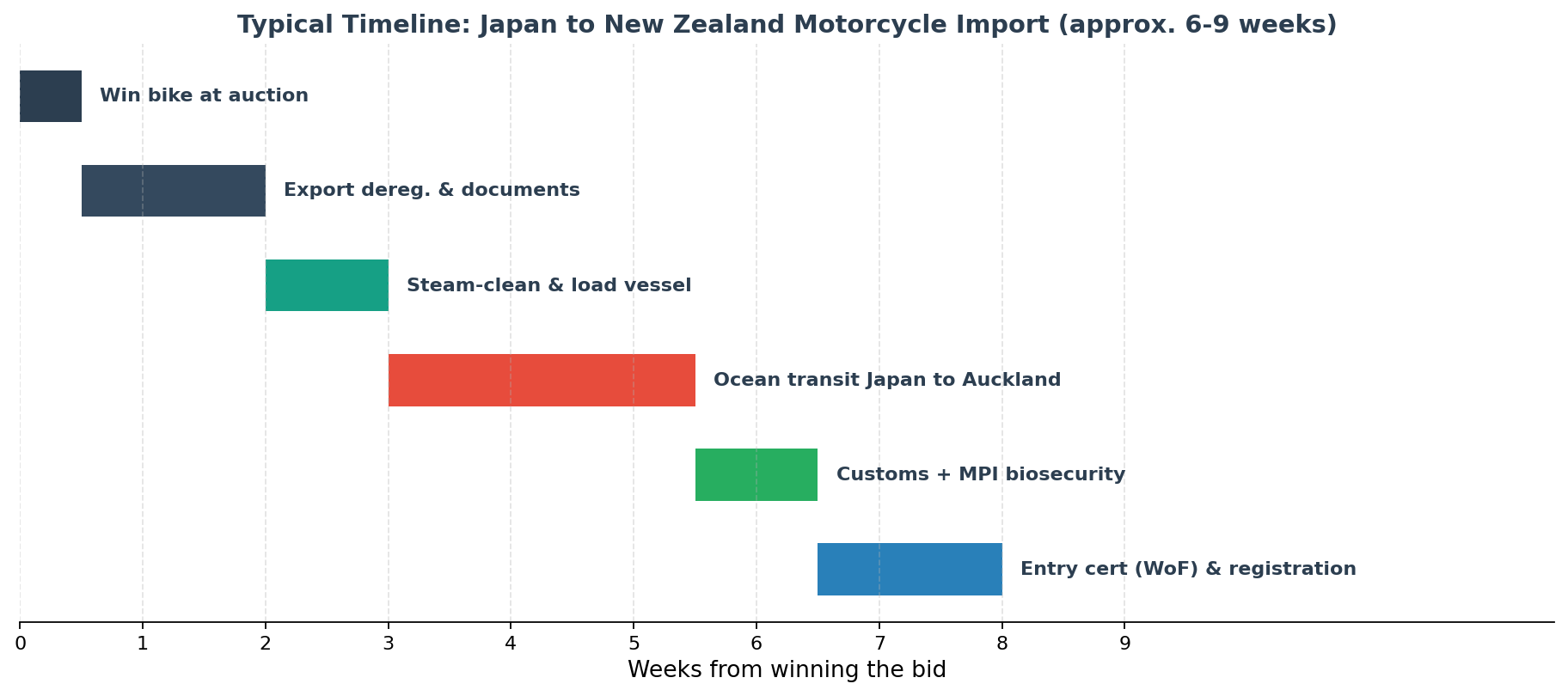
The big chunks are deregistration and export documents (one to two weeks while the Japanese paperwork is processed), ocean transit to Auckland (two to three weeks), and then the New Zealand gates — Customs and MPI clearance in about a week, and entry certification plus registration in another week or two depending on the certifier's queue. Nothing in that chain is hard. The skill is starting each step the moment the previous one finishes, instead of letting the bike sit while a document chases it across the Pacific.
Entry certification, WoF and registration, explained
This is the part that confuses first-timers, so let us untangle it. Entry certification is the one-time process that turns an imported bike into a vehicle New Zealand recognises. A normal warrant of fitness (WoF) is the routine roadworthy check every Kiwi bike gets periodically. Registration is the act of putting the vehicle on the New Zealand register and getting plates. They happen in that order, and the entry certifier handles the first WoF as part of certification.
An NZTA-approved entry certifier — you will know the brands from car compliance — checks that the documentation is genuine and complete, confirms the bike matches its papers, inspects brakes, tyres, lights, steering, and structure, and decides whether anything needs fixing before it can pass. For a tidy bike with clean paperwork this is a formality. For a bike with a dodgy repair or a missing document, this is where the problem surfaces, which is exactly why reading the auction sheet correctly at the start matters so much.
Once the certifier issues the WoF and clears the bike, you register it, pay the fees, and receive your plates. From there your import behaves like any other registered motorcycle in New Zealand — periodic WoF, annual registration, the lot.
Biosecurity: why a clean bike clears first time
New Zealand takes biosecurity more seriously than almost any country on the planet, and for good reason — the entire economy leans on agriculture, and one stray pest can do billions in damage. Every used vehicle entering the country gets a physical MPI inspection, inside and out, looking for soil, plant material, seeds, egg masses, and insects.
Here is the thing nobody mentions: this is the single easiest place to save money, and people throw it away constantly. A bike that arrives genuinely spotless clears the inspection first time at the standard fee. A bike with caked mud on the chain, grass seeds in the bash plate, or a spider colony in the airbox gets pulled for a supervised clean — and you pay for that clean, plus the extra days the bike sits in a holding yard. Insist your exporter steam-cleans to MPI standard before loading. It is the cheapest insurance in the whole import.
Common mistakes — and what nobody tells you
Most New Zealand imports that go wrong fail for the same handful of reasons. None of them are about the bike itself.
Buying a common bike. The maths only works on scarcity. Importing a model that Kiwi dealers already sell cheaply means paying NZ$2,000 in freight and GST to save nothing. Pick a bike New Zealand never got, or one that commands a silly premium locally.
Losing the original export certificate. A photocopy will not do. If the original deregistration document does not arrive with the bike, entry certification stalls until it does — and chasing a lost original from Japan can take weeks.
Skipping the steam-clean. Covered above, but it bears repeating because it is the most common avoidable cost. A dirty bike is an expensive bike.
Misreading the auction sheet. A bike graded with an accident-history note or a corrosion map you ignored can fail entry certification or need repairs that erase your saving. Learn the sheet, or work with someone who reads them daily.
Forgetting that GST rides on freight. Buyers budget 15% of the purchase price and get a surprise when the bill is higher, because GST is charged on the value-plus-freight-plus-insurance. Budget the real number from the start.
Which Japanese bikes are the best value to import to New Zealand
The rule is simple: import the bikes New Zealand never officially sold, or the ones that command a daft premium on the local market. Scarcity here plus abundance in Japan is what makes the freight worth swallowing.
The 400-class four-strokes are the sweet spot — the Honda CB400 Super Four, VFR400, and CBR400RR, the Kawasaki ZXR400, the Yamaha FZR400. New Zealand's licensing rules have long favoured smaller-capacity bikes, which makes a learner-legal 400 with real performance genuinely desirable, and Japan has thousands of them in beautiful condition. The two-stroke 250 replicas — the Honda NSR250, Yamaha TZR250, and Suzuki RGV250 Gamma — are pure JDM legends that almost never came here new, so importing is often the only way to get a clean one.
Modern classics travel well too. The Yamaha SR400 and Kawasaki W650 have devoted Kiwi followings and short local supply. And the big air-cooled nakeds — the Kawasaki ZRX1200, Yamaha XJR1300, Honda CB1300 — offer a lot of muscle for the money when bought at a Japanese auction rather than from a local specialist. As the seasoned reviewers on channels like FortNine repeat: the best used motorcycle is a well-kept one with honest history, and the Japanese auction sheet is the closest thing to honest history you will ever get from a stranger.
Choosing your shipping method without overpaying
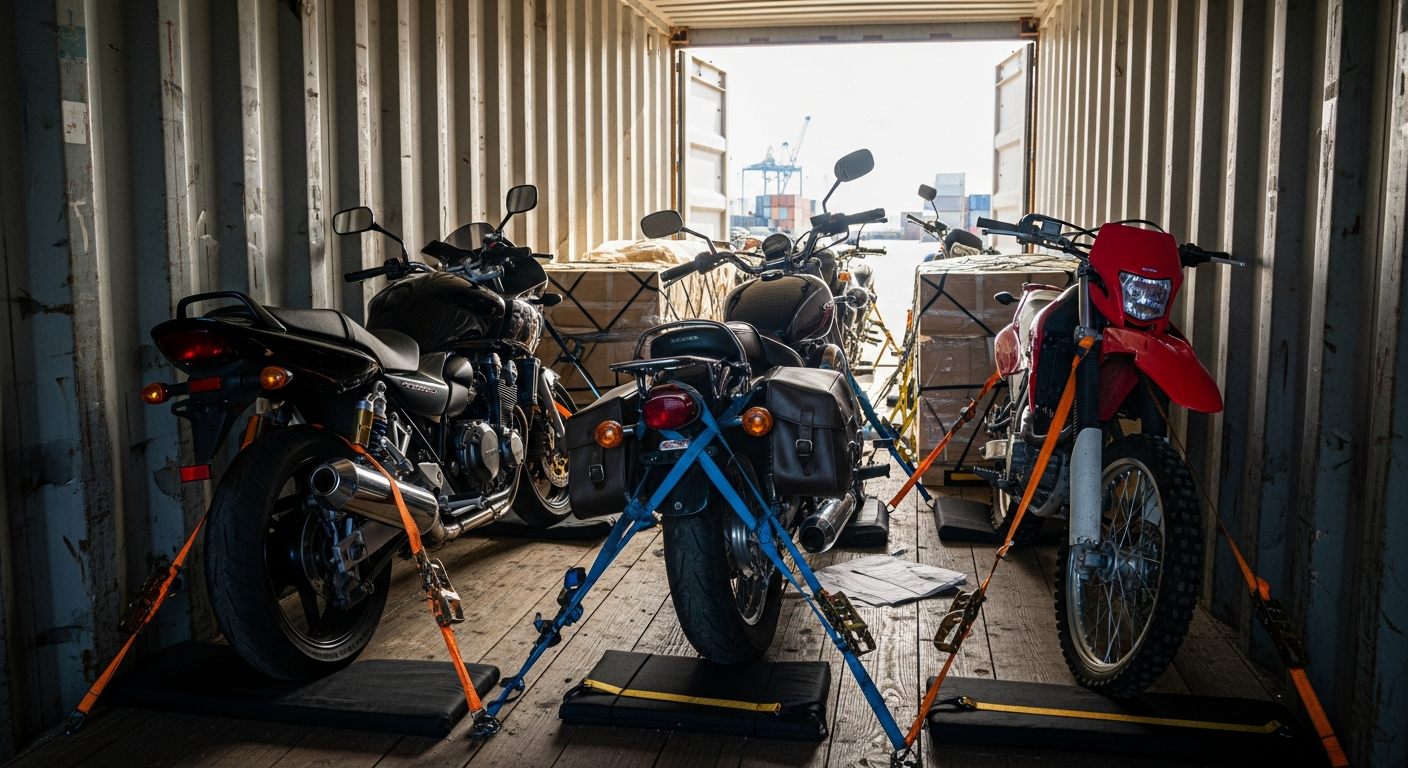
Shipping is where small decisions quietly add or save hundreds of dollars. For a single motorcycle, a shared or consolidated container — where your bike shares a box with other vehicles or freight — is the usual choice from Japan, with the bike strapped down securely for the voyage. A sole-use container is overkill for one bike unless you are also shipping a pile of spares.
Ship to Auckland unless you have a specific reason not to — it handles the overwhelming majority of New Zealand's vehicle imports, which keeps freight competitive and clearance routine. If you live in the South Island, factor the cost of moving the bike down from Auckland into your sums rather than chasing a port that looks cheaper on paper. The full trade-offs on crating, consolidation, and marine insurance sit in our guide to shipping a motorcycle from Japan. Whatever you choose, insure the shipment — it is cheap relative to the value at risk, and the one time you need it pays for every time you did not.
Should you use an agent or go it alone?
You can, in theory, register with a Japanese auction proxy, bid yourself, arrange your own freight forwarder, and project-manage the whole thing from your laptop in Wellington. People do it. Whether you should depends on how much risk you want to carry personally.
The auctions are trade-only — you cannot walk in off the street and bid, which is why a licensed intermediary exists at all. Beyond access, the real value an agent adds is judgement: reading the inspection sheet correctly, spotting the repainted tank or the accident-history note, knowing which auction houses grade harshly and which are generous, and arranging the export certificate and steam-clean so the bike clears New Zealand biosecurity and certification first time.
Going solo saves the agent's margin but exposes you to the expensive mistakes — the misread sheet, the failed biosecurity inspection, the lost original document. For a first import especially, a good agent usually pays for itself in errors avoided. Once you have done a few and learned the sheet yourself, the balance shifts. There is no shame in either choice; just know which risks you are signing up to own. If you would rather hand the messy bits to people who do this every day, that is what we are here for — talk to our team and we will walk you through it.
Your one-page New Zealand import checklist
Tape this to the wall. Tick every box in order and you have done it right.
- Read the auction inspection sheet and set a hard maximum bid.
- Confirm the bike's real build date and engine capacity (it sets which export document you need).
- Win the bike through a licensed agent or proxy and pay the hammer plus fees.
- Have the bike deregistered in Japan and collect the original export certificate.
- Insist on a biosecurity-standard steam-clean before loading.
- Book shipping to Auckland with marine insurance.
- Engage a customs broker to file the entry and pay 15% GST on arrival.
- Clear the MPI biosecurity inspection — a spotless bike clears first time.
- Take the bike to an NZTA-approved entry certifier for the WoF and compliance check.
- Register the bike, pay the fees, and collect your plates.
- Sort insurance and a spares plan before the first ride.
That is the entire job. None of the steps are hard on their own; the skill is doing them in the right order and not skipping the boring ones. Do that, and the bike New Zealand never sold ends up in your shed for a price the local dealer could never match.
Living with an imported bike: insurance, parts and resale
Once the bike is plated it behaves like any other registered motorcycle in New Zealand, with two small wrinkles worth planning for before the first ride.
First, insurance. Some insurers price grey imports cautiously or want an agreed-value policy with photos and a description, particularly for rarer models. Sort this out before you ride, and use an agreed-value policy for anything collectible so that a write-off pays what the bike is actually worth rather than a generic book figure. A clean import history and the auction sheet help here — they give the insurer confidence in what they are covering.
Second, parts and servicing. The mechanical consumables on most Japanese imports — filters, pads, tyres, chains, fork seals — are shared with models New Zealand did sell, so they are easy to source. The model-specific bits, like fairing panels, badges, and two-stroke power-valve components, come from Japan. Build a relationship with a parts importer early, or buy a spares package up front for anything rare while you have an agent on the ground in Japan. Nothing kills the joy of a rare import faster than a six-week wait for a side cover.
Resale is the happy ending. Because you bought a scarce bike well, an imported JDM machine in good order tends to hold its value far better than a mass-market new bike that sheds a third of its price the moment it leaves the showroom. Keep the import paperwork, the original auction sheet, and the service records together in one folder — that documented history is exactly what the next buyer pays a premium for, and it is the same honesty the Japanese auction system gave you when you bought it.
See Also
Share this article: