
If you want a Honda VFR800 import from Japan, you are chasing one of the most stubbornly loved motorcycles Honda ever built: a 782cc, 90-degree V4 sport-tourer that sounds like nothing else on the road and simply refuses to wear out. This is the bike owners describe as "by no means superbike fast, but you would be hard pushed to find better value" — a real quote from a UK rider defending his gen-five VFR on social media, and it captures the VFR800 perfectly. It is fast enough, comfortable enough, and reliable to a degree that borders on boring. Honda surveys put it at roughly one reported problem every 15,000 miles across more than 1.25 million miles ridden. Japan is where the cleanest, lowest-mileage, dry-stored examples live, and this guide walks you through every generation, the famous VTEC debate, every known fault, and exactly what a good one costs.
Here is the thing nobody tells you when you start shopping: "VFR800" covers four quite different machines built over 23 years, and mixing them up is how people overpay. We will sort that out first, then get into the metal.
What Is the Honda VFR800 (and Why Japan Has the Best Ones)?
The Honda VFR800 is a full-fairing sport-tourer built around an 782cc liquid-cooled V4 engine — a layout Honda has poured its racing heart into since the 1980s. Think of it as the sensible, do-everything cousin of Honda's fire-breathing race bikes: the same silky V4 character, but geared toward real roads, real distances, and real luggage. It carries a single-sided Pro-Arm swingarm, an aluminium twin-spar frame, dual linked brakes, and one of the most distinctive engine notes in motorcycling. Riders do not buy a VFR because it is the fastest thing in the showroom. They buy it because it does 90% of everything brilliantly and then keeps doing it for a decade.
The V4 is the whole point. Where an inline-four screams and a twin thumps, the VFR800 howls — a hard-edged, offbeat wail that gets louder and angrier the harder you push it. On the early gear-driven-cam bikes that howl is mechanical and pure, and it is the single biggest reason people fall in love. One MCN first-ride video of the VFR has pulled over 350,000 views, and the comment sections are full of owners talking about the sound before they talk about anything else.
So why import from Japan? Because the Japanese domestic market is full of VFR800s that were ridden gently, serviced on time, stored indoors, and never salted through a British or Australian winter. Bikes rot from the outside in, and the VFR's weak spots — exhaust corrosion, electrical connectors, fastener seizure — are exactly the things that a dry, low-mileage Japanese life prevents. You are not just buying a cheaper bike; you are buying a structurally better-preserved one. If you are new to the process, our guide on how to import a motorcycle from Japan covers the mechanics, and why Japanese motorcycles are so reliable explains the culture behind the condition.
Honda VFR800 Generations Explained: Fi, VTEC, Crossrunner and 800F
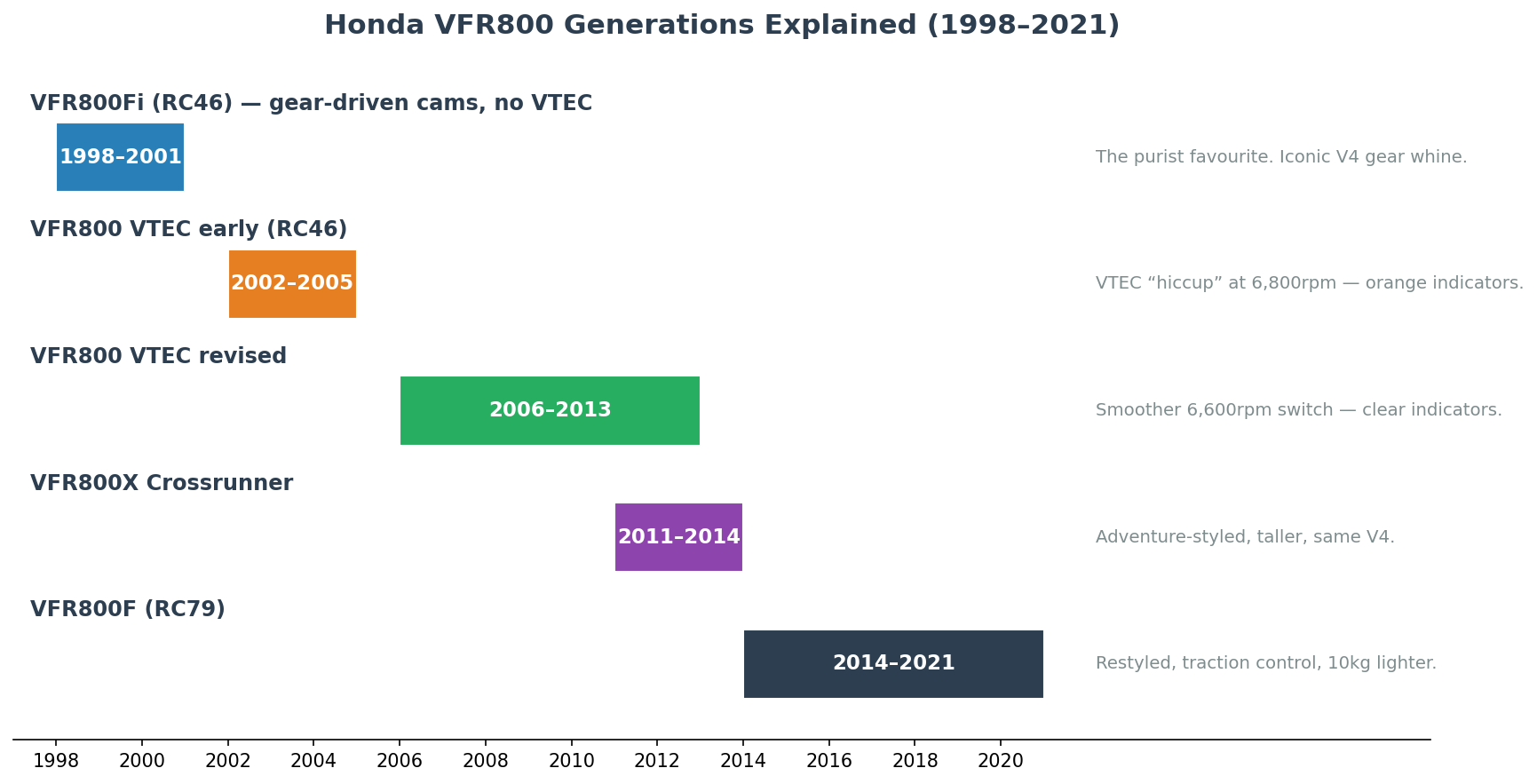
Getting the generations straight is half the buying decision. Each one has a different engine feel, a different fault profile, and a very different price. Here is the map:
VFR800Fi (RC46), 1998–2001 — the purist's choice. This is the fifth-generation VFR: fuel-injected, gear-driven cams, and crucially no VTEC. The gear-driven valvetrain is what gives this bike its famous mechanical whine, and enthusiasts guard these models jealously. It makes around 108 bhp, weighs about 208 kg, and wears combined braking. If the pure V4 sound is what you are here for, this is the bike to hunt.
VFR800 VTEC (RC46), 2002–2013 — the volume seller. The sixth generation dropped the gear-driven cams for a chain-driven, VTEC-equipped head that switches from two valves per cylinder to four at higher revs. It is quieter, a touch more refined, and by far the most common VFR on the used market. Early bikes (2002–2005) had an abrupt VTEC changeover; from 2006 Honda smoothed it. This is where most buyers end up.
VFR800X Crossrunner, 2011–2014 — the tall one. Same V4 heart in adventure-styled bodywork, with a higher seat, wider bars, and longer-travel suspension. It is not an off-roader; it is a VFR that sits you up and softens the ride. A niche pick, but a brilliant one for taller riders.
VFR800F (RC79), 2014–2021 — the modern one. A ground-up restyle aimed squarely at the fans who loved the old Fi bike and shunned the VTEC. It kept the 782cc V4 and 105 bhp but added traction control, LED lighting, an adjustable seat, a single-sided exhaust, and shed about 10 kg. It is the one to buy if you want ABS, traction control, and a warranty-era feel.
One more note: a smaller, screaming Honda VFR400 NC30 exists as the VFR's baby brother — a 400cc gear-driven V4 that is a JDM legend in its own right. Same DNA, half the capacity, twice the drama.
The VTEC Debate: Gimmick or Genius?
No VFR conversation survives five minutes without VTEC coming up, so let us settle it. On the 2002-onward bikes, the engine runs on two valves per cylinder low down for efficiency, then brings the second pair of valves online higher in the rev range for top-end power. In theory, best of both worlds. In practice, the early execution was clumsy.
The problem: the changeover happened at 6,800 rpm and arrived with a noticeable step in power — owners called it the "hiccup." On the motorway, 6,800 rpm was right where you cruised, so the bike would nervously flick in and out of VTEC and unsettle the drive. It was never dangerous, just annoying, and it gave the whole system a bad reputation it has never fully shaken.
Honda fixed it. In 2006 they moved the switch point to 6,600 rpm and reworked the transition so it slid in smoothly instead of jolting. The post-2006 bikes are genuinely pleasant, and the change is the single most important dividing line in the VTEC range. Here is the insider trick for spotting a fixed bike at a glance: the pre-2006 models have orange indicator lenses, while the 2006-on revised bikes have clear ones. Learn that tell and you can date a VFR from across a car park.
Is VTEC genius? No. Is it a dealbreaker? Also no. On a smooth 2006-plus bike it is a non-issue, and you get a slightly more refined engine and easier day-to-day manners. Purists will always prefer the gear-driven Fi for its sound and simplicity. Everyone else should just buy a post-2006 VTEC and stop worrying about it.
Honda VFR800 Specs and the Numbers That Matter
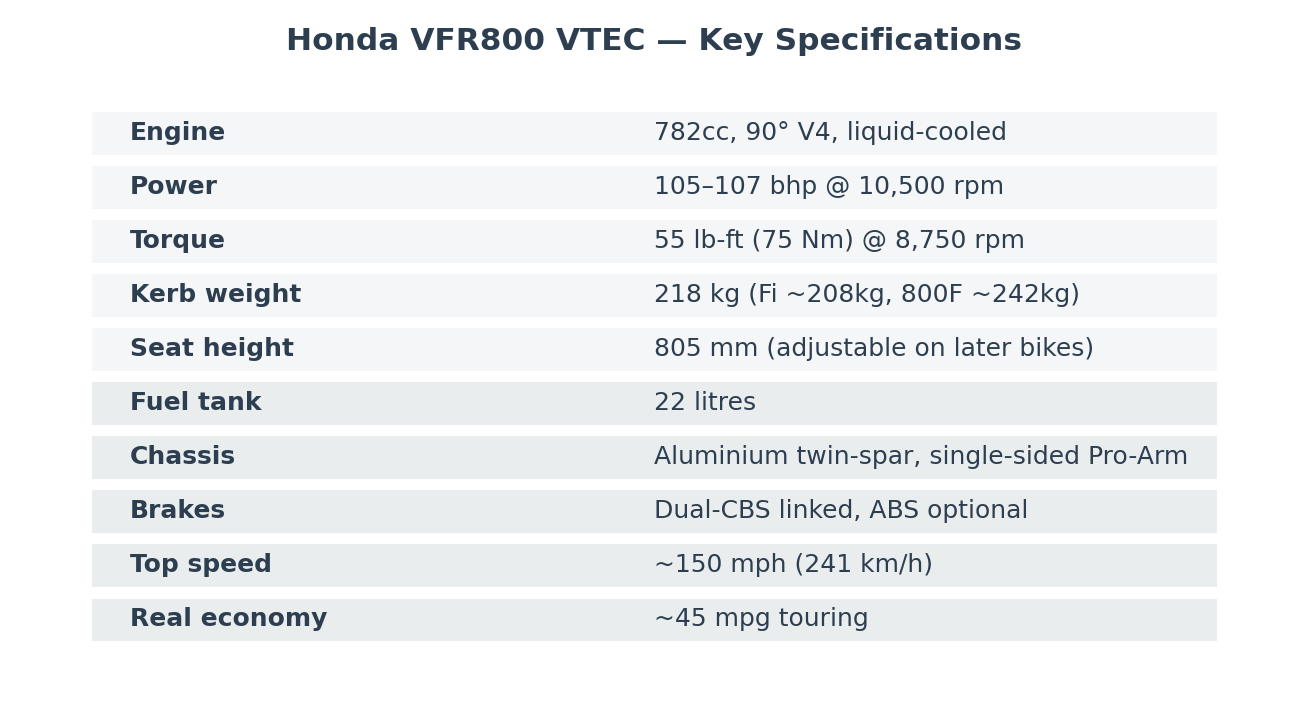
Here are the figures for the VTEC bike, which is what most buyers will be looking at: an 782cc, 90-degree V4 making 105–107 bhp at around 10,500 rpm and 55 lb-ft (75 Nm) of torque at 8,750 rpm. Kerb weight is about 218 kg. The seat sits at roughly 805 mm, the tank holds 22 litres, and top speed lands around 150 mph.
What do those numbers mean on the road? They mean a bike that is quick without being intimidating. The V4 pulls cleanly from low revs, comes alive in the mid-range, and rewards you with that hard V4 wail near the redline. It will keep pace with almost anything on a real-world back road, tour two-up all day, and never feel like it is trying to kill you. The 22-litre tank is a genuine 180–200 mile range at a touring pace, which matters when you are eating up distance.
The numbers also tell you what it is not. At 218 kg it is no lightweight, and the sporty-but-upright riding position is a compromise: more relaxed than a superbike, more committed than a tourer. The 805 mm seat suits average and taller riders well; if you are short in the leg, sit on one first. And that V4 runs warm — worth remembering if you ride in traffic or hot climates. The valve-clearance check on the VTEC bikes is the one genuinely pricey service, so always ask when it was last done.
Honda VFR800 VTEC Common Problems and What to Check
The VFR800 is famously tough, but "tough" is not "perfect." These are the faults that actually turn up, drawn from owner surveys and long-term reviews rather than forum panic.
Regulator/rectifier failure. This is the big one, especially on the Fi models. In one owner survey, exactly a third of Fi bikes had needed a new regulator/rectifier, and when they fail they often cook the battery on the way out. Check for a bike that starts strong and holds voltage; a tired R/R and a boiling battery go hand in hand. Many owners upgrade to a MOSFET unit as a permanent fix.
Exhaust corrosion. The system is known to crack and rot where the rear pipes meet the rest of the collector, and because the rear cylinders are buried, removal is a knuckle-skinning job with seized nuts. Inspect the exhaust carefully — a rotten one is a real expense and a common reason a cheap VFR is cheap.
Cam chain tensioner (VTEC only). The switch to chain-driven cams brought the odd tensioner failure — two out of 39 VTEC bikes in one survey needed replacement, and early VTEC engines were recalled over the tensioner. Listen for rattle on start-up and confirm any recall work was done.
Console PCB water ingress (Fi). The Fi model's instrument console has a printed circuit board that suffers if water gets in, causing partial display failure. Replacement is costly, so a working, undamaged clock set is worth confirming.
General wear. Linked-brake calipers need regular cleaning, fork seals weep with age, and chains and sprockets wear like any chain-drive bike. None of it is dramatic — it is just the checklist of a 15-to-25-year-old machine. Cross-reference anything you find against the auction condition report; our guide to the Japanese auction sheet shows how to read those grades and marks.
Honda VFR800 Years to Avoid (and the Sweet Spot)
Let us be honest about the weak years, because pretending a bike has none helps nobody.
Avoid, or buy with eyes open: 2002–2005 VTEC. These are the pre-fix bikes with the abrupt VTEC hiccup and orange indicators. They are not bad motorcycles — they are cheap and reliable — but you are living with the changeover quirk and the earliest tensioner concerns. Buy one only if the price reflects it.
Watch the earliest Fi bikes for electrics. The 1998–2000 Fi models are gorgeous and sound divine, but they are now 25-plus years old, and the regulator/rectifier and console PCB are age-related weak spots. A well-sorted one with an upgraded R/R is a keeper; a neglected one is a project.
The sweet spot: 2006–2013 revised VTEC. This is the value pick. You get the smoothed VTEC, clear indicators, a mature and debugged engine, and the largest supply of clean examples to choose from. A tidy one with service history and 20,000–30,000 miles is the classic "just buy it" VFR.
The premium pick: 2014–2021 VFR800F. If you want traction control, ABS as standard, LED lights and the lightest, most modern feel, the RC79 is the one — you just pay more for it. Think of the revised VTEC as the smart-money buy and the 800F as the treat.
Real Used Prices for a Honda VFR800
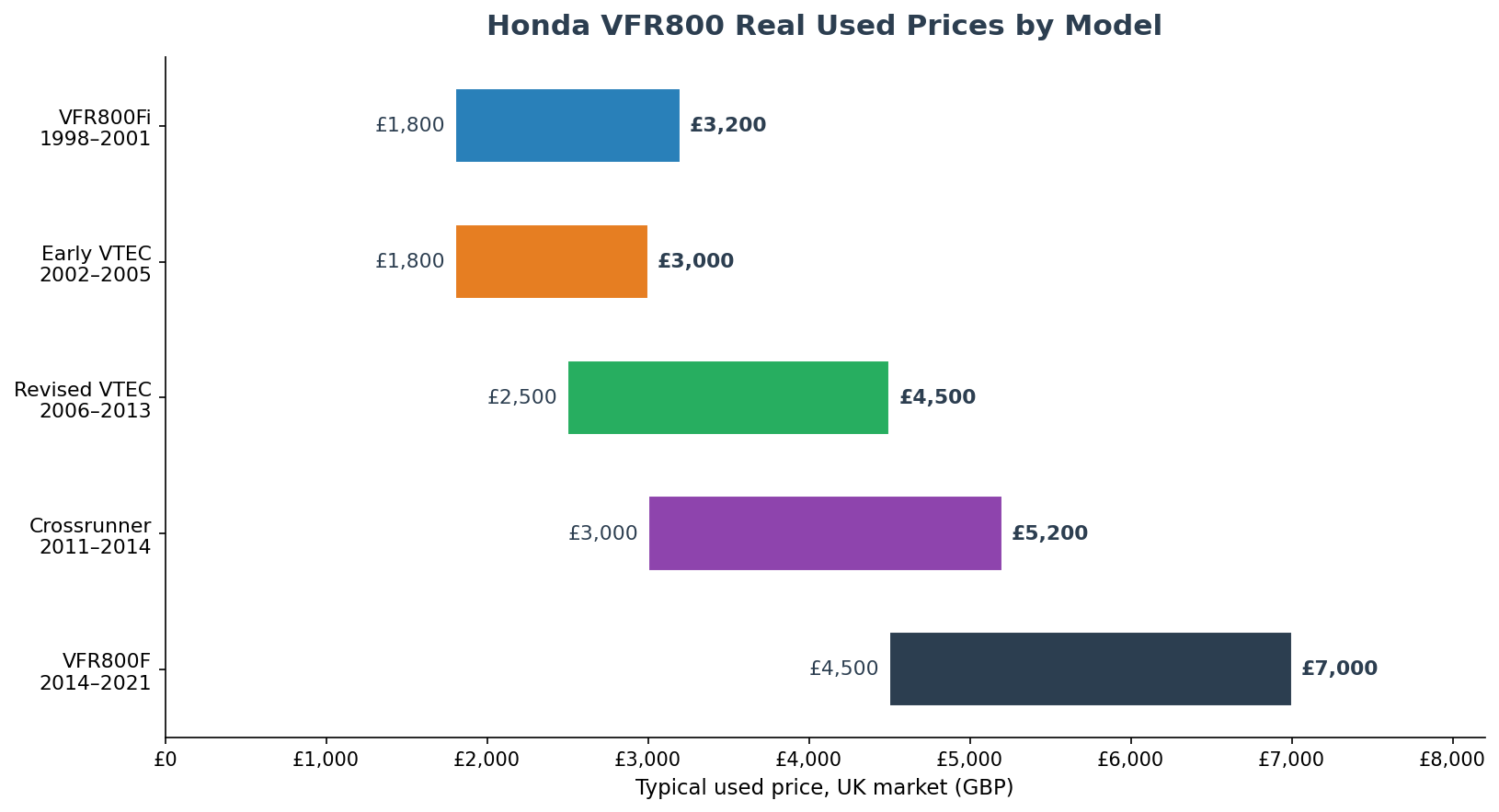
These are realistic UK used values in 2026; adjust for your market, but the shape holds everywhere. A rough VTEC can be had for about £2,000, while a tidy 2002 example fetches closer to £3,000–3,500. The consensus advice from buyer guides is to spend £2,000–2,500 and get a clean bike with good history and 20,000–30,000 miles.
VFR800Fi (1998–2001): roughly £1,800–3,200. The gear-driven-cam sound for the price of a scooter. Pay at the top of the range for a genuinely sorted one with the electrics addressed.
Early VTEC (2002–2005): roughly £1,800–3,000. The bargain end of the range, with the pre-fix VTEC caveat.
Revised VTEC (2006–2013): roughly £2,500–4,500. The sweet spot, and worth every pound of the small premium over the early bikes.
Crossrunner (2011–2014): roughly £3,000–5,200. Niche, but great value for taller riders who want the upright stance.
VFR800F (2014–2021): roughly £4,500–7,000. Modern electronics and the freshest examples.
Here is the rule that applies to every one of these: if you find a VFR priced well below its band, that is not a bargain, it is a warning. It usually means a rotten exhaust, a dead R/R, missing history, or accident damage. On a bike this cheap to buy, the "too good to be true" example is almost always the most expensive one in the long run. When you import, budget the landed cost properly — our UK motorcycle import duty and tax guide breaks down the numbers so there are no surprises at the port.
Why Import a Honda VFR800 From Japan?
The case for a JDM VFR800 is simple: condition and honesty. Japanese owners tend to service on schedule, ride in dry weather, store bikes indoors, and part with them at low mileage. That is the opposite of the salt-and-neglect life many Western VFRs have lived, and it directly protects the VFR's weak points — the exhaust does not rot, the connectors do not corrode, the fasteners do not seize.
Then there is the auction system. Japanese motorcycle auctions grade every bike with an independent condition report, so you are not trusting a seller's optimism — you are reading a standardized sheet that flags corrosion, damage, and mileage discrepancies. Learn to read it and you can buy a bike sight-unseen with real confidence. Our overview of the Japanese motorcycle auction explains how the whole thing works.
There is also a supply argument. Japan bought a lot of VFR800s and looked after them, so the pool of clean, low-owner examples is deep — deeper, often, than your local classifieds. And for buyers in the United States, there is a bonus: the VFR800 was never a huge seller there, so a tidy JDM import stands out. Under the 25-year import rule, the 1998 Fi bikes are already eligible, and each year another slice of VTEC production crosses the line — the 2002 bikes clear in 2027. For UK, Australia and New Zealand buyers, there is no such wait; you can import any of them today.
How to Import a Honda VFR800 From Japan, Step by Step
The process is more straightforward than most people fear. Here is the shape of it.
Step 1 — Set your spec and budget. Decide which VFR you actually want (gear-cam Fi, sweet-spot revised VTEC, or modern 800F) and set a landed budget that includes the bike, auction and export fees, shipping, and your country's duty and taxes.
Step 2 — Work with an exporter or auction agent. A good agent bids for you at the Japanese auctions, translates the condition sheet, and handles export paperwork and de-registration. This is where AWA Auction comes in — you tell us the bike, we hunt it and vet it.
Step 3 — Read the auction sheet before you bid. Confirm the grade, the mileage, and any noted corrosion or damage. For a VFR, pay special attention to any exhaust or electrical notes.
Step 4 — Win, ship, and clear customs. Once you have bought the bike, it is crated or roll-on shipped to your nearest port. You (or a customs broker) pay the import duty and taxes, and the bike is released. Our step-by-step import walkthrough covers the paperwork in detail.
Step 5 — Register and ride. Complete your local registration and any inspection, fit a fresh set of consumables, and enjoy the fact that you bought a better bike for less money than the tired local example you almost settled for.
Living With a VFR800: Running Costs and Maintenance
A VFR800 is one of the cheaper big bikes to run, which is a large part of its appeal. Fuel economy sits around 45 mpg at a touring pace, and the 22-litre tank means fewer stops than most sport-tourers. Tyres are a standard 120/70 front and 180/55 rear, so there is huge choice and no exotic pricing.
The one cost to plan for is the valve-clearance check on the VTEC engines. It is a proper job because of the V4 layout, and it is the single biggest scheduled expense — which is exactly why you always ask a seller when it was last done. A bike with a recent, documented valve service is worth paying more for; a bike overdue for one is a negotiating point.
Beyond that, it is honest, cheap maintenance: chain and sprockets, brake fluid, coolant, and a periodic clean of the linked-brake calipers. Keep the electrics healthy — an upgraded regulator/rectifier is money well spent on the older bikes — and the V4 will just keep running. This is a motorcycle that punishes neglect slowly and rewards care for years.
How Many Miles Is Too Many? The V4 Longevity Question
Short answer: high mileage scares people off VFRs far more than it should. These V4s are built to endure, and plenty have covered six-figure mileages on original bottom ends. In Honda's owner surveys the VFR averaged about one problem every 15,000 miles across more than 1.25 million miles ridden — that is a bike you can trust, not one you nurse.
What matters is not the number on the clock but the story behind it. A 45,000-mile bike with a folder of receipts, regular oil changes, a recent valve check, and a sorted R/R is a far safer buy than a 12,000-mile example that sat neglected in a damp garage for a decade. Miles ridden regularly are kinder to a bike than miles not ridden at all.
So do not walk past a high-mile VFR with good history. On this platform, history beats mileage almost every time. The famous line from the used-VFR world is that these bikes are "the thinking rider's superbike" — and thinking riders read the paperwork.
Popular VFR800 Modifications
Most VFR owners keep things sensible, but a few upgrades come up again and again — and one YouTube channel even bolted a budget turbo to "the UK's cheapest VFR800" for a video that pulled nearly half a million views, which tells you how much affection and mischief these bikes attract.
Exhaust. A slip-on or full aftermarket system saves weight, sidesteps the corrosion-prone stock collector, and — most importantly — unlocks more of that V4 howl. It is the number-one VFR mod for a reason.
Ergonomics. Bar risers or heli-bars take the weight off your wrists for touring, and a better seat (or a re-foamed original) transforms long days. Small money, big comfort gains.
Luggage and touring kit. Genuine Honda panniers, a top box, a taller screen, and heated grips turn the VFR into the continent-crossing tool it always wanted to be.
Electrical fixes. On older bikes, a MOSFET regulator/rectifier and fresh connectors count as an upgrade as much as a repair. Do this once and forget the charging gremlins.
Honda VFR800 vs Its Rivals
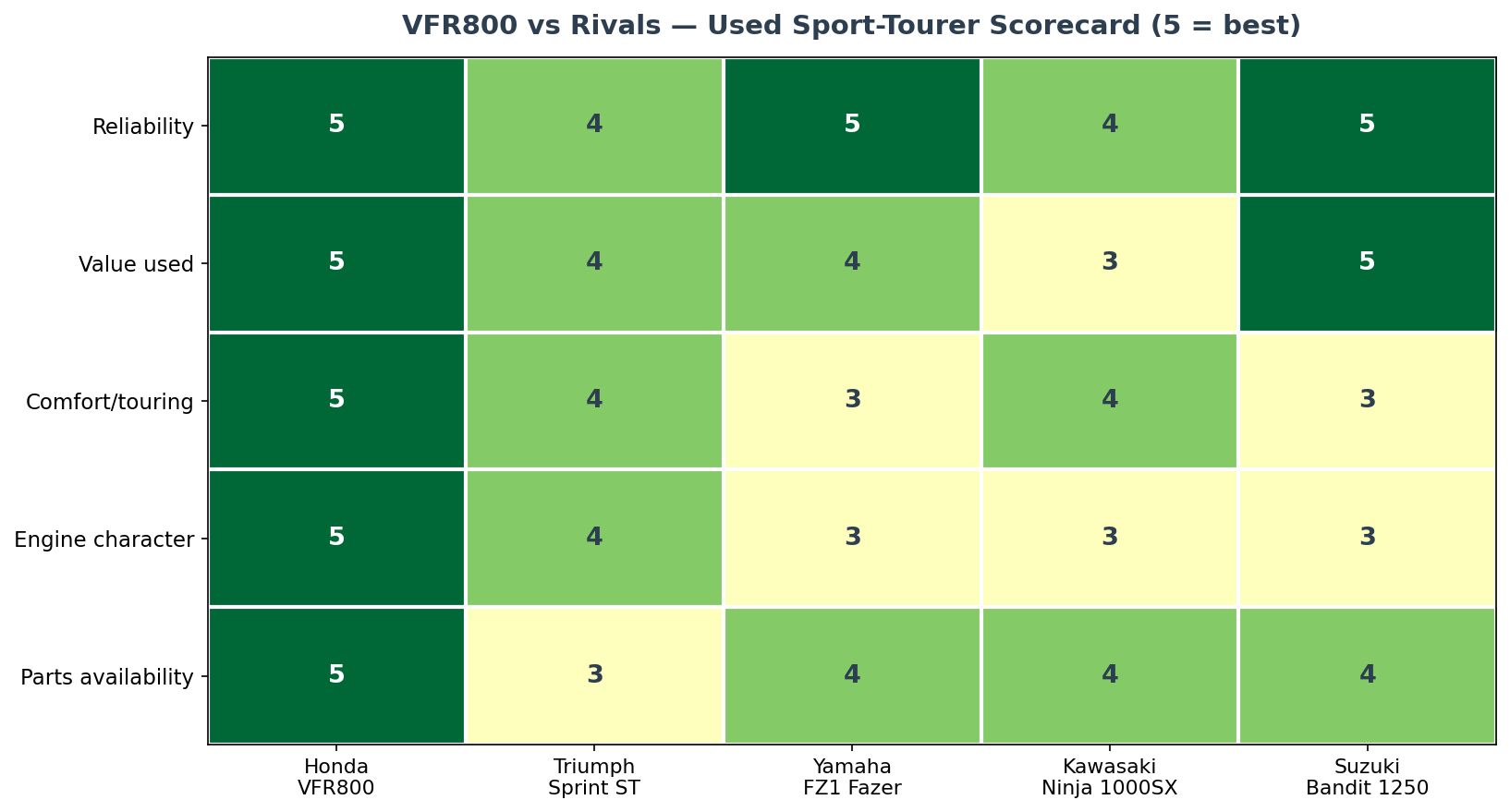
The VFR800 does not win every category, but it wins the one that matters most to a used buyer: it is the complete package for the money. Here is how it stacks up against the obvious alternatives.
Triumph Sprint ST: a lovely triple with real character and comfort, but parts supply and long-term reliability do not match the Honda, and values reflect that.
Yamaha FZ1 Fazer: faster and cheaper to buy, with a punchy inline-four, but it is more of a naked-with-a-fairing than a true tourer, and the engine lacks the VFR's charm. Our Yamaha FZ1 import guide covers it in full if the extra speed tempts you.
Kawasaki Ninja 1000SX: newer, more powerful, and better equipped, but also more expensive and less characterful. If you want modern tech over V4 soul, read our Ninja 1000SX guide — it is the sharper, pricier alternative.
Suzuki Bandit 1250: the budget workhorse — bulletproof and dirt cheap, but agricultural next to the VFR's polish. Great value, less soul.
The verdict? For character, reliability, and money-in-hand value on the used market, the VFR800 is the one to beat. It is not the fastest or the newest, but it is the one owners keep for a decade and then buy again.
Who Should Buy a VFR800 (and Who Shouldn't)?
Buy one if you want a do-everything bike that commutes, tours, and thrills in equal measure; if you value that unmistakable V4 sound; if you want low running costs and legendary reliability; and if you would rather spend your money on riding than on repairs. It is the ideal one-bike garage and a brilliant first big bike for a sensible rider.
Think twice if you need outright superbike speed, cutting-edge electronics on every model, or a featherweight track tool. The VFR is quick, not savage; refined, not radical. If your idea of fun is a 200 bhp missile, this is not your bike — and that is fine.
For most riders, though, the VFR800 sits in a very sweet spot: fast enough to grin, comfortable enough to tour, cheap enough to run, and tough enough to trust. That combination is exactly why it has such a devoted following, and why a clean Japanese import is one of the smartest used-bike buys going.
Riding the VFR800: What It Is Actually Like
Numbers only tell you so much, so here is the felt experience. Thumb the starter and the V4 settles into a busy, mechanical idle — on the gear-cam Fi bikes especially, you hear the valvetrain working, a sound Honda spent decades perfecting. Pull away and the first thing you notice is how easy it all is. The clutch is light, the fuelling is clean, and the bike shrinks around you the moment it rolls.
Then you open it up. Below 6,000 rpm the VFR is smooth and torquey, happy to short-shift and waft. Push past that and the engine hardens, the intake and exhaust note climb into that unmistakable V4 wail, and the bike surges forward with real intent. It is not the violent, wheelie-happy hit of a superbike — it is a long, building, addictive pull that makes you want to hold every gear a little longer. One owner summed it up on social media: even after "a bad pull away and questionable gear changes," his VFR was "still faster than a 120k exotic car." That is the VFR's party trick — it embarrasses far more expensive machinery while asking nothing of you.
On the motorway it is composed and relaxed, the fairing doing real work, the mirrors actually usable. Through a set of bends it steers with that reassuring Honda neutrality — not the sharpest, but utterly predictable, the kind of handling that flatters a rusty rider back into form. And after 150 miles you climb off without the wrist ache and numb backside a full sportbike inflicts. This is a machine engineered to be lived with, and it shows in every mile.
VFR800 Pre-Purchase Inspection Checklist
Whether you are viewing a bike in person or reading a Japanese auction sheet, run through this VFR-specific checklist before you commit. It is built from the exact faults covered above, so nothing here is theoretical.
Charging system: Start it cold and warm, watch the lights hold steady, and ask whether the regulator/rectifier has ever been replaced or upgraded. On Fi bikes especially, an original, never-touched R/R is a bargaining chip and a near-term job.
Exhaust: Get down and look at the collector where the rear pipes join. Surface rust is normal; cracks, heavy corrosion, or a suspiciously fresh aftermarket system hiding a rotten stock one are the things to price in.
Engine noise: On VTEC bikes, listen for cam-chain-tensioner rattle at cold start-up, and confirm the early recall was carried out. A healthy V4 is busy but even; a persistent top-end rattle is a red flag.
Service history: The single most important document is proof of the last valve-clearance check. Ask for the date and mileage. No record and high miles means you are budgeting for that job soon.
Instruments and electrics: On Fi bikes, confirm the console display works fully with no dead segments — the PCB is water-sensitive and expensive to replace. Check all switchgear, lights, and the fuel gauge.
Consumables and chassis: Fork seals for weeping, chain and sprockets for wear, tyres for age and profile, and the linked-brake calipers for sticky pistons. None are dealbreakers, but they add up as negotiating ammunition.
Score a bike against all six and you will know instantly whether the price is fair. A clean sheet on every point justifies the top of the price band; a couple of flags is your route to a discount or a walk-away.
Is the VFR800 a Good First Big Bike?
For the right rider, the VFR800 is one of the best first big bikes money can buy — and that is not faint praise. It makes its power in a linear, predictable way, so there is no sudden hit waiting to catch you out. The riding position is sporty but sensible, the brakes are strong and progressive, and the whole bike is famous for flattering the rider rather than testing them. You can grow into a VFR for years without ever running out of talent to explore.
It is also cheap enough to buy that a first drop or a learning knock will not ruin you financially, and reliable enough that you will spend your weekends riding rather than wrenching. Parts are plentiful, the community is huge and helpful, and there is a deep well of knowledge online for every job. That support network matters enormously when you are new and learning.
The one honest caveat: at around 218 kg it is not a lightweight, so a shorter or less confident rider should sit on one and practise low-speed manoeuvres before committing. If a full-size sport-tourer feels like a lot, the smaller Honda VFR400 NC30 offers the same V4 magic in a lighter, more compact package. But for most new big-bike riders, a clean VFR800 is a machine you can trust on day one and still love on day one thousand.
How AWA Auction Helps You Import a VFR800
Finding a clean VFR800 in Japan is one thing; buying it safely from thousands of miles away is another. That is what AWA Auction exists for. We have direct access to the Japanese motorcycle auctions where these bikes turn up every week, we read and translate the condition sheets so you know exactly what you are bidding on, and we handle the export paperwork, shipping, and logistics end to end.
You tell us which VFR you want — the gear-cam Fi for the sound, the sweet-spot revised VTEC for value, or the modern 800F — and we hunt it, vet it against the faults in this guide, and get it to your door. No guesswork, no rotten-exhaust surprises, no wondering whether the mileage is real.
Browse our current listings to see what is available now, or contact our team with your target spec and budget and we will start the search. A better-preserved bike for less money is the whole reason to import — and the VFR800 is one of the best cases for doing it.
See Also
Share this article: