
Japanese motorcycle parts have a reputation problem. Ask on any forum whether you should import a JDM bike and within three replies someone will tell you that you'll never get parts for it, that your local dealer will laugh you out of the workshop, and that the first time you drop it you'll own a very expensive ornament.
That reputation is about twenty years out of date.
Here's the thing nobody mentions: Japan runs the densest motorcycle parts network on the planet, and almost all of it now ships internationally. Honda, Yamaha, Suzuki and Kawasaki keep online parts catalogues for models they never sold in your country. Japan's own retail chains stock walls of consumables for bikes that were JDM-only from day one. The problem was never that the parts don't exist. The problem is that nobody wrote down how to find them.
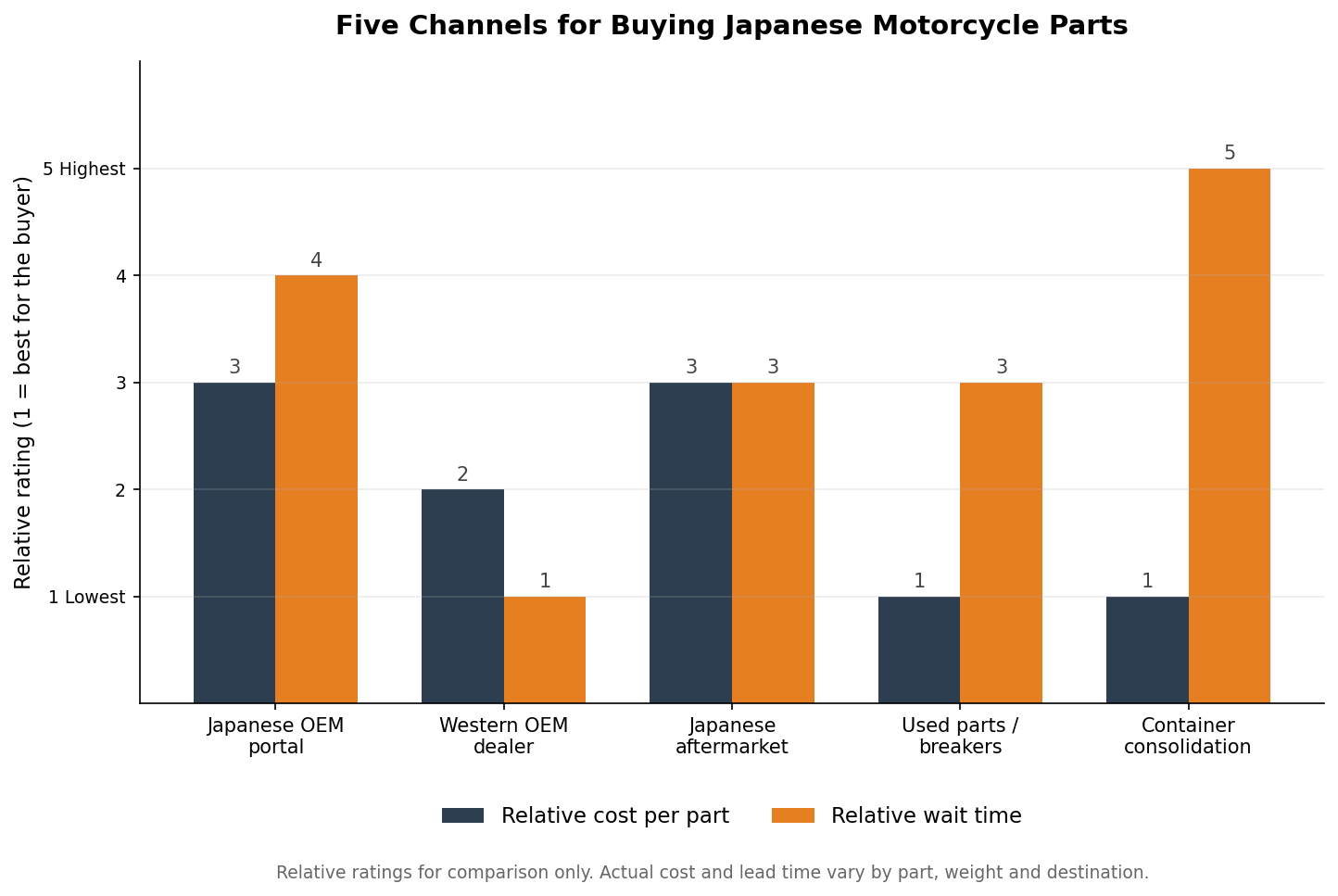
This guide fixes that. You'll get the five channels that actually supply Japanese motorcycle parts, how the part numbering system works and why it's the single most useful thing you can learn, what a realistic order costs once shipping and duty land, which bikes are genuinely risky and which are effectively as easy to run as a bike sold new in your market, and how to check availability before you bid rather than after the bike arrives.
We buy bikes out of Japan's wholesale auctions every week. The parts question comes up on nearly every enquiry, and the honest answer is more encouraging than the forums suggest — with a few specific exceptions that are worth knowing about before you spend money.
Japanese motorcycle parts: the short answer
For roughly 85% of the Japanese bikes people actually import — the CB, CBR, ZX, GSX-R, YZF, MT, Ninja and V-Strom families, plus most of the 400cc and 250cc JDM-only variants — parts sourcing is a solved problem. Engine internals, brakes, bearings, gaskets, filters, cables and electrical components either share part numbers with an export model or can be ordered by part number from a Japanese OEM supplier that ships worldwide.
What's genuinely hard is a narrow band: model-specific bodywork, decals, unique instrument clusters, and the electronics on low-volume two-strokes and homologation specials. Those parts were made in small numbers, they were never warehoused abroad, and when Japanese domestic stock runs out the factory does not make more.
So the real question isn't "can I get parts for a Japanese motorcycle?" It's "which parts on this specific bike are the hard ones, and can I live with that?" That distinction is the whole game, and the rest of this guide is about learning to make it before you commit.
The second thing worth understanding early: your local dealer's willingness to help is a completely separate issue from whether parts exist. A UK Honda dealer who tells you a part is unavailable usually means it's not in the UK parts system. It may sit on a shelf in Japan with a live part number and a two-week lead time. Those are very different sentences, and dealers rarely distinguish between them.
Why Japanese motorcycle parts feel impossible (and why that's mostly wrong)
Three things created the myth, and all three have specific, boring explanations.
Manufacturers run separate regional parts systems
Honda UK, Honda Europe, American Honda and Honda Motor Co. in Japan do not share one parts database. Each region stocks what it sold. When your dealer types a frame number from a JDM CB400 Super Four into their terminal, the system genuinely returns nothing — because that model was never entered into the European catalogue. The dealer isn't lying. Their software just can't see Japan.
Workshops price hassle into the answer
Sourcing a part from Japan means a part number lookup, a currency conversion, an import, and a customer who calls twice a week asking where it is. A workshop billing by the hour has no incentive to take that on for a bike that will visit twice a year. As one long-running UK forum thread on grey imports puts it, dealers can be uninterested in chasing parts once they find out it's a grey market model — the position becomes "if it isn't available from the manufacturer or regular aftermarket suppliers, then we can't fix it." That's a business decision dressed up as a technical limitation.
The internet remembers 2005
Most of the horror stories circulating today were written when ordering from Japan meant faxing a dealer, paying by international money order, and waiting six weeks with no tracking. Japanese OEM parts portals with English interfaces and international checkout are a recent development. The advice aged badly and nobody went back to update it.
The practical consequence: you have to become your own parts department. That sounds worse than it is. In practice it means learning one numbering system and bookmarking four websites. Riders who do this find that a JDM import is no harder to keep on the road than a used bike bought locally — and often cheaper, because Japanese domestic parts prices are frequently below Western dealer prices for the identical component.
The part number is everything
If you take one thing from this guide, take this: stop searching by model name and start searching by part number. Model names fragment across markets. A Kawasaki ZX-9R is a Ninja ZX-9R in one catalogue and a ZX900 in another. Part numbers don't fragment. A part number is the same string in Tokyo, Texas and Tamworth.
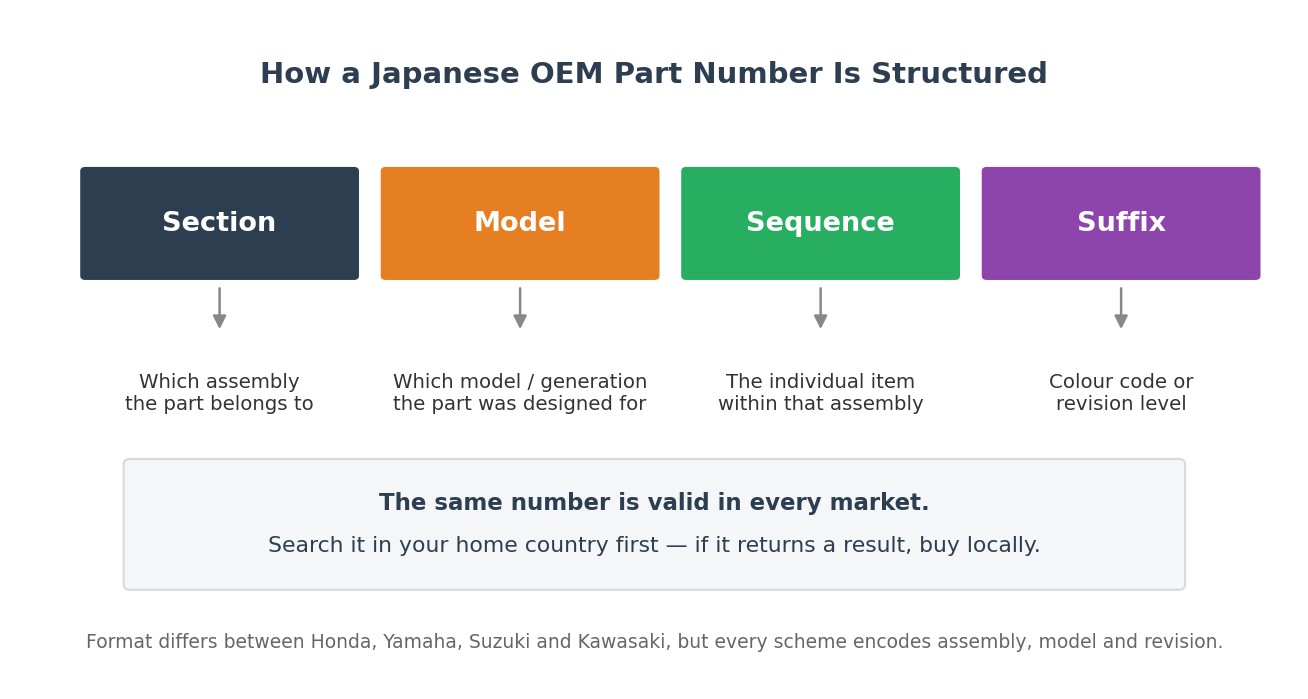
Japanese OEM part numbers are structured, not random. Honda's format runs as a section code, a model code, a sequence number and a colour or revision suffix. Yamaha, Suzuki and Kawasaki each use their own scheme, but the logic is identical: the number encodes which assembly the part belongs to and which generation of that assembly it is.
Why that matters in practice: part numbers reveal shared components across models. When a JDM-only bike shares a rear master cylinder with an export model sold in your country, the part number is identical. You walk into your local dealer, hand over the number, and they order it as a routine stock item without ever knowing it's destined for a grey import. No conversation about frame numbers. No "we can't help with those."
This is how experienced import owners actually operate, and it's why their parts bills look nothing like the forum predictions. Roughly speaking, the overlap runs highest on consumables and chassis hardware, and lowest on bodywork and anything with a model-specific casting.
How to find the part number for a bike your dealer can't see
- Get the model code, not just the model name. It's on the frame plate and in the export certificate paperwork. A CB400 Super Four is an NC39 or an NC42 depending on year — completely different parts in places.
- Open a Japanese OEM parts diagram. The manufacturer portals publish exploded diagrams by model code. Click the part in the diagram, get the number.
- Search that number in your own market. Paste it into a Western OEM parts retailer's search. If it returns a result, you can buy it locally at local prices with local shipping.
- If it returns nothing, order from Japan. The number is confirmed correct — it just isn't stocked in your region.
That four-step loop resolves the overwhelming majority of parts questions. It takes about ten minutes the first time and about ninety seconds once you've done it twice.
One caution worth taking seriously: part numbers get superseded. Manufacturers revise components and retire old numbers, with the catalogue pointing to the replacement. Always order the current number, not the one printed in a 1998 workshop manual. Ordering a superseded number is the single most common reason a parts order arrives wrong.
The five channels for buying Japanese motorcycle parts
Every part you will ever need comes from one of five places. Knowing which channel to reach for saves more money than any single negotiating trick.
1. Japanese OEM parts portals
Japan's motorcycle retail platforms publish OEM parts catalogues for every manufacturer and take international orders. Webike's OEM parts service covers Honda, Yamaha, Suzuki, Kawasaki and most import brands, with a quotation form for anything not in the standard listing. You search by model or by number, you get a diagram, you order.
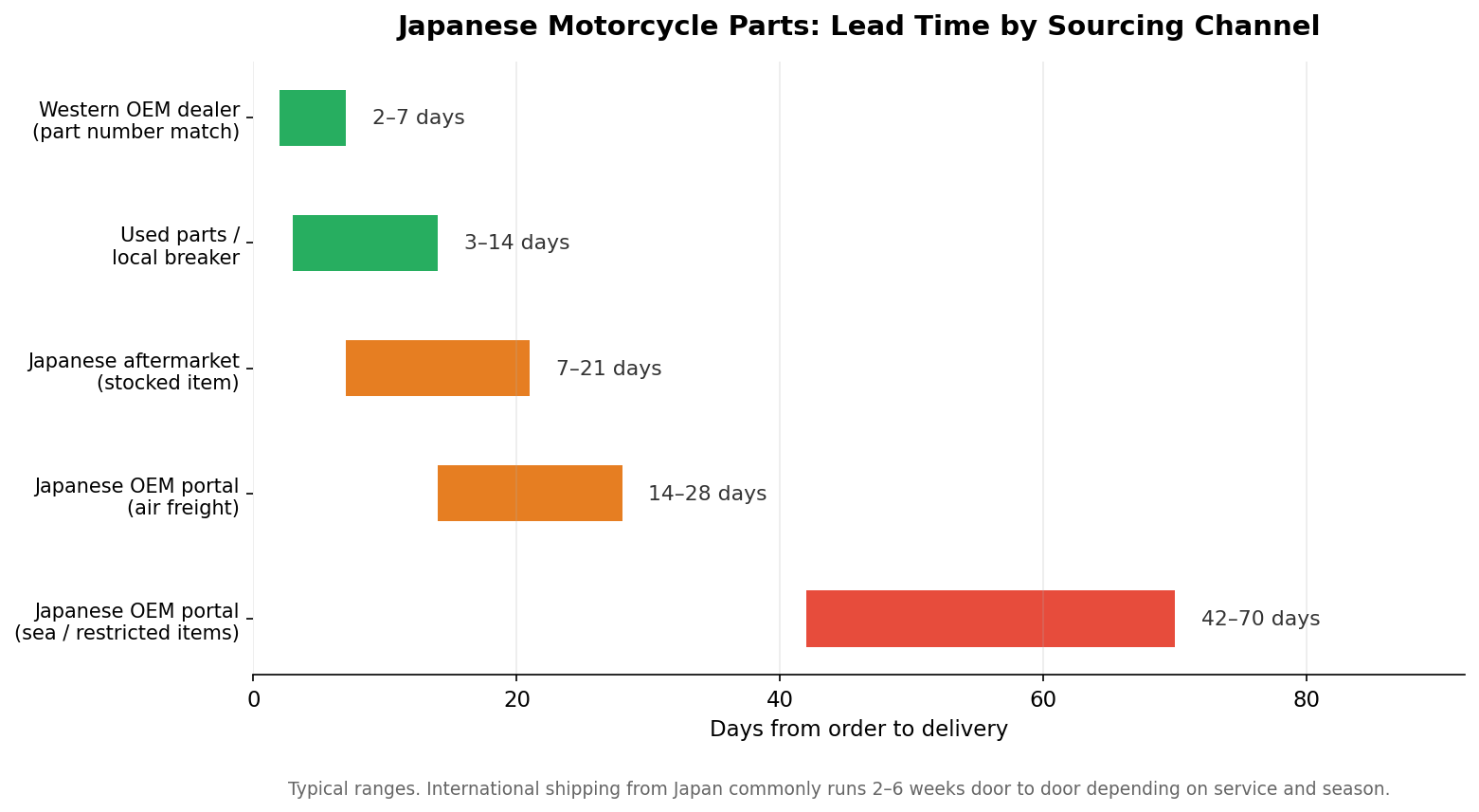
This is the channel for genuine factory parts on JDM-only models. It is also the channel with the longest lead time, because the part often has to be pulled from a manufacturer warehouse before it ships internationally.
2. Western OEM dealers, ordered by number
Retailers like Partzilla hold genuine Honda, Yamaha, Suzuki and Kawasaki stock in Western warehouses and search by part number. For any component that overlaps with an export model, this is faster and cheaper than importing — no international shipping, no customs, no currency spread.
Always check this channel second, immediately after you have the number. People skip it, order from Japan, and pay three times what they needed to for a part sitting in a warehouse forty miles away.
3. Japanese aftermarket and performance brands
Yoshimura, Daytona, Kitaco, Over Racing, NGK and dozens of others make parts specifically for the JDM market, and much of it fits models that never left Japan. Yoshimura's history is a good illustration of how deep this ecosystem runs — the company started in the 1950s and 60s doing engine work on Triumphs and BSAs for US servicemen stationed in Japan, and grew into a world-class racing engine builder and exhaust manufacturer.
Aftermarket is often the answer when the OEM part is discontinued. A replacement exhaust, a set of levers, a rebuilt carburettor kit — the aftermarket makes them long after the factory stopped.
4. Used parts, breakers and dismantlers
For bodywork, instrument clusters, mirrors, brackets and anything cosmetic, used is usually the only realistic route. Japan's domestic used parts trade is enormous, and Japanese auction platforms carry huge volumes of dismantled motorcycle stock. In your own market, breakers who specialise in imports are worth finding and keeping.
Used parts have a hidden advantage on older bikes: a twenty-year-old part that survived in Japan's climate and maintenance culture is frequently in better condition than a fifteen-year-old part that survived a British winter. That isn't sentiment — it's why Japanese used bikes command a premium in the first place, and the same logic applies to the parts that come off them.
5. Container consolidation
If you're importing a bike anyway, parts can travel with it. Buyers who ship a container out of Japan routinely fill dead space with spares, and the marginal shipping cost approaches zero. The Bikes and Beards channel documented this at scale in a video that has been watched over 19 million times, filling a 40-foot container out of Japan with motorcycles and stock — the comment section is full of people realising the container is the cheap part of the equation.
For anyone importing a rare or parts-sensitive bike, buying a spare set of bodywork, a spare set of wheels, or a whole donor bike in the same shipment is the single smartest insurance policy available. It costs a fraction of what those parts cost individually two years later. You can see what's currently moving through the auctions on our current listings.
What Japanese motorcycle parts actually cost
The part price is rarely the problem. The freight is.
A small OEM component — a lever, a sensor, a gasket set — often costs less in Japan than the equivalent part costs through a Western dealer. Japanese domestic parts pricing is competitive because the domestic market is huge and the distribution chain is short. Then you attach international shipping to a 200-gram item and the economics invert.
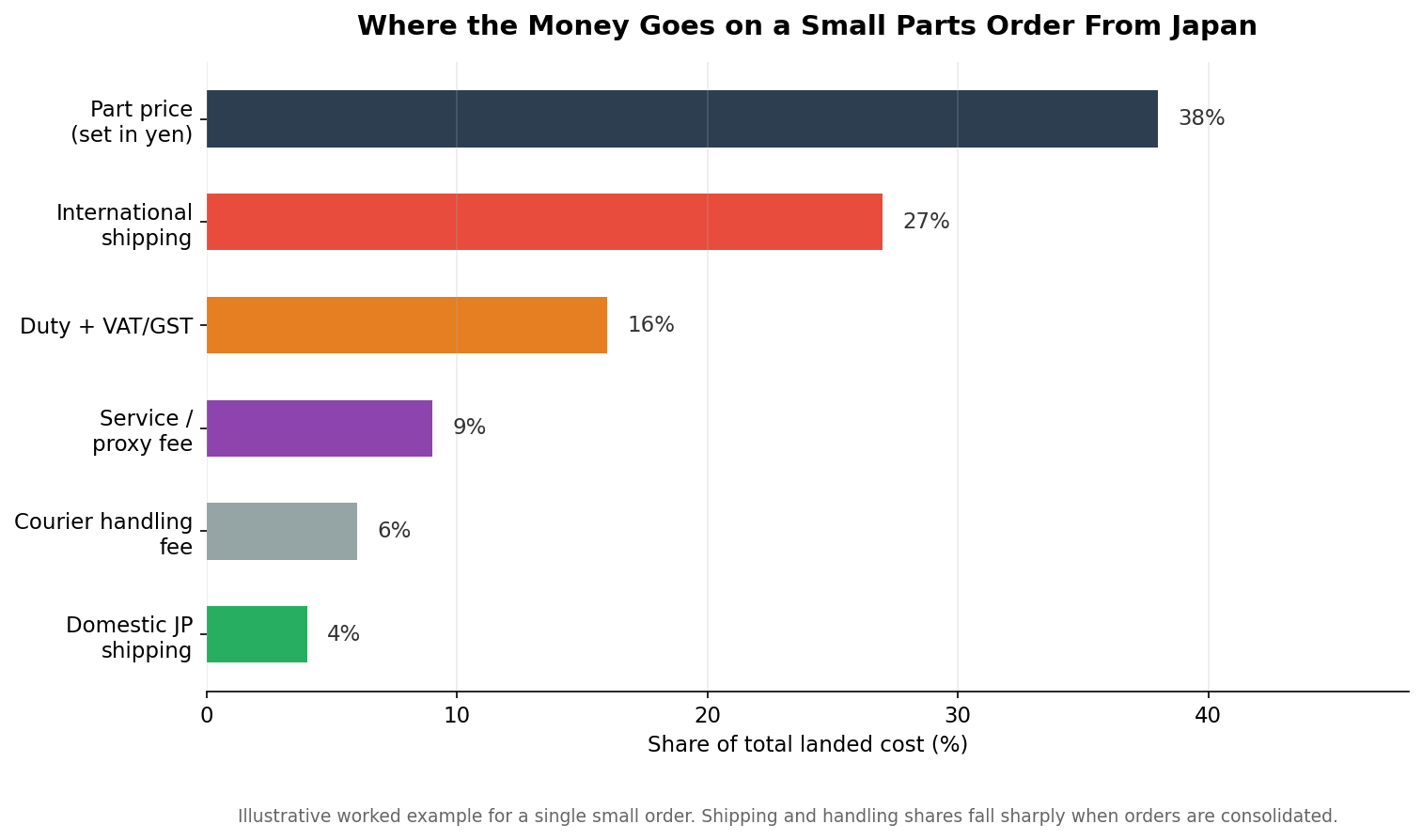
Here's the structure of a typical landed order, and where each cost comes from:
- Part price — set in yen, so it moves with the exchange rate. A weak yen is a parts buyer's best friend.
- Domestic Japanese shipping — the part moving from a manufacturer warehouse to the exporter. Small, fixed, unavoidable.
- Service or proxy fee — either a fixed fee or a percentage, depending on the service. This is what you pay for someone to handle the Japanese-language side.
- International shipping — the big one, and heavily weight-banded. This is why consolidation matters so much.
- Duty and import tax — charged on the declared value plus freight in most jurisdictions, then VAT or GST on top of that in the UK, EU, Australia and New Zealand.
- Handling fee — the courier's charge for processing the customs entry. Usually a flat fee, which makes it brutal on small orders.
The single biggest lever you control is order consolidation. Three separate orders across a year means paying international freight and a customs handling fee three times. One order of everything you'll need for two services costs a fraction of that. Experienced import owners keep a running shopping list and place two orders a year.
The second lever is the de minimis threshold — the value below which your country doesn't charge duty. It varies enormously by market, and it's worth knowing yours precisely, because an order sized just under it lands dramatically cheaper than one sized just over. Check the current figure with your own customs authority before you order — UK buyers can look up the duty rate for motorcycle parts on the UK Trade Tariff — because these thresholds change.
If you want the full landed-cost picture for the bike itself rather than the parts, our complete import cost breakdown covers shipping, duty and registration end to end.
Step by step: sourcing a part for a bike nobody has heard of
This is the exact process, in order, for a part on a JDM-only model.
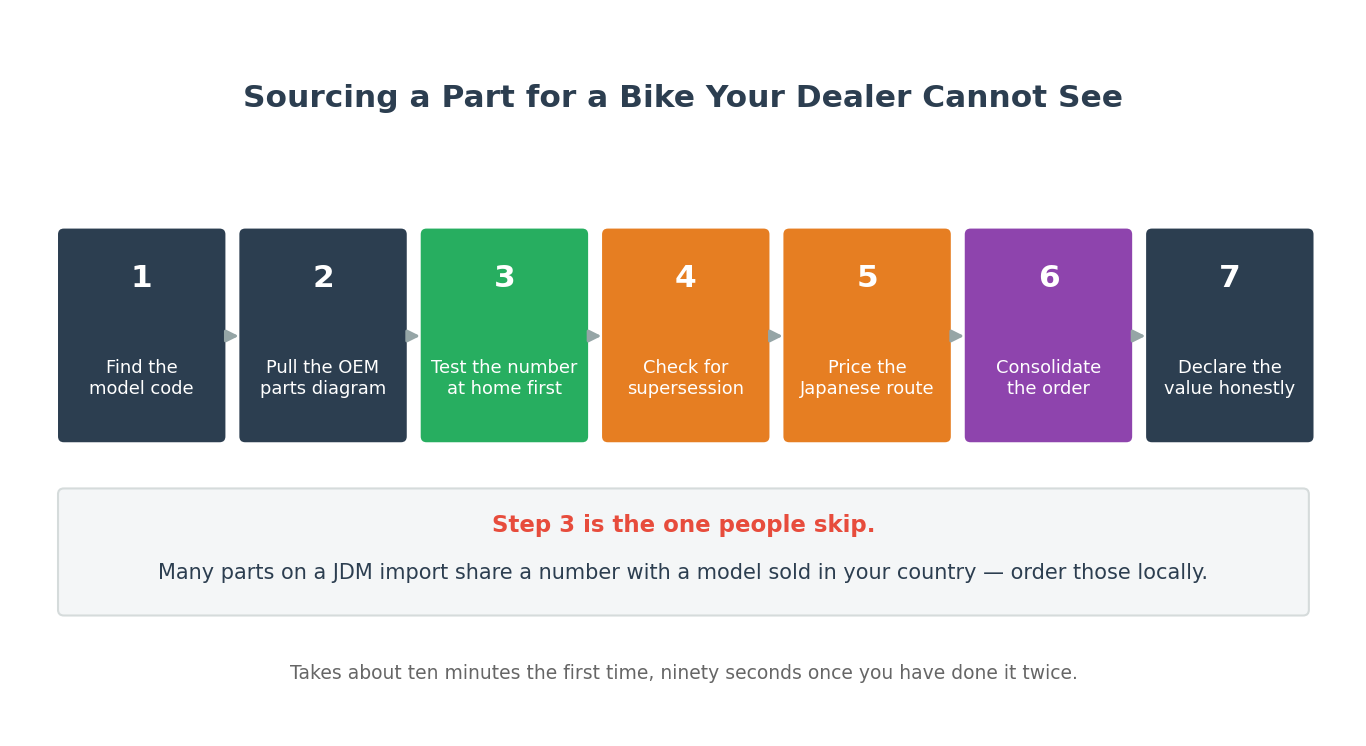
Step 1 — Identify the model code
Find the frame number and the model code on the frame plate. Cross-reference against the export certificate that came with the bike. Getting this wrong wastes the most time of any single mistake, because generations of the same model name often share nothing. If you're unclear on the paperwork, our export certificate guide explains what each document actually tells you.
Step 2 — Pull the parts diagram
Open the manufacturer's parts catalogue for that model code and navigate to the assembly. The diagrams are exploded views with every component numbered. Click the item, note the number.
Step 3 — Test the number in your home market
Search it at a Western OEM retailer. A hit means you're done — buy locally. A miss means the part is Japan-only, which is information, not a dead end.
Step 4 — Check supersession
Confirm the number is current. If the catalogue shows a replacement number, order that one.
Step 5 — Price the Japanese route
Get a quote including domestic shipping and service fee before international freight. Compare against the used market for the same part — for bodywork and cosmetics, used almost always wins.
Step 6 — Consolidate before you commit
Before placing the order, go through your service schedule for the next twelve months and add everything you'll need. Filters, plugs, brake pads, a chain and sprocket set. Adding four items to an existing order costs a fraction of ordering them separately later.
Step 7 — Declare honestly
Under-declaring value to dodge duty is fraud, and it voids any shipping insurance on the parcel. If the box goes missing, you get back what you declared. People learn this once.
Parts availability tiers: which Japanese imports are safe
Not all JDM bikes carry the same risk. Sorting them into tiers before you bid is the most valuable ten minutes you'll spend.
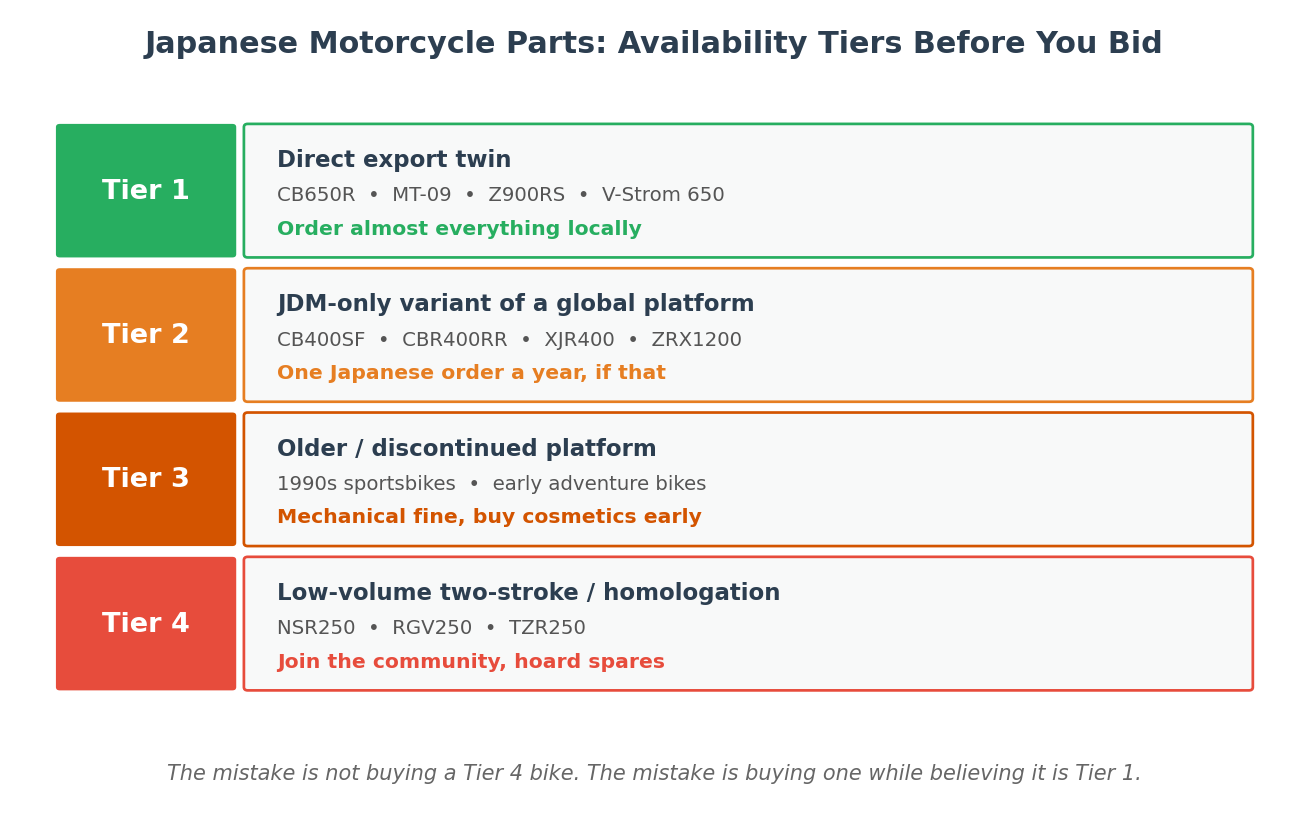
Tier 1 — Effectively unrestricted
Models with a direct export twin. A JDM Honda CB650R, a Yamaha MT-09, a Kawasaki Z900RS, a Suzuki V-Strom 650. These were sold worldwide with near-identical part numbers. Every service item, every consumable, most bodywork, ordered locally.
The only JDM-specific components tend to be the speedometer face, occasionally the wiring for market-specific lighting, and any restricted-power hardware. Everything else is a standard dealer order.
Tier 2 — Easy with one extra step
JDM-only variants of globally sold platforms. The CB400 Super Four, the CBR400RR, the XJR400, the ZRX1200. Engine and chassis components share heavily with export models; a handful of items are Japan-only and need one order from a Japanese supplier per year, if that.
This tier covers most of what people actually import from Japan's 400cc class, and it's much easier than its reputation. Our guide to the Japanese motorcycle brands breaks down how each manufacturer's parts support behaves after import.
Tier 3 — Plan ahead
Older JDM models and discontinued platforms — 1990s sports bikes, early adventure models, first-generation naked bikes. Mechanical parts are generally fine because they were made in volume for years. Bodywork, decals and instrument clusters are getting thin. Buy spares when you see them, not when you need them.
Tier 4 — Know what you're signing up for
Low-volume two-strokes and homologation specials. The NSR250, the RGV250, the TZR250. These are wonderful machines and they carry a genuine parts problem: power valve components, specific ignition modules, expansion chambers and bodywork were made in small numbers for a few years and the factory supply is exhausted.
People run these bikes happily. They do it by joining a model-specific owners' community, buying spares opportunistically, and accepting that a rebuild is measured in months of parts hunting rather than a weekend. If that appeals, our NSR250 import guide is honest about what ownership involves.
The mistake isn't buying a Tier 4 bike. The mistake is buying one while believing it's Tier 1.
Red Baron, NAPS and why Japan's parts network has no Western equivalent
To understand why parts sourcing from Japan works at all, it helps to see the infrastructure behind it. Two things exist in Japan that simply don't exist elsewhere at the same scale.
Red Baron is Japan's largest second-hand motorcycle dealer, operating over 300 branches nationwide. The OK Moto channel toured their headquarters in a video with nearly 400,000 views, and what stands out isn't the showroom — it's the parts and repair operation behind it. A former Red Baron workshop manager in New Zealand commented on that video that his branch imported roughly 30 bikes every six weeks for seven years. Another commenter bought a 1990 sports bike from Red Baron nearly 25 years ago and still owns and rides it. That is a parts supply chain doing its job for a quarter of a century.
NAPS is the retail side. Brian_636's tour of the NAPS store south of Tokyo — a video with roughly 490,000 views — is essentially forty minutes of walking past parts and consumables in a shop the size of a supermarket. Commenters from the US and Canada repeatedly note that nothing comparable exists near them. One from Pittsburgh simply wrote that he wished a shop like that existed where he lived.
The relevance to you is direct: that density is why a JDM part is usually available somewhere in Japan long after your local distributor stopped listing it. Japan's domestic fleet keeps old bikes on the road, so the parts trade keeps supplying them, so the stock exists for you to buy. Japan's used bikes are well maintained for exactly the same reason — a point we cover in more detail in whether Japanese motorcycles are actually reliable.
The shipping restrictions that kill parts orders
This catches almost everyone once, so learn it before it costs you.
Anything that has touched oil, fuel, lubricant, pressurised air or flammable liquid cannot be shipped by air. That rule is enforced across international carriers, and it takes out a surprisingly wide category of parts.
- Used engine components — a second-hand cylinder head, a used carburettor, a used oil pump. Residue is enough to fail the check.
- Fluids of any kind — brake fluid, coolant, fork oil, chain lube. Buy these locally, always.
- Shocks and gas-charged struts — pressurised, so restricted.
- Batteries — lithium and lead-acid both face restrictions and surcharges.
- Airbag-style pyrotechnic components — rare on motorcycles but present on some modern models.
Sea freight handles most of these, but sea freight means weeks, not days, and only makes sense on a consolidated order. Plan around it: order the restricted items with your bike's shipment or from a domestic supplier, and reserve air freight for the small, dry, model-specific parts that only Japan has.
The second trap is timing. Shipping from Japan typically runs two to six weeks door to door depending on service and season. If your bike is off the road waiting on a part, that's a month of not riding. Order early, order twice a year, keep consumables on the shelf.
The consumables to stock from day one
The single best habit an import owner can build is keeping a small shelf of parts before anything breaks. It converts a two-week wait into a Saturday afternoon, and it costs almost nothing when the items ride along on an order you were placing anyway.
Stock these from the start:
- Two oil filters and a set of sump washers. Cheap, tiny, and the item most likely to be JDM-specific on a 400cc domestic model.
- A full set of spark plugs. Usually NGK and usually available locally, but confirm the exact grade rather than assuming.
- An air filter. Frequently model-specific and frequently the part that turns out to be discontinued first.
- Front and rear brake pads. Often shared with an export model, so check your home market before importing them.
- A chain and sprocket set. Gearing on JDM models sometimes differs from export spec, so buy to the Japanese specification unless you deliberately want to change it.
- Clutch and throttle cables. Almost always model-specific, almost always cheap, and the failure that leaves you on the roadside.
- A regulator/rectifier. On any 1990s Japanese bike, this is the component most likely to fail. Buying a spare early, while stock exists, is the best money you will spend.
That list fits in a single box, ships as one consolidated order, and removes almost every realistic reason a healthy import would sit off the road. Riders who skip it are the ones writing the forum posts about how impossible parts are.
The total-loss trap nobody warns you about
Here's the parts problem that costs the most money, and it has nothing to do with maintenance.
When you have a crash, your insurer compares the repair cost against the bike's market value. If repair exceeds value, they write the bike off. On an import, the repair estimate includes sourcing parts from Japan — and some insurers or their approved repairers will simply price that as "unavailable" and total the bike rather than chase the parts.
The result is that a JDM import gets written off after damage that would be a routine repair on a locally sold model. You lose a bike that was perfectly repairable, and you get paid a valuation that rarely reflects what an equivalent import costs to replace.
Three defences work:
- Insure on an agreed value, not market value. Specialist import insurers will do this. It costs more and it is worth it.
- Keep a spares stash for the cosmetic parts. If you can hand the repairer a set of bodywork, the repair estimate drops below the write-off threshold.
- Use a repairer who will work with owner-supplied parts. Many won't, on liability grounds. Find one who will before you need one.
Our imported motorcycle insurance guide goes deeper on agreed-value policies and which insurers actually understand grey imports.
Common mistakes with Japanese motorcycle parts
Every one of these is avoidable and every one of these happens weekly.
Searching by model name instead of part number. The number is universal. The name is not. This one mistake causes more false "unavailable" conclusions than everything else combined.
Taking the first dealer's answer as final. "We can't get that" means "our regional system doesn't list it." Get the part number and check for yourself. Ten minutes.
Ordering one part at a time. Freight and customs handling are largely fixed per shipment. Five separate orders can cost more in overheads than the parts themselves.
Ignoring supersession. Ordering the number from an old manual, receiving the wrong revision, then paying return freight to Japan. Check the current number every time.
Buying a Tier 4 bike on Tier 1 assumptions. A 250cc two-stroke is not a CB650R. Both are great. Only one of them lets you order a fairing panel on a Tuesday.
Assuming aftermarket won't fit. A lot of Japanese aftermarket is built specifically for JDM models. When the OEM part is gone, that's frequently where the answer lives.
Skipping the pre-purchase check. Which brings us to the part that actually saves money.
How to check parts availability before you bid
Everything above is easier if you do it before you own the bike. This is a twenty-minute check that has stopped more bad purchases than any inspection report.
Find the export twin
Was this model, or something mechanically close to it, sold in your country? If yes, you're in Tier 1 or 2 and the rest of the check is a formality. If the model existed only in Japan, keep going.
Price four benchmark parts
Pick four items that represent the categories that matter and price each one right now, before bidding:
- An oil filter — proxy for routine consumables. If this is hard, walk away.
- A front brake pad set — proxy for wear items and safety-critical hardware.
- A regulator/rectifier or ignition module — proxy for electrical, which is where old Japanese bikes actually fail.
- One fairing panel or side cover — proxy for cosmetics, and the item most likely to be discontinued.
If all four return current part numbers with stock somewhere, the bike is straightforward to own. If the fairing panel is dead but the other three are live, you have a mechanically supported bike with a cosmetic risk — which is usually acceptable, provided you buy it at a price that reflects that.
If the electrical part is dead, be careful. Electronics are the components that strand imports, because there's no aftermarket substitute and no way to fabricate one.
Check the community
Every JDM model that people import has a forum or group where owners discuss exactly this. Search the model name plus "parts" and read what current owners say. Twenty minutes of reading tells you more than any spec sheet.
Look at the auction sheet
The auction inspection sheet tells you which parts you'll need first. Corrosion notes, scratch maps and repair marks all translate directly into a parts list. A bike with a documented panel repair is a bike where you'll want a spare panel. Our guide to reading Japanese auction inspection sheets covers how to decode the notation.
What JDM parts get you that export parts don't
The parts conversation is almost always framed as a downside. It cuts both ways, and the upside is real.
Japan built the good versions. Home-market models frequently received better suspension, better brakes and better finishes than the export versions, because Japan's domestic buyers were the most demanding audience the manufacturers had. That's true of the parts too — and when you order a JDM-spec component, you're getting the specification Japan kept for itself. Our JDM motorcycle guide covers where those differences show up model by model.
The Japanese aftermarket is deeper than yours. Yoshimura, Nissin, Ohlins Japan, Daytona, Kitaco, Over Racing — the catalogue of performance and restoration parts built for domestic models is enormous, and much of it never reached Western distribution at all. Owners of imports get access to a parts ecosystem that owners of export models don't even know exists.
Old parts are still supported. Japan's domestic culture of keeping bikes running for decades means demand for parts on 20 and 30-year-old models never fully disappeared. Compare that to a Western market where a manufacturer discontinues parts support a decade after the last sale.
Exchange rates work in your favour more often than not. Parts priced in yen have been persistently good value for buyers holding pounds, dollars and Australian dollars. That's a market condition rather than a law of nature, but it has held for a long time.
Put together: a Tier 1 or Tier 2 import is not a compromise on parts. It's an expansion of your options. The compromise only appears at Tier 4, and that's a choice you make deliberately.
How AWA Auction handles the parts question
We buy directly from Japan's wholesale motorcycle auctions — the same closed system Japanese dealers use — and the parts conversation happens before the bid, not after the bike lands.
What that looks like in practice. Before we bid on your behalf, we tell you which availability tier the model sits in and which specific components are the constrained ones. If a bike is a beautiful Tier 4 machine, you'll hear that plainly rather than discovering it eighteen months later with a cracked fairing and no replacement.
We source spares in the same shipment where it makes sense. Bodywork, a spare set of wheels, a full service kit, or in some cases an entire donor bike — bought at Japanese domestic prices and shipped in dead space you're already paying for. For a rare model, this is the difference between a bike you can own for a decade and a bike that becomes an ornament after one incident.
And we hand over the model code and paperwork properly, so your first parts order takes ten minutes instead of a fortnight of frame-number archaeology.
Browse what's currently available in our listings, or talk to our team about a specific model — including a straight answer on what it will take to keep it running.
The bottom line on Japanese motorcycle parts
The parts myth persists because it's a convenient story for anyone who doesn't want to do a part number lookup. The reality is that Japan supports its motorcycles better than almost any market on earth, most of that supply now ships internationally, and the majority of components on the bikes people import are shared with models sold in your own country anyway.
Learn the part number system. Check your home market before you import. Consolidate your orders. Know which tier your bike sits in before you bid, and buy the cosmetic spares while they still exist.
Do those five things and a Japanese import is no harder to keep on the road than anything else in your garage. Skip them, and you'll write a forum post that scares somebody else off a perfectly good motorcycle for another decade.
See Also
Share this article: