
Imported motorcycle insurance is the part of the process that catches people out, and it catches them out late. You have already paid for the bike. You have already paid for the shipping. The container has cleared customs, the crate is sitting on a pallet in a compound thirty miles from your house, and the man on the phone has just told you that his system does not recognise a Honda CB400 Super Four.
He is not being difficult. His system genuinely does not recognise it. That is the whole problem, and almost nobody explains it properly.
Here is the thing nobody mentions: when an insurer declines your imported motorcycle, that is usually not an underwriting decision about risk. It is a database lookup that returned nothing. The quote engine asked for a vehicle record, got an empty result, and fell through to a decline. No human looked at your bike, your licence, or your no-claims record. A field was blank.
Once you understand that, the entire problem changes shape. You stop trying to argue with a call centre and start doing the one thing that actually works, which is going to the people who underwrite these bikes by hand.
This guide covers all of it. What insurance you need and when — and it is three separate policies, not one. What the DVLA's own registration guidance actually says about insurance, which is not what the forums tell you. What the numbers look like in the UK, the USA, Australia, New Zealand and Canada. And the total-loss trap that makes full cover on a rare Japanese import worth considerably less than the same cover on a domestic-market bike.
One warning up front, because it stops imports dead and it is the least-discussed rule in the whole process: a motorcycle classed as seriously damaged in another country cannot be registered in the UK at all. Not with extra paperwork. Not with an inspection. At all. We come back to that in the registration section, and it is the reason the auction sheet matters before you bid rather than after.
Why your imported motorcycle gets declined (and why it is not about you)
UK motorcycle insurance runs on group ratings. Every bike sold through official channels gets assigned a rating by the industry bodies that classify vehicles for insurers, and that rating feeds directly into the pricing engine. Type your registration into a comparison site, and behind the scenes the site pulls a vehicle record, reads the group, applies your personal risk factors and returns a number in about four seconds.
A Japanese-domestic-market motorcycle never went through that process. It was never sold in the UK, never classified, never assigned a group. So the record does not exist.
What happens next depends entirely on how the insurer built their system. Some fall back to a manual referral queue. Most simply return "we cannot quote for this vehicle" and move on, because the cost of building a manual path for a few hundred bikes a year does not justify itself.
The scale of this is worth stating plainly. Rider forums have measured it informally for years, and the figure that keeps coming back is that roughly 60% of insurers do not carry certain grey-import models on file at all — the Honda GB400 being the example that gets cited most often. That is not sixty percent of insurers judging the bike to be risky. That is sixty percent of insurers being unable to find it.
This distinction matters because it tells you what to do. Arguing about risk with a company that cannot locate your bike in a dropdown is wasted breath. Going to a broker who underwrites by frame number is not.
Parallel import, grey import, personal import — insurers price all three differently
The industry uses three terms and treats them as three different risk classes. Get the wrong one on your proposal form and you either overpay or, worse, hand the insurer a reason to challenge a claim later.
A parallel import is a bike built to European specification by the manufacturer but brought in through an unofficial channel. A Kawasaki Z900 bought in Germany and ridden to Britain is a parallel import. Mechanically and legally it is the same machine as the one in the UK dealership. Insurers know this, and the loading is small — often nothing at all once the bike is on the database.
A grey import is a bike built for a market outside Europe and never intended for sale here. Almost everything coming out of a Japanese auction house falls into this bucket, and our full grey import guide covers the wider ownership picture. Different lighting, different instruments, sometimes a restrictor, and — critically — a parts supply chain that runs through Japan rather than through a European distributor.
A personal import is a bike you owned abroad and brought home with you when you moved. Some insurers treat this more kindly than a grey import because the ownership history is clean and documented, even when the bike is mechanically identical to a grey.
Declare the right one. If you bought at auction in Japan and shipped it in, you have a grey import, and describing it as anything else on a proposal form is a misrepresentation that will surface at exactly the wrong moment.
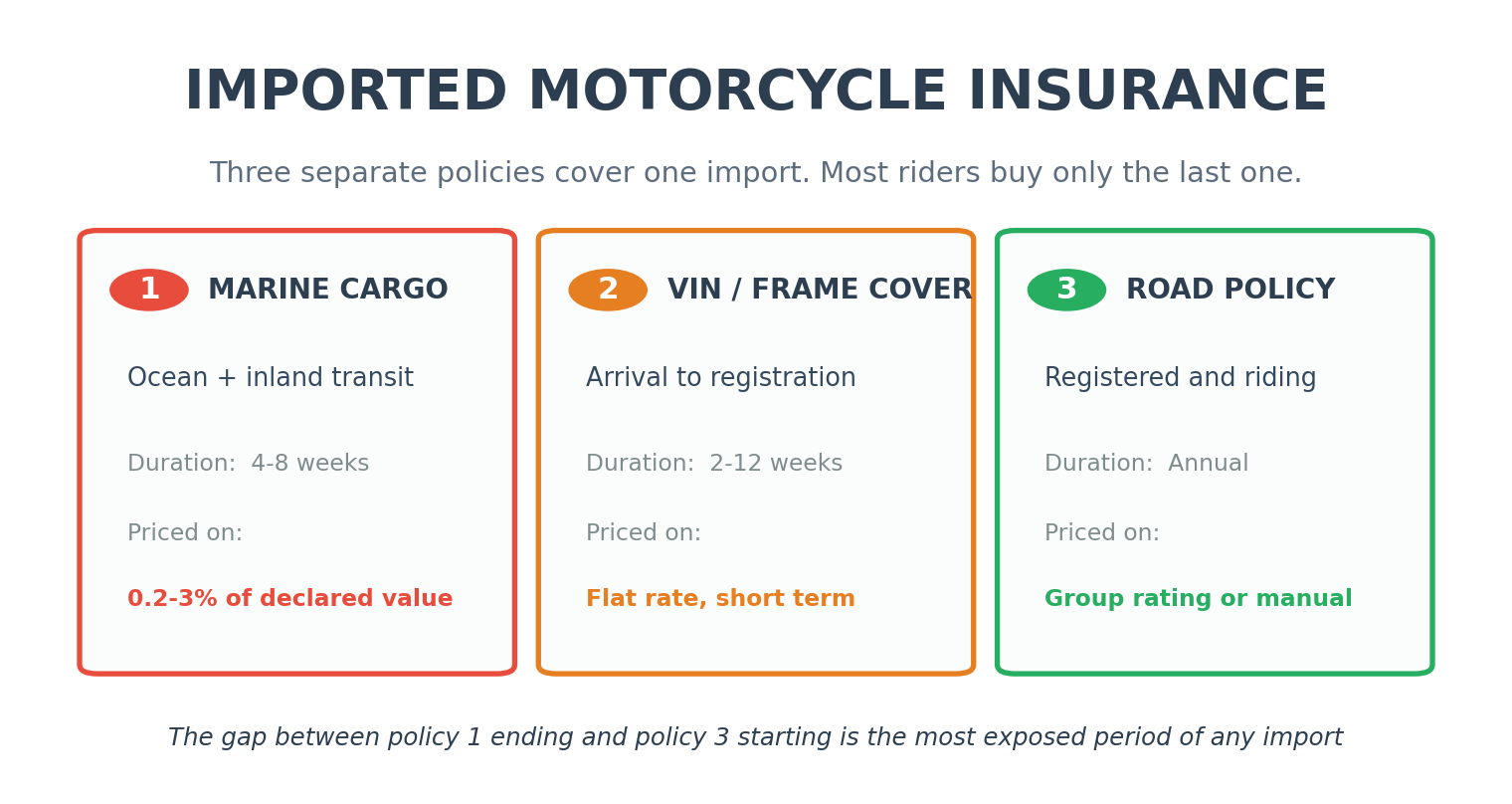
Imported motorcycle insurance is three policies, not one
Every guide on this subject writes about the road policy. That is the third of three, and by the time you need it the two riskiest windows have already closed.
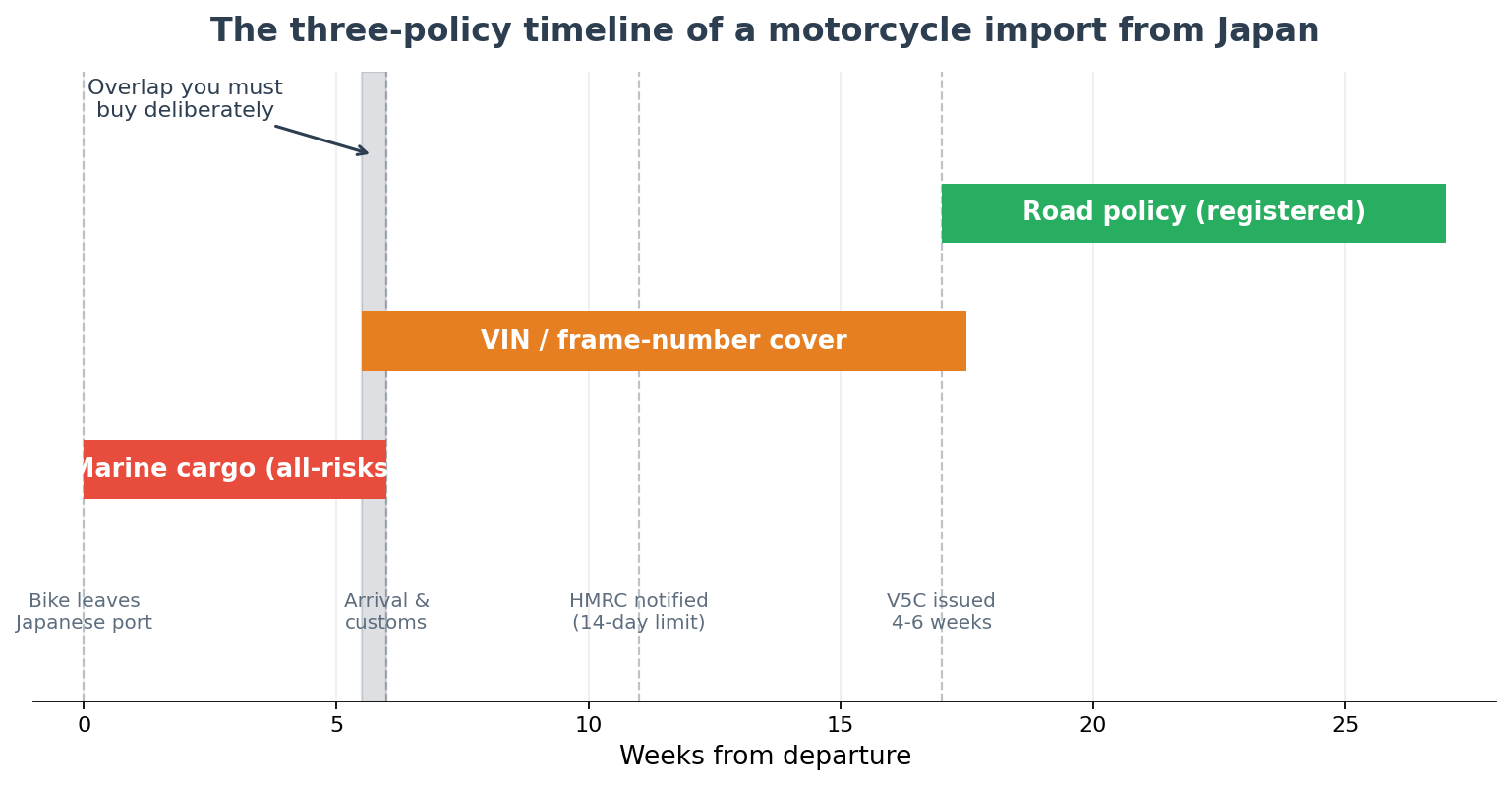
Think about where your money actually sits during an import. For four to eight weeks it is a crate on a ship. For another two to twelve weeks it is a machine sitting in the UK with no registration mark, no plate, and no legal identity beyond a frame number. Only after that does it become a bike on your driveway with a V5C in the drawer.
Each of those three phases needs a different product, sold by a different kind of company, priced on a different basis.
| Phase | Duration | Policy | Priced on | Sold by |
|---|---|---|---|---|
| Ocean and land transit | 4–8 weeks | Marine cargo (all-risks) | % of declared value | Freight forwarder or cargo underwriter |
| Arrival to registration | 2–12 weeks | VIN / frame-number cover | Flat rate, short term | Specialist motorcycle broker |
| On the road | Annual | Road policy | Group rating or manual underwrite | Specialist or mainstream insurer |
Miss the first and a container incident costs you the entire purchase. Miss the second and you have a legal problem the day the bike lands. Miss the third and you are not riding.
Most people only discover the second one exists when the DVLA asks for it.
Policy one: marine cargo insurance, and the number that should worry you
Marine cargo cover is arranged alongside the freight itself, and our guide to shipping a motorcycle from Japan sets out how the two are quoted together.
Marine cargo insurance is the cheapest protection you will buy in this whole exercise and the one most often skipped, because the shipping quote already looks expensive and this feels like an upsell.
It is not an upsell. Read your forwarder's terms and you will find their liability is capped by international convention at a figure calculated per kilogram, not per motorcycle. A 200kg bike attracts a liability limit that does not come close to what you paid for it. If the container goes over the side, the forwarder's exposure is a fraction of your loss, and the difference is yours.
What it costs
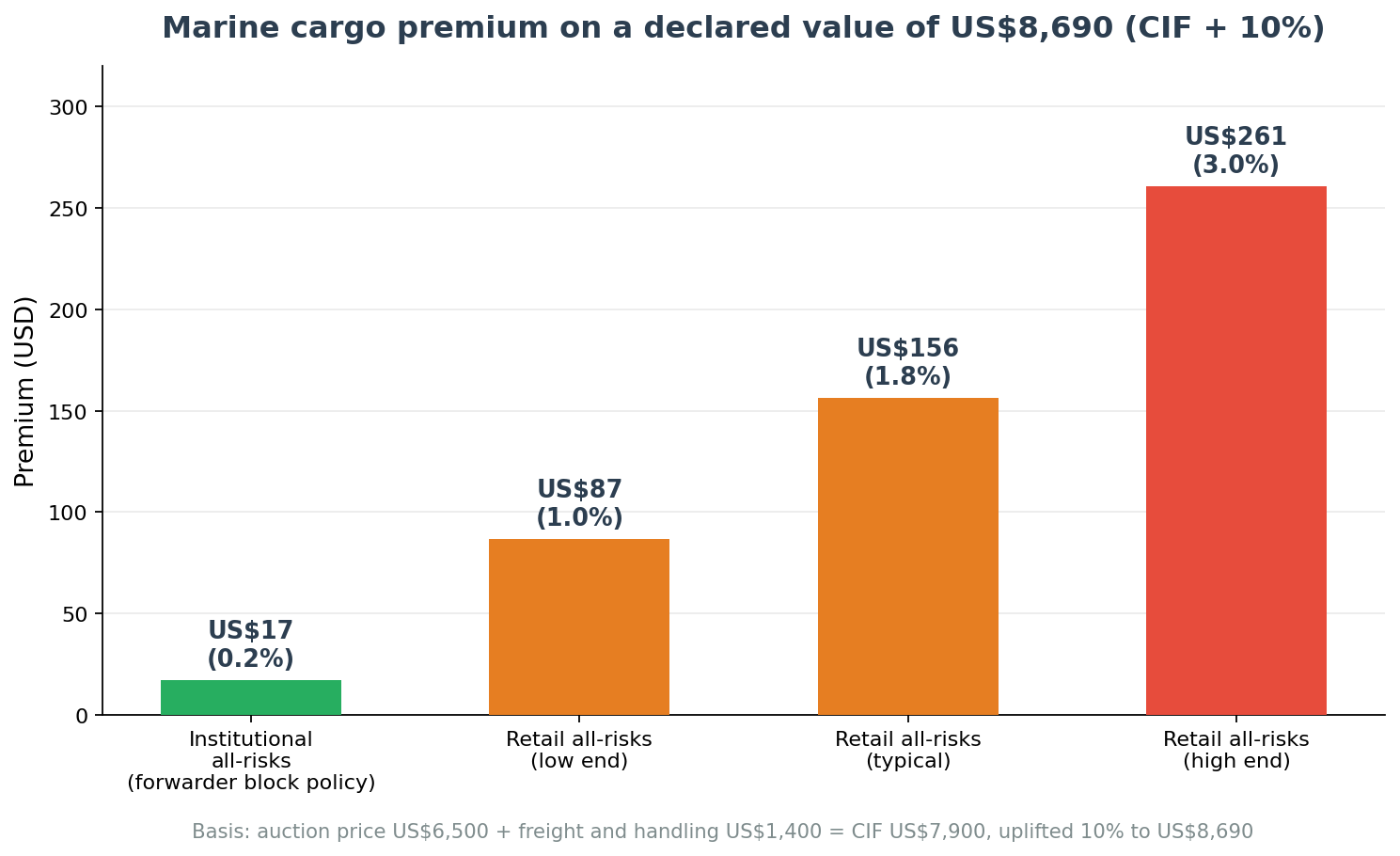
Marine cargo rates for all-risks cover sit in a well-established band. Broad all-risks marine cargo insurance generally runs 1% to 3% of the total shipment value. Where a forwarder has a block policy and can attach your bike to an existing programme, institutional all-risks rates drop to 0.2% to 0.5% of cargo value. That is the range worth asking about by name.
The valuation basis matters as much as the rate. The market standard is CIF plus 10% — cost, insurance and freight, uplifted by a tenth. Shippers routinely add 10% to 20% on top of the commercial value to absorb customs charges, storage and reshipping costs that a bare purchase-price valuation would leave uncovered.
Run the arithmetic on a real example. A bike bought at auction for $6,500 with $1,400 of freight and handling gives a CIF of $7,900. Uplifted by 10%, you declare $8,690. At the bottom of the institutional band — 0.2% — the premium is $17. At a typical retail all-risks rate of 1.8%, it is $156. At the top of the retail band, 3%, it is $261.
Seventeen dollars to protect eight and a half thousand. People skip this.
What all-risks does not cover
All-risks is a term of art, not a promise. The standard exclusions bite in predictable places:
- Insufficient packing. If the bike was crated badly and the damage traces to that, the claim fails. This is the single most common reason a marine claim gets rejected on a motorcycle, and it is why crated shipping in a container behaves differently from roll-on roll-off. Our breakdown of container versus RoRo shipping covers the handling differences in detail.
- Pre-existing damage. Anything already on the auction sheet is excluded. Read the sheet before you bid — our guide to reading Japanese auction inspection sheets shows you exactly where damage is recorded.
- Delay. Pure financial loss from a late arrival is not a cargo peril, no matter how much it costs you.
- Inherent vice. A tank that was already rusting inside will keep rusting on the ship, and that is not an insured event.
Japan-specific risk deserves a line of its own. Sailings out of Yokohama and Kobe cross typhoon season between roughly May and October, and humidity in a steel box does things to unprotected metal that surprise first-time importers. Ask for all-risks rather than the restricted named-perils clauses, and ask specifically whether the policy covers the inland leg from the auction house to the port. That road journey is short, and it is where a surprising share of damage happens.
Policy two: VIN insurance, and the registration Catch-22 (which is not what you have been told)
This section is where almost every guide on the internet gets it wrong, and getting it right saves you money and a fortnight of arguing with the wrong department.
The claim you will read everywhere is that the DVLA requires proof of insurance before it will register an imported vehicle. Repeat that on any forum and nobody will challenge you.
Go to the source and it does not hold up. The DVLA's own V355/5 guidance for filling in the V55/5 form lists the supporting documents for first registration of a used vehicle, and the insurance line reads: "certificate of insurance or cover note (downloaded copies are acceptable, photocopies are not) valid on the date the tax comes into force, for vehicles registered with a Northern Ireland address."
That qualifier at the end changes everything. If your address is in England, Scotland or Wales, the DVLA does not ask for an insurance certificate with the V55/5. If your address is in Northern Ireland, it does — and a photocopy will get your application rejected.
So why does everyone insist otherwise, and why do you still need cover before the plate arrives?
The real Catch-22, and it is worse than the one people describe
The genuine trap is not paperwork. It is movement.
A motorcycle under ten years old needs an MSVA test before it can be registered. The test happens at a DVSA site. To get the bike to that site you either trailer it — which is fine — or you ride it, which requires road insurance, which requires a registration mark you do not have yet. Ride it uninsured and unregistered and the offence is not a technicality.
And the whole time the bike sits waiting, it is an uninsured asset. Theft from a domestic garage, fire, a shelf falling on it. Marine cargo cover ended at delivery. Your road policy has not started. That gap runs from three weeks to three months and it is the single most exposed period in the entire import.
How you actually cover it
The answer is VIN insurance, also called frame-number cover. A specialist motorcycle broker writes a policy against the frame and engine numbers instead of a registration mark. It is a normal, established product. Mainstream comparison sites do not sell it, which is why most people never learn it exists.
The typical structure gives you a policy that runs on the VIN, with a contractual obligation to supply the registration mark once the DVLA issues it. The standard window is 30 days from policy inception to provide that registration. Brokers extend it where an MSVA slot is queued and you can evidence the booking.
Three practical points that matter more than they look:
- Buy it before the bike leaves the port compound. The moment the crate is opened and the bike moves by any hand other than the freight handler's, marine cargo cover has ended. That gap is measured in days and it is uninsured.
- Frame and engine numbers must match your paperwork character for character. The V55/5 asks for both separately — box 32 for the VIN, chassis or frame number "stamped into the vehicle," box 33 for the full engine number taken from the engine itself. A single transposed character between the export certificate and the stamping stalls the policy and the registration together.
- Keep the certificate, not the confirmation email. Northern Ireland applicants need the actual certificate or cover note, and downloaded copies are accepted while photocopies are not. That is an oddly specific rule and it catches people out.
The rule that stops some imports dead, and nobody mentions it
Buried at the top of the same DVLA guidance is a restriction with more teeth than anything else in the document: the DVLA cannot register or tax any imported vehicle that has been classed as seriously damaged in another country. "Seriously damaged" means the equivalent of a UK category A or category B insurance write-off.
The obligation sits on you, before the bike ships. In the DVLA's words, before you import a vehicle you must make sure it has not been classed as seriously damaged, and you must check this with the foreign registration authority. Where there is any indication of damage, you must produce evidence from that authority confirming the vehicle is not seriously damaged before it can be registered for UK roads. And if the bike turns out to be unregisterable, the DVLA states plainly that it cannot be held liable for any fees or costs you have already incurred.
Read that last sentence again with a shipping invoice in your hand.
This is precisely why the auction sheet is an insurance document as much as a condition report. A Japanese inspection sheet records repair and accident history in a coded form, and a bike carrying a serious repair history is exactly the machine that generates this problem at the far end. Our guide to reading Japanese auction inspection sheets and the piece on auction grades show you where that history is recorded and what the codes mean.
The registration clock, and why cover length is a real decision
How long you need VIN cover depends on the path your bike takes. Two hard numbers from the DVLA anchor the estimate: you must notify HMRC of an imported vehicle within 14 days of it arriving in the UK, and once your V55/5 application is approved the DVLA issues the V5C within four to six weeks of receiving the application.
| Route | Typical elapsed time | VIN cover to buy |
|---|---|---|
| Over 10 years old, documents complete | 4–6 weeks | 2 months |
| Over 10 years old, dating certificate required | 6–10 weeks | 3 months |
| Under 10 years old, MSVA required | 8–14 weeks | 3 months |
| Age or identity unproven (Q-plate route) | 12 weeks and up | 3 months, renewable |
Our walkthroughs of the NOVA registration process and the MSVA test for imported motorcycles set out what happens at each stage. Buy VIN cover to match the realistic route, not the optimistic one.
The MID gap: legally insured, digitally invisible
Here is a wrinkle that catches out people who did everything right, and the consequences are unpleasant and entirely avoidable.
The Motor Insurance Database is the central record of insured vehicles in the UK, run by the Motor Insurers' Bureau. Police ANPR cameras query it. The DVLA queries it to enforce Continuous Insurance Enforcement — the rule that says a vehicle registered in your name must be insured at all times unless you have declared it off the road with a SORN.
The MID is keyed on registration marks. It does not index by VIN. The MIB's own askMID vehicle lookup asks for a Vehicle Registration Number and nothing else.
So a bike on a valid VIN-based policy sits in a gap. The policy is real and enforceable. The bike does not appear on the MID, because there is no registration mark to file it under. And even once you have a plate, the MIB warns that a new policy or a change to an existing one takes a few days to appear on the database — insurers have seven days from the effective date to upload it.
What this means in practice:
- Do not ride it. A VIN policy covers the bike as property and covers movements your broker has specifically agreed. It is not a substitute for road-legal status.
- Carry the paper certificate. If the bike moves on a trailer and anyone asks, that certificate is your evidence. The database will not back you up.
- Check the MID the week after your V5C arrives. Converting a VIN policy to a registered policy is a manual step at the insurer's end, and manual steps get missed. The MIB lookup is free for your own vehicle.
- SORN it if there is any delay. Continuous Insurance Enforcement bites once the vehicle is registered in your name. The MIB is explicit that an uninsured-looking vehicle triggers a letter to the registered keeper, then a fixed penalty or prosecution if nothing changes.
A bike that lands in March and clears MSVA in June has spent three months as a vehicle the system sees as untaxed and uninsured — unless you tell them otherwise.
Policy three: the road policy, and what it actually costs
Now the bit everyone came for. What does it cost to insure an imported motorcycle once it is on the road?
The honest answer is that it depends far more on which insurer you reach than on the bike. That is unusual. On a domestic-market machine the spread between the cheapest and dearest quote is meaningful but bounded. On a grey import the spread is the difference between a number and a refusal.
The published market data makes the point in a way that looks backwards until you unpack it. Comparison-site figures put the median price for full cover on a motorbike at around £286, while the median for imported motorbikes that are not official UK models sits near £81.
Imports are not cheaper to insure. That figure measures a different population. Grey imports skew heavily towards older, lower-value, lower-powered machines ridden by experienced owners with long no-claims records, and those are the cheapest risks in motorcycling. A 1997 CB400SF ridden 2,000 miles a year by a forty-five-year-old with nine years no claims is a better risk than almost anything else on the road.
The loading is real. It is simply applied to a base that was already low. Where riders get hurt is not the loading — it is the refusals, and the habit of accepting the first company that says yes without checking whether the price is competitive.
The realistic ranges
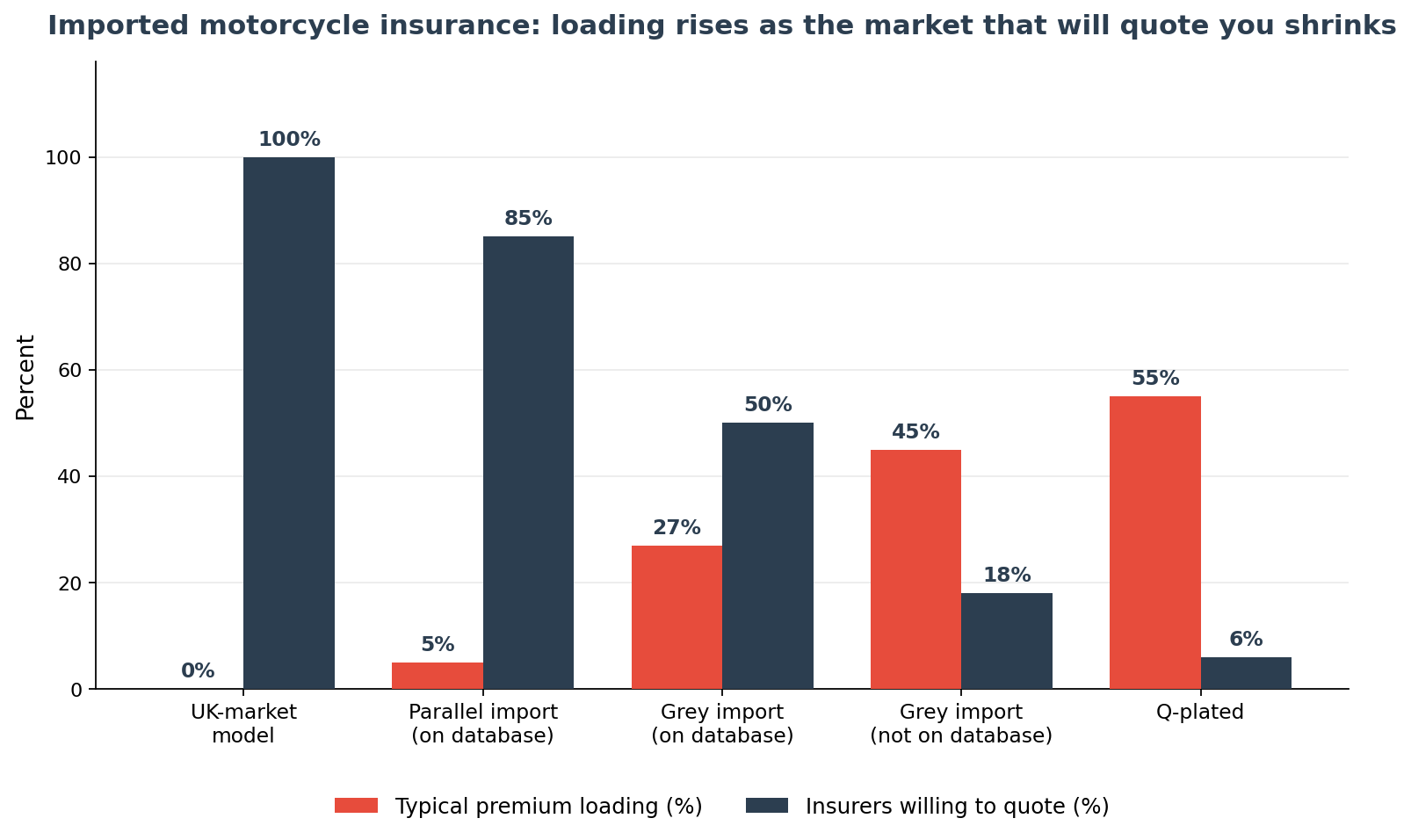
Based on how the market is structured rather than any single quote, here is the shape of what to expect on a like-for-like basis in the UK:
| Bike status | Insurers willing to quote | Typical loading vs UK-market equivalent |
|---|---|---|
| UK-market model | Effectively all | Baseline |
| Parallel import, on database | Most | 0–10% |
| Grey import, on database | Around half | 15–40% |
| Grey import, not on database | Specialists only | 30–60% |
| Q-plated | A handful | 50%+ |
The Q-plate row is the worst outcome and it is avoidable. The DVLA's rule is stated in one line of the V355/5 guidance: if you cannot provide proof of the vehicle's age or identity, they will issue a "Q/QNI" registration number. It does not mean the bike is unsafe or stolen. It means your documents failed to prove what it is.
Insurers dislike Q-plates for a reason that has nothing to do with your individual bike: the Q class also holds rebuilt write-offs and vehicles whose identity was reconstructed after a theft. Your honest JDM import is being priced alongside that population.
You avoid a Q-plate with documentation, and it starts before you bid. A complete Japanese export certificate with a frame number matching the stamping, plus a dating certificate from the manufacturer or another acceptable source where the age is not obvious from the paperwork — the DVLA names both. Our guide to the Japanese export certificate explains which document you get for which engine size, and why a 250cc bike produces different paperwork from a 750.
One more detail from the form that trips importers: box 24 asks for the date the vehicle was first registered regardless of country, and box 25 asks for the year it was built. These are different fields and they are frequently different years on a Japanese machine. Filling both from the same number is a fast route to a records dispute.
Agreed value: why full cover on a JDM import is worth less than you think
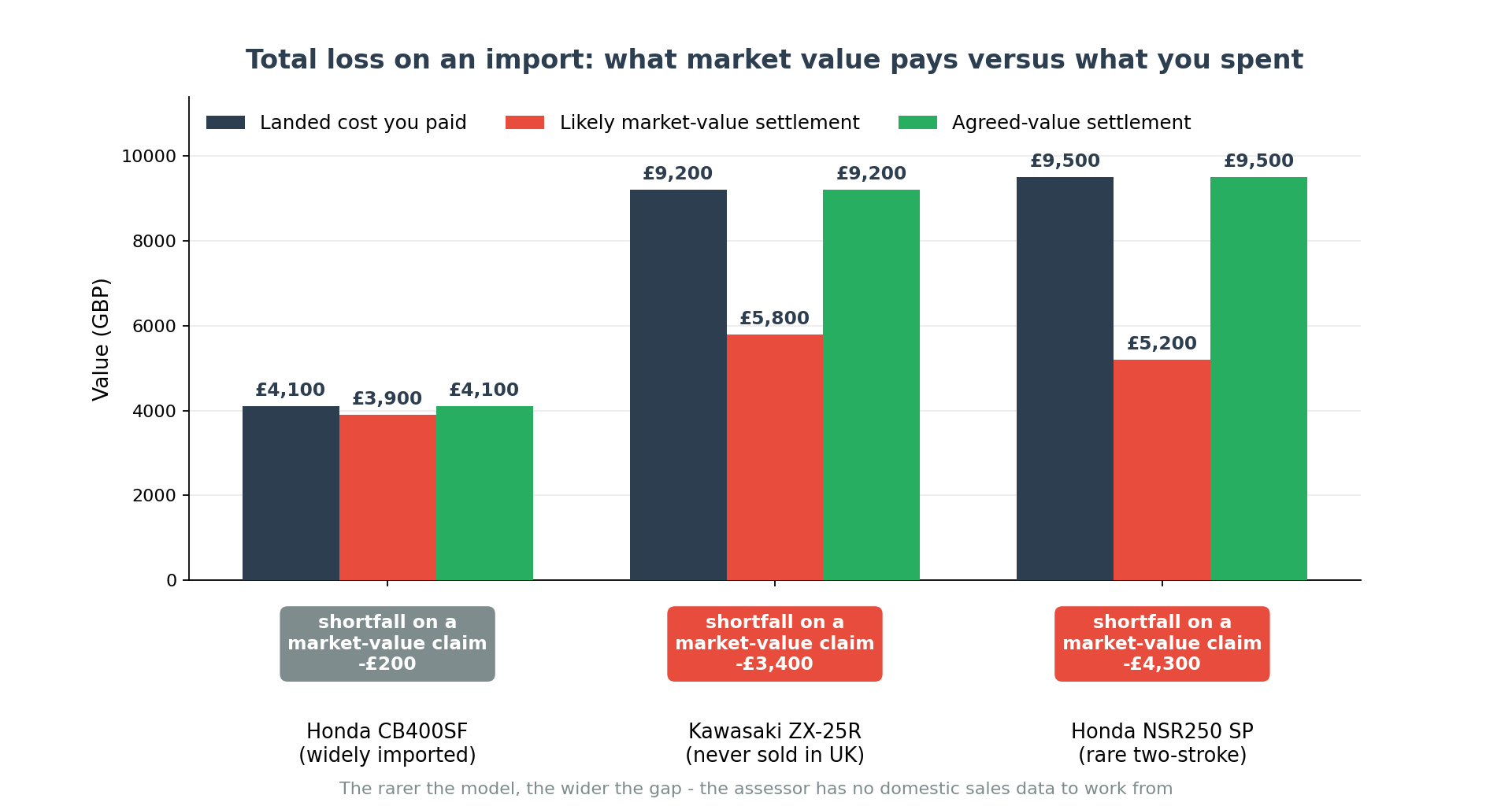
You buy the top tier of cover, you pay the premium, the bike gets written off, and the insurer offers you a number that bears no relationship to what you spent. This happens to importers more than to anyone else, and the mechanism is straightforward once you see it.
A standard policy settles a total loss at market value. Market value means what the insurer's valuation guide says the bike is worth. Those guides are built from domestic sales data. A motorcycle that was never sold in your market has no entry, so the assessor picks the nearest thing they recognise and works from that.
The nearest thing is almost never right. A Honda NSR250 SP with a dry clutch gets valued as a generic two-stroke 250. A Kawasaki ZX-25R, a screaming four-cylinder that was never officially sold in Britain, gets valued against a twin-cylinder 300. The gap between those numbers is thousands.
American importers hit this harder still. There is no domestic book value for a twenty-five-year-old right-hand-drive import, which means a theft or a total loss produces a settlement figure generated from nothing at all.
What agreed value actually does
An agreed value policy fixes the settlement figure in writing before the policy starts. Insurer and owner agree a sum, that sum goes on the schedule, and a total loss pays that sum. No assessor, no valuation guide, no argument about what a 1994 grey import is worth in a market where nobody sells them.
Getting it requires work at the outset, and this is the part people skip:
- A professional valuation or an appraisal. For a rare model, an independent appraiser's report carries more weight than anything you write yourself.
- Photographs. Every side, the instruments, the frame stamping, the engine number, any modification. Insurers in New Zealand and Australia in particular ask for a photo set and a written description before they will agree a figure on a rarer machine.
- Receipts. Purchase invoice, shipping invoice, duty and VAT receipts, import agent fees, MSVA fee, and every part fitted since. The landed cost is your argument, not the auction hammer price.
- Annual review. An agreed value set in 2024 on a bike that has appreciated is now a cap working against you. Revisit it at renewal.
In the United States the same product goes by two names — agreed value and stated value — and they are not identical. Agreed value pays the agreed figure. Stated value in some policy wordings pays the lesser of the stated figure and actual cash value, which quietly reintroduces the exact problem you were trying to solve. Read which one you have been sold.
The total loss trap: parts scarcity writes off bikes that would otherwise be repaired
This is the sharpest edge of importing, and it changes what cover is worth buying.
An insurer declares a total loss when the repair cost crosses a threshold expressed as a percentage of the bike's value. Under many state regulations in the US the trigger is 70% of fair market value. UK insurers work to internal thresholds in a similar band.
Now hold the damage constant and change the bike. A dropped Yamaha MT-07 needs a fairing panel, a lever, a mirror and a bar end. The parts are in a UK warehouse, the labour is quoted from a standard time guide, the repair comes in at 45% of value, and the bike is repaired.
The identical damage to a grey-import Yamaha FZ400 means panels sourced from Japan on a four-to-eight-week lead time, freight, and a body shop pricing uncertainty into the estimate because they have never seen one. The estimate lands at 80% of a value the assessor has already pitched low. Written off.
And insurers total bikes below the formal threshold when parts are simply unavailable, or when they suspect hidden damage they cannot price. Repair labour costs have climbed steadily, replacement parts are harder to source on predictable timelines, and even moderate damage involving painted plastics or calibration work pushes estimates upward fast.
Two conclusions follow, and they point in opposite directions depending on the bike.
On a common, well-supported import — a CB400SF, an SV650, a Z900 — parts flow well enough that full cover behaves normally. Buy it.
On a rare model with a thin parts supply — a two-stroke race replica, a limited-run homologation special, anything where a fairing panel is a three-month hunt — full cover on a market-value basis buys you a low settlement on a bike you cannot replace. Either get agreed value in writing, or consider third-party, fire and theft and accept that a crash means you rebuild it yourself.
That second option sounds reckless. It is what a lot of experienced importers of rare machinery actually do, because they know the settlement figure will not buy another one anyway. Our guide to two-stroke imports and the piece on vintage Japanese motorcycles cover which models sit in this category.
Buying parts availability before you buy the bike
The insurance consequence of parts scarcity means parts availability is an insurance question, not just a maintenance one. Check it before you bid, not after:
- Search the model on a Japanese parts retailer that ships worldwide and count the listed items. A model with thousands of catalogued parts is in a different class from one with two hundred.
- Check whether the model shares body panels with a machine that was officially sold in your market. Shared panels collapse your repair timeline.
- Find out whether the manufacturer still supplies. Japanese makers typically support a model for around ten years after production ends — not after your bike was built. A 2014 machine from a line that ran until 2023 has support until roughly 2033. A 2018 machine from a line that ended in 2019 falls off a cliff in 2029.
That last distinction reframes the whole calculation. Age of the bike tells you very little. End of production tells you almost everything.
Country by country: UK, USA, Australia, New Zealand, Canada
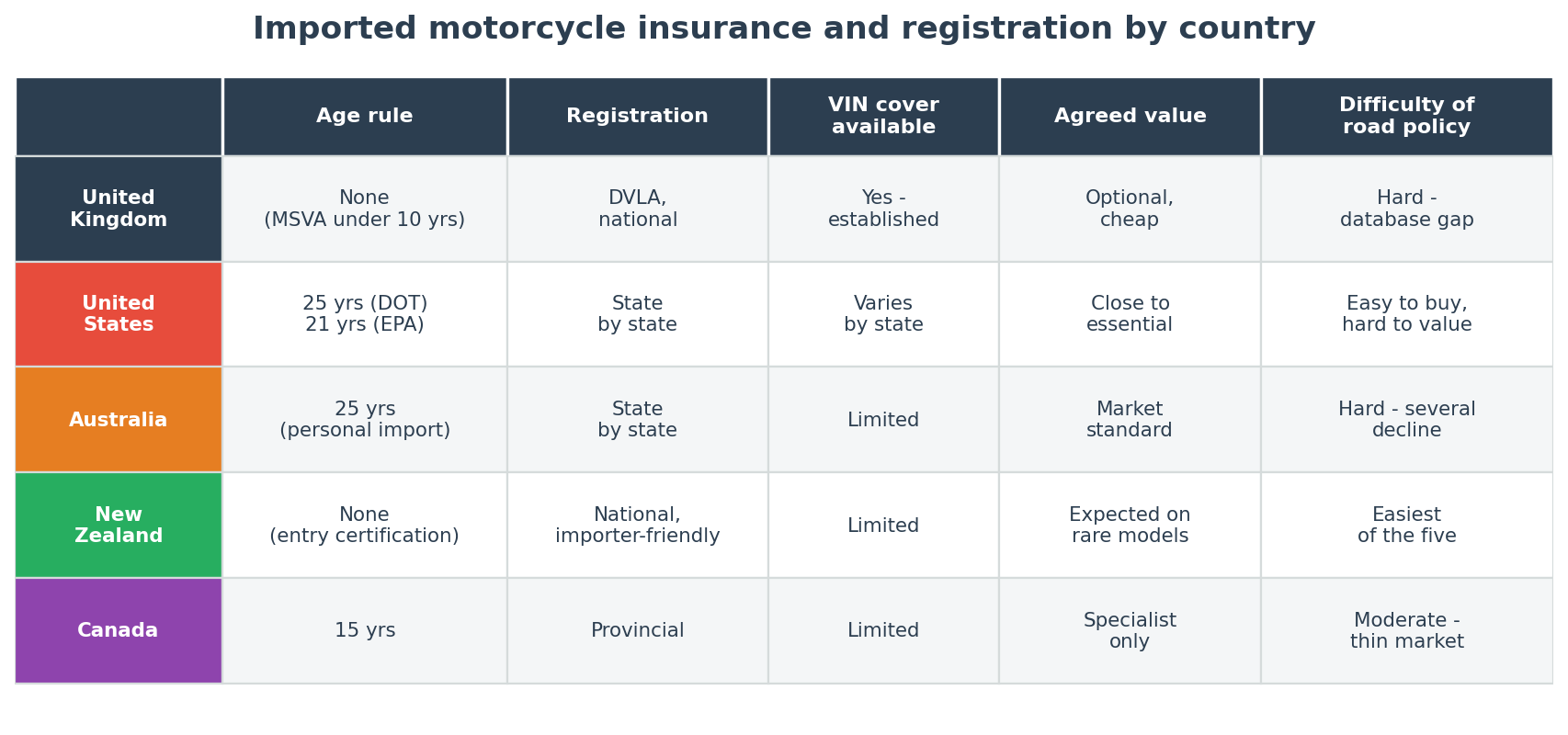
The three-policy structure holds everywhere. What changes is the registration mechanics in the middle phase, and how hard the road policy is to buy.
United Kingdom
The hardest of the five for the road policy, and the easiest for everything else. VIN cover is an established product, brokers understand it, and the DVLA process is documented. The pain points are the MSVA test for bikes under ten years old, the Q-plate risk when documentation is thin, and the database gap that produces refusals.
The practical route: HMRC notification within 14 days of arrival, VIN policy, V55/5 to DVLA Swansea, MSVA if the bike is under ten years old, V5C in four to six weeks, then convert to a registered road policy. The official starting point is the government's importing vehicles into the UK guidance, which the DVLA's own form notes point to. Our UK import walkthrough and the full UK cost breakdown set out the sequence and the fees.
United States
Registration is a state matter, which means the middle phase varies enormously. Some states register a twenty-five-year-old import on the strength of the customs entry and a bill of sale. Others demand a VIN inspection by a state trooper before they will issue a title.
The insurance issue is valuation rather than availability. American insurers will write the policy. What they will not do is value a right-hand-drive twenty-five-year-old import sensibly, because no book value exists. Stated value or agreed value is close to mandatory on anything with real value, and vintage or classic programmes are the usual route — most require the bike to be at least twenty years old, with twenty-five being the common line for full classic classification.
If your bike qualifies under the federal exemption, our guide to the 25-year rule for motorcycles explains what the date actually means, and the USA import guide covers the customs paperwork.
Australia
Compulsory third-party cover attaches to registration and is handled at state level. That part is straightforward. The optional cover on top is where grey imports run into trouble, and the Australian market has settled on agreed value as the standard answer for anything imported.
Australian insurers price grey imports cautiously and several decline them outright. Specialist brokers exist precisely for this, and the agreed-value route with photographs and a written description is the well-worn path. See our Australia import guide for the compliance side.
New Zealand
The most import-friendly registration system of the five, and it shows in the insurance market: New Zealand has been absorbing Japanese used vehicles for decades and insurers are used to them. Grey imports still attract higher premiums than NZ-new bikes, and insurers want an agreed-value policy with photographs and a description for rarer models.
The one thing to watch is the entry certification process, which has to complete before you can register and therefore before a normal policy attaches. Our New Zealand import guide covers the certification steps.
Canada
Fifteen years rather than twenty-five, provincial registration, and a market that is smaller and therefore thinner on specialist products. Provincial insurers handle the basic cover, and private specialists handle agreed value on anything unusual. The Canada import guide covers the federal admissibility side.
The nine-step script that actually gets you quoted
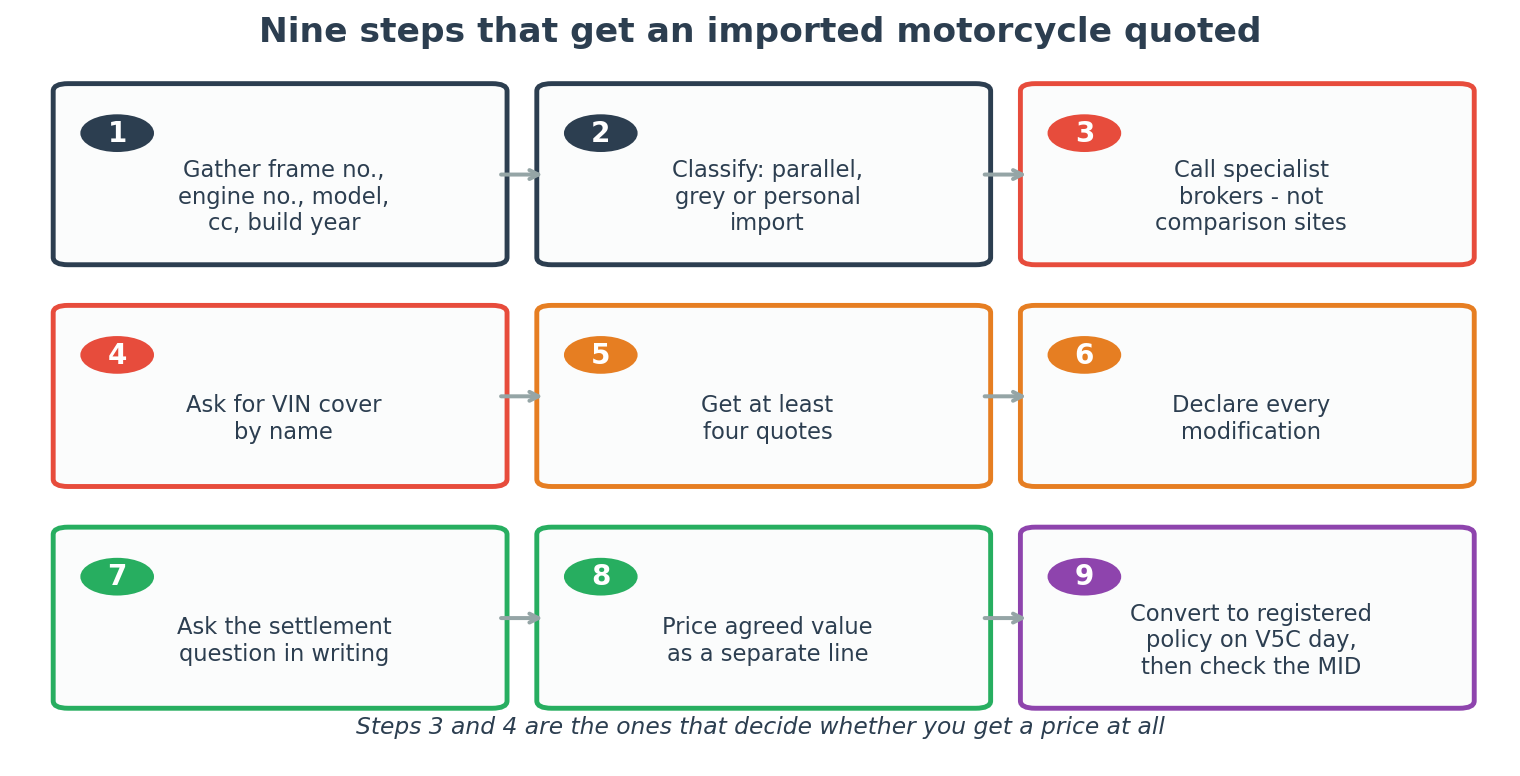
Comparison sites are the wrong tool for this job and will waste an afternoon proving it. Here is the sequence that works, in order.
If you have not chosen a bike yet, it is worth reading this alongside our overview of what JDM actually means and the step-by-step on how to import a motorcycle from Japan, because model choice and insurability are the same decision.
Step 1 — Gather the identity documents first. Frame number, engine number, exact model designation as it appears on the Japanese export certificate, engine capacity in cc, and year of manufacture. Not the year of first registration in your country. The year the machine was built.
Step 2 — Establish what class of import you have. Parallel, grey or personal. You will be asked, and the answer changes the price.
Step 3 — Call brokers, do not fill in forms. A specialist motorcycle broker has underwriters who write bikes by hand. The first question to ask is direct: "Do you underwrite grey imports outside the standard vehicle database?" If the answer is no, thank them and move on rather than spending ten minutes on details.
Step 4 — Ask for VIN cover by name. Say "frame and engine number cover pending registration." Using the industry term gets you routed to someone who knows what you mean, instead of to someone who tells you a registration is mandatory.
Step 5 — Get at least four quotes. The spread on imports is wide enough that the fourth call regularly beats the first by a third. This is not true of domestic bikes and it surprises people.
Step 6 — Declare every modification. An aftermarket exhaust, a rejet, a different screen, a tail tidy. Japanese auction bikes arrive modified more often than not, and an undeclared modification is the cleanest reason an insurer has to reduce a claim.
Step 7 — Ask the settlement question in writing. "On a total loss, how do you value this specific model?" Get the answer by email. If the reply is "market value" and the bike has no market in your country, you now know the policy is worth less than the premium suggests.
Step 8 — Price agreed value as a separate line. Ask what it costs to add and what evidence they need. Then decide with a number in front of you rather than a feeling.
Step 9 — Diarise the registration handover. The day your V5C arrives, phone the insurer and convert the VIN policy to a registered policy. Then check the insurance database a week later to confirm it landed.
Mistakes that cost real money
Every one of these has happened to somebody, repeatedly.
Declaring the auction hammer price as the bike's value. Your bike is worth the landed cost — hammer price plus auction fees plus freight plus duty plus VAT plus registration and test fees. Insure the hammer price and you have insured roughly 60% of your money. On an $6,500 auction purchase that lands at $10,200, you have quietly left $3,700 uninsured.
Letting marine cover lapse at the port. Marine cargo cover ends when the goods are delivered as defined in the policy, and "delivered" often means the port compound rather than your garage. The trailer ride home is a separate exposure, and a surprising number of import horror stories happen in that final hour.
Assuming the freight forwarder's liability is insurance. It is not. It is a capped liability calculated per kilogram under an international convention, and the cap will not buy you another motorcycle.
Riding on the VIN policy. The policy exists to protect the asset and to satisfy the registration authority. It does not make an unregistered motorcycle road legal.
Describing a grey import as a UK or US model to get a cheaper quote. The frame number gives it away the moment an assessor looks at the bike. A policy obtained on a misdescription is a policy the insurer will challenge, and they will do it at the point of claim rather than at the point of sale.
Forgetting to SORN during the registration wait. Continuous Insurance Enforcement does not pause because your bike is stuck waiting for a test slot.
Buying a bike with a thin document trail and hoping. If anything about the history looks uncertain, ask us to check it before the hammer falls. A missing export certificate is a Q-plate, a Q-plate is a 50% loading and a shortlist of two willing insurers, and none of that was priced into the bargain you thought you found.
The one calculation to run before you bid
Insurance turns out to be a bidding constraint, not a post-purchase chore. Run this before the auction, not after.
You can see what is currently coming through the Japanese auction system on our live listings page, which is the fastest way to sanity-check landed cost against a real machine rather than a hypothetical one.
Take the landed cost of the bike. Add three years of realistic import-loaded premiums. Then ask what a total loss would pay you on a market-value basis in your country — and if the honest answer is "nobody knows, because the model has never been sold here," you have found a real cost that the auction price did not include.
Work a concrete case. A 1998 Honda CB400 Super Four lands in the UK at roughly £4,100 all in. Import-loaded full cover for an experienced rider runs somewhere near £210 a year, so three years is £630. A market-value settlement on a CB400SF is well supported, because the model has been imported in numbers for twenty years and assessors recognise it. Total exposure over three years is £4,730, and the downside is contained.
Now the same exercise on a rare two-stroke that lands at £9,500. Loaded cover runs near £340, so £1,020 over three years. Agreed value adds a further £60 a year and requires an appraisal costing £150. Skip the agreed value and a total loss produces a settlement generated from a guess. Total exposure is £10,670 with agreed value in place, or £10,520 without it and a settlement risk running into four figures.
The £150 appraisal is the best money in that entire table. That is the calculation, and it takes ten minutes.
How AWA Auction fits into this
We bid on Japanese auctions on behalf of buyers in the UK, the US, Australia, New Zealand and Canada, and the insurance side of the process shapes what we do before a bid ever goes in.
We check the export documentation is complete and the frame number on the paperwork matches the stamping on the bike, because that document set is what stands between you and a Q-plate. We give you the frame and engine numbers early, so you have them in hand when you start calling brokers rather than after the bike has landed. We arrange marine cargo cover on an all-risks basis at institutional rates as part of the shipping arrangement, on a CIF-plus-ten valuation rather than the hammer price. And we tell you honestly when a model has a thin parts supply, because that is the variable that decides whether full cover on that bike is worth buying.
What we will not do is tell you a rare machine will be easy to insure when it will not. The database gap is real, some models take four calls to place, and knowing that before you bid is worth more than finding out afterwards.
You can browse current listings to see what is available now, or contact our team with a specific model and we will tell you what its documentation and parts situation look like before you commit a penny.
See Also
Share this article: