
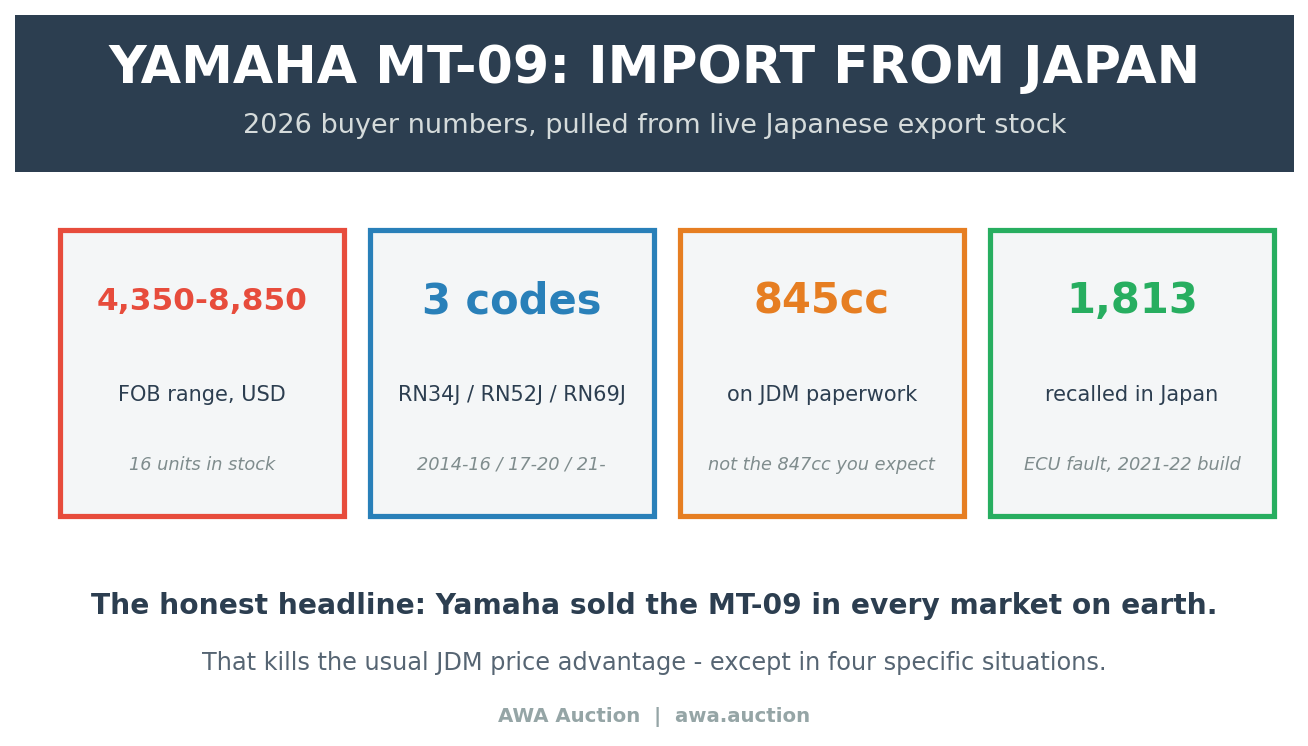
Here is the sentence most import guides will not write: a Yamaha MT-09 import from Japan is, for most riders in most countries, a worse deal than walking into a local dealer. We sell Japanese auction access for a living, and we would rather tell you that up front than take your deposit and let you work it out at the port.
The reason is simple. Yamaha built the MT-09 to conquer the world, and it did. Britain got it. Europe got it. America got it as the FZ-09. Australia, New Zealand, South Africa, the Gulf — everyone got it. When a bike sells in that kind of volume everywhere, the price gap between Japan and everywhere else collapses, and the shipping bill eats whatever gap survives. That is the opposite of a CBR250RR MC22 or a XJR400, where Japan is the only shop in the world that stocks them.
So why is this guide 5,000 words long instead of one paragraph? Because there are four specific situations where importing an MT-09 from Japan makes complete sense, and because the paperwork on a Japanese-market MT-09 contains three traps that will cost you money and a fortnight if you meet them cold at a registration office. This guide covers both: the honest maths that will talk most of you out of it, and the details you need if you are one of the people it still works for.
Everything priced here comes from live export stock and current classified listings in July 2026, not from a spreadsheet somebody built in 2019.
Real Yamaha MT-09 export prices from Japan right now
Start with the number that matters. We pulled the current MT-09 stock list from a single Japanese exporter and got seventeen bikes. Sixteen had prices attached. Here they are, sorted by FOB price — FOB meaning the bike is loaded on the boat in Japan and the ocean freight has not been paid yet.
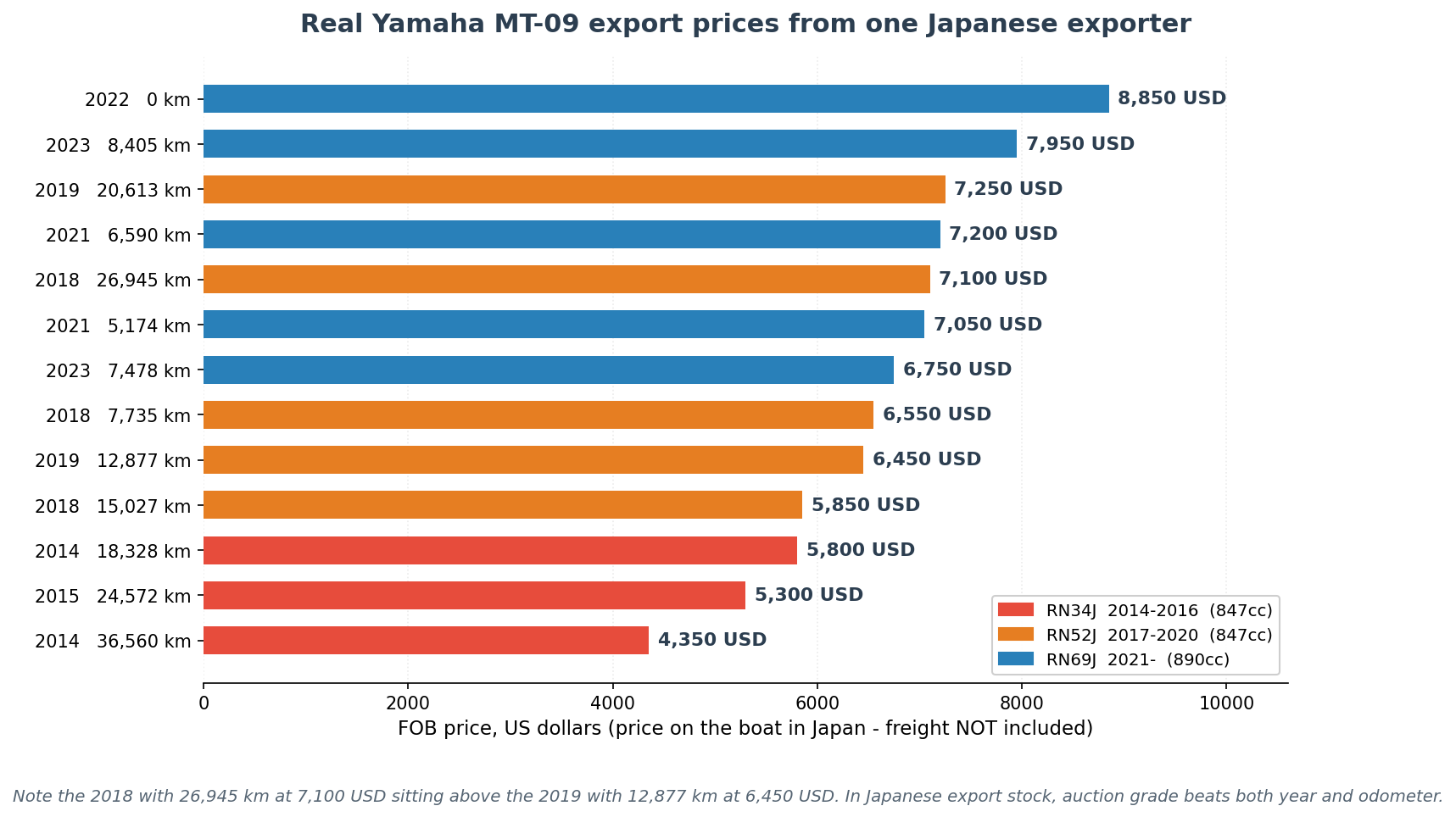
Read that chart twice, because there is a lesson buried in it that applies to every Japanese import you will ever buy.
Look at the three 2018 bikes. One with 7,735 km asks 6,550 USD. One with 15,027 km asks 5,850 USD. And one with 26,945 km asks 7,100 USD — the highest of the three, on nearly four times the mileage of the cheapest. Now look at the 2019 with 12,877 km at 6,450 USD, which undercuts a 2018 with twice its mileage.
Year and odometer are not driving these prices. Auction grade is. A grade 4.5 bike with 27,000 km on it that has never been dropped, never been repainted and has a full Yamaha service book will out-price a grade 3.5 bike with 8,000 km and a scuffed swingarm every single time. If you take one thing from this guide, take that: in Japanese export stock, condition beats both year and mileage, and the number you should be interrogating is the grade on the sheet, not the digits on the clock.
The full spread across those sixteen bikes ran from 4,350 USD for a 2014 with 36,560 km to 8,850 USD for a 2022 showing literally zero kilometres — an unregistered bike that sat in a showroom for four years. There was also a 2023 with 7,478 km at 6,750 USD sitting below a 2021 with 6,590 km at 7,200 USD, which tells you how much individual condition and colour scheme move the needle.
One more thing from that stock list, and it is a warning. Chassis codes on the sixteen bikes broke down as RN34J on three, RN52J on six and RN69J on five. The remaining bike was listed with the chassis prefix RM36J, which is not an MT-09 code at all. Either the bike is not what the listing says it is, or somebody typed it wrong. Exporter data entry is a manual job done at volume, and this is what it looks like when it slips. Always check the chassis prefix against the model you think you are buying before you send a deposit, and read our guide to what an auction sheet actually tells you before you bid on anything.
Why the MT-09 is the wrong bike to import, and the four times it is right
Let us do the arithmetic that most import brokers hope you will not do.
A 2015 MT-09 with 24,572 km sits in Japanese export stock at 5,300 USD FOB. In the UK, a 2015 MT-09 with 17,199 miles — that is 27,678 km, so more worn than the Japanese bike — has an asking price of £4,790, already registered, already carrying a V5C, already legal to ride home on.
The Japanese bike, at 1 GBP to 1.28 USD, is £4,141 before a single other cost. Add ocean freight, marine insurance, UK port handling and clearance, 6% import duty, 20% VAT on the lot, an MSVA test, an mph speedometer and the registration fee, and you are looking at roughly £6,669 on your driveway.
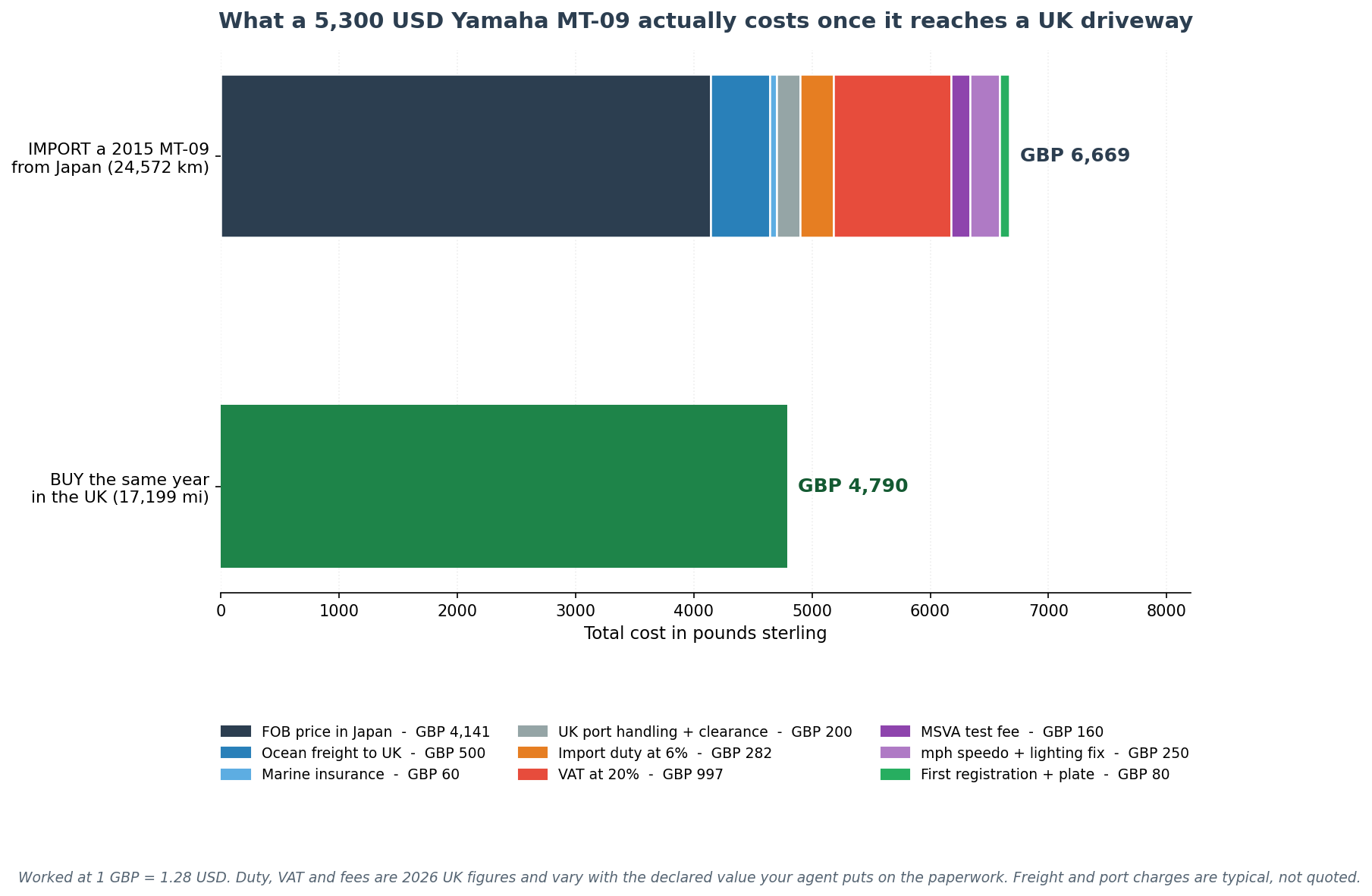
You have spent £1,879 more than the man down the road paid, and you waited eight to twelve weeks to do it. Repeat the exercise on a 2019 and a 2023 and the penalty barely moves: £1,813 and £1,704 respectively.
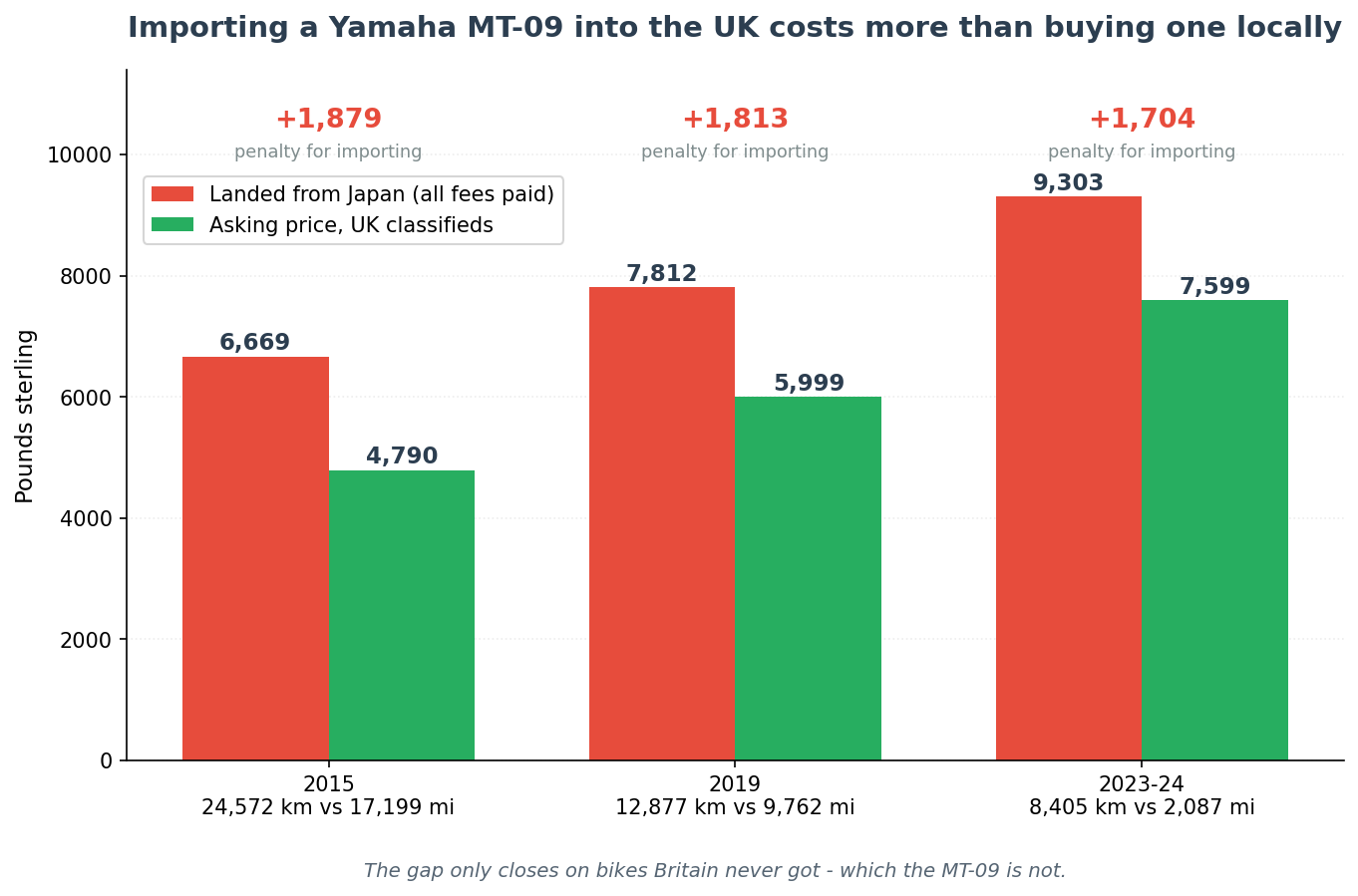
The penalty is remarkably stable because it is mostly tax. VAT at 20% and duty at 6% scale with the bike, so you cannot outrun them by buying a cheaper or a dearer example. There is no clever year to pick.
That is the case against. Now the four cases for, and they are real.
1. You want an MT-09 SP and your market never sold one
The SP is the version with the Öhlins rear shock and the uprated fork, and it fixes the single worst thing about the bike. Japan sold it. Plenty of markets did not, or sold it in tiny numbers that never reach the used classifieds. If your local market has zero SPs for sale, the import penalty stops being a penalty and becomes the entry fee.
2. You want genuinely low mileage, and your local market does not have it
Look again at that stock list. A 2021 with 5,174 km. A 2021 with 6,590 km. A 2023 with 7,478 km. A 2022 with zero. Japanese riders cover very few kilometres — expensive parking, expensive tolls, a short riding season in much of the country and a cultural habit of trading bikes early. The equivalent bikes in Britain or Australia have three to five times the mileage. If low mileage is what you are actually buying, Japan is where the low-mileage stock lives.
3. You live somewhere the local used market is thin or overpriced
This is the Gulf and, to a lesser extent, New Zealand. In the UAE the used naked-bike market is small, seasonal and priced against a new-bike market that is itself expensive. Where local supply is thin, the Japanese auction system with its tens of thousands of weekly lots is not the expensive option, it is the only option with real choice. We cover the mechanics of that route in our UAE import guide.
4. You are buying a cheap first-generation bike as a project or a track hack
A 2014 RN34J at 4,350 USD FOB is a genuinely cheap 113 bhp triple. If the plan is a track bike, a supermoto conversion or a stunt hack where paperwork matters less and the tatty-looking one is fine, the bottom end of the Japanese market is cheaper than the bottom end of most Western markets, because Japan rarely sells anything truly rough.
If you are not in one of those four groups, close this tab and go buy locally. We will still be here when you want a bike that Britain, America and Australia never got.
RN34J, RN52J, RN69J: the Japan-market chassis codes and why they matter
A Japanese-market MT-09 does not carry the same identifiers as the bike sold in your country, and this is where imports go wrong at the registration counter rather than at the auction.
Japan uses a two-part identity. There is a type designation (the kata-shiki) printed on the registration document, and there is a chassis number stamped on the frame whose prefix matches it. For the MT-09 the three you will encounter are:
- EBL-RN34J — 2014 to 2016. Engine code N703E. Frame numbers read RN34J-0000xx onward.
- 2BL-RN52J — 2017 to 2020. The facelift with the fully adjustable fork, standard ABS, assist and slipper clutch and the quickshifter.
- 8BL-RN69J — 2021 onward, including the 2024 revision. The bigger engine and the six-axis IMU.
The leading letters change with Japanese emissions legislation, not with the motorcycle. EBL, 2BL and 8BL are emissions-era markers. Your local authority will not recognise any of them, and it does not need to — but the officer processing your file will want the chassis number to match the year you have declared, and the RN34J / RN52J / RN69J split is how you prove it without arguing about brochures.
Write those three codes down before you start shopping. When an export listing shows a chassis prefix that is not one of them, treat the listing as unverified until the exporter sends you a photograph of the frame stamp. We wrote a full walkthrough of reading Japanese inspection sheets that covers where the stamp lives and what a re-stamped frame looks like.
The 845cc problem on your paperwork
Here is a trap that catches first-time importers on the MT-09 specifically.
Your Japanese export certificate will state the displacement as 845cc for a 2014 to 2020 bike and 888cc for a 2021 onward bike. Every English-language brochure, every review you have read and every insurance quote form you will fill in says 847cc and 890cc.
Nothing is wrong. Japan and Europe round the same swept volume differently under different measurement standards. The engine is identical — 78 mm bore, 59.1 mm stroke on the first CP3, and 78 mm bore with a 62.1 mm stroke on the 890. But a registration clerk comparing your export certificate against a Yamaha type-approval sheet sees 845 next to 847 and stops the file.
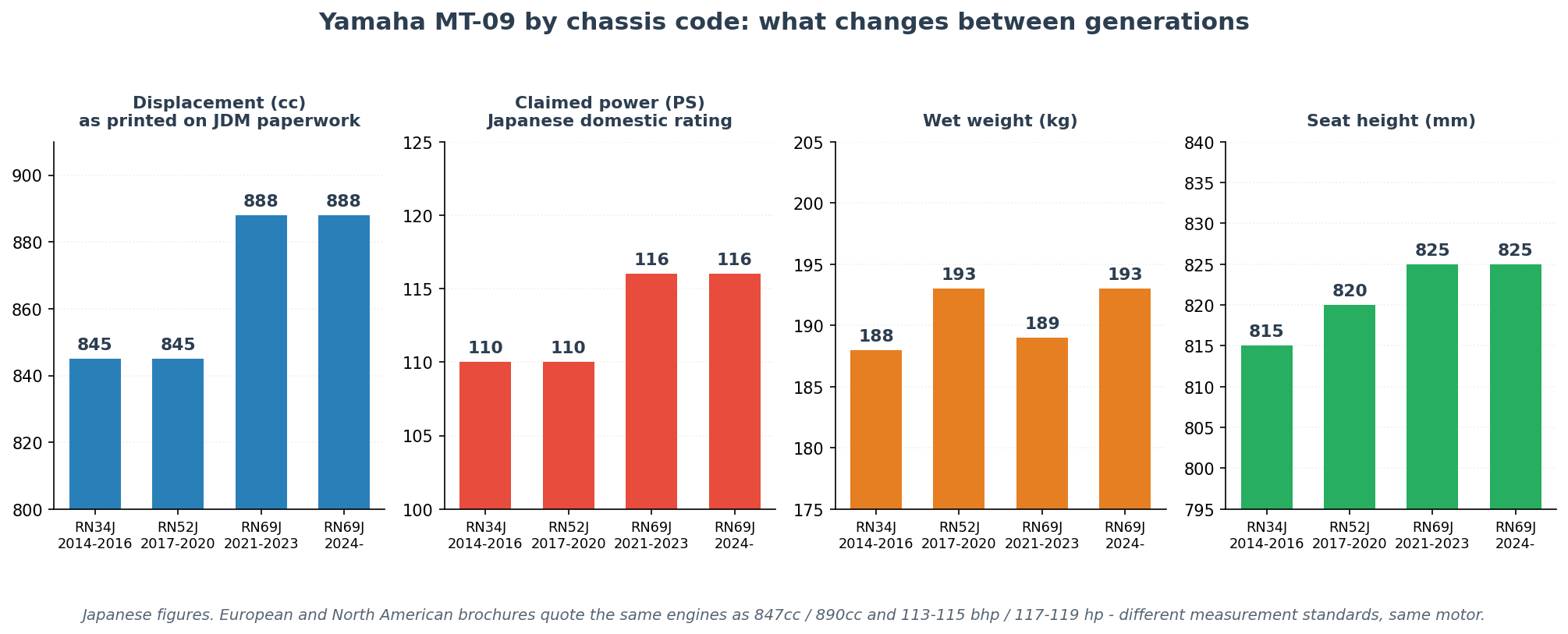
The same divergence hits the power figure. Japan rates the first-generation CP3 at 110 PS and the 888 at 116 PS. Britain and Europe quote 113 to 115 bhp and 117 to 119 hp for the same two engines. Nobody has restricted your bike and nobody has tuned it. PS and bhp are different units, and Japanese homologation measures at a different point.
Deal with this before the bike lands. Get your agent to send the export certificate as soon as it is issued, print a Yamaha Japan specification page alongside it, and put both in the file you hand over. Two sheets of paper save a fortnight of correspondence. The same trick works for the NOVA notification in the UK, where the declared engine size feeds directly into your VAT calculation.
Which Yamaha MT-09 generation to import
Four distinct bikes wear this badge. They ride very differently and they are worth very different money.
2014 to 2016 (RN34J): the cheap, rowdy one
The original. 845cc on Japanese paper, 110 PS, 188 kg wet, 815 mm seat. ABS was an option rather than standard equipment, and traction control did not exist on the early bikes at all. Yamaha revised the throttle mapping for the 2015 model year and issued a service bulletin to reprogram the throttle map on 2014 bikes, because the A-mode fuelling was so abrupt that riders were being thrown around by their own right wrists.
Even after the reflash, plenty of owners describe it as twitchy. The Japanese motorcycle historian account Bike no Keifu put it well on X: the MT-09 was conceived after Yamaha staff noticed how many of their own engineers commuted on trail bikes, and, in his words, a lot of people got bitten by this bike's A mode, in more ways than one. That is the first-generation experience in one sentence.
Buy this generation if you want the cheapest possible CP3 triple and you accept that a dyno tune and a rear shock are part of the purchase price, not upgrades. At 4,350 to 5,800 USD FOB it is the only MT-09 where the numbers get interesting.
2017 to 2020 (RN52J): the sweet spot
This is the one to import if you are importing one. The engine is unchanged, but Yamaha fixed most of the complaints: a fully adjustable 41 mm KYB inverted fork with rebound damping on one leg and compression on the other, ABS as standard, three-stage traction control, an assist and slipper clutch that lightened the lever by around 20%, and a quickshifter. Seat height rose 5 mm to 820 mm and wet weight to 193 kg.
The quickshifter cannot be retrofitted to a first-generation bike, so if you want one you buy this generation or newer. Japanese export prices land between 5,850 and 7,250 USD, which makes it the best value-per-improvement step in the whole range.
2021 to 2023 (RN69J): the one that finally works out of the box
888cc on Japanese paper, 116 PS, a longer 62.1 mm stroke that shifts peak torque down to 7,000 rpm, 189 kg, and a six-axis IMU bringing cornering ABS and lean-sensitive traction control. The chassis and suspension were properly sorted rather than patched. Reviewers who ride everything tend to describe this as the first MT-09 that needed nothing.
Two things to know. The base 2021 to 2023 bike has no cruise control — that was an SP feature until 2024. And the display is a 3.5-inch unit. Japanese export prices sit at 7,050 to 7,950 USD, close enough to Western used prices that the import penalty is at its most brutal here.
2024 onward (RN69J, revised): buy this one locally
A 5-inch TFT screen, a new airbox tuned for intake noise, the third-generation quickshifter, a Brembo radial master cylinder, two custom ride modes on top of the three standard ones, cruise control on the base model at last, a USB-C socket under the seat and adjustable handlebars. It also gained about 4 kg. The SP adds Brembo Stylema calipers, four track modes with configurable brake control and the option to switch off rear ABS, a track theme for the dash and a keyless ignition.
These are still in dealer stock in most markets. Importing a four-year-old bike that your local dealer will sell you with a warranty is a hobby, not a strategy.
The MT-09 SP: the one version worth crossing an ocean for
If there is a single honest argument for a Yamaha MT-09 import from Japan, it is the SP.
Yamaha announced it at EICMA 2017 for the 2018 model year. Mechanically it is a standard 845cc MT-09 — same engine, same output, same frame — with the suspension rebuilt into something worth having: a fully adjustable KYB fork where both legs adjust for rebound and compression, an Öhlins rear shock with a remote preload adjuster, SP-only silver and blue paint and blue stitching on the seat.
That matters because the rear shock is the MT-09's original sin. On the base bike the shock is sprung and damped too softly, the long-travel fork dives under braking, and the bike pitches back and forth even at a gentle pace. Testers have described the only real fix as a fork revalve at around £150 plus a quality aftermarket shock at around £500. Buy an SP and Öhlins has already done it for you.
The 2021 SP added a six-axis IMU, cornering ABS, lean-sensitive traction control and cruise control, and it is around 4 kg lighter than the 2024 SP's 194 kg. The 2024 SP added Stylema calipers and the track modes.
Here is the arbitrage. In markets where the SP was sold in small numbers, used examples are rare and dealers know it. In Japan, the SP was a normal catalogue model, and the used stock reflects that. If you have been watching your local classifieds for six months and seen one SP, that is your signal. Start with our naked bike import shortlist to see how the SP stacks against the other Japanese nakeds worth shipping.
What actually goes wrong on a used MT-09
The good news first: the CP3 engine is close to bulletproof. Across the entire family of CP3-powered bikes there is no signature engine failure, which is unusual for an all-new motor. The major service item is the valve clearance check, and Yamaha's interval is enormous — 42,000 km (26,600 miles), or 40,000 km in European manuals, with oil changes at 6,000 km (10,000 km on European schedules). The valves rarely need adjusting when they are checked, so most of that service is inspection labour rather than parts.
So the checklist is about everything except the engine.
Head bearings
Check them on every used MT-09 without exception. This bike lifts its front wheel with almost no encouragement, and not every owner is good at putting it back down gently. Notchiness dead ahead with the front wheel off the ground is a bearing set that has been hammered. Budget for a replacement and negotiate accordingly.
Suspension linkages
Yamaha are stingy with grease from the factory and the rear linkage bearings seize on neglected bikes. On an import this matters twice over, because the bike will have sat in a Japanese yard and then in a container for six to ten weeks. Strip, clean and grease the linkage as part of your commissioning, not as a repair later.
Corrosion and the exhaust
Build quality on exposed metal is the weak point of the whole MT range. The original one-piece exhaust discolours quickly and starts looking second-hand while the rest of the bike still looks new. Japanese bikes are often better here than British ones because Japan does not salt its roads the way northern Europe does, but coastal Japanese bikes get their own version of the problem. Look at fastener heads and fork lowers in the auction photographs.
Clutch on 2017 onward bikes
The assist and slipper clutch is a genuine improvement, but a minority of owners report slip. It is a plate replacement, not a disaster, and it is cheap in the scheme of things.
Sensors
Scattered reports of individual sensor failures across the range. Nothing systemic, nothing that should stop a purchase, but a bike arriving from Japan with an engine warning light already lit is a bike whose fault codes you want read before you pay the final invoice.
Brake pads
The four-piston radial calipers are strong, but the factory Yamaha pads are widely considered short on bite and feel. A set of higher-friction pads transforms the front end for very little money and is the first thing most owners change.
The recall your imported MT-09 has probably never had
This is the most important section in this guide, and it is the one no English-language MT-09 buyer's guide mentions.
In early 2022, Yamaha recalled the 2021 to 2022 MT-09, MT-09 SP and Tracer 9 GT for an ECU programming fault. The symptom: with the throttle closed on deceleration, pulling in the clutch lever leans out the mixture, and in the worst case the engine stalls. Improper ECU programming also limited throttle response and failed to illuminate the warning light when the system logged an error. Stalling on a downshift into a roundabout is exactly as dangerous as it sounds.
The numbers on both sides of the Pacific:
- Japan — recall notification number 5107, filed with the Ministry of Land, Infrastructure, Transport and Tourism, remedy starting 2 March 2022. 1,813 units across three models, covering production from 10 February 2021 to 11 February 2022. Read the MLIT notice for the exact wording.
- United States — NHTSA campaign 22V-130, Yamaha recall 990158, roughly 3,600 units, owner letters mailed 17 March 2022. The NHTSA recall report spells out the defect and the remedy.
Now the import problem. Recall campaigns follow national registration databases. When a Japanese-market MT-09 built inside that window leaves Japan, it leaves that database. No Japanese dealer will chase you. Your local Yamaha dealer very likely cannot find the JDM chassis number in their system to look up its campaign status. The fix is a free ECU reflash that takes under an hour — but only if somebody knows it is outstanding.
So: if the bike you are bidding on is an RN69J built between February 2021 and February 2022, make the recall a condition of purchase. Ask your agent to obtain written confirmation from the selling dealer that campaign 5107 has been performed, and photograph the recall completion sticker if one is fitted. If nobody can confirm it, take the chassis number to a Yamaha dealer in your own country and ask them to query it against Yamaha's global campaign records before you ride the bike. This costs nothing and removes the single most dangerous unknown on a 2021 to 2022 import.
What it costs to land a Yamaha MT-09, line by line
The chart earlier gives you the shape. Here is the same worked example in words, using the real 2015 bike at 5,300 USD FOB and 1 GBP to 1.28 USD.
- FOB price in Japan — £4,141. This includes the bike, the exporter's inland transport, crating and the export documentation. FOB means everything up to and including loading.
- Ocean freight to the UK — around £500. Crated air-freight-style handling for a single bike. A shared container brings this down; roll-on roll-off is not usually offered for motorcycles as single units. Our container versus RoRo comparison explains which to choose.
- Marine insurance — around £60. Optional, and skipping it to save sixty pounds on a four-thousand-pound asset is not a decision a sober person makes.
- UK port handling and customs clearance — around £200. Paid to your clearing agent.
- Import duty at 6% — £282. Charged on the FOB price plus freight plus insurance, not on the bike alone.
- VAT at 20% — £997. Charged on FOB plus freight plus insurance plus the duty. Tax on tax, and it is the single biggest line after the bike itself.
- NOVA notification — free. But mandatory, and you cannot register the bike without it.
- MSVA test — around £160. Plus your time and the cost of whatever it fails on.
- mph speedometer and lighting rectification — around £250. A Japanese-market bike has a km/h-only speedometer and Japanese lighting. See our MSVA guide for exactly what the tester looks at.
- First registration and plate — around £80.
Total: roughly £6,669, against £4,790 for a locally registered example of the same year with higher mileage.
Two caveats that cut in your favour. Duty and VAT are calculated on the declared value, so a bike bought genuinely cheaply at auction carries a genuinely smaller tax bill — this is one of the few places where buying well at auction compounds. And these figures are for a single bike shipped alone. Two or three bikes in a shared container split the freight and clearance lines, which is why serious importers never ship one at a time. Our full Japan to UK cost breakdown runs the multi-bike maths.
Country by country: where you can legally import a Yamaha MT-09 from Japan
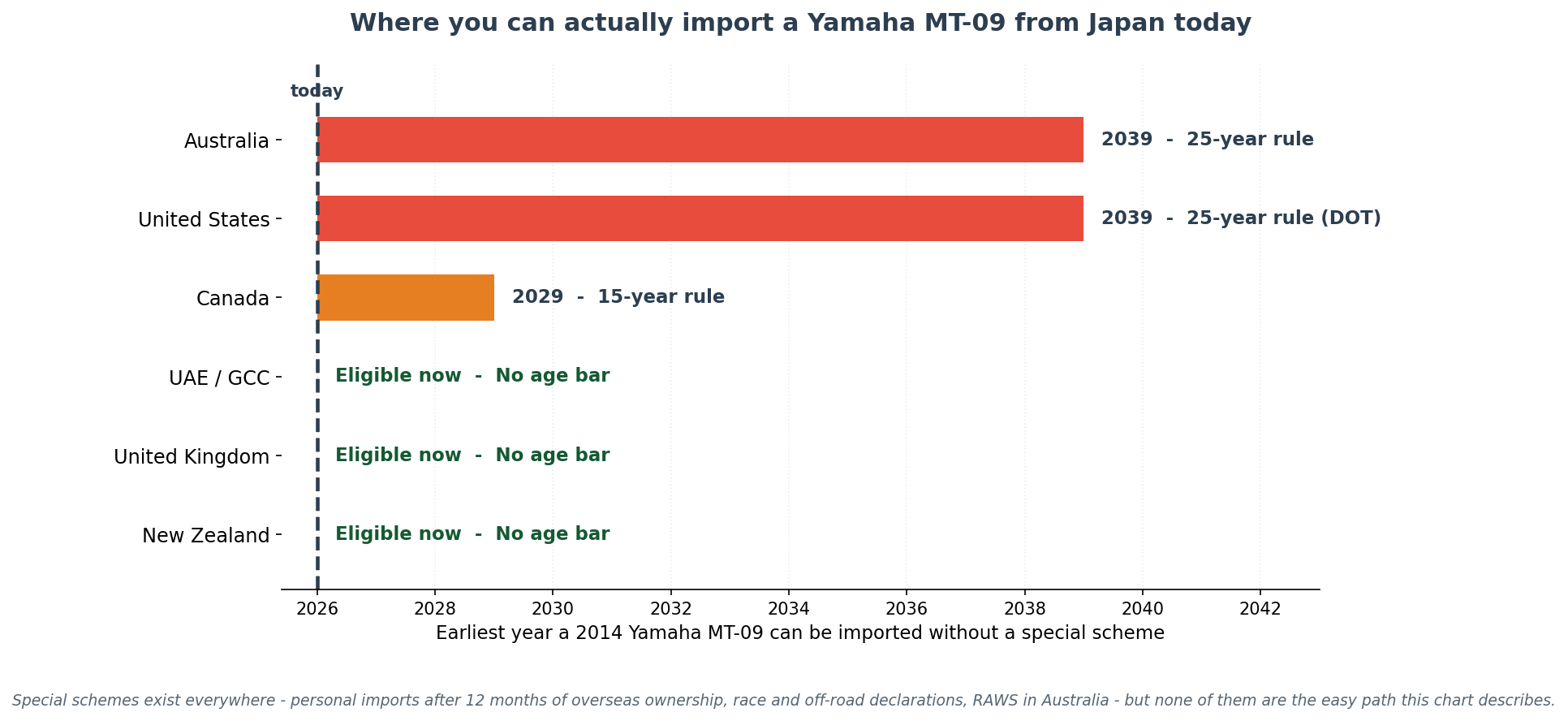
Before you price anything, check whether your country will let the bike in at all. The MT-09 launched for the 2014 model year, which makes the oldest one twelve years old in 2026. That is young, and youth is the problem.
United States: no
Not until roughly 2039. The NHTSA exemption for non-conforming vehicles applies at twenty-five years from the month of manufacture, with a separate EPA provision at twenty-one years. A 2014 MT-09 is neither. Yes, the FZ-09 was federalised and sold in America, but that certification attaches to US-spec bikes with US VINs, not to a Japanese-market RN34J. Any exporter promising to put a JDM MT-09 into a US port is telling you the truth about the shipping and lying about the clearance. Buy a used FZ-09 domestically — there are thousands. Our US import guide covers the 25-year rule in detail.
Canada: not until 2029
Canada's threshold is fifteen years, which brings the 2014 bikes in around 2029 and the 2017 facelift around 2032. Under fifteen years a motorcycle needs to clear the Registrar of Imported Vehicles process, and Yamaha Canada will not issue compliance documentation for a Japanese-market bike. See our Canada guide.
Australia: effectively no
The concessional route for older vehicles sits at twenty-five years, so 2039 for the earliest MT-09. The alternatives are a Registered Automotive Workshop pathway, which nobody operates for a bike Yamaha already sells locally, or a personal import after you have owned and used the bike overseas for twelve months. Australia got the MT-09 from launch, so local supply is deep. Full detail in our Australia guide.
New Zealand: yes, and this is the friendliest developed market
New Zealand has no blanket age bar for motorcycles. Entry certification checks safety, emissions and frontal impact standards, and a vehicle built in Japan for the Japanese market on or after 1 October 2003 already meets a frontal impact standard New Zealand accepts. Every MT-09 ever built clears that date by a decade. NZTA publishes the rules for used vehicles from Japan, and our New Zealand guide walks the process.
United Kingdom: yes, but the tax makes it pointless
No age bar. NOVA notification, then MSVA because a Japanese-market bike carries no European type approval, then registration. It works, thousands of people do it every year, and on an MT-09 specifically it costs you around £1,800 more than buying locally. Start with our UK import walkthrough if you are doing it anyway.
UAE and the wider Gulf: yes, and often the best case
No equivalent age wall, a thin local used market, and new-bike pricing that makes a low-mileage Japanese import look sensible rather than eccentric. This is the market where the MT-09 import maths flips from bad to good.
Reading a Japanese auction sheet on an MT-09 specifically
General auction sheet advice applies, and we have written it. What follows is what to look for on this model.
Grade 4 and up, or walk away. Given how many MT-09s exist and how many pass through the auctions weekly, there is no reason to accept a grade 3.5 bike. Patience costs nothing. Bidding on rough stock costs you the difference in rectification.
Front wheel and fork. This is a wheelie bike owned by people who wheelie. Look for kerbed rims, mismatched fork leg finish (one leg replaced), and any note referencing the front end on the sheet diagram.
Left and right bar ends and the levers. The MT-09 tips over easily at parking speeds because the bars are wide and the steering lock is generous. Scraped bar ends with an otherwise clean bike usually means one low-speed drop, which is fine. Scraped bar ends plus a scuffed tank edge plus a replaced lever means something faster.
Aftermarket exhaust. Extremely common on this model and not a negative on its own. The factory system is one piece, so any exhaust change means a full system. Ask whether the ECU was remapped or a fuelling module fitted to suit. An unmapped full system on a bike already known for abrupt fuelling is a bad combination, and it means the previous owner did the cheap half of the job.
Aftermarket rear shock. This is a positive. On a used MT-09 a quality aftermarket shock is a sign the previous owner understood the bike and spent real money on it. It is also around £500 you do not have to spend.
Service book stamps at the 42,000 km valve check. If the bike is past that mileage and the book has no entry, assume the check has not been done and price the labour in.
Our guide to Japanese auction grades explains what separates a 4 from a 4.5, and how bidding actually works covers the mechanics of placing the bid.
The suspension budget nobody puts in the spreadsheet
Every MT-09 import calculation you will read online stops at the registration fee. Here is the line item that belongs underneath it.
On a base-model first or second-generation MT-09, the suspension is not to a standard you want to keep. The fork dives, the shock is under-sprung and under-damped, and the bike rocks fore and aft under braking and acceleration even when you are not riding hard. Owners who love these bikes — and they genuinely love them, which is why so few get traded in — usually love them after spending money.
The accepted fix is two parts. A fork revalve runs about £150. A quality aftermarket rear shock runs about £500. Call it £650, and add it to the £6,669 landed figure, and your imported 2015 MT-09 has cost £7,319 against a £4,790 local bike that needs the same work.
There is a second budget line for first-generation bikes: fuelling. Yamaha's own reflash improved the abrupt throttle pick-up but did not cure it, and the accepted route is a dyno tune rather than a throttle tamer cam. Riders who fit a throttle tamer are treating the symptom; riders who get it tuned fix the cause. Either way, it is money.
None of this is a reason not to buy an MT-09. It is a reason not to compare the Japanese FOB price against a Western asking price and conclude you are winning. Do the whole sum.
Parts, and the Brembo trap
Parts availability is a non-issue on this bike, which is the flip side of the volume argument. Yamaha sold the MT-09 everywhere, so consumables, brake pads, chains, sprockets, levers, bodywork and suspension components are available from your local dealer network and every aftermarket supplier on earth. Compare that with a genuinely obscure JDM import where you are ordering fork seals from a dealer in Osaka.
Two specific warnings.
The Stylema caliper does not transfer. Owners of other Yamahas keep asking whether they can fit the MT-09 SP's Brembo Stylema calipers to their bike. A Yamaha dealer in Japan spelled out why not: the Brembo caliper uses a 100 mm mounting pitch while the other Yamaha calipers use 108 mm. If you are buying an SP partly for the brakes, that hardware stays with the SP.
Japanese-market accessories are sized for Japanese-market bikes. The used parts ecosystem for this model in Japan is deep — radiator guards, fork tube protectors, belly pan brackets, protective covers. Buying those alongside the bike while it is still in Japan is cheaper than sourcing them later, and your exporter can crate them with the bike for almost nothing. Ask. Most agents will not offer.
One fitment note that catches people: some pannier kits use the same mounting point as an aftermarket shock's remote preload adjuster. If your imported bike arrives with an aftermarket shock and you then buy luggage, expect to fabricate a bracket.
MT-07 vs MT-09 vs MT-10 vs Tracer 9: which one to actually import
If you are shipping a bike from Japan, spend a minute deciding whether the MT-09 is even the right MT.
MT-07. The CP2 parallel twin, cheaper everywhere, and the bike with the genuinely notorious fork — a tuning specialist's video on the FZ-07 and MT-07 fork's lack of static sag has over a million views for a reason. Even more widely sold than the MT-09, so the import case is weaker still. Read our MT-07 import guide.
MT-09. The middle child and the one most riders end up wanting. Owners who move up from the MT-07 talk about the third cylinder as the thing they did not know they needed.
MT-10. The R1-engined one. Faster, heavier, more expensive, and with fuelling described by testers as far more aggressive than the MT-09's. It is also rarer in used markets outside Japan, which strengthens the import case relative to the MT-09. See our MT-10 import guide.
Tracer 9. The same CP3 with a fairing, a screen, luggage mounts and a comfortable seat. If your honest plan involves distance rather than roundabouts, buy this instead and stop pretending. Our Tracer 900 import guide covers it.
Outside the family, the obvious rivals are the Triumph Street Triple, the KTM 890 Duke, the Kawasaki Z900 and the Yamaha XSR900 — which is the same 890cc triple in retro clothing and, unlike the 2021 to 2023 base MT-09, came with cruise control. If you want the CP3 engine and cruise control on a budget, the XSR900 is the answer nobody gives you.
How AWA Auction handles an MT-09 bid
We are an auction agent, so here is what we would actually do with this brief, including the parts where we tell you no.
We check your country first. If you write to us from Texas or Melbourne asking for a 2018 MT-09, we will tell you it cannot be registered and we will not take a deposit. That conversation takes one email and saves you thousands.
We run the local-versus-import sum before bidding. On a bike as widely sold as the MT-09, we will price your local market first. If buying at home wins, we say so. We would rather have a customer who trusts us on a Serow or an NSR250 next year than a one-off commission on a bike you regret.
We filter for grade before price. Given the volume of MT-09 lots, we bid only on grade 4 and above unless you specifically want a cheap project. The three 2018 bikes in that stock list are the argument: the dearest one is dearest because it is the best one.
We check the recall window. Any RN69J built between February 2021 and February 2022 gets a written recall-status query before we bid, not after.
We chase the SP. If the SP is what you are after, we set a standing search rather than bidding on whatever is in front of us this week. Öhlins-equipped stock appears often enough in Japan that patience beats urgency.
We crate the parts with the bike. Radiator guards, spare levers, the original exhaust if the bike has been modified — all of it ships in the same crate for close to nothing.
You can see what is currently in front of us on the live listings page, and if you want the local-versus-import sum run on your own postcode before you commit to anything, send us the details and we will do it for free.
Yamaha MT-09 import from Japan: frequently asked questions
Is importing a Yamaha MT-09 from Japan cheaper than buying locally?
In the UK, no. A 2015 MT-09 at 5,300 USD FOB in Japan lands at roughly £6,669 once freight, duty, VAT, MSVA and registration are paid, against £4,790 for a locally registered 2015 example with higher mileage. The penalty holds at £1,704 to £1,879 across 2015, 2019 and 2023 bikes because most of it is VAT and duty, which scale with the price. Importing wins only where local supply is thin (the Gulf), where you want a version your market never sold (the SP), or where you want genuinely low mileage that Western markets do not have.
Can I import a Yamaha MT-09 to the United States?
Not until around 2039. The NHTSA exemption for non-conforming vehicles applies at twenty-five years from manufacture, and the separate EPA provision at twenty-one years. The oldest MT-09 is a 2014, so neither threshold is met. The FZ-09 sold in America was federalised with a US VIN, and that certification does not extend to a Japanese-market RN34J. Buy a used FZ-09 or MT-09 domestically instead — America has thousands of them.
What are the Japanese chassis codes for the MT-09?
Three of them. EBL-RN34J covers 2014 to 2016 with the N703E engine. 2BL-RN52J covers 2017 to 2020, the facelift with the adjustable fork, standard ABS, slipper clutch and quickshifter. 8BL-RN69J covers 2021 onward with the larger engine and the six-axis IMU. The leading letters mark Japanese emissions eras, not mechanical differences. Verify the frame stamp against the year the exporter has declared before you send money.
Why does my export certificate say 845cc when the brochures say 847cc?
Because Japan and Europe round the same swept volume differently under different measurement standards. The engine is identical: 78 mm bore and 59.1 mm stroke on the 2014 to 2020 CP3, and 78 mm bore with a 62.1 mm stroke on the 2021 onward motor, which Japan lists as 888cc and Europe as 890cc. The same thing happens to the power figure — Japan quotes 110 PS and 116 PS, Europe quotes 113 to 115 bhp and 117 to 119 hp. Nobody has restricted your bike. Print a Yamaha Japan specification page and file it with your export certificate so the registration clerk can see both numbers at once.
Which MT-09 generation is the best one to import?
The 2017 to 2020 RN52J. It keeps the cheaper 845cc engine but adds the fully adjustable KYB fork, standard ABS, three-stage traction control, an assist and slipper clutch about 20% lighter at the lever, and a quickshifter that cannot be retrofitted to earlier bikes. Japanese export prices sit at 5,850 to 7,250 USD. The 2021 onward bikes are better motorcycles but their local used prices are close enough that the import penalty bites hardest there.
What goes wrong on a used Yamaha MT-09?
Not the engine. The CP3 triple has no signature failure and the valve check interval is 42,000 km. The real checklist is head bearings (this bike wheelies and owners land badly), seized rear suspension linkages from factory grease that Yamaha applied sparingly, corrosion on exposed metal and a factory exhaust that discolours early, occasional clutch slip on 2017 onward bikes, scattered sensor failures, and factory brake pads that lack bite. Budget £650 for a fork revalve and an aftermarket rear shock on any base-model bike, because the standard suspension is the model's weakest point.
Is there an outstanding recall on imported 2021 and 2022 MT-09s?
There is, and imports are the bikes most likely to have missed it. Yamaha recalled 2021 to 2022 MT-09, MT-09 SP and Tracer 9 GT models for ECU programming that leans the mixture when the clutch is pulled with the throttle closed, stalling the engine. Japan filed it as notification 5107 covering 1,813 units built between 10 February 2021 and 11 February 2022, with the remedy starting 2 March 2022. The US campaign was NHTSA 22V-130, roughly 3,600 units. Recall notices follow national registration databases, so a bike exported out of Japan drops off the list. Get written confirmation from the selling dealer, or take the chassis number to a Yamaha dealer at home and have them query it.
Is the MT-09 SP worth importing?
It is the strongest argument for importing this model. Mechanically it is a standard MT-09 with the suspension solved: a fully adjustable KYB fork with rebound and compression on both legs, and an Öhlins rear shock with a remote preload adjuster. That is roughly £650 of work already done, plus a shock you cannot buy the equivalent of at that price. In markets where the SP sold in small numbers, used examples barely appear. In Japan it was a normal catalogue model. That mismatch is exactly the gap importing exists to close.
How long does it take to import an MT-09 from Japan?
Budget eight to twelve weeks from winning bid to riding, and treat anything faster as luck. Roughly one to two weeks for payment, deregistration and the export certificate, three to five weeks on the water depending on the route and whether you are in a shared container, one to two weeks for port clearance and customs, then however long your local inspection regime takes — an MSVA slot in the UK is the usual bottleneck, and a failure means rebooking. Add a week for the mph speedometer and lighting work if you have not arranged it in advance.
Can I import an MT-09 to New Zealand?
Yes, and New Zealand is the friendliest developed market for this bike. There is no blanket age bar for motorcycles. Entry certification checks safety, emissions and frontal impact, and any vehicle built in Japan for the Japanese market on or after 1 October 2003 already meets a frontal impact standard New Zealand accepts — which every MT-09 ever built does by a decade. You still need entry certification and the bike still needs to meet the applicable exhaust emissions standard, so budget for the certifier and any rectification they call for.
Should I import a 2024 or newer MT-09?
Almost certainly not. The 2024 revision brought a 5-inch TFT screen, a new airbox, the third-generation quickshifter, a Brembo radial master cylinder, two custom ride modes, cruise control on the base model and a USB-C socket, and the SP added Stylema calipers and four track modes. All of it is still available new or nearly new from dealers in most markets, with a warranty and no MSVA test. Importing a bike your local dealer will hand you with paperwork already done is a hobby rather than a saving.
The verdict
The MT-09 is one of the best motorcycles Yamaha has built in twenty years, and one of the worst candidates for a Japanese import. Both statements are true, and they are true for the same reason: Yamaha sold it to everybody.
If you are in Britain, Europe, America, Canada or Australia, buy locally. If you are in the Gulf or New Zealand, or you want an SP, or you want a genuinely 6,000 km example that your local market cannot produce, then Japan is worth the freight — and the bike waiting at the other end is the same brilliant, slightly unhinged triple everyone else is riding, with a fresher odometer and cleaner metal.
Whichever way that lands for you, do the sum with the tax in it before you fall in love with a photograph.
See Also
Share this article: