
Every guide to buying a bike out of Japan tells you to "watch the exchange rate." None of them tell you that there are two of them, that you only control one, and that a government picks the other one for you on a date almost no buyer can name.
That is the whole problem with the Japanese motorcycle import exchange rate. The rate your bank gives you when you send yen to Japan decides what the bike costs. A completely different rate — set by law, on a date fixed by statute — decides what your duty and tax bill is. In the UK those two rates can be six weeks apart. In Australia they can be set on opposite sides of an ocean crossing. And in the United States, the rate that applies to your customs entry is knowable months in advance, which almost nobody exploits.
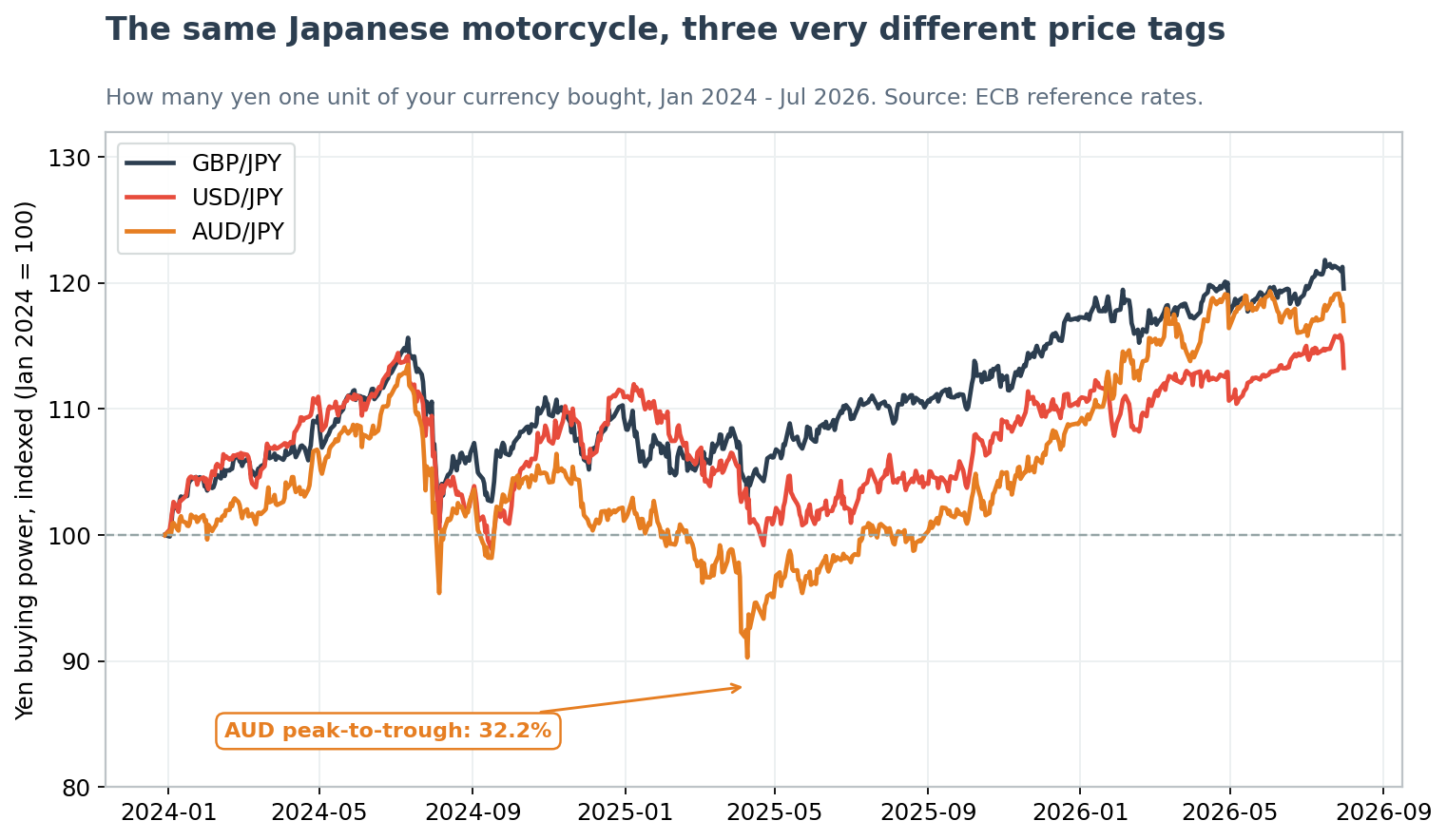
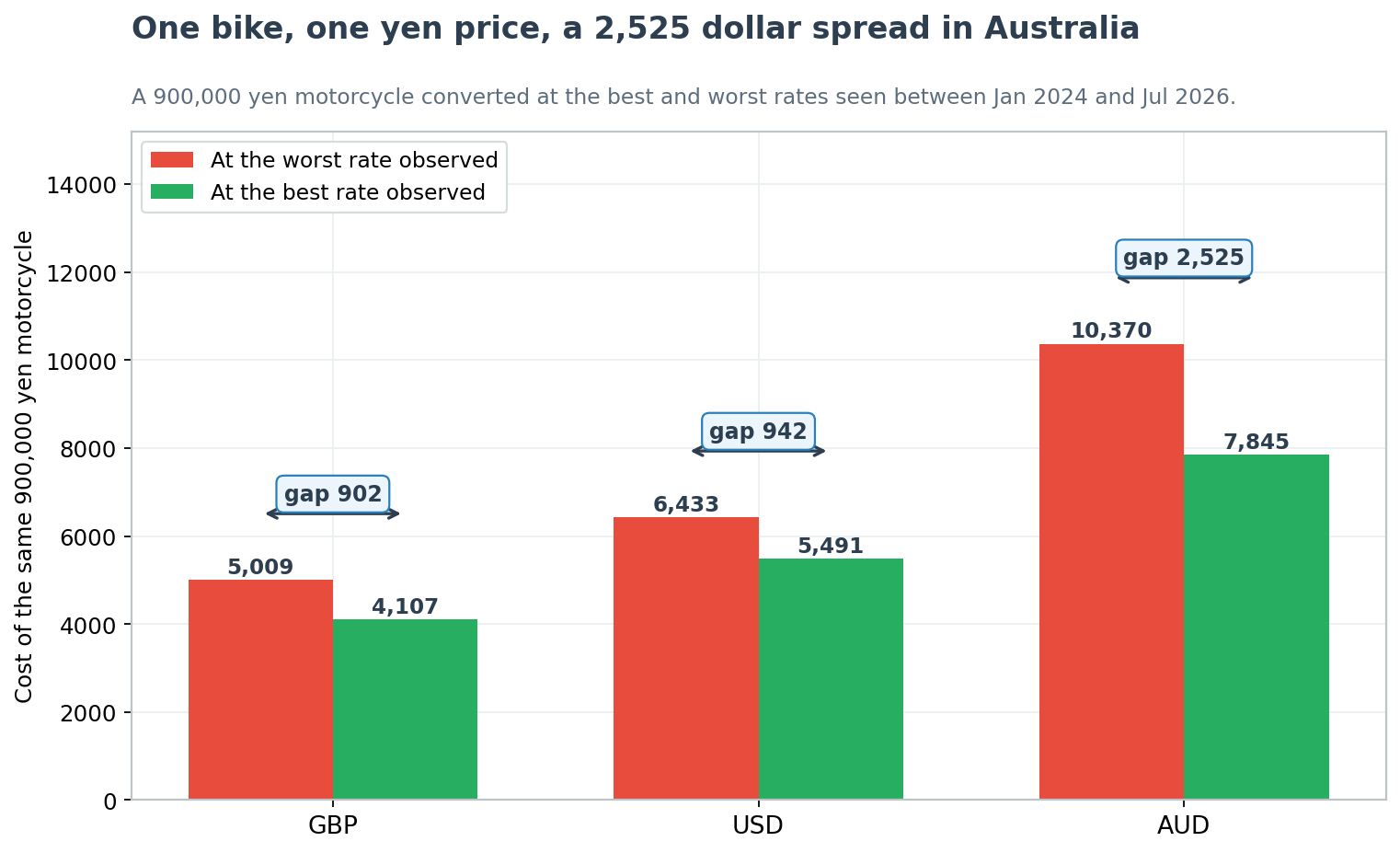
Here is what that looks like in money. A 900,000 yen motorcycle — a clean, mid-mileage 600 with a decent auction grade — cost an Australian buyer A$10,370 on 9 April 2025 and A$7,845 on 2 June 2026. Same bike. Same yen price. A gap of A$2,525, which is most of a shipping bill, and none of it has anything to do with the motorcycle.
This guide covers both rates: the one you negotiate and the one you inherit. All the currency data below comes from European Central Bank reference rates for the period January 2024 to July 2026, and every customs rule is quoted from the primary legislation rather than from another blog.
The two exchange rates in every Japanese motorcycle import
Split them apart and everything else gets easier.
Rate one is the commercial rate. This is what your bank or transfer service actually gives you when you convert your money into yen to pay the auction house, the agent and the shipping company. You choose the provider, you choose roughly when you send, and the difference between a good provider and a bad one is real money. This rate is negotiable.
Rate two is the customs rate. This is the rate the destination government uses to convert the yen value of your motorcycle into local currency so it can calculate duty and, where it applies, VAT or GST. You do not choose it. You do not choose the date it applies to. In most cases you cannot even find out what it will be until after the fact.
Most buyers only think about rate one, and only on the day they bid. That is the expensive mistake. Rate one applies over a two-month window, not a single afternoon, and rate two applies on a date set by a statute they have never read.
Why the customs rate exists at all
Customs authorities have a boring problem. Duty is a percentage of the value of the goods. The invoice is in yen. The duty has to be collected in pounds, dollars or New Zealand dollars. Somebody has to pick a conversion rate, and if they let importers pick it themselves, every importer would pick the most favourable rate of the past six months.
So each country wrote a rule. The rules are simple individually. The interesting part is that no two of the four major destination markets for Japanese motorcycles picked the same rule, and the differences are not cosmetic. They point at completely different dates in your shipment.
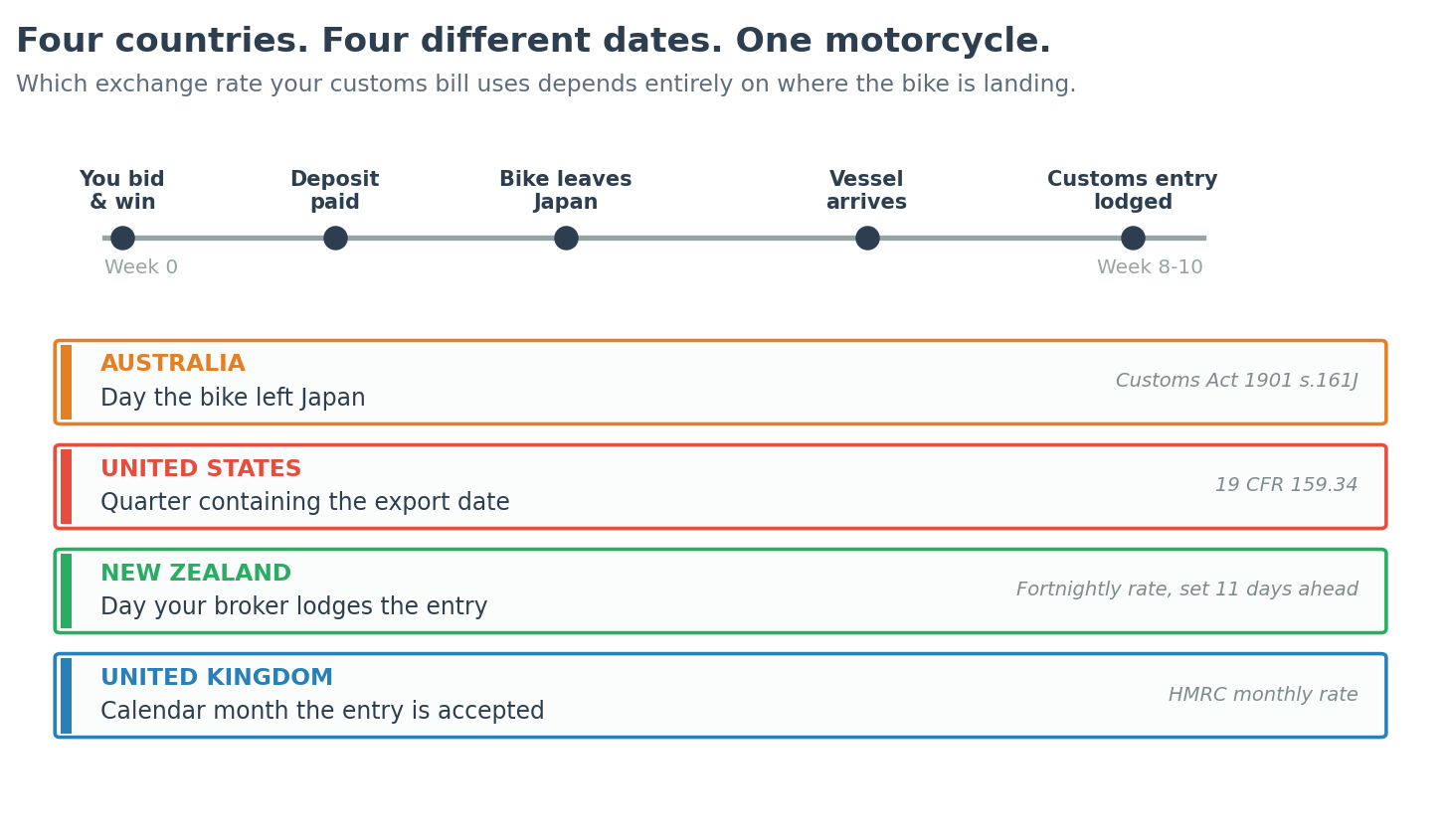
United Kingdom: your rate is locked to a calendar month
HMRC publishes a set of customs exchange rates once a month. They go out on the penultimate Thursday of the month and they apply for the whole of the following calendar month. Every import declaration accepted in that month uses that one rate, regardless of what the market did in between. You can read the current set through the GOV.UK exchange rates collection.
The practical consequence is a cliff edge at the end of every month.
Say your bike lands at Southampton on 29 March and your broker is a little slow with the paperwork. If the entry is accepted on 31 March, you get March's rate. If it slips to 1 April, you get April's rate. Those two rates were set five weeks apart. In a quiet month the difference is noise. In July 2024 the yen moved more than 5% inside four weeks, and that same slip would have changed the taxable value of the bike by roughly that much.
Nobody tells you this because the broker filing your entry does not think of themselves as making a currency decision. They are just clearing the paperwork. But on the last two working days of any month, they are.
The UK stacks a second thing on top. Duty on a motorcycle is charged on the CIF value — cost, insurance and freight — so the freight bill is inside the number being converted. More on that further down, but keep it in mind: in the UK the exchange rate is applied to a bigger base than it is in the United States. For the full duty and VAT mechanics, our UK motorcycle import duty and tax guide covers the rates themselves.
Australia: your rate is the day the bike left Japan
Australia took the opposite approach. Section 161J(1) of the Customs Act 1901 says the foreign-currency amount must be converted "according to the ruling rate of exchange in relation to that other currency in respect of the day of exportation of the goods." Not the day you bought it. Not the day it arrived. The day it left.
The Reserve Bank of Australia sends the ABF a schedule of rates every working day, and those become the ruling rates. Each one is valid for twenty-four hours from one minute past midnight the following day, with Friday's rate carrying across the weekend. It is all set out in Australian Customs Notice 2020/08, and the current rates sit on the ABF exchange rates page.
So an Australian buyer's customs rate is fixed at roughly week five or six of the process, while the bike is still in Japanese waters. By the time the vessel docks in Melbourne, the number has been locked for a month and a half and there is nothing anyone can do about it.
This is a genuinely better rule for the importer, incidentally. It is a single, knowable, published daily rate tied to a hard event. The UK's monthly rate is smoother but blunter. Australia's is sharper but at least it is honest about what date it is measuring.
Australia's container trap: your shipping method moves the date
Here is the part that appears in no motorcycle import guide anywhere, and it is the single most actionable thing in this article for Australian buyers.
"Day of exportation" depends on the definition of "place of export" in section 154(1) of the Customs Act. And that definition splits depending on how your bike travels.
- Containerised. The place of export is the place where the goods were packed into the container. ACN 2020/08 is explicit: "For goods packed in a container, the day of exportation is the day the container leaves the place where it was packed." That is a warehouse in Yokohama or Nagoya, not the port. If you do not know that date, the bill of lading date is accepted as the nearest known date — but if your broker did know it and used the bill of lading date anyway, the ABF treats the declaration as incorrect.
- RoRo or otherwise non-containerised. The day of exportation is the day the vessel actually departs the port where the bike was loaded.
Those two dates are routinely one to three weeks apart. A bike gets crated and containerised at a consolidation warehouse, the container sits waiting for a sailing, and only then does the ship leave. Choose container shipping and your customs exchange rate is set on the earlier date. Choose RoRo and it is set on the later one.
You are not going to pick your shipping method purely on currency — cost and damage risk matter far more, and our container vs RoRo shipping comparison goes through those properly. But you should know that the choice quietly carries a currency consequence, and that in a fast-moving fortnight it is worth real money.
United States: a quarterly rate you can look up before you bid
The American system is the strangest of the four and the most useful once you understand it.
Under 19 CFR 159.34, CBP publishes a certified quarterly rate for a list of currencies that includes Japan. The rate is "the rate or rates first certified by the Federal Reserve Bank of New York for such foreign currency for a day in that quarter" — in plain English, the first certified rate of the quarter becomes the rate for the entire quarter. It applies to "any date of exportation within the quarter."
Think about what that means. If your bike leaves Japan on 14 February, your customs conversion rate was fixed on the first business day of January. It is public. You can look it up before you even register to bid.
For a US buyer working to a tight landed-cost budget, that is a real planning advantage, and it is one that essentially no import guide mentions. You cannot know your freight to the dollar, you cannot know your compliance costs, but you can know the exact exchange rate CBP will apply to your customs value — provided the exception does not fire.
It fires more often than you would think.
The 8-quarter run that broke the American rule
Section 159.34(b)(2) contains an escape hatch. If the certified daily rate for the date of exportation "varies by 5 percent or more from the certified quarterly rate," the variation gets published in the Customs Bulletin and the daily rate is used instead.
That is written like a rare-event provision. For the yen, it has not been rare at all.
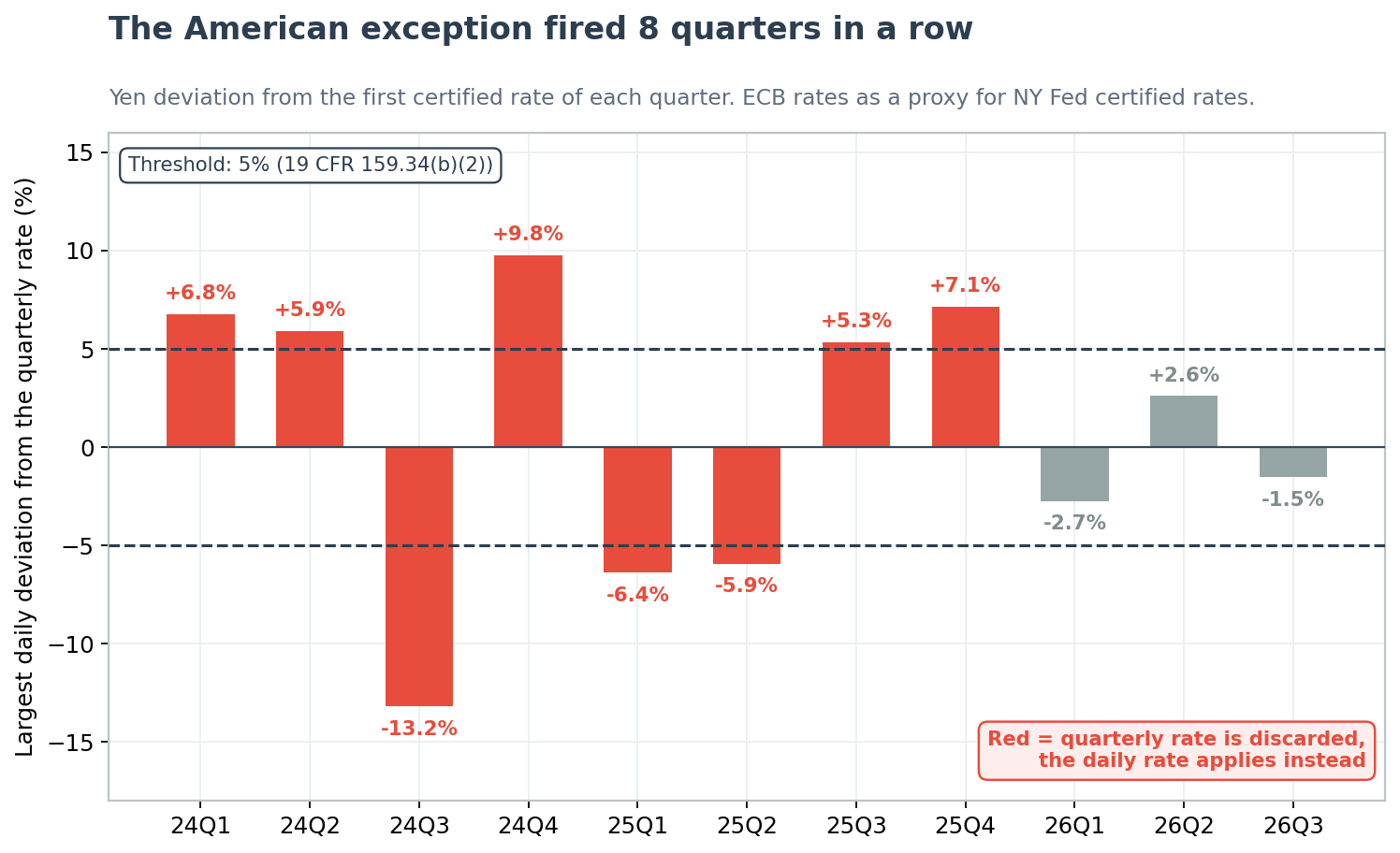
Taking the first observation of each quarter as a stand-in for the first certified rate, and measuring the largest daily deviation inside each quarter, the 5% threshold was crossed in eight consecutive quarters, from Q1 2024 through Q4 2025. The worst was Q3 2024, when the yen ran 13.2% away from where the quarter started. Q4 2024 hit 9.8%. Q1 2024 hit 6.8%.
Only in 2026 did things settle: Q1, Q2 and Q3 all stayed inside the band, peaking at 2.7%, 2.6% and 1.5%.
One caveat, stated plainly: these figures use ECB reference rates as a proxy for the New York Fed certified rates. The two sources track each other closely but they are not identical, and the exact quarter-open date CBP certifies can differ by a day. The pattern is not in doubt — the magnitude of any single quarter shifts by a fraction of a percent depending on which source you use.
The takeaway for a US importer: the quarterly rate is a good planning assumption in a calm market and a bad one in a volatile market. Through 2024 and 2025 the exception was the rule. Check whether your export date fell in a quarter where the yen ran away, because if it did, your duty was calculated on a number you did not expect.
New Zealand: the rate is set by when your broker files
New Zealand Customs sets rates for a two-week period and publishes them 11 days in advance. Then comes the sentence that matters, taken directly from the NZ Customs rates of exchange page:
"The rate of exchange will be applied at the date an entry has been made. This happens on the day an electronic clearance for your goods has been submitted to Customs. Note: the rate of exchange will not be applied to the date of purchase or the date when your goods have arrived in New Zealand."
Customs is telling you outright that the two dates you would naturally assume — purchase and arrival — are both wrong. What counts is the moment your broker hits submit.
Because the rate is published 11 days ahead and holds for a fortnight, a New Zealand importer can see the applicable rate before the entry is lodged. If the bike has arrived, the paperwork is complete, and a materially better rate takes effect in three days, that is a conversation worth having with your broker. This is the only one of the four markets where the timing is genuinely inside anyone's control.
It cuts the other way too. A broker who sits on a completed file for a week is making an uncompensated currency bet with your money.
Four countries, four dates, one motorcycle
Put the four rules on the same timeline and the incoherence is obvious.
| Market | Date that fixes your customs rate | Rate type | Legal basis |
|---|---|---|---|
| Australia | Day the bike left Japan (container: day it left the packing site) | Daily, RBA-sourced | Customs Act 1901 s.161J |
| United States | Quarter containing the export date | Quarterly, NY Fed certified | 19 CFR 159.34 |
| New Zealand | Day the entry is lodged | Fortnightly, set 11 days ahead | NZ Customs rates of exchange |
| United Kingdom | Calendar month the entry is accepted | Monthly, fixed in advance | HMRC monthly customs rates |
Four buyers bid on four identical bikes in the same auction on the same morning. They pay the same yen. By the time the duty is assessed, they have been converted at four rates, fixed on four dates, spread across roughly ten weeks of currency movement.
There is no international standard here and no sign of one coming. If you import into more than one market, you are running four different systems.
How far the yen actually moves while your bike is at sea
All of this only matters if the yen actually moves in that window. It does.
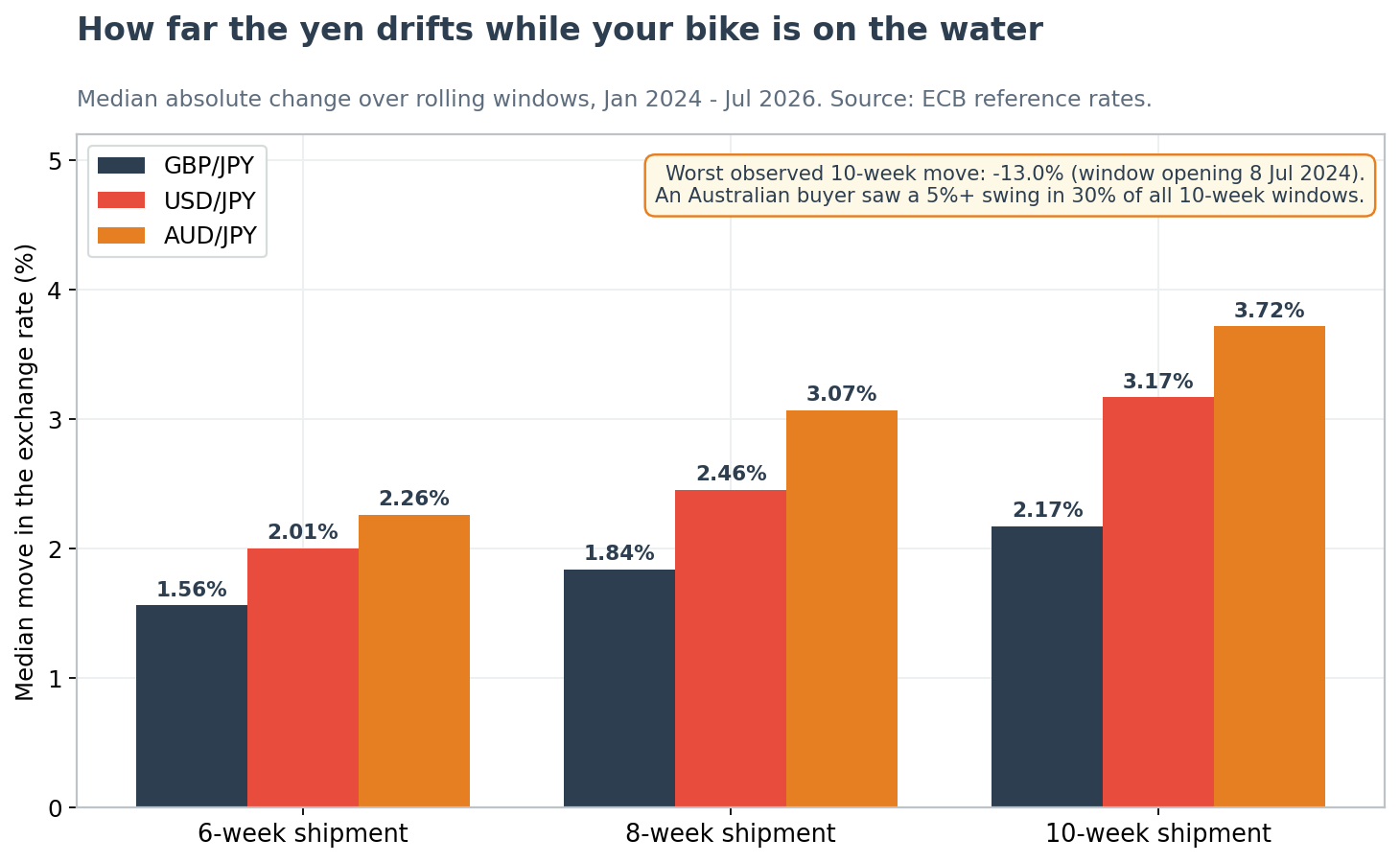
Measuring every rolling window across the period, the median absolute move over a ten-week shipment was 2.17% for GBP, 3.17% for USD and 3.72% for AUD. Those are medians — half of all shipments saw more.
The tails are where the damage is:
- An Australian buyer saw a swing of 5% or more in 30% of all ten-week windows. Roughly one shipment in three.
- A US buyer saw 5%+ in 21% of ten-week windows, and 3%+ in 52% of them.
- The worst ten-week window in the whole period opened on 8 July 2024 and ran 13.0% against the buyer.
- Even the calmest pairing, GBP over a six-week shipment, still had a median move of 1.56%.
On a 900,000 yen bike, a 3.72% move is about A$300 — and that is only the median case. The 8 July 2024 window would have cost an Australian buyer well over A$1,200 on the same machine.
Shipping time is currency risk. Anyone quoting you a landed cost to the pound eight weeks out is quoting you a rate that nobody knows yet. Our import timeline guide sets out how long each stage really takes, and every week in it is a week of exposure.
What a 3% move costs on the bikes people actually buy
Percentages are easy to wave away. Here is the same drift expressed in money, across the three price bands most Japanese auction bikes fall into.
| Bike (yen) | Typical example | 3% move, GBP | 3% move, USD | 3% move, AUD |
|---|---|---|---|---|
| 450,000 | Grade 4 250cc, high mileage | £63 | $84 | A$120 |
| 900,000 | Grade 4.5 600cc, mid mileage | £126 | $169 | A$240 |
| 1,800,000 | Grade 5 litre bike, low mileage | £251 | $337 | A$480 |
Now apply the real distribution rather than a round 3%. The median ten-week drift for an Australian buyer was 3.72%, so the middle case on a 900,000 yen bike is around A$298. The 30% of shipments that moved 5% or more put that at A$400 and up. The 8 July 2024 window, at 13.0%, would have cost A$1,040 on the same machine — more than the auction fees.
Scale it to a litre bike and the worst-case number passes A$2,000. At that point the currency movement is no longer a rounding item on the invoice; it is the difference between the bike you budgeted for and one a category below it.
Two things follow. First, the bigger the bike, the more the currency work is worth doing — a 0.5% provider saves four times as much on a 1,800,000 yen machine as on a 450,000 yen one, for exactly the same twenty minutes of admin. Second, your contingency should be a percentage rather than a flat figure. A £200 buffer covers a 250; on a low-mileage litre bike it covers a bad fortnight and nothing else.
The spread your bank takes without printing it anywhere
Now back to rate one, which you actually control.
When you send yen to Japan, your provider does not usually charge you a visible commission on the conversion. They give you a rate that is worse than the mid-market rate and keep the difference. Industry reporting puts typical high-street bank markups at 3% to 5%, while specialist FX brokers and fintech platforms commonly run under 1%, with some at 0.5%.
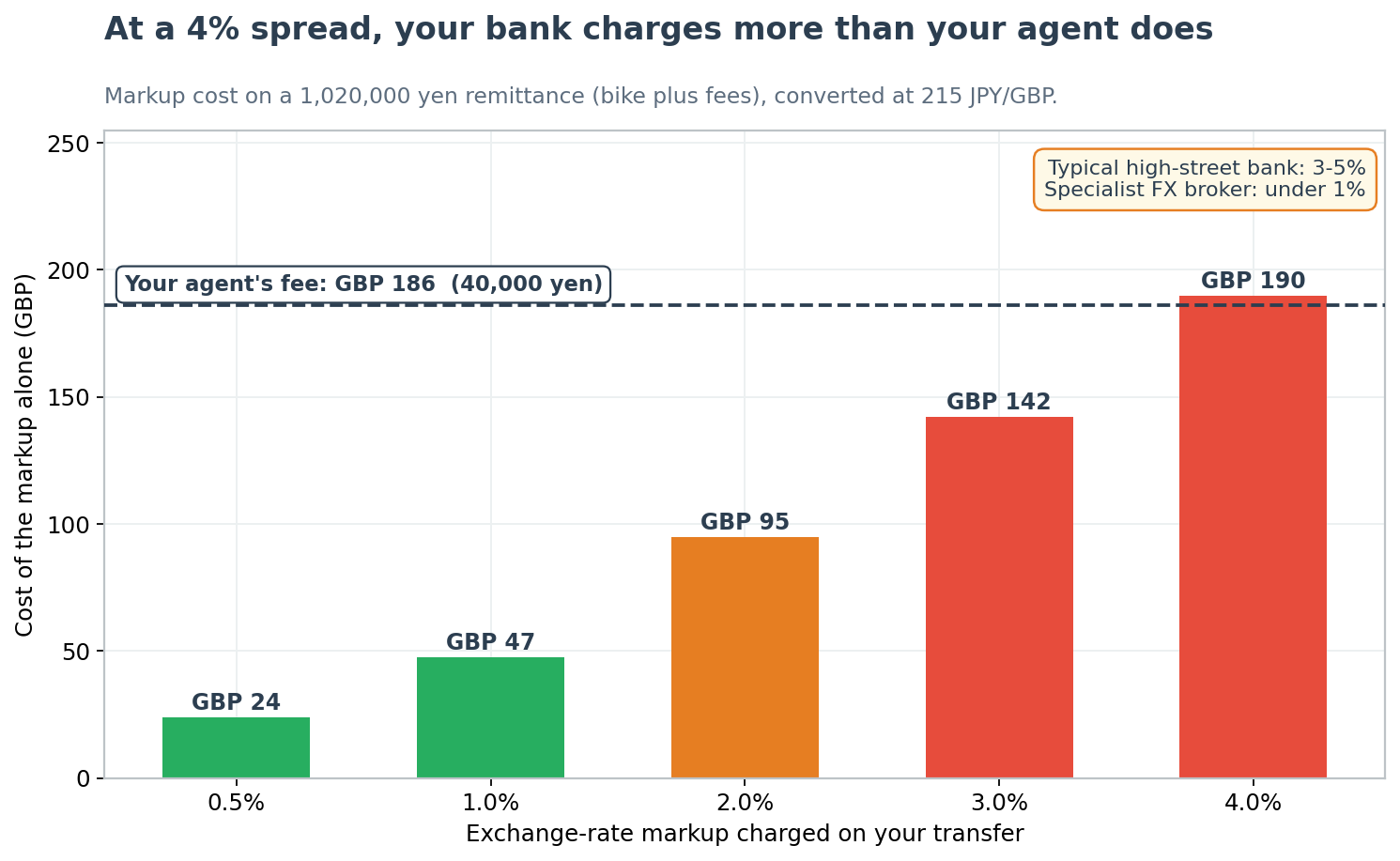
Run it on a realistic remittance. A 900,000 yen bike plus auction fees, agent fee and export handling comes to roughly 1,020,000 yen leaving your account. At 215 yen to the pound:
- 0.5% markup: £24
- 1.0% markup: £47
- 2.0% markup: £95
- 3.0% markup: £142
- 4.0% markup: £190
A typical agent fee of 40,000 yen is about £186. So at a 4% spread, your bank is charging you more than your agent is — and unlike the agent fee, it appears on no invoice, in no quote and in no comparison table. You will never see a line item for it. You will just receive slightly less yen than you expected and assume that is what yen costs.
Moving from a 3% bank to a 0.7% broker on this one transfer saves about £109. That is not a rounding error on a used motorcycle. It is a set of tyres, and it is available to anyone who spends twenty minutes opening an account.
The irony is worth sitting with: buyers will spend three weeks agonising over a 40,000 yen difference between two bikes at auction, then hand a comparable sum to their bank without a second's thought.
When you are actually exposed: the deposit-to-invoice gap
Most people picture their currency exposure as a single moment — the second the hammer falls. It is nothing like that.
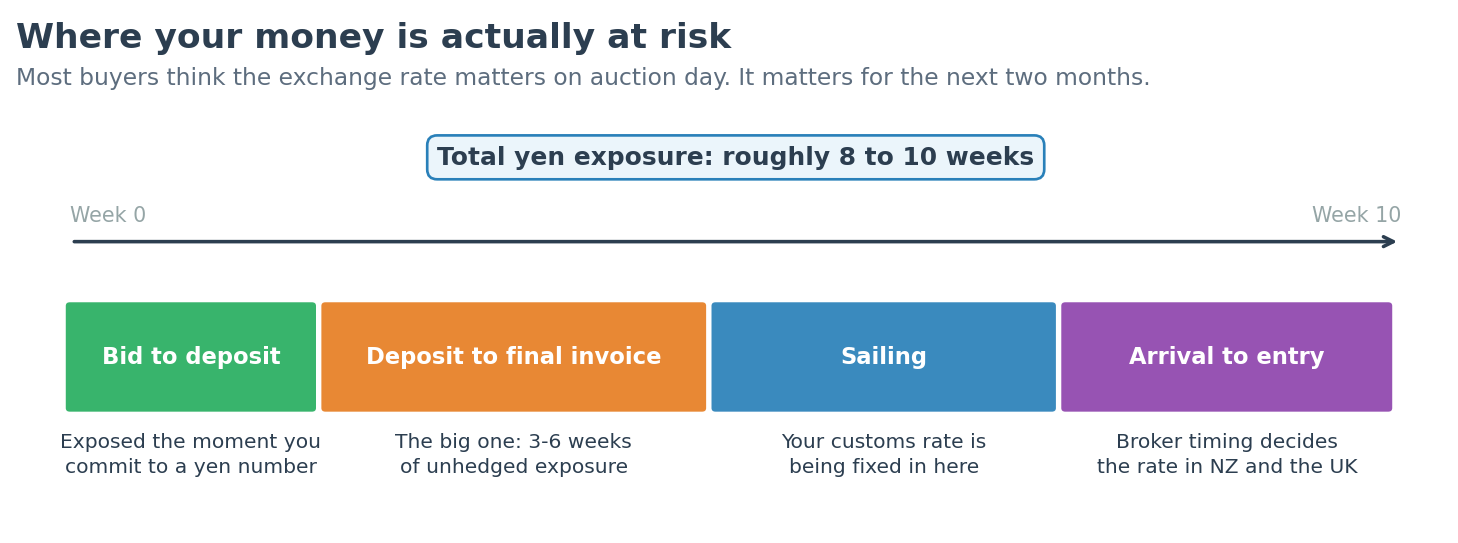
The exposure opens the instant you commit to a yen number, which is when you place a bid, not when you pay. From there:
- Bid to deposit. Usually days. You have committed to a yen figure but converted nothing.
- Deposit to final invoice. The big one. Three to six weeks in which the balance of the purchase price, the auction fees and the shipping costs are all still sitting in yen, unconverted and unhedged. This is where most of the damage happens and where almost nobody is watching.
- Sailing. Your commercial exposure may be closed by now. Your customs rate is being fixed somewhere in this stretch if you are importing into Australia or the US.
- Arrival to entry. The final stretch, where broker timing sets the customs rate in New Zealand and the UK.
Total: eight to ten weeks of yen exposure on a purchase most people think of as a one-day transaction.
The fix is not complicated. Convert in tranches rather than all at once, so you average out rather than betting everything on a single day. If your provider offers a forward contract, locking the yen for the final invoice at the point you win the auction removes the largest block of risk entirely. And ask your agent for the full expected yen total up front, not just the hammer price, so you know the size of the position you are carrying. Our guide to bidding at Japanese motorcycle auctions covers the fee structure you need in order to work that total out.
CIF vs FOB: what the exchange rate is applied to
One more asymmetry, because it changes the size of the number being converted.
The UK calculates duty on the CIF value — the price of the bike plus international freight plus insurance. The United States, Australia and New Zealand work from an FOB-style customs value, which is essentially the price of the goods at the point of export, with freight and insurance excluded.
The exchange rate is applied to that base. So a UK importer is not only using a monthly rate — they are applying it to a larger number, one that includes an ocean freight bill of roughly 80,000 to 150,000 yen. A 3% currency move against a UK buyer hurts more in absolute terms than the same 3% move against an Australian buyer, because it is moving a bigger base.
It also means the two variables compound. A high freight quote and an unfavourable monthly rate landing together produce a duty bill noticeably above the estimate you were given, and the importer usually blames the freight because that is the only one of the two they can see. Our complete import cost breakdown lays out all eight cost categories so you can see which of them the exchange rate touches.
Australia's other valuation trap: when transaction value fails
This one is not strictly about exchange rates, but it decides whether the exchange rate rule even applies to you, so it belongs here.
The ABF's Valuation of Imported Road Vehicles factsheet — which covers motorcycles explicitly — sets out the normal method: take the purchase price in yen, convert at the official rate for the date of export, and that is your customs value.
But the transaction value method cannot be used where the importer cannot show the vehicle was purchased solely for the purpose of export to Australia, or where the vehicle has depreciated through use between purchase and export. The factsheet is blunt about how often this bites: "ABF experience has shown that many road vehicles imported cannot be valued using the transaction value method because they were not purchased solely for export to Australia, or the vehicle has depreciated since purchase due to use."
When that happens, the fall-back deductive method applies. Your customs value becomes an expert appraisal of the bike's realisable value as landed on the Australian wharf — and the importer pays for that appraisal.
The exchange rate stops mattering at that point, because there is no longer a yen figure being converted. The value is struck directly in Australian dollars.
Who does this catch? Not the buyer who bids at auction and ships straight out — that purchase is plainly for export. It catches the returning expat who owned and rode the bike in Japan, and the buyer who leaves a machine in Japan for a year before shipping it. If that is you, budget for an appraisal and stop worrying about the RBA's daily rate.
What you can control and what you cannot
Sorting it honestly:
Genuinely within your control:
- Which provider converts your money, and therefore whether you pay 0.5% or 4%. This is the single biggest currency decision you will make.
- Whether you convert in one lump or in tranches.
- Whether you use a forward contract to lock the final invoice.
- In New Zealand, when your broker lodges the entry — within reason, and only if you ask.
- In Australia, indirectly, through the container-versus-RoRo decision.
Partly within your control:
- In the UK, whether an entry lands on the last day of one month or the first of the next. Worth a phone call at month end, worth nothing the rest of the time.
- Roughly when you bid, which sets where your ten-week window sits.
Entirely outside your control:
- The customs rate itself, in every market.
- Whether the US 5% exception fires on your quarter.
- What the Bank of Japan and your own central bank do while your bike is on a boat.
The useful conclusion is that the controllable items are also the cheap ones. Switching FX provider takes an afternoon and saves more than every timing trick combined.
Watching the rate without turning into a currency trader
There is a failure mode on the other side of this, and it is worth naming: the buyer who reads an article like this one, decides to time the market, and spends four months not buying a motorcycle.
Do not do that. The yen has humiliated professional forecasters repeatedly over the past three years. Every projection that had it strengthening through 2025 watched it weaken instead. You are not going to out-trade a currency desk on a hobby purchase, and while you wait, the specific bike you wanted — a particular colour, a particular mileage, a particular auction grade — gets bought by someone who was less clever about it.
A workable discipline is short:
- Set your budget in yen, not in your home currency. This is the single most useful habit. The auction runs in yen and the bikes are priced in yen. Deciding "my ceiling is 950,000 yen" keeps you honest across a moving rate, whereas "my ceiling is £4,500" silently changes what you can bid on from one week to the next.
- Check the rate weekly, not daily. Daily checking produces anxiety and no better decisions. Weekly is enough to notice a real trend.
- Fix the provider question once. Open an account with a sub-1% broker before you start bidding, not after you win. This is the decision that actually pays, and it is a one-off.
- Convert the deposit immediately, then decide about the balance. The deposit is committed money. Sitting on it in your home currency is an open position with no upside you would accept if someone described it to you plainly.
- Take a forward contract if one is offered and the balance is large. Locking the final invoice at the point you win the auction removes the biggest single block of exposure. On a litre bike it is worth the paperwork.
- Accept a bad month. If the rate moves against you mid-shipment, that is the cost of doing business across a currency border. The bike is still the bike.
The buyers who handle this well are not the ones with a view on Bank of Japan policy. They are the ones who priced in yen, used a cheap provider, and stopped thinking about it.
Mistakes that cost real money
Budgeting at today's rate for a purchase that settles in six weeks. The median ten-week drift is over 3% for USD and AUD. Build in a buffer of at least 5% or your landed cost is fiction.
Assuming the rate on your bank statement is the rate customs will use. They are different numbers, set by different bodies, on different dates. Reconciling one against the other will only confuse you.
Comparing agent quotes without asking what rate they convert at. An agent quoting in your home currency is converting somewhere, at some spread. An agent who quotes 30,000 yen cheaper and converts at 4% is more expensive. Ask both questions.
Ignoring the deposit-to-invoice gap. This is the longest single stretch of unhedged exposure in the process and the one nobody plans for.
Letting a completed entry sit. In New Zealand and the UK the lodgement date sets the rate. A file sitting in a broker's inbox is an open currency position.
Treating a 4% bank spread as unavoidable. It is the most avoidable cost in the entire import.
Forgetting that duty is charged on the converted value, not the yen value. An unfavourable customs rate raises your taxable base, so you pay more duty and more VAT on top of it. The effect compounds.
How AWA Auction handles the currency side
We bid on your behalf in Japanese auctions, so we live on the yen side of this every day.
What we do about it is unglamorous. We quote in yen and we itemise every yen component — hammer price, auction fees, our fee, export handling, freight — so that you know the exact size of the position you are carrying before you send anything. If you want a figure in your own currency, we will convert it at the mid-market rate on the day and tell you plainly that it is an indication, not a quote, because we cannot control what your bank does.
We will also tell you your expected export date as soon as the booking is confirmed. For Australian buyers that date is your customs rate, and you are entitled to know it rather than discover it on a broker's invoice. For US buyers we will tell you which quarter your export date falls in so you can look up the certified rate yourself.
What we will not do is pretend to forecast the yen. Anyone in this industry who tells you the rate is about to move in your favour is guessing, and guessing with your money.
You can browse our current listings to see live yen pricing on stock we are already tracking, and if you want a full itemised yen breakdown for a specific machine before you commit to anything, contact our team and we will put one together.
For the wider process, start with how to import a motorcycle from Japan, then work through shipping and the market-specific guides for Australia, the USA, New Zealand and the UK. If you are still choosing a bike, our auction grades guide and inspection sheet guide will save you more than any exchange rate ever will.
The short version
There are two exchange rates in every Japanese motorcycle import. The commercial one decides what the bike costs and you control it — pick a provider under 1% and you are most of the way there. The customs one decides what the tax bill is, and it is set by a statute in the destination country on a date you did not choose: the export day in Australia, the quarter in the United States, the entry-lodgement day in New Zealand, the entry month in the United Kingdom.
The yen moved 22% against the pound and 32% against the Australian dollar over the last two and a half years. Across a typical ten-week shipment it drifts more than 3% for most buyers and more than 5% for about a third of Australian ones. Plan with a buffer, convert deliberately rather than accidentally, and find out which date your destination country is going to use before you bid rather than after you are invoiced.
See Also
Share this article: