
The best 650cc motorcycles to import from Japan are the bikes the rest of the world quietly settled on once the hype died down. Not the 200-horsepower superbikes that live on Instagram and nowhere else. Not the 125cc commuters that cost more to ship than they're worth. The 650cc twin is the bike that does everything — commute, tour, scratch a back road, teach a beginner, carry a veteran — and Japan is sitting on a warehouse full of them at prices that make your local listings look like a joke. When FortNine made a film literally titled "The Best Used Motorcycle to Buy," it pulled over 3.1 million views and 77,000 likes, and the bike he landed on was a 650 twin. The comment section did the rest: "the one person who managed to make the Suzuki Gladius desirable." That's the 650 class in a nutshell. Underrated, over-delivering, and cheap because nobody was looking.
This is the buyer's guide I wish I'd had. Not a generic "best 650cc motorcycles" listicle that ranks bikes by peak horsepower and forgets you have to actually buy one. This is about which 650s make sense to ship from Japan, which generation to chase, what they cost landed on your driveway, and how the 25-year import rule is quietly opening the door on a whole batch of late-90s twins right now. If you've already read our guides to the best 600cc motorcycles and the best 750cc motorcycles to import from Japan, think of the 650 as the sensible sibling that quietly outsells both.
Why a 650cc is the smartest bike to import from Japan
Here's the thing nobody mentions when they talk about importing: the bike is only half the cost. Shipping, duty, inspection, and an agent fee are roughly fixed no matter what you buy. Spend that money moving a $1,500 commuter and the math is laughable. Spend it moving a $3,000 650 twin that retails for $7,000 in your home market and suddenly the import pays for itself twice over.
The 650cc class hits the exact sweet spot. These bikes were built in enormous numbers, sold to sensible people who maintained them, and depreciated hard — which is great news for the second owner shipping one out of Japan. A clean Suzuki SV650 or Kawasaki ER-6 that's been through Japan's shaken inspection culture is a different animal to the thrashed, crashed, weather-beaten example you'll find rotting in a local classified ad.
And the 650 twin is genuinely all the bike most riders ever need. Around 70 horsepower, a wide torque curve you can actually use on the street, a seat height most people can flat-foot, and fuel economy that embarrasses bigger bikes. When Motorcyclist Magazine put the SV650 head-to-head with the Yamaha FZ-07 — a video with nearly 2 million views — the top comments weren't arguing about lap times. One rider summed it up: "Ridden both bikes and a Monster 797, SV650 was the best of them all. Made in Japan, V-Twin character, trellis chassis, timeless style." Another, defending the modest power figure: "70 horsepower enough for having fun? I'm having a hell of a time on a 14hp bike." That's the 650 buyer talking. They're not chasing numbers. They want a bike that works.
The reliability nobody else can match
FortNine's host has a phrase for the SV650 engine that's now burned into motorcycle culture: "cockroach reliability." It survives everything. That's not marketing — it's why the 645cc V-twin has been in continuous production in one form or another since 1999, powering the SV650, the Gladius, the V-Strom 650, and the SFV650. Suzuki built one good engine and refused to stop. Kawasaki did the same with the 649cc parallel twin that runs the Ninja 650, Z650, Versys 650, and the old ER-6. Buy a 650 twin and you're buying an engine with two decades of proven mileage behind it.
Japan has the deepest, cleanest stock on earth
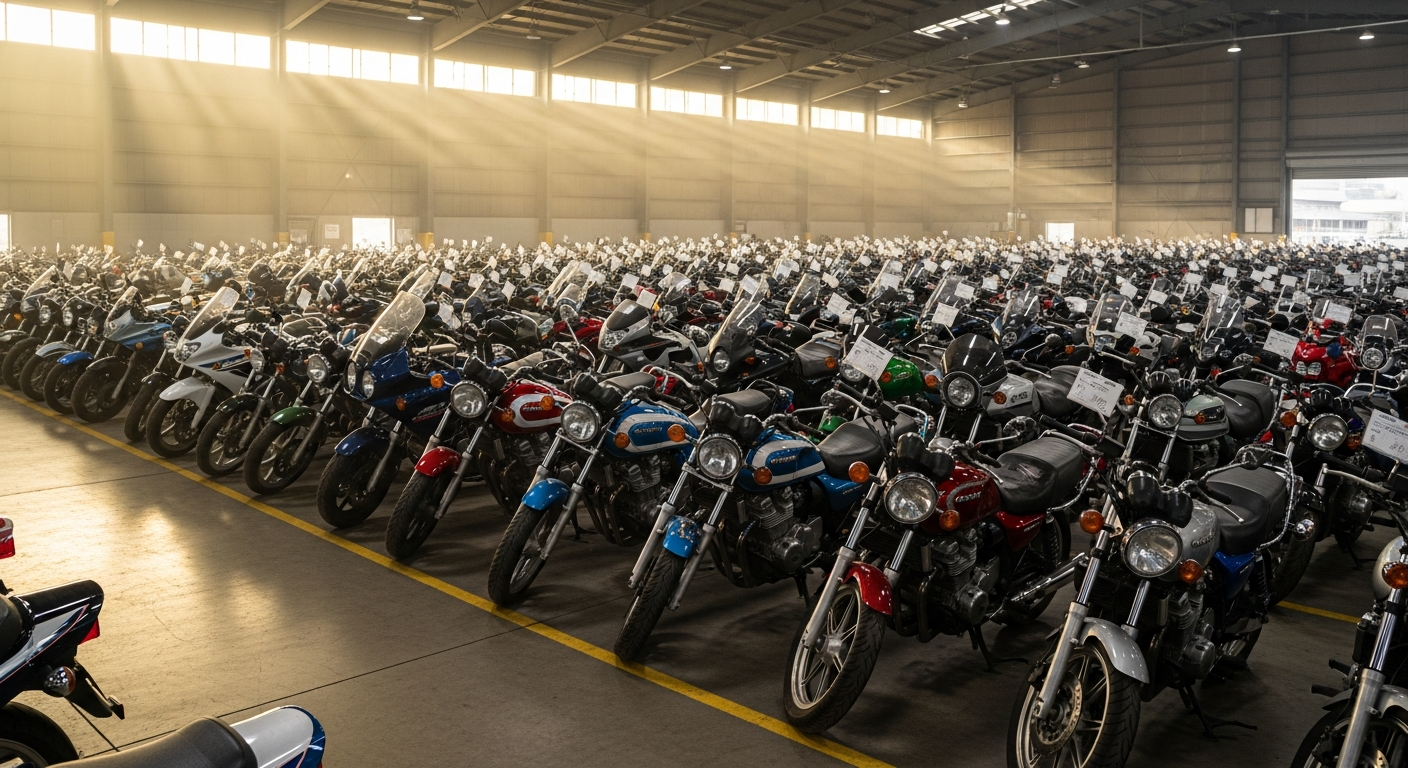
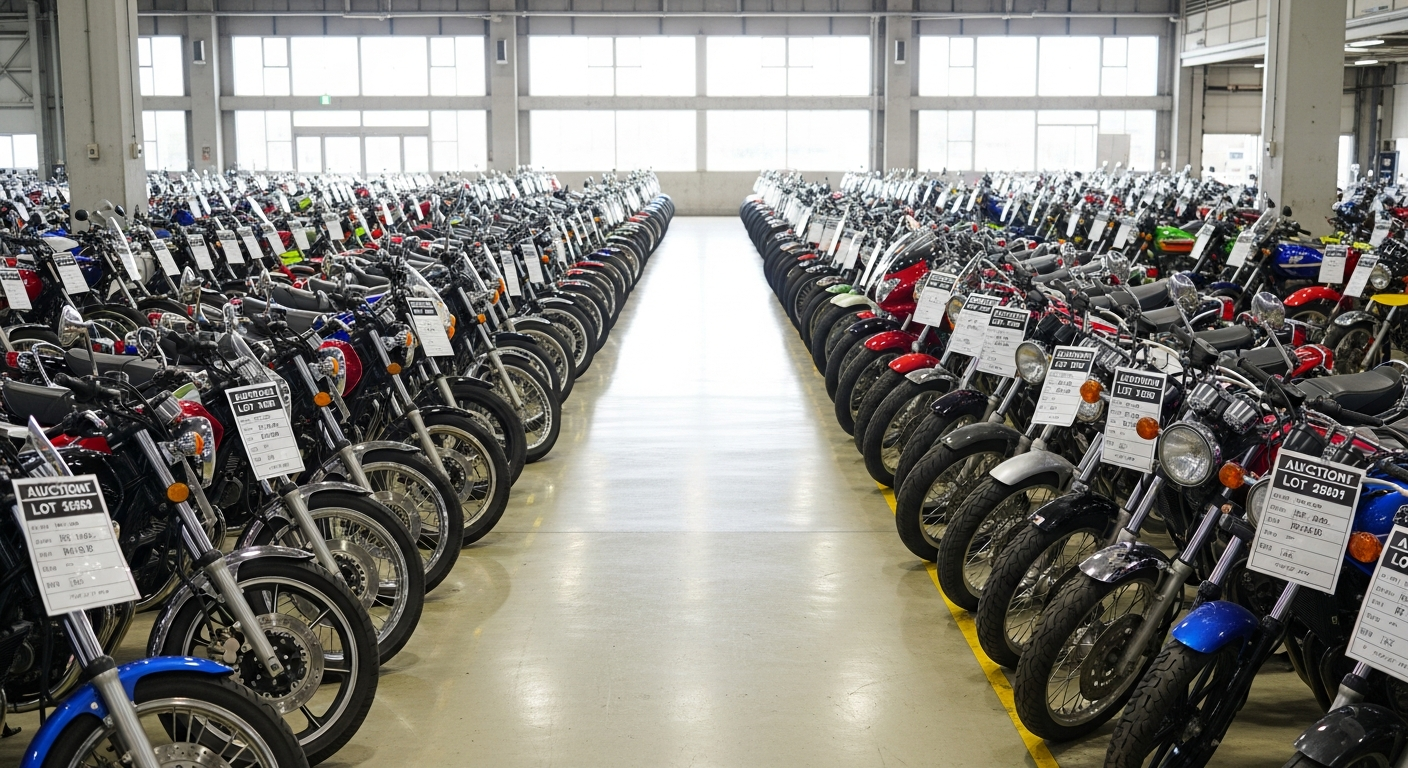
Japan's used bike market moves roughly 15,000 motorcycles through auction every single week. The YouTuber Bikes and Beards documented buying a full 40-foot container of bikes straight from Japan in a video that's now past 3.2 million views — and the practical detail buried in the comments is the one that matters: a 40-foot container fits 20-plus motorcycles, so the shipping cost gets split across the whole load. That's the economics that makes importing a 650 from Japan work. You're not paying car-shipping money to move one bike. For the full math, see our guide to shipping a motorcycle from Japan.
The two worlds of the 650cc class
Before you start bidding, understand that "650cc" describes two very different groups of bikes, and which one you chase changes your whole strategy.
World one: the modern all-rounder twins (2003 to today)
This is the heart of the class. Parallel twins and V-twins built from the early 2000s onward: the Suzuki SV650 and Gladius, Kawasaki ER-6n, ER-6f, Ninja 650, Z650 and Versys 650, the Suzuki V-Strom 650 and Bandit 650, plus Honda's NC700-adjacent middleweights and the CB650/CBR650 fours. These are liquid-cooled, fuel-injected, ABS-equipped on later models, and dead reliable. You're buying these to ride hard for years, not to collect.
For most of these, the limiting factor isn't condition — Japan has thousands of them in great shape — it's your country's import rules. A 2015 Ninja 650 is fantastic, but it won't clear the 25-year rule in the US or Australia until 2040. Riders in the UK and New Zealand have it easier, where there's no blanket age bar. We break down each market in our country guides for the USA, Australia, and New Zealand.
World two: the 25-year-rule classics opening up now
This is where it gets interesting in 2026. The first generation of the modern 650 twins is now old enough to import freely into the strictest markets. The original Suzuki SV650 (1999), the Kawasaki W650 retro twin (1999), the Suzuki Bandit 650, the Kawasaki ER-5, and the GSF650 are all crossing the 25-year line. The W650 in particular — a gorgeous air-cooled retro that Kawasaki sold mostly in Japan and a few export markets — is quietly becoming collectible, and Japan is the only place with real stock. Buy the right one now and you're not just getting a bike; you're getting a bike that's done depreciating.
The best modern 650cc motorcycles to import from Japan
These are the all-rounders — the bikes you import to ride, not to park. Every one of them is abundant in Japanese auctions, mechanically bulletproof, and worth far more landed than what you'll pay at the hammer.
Suzuki SV650 and SFV650 Gladius — the people's champion
If you only remember one bike from this guide, make it the SV650. The 645cc 90-degree V-twin makes around 75 horsepower, weighs next to nothing, and refuses to die. FortNine called it the best used motorcycle you can buy, full stop, and the market agreed so hard that even the awkward-looking Gladius variant started climbing in value after the video dropped. One commenter went and bought a Gladius as a first bike on the strength of that film: "literally the best experience I ever had in my life." The first-generation curvy SV650 (1999–2002) is already 25-year-rule legal everywhere. The pointy second gen (2003–2008) and the Gladius (2009–2015) are the value buys in markets without an age bar. Auction-grade examples in Japan routinely sell for the equivalent of $2,000–$3,500, landing around $4,500–$6,000 — against $5,500–$8,150 for a tired one in your local market.
Kawasaki ER-6n, ER-6f and Ninja 650 — the sensible workhorse
Kawasaki's 649cc parallel twin is the SV650's great rival, and the ER-6 generation (2006–2011) is the import bargain. The ER-6n is the naked, the ER-6f is the half-faired version, and from 2012 the whole line was rebadged Ninja 650 and Z650. Smooth, frugal, and forgiving, with a 180-degree crank that gives it a punchy low-end. Japan has these by the thousand because they were popular commuters and big-city bikes. They're not exciting in the way an old two-stroke is exciting — they're the bike you keep for ten years and never think about. Landed costs sit right alongside the SV650.
Suzuki V-Strom 650 — the do-anything adventure twin
Same legendary 645cc V-twin as the SV650, wrapped in a tall, comfortable adventure-touring body. The V-Strom 650 (2004 onward) is the bike long-distance riders quietly recommend to each other because it never lets them down — owners regularly post six-figure mileage with the original engine untouched. If your plan is touring, commuting, and the occasional gravel road, this is the smartest 650 you can import. It overlaps with our best adventure motorcycles to import from Japan guide, but at a price point that undercuts every bigger ADV bike.
Kawasaki Versys 650 — the underrated all-rounder
The Versys 650 takes the ER-6 engine and gives it long-travel suspension, an upright riding position, and a riding character that road testers consistently rank above its price. It's not glamorous, which is exactly why it's cheap to import and brilliant to own. Japan sees plenty of them. For a rider who wants one bike to do town, twisties, and weekend trips, the Versys 650 is a genuinely hard bike to beat on value.
Suzuki Bandit 650 (GSF650) — the honest budget standard
The Bandit was Suzuki's no-nonsense standard, and the 650 (2005–2015, plus the earlier 600 it replaced) is the definition of cheap, cheerful, and tough. An inline-four in the earlier carb cars, a fuel-injected version later, with a half-faired GSF650S option. These are the bikes that taught a generation of European riders how to ride. They land cheap and run forever. If you want maximum bike for minimum money, the Bandit is on the shortlist.
Honda CB650F, CBR650F and CB650R — the four-cylinder option
Not every 650 is a twin. Honda's CB650/CBR650 line runs a 649cc inline-four that revs higher and sounds sharper than any parallel twin, with the bulletproof Honda build quality our reliability deep-dive documents in detail. The CB650R Neo Sports Café in particular is one of the best-looking middleweights of the last decade. These are newer bikes, so the 25-year rule keeps them out of the US and Australia for now, but they're prime targets for UK and NZ importers who aren't bound by an age limit.
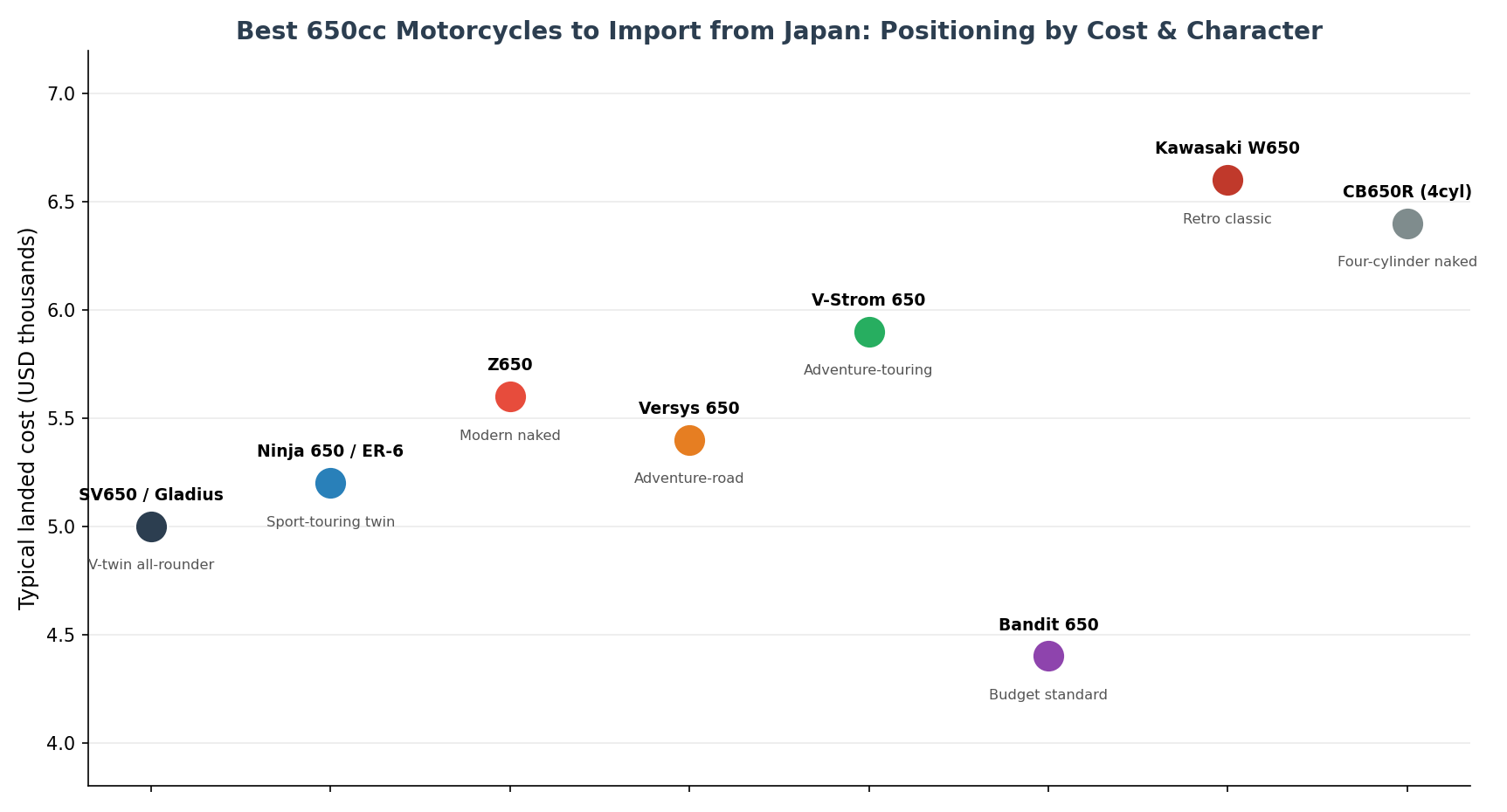
Here's the part that ties it together — what one of these actually costs to put on your driveway:
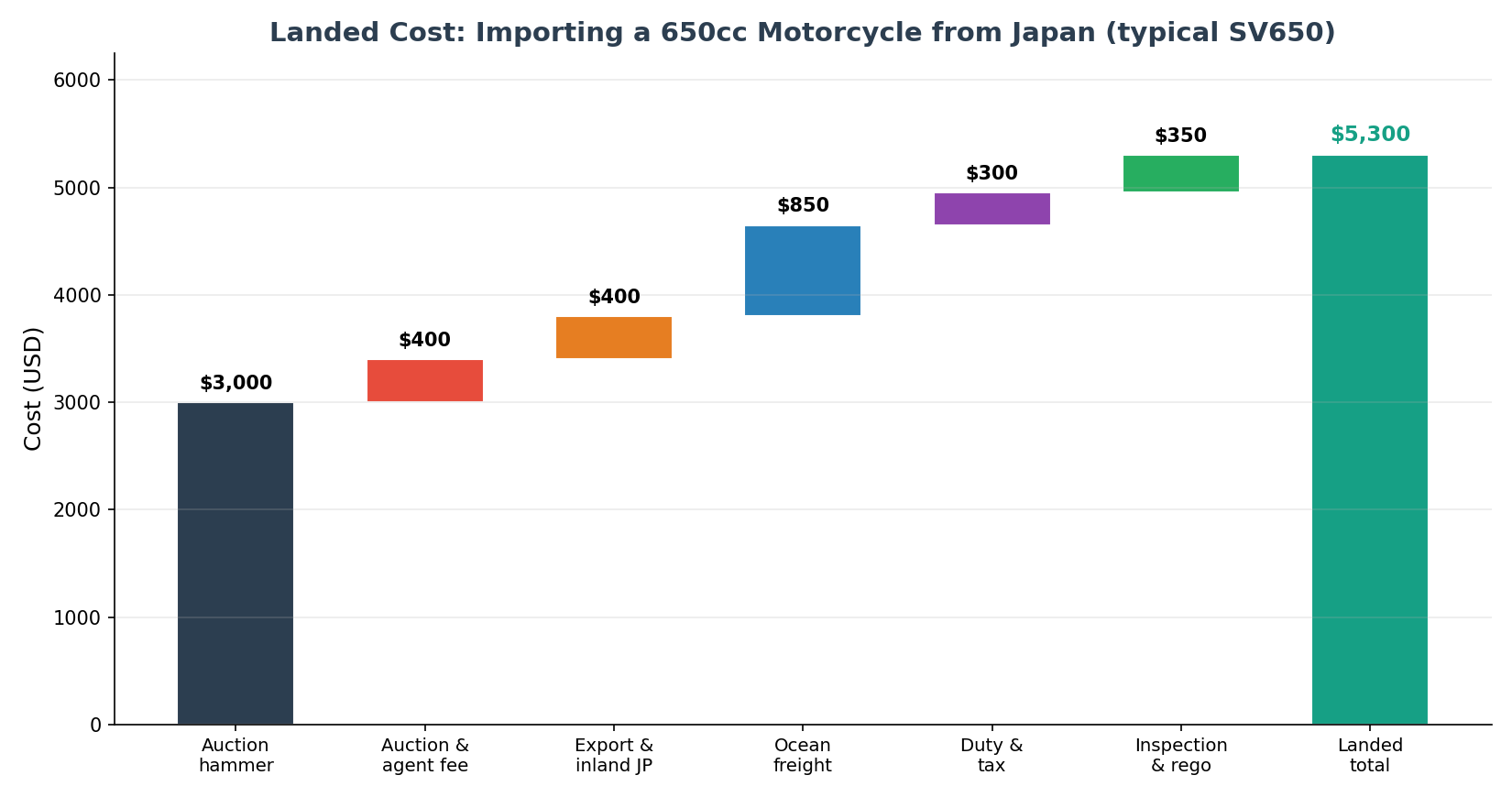
That auction hammer price of around $3,000 is the headline, but the all-in number — roughly $5,000 to $6,500 depending on your country's duty and shipping route — is what you should be budgeting against your local used prices. On a 650 twin, that gap is almost always in your favour.
Kawasaki Z650 and the new-generation naked twins
From 2017, Kawasaki sharpened the ER-6 formula into the Z650 — lighter, with a trellis frame and aggressive Sugomi styling. It's the bike that proved the 650 parallel twin still had room to grow. Riders love it for the same reasons they loved the ER-6: light, flickable, and frugal, but with modern brakes and a far better chassis. For UK and NZ importers who aren't limited by the age rule, a low-mileage Japanese Z650 is one of the best value-for-money nakeds on the market right now. Japan's stock is deep because the Z650 sold well domestically as a big-city bike.
Yamaha MT-07 and the cross-plane crowd — a fair comparison
Strictly, the Yamaha MT-07 is a 689cc bike, not a 650 — but no honest 650 guide can ignore it, because it's the bike every SV650 and Ninja 650 buyer cross-shops. The MT-07's 270-degree crossplane twin has a character that converted a lot of riders, and Japan has plenty of them. If you find the SV650 a touch soft, the MT-07 is the punchier alternative from the same era. We cover it in detail in our Yamaha MT-07 import guide. The point stands: the middleweight-twin class is where the real-world action is, and importing from Japan is how you get the cleanest one for the least money.
650 vs 600 vs 750: which displacement should you actually import?
This is the question that stalls most buyers, so let's settle it. The three classes look similar on paper and serve completely different riders.
The 600cc class, as we cover in our 600cc import guide, is dominated by screaming inline-four supersports — CBR600RR, YZF-R6, GSX-R600, ZX-6R. These are track-focused, high-revving, and demanding. They're brilliant if you ride hard and don't mind a committed riding position. They're miserable as a daily bike.
The 650cc class is the opposite philosophy: torquey twins (and the odd mellow four) built for the real world. Lower revs, wider powerband, upright comfort, and far cheaper to insure and maintain. This is the class you import to actually ride every day.
The 750cc class, covered in our 750cc import guide, splits the difference and adds the legendary race-replica fours like the GSX-R750 — more power, more presence, more money, and more bike than many riders need.
Here's the honest verdict. If you want a track weapon, import a 600. If you want a bike with serious presence and don't mind the cost, import a 750. But if you want the single most sensible, most usable, most affordable motorcycle that does everything well — you import a 650. That's not a compromise pick. Ask the 3.1 million people who watched FortNine crown a 650 the best used bike you can buy.
The 25-year-rule 650s coming legal right now
This is the timing play. In the US and Australia, a bike generally has to be 25 years old to import without federal compliance headaches. That clock is now ticking past the first wave of modern 650 twins, and a few genuine future classics are crossing the line.
Kawasaki W650 — the retro that's already climbing
The W650 (1999–2007) is the standout. An air-cooled 676cc parallel twin with a bevel-driven cam, styled like a 1960s British classic but built with Kawasaki reliability. It was sold mainly in Japan and Europe, never in big numbers in North America, and it's the spiritual ancestor of the modern W800. Clean examples are getting harder to find and the values are firming up — which is exactly why you want to source one from Japan, where the stock is deepest and the bikes were babied. As of 2026, the early W650s are over 25 years old and importable into the strictest markets.
First-generation Suzuki SV650 (1999–2002)
The curvy original SV650 and SV650S are now 25-year-rule eligible, which means American and Australian riders can finally import the bike FortNine crowned without compliance gymnastics. Early SVs are getting a second look as modern classics, and the carbureted first-gen has a simplicity that fuel-injected later bikes can't match.
Suzuki Bandit 650/600 and Kawasaki ER-5
The honest, unglamorous 650s of the late 90s — the early Bandits and the Kawasaki ER-5 — are crossing 25 years too. Nobody's going to call these collectible, but they're dirt-cheap, tough, and now legal everywhere. For a first big bike or a winter hack, they're hard to argue with.
The chart below shows roughly when key 650s become importable under each country's rules — the difference between markets is bigger than most buyers realise:
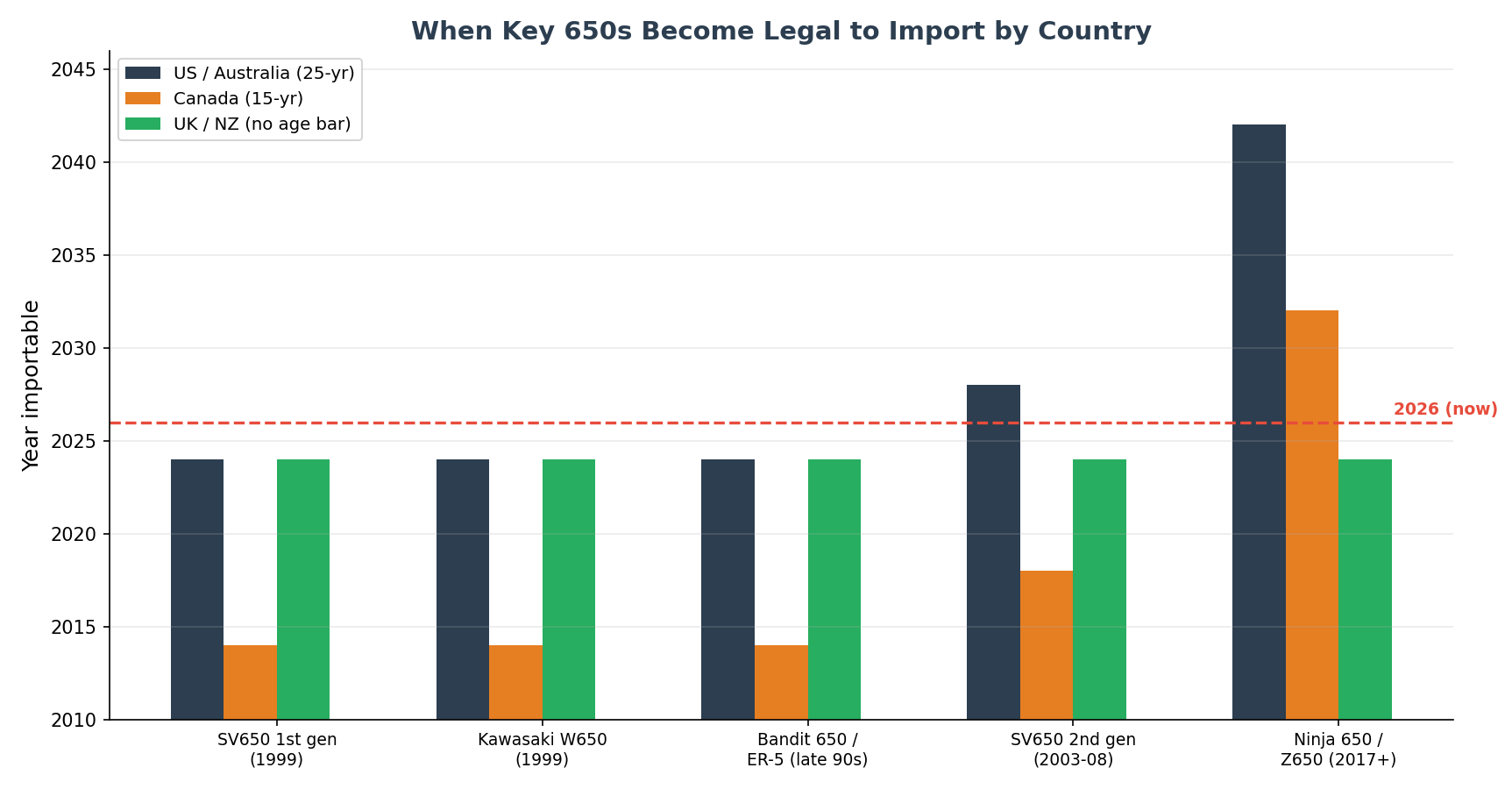
The takeaway: UK and New Zealand buyers can import almost any 650 right now, Canada's 15-year rule opens up bikes a decade earlier than the US, and US/Australia buyers should focus on the late-90s and early-2000s twins that are crossing the 25-year line as we speak. Always confirm the current rule for your exact market before you bid — see the country guides linked throughout this page.
Which 650cc is right for you
You don't buy a 650 by spec sheet. You buy it by what you actually do with a bike. Here's the honest breakdown.
The beginner or returning rider
Go SV650 or ER-6n/Ninja 650. Forgiving power, low seat height, light weight, and an engine you literally cannot break. These are the most-recommended first big bikes for a reason — and because Japan has so many, you can afford a clean low-mileage one instead of a beaten-up local example.
The commuter who also wants weekend fun
The Versys 650 or V-Strom 650. Upright, comfortable, frugal, and happy in traffic on Monday and on a mountain road on Sunday. The taller bikes also handle rough roads better, which matters more than people admit.
The rider who wants character
SV650 for the V-twin grunt, or the W650 if you want air-cooled retro soul and a bike that turns heads outside every café. The W650 is the heart pick; the SV650 is the head pick that happens to have heart too.
The four-cylinder fan
CB650R or CBR650F. If you grew up loving the howl of an inline-four and a twin feels too sensible, this is your 650. Just remember the age-rule limits if you're in the US or Australia.
The value hunter
Bandit 650 or Kawasaki ER-5. Maximum motorcycle, minimum money, zero pretension. Land one cheap, ride it for years, sell it for nearly what you paid.
Living with an imported 650: parts, insurance, and resale
The bike landing on your driveway is the start, not the finish. The good news is that the 650 class is the easiest imported bike to live with, and that's a big part of why it's the smart buy.
Parts are everywhere
Because the SV650, Ninja 650, ER-6, V-Strom 650, and Bandit were sold worldwide in huge numbers, parts are cheap and available anywhere. Consumables, filters, chains, sprockets, brake pads — all off-the-shelf at any dealer or online in minutes. This is the killer advantage over importing a rare JDM-only machine like an old two-stroke, where you're hunting for a specific carb diaphragm for months. The only exception in this guide is the W650, which is rarer — but even there, the modern W800 shares enough DNA that the situation is manageable. For the full picture on keeping a Japanese import running, our reliability guide is worth a read.
Insurance is genuinely cheap
A 650 twin sits in a friendly insurance bracket. It's not a litre-bike, it's not a supersport, and insurers know these engines are reliable and the riders sensible. Premiums on an SV650 or Ninja 650 are a fraction of what you'd pay on a 600 supersport or a 1000cc bike, which is one more way the 650 quietly saves you money over years of ownership. Newer riders especially feel this — a 650 is one of the few "proper" bikes you can insure affordably on a fresh licence.
Resale holds up
Here's the part that makes importing a 650 a near-zero-risk move: these bikes barely depreciate once they're a few years old. You're buying at the flat part of the depreciation curve. A clean imported SV650 or V-Strom you paid $5,500 for, ridden sensibly for three years, will sell for close to what you paid — sometimes more if good examples have dried up in your market. And the appreciating models like the W650 and first-gen SV650 can actually make you money. Compare that to a new bike that loses 20% the moment you ride it home.
The paperwork reality
The one genuine bit of homework is registration. Every country handles imported bikes slightly differently — the US wants the right federal forms and a state title, the UK has NOVA and IVA/MSVA for certain bikes, Australia needs compliance and state rego, and so on. None of it is hard, but it's the step people underestimate. Our country guides for the USA, Canada, Australia, and New Zealand walk through exactly what each market requires so there are no surprises at the registry desk.
What it really costs to import a 650 from Japan
Let's put real numbers on it, because the cost breakdown is where most buyers either get excited or get scared. Take a clean Suzuki SV650 that sells at a Japanese auction for around 450,000 yen — call it $3,000 at the hammer.
On top of that you're looking at: an auction and agent fee (typically the equivalent of $300–$500), inland transport to the port and export paperwork (around $300–$500), ocean freight (roughly $700–$1,000 depending on whether you go container or RoRo, and how many bikes share the box), then your home-country import duty and tax. Motorcycle duty is low or zero in most markets — the UK and EU charge a small percentage, the US charges next to nothing on bikes, and Australia and NZ apply GST. Add a few hundred for local inspection and registration and the all-in number lands between $5,000 and $6,500 for most 650 twins.
Compare that to buying locally. A high-mileage SV650 in the US runs $5,500–$8,150. A used Ninja 650 sits in the same range. You're importing a cleaner, lower-mileage bike from Japan for the price of a tired one at home — and you know its exact history from the auction inspection sheet instead of trusting a stranger's word. For the deep dive on every line item, our complete guide to importing a motorcycle from Japan walks through it step by step.
Container versus RoRo
If you're importing one bike, RoRo (roll-on/roll-off) shipping is usually cheapest. If you're going in with friends or buying several, a shared container is the move — remember Bikes and Beards fit 20-plus bikes in one 40-foot box. Our container vs RoRo breakdown covers which makes sense for your situation.
How to buy a 650 at a Japanese auction
You can't walk into a Japanese motorcycle auction yourself — they're trade-only, members-only events run by houses like BDS (Bike Dealer's System), JBA, and the bike lanes of USS. You bid through a licensed agent. Here's the flow.
Step 1: Pick your agent and set a budget. A good import agent gives you access to the live auction feeds and translates the inspection sheets. Set your maximum landed budget, not just your hammer budget — work backwards from the all-in number.
Step 2: Watch the auction listings. Thousands of bikes run every week. For a popular 650 like an SV650 or Ninja 650, you'll see multiple examples in a single week, so you can afford to be picky and wait for the right grade.
Step 3: Read the auction sheet. This is the whole game. Japanese auction houses grade every bike with a neutral inspector's report — an overall grade (S, A, B, C, R and so on), an exterior grade, and a map of every scratch, dent, and rust spot. Learn to read it and you'll never buy a surprise. Our guides on auction grades explained and reading inspection sheets cover the codes in detail. For a 650 daily rider, target grade A or B with a clean exterior.
Step 4: Bid. Your agent places the bid for you. If you win, you pay the hammer price plus fees and the bike moves into the export pipeline.
Step 5: Ship, clear, register. The agent handles export paperwork and freight. On arrival you clear customs, pay any duty, pass local inspection, and register. Total timeline is usually 6 to 10 weeks door to door. For more on bidding mechanics, see how to bid on a Japanese motorcycle auction.
650cc pre-purchase checklist, model by model
Every 650 has its known weak spots. Read the auction sheet against this list before you bid.
Suzuki SV650 / V-Strom 650 / Gladius: Check the regulator/rectifier — the early ones can cook. Look for clean coolant and no weeping from the water pump. The V-twin is otherwise close to indestructible. High mileage is not a dealbreaker on this engine.
Kawasaki ER-6 / Ninja 650 / Z650 / Versys 650: The 649cc twin is reliable, but check the rear shock (the budget unit wears) and confirm the cam chain tensioner isn't rattling on high-mileage examples. Coolant and oil condition tell you how the bike was cared for.
Suzuki Bandit 650 (GSF650): On carbureted examples, look for signs the carbs have been balanced and aren't gummed up from sitting. Check the exhaust and downpipes for rust, a common Bandit weak point.
Kawasaki W650: This is a more delicate buy because it's becoming collectible. Confirm originality, check for corrosion on the chrome and spokes, and make sure the bevel-gear cam drive is quiet. Pay for condition here — a clean W650 is worth the premium.
Honda CB650/CBR650 four: Newer and very reliable. The main thing is confirming service history and that the inline-four runs smoothly across the rev range with no top-end noise.
Common mistakes, and what nobody tells you
Buying on hammer price alone. A cheap bike with a bad auction sheet is not cheap once you've paid to ship a problem across an ocean. Budget the landed cost and read the grade.
Ignoring your country's age rule. Falling in love with a 2018 Ninja 650 is easy. Discovering it can't legally enter the US until 2043 is heartbreak. Check the rule first, then shop.
Chasing the wrong generation. The first-gen carbureted SV650 and the W650 are simpler and, in some markets, the only legal option — but they ride differently to the modern fuel-injected bikes. Know which era you actually want.
Skipping the agent. Japanese auctions are not open to foreign buyers walking in. Anyone telling you to wire money directly to a private seller you found online is the exact scam our scam-avoidance guide warns about. Use a licensed agent.
Which 650s will hold their value
Most 650 twins are tools, not investments — but a few are quietly appreciating. The Kawasaki W650 leads the pack as a genuine future classic. First-generation SV650s are firming up as modern classics now that they're 25-year-rule eligible. And clean, low-mileage examples of any of the big twins hold value simply because good ones are getting scarce in Western markets while Japan still has stock. Import a clean one now and you've effectively locked in today's price.
How AWA Auction helps you import the right 650
This is what we do. AWA Auction gives you direct access to the same Japanese auctions the trade buys from — the SV650s, Ninja 650s, V-Stroms, and W650s moving through BDS, JBA, and USS every week. We read the inspection sheets so you don't buy a surprise, bid to your landed budget, handle export and shipping, and get the bike to your door. No wiring money to strangers, no guessing about condition.
Browse what's running right now, or tell us the exact 650 you're after and we'll hunt it down at auction.
See Also
Share this article: