
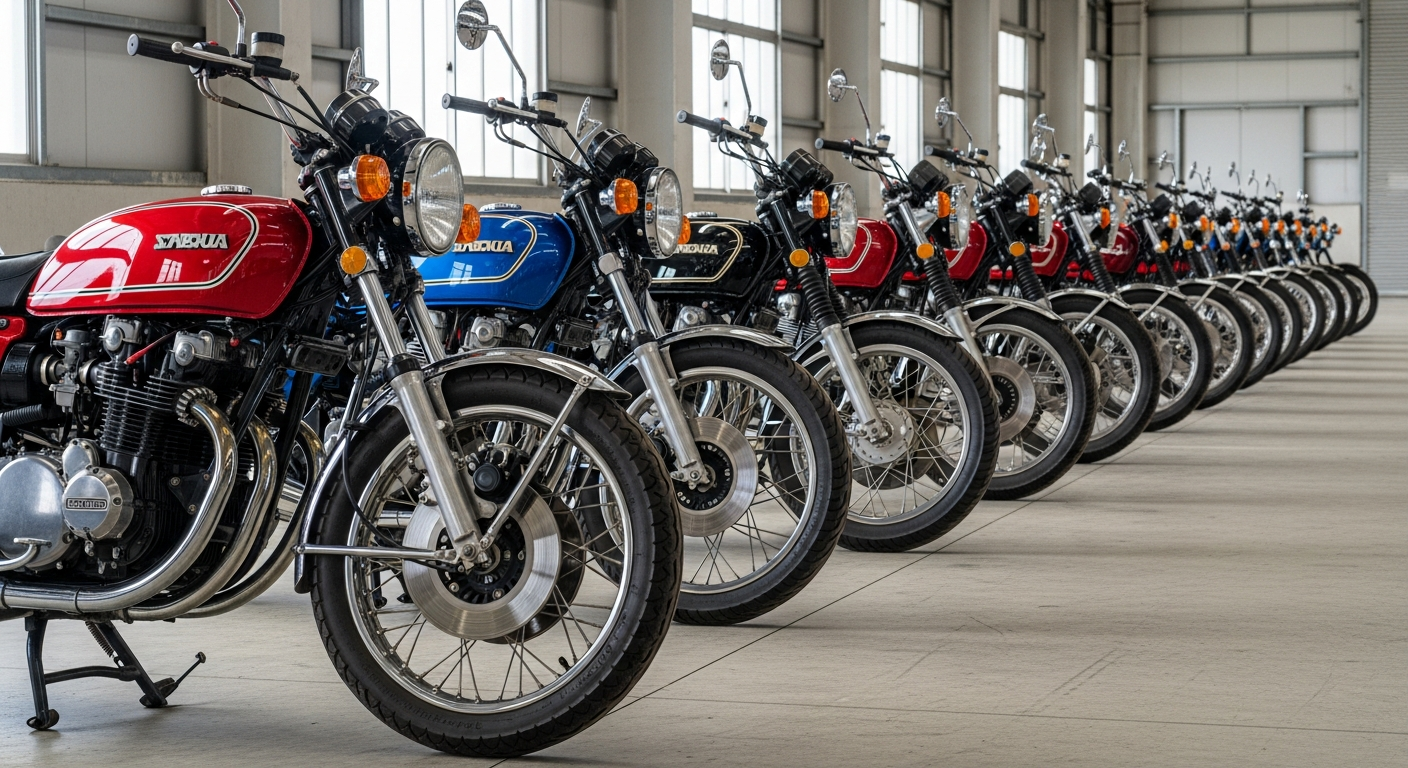
Here's something most riders outside Japan never figure out: some of the best small-capacity motorcycles ever built were never sold in their country. They were locked inside Japan by a quirk of the licensing system, ridden hard on Japanese roads, maintained obsessively, and then quietly retired. If you want one of these 400cc Japanese motorcycles, you don't walk into a dealer. You import it.
This guide is the shortcut. We'll cover the ten best 400cc motorcycles to import from Japan, why this oddball displacement class produced some of the most exciting bikes on the planet, what each one costs to land on your driveway, and whether it's even legal where you live. By the end you'll know exactly which 400 to chase and how to actually get it home.
And no, you don't need to speak Japanese or fly to Nagoya. You just need to know how the auctions work — which is the part nobody explains.
Why 400cc Japanese Motorcycles Are Worth Importing
Start with the thing that created this whole category: Japan's motorcycle licensing tiers. For decades, getting a license to ride anything over 400cc in Japan was brutally hard. The large-bike test had a pass rate that made grown adults give up. Anything 400cc and under sat in the friendlier mid-size license bracket.
So the factories did the obvious thing. They poured race-bike engineering into 400cc machines and sold them to a captive home market that couldn't easily get the bigger stuff. The result was a golden era of high-revving, fully-faired, inline-four 400s that screamed past 14,000 rpm and looked like shrunken superbikes.
Most of these never left Japan. The CB400 Super Four, the ZRX400, the XJR400, the VFR400 NC30 — they were Japanese-market-only, or sold abroad in tiny numbers. For a rider in the US, UK, Australia, Canada or New Zealand, importing from Japan isn't the convenient option. It's the only option.
There's a second reason, and it matters just as much: condition. Japanese owners baby their bikes. The roads are clean, the shaken inspection regime forces regular maintenance, and rust is rare. A 25-year-old 400 pulled from a Japanese garage routinely shows up in better shape than a 10-year-old bike from a wetter, saltier country. You're not importing a project. You're importing a survivor.
Demand for these machines isn't fading either. In 2025 Honda announced it was reviving the CB400 Four and CBR400R Four — a brand-new 400cc inline-four for the modern era. A MotoLogues video covering that reveal pulled over 43,000 views in short order, with comment sections full of riders begging for the bikes to be sold worldwide. When a manufacturer resurrects a 40-year-old formula, that tells you the appetite for the original JDM 400s isn't going anywhere.
What Makes the 400cc Class So Special
If you've only ridden modern bikes, the 400cc Japanese four is a different animal. These engines don't make their power down low. They make it at the top, in a frantic, intoxicating rush that you have to chase with the gearbox. A CB400 will happily spin past 13,000 rpm. A VFR400 V4 sounds like a Grand Prix bike that got shrunk in the wash.
That's the magic. You can ride a 400 flat-out on a public road and not immediately lose your license. Try that on a 1,000cc superbike and you'll be explaining yourself to a magistrate. The 400s give you most of the theatre at a fraction of the speed, which is exactly why people fall in love with them.
There's a cult around the sound, too. One YouTube feature titled "The Best Sounding 250cc Motorcycles Ever Made (Spoilers; They're all Japanese)" has racked up more than 640,000 views and nearly 700 comments — and the 400cc fours are the bigger, angrier siblings of those same screamers. People don't import these bikes purely for transport. They import them for the noise.
The class also splits into clear flavours, which helps you pick:
- Naked retros — CB400 Super Four, XJR400, Zephyr 400, ZRX400. Upright, friendly, gorgeous.
- Faired sportbikes — CBR400RR, ZXR400, FZR400, GSX-R400. Race-replica looks and a 14,000 rpm redline.
- Exotic V4s — VFR400 NC30 and RVF400 NC35. The miniature RC30/RC45 that handle like nothing else in the class.
Whichever you choose, you're buying a piece of engineering that the rest of the world simply wasn't allowed to have.
The 10 Best 400cc Motorcycles to Import From Japan
This list isn't ranked by raw speed. It's ranked by what actually matters when you import: how good the bike is, how available it is at Japanese auctions, and how well it holds up once it's yours. Every one of these is a machine you can realistically find and ship this year.
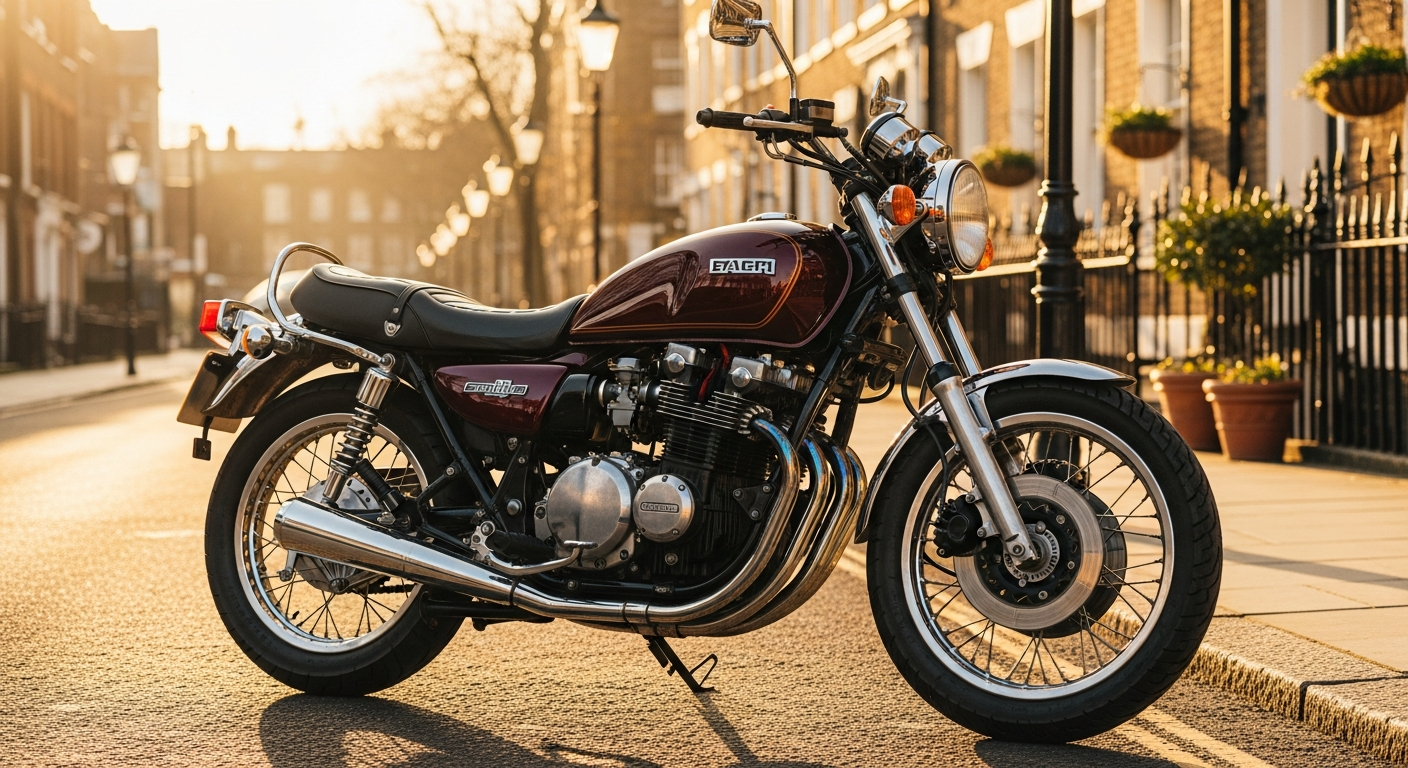
1. Honda CB400 Super Four (NC31 / NC39 / NC42)
If you only import one 400, make it this. The CB400 Super Four is the undisputed king of the class — a water-cooled inline-four naked that Honda kept building, refining and selling in Japan from 1992 all the way to 2022. Thirty years of production means parts are everywhere and reliability is bulletproof.
The later VTEC versions are the party trick: below around 6,000 rpm only two valves per cylinder open, then the second pair kicks in and the engine transforms from a docile commuter into a 13,000 rpm howler. It's the most usable 400 on this list and the easiest to live with day to day. We cover the buying details in our full Honda CB400 Super Four import guide.
Availability at auction is excellent — hundreds pass through Japanese yards every week. Expect to pay more than the others here, simply because everyone wants one.
2. Kawasaki ZRX400
The ZRX400 is the bike for people who grew up worshipping Eddie Lawson's green Superbike racer. It wears that iconic bikini fairing and lime-green paint, runs a punchy inline-four, and looks like a 1980s race weekend distilled into a 400. Introduced in 1994 as the successor to the Xanthus 400, it was Japanese-market only — there's no buying one second-hand outside an import.
Riders love it because it's the rare 400 that feels muscular rather than frantic. The styling has aged beautifully, and clean examples are climbing in value. Get one while they're still sensible money.
3. Yamaha XJR400
Air-cooled, big-tanked, and unapologetically old-school, the XJR400 is the muscle-bike of the naked 400s. It's a baby version of the legendary XJR1200/1300, with the same square-shouldered stance and a torquey air-cooled four that doesn't demand you live at the top of the rev range.
The XJR is the sensible romantic's pick. It's mechanically simple, gorgeous in a timeless way, and one of the more affordable entries into the class. It's also a favourite of the Japanese custom scene, so you'll find plenty wearing tasteful period modifications.
4. Honda CBR400RR (NC23 "Tri-Arm" / NC29 "Gull-Arm")
Now we get serious. The CBR400RR is a fully-faired race replica that looks and behaves like a shrunken Fireblade — which was exactly Honda's intent. The early NC23 has a conventional swingarm; the later NC29 introduced the gorgeous curved "Gull-Arm" that's become its signature.
This is a 14,000 rpm screamer with proper sportbike ergonomics and handling to match. It's not a commuter — it's a weekend weapon. Our dedicated Honda CBR400RR import guide walks through the generation differences and what to inspect before you bid.
5. Honda VFR400 NC30 (and RVF400 NC35)
The crown jewel of the entire class. The VFR400 NC30 is a miniature replica of the legendary RC30 — gear-driven cam V4, single-sided swingarm, twin headlights, the whole exotic package. The later RVF400 NC35 took the formula even further and channelled the RC45. These are the bikes that make grown enthusiasts go weak.
A V4 400 sounds like nothing else on Earth, and the handling is razor-sharp. They command the highest prices in the class and they're worth every yen. Read the full breakdown in our Honda VFR400 NC30 import guide before you commit, because condition variance is wide.
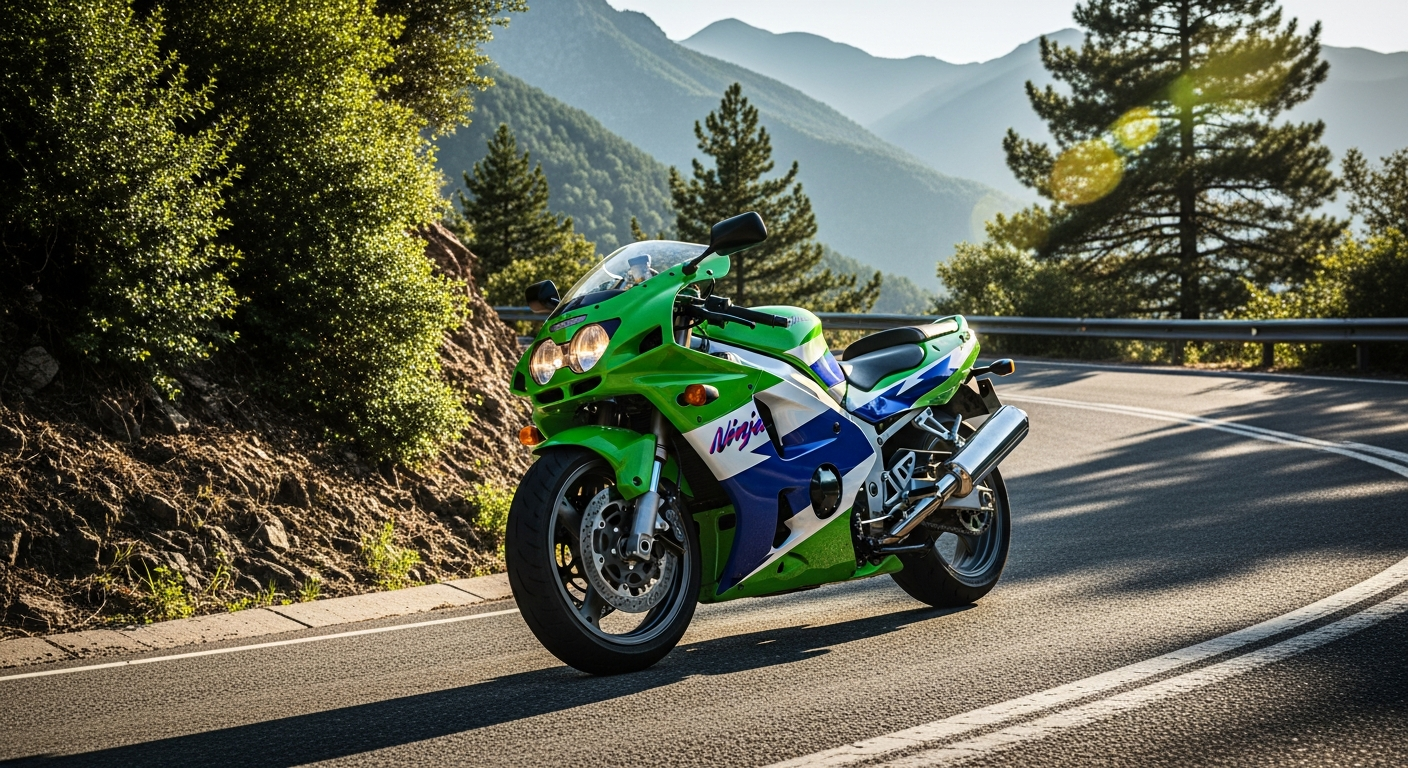
6. Kawasaki ZXR400
The ZXR400 is the bargain race-replica. Unusually for the class, it was officially imported into the UK in period, which means it's more common and more affordable than its rivals today. That official-import history also makes paperwork simpler in some markets.
It runs a 400cc inline-four good for over 130 mph, wears those distinctive twin "hoover hose" air intakes, and handles like a proper sportbike. If you want the faired 400 experience without VFR money, this is your bike.
7. Yamaha FZR400 / FZR400RR
Effectively a pocket FZR1000, the FZR400 is small, light, focused and high-revving — and the later 1990-on RR models are widely regarded as some of the best-handling small bikes ever built. Yamaha offered it in a steady run of successive models from 1986, so there's choice in spec and condition.
It's a connoisseur's sportbike: less famous than the Honda, but loved by people who've actually ridden the whole class. Auction supply is decent and prices are reasonable.
8. Suzuki Bandit 400 / GSX-R400
Suzuki's pair covers both bases. The GSX-R400 is the faired race replica — light, aggressive, and a direct cousin of the bigger GSX-R sportbikes. The Bandit 400 is the naked all-rounder, with a willing inline-four in a friendly upright chassis that makes a brilliant first import.
The Bandit in particular is one of the cheapest ways into a Japanese 400 four, which makes it a smart pick if you're testing the import waters before chasing something rarer.
9. Honda CB-1 (NC27)
The CB-1 is the quirky underdog. Built 1989–1990, it's essentially the CBR400RR's engine dropped into a naked, minimalist roadster body. It never sold in big numbers and it's been overlooked for years, which means it's still a relative bargain.
An owner on YouTube documented his "cheap red 1989 CB1 400 Honda Grey Import" in a video that's drawn nearly 40,000 views — proof that the affordable end of the 400 market has a devoted following. If you want a high-revving Honda four with rare-bike kudos and a friendly price, the CB-1 is hiding in plain sight.
10. Kawasaki Zephyr 400
The bike that started the retro-naked craze. The Zephyr 400 launched in 1989 and single-handedly revived the appetite for simple, air-cooled, standard motorcycles in an era obsessed with plastic fairings. It's honest, characterful, and endlessly customisable.
Zephyrs have a huge following and a deep aftermarket, and they're one of the most recognisable shapes in the class. We dig into the details in our Kawasaki Zephyr import guide. If your taste runs classic rather than race-replica, start here.
How Much It Costs to Import a 400cc From Japan
Here's the part that scares people off — and it shouldn't. Importing a 400 is far cheaper than most riders assume, because these bikes are small, light, and sell for modest money at Japanese auctions.
A clean 1990s 400 four typically hammers for somewhere between ¥300,000 and ¥800,000 at auction — roughly $2,000 to $5,500 depending on model and condition. A VFR400 NC30 sits at the top; a Bandit 400 or CB-1 sits at the bottom. On top of the bike, you add a stack of predictable costs.
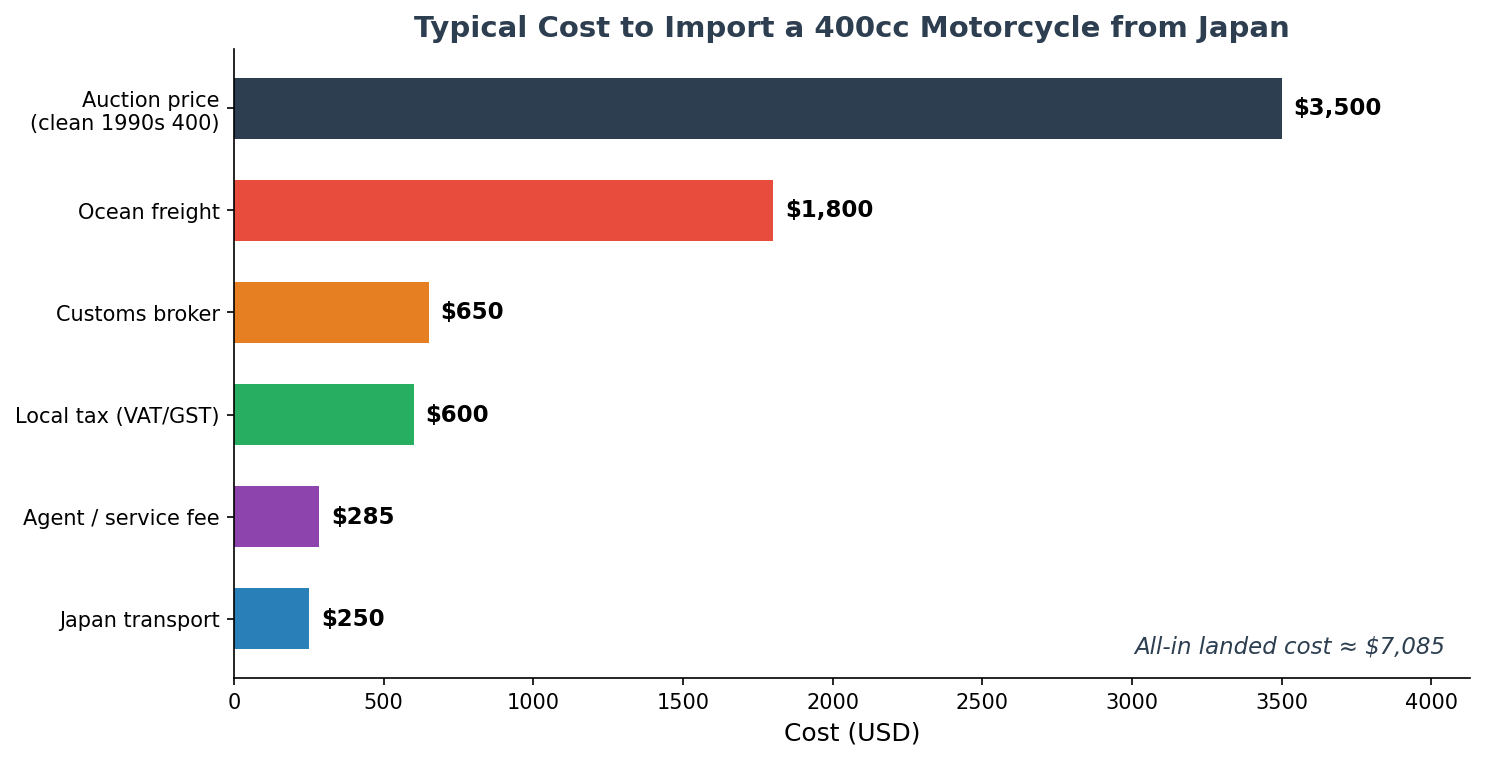
The typical extra costs break down like this:
- Auction service / agent fee — around ¥45,000 per unit (roughly $285) through a buying service. This is what you pay to actually bid on your behalf inside the auction.
- Domestic transport in Japan — getting the bike from the auction yard to the export port, usually $150–$300.
- Ocean freight — $1,000 to $2,500 depending on whether you ship RoRo or in a shared container, and which port you're landing at.
- Customs broker at your end — $400 to $900 for full clearance.
- Import duty — and here's the good news: motorcycle import duty is 0% in the US, UK, Australia, Canada and New Zealand. You'll still pay local consumption tax (VAT/GST) in most countries, but the duty line itself is usually zero.
Add it up and a 400 that cost you $3,500 at auction generally lands on your driveway for around $6,000 to $8,000 all-in. A useful rule of thumb the trade lives by: budget roughly 30% above the purchase price for everything else, and you won't get a nasty surprise. For the full mechanics of shipping, see our guide on shipping a motorcycle from Japan.
One genuine warning for US buyers: in 2025 a 25% Section 232 tariff hit certain motor vehicle imports. Most 25-year-old motorcycles are handled differently from new cars, but tariff rules shift, so confirm the current treatment before you bid. The auction price is the easy part to predict — the policy is the part that moves.
Is It Legal to Import a 400cc in Your Country?
This is where buyers get tripped up, because the rules are completely different depending on where you live. The single biggest factor is the age of the bike. Good news for 400 hunters: almost the entire golden-era catalogue is now old enough to qualify.
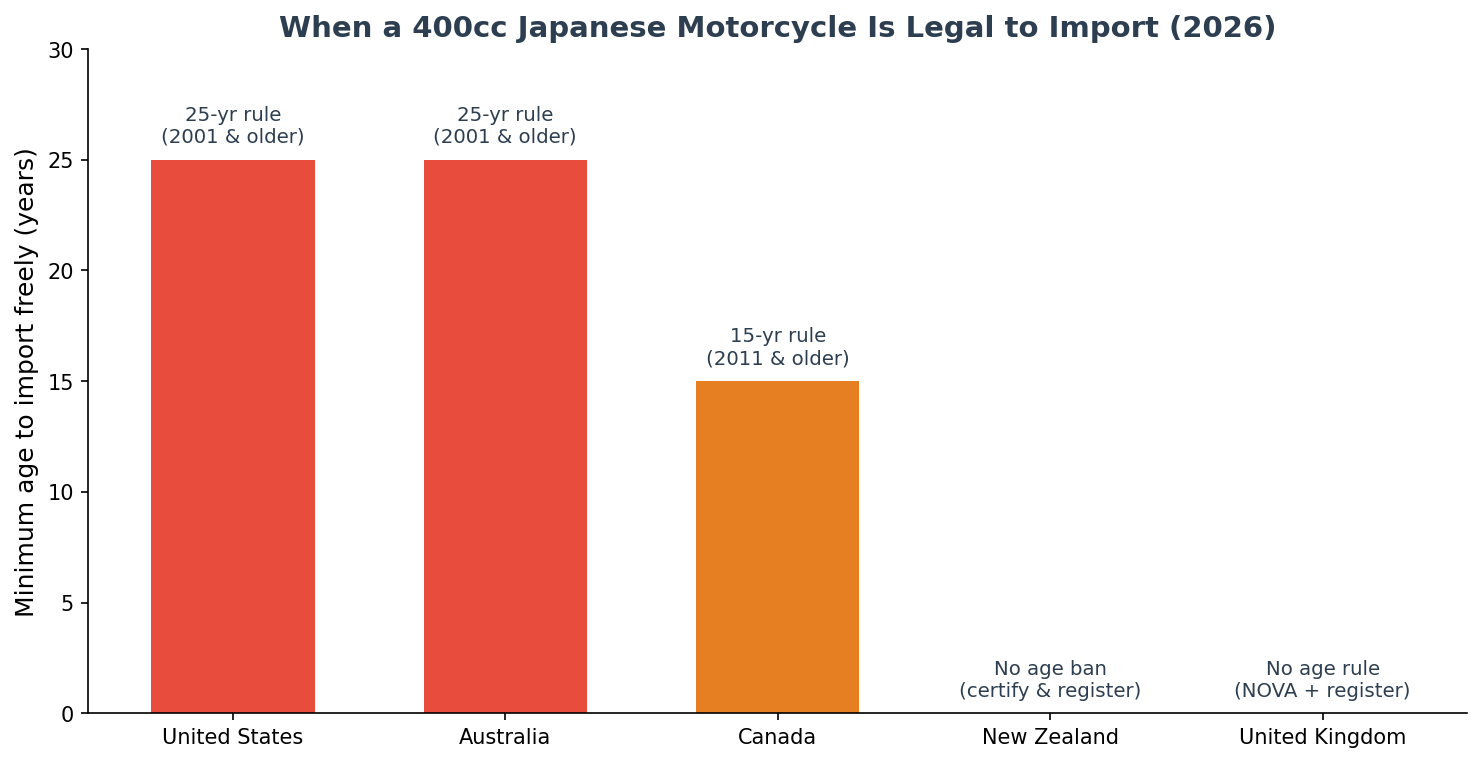
Here's the quick version by country:
- United States — the 25-year rule. A motorcycle at least 25 years old is exempt from FMVSS safety compliance and imports freely. In 2026 that means anything from 2001 or earlier — which covers the vast majority of classic 400 fours. Newer bikes need a Registered Importer and are rarely worth the hassle. Full details in our Japan-to-USA import guide.
- Canada — a friendlier 15-year rule, so 2011-and-older bikes qualify. Canada is often the easiest English-speaking market to import a 400 into. See our Japan-to-Canada guide.
- Australia — a 25-year rule plus mandatory asbestos inspection and biosecurity cleaning. More paperwork, but very doable. We break it down in the Japan-to-Australia guide.
- New Zealand — among the most relaxed; no blanket age ban, just entry certification and registration. See the Japan-to-New Zealand guide.
- United Kingdom — no age rule at all. You can import any 400, new or old, but you must declare it through NOVA for tax and register it. Older bikes skip the toughest type-approval steps. Our Japan-to-UK guide has the full process.
The practical takeaway: if you're in the US or Australia, stick to bikes built in 2001 or earlier and life is simple. In Canada, the UK and New Zealand, your options are even wider. Either way, the classic 400 fours from the 80s and 90s are squarely in the clear.
How to Actually Buy One at a Japanese Auction
This is the part that feels mysterious from the outside and is genuinely straightforward once you see it. Japan runs enormous wholesale motorcycle auctions — BDS, JBA and others — where thousands of bikes change hands every week. You can't walk in off the street; you bid through a licensed buying agent. That's the whole secret.
The process looks like this:
- Browse the catalogue. Every bike gets listed with photos and an inspection sheet days before the sale.
- Set your maximum bid. You tell your agent the most you'll pay, all-in. They bid for you in real time.
- Win the lot. If your bid takes it, you pay the hammer price plus the auction and service fees.
- Export and ship. The agent handles de-registration, transport to port, and booking your freight.
The key skill is reading the auction inspection sheet — a standardised report where a Japanese inspector grades the bike and notes every scratch, dent and mechanical issue in a shorthand of letters and numbers. Learn to read it and you can buy a bike sight-unseen with real confidence. Start with our guide to Japanese auction grades explained and our walkthrough on how to bid on a Japanese motorcycle auction.
You can see live machines moving through this exact pipeline on our current listings page. That's the easiest way to get a feel for real prices and grades before you commit a single yen.
What to Check Before You Bid on a 400
These bikes are 25 to 35 years old. Most are spectacular for their age, but a 400 four has specific weak spots, and knowing them turns you from a hopeful gambler into a sharp buyer.
Carburettors first. Almost every classic 400 runs a bank of four carbs. If a bike has sat for years, those carbs gum up, and a four-cylinder carb rebuild is fiddly and not cheap. On the inspection sheet and in the photos, look for a bike that's clearly been run recently. A cold-start video from your agent is gold.
The top end. These engines live at high rpm, so valve clearances matter. A faint top-end tick on a Honda four is often just clearances due for a shim adjustment — routine. A deep knock is not. Don't panic at every noise, but do ask.
Originality. Japan's custom scene is enthusiastic, which is wonderful until you discover the VFR400 you bought has a one-off exhaust and aftermarket everything. If you want stock, read the sheet and the photos carefully. Original bikes hold value far better.
Model-specific gremlins. VFR400 V4s want their cam-chain tensioners checked. ZXR400 and FZR400 race-replicas may have been crashed and rebuilt — look for mismatched fairing panels. XJR400s are tough but check for the air-cooled engine running hot from blocked fins. None of this is a deal-breaker; it's just the homework that saves you money.
The inspection sheet does most of this work for you. A bike graded 4 or above with a clean auction sheet and recent service history is a safe buy. Learning to read those inspection sheets is the single most valuable skill in this whole game.
Common Mistakes Buyers Make (The Stuff Nobody Tells You)
After watching a lot of first-time importers, the same handful of mistakes come up again and again. Avoid these and you're ahead of 90% of buyers.
Chasing the cheapest bike instead of the cleanest. A $2,000 project 400 will cost you more than a $4,000 clean one by the time you've sorted the carbs, the tyres and the corrosion. On a bike you're importing sight-unseen, condition is everything. Pay for the auction grade.
Forgetting registration is a separate fight. Importing the bike and registering it for the road are two different jobs. In the US, some states make titling a grey-import a paperwork marathon — a 17-digit VIN expectation on a bike that left the factory with a shorter Japanese frame number trips people up constantly. Research your state or country's registration process before you bid, not after the crate arrives.
Underestimating the wait. From winning bid to bike-in-your-garage is typically six to ten weeks once you factor in the next sailing, the ocean crossing and customs. It's not a next-day Amazon order. Plan for the season you actually want to ride.
Going it completely alone. You can absolutely import a bike yourself, but the people who get burned are usually the ones who skipped a trusted agent to save a few hundred dollars and then mis-read an auction sheet on a bike with a hidden fault. The agent fee is cheap insurance.
Buying the bike, ignoring the parts. Before you fall for a rare model, do a five-minute check on parts availability in your country. A CB400 Super Four is easy to keep running anywhere. A rarer race-replica might mean sourcing fairings and electrical bits from Japan for years. Both are fine — just know which you're signing up for.
How AWA Auction Helps You Import a 400cc From Japan
Everything above is doable solo, but it's a lot of moving parts in a language you probably don't read. That's the gap AWA Auction fills. We give English-speaking buyers direct access to the same Japanese motorcycle auctions the trade uses — without the language barrier, the guesswork, or the worry about what an auction sheet really means.
You tell us the 400 you're after — a VTEC CB400, an Eddie Lawson ZRX, a screaming VFR400 V4 — and your budget. We find clean examples, translate and interpret the auction sheets honestly, bid on your behalf, and handle export, shipping and the paperwork to get the bike to your port. You get the bike you wanted, graded and described in plain English, at a fair all-in price.
Browse our current listings to see what's available right now, or contact our team with the exact model you're hunting and we'll go find it. The best 400s don't sit around — but new ones cross the auction blocks every single week.
Honourable Mentions and Where to Stop
The top ten covers the bikes worth crossing an ocean for, but a few more deserve a nod. The Suzuki Across (GF250/400) is the oddball with a lockable "boot" where the fuel tank usually sits — genuinely practical and dirt cheap. The Kawasaki Balius is the naked sibling of the ZXR400 engine, a high-revving little rocket that's flown under the radar for years. The Honda Bros 400 (a V-twin, technically NT400) is a left-field choice with real character if inline-four mania isn't your thing.
And then there's the trap: the rabbit hole of ever-rarer variants. Once you start chasing limited-edition colours, one-make-race homologation specials and single-owner museum pieces, prices stop making sense fast. There's nothing wrong with that game if you know you're playing it — just don't wander into it by accident while shopping for a first bike. The mainstream models on this list deliver 95% of the joy for a fraction of the drama.
Which 400 Is Right for You?
Strip away the romance and the choice comes down to how you actually ride. Here's the honest matchmaking.
If you want one bike to do everything — commute, weekend blast, the occasional longer ride — buy the Honda CB400 Super Four. It's the most complete, most reliable, most resale-proof 400 ever made. You will never regret it.
If you grew up taping superbike posters to your wall — you want a faired race-replica. The CBR400RR is the all-rounder of the sporty crowd, the ZXR400 is the value pick, and the FZR400RR is the handling connoisseur's choice. All three turn back roads into a personal Grand Prix.
If you want something nobody else has — the VFR400 NC30 or RVF400 NC35. A gear-driven V4 with a single-sided swingarm is exotica at any price, and at 400cc it's a riot you can use. Budget the most, demand the best condition, and savour every downshift.
If you love classic, simple, honest motorcycles — the Yamaha XJR400, Kawasaki Zephyr 400 or Suzuki Bandit 400. Air-cooled or simple, easy to maintain, endlessly customisable, and the cheapest way into the class. These are the bikes you keep forever and slowly make your own.
Whatever lands on your shortlist, the buying path is identical: find a clean example at a Japanese auction, read the sheet, bid smart, and ship it home. The bike is the fun part. We'll handle the boring part.
Why Now Is the Moment to Import a 400
Timing matters with these bikes, and right now the window is wide open. Two forces are pushing in your favour at once. First, the 25-year rule keeps unlocking fresh metal every single year — bikes that were off-limits to US and Australian buyers a few seasons ago are now legal, and the catalogue of eligible 400s grows on a rolling basis. Second, Japan's own riders are slowly moving on from these machines, so supply at auction remains healthy even as overseas demand climbs.
That balance won't last forever. Values for the best examples — clean VFR400s, original ZRX400s, low-mileage CB400 VTECs — have been climbing steadily as the wider world wakes up to what Japan kept to itself. A bike that costs $4,000 at auction today was closer to $2,500 a handful of years ago. The trajectory is clear, and it points up.
None of this means you should panic-buy. It means a clean, honest 400 four bought at a fair price today is both a brilliant thing to ride and a sound thing to own. You're not throwing money at a depreciating commuter — you're buying a slice of a finite, appreciating slice of motorcycling history that happens to be enormous fun on a Sunday morning.
The riders who'll kick themselves in five years are the ones who kept meaning to import one and never did. The auctions run every week. The bike you want is probably crossing a block in Japan right now. The only real question is whether you're set up to bid on it.
Frequently Asked Questions
Why were so many 400cc motorcycles only sold in Japan?
Japan's tiered licensing system made anything over 400cc difficult and expensive to get licensed for, so manufacturers concentrated enormous engineering effort on the 400cc class for the domestic market. Models like the CB400 Super Four, VFR400 NC30, ZRX400 and XJR400 were built primarily or exclusively for Japanese buyers. Because they were never widely exported, importing from Japan is now the main way for riders in the US, UK, Australia, Canada and New Zealand to own one. That same home-market exclusivity is why these bikes feel special — they're machines the rest of the world was effectively shut out of for decades.
What is the best 400cc motorcycle to import from Japan for a first-time importer?
The Honda CB400 Super Four. It was produced for thirty years, so parts and knowledge are everywhere, it's mechanically bulletproof, and clean examples are abundant at Japanese auctions. It's easy to ride, easy to register, and easy to sell on if you ever move it along. If you want something cheaper to test the waters, the Suzuki Bandit 400 or Honda CB-1 are friendly, affordable inline-four nakeds. Save the rare race-replicas like the VFR400 NC30 for your second import, once you're comfortable reading auction sheets.
How much does it cost to import a 400cc motorcycle from Japan?
Most clean 1990s 400 fours hammer for $2,000–$5,500 at auction. Add roughly $285 in agent/service fees, $150–$300 of domestic transport in Japan, $1,000–$2,500 of ocean freight, and $400–$900 for a customs broker at your end. Motorcycle import duty is 0% in the US, UK, Australia, Canada and New Zealand, though you'll usually still owe local VAT or GST. All-in, a $3,500 auction bike typically lands for $6,000–$8,000. Budget about 30% above the purchase price for everything else and you'll be close.
Are 400cc Japanese motorcycles legal to import to the USA?
Yes, as long as the bike is at least 25 years old. Under the US 25-year rule, a motorcycle built in 2001 or earlier (as of 2026) is exempt from FMVSS safety standards and imports freely — and that covers almost every classic 400 four. Newer bikes require a Registered Importer and are rarely worth it. After import you'll title and register the bike in your state, which can be the slower part of the process. Our Japan-to-USA import guide covers the federal forms and the state-titling quirks in detail.
What's the difference between the VFR400 NC30 and the RVF400 NC35?
Both are gear-driven-cam V4 400s with single-sided swingarms, and both are the most exotic bikes in the class. The NC30 (1989–1992) is styled after the RC30 superbike, with twin round headlights. The NC35 (1994–1996) is the later evolution, styled after the RC45, with a different fairing, upgraded brakes and chassis tweaks. The NC35 is rarer and usually pricier; the NC30 is the more iconic shape. Both sound astonishing and handle brilliantly. Either is a genuine collector's bike, so prioritise condition and originality over saving a few hundred dollars.
How long does it take to import a 400cc from Japan?
Plan for six to ten weeks from winning the auction to the bike arriving at your local port. That window covers de-registration and transport to port in Japan, waiting for the next suitable sailing, the ocean crossing itself, and customs clearance at your end. Container shipping can be a little slower to consolidate than RoRo. Add a few more days for the bike to clear and for you to complete local registration. It rewards patience — this is a considered purchase, not an impulse buy.
Which 400cc is the most reliable to import?
The Honda CB400 Super Four, comfortably. Its long production run, water-cooling and Honda build quality make it the most dependable daily-usable 400. The Yamaha XJR400 and Kawasaki Zephyr 400 are also tough, simple, air-cooled designs that take abuse well. The high-strung race-replicas — CBR400RR, ZXR400, FZR400 — are reliable when maintained but live at high rpm and need attentive ownership. The V4 VFR400s are robust but more complex to service. For lowest-stress ownership, go naked and water-cooled.
Can I import a 400cc to the UK even though it's not 25 years old?
Yes. The UK has no minimum age rule for importing motorcycles, so you can bring in any 400, old or new. You'll need to declare it through NOVA so HMRC can collect any VAT due, then register it with the DVLA. Older bikes avoid the most demanding type-approval requirements, which makes the classic 80s and 90s 400 fours the simplest to put on UK plates. Our Japan-to-UK guide walks through NOVA, registration and the paperwork step by step.
Do these 400cc bikes have enough power for highway riding?
For most riders, yes — with a caveat. A 400 four makes its power high in the rev range, so you cruise at higher rpm than you would on a big twin. A CB400 Super Four or ZRX400 will sit at highway speeds comfortably and has enough in reserve to overtake; you just work the gearbox more. They're happiest on flowing back roads where you can use the revs. If your daily life is long, fast, two-up motorway slogs, a 400 is hard work. For everything else, the power is part of the fun.
Where can I find 400cc Japanese motorcycles for sale?
The bikes live at Japanese wholesale auctions like BDS and JBA, which thousands of dealers and exporters access every week. As a private overseas buyer you reach those auctions through a licensed buying agent rather than directly. AWA Auction gives English-speaking buyers exactly that access — browse our current listings to see real bikes and real auction grades, or contact our team with the specific 400 you want and we'll source it from the next sale.
See Also
Share this article: