
If you want to import a Honda CB1000 Super Four from Japan, you are chasing one of the most quietly brilliant retro-muscle bikes the country ever built. This is "The Big One" — the bike that took a full-fat 998cc superbike engine, stripped the fairing off it, and stood the whole thing up in the sunlight so you could actually see what a Honda inline-four looks like. It launched in 1992 under the internal codename Project BIG-1, and more than thirty years later Honda still keeps a running example in its own museum. That tells you exactly how the factory feels about it.
Here is the thing nobody tells you: outside Japan, the CB1000 Super Four barely registered. Honda sold it in America for two model years and then pulled it. The UK and Australia got a trickle. Japan, on the other hand, bought them by the thousand, serviced them at the dealer, and parked them in dry garages. That is why the Japanese domestic auction market is the single best place on the planet to find a clean, honest SC30 — and why importing one direct usually beats hunting for a tired local example that somebody has already ridden hard for two decades.
This guide walks you through what makes the Big One special, the Project BIG-1 origin story, the engine, how it slots into the wider Honda Super Four family, the model-year details, the handful of things to watch, what one really costs to land in your driveway, and the country-by-country rules for the US, UK, Australia and New Zealand. By the end you will know exactly what to buy, what to pay, and how to avoid the mistakes that catch first-time importers.
What Makes the Honda CB1000 Super Four "Big One" Special
Walk up to a CB1000 Super Four and the first thing that hits you is scale. This is a big, wide, physically imposing motorcycle, and that was entirely the point. In the early 1990s the Japanese market was drowning in plastic-clad race replicas. Honda's designers wanted to go the other way and build a naked bike that celebrated the engine instead of hiding it. So they took the 998cc four out of the CBR1000F, set it in a big steel frame, wrapped it in a muscular teardrop tank, and let the whole thing look as heavy and serious as it actually is.
The numbers back up the presence. The SC30 makes around 93 PS in Japanese-market trim (export versions ran a little higher), it carries roughly 260kg wet, and it produces a fat wall of torque low in the rev range rather than a screaming top end. One well-liked Japanese enthusiast post summed the character up perfectly: 998cc, 93 PS at 8,500 rpm, 8.6 kg-m of torque, a 260kg body — and "one twist of the throttle just shoves the whole thing forward." That is the Big One in a sentence. It is not a scalpel. It is a sledgehammer with beautiful paint.
What you get in exchange for the weight is a bike that feels indestructible and utterly relaxed. The engine is barely working at highway speeds. The riding position is upright and commanding. And because it is air-cooled with a simple, over-built four-cylinder heart, there is very little on it to go dramatically wrong. This is a motorcycle built in Honda's confident era, when "reliable" was a design goal rather than a marketing word. If you have read our piece on whether Japanese motorcycles are actually reliable, the Big One is the poster child for the "yes, absurdly so" side of that argument.
Project BIG-1: The Bike That Invented the Modern Japanese Muscle-Naked
To understand why the CB1000 Super Four matters, you have to understand where it came from. In the late 1980s Honda had a small naked bike called the CB-1, a 400 aimed at the Japanese licence market. It was competent and completely forgettable. A group of young engineers looked at it and thought the idea was right but the execution was timid. What if you took that honest, engine-forward naked concept and made it enormous?
The story Honda itself tells — laid out in detail in its own Project BIG-1 30th anniversary engineers' discussion — is that the team wanted the four-cylinder engine to be the hero of the whole design. Not a component to be faired over, but the visual centrepiece. They reportedly sketched the concept by imagining a CB-1 body carrying the fuel tank from the legendary CB1100R endurance racer. Blow that up to litre-class size, and you have the silhouette of the Big One. The internal project name, BIG-1, stuck so hard that owners still use it today.
Why does this matter to you as a buyer? Because the CB1000 Super Four was the bike that opened the door to an entire genre. Everything that came after it — the muscular air-cooled naked with a big-bore four and retro styling — traces back here. When you look at a Kawasaki ZRX1200, a Yamaha XJR1300, or a Suzuki GSX1400, you are looking at Honda's rivals answering a question the Big One asked first. Owning the SC30 is owning the original. There is real collector logic in buying the bike that started a category rather than one of the followers.
The Engine: A Detuned CBR1000F Superbike Motor
The heart of the Big One is a 998cc DOHC 16-valve inline-four, and it is not some bespoke, fragile special. It is the engine from the CBR1000F sport-tourer, a motor Honda had already spent years making bombproof, detuned for midrange muscle instead of top-end power. Peak output sits around 93 PS in JDM form, which sounds modest until you remember the enormous torque and the way it is delivered. This engine pulls cleanly from just above idle, which is exactly what you want in a heavy naked bike you plan to ride on real roads.
Two features make the SC30 engine a joy to live with. First, it is air-cooled, so there is no radiator, no water pump, and no coolant to leak — fewer things to fail on a thirty-year-old machine. Second, and this is the detail experienced buyers love, the valve clearances are set with old-fashioned screw-and-locknut adjusters. You do not need to pull the camshafts to do a valve check. Any competent home mechanic can do it in an afternoon with basic tools. On a lot of modern engines that same job is a shim-under-bucket nightmare that costs hundreds at a shop. The Big One just shrugs.
The Men and Motors road test of the CB1000 from the late 1990s — one of the few English-language period reviews that survives — kept coming back to the same word: unburstable. The reviewer treated it as a big, honest, do-anything bike rather than a specialist tool, and that reputation has only hardened with age. Owners today routinely report six-figure kilometre readings on original engines that have never been apart. This is a motor you buy once and forget about.
What It Is Like to Own and Ride a Big One
Numbers only tell you so much. What is it actually like to live with a CB1000 Super Four? In a word: easy. This is a bike that flatters the rider. The low-down torque means you rarely need to work the gearbox hard, the upright seating puts you in charge of traffic, and the sheer physical mass — the thing that intimidates people in the car park — turns into rock-steady stability once you are moving. On a fast, flowing road the Big One is in its element, surfing that fat midrange from corner to corner while the engine barely raises its voice.
The affection owners feel for these bikes is real and it shows up everywhere. Japanese enthusiasts still post about them with genuine pride — one recent tribute racked up hundreds of likes simply for laying out the spec and calling it a "super macho" machine that shoves its whole 260kg forward with a single twist of the wrist. Others reminisce about running one alongside a little Super Cub as a broke university student, treasuring the big Honda through the lean years. That kind of long-term loyalty is the clearest signal you can get that a used bike is worth owning.
There is also a lively customising scene. Because the SC30 has such clean, engine-forward lines, owners love to personalise them — a swapped exhaust to free up that inline-four bark, bar-end mirrors, a fork brace, a two-into-one or a set of aftermarket cans. You will see plenty of tastefully modified examples come through the auctions alongside bone-stock survivors. Decide up front which camp you want: a factory-original bike to preserve, or a sorted custom to enjoy. Both are out there, and both have their audience.
The Honda Super Four Family: Where the Big One Sits
The CB1000 Super Four does not exist in isolation. It is the middle child of a three-bike family, and understanding that family is the fastest way to work out whether the Big One is the right choice for you.
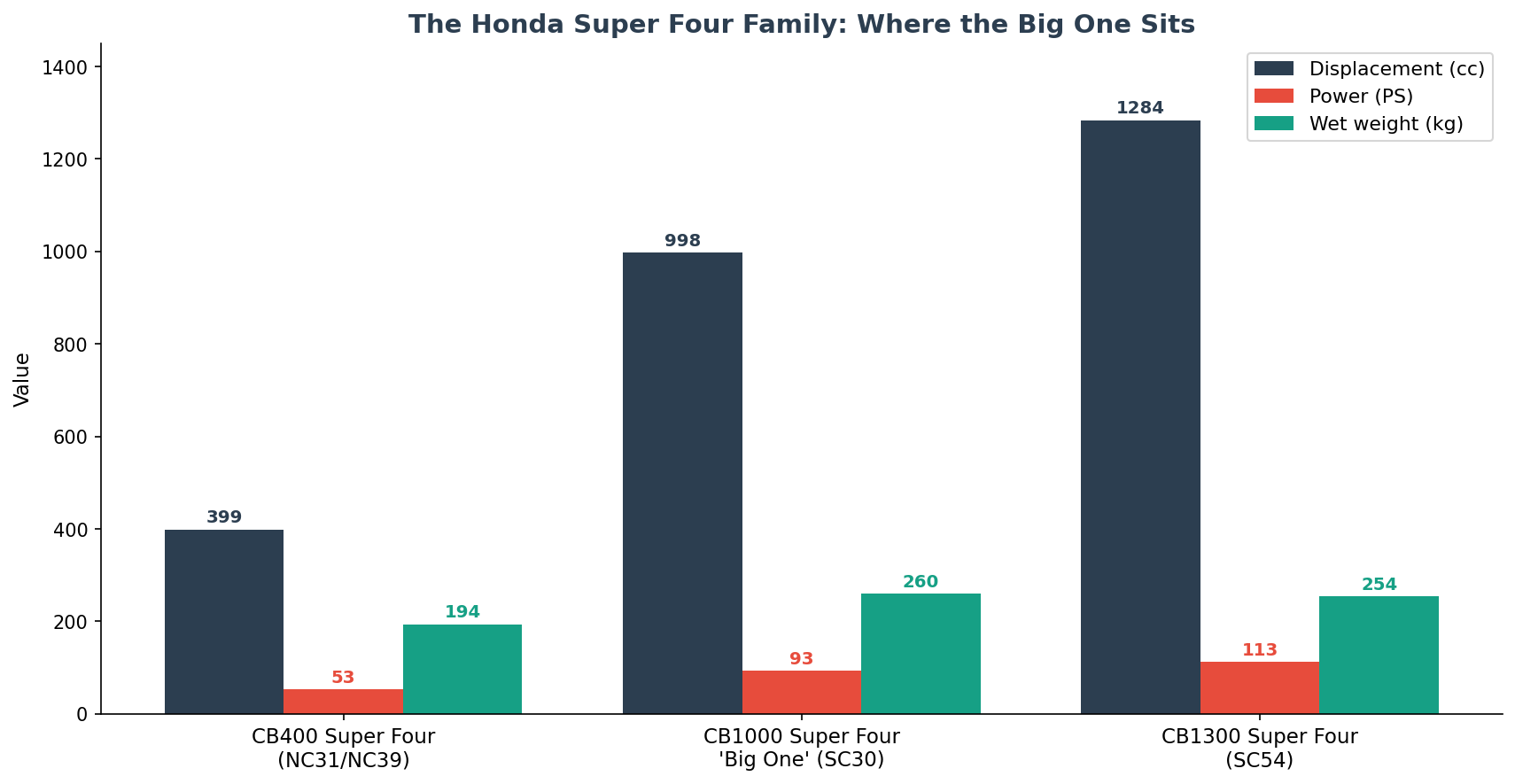
At the small end sits the Honda CB400 Super Four, the featherweight 399cc revver that is one of Japan's all-time best-selling bikes. At the top sits the Honda CB1300 Super Four, the modern, fuel-injected, 1284cc monster that replaced the Big One and is still built today. The CB1000 is the bridge between them — the bike that proved the "Super Four" naming and the muscular naked formula could work at litre size, before the CB1300 came along and made it smooth and civilised.
Here is the honest positioning. The CB400 is the choice for city riders and licence-restricted markets. The CB1300 is the choice if you want the same character with modern injection, better brakes and no age worries. The CB1000 Big One is the choice for someone who wants the raw, analogue, carburetted original — the one with the most character, the most history, and, crucially, the lowest entry price of the three. It is also the only one of the trio old enough to clear the 25-year import rule in every market right now. That combination of character and easy legal entry is exactly why it belongs on your list.
CB1000 Super Four vs the Air-Cooled Muscle Rivals
Once the Big One proved the concept, everyone piled in. If you are cross-shopping, here is where it lands against the bikes it inspired. The Kawasaki ZRX1200 is the sharpest handler and the sportiest of the group, with a hooligan streak and that iconic Eddie Lawson green-and-blue paint option. The Yamaha XJR1300 is the smoothest and most refined, with Ohlins shocks on later bikes and a gorgeous 1251cc lump. The Suzuki GSX1400 is the torque king, the biggest-engined of them all, and a cult hero precisely because Suzuki never sold it in America.
So why pick the Honda? Three reasons. It is the oldest and therefore the cheapest to buy and the easiest to import legally. It has the strongest origin story — it is the founder, not a follower. And it is, mechanically, the simplest and most over-engineered of the bunch, which matters when you are buying something with thirty years on the clock. If your priority is outright performance or the newest tech, one of the rivals may suit you better, and we have full import guides on all of them. If your priority is buying the genuine article at the friendliest price, the Big One wins.
Model-Year Guide: SC30 Generations and the T2
The good news for buyers is that the CB1000 Super Four barely changed across its life, so there is no dreaded "bad year" to swerve. But there are meaningful differences worth knowing before you bid.
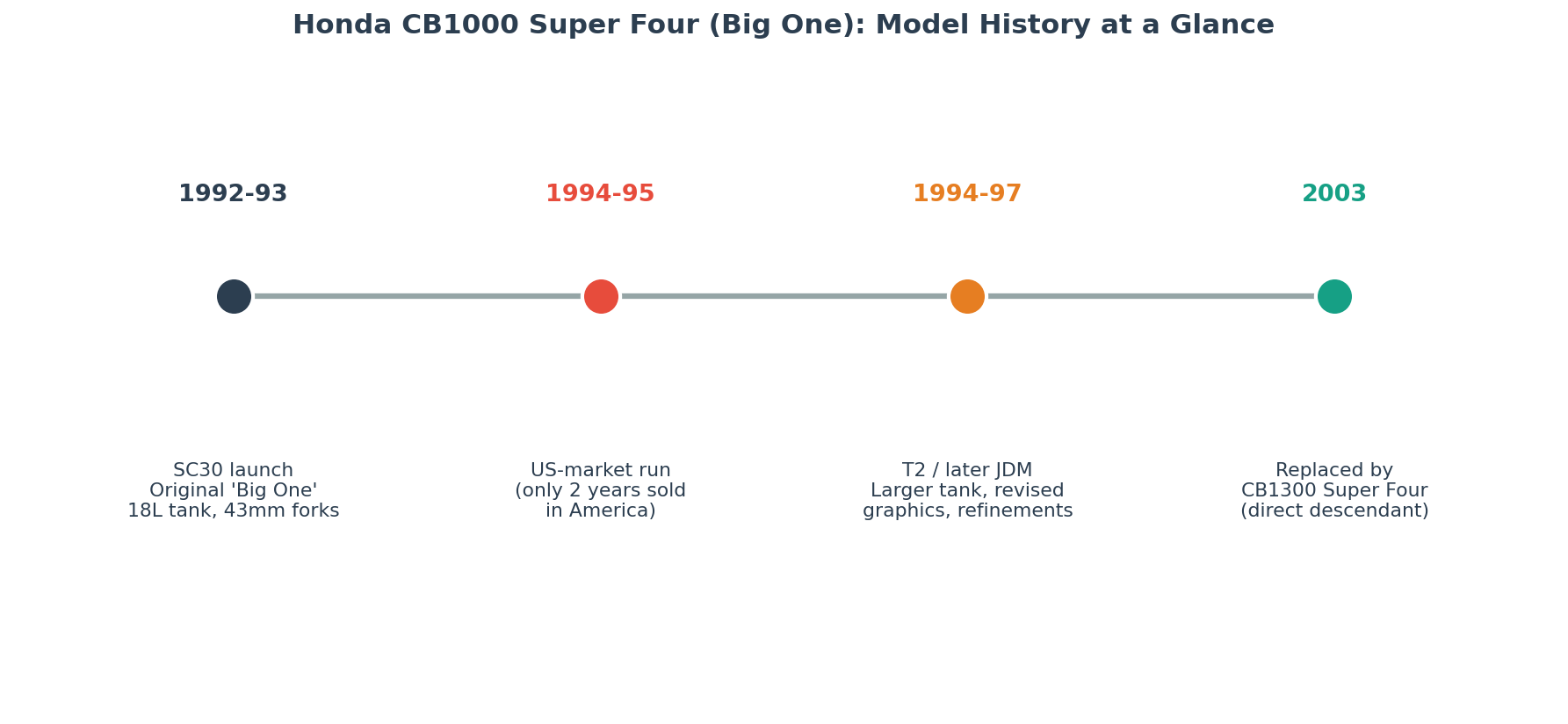
The original run started in late 1992. These first bikes are the purest expression of the concept: the classic teardrop tank, 43mm forks, and the clean early graphics that collectors prize. From 1994, Honda offered the bike in the United States for what turned out to be just two model years, 1994 and 1995. American sales were thin — the CBR1000F cost only a little more and buyers wanted the sporty faired bike — so US-market Big Ones are genuinely rare today.
Later in the run, Japanese-market bikes gained a version often referred to by owners as the T2, with a larger fuel tank and revised graphics. These give you more range and a slightly different look, and they tend to be the youngest, lowest-mileage examples you will find at auction. By 2003 the Big One was gone, replaced directly by the CB1300 Super Four. The takeaway: chase condition and history, not the badge on the side panel. A cherished 1993 with a full service record beats a neglected late bike every single time.
Years to Avoid and Known Faults
Let us be straight with you: there is no year of CB1000 Super Four you should categorically avoid. This is a robust, low-stress machine. But it is old, and old bikes have patterns. Knowing them is how you buy well.
The most common gremlin on any 1990s Honda four is the charging system. The regulator/rectifier and the stator can weaken with age and heat. It is cheap and easy to fix, but on a test ride or from an auction sheet you want to look for signs of a healthy charging voltage and check that the battery is not being cooked or starved. A tired reg/rec is not a deal-breaker — it is a bargaining chip.
Second, the carburettors. The Big One runs a bank of four carbs, and if a bike has been sitting — which many low-mileage Japanese examples have — the carbs can gum up with varnish from stale fuel. Symptoms are rough idle, hesitation, and uneven running. A clean and balance sorts it. Factor a carb service into your budget on any bike that has not been ridden regularly, and treat a bike that already runs crisply as the prize it is.
Third, the weight and the front end. At around 260kg this is a heavy motorcycle, and the original suspension was set up for comfort rather than sharpness. That is character, not a fault, but if you are coming off a modern bike, respect the mass at low speed and in car parks. Many owners fit modern fork oil, fresh springs or an upgraded rear shock, and the transformation is dramatic. Finally, watch for the usual thirty-year-old issues: corrosion on fasteners and switchgear, tired wheel bearings, and perished rubber. None of it is expensive. All of it is visible if you know to look — which is exactly what a Japanese auction inspection sheet is for.
How to Read the Auction Sheet on a 30-Year-Old CB1000
The single most powerful tool you have when importing a Big One is the Japanese auction inspection sheet. Every bike that crosses a Japanese auction block is examined by an independent inspector who grades its overall condition and maps its faults onto a diagram of the bike. For a thirty-year-old machine, this sheet is worth more than a hundred glossy photos.
On a CB1000, you are reading that sheet for a specific set of things: rust notes around the tank and frame, any accident-repair indicators, corrosion on the engine cases, and the inspector's overall grade. A grade 4 or above generally signals a genuinely clean, honest bike. You also want to see the mileage confirmed and any oil leaks or "engine noise" comments flagged. We have a complete walkthrough in our guide on how to read Japanese auction inspection sheets, and it is essential reading before you place a single bid. The whole point of buying from Japan is that the condition is documented, not guessed at. Use that advantage.
What a Honda CB1000 Big One Really Costs to Import From Japan
Now the part everyone actually wants: the money. The beauty of the Big One is that it is still an affordable classic. Clean SC30s change hands at Japanese auctions for genuinely reasonable numbers, and even after you add every cost of getting one home, the total is friendly compared to almost anything with this much history and presence.
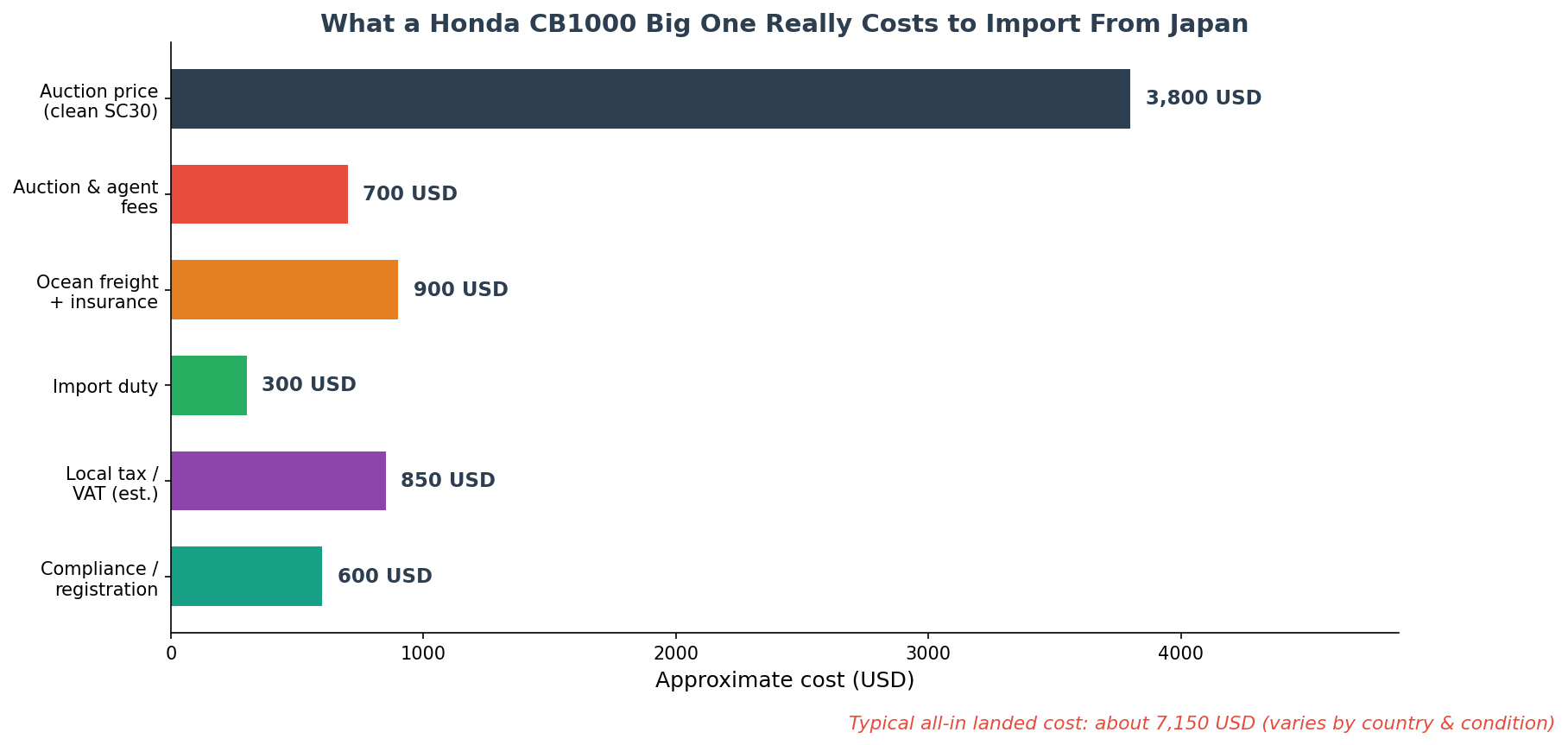
Here is a realistic breakdown for a clean, honest example. The auction price itself for a good SC30 typically sits around 3,800 USD, though excellent low-mileage bikes fetch more and rough project bikes go for much less. On top of that you have auction and agent fees of roughly 700 USD, ocean freight and marine insurance of around 900 USD, import duty (which is low on motorcycles in most markets) of around 300 USD, your local tax or VAT which we have estimated at about 850 USD, and compliance plus registration costs of around 600 USD. Add it up and a typical all-in landed figure lands near 7,150 USD before your own country's quirks.
Two things to remember. First, these are guide numbers — the bike, the exchange rate and current rules all move the total. Second, the auction price is the one variable you control most. Buy a well-graded bike from a documented sheet and you avoid the single biggest hidden cost of importing: fixing a bike that turned out worse than it looked. That is precisely the risk buying blind on a local classified never protects you from.
One more thing on money, because it matters. The Big One is quietly becoming a collector's bike. Clean, original SC30s are getting harder to find, and the market has already noticed — tidy examples that sold for pocket change a decade ago now command real, if still sensible, prices. That means a well-bought Big One is not just a great ride, it is a stable asset. Because it is the founder of the muscle-naked genre and Honda itself treats it as a landmark, the SC30 sits on the right side of the classic-value curve. You are unlikely to lose money on a good one, and you may well make some.
Landed Cost by Country: US, UK, Australia, New Zealand
Your total depends heavily on where you live, because duty, tax and compliance rules differ sharply between markets. Here is roughly where a clean Big One lands in each of the four big English-speaking import destinations.
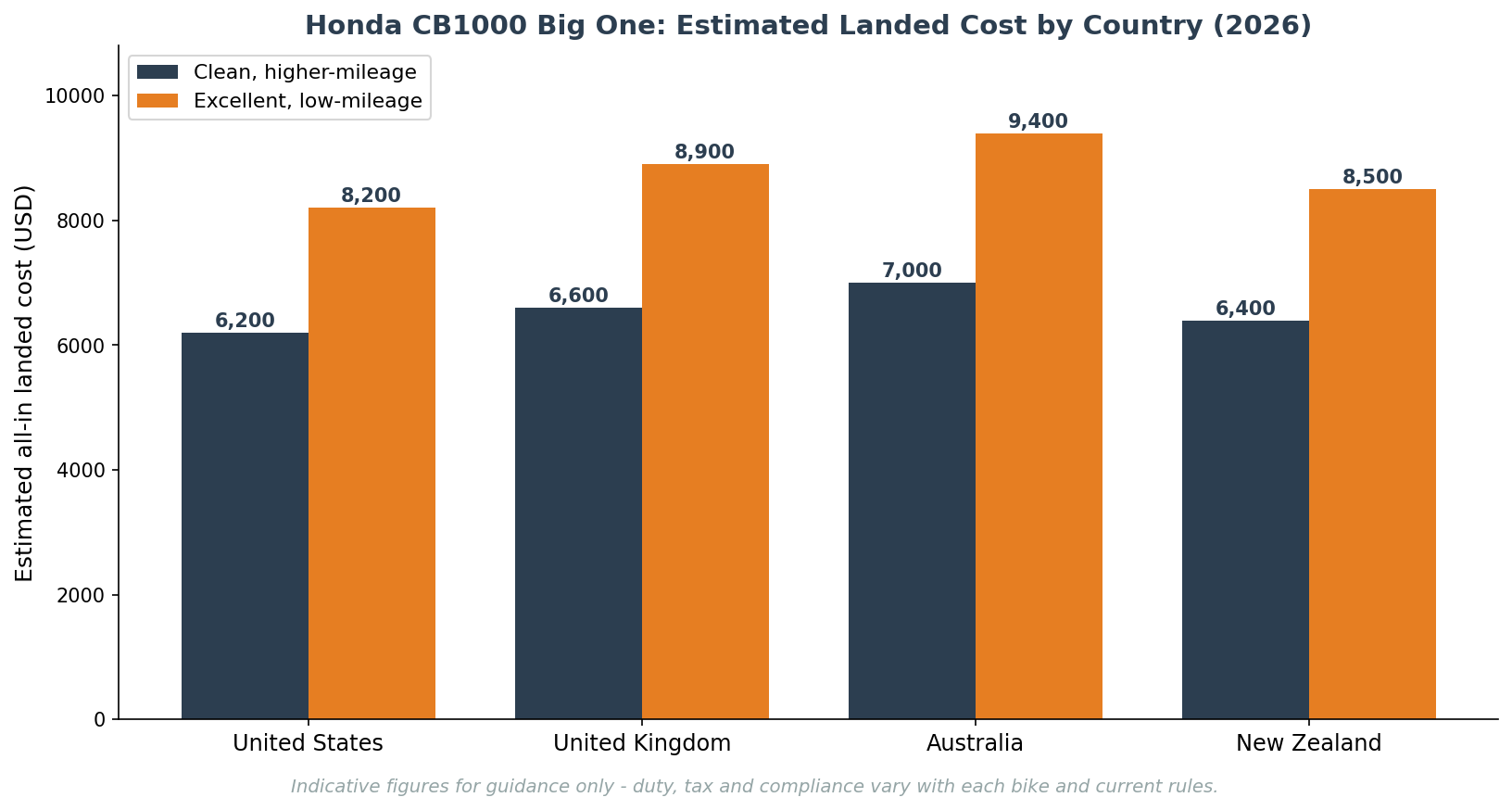
In broad terms, a clean, higher-mileage Big One lands somewhere in the low-to-mid 6,000s USD, and an excellent low-mileage example pushes into the 8,000s or beyond, depending on the country. Australia tends to sit at the top of the range because of its compliance requirements, while the United States and New Zealand are often the friendliest thanks to straightforward classic-vehicle pathways. The UK sits in the middle, with VAT being the biggest single line item. Treat these as planning numbers, get a firm quote before you bid, and never forget that the cheapest bike to buy is not always the cheapest bike to own.
Country-by-Country Import Rules
This is where importers get tripped up, so read carefully. The rules are not hard, but they are specific.
United States
The US is governed by the federal 25-year rule. Any vehicle 25 or more years old can be imported free of the modern DOT and EPA requirements that block newer bikes. Since the CB1000 Super Four ran from 1992, every single year is now comfortably over that threshold — the Big One is fully eligible today, no exceptions. You will still file the standard entry paperwork, but you skip the hard compliance barriers. Note that because Honda did sell the bike in the US in 1994 and 1995, you may occasionally find a federalised domestic example, though they are rare. Our full guide to importing a motorcycle from Japan to the USA covers the paperwork step by step, and the official reference is the NHTSA vehicle import page.
United Kingdom
The UK has no 25-year wall, so age is not a barrier, but you do have process. You register the import with HMRC through the NOVA system within 14 days of arrival, pay duty and VAT, and then complete registration with the DVLA. A bike as old as the Big One is generally treated favourably and, being over a certain age, sidesteps some of the tougher approval tests that newer imports face. Budget for VAT as your largest cost and you will not be surprised.
Australia
Australia is the strictest of the four and the reason its landed costs sit highest. Imports run through the federal ROVER system and typically require an import approval before the bike ships. There are established pathways for older and enthusiast vehicles, and a Big One fits them, but the compliance work is real and it costs money. Do your approval homework before you bid, not after — a bike stuck on the dock without approval is an expensive lesson.
New Zealand
New Zealand is one of the most import-friendly countries on earth, which is why so many Japanese bikes end up there. The bike goes through an entry certification and compliance check, and older machines are well catered for. As long as the bike is structurally sound and passes its checks, the process is refreshingly sane. It is one of the best places in the world to bring in a Japanese classic like this.
Why Japan Is the Best Place to Buy a Big One
Everything about the CB1000 Super Four points back to one conclusion: buy it from Japan. The bikes were sold there in volume, so the choice is enormous. They were serviced by a culture that treats maintenance as a duty rather than a chore. They were ridden in a country with strict inspections that keep rough bikes off the road. And critically, every auction bike comes with that independent inspection sheet, so you are buying documented condition instead of a stranger's optimistic description.
Compare that to hunting locally. In the US, UK or Australia, the Big One was a niche seller, so the domestic pool is tiny, often tired, and frequently overpriced simply because it is rare. You end up paying a premium for a worse bike with no paper trail. Importing flips that on its head: a bigger selection, better-kept machines, honest grading, and usually a lower all-in price. For a bike this specific, the Japanese auction system is not just an option — it is the sensible default.
There is a cultural point here too that is easy to miss. In Japan a motorcycle is documentation as much as machinery. Service records, original tool kits, owner's manuals and even the little maintenance logbooks often survive with the bike, because keeping them is simply what you do. When one of these tidy, fully-papered SC30s appears at auction, you are not just buying metal — you are buying a traceable history that a thirty-year-old bike in the West almost never comes with. That paper trail is worth real money the day you decide to sell, and it is peace of mind every day you own it. It is one more reason the smart move on a Big One is to skip the local classifieds and go straight to the source.
Buying a CB1000 Super Four Through AWA Auction
This is where we come in. AWA Auction gives you direct access to the same Japanese motorcycle auctions where clean SC30 Big Ones cross the block every week, without needing to speak Japanese, hold a Japanese address, or navigate the bidding system yourself. We read the auction sheets with you, translate the inspector's notes, help you set a sensible maximum bid, and handle the export paperwork and shipping to your country.
The practical upshot is simple. You tell us the kind of Big One you want — an early collectable, a low-mileage T2, a tidy rider — and we watch the auctions until the right one appears, then bid on your behalf with a documented condition report in hand. You can browse the motorcycles we currently have access to to get a feel for what is out there, and when you are ready to start a specific search, contact our team and we will get you set up. If you are brand new to the process, our walkthrough on how to bid on a Japanese motorcycle auction explains exactly how bidding works.
Common Mistakes Importers Make
Finally, the traps. Avoid these and your first Big One import will be smooth.
The biggest mistake is buying on photos alone and ignoring the auction sheet. Photos hide rust, leaks and accident repairs. The sheet reveals them. Always read the grade and the diagram before you fall in love with the paint. The second mistake is under-budgeting the destination costs — people fixate on the cheap auction price and forget the freight, duty, tax and compliance that follow. Use the country breakdown above and get a firm quote before you bid.
The third mistake is chasing the newest model year at the expense of condition. On a bike that changed this little, a well-kept early example is worth more than a neglected late one. The fourth is skipping the import approval step in strict markets like Australia — sort your paperwork before the bike ships, never after. And the fifth, the one that stings most, is going it alone on your first import and getting burned on a bike that was rougher than it looked. The whole reason to use an agent who reads the sheets is to make sure the bike that arrives is the bike you paid for. Get those five right and the Big One will reward you for decades. For the wider reference on the machine itself, the CB1000 Super Four Wikipedia entry is a solid starting point.
See Also
Share this article: