
Here's a quiet truth the superbike world doesn't say out loud: the Kawasaki ZX-9R is one of the most underrated fast bikes Japan ever built. Everyone remembers the Honda FireBlade that started the litre-class war and the Yamaha R1 that finished it. The ZX-9R sat right in the middle of that fight for a decade, often quicker in a straight line than both, and somehow it became the bargain nobody talks about. One Japanese owner put it perfectly on X recently: "Nearly extinct now. It's a rare bike, so you'd think prices would climb. Average ¥600,000 to buy, and for this performance that's too good value." He's right, and that gap between how good the bike is and how little it costs is exactly why you should be importing one from Japan in 2026.
This is the bike that did everything. It would touch a genuine 170 mph, carry a passenger and luggage to the other end of the country, and still hold its own on a track day. A GPS-timed run on YouTube has a stock ZX-9R pulling cleanly to 280 km/h, and the comments under it are full of owners saying the same thing: "mine still does this with 40,000 km on it." That's the ZX-9R story in one line. It was built to be ridden hard and last, and the clean low-mileage examples are sitting in Japanese garages right now, not in Western classifieds.
We write this from the inside, because bidding on Japanese auction bikes for overseas buyers is what we do every week. The ZX-9R is one of those models where importing from Japan isn't just cheaper, it's genuinely the best way to get a good one. Below is the whole picture: every generation decoded, what each one costs to land on your driveway, which versions you can legally import to your country right now, and the model-specific things to check before you ever place a bid.
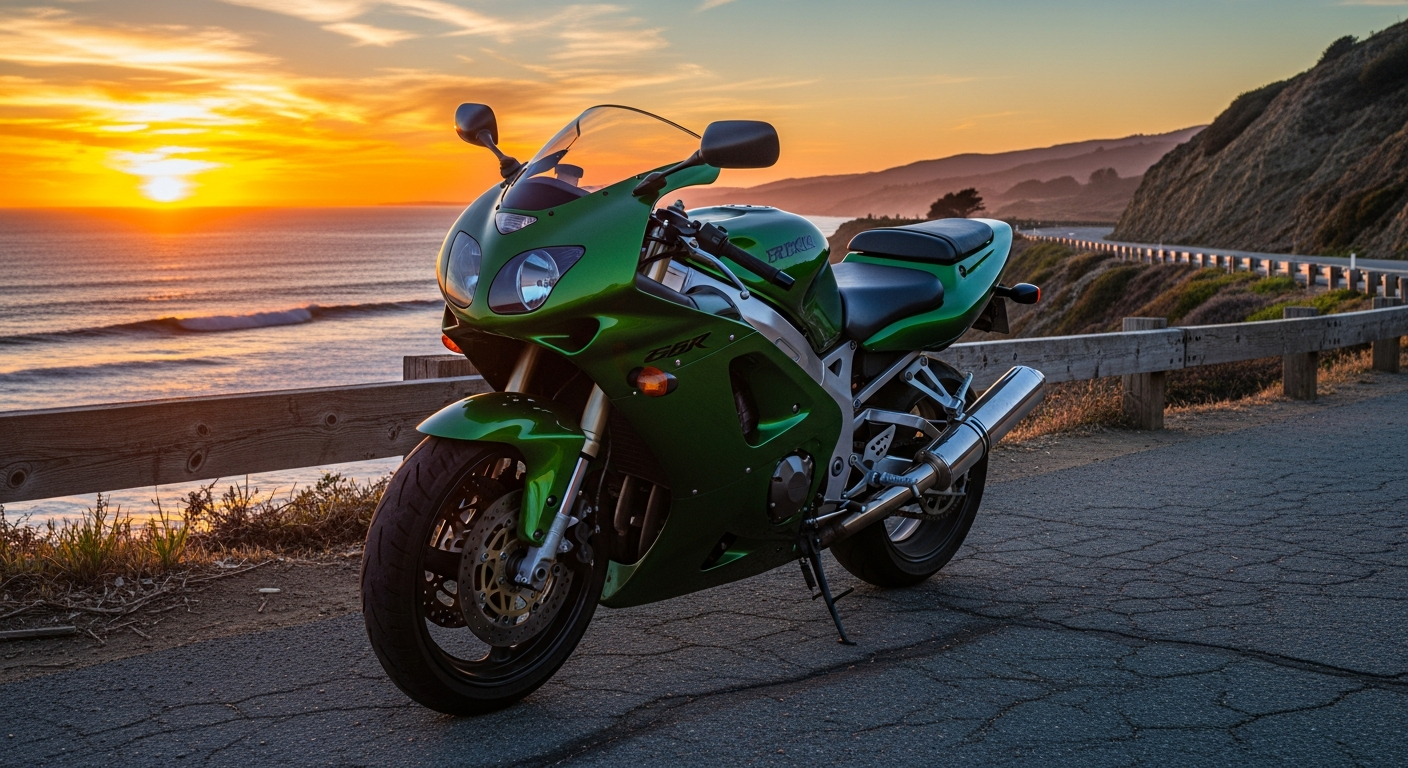
What the Kawasaki ZX-9R Actually Is (And Why It's the Smart-Money Superbike)
The ZX-9R is Kawasaki's 899cc inline-four sportbike, built from 1994 to 2003. On paper it was a litre-class rival; in reality it occupied its own clever niche. It was never the lightest bike in its class, but it always had one of the strongest engines, and Kawasaki tuned it to be usable everywhere rather than peaky and track-only. Think of it as the muscular all-rounder that happened to embarrass dedicated superbikes at the lights.
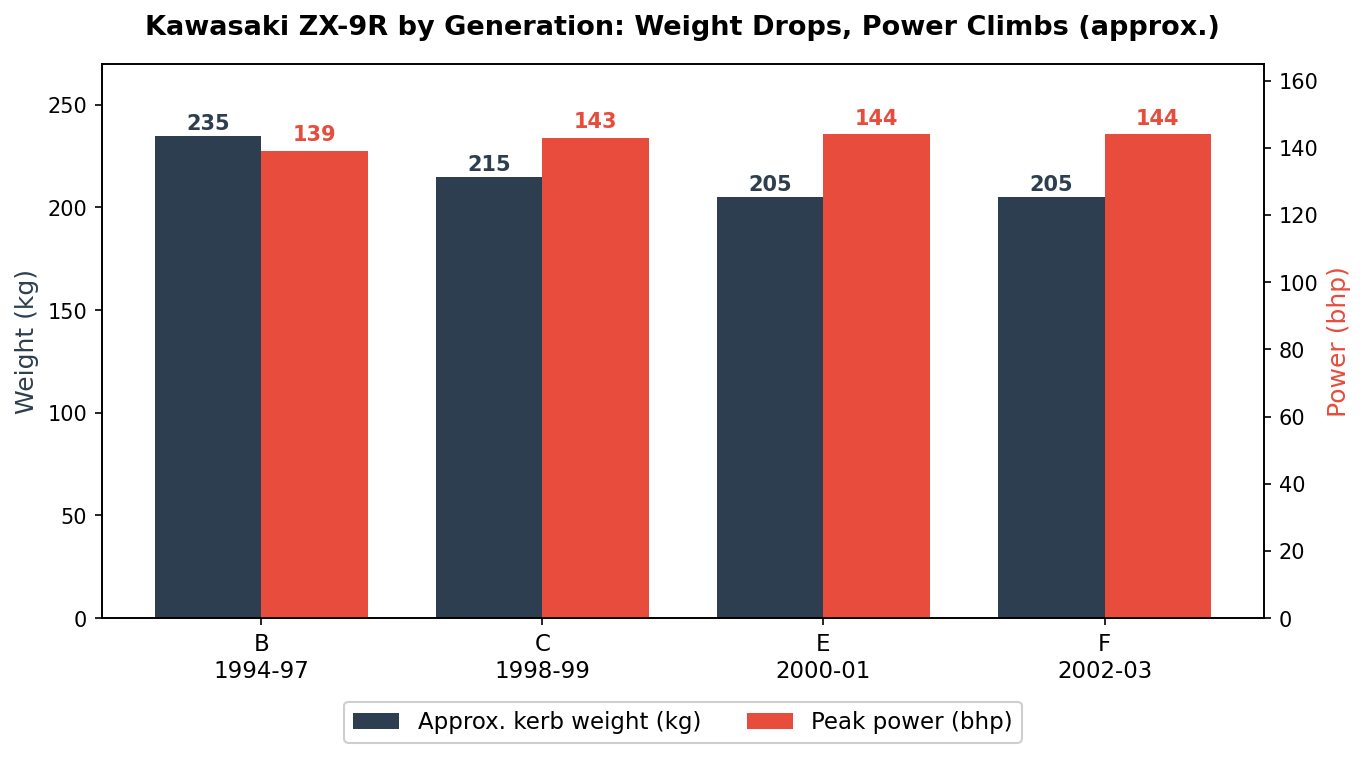
The engine is the heart of the appeal. That 899cc four is liquid-cooled, DOHC, 16-valve, and depending on the year it makes between roughly 139 and 144 horsepower. In the 1990s that was supercar territory on two wheels. Crucially, it makes that power with a fat midrange, so you don't have to wring its neck to make rapid progress. It's the kind of motor that flatters a rider rather than punishing them, which is part of why so many ZX-9Rs survived their first owners intact.
Here's the thing nobody mentions when they're busy worshipping the Blade: the ZX-9R is faster than people give it credit for, and it's cheaper to buy than almost anything with the same performance. A used ZX-9R in the UK can be found under £2,000 for an average example and under £3,000 for a really good one. That's not because it's bad. It's because it was overshadowed in the showroom and never built the cult following the Honda and Yamaha did. Your wallet is the direct beneficiary of that injustice. If you want a 170 mph sportbike that won't bankrupt you, this is the smart-money pick, and the cleanest ones come out of Japan.
If you're new to Japanese sportbike imports in general, it's worth understanding how the whole pipeline works first. Our guide on how to buy a motorcycle from Japan covers the basics, and you can always browse our current listings to see what's moving through the auctions this week.
The Four Generations of ZX-9R, Decoded (B, C, E, and F)
Buying a ZX-9R without knowing which generation you're looking at is how people end up disappointed. There were four distinct versions across the bike's life, and they ride differently enough that the right choice depends on what you actually want. Kawasaki's internal codes are ZX900B, ZX900C, ZX900E, and ZX900F, and you'll see those letters in auction listings and chassis numbers. Learn them and you'll instantly look like you know what you're doing.
ZX900B (1994–1997): The Original Heavyweight
The first ZX-9R was Kawasaki's answer to the FireBlade, and it answered with brute force rather than finesse. The B model carried its 899cc four in a chassis that was around 30 kg heavier than the Honda, and while the engine made 10 to 15 bhp more, the extra weight blunted the handling. It's a fast, stable, slightly old-school sports-tourer-ish missile. If you want the cheapest entry into ZX-9R ownership and you value straight-line stability over flickability, the early B is honest value. Just go in knowing it's the porkiest of the bunch.
ZX900C (1998–1999): The Redesign That Got It Right
This is the one most people should buy. For 1998 Kawasaki completely reworked the bike around a new twin-spar frame, dropped serious weight, and sharpened the whole package. The C model is the sweet spot: it kept the bruiser engine, around 143 bhp, but finally had a chassis that could use it. This was the ZX-9R that went head to head with the FireBlade in period road tests, and a 1998 Men and Motors comparison of the two has racked up over 256,000 views with people still arguing in the comments about which one they'd take home. The C model is light enough to be fun, fast enough to be serious, and cheap enough to be sensible.
ZX900E (2000–2001): The Refined Fighter
For 2000 Kawasaki refined the C into the E. Power crept up to around 144 bhp at 11,000 rpm and the bike got lighter again, finally undercutting the FireBlade on weight while beating it on power. The E is arguably the best all-round ZX-9R to ride: more modern feeling, strong brakes, and that signature wall of midrange. If you can stretch a little past the C-model money, the E rewards you. It stayed carbureted like every ZX-9R, so factor in the cost of a proper four-carb balance when you service it.
ZX900F (2002–2003): The Final Evolution
The F is the last and most polished ZX-9R, sold in 2002 and 2003 before the ZX-10R took over. Mechanically similar to the E with detail improvements, the F is the one to chase if you want the newest, lowest-mileage example and the best chance of a bike that was babied. The catch, as you'll see in the next section, is that the F is the only generation that can't yet be imported to some countries under the 25-year rule, so where you live matters here.
Which ZX-9R Can You Legally Import Right Now? (The 25-Year Rule by Country)
This is where buyers trip up, so read it carefully. The rules that decide whether you can import a ZX-9R depend entirely on where you live and exactly when your specific bike was built. Get this wrong and you'll buy a bike you can't register. Get it right and you'll know precisely which generations are open to you in 2026.
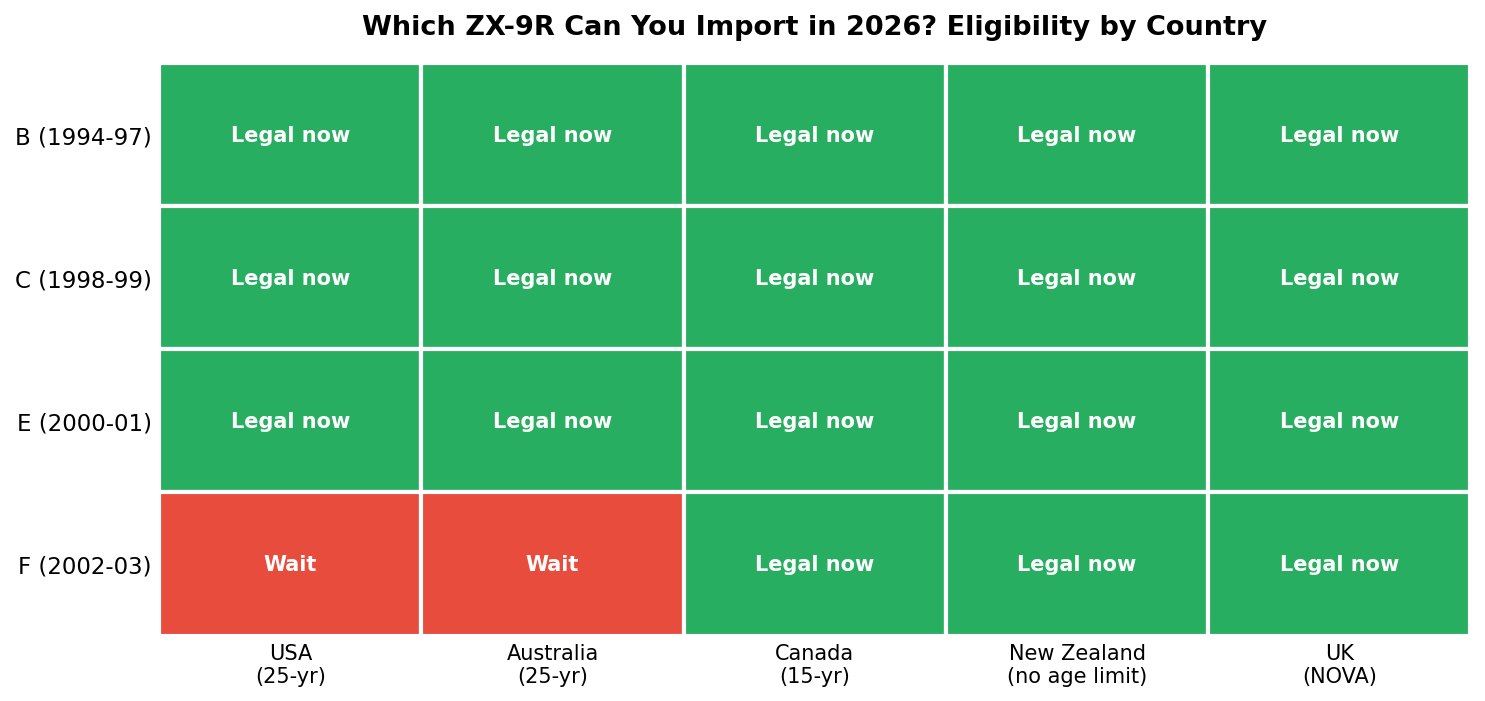
United States: The NHTSA 25-year rule is your friend. Any motorcycle built 25 or more years ago is exempt from FMVSS safety standards, and the EPA grants a matching exemption at 21 years. The clock runs on the actual month and year of manufacture, not the model year. In 2026 that means every B (1994–97), every C (1998–99), and every E (2000–01) is clear to import. The F is the watch item: a 2002-built bike becomes eligible in 2027, and 2003 builds in 2028. Our full guide to importing a motorcycle from Japan to the USA walks through the HS-7 and EPA paperwork.
Australia: Australia also uses a 25-year threshold for its simplified import path, measured against the build date. So in 2026 the B, C, and E generations qualify, while the 2002–03 F has to wait its turn. The Japan to Australia import guide covers the asbestos inspection and state rego steps you'll also need.
Canada: Canada is the generous one with a 15-year rule. In 2026 that means everything up to and including the 2011 model year is fair game, so every single ZX-9R generation, B through F, is legal to import today. If you want the newest F model and you're Canadian, you're in luck. See our Japan to Canada import guide for the RIV and provincial details.
New Zealand: New Zealand has no blanket age ban on motorcycle imports, so any ZX-9R can come in provided it passes entry certification. The Japan to New Zealand guide explains the compliance and registration flow.
United Kingdom: The UK has no age cutoff either. You register the bike through the NOVA system, pay VAT and duty as applicable, and get an MOT. Every generation is importable. If you're in Britain, the question isn't "can I," it's "which one."
Why Buy a ZX-9R from Japan Instead of Locally
You could buy a ZX-9R down the road. So why ship one halfway around the planet? Because the Japanese used market is a different animal, and for a 20-to-30-year-old sportbike that difference is the whole game.
Start with condition. Japan's roads are smooth, the climate in most of the country is kind to metal, and riders there tend to maintain bikes obsessively and ride them less. The result is a supply of ZX-9Rs with genuinely low mileage and original, unmolested condition that simply doesn't exist in the West anymore. A Western ZX-9R has usually been through several owners, a few winters of road salt, and at least one questionable "upgrade." A Japanese example often hasn't.
Then there's honesty. Every bike that crosses a Japanese auction block gets graded by an independent inspector who has no stake in the sale. They note corrosion, accident history, engine condition, and modifications on a standardized sheet, then assign an overall grade. Once you learn to read that sheet, you're buying with X-ray vision instead of trusting a seller's adjectives. Our guide on how to read Japanese auction inspection sheets and the breakdown of Japanese auction grades turn that sheet from gibberish into a buying tool.
Finally, rarity and price. The clean ZX-9Rs are in Japan, and Japan prices them as ordinary used bikes rather than appreciating classics. That Japanese owner on X wasn't wrong about the ¥600,000 figure for a tidy retail example, and auction hammer prices often land well below that. You're buying from the source, before a Western dealer adds a margin for the privilege of finding it for you. The ZX-9R is one of the last genuinely fast bikes you can import for sensible money, and that window won't stay open forever as the survivors thin out.
What a ZX-9R Actually Costs to Land (The Full Breakdown)
Let's talk real numbers, because "it's cheap" isn't a budget. The headline auction price is only the start, and anyone who tells you otherwise is about to surprise you with a bill. Here's how the all-in cost stacks up for a clean ZX-9R landed in a typical destination country.
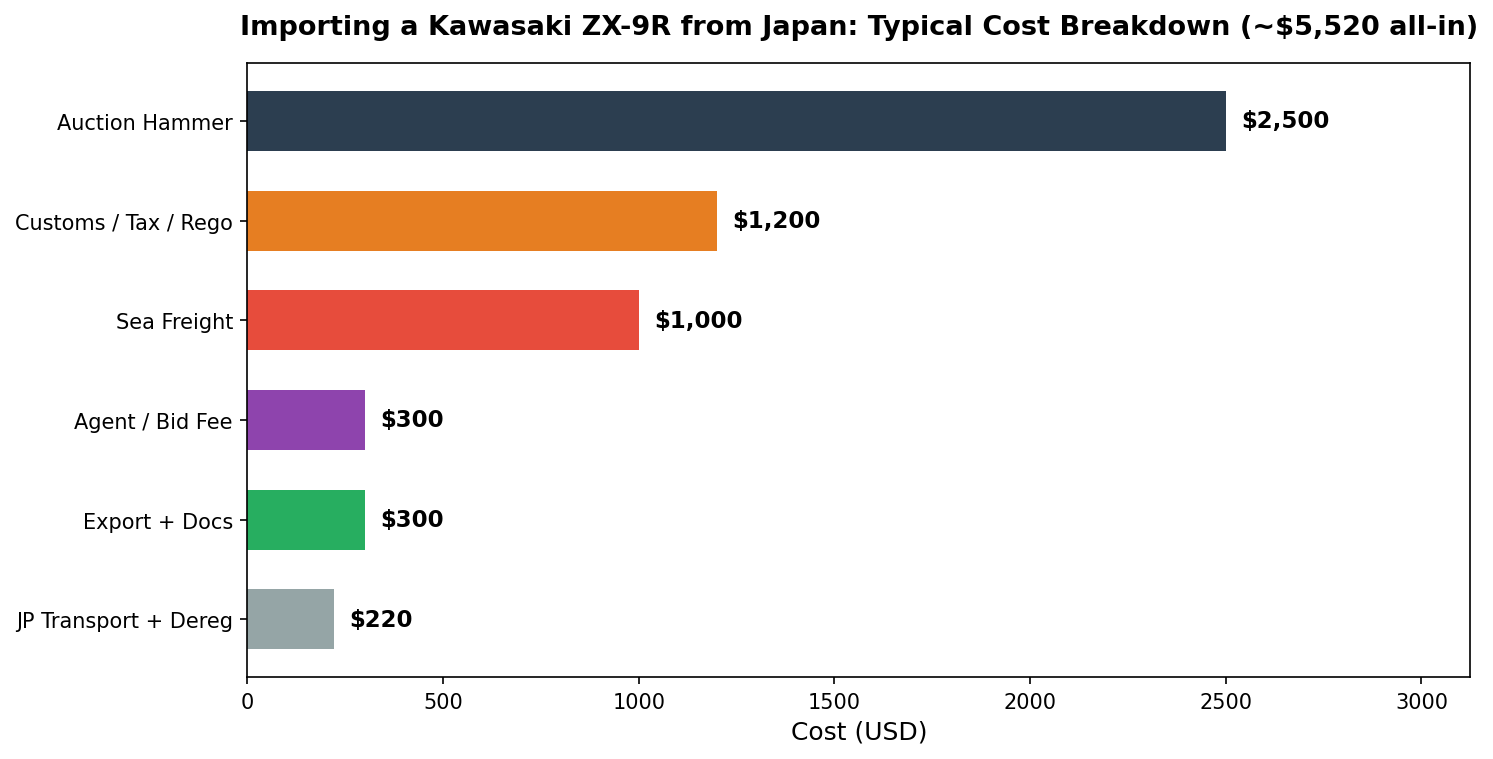
A solid, honest ZX-9R tends to hammer somewhere between ¥250,000 and ¥500,000 at Japanese auction depending on generation, grade, and mileage. Call it roughly $1,700 to $3,400 for the bike itself. The cleanest, lowest-mileage F models can push higher, the early B models sit at the bottom. On top of that hammer price you add the costs that actually get the bike to you.
The agent or bidding service fee usually runs ¥35,000 to ¥50,000, roughly $250 to $350, and that buys you the ability to bid without a Japanese auction account and someone to read the sheet before you commit. Domestic transport and deregistration paperwork in Japan add another $150 to $300. Export handling and documentation is typically $200 to $400. Sea freight, whether your bike rides in a shared container or crated, runs anywhere from $700 to $1,500 depending on destination and method, which our guide to shipping a motorcycle from Japan breaks down in detail.
Then come the costs in your own country. Import duty on motorcycles is low or zero in many markets, but consumption tax or VAT usually applies to the total value, and you'll have customs clearance, local compliance or certification, and registration on top. Add it all up and a ZX-9R that hammered for the equivalent of $2,500 commonly lands all-in somewhere around $5,500 to $7,500 depending on where you live and how clean an example you chase. That's still remarkable value for a 170 mph superbike in honest, original condition. Build your budget around the all-in figure, never the hammer price, and you'll never get an unpleasant surprise at the dock.
Step-by-Step: How to Buy a ZX-9R at Japanese Auction
The process is more straightforward than people fear, especially with an agent doing the heavy lifting. Here's the path from "I want one" to "it's in my garage."
Step 1: Lock Down Your Target and Budget
Decide which generation suits you and your country's import rules, then set a firm all-in budget, not a hammer-price fantasy. Know your ceiling before the emotion of bidding kicks in. A C or E model in grade 4 or better is the sweet spot for most buyers: clean, usable, and not yet collector-priced.
Step 2: Find the Bike in the Auction Catalogues
Japan's auction houses list thousands of bikes a week across systems like BDS and JBA. You, or your agent, search the upcoming catalogues for ZX-9Rs and shortlist the ones with promising grades and mileage. If you want to understand the machinery behind the listings, our overview of how to bid on a Japanese motorcycle auction explains how it all fits together.
Step 3: Read the Auction Sheet Honestly
Before any bid goes in, read the inspection sheet. For a ZX-9R you're looking at the overall grade, the corrosion map, any accident-repair notes, and the inspector's engine comments. This is where a good agent earns their fee, because they can flag a tired example or a hidden repair that a hopeful buyer would gloss over. A grade 4 bike with clean corrosion marks is worth chasing; a grade 3.5 with rust flags on the frame is a haggle or a hard pass.
Step 4: Place the Bid
On auction day your maximum bid is submitted, and the system does the rest. You either win at or below your ceiling, or you walk away and wait for the next one. There's always another ZX-9R; discipline beats desperation every time. Don't chase a single bike past its worth when fifteen thousand others cross the block every week.
Step 5: Deregistration, Export, and Shipping
Once you've won, the bike is deregistered in Japan, the export certificate is issued, and it's booked onto a vessel. Your agent handles the paperwork chain. Depending on your country and the shipping method, the bike is on the water for a few weeks.
Step 6: Clear Customs and Register at Home
When the bike lands, you clear customs, pay the applicable taxes, complete any compliance or certification your country requires, and register it. Then the only job left is fuel, a fresh set of tires, and a long first ride. The country-specific guides linked above cover the registration details for each market.
The Buyer's Checklist: What to Check Before You Bid on a ZX-9R
Every model has its known quirks, and the ZX-9R is no different. The good news is the bike is fundamentally tough; the bad news is a neglected one will still nickel-and-dime you. Here's what owners and the forums flag again and again, so you can spot trouble on an auction sheet or in a test ride.
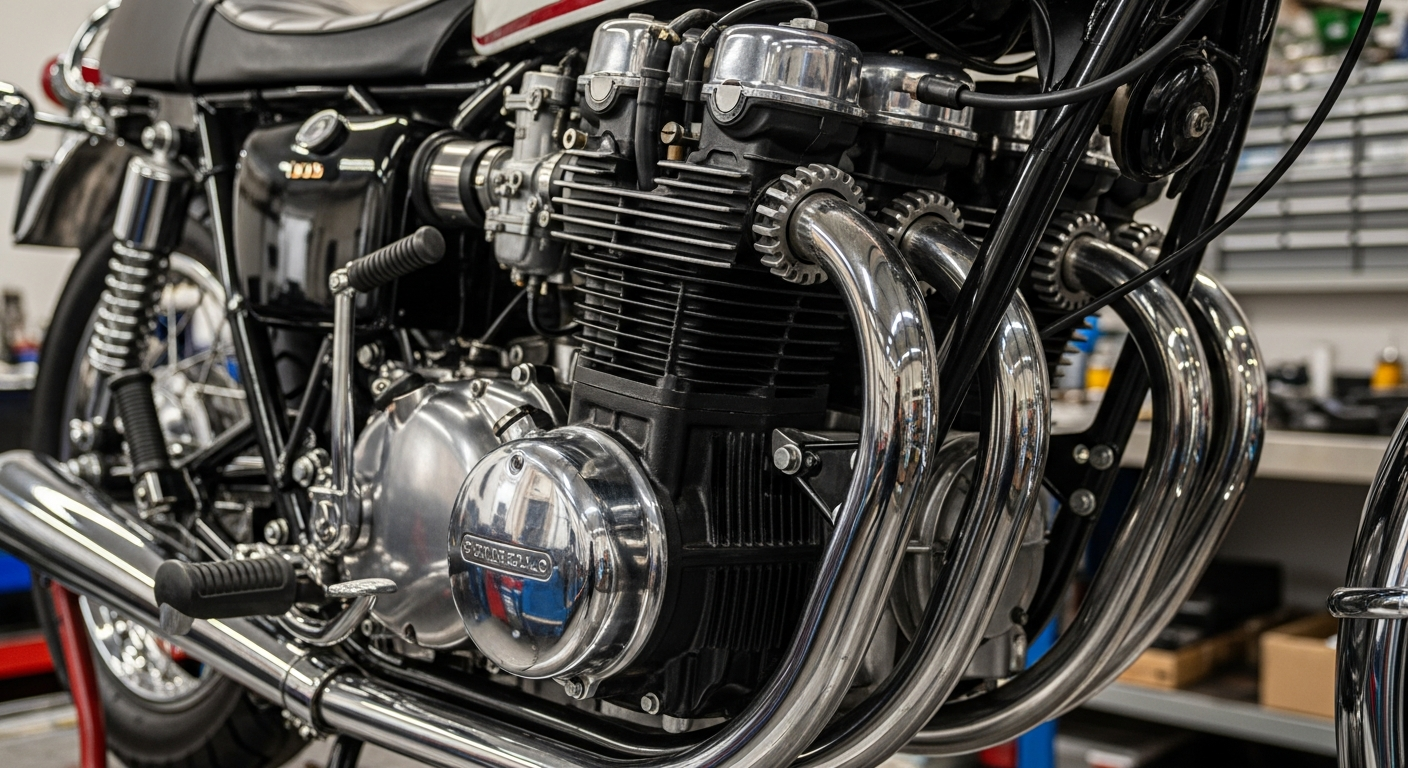
The cam chain tensioner. This is the famous one. The factory tensioner on the ZX-9R is, in the polite words of one owner, "wimpy." It can stick and rattle, and you'll often hear a faint whine from a healthy one even when it's set correctly. Outright failures are rare, but the noise scares buyers. Many owners fit a manual tensioner, which cures the rattle but needs periodic checking, because over-tightening it accelerates cam chain wear. On a bike you're inspecting, listen for a marbles-in-a-can rattle from the top end and check the service history for tensioner work. It's rarely a dealbreaker, but it's a useful bargaining chip.
The regulator/rectifier and charging system. Like a lot of 1990s and early-2000s Japanese bikes, the ZX-9R can suffer charging gremlins as the regulator/rectifier ages. A weak or failing R/R cooks batteries and leaves you stranded. It's a cheap part to replace and a common upgrade, but check that the charging voltage is healthy and ask whether the R/R has ever been swapped.
Carburetor balance. Every ZX-9R is carbureted, with four carbs that need periodic balancing to run sweetly. A bike that's been sitting, or one that's never had the carbs synced, will feel lumpy at low revs and hesitant off idle. It's normal maintenance, not a fault, but budget for a proper carb balance and clean when the bike arrives, especially on an example that's done low mileage and sat for long periods.
Crash and corrosion history. These were fast bikes ridden by enthusiasts, so check the auction sheet's accident notes and the corrosion map closely. Look for repaired frame damage, mismatched fairing panels, and corrosion on the frame and fasteners. A Japanese-market bike usually fares better here than a Western one, but verify rather than assume. Fork seals, steering head bearings, and tired suspension are age-related items to factor in too.
Originality. The clean ones are worth more for a reason. An unmolested ZX-9R with stock bodywork, original exhaust, and a clear maintenance trail is the one to chase. Aftermarket everything can mean a hard life; tasteful, documented mods can be fine. The auction sheet's modification notes tell you which you're dealing with.
ZX-9R vs the Rivals: Fireblade, R1, and GSX-R750
You can't talk about the ZX-9R without the bikes it fought, because understanding the rivalry tells you exactly what you're buying. This was the golden age of the open-class sportbike, and each Japanese maker had a different philosophy.
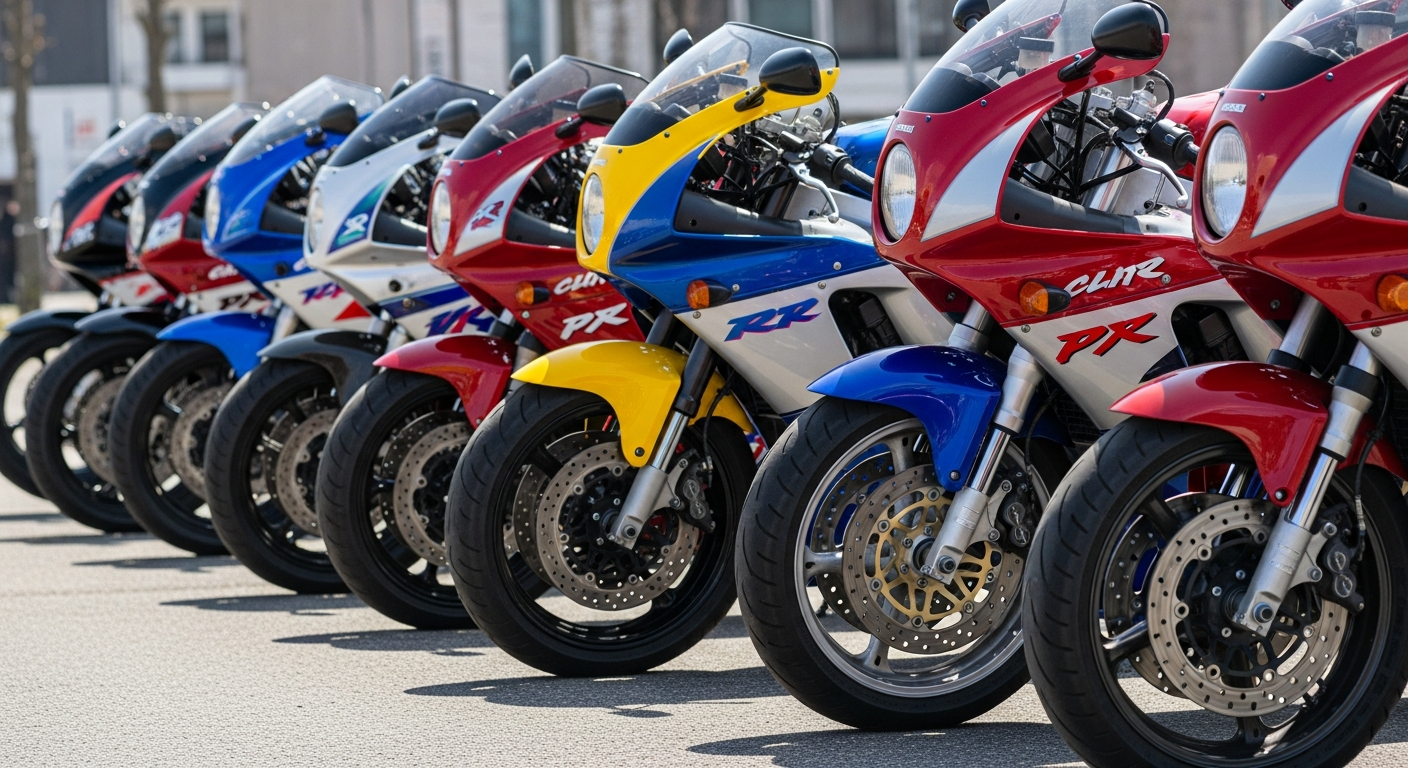
The Honda CBR900RR FireBlade was the bike that started the modern superbike when it arrived in 1992, built around the radical idea of putting big-bike power in a 600-sized chassis. It was lighter and more agile than the early ZX-9R, and it built a cult following the Kawasaki never quite matched. But the Blade gave away power, and a well-ridden ZX-9R would reel it in on anything resembling a straight. That period tension is exactly what made the 1998 Men and Motors comparison such compulsive viewing two and a half decades later.
The Yamaha YZF-R1 arrived in 1998 and rewrote the rules again with its stacked gearbox, ultra-compact engine, and razor handling. It was the new sharpest tool in the shed, and it's the bike that gets all the modern collector attention now. The ZX-9R couldn't match the R1's steering, but it could match its speed for a fraction of today's price, which is the whole value argument in a sentence.
The Suzuki GSX-R750 played a different game, splitting the difference with 750cc and superb balance. It's the connoisseur's choice and priced accordingly. Against all three, the ZX-9R's pitch is identical: nearly the performance, a tiny fraction of the hype tax. If you want a fast 1990s Japanese four and you're allergic to overpaying, the Kawasaki wins on value every time. For another Kawasaki legend worth importing, the GPZ900R import guide covers the original Ninja, and the Hayabusa guide covers the hyperbike that followed this era.
Common Mistakes Buyers Make Importing a ZX-9R
Most import regrets come from a handful of avoidable errors. Sidestep these and you'll be the person who got a great bike for sensible money instead of the cautionary tale.
The first mistake is buying the wrong generation for your country. Falling in love with a low-mileage 2003 F model is easy; discovering it's not yet 25-year-legal where you live is expensive. Match the generation to your import rules before you bid, not after.
The second is budgeting on the hammer price. The bike that hammered for $2,500 does not cost $2,500 in your garage. Build your budget on the all-in landed figure or you'll be the person frantically scraping together customs money at the dock.
The third is ignoring the auction sheet because the photos look nice. Photos lie; the inspector's grade and corrosion map don't. A pretty bike with rust flags and an accident note is a worse buy than a plain one with a clean sheet.
The fourth is chasing one specific bike past all reason. Fifteen thousand bikes cross Japan's auction blocks every week, and ZX-9Rs come through constantly. If one goes past your ceiling, let it go. The next one is days away. We've watched buyers overpay by a thousand dollars out of impatience for a bike that had a near-twin in the following week's catalogue.
The fifth is skipping a professional read of the sheet to save a small agent fee, then buying a tired bike that costs ten times that fee to put right. Penny wise, pound foolish, as the saying goes.
How AWA Auction Helps You Land the Right ZX-9R
This is the part where importing from Japan stops sounding intimidating and starts sounding like a Tuesday. We do this every week, and the ZX-9R is exactly the kind of bike the Japanese auction system was made for: plentiful, honestly graded, and far cheaper at the source than anywhere a Western buyer would normally look.
We bid on your behalf, read the auction sheet honestly before you commit a single yen, handle the deregistration and export paperwork, and arrange shipping to your country. You tell us the generation, the grade, and your all-in budget, and we do the hunting and the disciplined bidding that keeps you from overpaying for a tired example. There's no Japanese auction account to set up, no language barrier to fight, and no guessing what a comment column means.
You can browse our current listings to see what's coming through the auctions right now, or contact our team and tell us you're hunting a clean ZX-9R. We'll watch the catalogues and flag the right one when it appears, in the generation that's legal for your country. The smart-money superbike is out there this week, sitting in a Japanese garage with low miles and an honest sheet. Let's go find yours.
Living With an Imported ZX-9R: Parts, Insurance, and Resale
Importing the bike is the start, not the finish, so let's talk about what owning one actually looks like once it's registered. The reassuring news is that the ZX-9R is one of the easiest classic-era sportbikes to live with, precisely because Kawasaki built so many and sold them worldwide.
Parts are plentiful and cheap. Consumables like brake pads, filters, chains, sprockets, and tires are off-the-shelf items at any motorcycle shop, and the bike isn't fussy about brands. Service items follow normal maintenance intervals, and the carbureted engine has no expensive electronics to fail. When you do need something model-specific, the worldwide parts network and a deep used market mean you're rarely stuck. This is a genuine advantage over rarer JDM imports where a single bracket can take months to source.
Insurance tends to be reasonable too, because the ZX-9R is old enough to qualify for classic or modern-classic policies in many markets, which are often cheaper than standard sportbike cover. Talk to an insurer who understands imports and grey-market bikes; some will want the bike valued as an agreed-value classic, which protects you if it's ever written off.
Resale is where the import math quietly pays off. Because clean ZX-9Rs are getting scarce in the West, a well-documented, low-mileage Japanese import with a clear auction sheet history holds its value far better than a tired local example. You're buying at the source price and owning an appreciating-curve asset that's also genuinely usable. The survivors are thinning out, and honest low-mileage examples are exactly the ones the market will reward in five years.
Is the ZX-9R a Good Buy in 2026?
Short answer: yes, and arguably it's one of the last great-value imports left. Here's the longer version, because "yes" isn't a reason.
The ZX-9R sits at a rare intersection. It's fast enough to thrill a modern rider, with genuine 170 mph capability and a midrange that makes real-world riding effortless. It's cheap enough to buy that you're not gambling a fortune, with hammer prices that still embarrass anything with comparable performance. And it's just old enough that the best examples are leaving the road, which means the clean ones are getting rarer every year while demand from people who've finally noticed the bargain keeps growing.
The collector money is currently chasing FireBlades and early R1s, which has dragged their prices up and left the ZX-9R sitting quietly underpriced. That's a window, not a permanent state. As the obvious bargains dry up, attention drifts to the next underrated thing, and the ZX-9R is squarely next in line. Buying a clean, honest, low-mileage example from Japan now means buying before the rest of the market catches on.
If you want a fast, characterful, usable 1990s Japanese superbike that won't bankrupt you to buy or to keep, and you want the best example money can sensibly find, the ZX-9R imported from Japan is one of the smartest two-wheeled purchases you can make in 2026. The bikes are there. The sheets are honest. The prices are still sane. All that's missing is your bid.
See Also
Share this article: