
Here's something the rest of the world quietly figured out and then kept to itself: the best 250cc motorcycles to import from Japan are unlike anything sold new today. We're talking about 250s that scream to 18,000 or 19,000 rpm on four tiny cylinders, two-strokes that were detuned race bikes wearing number plates, and build quality that has survived thirty years of hard riding. A popular YouTube tribute to these machines is literally titled "The Best Sounding 250cc Motorcycles Ever Made (Spoilers; They're all Japanese)" — 644,000 views and a comment section full of riders begging the factories to build them again. They won't. The only way to own one is to import it from Japan.
This is the guide we wish existed when buyers first email us asking "which 250 should I actually import?" Most lists online are generic best-of-2024 roundups stuffed with bikes you can buy at any dealer. This is different. Every bike here is a Japanese-market machine that barely left the country when new, which means the clean, low-mileage examples are sitting in Japanese garages and auction halls right now — not in Western classifieds where they've been thrashed for twenty years.
We bid on Japanese auction bikes for overseas buyers every single week, so the numbers, the model years, and the buyer traps below come from the inside, not from a spec sheet. If you want the bigger-engine version of this conversation, we also have a full guide to the best 400cc motorcycles to import from Japan. But the 250 class is where the real magic lives. Let's get into it.
Why Japan Is the Only Place to Find These 250s
To understand why a 30-year-old 250 from Japan is worth importing, you have to understand a quirk of Japanese licensing. For decades, Japan's tiered licence system made anything over 400cc a genuine pain to own. The result? Manufacturers poured Grand Prix levels of engineering into small-displacement bikes, because that's where the domestic market actually was. A 250 wasn't a beginner's afterthought in Japan — it was a flagship.
That's how you ended up with 250cc inline-four engines revving past 18,000 rpm and 250cc two-stroke V-twins making racing power. No Western market ever got most of these bikes new. They were built for Japan, sold in Japan, and stayed in Japan. As one commenter put it under that best-sounding-250s video: "Love how these all ended up in Australia and New Zealand" — because those were among the first countries with import rules relaxed enough to let them in.
Here's the thing nobody mentions: because these bikes never flooded Western markets, the supply that exists today is almost entirely still in Japan. And Japanese owners maintain bikes obsessively. Low mileage, full service history, original parts — it's the norm there, not the exception. When you import a 250 from Japan, you're not buying the leftovers. You're buying from the source. If you're new to the whole process, start with our overview on how to buy a motorcycle from Japan, then come back here for the model picks.
The Two Worlds of the Japanese 250: Screaming Fours vs GP Two-Strokes
Before you pick a model, you need to know which of the two great 250 families you're chasing, because they ride, sound, and cost completely differently.
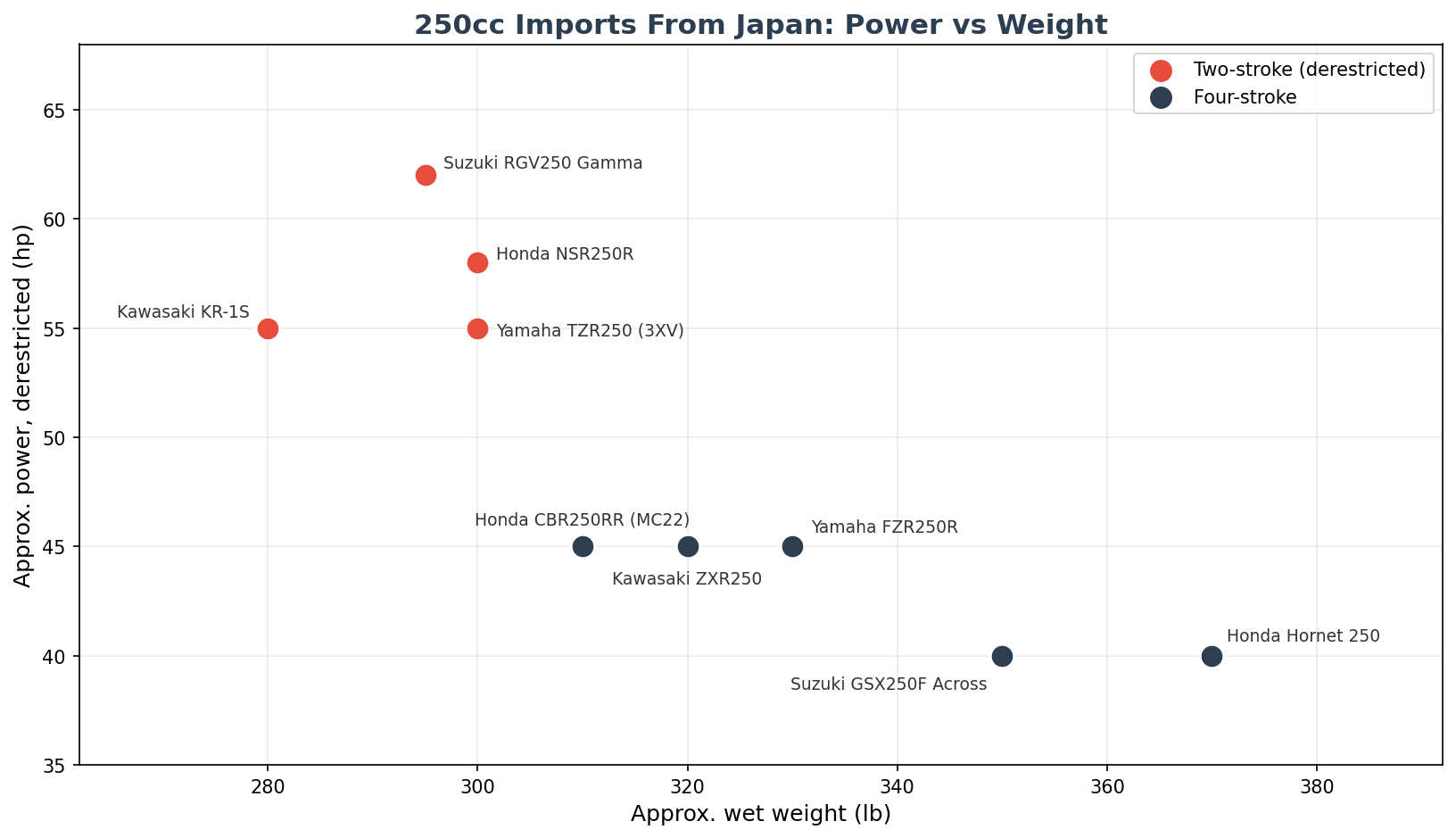
The four-stroke inline-fours. These are the 16,000–19,000 rpm miniature superbikes — the CBR250RR, FZR250R, ZXR250, and GSX-R250. Four cylinders the size of espresso cups, redlines that sound like an F1 car going past, and almost no torque until the needle swings past 10,000 rpm. They're reliable, they sip fuel, and they make a noise that genuinely stops people in the street. One owner under the best-sounding video summed it up: "I had a Honda CBR250R, revved it to 18,000 rpm every day for 3 years, no oil change, no filter change. Got it over 180 km/h." (Please change your oil. But the point stands — these engines are tanks.)
The two-stroke GP replicas. These are the NSR250, TZR250, RGV250, and KR-1 — road-legal versions of the bikes that fought in 250cc Grand Prix racing. Light, vicious, and addictive, they make their power in a sudden hit when the engine "comes on the pipe." Restricted to 45 hp for the Japanese market, most make 55–65 hp once derestricted, in a bike weighing under 300 lb wet. The catch: two-strokes need understanding. They foul plugs, they need their oil pump and power valves maintained, and a neglected one is an expensive paperweight. We have dedicated deep-dives on the Honda NSR250, the Yamaha TZR250, and the Suzuki RGV250 Gamma if you want the full generation-by-generation breakdown on each.
Decide which world you're in first. A two-stroke and a four-stroke 250 are about as similar as a chainsaw and a sewing machine. Both brilliant. Completely different jobs.
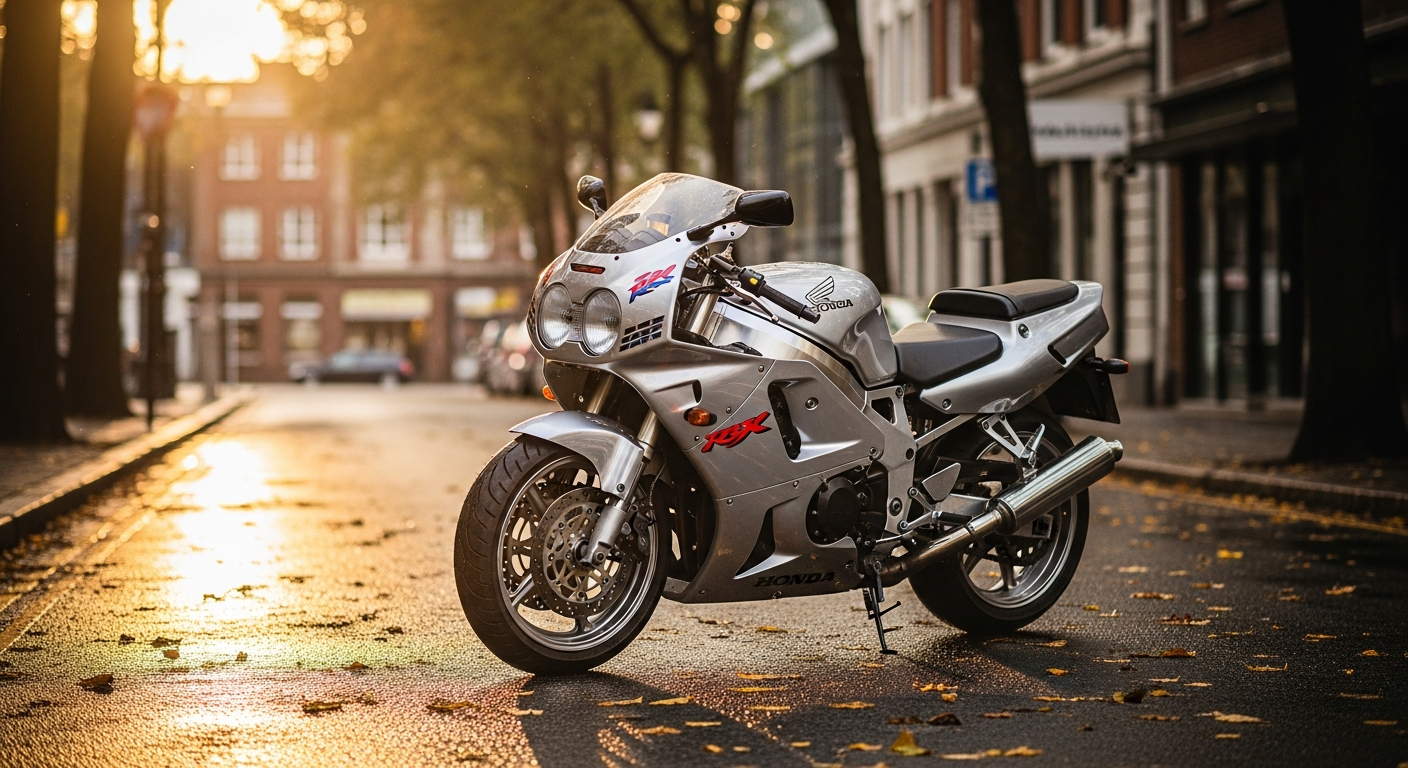
The Best 250cc Four-Strokes to Import From Japan
These are the high-revving inline-fours and a couple of clever singles and twins that defined the four-stroke 250 era. If you want a bike you can ride hard, leave outside, and trust to start every morning, this is your list.
Honda CBR250RR (MC22) — the 19,000 rpm legend
The MC22 is the bike most people picture when they hear "250 four-cylinder." A 249cc liquid-cooled inline-four redlining at 19,000 rpm, gear-driven cams, and a sound that one viral video described as making "your heart pound." It's the most refined of the four-cylinder 250s and the easiest to live with day to day. Prices have climbed as the legend grew — clean MC22s are now genuine collector bikes. We have a full Honda CBR250RR MC22 import guide with generation decoding (MC17/MC19/MC22) and a buyer checklist. If you want one bike that captures the whole four-cylinder-250 phenomenon, it's this.
Yamaha FZR250 / FZR250R — the affordable screamer
Yamaha's answer revved to 18,000 rpm, made a quoted 45 hp, and weighed around 320 lb dry. The later FZR250R (3LN) added EXUP exhaust valve tech borrowed from the bigger FZRs. It usually lands cheaper than the CBR250RR for similar performance, which makes it the value pick of the four-cylinder crowd. The trade-off is parts: some FZR250-specific bits are harder to source than Honda equivalents, so buy the cleanest one you can find rather than a project.
Kawasaki ZXR250 — the one that tops the sound charts
In that best-sounding-250s video, the ZXR250 was ranked number one. It's a 249cc inline-four with a 19,000 rpm redline and the aggressive ZXR styling of the early '90s, including the signature "hoover hose" intake ducts. Kawasaki later reawakened this idea with the modern ZX-25R, which tells you how special the original was. The ZXR250 is the enthusiast's choice — slightly rarer, slightly raw, and arguably the best-sounding of the lot.
Suzuki GSX-R250 and the GSX250F Across — the practical four
The GSX-R250 brought Gixxer looks to the class with the same 45 hp / 18,000 rpm formula. But the cult pick from Suzuki is the GSX250F Across — a four-cylinder 250 with a lockable storage compartment where the fuel tank normally sits, big enough for a full-face helmet. As one rider recalled: "I had a Suzuki 250 GSX-F Across, revved out to 17,000 rpm, plus it had a compartment that fit your helmet." It's the only sportbike-engined 250 you can genuinely commute on. Quirky, useful, underrated.
Honda Hornet 250 and Bandit 250 — naked four-cylinder fun
If you love the screaming four-cylinder engine but not the clip-ons and crouch, the naked bikes are the answer. The Honda Hornet 250 (MC31) wraps a 250 four — redlining at a heady 18,000-plus rpm — in an upright streetfighter chassis with a fat 180-section rear tyre. The Suzuki Bandit 250 does the same on a budget. Both are comfortable, characterful, and far rarer in the West than their 600cc siblings. Perfect city bikes with a soundtrack that doesn't match their size.
The Best 250cc Two-Strokes to Import From Japan
This is the holy grail end of the class. These are road-registered Grand Prix bikes, and they are getting rarer and more valuable every single year. One Japanese owner recently posted his shock at seeing an NSR250 advertised for ¥2,500,000 (about US$16,700) — "I nearly fell over." That's where the clean ones are heading. Buy now, or watch the prices keep climbing.
Honda NSR250R — the king
The NSR250R is the most celebrated 250 two-stroke ever made, with a race pedigree that runs straight back to Honda's championship-winning NSR500 GP bikes — the same lineage that riders like Dominique Sarron and Freddie Spencer made famous. Across its MC16, MC18, MC21, and MC28 generations it gained a programmable ignition "PGM" card system, gull-arm swingarms, and progressively sharper handling. The final MC28 with its card key is the collector's prize. Restricted to 45 hp, derestricted examples make 55-plus hp in a sub-300 lb bike. Read the full NSR250 import guide before you bid — generation matters enormously to both price and parts.
Suzuki RGV250 Gamma — the sharpest of them all
Built around a 90-degree V-twin and directly descended from Kevin Schwantz's RGV500 racer, the RGV250 is the most aggressive of the GP replicas. The VJ21, VJ22, and VJ23 generations each got lighter and harder-edged, with the banana-swingarm VJ22 being the sweet spot for most buyers and the alloy-frame VJ23 the rarest. It rewards a rider who knows what a powerband is. Our RGV250 Gamma import guide covers the power-valve and crank-seal checks that separate a good one from a money pit.
Yamaha TZR250 — from reed-valve to the legendary 3MA
Yamaha's TZR250 evolved from the early parallel-twin 1KT to the reverse-cylinder 3MA and finally the V-twin 3XV with YPVS power valves. The 3MA is the connoisseur's pick — an engineering oddity with the exhaust exiting the front, prized for its rarity. The full TZR250 import guide walks through which generation suits which rider. All of them are 25-year-rule eligible now, which is part of why prices are moving.
Kawasaki KR-1 / KR-1S — the underdog
The forgotten gem. The KR-1 and sharper KR-1S used a parallel-twin two-stroke making around 55 hp in a featherweight chassis, and back in the day they were genuinely competitive with — sometimes faster than — the more famous trio. Because nobody talks about them, they're still relatively affordable. If you want GP-replica thrills without the NSR price tag, the KR-1S is the smart-money play.
Which 250 Is Right for You? Picks by Rider Type
Twelve great bikes is a lot. Here's how to narrow it down fast.
Best first import / easiest to own: Honda CBR250RR (MC22) or Hornet 250. Four-stroke reliability, Honda parts support, and no two-stroke maintenance learning curve. You ride, you change the oil, you grin.
Best sound and the "wow" factor: Kawasaki ZXR250 or any of the four-cylinder fours. Nothing under a litre sounds like a 19,000 rpm inline-four. As one commenter wrote, "Not even 1000cc makes that kind of sound except a CBX inline-six."
Best pure thrill and future value: Honda NSR250R or Suzuki RGV250. These are appreciating assets you can ride. Just respect the two-stroke maintenance.
Best value hidden gem: Kawasaki KR-1S (two-stroke) or Yamaha FZR250R (four-stroke). Same thrills, smaller price, less hype.
Best daily usability: Suzuki GSX250F Across. The helmet storage alone makes it the only one of these you can run errands on.
Is Your 250 Legal to Import? The 25-Year Rule by Country
This is the part that turns a dream into a registered bike in your garage — or a very expensive ornament. The rules depend entirely on where you live and how old the bike is. Here's the honest version for 2026.
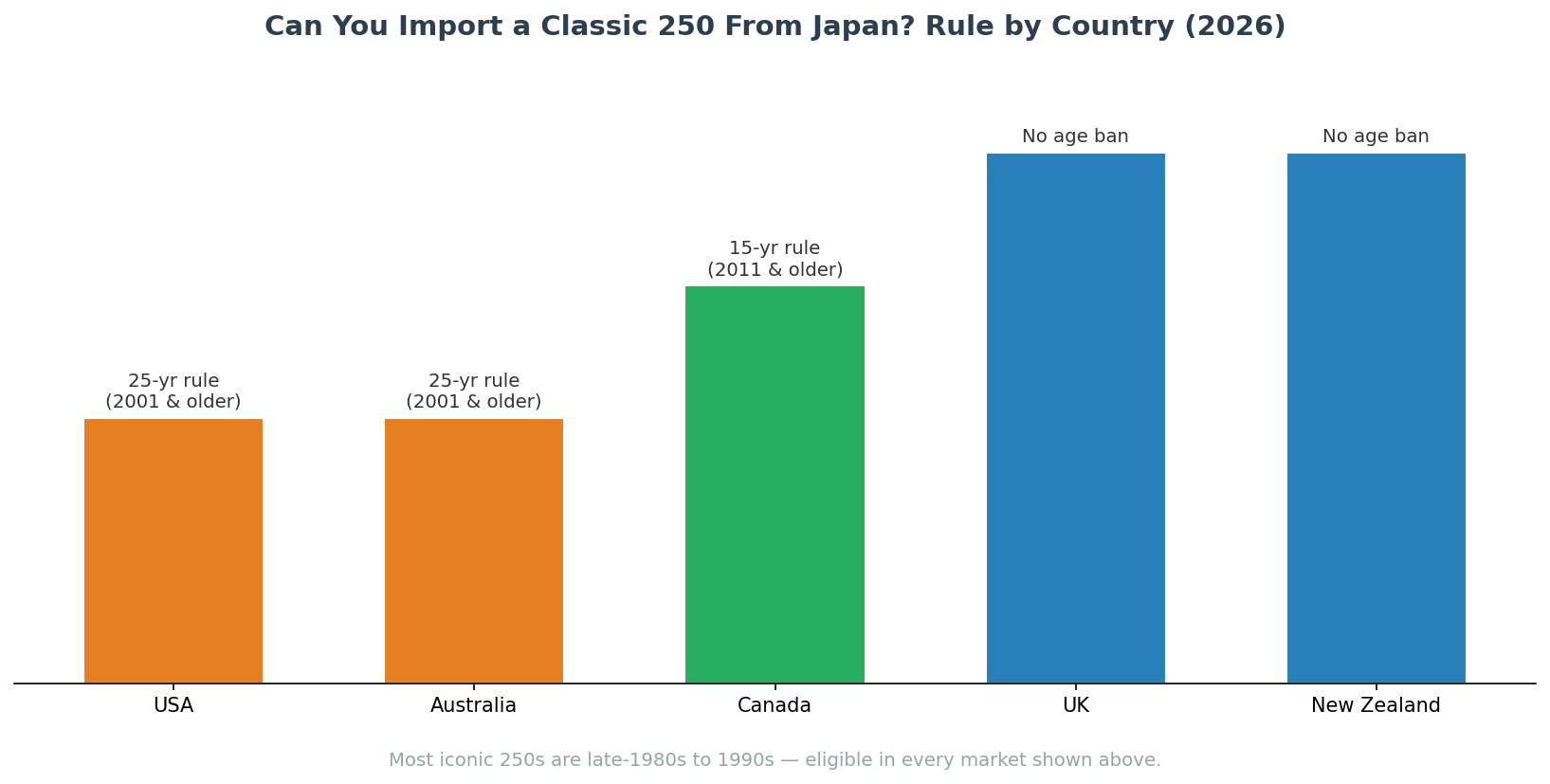
United States: The 25-year rule is your friend. Any motorcycle 25 or more years old is exempt from FMVSS safety and EPA emissions conformity, which is the entire ballgame for these grey-market 250s. In 2026 that means anything built in 2001 or earlier rolls straight in. A 1990 NSR250, a 1991 CBR250RR, a 1989 FZR250 — all clear. Bikes 25-plus years old are also outside the newer automobile tariff regime and assessed only the low base duty. Full details in our guide to importing a motorcycle from Japan to the USA.
United Kingdom: No blanket age ban. You can import a 250 of almost any age; you'll handle the NOVA notification to HMRC, pay VAT and duty, and register it. Newer bikes may need an MSVA test, but the classic 250s are straightforward. See our UK import guide for the step-by-step.
Australia: The 25-year rule applies here too, with an asbestos declaration and state-by-state registration on top. The good news: most of the legendary 250s are now comfortably over 25 years old. Our Australia import guide covers the ROVER/SEVS path and the asbestos check that catches people out.
New Zealand: The most relaxed of the lot — no blanket year ban, with entry certification and compliance rather than an age wall. NZ is part of why so many of these bikes ended up there. See the New Zealand import guide.
Canada: Even better than the US for recent classics — Canada's threshold is 15 years, so far more of these 250s are already legal. Details in our Canada import guide.
The takeaway: if you're in the US or Australia, check the exact build year against the 25-year line. If you're in the UK, Canada, or NZ, you have far more freedom on year. Either way, the iconic 250s from the late '80s and '90s are mostly eligible everywhere right now.
What a 250 From Japan Actually Costs to Land
Let's kill the biggest myth: the auction price is not the price. The number that matters is the landed cost — the bike sitting in your country, cleared and ready to register. Here's a realistic breakdown for a clean four-stroke 250 bought at auction.
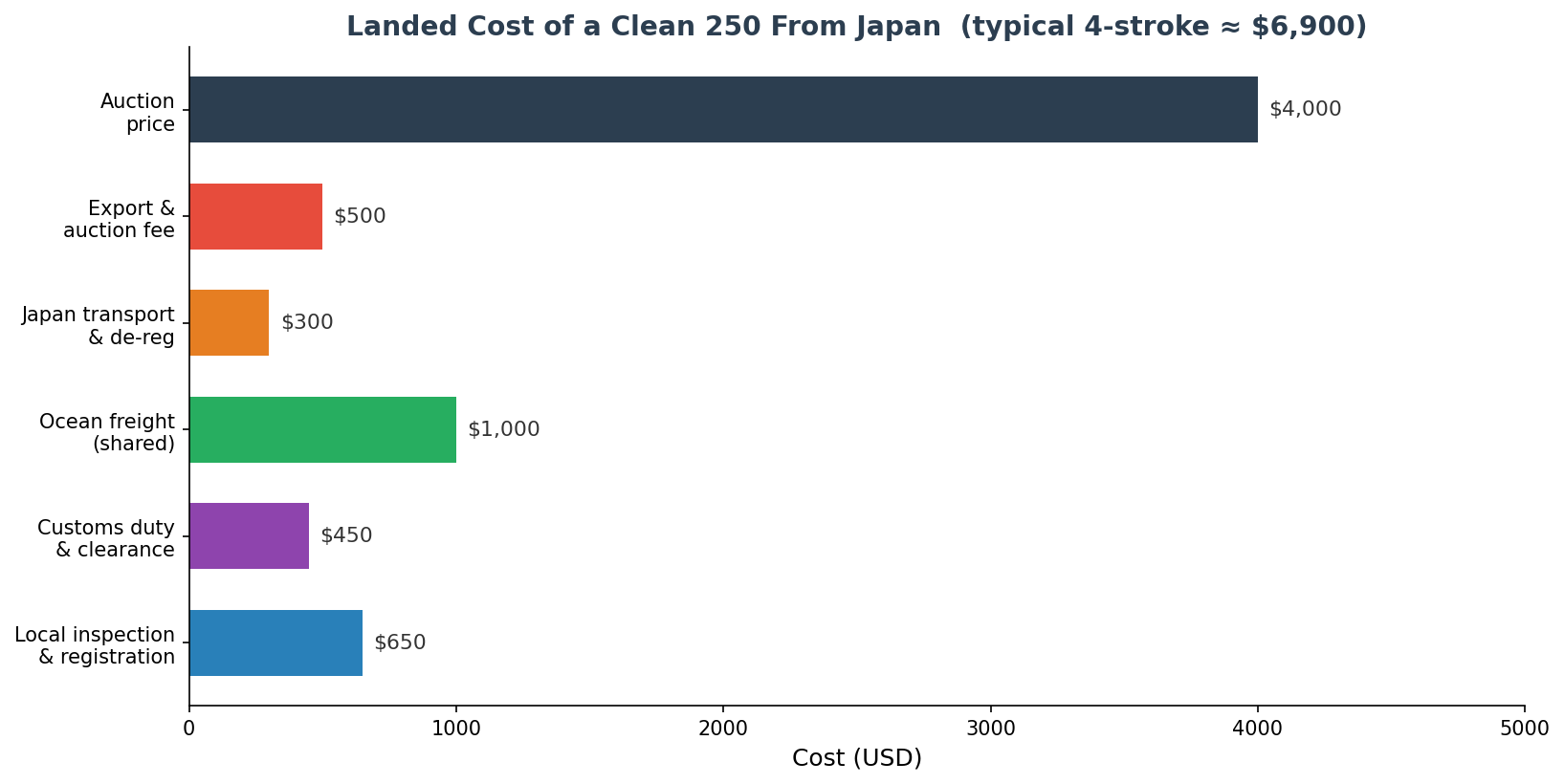
A solid CBR250RR or FZR250R typically hammers for around US$3,500–4,500 at auction. Add an export agent/auction fee (roughly $400–600), domestic transport and de-registration paperwork in Japan, ocean freight in a shared container ($800–1,200 depending on destination), and arrival-side customs duty, plus your local inspection and registration. All in, you're usually looking at roughly $6,500–8,000 landed for a four-stroke.
Two-strokes run higher because the bikes themselves cost more. A clean NSR250 or RGV250 can hammer anywhere from $5,000 to well over $10,000 depending on generation and condition, and the genuinely minty MC28 NSR250s now flirt with collector-car money. Budget accordingly, and remember that on these, condition is everything — a cheap two-stroke is almost never actually cheap.
The encouraging part: motorcycle import duty is low or zero in most of these countries, and shared-container shipping keeps freight reasonable. For the full mechanics of getting the bike across the ocean, see our guide on shipping a motorcycle from Japan.
How to Actually Buy One: The Auction Process
You don't fly to Japan and wander an auction yard. Almost every overseas buyer goes through an export agent (that's us) who holds access to the big bike auctions like BDS and JBA. Here's the flow.
1. Pick your model and budget. Decide on the bike and the maximum landed price you'll accept. Work backwards from landed cost, not hammer price.
2. We watch the auctions. Hundreds of bikes cross the block weekly. We send you candidates that match your spec as they appear, with the auction sheet for each.
3. Read the auction sheet — this is the whole game. Every bike gets graded by a neutral inspector. The sheet tells you mileage, a condition grade, and a map of every scratch, dent, and repair. Learning to read one is the single most valuable skill in this hobby. We break it down completely in how to read Japanese auction inspection sheets and Japanese auction grades explained.
4. Set your bid. You give a maximum; we bid on your behalf. No emotional overbidding at 3 a.m. Our full walkthrough lives in how to bid on a Japanese motorcycle auction.
5. Win, ship, land. If you win, we handle export paperwork, de-registration, and shipping to your port. You handle (or we guide) local clearance and registration. Six to ten weeks later, you're riding it.
The Buyer's Checklist: What to Check Before You Bid on a 250
These are old, high-strung engines. The auction sheet protects you on cosmetics; this list protects you on mechanicals.
For four-cylinder four-strokes (CBR250RR, FZR250, ZXR250, GSX-R250): Four tiny carburettors that must be perfectly balanced — a bike that won't idle cleanly often just needs a carb sync, but factor it in. Check for a clean rev to redline on any video the seller provides. Confirm the bike actually pulls past 10,000 rpm; a four that won't rev is a sick four. Original exhausts are increasingly rare and valuable, so note whether it's stock.
For two-strokes (NSR250, RGV250, TZR250, KR-1): Power valves (Honda's RC valve, Yamaha's YPVS) must move freely — seized valves kill performance. The oil injection pump must work; people who convert to pre-mix sometimes hide a failed pump. Crank seals are the classic two-stroke weak point. And confirm whether it's been derestricted and how, because a bad derestriction job runs lean and melts pistons.
For everything: Match the frame and engine numbers on the sheet. Prefer documented low mileage with a high condition grade. And remember the golden rule one veteran posted: a 250 with full history and a clean sheet at a higher price is almost always cheaper than a "bargain" with question marks.
Common Mistakes Nobody Warns You About
Buying a two-stroke you can't maintain. The romance of a GP replica is real. So is fouling a plug 20 minutes into your first ride because you don't understand the oil system. If you've never owned a two-stroke, start with a four-stroke 250 or budget for a specialist mechanic.
Underestimating parts. These bikes are 30 years old and were domestic-market only. Common service items are fine, but model-specific bodywork and electronics can be slow to find. Buy complete, original bikes. Restoring a stripped one from overseas is a heartbreak project.
Chasing the cheapest hammer price. The cheap bike on the sheet is cheap for a reason the sheet will usually tell you. Read the grade. A higher-graded bike costs more up front and far less over the next two years.
Ignoring the landed-cost math. We've watched buyers win a "$3,000 bargain" and then get sticker shock at shipping and clearance. Always quote yourself the landed number before you set a bid.
A Short History: How Japan's 250 War Actually Happened
None of these bikes make sense without the backstory, so here's the short version. Through the 1980s and into the '90s, Japan's domestic market was the most competitive motorcycle market on earth, and the 250 class was its main battlefield. Honda, Yamaha, Suzuki, and Kawasaki were not just selling bikes to each other's customers — they were settling Grand Prix grudges in the showroom.
On the two-stroke side, that meant taking the technology from 250cc GP racing — where Japanese factories dominated for years — and putting a number plate on it. The NSR250, TZR250, and RGV250 were each tied to a specific 500cc GP weapon and the riders who made them famous. Buying one in 1990 was buying a piece of the championship. On the four-stroke side, the war was about revs and refinement: who could build the smoothest, highest-revving, best-sounding inline-four in a 250cc package. The answer kept changing as each factory leapfrogged the others, which is why there's no single "best" four — there's a CBR250RR person, a ZXR250 person, and an FZR250 person, and they'll argue about it forever.
Then it ended. Tightening emissions rules killed the road two-strokes, and a domestic recession plus shifting tastes ended the four-cylinder 250 era. The factories moved on to cheaper twins and singles. Nothing like these bikes has been built since — the closest is Kawasaki's modern ZX-25R four, which exists precisely because people never stopped loving the originals. That short, intense window is why the supply is fixed and why importing from Japan is the only way in.
Where These Bikes Come Up: The Japanese Auctions
The reason an export agent matters is that the bikes move through a wholesale auction system most overseas buyers never see. Houses like BDS (Bike Dealer System) and JBA run weekly sales where thousands of motorcycles change hands, each one inspected and graded by a neutral third party. That grading is what makes buying a bike you've never seen, in a country you've never visited, genuinely safe. We cover the whole landscape in our guide to Japanese motorcycle auction houses.
For the classic 250s, this system is gold. A rare NSR250 or a clean CBR250RR can surface at any of these sales in a given week, and because the auction is wholesale, you're buying at the price dealers pay — before anyone marks it up, ships it West, and sells it as a "rare grey import." That margin is exactly what you keep by importing directly. The flip side is that you need someone watching the sales constantly and reading every sheet, because the good ones are gone in a single afternoon. That's the job.
Living With a Japanese 250: Insurance, Parts, and Riding Reality
Importing the bike is the start, not the finish. A few honest words on what ownership actually looks like, because the romance videos never mention it.
Insurance. In most countries a grey-import classic 250 is cheap to insure precisely because it's a 250 — insurers price on displacement and power, and 45-ish horsepower is friendly territory. Some insurers want an agreed-value classic policy for the rarer two-strokes, which actually works in your favour if values keep climbing. Mention the import status up front; it's routine.
Parts. This is the genuine homework. Consumables — tyres, brake pads, chains, sprockets, filters, plugs — are easy and cheap everywhere. The four-strokes share a lot with their bigger siblings. Two-stroke-specific items like power-valve components and reed cages are findable but take patience and a good parts network. Bodywork in original colours is the hardest thing to source, which is exactly why you buy a complete, unmolested bike rather than a project. Japanese parts suppliers and specialist forums ship worldwide, and the community around these bikes is one of the most helpful in motorcycling.
Riding. A four-cylinder 250 teaches you to ride properly because you have to keep it singing — there's no lazy low-end torque to bail you out, so you learn to use the gearbox and carry corner speed. It's the best skills classroom on two wheels. A two-stroke takes that further: you ride the powerband, you respect the front brake, and you grin like an idiot. Neither bike is a motorway tourer. Both are weapons on a back road and conversation magnets at every fuel stop.
Quick Reference: The Twelve at a Glance
If you skimmed straight here, this is the cheat sheet. Pair it with the model-specific guides linked above before you commit.
Honda CBR250RR (MC22): Inline-four, 19,000 rpm, the refined all-rounder and most iconic four-cylinder 250. The safe, brilliant choice.
Kawasaki ZXR250: Inline-four, 19,000 rpm, voted the best-sounding 250 ever. The enthusiast's pick.
Yamaha FZR250R: Inline-four with EXUP, 18,000 rpm, the value four-cylinder. Same thrills, smaller price.
Suzuki GSX-R250 / GSX250F Across: Inline-four; the Across adds helmet storage and is the only practical one. Quirky cult hero.
Honda Hornet 250 / Suzuki Bandit 250: Naked four-cylinder streetfighters. Comfort plus the four-cylinder soundtrack.
Honda NSR250R: Two-stroke V-twin GP replica. The king. MC28 is the collector grail.
Suzuki RGV250 Gamma: Two-stroke V-twin, sharpest and most aggressive. For experienced hands.
Yamaha TZR250: Two-stroke, parallel-twin to V-twin across generations. The 3MA is the oddball connoisseur's bike.
Kawasaki KR-1 / KR-1S: Two-stroke parallel-twin, the underrated bargain GP replica. Smart-money two-stroke.
Why 2026 Is the Moment to Buy
Two clocks are ticking at once, and they both point to "now." The first is the 25-year import clock — every year, another batch of these bikes crosses the line and becomes legal in the US and Australia, which widens the buyer pool and pushes prices up, not down. The second is the appreciation clock. These were always rare; the two-strokes especially are a finite, shrinking supply because they get crashed, seized, and parted out. Clean examples only get scarcer.
Put those together and you get a market that has only gone one direction for a decade. The ¥2.5 million NSR250 that made an owner "fall over" wasn't an outlier — it was a preview. The four-cylinder 250s are following the same curve a few years behind. Buying a clean one from Japan today isn't just acquiring a brilliant little motorcycle; it's getting in before the rest of the world finishes catching on. They are not making any more of these, and the ones in Japan are the best ones left.
Should You Import a 250 — or Size Up to a 400?
It's a fair question, and we get it constantly. The honest answer depends on what you want from the bike, not on which number is bigger.
Stay in the 250 class if the experience is the point. The four-cylinder 250s offer a sound and a riding character — keeping a tiny engine pinned near a 19,000 rpm redline — that no larger bike replicates. The two-stroke 250s deliver a power delivery that's genuinely thrilling and increasingly rare on any public road. A 250 is also lighter, friendlier in the city, cheaper to insure, and in many markets easier for a newer rider to handle legally and confidently. If you want a usable classic that makes every short ride an event, the 250 is the move.
Size up to a 400 if you'll spend real time at higher speeds or carry a passenger. The JDM 400 class — the CB400 Super Four, the four-cylinder CBR400RR, the VFR400 NC30 — gives you most of the same Japanese-domestic-market magic with more usable torque and motorway legs. Same import logic, same auctions, same 25-year math; just a bigger engine. We laid the whole class out in the best 400cc motorcycles to import from Japan guide, and plenty of buyers end up importing one of each. There are worse problems to have.
Whichever way you lean, the process is identical and the window is the same: these are finite, appreciating, domestic-market bikes, and the cleanest survivors are in Japan right now.
How AWA Auction Helps You Land the Right 250
Here's where we come in. AWA Auction gives overseas buyers direct access to the same Japanese bike auctions that supply dealers worldwide — the place where these 250s actually are. We translate and interpret the auction sheets, bid on your behalf, and handle export and shipping end to end. No flights to Japan, no language barrier, no middleman markup on a dealer's already-imported stock.
Because we're bidding every week, we know which 250s are coming up, what a fair landed number looks like, and which "bargains" to walk away from. You can browse current listings to see what's available right now, or contact our team with the exact model you're hunting and we'll watch for it. The clean ones don't last — and on these bikes, the right one found early is worth far more than the cheap one found late.
See Also
Share this article: