
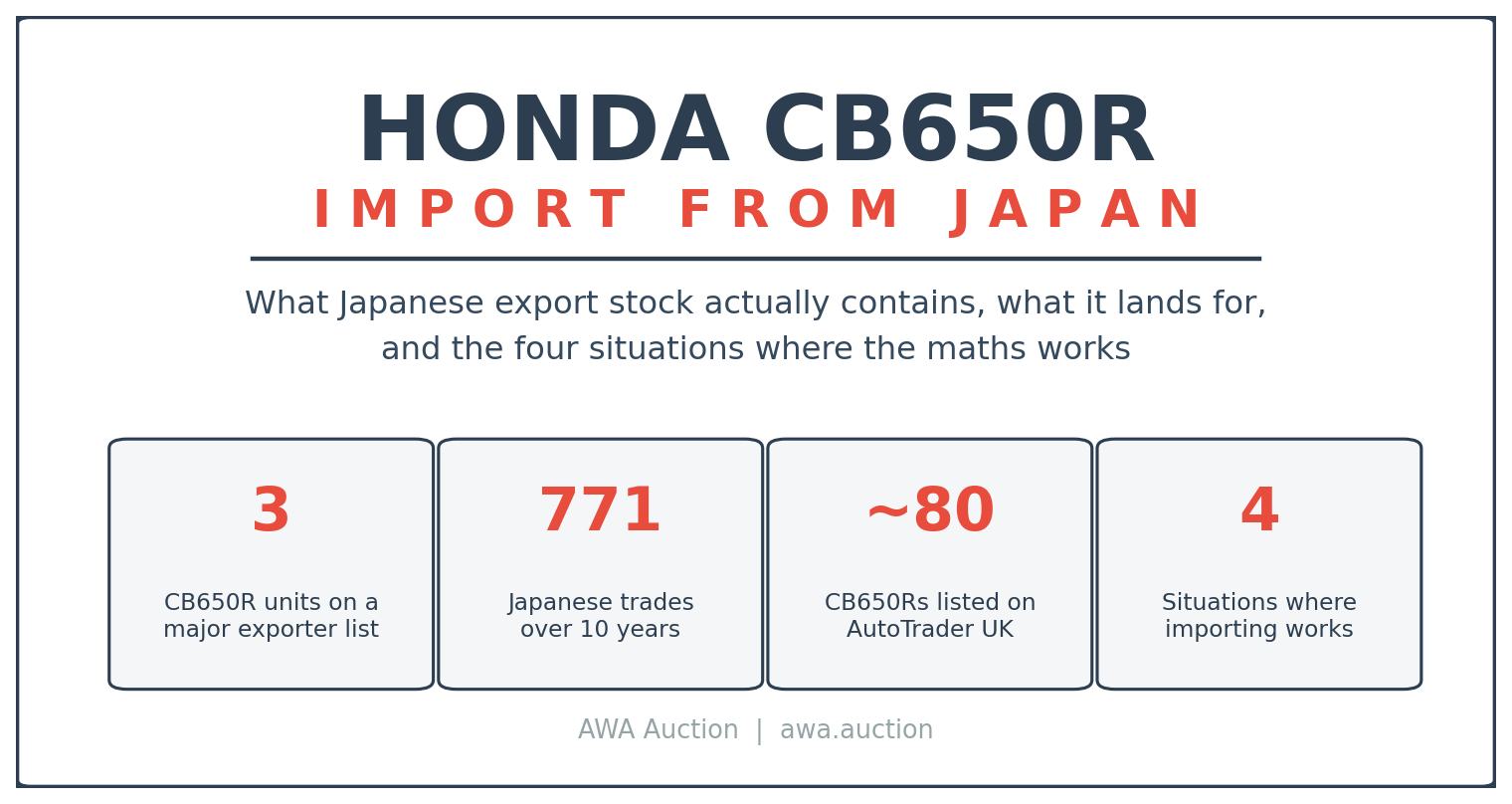
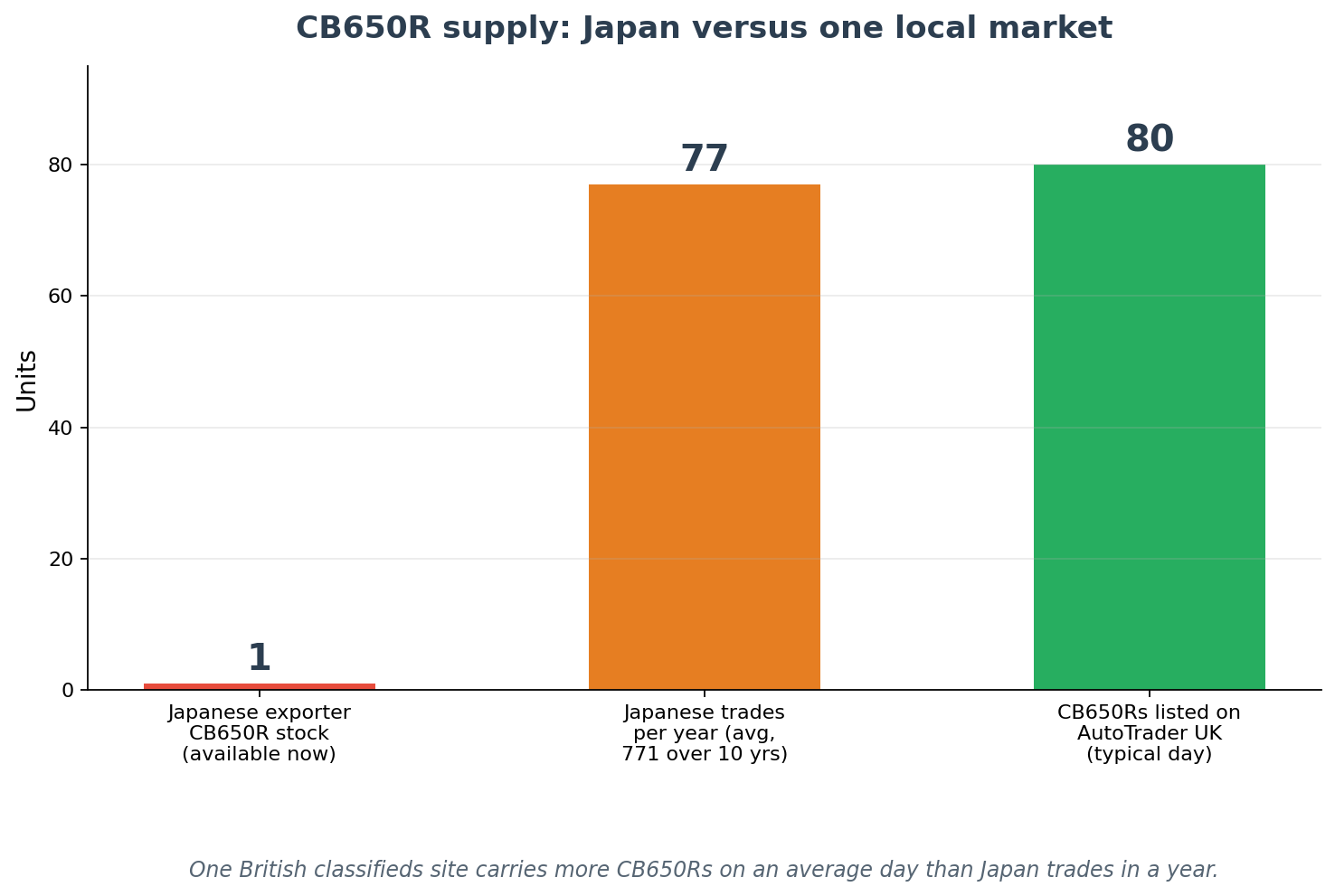
Start with the fact that decides everything else. A Honda CB650R import from Japan begins with finding a CB650R in Japan, and Japan barely has any. BATFA Japan, a Tokyo exporter that has been shipping used bikes worldwide for decades, lists exactly three CB650R stock numbers on its Honda CB650 page. Two of them say "Sold out." The one survivor is a 2020 bike, model code RH03, 14,800 km on the clock, no accident history, listed at 8,600 US dollars.
Three. Not three pages. Three bikes, two of them gone.
Compare that to the same exporter's CB400 Super Four or Ninja 250 pages, which run to dozens of units at a time, and you have the whole story of this model in one screenshot. The CB650R is a Honda built mostly for people who do not live in Japan. Japan sells it, Japan just does not sell many, and the ones it does sell get bought by Japanese riders who then keep them.
That single supply fact reshapes every question you were about to ask. It changes what you should search for, what you should pay, which generation you can realistically get, and — for a large share of readers — whether you should be importing a CB650R at all rather than a CB650F, a CB1000R, or a Hornet.
This guide answers all of it with real numbers: Japanese export stock and its asking price, Japanese model codes and engine number blocks, UK dealer and private averages by year, landed cost to four countries, the recall letter your imported bike will never receive, and the one buying situation where a Japanese-market CB650R genuinely beats anything on your local forecourt. There is also a straight answer at the end for the majority of readers, and that answer is not the one an import broker normally gives you.
Why Japan Has Almost No CB650Rs to Sell You
Japan's motorcycle licence system is the reason, and it is worth understanding because it explains the supply of every Japanese bike you will ever consider importing.
Japanese riders sit in one of three tiers. A 原付 licence covers 50cc. A 普通自動二輪 (ordinary) licence covers everything up to 400cc. Above 400cc you need a 大型自動二輪 — the large licence — and getting one takes a separate course, a separate test, and real money at a driving school.
Look at what that does to a 649cc bike. The CB650R sits on the wrong side of the 400cc wall, so it needs the expensive licence. But a rider who has just spent the time and money on a large licence does not typically celebrate by buying the smallest bike that licence unlocks. They buy a 750, a litre bike, a Rebel 1100, an Africa Twin, a Z900RS. The 650 class in Japan is a narrow strip of road between the enormous 400cc market below it and the aspirational big-bike market above it.
Japanese trade-price data for the CB650R shows the RH03 type — the 2019 to 2023 bike — as the most actively traded version of the model, with roughly 771 units passing through Japanese trade channels across ten years of records. For context, popular JDM models rack up that many trades in a single strong year. Seven hundred and seventy-one units over a decade is a rounding error, and only a fraction of those ever reach an exporter's stock list instead of a Japanese buyer.
Meanwhile Honda shipped CB650Rs to the UK, Ireland, France, Germany, Spain, Italy, the United States, Canada, Australia, New Zealand, Thailand, India, the Philippines and the Gulf. AutoTrader UK alone carries around 80 CB650Rs on any given day. Your local market has more of this bike, right now, than Japan's entire export channel.
Here is the thing nobody selling import services will say out loud: scarcity at the source is not a bargain. It is the opposite. When three units exist, the seller sets the price, and the price they set is a Japanese retail price with an export margin stacked on top. That 8,600 dollar 2020 bike is not a 3,000 dollar auction find. It is roughly what a well-kept 2020 CB650R costs anywhere on earth, except you have not paid for shipping yet.
The Four CB650R Generations, and Which One Japan Actually Has
Honda has revised this bike four times in a way that matters to a buyer. Get the generations straight before you look at a single listing, because Japanese exporter listings often say nothing more useful than "CB650R 2020" and leave the rest to you.
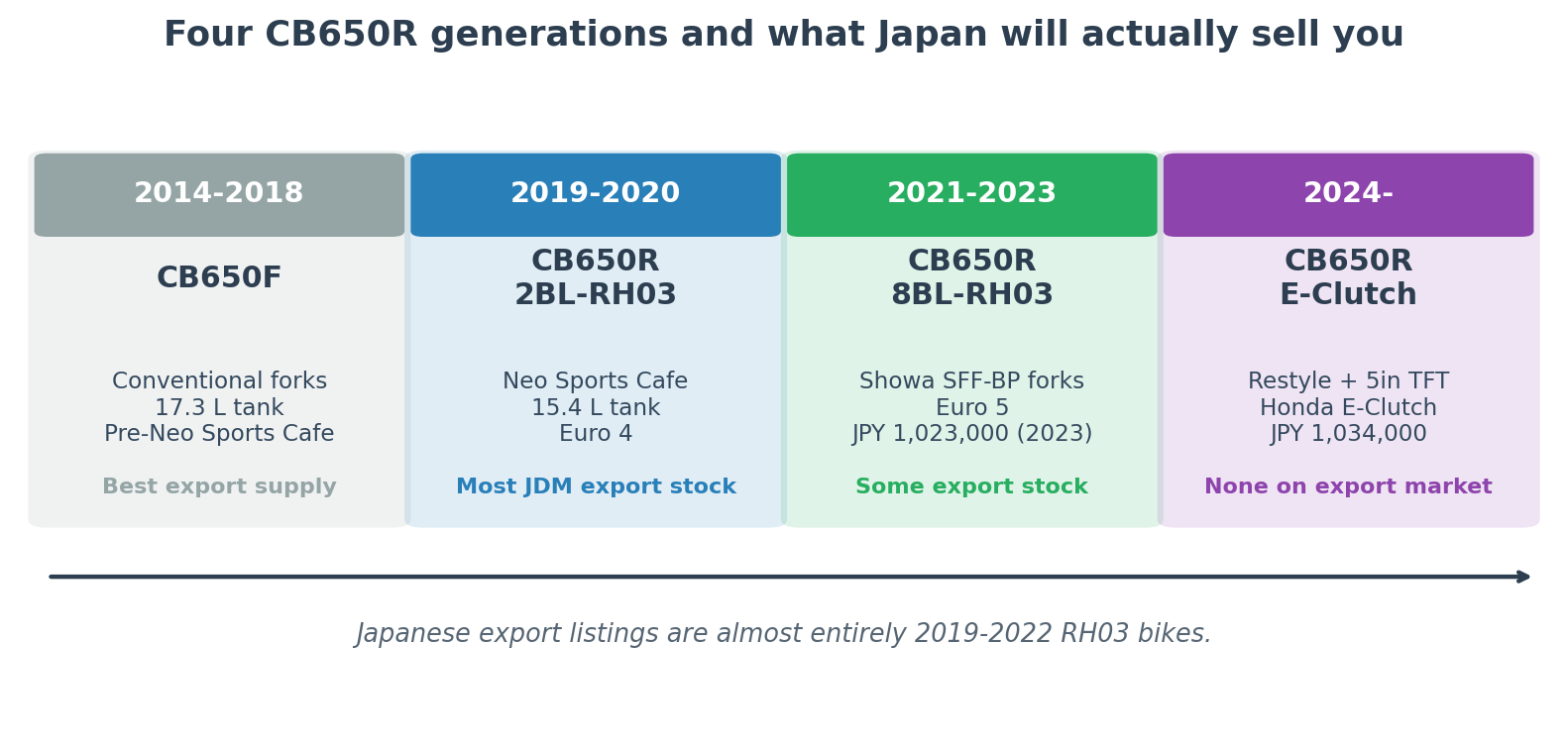
2014–2018: CB650F — the ancestor
Not a CB650R, but you need it in the picture because it shares the engine architecture and because it is the version Japan and the world actually have in quantity. Conventional right-way-up forks, a 17.3-litre tank, softer styling, and a lower price everywhere. Honda replaced it with the CB650R for 2019.
2019–2020: CB650R, first generation, model code 2BL-RH03
Neo Sports Café styling arrives. Round LED headlight, exposed engine, four short header pipes swept into a compact silencer. Chassis, suspension and ergonomics all revised over the CB650F. The tank drops to 15.4 litres. Euro 4 emissions. Japanese launch was March 2019. The forks on this generation are the weak point relative to what came next — they are inverted but not the Showa big-piston items.
2021–2023: CB650R, second generation, model code 8BL-RH03
Euro 5 compliance plus the change that matters most on the road: Showa 41mm Separate Function Fork Big Piston (SFF-BP) inverted forks, with the pressure-separated damper in one leg and the spring in the other. Front-end feel, bump absorption and control all step up. Detail improvements to comfort and practicality follow. Japanese engine numbers for this block run RH03-1100001 onward, then RH03-1200001 onward for the later cars of the run. The 2023 Japanese-market bike listed at ¥1,023,000 and went on sale 16 February 2023.
2024 onward: restyled CB650R and CB650R E-Clutch
Honda announced the restyle on 11 April 2024 and put the bike on sale in Japan on 25 April 2024 at ¥1,034,000 including tax. New bodywork, and — finally — a proper 5-inch TFT screen replacing the squinty LCD that every reviewer complained about for five years. The headline is Honda E-Clutch: computer-controlled clutch actuation that lets you pull away, shift and stop without touching the lever, while leaving the lever fully functional whenever you want it. The CB650R and CBR650R were the first Hondas to get it.
What Japanese export stock actually contains: almost entirely 2019–2022 RH03 bikes, because those are the ones old enough to have been traded in. E-Clutch bikes are two years old and Japanese owners are still riding them. If your reason for importing is "I want the E-Clutch," Japan is not going to help you, and your local Honda dealer will.
Reading a Japanese CB650R: Codes, Frame Numbers and Auction Sheets
Japanese paperwork uses its own vocabulary, and a listing that looks thin in English is usually dense with information once you know where to look.
The 型式 (model code) tells you the emissions era
Japanese vehicle registration prefixes the chassis code with an emissions-era marker. On this model you will meet:
- 2BL-RH03 — the 2019–2020 Euro 4 era bike, conventional inverted forks.
- 8BL-RH03 — the 2021–2023 Euro 5 bike with the Showa SFF-BP front end.
The RH03 part is the chassis family. The prefix is the era. When a seller shows you a Japanese registration document (車検証) or an export deregistration certificate, that prefix is printed on it, and it is the fastest way to confirm you are buying the second-generation forks rather than the first. Never take the model year in the listing title as proof — Japanese sellers frequently list the registration year, which can be a year after manufacture.
The engine number blocks
Engine numbers in the RH03-1100001 to RH03-1199999 range and the RH03-1200001 range onward correspond to the Euro 5 production run. Cross-check the engine number against the frame number on the paperwork. A mismatch means an engine swap, a rebuild, or a salvage history that somebody has tidied up. Our guide to Japanese auction grades covers how graders record that, and how to read a Japanese auction inspection sheet walks through the diagram markings line by line.
What the auction sheet is telling you on this specific bike
Four things carry disproportionate weight on a CB650R:
- Header corrosion. Four short exposed headers are the visual signature of the bike and the first thing Japanese winter road salt attacks. Graders note it as 錆 (rust) on the diagram. On a CB650R this is expensive and visible, not cosmetic trim you can ignore.
- Fork legs. Pitting or weeping on the sliders. Fork seals are a known service item on this engine family and the parts are not cheap.
- Water pump area. A small number of CB650Rs weep oil or coolant from the water pump. Most are cured by a pump replacement. A few are not, and those bikes get traded in. A grader's note of an oil or coolant trace low on the right of the engine deserves your full attention.
- Fasteners and bolt heads. Rounded or replaced fasteners in the same area on multiple bikes in the diagram means the bike has been apart more than a service schedule explains.
The Real Landed Cost of a Honda CB650R Import From Japan
Take the one bike Japan currently has on an English-language export list and run it to the end. This is not a modelled example; the starting number is a live asking price.
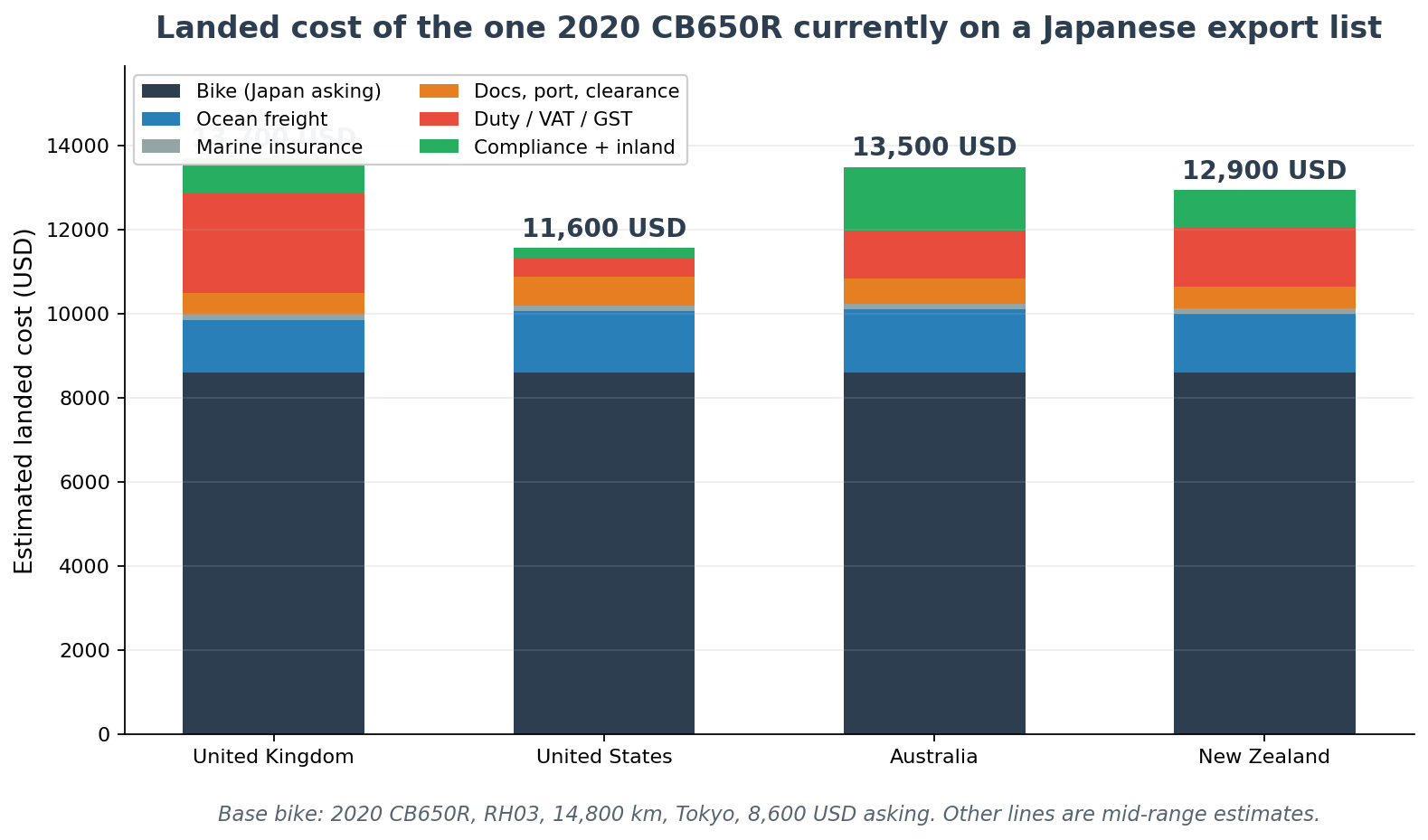
Base: 2020 CB650R, RH03, 14,800 km, no accident history, JIO-certified, Tokyo. Asking 8,600 USD.
To that you add, in roughly this order:
- Ocean freight — 900 to 1,600 USD depending on destination and whether the bike goes in a shared container or RoRo. Our container versus RoRo comparison explains which one suits a naked bike with exposed bodywork.
- Marine cargo insurance — around 1.5% of declared value. On this bike, roughly 130 USD.
- Export documentation and deregistration — the export certificate that proves the bike is legally off Japan's register. Usually bundled by the exporter, typically 100 to 250 USD.
- Destination port handling and customs clearance — 200 to 400 USD.
- Customs bond (US only) — 125 USD.
- Duty and consumption tax — this is where countries diverge sharply, and it is covered per country below.
- Compliance testing and registration — MSVA in the UK, entry certification in New Zealand, nothing meaningful in the US for a bike this new, an approval scheme in Australia.
- Inland transport from port to your door — 150 to 400 USD.
Before any duty or compliance, the 8,600 dollar bike has already become roughly 10,000 to 10,900 dollars sitting on a dock in your country. Then the country-specific layer lands on top.
The Local-Market Comparison That Kills Most CB650R Imports
Now put that landed figure next to what the same bike costs without an ocean crossing. UK numbers are the clearest because the market is deep and the data is public.
UK dealer averages by model year: 2019 around £6,250, 2020 around £6,550, 2021 around £6,850. Private sale averages: 2019 around £5,000, 2020 around £5,250, 2021 around £5,500.
Those are averages. Real listings undercut them. A 2019 CB650R with 9,415 miles has traded at £5,490. A 2020 with 14,533 miles — almost exactly the mileage of the Japanese export bike — at £5,590. A 2021 with 8,675 miles at £6,990. Around 80 CB650Rs sit on AutoTrader UK at any moment, which means you can be fussy about colour, service history and mileage without leaving your county.
Set that £5,590 private 2020 against a Japanese 2020 that costs 8,600 dollars before it has left Tokyo. Convert conservatively and add every line item above, and the imported bike arrives in Britain at somewhere near double the price of the identical bike parked twenty minutes away with a V5C already in the glovebox.
That is not a marginal call. That is not "worth it for the JDM spec." That is a straightforwardly worse purchase, and any broker who tells you otherwise is selling you a service rather than a bike.
The same arithmetic holds in the United States, where Honda has sold the CB650R since 2019 and used examples sit between roughly 6,000 and 8,500 dollars depending on year and miles. It holds in Australia and, with one important asterisk, in New Zealand.
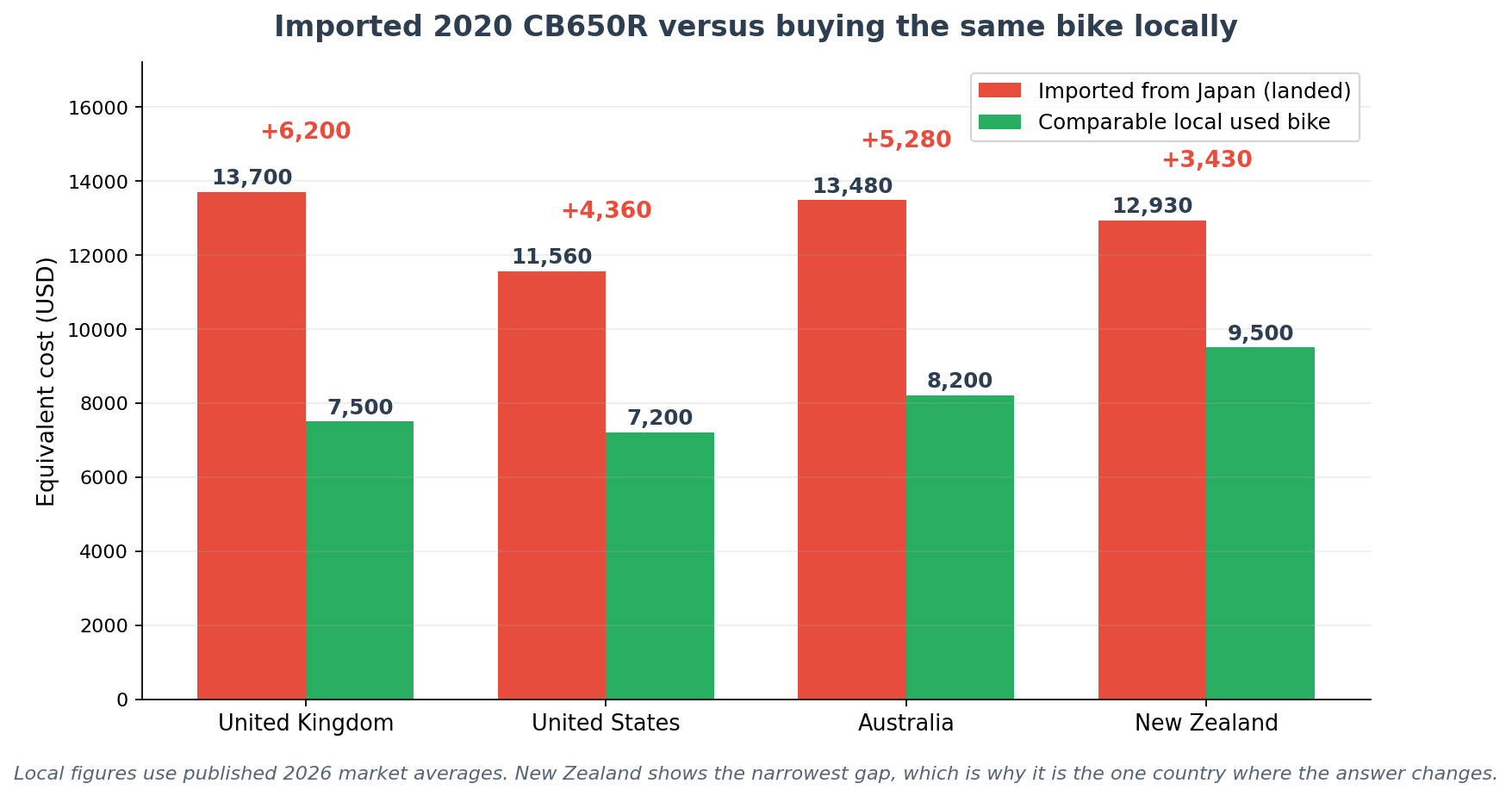
If you want that comparison run against a live Japanese auction listing rather than a published average, send us the destination country and your budget and we will do the arithmetic before you bid.
The A2 Restriction Trap — Where a Japanese Bike Genuinely Wins
Here is the one argument for a Japanese CB650R that survives contact with a spreadsheet, and it applies to the UK, Ireland and the EU.
European licensing has an A2 category capped at 35 kW — 47 bhp. A full-power CB650R makes roughly twice that. Honda's answer, and the answer of every manufacturer selling a middleweight into Europe, is a restrictor kit: a homologated power-reduction package that takes the bike down to 35 kW so an A2 licence holder can ride it legally. DVSA and RSA-approved kits exist for CB650R and CBR650R model years 2019 through 2025, and on Euro 4 bikes and later the restriction is electronic rather than a mechanical throttle stop.
Now think about who buys a CB650R new in Britain. It is the archetypal A2-holder's bike: big enough to feel like a proper motorcycle, restrictable, and the thing riding schools themselves use — one rider on X in July 2026 described passing his test on a school CB650R and then buying the CBR650R version, putting 600 miles on it in his first month. That is the CB650R's core British customer.
Which means a meaningful slice of the UK used CB650R market has been restricted, derestricted, or both. And that leaves you three specific problems:
- Paperwork drift. A bike restricted for two years and then derestricted should have documentation for both operations. Plenty do not. Insurers ask.
- Unknown-quality reinstatement. An electronic restriction reversed by whoever was cheapest, with no record of what was flashed onto the ECU, is a bike with an unaudited engine map.
- Riding history. A bike that spent its first two years restricted was, by definition, ridden by a rider inside their first two years of licensed riding. That is not a criticism of new riders — it is a statement about how a machine gets used during learning.
A Japanese-market CB650R has none of this. Japan has no A2 category. The 大型自動二輪 licence that lets a Japanese rider buy a CB650R has no power cap at all, so Japanese-market bikes leave the factory at full power and stay there. The ECU has never been touched, the throttle bodies have never been shimmed, and the bike was ridden by somebody who had already passed the hardest motorcycle test in the developed world.
That is a real, checkable, non-imaginary advantage. Whether it is worth two to four thousand pounds is a question only you can answer, and for most riders the honest answer is no — because you can also just buy a British bike that was never restricted and read its service book. But if you have looked at forty UK listings and every one of them has a restriction history you dislike, this is why Japan exists.
Recall KR7 and the Letter That Never Arrives
Every imported motorcycle carries a structural safety problem that has nothing to do with the machine: recall notices follow registration databases, and an exported bike falls out of the database it was registered in.
The live example on this model is straightforward. American Honda recalled certain 2024 CB650R and CBR650R motorcycles under NHTSA campaign 25V-107, Honda's internal number KR7. Improper paint application to the gear change arm allows the fasteners securing that arm to the stroke sensor assembly to loosen and fall out. If the arm separates, the rider cannot change gear while moving. Affected units were built between 7 June 2024 and 18 July 2024 — a six-week production window covering an estimated 507 motorcycles. Dealers replace the gear shift arm free of charge. Owner notification letters went out on 21 April 2025.
Went out to whom? To owners on the American register. A bike exported before that date is not on it. Nobody writes to you.
The 2024 build window makes this specific recall unlikely to touch a Japanese export bike, because Japanese stock skews to 2019–2022. That is exactly why you should treat it as a template rather than a checklist item. The pattern repeats on every model: a defect is found, a campaign opens, letters go to a national register, and imported bikes are invisible to all of it.
What to do instead of waiting for post: take the frame number off the export certificate before the bike ships, and run it through Honda's recall lookup in the market where the bike was sold, then again in your own market once it is registered. Do it at purchase, and do it again annually. Our grey import guide covers why an imported bike's service history needs to be reconstructed by you rather than inherited.
What Actually Goes Wrong on a CB650R
The honest summary: not much. This is a Honda inline-four with a long development lineage, and most owners report nothing beyond consumables past 30,000 miles. The specific items below are the ones that recur often enough to check for, and every one of them is visible or audible during a pre-purchase inspection.
Regulator/rectifier heat failure
The most-reported electrical fault across the whole 650 family, and it is not unique to this model — Honda uses closely related regulator/rectifier hardware across a wide swathe of its range, and the shunt-type unit runs hot. Symptoms: a battery that will not hold charge, headlights dimming at idle, or the bike dying at low revs. The aftermarket MOSFET replacement runs cooler and lasts longer. Budget 50 to 150 for a DIY swap, 150 to 300 at a shop.
Fork seals
A known service item around the 20,000-mile mark on this engine family, and the earlier CB650F is where it shows up most. Weeping seals leave a visible oil film down the slider. Non-negotiable inspection point.
Cam chain tensioner rattle
Higher-mileage examples can develop a rattle on cold start that quietens as oil pressure builds. Start every candidate bike stone cold. A seller who has warmed the bike before you arrive has told you something, whether or not they meant to.
Exhaust header corrosion
The four exposed headers are the design's signature and its most exposed surface. Road salt gets into them. Japanese winter roads in the north are salted, and a bike from Hokkaido or Tohoku wears that differently from one that lived in Fukuoka. Check where the bike was registered.
Water pump weep
A minority of CB650Rs drip oil or coolant from the water pump area. Most are resolved by a replacement pump. A small number continue after multiple replacements, and those bikes get traded in. Any trace of coolant or oil low on the engine's right side is a walk-away until proven otherwise.
The display, on pre-2024 bikes
Not a fault, but the single most consistent complaint in every road test from 2019 to 2023: the LCD instrument panel is hard to read in daylight. Honda fixed it with the 5-inch TFT in 2024. If a legible dash matters to you, that is a generation decision, not an accessory decision.
The CB650F Play: Why the 2014–2018 Bike Is the Real Japanese Bargain
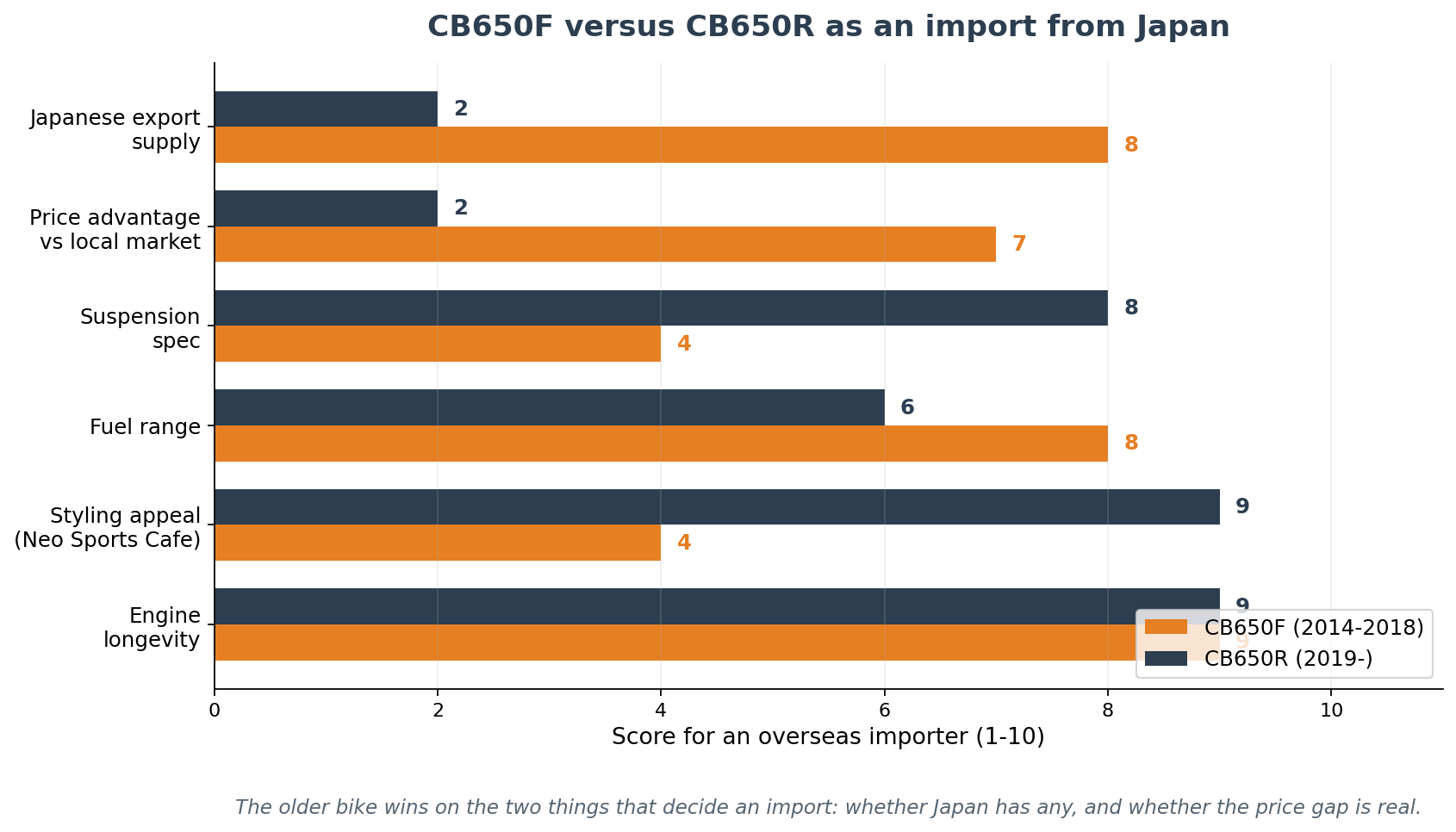
If you have read this far and the maths keeps saying no, redirect the question. You did not fall in love with a model code. You fell in love with an affordable Honda inline-four that revs, sounds right and will not break. There is a version of that bike where importing from Japan makes far more sense, and it is the one that came before.
The CB650F ran from 2014 to 2018. Same engine architecture, same four-cylinder character, right-way-up conventional forks instead of inverted, softer pre-Neo-Sports-Café styling, and a 17.3-litre tank against the CB650R's 15.4 — which is nearly two extra litres of range on a bike people actually tour on.
Three things make it the better import candidate:
- Supply. Five model years of production that are now seven to twelve years old, which is exactly the age at which Japanese owners trade bikes in and exporters list them. Japanese export stock of CB650F-era bikes is real in a way CB650R stock is not.
- Price. An older bike bought at Japanese trade prices, where the gap between Japan and your local market has had a decade to open rather than five years.
- The same engine. Owners routinely report 50,000 km and beyond on the CB650F motor with nothing but scheduled servicing. You are not buying a lesser powerplant.
Its weak points are the ones listed above, aged: fork seals near 20,000 miles, cam chain tensioner noise on cold start at high mileage, and header rust. All three are inspectable, all three are priced into an older bike, and none of them is a reason to walk away from a good example.
The trade-offs are honest ones. You lose the Showa SFF-BP forks, the LED lighting package on the very earliest bikes, and the styling if the Neo Sports Café look is what drew you in. You gain fuel range, a lower purchase price and an actual choice of units.
Country by Country: UK, USA, Australia, New Zealand
United Kingdom
Duty on a motorcycle over 250cc is 6% on the CIF value, then 20% VAT on the total including duty. On top of that an imported bike needs a NOVA notification to HMRC within 14 days of arrival, and a bike never type-approved for the UK needs an MSVA test before the DVLA will register it. A Japanese-market CB650R is mechanically identical to a UK one, so the MSVA is about lighting, speedometer units, sharp edges and mirrors rather than anything structural — but it is still a test, a booking, a fee and a delay.
We have full breakdowns of the UK import duty and tax rules, the NOVA registration process, the MSVA test, and a complete Japan-to-UK cost breakdown. Read the cost breakdown before you commit to a CB650R specifically, because that article's arithmetic is what makes this one's conclusion inevitable.
Verdict: the deepest local CB650R market in the world sits on your doorstep. Import only for the A2-history reason above, or if you want a CB650F and cannot find a clean one locally.
United States
The CB650R has been sold new in America since 2019, so any bike you would import is EPA and DOT compliant by type rather than by exception, and there is no 25-year rule problem for a road bike this recent — the age question that dogs car imports does not apply the same way here, but the EPA and DOT paperwork does, and a Japanese-market bike is not a US-certified bike. Add the 125-dollar customs bond and the fact that used American CB650Rs sit around 6,000 to 8,500 dollars.
Our Japan-to-USA import guide covers the EPA 3520-1 and DOT HS-7 forms in detail.
Verdict: no. There is no version of this that works financially, and the compliance paperwork on a non-US-certified bike is a headache you are paying extra to acquire.
Australia
Australia runs the strictest import approval regime of the four. Road vehicles need an approval before they arrive, motorcycles need to meet applicable Australian Design Rules or come in under a specific concession, and asbestos screening applies to imported vehicles as a matter of course. A 2019-onward CB650R is a current-model bike that Honda Australia sells, which puts you in the hardest category: importing something that is already on the local new and used market.
Details are in our Japan-to-Australia import guide.
Verdict: no, unless you are moving to Australia and bringing a bike you already own.
New Zealand
The friendliest of the four, and the one place where the answer shifts. New Zealand has no blanket age bar for motorcycles, entry certification is a well-worn path, and the country's used market is built substantially on Japanese imports — which means the infrastructure, the compliance shops and the parts channels all already speak this language. New Zealand's local CB650R supply is also the thinnest of the four countries, so the comparison bike you are measuring against is scarcer.
Our Japan-to-New-Zealand guide covers entry certification and emissions.
Verdict: the one country where a CB650R import is a normal transaction rather than an expensive statement. Still check local listings first, but the gap is narrow enough that the JDM specification and condition can close it.
Four Situations Where Importing a CB650R From Japan Makes Sense
Everything above says no. These four say yes, and they are the entire list.
1. You are in New Zealand and local stock is thin
Covered above. The compliance path is established, local supply is limited, and the cost gap narrows to the point where condition and specification decide it.
2. You want a documented full-power bike and your local market cannot give you one
The A2 argument. If you have worked through your local listings and the clean ones all carry restriction and derestriction history you cannot verify, a Japanese-market bike solves a problem that money alone will not solve at home.
3. You want the CB650F and your market barely got it
Some markets took the CB650F in small numbers or dropped it early. Japan has them, they are the right age to be traded, and the price gap is real on a ten-year-old bike in a way it is not on a five-year-old one.
4. You are already importing and the bike rides along
If you are shipping a container with two or three other machines, the marginal cost of adding a CB650R collapses. Freight is the single biggest variable line item, and shared containers change the answer. This is the one case where the "it is only a bit more" logic is actually true rather than a sales line.
Notice what is not on this list: "JDM bikes are better built." They are not. The CB650R is made in Thailand for most markets and the Japanese-market bike comes off the same production system as yours. There is no secret Japanese-only specification, no different metallurgy, no hidden power. Anyone who tells you otherwise is describing 1990s grey imports, not a 2020 Honda.
Pre-Purchase Checklist for a Japanese CB650R or CB650F
Run this before you bid, not after the bike ships. Every item is checkable from a listing, an auction sheet and a set of photographs.
- Confirm the model code prefix on the registration or export document. 2BL-RH03 is the 2019–2020 bike. 8BL-RH03 is the 2021–2023 bike with the Showa SFF-BP forks. This decides what you are buying more than the listed year does.
- Match engine number to frame number. Any mismatch is a rebuild or a salvage history. Walk away or get a written explanation with documentation.
- Check the registration prefecture against Japan's salt belt. Northern registrations mean salted winter roads and a harder life for those exposed headers.
- Photograph the four headers individually. Not a wide shot of the right side of the bike. Individual close-ups, including where they meet the collector.
- Inspect both fork sliders for pitting and any oil film. Fork seals are the known service item on this family.
- Demand a low-right-side engine photo covering the water pump area. Any coolant or oil trace ends the conversation until it is explained.
- Ask for a cold start video with audible sound for the first thirty seconds. Cam chain tensioner rattle shows up cold and disappears warm.
- Check the fasteners in the gear-linkage and engine-case areas for rounding or replacement, which indicates the bike has been apart.
- Verify the battery and charging system. Ask when the battery was last replaced. Frequent replacement points at the regulator/rectifier rather than the battery.
- Run the frame number through Honda's recall lookup in the bike's original market before you pay, then again in yours after registration.
- Get the export deregistration certificate confirmed in writing before payment. Without it the bike cannot legally leave Japan or be registered anywhere else.
- Price your compliance path — MSVA, entry certification, or approval — as a hard number, not a rough idea, before you bid.
If Not a CB650R, Then What? Four Japanese Inline-Fours Worth Importing
The CB650R fails the import test because the world already has it. These four pass, because Japan has them and your local market largely does not.
- Honda CB400 Super Four — the great Japan-only inline-four. Never sold new in most Western markets, produced for decades, and available in genuine volume from Japanese exporters. The bike the CB650R's character is descended from.
- Honda CB1000 Super Four — the "Big One." Japanese-market flagship muscle from the era when Honda built four-cylinder nakeds without apology.
- Honda CB900 Hornet / 919 — a CBR900RR engine in a naked chassis, and the closest thing to a CB650R with an extra 300cc of attitude.
- Honda CB1000R — if the Neo Sports Café styling is what you actually want, this is the same design language with a litre-class engine underneath.
Also worth a look if you are open beyond Honda: the Suzuki Bandit for the same four-cylinder-on-a-budget brief, our 650cc import shortlist, and the naked bike import shortlist for the full field. For the sportsbike version of this exact question, our CBR600F guide and CBF600 guide cover Honda's other affordable fours.
How AWA Auction Handles a CB650R Search
We bid at Japanese motorcycle auctions on behalf of buyers overseas, and the first thing we do with a CB650R enquiry is the thing this article just did: tell you what the supply looks like and what your local market charges.
If the numbers still work for your situation — New Zealand, a documented full-power requirement, a CB650F, or a shared container — the process runs like this. We search Japanese auction inventory and exporter stock for units matching your model code, mileage and grade. We read the auction sheet properly, including the diagram markings that English-language listings omit. We bid to a ceiling you set. We handle export deregistration and the certificate, arrange freight and insurance, and hand you a documented bike with the frame and engine numbers verified against the paperwork.
If the numbers do not work, we say so, and we point you at the models above where they do. An import broker who ships you a bike you regret has made one sale. We would rather make ten.
Browse our current Japanese auction inventory to see what is actually available this week, or contact our team with your model, budget and destination country and we will tell you honestly whether the import maths works before you commit a single yen.
If you want to understand the machinery behind all of this first, start with how bidding at a Japanese motorcycle auction actually works and how shipping a motorcycle from Japan is organised.
The Straight Answer
For most riders in the UK, the United States and Australia, a Honda CB650R import from Japan is a worse deal than buying locally — not marginally, but by roughly the price of a second bike. Japan has almost none to sell, the few it has are priced at Japanese retail, and your own market is full of them.
The exceptions are narrow and specific: New Zealand, a verified full-power requirement in A2 territory, the older CB650F, and a shared container that is shipping anyway.
If none of those describe you, buy the bike down the road, read its service book, check its restriction history, and put the four thousand you saved into tyres, a shock, and fuel. And if the itch is really for a Japan-only inline-four, the CB400 Super Four is waiting, and Japan has hundreds of them.
Sources
See Also
Share this article: