
Japanese motorcycle speedometer mph conversion is the single cheapest job on an import invoice and the one that most often stops a bike getting registered. The dial arrives reading 0 to 180 in kilometres per hour, the numbers are beautiful, and not one of them lines up with a British speed limit. Forty km/h is 25 mph. Fifty mph does not exist on the face at all. You are left doing arithmetic at 70 mph on a motorway, which is exactly the activity nobody sane wants to combine with a motorway.
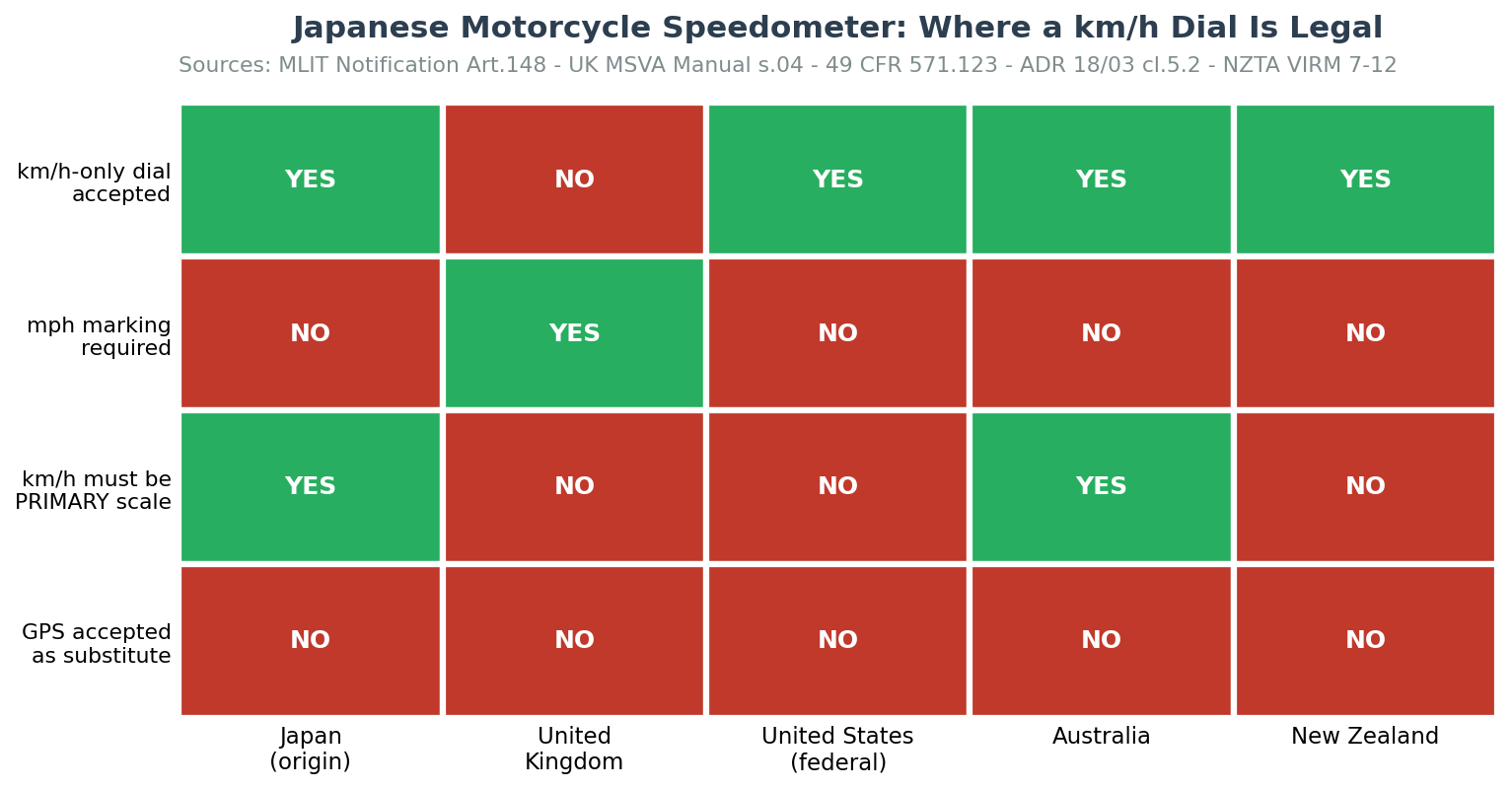
Here is the thing nobody mentions when they quote you for the work: the four English-speaking markets that buy Japanese bikes do not agree with each other about what that dial has to say. One of them forces you to change it. Two of them are entirely happy with the dial as Japan built it. One of them changed its rule in February 2026 in a direction that makes a UK-style conversion technically wrong.
So this guide does something the generic "convert your import to mph" pages do not. It goes to the actual regulations — Japan's own notification, the UK inspection manual your bike will be tested against, the US federal standard, the Australian design rule as amended this year, and the New Zealand inspection requirement — and reads what they say. Then it works out what that means for the specific piece of glass and plastic bolted to your top yoke.
There is also a second problem hiding underneath the units problem, and almost nobody writes about it. Japan's inspection rule for motorcycles built up to 31 December 2006 permitted the speedometer to read low. Every rule in the UK, Europe and Australia forbids that outright. A dial that has been faithfully re-lettered into miles per hour still breaks the law if the mechanism behind it under-reads. Re-lettering does not fix mechanics.
Why every JDM motorcycle arrives with a km/h-only speedometer
This is not a manufacturer preference. It is a legal requirement in Japan, written in a way that leaves no room to do anything else.
The Japanese safety standard for road vehicles (道路運送車両の保安基準) covers speedometers at Article 46. The detail sits in the implementing notification, Article 148, which lists the specific conditions under which a speedometer fails. The first one on the list, item 1(1)(a), reads: 速度がkm/hで表示されないもの — a speedometer on which the speed is not displayed in km/h does not conform.
Read that again, because it matters. Japan does not say "km/h preferred". It defines a non-km/h display as a defect. Any bike that has ever passed a Japanese roadworthiness inspection — the shaken test — has a km/h dial, because a bike without one is not permitted to pass.
The same article adds three more conditions that fail a speedometer: it must be readable by the rider without effort, it must be illuminated or self-luminous (or have luminous paint on the face and needle), and a digital display must hold enough brightness and contrast in both daylight and darkness. Those three carry over almost word for word into the British test, which is convenient. The units do not.
So the km/h face is not a corner your exporter cut. It is the only face the bike is allowed to have while it lives in Japan. Anyone selling you a "genuine JDM bike with a factory mph dial" is selling you a bike that has had its dial changed, or a bike that was never a JDM bike. Both are fine. Neither is what the advert says.
You can see the same pattern in every direction on a Japanese domestic bike: the object is built correctly for Japan and needs paperwork or parts attention for somewhere else. We covered the identical logic for rubber in our guide to Japanese motorcycle tyres, where the Japanese minimum tread depth for a motorcycle is half the four-wheel figure and lower than any destination market.
The four-market split: where a km/h dial is legal and where it is not
Now the part that surprises people. There is no shared English-speaking position on speedometer units. There are four different positions, and the differences are not cosmetic.
United Kingdom. A speedometer must be capable of indicating speed in miles per hour, and the mph marking must be permanent. This is enforced at the approval test that every imported motorcycle sits. It is the only one of the four that forces physical work on the bike.
United States (federal). The federal motorcycle standard does not require an mph-only speedometer. It does not require a speedometer at all. What it does is specify how displays are identified if they are fitted, and it names both "M.P.H." and "km/h" as acceptable abbreviations in the same clause.
Australia. The design rule was written around the UN speedometer regulation, and as amended in February 2026 it states that a dial carrying an additional mph scale is acceptable provided the primary scale is in km/h and the mph scale is secondary. A stock Japanese km/h dial satisfies this without touching it. A dial converted to read mph as the primary scale does not.
New Zealand. The inspection requirement names both units explicitly. A speedometer that "does not indicate the vehicle's speed in km/h or mph" is a reason for rejection. Either unit passes. Nothing to do.
Put those side by side and the shape is obvious. Japan builds in km/h. Australia and New Zealand accept km/h. The United States has no federal objection to km/h. Britain is the outlier, and Britain is where most of the buying pressure for 1990s Japanese bikes sits.
That single fact changes the economics of a purchase. If you are shipping to Sydney or Auckland, the speedometer line on your budget is zero. If you are shipping to Southampton, it is a job that has to be booked, paid for and finished before your test slot. We break the rest of the destination differences down in our country guides for Australia, New Zealand, the USA and Canada.
The UK rule in full: what MSVA Section 04 actually demands
An imported motorcycle with no European type approval goes through Motorcycle Single Vehicle Approval before the DVLA will register it. We have a full walkthrough of the MSVA test for imported motorcycles, but Section 04 is the one that decides your speedometer, and it is short enough to quote almost in full.
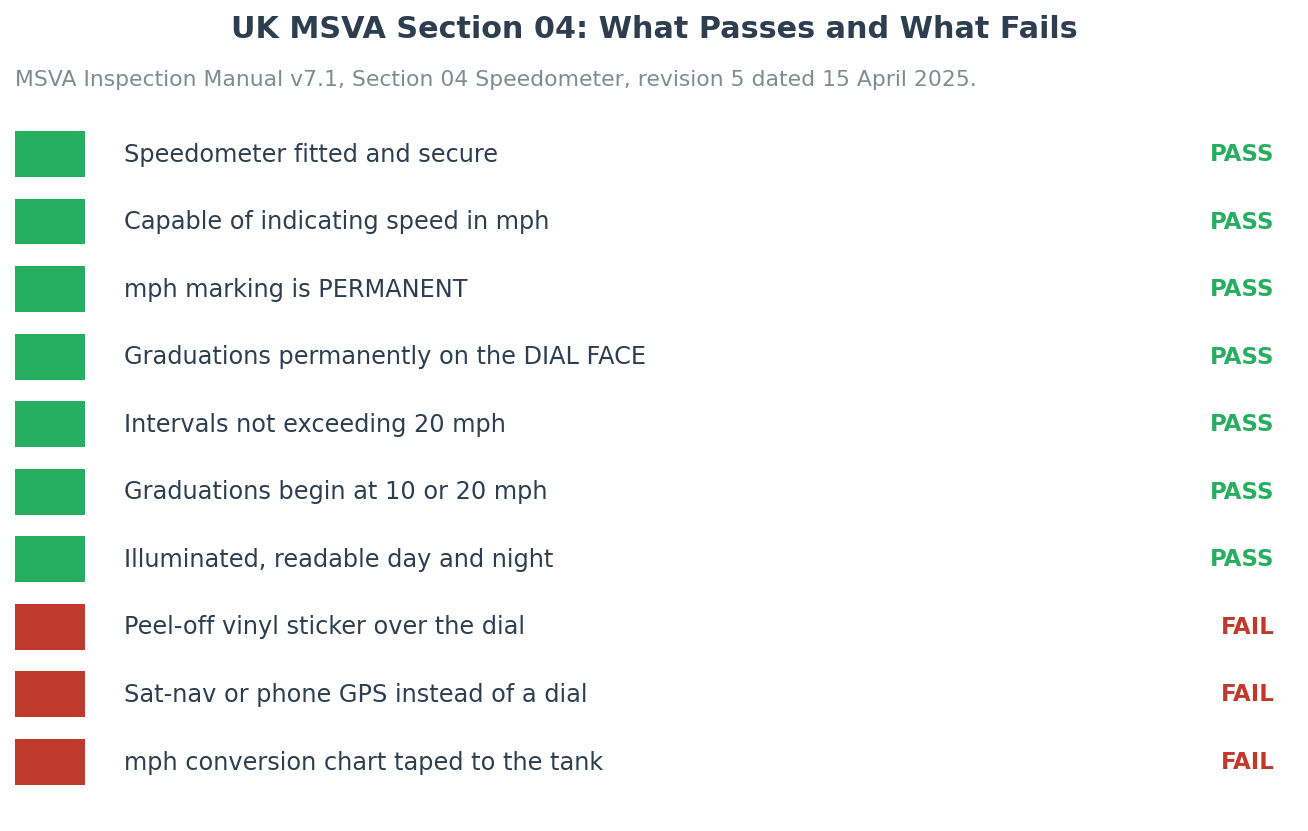
From the MSVA Inspection Manual version 7.1, Section 04 Speedometer, revision 5 dated 15 April 2025, a speedometer must:
- be fitted
- be capable of indicating the vehicle speed in miles per hour
- indicate the speed up to the design speed of the vehicle
- be within the direct field of view of the driver
- be complete (including operating means)
- be secure
Then, for dial speedometers specifically, it must be graduated at uniform intervals not exceeding 20 mph, the graduations must begin at either 10 mph or 20 mph, and — this is the clause that catches people — the graduations must be permanently marked on the dial face.
Two more requirements finish the section. The speedometer has to be capable of illumination such that the indicated speed reads at any hour of the day or night. And the mph (or m/h) indication itself must be permanently marked.
The manual then adds a note that quietly rules out the most popular internet solution: "A global positioning system (GPS) such as a Sat Nav device is not an acceptable alternative to a speedometer." Your phone on a bar mount is not a speedometer. Neither is your Garmin. The examiner is looking at the instrument on the bike.
Underneath MSVA sits the general in-use law. Regulation 35 of the Road Vehicles (Construction and Use) Regulations 1986 requires every motor vehicle first used on or after 1 April 1984 to carry a speedometer "capable of indicating speed in both miles per hour and kilometres per hour, either simultaneously or, by the operation of a switch, separately". The exemptions in paragraph 2 cover slow vehicles, agricultural machines, pre-1984 machines under 100 cc, invalid carriages, works trucks and anything first used before October 1937.
Notice what is not on that list. There is no exemption for imports. There is no exemption for age beyond the 1984 line, and a 1994 Japanese bike was first used in 1994. Every JDM motorcycle anyone is realistically importing falls inside Regulation 35.
The trap inside Section 04: the dial face and the dial glass are different things
Here is the detail that separates a conversion that passes from one that gets you a re-test fee, and it hangs on two words.
Section 04 says the graduations must be permanently marked on the dial face. The note attached to the same section says something different about the unit label: "It is acceptable for the marking (either mph or m/h) to be permanently marked on the dial glass and any reference to kph (km/h) removed (unless it is dual marked)."
So the manual draws a line straight through the middle of the instrument:
- The numbers and graduations — must be on the face, permanently.
- The unit label saying "mph" — may be on the glass, permanently.
That distinction kills the cheapest fix on the market. A vinyl overlay printed with an mph scale and stuck to the outside of the glass puts the graduations on the glass, not the face. It is also removable by definition, which fails "permanently marked" on both counts. Twelve pounds saved, one re-test booked, six weeks lost.
It also explains why the professional route is what it is. A dial specialist strips the cluster, prints or transfers a new face carrying mph graduations, and refits it. The graduations end up where the manual wants them. The unit label goes on either surface. The needle sweep is unchanged because the mechanism has not been touched — only what is printed underneath it.
And it explains the tolerance the note grants at the end: "unless it is dual marked". If your dial carries both scales, you leave the km/h reference alone. The manual only insists you delete km/h when you are converting a single-scale face. Dual-marked instruments were never the problem.
Why the MOT will happily pass an illegal speedometer
Once the bike is registered it stops seeing MSVA and starts seeing the MOT. Those are different tests written by different people to answer different questions, and the gap between them is where a lot of imported bikes quietly live.
MSVA asks: does this vehicle meet construction standards for first registration in Great Britain? Section 04 answers that with the mph requirement above.
The MOT asks: is this vehicle roadworthy today? The motorcycle MOT looks at whether a speedometer is fitted, complete and not obviously inoperative. It does not audit the units. It does not put the bike on a rolling road and check indication against true speed. A tester who sees a working needle sweeping a km/h face has nothing in the manual telling him to fail it.
The consequence is a bike that passes its MOT every year while sitting outside Regulation 35 every day. That is not a loophole you want to rely on. Regulation 35 is in-use law, enforced at the roadside and, more expensively, by insurers reading the fine print after a claim. "It passed the MOT" is not a defence to a construction and use offence, because the MOT never tested for it.
This same split catches imports in other areas. Headlamp beam pattern is checked at MSVA and only aimed at MOT, which is why a Japanese left-hand-traffic headlamp gets through year after year. The pattern is consistent: the approval test is where compliance is proven, and the annual test is where it is assumed.
So the practical rule is simple. Do the conversion once, properly, at import. It is the only moment where somebody is going to check, and it is the cheapest moment to do the work because the bike is already apart for the rest of the pre-MSVA list.
Australia moved the goalposts in February 2026
Most guides written before this year will tell you Australia requires km/h and leave it there. That was true and it is now more specific, in a way that changes what you should do to any bike that will cross markets during its life.
Australian Design Rule 18/03 (Instrumentation) adopts the technical requirements of UN Regulation No. 39. On 3 February 2026 the Vehicle Standard (Australian Design Rule) Alternative Standard Amendments 2025 was registered, commencing the following day, and it inserted a new clause 5.2 into ADR 18/03:
"Speedometers marked with an additional scale in miles per hour (mp/h) in accordance with paragraphs 5.1.2 and 5.1.4 of Appendix A are acceptable for the purposes of this standard, provided that the primary scale is marked in kilometres per hour (km/h) and the mp/h scale is the secondary scale."
Read that against MSVA Section 04 and the conflict jumps out. Britain wants mph permanently marked and, on a single-scale conversion, wants the km/h reference removed. Australia wants km/h as the primary scale with mph demoted to secondary. Those two instructions cannot both be satisfied by a single-scale face.
They can both be satisfied by one instrument: a dual-scale dial with km/h as the outer, primary ring and mph as the inner, secondary ring. That is exactly what UN Regulation 39 paragraph 5.1.2 describes for vehicles built for imperial-unit markets — the speedometer "shall also be marked in miles per hour". Also. Not instead.
ADR 18/03 applies to LC-category motorcycles manufactured on or after 1 July 2006. Older machines are handled through state in-service rules and the prior ADRs, which are less prescriptive but point the same way. If you are buying a post-2006 Japanese bike with an eye on the Australian market, leave the dial alone or specify dual-scale. Do not let a UK-focused dial shop delete the km/h ring.
What the United States federal standard actually says
American buyers get told a lot of confident things about DOT requirements. The federal text is narrower than the folklore.
The relevant standard is FMVSS No. 123, Motorcycle controls and displays, at 49 CFR 571.123. Its stated purpose is "to minimize accidents caused by operator error in responding to the motoring environment, by standardizing certain motorcycle controls and displays". That is a standard about layout and labelling, not about units of measurement.
Two things follow. First, the requirements in S5.2.2 and S5.2.3 are conditional — they apply "if an item of equipment listed in Table 1, Column 1, is provided". The standard regulates the speedometer you have; it does not order you to have one. Second, S5.2.3(d) names the acceptable abbreviations in a single breath: "The abbreviations 'M.P.H.', 'km/h', 'r/min', 'Hi', 'Lo', 'L', 'R', and 'Res' ... may be spelled in full."
km/h is sitting right there in the federal text, on equal footing with M.P.H. There is no federal instruction to convert.
What does bite in the United States is the 25-year rule at the border and state-level registration and inspection practice, which varies enormously. A handful of states run safety inspections that include a functioning speedometer check; almost none specify units. The practical American answer is that the dial is a comfort question rather than a legal one, and a $30 stick-on conversion ring that would fail a British test is perfectly acceptable in most of the country because no British-style test exists.
New Zealand: the one country that wrote both units into the rule
New Zealand's requirement is the clearest of the four, and worth quoting because it settles the question in a sentence.
The NZTA Vehicle Inspection Requirements Manual, section 7-12 Speedometer, defines the instrument as one that "continuously indicates to the driver the forward speed of the vehicle in either kilometres per hour (km/h) or miles per hour (mph)". The reasons-for-rejection list then fails a speedometer that "does not indicate the vehicle's speed in km/h or mph".
Either. Not both, not one specific one. A Japanese km/h dial passes a New Zealand warrant of fitness as delivered.
The same page carries a clarification that echoes the British manual: "This definition does not include the speed provided by a GPS system." Two regulators on opposite sides of the planet felt the need to write that down, which tells you how often somebody turns up to an inspection with a phone in a bar mount and an argument.
New Zealand also requires the speedometer only on vehicles first registered there on or after 1 December 1951 and capable of exceeding 50 km/h, and allows a temporary exemption with written evidence from a repairer that the unit is away for repair with no undue delay. That is a more forgiving structure than anything in the British rules.
Motorcycle speedometers are allowed to lie more than car speedometers
Units are the visible problem. Accuracy is the invisible one, and the numbers here are larger than most riders assume.
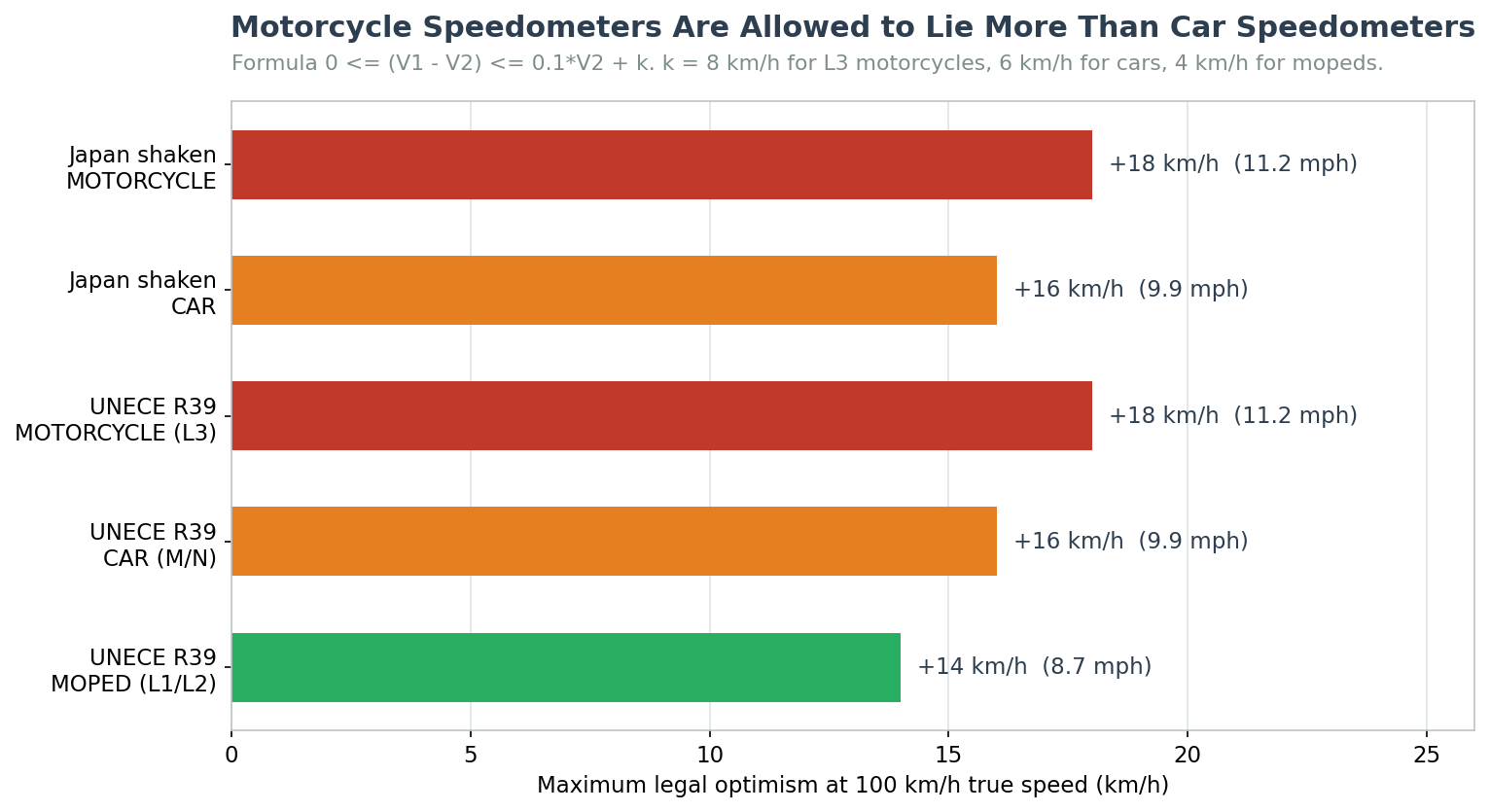
UN Regulation 39, which underpins the British, European and Australian rules, sets the type-approval relationship between displayed speed (V1) and true speed (V2) as:
0 ≤ (V1 − V2) ≤ 0.1 V2 + 4 km/h
Its Annex 3, covering conformity of production, then splits the allowance by vehicle category. Cars and light goods vehicles get 0.1 V2 + 6 km/h. Mopeds get 0.1 V2 + 4 km/h. And L3, L4 and L5 vehicles — solo motorcycles, sidecar outfits and motor tricycles — get 0.1 V2 + 8 km/h.
Motorcycles are handed double the moped allowance and a third more than cars. At a true 100 km/h, a legal motorcycle speedometer reads anything up to 118. At a true 62 mph you are entitled to see 73 mph on the dial and still be inside the regulation.
Japan reaches the same place by a different route. Notification Article 148 sets the post-2006 motorcycle band as 10(V1 − 8)/11 ≤ V2 ≤ V1, and the car band as 10(V1 − 6)/11 ≤ V2 ≤ V1. Rearrange the motorcycle version and you get V1 ≤ 1.1 V2 + 8 — numerically identical to the UN motorcycle figure. Two regulators, two formats, one answer.
This is why owners of derestricted JDM bikes keep reporting GPS speeds well below the dial. It is not a fault. It is the design envelope. When you read a top-speed claim taken off a speedometer in a 1990s magazine test, subtract roughly a tenth and then some.
It also means your converted mph dial inherits whatever optimism the mechanism already had. Re-printing the face changes the labels, not the drive ratio.
The pre-2007 trap: a Japanese speedometer that legally reads low
Now the finding that nobody writes about, and the reason a units-only conversion is not the whole job on an older bike.
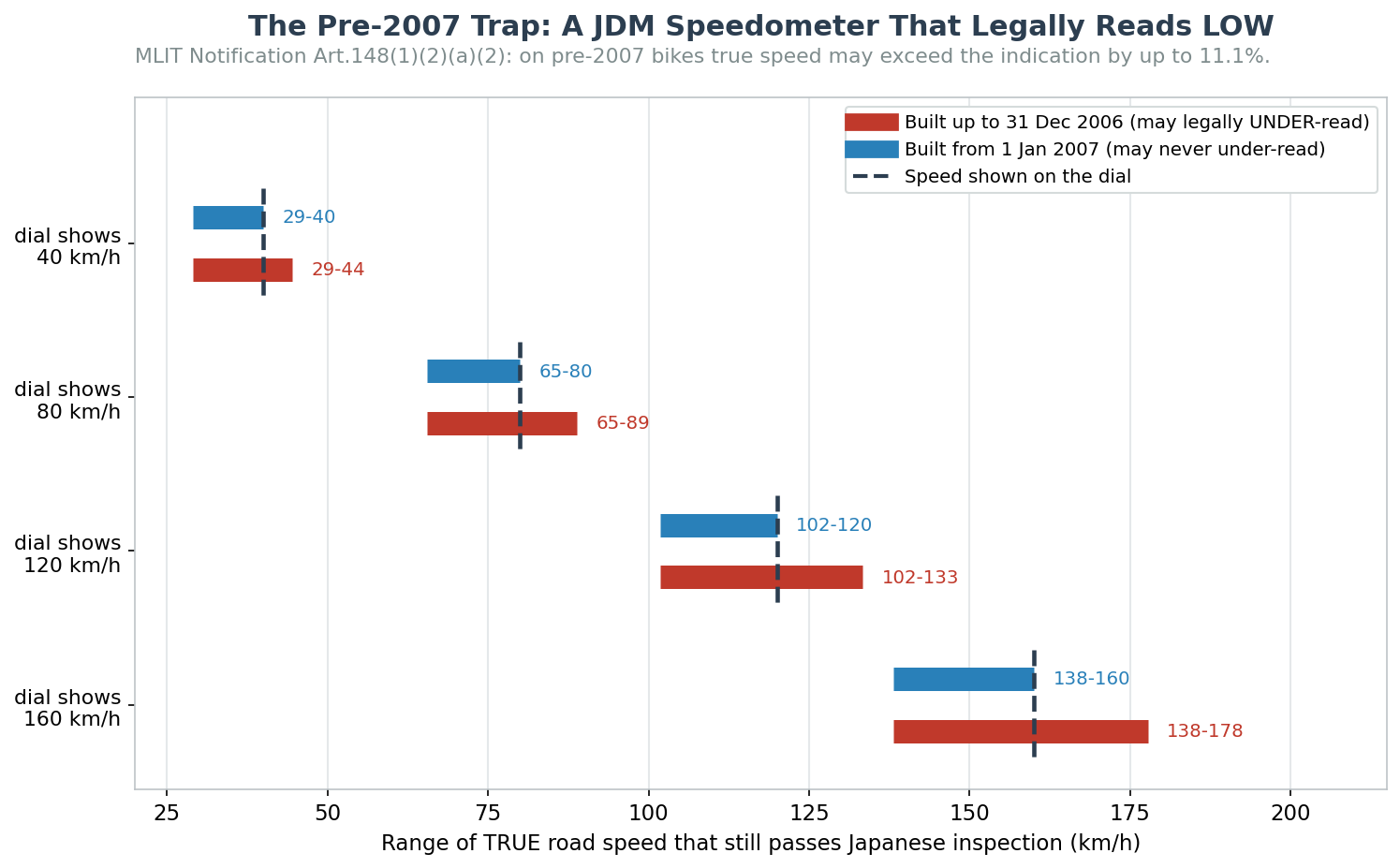
Article 148 splits its accuracy test by build date. For motorcycles manufactured from 1 January 2007 the band is 10(V1 − 8)/11 ≤ V2 ≤ V1. The upper bound is V1 — the true speed may never exceed the indicated speed. That matches the UN rule and every destination market.
For motorcycles manufactured up to 31 December 2006, the upper bound is different: 10(V1 − 8)/11 ≤ V2 ≤ (100/90) V1.
(100/90) V1 is 1.111 × V1. The true speed was permitted to exceed the indicated speed by up to 11.1 per cent. A pre-2007 Japanese motorcycle passed its inspection legally with a speedometer showing 160 km/h while the bike was doing 178.
Set that against UN Regulation 39 paragraph 5.3, which opens with a flat prohibition: "The speed indicated shall not be less than the true speed of the vehicle." The same sentence appears in substance in the British accuracy requirement. Under-reading is not a tolerance in the UK, Europe, Australia or New Zealand. It is a fail.
So a 1990s or early-2000s Japanese bike — which is most of what people import — was built and inspected under a standard that allowed the exact defect that every destination market prohibits outright. Not every bike under-reads. In practice most Japanese speedometers over-read comfortably. But the standard permitted it, and no one checks on the way out.
This is the argument for a rolling-road or GPS check before you commit to a dial re-print. Twenty minutes on a run with a GPS app logging alongside the dial tells you whether you are converting a healthy instrument or gold-plating a broken one. If the dial reads low, the fix is a drive ratio correction or a replacement cluster, not new printing.
The same "verify before you spend" instinct applies to the numbers on the auction sheet. Our guide to reading a Japanese auction sheet covers what the inspector actually records, and our mileage and odometer guide covers what those kilometre readings are worth.
Step by step: how to convert a Japanese motorcycle speedometer to mph
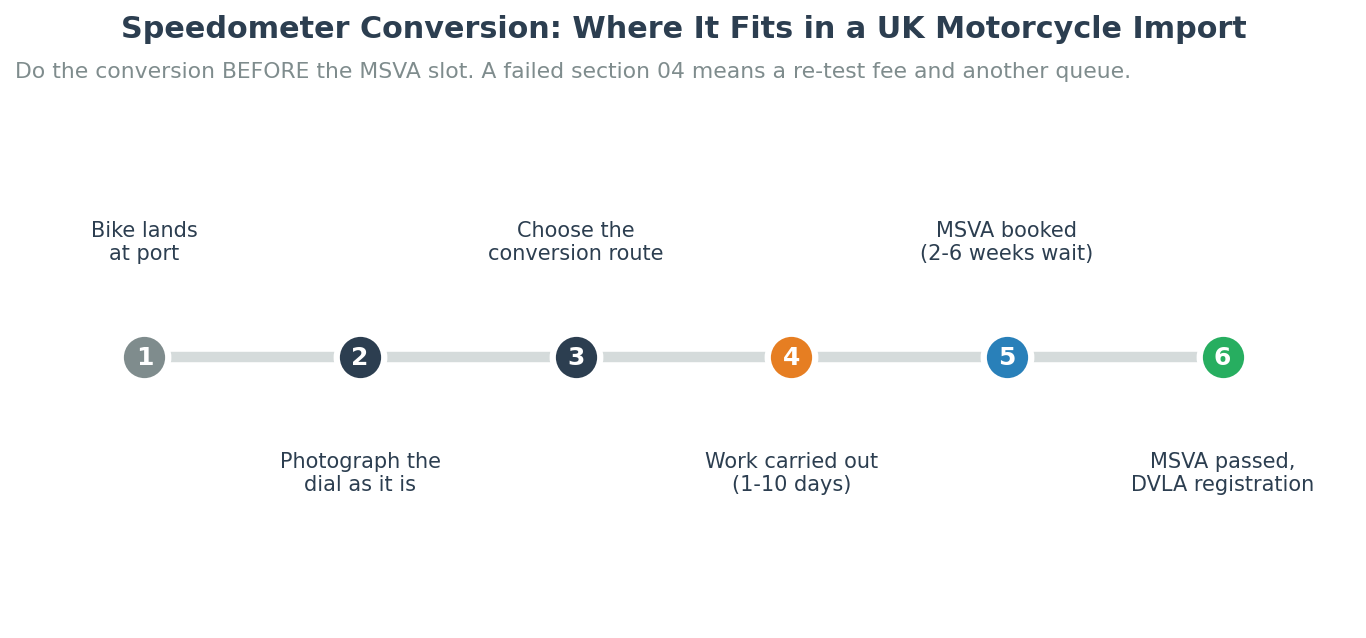
There are five routes. Two of them pass a British test, two of them pass in some markets and not others, and one of them fails everywhere it is checked. Take them in order.
Route 1: vinyl overlay sticker — do not do this
A printed ring that sticks to the outside of the instrument glass, sold for £8 to £20, sometimes bundled free by import agents who ought to know better. It puts the graduations on the glass rather than the dial face, and it peels. Section 04 wants permanent marking on the face. This is neither.
Fine for a track bike. Fine in most of the United States. It will not get an imported motorcycle through MSVA, and the examiner has seen a hundred of them.
Owners report the same thing from the other side of the counter. Under a UK video walking through registering an imported motorbike for road use, one rider describes exactly this position: "I got a kph speedo on my scoot so I have to change the speedo for an mph one. They won't accept stick on numbers any more." That is a field report from somebody who tried it, and it matches Section 04 word for word.
Worth noting what happens when you search for help with this. Every high-ranking video on converting a km/h speedometer to mph is about a car — a Toyota Supra with a speedo converter wired in, a Mini Cooper display toggle, a RAV4, a Corolla. The written guides are the same: car import specialists, car conversion shops, car forums. Motorcycles have their own inspection section with its own dial-face rule, and nobody had written it up.
Route 2: permanent glass re-marking — the budget route that works
Screen-printing or etching the mph unit label permanently onto the glass, combined with an existing dual-marked face or a face that already carries mph graduations. £45 to £90 at most instrument specialists.
This is the route the MSVA note explicitly blesses. It works only if the graduations problem is already solved — the glass carries the unit label, the face carries the numbers. If your face is km/h-only with no mph ring, glass marking alone does not get you there.
Route 3: professional dial face re-print — the standard answer
The cluster comes apart, the original face is either over-printed or replaced with a reproduction carrying mph graduations at uniform intervals of 20 mph or less, starting at 10 or 20 mph, and the whole thing goes back together. £95 to £180 in the UK depending on how awkward the cluster is to open and whether the needle needs re-zeroing.
This satisfies every clause in Section 04 at once: permanent, on the face, correct interval, correct starting graduation. It also preserves the original instrument, which matters to anyone who cares what the bike looks like in ten years.
Ask the shop two questions before you book. Do they re-zero the needle after refitting, and do they photograph the face before disassembly. The second one has settled more arguments than the first.
Route 4: dual-scale replacement cluster — the expensive, portable answer
Buying the export-market instrument cluster for the same model, which carries km/h as the primary scale and mph as the secondary. £180 to £520 depending on model and how many people are chasing the same part.
This is the only route that satisfies the UK and the amended Australian rule simultaneously, because it is the configuration UN Regulation 39 paragraph 5.1.2 was written to describe. If there is any chance the bike moves market during your ownership, this is the one to buy.
The catch is availability. Export clusters for 1990s 400cc-class bikes are thin on the ground, because those bikes were never sold outside Japan in the first place — which is rather the point of importing one. Popular grey import models with export twins, like the litre-class sports bikes, are far easier to source.
Route 5: aftermarket digital speedometer — the last resort
A universal digital unit with a switchable mph display, £120 to £340 fitted. It solves units permanently and usually improves accuracy, since you calibrate it to the actual wheel and sprocket combination.
It also throws away the original instrument, changes the look of the bike, and introduces a wiring job. MSVA will accept it as long as it is fitted, secure, illuminated, in the rider's direct field of view, and shows mph. Section 04's dial-specific graduation rules do not apply to a digital display.
What each route costs and how long it takes
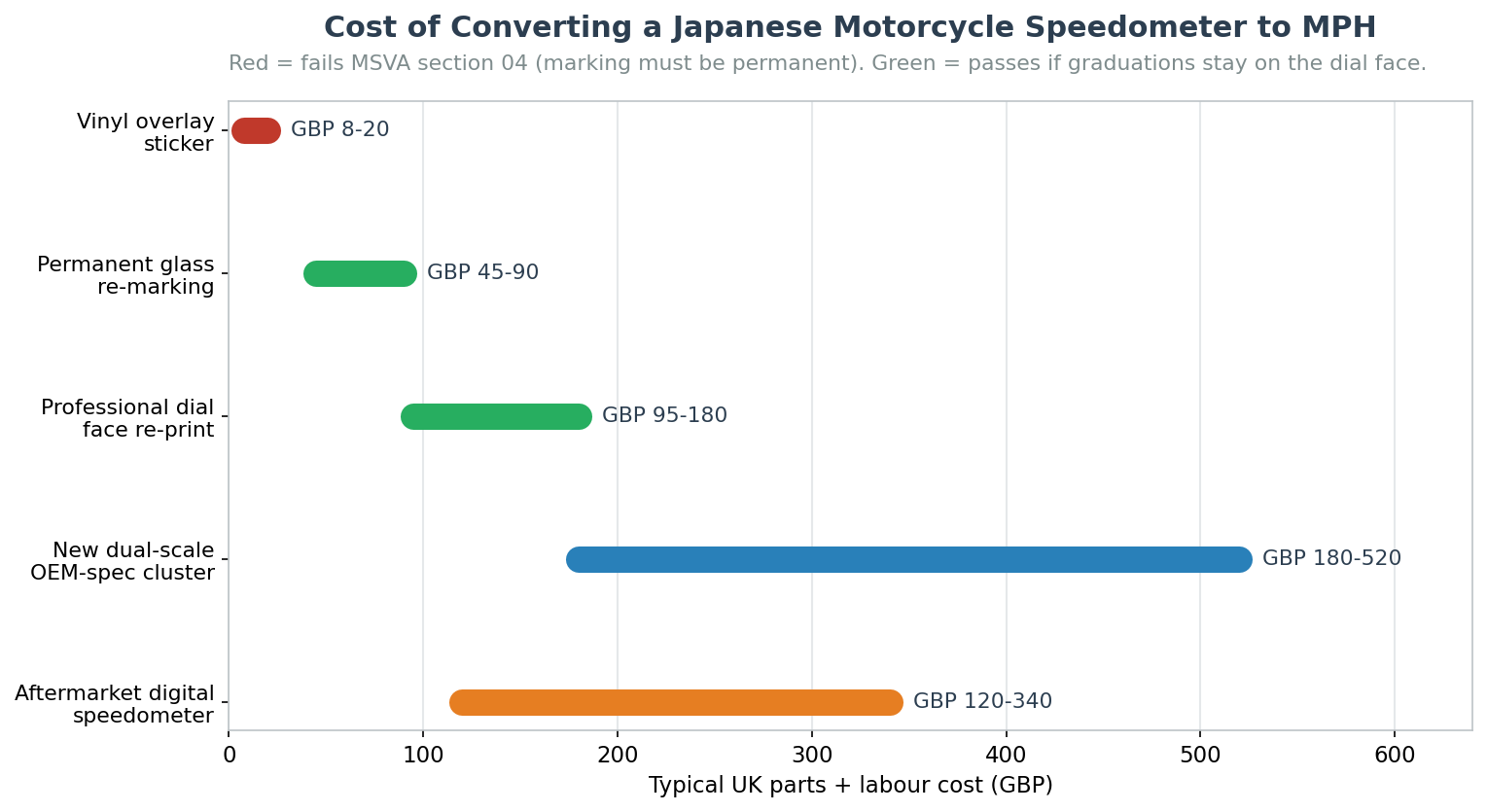
Costs are only half the decision. Timing is the other half, and timing is where imports go wrong.
Dial face re-printing takes one to ten working days depending on whether the shop stocks a face for your model or has to print one. Export clusters take as long as the part takes to find, which is anywhere from a week to never. Digital units are same-day if you are fitting it yourself and a workshop day if you are not.
MSVA slots are the constraint. Booking a test typically runs two to six weeks out depending on the station. That is dead time you should be spending on the conversion, the headlamp, and everything else on the pre-test list. Sequence it so the bike arrives at the test complete.
A failed Section 04 costs you the re-test fee plus a second wait in the same queue. Against a £150 dial re-print, that is a bad trade twice over. Set the whole import budget out properly with our full Japan-to-UK cost breakdown and the duty and tax guide.
Reading a km/h dial before you convert it
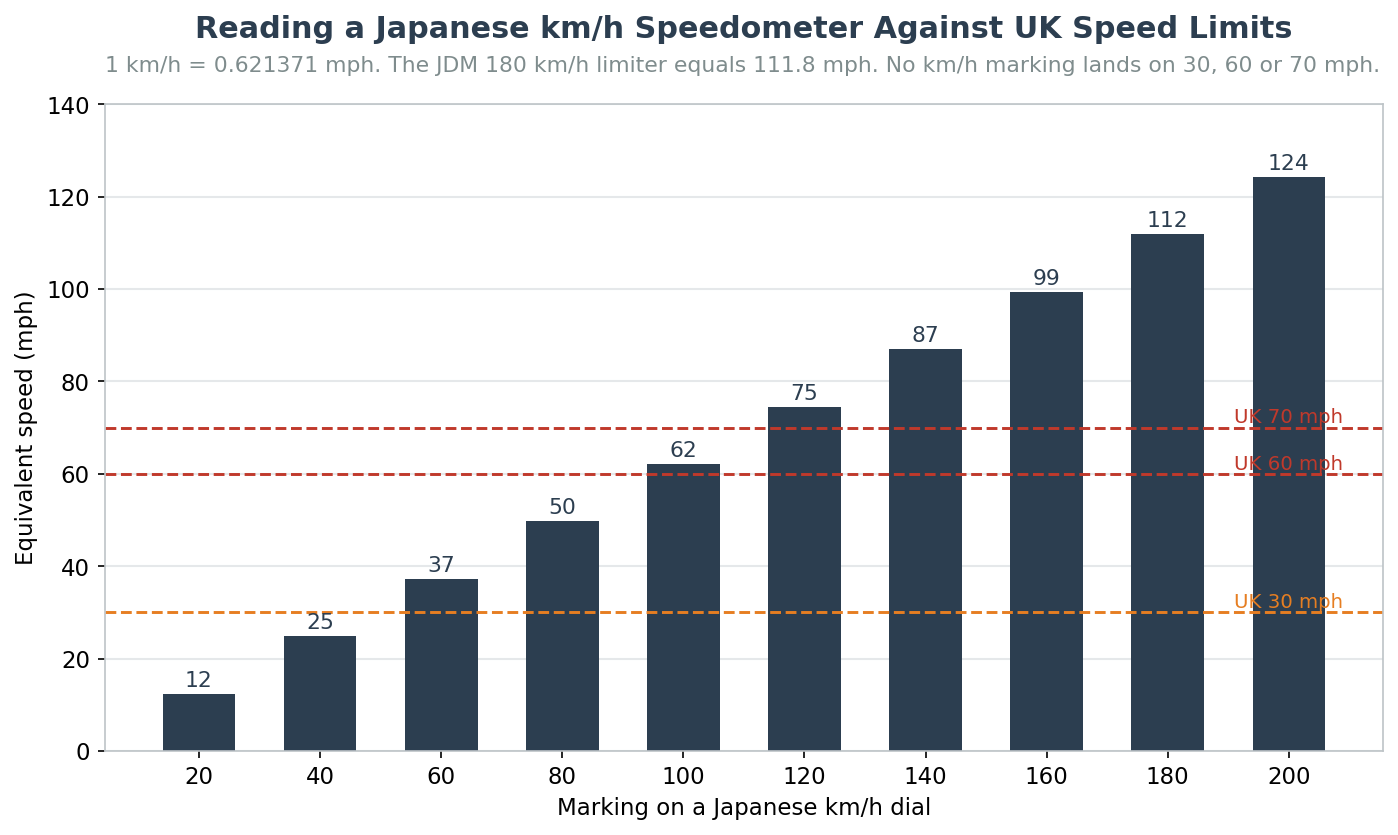
Between the bike landing and the conversion happening, you have a bike you sometimes need to move. One kilometre per hour is 0.621371 mph. That is the whole conversion, and the useful landmarks are these:
- 30 mph — a British urban limit — is 48 km/h. Your dial has marks at 40 and 60.
- 60 mph is 97 km/h. Just under the 100 mark.
- 70 mph is 113 km/h. Between 100 and 120, closer to 120.
- The JDM 180 km/h limiter is 111.8 mph.
Not one British speed limit lands on a Japanese dial graduation. That is not bad luck; it is what happens when you divide a base-10 scale by 1.609. The mental arithmetic is genuinely awkward, which is a large part of why the British rule exists in the first place.
The rough field method that works: take the km/h reading, halve it, then add a tenth of the original. 100 km/h becomes 50 plus 10, which is 60. True answer 62. Close enough to keep a licence, not close enough to argue with.
What to look for in the auction photographs
Every one of the decisions above is made easier by three photographs taken before the bike leaves Japan, and every one of them is harder if you wait until it lands.
The first is a straight-on shot of the instrument cluster with the ignition off. That tells you whether the face is single-scale km/h or already dual-marked, what the maximum marking is, and whether the graduations sit at 10 or 20 km/h intervals. A face with a 180 maximum and 20 km/h graduations converts cleanly to a 20 mph interval. A face with a 320 maximum and 10 km/h graduations needs more thought, because a straight re-print at 20 mph intervals leaves an oddly sparse dial.
The second is the same shot with the ignition on. Section 04 wants the speedometer capable of illumination such that the reading is visible day and night. Japanese clusters from the 1990s use small filament bulbs behind the face, and a dead bulb is a five-minute job that becomes a re-test if nobody notices until the examiner does.
The third is a close crop of the odometer window. Six digits or five decides how much you trust the reading, and a mechanical drum sitting between digits tells you the cable has been disconnected at some point. That has nothing to do with units and everything to do with what you are paying.
None of that requires a specialist. It requires somebody standing in front of the bike at the auction house with a phone, which is the part most buyers do not have and most agents do not offer.
The limiter and the dial are two different problems
People conflate these constantly, so it is worth separating them cleanly.
The 180 km/h limiter on Japanese domestic bikes is a voluntary industry agreement, implemented in the ECU or the ignition, that cuts power or spark once the speed signal crosses the threshold. It is about how fast the bike goes. We cover how it works on specific machines in our guides to the Kawasaki ZXR400, the Suzuki Hayabusa, the Honda CBR1000RR and the Kawasaki ZZR1100.
The km/h dial is about what the bike tells you. It is a printing question.
Removing the limiter does nothing to the dial. Converting the dial does nothing to the limiter. Neither is required by the other, and no inspection in any of the four markets asks about the limiter at all — a restricted bike is simply a bike with a lower top speed, which is not an offence anywhere.
The two do meet in one place. Derestricting raises the speeds you will actually see, which means the accuracy question above stops being academic. A speedometer that over-reads by the full legal allowance is a nuisance at 60 mph and an expensive misunderstanding at 130.
The odometer stays in kilometres, and that is fine
Every conversion customer asks this, so here it is plainly: no British rule requires the odometer to read miles.
MSVA Section 04 governs the speedometer. It says nothing about distance units. Regulation 35 is titled Speedometers and addresses speed indication. The MOT records a mileage figure and has a field for recording that the reading is in kilometres. The DVLA V5C carries the reading as supplied.
This produces the standard British import instrument: speed in miles per hour, distance in kilometres. It looks wrong and it is entirely legal. New Zealand's inspection manual takes the same position, requiring only that an unreadable odometer be noted on the checksheet.
Where it does matter is resale. A UK buyer reading 68,000 on a Japanese odometer sees a high-mileage bike; the honest figure is 42,000 miles. Put both numbers in the advert. Sellers who quietly let the kilometre figure stand as if it were miles are the reason buyers now assume the worst.
Five mistakes that cost imported bikes their test slot
Converting after booking the test. The dial shop's lead time and the test station's lead time are not the same number, and only one of them is refundable.
Buying a sticker because the agent included it. A free part that fails a test is not free. It costs a re-test fee and a place in the queue.
Deleting the km/h scale on a bike destined for Australia. ADR 18/03 clause 5.2 wants km/h primary. A UK-style single-scale mph face is now the wrong answer down there, and it has been since 4 February 2026.
Assuming an mph face fixes accuracy. The face is printing. The error lives in the drive ratio and the mechanism. Check with GPS first, especially on anything built before 2007.
Relying on GPS at the test. Both the British and New Zealand manuals write GPS out explicitly. Two regulators bothered to say it, which means plenty of people have tried.
A sixth one, for completeness: doing all of this before the paperwork exists. The speedometer is a Section 04 problem, but the bike does not reach Section 04 without a NOVA registration and the right export documents. Our step-by-step UK import guide puts the whole sequence in order.
How AWA Auction handles the speedometer question before you bid
We buy from Japanese auctions on behalf of customers in the UK, Australia, New Zealand and North America, which means we deal with all four of the rules above in the same week.
On every lot we inspect, we photograph the instrument cluster straight on and record three things: whether the face is single or dual scale, the maximum marking, and whether the odometer reads kilometres. Those three facts decide whether a UK buyer has a £150 job or a £400 one, and whether an Australian buyer has anything to do at all.
For UK-bound bikes we flag models where an export-spec dual-scale cluster is realistically available, because that is the version worth paying for. For 400cc-class machines that were never exported, we say so up front rather than letting you discover it after the bike has shipped.
You can see what is currently coming out of the Japanese auction halls on our current listings page. If a specific model matters to you and you want the dial checked before anyone bids, tell our team which model and we will look at the cluster on every example that comes up.
None of this is exotic knowledge. It is one section of one inspection manual, one clause of an Australian design rule that changed six months ago, and one Japanese notification that explains why the dial is the way it is. It is just that nobody had put them next to each other for motorcycles — the conversion guides that exist are all written about cars, and a car does not have a Section 04 that distinguishes the dial face from the dial glass.
Get the dial right once, at import, and it never comes up again. Get it wrong and it comes up at the worst possible moment, which is the morning of a test you waited five weeks for.
Ready to start? Browse the bikes we have available now, or talk to us about a specific model and we will tell you exactly what its instrument cluster will cost you in your market.
Primary sources referenced in this guide: MLIT Notification Article 148 (Speedometers), Japan; Motorcycle Single Vehicle Approval Inspection Manual, Section 04, DVSA; Road Vehicles (Construction and Use) Regulations 1986, Regulation 35; 49 CFR 571.123, FMVSS No. 123; Australian Design Rule 18/03 — Instrumentation; NZTA VIRM 7-12 Speedometer.
See Also
Share this article: