
If you want to import a Kawasaki Ninja 650 or ER-6f from Japan, you are chasing one of the most quietly sensible motorcycles Kawasaki ever built — and one of the most confusing to shop for. Same engine, five generations, three different names depending on which continent you are standing on. Buyers lose money on this bike not because it is a bad machine, but because they bid on the wrong version of it.
Here's the thing nobody mentions in the glossy reviews: the 649cc parallel twin under all of these bikes is close to indestructible. A Malaysian owner posted a top-speed run on a bone-stock 2010 ER-6f that pulled 212 km/h on a wet highway, and noted his dry-road best was 220 km/h. He later beat it with 230 km/h on the 2013 model. That video has passed 1.5 million views. Nobody in the comments is complaining that the engine let go. They are arguing about whether the speedo reads eight km/h fast (it does).
What kills these bikes is neglect and salt, not mileage. And that is exactly why Japan is the right place to buy one.
This guide covers what the bike is actually called on a Japanese auction listing, which generations are worth the freight, whether you can legally import one at all, what it costs door to driveway, and the eight repair bills that decide whether you got a bargain or a project.
Why a Japanese ER-6f beats a local one
Three things make the Japanese domestic market the best hunting ground for this particular bike.
Mileage is genuinely low. Japanese riders commute by train. Bikes get used at weekends, stored indoors, and sold on at 15,000 km when the owner fancies something else. A UK ER-6f with 15,000 miles on it is a garage queen and priced like one. In Japan that is an ordinary Tuesday listing.
Corrosion is a different conversation. The ER-6f has a known weakness around rusted exhaust studs and swingarm fasteners — and the reason UK-market examples suffer is winter road salt. Japan grits its northern roads, but the Kanto and Kansai bikes that fill the big auction houses have rarely met a salted road in their lives. Our guide to rust and corrosion on Japanese imports goes deeper on what to look for and where regional differences show up.
The paperwork trail is real. Japan's shaken inspection system means bikes over 250cc carry a documented history of periodic roadworthiness checks. That is not a full service book, but it is a great deal more than "seller says it's been serviced."
Put those together and the arithmetic works. A tidy 2013 ER-6f with 24,000 km lands in the UK for roughly £4,900 all in. The equivalent bike sitting on a British dealer's forecourt with 31,000 miles and a winter's worth of fastener rot sits at £5,900 to £6,200.
Ninja 650, ER-6f or 650R: what this bike is called in a Japanese listing
This is where most first-time importers waste three weeks searching the wrong term.
Kawasaki gave the same motorcycle different badges in different markets, and Japanese auction catalogues use the domestic name. Search the wrong one and you will see a fraction of the available stock.
- ER-6f — the European and Japanese name for the half-faired model, 2006 to 2016. This is the term that appears most often in auction data.
- Ninja 650R — the North American badge for the 2006 to 2011 bike. You will see this on Japanese listings too, because Kawasaki sold "Ninja 650R" stickers in Japan for part of that run.
- Ninja 650 — from 2012 in North America, and worldwide from 2017 when the ER-6f name was retired.
- ER-6n — the naked sister. Same engine, no fairing, different bike to live with. Covered in our ER-6n import guide.
- Z650 / Versys 650 — the 2017-on naked and the adventure-styled tourer. Same 649cc twin, different chassis.
Practical advice: run every search across "ER-6f", "ER6f", "Ninja650" and "650R". Japanese auction house databases treat those as separate strings. A single search term will hide half the catalogue from you.
Every generation, and which ones deserve the freight bill
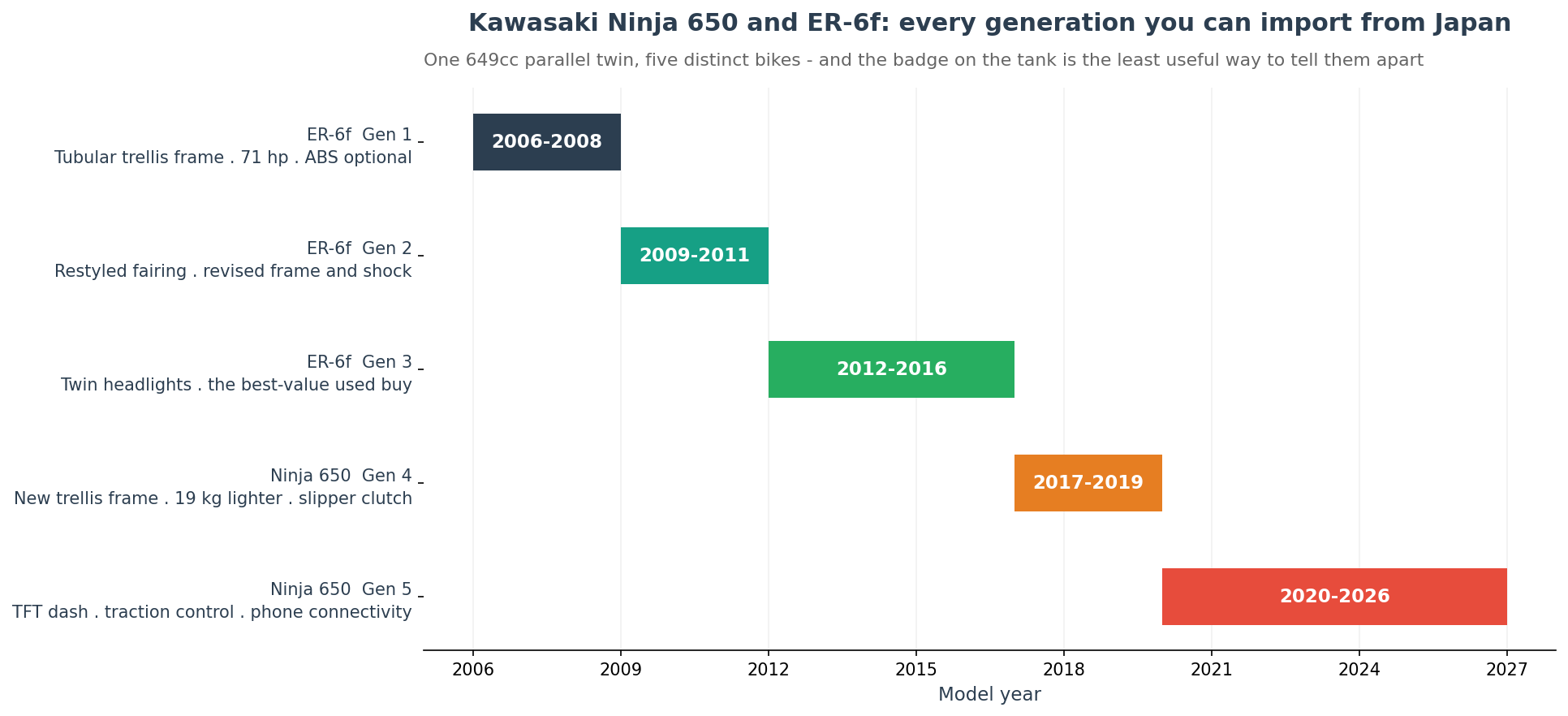
Gen 1, 2006–2008. The original. Tubular trellis frame, 71 hp, underslung shock mounted on the right, distinctive single headlight. ABS was optional and rare in Japan. These are the cheapest at auction and they ride beautifully, but they are now approaching twenty years old and the suspension has usually surrendered. Buy one if you want a cheap, characterful bike and you are comfortable budgeting for fork and shock work.
Gen 2, 2009–2011. Restyled bodywork, revised frame, better rear shock linkage, and a much less awkward-looking tail. The riding experience is the same in the best way. Prices at Japanese auction sit only marginally above Gen 1, which makes this a strong value pick.
Gen 3, 2012–2016. The one to buy. Twin headlights, sharper fairing, improved dash, and by this point Kawasaki had ironed out most of the early niggles. This is the generation both MCN and Bennetts BikeSocial single out in their used buying guides, and the Japanese supply of them is deep.
Gen 4, 2017–2019. Renamed Ninja 650. A genuinely new bike: fresh trellis frame, 19 kg lighter, slipper clutch, sharper steering. Power dropped fractionally to 67 hp on paper but the bike is quicker in the real world because of the weight loss. One commenter on a 745,000-view dealer review put it plainly: Kawasaki "improved the gear shift linkage and new dashboard and seats." Downside for importers — these are recent enough that Japanese prices are still firm.
Gen 5, 2020 onward. TFT dash, traction control, smartphone connectivity, two riding modes. Lovely bike. Terrible import value while it is this new, and in most countries you can buy one locally without the freight and paperwork.
The short version: Gen 2 and Gen 3 are the import sweet spot. Cheap enough in Japan for the shipping cost to make sense, modern enough to live with daily.
Can you legally import one? Check this before you get attached
This is the section that saves some readers a lot of heartache, so let's be blunt about it.
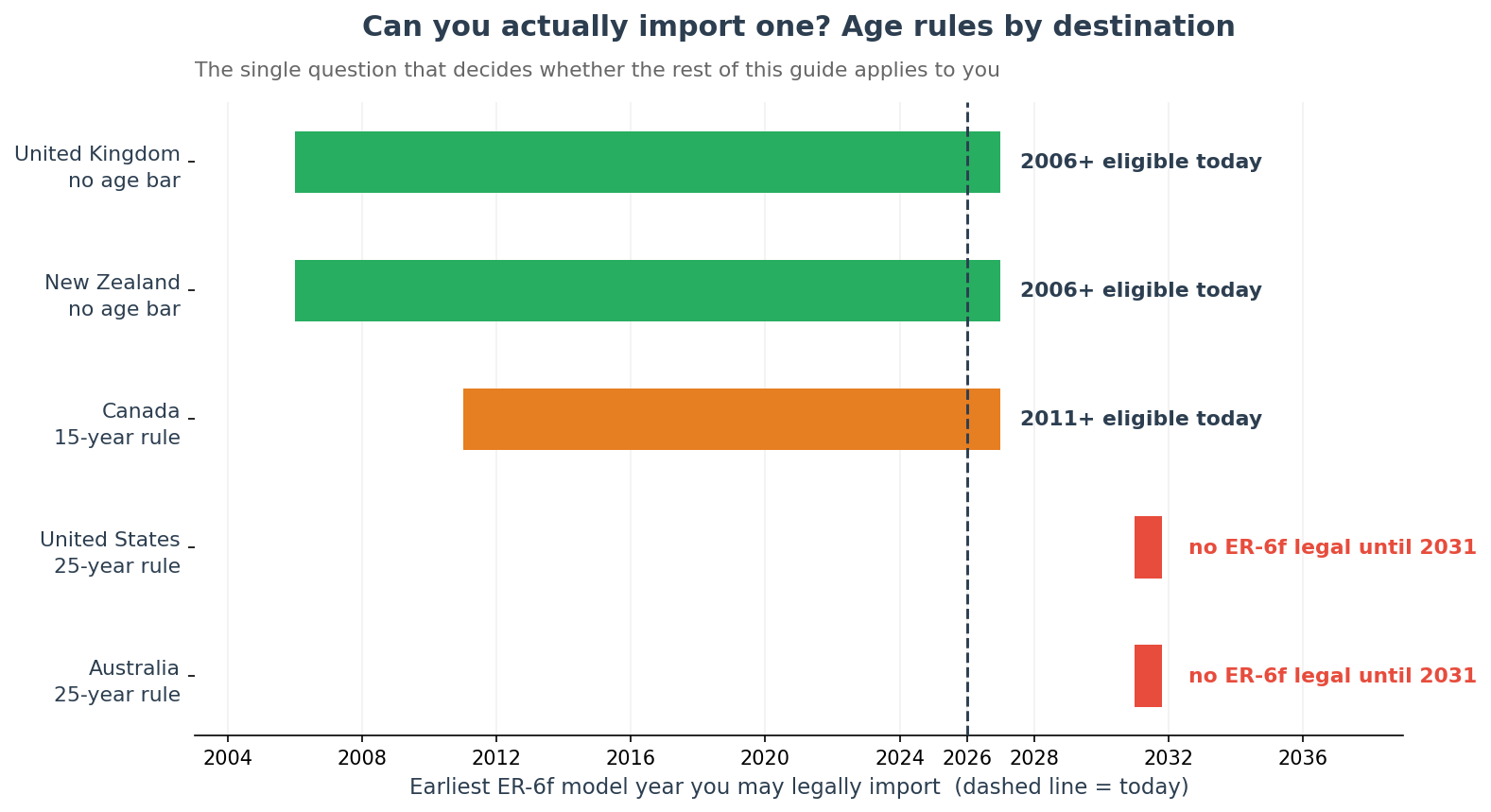
United States and Australia: you cannot import an ER-6f yet. Both operate a 25-year rule, and the first ER-6f rolled out in 2006. That makes 2031 the earliest year a US or Australian buyer can bring one in under the age exemption. There is no clever workaround for a road-registered bike. Our 25-year rule guide explains the narrow exceptions, and none of them are a practical route for a 2013 middleweight.
Canada: 2011 and earlier are fair game. Canada uses a 15-year rule, which as of 2026 opens up Gen 1 and Gen 2 ER-6f models. See our Japan to Canada import guide for the RIV and provincial steps.
United Kingdom and New Zealand: any model year. Neither imposes an age bar on motorcycle imports. UK buyers deal with NOVA notification and, for a bike without European type approval, an MSVA test. New Zealand runs its own compliance inspection. Both are routine.
If you are in the US or Australia and you have fallen for the ER-6f, the honest advice is to look at what your rules do allow. Plenty of excellent 2001-and-earlier Japanese middleweights are eligible right now.
What a Japanese ER-6f costs to land on your driveway
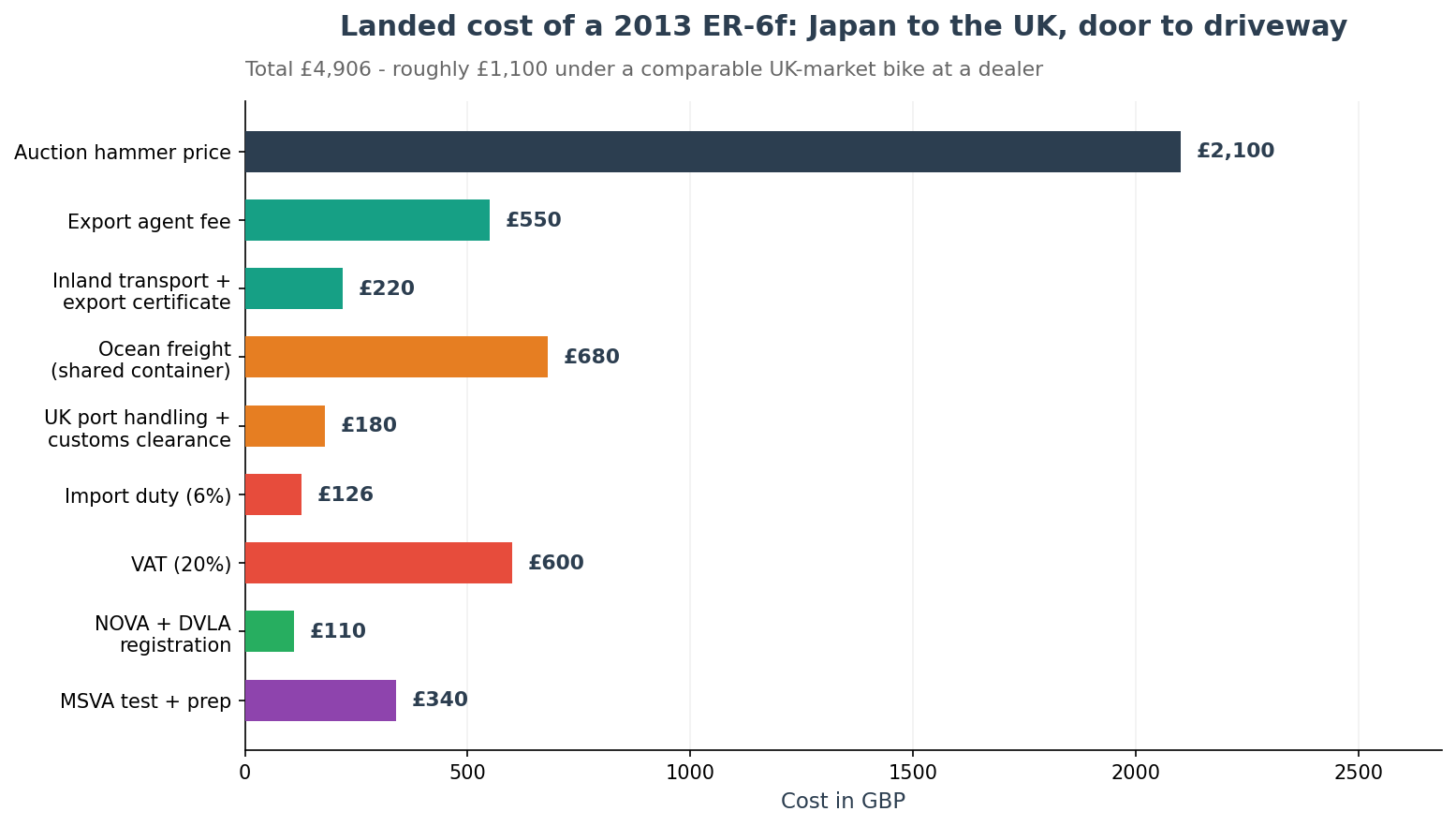
Numbers for a 2013 ER-6f, Grade 4, around 24,000 km, shipped Japan to the UK in a shared container.
| Line item | Typical cost | What it covers |
|---|---|---|
| Auction hammer price | £2,100 | Winning bid, roughly ¥400,000 |
| Export agent fee | £550 | Bidding, translation, inspection, export handling |
| Inland transport + export certificate | £220 | Auction house to port, deregistration paperwork |
| Ocean freight, shared container | £680 | Japan to Southampton or Felixstowe |
| UK port handling + customs clearance | £180 | Unloading, agent clearance fee |
| Import duty at 6% | £126 | Charged on the CIF value |
| VAT at 20% | £600 | Charged on value plus duty plus freight |
| NOVA + DVLA registration | £110 | HMRC notification, first registration, plate |
| MSVA test + prep | £340 | Test fee plus headlight, speedo and mirror work |
| Total landed | £4,906 | Registered and legal on UK roads |
Three notes on that table. The MSVA line is the one people forget: a Japanese-market bike has a speedometer in km/h and a headlight aimed for left-hand traffic, and the UK wants both addressed. The good news is that the ER-6f is a straightforward MSVA candidate — no exotic parts required.
Freight is the line with the most variance. A shared container is the sensible default for a single bike. RoRo is cheaper on paper and rougher in practice; our container versus RoRo comparison lays out when each makes sense. If you want the full picture on UK costs across any model, the complete Japan to UK cost breakdown covers it in detail.
Insurance is the last piece and worth sorting before the bike arrives, not after. An imported ER-6f is easy to insure once it has a UK registration, but a handful of insurers still balk at grey imports. Our imported motorcycle insurance guide covers who plays nicely.
Reading the auction sheet when the bike has a fairing
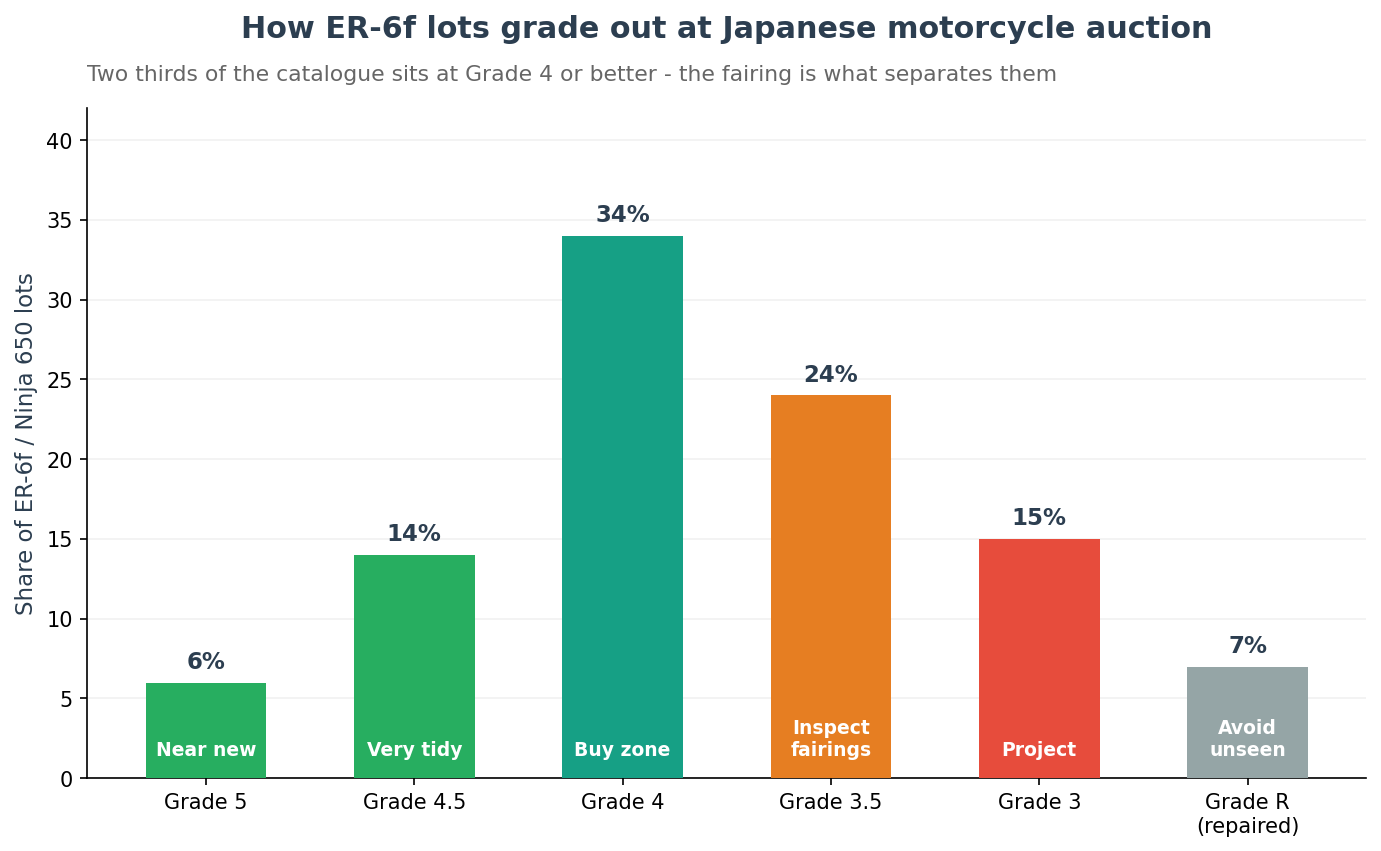
Japanese motorcycle auctions grade every lot, and the grade is the single most useful number on the sheet. Roughly a third of ER-6f lots land at Grade 4, another fifth at 4.5 or 5, and about a quarter at 3.5.
Faired bikes need reading differently from naked ones, and this is where ER-6f buyers get caught.
On a naked ER-6n, a drop shows up as a bent lever, a scuffed bar end, a scraped engine case. Obvious, cheap, honest. On an ER-6f the fairing absorbs the impact and hides the story. A bike that went down at walking pace in a car park can present as a Grade 4 with a single noted scratch — and the crack that runs behind the panel where the mounting tab snapped never makes the sheet.
What to insist your agent photographs on an ER-6f:
- The inner fairing mounting tabs. These snap first and are invisible from outside. A cable-tied fairing is the tell.
- Both fairing panel edges where they meet the tank. Misalignment here means the subframe or the bracket took a hit.
- The exhaust header studs. The ER-6f uses a one-piece exhaust. If the header nuts are corroded solid, a future hole in the system means replacing the entire thing.
- The top shock mount. Play at the upper mount is a documented owner complaint on higher-mileage examples.
- Fork lowers, close up. Seal weep shows as a dark ring above the slider.
A Grade 4 with clean tabs is a better buy than a Grade 4.5 where nobody looked. Our guide to reading Japanese auction inspection sheets walks through the symbols and abbreviations line by line, and what an auction sheet actually tells you covers the grading scale itself.
The odometer sweet spot, and why Japanese numbers are real
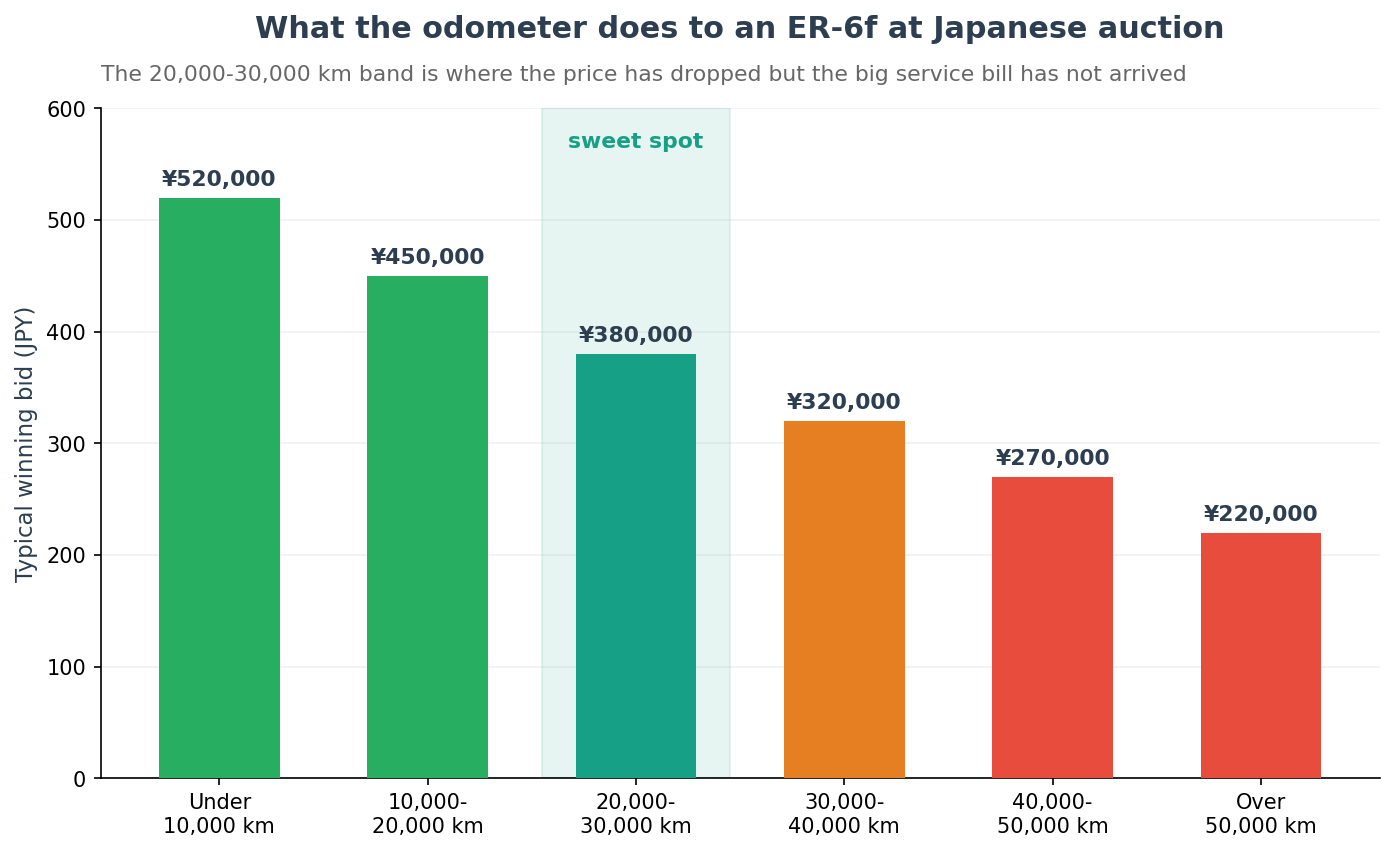
Price against mileage on ER-6f lots follows a clean curve, and it has a kink in it worth exploiting.
Under 10,000 km, you pay a serious premium for numbers that mostly signal a bike that sat. Between 10,000 and 20,000 km the premium is still there. From 20,000 to 30,000 km the price has fallen by roughly a quarter from the low-mileage bikes, and here is the important part: the ER-6f's first valve clearance service falls at around 19,000 km, and the second at 38,000 km. A bike in the 20,000 to 30,000 km band has had the expensive service done and is not yet due the next one.
Push past 40,000 km and you need paperwork. Owners in the 40,000-plus bracket should be able to show a clutch replacement and at least one chain and sprocket set. Without records, treat a 45,000 km ER-6f as a bike that needs £700 of work on arrival.
Japanese odometer readings are, on the whole, trustworthy. The auction system stakes its reputation on it and tampering carries real consequences. That said, verify rather than assume — our guide to Japanese motorcycle mileage and odometers explains the cross-checks, including how shaken records corroborate the reading.
Eight bills that decide whether your import was a bargain
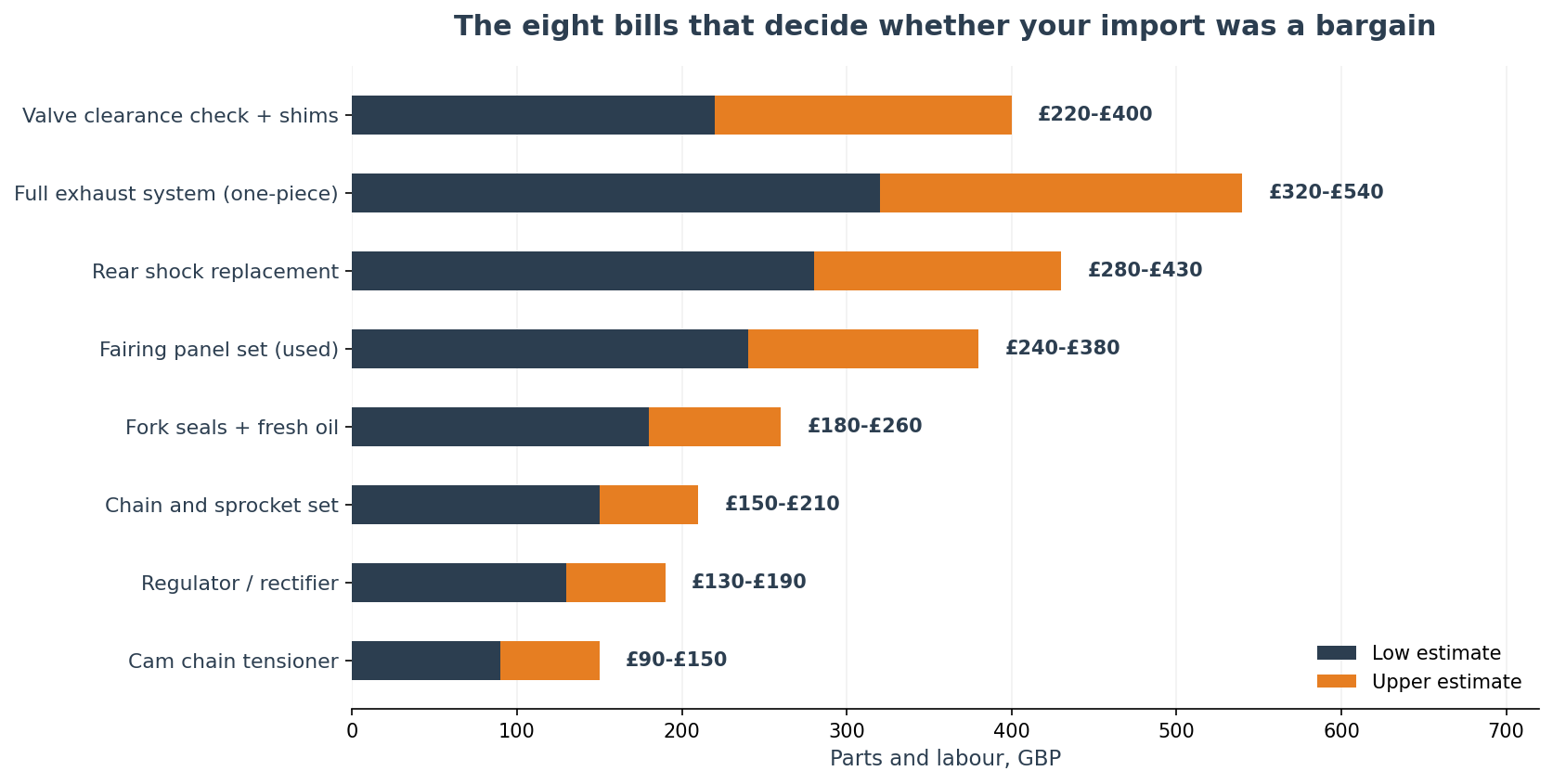
The engine is not the risk. The stuff bolted around it is. These are the eight items that show up repeatedly on used ER-6f inspections, with realistic parts-and-labour figures.
1. Valve clearance check and shims — £220 to £400. Due roughly every 19,000 km. A ticking noise at idle points at tight shims. Skipping this interval is the one genuine way to hurt this engine.
2. Full exhaust system — £320 to £540. The ER-6f exhaust is a single welded unit. One hole and the whole system goes. The failure mode is corrosion at the header studs, which then seize and turn a simple job into a drilling exercise. This is the ER-6f's worst design decision.
3. Rear shock replacement £280 to £430. The original shock is adequate new and tired by 40,000 km. Play at the top mount is the classic symptom.
4. Fairing panel set — £240 to £380 used. The plastics crack easily and new panels are expensive enough to write off a cheap bike. Buy used.
5. Fork seals and fresh oil — £180 to £260. A known weak point on higher-mileage examples.
6. Chain and sprocket set — £150 to £210. Neglected badly on these bikes. Budget for it unless you see a receipt.
7. Regulator / rectifier — £130 to £190. Not epidemic on the ER-6f, but a known Kawasaki-family item worth checking with a multimeter.
8. Cam chain tensioner — £90 to £150. A rattle on cold start is the early warning. Cheap to fix, expensive to ignore.
Total worst case if every one of those needs doing: about £2,400. Which is why buying a Grade 4 or better with a documented history matters more than shaving ¥30,000 off the hammer price. Sourcing the parts is straightforward — our Japanese motorcycle parts import guide covers where to buy and what to ship with the bike.
ER-6f versus ER-6n, Z650 and Versys 650
All four run the same 649cc twin. They are not the same bike to own, and picking wrong is the most expensive mistake in this whole guide.
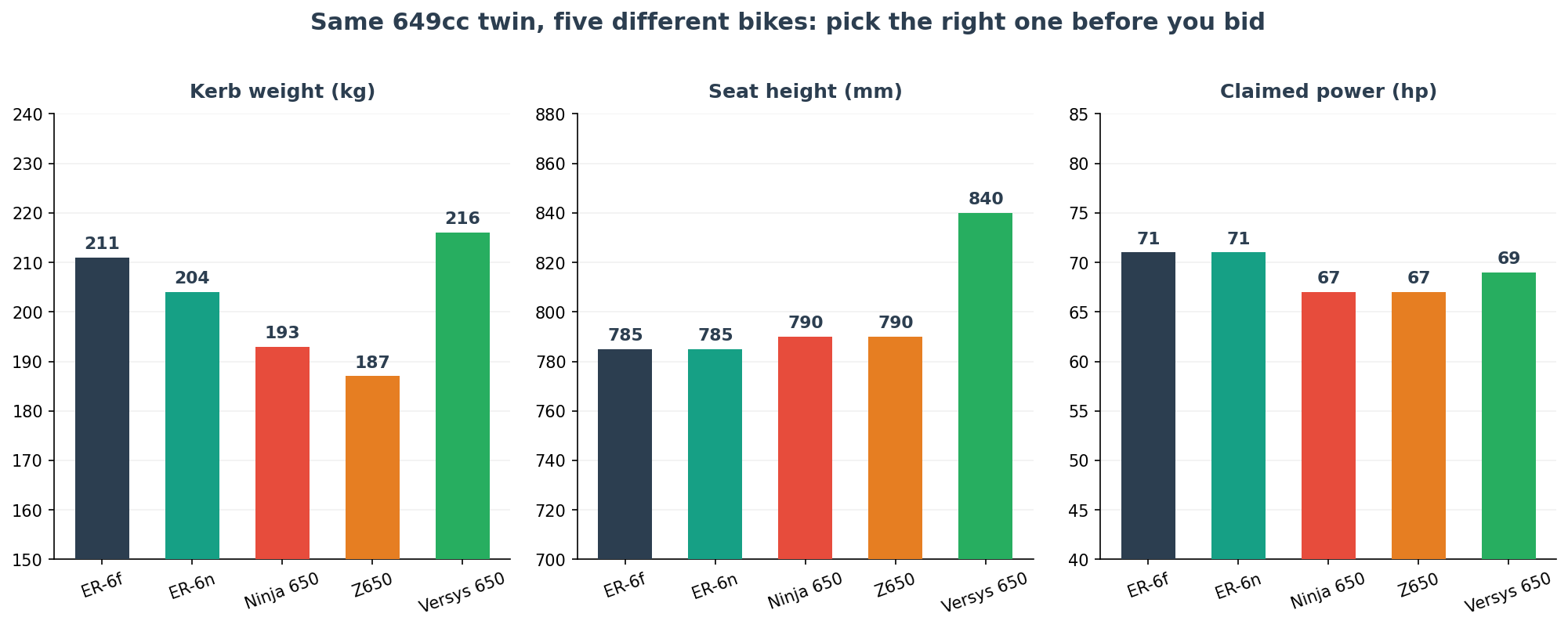
ER-6f (211 kg, 785 mm seat, 71 hp). Half fairing, small screen. Calmer at motorway speed, protected engine and plastics in a tip-over, marginally faster in a straight line because of the aerodynamics. One owner described racing a friend's ER-6n and pulling away by seven to eight km/h purely on the screen. The trade-off is fairing repair cost and slightly more weight.
ER-6n (204 kg, 785 mm seat, 71 hp). Naked, cheaper to crash, easier to inspect, more wind. The town and back-roads choice. Full detail in the ER-6n guide.
Z650 (187 kg, 790 mm seat, 67 hp). The 2017-on naked. Dramatically lighter, sharper, more modern. Also newer and priced accordingly. See our Z650 UK import guide.
Versys 650 (216 kg, 840 mm seat, 69 hp). Same engine in a tall, long-travel chassis with real wind protection and luggage capacity. If you are actually touring, this is the one. That 840 mm seat rules it out for shorter riders. The Versys 1000 import guide covers the bigger sibling.
If you commute on a motorway and want to keep the bike a decade, the ER-6f is the right answer. If you ride in town and drop things occasionally, buy the naked. Our best 650cc motorcycles to import from Japan puts the whole class in context.
What owners actually say after 20,000 miles
Reviews tell you what a bike is like for a week. Comment sections tell you what it is like for a decade. We went through the three highest-engagement English-language ER-6f and Ninja 650 videos on YouTube — a dealer walkaround with 934 comments, a first-ride review with 1,234 comments, and a 1.5-million-view top-speed run — and pulled out what real owners keep repeating.
The engine is not the topic of conversation. That is the loudest signal in the data. Across thousands of comments, almost nobody is describing an engine failure. One owner: "ER6f one of the best bike ever in terms of engine performance, economy and engine reliability." Another had covered 20,000 miles commuting on a 2012 and had not felt the need to change bike in four years.
Vibration through the pegs is the honest complaint. A 2015 ABS owner: "The vibration on the pegs can be a little annoying when the rpms go up but everything else is perfect." This comes up again and again. It is a parallel twin without balance shafts working hard — it buzzes above about 6,000 rpm. Not a fault, just the character of the bike. Test-sit before you commit if you are sensitive to it.
Bar risers are the near-universal first modification. Multiple owners independently recommend swapping to taller "sport bars" or risers. One put it bluntly: "The sport bars totally change my riding experience from fun to Awesomeness Personified." Budget £80 and factor it in.
It genuinely tours. A rider covered Sacramento to Los Angeles and back — over 500 miles — in a single weekend and called it "a solid traveling bike for a sport bike at least." A 56-year-old owner reported averaging 50 mpg on longer rides and having power to spare. That is not a bike being flattered; that is people describing five-year ownership.
The beginner debate never ends. The single most-liked comment across all three videos, at 1,262 likes, cuts through it: "Cautious, mature beginners will do fine on any motorcycle, and immature reckless people will die on a 50cc." Several owners started on the 650 and said they were glad they did not start smaller, because they never got bored and never needed to sell it on.
Nobody fits a gear indicator from the factory. An owner noted the aftermarket unit runs around US$150. Small thing, but it is the kind of detail that only shows up in a comment section, and it is worth knowing before you unbox your import and go looking for one.
Ninja 650 and ER-6f: the numbers, honestly
Manufacturer figures flatter every motorcycle ever built. Here is what this one actually does.
| Figure | Claimed | Real world |
|---|---|---|
| Top speed | around 210 km/h | 212 km/h wet, 220 km/h dry on a stock 2010; 230 km/h reported on a 2013 |
| Power | 71 hp (to 2016), 67 hp (2017 on) | The lighter 2017 bike feels quicker despite the lower number |
| Fuel economy | around 55 mpg | 50 mpg touring two-up-ish loads; high 50s commuting gently |
| Speedometer | — | Reads roughly 8 km/h optimistic against GPS |
| Kerb weight | 211 kg (ER-6f), 193 kg (2017 Ninja 650) | Feels lighter than the number because the mass sits low |
| Seat height | 785 mm (ER-6f), 790 mm (Ninja 650) | Accessible for most riders; narrow waist helps shorter legs |
Two things worth flagging from that table. The speedometer over-read is normal for the model and not a fault — but if you are going through an MSVA test, the tester checks the speedo does not under-read, so an optimistic reading is in your favour.
And the top-speed figures come with a caveat the owner himself supplied: fitting soft luggage cost him roughly 14 km/h of top end. Aerodynamics on a half-faired bike are finely balanced.
What it costs to run for a year
Landed cost is one number; the annual bill is the one that decides whether you keep the bike. For a UK-registered imported ER-6f covering 6,000 miles a year, the realistic figures are a road tax band of around £120, insurance between £180 and £400 depending on age and postcode, fuel at roughly £520 at 55 mpg, a set of tyres every other year at £220, and a routine service at £180 with a valve-clearance year adding £300.
That comes to somewhere around £1,100 in an ordinary year and £1,400 in a service year. For a 70-horsepower motorcycle that will cross a continent, those are motorcycle-shaped numbers rather than sportbike-shaped ones. It is the reason so many of the owners quoted above are still riding the same bike five and ten years on: the ER-6f never gives you a financial reason to sell it.
Step by step: buying an ER-6f at Japanese auction
The process is the same as any Japanese import, with a few ER-6f-specific decisions layered in.
Step 1: confirm eligibility for your country
Do this first, not last. If you are in the US or Australia, stop here until 2031. Everyone else, continue.
Step 2: set a realistic total budget, not a bid budget
Work backwards from your landed number. If you can spend £5,000 all in, your maximum hammer price on a UK import is around £2,100 to £2,200. Bidders who budget the bid and discover the freight later end up disappointed or over-extended.
Step 3: pick your generation and lock it
Decide on Gen 2 or Gen 3 and stick to it. Chasing every ER-6f in every auction is how people end up bidding on a tired Gen 1 at Gen 3 money because it appeared at the right moment.
Step 4: filter by grade before anything else
Grade 4 minimum unless you have a specific reason and a specific budget for repairs. Grade 3.5 examples are frequently fine, but on a faired bike the risk is concentrated exactly where the sheet is least informative.
Step 5: request the extra photographs
Send your agent the fairing checklist above. A good agent will get someone to look. This costs nothing and it is the highest-value fifteen minutes in the whole process.
Step 6: bid with a hard ceiling
Japanese auctions move fast and there is always another ER-6f. Around 34% of listings grade at 4 and the model was built for eleven years — supply is not your constraint. Set the number, walk away from anything above it. Our guide to bidding at Japanese motorcycle auction covers the mechanics.
Step 7: export paperwork and shipping
Your agent handles deregistration and the export certificate, which is the document your customs authority will want. Shared container for a single bike. Expect five to eight weeks on the water depending on route and port.
Step 8: clear customs and register
UK: NOVA within 14 days of arrival, then duty and VAT, then MSVA, then DVLA registration. The official UK government guidance on importing vehicles sets out the deadlines and is the document to check if anything in your case is unusual. Canada: RIV process and provincial inspection. New Zealand: entry certification. None of it is difficult; all of it has deadlines.
Mistakes that cost ER-6f importers money
Searching only one model name. Covered above, and it is the most common one. Four search terms, every time.
Assuming a fairing scratch is just a fairing scratch. On this bike, the panel is the crumple zone. Look behind it.
Buying a 45,000 km example because it looked cheap. It is cheap because the next owner pays for the clutch, the chain set and the shock. That is not a bargain, that is a deferred invoice.
Ignoring the exhaust. The one-piece system is the single most expensive routine failure on the model. Photograph the studs. Every time.
Forgetting the MSVA line in the budget. £340 does not sound like much until it is the difference between the import making sense and not.
Not arranging insurance before arrival. A bike sitting at the docks uninsured and unregistered is a bike you cannot legally move.
Choosing RoRo to save £200. On a faired bike with expensive plastics, a shared container is money well spent.
What a Japanese-market ER-6f has that a European one does not
A JDM bike is not simply a European bike that happens to be in Japan. There are real differences, and knowing them stops you panicking when the crate opens.
The speedometer reads in km/h. Obvious, but it is an MSVA item in the UK and a compliance item in New Zealand. Options are a replacement dial face, a conversion overlay, or on later bikes a menu setting. Budget it into the MSVA prep line.
The headlight is aimed for left-hand traffic. Which is fine in the UK, New Zealand and Australia, and needs a beam adjustment or a lens change for Canada. Japanese and British roads agreeing on something is one of the small mercies of this hobby.
ABS was far less common in Japan. European ER-6f buyers took ABS in large numbers; Japanese buyers frequently did not. If ABS matters to you, filter for it explicitly and expect to pay a premium and wait longer. Do not assume a 2013 bike has it.
Many carry an ETC toll transponder. Japan's electronic toll unit is usually mounted under the seat or in the tail. It is useless outside Japan and worth removing, but leave the wiring loom alone — it is a factory-adjacent installation on many bikes and hacking it out creates problems.
Japanese accessories are often better than the aftermarket at home. Grip heaters, engine bars, tank bags and Japanese-brand screens are frequently already fitted, often from brands that cost a fortune to import separately. Read the auction sheet notes for what is included.
Service intervals were kept. This is the underrated one. Japanese ownership culture treats the dealer schedule as compulsory rather than advisory. A bike with shaken history has been through documented inspections at fixed points in its life, which is a meaningfully better baseline than most private-sale bikes anywhere else.
One practical tip: ask your agent to ship a set of OEM fairing fasteners and the exhaust header nuts in the crate. They are cheap in Japan, they are the two things you will need first, and shipping them with the bike costs nothing extra.
ER-6f versus the rest of the middleweight import class
The ER-6f does not exist in isolation. If you are shopping the 600 to 700cc bracket out of Japan, these are the bikes it competes against, and each one wins at something different.
Suzuki SV650. The V-twin alternative and the ER-6f's oldest rival. More character, better noise, similar reliability record, and a huge parts supply. The naked SV is easier to inspect; the faired S model has the same hidden-damage problem as the ER-6f. Our SV650 UK import guide compares them directly.
Honda CBF600. The sensible four-cylinder. Smoother than the Kawasaki, less torquey low down, and built with Honda's usual indifference to excitement. If the ER-6f's vibration bothers you on a test sit, this is the bike to look at instead. See the CBF600 import guide.
Suzuki Bandit 650. More low-down grunt from the larger engine, heavier, cheaper. Strong value at auction and a legitimately good tourer with a screen fitted. The Bandit import guide covers the range.
Honda Hornet 600. Revvier, sharper, more fun on a back road, less comfortable everywhere else. A different brief entirely. Detailed in our Hornet 600 guide.
Where the ER-6f wins is the combination nobody else quite matches: fairing protection, low seat, torquey twin, cheap running costs, and an engine with a two-decade reliability record. It is not the most exciting bike in this list. It is the one most people still own five years later.
Your first thirty days with an imported ER-6f
The bike has landed, it is registered, and you want to ride it. Do these things first.
Week one: fluids and consumables. Change the engine oil and filter regardless of what the paperwork says, and flush the brake fluid. A bike that has spent six weeks in a container has had brake fluid sitting still absorbing moisture. Both jobs are cheap insurance.
Week one: fasteners. Go round the fairing bolts, the exhaust header nuts and the rear shock mount with a torque wrench. Shipping shakes things loose. This is also your chance to confirm the tabs behind the fairing are intact.
Week two: chain and sprockets. Clean, measure and adjust. If the chain has more than the manual's maximum slack at its tightest point, or the sprocket teeth are hooked, replace the set now rather than after it eats a countershaft seal.
Week two: tyres. Check the date codes, not the tread. Japanese low-mileage bikes routinely arrive with tyres that look new and are eight years old. Old rubber on a bike you do not know yet is a bad combination.
Week three: a proper shakedown ride. Two hundred kilometres in one go, including motorway. Anything the bike wants to tell you — a weep, a rattle, a vibration that is more than the usual peg buzz — will announce itself on a long ride and stay quiet on a ten-minute one.
Week four: valve clearances if the history is unclear. If you cannot establish when the shims were last checked, book it. On this engine that single service is the difference between a bike that runs to 100,000 km and one that does not.
None of that is unique to imports, but importers skip it more often, because a bike that has just cost thousands in freight and paperwork feels like it should already be sorted. It is not. It is a used motorcycle that has been on a boat.
How AWA Auction handles a Ninja 650 import
We bid at the Japanese motorcycle auctions every week, which means we see ER-6f and Ninja 650 lots before they hit any public listing site — and we see how they grade out over time rather than one at a time.
What that changes for you: we know which auction houses see the tidy Kanto-region bikes, we know which grades on this specific model tend to under-promise, and we know to photograph the fairing tabs and the exhaust studs without being asked, because we have watched those two items cost buyers money.
We handle bidding, translation, inspection, export paperwork, shipping and the handover to your local customs agent. You get the auction sheet translated in full, extra photographs before you commit, and a landed cost figure up front rather than a series of surprises.
Browse our current listings to see what is available now, or contact our team and tell us the generation, grade and mileage band you want. We will watch the auctions and come back to you when the right ER-6f appears.
One last thought. The ER-6f has never been a fashionable motorcycle. It does not turn heads, it does not appear on posters, and the used market has never treated it as a collectable. That is precisely why it is a good import: you are buying a mechanically excellent, genuinely durable middleweight at a price set by indifference rather than demand. Every year that passes makes the good ones harder to find and the neglected ones cheaper. Buy a documented Grade 4 now and you have a bike you can keep for a decade.
The people who bought these new have mostly kept them. That tells you most of what you need to know.
See Also
Share this article: