
The 25-year rule for motorcycles is the single most misunderstood piece of American import law, and the confusion costs people money every week. Riders read a car-import blog, decide their 2003 Kawasaki ZX-9R is illegal forever, and walk away from a bike they could have landed for the price of a decent set of leathers. Others go the opposite way, buy a 2002 machine in March because "it's a 2001 model," and discover at the port that Customs does not care what the marketing brochure said.
Here is the short version, and then we will spend the rest of this guide proving it. A motorcycle manufactured 25 or more years before the date of import is exempt from Federal Motor Vehicle Safety Standards. The EPA uses a different and shorter threshold — 21 years. And for motorcycles specifically, the sub-25-year world is nothing like the sub-25-year world for cars, because only a handful of federal safety standards apply to a two-wheeler in the first place.
That last point is the one nobody writes about, and it is the reason a lot of the "you can't import that" advice floating around JDM forums is simply wrong when it is applied to bikes.
What the 25-Year Rule Actually Says
The rule lives in two places. The statute is 49 U.S.C. § 30112(b)(9), and the regulation that implements it is 49 CFR Part 591, specifically § 591.5(i). The language is refreshingly plain: a motor vehicle can be imported without conforming to the Federal Motor Vehicle Safety Standards if it was manufactured 25 or more years before the date of importation.
Three words in that sentence do all the work.
"Manufactured." Not sold, not first registered, not model year. The date the machine came off the line.
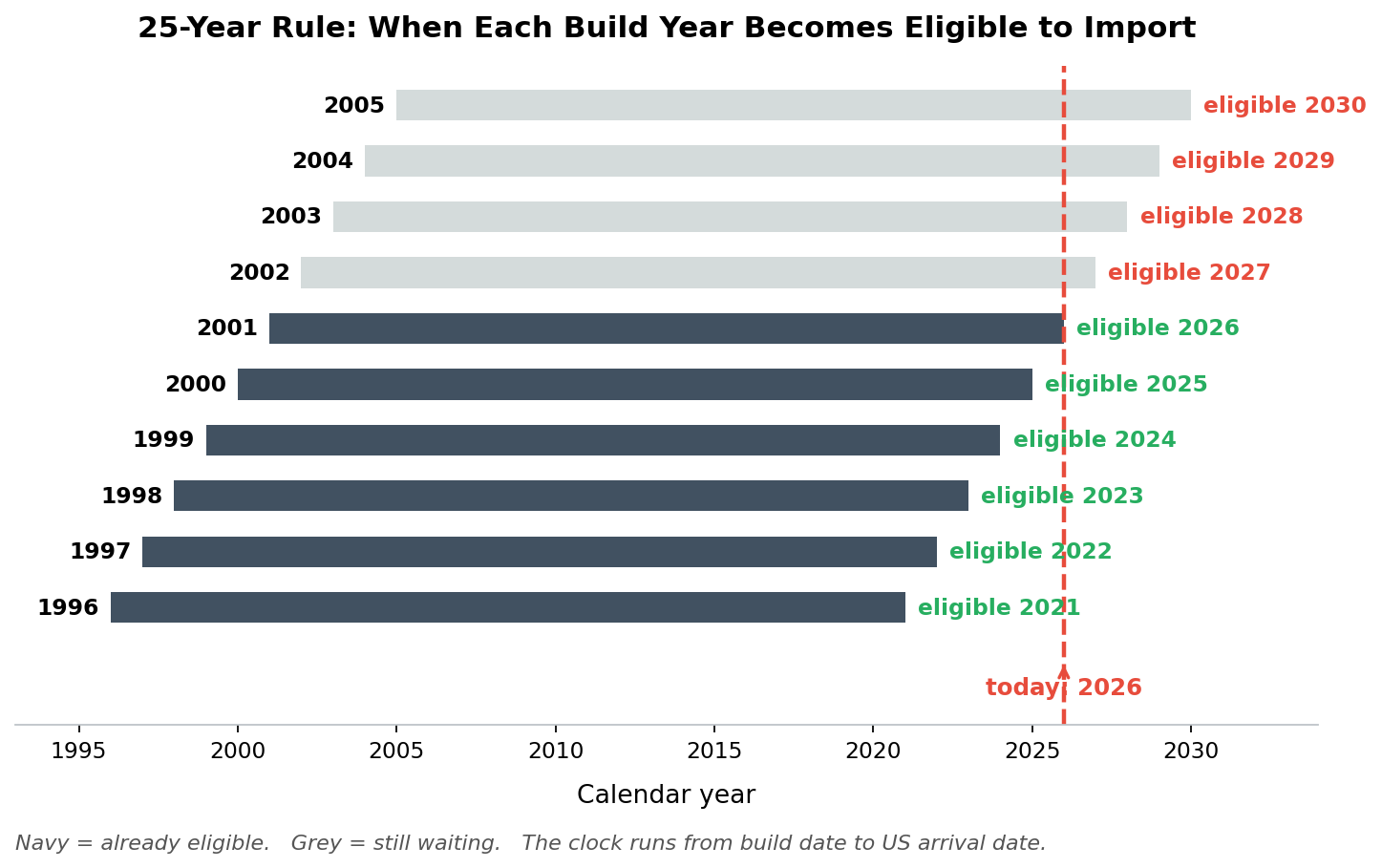
"25 or more years." A rolling window, not a fixed cutoff. It advances every single day.
"Before the date of importation." The clock stops when the bike arrives in the United States, not when you bid on it, not when it leaves Yokohama.
That is the entire mechanism. There is no application, no committee, no waiting list. You declare the exemption on a form at entry and the bike walks in. NHTSA's own import guidance confirms that vehicles claiming this exemption are entered under Box 1 of the HS-7 Declaration, and that the 25-year period runs from the date of manufacture.
What the rule does not do is equally important. It does not exempt you from Customs duty. It does not exempt you from EPA paperwork — it just makes that paperwork trivial, for reasons we will get to. It does not register the bike in your state. And it does not make a stolen or improperly exported motorcycle legal. Federal import clearance and state titling are two entirely separate gates, and clearing the first tells you nothing about the second.
Why the EPA Says 21 and the DOT Says 25
This is the part that gets skipped, and it is worth real money to anyone shopping in the gap.
Two federal agencies regulate a motorcycle coming into the United States, and they do not use the same age threshold.
NHTSA (safety, under the DOT) uses 25 years. That is the FMVSS exemption described above.
The EPA (emissions, under the Clean Air Act) uses 21 years. On EPA Form 3520-1, code E covers vehicles and highway motorcycles that are at least 21 original production years old and remain in their original unmodified configuration. Those machines are excluded from federal emissions requirements outright.
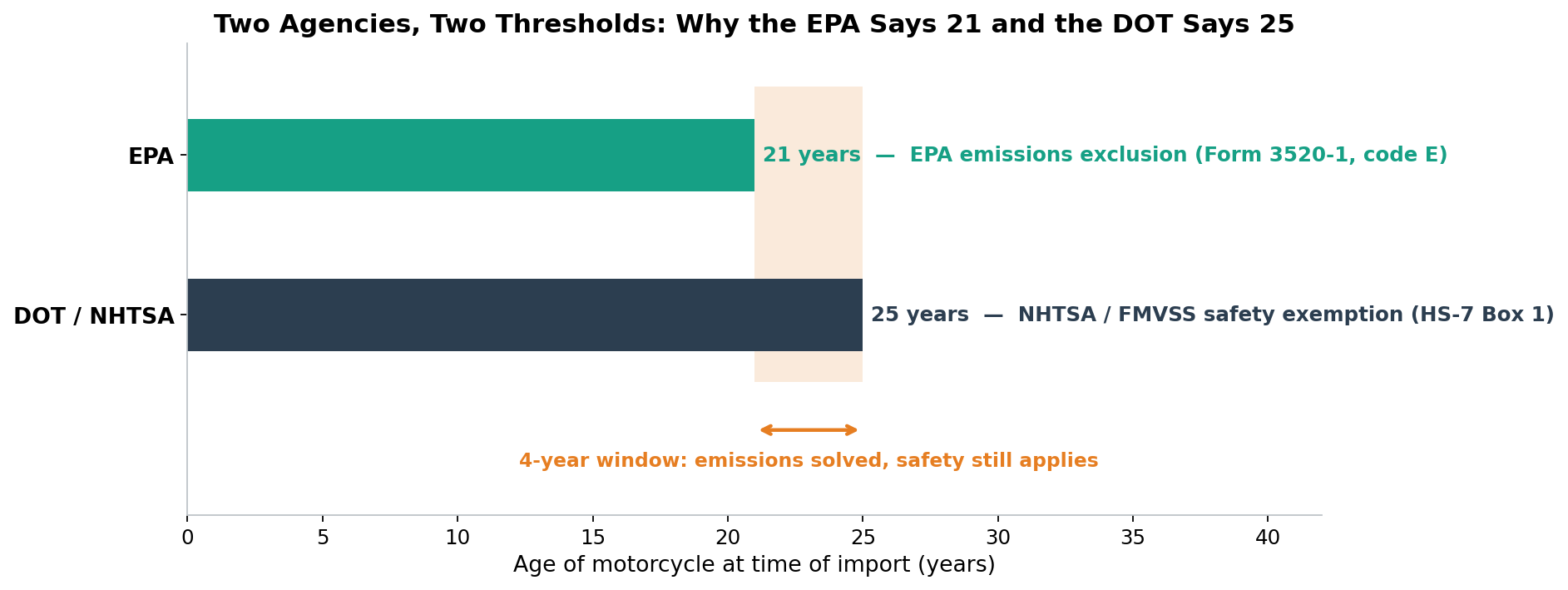
Do the arithmetic and a four-year window falls out. In 2026, a motorcycle built in 2005 is 21 years old: EPA-exempt, DOT-non-exempt. A motorcycle built in 2001 is 25: exempt from both. Between 2002 and 2005 build dates sits a band of bikes where emissions are a solved problem and safety compliance is the only remaining question.
Most guides collapse this into "by the time you hit 25 the EPA is already handled, so ignore it." That is true if you only ever buy 25-plus-year machines. It is actively misleading if you are looking at a 2003 Yamaha R1 or a 2004 Suzuki GSX-R750, because it hides the fact that half the regulatory burden on that bike has already expired.
The practical consequence: when someone tells you a 2003 bike "fails emissions," they are wrong. It does not fail emissions. Emissions do not apply to it. What it needs is a safety answer, and as the next sections show, a motorcycle's safety answer is a much shorter document than a car's.
One condition attaches to the EPA exclusion and it catches people out. The machine must be in original, unmodified configuration. A 2004 bike with an aftermarket full system, a rejetted carb, or a swapped engine from a different year can lose code E eligibility. The engine swap is the killer — a replacement engine disqualifies the exclusion unless the substituted engine is equivalent or newer and carries its own EPA certification. If you are buying in the 21-to-25 band, buy stock. If you want the loud pipe, fit it after the bike is on American soil.
The 2026 Eligibility Calendar: Which Motorcycles Qualify Right Now
Because the rule is rolling, eligibility moves forward month by month, not year by year. This is where most people get burned, and it is entirely avoidable with a calendar.
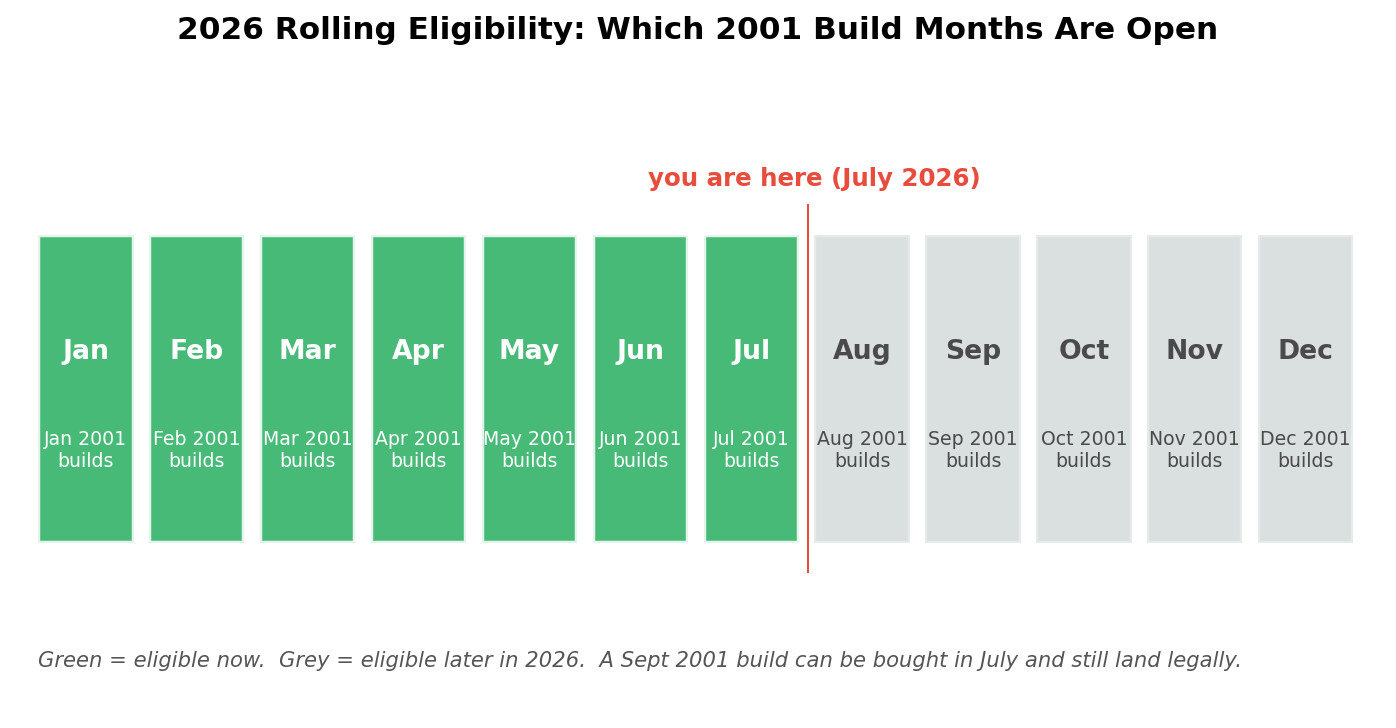
Here is the working table for the current and next calendar year. Find your bike's build month in the left column and read across.
| Build date (month/year) | Eligible from | What that means in 2026 |
|---|---|---|
| Dec 2000 and earlier | Already eligible | Import any time |
| Jan 2001 | Jan 2026 | Eligible |
| Mar 2001 | Mar 2026 | Eligible |
| Jun 2001 | Jun 2026 | Eligible |
| Jul 2001 | Jul 2026 | Eligible this month |
| Sep 2001 | Sep 2026 | Bid now, land in autumn |
| Dec 2001 | Dec 2026 | Bid in autumn, land at year end |
| Mar 2002 | Mar 2027 | Not yet — plan ahead |
| Aug 2002 | Aug 2027 | Not yet |
Notice the planning opportunity buried in that table. Ocean freight from Japan to the US West Coast runs roughly four to six weeks door to port, and the auction-to-loading cycle adds two to four weeks on top. A motorcycle built in September 2001 can be bought in July 2026 and still arrive after its eligibility date. You are not waiting for the calendar — you are using the shipping lead time as the wait.
That is a genuine edge. The bikes closest to their eligibility date have the least competition from American buyers, because most American buyers assume they cannot touch them yet. If you understand that the clock stops at arrival, you can bid a month or two early at softer prices. Just build in margin: if you plan to arrive within two weeks of the eligibility date, choose the slower, cheaper route rather than the fast one, and never plan to land on the exact day.
The 2001 build year is a very good year to be shopping. It covers the last of the great Japanese domestic-market sport bikes before the market shifted — late GPZ900R production, ZZR1100 run-out models, the final carburetted CBR900RR variants, and a deep field of 400cc four-cylinder machines that Americans never officially got.
Build Date vs Model Year: The Mistake That Strands Bikes at the Port
A Japanese motorcycle's model year is a marketing decision. Its build date is a physical fact stamped into the frame and recorded on the export paperwork. Customs cares about the second one.
Japanese manufacturers commonly start building the following model year in the autumn. A "2002" Honda can easily have rolled off the line in October 2001, which makes it eligible in October 2026. Run it the other way and the trap opens: a "2001" model built in February 2002 does not become eligible until February 2027, no matter what the seller's listing says.
So where do you find the real date? Three sources, in descending order of reliability.
1. The frame stamping and the frame plate
Most Japanese motorcycles carry a manufacture date on a riveted or adhesive plate on the frame, often near the steering head or under the seat. On many Honda and Yamaha models it reads as a month and year. This is the strongest evidence you can hand to a Customs officer because it is physically attached to the machine.
2. The export certificate
The Japanese export certificate — the document produced when the bike is de-registered for export — carries registration and, on many forms, first-registration dates. First registration is not the build date, but it is an upper bound: a bike first registered in June 2001 cannot have been built after June 2001. That is often enough to settle a borderline case. Our guide to the Japanese motorcycle export certificate walks through every field on that document.
3. A manufacturer build record
For genuinely borderline machines, the manufacturer's regional office can confirm a production date against the frame number. It takes weeks and it is not free, but for a bike sitting three weeks either side of its eligibility date, it is the difference between a clean entry and a bonded warehouse.
Here is the rule we apply internally: if a motorcycle's eligibility date is within 60 days of its projected arrival, we document the build date before bidding, not after. Not because Customs always asks, but because when they do ask, the answer needs to exist already. A bike held at the port accrues storage charges daily, and those charges do not care whose fault it is.
The related error is assuming the auction sheet resolves this. It does not. Auction sheets are condition documents — they grade paint, frame, engine and mileage, and they are outstanding at what they do. They are not compliance documents. If you have not read one before, start with our walkthrough of Japanese auction inspection sheets and the companion piece on what the auction grades actually mean.
Only Six Safety Standards Actually Apply to a Motorcycle
This is the section that changes how people shop, so read it twice.
When a JDM car falls short of the 25-year line, conforming it to FMVSS is close to hopeless. Cars are subject to dozens of standards covering crash structure, airbags, restraint systems, fuel system integrity, bumper impact, side impact, roof crush and more. Bringing a non-conforming car into compliance means destructive crash testing. That is why the car community treats 25 years as an absolute wall, and why "the 25-year rule" entered the vocabulary as a synonym for "impossible."
Motorcycles are not cars. The list of FMVSS that apply to a two-wheeler is short enough to print on a business card.
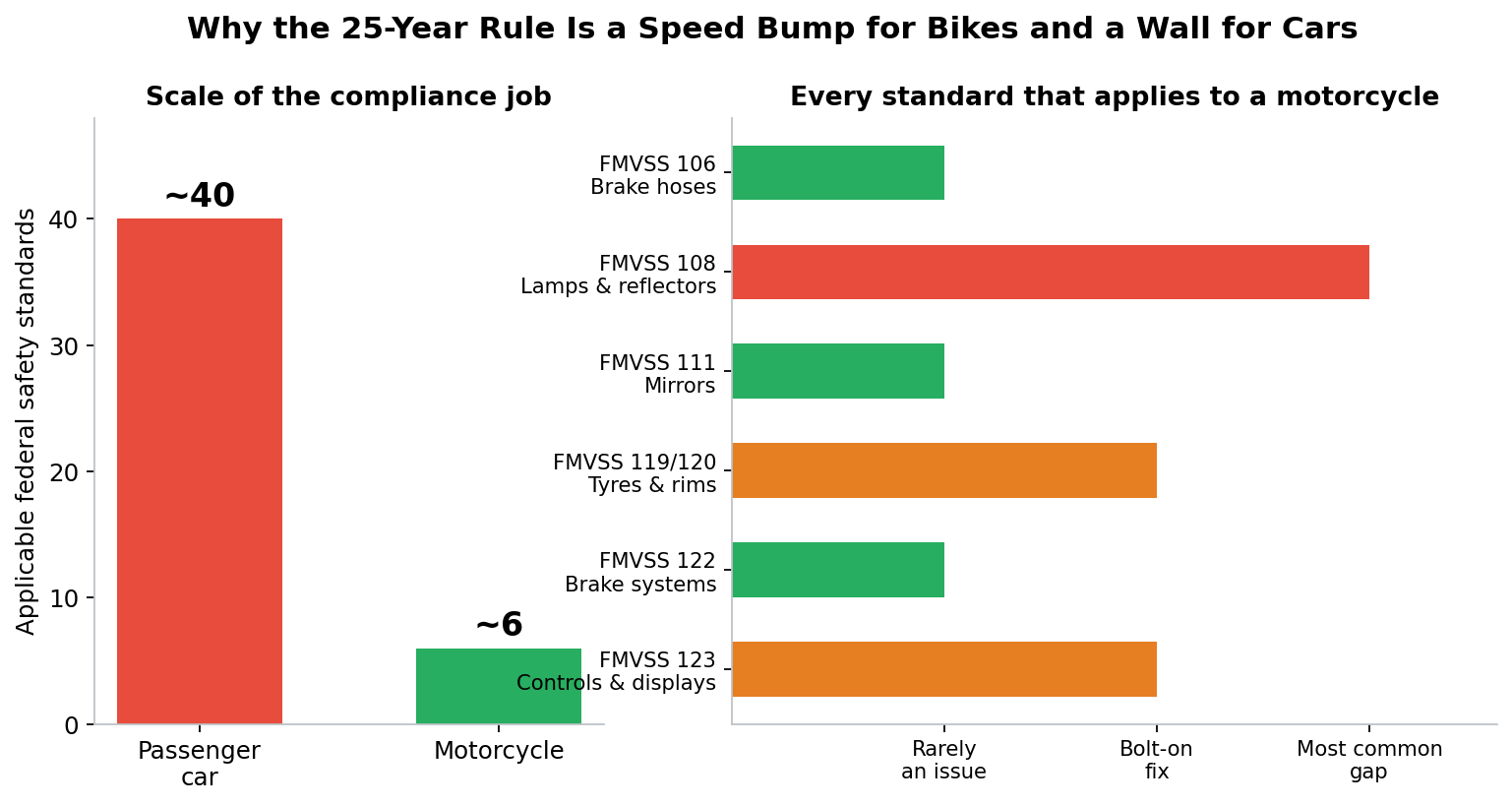
| Standard | Covers | Typical JDM gap |
|---|---|---|
| FMVSS 106 | Brake hoses | Rarely an issue; DOT-marked hoses are cheap |
| FMVSS 108 | Lamps and reflective devices | The most common gap — see below |
| FMVSS 111 | Rear visibility (mirrors) | Occasionally; mirrors are a bolt-on fix |
| FMVSS 119 / 120 | Tyres and rims | Fitting DOT-marked tyres solves it |
| FMVSS 122 | Motorcycle brake systems | Japanese-market bikes generally comply as built |
| FMVSS 123 | Motorcycle controls and displays | Speedometer marked only in km/h is the usual flag |
Add the VIN and certification-label requirements in 49 CFR Parts 565 and 567 and you have the whole picture.
Look at that "typical gap" column. Lighting, tyres, mirrors, a speedometer face. Those are parts-counter problems, not engineering problems. Nobody crash-tests a motorcycle to conform it.
FMVSS 108 is where most Japanese-market bikes actually differ, and the differences are mundane. Japanese-market machines often run amber rear turn signals where the US expects specific colour and photometric performance, side reflectors are often absent, and the headlamp beam pattern is cut for left-hand traffic. Every one of those is a replacement part.
The point is not that a sub-25-year import is free — it is that the barrier for a motorcycle is measured in hundreds of dollars and weeks, where for a car it is measured in tens of thousands and "don't bother." Anyone who tells you the 25-year rule makes a 2004 Japanese motorcycle impossible has imported cars, not bikes.
Importing a Motorcycle Under 25 Years Old: The Three Legal Routes
If your bike misses the 25-year line, you have three genuine paths. They are not equally good, and the right one depends almost entirely on one question: does the machine already carry a US certification label?
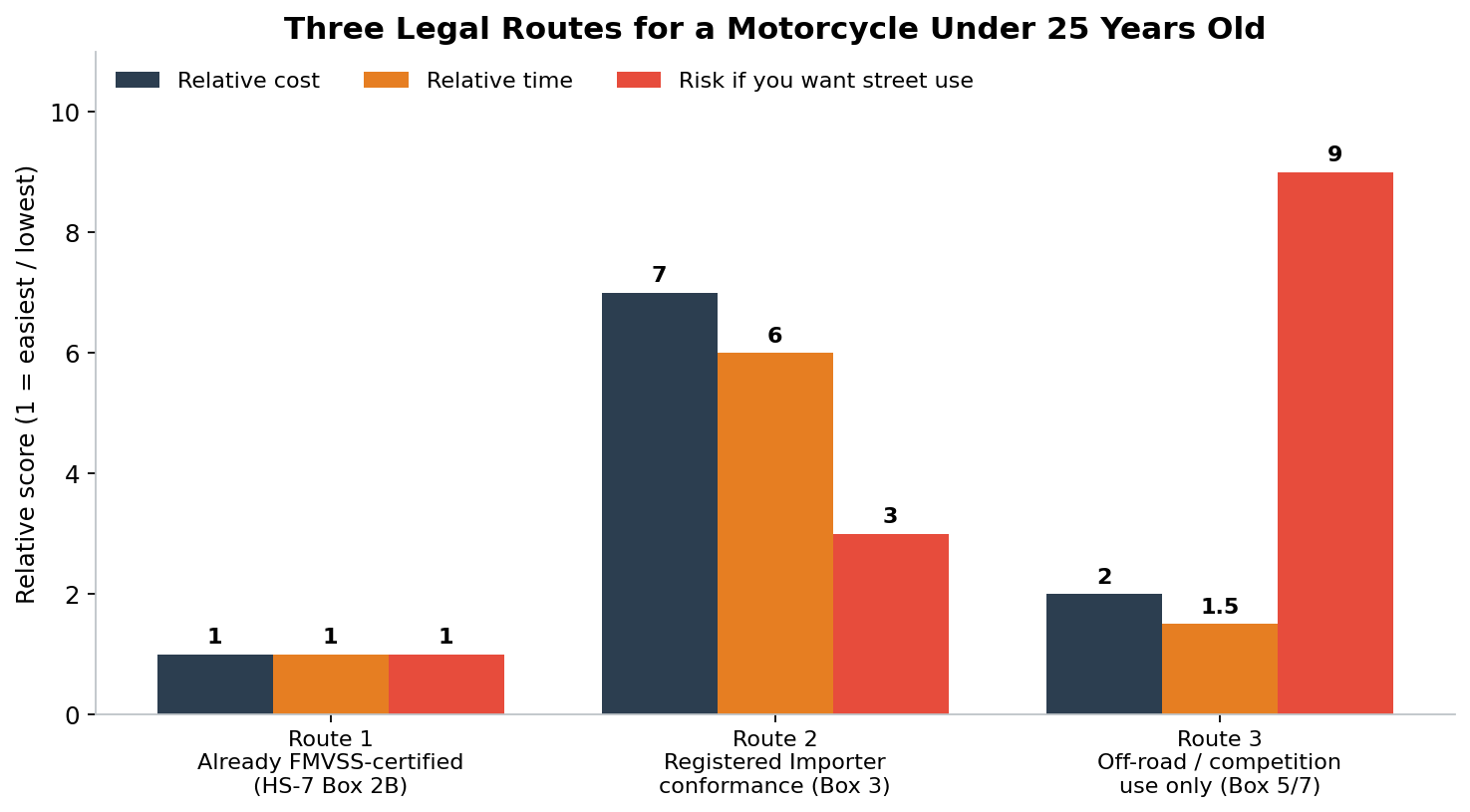
Route 1: The bike is already FMVSS-certified (HS-7 Box 2B)
This is the cheapest route and it is available more often than people expect. Look for a certification label near the intersection of the steering head and the frame — on many machines it sits on the frame's right side under the steering stem. If it states that the vehicle conforms to all applicable FMVSS, the bike enters as a conforming vehicle. No Registered Importer, no bond, no conformance work.
Why would a Japanese-market bike carry one? Because global platforms exist. Several models were built on a single line for multiple markets, and export-spec units sometimes end up back in the Japanese used market — a bike sold new in the US, ridden, exported to Japan, then sold at auction. It is not the norm, but it happens often enough that checking the label costs you nothing and occasionally saves you two thousand dollars.
Route 2: Registered Importer conformance (HS-7 Box 3)
A motorcycle that was not built to FMVSS can still be imported permanently if NHTSA has determined the model eligible and a Registered Importer brings it into compliance after entry. You either import through an RI or contract with one. A DOT conformance bond is posted at entry and released once the RI certifies the work.
For motorcycles this is a real, usable path, because the conformance work is the short list above. Budget for the RI's fee, the bond, the parts and a few weeks in their shop. It is not cheap, but it is a known number rather than an open-ended engineering project.
Route 3: Off-road, show or display, and racing use (HS-7 Boxes 5 and 7)
A motorcycle imported strictly for competition or off-road use, and never registered for the road, enters under a different declaration. This is the honest route for a race-only two-stroke or a track bike. It is also the route people abuse, and the consequences of declaring off-road use and then titling the machine for the street run from a rejected registration to federal penalties. If you intend to ride it on a public road, do not check that box.
There is a fourth thing people try that is not a route at all: importing a sub-25-year bike as "parts." A crated motorcycle in pieces is still a motor vehicle if it can be reassembled into one, and Customs has seen the trick. It ends in seizure.
Our broader guide to importing a motorcycle from Japan to the USA covers the full logistics chain around all three routes, and the grey import guide explains what "grey import" means once the bike is on the ground.
The Paperwork: HS-7, EPA 3520-1, and What Customs Actually Wants
For a 25-year-rule motorcycle the federal paperwork is genuinely light. Four documents carry the entry.
DOT Form HS-7
The declaration that tells NHTSA why your motorcycle is allowed in. For a machine 25 or more years old you check Box 1. That is the whole safety story. No RI, no bond, no eligibility petition.
EPA Form 3520-1
The emissions declaration. For a machine at least 21 original production years old and in original configuration, you claim code E. Since every 25-year-rule bike is also over 21, the emissions side resolves itself automatically — this is exactly why so many guides stop mentioning the EPA at all. It still has to be filed. "Automatic" does not mean "optional."
The Japanese export certificate, with a certified translation
This proves the bike was legally de-registered in Japan and legally exported. Customs will want an English translation. Your state DMV will want it again later, usually notarised. Get two certified copies at the outset; sourcing a second one after the fact from overseas is a miserable errand.
Bill of lading and commercial invoice
The shipping document and the proof of purchase price. The invoice sets the Customs value, which sets the duty. Undervaluing it to trim a two-percent duty bill is a spectacularly bad trade against a federal fraud exposure.
Two practical notes. First, entry is filed by a customs broker in almost every real case. You can self-file. Almost nobody should. A broker's fee is a small fraction of one day of port storage. Second, if the motorcycle arrives before its eligibility date because a vessel ran early, it does not become eligible by sitting on the dock — a bonded warehouse is the fix, and it is expensive. Plan the arrival, not the departure.
One more item that is not paperwork but behaves like it: cleanliness. Soil on tyres, in chain links and inside mudguards is an agricultural issue at the border. A bike that arrives visibly dirty can be held for cleaning at your cost. Ask your exporter to pressure-wash the underside before loading. It is a fifteen-minute job in Japan and a multi-day problem in Long Beach.
What a 25-Year-Rule Motorcycle Actually Costs to Land
The age exemption removes compliance cost. It removes nothing else. Here is the honest structure of a landed price, using a representative 2001 Japanese-market sport bike bought at auction.
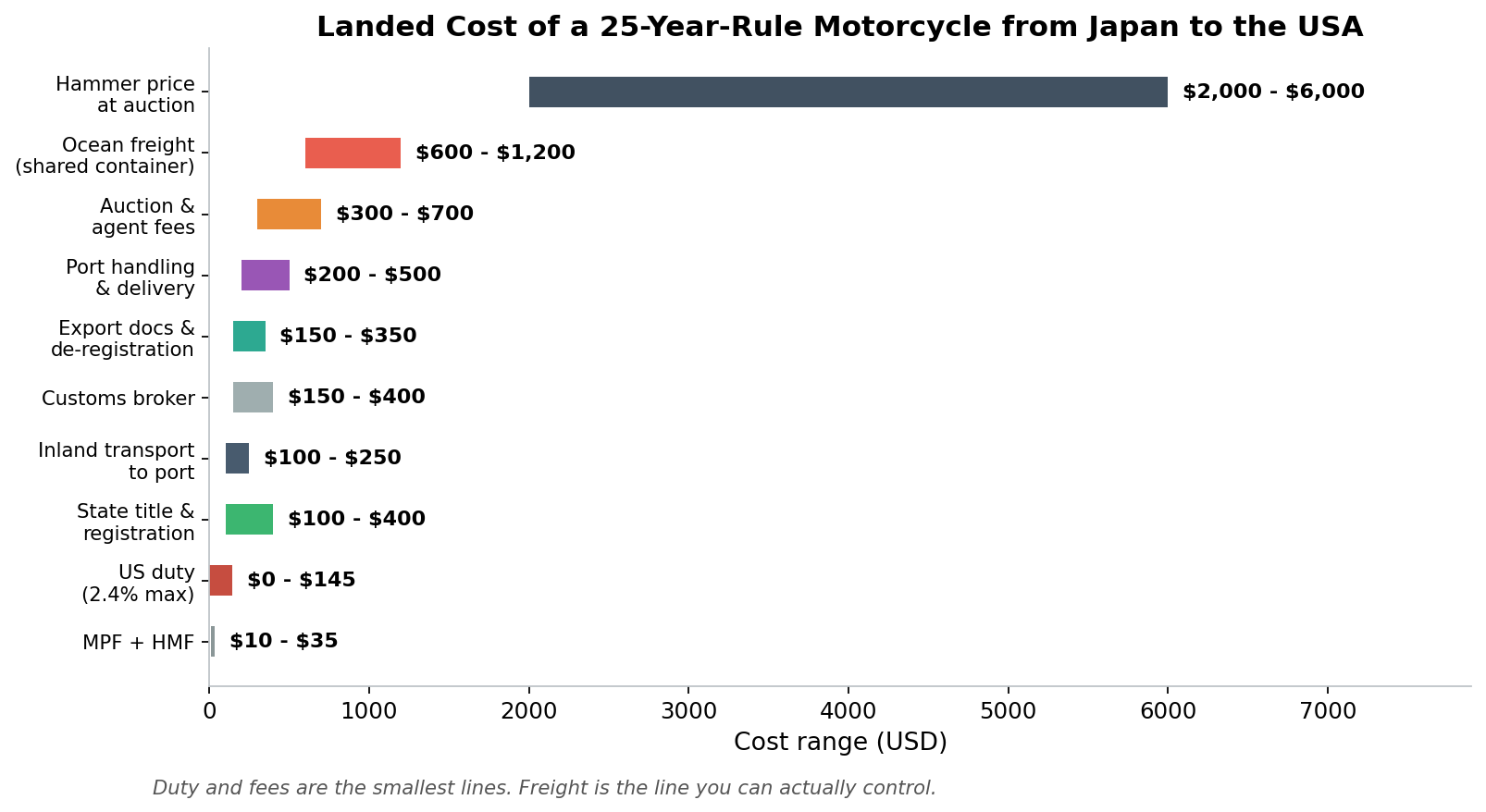
| Line item | Typical range (USD) | Notes |
|---|---|---|
| Hammer price at auction | 2,000 – 6,000 | Varies enormously by model |
| Auction and agent fees | 300 – 700 | House fee plus buyer's agent |
| Japanese de-registration and export docs | 150 – 350 | Includes export certificate |
| Inland transport to port | 100 – 250 | Depends on auction house location |
| Ocean freight (shared container) | 600 – 1,200 | RoRo can be cheaper; see below |
| Marine insurance | 1 – 2% of value | Optional and worth it |
| US Customs duty | 0 – 2.4% of value | By displacement; verify current HTSUS |
| MPF and HMF | ~0.35% + 0.125% | Merchandise and harbour processing |
| Customs broker | 150 – 400 | Per entry |
| Port handling and delivery | 200 – 500 | Excludes storage if delayed |
| State title, registration, VIN inspection | 100 – 400 | Wildly state-dependent |
On duty specifically: the historic HTSUS structure under heading 8711 has run free for the smaller displacement classes and 2.4% for machines above 500cc, with electric motorcycles free. Tariff policy has been unusually volatile in recent years, so treat any percentage you read anywhere — including here — as a starting point and confirm the current rate against the live HTSUS before you commit. The number is small relative to freight either way.
The line that surprises people is not duty. It is freight. Shipping frequently costs more than the duty, the fees and the broker combined, and it is the one line you have real control over. Consolidating into a shared container with other bikes is usually the cheapest route per machine; RoRo can beat it for a single unit on certain lanes. We broke the trade-off down properly in container versus RoRo motorcycle shipping, and the end-to-end logistics live in shipping a motorcycle from Japan.
The second surprise is storage. It is zero if everything goes right and brutal if it does not. Demurrage and port storage accrue daily and compound the exact problem that caused them. Every hour you spend confirming a build date before bidding is insurance against this line item.
The Frame Number Problem: Your JDM Bike Doesn't Have a 17-Digit VIN
You have cleared Customs. The bike is in your garage. Now comes the part that trips up more first-time importers than the entire federal process: your state DMV wants a 17-character VIN, and your motorcycle does not have one.
Japanese domestic-market vehicles do not follow the ISO 3779 VIN standard that the US adopted for 1981 and later model years. A JDM motorcycle carries a chassis number — typically a model prefix and a serial, running somewhere between 9 and 15 characters. On a Honda CB400 Super Four it reads as a five-character model code and a six-digit serial. Correct, legal, permanent, and not 17 characters long.
DMV computer systems are frequently built around a hard 17-character field. Clerks who process a thousand domestic titles a month have often never seen a short chassis number. The result is a rejection at the counter that has nothing to do with the legality of your motorcycle and everything to do with a database schema.
States handle it in three broad ways.
Accept the chassis number as-is. Several states will simply title the machine on its Japanese chassis number, padding or flagging the record internally. California, Washington and Florida are generally reported as straightforward on this.
Assign a state VIN. A DMV inspector or law enforcement officer physically inspects the machine, verifies the chassis number against the import documents, and issues a state-assigned VIN on a riveted plate. This is common and it is not a problem — it is the system working.
Require a surety bond. Some states want a bonded title, typically held for three to five years, as protection against a competing ownership claim. The bond is priced off the declared value. Annoying, not fatal.
How to make this painless: turn up with the certified English translation of the export certificate, the stamped CBP entry summary, the HS-7 and EPA 3520-1 copies, the bill of lading, and clear photographs of the frame stamping. Bring the originals and a full set of copies. If the first clerk says no, ask politely for a supervisor or for the office's designated VIN inspection unit — the second person you speak to has usually seen an import before.
Do this research before you bid. Registration rules are state law, they vary enormously, and there is no federal fix for a state that has decided to be difficult. A twenty-minute phone call to your DMV's title section is the cheapest due diligence in this entire process.
What Buyers Actually Report
Regulation is one thing. What actually happens when a container of Japanese auction bikes lands in America is another, and there is more honest primary evidence about this on YouTube than in any import blog.
The clearest example is Bikes and Beards' walkthrough of a 40-foot container shipped out of Japan — over 3.3 million views and roughly 2,400 comments, showing the actual unloading of a mixed lot of Japanese-market machines and, crucially, whether they started. Two things stand out for anyone planning an import. First, the container was consolidated: multiple bikes in one box, which is exactly the freight structure that makes per-unit shipping cost sane. Second, several machines needed fuel-system attention before they would run — which is what a decade of low-mileage garage storage does, and why the carburettor line in your budget is not optional.
The most useful thing in that video is not in the video. It is a comment from a Japan-based rider who has owned many of the same models, and it earned close to a hundred likes: his read was that the pick of the shipment was the NSR250R, and that the whole lot bought privately in Japan would have run "$25k max." Translated: auction buying carries a knowledge premium. The auction is not automatically the cheapest channel — it is the deepest channel. You pay for access to inventory that does not exist elsewhere, and you overpay if you cannot read the sheets.
The second recurring theme in the comments on Japanese-import videos is disbelief at the small-displacement four-cylinders. One commenter recalled 250cc four-cylinder machines imported into Venezuela running comfortably at 100 to 120 mph — a level of performance from a quarter-litre engine that is genuinely hard to explain to someone who has only ridden American-market bikes. That is the class of machine the 25-year rule opens up, and it is why the rule generates the enthusiasm it does.
The third theme is quieter and it is about condition. Comment sections on Japanese import content fill with people noting that the bikes look better than expected for their age. That is the shaken inspection regime, high garaging rates and low annual mileage doing their work — and it is the single strongest argument for buying out of Japan rather than hunting a domestic survivor.
Browse current Japanese motorcycle listings or ask our team about a specific model's eligibility date.
Titling an Import: What to Ask Your DMV Before You Bid
Registration is state law, and it is the step where an otherwise clean import turns into a three-month errand. The federal side is uniform across all fifty states. The state side is not, and the variation is enormous.
Rather than trusting a list of state rules that goes stale the moment a policy memo circulates, work out which of the three patterns your state follows. One phone call to the title section does it. Here are the five questions to ask, in order.
1. "Can you title a vehicle whose VIN is fewer than 17 characters?"
This is the question that determines everything else. If the answer is yes, you are in the easy pattern and you title on the Japanese chassis number. If the answer is a pause followed by "let me check," you are probably in a state-assigned-VIN state.
2. "Do you require a VIN inspection, and who performs it?"
Some states use DMV staff, some use state police, some use licensed inspection stations. The answer tells you where to drive and whether you need an appointment weeks out. It also tells you whether the bike needs to be transportable — a non-running import that must be physically inspected needs a trailer.
3. "Will you accept a translated Japanese export certificate as proof of ownership?"
There is no US title on an import, and that is the point clerks stumble over. The export certificate plus the CBP entry paperwork is the ownership chain. Ask whether the translation needs to be notarised and whether they want a specific translator's certification.
4. "Is a surety bond required, and how is the amount calculated?"
Bonded titles are common for vehicles without a conventional ownership document. The bond typically runs for three to five years and is priced off declared value. It is a cost line, not a barrier, and knowing it in advance keeps it from being a surprise.
5. "Does the vehicle need a safety or emissions inspection to register?"
Federal exemption at the border does not exempt you from a state inspection programme. Some states inspect motorcycles, most do not. Where they do, a km/h-only speedometer or a non-DOT headlamp can generate a rejection that has nothing to do with import law. Ask what the inspection covers for a motorcycle specifically.
Write the answers down with the name of the person who gave them. When you arrive at the counter and the clerk in front of you has never processed an import, a note saying "spoken to the title section on this date, told to bring these documents" moves the conversation forward faster than an argument about federal regulations.
The single most useful preparation is a folder. Certified translation of the export certificate, stamped CBP entry summary, HS-7, EPA 3520-1, bill of lading, commercial invoice, and clear photographs of the frame stamping alongside a tape measure so the character count is legible. Originals plus a full set of copies. Importers who turn up with that folder get titled. Importers who turn up with a bike and a shipping receipt get sent home.
The 2027 and 2028 Watch List
The rolling nature of the exemption means today's forbidden bike is next year's bargain, and the buyers who do best are the ones tracking the queue rather than the current inventory.
Build years crossing the line over the next two years bring a distinctly different generation of machine into reach. Where the 2001 cohort is the tail end of the carburetted era, the 2002 and 2003 build years mark the arrival of fuel injection across the Japanese domestic range, sharper chassis, and the first generation of bikes that feel modern rather than classic to ride.
| Build year | Eligible from | What that cohort brings |
|---|---|---|
| 2002 | 2027 | Early fuel injection across the sport range; last of several long-running JDM model lines |
| 2003 | 2028 | Significant chassis and brake generation change; radial calipers appear |
| 2004 | 2029 | Underseat exhaust era; first widespread slipper clutches |
| 2005 | 2030 | Machines that still feel current; strong survivor rates |
Two practical moves follow from that table.
Track prices now, buy later. Japanese auction prices for a given model are visible long before you can legally import it. Watching a model for twelve months before its eligibility year tells you what normal money looks like, which means you recognise a good result the week the window opens. Buyers who start looking on the day of eligibility have no baseline and overpay.
Understand that eligibility raises prices. When a desirable model crosses into US eligibility, American demand enters a market that previously had none, and Japanese auction prices for that model tend to firm. The bargain is in the months before the window opens, using shipping lead time as the bridge — exactly the technique described earlier. The bargain is not in the month after, when every US buyer has noticed.
If a specific model is on your list, tell us which one and we will give you its eligibility month rather than its eligibility year. On a bike you have waited three years for, the difference between March and November matters.
Which Japanese Motorcycles Are Worth Chasing Under the 25-Year Rule
The exemption is a legal mechanism, not a shopping list. What makes it interesting is what Japan built in the years now crossing the line — and Japan built a lot of machines the United States never officially received.
The 400cc four-cylinder class. The single biggest category of bikes Americans could not buy new. The Honda CB400 Super Four, the CBR400RR, the VFR400 NC30 and the Yamaha XJR400 are all screaming, high-revving four-cylinder machines in a displacement class the US market simply skipped. Our 400cc import shortlist ranks the field.
The 250cc two-strokes. The Honda NSR250, Yamaha TZR250 and Suzuki RGV250 Gamma are the reason a lot of people learn about this rule in the first place. Emissions law killed the road-going two-stroke, which is precisely why the exemption matters here more than anywhere else. See the full two-stroke import guide.
The big air-cooled classics. The Kawasaki GPZ900R, Zephyr, Suzuki Katana and Kawasaki W650 occupy a middle ground: available in some export markets, but Japanese-market examples are typically lower-mileage, better-documented and cheaper.
The 1990s superbike field. ZZR1100, ZX-9R, CBR900RR Fireblade, CBR1100XX Blackbird. All comfortably over the line, all trading at a fraction of what a comparable-condition US example costs.
The reason Japanese-market examples are attractive is not sentiment. Japan's shaken inspection regime, its high garaging rates, its low annual mileage and its salt-free winters in most of the country produce used motorcycles in a condition that genuinely surprises first-time buyers. Our piece on vintage Japanese motorcycles covers why, and are Japanese motorcycles reliable deals with the mechanical side.
What Nobody Tells You About 25-Year-Rule Bikes
Six failure modes we see repeatedly. None of them are about the rule itself.
1. Buying on model year and hoping. Already covered, still the number one cause of stranded motorcycles. Confirm the build month.
2. Assuming the exemption covers parts availability. A JDM-only model may share almost nothing with its US sibling. Fairings, wiring looms, instrument clusters and switchgear are frequently market-specific. Check parts supply before you bid, not after a tip-over.
3. The km/h speedometer. Not a federal problem for a 25-year-rule bike, but a real annoyance and, in a small number of states, a registration inspection flag. Aftermarket faces exist for popular models. It is a $60 fix if you plan for it and a two-week fix if you do not.
4. Fuel system age. A 2001 machine that sat in a Japanese garage for six years has a carburettor full of varnish and fuel lines with the flexibility of a breadstick. Budget for a carb clean, fuel lines, and probably tyres regardless of tread depth — rubber ages whether it is ridden or not.
5. No insurance quote before purchase. Some US insurers cannot rate a vehicle their system does not recognise. Call your insurer with the model and chassis number before you commit, not after the bike is in your garage and uninsurable.
6. Trusting a photo instead of an auction sheet. The auction inspection sheet is the single most valuable document in this process and it is written in Japanese shorthand. Learn it, or work with someone who has. Start with the auction sheet guide and how to bid on a Japanese motorcycle auction.
How AWA Auction Handles 25-Year-Rule Motorcycles
We bid on Japanese motorcycle auctions on behalf of buyers, which means the build-date question lands on our desk before it lands on yours.
On any machine within twelve months of its eligibility date, we pull the build date from the frame plate and the export certificate before bidding, and we plan the shipping route so arrival falls comfortably after the eligibility date rather than on top of it. We check for an FMVSS certification label as a matter of course, because on the occasional bike it changes the entire import route. We arrange de-registration, the export certificate and its certified translation, and we hand over a document set your customs broker and your DMV can both use.
What we do not do is tell you a bike is eligible when it is not. The rolling date is arithmetic, not opinion, and there is no version of this where guessing works out.
You can browse current listings to see what is available now, or contact our team with a specific model and we will tell you exactly when it crosses the line — including if the answer is "not until 2028."
See Also
Share this article: