
A Kawasaki ZXR400 import from Japan is one of the few grey-import decisions that turns on condition rather than availability, and that makes it more interesting than most. Britain got the ZXR400 officially. Kawasaki UK sold it new, and dealers were still shifting unregistered stock in 2003. So unlike a Serow or a D-Tracker, you can walk into a British classifieds page today and find one without leaving the country. The question is not whether you can buy one locally. The question is whether the one you can buy locally is the one you actually want.
Most of them are not. The UK bikes have spent thirty years in a salted, wet climate, ridden hard by riders on restricted licences and then left outside under a cover. The Japanese bikes have spent those same thirty years in a country where a 400cc four was an ordinary, sensible motorcycle that fitted the licence class, got garaged, and was serviced by people who still bought the parts over a counter. Same model. Completely different survivors.
There is also a category of ZXR400 that never legally reached a British or American showroom at all: the Sport Production homologation bikes, the J and M models, with flat-slide FCR carburettors, adjustable camshafts, a close-ratio gearbox and a rev limiter set at 15,200rpm. Those were Japan-only. If you want one, importing is the only route, and there is a single digit in the frame number that tells you whether the bike in the photographs is a real one.
This guide covers all of it: which ZXR400 is which, the engine failure that writes these bikes off, the carburettor trap that costs more than the bike is worth, what a landed example genuinely costs in 2026, and the one date on the logbook that changes your UK tax bill by roughly nine hundred pounds.
Why a Kawasaki ZXR400 import from Japan beats the local option
Start with the awkward fact. On price alone, importing a ZXR400 from Japan does not beat buying one in Britain. A 1999 L9 with 28,000 miles sold recently in Irvine for £2,500. A tidy 1992 example came out of the Netherlands at £2,375. You will not land a Japanese bike for that, and anyone telling you otherwise is quietly leaving fees off the spreadsheet.
So the case for importing has to be made on something other than the sticker. It is made on four things.
Corrosion. This is the single biggest one and it is not close. The ZXR400's weak point in a British life is not the engine, it is everything around it. Read enough owner reports and the same pattern emerges: an owner who kept the bike outside for part of its life describing corroded wheels and rusting fasteners, insisting it is only cosmetic. It is only cosmetic right up until you price a pair of period-correct wheels. Japanese bikes are overwhelmingly garage-kept, and a Japanese auction inspector grades corrosion explicitly and unsentimentally.
Specification. The Sport Production models, the ZX400J and ZX400M, were never sold outside Japan. Neither were several of the domestic colour schemes that command a premium among people who care. If you want one of those, the import is not the cheaper route, it is the only route.
Mileage that is actually low. Japan's shaken inspection regime and the sheer density of the motorcycle market produce a steady supply of thirty-year-old bikes with genuinely small numbers on the clock, documented rather than claimed. A UK ZXR400 advertised as "low mileage" is a story. A Japanese auction bike with an inspection sheet is a record.
Originality. British ZXR400s were the archetypal first big bike. They were dropped, restricted, derestricted, fitted with straight-through cans, crashed at track days and rebuilt from three donors. One long-term owner described his own as having arrived with a baffle-free exhaust audible from several miles away. Charming. Not what you want to import.
Here is the honest version, and it is the version this site keeps repeating because it is true: import a ZXR400 when you want a specific, better, unmolested bike. Do not import one to save money. You will not.
What the ZXR400 actually is: 398cc, 14,500rpm and no torque whatsoever
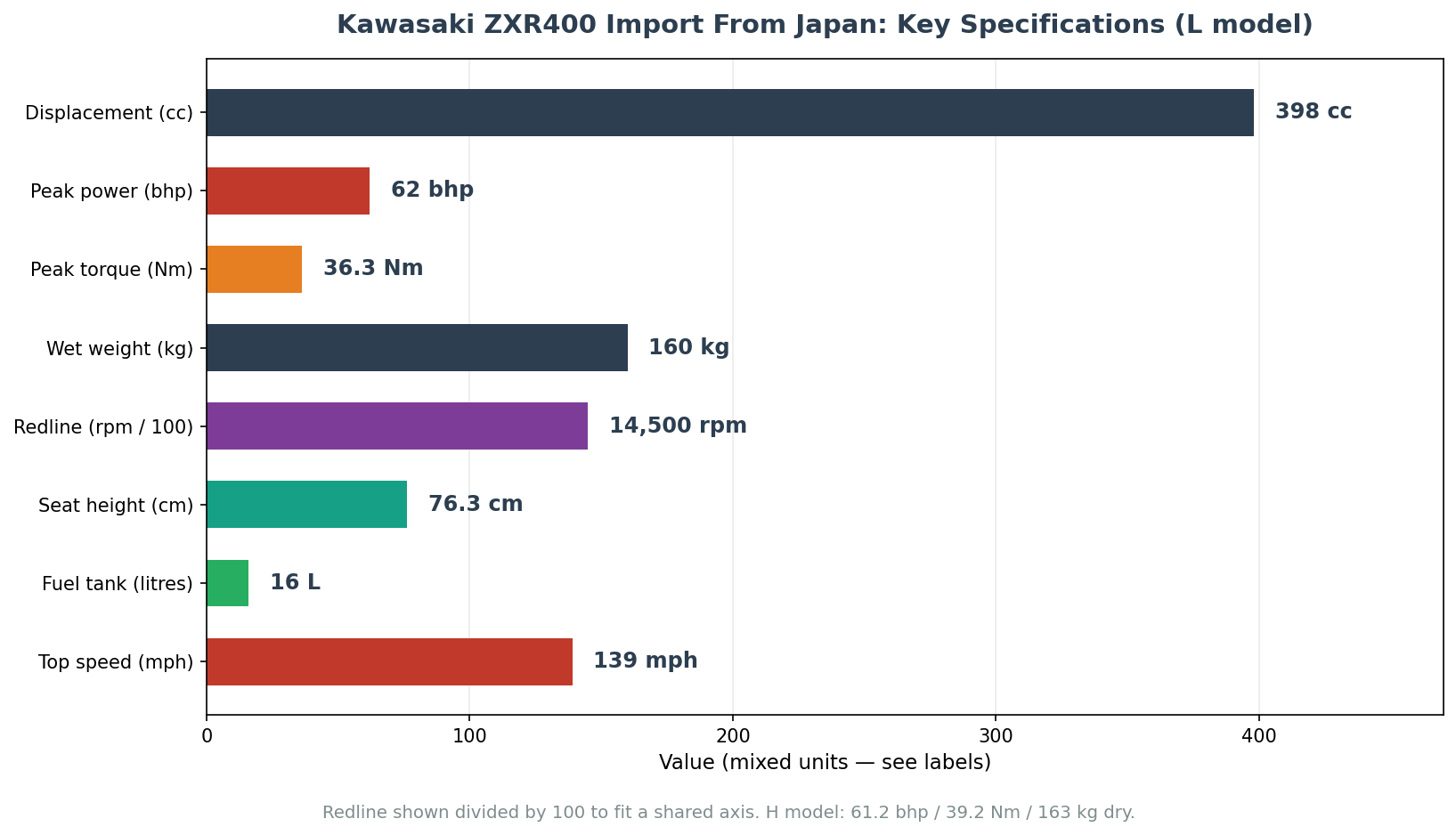
The ZXR400 is a 398cc liquid-cooled 16-valve DOHC inline four with a 57mm bore and a 39mm stroke, a 12.1:1 compression ratio, four carburettors and a six-speed box. The H model made 61.2hp at 12,500rpm. The L model made 64.1hp at 13,000rpm, and gave up torque to get it, dropping from 39.2Nm at 10,000rpm to 36.3Nm at 12,000rpm. Kawasaki went looking for peak power and paid for it in the middle, which tells you everything about the intent.
Dry weight is 163kg for the H and 159kg for the L. Independent road-test figures land the wet bike around 160kg with a 62bhp reading at the rear wheel, a 139mph top speed and a standing quarter mile in 12.9 seconds. Seat height is 760 to 765mm, low enough that riders who struggle with modern sportsbikes get both feet down. Wheelbase is 1,395mm, rake 24 degrees, trail 85mm. The tank holds 16 litres and returns around 42mpg if you ride it the way it wants to be ridden, which gives a realistic 140-mile range before the fuel tap becomes interesting.
Those numbers do not explain the bike. This does, from a British owner of a 1995 L model, describing the powerband in the plainest terms anyone has managed: gutless below 6,000rpm, usable from 6,000 to 8,000, showing signs of life from 8,000 to 10,000, and from 10,000 to the 14,500rpm redline it behaves like an on-off switch. That is the ZXR400. It is not a small sportsbike. It is a scaled-down race engine with lights bolted to it, and the same owner pointed out that the pillion seat, subframe and number plate come off with four bolts and a clip, because Kawasaki designed it that way on purpose.
Two consequences follow, and they decide whether this bike suits you.
First, it is small. Two separate owners at 5ft 7in and 5ft 10in both described it as cramped, one saying it made his 2007 Fireblade look enormous by comparison. If you are over six foot, ride one before you ship one.
Second, the chassis massively outclasses the engine. Owner after owner describes the front end as the best part: planted, precise, forgiving enough to let you brake mid-corner and get away with it. One rider summarised it as MotoGP handling that simply needs more horsepower. The suspension is brutally firm, unyielding over British and Australian road surfaces, and no amount of adjustment softens the rear meaningfully. Nobody bought this bike for comfort. Do not import one expecting it.
ZXR400 generations: H1, H2, L1 to L9, and how to tell them apart
Kawasaki built the ZXR400 from 1989 to 1999 for the world market, with the UK selling residual stock into 2003. There was an earlier Japan-only ZX-4 in 1987 and 1988, which is a different motorcycle and is not what you are buying. The modern descendant is the Ninja ZX-4R, launched in 2023, which is why interest in the original has spiked: a whole generation discovered that Kawasaki had done the screaming 400 four thirty years earlier.
H1 (1989). The launch bike. Twin round headlights, flat radiator, the fat rear end, and the pair of external "hoover hose" ram-air ducts running along the tank that became the model's visual signature.
H2 (1990). Revised swingarm and a curved radiator replacing the flat unit. Styling and engine output unchanged. Cosmetically almost indistinguishable from the H1 at a glance, which matters when a seller has rounded the year up.
L1 to L3 (1991 to 1993). The big change. New frame, engine revisions, more peak power, less midrange, and a completely restyled front end with a single headlight unit replacing the twin round lamps. Slimmer, more modern tail. If the bike in the photos has one headlight, it is an L, and every dating question after that is about which L.
L4 (1994). Includes the limited ITOHAM livery, a Japanese-market sponsor scheme that collectors pay over the odds for and that sellers outside Japan frequently misidentify.
L5 onwards (1995 to 1999). The long production plateau. Mechanically stable, which is good news for parts commonality across a five-year span.
L9 (1999). Modified engine internals and revised suspension, the last and the best of the standard bikes. This is the one UK dealers were still registering in the early 2000s, which is why you see "2002" and "2003" ZXR400s advertised. The bike is a 1999 build with a later first-registration date, and the honest sellers say so.
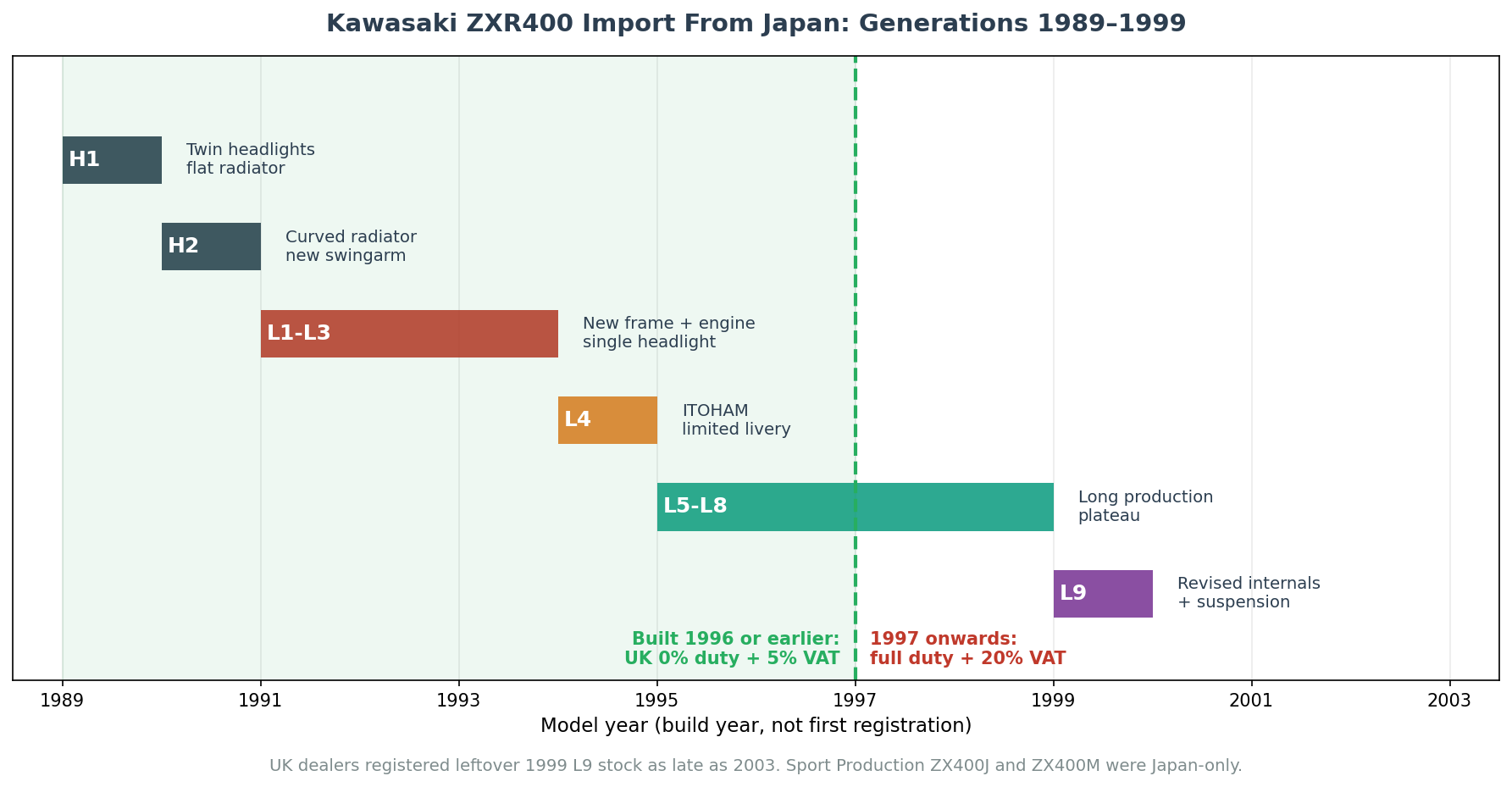
Here is the thing nobody mentions when they advertise a "2003 ZXR400": that late registration date is worth money to you in a way the seller may not have realised, and worth money against you in a way described further down in the tax section. Two identical bikes, one first registered in 1996 and one in 2003, are not the same purchase in the eyes of a customs officer.
If you are new to buying at Japanese auctions, read the overall import process and our grey import guide before you shortlist anything. They explain who does what and where the money leaks.
The Sport Production ZXR400: the J and M models, and the frame number that proves it
This is the section that justifies the import on its own.
To go racing in Japan's Formula 3 class, Kawasaki had to homologate a higher-specification ZXR400, and did so in very limited numbers. The H-based versions were the ZX400J1 and ZX400J2, carrying "Sport Production" decals. The L-based version dropped the decals, wore "400R" on the number board, and was designated ZX400M.
What you get over the standard bike is a genuinely different motorcycle:
- Keihin FCR flat-slide carburettors with a throttle position sensor, in place of the standard CV carbs
- Adjustable camshafts
- A close-ratio gearbox
- A lighter rear subframe with a single seat unit
- Front forks with both compression and rebound damping adjustment
- Fully adjustable rear suspension
- A Mitsubishi CDI with the rev limiter raised to 15,200rpm
These were sold in Japan and nowhere else. Every single one on the road in Britain, Australia or the United States arrived as an import, and a good proportion of the ones advertised as Sport Production models are standard bikes wearing the decals and a single seat cowl.
The verification is simple and it is public: genuine J and M specification bikes carry a VIN beginning with the digit 3. Ask for a clear photograph of the frame number before you bid. Not the engine number, not a photograph of the decal, the frame number. A seller who cannot or will not photograph it has told you what you needed to know.
The performance difference is real rather than theoretical. A comparison test between a 1990 Sport Production and a 1991 standard ZXR400 has been viewed 417,000 times with 146 comments, and the flat-slides plus adjustable cams change the character of the engine rather than just the peak figure. Whether that is worth a fifty percent premium is your call. Whether the premium you are being asked to pay is for a real one is a question the frame number answers for free.
The Six Horsepower Problem: Why a JDM ZXR400 Is Slower Than a British One
This is the section that does not exist anywhere else, so read it twice.
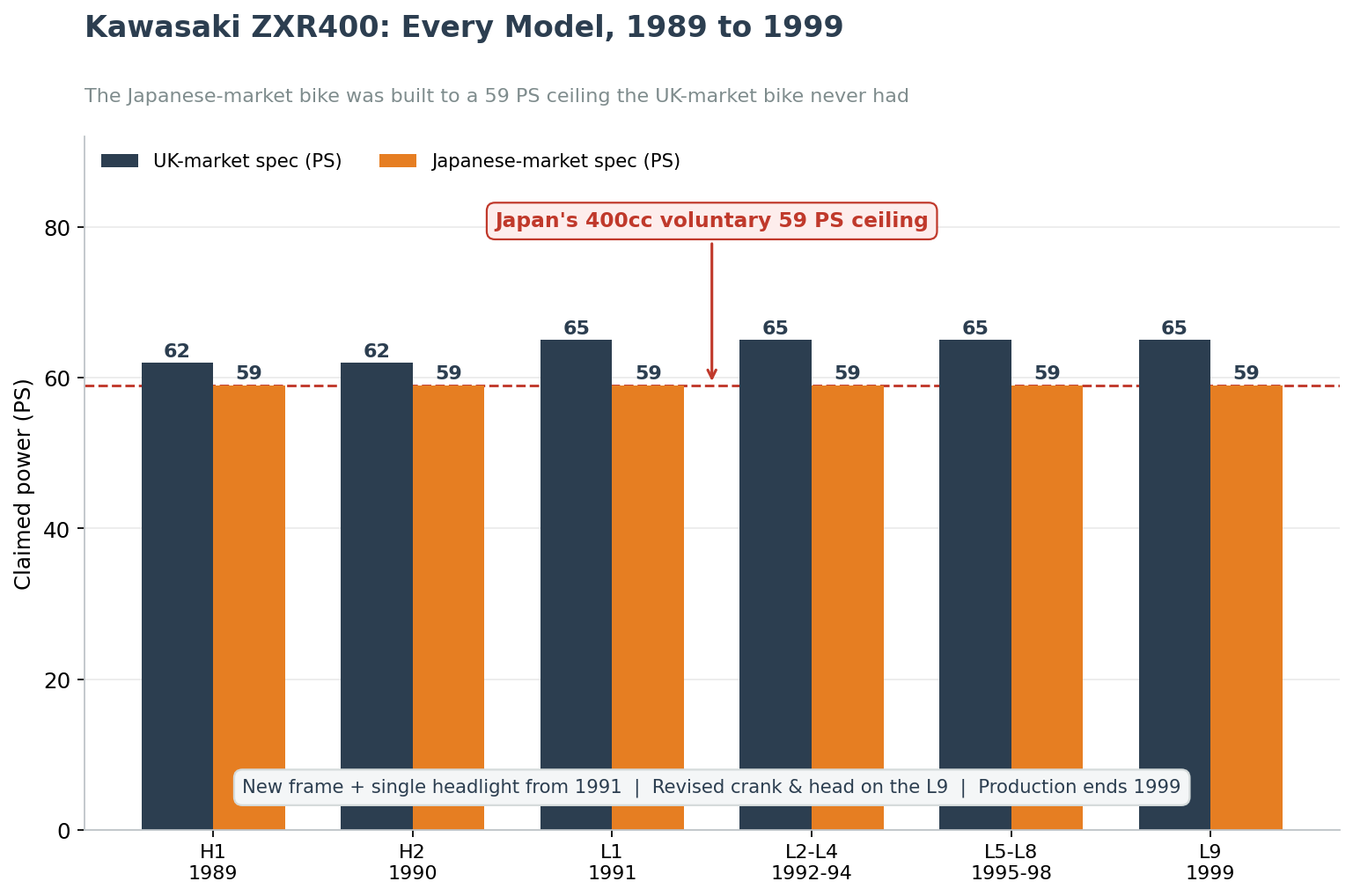
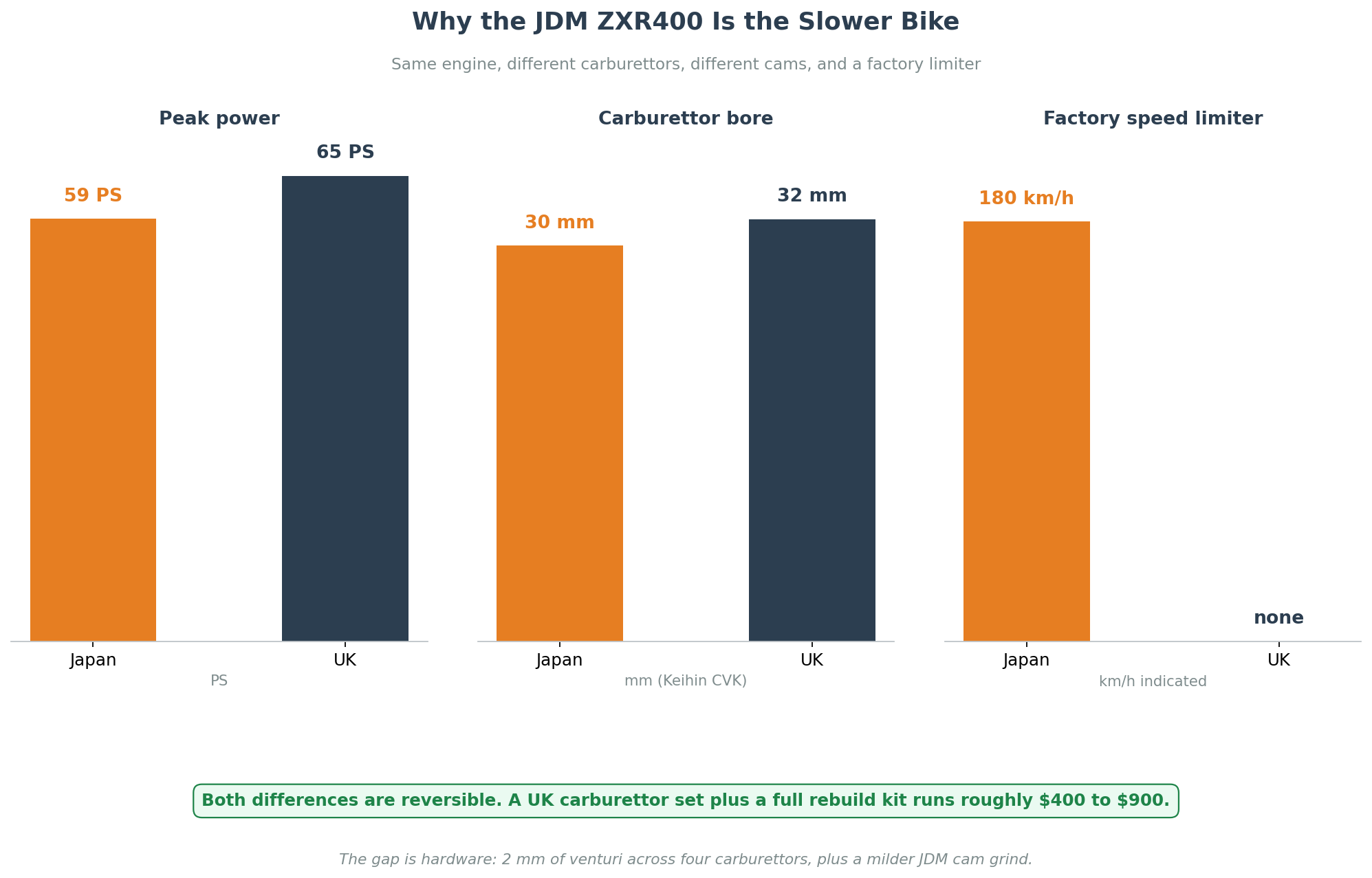
Japan's motorcycle industry operated under a self-imposed power ceiling for the 400cc class: 59 PS. Not a law with a penalty attached, but an agreement between manufacturers that held for years and shaped every home-market 400 of the era. Kawasaki built the ZXR400 to that number for Japan.
Britain had no such ceiling. The UK-market ZXR400 L was homologated at 63 to 65 PS depending on the year and the brochure you read. Same engine, same displacement, same everything from ten feet away. If that clashes with the 62 bhp in the specification chart earlier, it should not: PS and bhp are different units, and Kawasaki revised the claim more than once across nine model years. The gap between the two markets is what matters, and it held throughout.
The difference comes down to two hardware changes, and both are reversible:
- Carburettors. The JDM bike wears Keihin CVK-D30s. The UK bike wears CVK-D32s. Two millimetres of venturi across four carburettors, which at 13,000 rpm is worth real airflow.
- Camshafts. The UK L1 cams are a more aggressive grind than the JDM L1 cams. More lift, more duration, more noise above 10,000 rpm.
So a Japanese-market ZXR400 that lands in your garage is down roughly 6 PS on the bike a British rider bought new down the road in 1994. On a 400cc four that lives on revs, that is not academic. It is the difference between a bike that feels frantic at the top and one that feels merely busy.
Now the part that matters commercially. Both parts are obtainable. A set of CVK-D32s from a UK-spec donor, or a rebuilt set sourced through a Japanese parts platform, converts the bike. Webike alone lists over 2,200 items for the ZXR400, and rebuild kits for the Keihins are stocked by specialist vendors in Europe and North America. Budget in the region of £350 to £700 for a good used UK carb set plus a full rebuild kit, and you have closed the gap. Our guide to importing Japanese motorcycle parts covers the platforms that actually ship these abroad.
Which raises the obvious question: if the JDM bike is down on power and you have to spend money to fix it, why import at all? Because power is one variable and condition is the other, and on a thirty-year-old sportbike condition is worth more. A British ZXR400 has survived thirty British winters. The alloy on these bikes pits when used all year, exhausts rot from the inside, and fork legs pick up corrosion that eats seals within weeks of fitting them. A Japanese bike that spent its life garaged, ridden in dry months and inspected on a legally mandated shaken cycle arrives with none of that. Our rust and corrosion guide puts numbers on the difference.
You can buy back six horsepower. You cannot buy back a frame that has not corroded.
The 180 km/h Limiter, and What Derestricting Actually Does
Every Japanese-market motorcycle of this era left the factory with a 180 km/h speed limiter. It is a separate restriction from the power ceiling and it works differently: rather than reducing output, it cuts ignition once the speedometer signal crosses the threshold. On the ZXR400 it is trivially removable.
How trivially? A Russian owner posted GPS-verified runs on his Japanese-market ZXR400 to an audience of 189,000. His caption is the whole story in two lines: "Japanese market ZXR400, 200 km/h GPS after derestrict. A few days before, in low traffic, it showed 203 km/h." That is 126 mph from a bike whose factory paperwork says 112.
Two things follow from that number.
First, treat every claimed top speed for this bike with suspicion. The 139 mph in the specification chart above is the period figure, and period literature quotes numbers approaching 140 mph across the whole class. Real GPS data from an owner on a derestricted JDM bike says 126. Speedometer error on these is generous, and 1990s magazine top speeds were measured downhill with a tailwind and a small rider.
Second, and more practically: if you are inspecting a JDM ZXR400 and the seller says it "pulls to an indicated 180 and stops," that is not a fault. That is the bike working exactly as Kawasaki built it. Buyers have paid for diagnostic work chasing a fuelling problem that was a factory limiter doing its job.
One consequence for paperwork. A speedometer reading in kilometres is a registration issue in the UK and the US, and swapping the face or fitting a converter is a £50 to £120 job. What matters more is that the odometer agrees with the auction sheet. Our mileage and odometer guide explains how Japanese inspectors record discrepancies and why an unexplained gap is a walk-away rather than a haggle.
Should You Import One at All? The Honest Decision Tree
Most import guides exist to talk you into importing. This one will not, because for one group of readers the answer is genuinely no.
United Kingdom. You have a real choice, and it is the only ZXR400 market where that is true. Kawasaki UK sold the L officially from 1991, so there is a domestic used pool with a V5C, an online MOT history and no paperwork to file. Against that, the surviving UK bikes are mostly high-mileage, corroded or raced. Import for condition and originality. Buy locally if you want to ride next week and do not care that the fork lowers are pitted. Our UK import overview and the step-by-step UK process cover the route if you go the import way.
United States. Import, or do not own one. The ZXR400 was never federalised for the US market, so everything for sale there arrived as an import. There is no domestic alternative to compare against. See the USA import guide.
Australia and New Zealand. Import, with a caveat. Both markets have active grey pipelines and a population of already-complied 400s, so check locally first — a complied bike saves you the step that costs the most in Australia. The Australia guide and New Zealand guide break both down.
Canada. Import. The 15-year rule clears every ZXR400 and there was never a Canadian-market version. See the Canada guide.
If your goal is a track bike: import a cheap L, budget for UK carbs and cams, and stop worrying about originality. A tatty L4 with good compression is a better starting point than a tidy UK bike you will feel guilty about cutting up.
If your goal is a collectable: import an H or an L9 and nothing else. The middle of the L range will not appreciate meaningfully. The bookends will.
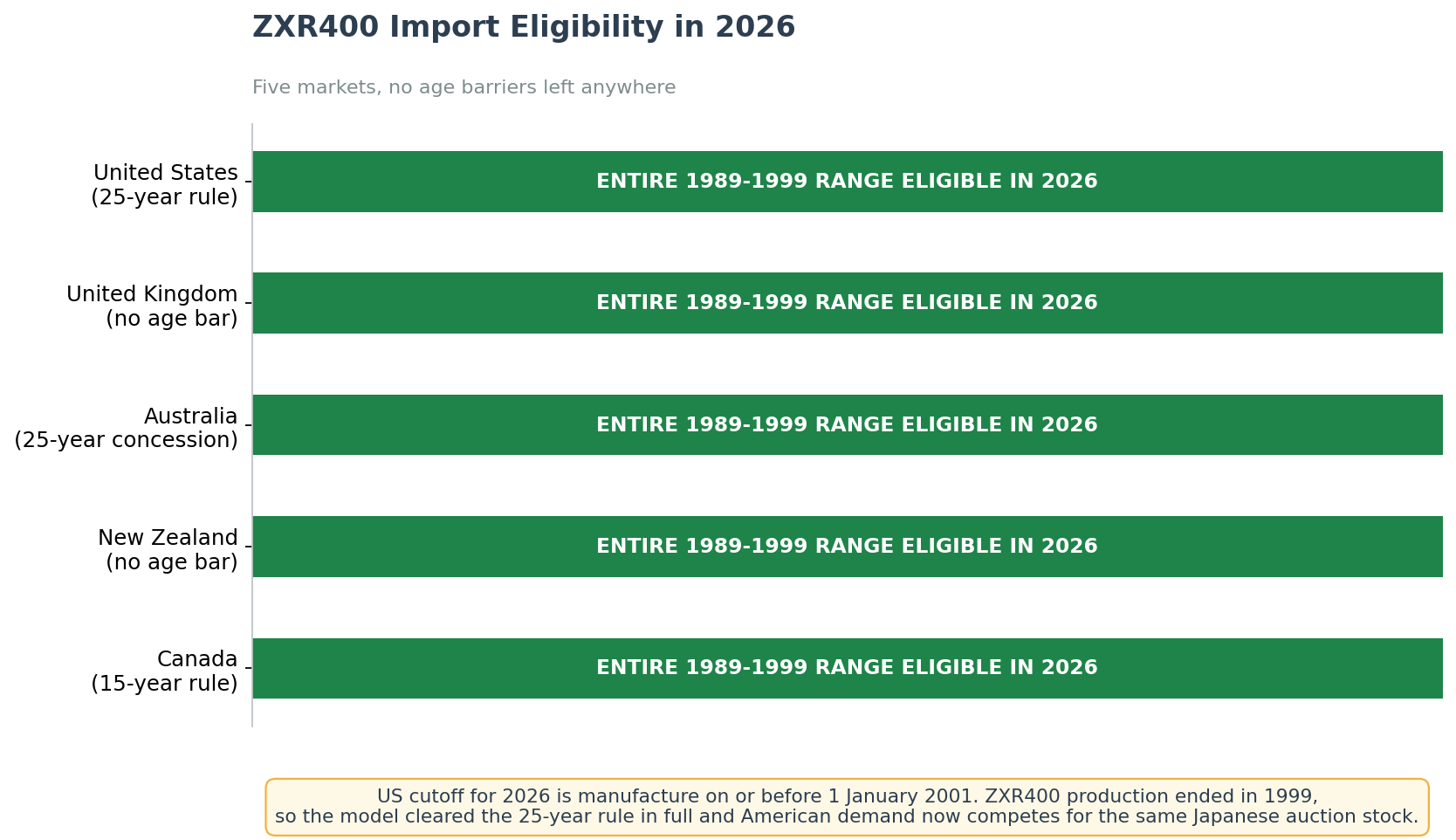
2026 is the first year every ZXR400 is legal to import into the United States
NHTSA's own importing pages are the primary source here, and worth reading yourself if a broker tells you something different. Our 25-year rule guide covers the exemption boxes on the forms.
American readers have spent the last few years reading import guides that end in disappointment. The bike you want is 2008. The rule says 2001. Come back in seven years.
Not this one.
The United States exempts motorcycles at least 25 years old from EPA emissions and DOT safety certification. In 2026 that cut-off is model year 2001. ZXR400 production for the world market ended in 1999. Every ZXR400 Kawasaki built, from the 1989 H1 to the last 1999 L9, is now on the right side of the line. There is no waiting list, no "eligible from" date to diary, and no reason to buy a lesser year to satisfy the calendar.
That makes the ZXR400 unusual among the bikes covered on this site. The KLX250 you want is too new. The ZX-25R is nowhere near eligible. The ZXR400 is entirely, permanently clear.
What you still have to do is the paperwork, properly. That means EPA Form 3520-1 and DOT Form HS-7 completed with the correct exemption boxes, a bill of sale, the Japanese export certificate with a translation, and a customs broker who has handled motorcycles rather than someone doing you a favour. Broker fees for a motorcycle typically run in the low hundreds of dollars. Federal duty on a motorcycle of this displacement is a low single-digit percentage of declared value, which is small enough that it is not the number that decides your purchase. Title and registration are then a state matter, and states vary enormously in how they treat a Japanese export certificate. Check yours before the bike sails, not after it lands.
Australia and New Zealand run their own versions of the same idea. Australia's personal-import and older-vehicle pathways plus state-level compliance are the gate, and duty of around five percent plus GST is the arithmetic. New Zealand is the most import-friendly of the English-speaking markets and has been receiving Japanese 400s continuously for decades, which is why the parts network there is unusually good.
The UK tax date that changes your bill by nine hundred pounds
The GOV.UK guidance on importing vehicles sets out the notification deadline and the penalties for missing it. Read it alongside the numbers below rather than instead of them.
British buyers have a decision to make that has nothing to do with which ZXR400 rides better.
Motorcycles over thirty years old, in original unmodified condition, can be imported into the UK as collectors' items: zero duty and a reduced five percent VAT rate. Everything else pays standard duty on a 398cc machine plus twenty percent VAT on the duty-inclusive value.
In 2026, thirty years old means built in 1996 or earlier. That covers the H1, the H2, and the L1 through to the L6. It does not cover the L7, L8 or L9, and it emphatically does not cover the late-registered bikes that dealers plated in 2002 and 2003.
Run the two routes side by side on the same bike value and the gap is stark.
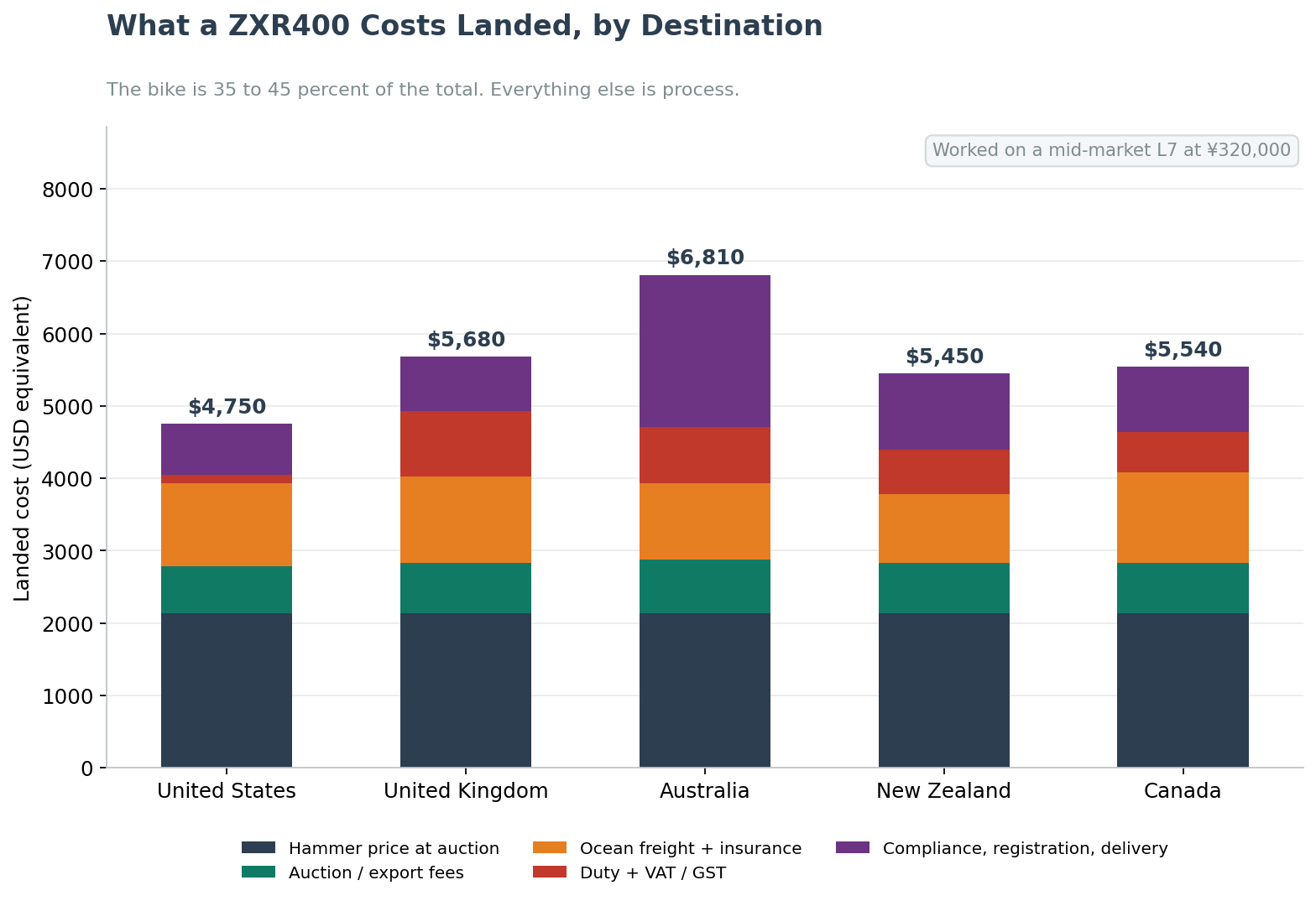
Take a clean example bought at Japanese auction for around £2,370, with roughly £600 for the export agent, domestic transport and deregistration, and around £810 for ocean freight and marine insurance. That is a landed value of about £3,780 before any tax.
On the pre-1997 collectors' route: zero duty, five percent VAT of about £189, port handling and clearance around £280, MOT and DVLA registration around £120. Total roughly £4,370.
On the standard route for a 1997-or-later bike: duty of about £302, then twenty percent VAT on the duty-inclusive figure at roughly £817, plus the same £280 and £120. Total roughly £5,300.
Nine hundred and thirty pounds, for a birthday. On a bike whose UK market tops out around £4,500 for an exceptional low-mileage example, that difference is not a rounding error, it is the entire margin.
The instruction writes itself. If you are importing a ZXR400 into the United Kingdom, buy one built in 1996 or earlier and keep it original. If you have fallen in love with an L9, buy one that is already here.
Two cautions. The relief is for bikes in original condition, so a heavily modified early bike can be argued out of it. And "built in 1996" means built, not registered. Get the frame number dated in writing from the exporter before you commit, because a Japanese registration document and a build date are not the same field.
The tax and duty arithmetic is worked through in full in our UK import duty and tax guide, and the all-in numbers sit in the complete Japan to UK cost breakdown. The NOVA registration guide covers the 14-day notification deadline, and the MSVA guide lists what an inspector actually checks on a faired import.
What actually breaks on a ZXR400
Before the list, one source worth bookmarking: MCN's road test archive for the 1995 to 1998 bikes is the most useful contemporary British write-up still online, and it is honest about the things the brochures were not.
The ZXR400 has a reputation for being tough, and mostly it deserves it. Owners routinely report thirty-year-old examples starting first time after months of standing. But there is one failure that dominates every honest conversation about this bike, and pretending otherwise would be dishonest.
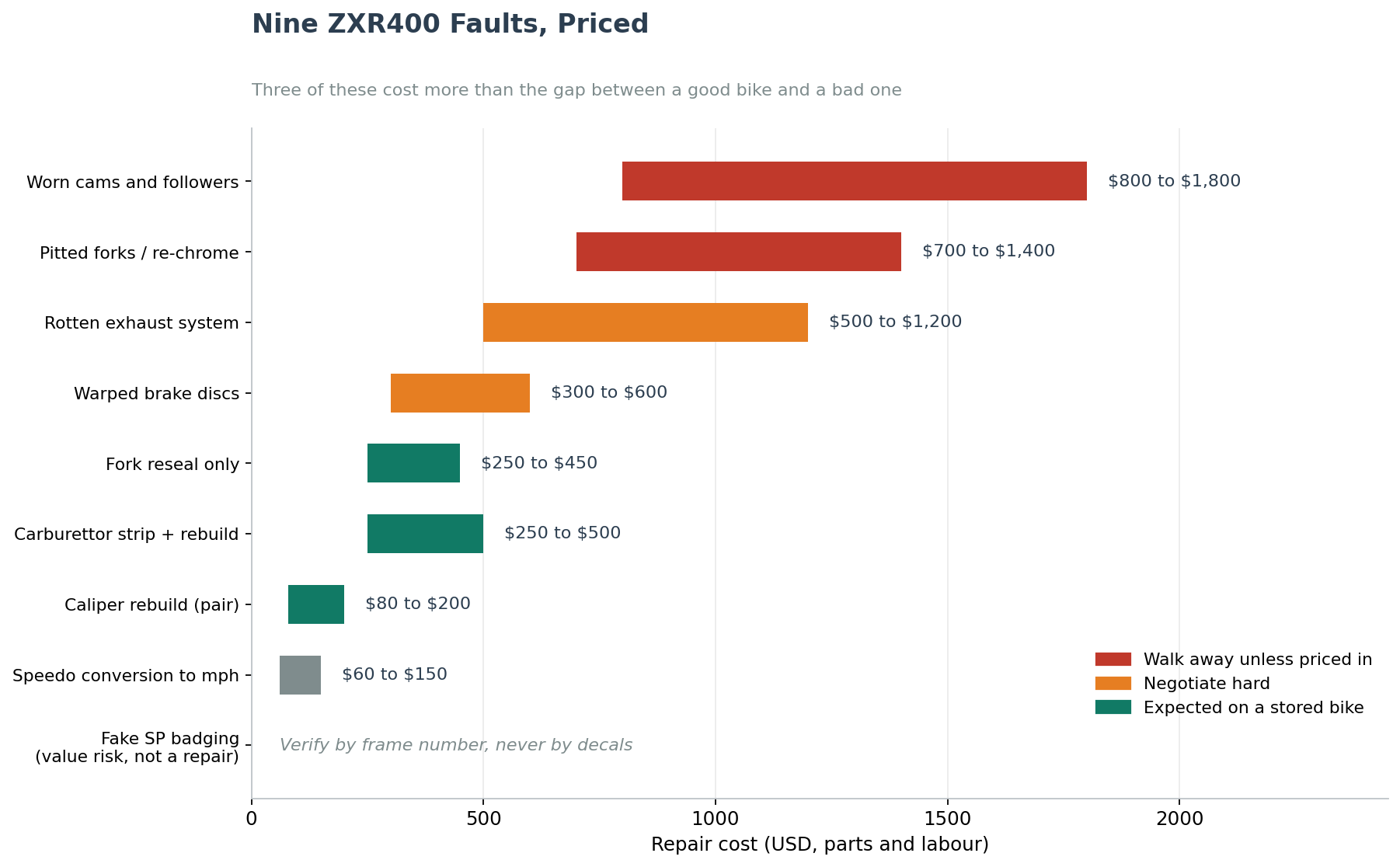
The camshaft can dislodge and destroy the engine. The clearest owner account of it runs like this: a cold morning, full choke, revs jumped to 4,000rpm as they always did, then an awful rattle. The dealer's diagnosis that same day was that the cam had come loose and wrecked the engine. The owner's parting note is the part that matters — he was told it is not particularly uncommon, regardless of how well the bike has been maintained. That bike was effectively written off.
This is why ZXR400 reliability ratings sit around 3.7 out of 5 while the engine itself scores 4.7. The engine is brilliant until the day it is not. What you do about it as a buyer is specific: never accept a video of a warm engine. Insist on a cold start, listen for top-end rattle in the first thirty seconds, and treat a bike that has been "warmed up ready for viewing" as a bike you have not heard. On an import, that means asking the exporter for a cold-start video with a timestamp, which reputable Japanese exporters will film for you.
Carburettors, which get their own section below, because they deserve one.
Corrosion. Fasteners, wheel rims, brackets and the exhaust collector. On UK bikes it is endemic. On Japanese bikes it is the single most useful thing the auction sheet tells you.
Charging and electrics. Thirty-year-old regulator-rectifiers, connectors and switchgear on a bike that lives at high rpm. The Japanese aftermarket is still actively selling replacement ignition switches with keys for the ZXR400 alongside the ZXR750 and ZZR400, which tells you how often they fail and, more usefully, that they are still available.
Crash and track damage. The ZXR400 was a track-day favourite because it is cheap, light and forgiving. Mismatched fairing panels, non-original bolts, a bent subframe or fresh paint on a bike where nothing else is fresh are all signals. Bikes that raced are not automatically bad, but they should be priced as what they are.
Fuel consumption and the missing fuel gauge. Not a fault, a design decision, but it surprises people. There is no fuel gauge. There is a reserve tap you flick when the engine stumbles. One owner described that as the single most annoying thing about the bike, and he had owned it for years.
The carburettor trap that costs more than the fairings
If you take one paragraph away from this guide, take this one.
A long-term owner who has bought three separate ZXR400s over three decades put it more bluntly than any dealer will: when a seller says "the carbs just need balancing", they do not. They are most likely broken. These are carburettors that are now more than twenty-five years old, and after roughly fifteen years the internals simply wear out. A clean and a balance will not fix worn float needles, perished diaphragms or blocked pilot jets. That is why fuel injection took over.
The practical consequences of that are worth real money:
- A bank of four carburettors that genuinely needs rebuilding, with proper Kawasaki internals rather than a generic eBay kit, is not a fifty-pound job. Budget accordingly and negotiate on it before you bid, not after.
- A bike that has stood for years without being drained is a bike whose jets have varnished. Japanese auction descriptions frequently note long-term storage. Read that as a rebuild.
- Poor cold running, hunting idle, a flat spot at part throttle and heavy fuel consumption are all symptoms, and all of them get explained away by sellers as "just needs a service".
- Genuine internal components for a full rebuild are still available. This is a solvable problem, which is why it is a negotiating lever rather than a reason to walk away.
The Sport Production models complicate this in one direction and simplify it in another. FCR flat-slides are a better carburettor, but a worn set costs considerably more to put right and there are far fewer people who know how to set them up.
Whether these faults are worth accepting depends on the grade you buy at. Our auction grade guide explains the scale, and are Japanese motorcycles reliable puts the ZXR400 in context against the rest of the era.
What owners say after living with a ZXR400 for years
The most revealing data point about this motorcycle is not a road test. It is a restoration video.
The most-watched piece of ZXR400 content anywhere on the internet is a full nut-and-bolt restoration of a 1989 bike, sitting at 41.8 million views and over 10,300 comments. Not a review. Not a track test. A rebuild. Second on the restoration list is a 1992 L2 rebuild at 169,000 views. A dyno run on a 1993 example has 171,000 views, and a top-speed run on a 1997 has 161,000.
That tells you what this bike is now. It is a project as often as it is transport, and a huge proportion of the surviving population has been apart at least once. The corollary for a buyer is that an honest, documented rebuild is worth more than a tired original, and that the phrase "recently restored" needs photographs to back it up.
The road-going verdicts, drawn from long-term owner reports, are consistent to the point of monotony:
- The engine is the reason to buy it. It scores 4.7 out of 5 from owners and is repeatedly described as sounding better than any modern 400.
- The handling is the second reason. "Race-spec" is the phrase the road testers use; owners talk about braking mid-corner and getting away with it.
- The suspension is punishing. One owner compared the rear to taking punches to the kidneys, on its softest setting.
- It is uncomfortable in traffic and pointless on a motorway. It hates being cold and will hold up a group ride while it warms.
- Values are moving. An owner who paid £4,000 for a mint example in 2018 now describes the model as becoming collectable and appreciating. A different owner put a decent one at £1,500 back in 2015. Both are correct about their own moment, and the direction between those two moments is the useful information.
One more, from a British buyer who owned three: the observation that people worry about "Japan imports" as a category, when every ZXR400 ever made came from Japan in the first place. The distinction that matters is not where it was built. It is where it spent the last thirty winters.
The English-language content gap, measured
Here is something you can use as a negotiating tool.
Searching X for recent posts mentioning the ZXR400 returns nine results. All nine are in Japanese. A search restricted to English-language posts returns exactly zero. Not few. Zero.
What the Japanese results contain is more useful than any of it being in English would have been. There is an ignition switch with two keys listed as fitting the ZXR750, ZZR400, ZZR600 and ZXR400. There is a new Sunstar 41-tooth rear sprocket advertised as fitting a 1990 ZXR400, an ER-4n and a ZX-6R. There are CNC adjustable clip-on bars listed across the ZX-6R, ZX-10R, ZXR400 and ZZ-R400. There is a rider listing his engine history and putting the ZXR400 and ZXR400R in it alongside a GPZ900R and a ZXR750. There is a man admitting he walked into a Kawasaki dealer intending to buy an RVF400 and rode out on a ZXR400 instead, because of the look the shop staff gave him. And there is someone actively hunting a BEET aero part, still, in 2026.
Three things follow from that.
The parts ecosystem for this bike is alive and it lives in Japan. Not in a museum, in an active daily marketplace where components are cross-listed across four or five Kawasaki models.
The English-language internet has almost nothing current on this motorcycle. Whatever you find is a fifteen-year-old forum thread or a review of the modern ZX-4R. That is why the specifics in this guide come from owner records and Japanese listings rather than a rewrite of somebody else's article.
And commercially, the bike is under-covered relative to demand. The modern ZX-4RR reviews pull over a million views apiece — one of them at 1.06 million with 2,129 comments, another at 230,000 with 381. The audience for a screaming 400 four is enormous and current. The bikes those people are quietly buying instead, at a third of the price, are the ones sitting in Japanese auction halls.
For the wider picture on why this class existed at all, see our JDM motorcycle overview and the ranked best 400cc motorcycles to import from Japan.
How to read a Japanese auction sheet on a ZXR400
Every bike in a Japanese auction hall carries an inspection sheet written by an independent grader who has no financial interest in the sale. That document is the single biggest advantage an importer has over someone buying from photographs on a classifieds site, and most first-time buyers read it wrong because they look at the headline grade and stop.
For a thirty-year-old 400 four, the headline grade matters less than the map. Read it in this order.
Corrosion notation first, not the grade. On a bike this age, rust markings on the sheet are the most predictive single element. Surface corrosion on fasteners is normal and cheap. Corrosion noted on the wheels, the exhaust collector or the frame is expensive and often invisible in photographs.
Then the fairings. Note every panel marked for scratches, cracks or repair. ZXR400 bodywork is model-specific, and the H-model twin-headlight nose in particular is scarce. A bike with two damaged panels can be cheaper to buy and more expensive to own than a bike with none.
Then the frame and subframe area. Ask for close photographs of the subframe mounting points and the lower frame rails. This bike's rear subframe unbolts, which is convenient for a racer and convenient for someone hiding a repair.
Then the odometer and the storage history. Japanese sheets are specific about long-term storage. A 12,000-mile bike that has been standing for eight years is a carburettor rebuild wearing a low number.
Then the modifications list. Aftermarket exhaust, non-standard bars, a different rear shock. Each one is either a plus or a minus, and the section below sorts which is which.
Finally, ask for the frame number photograph. On a ZXR400 that photograph does two jobs at once: it dates the bike for your customs relief, and it tells you whether a "Sport Production" is genuine.
The full sheet-reading method is in our Japanese auction inspection sheet guide, with the bidding mechanics in how to bid at a Japanese motorcycle auction and the venues themselves in the auction house guide.
Modifications: what adds value on a ZXR400 and what destroys it
The ZXR400 attracts modification the way a blank wall attracts posters, and thirty years is a long time for a wall.
Adds value or is neutral: braided brake lines, fresh discs and quality pads, a rebuilt or reconditioned rear shock, new fork seals and oil, a period-correct aftermarket exhaust that came with the original can in a box, a properly rebuilt carburettor bank with receipts, new tyres of a known brand, and a documented full restoration with photographs.
Destroys value: a straight-through exhaust with no baffle and no original can, a full respray in a non-original colour, cut or welded subframes, drilled fairings, aftermarket switchgear spliced into the loom, and any electrical work done with insulating tape.
The specific trap: a loud aftermarket can fitted without rejetting. On a bike with four carburettors and a peaky powerband, that combination produces exactly the poor cold running and flat midrange that people then misdiagnose as worn carbs. Sometimes it is both. Ask whether the bike was rejetted when the exhaust went on, and if the seller does not know, assume it was not.
The one that costs the most: a respray. Paint is often covering up the story, and on a bike where the original graphics are unobtainable, a respray permanently removes the top tier of value. A tidy original with honest stone chips is worth more than a shiny repaint, every time.
Parts supply, restriction and running costs outside Japan
Three practical questions decide whether you enjoy this bike or resent it.
Parts. Service and wear items are easy anywhere: filters, pads, cables, chains, sprockets, batteries. The same logic applies to every JDM bike in our current inventory. The Sunstar sprocket cross-listed across the ZXR400, ER-4n and ZX-6R in a Japanese listing is a good illustration — Kawasaki's parts sharing across that era works in your favour. The hard parts are exhaust systems and fork components, both of which specialists have flagged as difficult to source outside Japan, plus model-specific bodywork and the H-model twin headlamp assembly. The right move is the same one this site recommends for every JDM import: buy the fiddly spares in Japan, at Japanese prices, and ship them in the crate with the bike. Air-freighting a single fairing panel eighteen months later costs more than the panel.
Restriction. The ZXR400 can be restricted for A2 licence holders in the UK and EU, and many UK bikes were. A restricted bike is not damaged, but it is a bike whose restriction kit needs to be present and correctly fitted, and a bike that has been derestricted badly runs badly. Japanese-market bikes were never restricted for A2, so an import arrives in full-power form. If you need the restriction, budget for a proper kit and a certificate. If you do not, that is one more small point in the import column.
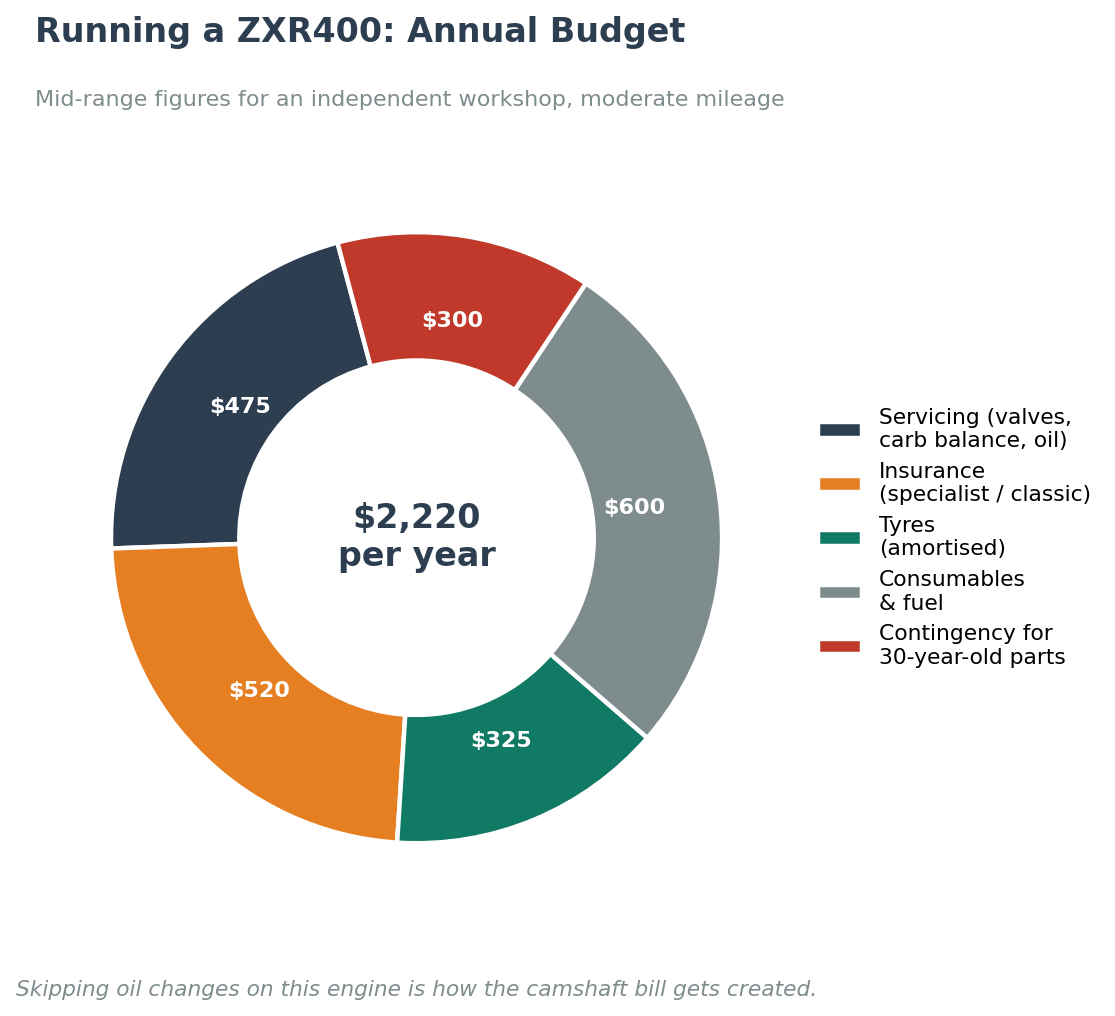
Running costs. Annual servicing runs around £260 on published figures, with owners reporting anywhere from £150 for a self-servicer to £500 for someone paying a shop for everything including carburettor work. Insurance sits in group 12 of 17, which is high for a 400 and reflects both the theft risk and the demographic. Fuel economy is around 42mpg and will be worse than that if you use the top four thousand revs, which is the only reason to own the bike. Budget realistically for consumables: this bike eats front tyres faster than rear ones because of how it is ridden.
Two logistics decisions change your total more than most people expect: how the bike travels and how it is insured on arrival. See container versus RoRo shipping — crate a fully faired 400 — and the imported motorcycle insurance guide, because several mainstream insurers will not quote on a grey import at all. The export certificate guide covers the one document your registration authority will insist on, and how long the whole thing takes sets expectations.
Common mistakes buyers make with a ZXR400 import from Japan
Buying on the headline year rather than the build year. A 2003-registered ZXR400 is a 1999 motorcycle. For UK customs purposes that distinction costs money in one direction, and for insurance and resale it works in another. Know which number you are quoting.
Accepting a warm-start video. The single most expensive failure on this bike announces itself on a cold start. A seller who only sends you footage of a running, warm engine has removed the only diagnostic that mattered.
Believing "just needs the carbs balanced". Covered above. It is the most repeated sentence in ZXR400 classifieds and it is almost always wrong.
Paying a Sport Production premium without a frame number. Decals and a single seat unit cost about eighty pounds. A frame number beginning with 3 cannot be bought.
Importing an L9 into the UK. The best standard ZXR400 is also the most expensive one to land, because it misses the thirty-year relief. Buy the L9 domestically or buy an earlier bike from Japan.
Underestimating the size. Riders at 5ft 7in call it cramped. If you are 6ft 2in, this is a bike you sit on top of rather than in, and no amount of enthusiasm about the engine will change that after an hour.
Forgetting the exhaust and forks when budgeting. These are the two documented hard-to-source areas. A bike with a rotten collector box and pitted fork stanchions is a bike whose repair bill exceeds its value.
Timings and paperwork aside, the model comparisons below are the part most buyers actually agonise over.
ZXR400 versus the other Japanese 400 fours
The 1990s Japanese 400 class was a genuine arms race, and the ZXR400 has a specific place in it.
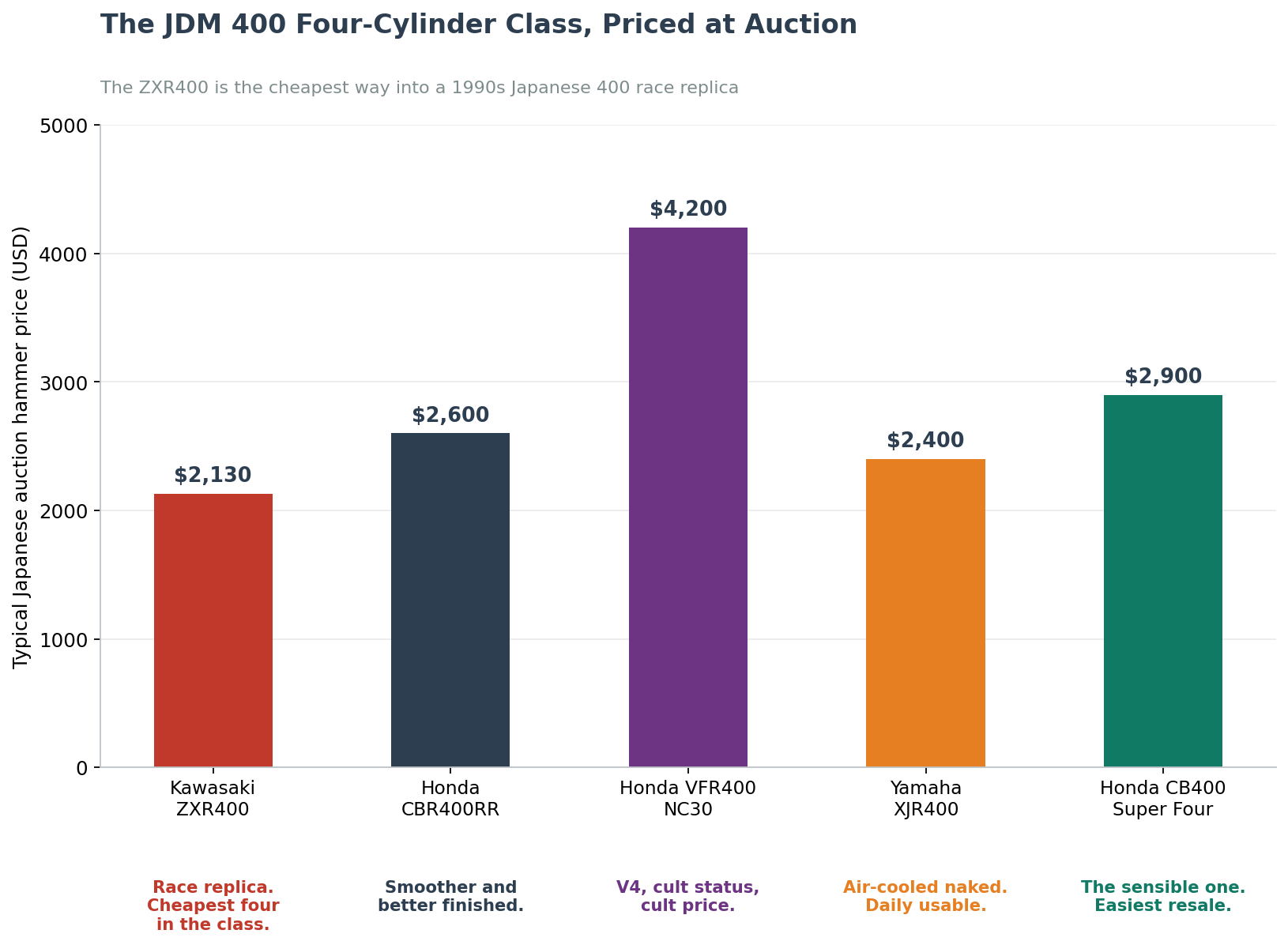
Honda VFR400 NC30. The connoisseur's choice and the UK's sentimental favourite, with a gear-driven-cam V4 and a single-sided swingarm. It sounds extraordinary and it costs more, both to buy and to service. Cam chain tensioners are its known weak point. If you want jewellery, buy the NC30.
Honda CBR400RR. The all-rounder. More usable low down than the ZXR, better finished, slightly less raw. The sensible pick if you want to ride it in the real world rather than at 12,000rpm.
Yamaha FZR400. The handling specialist and the rarest of the mainstream four on the used market. Like the ZXR, a popular race-replica that got raced, so provenance matters more than usual.
Yamaha XJR400. A different bike entirely — air-cooled, naked, retro, torquey. If the ZXR's powerband sounds exhausting rather than exciting, this is the one you actually want.
Where the ZXR400 wins. It was the fastest of the group in a straight line, it is the most robust and cheapest to keep of the faired 400s, and it was the one officially imported into the UK for the longest, which means the domestic parts and knowledge base is better than for any of its rivals. It also has the best chassis-to-price ratio of the lot: you are buying racing-grade handling for less than a modern 125 costs new.
Where it loses. Torque, comfort, refinement, and the cam failure hanging over the engine. The NC30 is prettier, the CBR is easier, the XJR is friendlier.
Dedicated guides exist for each of the rivals named above: the Honda CBR400RR, the VFR400 NC30, the Yamaha XJR400, the Honda CB400 Super Four and, if you want the modern answer to the same question, the Kawasaki ZX-25R. Two-stroke shoppers should read the NSR250 and RGV250 Gamma guides instead.
Pre-purchase checklist for a ZXR400 import
- Timestamped cold-start video, filmed from cold, with audio, and at least sixty seconds long.
- Clear photograph of the frame number, for dating and for Sport Production verification.
- Written confirmation of the build year, separate from the registration year.
- Auction sheet with corrosion notations translated in full, not summarised.
- Close photographs of both wheel rims and the exhaust collector.
- Photographs of the subframe mounting points from below.
- Confirmation of whether the carburettors have been rebuilt, and with what.
- Confirmation of any long-term storage period.
- Photographs of every fairing panel from an angle, in daylight, showing reflections.
- Original exhaust present, or confirmation that it is not.
- Fork stanchions photographed for pitting above the seal line.
- Confirmation that the bike is unrestricted, and what restriction hardware if any is fitted.
Twelve items. Any exporter worth using will supply all twelve without complaint, and you can ask us to request them on a specific lot. One who supplies eight and gets impatient about the other four has told you something.
How AWA Auction helps you buy the right ZXR400
Buying a thirty-year-old Japanese sportsbike from eight thousand miles away comes down to two things: seeing what the auction inspector saw, and having someone in Japan who can ask the extra question.
AWA Auction works inside the Japanese auction system rather than reselling from a forecourt. That means access to the same inspection sheets the domestic dealers bid on, translation of the corrosion and repair notations that decide a thirty-year-old bike's real value, and the ability to request the specific photographs listed above before a bid goes in rather than after the hammer falls.
For a ZXR400 specifically, that matters in three places. The frame number photograph that separates a real ZX400M from a decal kit. The build-year confirmation that decides whether you pay five percent VAT or twenty. And the cold-start video that is the only way to hear the one failure that writes these engines off.
Browse current listings to see what is coming through the Japanese halls this week, and contact our team if you want a specific ZXR400 variant watched. If you are after a Sport Production model, tell us early — they surface rarely and they do not sit around.
The ZXR400 is not a sensible motorcycle. It is loud above ten thousand revs, punishing everywhere, thirsty, and it has no fuel gauge. It is also one of the best-handling things ever sold with a 400cc engine, it is now old enough to be legal everywhere in the English-speaking world, and the good ones are appreciating while the tired ones are being broken for parts. That gap is widening every year, and which side of it you land on is decided entirely by which bike you buy.
Buy the right one. Start here.
One closing thought. The ZXR400 spent twenty years as the cheap one — the bike people bought when they could not afford an NC30. That window is closing. Every ZXR400 is now legal in the United States, restoration content on this model is pulling audiences in the tens of millions, and the supply is a finite pool of thirty-year-old motorcycles that gets smaller every year.
Six horsepower is a solvable problem. A clean, unmolested, uncorroded example is not, once they are gone.
Browse our current listings to see what is in the pipeline now, or contact our team with the model code, the grade and the mileage band you want. We will watch the auctions and come back when the right ZXR400 surfaces.
See Also
Share this article: